

What The Energy Department Does
Established August 4, 1977, The U.S. Department of Energy is one of the fifteen Cabinet-level departments of the U.S. federal government.
Despite its name, the Energy Department's single largest responsibility is managing the U.S. nuclear weapons stockpile through the National Nuclear Security Administration, which designs, maintains, and secures America's nuclear arsenal without conducting live nuclear test explosions, which the United States has not carried out since 1992 (in October 2025 the President directed the military to begin preparing for nuclear weapons testing).
The department also manages the environmental cleanup of former nuclear weapons production sites, oversees the Strategic Petroleum Reserve, the world's largest emergency crude oil stockpile, and funds a wide range of energy research and development, from advanced nuclear reactor designs to renewable energy technology.
The department runs seventeen national laboratories, including Los Alamos, Lawrence Livermore, and Oak Ridge, which conduct fundamental scientific research well beyond energy alone, spanning particle physics, supercomputing, and materials science, making the department one of the largest funders of basic scientific research in the federal government.
Roughly two-thirds of the department's budget is defense-related: about half goes to nuclear weapons and naval reactors through the NNSA, and another large share to cleaning up Cold War contamination. The rest funds the Office of Science (the largest U.S. federal supporter of the physical sciences), applied energy offices for nuclear, fossil, renewable, and grid technology, and the Energy Information Administration's statistics.

The Secretary of Energy
The Secretary of Energy leads The Energy Department, sits on the President's Cabinet, and is confirmed by a majority vote of the U.S. Senate.
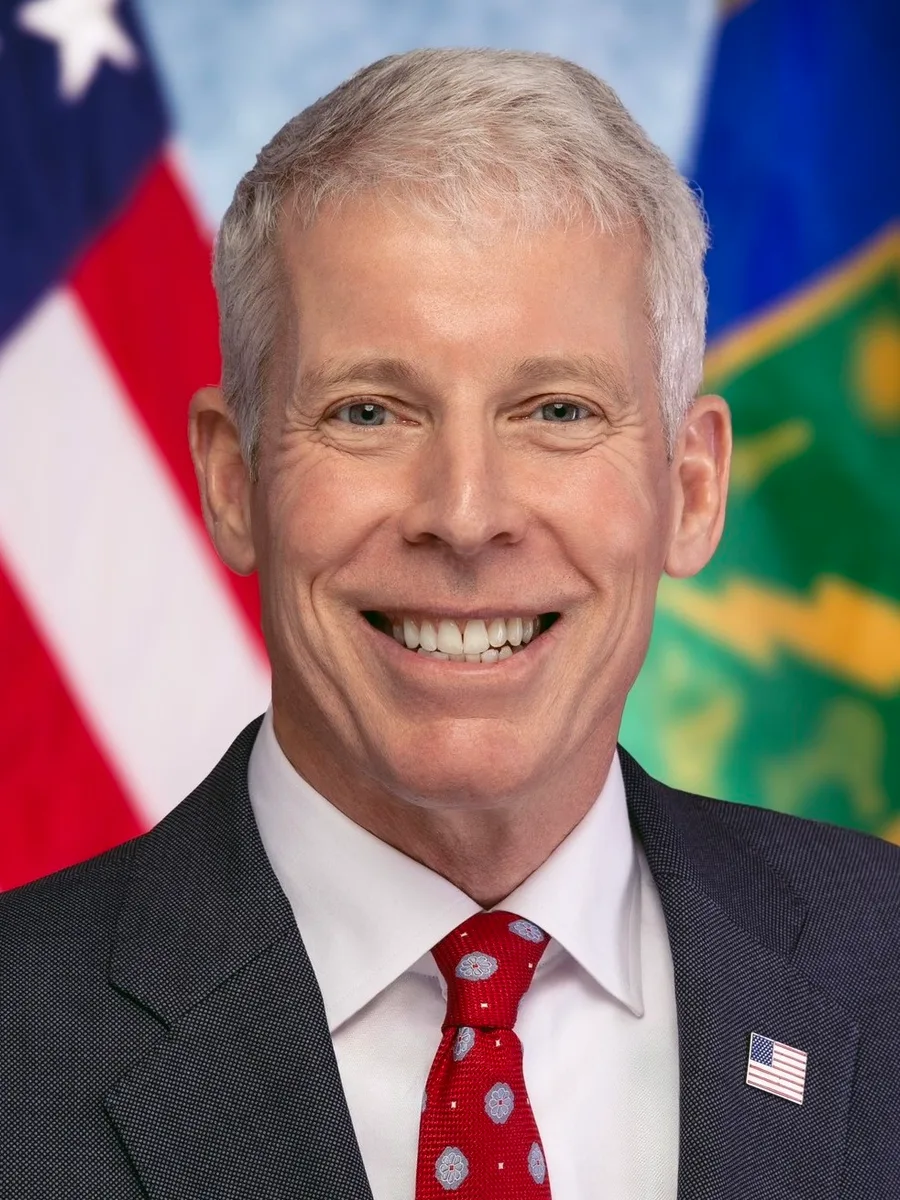
Current Secretary of Energy
Chris Wright
In office since
February 3, 2025
Prior role: Founder and CEO, Liberty Energy (oil and gas services company)
Chris Wright was confirmed as Secretary of Energy on February 3, 2025. He founded Liberty Energy, a major hydraulic fracturing services company, and spent his career in the oil and gas industry, including earlier work in geothermal and nuclear energy technology development.
Wright holds a degree in mechanical engineering from MIT and has been a vocal advocate for expanding U.S. energy production across multiple sources, including fossil fuels, nuclear power, and geothermal energy, positions he has carried directly into his management of the department's energy policy portfolio.
Major Sub-Agencies & Bureaus
The Energy Department carries out its mission through operating divisions and sub-agencies, each with its own specific mandate.
The NNSA designs, produces, and maintains America's nuclear weapons stockpile, ensuring warheads remain safe, secure, and reliable without physically test-detonating them, using computer simulation and laboratory experiments instead since the U.S. stopped underground nuclear testing in 1992.
The agency also works to prevent nuclear proliferation worldwide, securing and consolidating vulnerable nuclear materials in other countries, and provides the naval nuclear propulsion program that powers U.S. Navy aircraft carriers and submarines, a joint responsibility shared with the Defense Department.
Created by Congress in 2000 as a "semi-autonomous" agency after security lapses at the weapons labs, the NNSA now accounts for roughly half the entire department's budget. Its Stockpile Stewardship Program relies on the world's fastest supercomputers and facilities like the National Ignition Facility, which in 2022 achieved the first laboratory fusion reaction to produce more energy than the lasers put in.
The United States maintains about 3,700 warheads in its active stockpile, and the NNSA is in the middle of a decades-long, multi-hundred-billion-dollar effort to refurbish or replace every warhead type and rebuild the aging factories that make plutonium "pits" and other components.
The department runs seventeen national laboratories, including Los Alamos and Lawrence Livermore (both central to nuclear weapons work), Oak Ridge (home to some of the world's fastest supercomputers), and others focused on renewable energy, particle physics, and materials science research.
These laboratories, mostly operated under contract by universities or private companies rather than directly by federal employees, have produced numerous Nobel Prize-winning discoveries and remain central to both U.S. scientific competitiveness and national security research.
The system is a "government-owned, contractor-operated" model dating to the Manhattan Project; the University of California ran Los Alamos and Livermore for decades before management shifted to private-led consortia in the 2000s. The labs together employ tens of thousands of scientists and engineers and account for a large share of the department's roughly 95,000 contractor workforce.
Beyond weapons, the labs operate national user facilities open to outside researchers, including particle accelerators (Fermilab, SLAC), light sources for studying materials and biology, and the Exascale supercomputers Frontier and Aurora, which are used for climate modeling, drug discovery, and fusion research.
The EIA collects and publishes independent statistical data on U.S. energy production, consumption, and prices, including the widely watched weekly petroleum inventory report that frequently moves oil futures markets, operating with statutory independence from political influence over its data and analysis.
The agency's long-term energy outlook reports are closely followed by investors, utilities, and policymakers as one of the most authoritative non-partisan sources of energy market projections available anywhere in the world.
Congress created the EIA in the 1977 law that established the department and, unusually, wrote in that its data and analysis "shall not be subject to approval" by any other officer of the government, a firewall meant to keep energy statistics credible regardless of the administration's policy views.
Its regular products include the weekly gasoline and diesel price survey, the monthly and annual energy reviews, the Short-Term Energy Outlook, and the Annual Energy Outlook, whose long-range projections are widely used as a baseline even by analysts who disagree with them.
This office manages the cleanup of radioactive and hazardous waste left behind at former nuclear weapons production sites from the Cold War era, including the Hanford Site in Washington state, one of the most contaminated nuclear sites in the world and among the most expensive environmental cleanup projects in U.S. history.
The cleanup effort, expected to continue for decades longer at a total projected cost well over $300 billion, represents a long-term financial and technical legacy obligation from the massive nuclear weapons production program the United States ran throughout the Cold War.
The office is responsible for 15 sites in 11 states. Hanford alone holds about 56 million gallons of highly radioactive waste in 177 aging underground tanks, some of which have leaked into the ground near the Columbia River; a giant vitrification plant to lock the waste in glass has been under construction since 2002 and is years behind schedule.
The Government Accountability Office lists the department's environmental liability, its own official estimate of what the full cleanup will eventually cost, at well over $500 billion, and has kept the program on its "high risk" list for decades because costs and timelines keep growing.
From August 4, 1977 to Today
The predecessor of The Energy Department was the Atomic Energy Commission (1946-1974) and the Federal Energy Administration (1974-1977). Here is how the department reached its current form.
The Manhattan Project, the secret World War II program that developed the first atomic bombs, laid the technical and institutional foundation for what eventually became the Energy Department, establishing several of the national laboratories and production facilities the department still operates today, including Los Alamos and Oak Ridge.
The project's massive scale and urgency established the pattern of large government-funded, contractor-operated national laboratories that has continued to define how the department conducts nuclear and scientific research to this day.
At its peak the project employed roughly 130,000 people across secret sites, including Oak Ridge in Tennessee (uranium enrichment), Hanford in Washington (plutonium production), and Los Alamos in New Mexico (weapon design). The first test, code-named Trinity, was detonated in the New Mexico desert on July 16, 1945.
The Atomic Energy Act of 1946 transferred nuclear weapons and energy research from military to civilian control, creating the Atomic Energy Commission to oversee both nuclear weapons production and the emerging peaceful applications of nuclear technology, including early civilian nuclear power development.
The commission operated for nearly three decades before Congress split its regulatory and promotional functions in 1974, spinning off nuclear safety regulation into the newly created, independent Nuclear Regulatory Commission to address a perceived conflict of interest in having one agency both promote and regulate nuclear power.
The 1946 debate over military versus civilian control was intense; Congress ultimately gave the AEC's five commissioners a government monopoly on all nuclear materials and information. A 1954 amendment opened the door to private nuclear power, and the first U.S. commercial reactor came online at Shippingport, Pennsylvania, in 1957.
The 1973 Arab oil embargo, which quadrupled gasoline prices and caused fuel shortages nationwide, exposed serious gaps in the federal government's ability to coordinate national energy policy, leading Congress to create the Federal Energy Administration in 1974 to manage the crisis response.
The embargo crisis fundamentally reshaped American energy policy for decades afterward, driving the creation of the Strategic Petroleum Reserve, fuel efficiency standards for vehicles, and eventually the consolidated Energy Department itself just a few years later.
OPEC members cut supply and embargoed the United States in retaliation for U.S. support of Israel during the 1973 war. The response included a national 55-mile-per-hour speed limit, year-round daylight saving time, gasoline rationing by license-plate number in some states, and the first federal fuel-economy standards (CAFE) for cars in 1975.
President Carter signed legislation creating the Department of Energy in 1977, consolidating the Atomic Energy Commission's remaining functions, the Federal Energy Administration, and dozens of other energy-related programs scattered across the government into a single Cabinet department for the first time.
The department's creation reflected the lasting impact of the 1970s energy crises on American politics, elevating energy policy to permanent Cabinet-level status at a time when energy independence had become a central national security and economic priority.
Carter, who called the energy crisis "the moral equivalent of war," also folded in the Federal Power Commission, whose independent successor, the Federal Energy Regulatory Commission (FERC), was placed inside the department but kept independent to regulate interstate electricity, natural gas, and pipeline rates.
As the Cold War wound down, the department created its Office of Environmental Management in 1989 to address the massive environmental contamination left behind at former nuclear weapons production sites, launching what would become one of the largest and longest-running environmental cleanup efforts in American history.
The cleanup program has continued for over three decades since and is projected to continue for decades more, representing one of the most expensive and technically challenging environmental remediation efforts ever undertaken by any government.
The program was created after a June 1989 FBI and EPA raid on the Rocky Flats plant near Denver over illegal waste handling, and after reporting revealed decades of contamination at Hanford, Savannah River, and other sites. Rocky Flats has since been cleaned to the point that part of it is now a wildlife refuge.
Defining Moments
Events that reshaped the department's authority, structure, or public role.
The partial meltdown at the Three Mile Island nuclear power plant in Pennsylvania in March 1979, the most serious commercial nuclear accident in U.S. history, occurred just two years after the department's creation and dramatically slowed new nuclear power plant construction in the United States for decades afterward.
The accident prompted major reforms to nuclear safety regulation and public communication protocols, and it remains the standard reference point in American nuclear policy debates whenever new reactor construction or nuclear safety standards are discussed.
A combination of a stuck valve and operator misreadings let coolant drain from the reactor and about half the core melt. No deaths or measurable health effects were ever documented, and studies found the average radiation dose to nearby residents was tiny, but the frightening days of conflicting official statements did lasting damage to public trust.
No new U.S. reactor ordered after 1978 was completed for decades, though the accident's chilling effect on new construction was compounded by cost overruns, high interest rates, and slack electricity demand. Existing plants kept running and still supply about 18 to 20 percent of U.S. electricity; one of Three Mile Island's own undamaged reactors is being restarted in the 2020s to power data centers.
The Strategic Petroleum Reserve, created after the 1970s oil embargoes, holds hundreds of millions of barrels of crude oil in underground salt caverns along the Gulf Coast, and the department has periodically released oil from the reserve to stabilize prices during supply disruptions, most notably a record release following Russia's 2022 invasion of Ukraine.
The reserve's size has fluctuated significantly over time based on both market conditions and political decisions about when to sell or replenish supplies, and refilling the reserve after a major release can take years given global oil market conditions.
Full releases have been ordered only three times: during the 1991 Gulf War, after Hurricane Katrina in 2005, and during the Libyan supply disruption in 2011. The 2022 sale of about 180 million barrels was by far the largest, dropping the reserve to its lowest level since the 1980s before the department began buying oil back at lower prices.
The reserve can move roughly 4.4 million barrels a day into the market at maximum drawdown. Smaller "exchanges" also occur, in which refiners borrow oil after a hurricane and return it with interest, and Congress has repeatedly mandated sales from the reserve to raise budget revenue, a practice energy-security analysts criticize.
Department-funded research into hydraulic fracturing and horizontal drilling techniques dating back to the 1970s and 1980s laid important technical groundwork for the shale oil and gas boom that transformed the United States from a net energy importer into one of the world's largest oil and gas producers over the past two decades.
This shift fundamentally altered U.S. energy policy priorities, reducing the strategic urgency around foreign oil dependence that had originally motivated much of the department's creation, while also raising new environmental and climate policy questions the department continues to navigate.
Federal support included the Eastern Gas Shales Project, the Gas Research Institute, and a production tax credit in the 1980s, alongside decades of private experimentation by operators such as Mitchell Energy, which combined slickwater fracking with horizontal wells in the Barnett Shale of Texas around 2000.
U.S. crude output roughly tripled from about 5 million barrels a day in 2008 to over 13 million by the mid-2020s, and the United States became a major crude exporter after Congress lifted a 1970s export ban in 2015, a net petroleum exporter, and the world's largest exporter of liquefied natural gas. The boom also drew scrutiny over methane leaks, water use, and induced earthquakes from wastewater injection.
Notable Programs & Initiatives
A selection of the programs The Energy Department runs, and what each one is actually for.
The Loan Programs Office provides federal loan guarantees to support large-scale clean energy and advanced technology projects that private lenders consider too risky to finance alone, having backed early-stage projects including Tesla's first mass-market vehicle factory loan in 2010.
The office's portfolio has grown substantially in recent years to support next-generation nuclear reactors, battery manufacturing, and grid infrastructure projects, reflecting a broader federal push to accelerate deployment of new energy technologies at commercial scale.
The office's reputation was shaped early by two loans from the same 2009 program: Solyndra, a solar manufacturer that went bankrupt in 2011 and cost taxpayers about $535 million, and Tesla, which repaid its $465 million loan nine years early. Across its history the overall portfolio has run at a modest net gain, with losses well under the loss reserve Congress set aside.
The 2021 infrastructure law and the 2022 Inflation Reduction Act gave the office more than $100 billion in new lending authority for a "Title 17" clean-energy program and a new Energy Infrastructure Reinvestment program to retool old fossil-fuel sites, though how much of that authority successive administrations use varies with policy.
This program provides funding to help low-income households make their homes more energy-efficient through insulation, weatherstripping, and heating system upgrades, reducing energy bills for participating families while also lowering overall national energy consumption, and has assisted more than 7 million households since its creation in 1976.
The program is administered through state and local community action agencies, and independent evaluations have generally found it reduces participating households' energy bills significantly while paying for itself over time through the cumulative energy savings generated.
It was created in 1976 in response to the oil embargoes and is one of the oldest continuously running federal energy programs. A national laboratory evaluation found it cuts a typical household's energy use by roughly 12 to 25 percent and returns well over a dollar in benefits for each dollar spent, counting health and safety gains from fixing furnaces and mold.
Normal annual funding is a few hundred million dollars, enough for tens of thousands of homes a year; the 2009 Recovery Act briefly gave it about $5 billion, and the 2021 infrastructure law added another $3.5 billion, the largest single investment in its history.
The department funds demonstration projects for next-generation nuclear reactor designs, including small modular reactors intended to be cheaper and faster to build than traditional large nuclear plants, reflecting renewed federal interest in nuclear power as a low-carbon energy source that can also provide steady baseline electricity.
These programs have drawn bipartisan congressional support in recent years as policymakers increasingly view advanced nuclear technology as a tool for both reducing carbon emissions and meeting the surging electricity demand driven by data centers and artificial intelligence computing infrastructure.
The Advanced Reactor Demonstration Program, launched in 2020, put multibillion-dollar cost-shares behind two first-of-a-kind plants: a sodium-cooled fast reactor with molten-salt storage in Wyoming (TerraPower's Natrium) and a high-temperature gas reactor in Washington State (X-energy). Both slipped from mid-2020s to later target dates.
An earlier small-modular-reactor project in Idaho, backed by the department and a Utah power consortium, was canceled in 2023 after projected costs rose sharply, a reminder that the economic case for the technology is still unproven. The 2024 ADVANCE Act sought to speed regulatory approvals for new designs.
The department manages the Strategic Petroleum Reserve, storing crude oil in underground salt caverns along the Gulf Coast that can be released during major supply disruptions to help stabilize energy prices and ensure continued fuel availability during emergencies like hurricanes or international conflicts.
Decisions about when to release or refill the reserve carry significant political and market weight, since even the announcement of a planned release can move global oil prices before a single barrel is actually sold.
The reserve is held in about 60 salt caverns at four sites in Texas and Louisiana, each cavern created by pumping water into a salt dome and cheaper to maintain than steel tanks. The oil is a mix of sweet and sour crude matched to Gulf Coast refineries.
Membership in the International Energy Agency, formed after the 1973 embargo, obligates the United States to hold reserves equal to at least 90 days of net petroleum imports; because domestic production has surged, the reserve now covers far more than 90 days of net imports even after the 2022 drawdown.
How This Affects Everyday Americans
The gas prices Americans pay at the pump can be directly affected by Strategic Petroleum Reserve releases the department authorizes during supply disruptions, and the department's energy statistics, published weekly by the Energy Information Administration, are among the most closely watched economic indicators affecting energy markets nationwide.
Millions of low-income households have had their home energy bills reduced through the department's weatherization assistance program, and the department's research funding has historically driven technology, from fracking to advances in battery storage, that reshaped both energy prices and the broader American economy.
As the primary steward of America's nuclear weapons stockpile, the department's work underpins the nuclear deterrent that has shaped U.S. national security strategy for eight decades, a responsibility largely invisible in daily life but foundational to how the country approaches its relationships with other nuclear powers.
The efficiency standards the department sets for refrigerators, water heaters, air conditioners, light bulbs, and dozens of other appliances are on nearly every product Americans buy for their homes; the department's own estimates put the cumulative savings on household energy bills in the hundreds of billions of dollars.
Quick Facts & Figures
Key statistics and reference information about The Energy Department.
| Established | August 4, 1977 |
| Headquarters | James V. Forrestal Building, Washington, D.C. |
| Current Secretary | Chris Wright |
| Annual Budget | ~$52 billion (FY2025 enacted) |
| Employees | ~14,000 federal, plus ~95,000 contractors |
| National Laboratories Operated | 17 |
| Predecessor Agency | Atomic Energy Commission (1946) |
| Website | energy.gov |
Did You Know?
Most people think the Energy Department is about oil and gas, but its single biggest job is actually maintaining America's nuclear weapons stockpile, which consumes roughly half its budget.
The department's Hanford Site cleanup in Washington state, one of the most contaminated places on Earth from Cold War-era plutonium production, is projected to cost well over $300 billion and take decades more to complete.
The Strategic Petroleum Reserve, managed by the department, is the largest emergency crude oil stockpile in the world, stored in underground salt caverns along the Gulf Coast.
Department-funded national laboratory research helped lay the technical groundwork for the fracking boom that made the United States one of the world's largest oil and gas producers.
The department's national laboratories, including Los Alamos and Lawrence Livermore, have been associated with numerous Nobel Prize-winning scientific discoveries well beyond nuclear weapons research.