Two Elections, Not One
When Americans talk about "the election," they usually mean the general election in November. But every candidate on that ballot got there through a separate, earlier contest, a party nomination process, that has changed dramatically over the country's history. Understanding how elections work means understanding both stages.
The earliest presidential nominees were chosen by informal meetings of each party's members of Congress, a system historians call "King Caucus." There was no primary, no convention, and no direct role for ordinary voters. The system collapsed in 1824 when Andrew Jackson, the popular-vote leader, lost the caucus nomination and later the presidency in a contingent House election, a result widely seen as illegitimate and out of step with a more democratic public mood.
The term itself was coined derisively by critics who saw the process as an unrepresentative clique deciding the presidency behind closed doors; even Andrew Jackson's own supporters used "King Caucus" as a rallying cry against what they portrayed as an aristocratic stranglehold on the nomination.
Under the caucus, party members of Congress met, often in the House chamber, to name a ticket, and state legislatures or party committees then chose presidential electors pledged to it. In 1808 and 1812 the Democratic-Republican caucus was effectively decisive because the Federalists were fading as a national force.
In 1824 the caucus nominated Treasury Secretary William Crawford, but only about a quarter of eligible members attended, and Jackson, John Quincy Adams, and Henry Clay ran anyway. Jackson led the popular and electoral vote but fell short of a majority; the House chose Adams, and Jackson's supporters spent four years building a mass party that made the caucus obsolete.
The Anti-Masonic Party held the first national nominating convention in Baltimore in September 1831, followed by the National Republicans and the Democratic Party in 1832. Conventions replaced the closed congressional caucus with delegates sent from state party organizations, a structure that would dominate presidential nominations for the next 140 years, but delegates themselves were still selected by state party leaders, not primary voters.
The Anti-Masonic Party's convention nominated William Wirt, who went on to win just a single state, Vermont, in the 1832 general election, making the first party to pioneer the modern convention system also one of the shortest-lived major parties in American history.
The Democratic convention of 1832 also adopted the two-thirds rule, requiring a nominee to win two-thirds of delegates, which the party kept until 1936. That rule repeatedly gave Southern delegations an effective veto and helped produce deadlocked conventions, including the 1924 Democratic convention that ran 103 ballots over 16 days.
Conventions quickly added platforms, credentials fights over which delegations to seat, and rules committees, becoming multi-day national events. For more than a century they were genuine deliberative bodies where the nominee was often unknown when delegates arrived, unlike the scripted ratification events they became after 1972.
Through the late 19th century, state and local party organizations, often run by powerful "bosses" such as New York's Tammany Hall, controlled delegate selection almost entirely. Convention floors were the real decision point, and deals struck in private among party leaders, the origin of the phrase "smoke-filled room," frequently decided the nominee.
Tammany Hall, the most famous of the era's political machines, controlled Democratic nominations in New York City for decades, trading patronage jobs and favors for delegate loyalty in a system that reform-minded Progressives would spend the following decades trying to dismantle.
Delegates were typically chosen at state party conventions dominated by officeholders and machine leaders who controlled patronage. National conventions of this era regularly ran to many ballots: the 1880 Republican convention took 36 ballots to nominate James Garfield, who was not even a candidate when it opened.
The phrase "smoke-filled room" entered the language after the deadlocked 1920 Republican convention, when party leaders reportedly settled on Warren G. Harding in a suite at the Blackstone Hotel in Chicago. Progressive reformers responded by pushing primary laws to move the decision out of such rooms and toward voters.
Wisconsin Governor Robert M. La Follette pushed through the nation's first mandatory statewide direct primary law in 1903 (effective 1905), part of the broader Progressive movement's push to strip power from party bosses and give it to ordinary voters. By 1912, roughly a dozen states had adopted presidential preference primaries, though most were non-binding and convention delegates still made the final choice.
La Follette's reform was part of a broader Progressive agenda in Wisconsin that also produced an early state income tax and workers' compensation law; his direct-primary model was copied widely enough that by the 1912 presidential race, primaries had become a recognized part of the national political conversation for the first time.
Oregon adopted a presidential preference primary in 1910, and by 1916 about 20 states had some form of primary. In the 1912 Republican race, Theodore Roosevelt won most primaries against President William Howard Taft but lost the nomination on the convention floor, where party-controlled delegates prevailed, exactly the outcome that fueled demands for binding primaries.
Most Progressive-era primaries were advisory: they measured voter preference but did not bind delegates, who were still chosen and instructed by state parties. Interest faded during the 1920s, and by 1936 the number of presidential primaries had fallen back to about a dozen, a low that held until the post-1968 reforms.
Hubert Humphrey won the 1968 Democratic nomination without entering a single primary, relying entirely on delegates controlled by party leaders, while anti-war candidates who had competed in and won primaries were shut out. The resulting convention in Chicago was marred by violent clashes between police and protesters outside the hall. The party's own McGovern-Fraser Commission concluded the process had to change.
The violence outside the convention hall was captured live on national television and was later described by a federal commission as a "police riot," a moment that damaged public confidence in the nominating process and gave the McGovern-Fraser Commission's subsequent reforms unusual momentum within the Democratic Party.
Senators Eugene McCarthy and Robert Kennedy had run in and won primaries on an anti-war platform; Kennedy was assassinated in June 1968. Humphrey, the sitting vice president, entered no primaries yet won the nomination on the first ballot with about 67 percent through delegates chosen by state parties.
The party's Commission on Party Structure and Delegate Selection, chaired by Senator George McGovern and then Representative Donald Fraser, issued rules in 1971 requiring open, timely, and proportional delegate-selection processes, the changes that produced the modern primary-driven system.
Following the McGovern-Fraser reforms, both major parties rapidly expanded binding, voter-decided primaries, and the number of states using them roughly tripled between 1968 and 1976. By 1980, primaries rather than caucuses or party conventions selected the large majority of national convention delegates, establishing the basic structure still used today.
The Republican Party, which had not faced the same internal crisis as the Democrats in 1968, nonetheless adopted many similar primary-expansion reforms over the same period, so that by 1976 both parties relied primarily on primary voters rather than party leaders to select their nominees for the first time in American history.
The number of Democratic primaries rose from 17 in 1968 to about 30 by 1976, and the share of delegates chosen in primaries passed two-thirds. McGovern, who helped write the new rules, used them to win in 1972, and Jimmy Carter, a little-known former Georgia governor, used early-state contests to do the same in 1976.
The reforms also shifted power toward candidates' personal campaign organizations and the news media, which now effectively winnow the field through early-state results and debate coverage before most voters have cast a ballot.
Not Every State Picks Its Nominees the Same Way
States choose how their parties allocate delegates, which means the actual voting mechanics, who can participate, whether it's a private ballot or a public show of hands, differ from state to state. Here are the main systems in use today.
Only voters registered with a party may vote in that party's primary. A registered Democrat cannot vote in the Republican primary, and vice versa. States including Florida, Kentucky, and Pennsylvania use closed or largely closed primaries. Supporters argue it keeps the choice of nominee in the hands of a party's own members; critics argue it excludes the roughly 40 percent of Americans who tell Gallup they identify as independents.
Party registration deadlines for closed primaries can fall weeks or even months before election day in some states, meaning a voter who wants to switch parties to participate in a specific primary must often plan well in advance rather than simply declaring a preference at the polls.
About a dozen states use fully closed primaries for at least one major party, per NCSL. In a closed system the parties, not the state, effectively define their own primary electorates, and the Supreme Court upheld a party's right to exclude non-members in Democratic Party v. La Follette (1981).
Some states let a party choose whether to open its own primary: in Tashjian v. Republican Party of Connecticut (1986) the Court held a state could not force a party to keep its primary closed when the party wanted to invite independents. As a result, primary type sometimes varies by party within the same state.
Any registered voter may choose either party's primary ballot on election day, regardless of their own registration. States including Wisconsin, Michigan, and South Carolina hold open primaries. Critics note the possibility of "crossover" or "raiding" voting, where members of one party vote in the other party's primary to influence its outcome, though political scientists have found little evidence this happens at a scale large enough to swing most races.
A widely publicized 2008 effort urging Republican radio listeners to vote in Democratic open primaries to prolong that year's competitive race remains the most often-cited example of an attempted crossover strategy, though political scientists who studied that race found its actual effect on the outcome was limited.
In an open primary the voter's choice of party ballot is usually not recorded as a registration change, so participation leaves no lasting affiliation. About 15 states use open primaries for both parties, concentrated in the South and Upper Midwest.
Researchers distinguish raiding (voting insincerely to nominate a weak opponent) from crossover (sincerely preferring a candidate in the other party's race). Studies of open-primary states generally find crossover common but raiding rare and rarely decisive, partly because voters cannot easily predict which sabotage vote would help their own side.
A middle category, used in states such as New Hampshire and Colorado, lets unaffiliated or independent voters choose either party's primary on election day, while registered party members must vote in their own party's primary. This preserves a role for independents without opening a party's primary to the opposing party's registered members.
New Hampshire's system carries particular significance because the state traditionally holds the nation's first primary, meaning its rules for independent participation can meaningfully shape which candidates gain early momentum before most other states have voted at all.
Roughly 10 states use a semi-closed or semi-open model. The practical effect is to enfranchise self-identified independents, a large and growing share of registrants in many states, while still barring a registered member of one party from voting in the other's primary.
In some semi-closed states an unaffiliated voter who requests a party ballot is automatically registered with that party unless they opt out afterward, a wrinkle that has produced litigation and confusion. New Hampshire lets a voter re-register as undeclared immediately after voting.
California, Washington, and Nebraska (for state offices) use a single primary ballot listing all candidates from every party together. The top two vote-getters advance to the general election, even if both belong to the same party. Louisiana uses a similar all-candidate primary for most state and local offices (since 2026 it uses closed party primaries for Congress and some state offices), holding it on the general election date itself, with a runoff only if no candidate wins a majority outright.
California adopted its top-two system by ballot initiative in 2010, and it has occasionally produced general election matchups between two candidates of the same party, a result impossible under a traditional partisan primary and one critics argue can reduce minor-party and independent candidates' chances even further.
Washington adopted top-two by initiative in 2004, and the Supreme Court upheld it in Washington State Grange v. Washington State Republican Party (2008), finding that listing a candidate's party "preference" on the ballot did not unconstitutionally associate the party with the candidate.
Supporters argue top-two pushes candidates toward the median voter and produces more moderate winners; the research is mixed. Same-party November runoffs are common in lopsided districts, and minor parties are almost entirely shut off the general-election ballot.
Alaska adopted a top-four primary combined with a ranked-choice general election in 2020. Maine uses ranked-choice voting in its party primaries and in federal general elections. Under ranked-choice voting, voters rank candidates in order of preference, and if no candidate wins a majority of first-choice votes, the last-place candidate is eliminated and their votes redistributed to those voters' next choice, repeating until someone has a majority.
Alaska's 2020 adoption came through a narrowly passed ballot measure, and the state's 2022 special election to fill a vacant U.S. House seat became the first statewide use of the new system, drawing national attention to how ranked-choice tabulation actually works in practice.
Maine adopted ranked-choice voting by initiative in 2016 and, after a state supreme court advisory opinion and a "people's veto" referendum, uses it for federal primaries and general elections but not for state general elections, which the Maine Constitution requires be decided by plurality.
In Alaska's August 2022 special U.S. House election, Democrat Mary Peltola won after ranked-choice tabulation because a majority of the two Republican candidates' voters did not consolidate behind one of them. Alaska voters narrowly kept the system in a 2024 repeal referendum.
A caucus is a local meeting of party members, not a private-ballot election, where attendees publicly declare and sometimes physically group by their preferred candidate, and delegates are allocated based on those groupings. Iowa's caucuses drew outsized national attention for decades because they were traditionally first on the calendar. After Iowa's 2020 Democratic caucuses were marred by a vote-reporting app failure that delayed final results for days, and amid long-standing criticism that caucuses depress turnout and exclude voters who cannot attend a specific evening meeting, both major parties sharply reduced caucus use afterward; the Democratic Party moved to a primary calendar for 2024, and most remaining states now use primaries instead.
At their peak in the 1970s and 1980s, more than a dozen states used caucuses to select some or all of their national convention delegates; by 2024, that number had fallen to just a handful, continuing a decades-long decline that accelerated sharply after Iowa's 2020 reporting failure.
Caucuses are run and paid for by the state parties rather than election officials, use no secret ballot in many cases, and can run for hours, which depresses participation: Iowa's 2016 Democratic caucus drew about 15 percent of eligible voters, versus 30 to 40 percent turnout in comparable primary states.
After the 2020 app failure, the Democratic National Committee removed Iowa's first-in-the-nation status for 2024 and pushed remaining caucus states toward primaries or party-run "firehouse" primaries. By 2024 only a few states and territories still used traditional caucuses for either party.
The Primary Doesn't Pick the Nominee, Delegates Do
A primary or caucus result is technically just an instruction to that state's delegates about how to vote at the party's national convention. In almost every modern election that instruction is followed exactly, but the delegate math, and the rules governing it, is what actually determines the nominee.
Most convention delegates are "pledged," meaning they are awarded to a candidate based on primary or caucus results and are expected to vote for that candidate on the convention's first nominating ballot. The exact number of delegates each state sends is set by national party rules and roughly reflects the state's population and, for Republicans, past support for the party's nominees.
The total number of pledged delegates a state receives can also be adjusted based on when it holds its primary, since both parties impose penalties, including reduced delegate counts, on states that schedule their contests earlier than national party rules allow, a recurring source of primary-calendar disputes.
A Democratic delegation splits into district-level delegates awarded by results in each congressional district and at-large and party-leader delegates awarded by the statewide result. Republican allocations blend a fixed base per state, three per congressional district, and bonus delegates for states with recent Republican wins.
The 2024 Democratic convention had roughly 3,900 pledged delegates; the 2024 Republican convention about 2,400. Both parties also seat a smaller number of unpledged or automatic delegates and publish detailed selection rules years in advance through their rules committees.
The Democratic Party designates certain elected officials and party leaders, such as members of Congress, governors, and Democratic National Committee members, as "automatic delegates" (commonly called superdelegates) who are not bound by any state's primary result. Following controversy in the 2016 race, the party changed its rules in 2018 so automatic delegates may vote on the first ballot only if the race is not close enough to have been effectively decided by pledged delegates alone. The Republican Party has a smaller category of unbound delegates, mainly members of the Republican National Committee, but does not use the term "superdelegate."
In the 2016 Democratic primary, unpledged superdelegates overwhelmingly favored Hillary Clinton before a single vote had been cast, a fact her chief rival's campaign cited as evidence the system unfairly tilted the race, directly fueling the 2018 rule change that curtailed their first-ballot influence.
The Democratic superdelegate category was created after 1980 on the recommendation of the Hunt Commission, to give elected officials a formal voice and a check on primary voters. At its peak it was roughly 15 to 20 percent of all delegates, about 700 to 800 people in recent cycles.
Republican RNC members, three per state, are bound in most states to the primary result on the first ballot under a 2016 rule, so the GOP has no true free-agent superdelegate bloc comparable to the Democrats' pre-2018 system.
Democratic Party rules require all states to award delegates proportionally to any candidate who clears a minimum vote threshold, typically 15 percent statewide or in a congressional district. Republican Party rules allow individual states to choose winner-take-all allocation, and many do, particularly for primaries held after a set date in March, which is one reason Republican nomination races have often been decided earlier than Democratic ones.
Because Republican rules allow winner-take-all contests after mid-March of an election year while Democratic rules require proportional allocation throughout, a large Republican state primary can effectively end a competitive race in a way that a comparably sized Democratic primary generally cannot.
Democratic rules fix the qualifying threshold at 15 percent and forbid winner-take-all outright, so a candidate with 30 percent statewide gets roughly 30 percent of that state's delegates. This tends to keep multi-candidate races going and makes it mathematically hard to lock up the nomination before late spring.
Republican rules require proportional allocation only for contests before March 15; after that, states may use winner-take-all or winner-take-most rules, and large states like Florida and Ohio often do, a main reason recent competitive Republican races have effectively ended in March or April while Democratic races have run into June.
Each party sets a specific delegate majority needed to win the nomination outright on the convention's first ballot, based on the total number of delegates at that year's convention. News organizations track this running total throughout primary season and describe a candidate as having "clinched" the nomination once they mathematically cannot be denied a first-ballot majority, even before the convention formally votes.
News organizations calculate a candidate's delegate count using their own independent estimates and projections throughout primary season, since neither party publishes a single authoritative running tally in real time, which occasionally leads different outlets to declare a candidate has "clinched" the nomination on slightly different days.
The magic number is simply half the total delegates plus one: roughly 1,969 for the 2024 Democratic convention and 1,215 for the 2024 Republican convention. It shifts slightly year to year as convention size changes and as states gain or lose delegates for scheduling penalties.
Because tallies include estimates for states that have not finished allocating and for unbound delegates' stated preferences, the Associated Press and major networks each run their own counts and call the nomination when a candidate's floor of committed delegates crosses the threshold, occasionally on different days.
If no candidate arrives at the convention with a first-ballot majority, the convention becomes "contested." On any required second ballot, most Democratic automatic delegates become free to vote for anyone, and in both parties many pledged delegates are released from their state's result after the first ballot under national party rules, opening the door to a negotiated outcome sometimes called a "brokered convention." No major-party convention has gone past a first ballot since the Democrats' 1952 convention.
The closest recent call came in 1976, when incumbent President Gerald Ford narrowly held off Ronald Reagan's challenge without quite reaching a first-ballot majority before additional delegates were confirmed, the last time a major party's outcome was seriously in doubt heading into its convention.
The 1952 Democratic convention took three ballots to nominate Adlai Stevenson. The 1976 Republican convention turned partly on a proposed rule that would have forced Reagan to name his running mate before the vote; Ford won the first ballot 1,187 to 1,070.
In a modern contested convention, most pledged delegates are released after the first ballot and become free agents, and campaigns, state delegations, and party leaders would negotiate on the floor. Analysts note that today's delegates are chosen for loyalty to a candidate rather than as independent brokers, making the dynamics hard to predict.
Even when the outcome is not in doubt, both parties preserve a formal roll call in which each state delegation's votes are announced from the convention floor, often with a brief promotional statement about the state before its delegate count is read. This ceremonial vote, followed by the nominee's acceptance speech, is the moment a party's nomination becomes official.
The roll call has occasionally become a moment of party unity theater even in uncompetitive years, such as when a defeated candidate asks the convention to nominate the winner by acclamation partway through the state-by-state count, skipping the remainder of the formal tally.
During the roll call, a delegation chair announces the state, usually with a scripted boast, then reports its vote split. The presiding officer keeps the running total, and a candidate is declared the nominee once they pass the magic number.
Since 2020 the Democratic Party has sometimes run a ceremonial or pre-recorded roll call for television, and in 2024 it held a virtual roll call before the convention to meet a state ballot deadline. The Republican Party retains a live floor roll call. Either way, the roll call plus the acceptance speech is the formal act of nomination.
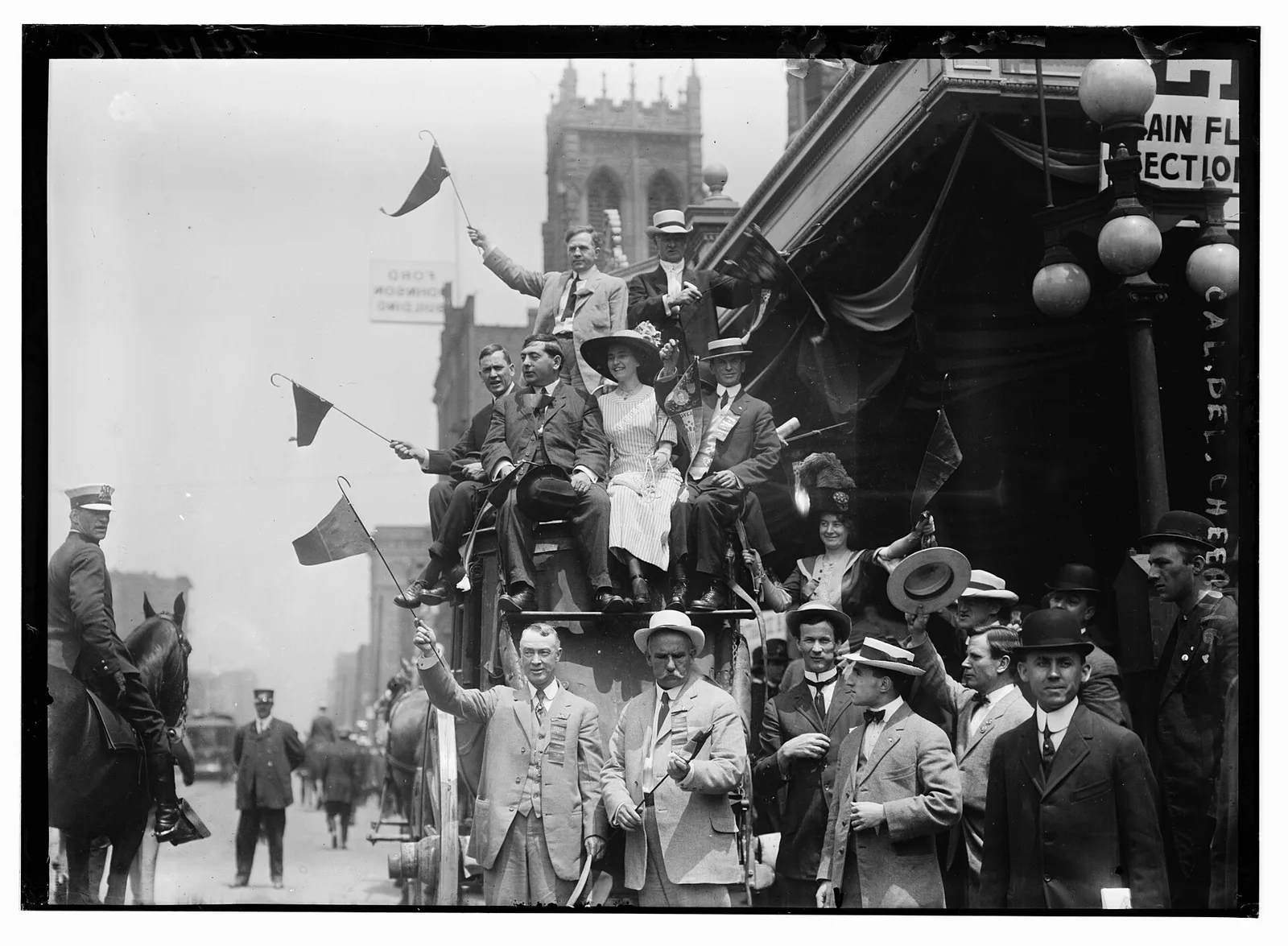
State delegations have paraded into national conventions with elaborate floor demonstrations since the 19th century, as seen here at the 1912 Republican National Convention in Chicago.
The Constitution Sets Eligibility, States Set Access
Who is allowed to run for federal office and how they actually get their name printed on a ballot are two different questions, governed by two different sets of rules, one set directly by the Constitution and the other set entirely by individual state law.
Article II, Section 1 of the Constitution requires a president be a natural-born U.S. citizen, at least 35 years old, and a resident within the United States for at least 14 years. The 12th Amendment applies the same qualifications to the vice president. The 22nd Amendment, ratified in 1951, limits a person to being elected president twice.
The natural-born-citizen requirement has never been definitively interpreted by the Supreme Court, and legal scholars have long debated whether it includes children born abroad to American citizen parents, a question raised in past campaigns without ever reaching a court ruling that resolved it.
The 14-year residency requirement is generally read as cumulative rather than immediately before the election. The 22nd Amendment also limits a vice president who served more than two years of another's term to one additional elected term.
The 1790 Naturalization Act called children born abroad to citizen parents "natural born," language Congress dropped in 1795, leaving the clause unsettled. It has been raised about candidates including George Romney, Barry Goldwater, John McCain, and Ted Cruz without a court ever ruling on it.
Article I, Section 3 requires a senator be at least 30 years old, a U.S. citizen for at least nine years, and an inhabitant of the state they represent at the time of election. Senators serve six-year terms, with roughly one-third of seats up for election every two years.
The nine-year citizenship requirement is the longest of any federal office, reflecting the Founders' view, expressed in the Federalist Papers, that senators would handle foreign affairs and treaties and therefore needed deeper, more tested ties to the country than House members.
The Constitution's qualifications are exclusive: Powell v. McCormack (1969) held a chamber cannot add qualifications beyond age, citizenship, and inhabitancy, and U.S. Term Limits v. Thornton (1995) held states cannot either. A candidate need only inhabit the state "when elected," not for any prior period.
Each chamber is "judge of the elections, returns and qualifications of its own members" under Article I, Section 5, and may exclude a member-elect who fails a constitutional qualification or expel a sitting member by a two-thirds vote. The Senate has expelled 15 members, 14 for supporting the Confederacy in 1861 and 1862.
Article I, Section 2 requires a House member be at least 25 years old, a U.S. citizen for at least seven years, and an inhabitant of the state they represent. All 435 voting House seats are up for election every two years.
Because the entire House stands for election every two years with no staggered terms, the chamber is designed to be the branch of government most immediately responsive to shifts in public opinion, a deliberate contrast to the Senate's six-year, staggered terms.
The seven-year citizenship and age-25 requirements are the lowest of the three federal elected offices, reflecting the design of the House as the branch closest to the people. Members must inhabit the state, though not necessarily the district, they represent.
Several people have been elected before turning 25 and seated once they reached it, since the Constitution requires the age be met at the time of service, not election. The House can add no qualifications and has expelled only six members: three in 1861 for supporting the Confederacy, Michael Myers in 1980, James Traficant in 2002, and George Santos in 2023.
The Constitution sets no petition or filing requirements; those are set entirely by individual state law and vary widely. Getting onto a state's general election ballot typically requires either winning a party primary or, for independent and minor-party candidates, submitting a petition with a state-specified minimum number of valid voter signatures, sometimes just a few thousand and sometimes tens of thousands, collected within a defined window before the election.
Signature requirements can vary by a wide margin between neighboring states for the same type of office, and several states also require a filing fee in addition to or instead of signatures, a combination that has repeatedly drawn legal challenges from candidates arguing the requirements are unconstitutionally burdensome.
The Supreme Court has upheld reasonable ballot-access rules as serving states' interest in orderly elections while striking down excessive ones, as in Williams v. Rhodes (1968), which invalidated an Ohio scheme requiring new parties to gather signatures equal to 15 percent of the last vote. Statewide thresholds today range from a few thousand signatures to more than 100,000.
Deadlines matter as much as numbers: some states require independent candidates to file in spring, months before the major-party nominees are known, which courts have sometimes struck as burdensome. Petition-verification standards, per-county distribution rules, and filing fees add further variation, and litigation recurs every cycle.
A candidate who does not seek a major party's nomination can still appear on the general election ballot by qualifying under a state's independent or minor-party ballot access rules, most commonly a signature petition, sometimes combined with a filing fee. Independent and third-party candidates historically face a steeper climb both because ballot access rules differ from getting on a primary ballot and because they are typically excluded from general election debates that require a minimum polling threshold, such as the 15 percent standard used by the Commission on Presidential Debates.
Ross Perot's 1992 campaign remains the most successful modern independent presidential run, winning 19 percent of the popular vote without carrying a single state's electoral votes, a result that illustrates how the debate-threshold and ballot-access hurdles can limit a third-party candidate's path even with substantial public support.
The Commission on Presidential Debates, a private nonpartisan body that ran the general-election debates from 1988 through 2020, set a 15 percent average-in-polls threshold in 2000; no independent has met it since Perot, who was invited in 1992 but excluded in 1996. In 2024 the parties bypassed the Commission and arranged debates directly with television networks.
Perot's run also showed the structural ceiling: nearly 20 million votes translated to zero electoral votes because he finished first in no state. Third-party presidential candidates have won electoral votes only when support was regionally concentrated, as with George Wallace in 1968 and Strom Thurmond in 1948.
Once a candidate for federal office raises or spends more than $5,000 for their campaign, federal law requires them to register with the Federal Election Commission (FEC) and file periodic reports disclosing contributions and expenditures. This financial registration is separate from, and does not by itself guarantee, a place on any state's ballot.
Once registered, a campaign must file periodic disclosure reports, generally quarterly or monthly depending on the office and election cycle, and these reports become part of the FEC's public database, which journalists, opponents, and watchdog groups routinely use to track who is funding a given campaign.
A candidate registers with FEC Form 2 within 15 days of crossing the $5,000 threshold, and the principal campaign committee files Form 1 within 10 days after that. Presidential candidates who accept federal matching funds take on further disclosure and spending-limit conditions, though most major candidates now decline public funds.
Registration triggers no vetting of eligibility or ballot status; the FEC's role is financial disclosure and enforcement of contribution limits. Its public database at fec.gov itemizes contributions above $200 and all disbursements, and is the primary source for reporting on campaign fundraising.
Federal law caps how much an individual may donate directly to a single federal candidate's campaign per election ($3,300 for the 2024 cycle and $3,500 for 2026, adjusted for inflation each cycle), but the Supreme Court's 2010 Citizens United v. FEC decision and the related SpeechNow.org v. FEC ruling allow corporations, unions, and individuals to spend unlimited amounts independently through political action committees, so long as that spending is not formally coordinated with a candidate's campaign.
The Citizens United ruling did not remove limits on direct contributions to a candidate's own campaign; it specifically freed independent spending by outside groups, which is why campaign finance today involves two separate tracks, tightly limited direct candidate contributions and largely unlimited independent expenditures through PACs and super PACs.
For the 2023-2024 cycle an individual could give $3,300 per election to a candidate (primary and general count separately), $5,000 per year to a traditional PAC, and larger indexed amounts to party committees. Direct contributions from corporations and unions to federal candidates remain banned, a prohibition dating to 1907 and 1947.
SpeechNow.org v. FEC (2010) let groups making only independent expenditures accept unlimited contributions, creating super PACs. They may not coordinate with campaigns, though the FEC's coordination rules are narrow and lightly enforced, a frequent criticism from watchdog groups. Political parties, by contrast, may now coordinate their spending with their own candidates without limit: in NRSC v. FEC (June 30, 2026), the Supreme Court struck down the federal caps on party coordinated expenditures 6-3.
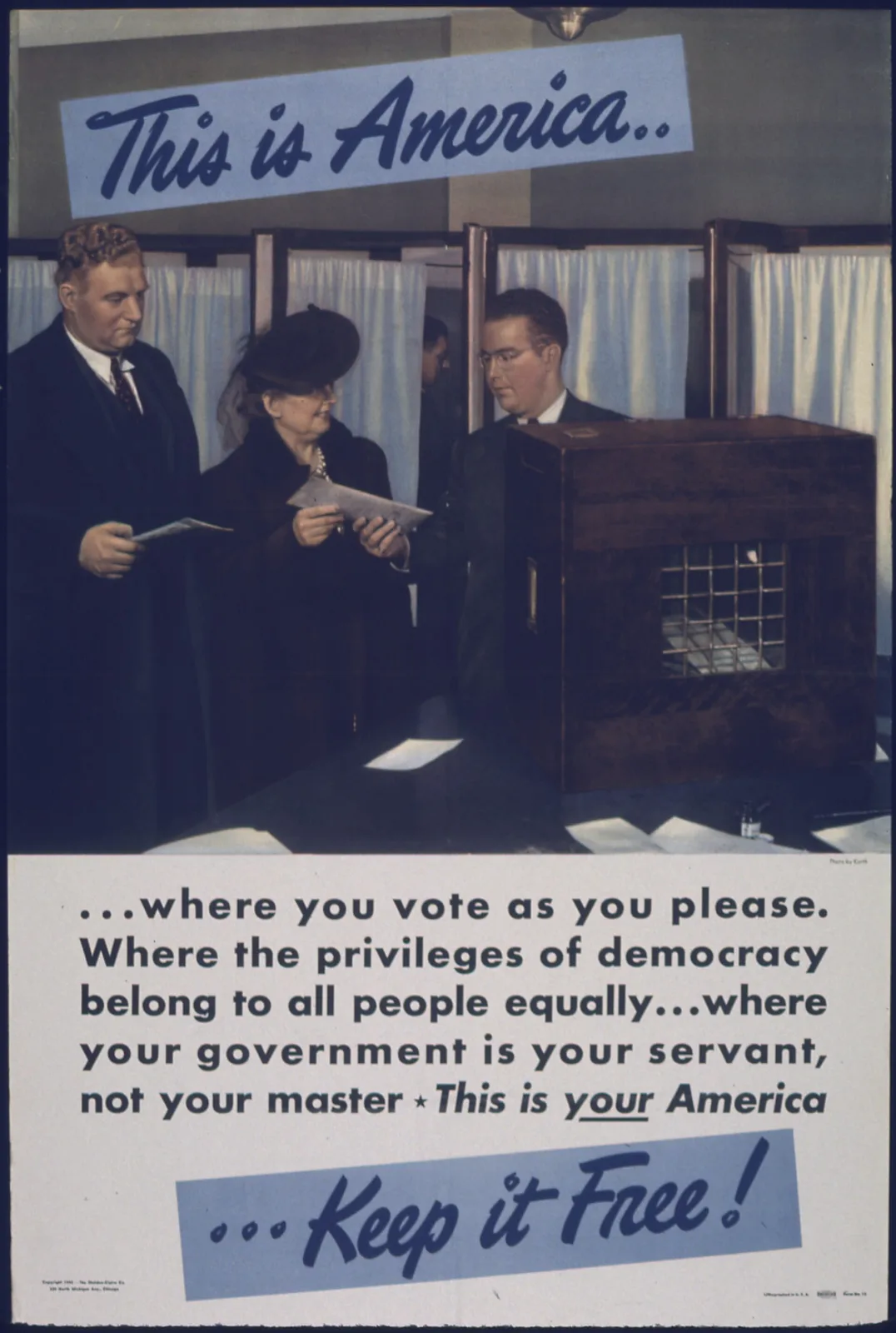
A wartime "This Is America" poster contrasting free elections at home with the absence of real choice under the regimes the U.S. was fighting, part of a series distributed by the federal government in the 1940s.
A Deliberately Decentralized System
There is no single federal agency that runs American elections. Roughly 10,000 state and local election jurisdictions actually administer the vote, which is a deliberate design choice going back to the Constitution, and it explains most of the variation voters notice between states.
The Constitution gives states the primary authority to run elections, including federal elections, subject to Congress's power to set rules for congressional races. In practice, this means roughly 10,000 separate state and local election jurisdictions, mostly county-level offices, actually design ballots, staff polling places, and count votes, which is why voting methods, deadlines, and equipment vary so much from one county to the next.
This decentralization is often cited by election security experts as both a vulnerability, since standards and equipment vary so widely, and a strength, since there is no single national system a bad actor could compromise to affect the outcome nationwide all at once.
Federal law sets some floors: the Voting Rights Act (1965), the National Voter Registration Act (1993), the Help America Vote Act (2002), and UOCAVA and the MOVE Act for military voters. But ballot design, polling-place location, early-voting hours, registration deadlines, and recount rules are set by states and often by counties.
The U.S. Election Assistance Commission, created by HAVA in 2002, sets voluntary voting-system guidelines and distributes federal funds but has no power to run or standardize elections. The 8,000 to 10,000 local jurisdictions administering voting range from large county offices to New England townships.
The people staffing a polling place on election day are typically temporary workers hired and trained by the county or municipal election office, often paid a modest stipend for the day, not permanent government employees. The U.S. Election Assistance Commission has estimated the country needs roughly 900,000 poll workers for a typical general election, and many jurisdictions report chronic difficulty recruiting enough, particularly workers younger than the median poll worker age, which national surveys have consistently found is over 60.
Many jurisdictions have responded to recruitment shortages by actively courting high school and college students; some states now allow 16- and 17-year-olds to serve as poll workers with parental permission, part of a deliberate effort to lower the average age of the workforce running elections.
Poll workers verify voters, issue ballots, operate equipment, and help close out the count, usually working a 12-to-15-hour day for a stipend often between $75 and $200. In many states the two major parties are entitled to have workers of each party at every precinct.
The median poll worker age has been over 60 in EAC surveys, which sharpened staffing concerns during the 2020 pandemic and prompted recruitment drives aimed at students and at employees given paid time off to serve.
Every state offers traditional in-person voting on election day, but most now also offer some combination of in-person early voting (in the days or weeks before election day) and mail or absentee voting. States vary enormously in how these options work: several states, including Colorado, Oregon, and Washington, mail a ballot automatically to every registered voter, while others require an excuse or a specific request to vote by mail.
The shift toward mail and early voting accelerated sharply during the 2020 election amid the COVID-19 pandemic, when a majority of ballots nationwide were cast by mail or in person before election day for the first time in modern history, a pattern that has only partly receded in elections since.
Eight states plus Washington, D.C. now mail every registered voter a ballot automatically; more than 30 states offer no-excuse absentee voting on request; and a shrinking number still require a stated excuse. In-person early voting is offered in about 47 states, with windows from a few days to six weeks.
In 2020, roughly 69 percent of ballots were cast before election day by mail or in-person early voting, up from about 40 percent in 2016, per the federal Election Administration and Voting Survey. Mail voting receded somewhat in 2022 and 2024 but stayed well above pre-2020 levels.
The Uniformed and Overseas Citizens Absentee Voting Act (UOCAVA) of 1986 requires states to let military service members and their families, as well as U.S. citizens living abroad, register and vote absentee in federal elections, and the federal government provides a standardized Federal Post Card Application for this purpose, coordinated through the Federal Voting Assistance Program at the Department of Defense.
Overseas and military voters covered by UOCAVA face unique timing challenges, since their ballots must be mailed internationally and returned before state deadlines; Congress addressed part of this with the MOVE Act of 2009, which requires states to send absentee ballots to these voters at least 45 days before a federal election.
UOCAVA covers an estimated three to four million potential voters. Those who do not receive a state ballot in time may use the Federal Write-In Absentee Ballot as a backup, and the FPCA registers and requests a ballot in a single step.
The MOVE Act also requires electronic delivery of blank ballots and eliminated notarization requirements for covered voters. Return methods still vary by state, most require mail, some allow fax or email, and turnout among covered voters is typically well below the general population.
Some jurisdictions use hand-marked paper ballots counted by optical scanners, others use ballot-marking devices that print a paper record for the voter to verify before it is scanned, and a shrinking number still use paperless direct-recording electronic (DRE) machines. Following widespread security concerns after 2016, the large majority of U.S. jurisdictions now use equipment that produces a voter-verifiable paper trail, which election security experts consider essential for a meaningful post-election audit or recount.
The shift to paper-trail equipment accelerated further after 2020, when scrutiny of voting-machine vendors pushed several jurisdictions still using older paperless systems to move up equipment replacements that had originally been scheduled for later years.
As of recent federal elections, roughly 95 percent of votes are cast on systems with a voter-verifiable paper record. Only a few jurisdictions still use paperless DRE machines, most slated for replacement.
The EAC certifies voting systems against Voluntary Voting System Guidelines, and many states add their own testing. After 2016, federal grants and state laws also drove adoption of risk-limiting audits, statistical checks that sample paper ballots to confirm the reported winner.
The count reported on election night is unofficial. In the days and weeks that follow, local election officials conduct a formal canvass, verifying signatures on mail ballots, resolving provisional ballots, and reconciling vote totals, before county and then state officials formally certify the results. Federal law sets a "safe harbor" deadline, six days before the Electoral College meets in December, by which states are expected to resolve any election disputes for their result to be treated as conclusive by Congress.
The "safe harbor" deadline traces back to the Electoral Count Act of 1887, passed in the aftermath of the disputed 1876 presidential election, and it was substantially updated by the Electoral Count Reform Act of 2022, which clarified several ambiguities that had drawn scrutiny after the 2020 election.
The canvass reconciles voters checked in against ballots cast, adjudicates damaged or ambiguous ballots, verifies mail-ballot signatures and cures, and counts qualifying provisional and late-arriving military ballots. County boards certify first, then the state, typically within two to four weeks of the election.
The Electoral Count Reform Act of 2022 also required governors to sign the certificate of ascertainment, narrowed Congress's January 6 role to a ministerial count, and raised the threshold to object to a state's electors to one-fifth of each chamber.
If a voter's eligibility cannot be confirmed at the polling place, such as when their name does not appear on the rolls or they lack required identification, federal law under the Help America Vote Act of 2002 requires they be offered a provisional ballot rather than turned away. That ballot is set aside and only counted once election officials verify the voter's eligibility during the canvass.
Not every provisional ballot is ultimately counted; if election officials cannot verify the voter's eligibility during the canvass, for example because the voter turns out not to have been registered at all, the ballot is set aside and excluded from the final certified total, a process each state documents in its own post-election reporting.
HAVA requires a provisional ballot when a voter's name is missing from the rolls, their ID or eligibility is questioned, or they vote during a court-ordered extension of polling hours. The voter gets a receipt and a way to check later whether the ballot counted.
In recent general elections, roughly 1 to 2 percent of ballots have been provisional, and about two-thirds are ultimately counted; most rejections are because the person was not registered or voted in the wrong jurisdiction. Rules on wrong-precinct provisional ballots have drawn significant litigation, especially in Ohio.
Ten Facts Worth Knowing
A quick-reference set of facts drawn from the sourced material throughout this page, useful for a fast read or a classroom discussion starter.
For the country's first several decades, presidential nominees were chosen by closed meetings of each party's own members of Congress, a system nicknamed "King Caucus," with no primary and no popular vote involved at all.
Wisconsin passed the nation's first mandatory statewide primary law in 1903, part of Progressive-era reformer Robert La Follette's push to take nominations away from party bosses.
As recently as 1968, a candidate could win a major party's presidential nomination without competing in a single primary, which is exactly what Hubert Humphrey did before the process was overhauled.
The U.S. has no single national election administrator. Roughly 10,000 separate state and local jurisdictions actually run American elections, which is why voting rules can differ from one county to the next.
A caucus and a primary are not the same thing. A primary is a private-ballot election; a caucus is a public local meeting where attendees often have to declare their preference in front of their neighbors.
Democratic "superdelegates" were restricted by a 2018 rule change so they can no longer vote on a first convention ballot if doing so could override the outcome pledged delegates already produced.
No major party's national convention has gone past a first ballot since the Democrats' 1952 convention, even though the rules for a contested convention are still on the books.
The Constitution sets no signature or filing requirements for getting on a ballot at all; every one of those rules comes from individual state law, which is why ballot access varies so much by state.
Federal law requires that a voter whose eligibility can't immediately be confirmed at the polls be offered a provisional ballot rather than turned away, then verified afterward before it's counted.
Election night results are always unofficial. Every state conducts a formal canvass afterward, and Congress has historically treated results certified by a state's federal "safe harbor" deadline as conclusive.
Sources & Further Reading
- National Archives, Constitution Annotated: Article II, Presidential Eligibility
- National Archives, Constitution Annotated: Article I, Qualifications of Members
- U.S. Election Assistance Commission, Poll Worker Resources
- National Conference of State Legislatures, State Primary Election Types
- National Conference of State Legislatures, States With No-Excuse Absentee Voting
- Federal Election Commission, Registering as a Candidate
- Federal Election Commission, Contribution Limits
- U.S. Department of Defense, Federal Voting Assistance Program
- Democratic National Committee, Charter and Bylaws
- Encyclopaedia Britannica, United States Presidential Election Process
- Encyclopaedia Britannica, King Caucus
- Congressional Research Service, The Electoral College and Certification of the 2020 Presidential Election
- U.S. Vote Foundation, Help America Vote Act Overview
- Cornell Legal Information Institute, Citizens United v. FEC (2010), Supreme Court opinion
This page draws on the U.S. Constitution and its Annotated Constitution guide published by the Library of Congress and Congress.gov, official rules and reports from the Federal Election Commission, the U.S. Election Assistance Commission, and the Democratic and Republican national parties, the National Conference of State Legislatures' state-by-state election law tracking, and Encyclopaedia Britannica's historical reference entries. State-level rules referenced here, particularly around ballot access, primary types, and voting methods, change periodically; figures and specific state examples are current as of 2026 and should be verified against a state's own election authority before relying on them for a specific filing deadline or eligibility question.