

A Break From 160 Years of Precedent
From George Washington's warning against "entangling alliances" through two world wars fought without a permanent peacetime commitment, the United States avoided binding military alliances outside the Western Hemisphere. NATO ended that tradition.
The North Atlantic Treaty Organization is a mutual-defense alliance created by the Washington Treaty of 1949. Its core commitment, Article 5, holds that an armed attack against one member in Europe or North America is treated as an attack against all of them.
NATO was built to deter Soviet expansion into Western Europe after World War II. More than three decades after the Cold War's end, it remains the most significant military alliance the United States belongs to, and has grown from 12 founding members to 32.
Born From the Berlin Blockade
The Soviet blockade of West Berlin in 1948 convinced Western leaders that collective defense, not individual national deterrence, was the only credible answer to Soviet pressure in Europe.
The Soviet Union cuts off land access to West Berlin, and the United States and Britain respond with the Berlin Airlift. The crisis convinces Western leaders that a formal mutual-defense alliance is needed against Soviet expansion.
Over nearly 15 months, Western pilots flew more than 200,000 flights delivering roughly 2.3 million tons of food, coal, and supplies to keep the city alive. The Soviets lifted the blockade in May 1949, just weeks after the North Atlantic Treaty was signed.
The blockade began on June 24, 1948, after the Western powers introduced a new currency, the Deutsche Mark, in their occupation zones. At the airlift's peak, supply planes landed at West Berlin's airfields as often as every 45 seconds, with figures of about every 90 seconds often cited for Tempelhof alone.
More than 70 airmen and ground crew died in crashes during the operation. The crisis also spurred the Treaty of Brussels in March 1948, a five-nation Western European defense pact among Britain, France, and the Benelux countries that became the nucleus of NATO a year later.
On April 4, 1949, the United States, Canada, and ten Western European nations sign the North Atlantic Treaty in Washington, D.C., founding NATO. It is the first peacetime military alliance the United States has joined outside the Western Hemisphere.
The treaty is remarkably short, just 14 articles, and its Article 5 mutual-defense clause deliberately leaves the specific response to an attack up to each member's own constitutional processes rather than mandating automatic military action. The U.S. Senate ratified it in July 1949 by a vote of 82 to 13.
The preamble commits members to democracy, individual liberty, and the rule of law, and Article 2, the "Canadian article," calls for economic cooperation, though it has rarely been invoked. Article 6 defined the treaty area as the North Atlantic north of the Tropic of Cancer.
Senate critics warned that the pact entangled the United States in permanent European commitments and sidestepped the new United Nations. Secretary of State Dean Acheson assured senators it created no obligation to send troops automatically, an interpretation still central to how Article 5 is understood today.
West Germany joins NATO, prompting the Soviet Union and its Eastern European satellite states to form the Warsaw Pact days later as a rival alliance, hardening the Cold War division of Europe.
West Germany's admission came exactly ten years after the end of World War II in Europe, a decision many allied nations found difficult given the recent history. The Soviet Union responded within days, signing the Warsaw Pact on May 14, 1955, formalizing its own alliance with Eastern Bloc states.
West German rearmament had been debated since 1950. An earlier plan for a joint European Defence Community collapsed when the French National Assembly rejected it in 1954; NATO membership, with West German forces placed under NATO command rather than a national general staff, was the compromise.
The Warsaw Pact bound the USSR, Poland, East Germany, Czechoslovakia, Hungary, Romania, Bulgaria, and Albania, which left in 1968. It gave Moscow a legal basis for stationing troops across Eastern Europe and a unified command that lasted until the pact dissolved in 1991.
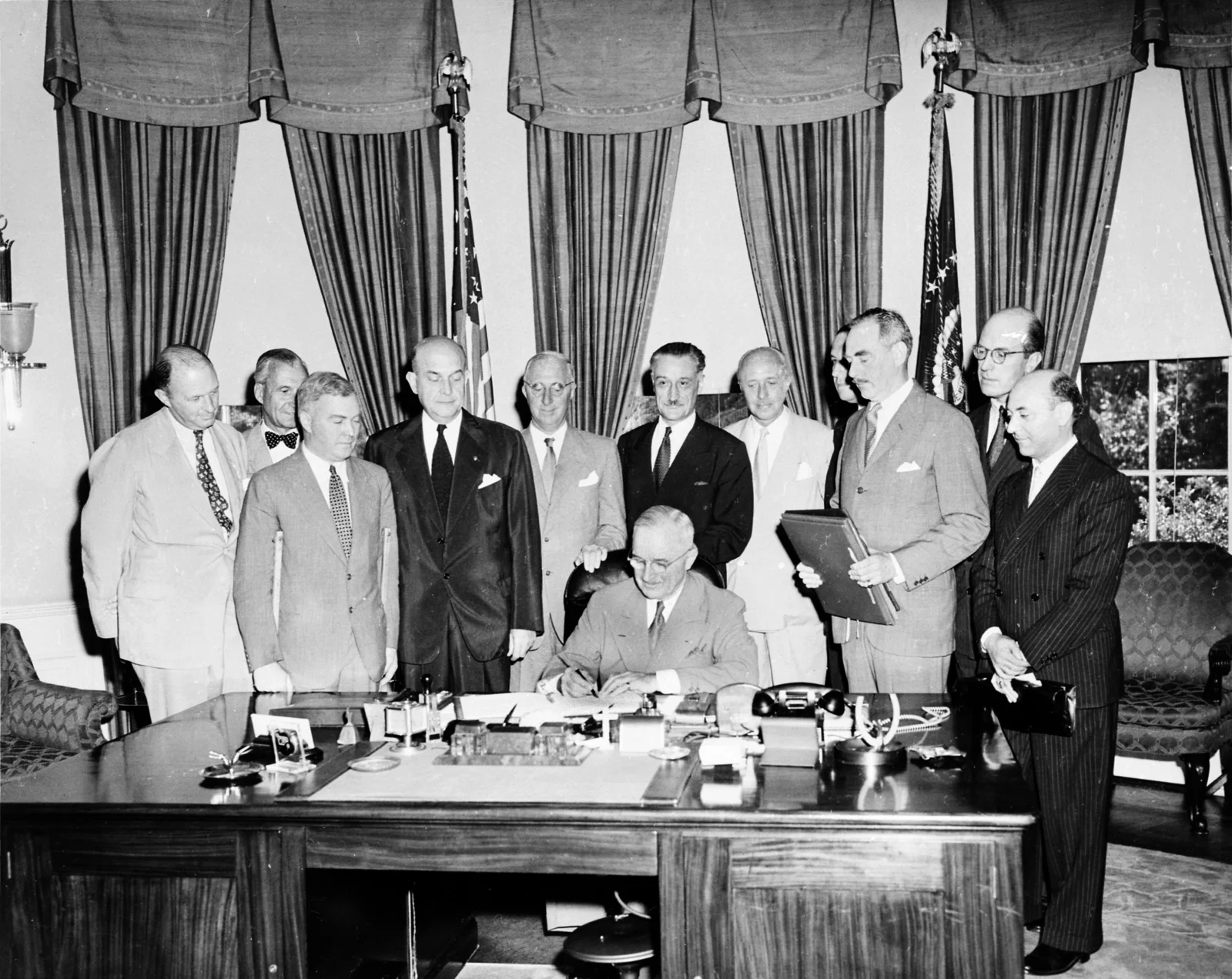
Secretary of State Dean Acheson and representatives of 11 other nations signed the North Atlantic Treaty on April 4, 1949.
Article 5
Article 5 of the Washington Treaty states that an armed attack against one or more members shall be considered an attack against them all, and commits each member to take "such action as it deems necessary," which can include armed force, to restore and maintain security. Each member decides for itself what response is necessary, so Article 5 is a political and moral commitment as much as an automatic trigger for war.
From 12 Members to 32
NATO expanded in waves throughout the Cold War and grew dramatically afterward as former Warsaw Pact and Soviet states sought the security guarantee it offered.
President Charles de Gaulle withdraws France from NATO's integrated military command structure while remaining a treaty member, forcing NATO headquarters to relocate from Paris to Brussels, Belgium, where it remains today.
De Gaulle gave NATO exactly one year's notice, forcing roughly 1,400 staff and their families to relocate along with the alliance's military and civilian headquarters by April 1967. France remained a full treaty member throughout, continuing to participate in NATO's political decision-making even while outside the military command.
De Gaulle objected to American and British dominance of the alliance and wanted France's own nuclear deterrent, the force de frappe, free of NATO's integrated command. He had proposed a three-power U.S.-U.K.-France directorate in 1958 and been rebuffed.
All non-French NATO forces left French soil by 1967, including roughly 26,000 U.S. personnel and dozens of bases and airfields. France kept liaison arrangements and rejoined some NATO military bodies over the following decades before its full return in 2009.
Poland, Hungary, and the Czech Republic join NATO, the alliance's first expansion into former Warsaw Pact territory after the Soviet Union's 1991 collapse.
Poland, Hungary, and the Czech Republic were formally invited at NATO's 1997 Madrid Summit and completed accession on March 12, 1999, mere weeks before the alliance marked its 50th anniversary and launched the Kosovo air campaign.
Expansion was contested from the start. Russia opposed it as a broken understanding, and the American diplomat George Kennan called it a "fateful error." Supporters argued that the new democracies had a sovereign right to choose their alliances and that NATO membership would stabilize Central Europe.
To manage relations with Moscow, NATO and Russia signed the 1997 Founding Act, creating a joint council and pledging no permanent stationing of "substantial combat forces" in the new member states, a commitment NATO maintained until after Russia's 2014 seizure of Crimea.
Seven more nations join in a single wave, Bulgaria, Estonia, Latvia, Lithuania, Romania, Slovakia, and Slovenia, the largest single expansion in NATO history and the first to include former Soviet republics.
The seven new members joined on March 29, 2004, bringing total NATO membership from 19 to 26 almost overnight. Several of these same countries joined the European Union just weeks later that May, tying their post-Cold War transformation to both alliances at once.
The three Baltic states, Estonia, Latvia, and Lithuania, had been Soviet republics until 1991, and their accession placed NATO territory directly on Russia's border along a significant frontier for the first time.
Because the Baltic states had almost no fighter aircraft of their own, NATO launched the Baltic Air Policing mission in 2004, rotating allied jets through bases in Lithuania and later Estonia to guard the airspace. The mission continues and was reinforced after 2014.
France, under President Nicolas Sarkozy, fully rejoins NATO's integrated military command structure after 43 years outside it.
President Sarkozy announced the decision in 2008 after a contentious debate in the French National Assembly, which approved the move 329 to 238. The formal return was completed at NATO's 60th anniversary summit in Strasbourg-Kehl in April 2009.
Sarkozy argued that France's outsider status had weakened its influence over NATO decisions and that rejoining would let it push for a stronger European role inside the alliance. France did not rejoin the Nuclear Planning Group, keeping its nuclear forces entirely national.
On its return, France took two senior NATO commands, including Allied Command Transformation in Norfolk, Virginia, the only major NATO command based in the United States. France remains among the alliance's largest military contributors.
Russia's 2022 invasion of Ukraine leads both historically neutral nations to abandon decades of non-alignment. Finland joins in April 2023 and Sweden in March 2024, bringing NATO to 32 members.
Finland's admission added an 830-mile border with Russia to the alliance, the longest shared by any NATO member. Sweden's accession was delayed for more than a year by objections from Turkey and Hungary before both ratified it in early 2024.
Finland and Sweden applied together in May 2022, ending a military non-alignment that Finland had held since 1948 and Sweden for roughly two centuries. Finnish public support for membership jumped from around a quarter before the invasion to more than three-quarters after it.
Turkey held up both bids over the applicants' handling of Kurdish groups it designates as terrorists, ratifying Finland in March 2023 and Sweden in January 2024; Hungary was the last to ratify Sweden, in February 2024. Sweden brought a capable navy and air force and the strategically placed Baltic island of Gotland.
NATO's principal political decision-making body, made up of permanent representatives from all member states. It operates by consensus, meaning every member has an effective veto over alliance decisions, a slower process than a majority vote but one that keeps the alliance unified once it acts.
The Council meets at least weekly at the ambassador level and periodically brings together heads of state, foreign ministers, or defense ministers. It was this body that decided within 24 hours of the September 11 attacks to invoke Article 5, pending confirmation the attacks were directed from abroad.
There is no formal vote. Decisions are reached when no member objects, and a "silence procedure" lets a proposal stand unless a country breaks silence before a deadline, so a reluctant member can let a decision pass without endorsing it.
Beneath the Council sit hundreds of subordinate committees covering defense planning, cyber defense, arms control, and civil emergency response. The Military Committee, composed of members' chiefs of defense, turns the Council's political decisions into military direction for NATO's commanders.
NATO's top civilian official, who chairs the North Atlantic Council and serves as the alliance's chief spokesperson. By tradition the post has always gone to a European; the position carries no independent command authority over military forces.
The position dates to 1952, when British General Lord Ismay became NATO's first Secretary General; terms typically run four years but have sometimes been extended by member consensus. The Secretary General also chairs the Nuclear Planning Group, NATO's senior body for nuclear policy consultations.
Fourteen people have held the post. Among the most consequential were Joseph Luns of the Netherlands, the longest serving, from 1971 to 1984; Javier Solana of Spain, who oversaw the 1999 Kosovo campaign; and Jens Stoltenberg of Norway, whose term was repeatedly extended after 2022 to a full decade.
The Secretary General is chosen by consensus of member governments through quiet consultation rather than a public campaign, and the deputy has by custom come from a different European country. Mark Rutte of the Netherlands took over the post in October 2024.
The senior military commander of NATO forces, a post held by an American general or admiral by tradition since NATO's founding, reflecting the outsized U.S. role in the alliance's military capability.
General Dwight D. Eisenhower became NATO's first Supreme Allied Commander Europe in 1951, years before his own presidency. The position is dual-hatted: the same officer simultaneously commands U.S. European Command, linking NATO's military structure directly to the U.S. chain of command.
SACEUR leads Allied Command Operations from SHAPE, the Supreme Headquarters Allied Powers Europe, at Mons in Belgium. Past holders include Alexander Haig and Wesley Clark, both of whom became prominent in American public life afterward.
Because one officer commands both NATO and U.S. forces in Europe, a U.S. president can move American troops without NATO involvement, but placing them under NATO's integrated command requires a North Atlantic Council decision. A second top commander, Supreme Allied Commander Transformation, has been based in Norfolk, Virginia, since 2003.
NATO has been headquartered in Brussels, Belgium since 1967, after France's 1966 withdrawal from the integrated military command forced a relocation from Paris.
NATO's current Brussels headquarters, opened in 2017 at a cost of more than $1.2 billion, replaced the original 1967 building, which had been built as a temporary facility but ended up serving the alliance for half a century.
The new complex covers about 250,000 square metres, and its design of eight interlocking "fingers" is meant to evoke members joining hands. It houses delegations from all 32 members plus partner missions and thousands of international civilian and military staff.
NATO's military nerve centers sit elsewhere: SHAPE at Mons, Allied Air Command at Ramstein in Germany, and Allied Maritime Command at Northwood in England. The civilian political headquarters and the military command structure are deliberately kept separate.
At the 2014 Wales Summit, member states agreed to a goal of spending at least 2 percent of GDP on national defense. It is a guideline, not a binding treaty obligation, and compliance has varied significantly by member and by year.
Compliance rose sharply after Russia's 2022 invasion of Ukraine, with roughly two-thirds of member states meeting or exceeding the 2 percent target by the mid-2020s, up from only a handful a decade earlier. At NATO's 2024 Washington Summit, allies began discussing whether to raise the benchmark even higher.
The 2 percent figure counts a country's total national defense budget, not payments to NATO. NATO's own common funding, for the headquarters, the command structure, and shared assets like the AWACS radar fleet, runs to only a few billion euros a year, divided among members by a GDP-based formula.
A companion Wales pledge asked members to spend at least 20 percent of their defense budgets on major new equipment. At the 2025 Hague Summit, allies went further, agreeing to a new target of 5 percent of GDP for defense and defense-related spending by the mid-2030s.
From Deterrence to Deployment
NATO spent its first four decades as a deterrent that never fired a shot. Since the 1990s it has conducted real military operations, from the Balkans to Afghanistan to supporting Ukraine.
Article 5 states that an armed attack against one member is an attack against all. It has been formally invoked only once in NATO's history, on September 12, 2001, the day after the September 11 attacks on the United States, when NATO's European and Canadian allies came to America's defense rather than the other way around.
Following the invocation, NATO launched Operation Eagle Assist, in which alliance AWACS surveillance aircraft flown by European and Canadian crews patrolled American skies, the alliance's first-ever operational deployment on U.S. soil.
The invocation was conditional at first. The Council acted on September 12 "if it is determined that the attack was directed from abroad," and confirmed it on October 2, 2001 after a U.S. briefing on al-Qaeda. It remained largely symbolic, since the United States chose to lead the Afghanistan campaign itself rather than as a NATO operation.
Concrete measures under the invocation included Eagle Assist, which ran from October 2001 to May 2002, and Operation Active Endeavour, naval patrols in the Mediterranean to deter terrorism and trafficking that continued until 2016.
NATO conducted Operation Deliberate Force, an air campaign against Bosnian Serb forces in 1995 that helped bring about the Dayton Accords ending the Bosnian War. In 1999, NATO launched a 78-day air campaign against Yugoslavia, Operation Allied Force, to halt the ethnic cleansing of Kosovar Albanians, without explicit UN Security Council authorization, a decision that remains debated.
The Dayton Accords were negotiated at Wright-Patterson Air Force Base in Ohio and formally signed in Paris in December 1995. The 1999 Kosovo campaign involved more than 38,000 sorties over 78 days and ended when Yugoslav forces agreed to withdraw from the province.
Deliberate Force flew about 3,500 sorties over roughly two weeks against Bosnian Serb air defenses, depots, and command sites, and, combined with a Croat-Bosniak ground offensive, pushed the parties to the table at Dayton.
The 1999 Kosovo campaign killed an estimated 500 civilians in Serbia by Human Rights Watch's count, and NATO mistakenly bombed the Chinese embassy in Belgrade. Afterward NATO deployed KFOR, a peacekeeping force that peaked near 50,000 troops and still operates in Kosovo today.
Following the Article 5 invocation after 9/11, NATO eventually took command of the International Security Assistance Force in Afghanistan in 2003, its largest and longest operational commitment, involving troops from nearly every member state until the 2021 withdrawal.
At its peak in 2011, ISAF included roughly 130,000 troops from 50 NATO and partner nations. The mission formally ended in December 2014, handing off to the smaller Resolute Support training mission that continued until the full withdrawal in 2021.
ISAF was created by a UN mandate in December 2001 and taken over by NATO in August 2003, the alliance's first operational mission outside Europe and North America. Over its life more than 50 countries contributed forces, and NATO members lost roughly 3,500 troops, the large majority American.
After ISAF ended, Resolute Support focused on training and advising the Afghan army and police. NATO withdrew its remaining forces in 2021 alongside the United States, and the Afghan government and military collapsed within weeks as the Taliban retook the country.
Since Russia's full-scale invasion of Ukraine in February 2022, NATO members have individually and collectively supplied weapons, training, and financial support to Ukraine, a non-member, while NATO itself has avoided direct combat involvement to prevent a direct NATO-Russia conflict. The invasion also drove Finland and Sweden to join the alliance.
At the 2023 Vilnius Summit, NATO established the NATO-Ukraine Council as a standing forum for consultation between the alliance and Ukraine, though no formal timeline for membership was set. Because most aid to Ukraine flows bilaterally from individual member states rather than NATO's own common funding, alliance members have collectively provided tens of billions of dollars in military assistance outside NATO's institutional budget.
NATO's own role has been defensive. It activated its response forces, placed 40,000 troops under direct NATO command on the eastern flank, and doubled its multinational battlegroups in eastern member states from four to eight, adding Bulgaria, Hungary, Romania, and Slovakia to the existing Baltic and Polish deployments.
The 2022 Madrid Summit adopted a new Strategic Concept naming Russia as "the most significant and direct threat" to allied security, reversing the 2010 document's hope for strategic partnership, and agreed to raise the number of high-readiness forces to more than 300,000.
Did You Know?
NATO's 12 founding members in 1949 were the United States, Canada, the United Kingdom, France, Belgium, the Netherlands, Luxembourg, Portugal, Italy, Norway, Denmark, and Iceland.
Iceland has no standing army of its own and has been a NATO member since 1949 based on its strategic North Atlantic location.
NATO's only Article 5 invocation was in defense of the United States, not by it, after the September 11, 2001 attacks.
The Supreme Allied Commander Europe has been an American officer for the alliance's entire history, a tradition rather than a treaty requirement.
NATO headquarters moved from Paris to Brussels in 1967 after France withdrew from the integrated military command in 1966.
NATO grew from 12 founding members in 1949 to 32 members by 2024, more than doubling in the three decades since the Cold War ended.