
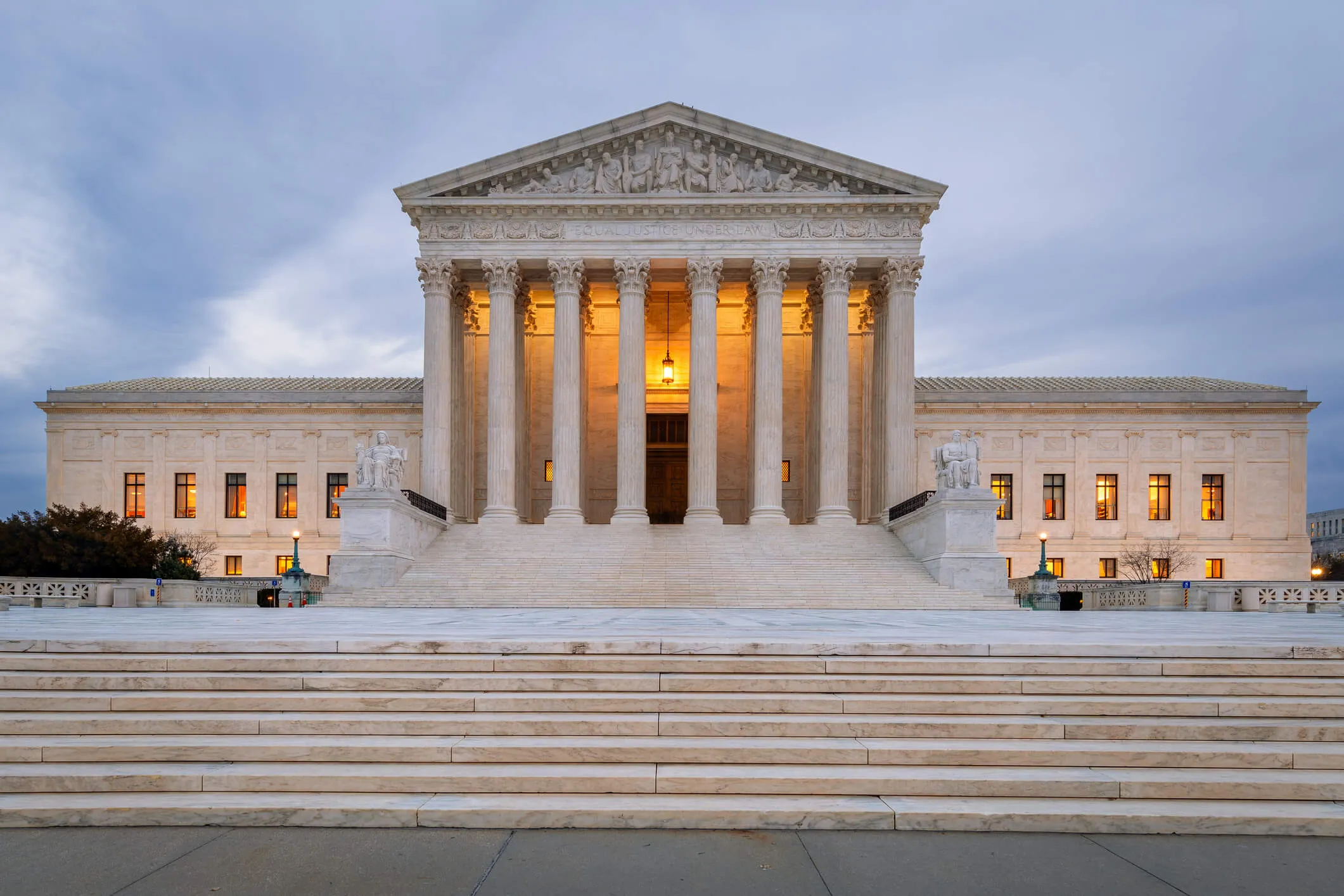
The Step-by-Step Journey
A case doesn't just show up at the Supreme Court. It has to survive a long, expensive climb through multiple courts, and then convince four justices it's worth their time. Tap any step to learn more.
It starts with a real dispute, a law you believe violated your constitutional rights, a federal agency that overstepped its authority, a contract dispute between people in different states, or a state court decision that you think got federal law wrong.
Federal courts can only decide an actual "case or controversy" under Article III, so there has to be a concrete injury, not just a disagreement about policy. A person also generally needs "standing," meaning they were personally harmed, the harm was caused by the defendant, and a court ruling could redress it. Abstract or hypothetical grievances are dismissed before they ever reach a judge.
The dispute also has to be "ripe" (the harm has happened or is imminent, not speculative) and not "moot" (still live, not already resolved by events). Courts will not issue "advisory opinions" telling the other branches whether a proposed action would be legal, a limit the Supreme Court set for itself in 1793 when it declined President Washington's request for legal advice.
Most disputes never become lawsuits at all. They are settled, dropped, or handled through an agency process first, and of the roughly 400,000 civil and criminal cases filed in federal district court each year, only a tiny fraction raise a federal legal question important or unsettled enough to have any chance of reaching the Supreme Court.
Your case starts at the trial level, either in one of the 94 U.S. District Courts (for federal matters) or in your state's trial court (for state matters that involve federal questions). This is where the facts are established, evidence is presented, and a judge or jury decides what happened.
The district courts are the workhorses of the federal system, with about 670 authorized judgeships handling roughly 350,000 to 400,000 new civil and criminal cases a year. Each state has at least one district; larger states have as many as four (California, New York, Texas). District judges are nominated by the president and confirmed by the Senate for life.
The great majority of cases end here. Well over 90 percent of federal criminal cases end in a guilty plea rather than a trial, and most civil cases settle or are dismissed before trial, so a full trial with a verdict is the exception, not the rule. A district judge's factual findings are given strong deference on appeal; only legal errors are readily reviewable.
The trial court also creates "the record," the transcripts, exhibits, and rulings, that every higher court, including the Supreme Court, will work from. Appellate courts do not gather new evidence, so anything not put into the record at trial is generally lost for the rest of the case.
If you lose at trial and believe a legal error was made, you appeal. For federal cases, that means one of the 13 U.S. Circuit Courts of Appeals. For state cases, it means your state's intermediate appellate court. These courts review whether the law was applied correctly, they don't re-hear the facts or call new witnesses.
Eleven of the circuits are numbered and cover groups of states (the Ninth Circuit, based in San Francisco, is the largest, covering nine western states plus Guam and the Northern Mariana Islands); the D.C. Circuit hears many challenges to federal agency rules; and the Federal Circuit has nationwide jurisdiction over patent, trade, and certain money claims against the government.
Appeals are normally heard by a randomly assigned panel of three judges, who decide by majority vote and issue a written opinion. In a small number of especially important cases, a circuit can rehear a case "en banc," with all of its active judges participating, to resolve a conflict within the circuit or overrule one of its own precedents.
For most litigants, the court of appeals is the last stop: it decides tens of thousands of cases a year, while the Supreme Court reviews only a few dozen. A circuit court's ruling is binding law throughout that circuit's states unless and until the Supreme Court or the full circuit says otherwise.
If your case started in state court and involves a federal or constitutional question, you must first exhaust your state appeals, all the way up to that state's highest court (usually called the Supreme Court, though some states use different names). Only then can you knock on the U.S. Supreme Court's door.
New York calls its top court the Court of Appeals (and confusingly calls its trial courts "Supreme Court"); Massachusetts and Maine use "Supreme Judicial Court"; Texas and Oklahoma split the job between a Supreme Court for civil cases and a Court of Criminal Appeals for criminal ones. Unlike federal judges, most state high-court justices face election or reappointment.
The U.S. Supreme Court can review a state court decision only to the extent it turns on federal law. If a state ruling rests on an "adequate and independent state ground," the state's own constitution or statutes, the Supreme Court has no power to disturb it, even if federal issues were also discussed.
State supreme courts collectively decide far more cases than the federal system, and on questions of that state's own law their word is final. The U.S. Supreme Court takes only a handful of cases from state courts each year, and does so mainly when a state ruling conflicts with federal law or with how other courts have read the U.S. Constitution.
You file a "petition for a writ of certiorari", a formal written request asking the Supreme Court to review your case. You have 90 days after the lower court's final decision to file. Your petition must explain why your case is important enough for the Supreme Court to spend one of its precious 60–80 annual case slots on it.
Certiorari, Latin for "to be more fully informed," became the Court's main tool for controlling its own docket after the Judges' Bill of 1925, which Chief Justice William Howard Taft pushed through Congress to let the Court decline most cases. Before 1925 the Court had to hear a large mandatory docket and was years behind.
The petition itself is a booklet capped by rule at 9,000 words. The filing fee is $300, but people who cannot afford it can file "in forma pauperis" for free, and thousands do; the Court keeps two separate dockets, the paid docket and the pauper docket, and grants review far more often from the paid one.
The other side may file a brief in opposition, and the Court will not usually grant a petition without giving it a chance to respond. Roughly 4,000 petitions arrive each year in recent terms, and the Court's staff and the justices' law clerks screen them, most through a shared "cert pool" in which one clerk writes a memo for several chambers.
📌 What goes in a certiorari petition?
- •The legal questions you want the Court to answer (stated as clearly as possible)
- •A summary of the lower court rulings and their reasoning
- •Why the case is nationally important, not just important to you
- •Whether there is a circuit split on this issue
- •The full record of the case below
The nine justices privately review petitions, often with help from their law clerks. If at least four of the nine justices vote to hear the case, certiorari is "granted" and the Court agrees to take it. This is called the "Rule of Four." If fewer than four want to hear it, cert is "denied", and the lower court's ruling stands.
The Rule of Four is a custom, not a written rule, dating to the 1925 Judges' Bill era; the justices adopted it to reassure Congress that a minority of the Court could still force a case onto the docket. Only a small fraction of petitions, most weeks, none, make the "discuss list" the Chief Justice circulates; everything left off is denied without a vote.
A denial of certiorari sets no precedent and expresses no view on whether the lower court was right. The Court has said this many times, because litigants and commentators often wrongly treat a denial as approval of the decision below.
The Court can also dispose of a case without full briefing and argument by issuing a short unsigned "per curiam" opinion, or by a "GVR" order that grants the petition, vacates the lower ruling, and remands for reconsideration in light of a recent decision. And it can dismiss a granted case as "improvidently granted" (a "DIG") if, after argument, it decides the case was a poor vehicle for the question.
🗂️ The "Discuss List"
Most petitions never even get a formal discussion among the justices. The Chief Justice circulates a "discuss list", only the petitions that at least one justice thinks is worth talking about make it on. The rest are denied automatically. Of the roughly 4,000 annual petitions, only a few hundred ever reach a real discussion.
Each side files written legal arguments called "briefs." The side that lost below (the petitioner) argues why the lower court was wrong. The other side (the respondent) argues why it was right. Outside parties, advocacy groups, other states, businesses, former officials, can file "amicus curiae" (friend of the court) briefs sharing their perspective.
Merits briefs are capped at 13,000 words and are printed as small booklets in a format the Court still specifies down to the color of the cover (petitioner blue, respondent red, amicus in support of petitioner green, and so on). The petitioner also gets to file a shorter reply brief last.
Amicus briefs have exploded in number: a major case now routinely draws dozens, and blockbuster cases have drawn well over 100. Studies find the justices and their clerks do read them, especially briefs from the Solicitor General, states, and subject-matter experts, and majority opinions frequently cite facts or arguments that first appeared in an amicus brief.
The written briefs, not the oral argument, do most of the work. Justices and clerks form tentative views from the briefs and the record; oral argument is mainly a chance to test those views and probe the weak points each side would rather avoid.
Each side gets roughly 30 minutes to argue their case in person before all nine justices, for about an hour per case, though the Court often runs well over. The justices interrupt with questions almost from the first sentence. These sessions are open to the public in the Court's chamber and are audio-recorded and released.
The Court hears arguments on a set of days from October through April, usually two or three cases a morning, in a courtroom that seats only a few hundred people. There are no cameras; no video has ever been broadcast from the chamber, and the Court began releasing same-day audio only in 2020, during the pandemic, when it also switched temporarily to telephone arguments.
Since the telephone arguments of May 2020, kept when in-person sessions resumed in October 2021, the Court has added a round of turn-taking questioning at the end of each side's time, in which each justice may ask questions in order of seniority with fewer interruptions, a change made partly in response to research showing female advocates and justices were interrupted disproportionately.
The lawyer at the lectern is called "counsel" and addresses the bench as "Your Honors" or a specific justice as "Justice [Name]." A white light warns that time is nearly up and a red light means stop, though a justice's question in progress is always answered. The federal government's advocate, from the Solicitor General's office, appears in a formal morning coat, a tradition few private lawyers still follow.
🎤 What oral arguments are (and aren't)
Oral arguments are not speeches. Attorneys rarely get through more than a sentence or two before a justice interrupts with a question. The justices often use the arguments to talk to each other through the attorneys, signaling their thinking, pushing back on colleagues' hypothetical questions, or floating a rationale they're considering. Occasionally a justice passes entirely and asks no questions at all, which becomes news.
After arguments, the justices meet in total secrecy, no clerks, no staff, no recordings. The Chief Justice speaks first, then each associate justice in order of seniority. They discuss the case and take a preliminary vote. The most senior justice in the majority assigns who will write the majority opinion.
The conference room is guarded, and by tradition the most junior justice sits nearest the door and acts as "doorkeeper," passing messages in and out. Notes taken by justices over the years (published after their deaths) are historians' main window into how cases were actually decided.
The initial vote is tentative. Justices routinely change their minds as draft opinions circulate, and a 5-4 majority can flip if the draft fails to hold five votes, which is one reason opinions in close cases take months. If the Chief Justice is in the dissent, the senior associate justice in the majority makes the assignment.
The Court also holds conferences roughly weekly during the term just to vote on which new petitions to grant, using the Chief Justice's "discuss list." A justice who was appointed after argument, or who is recused, does not participate, which is how the Court can decide a case 4-4, leaving the lower ruling standing with no national precedent.
The assigned justice drafts the majority opinion, the official ruling of the Court explaining the decision and the legal reasoning. Other justices can join, write concurrences (agreeing with the outcome but for different reasons), or write dissents (disagreeing with the outcome entirely). Opinions are circulated, debated, and revised, sometimes for months.
Law clerks, four per justice, typically 26-to-32-year-old recent top law-school graduates, do much of the first drafting and research, though the degree of a justice's personal editing varies. A former clerkship at the Court is now almost a prerequisite for arguing before it and a common step toward a federal judgeship.
An opinion is not final until it is announced. Justices send around memos joining, or refusing to join, specific sections, and a majority opinion sometimes loses its fifth vote late and becomes a plurality, or a strong dissent persuades enough colleagues to become the majority. Bush v. Gore and the 2012 health-care case are both reported to have shifted during drafting.
The finished opinion is released as a "slip opinion," later corrected and bound into the official United States Reports. Only the majority (or plurality) opinion is binding law; concurrences and dissents are persuasive at most, though a famous dissent, such as Justice Harlan's in Plessy v. Ferguson, can supply the reasoning a later Court uses to overrule the majority.
✍️ Types of opinions
- •Majority opinion, Signed by enough justices to constitute a majority (5+). This is the binding law.
- •Plurality opinion, The most-joined opinion when no single opinion gets 5 votes. Binding in outcome but weaker as precedent.
- •Concurrence, A justice agrees with the outcome but for different or additional reasons.
- •Dissent, A justice disagrees with the outcome. Not binding law, but influential, future Courts often cite great dissents when overturning decisions.
- •Per curiam, An unsigned opinion issued 'by the Court' as a whole, usually for brief, unanimous decisions.
The Court announces decisions on Opinion Days, typically from late fall through late June. The author of the majority opinion reads a summary from the bench. Dissenting justices sometimes read their dissents aloud, a rare signal of deep disagreement. The decision is immediately binding on all lower courts across the country.
The Court almost always clears its entire argued docket before its summer recess, so the biggest and most divided cases tend to land in the last days of June. It does not announce its schedule in advance, and there is no live video, so reporters and the public watch a running website feed and the courtroom itself.
A Supreme Court ruling settles the case for the parties and sets a nationwide precedent, but the Court cannot make anyone comply. Enforcement depends on lower courts, the executive branch, and public acceptance, which is why episodes like the slow, resisted implementation of Brown v. Board of Education ("all deliberate speed") are studied as tests of the Court's real power.
A losing party's only routes forward are narrow: ask the same Court to reconsider (rarely granted), wait for a future case with different facts, seek a change in the underlying statute from Congress or a state legislature, or, for a constitutional ruling, pursue a constitutional amendment. Congress has occasionally responded to a decision within months, as it did after several employment-discrimination rulings in 1991 and 2009.
What Makes the Supreme Court Say "Yes"?
The Supreme Court isn't required to explain why it denies a petition, and it usually doesn't. But decades of patterns reveal what actually drives a "yes." The most important factor, by far, is a circuit split. Everything else is secondary.
Circuit Split
Very HighThis is the single biggest reason the Court takes a case. If the 5th Circuit and the 9th Circuit have ruled opposite ways on the same federal legal question, Americans in different states have different legal rights. The Supreme Court steps in to resolve the conflict and create one uniform national rule.
The Court's own Rule 10, which lists the "considerations governing review on certiorari," puts a conflict among the circuits, or between a circuit and a state high court, at the top. Petitions are drafted specifically to feature a split, and the opposing brief often argues there is no "real" or "mature" split, that the cases can be reconciled or that too few courts have weighed in.
Splits matter because the federal courts of appeals are the effective last word for the whole country in the vast majority of cases; only the Supreme Court can bind all of them at once. A well-developed split where several circuits have taken each side, sometimes called a "deep" split, is close to an automatic grant.
The Solicitor General frequently flags splits for the Court in cases where the United States is not a party, and the justices sometimes hold a petition to let more circuits rule first, letting the issue "percolate" so they can decide it with the benefit of several reasoned opinions on each side.
Important Constitutional Question
Very HighCases that require the Court to interpret the Constitution for the first time, or to revisit a prior interpretation, are strong candidates. When a lower court strikes down a law as unconstitutional, or upholds one that may be unconstitutional, the Court tends to get involved.
The Court is especially likely to grant review when a lower court has held a federal statute unconstitutional, since leaving an act of Congress void in one part of the country without Supreme Court review is a serious step. Rule 10 lists this as a specific reason favoring a grant.
"Important" is doing a lot of work: the question usually has to be one that will recur, that other branches and lower courts genuinely need answered, and that this particular case presents cleanly, without procedural tangles that would let the Court duck the merits. A great constitutional question in a bad "vehicle" is often passed over for a cleaner case later.
The Court also sometimes takes a constitutional case with no split at all when the stakes are national and time-sensitive, election disputes, separation-of-powers clashes between the president and Congress, or emergency challenges to major federal programs, occasionally hearing them on an expedited schedule.
The Government Is a Party
HighWhen the U.S. federal government, through the Solicitor General, asks the Supreme Court to hear a case, the Court grants certiorari at an unusually high rate. The Solicitor General is sometimes called the 'tenth justice' because of this influence.
The Solicitor General's office, a small unit in the Justice Department, decides which of the government's many losses in the lower courts are worth taking up, filing only a few dozen petitions a year, and the Court grants a large share of them, historically on the order of 70 to 80 percent, versus under 1 percent for private parties.
That credibility is built on restraint and candor: the office confesses error when the government won a case it should have lost, declines to defend positions it thinks are wrong, and is expected to give the Court an accurate picture of the law even against its own client's short-term interest. Losing that reputation would cost the office its influence.
The Court also regularly "calls for the views of the Solicitor General" (a "CVSG") in private cases, effectively asking the federal government whether it should grant review; the Court follows that recommendation the large majority of the time.
National Significance
HighThe case involves a legal question that will affect millions of people, major industries, or the structure of government itself. The Court is more likely to take cases where its answer will have broad, lasting impact, not just settle a one-time dispute between two parties.
Rule 10 explicitly says review is rarely granted merely to correct a wrong decision in a single case; the question has to be "an important question of federal law" that "should be settled by this Court." A large dollar amount or a sympathetic party is not enough on its own.
Cases touching whole sectors of the economy, securities regulation, patents, health-insurance rules, immigration enforcement, environmental permitting, tend to attract many amicus briefs from trade groups and states, which itself signals to the Court that the answer matters beyond the parties.
The Court has finite capacity, roughly 60 to 70 argued cases a year out of roughly 4,000 petitions, so it functions less like an error-correcting court of last resort and more like a national policy court, choosing the questions where a single authoritative answer is most needed.
Lower Court Strayed from Supreme Court Precedent
Moderate–HighIf a circuit court or state supreme court issued a ruling that the Supreme Court believes directly conflicts with one of its own prior decisions, the Court may take the case to correct the deviation and reaffirm its precedent.
Lower courts are bound to follow Supreme Court precedent even when they think it is outdated; the Supreme Court has said only it may overrule its own cases. A circuit that reads a precedent narrowly to avoid applying it, or predicts the Court will soon abandon it, risks a summary reversal.
These grants are often quick and one-sided: the Court may not even schedule argument, instead issuing a short per curiam opinion reversing the lower court and quoting its own precedent back at it. Justices sometimes note publicly when they think a circuit is defying the Court.
The flip side is that a lower court flagging a precedent as unworkable, with several judges writing separately to urge reconsideration, can prompt the Court to grant review in order to reconsider the precedent itself, as happened in the run-up to several recent overrulings.
Recurring Issue
ModerateIf the same legal question keeps coming up across the country in many different courts, the Supreme Court knows it will keep getting petitions on the same issue until it answers definitively. Taking one clean case to settle it is more efficient than letting confusion fester.
The Court prefers to wait until an issue has "percolated," meaning several courts of appeals have decided it and written full opinions exploring the arguments, so the justices can choose the best-reasoned case and the best factual vehicle rather than deciding a hard question cold.
Issues that arise in fast-moving areas, technology, elections, immigration, emergency public-health powers, can recur so quickly that the Court steps in sooner than usual, sometimes through its "emergency docket" of stay applications rather than a normal merits case.
A question that is important but "evades review," because it keeps becoming moot before a case can be fully litigated (short election cycles, for instance), gets special treatment under a doctrine allowing the Court to hear disputes "capable of repetition, yet evading review."
🎯 The Solicitor General, The "Tenth Justice"
The Solicitor General is the federal government's top lawyer before the Supreme Court, a presidentially appointed official who decides which government cases go to SCOTUS and argues them on behalf of the United States.
When the Solicitor General files a petition for certiorari, the Court grants it at a rate of about 70–80%, compared to less than 1% for everyone else. When the SG files an amicus brief recommending the Court take (or decline) a case, the Court follows that recommendation roughly two-thirds of the time.
This extraordinary influence has earned the Solicitor General the informal nickname "the tenth justice." The office filters and shapes the federal government's legal positions so carefully that justices have come to rely on it as a trusted guide to which cases actually deserve attention.
What Doesn't Work
✗ "You think the lower court was unfair to you"
The Supreme Court doesn't take cases just to give someone a second chance. Error correction isn't its job, that's what the circuit courts are for.
✗ "Your case involves a lot of money"
High dollar amounts don't move the needle. What matters is the legal principle at stake, not the dollar figure.
✗ "Famous or sympathetic people are involved"
Celebrity, media attention, or public sympathy don't factor into certiorari decisions. The legal question must be significant regardless of who's involved.
✗ "You disagree with the ruling on principle"
The Court isn't an ethics board. Petitioners who argue 'this decision is morally wrong' without a constitutional or legal hook don't get far.
The Three Ways a Case Reaches SCOTUS
There isn't just one route to the Supreme Court. Cases can arrive from the federal court system, from state court systems, or, in rare situations, go straight to SCOTUS without any lower court at all.
Via a U.S. Circuit Court
~70% of SCOTUS cases- U.S. District Court (trial)
- U.S. Court of Appeals (one of 13 circuits)
- Petition for Certiorari → Supreme Court
The most common path. A federal case that travels up through the federal court hierarchy.
Via a State Supreme Court
~30% of SCOTUS cases- State Trial Court
- State Intermediate Appeals Court
- State Supreme Court
- Petition for Certiorari → Supreme Court
A state court case that involves a federal or constitutional question. Must exhaust all state appeals first.
Original Jurisdiction (Rare)
~1–2 cases per decade- Filed directly in the Supreme Court, no lower court first
The Constitution gives the Supreme Court original jurisdiction over disputes between two states (e.g., water rights, border disputes) and cases involving ambassadors. These go straight to SCOTUS.
Certiorari vs. Appeal, What's the Difference?
📨 Certiorari (Discretionary)
The Court chooses whether to hear the case. This is how the vast majority of SCOTUS cases arrive. The justices have full discretion, they can say no for any reason or no reason. A denial is not a ruling on the merits.
📬 Appeal (Mandatory)
In a narrow set of cases defined by federal statute, the Supreme Court is required to hear an appeal. These are rare, mostly involving decisions where a federal court struck down a federal law, or three-judge district court panels in certain election cases.
How Long Does the Whole Process Take?
Bottom line: From the incident that starts a case to a Supreme Court decision, it is common for 5 to 10 years to pass. Some took even longer. Justice is rarely fast.
Common Myths, Busted
Most people's mental picture of the Supreme Court comes from TV dramas and news headlines. Here's what the process actually looks like versus the myths.
Reality: Almost no one actually gets in. The Court receives around 4,000 petitions a year and accepts about 2 percent of them, typically 60 to 80 cases. The rest are denied without explanation, and the lower court's ruling stands.
Under the Court's own 'Rule of Four,' just four of the nine justices need to agree to hear a case, meaning a case can be accepted for review even though it would go on to lose by a 5-4 vote on the merits.
Reality: The Supreme Court does not rehear evidence, call witnesses, or re-examine the facts. It only decides legal questions, whether the law was applied correctly, or whether a constitutional right was violated.
Because the Court works only from the trial record and written briefs, oral argument is limited to just 30 minutes per side, and the justices frequently interrupt with questions rather than letting attorneys deliver prepared remarks.
Reality: A Supreme Court decision is final and binding. While the Court can technically overturn its own precedent in a future case (as it did with Roe v. Wade in 2022), there is no higher court to appeal to and no automatic mechanism for revisiting a decision.
The main way a losing party can revisit the same issue is if Congress passes a new law addressing it, or if a future case presents a materially different set of facts that the Court agrees to hear.
Reality: Justices have judicial philosophies, textualism, originalism, living constitutionalism, and prior opinions that signal how they tend to think. Law clerks and attorneys research a justice's past rulings extensively before writing briefs or preparing oral arguments.
Unlike lower federal courts, the Supreme Court historically had no binding code of conduct enforced by another body; the Court adopted its first formal ethics code in November 2023, with recusal decisions still left largely to each justice's own judgment.
Reality: When the Court denies cert, it says nothing about whether the lower court was right or wrong. It simply means four justices didn't think this was the right case to use for resolving that legal question right now.
Justices occasionally publish a written dissent from a cert denial, explaining why they believe the Court should have taken the case, though these public dissents from denial are the exception rather than the rule.
What a Supreme Court Decision Actually Does
When the Supreme Court issues a ruling, it doesn't just decide the case between the two parties in front of it. Its decisions are binding precedent for every court in the United States, federal and state. Every judge in the country must apply that ruling.
If the Court rules that a law is unconstitutional, that law is effectively struck down nationwide, even in states that supported it. If the Court rules that a constitutional right exists, or doesn't, that answer applies to every American immediately.
That's why so few cases are accepted. Each one has the potential to reshape law, policy, and daily life for about 342 million people.
🏛️ Famous examples of SCOTUS decisions that changed everything:
- •Brown v. Board of Education (1954), Declared racial segregation in public schools unconstitutional, overturning 'separate but equal.'
- •Miranda v. Arizona (1966), Required police to inform suspects of their rights before interrogation, creating what we now call 'Miranda rights.'
- •Roe v. Wade (1973) / Dobbs v. Jackson (2022), Established a constitutional right to abortion in 1973, then overturned that ruling in 2022, returning the issue to individual states.
- •Obergefell v. Hodges (2015), Made same-sex marriage a constitutional right nationwide.