
About Oklahoma
Oklahoma takes its name from the Choctaw words "okla" (people) and "humma" (red), meaning "red people," a term used by the Choctaw Nation to describe Native Americans collectively. When the federal government negotiated the removal of the Five Civilized Tribes from the Southeast to Indian Territory in the 1830s, Allen Wright, a Choctaw chief who participated in the post-Civil War treaty negotiations, suggested the name Oklahoma for the territory. The name was formally adopted when Oklahoma Territory was organized in 1890 after the federal government opened the territory to non-Native settlement, beginning with the famous Land Run of 1889. Oklahoma became a state in 1907, incorporating both Oklahoma Territory and Indian Territory.
Oklahoma is a state built on contradictions and carried forward by resilience. It was Indian Territory before it was a state, the land promised in perpetuity to the Five Civilized Tribes and dozens of other nations forcibly relocated from the East, only to be opened to white settlement in a series of land runs that defined the state's character and gave it its name. More tribal nations call Oklahoma home than any other state, and the 2020 McGirt decision reminded the country that the promises of those original removal treaties are not yet finished business.
The red clay soil, the oil derricks on the Capitol lawn, the memory of Black Sunday's dust storms, the 168 empty chairs at the Oklahoma City National Memorial, Oklahoma's identity is inseparable from its most difficult history. But it is also the state of Will Rogers's wit, Woody Guthrie's music, Jim Thorpe's athleticism, and the Tulsa skyline rising from Art Deco buildings funded by the same oil boom that dispossessed the Osage of their wealth and their lives.
The Oklahoma of today is a state in genuine transition: growing cities drawing young workers from across the region, tribal nations building economic institutions of national significance, wind turbines replacing oil derricks across the western plains, and a university system producing graduates who increasingly choose to stay. The contradictions have not been resolved. But Oklahoma has never been a state that waited for resolution before moving forward.
Oklahoma's Five Regions
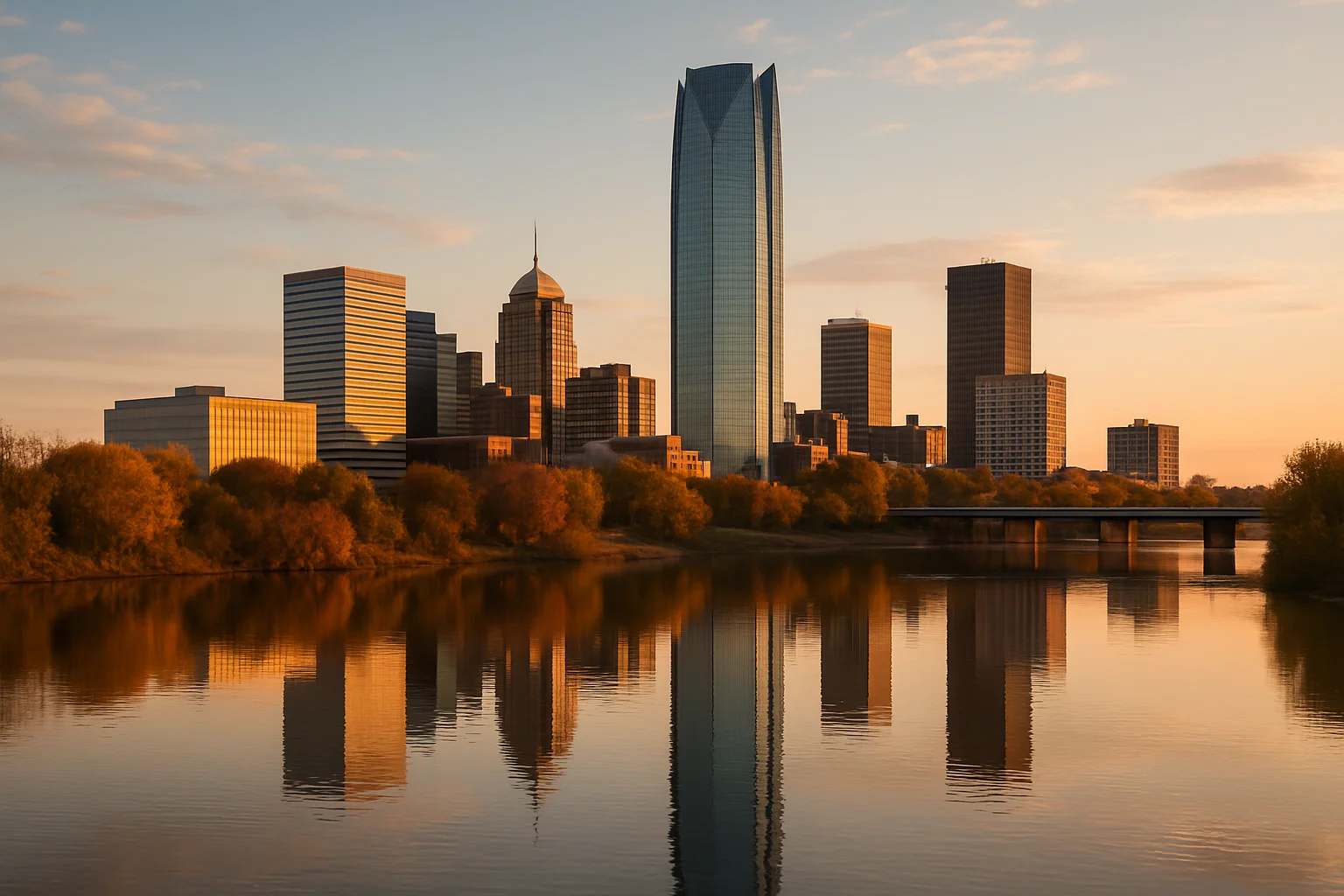
Oklahoma City, the state capital and largest city with a metropolitan population exceeding 1.4 million, is one of the fastest-growing large cities in the South-Central United States, a sprawling, car-dependent metropolis covering more land area than any comparably sized American city, built atop one of the only active urban oil fields in the world. The State Capitol, completed in 1917 and famous for the working oil derricks on its grounds, anchors a government district that has been joined by a revitalized downtown centered on Bricktown (a converted warehouse district) and the Scissortail Park entertainment complex.
The Chesapeake Energy Arena (now Paycom Center), home of the Oklahoma City Thunder NBA franchise, which arrived from Seattle in 2008 and immediately became the city's most powerful unifying force, has driven downtown development and made Oklahoma City a destination for sports tourism. The city's energy economy, anchored by Devon Energy's 50-story tower, the Devon Energy Center (the tallest building in Oklahoma), and dozens of other oil and gas companies, gives downtown a scale that surprises visitors expecting a provincial capital.
The National Memorial on the former site of the Alfred P. Murrah Federal Building, where 168 people were killed in the April 19, 1995 bombing, is among the most emotionally affecting commemorative sites in the United States, its 168 empty chairs, one for each victim, arranged in the footprint of the destroyed building, are an image of loss that requires no explanation.
The broader OKC metro has grown dramatically through annexation and suburban expansion, with Edmond, Norman (home of the University of Oklahoma), Moore, Yukon, and Mustang forming a continuous suburban fabric that extends 30 or more miles in every direction from the city center.
Northeastern Oklahoma, known locally as 'Green Country' for its trees, lakes, and rolling hills, a landscape entirely unlike the flat plains that most Americans associate with Oklahoma, is the most densely populated and economically diverse region in the state outside the OKC metro. Tulsa, Oklahoma's second city with a metropolitan population approaching 1.1 million, was built on oil money: the Glenn Pool discovery in 1905 and subsequent Osage Hills oil booms created fortunes that funded the Art Deco architecture that makes Tulsa's downtown one of the most architecturally coherent in the South, the Philbrook Museum of Art (a Villa-style palazzo and gardens donated to the city in 1938 by oilman Waite Phillips), the Gilcrease Museum (the world's largest collection of art and artifacts related to the American West, donated by oil heir Thomas Gilcrease), and the University of Tulsa.
Green Country is also the heartland of the Cherokee Nation, whose tribal headquarters in Tahlequah is within 45 minutes of Tulsa, whose citizens represent hundreds of thousands of people across the region, and whose economic enterprises have grown into a multibillion-dollar conglomerate.
The Greenwood District of Tulsa, once known as 'Black Wall Street', the wealthiest African American community in the United States, was destroyed in the Tulsa Race Massacre of 1921 and has been the subject of decades of commemoration and reparations debate.
The Gathering Place, a privately funded 100-acre park on the Arkansas River waterfront donated by the Kaiser family, opened in 2018 and immediately became one of the most acclaimed new public parks in America, transforming Tulsa's riverfront and providing a gathering space that reflects the city's aspirations as much as its oil heritage.
Western Oklahoma, stretching from the wheat fields of the northwest through the red clay ranching country of the southwest to the three-county panhandle that juts west between Kansas and Texas, is the Oklahoma of popular imagination: flat, wide, windswept, and defined by agriculture and oil. The panhandle's three counties, Cimarron, Texas, and Beaver, were called 'No Man's Land' before statehood because a surveying error and the Missouri Compromise's latitude restrictions left them unattached to any territory; settlers who moved there in the 1880s were technically operating outside any legal jurisdiction.
The region sits atop the Ogallala Aquifer, whose water has enabled intensive irrigation agriculture but whose depletion rate far exceeds natural recharge, making the long-term future of agriculture in the panhandle one of the most pressing sustainability questions in the American Great Plains. The Dust Bowl of the 1930s was centered precisely on this region: the massive drought and soil erosion that produced the black blizzards, walls of dust thousands of feet high that rolled across the plains, burying farms, killing cattle, and driving hundreds of thousands of Oklahomans off their land, was most severe in the panhandle and the adjacent southwestern counties.
Families who fled became the 'Okies' of John Steinbeck's The Grapes of Wrath, their migration along Route 66 to California becoming one of the most powerful narratives of American poverty and displacement in the 20th century. The western plains also host the large majority of Oklahoma's wind energy capacity: the Panhandle Wind Farm, the Canadian Hills Wind Farm, and dozens of other installations cover the landscape with turbines that generate electricity for the regional grid.
Western Oklahoma is Tornado Alley's core. The town of Moore, on the OKC metro's southern edge, has been struck by violent tornadoes in 1999, 2003, and 2013, and the May 3, 1999, storm produced a radar-measured wind of 302 miles per hour near Bridge Creek, one of the highest wind speeds ever measured on Earth; the May 31, 2013, El Reno tornado was the widest ever documented at 2.6 miles and killed several veteran storm chasers. The National Weather Center and the federal Storm Prediction Center are based in Norman for exactly this reason.
The region also carries a large Plains-tribe presence relocated here in the 1870s: the Kiowa, Comanche, and Apache around Anadarko and Lawton, the Cheyenne and Arapaho across a wide stretch of the west, and the Wichita and Caddo near Anadarko, whose annual expositions and powwows are among the largest in the country. Fort Reno and Fort Sill were the military posts that enforced those confinements.
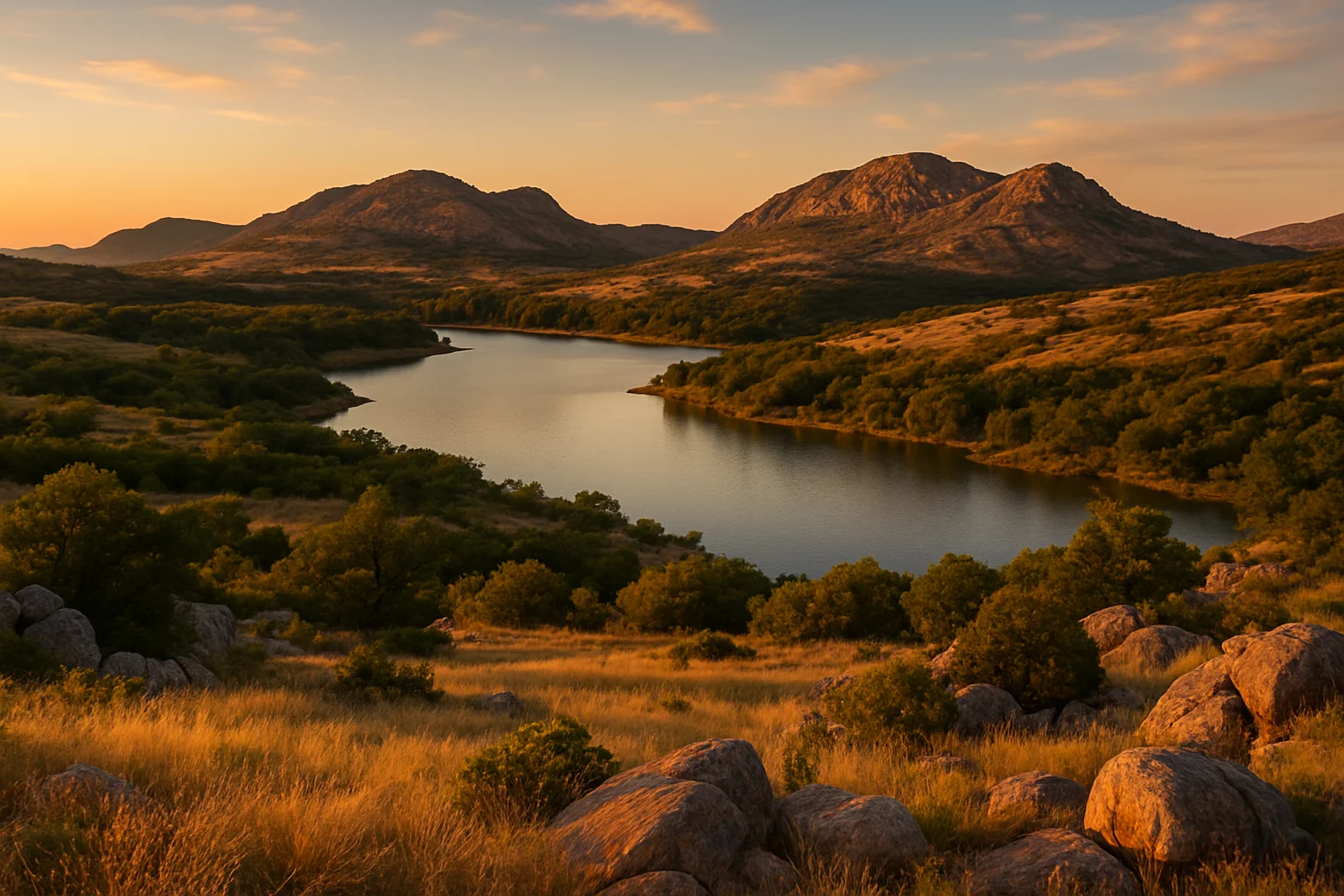
The southwestern quarter is red-dirt cattle and cotton country anchored by Lawton, Oklahoma's fourth-largest city and Fort Sill's company town, and by the granite Wichita Mountains, some of the oldest exposed rock in North America and home to a bison and longhorn refuge established in 1901. Weatherman-and-oilfield culture aside, much of rural western Oklahoma has been losing population for decades as farms consolidate.
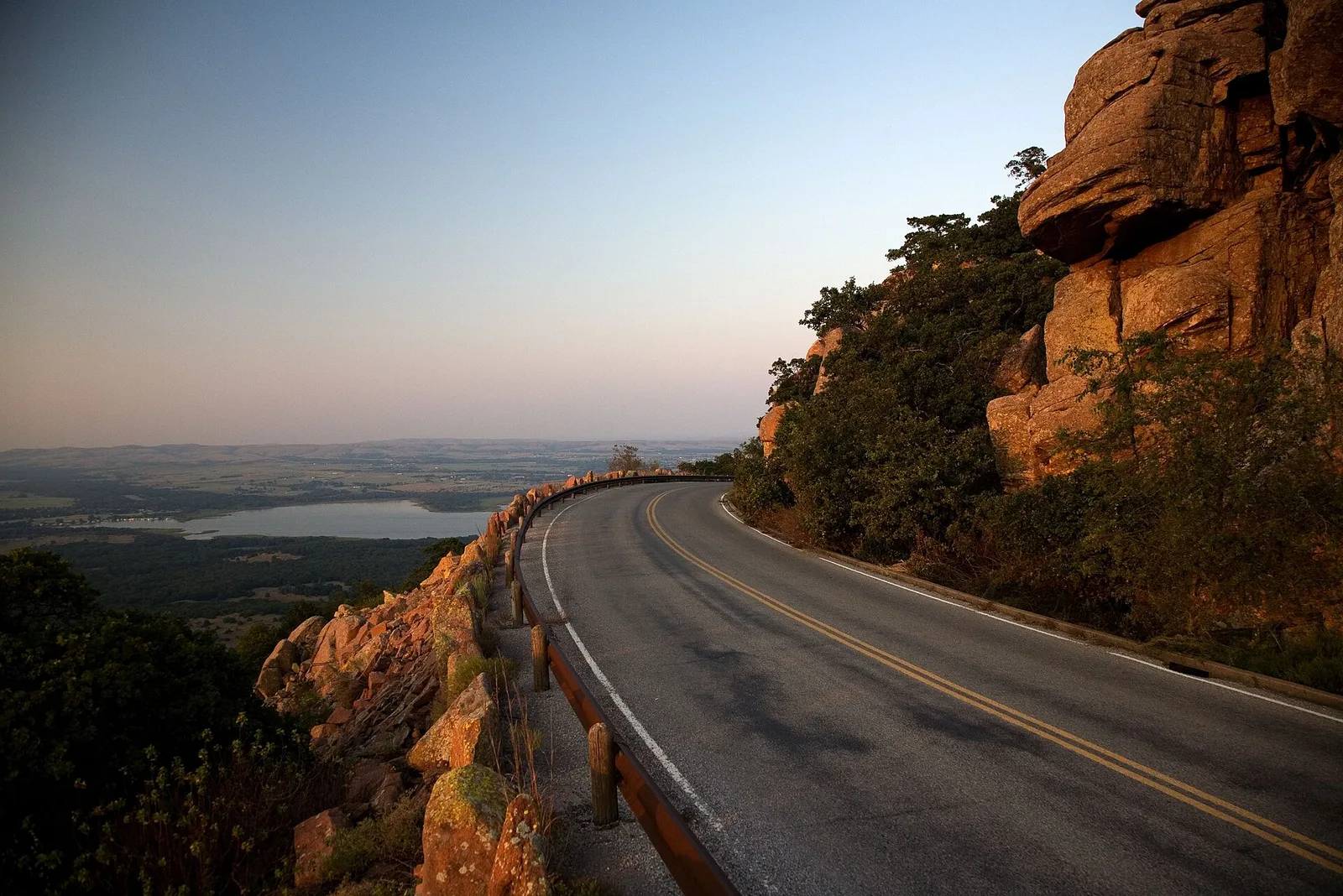
Southeastern Oklahoma, the corner of the state bordered by Arkansas to the east and Texas to the south, is the most topographically dramatic and the most economically distressed part of Oklahoma, a region of genuine mountain wilderness, deep poverty, and the homeland of the Choctaw Nation. The Ouachita Mountains, whose ridges extend from central Arkansas into southeastern Oklahoma, reach their Oklahoma heights in the Sans Bois and Winding Stair ranges; the Talimena National Scenic Byway traverses this landscape along a mountain ridge with views extending 50 miles in clear conditions.
The Ouachita National Forest, shared with Arkansas, and the Ouachita River watershed provide habitat for black bear, mountain lion, and some of the most productive trout streams in the South. The Winding Stair Mountain National Recreation Area and the Ouachita Trail (approximately 200 miles of hiking from Talimena State Park in Oklahoma to Pinnacle Mountain State Park in Arkansas) attract hikers and outdoor recreation visitors.
The region was settled largely by migrants from the Upper South, Tennessee, Kentucky, Arkansas, whose cultural character earned southeastern Oklahoma the nickname 'Little Dixie': deeply Baptist, conservative, Democratic until very recently, and connected to Southern Appalachian traditions of music, storytelling, and subsistence agriculture. The Choctaw Nation's headquarters in Durant and its economic enterprises across the region are among the most significant development forces in southeastern Oklahoma, with Choctaw casinos, health clinics, and workforce programs serving both tribal citizens and the broader community in counties where other economic anchors are scarce.
The old economy was timber and coal. The Choctaw Nation leased its coalfields to railroads and mining companies in the late 1800s, drawing Italian, Welsh, and Eastern European miners to towns like Krebs, McAlester, and Hartshorne, and a 1892 explosion at Krebs killed about 100 men; the mines are long closed, but McAlester's Italian-heritage restaurants and the state's oldest brewery trace to that wave. Weyerhaeuser and other companies still run large pine plantations across the far southeast.
The federal government is a major presence: the Oklahoma State Penitentiary at McAlester, the state's maximum-security prison and death house, opened in 1908, and the McAlester Army Ammunition Plant nearby is one of the largest bomb-loading facilities in the country. Broken Bow and the Hochatown area near the Arkansas line have boomed since the 2010s as a cabin-and-lake vacation market for the Dallas metro, one of the few bright spots in the regional economy.
Southeastern Oklahoma is also ground zero of a long interstate water fight: Oklahoma, backed by a 2016 U.S. Supreme Court ruling, has blocked attempts by North Texas water districts to buy or pipe water from the Kiamichi River basin and Sardis Lake, and the Choctaw and Chickasaw nations settled a separate water-rights suit with the state in 2016 giving them a formal role in managing the region's water.
North-central Oklahoma, stretching from the Osage Nation's reservation in the northeast through the oil towns of the Arkansas River valley to the Cherokee Strip country along the Kansas border, is a region whose history combines extraordinary wealth, violent dispossession, and the quintessential Oklahoma experience of the land run. The Osage Nation, whose reservation covers the entirety of Osage County, the largest county in Oklahoma by area, sits atop some of the richest oil deposits in the state, and when oil was discovered on Osage land in the early 20th century, Osage citizens became the wealthiest people per capita in the world.
This wealth attracted swindlers, con men, and murderers: the Osage Indian Murders of the early 1920s, in which white men systematically killed Osage oil headright holders to inherit their wealth, were the subject of David Grann's 2017 book Killers of the Flower Moon and Martin Scorsese's 2023 film adaptation, bringing the story to international attention. Pawhuska, the Osage Nation capital, has been revitalized in part by the fame of the Pioneer Woman, Food Network personality Ree Drummond, whose ranch outside Pawhuska became the basis of a brand and a general store that draws visitors from across the country.
The Cherokee Strip, the band of land along the Kansas border that was the last major Oklahoma land run (September 16, 1893, the largest land run in history with 100,000 participants racing for 6 million acres), is remembered in Enid, Perry, and other strip cities through museums and annual celebrations.
Enid, the regional hub, is one of the most agriculturally productive cities in Oklahoma, sitting at the center of the wheat belt and hosting one of the largest grain storage complexes in the world.

Economy
Oklahoma's economy has been shaped by oil booms and busts for over a century, but the 21st-century state is broader than its petroleum heritage: tribal gaming, aerospace manufacturing, wind energy, and agriculture all play significant roles in a diversifying economy that is learning, slowly and unevenly, to hedge its bets against oil's volatility.
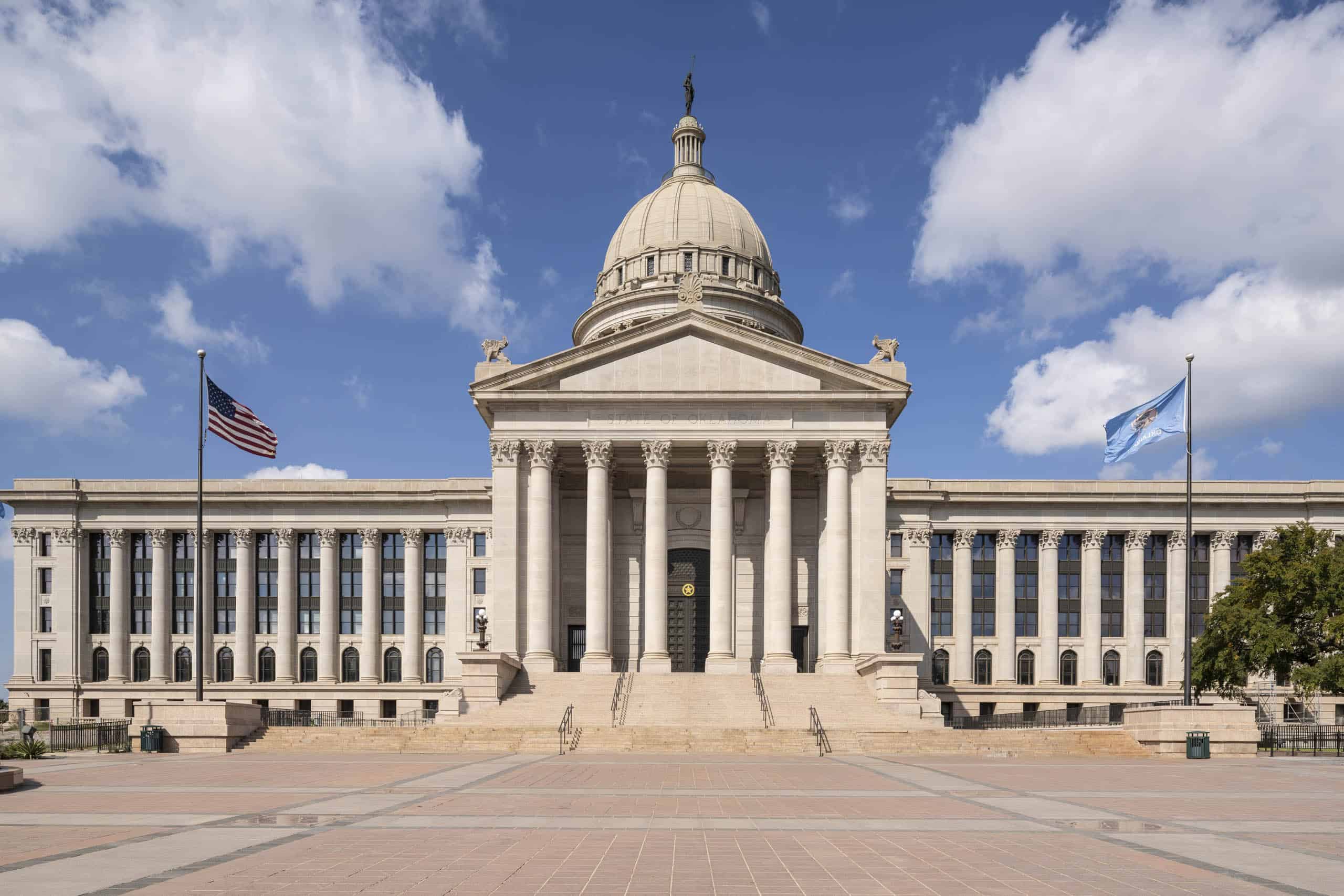
Oklahoma sits atop multiple producing formations: the Anadarko Basin in the west, one of the deepest sedimentary basins in North America and one of the most prolific natural gas producers in the United States; the Arkoma Basin in the east; and a series of conventional oil fields scattered across the central part of the state. The Oklahoma City skyline is framed by oil derricks on the State Capitol grounds, Oklahoma is the only state capitol building in the country sitting on an active oil field, with production wells operating since the 1920s on the capitol lawn and beneath the building itself.
Devon Energy, headquartered in Oklahoma City, is one of the largest independent oil and gas companies in the United States. Chesapeake Energy, founded in Oklahoma City by Aubrey McClendon and Tom Ward in 1989, became the second-largest natural gas producer in the country before its dramatic bankruptcy in 2016, the story of its rise and collapse is a parable of the natural gas boom and bust that mirrors Oklahoma's own boom-bust economic history.
Continental Resources, founded by Harold Hamm (who grew up in a sharecropping family in Enid), became one of the pioneering companies in Bakken Shale development and made Hamm a billionaire whose influence in Oklahoma politics and energy policy is pervasive. The oil and gas industry's volatility has been a defining characteristic of the Oklahoma economy: the state has experienced at least four major boom-bust cycles since statehood, each reshaping communities, politics, and public finance in its wake.
The most recent bust, triggered by the 2014-2016 oil price collapse, caused severe state budget shortfalls that forced cuts to education and public services and accelerated a teacher walkout in 2018 that drew national attention.
Oklahoma is consistently among the top five states in winter wheat production, with the western half of the state, particularly the wheat belt running through Alfalfa, Garfield, Major, and adjacent counties in the northwest, producing the hard red winter wheat that goes into bread flour and feeds both domestic and export markets. The Texas Longhorn cattle drives of the post-Civil War era established the Chisholm Trail through the heart of what became Oklahoma, and the cattle economy has persisted in various forms ever since.
Oklahoma regularly ranks in the top ten states for beef cattle numbers, with ranching operations distributed across the state from the eastern Cross Timbers to the western panhandle. The panhandle's three counties, Cimarron, Texas, and Beaver, were dubbed 'No Man's Land' before statehood because they were not legally part of any territory; today they are among the most intensively agricultural areas in the state, producing winter wheat, corn, sorghum, and cattle in a high-plains environment that also sits directly above the Ogallala Aquifer, whose depletion is an existential agricultural threat.
Oklahoma's agricultural diversity extends beyond wheat and cattle: the state is a significant producer of peanuts (in the southwestern counties), pecans, hogs, broiler chickens (in the southeastern corner), cotton, and sorghum. The strawberry festival in Stilwell (Cherokee County) reflects the fruit-growing economy of the eastern hills, where the wetter climate supports crops impossible in the arid west.
Oklahoma's wheat crop is often as much about grazing as grain: cattle are turned out on the green winter wheat from November to March in a 'dual-purpose' system found almost nowhere else, then pulled off so the plants can head out, and a poor grain price sometimes leads farmers to simply 'graze it out.' The state is also the beef-industry's staging ground, with vast wheat-pasture and native-grass 'stocker' operations that put weight on calves before they go to feedlots in the Texas and Kansas panhandles.
Hog farming grew explosively in the Oklahoma panhandle in the 1990s when Seaboard Foods built a huge slaughter plant at Guymon and contract barns spread across the high plains, making Texas County the top hog county in the state and drawing a large immigrant workforce; the industry's manure lagoons and its heavy draw on the Ogallala remain contentious. The 1990s corporate-hog boom also prompted a state constitutional ban, largely still in place, on corporate ownership of farmland.
The Ogallala Aquifer under the panhandle is the region's binding constraint: it is being pumped many times faster than it recharges, some panhandle wells have dropped 100 feet or more, and studies project that irrigated agriculture there has a finite horizon measured in decades, a slow-motion version of the Dust Bowl's water crisis.
Tinker Air Force Base on the southeastern edge of Oklahoma City is the largest single-site employer in Oklahoma, with approximately 26,000 military and civilian workers, and is home to the Oklahoma City Air Logistics Complex, the Air Force's premier aircraft and engine maintenance, repair, and overhaul facility, capable of working on virtually every aircraft in the Air Force inventory. The B-1 Lancer, B-52 Stratofortress, E-3 Sentry AWACS, and KC-135 Stratotanker are among the aircraft serviced at Tinker.
Fort Sill, near Lawton in southwestern Oklahoma, is one of the Army's primary field artillery training centers and home of the Air Defense Artillery School; it was also the site where Geronimo, the Apache leader, was held as a prisoner of war from 1894 until his death in 1909. Vance Air Force Base near Enid is a pilot training installation that has graduated thousands of Air Force pilots.
Altus Air Force Base near Altus trains C-17 and KC-135 air crews and is a major tanker and cargo training facility. The aviation and aerospace manufacturing sector built around these installations includes Spirit AeroSystems' Tulsa operations (fuselage components for Boeing commercial aircraft), American Airlines' largest maintenance and engineering base (in Tulsa, the largest aviation maintenance facility in the country), and a cluster of aerospace suppliers and MRO (maintenance, repair, overhaul) companies that make Tulsa one of the more important aerospace manufacturing cities in the South.
Aerospace is now Oklahoma's second-largest industry after energy, employing well over 100,000 people statewide when defense, MRO, and civilian manufacturing are combined; the state gives aerospace engineers a personal income-tax credit to counter recruitment competition from Texas and Wichita. The FAA's Mike Monroney Aeronautical Center in Oklahoma City trains every air-traffic controller in the country and runs the national aircraft registry.
Tinker's depot work is strategically irreplaceable: it overhauls the engines for the B-52 and the KC-135, sustains the aging AWACS radar-plane fleet, and is the sole depot for several weapon systems, which makes its funding a perennial concern for the Oklahoma congressional delegation. Fort Sill, meanwhile, is the Army's field-artillery 'home of the fires' and trains foreign militaries, and it briefly housed migrant children in 2019 and was considered again in 2025, drawing protest tied to its history as Geronimo's prison.
The University of Oklahoma runs one of the largest university-based weather and radar research programs in the country in Norman, home to the National Weather Center and the federal Storm Prediction Center, an outgrowth of Oklahoma's position in 'Tornado Alley' that also feeds the state's aerospace and sensor economy.
Oklahoma's tribal gaming industry is the second-largest in the United States after California, generating approximately $4.5 billion in annual gaming revenues. The Cherokee Nation, headquartered in Tahlequah and the largest tribal employer in Oklahoma, operates multiple Hard Rock Hotel and Casino properties and has diversified into manufacturing, technology services, healthcare, and construction. The Chickasaw Nation, headquartered in Ada, operates Chickasaw Nation Industries (a government contracting company with over $1 billion in annual revenue) and has developed one of the most sophisticated economic development programs of any tribal nation in the country.
The Choctaw Nation of Oklahoma, headquartered in Durant, operates major resort casinos and has built a tribal economy spanning manufacturing, healthcare, and hospitality. The McGirt v. Oklahoma Supreme Court decision in 2020, which held that the Muscogee (Creek) Nation's reservation had never been disestablished and that large portions of eastern Oklahoma (including most of Tulsa) remained Indian Country for federal criminal jurisdiction purposes, was the most significant legal development in Native American sovereignty in a generation.
Subsequent rulings extended the McGirt principle to the Cherokee, Choctaw, Chickasaw, and Seminole Nations, meaning that roughly half of Oklahoma's land area, including the state's second-largest city, falls within tribal reservation boundaries for jurisdictional purposes. The decision fundamentally altered the relationship between state government, tribal governments, and federal law in Oklahoma.
The Five Tribes now function as large governments and employers in their own right. The Cherokee Nation, with about 460,000 citizens, is the largest tribe in the country and runs its own health system (it opened a 469 million dollar hospital in Tahlequah in 2019), a car-tag office, courts, a marshal service, and Cherokee Nation Businesses, whose casino, hospitality, manufacturing, and federal-contracting arms generate well over a billion dollars a year and fund tribal government without taxing citizens.
The Chickasaw and Choctaw nations built comparable enterprises: the Chickasaw operate the enormous WinStar casino near the Texas line, one of the largest in the world, plus a bank, a chocolate factory, and Chickasaw Nation Industries, a federal contractor; the Choctaw run resorts, a defense-parts plant, and one of the state's largest health networks out of Durant. Tribal governments have become among the biggest employers in a dozen eastern Oklahoma counties.
The tribes also spend heavily on things the state underfunds, roads, bridges, rural clinics, scholarships, language immersion schools, and disaster relief, and their gaming compacts send the state hundreds of millions of dollars a year in 'exclusivity fees,' a payment Governor Stitt unsuccessfully tried to renegotiate upward in a 2019 to 2020 legal fight the tribes won.
The wind energy build-out, which accelerated dramatically in the 2010s, has been concentrated in the western two-thirds of the state, the panhandle, the Anadarko Basin region, and the rolling plains of western Oklahoma, where wind speeds and land availability combine to make large-scale wind farms economical. Oklahoma wind turbines now produce enough electricity to power the equivalent of several million homes and have become a major source of lease income for farmers and ranchers whose land they occupy.
The transition from the state's historical fossil fuel economy to renewable energy generation has not been seamless politically: Oklahoma's oil and gas industry and its legislative allies have periodically sought to limit wind development through regulatory burdens, and the state imposed a temporary moratorium on new wind farm permits near military installations. But the economics of wind power have been compelling enough that development has continued, and Oklahoma's electric grid, managed as part of the Southwest Power Pool, is among the greenest in the country by generation mix.
The wind energy sector has also created a modest but real manufacturing and service economy: tower fabrication, blade manufacturing, and turbine maintenance operations have established footholds in Oklahoma communities looking for post-oil economic diversification.
Oklahoma generates roughly 40 percent or more of its electricity from wind, one of the highest shares of any state, and one project stands out: the roughly 2 billion dollar, 350-mile Plains and Eastern / Wind Catcher-era transmission ambitions were repeatedly reworked, but American Electric Power's utility affiliate did build a 700-turbine, roughly 2-gigawatt wind farm in the panhandle, one of the largest in the country, tied to a dedicated power line to Tulsa.
The politics soured as the fiscal cost became clear. Oklahoma's zero-emission tax credit for wind, generous and uncapped, was paying out over 100 million dollars a year by the mid-2010s as the state faced budget crises, and the legislature ended new eligibility in 2017 and later clawed back part of the benefit, a rare retroactive move that unsettled investors. Wind property also became a target of proposals to tax it more heavily than oil and gas equipment.
Wind now competes for the same panhandle land and transmission as a growing solar build-out and as data centers and hydrogen projects that want cheap renewable power, and the Southwest Power Pool grid that Oklahoma sits in has had to manage the swings, including a near-collapse during the February 2021 winter storm that forced rolling blackouts across the region.
How Oklahoma's Government Works
Oklahoma is one of the most consistently Republican states in presidential voting, it was one of two states, with West Virginia, in which every county voted for Donald Trump in both 2016 and 2020, but its political culture retains distinctive populist and communitarian strains from its agrarian, labor-oriented founding. The state constitution, written in 1906-1907 at Guthrie, was among the most progressive in America at the time of its adoption, strongly influenced by the Populist and labor movements.
The state's most distinctive governance feature is the power of its 39 tribal nations, which have grown from dependent wards of the federal government to sovereign economic and political powers with their own governments, courts, police forces, health systems, and tax authorities. Governor Stitt's contentious relationship with the Five Tribes, over gaming compacts, the McGirt decision's jurisdictional implications, and water rights, has been one of the defining political conflicts of recent Oklahoma governance.
In April 2018, after years of budget cuts driven by oil revenue declines, Oklahoma's teachers, some of the lowest-paid in the country, walked out of classrooms for two weeks, demanding higher pay and restored education funding. The walkout drew national attention to the consequences of oil-dependent state finance and produced modest pay increases, but the underlying tensions between Oklahoma's low-tax preferences and its public service needs remain unresolved.
Governor of Oklahoma
Current Governor
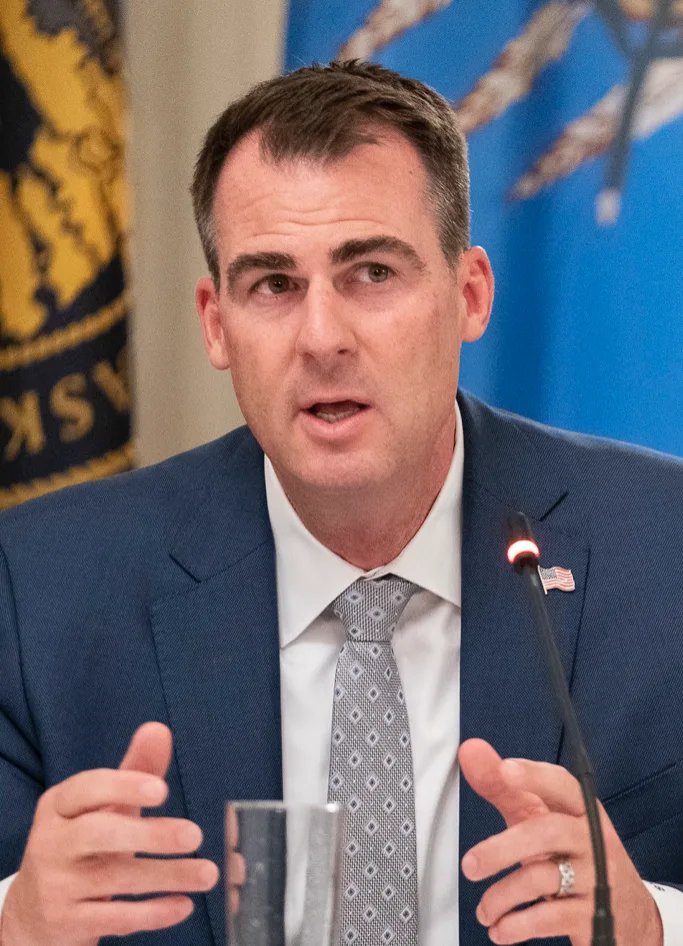
Kevin Stitt
- Party
- Republican
- In Office Since
- January 14, 2019
- Term Ends
- January 2027
- Born
- December 28, 1972, Monroe, Georgia (raised in Mustang, OK)
- Education
- Oklahoma State University (BS in Accounting, 1996)
- Prior Role
- Founder & CEO, Gateway Mortgage Group (1999-2018)
Kevin Stitt is a Cherokee Nation citizen and former mortgage company CEO who entered politics with no prior elected experience, winning the 2018 Republican primary and general election on a business-executive outsider platform. His tenure has been defined by a persistent and often contentious conflict with the Five Civilized Tribes over gaming compact renewals, the jurisdictional implications of the McGirt decision, and water rights. He declined to issue COVID-19 mask mandates, making Oklahoma an outlier among states. He was re-elected in 2022 despite strong opposition from tribal leaders and some within his own party, winning with 55 percent of the vote.
Other Current State Officials
Attorney General
Gentner Drummond
In office since January 2023. A Hominy attorney and rancher, Drummond defeated former AG John O'Connor in the 2022 Republican primary with the backing of tribal leaders who had clashed with O'Connor over McGirt-related prosecutions. As AG he has notably taken positions independent of Governor Stitt, including opposing some of the governor's efforts to limit tribal jurisdiction, and has pursued major cases against pharmaceutical companies and social media platforms.
Lieutenant Governor
Matt Pinnell
In office since January 2019, re-elected 2022. A former Oklahoma Republican Party chairman and marketing executive, Pinnell has focused his tenure on tourism development, Oklahoma has invested significantly in Route 66 tourism, outdoor recreation, and cultural heritage marketing under his leadership. He presides over the State Senate and serves on several state boards.
State Treasurer
Todd Russ
In office since January 2023. A Cordell banker and former Oklahoma House member (2010-2022), Russ manages approximately $16 billion in state investments. He has focused on ESG (Environmental, Social, and Governance) investing restrictions, Oklahoma has joined several Republican-led states in prohibiting state pension funds from considering ESG criteria in investment decisions.
The Oklahoma Legislature
Oklahoma State Senate
- Seats: 48 members
- Terms: 4-year staggered terms
The upper chamber. Senators serve 4-year terms with half the seats on the ballot every two years. Republicans hold a supermajority. Subject to 12-year combined term limits across both chambers. The Senate President Pro Tempore is a major power center in Oklahoma government.
Oklahoma House of Representatives
- Seats: 101 members
- Terms: 2-year terms
The lower chamber. All 101 seats are up for election every two years. Republicans hold a supermajority sufficient to override governor vetoes. The 12-year combined term limit creates significant member turnover that gives the executive branch and lobbyists structural advantages over newer legislators.
Oklahoma's U.S. Senators
U.S. Senator
James Lankford
Oklahoma's senior senator, first elected in 2014. A former Baptist youth camp director and director of the Baptist General Convention of Oklahoma, Lankford served two terms in the U.S. House before winning the Senate seat. He serves on the Senate Appropriations and Intelligence committees. In 2024, he co-authored a bipartisan border security bill that failed a Senate procedural vote in February 2024 after former President Donald Trump and most Senate Republicans came out against it.
U.S. Senator
Alan Armstrong
Appointed by Governor Kevin Stitt in March 2026 after Markwayne Mullin (senator 2023 to 2026) resigned to become Secretary of Homeland Security. Armstrong, a Tulsa businessman, was chief executive of the energy company Williams from 2011 to 2025 and had never run for office. He serves until the winner of the November 2026 special election for the rest of the term takes office.
Oklahoma Through the Years
From the Caddoan mound builders to the Trail of Tears, the land runs, the oil boom, the Dust Bowl, Black Wall Street, the Oklahoma City bombing, and the McGirt decision, Oklahoma has compressed more dramatic history into fewer years than almost any state in the Union.
The territory that became Oklahoma was home to a remarkable diversity of Native peoples long before European contact or American expansion. The Caddoan-speaking peoples of eastern Oklahoma, the Caddo, Wichita, and related groups, were sophisticated agricultural societies who built platform mounds, maintained long-distance trade networks, and cultivated corn, beans, and squash in the river valleys of what is now eastern Oklahoma.
The Spiro Mounds, near present-day Poteau in LeFlore County, were the ceremonial center of a Caddoan-speaking culture that flourished from roughly 800 to 1450 CE and produced carved shell gorgets, copper plates, and other artifacts of extraordinary artistry that were traded as far north as the Great Lakes and as far south as the Gulf of Mexico. By the time Europeans arrived, the southern Great Plains were dominated by the Wichita confederacy in the east and increasingly by the Comanche empire in the west: the Comanche, who had acquired horses by the early 18th century, became the dominant military power of the southern plains and effectively controlled access to the region for Europeans and Americans alike until the 1870s.
The Osage Nation, whose territory extended from Missouri south into present-day Oklahoma, controlled the Ozark Plateau and the Arkansas River corridor. These Indigenous polities, agriculturalists, nomadic hunters, traders, and warriors, formed the complex political landscape into which American expansion would intrude with catastrophic force in the 1830s.
Spain's Francisco Vazquez de Coronado crossed the panhandle in 1541 searching for the golden city of Quivira, which turned out to be Wichita grass-lodge villages in Kansas, and French traders working up the Arkansas and Red rivers in the 1700s left the region's oldest European place names. Neither empire settled it; the land passed to the United States in the 1803 Louisiana Purchase largely unmapped.
The Comanche and their Kiowa allies dominated the western half of the future state for a century and a half, raiding deep into Mexico and Texas from a heartland historians call the Comancheria; their power was broken only by the Red River War of 1874 to 1875 and the near-extermination of the southern bison herd, after which they were confined to a reservation around Fort Sill.
Long before any of them, the Spiro site on the Arkansas River was a major Mississippian ceremonial center: its 'Great Mortuary,' opened by treasure-hunting diggers in the 1930s in what has been called 'a King Tut's tomb of North America,' held thousands of engraved shells, copper plates, textiles, and pearls, and the looting of it helped prompt the 1935 federal Antiquities Act enforcement and Oklahoma's first antiquities law.
The Indian Removal Act of 1830, signed by President Andrew Jackson over fierce congressional opposition (including a notable dissent from Congressman Davy Crockett of Tennessee), authorized the forced removal of the Five Civilized Tribes, the Cherokee, Choctaw, Chickasaw, Muscogee (Creek), and Seminole, from their ancestral homelands in the southeastern United States to Indian Territory, the region west of Arkansas that would eventually become Oklahoma. The removals, conducted over the following decade, were among the most brutal episodes in American history. The Choctaw were the first removed, between 1831 and 1833, walking through winter conditions so severe that Army General George Gibson described the suffering as beyond description.
The Cherokee removal of 1838-1839, conducted by the U.S. Army after the elected Cherokee government refused to recognize a fraudulent treaty, became the most notorious: approximately 16,000 Cherokee were forced to march 800-1,000 miles in winter conditions, and an estimated 4,000-8,000 died on the journey the Cherokee call 'Nunna daul Tsuny', 'The Trail Where They Cried,' now known in English as the Trail of Tears. The Creek removal involved forced marches and river crossings that killed hundreds.
The Seminole removal required seven years of military campaigns (the Second Seminole War, 1835-1842) before most Seminoles were removed; a small group hid in the Florida Everglades and was never removed. The Five Tribes rebuilt their nations in Indian Territory with remarkable tenacity, establishing written constitutions, capital cities, bilingual schools, and agricultural economies.
The Five Tribes also brought slavery with them: their wealthier members, especially among the Cherokee, Choctaw, and Chickasaw, owned thousands of enslaved people of African descent who were forced west on the same trails. When the Civil War came, each of the Five Tribes signed a treaty with the Confederacy, and Indian Territory became a bloody sideshow with battles at Honey Springs and Cabin Creek and a Cherokee civil war between the factions of John Ross and Stand Watie, the last Confederate general to surrender, in June 1865.
The 1866 'Reconstruction treaties' the U.S. imposed on the defeated nations abolished slavery in the territory, required the tribes to adopt their former slaves, the 'Freedmen,' as citizens, and forced land cessions in the west that opened the door to later settlement and to the relocation of Plains and other nations, Cheyenne, Arapaho, Kiowa, Comanche, Ponca, Modoc, Nez Perce, and more, onto reservations carved from it.
Dozens of the 39 tribal nations in Oklahoma today arrived through that second wave of removals in the 1870s, which is why the state contains nations from nearly every corner of the country.
At precisely noon on April 22, 1889, a pistol shot and a bugle call launched one of the most extraordinary events in American history: approximately 50,000 people raced on horseback, in wagons, on bicycles, and on foot to claim homestead plots in the Unassigned Lands of central Indian Territory, 1.9 million acres opened for settlement by presidential proclamation. Within hours, the Oklahoma City townsite had a population of 10,000 people living in tents; Guthrie, the territorial capital, had 15,000.
The people who had cheated, sneaking into the territory before noon to claim the best land, were called 'Sooners,' a term of contemporary derision that became, over time, a badge of pride and the basis of the state's nickname and the University of Oklahoma's athletic identity. The 1889 Land Run was the first and most famous of several Oklahoma land runs: the Cherokee Strip Run of September 16, 1893, was the largest, with 100,000 participants racing for 6 million acres in what is still the largest mass land run in history.
The land runs were the culmination of the 'Boomer' movement, organized campaigns by would-be settlers, led by figures like David Payne, to pressure the federal government to open Indian Territory to settlement. They represented the final phase of the dispossession of the Five Tribes: despite the guarantees of their removal treaties, the federal government allotted tribal lands to individual tribal citizens and then opened the 'surplus' land to non-Indian settlement, destroying the tribal land base and paving the way for statehood.
The legal machinery was the Dawes Act of 1887 and, for Indian Territory specifically, the Dawes Commission (1893) and the 1898 Curtis Act, which dissolved tribal courts and governments, forced the allotment of communally held land, and compiled the 'Dawes Rolls' that are still the basis for Five Tribes citizenship today. Enrollment was itself contested and racialized: Black Freedmen were often placed on separate 'Freedmen' rolls without land, a distinction that fuels citizenship disputes into the present.
The runs were chaotic and often deadly, so most later openings used lotteries or sealed bids instead. The government's own maps of the runs show towns like Guthrie and Norman with thousands of residents by nightfall on opening day, most living in tents on lots whose ownership would be litigated for years.
For the promoters it was a triumph and for the tribes a catastrophe: within a generation Native people went from owning nearly all of the future state to a small minority of its land and population, and 'Sooner,' originally a term for a cheat, was adopted as the state's proud nickname.
The Glenn Pool oil discovery south of Tulsa in November 1905 transformed the economic and political calculus of Indian Territory and Oklahoma Territory almost overnight. The discovery, made on Muscogee (Creek) allotment land, produced one of the most prolific oil fields in American history and triggered a boom that brought speculators, wildcatters, roughnecks, and every variety of fortune-seeker flooding into the territory.
Within three years, the Tulsa region was producing more oil than the rest of the country combined, and the Oklahoma petroleum industry was established as one of the pillars of the American economy. The oil discovery accelerated the push for statehood: Indian Territory and Oklahoma Territory, which had been governed separately, were combined into a single state over the objection of many tribal leaders who had hoped to establish a separate 'Sequoyah State' for Indian Territory.
On November 16, 1907, Oklahoma was admitted as the 46th state, and the Five Tribes' dream of Indian self-governance within their own jurisdiction was extinguished, or so it seemed. The new state's constitution, written at a constitutional convention in Guthrie, was one of the most progressive in America (influenced by agrarian Populist traditions) but also enshrined racial segregation in its very first session: Senate Bill 1, the first act of the first Oklahoma legislature, required racial segregation on railroad cars.
Native leaders had tried a different path. In 1905 delegates from the Five Tribes met at Muskogee and drafted a constitution for a proposed Indian-controlled state to be called 'Sequoyah,' after the Cherokee scholar; Oklahoma voters in Indian Territory approved it overwhelmingly, but Congress, unwilling to add two new Western states or a Native-run one, ignored it and forced the two territories together instead.
The 1907 state constitution was, at 45,000 words, one of the longest in the country, packed with Populist and labor provisions, an eight-hour day on public works, a corporation commission to regulate railroads and utilities, a ban on corporate campaign money, that reflected the strength of the Farmers' Alliance and, soon, the Socialist Party, which by 1914 was polling over 20 percent statewide, its high-water mark anywhere in the U.S.
William H. 'Alfalfa Bill' Murray, president of the constitutional convention and later a Depression-era governor, embodied the mix: agrarian radical on economics, hard segregationist on race, and, by the 1930s, an eccentric authoritarian who called out the National Guard dozens of times, including to seize the Red River toll bridges from Texas.
On the evening of May 31 and morning of June 1, 1921, the Greenwood District of Tulsa, a 35-square-block community of African American businesses, homes, churches, schools, and institutions known as 'Black Wall Street' for the extraordinary concentration of Black wealth it represented, was invaded and destroyed by white mobs and possibly by private aircraft dropping incendiary devices, in one of the worst acts of racial violence in American history. The massacre was triggered by a confrontation between a young Black man named Dick Rowland and a white elevator operator named Sarah Page; Rowland was arrested for alleged assault, a Tulsa Tribune editorial inflamed white opinion, and armed white men stormed the Greenwood District after Black residents appeared to defend the jail where Rowland was held.
In 18 hours, more than 35 blocks of Greenwood were burned to the ground, approximately 1,256 homes were destroyed, 10,000 Black residents were left homeless, and an estimated 100-300 people were killed (the true death toll has never been established). The destruction of Greenwood wiped out approximately $1.8 million in property (over $30 million in 2023 dollars) that Black Tulsans had accumulated over two decades.
The massacre was suppressed from Oklahoma history for decades, not taught in schools, not discussed in polite company, barely acknowledged by officials, until a state commission investigation in 1997-2001 brought it back into public consciousness. A centennial commemoration in 2021 drew national attention.
Greenwood was the product of segregation as much as of oil wealth: barred from white businesses, banks, and hospitals, Black Tulsans built a parallel economy where a dollar reportedly circulated 36 times before leaving the district, supporting more than 100 Black-owned businesses, a hospital, a library branch, and two newspapers on 35 blocks. Many of the men who came armed to the courthouse to protect Dick Rowland were World War I veterans.
After the burning, the city denied that a 'riot' triggered insurance coverage, arrested Black residents rather than white attackers, and passed a fire-code amendment meant to prevent rebuilding, which Black lawyers overturned in court. Greenwood was largely rebuilt by 1925 and thrived again until 'urban renewal' and a new interstate highway cut through it in the 1960s and 1970s.
Forensic teams began excavating suspected mass graves in Oaklawn Cemetery in 2020 and by 2024 had exhumed more than 100 sets of remains for DNA analysis. The Oklahoma Supreme Court dismissed the last two living survivors' reparations lawsuit in 2024, and a 2025 U.S. Justice Department review formally described the event as a coordinated, government-assisted attack while finding no living perpetrators to charge.
The Dust Bowl of the 1930s was the worst human-caused ecological disaster in North American history, and Oklahoma was at its epicenter. The combination of severe drought, decades of over-plowing that had destroyed the deep-rooted native grasses holding the soil in place, and the brutal economic depression of the 1930s produced the black blizzards, massive walls of topsoil, sometimes thousands of feet high, that rolled across the southern plains blotting out the sun, burying fences and farm buildings, suffocating cattle, and making the air unbreathable. The dust pneumonia that followed killed children and elderly people across the region.
'Black Sunday', April 14, 1935, the worst single dust storm of the decade, turned day to night across Kansas, Oklahoma, Texas, and Colorado. The human cost was devastating: approximately 400,000 Oklahomans left the state between 1930 and 1940, migrating west along Route 66 to California and becoming the 'Okies' whose story John Steinbeck immortalized in The Grapes of Wrath (1939). The migrants were met with hostility in California, 'Okies Go Home' signs, labor exploitation, migrant camps of squalor and desperation, and the word 'Okie' itself became a term of contempt.
Woody Guthrie, born in Okemah, drove through the Dust Bowl and the migrant camps and wrote 'This Land Is Your Land' and hundreds of other songs in response to what he witnessed, creating an artistic legacy that defined the progressive folk music tradition for generations.
The physical cause was clear: the World War I plow-up had turned roughly 100 million acres of shortgrass prairie across five states into wheat fields, and when the rain stopped in 1931 the bare soil simply blew. Cimarron County in Oklahoma's far panhandle lost the most topsoil of any county in the region, and by 1938 an estimated 850 million tons of dirt a year was moving on the wind.
Federal aid was massive and mixed: the Resettlement Administration bought out ruined farms, the Civilian Conservation Corps and the Prairie States Forestry Project planted about 220 million trees in shelterbelts from the Dakotas to Texas, and the new Soil Conservation Service taught contour plowing and cover-cropping, paying farmers to adopt them. Rain returning in 1939 and 1940 did as much as any program.
The exodus was permanent for many: Oklahoma lost population in the 1930s, the only census decade in which it has ever done so, and California's Central Valley absorbed a labor underclass whose descendants still identify as 'Okie.' The state's own memory softened the word into a badge of grit, and Merle Haggard, born in a California boxcar to Oklahoma migrants, turned it into a 1969 anthem, 'Okie from Muskogee.'
At 9:02 AM on April 19, 1995, the second anniversary of the federal assault on the Branch Davidian compound in Waco, Texas, a rented Ryder truck containing approximately 5,000 pounds of ammonium nitrate fertilizer and nitromethane exploded in front of the Alfred P. Murrah Federal Building in downtown Oklahoma City. The blast, equivalent to roughly 5,000 pounds of TNT, destroyed the northern face of the nine-story building, collapsing floors and killing 168 people, including 19 children in the building's second-floor day care center. Another 680 people were injured.
It remains the deadliest act of domestic terrorism in American history, and it was the deadliest act of terrorism on American soil until the September 11, 2001 attacks. The perpetrators were Timothy McVeigh, a decorated Gulf War veteran radicalized by anti-government ideology and the militia movement, and Terry Nichols; McVeigh was executed in 2001, Nichols received multiple life sentences. The bombing had a profound and lasting effect on Oklahoma City, on the nation's understanding of domestic terrorism, and on federal law enforcement priorities.
Oklahoma City's response, the immediate mobilization of rescue workers, the steady community grief, the deliberate and dignified memorialization, became a model for how communities respond to catastrophic loss. The Oklahoma City National Memorial, opened on the site in 2000, is one of the most visited and most emotionally powerful commemorative spaces in the United States.
McVeigh had served in the Gulf War and then drifted into the armed-militia and gun-show world, seething over the 1992 Ruby Ridge standoff and the 1993 Waco siege, which ended in fire on April 19; he set the OKC bomb to detonate on Waco's second anniversary. Investigators traced the Ryder truck to a Kansas rental agency through a stamped axle part found in the wreckage within a day.
The rescue was the first full-scale deployment of the federal Urban Search and Rescue task-force system, and one rescuer, nurse Rebecca Anderson, was killed by falling debris. Congress responded within a year with the 1996 Antiterrorism and Effective Death Penalty Act, which restricted death-penalty appeals nationwide, and with a government-wide program to set federal buildings back from streets and add blast protection.
The trials moved to Denver for an impartial jury; McVeigh was convicted in 1997 and executed by lethal injection at the federal prison in Terre Haute, Indiana, on June 11, 2001, the first federal execution since 1963, and 232 survivors and family members watched by closed-circuit feed. The memorial's field of 168 stone-and-glass chairs, 19 of them small, sits in the footprint of the destroyed building.
On July 9, 2020, the United States Supreme Court issued its decision in McGirt v. Oklahoma, holding 5-4 that the Muscogee (Creek) Nation's reservation, promised by treaty in the 1830s and never formally disestablished by Congress, remained legally intact, meaning that criminal offenses committed by Native Americans on that territory fell under federal rather than state jurisdiction. The decision, written by Justice Neil Gorsuch (himself from Colorado but with a distinguished record on tribal rights), immediately affected the criminal prosecution of hundreds of defendants in eastern Oklahoma and raised fundamental questions about land use, regulation, and governance across a vast swath of the state.
Subsequent decisions extended the McGirt principle to the Cherokee, Choctaw, Chickasaw, and Seminole Nations' reservations, meaning that roughly half of Oklahoma's land area, including the city of Tulsa, was recognized as Indian Country for jurisdictional purposes. The political response in Oklahoma, from Governor Kevin Stitt and the state legislature, was fierce: the state fought the decisions at every level and worked to persuade the Supreme Court to reverse or limit McGirt, achieving some limitation in Oklahoma v. Castro-Huerta (2022).
But the fundamental shift in the legal status of the Five Tribes' territories has been only partially reversed, and the long-term implications for taxation, regulation, and governance in Oklahoma remain deeply contested.
The case reached the Court through a state prosecution of Jimcy McGirt, a Seminole and Muscogee citizen convicted of child sexual abuse in Wagoner County; because the crime occurred within the historic Creek reservation and involved a Native defendant, the Major Crimes Act made it a federal, not a state, matter, and McGirt's conviction was vacated (he was retried and reconvicted in federal court). Gorsuch's majority opinion turned on a simple point: only Congress can disestablish a reservation, and for the Creek Nation it never clearly had.
The practical fallout was immediate. Thousands of state convictions of Native defendants in eastern Oklahoma were thrown into question, federal and tribal courts and prosecutors scrambled to absorb the caseload, and the tribes signed dozens of cross-deputization and cooperation agreements with local law enforcement. The 2022 Castro-Huerta ruling restored state jurisdiction over crimes by non-Natives against Native victims on the reservations, trimming McGirt's reach.
Governor Kevin Stitt, himself a Cherokee citizen, has been the tribes' fiercest opponent, fighting them over gaming compacts, car tags, and taxation and warning that McGirt could void state regulatory authority over half the state; the tribes counter that they have governed there continuously and that the ruling simply enforced treaties the U.S. signed. The dispute is the central fact of Oklahoma politics in the 2020s.
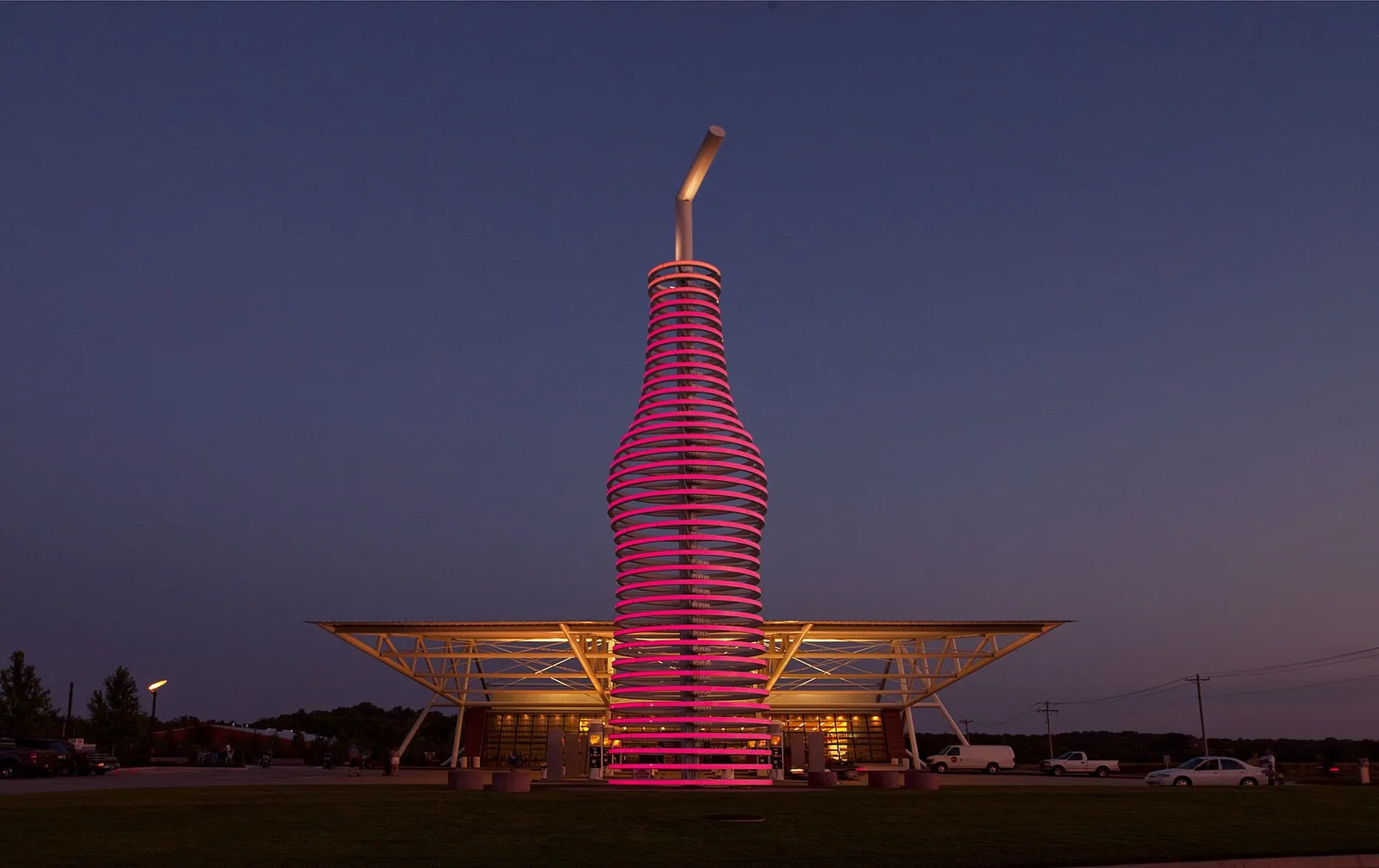
Oklahoma's Defining Moments in American History
These are the events that didn't just shape Oklahoma, they changed the nation.
In the 1830s, the U.S. government forced the Five Civilized Tribes, the Cherokee, Choctaw, Chickasaw, Creek, and Seminole, from their ancestral lands in the Southeast to Indian Territory in present-day Oklahoma. The forced removal, conducted in the dead of winter with inadequate food, clothing, and shelter, killed an estimated 15,000 people. The Cherokee called it Nunna daul Tsuny: the Trail Where They Cried.
Oklahoma was supposed to be permanent Native American territory. Within decades, it too was opened to white settlement. The Trail of Tears is one of the most consequential acts of ethnic cleansing in American history.
The removals were fought in court and lost by force. The Cherokee sued Georgia and won in the Supreme Court's Worcester v. Georgia (1832), which held that the Cherokee Nation was a distinct sovereign community, but President Jackson refused to enforce it, and a small faction signed the unauthorized 1835 Treaty of New Echota that the Senate ratified by a single vote. General Winfield Scott's soldiers then rounded up about 16,000 Cherokee into stockades in the summer of 1838 before the march west.
Each nation's removal had its own toll: roughly a quarter of the Choctaw who set out in 1831 to 1833 died, hundreds of Creeks drowned when the steamboat Monmouth sank on the Mississippi in 1837, and the Seminoles fought a seven-year war before most were shipped west. The people who arrived in Indian Territory carried the losses forward for generations.
The Five Tribes rebuilt fast, with written constitutions, capitals at Tahlequah, Tuskahoma, Tishomingo, Okmulgee, and Wewoka, newspapers, and their own courts and schools, and then lost their governments a second time when Oklahoma statehood in 1907 dissolved tribal jurisdiction, a status not restored, in part, until the Supreme Court's 2020 McGirt decision.
At noon on April 22, 1889, a cannon fired and 50,000 settlers raced on horseback, by wagon, and on foot into the Unassigned Lands of Indian Territory to claim 160-acre homesteads. By sunset, Oklahoma City and Guthrie had materialized from empty prairie. The Oklahoma Land Run was the most dramatic real estate event in American history.
Those who cheated by sneaking in early were called 'Sooners,' which became the state's nickname. Within weeks, disputes, claims jumping, and fraud turned the utopian experiment chaotic, but Oklahoma Territory was opened, and statehood followed in 1907.
The 'Unassigned Lands' at the center of the 1889 run were about 2 million acres the government had bought from the Creeks and Seminoles after the Civil War, punishment for their nations having sided partly with the Confederacy, and had never given to any tribe. The 'Boomer' movement led by David Payne had spent the 1880s staging illegal colonizing raids and lobbying Congress to open the land, and the run was the payoff.
1889 was the first of at least seven Oklahoma land openings between then and 1906. The largest by far was the Cherokee Outlet, or 'Cherokee Strip,' run of September 16, 1893, when an estimated 100,000 people raced for about 6 million acres bought from the Cherokee Nation; later tracts, including the Kiowa-Comanche-Apache and Wichita lands in 1901, were distributed by lottery instead of a race because the runs had proven so chaotic and deadly.
Each opening was the same transaction from the tribes' side: reservation land was allotted in 160-acre parcels to individual tribal members, the government declared the remainder 'surplus,' and non-Native settlers took it. By statehood the Five Tribes' collective land base had shrunk from a near-monopoly of eastern Oklahoma to the scattered individual allotments many families still hold.
The Dust Bowl of the 1930s was an environmental and human catastrophe centered on Oklahoma, Kansas, and the Texas Panhandle. Years of over-plowing, combined with a decade of drought, stripped the region's topsoil, which rose in massive black clouds called Black Blizzards that reached the Atlantic. Hundreds of thousands of Oklahomans, called Okies and often viewed with contempt, fled west to California.
John Steinbeck's The Grapes of Wrath captured their journey. The Dust Bowl transformed American agricultural policy, leading to soil conservation programs and farming practice reforms that fundamentally changed how Americans relate to the land.
The disaster was man-made. A wet stretch and high wheat prices during and after World War I had drawn a plow-up of millions of acres of shortgrass prairie across the panhandle and adjacent Texas, Kansas, Colorado, and New Mexico; when drought returned in 1931 and stayed most of the decade, there was no root system left to hold the soil, and the wind took it. The worst-hit county in the entire Dust Bowl was Cimarron County in Oklahoma's far panhandle.
'Black Sunday,' April 14, 1935, sent a rolling black wall of dust across the southern plains that turned midday to full dark; an Associated Press reporter sheltering in the Oklahoma panhandle coined the phrase 'Dust Bowl' in his dispatch the next day. Dust pneumonia killed people, mostly the very young and old, static electricity from the storms shorted out engines, and drifts buried farm machinery and fence lines.
Not all the roughly 400,000 who left Oklahoma in the 1930s were farmers or from the Dust Bowl counties, many were tenant families displaced by tractors and the collapse of cotton prices in the eastern part of the state, but 'Okie' became a slur for all of them in California's fields and camps. The federal Soil Conservation Service, shelterbelt tree plantings, and paid grassland retirement followed, and the practices they introduced are why a drought as severe as the 2010s did not repeat 1935.
On May 31-June 1, 1921, a white mob with the assistance of law enforcement and special deputies attacked the Greenwood District of Tulsa, Oklahoma, a thriving Black neighborhood known as Black Wall Street. By the time the violence ended, 35 blocks had been destroyed, 10,000 Black Tulsans had been left homeless, and an estimated 100 to 300 people had been killed. Airplanes were used against American citizens for what may have been the first time.
The massacre was deliberately suppressed in Oklahoma history for decades. Its rediscovery and recognition in the 21st century sparked a national reckoning with anti-Black racial violence.
Greenwood had grown wealthy in part because Jim Crow forced Black Tulsans to shop, bank, and be treated within their own district, so oil-era money circulated many times over among Black-owned groceries, hotels, theaters, doctors' offices, and two newspapers on 35 blocks. The trigger was an ambiguous elevator encounter between a Black teenager, Dick Rowland, and a white operator, Sarah Page; a Tulsa Tribune article and rumors of a lynching drew armed Black veterans to the courthouse to protect Rowland, and a shot set off the night.
White rioters, some deputized and armed by city officials, looted and burned every block of Greenwood over roughly 18 hours; survivors described private planes dropping burning turpentine balls, and the National Guard interned some 6,000 Black residents in fairgrounds and a ballpark. Insurance claims were denied under 'riot' exclusions, no white attacker was ever convicted, and the city later used zoning and a new fire code to block rebuilding.
A 2001 Oklahoma state commission report put the likely death toll at 100 to 300, recommended reparations, and led to scholarships and a memorial rather than direct payments; forensic teams began excavating suspected mass graves in Oaklawn Cemetery in 2020. In 2024 the Oklahoma Supreme Court dismissed the last living survivors' reparations lawsuit, and in 2025 the U.S. Justice Department released a report formally acknowledging the massacre as a coordinated attack while noting no living perpetrators could be prosecuted.
On April 19, 1995, a truck bomb packed with 4,800 pounds of ammonium nitrate exploded outside the Alfred P. Murrah Federal Building in Oklahoma City, killing 168 people, including 19 children in a daycare center, and injuring nearly 700 more. Timothy McVeigh, a decorated Gulf War veteran motivated by anti-government ideology, was convicted and executed.
The bombing was the deadliest terrorist attack on American soil until September 11, 2001, and it remains the deadliest act of domestic terrorism in U.S. history. It shattered the assumption that terrorism was something that happened overseas and forced a national reassessment of homegrown extremism.
McVeigh chose April 19 as the second anniversary of the fiery end of the federal siege at Waco, Texas, and the 220th anniversary of Lexington and Concord; he mixed roughly 4,800 pounds of ammonium nitrate fertilizer and racing fuel in barrels in a rented Ryder truck. He was arrested about 90 minutes after the blast by an Oklahoma state trooper for driving without a license plate, and identified from the truck's axle serial number within days.
The response set the template for mass-casualty rescue in the U.S.: the modern FEMA Urban Search and Rescue system was tested for the first time here, and the 'Oklahoma Standard' of neighbor helping neighbor became a civic identity. The bombing also produced the 1996 Antiterrorism and Effective Death Penalty Act, which sharply limited federal habeas appeals for all prisoners, and a wave of hardening around federal buildings nationwide.
McVeigh was convicted and executed by lethal injection in 2001, the first federal execution in 38 years; Terry Nichols got life, and a third man, Michael Fortier, testified against them and served about ten years. The Oklahoma City National Memorial and Museum, with its reflecting pool, Survivor Tree, and field of 168 empty bronze-and-glass chairs, opened on the site in 2000 and 2001.
Notable Oklahomans
Will Rogers
Born near Claremore, Cherokee Nation (Indian Territory), November 4, 1879. Part Cherokee, cowboy, vaudeville performer, Broadway star, film actor, radio commentator, and syndicated newspaper columnist whose gentle satirical wit made him the most beloved public figure in America in the late 1920s and early 1930s. 'I never met a man I didn't like.' He and aviator Wiley Post died together in an airplane crash near Barrow, Alaska in August 1935.
Jim Thorpe
Born near Prague, Indian Territory (present-day Oklahoma), May 28, 1888. Sac and Fox Nation citizen widely considered the greatest multi-sport athlete in American history: won gold medals in both the pentathlon and decathlon at the 1912 Stockholm Olympics, played professional baseball (six seasons in the major leagues), and was one of the founding members and first president of the American Professional Football Association (later the NFL). Died 1953.
Woody Guthrie
Born in Okemah, Oklahoma, July 14, 1912. Folk singer, songwriter, and social activist who wrote 'This Land Is Your Land,' 'Oklahoma Hills,' 'Dust Bowl Blues,' and more than 3,000 other songs documenting the lives of the poor, dispossessed, and working class. Drove Route 66 through the Dust Bowl and the California migrant camps and translated the experience into an enduring artistic and political legacy. Bob Dylan, Bruce Springsteen, and generations of socially conscious musicians cite him as their primary influence. Died 1967.
Ralph Ellison
Born in Oklahoma City, Oklahoma, March 1, 1914. Author of Invisible Man (1952), one of the most celebrated American novels of the 20th century, a story of a Black man's search for identity in a racist America that won the National Book Award and is consistently ranked among the greatest works of American literature. Ellison grew up in OKC, studied music at Tuskegee, and brought an Oklahoma-inflected perspective on race and identity to his work that distinguishes it from more strictly Southern or Northern traditions. Died 1994.
Sequoyah
Born c. 1770 in Tuskegee, Tennessee (Cherokee territory), but central to Oklahoma history as the creator of the Cherokee syllabary and a major figure in the Cherokee Nation's Oklahoma period. Sequoyah (George Gist) was the only person in recorded history to create, alone and without prior literacy, a complete writing system for a language, his 86-character syllabary, completed around 1821, enabled the Cherokee to achieve mass literacy within a generation and is still in use today. Died c. 1843 in Mexico.
Maria Tallchief
Born in Fairfax, Oklahoma (Osage County), January 24, 1925. The first major Native American prima ballerina and one of the most celebrated ballet dancers of the 20th century. Of Osage descent, Tallchief became the prima ballerina of the New York City Ballet under George Balanchine (whom she married) and revolutionized American ballet with her technical precision and dramatic power. Her performance as the Sugar Plum Fairy in The Nutcracker is credited with making that ballet an American Christmas tradition. Died 2013.
Garth Brooks
Born in Tulsa, raised in Yukon, Oklahoma, February 7, 1962. The best-selling solo artist in American history by RIAA-certified album sales, more than 160 million, ahead of Elvis Presley and second only to the Beatles among all acts. His fusion of country music with rock arena production values transformed country music in the late 1980s and 1990s and made him a cultural phenomenon. His concerts at Yankee Stadium, Shea Stadium, and venues across the world drew audiences that few musical performers have matched.
Brad Pitt
Born in Shawnee, Oklahoma, December 18, 1963, and raised in Springfield, Missouri. Actor and producer widely regarded as one of the major film stars of his generation, with films including Fight Club, Se7en, Troy, The Curious Case of Benjamin Button (Oscar nomination), Inglourious Basterds, Moneyball (Oscar nomination), 12 Years a Slave (producer, Best Picture Oscar), and Once Upon a Time in Hollywood (Best Supporting Actor Oscar, 2020).
Mickey Mantle
Born in Spavinaw, Oklahoma, October 20, 1931. New York Yankees center fielder (1951-1968) and one of the two or three greatest switch-hitters in baseball history. Won the Triple Crown in 1956, three AL MVP awards, and seven World Series championships with the Yankees. His combination of power (536 career home runs), speed, and mythic good looks made him the defining baseball hero of the 1950s and 1960s despite career-long battles with injury and alcoholism. Died 1995.
Wiley Post
Born near Grand Saline, Texas (raised in Oklahoma from childhood), November 22, 1898. Aviator who became the first person to fly solo around the world (July 15-22, 1933, in 7 days, 18 hours, and 49.5 minutes in his plane Winnie Mae), and the first to fly in the stratosphere using a pressure suit he helped design. Lost his right eye in an oil field accident but became one of the most celebrated aviators of the interwar period. Died with Will Rogers in a plane crash in Alaska in August 1935.
State Symbols & Quick Facts
| Nickname | "The Sooner State" |
| Capital | Oklahoma City |
| Largest City | Oklahoma City |
| Statehood | November 16, 1907 (46th state) |
| Population | ~4.1 million (2025 est.) |
| Area | 69,899 sq miles (20th largest) |
| State Bird | Scissor-tailed Flycatcher |
| State Flower | Oklahoma Rose (mistletoe is the state floral emblem) |
| State Tree | Eastern Redbud |
| State Animal | American Bison |
| State Reptile | Collared Lizard (Mountain Boomer) |
| State Insect | Honeybee |
| State Fruit | Strawberry |
| State Vegetable | Watermelon |
| State Fossil | Saurophaganax maximus |
| State Song | "Oklahoma!" (Rodgers & Hammerstein) |
| State Motto | "Labor Omnia Vincit" (Labor Conquers All Things) |
| Time Zone | Central |
| Bordering States | Kansas, Missouri, Arkansas, Texas, New Mexico, Colorado |
Did You Know?
Oklahoma has 39 tribal nations within its borders, more than any state except Alaska and California. The Five Civilized Tribes (Cherokee, Choctaw, Chickasaw, Muscogee/Creek, and Seminole) alone represent hundreds of thousands of citizens and operate economic enterprises generating billions in annual revenue.
The Oklahoma State Capitol is the only state capitol building in the United States sitting on an active oil field. Oil wells have been drilled on the Capitol grounds since the 1920s; the most recent, Capitol Site No. 1, was drilled directly beneath the Capitol dome in 2010 and produced oil for several years.
The 1889 Oklahoma Land Run, 50,000 people racing at noon on April 22 for 1.9 million acres, established the term 'Sooner' for those who cheated by entering early. What began as a term of contempt became the state nickname and the University of Oklahoma's mascot identity. The Cherokee Strip Run of 1893, with 100,000 participants, was the largest land run in history.
The Tulsa Race Massacre of May 31 and June 1, 1921 destroyed 'Black Wall Street', the Greenwood District's 35 blocks of Black-owned businesses, homes, and institutions, one of the most prosperous Black communities in America. An estimated 100 to 300 people were killed and 10,000 left homeless. The massacre was left out of most Oklahoma history teaching for decades.
Woody Guthrie, born in Okemah, Oklahoma, wrote 'This Land Is Your Land' in New York City in 1940, drawing on what he had seen of the Dust Bowl, the catastrophic ecological disaster of the 1930s that forced roughly 400,000 Oklahomans off their farms and onto Route 66 headed west. John Steinbeck's The Grapes of Wrath documented their journey, and the word 'Okie' became synonymous with dust and displacement.
Oklahoma has more miles of historic Route 66 than any other state, approximately 400 miles of the original 'Mother Road' run through Oklahoma from the Kansas border to the Texas Panhandle. The route was the primary migration corridor for Dust Bowl refugees and is now one of the country's most popular heritage tourism drives.
The Oklahoma City bombing of April 19, 1995, 168 people killed, including 19 children, was the deadliest terrorist attack on U.S. soil until September 11, 2001, and remains the deadliest act of domestic terrorism in American history. The perpetrators were American citizens motivated by anti-government ideology. The Oklahoma City National Memorial's 168 empty chairs, one for each victim, are among the most visited and most emotionally affecting commemorative objects in the country.
The Supreme Court's 2020 McGirt v. Oklahoma decision held that the Muscogee (Creek) Nation's reservation had never been legally disestablished, and subsequent rulings extended this to four other tribes, meaning roughly half of Oklahoma's land area, including most of Tulsa, remains legally Indian Country for federal criminal jurisdiction purposes.
Oklahoma is consistently a top-three wind energy state, generating enough wind power to rank among the leaders nationally despite being known primarily as an oil state. The same flat terrain and relentless winds that made the Dust Bowl possible now drive turbines that supply electricity across the Southwest Power Pool regional grid.
Jim Thorpe, born in Indian Territory (near Prague, Oklahoma) in 1888 and a citizen of the Sac and Fox Nation, won gold medals in both the pentathlon and decathlon at the 1912 Stockholm Olympics, a feat no other athlete has replicated. King Gustav V of Sweden reportedly told him: 'Sir, you are the greatest athlete in the world.' Thorpe replied: 'Thanks, King.'
Quick Facts and Common Questions
Short answers to the questions people most often ask about Oklahoma: its abbreviation, how it became a state, why it is the Sooner State, and its place in Congress.
Oklahoma's two-letter postal abbreviation is OK. The U.S. Census Bureau places it in the South region, in the West South Central division, and about 3.96 million people lived there in the 2020 census.
Oklahoma became the 46th state on November 16, 1907, when the Oklahoma Territory and the Indian Territory were joined into a single state. Earlier, leaders of the Five Tribes in the Indian Territory had proposed a separate Native-led state called Sequoyah, but Congress did not approve it.
Oklahoma comes from two Choctaw words, "okla" (people) and "humma" (red), meaning "red people." Choctaw chief Allen Wright suggested the name in 1866 during treaty talks with the federal government.
Oklahoma City has been the capital since 1910. Guthrie was the territorial capital from 1890 and the first state capital, until voters chose Oklahoma City in a 1910 election. The State Capitol was completed in 1917, and its dome was finally added in 2002.
Oklahoma borders six states: Kansas and Colorado to the north, Missouri and Arkansas to the east, Texas to the south, and New Mexico to the west at the end of its panhandle. The Red River forms much of its border with Texas.
On April 22, 1889, the federal government opened about 2 million acres of the Unassigned Lands to settlers in a land run that began at noon. People who slipped in early to claim land before the official start were called "Sooners," and the name became the state's nickname.
Oklahoma is home to dozens of federally recognized tribal nations. Many, including the Cherokee, Chickasaw, Choctaw, Muscogee (Creek), and Seminole, were forcibly removed there from the Southeast in the 1830s along routes now remembered as the Trail of Tears.
Oklahoma's motto is "Labor omnia vincit," Latin for "Labor conquers all things." Its state bird is the scissor-tailed flycatcher, its flower is the Oklahoma rose, its tree is the eastern redbud, and its animal is the American bison.
Based on the 2020 census, Oklahoma has 5 seats in the U.S. House of Representatives, the same as before, which gives it 7 votes in the Electoral College.
Wichita Mountains Wildlife Refuge
Ancient Granite Peaks, Wild Bison, and Longhorn Cattle on Oklahoma's Southern Plains
About Wichita Mountains Wildlife Refuge
Wichita Mountains Wildlife Refuge, set aside in 1901, is one of the oldest units in the National Wildlife Refuge System. President William McKinley proclaimed the area the Wichita Forest Reserve on July 4, 1901, from land opened in the breakup of the Kiowa-Comanche-Apache reservation; President Theodore Roosevelt added national game-preserve status in 1905, and it was renamed the Wichita Mountains Wildlife Refuge in 1935. The US Fish and Wildlife Service now manages 59,020 acres in Comanche County, near Lawton.
The refuge was the site of the first bison reintroduction in United States history. In October 1907 the American Bison Society and the New York Zoological Park (the Bronx Zoo) shipped 15 bison by rail from New York to Cache, Oklahoma, and released them into a fenced pasture. That herd now numbers around 650 animals and has supplied stock to conservation herds across the country.
The Wichita Mountains are the eroded roots of a range that rose about 300 million years ago, exposing granite, rhyolite, and gabbro that crystallized roughly 525 to 540 million years ago. The rounded domes, notably 2,464-foot Mount Scott, stand a few hundred feet above a mixed-grass prairie, and the refuge also protects post oak woodland, granite canyons, boulder fields, and several reservoirs.
About 1.5 million people visit each year. Alongside the bison, the refuge keeps a herd of roughly 650 Texas longhorn cattle, a USFWS breeding program begun in 1927 to preserve the breed, contains the 5,000-acre Charons Garden Wilderness designated by Congress in 1970, and includes the Holy City of the Wichitas, a stone pageant site that predates the refuge designation.
- Designation
- National Wildlife Refuge
- Location
- Comanche County, southwestern Oklahoma, near Lawton
- Established
- July 4, 1901
- Annual Visitors
- ~1.5 million
Geology and Landscape
The Wichita Mountains are among the oldest exposed rock in the southern plains: bodies of granite, rhyolite, and gabbro that formed roughly 525 to 540 million years ago, in the Cambrian Period, when magma rose into a rift as the ancestral North American continent was pulling apart.
Those igneous rocks were buried under thousands of feet of Paleozoic sediment, then uplifted about 300 million years ago in the mountain-building that also raised the Arbuckle Mountains and the ancestral Rockies. Erosion has since stripped the sedimentary cover, leaving the resistant granite standing above the plain.
The rounded shape of Mount Scott and the other domes comes from exfoliation: sheets of granite peel away parallel to the surface as the weight of overlying rock is removed. Between the domes, jumbled fields of house-sized boulders fill the valleys, most dramatically in Charons Garden.
The pink Cambrian granite here is prized by rock climbers, and the refuge holds hundreds of established routes on formations such as the Narrows, Elk Mountain, and Crab Eyes. It falls in the same age range as the deep basement rock beneath much of the central United States.
The refuge protects one of the largest intact blocks of mixed-grass prairie in Oklahoma, the transition belt between the tallgrass prairie to the east and the shortgrass high plains to the west. Little bluestem, sideoats grama, blue grama, buffalograss, and Indiangrass grow among several hundred wildflower species.
The grassland is held open by grazing and fire. Bison, elk (reintroduced in 1908 and 1911 from Wyoming's Jackson Hole herd after Oklahoma elk were wiped out by 1881), and longhorns graze it, and USFWS runs a prescribed-burn program covering thousands of acres a year to beat back woody plants.
Black-tailed prairie dog colonies support burrowing owls, which nest in abandoned burrows, and draw badgers, coyotes, and hawks. Other grassland wildlife includes Texas horned lizards, prairie rattlesnakes, scaled quail, and songbirds such as dickcissels and grasshopper sparrows.
The refuge's plant list exceeds 800 vascular species, high for its size, because granite uplands, prairie, oak woodland, canyon seeps, and lake margins pack several habitats into a small area, and some species here reach the western edge of their range.
Several impoundments serve the refuge and its edges. Lake Lawtonka, on Medicine Creek below Mount Scott, was built by the city of Lawton in 1905 (its dam raised in 1959) as the city water supply and lies just outside the refuge; Lake Elmer Thomas, inside the refuge on West Cache Creek, was completed in 1963.
Smaller interior lakes, including Quanah Parker Lake, Jed Johnson Lake, French Lake, and Rush Lake, were built in the 1930s largely by Civilian Conservation Corps crews, whose stone dams, shelters, and the Jed Johnson Tower still stand and are listed on the National Register.
The lakes water the bison and longhorn herds, hold largemouth bass, channel catfish, sunfish, and crappie, and pull migrating and wintering ducks, geese, and American white pelicans into an area otherwise short of open water.
Lake Elmer Thomas has a developed recreation area with camping, swimming, and boat access run in cooperation with the city of Lawton, while most interior lakes are managed primarily for wildlife with limited or bank-only fishing.
The Holy City of the Wichitas is a group of stone buildings inside the refuge laid out to evoke first-century Jerusalem, built to stage an outdoor Easter passion play. The pageant, 'The Prince of Peace,' was first performed in 1926 and, apart from wartime pauses, has run every year since, at times drawing crowds in the tens of thousands.
The permanent stone structures, a chapel, watchtowers, and a walled 'city,' were built between 1934 and 1936 by the Works Progress Administration and Civilian Conservation Corps using local Wichita Mountains granite, so they blend into the surrounding boulders.
The site is run by a private nonprofit under a special-use agreement with the US Fish and Wildlife Service, and the chapel and grounds are open to visitors year-round outside event times. A 1987 fire destroyed the memorial chapel, which was later rebuilt.
The Holy City predates the wildlife refuge designation of the surrounding land, making it an unusual case of a religious pageant site inside a federal refuge; its continued presence is treated as a historical exception, not a precedent for new construction.
Indigenous Peoples of the Southern Plains
Wichita and Affiliated Tribes
The mountains carry the name of the Wichita, a Caddoan-speaking people who lived in villages of dome-shaped grass-thatched lodges along the Red, Washita, and Canadian rivers, farming corn, beans, squash, and tobacco and hunting bison on foot and later on horseback.
Wichita ancestors are generally identified with 'Quivira,' the province Francisco Vasquez de Coronado marched north to reach in 1541. By the 18th century the Wichita were major middlemen in the plains trade, moving French guns eastward to the Comanche and horses and hides back east, and they joined the Comanche-led alliance that destroyed the Spanish mission at San Saba in 1758.
Repeated epidemics, warfare, and forced moves cut the Wichita from tens of thousands to a few hundred by the late 19th century. They were settled on a reservation between the Washita and Canadian rivers that was dissolved by allotment in 1901, the same year the forest reserve was created.
The Wichita and Affiliated Tribes (Wichita, Keechi, Waco, and Tawakoni) are headquartered in Anadarko, Oklahoma. The tribal complex at Anadarko is one of the largest concentrations of tribal nations in Oklahoma, reflecting the removal policies that brought dozens of nations to Indian Territory in the 19th century.
Comanche Nation
The Comanche (Numunuu) split from the Eastern Shoshone and moved south onto the plains in the late 1600s and early 1700s, becoming the dominant power of the southern plains. Their territory, the Comancheria, covered roughly 240,000 square miles across present-day Texas, Oklahoma, New Mexico, Kansas, and Colorado.
Comanche bands used the Wichita Mountains as a landmark, wintering ground, and refuge. The 1867 Treaty of Medicine Lodge, signed about 60 miles north, assigned the Comanche, Kiowa, and Plains Apache a shared reservation that included the mountains; the last free Comanche bands, led by Quanah Parker, surrendered at Fort Sill in 1875.
The reservation was broken up under the Jerome Agreement, upheld by the Supreme Court in Lone Wolf v. Hitchcock (1903), a ruling that affirmed Congress's power to override treaties with tribes. Surplus land, including what became the refuge, was opened to non-Native settlement by lottery in 1901.
The Comanche Nation is headquartered in Lawton, Oklahoma, adjacent to the Wichita Mountains Wildlife Refuge. The tribe operates Comanche Nation Casinos and multiple programs serving tribal members. The Comanche Nation plays an active cultural role in the Wichita Mountains area.
What to Do
Bison and Wildlife Viewing Drive
State Highway 49 and the Refuge Road run about 12 paved miles across the refuge, passing bison and longhorn range, prairie dog towns, granite domes, and the Quanah Parker and Jed Johnson lake areas. Bison and longhorns roam freely and are often visible, sometimes standing in or beside the road.
Bison are most active in early morning and near sunset, and herds move seasonally around the refuge, so sightings are not guaranteed at any one spot. The refuge asks drivers to stay in their vehicles near bison and never to get between animals, especially cows and calves in spring.
The longhorns belong to a USFWS herd started in 1927 to help save the Texas longhorn, which had nearly vanished as ranchers switched to heavier beef breeds. Refuge longhorns have supplied foundation stock to other public and private conservation herds.
Elk, white-tailed deer, wild turkey, and roadrunners are also common along the drive, and the refuge holds controlled elk and deer hunts each fall by permit to keep numbers within what the prairie can support.
Mount Scott Summit Drive
A 2.5-mile paved road, built by the Civilian Conservation Corps in the 1930s, switchbacks to the top of Mount Scott at 2,464 feet, the highest point in the refuge reachable by car and one of the highest in Oklahoma east of the panhandle.
The summit gives a 360-degree view over the plains, the refuge's other domes, Lake Lawtonka directly below to the north, and, on clear days, Lawton and Fort Sill to the south. Sunset is the busiest time and the small lot fills fast.
Short unmarked paths lead out across the granite dome from the parking area, over bare rock, lichen, and shallow-soil plants that tolerate the wind-scoured exposure. There are no railings, and the drop-offs on the south and east sides are abrupt.
The road closes in ice and high wind and sometimes for events or wildlife management. Mount Scott is named for General Winfield Scott, and the land was part of the Kiowa-Comanche-Apache reservation until 1901.
Elk Mountain Trail
The Elk Mountain Trail climbs about three-quarters of a mile and roughly 450 feet from the Sunset picnic area to the flat granite top of Elk Mountain, on the edge of the Charons Garden Wilderness. It is the refuge's most demanding maintained hike.
The lower trail is a rocky footpath; the upper section requires scrambling over and between large granite blocks, with painted marks showing the route. From the summit plateau, hikers can walk out to overlooks above the Charons Garden boulder field and the Crab Eyes formation.
Elk Mountain and the nearby crags form one of the premier rock-climbing areas in the southern plains, with hundreds of routes, and climbers use this trail as their approach. Some areas close seasonally to protect nesting raptors.
The Charons Garden Wilderness beyond the summit is a 5,000-acre unit designated by Congress in 1970, among the first wilderness areas in the refuge system. Overnight backpacking there requires a permit, and the number of users is capped.
Doris Campsite Area / Prairie Dog Town
The Doris Campground, near Quanah Parker Lake, is the refuge's main developed campground, with tent and RV sites, and it sits within walking distance of prairie dog colonies, the Little Baldy trail, and the French Lake area.
Black-tailed prairie dogs are active by day around their burrow mounds, barking alarm calls and clipping vegetation to keep sightlines open. Their colonies are keystone habitat: burrowing owls nest in old burrows, and the towns concentrate hawks, badgers, and snakes.
Prairie dogs were poisoned across the Great Plains through the 20th century and now hold a small fraction of their former range; the refuge manages its towns as one of the more accessible places in Oklahoma to see the species and the wildlife that depends on it.
The campground and the nearby Dog Run Hollow trail system connect to roughly 15 miles of hiking trails, and the Environmental Education Center near Quanah Parker Lake has exhibits on refuge history, geology, and the 1907 bison shipment.
Conservation Challenges
Bison Herd Genetic Diversity
The refuge's roughly 650 bison descend mostly from the 15 animals brought from the Bronx Zoo in 1907, plus a few later additions, so the herd carries limited genetic variation and some long-term risk of inbreeding.
The US Fish and Wildlife Service manages it as part of a metapopulation: animals are periodically swapped among the Wichita Mountains, the National Bison Range in Montana, Badlands, Wind Cave, and other federal herds to spread genes and offset isolation.
Unlike many ranch and some park bison, the Wichita Mountains herd tests free of detectable cattle-gene introgression, which makes it a valued source of genetically important stock for restoration projects, including transfers to tribal herds through the InterTribal Buffalo Council.
The herd is rounded up each fall and surplus animals are auctioned or donated, holding the population near the 550 to 650 the refuge's grass and water can carry, since the fenced refuge has no predators and no room for the herd to disperse.
Invasive and Encroaching Plants
Eastern red cedar, a native juniper, is the refuge's biggest woody-plant problem. Historically checked by frequent prairie fire, it has spread rapidly across the southern plains during a century of fire suppression, turning open grassland into closed cedar thicket that crowds out grasses and grassland birds and raises wildfire intensity.
Introduced plants add to the pressure: sericea lespedeza, an Asian legume once planted for erosion control and forage, forms dense stands that livestock and wildlife avoid, and Old World bluestems, Johnsongrass, and musk thistle line roads and disturbed ground.
USFWS uses prescribed burning on a multi-year rotation, mechanical cedar cutting, and targeted herbicide to keep the prairie open. Burns are timed to top-kill cedar, which does not resprout, and to set back cool-season invaders while favoring native warm-season grasses.
Grazing by bison, elk, and longhorns works with fire in this system, and the refuge serves as a research site for how fire and large grazers together maintain mixed-grass prairie, findings that inform ranch and public-land management across the region.
Drought and Climate Change
Southwestern Oklahoma sits in one of the most drought-prone parts of the country, and the 2011 to 2015 drought, among the worst on record for the state, drew down refuge lakes, cut grass production, and forced reductions in the grazing herds.
Climate projections for the southern plains point to higher temperatures, more frequent and intense heat waves, and more variable rainfall, which would stress the mixed-grass prairie, shift its plant composition, and increase demand on the reservoirs that water wildlife.
Drought and heat also raise wildfire risk in the cedar-invaded uplands; a fire on cured grass and cedar can carry into the granite hills where suppression is difficult, threatening the wilderness, climbing areas, and the Holy City structures.
The USFWS response centers on keeping the prairie resilient: maintaining fire on the landscape, controlling woody encroachment so more rainfall reaches the grasses, managing herd sizes conservatively in dry years, and protecting the lakes and canyon seeps that act as drought refuges for wildlife.
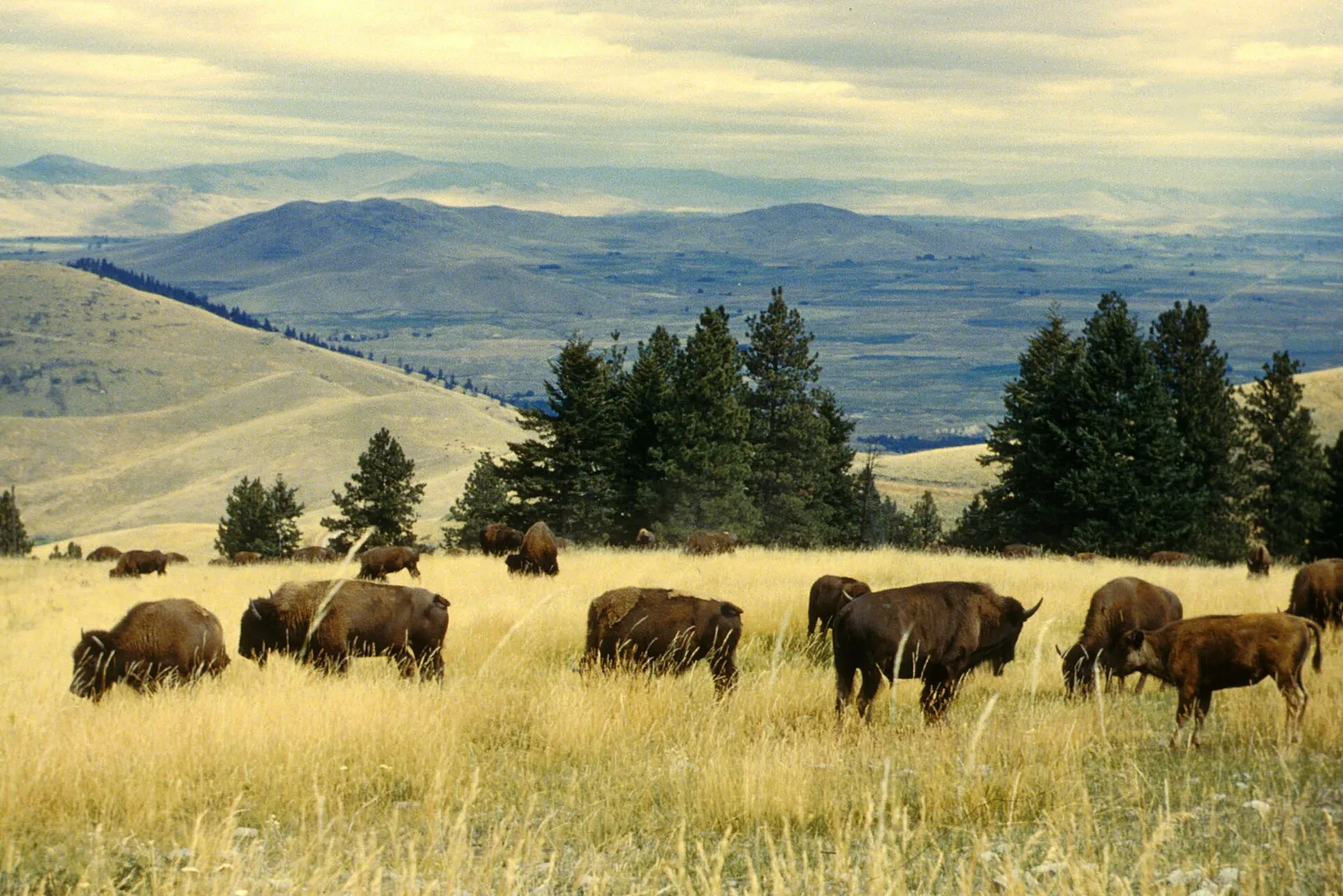
Bison herd, Wichita Mountains Wildlife Refuge
Fast Facts
Did You Know?
In 1907, the New York Zoological Society (now the Bronx Zoo) shipped 15 bison by train from the Bronx to the Wichita Mountains Wildlife Refuge, making it the first bison reintroduction in American history. From those 15 animals, the herd has grown to approximately 650 today, and descendant herds have been distributed to reservations and conservation areas across the Great Plains.
The Wichita Mountains Wildlife Refuge maintains a herd of Texas Longhorn cattle as a conservation measure. The Longhorn breed had nearly disappeared by the early 20th century, replaced by more productive beef breeds. The refuge herd, established in 1927, helped preserve the breed and is considered one of the founding herds of the modern Longhorn conservation program.
The Holy City of the Wichitas within the refuge has hosted an outdoor Easter pageant every year since 1926, making it one of the longest-running outdoor theatrical productions in the United States. The stone buildings, built to replicate ancient Jerusalem, were constructed by the Civilian Conservation Corps in the 1930s and can accommodate audiences of over 100,000 for the weekend performances.
Plan Your Visit
Location
Comanche County, southwestern Oklahoma, near Lawton
Designation
National Wildlife Refuge
Best Time to Visit
Spring and fall for mild temperatures; summers are hot
Admission
Free, U.S. Fish and Wildlife Service
Visitor Center
32 Quanah Parker Trail, Indiahoma, OK 73552
Hours
Refuge open year-round; visitor center hours vary seasonally
Getting There
OK-49 west from Lawton; 7 miles north of Medicine Park
More Info
fws.gov/refuge/wichita-mountains