

About Massachusetts
Massachusetts takes its name from the Massachusett people, an Algonquian-speaking nation who lived in the region around Massachusetts Bay when English colonists arrived in the early 1600s. The name "Massachusett" is believed to mean "at the great hill" or "at the range of hills," referring to the Blue Hills south of present-day Boston, a prominent landmark visible from the coast. English colonists recorded the name for the people and the bay, and it was applied to the Massachusetts Bay Colony established in 1630 by Puritan settlers led by John Winthrop. Massachusetts was one of the most influential colonies in the founding era, home to the Boston Massacre, the Boston Tea Party, the Battles of Lexington and Concord, and many of the Revolution's most important leaders.
Massachusetts punches far above its weight. It is the 44th-largest state by area, smaller than West Virginia, yet it is home to the oldest university in America, the world's most productive biotech cluster, and more history per square mile than almost anywhere else in the country. Two presidents were born within miles of each other in the same town. The American Revolution started here. The national anthem was written about a battle fought nearby. The first public school, the first college, the first regularly published newspaper in America, all Massachusetts.
The state's modern economy is built on three overlapping foundations: education, healthcare, and innovation. Harvard and MIT in Cambridge produce a constant stream of research, talent, and startups. Kendall Square, a single square mile next to MIT, has the highest concentration of biotechnology companies on Earth. Boston's hospitals are among the best in the world. The result is one of the highest per-capita incomes and levels of educational attainment of any state in the nation.
Politically, Massachusetts is one of the most reliably Democratic states in the country, yet it has a long tradition of electing Republican governors, Mitt Romney, Charlie Baker, who govern pragmatically in a state where the legislature is overwhelmingly Democratic. Maura Healey, elected in 2022, made history as one of the first two openly lesbian governors in U.S. history, elected the same night as Oregon's Tina Kotek, and as the first woman elected governor of Massachusetts.

Massachusetts's Five Regions
Massachusetts's capital and largest city is also one of the most historically significant cities in the United States. Boston was founded in 1630 by Puritan settlers and has been at the center of American history ever since, the Boston Massacre, the Boston Tea Party, the Midnight Ride of Paul Revere, and the battles of Lexington and Concord all trace back to Boston or its immediate surroundings.
Today the Greater Boston metro area, including Cambridge, Somerville, Newton, Quincy, and dozens of surrounding cities and towns, is the economic and cultural engine of New England. Cambridge alone, home to Harvard and MIT, is one of the most intellectually productive places on Earth.
Boston sits on the Shawmut Peninsula, originally connected to the mainland by a thin neck now buried under Washington Street; the modern city is largely built on fill. The Back Bay was a tidal marsh filled between 1857 and 1900 with gravel hauled by train from Needham, one of the largest landmaking projects of the 19th century, and Logan Airport, the Seaport, and much of the North End and West End also stand on made land.
Waves of immigration reshaped the city: the Irish arrived by the tens of thousands during and after the 1845 to 1852 famine, followed by Italians, Eastern European Jews, and, more recently, large Haitian, Cape Verdean, Vietnamese, Chinese, and Brazilian communities. Boston elected the Irish-American James Michael Curley mayor four times between 1914 and 1950, and his career came to define big-city machine politics in the popular imagination and in the novel The Last Hurrah.
Court-ordered school desegregation busing in 1974 and 1975 set off violent protests, especially in South Boston and Charlestown, and accelerated white flight and enrollment decline in the Boston Public Schools. The metro area's severe housing shortage has since made it one of the most expensive places to live in the country, with a median single-family home price above one million dollars across much of the inner suburbs by the mid-2020s.
The crooked arm of Cape Cod extends into the Atlantic southeast of Boston, giving Massachusetts one of the most distinctive and beloved coastlines in America. Cape Cod's beaches, lighthouses, salt marshes, and historic fishing villages, Provincetown, Wellfleet, Chatham, Falmouth, draw millions of visitors each summer. Martha's Vineyard and Nantucket, accessible only by ferry or plane, are two of the most exclusive island retreats in the country.
The South Shore communities south of Boston, Plymouth (site of the Pilgrims' 1620 landing), Duxbury, Marshfield, blend colonial history with suburban growth. Plymouth's Plimoth Patuxet living history museum and Plymouth Rock remain major heritage tourism destinations.
Cape Cod owes its shape to the last ice age: it is a terminal moraine and outwash plain of sand and gravel left by the retreating Laurentide ice sheet, which makes its bluffs erode quickly, in places over three feet a year at the Outer Cape. President Kennedy signed the Cape Cod National Seashore into law in 1961, protecting about 40 miles of the Outer Cape shore from development.
Martha's Vineyard has roughly 20,000 year-round residents and about 200,000 in summer, and the town of Oak Bluffs grew from a Methodist camp-meeting ground into one of the oldest African American summer resort communities in the country. Nantucket, 30 miles out to sea, was the world's leading whaling port in the early 1800s before New Bedford eclipsed it, and the entire island is a National Historic Landmark District.
The Cape Cod Canal, opened in 1914 and widened by the Army Corps of Engineers in the 1930s, cut the dangerous trip around the Outer Cape and effectively made the Cape an island crossed by three bridges. The two aging highway bridges at Bourne and Sagamore, built in 1935, carry the entire summer traffic load and are slated for federally funded replacement in the late 2020s.
Western Massachusetts is a world apart from the Boston metro, quieter, more rural, and shaped by the Connecticut River valley and the Berkshire Mountains. The Pioneer Valley anchors a surprising concentration of higher education: the Five College Consortium (UMass Amherst, Amherst College, Hampshire College, Mount Holyoke, and Smith) makes the Amherst-Northampton area one of the most college-dense communities in the country.
The Berkshires, the rolling mountains of the far western corner of the state, are home to Tanglewood (summer home of the Boston Symphony Orchestra), the Clark Art Institute, Mass MoCA, and one of the most vibrant rural arts scenes in America.
The Connecticut River, New England's longest, runs down the middle of the region through the fertile Pioneer Valley, historically called the 'Valley of the Tobacco' for the shade-grown cigar-wrapper leaf raised under acres of white netting around Hadley and Deerfield. Springfield, the region's largest city, was home to the U.S. Armory that gave the world the interchangeable-parts 'Springfield rifle,' and the assembly-line term 'the American system of manufactures'; the site is now Springfield Armory National Historic Site.
The region's colleges are an economic anchor by themselves: Williams College in Williamstown, founded in 1793, and the Five College Consortium together enroll more than 30,000 students, and UMass Amherst is the flagship of the state university system with about 32,000 students. Northampton became known from the 1980s onward as a center of LGBTQ life and small-scale arts and food businesses.
MASS MoCA opened in 1999 in a 26-building former Sprague Electric factory complex in North Adams and is one of the largest contemporary art museums in the United States, a deliberate bet on culture to replace lost manufacturing. General Electric's decades of dumping PCBs into the Housatonic River from its Pittsfield transformer plant left one of the longest Superfund cleanup sites in the country, still being negotiated in the 2020s.
Worcester, Massachusetts's second-largest city, sits at the geographic heart of the state. It was a center of the abolitionist movement in the 19th century and an industrial powerhouse in the early 20th. Today Worcester is home to the University of Massachusetts Medical School, Worcester Polytechnic Institute, Holy Cross, and Clark University.
The city has undergone significant revitalization driven by healthcare, education, and the arrival of the Triple-A baseball Worcester Red Sox (formerly the Pawtucket Red Sox). Lowell, northeast of Worcester, was America's first planned industrial city, built around water-powered textile mills in the 1820s, and is now a National Historical Park.
Worcester hosted the first National Woman's Rights Convention in 1850, a larger and more national gathering than Seneca Falls two years earlier, and the city was a hub of the Underground Railroad and of abolitionist Thomas Wentworth Higginson's activism. In 1926 the Worcester-raised physicist Robert Goddard launched the world's first liquid-fueled rocket from his aunt's farm in nearby Auburn.
The industrial city built machinery, wire, and abrasives; Worcester-based Norton Company was for decades the world's largest maker of grinding wheels. Its manufacturing decline was severe, and by the 2000s the city was leaning on its 'meds and eds' base, the UMass Chan Medical School, WPI, Holy Cross, and Clark, to drive recovery, capped by the 2021 opening of Polar Park for the relocated Triple-A club.
Lowell's mills drew on the labor of Yankee 'mill girls' and then successive immigrant groups, and today the city is home to the second-largest Cambodian American community in the United States, the result of refugee resettlement after the Khmer Rouge genocide. The former mill town of Lawrence, on the Merrimack, was the site of the 1912 'Bread and Roses' strike, a landmark victory for the Industrial Workers of the World and immigrant textile workers.
The communities north of Boston along the Atlantic coast are defined by maritime heritage, literary history, and, in the case of Salem, one of the most infamous episodes in American colonial history. Salem was the site of the 1692 witch trials, in which 20 people were executed after being accused of witchcraft in a wave of mass hysteria. Today Salem has embraced this dark history, becoming a major Halloween tourism destination with museums, walking tours, and the Peabody Essex Museum.
Gloucester is America's oldest fishing port. Newburyport, Rockport, and Marblehead are among New England's most picturesque coastal towns. Plum Island National Wildlife Refuge protects one of the last great barrier beaches on the New England coast.
The 1692 witch trials touched more than a dozen communities, and the accused were held and tried in Salem Town; the executions took place at a site on Proctor's Ledge, confirmed by scholars in 2016, where the city dedicated a memorial in 2017. The trials ended after the governor's own wife was accused and the courts stopped admitting 'spectral evidence,' and Arthur Miller used them as an allegory for McCarthyism in his 1953 play The Crucible.
Salem's real historical importance is maritime: in the decades after the Revolution its merchant fleet opened American trade with India, Sumatra, and China, and for a time Salem was one of the richest cities per capita in the country, a story told at the Salem Maritime National Historic Site and the Peabody Essex Museum, founded in 1799 as the East India Marine Society. Nathaniel Hawthorne worked in the Salem Custom House and set The House of the Seven Gables in the town.
Marblehead calls itself the birthplace of the American Navy, tracing to the schooner Hannah commissioned there in 1775, and Colonel John Glover's Marblehead mariners rowed Washington's army across the Delaware in 1776. Cape Ann's rocky shore around Rockport drew the artists of the Rockport Art Association and the fishing-shack subject known as 'Motif Number 1,' one of the most painted buildings in America.

Economy
Massachusetts's economy is built on the world's densest concentration of universities, hospitals, and research institutions, and the industries those institutions spawn.
Harvard University (1636) is the oldest university in America. MIT, Boston University, Tufts, Boston College, Brandeis, Northeastern, UMass Amherst, Williams, Amherst, and over 100 other colleges and universities operate in the state.
This academic density produces a constant pipeline of talent, ideas, and spinoff companies that drive every other sector of the economy. The 'eds and meds' cluster in Boston and Cambridge generates billions in research spending annually, much of it federally funded through NIH, NSF, and Department of Defense grants.
Massachusetts enrolls well over 400,000 college students, and roughly half of the four-year students come from out of state, a larger share than almost any state, making higher education one of the commonwealth's biggest exports. Harvard's endowment, about 50 billion dollars, and MIT's, above 20 billion, are the two largest of any university in the world, and MIT alone reports that companies founded by its alumni would rank among the largest economies on Earth if taken as a nation.
The concentration also creates fragility: the pandemic and later federal research-funding disputes exposed how dependent the region's hospitals and labs are on National Institutes of Health money, and Massachusetts institutions receive more NIH funding per capita than any other state. Falling numbers of college-age Americans have forced small New England colleges to merge or close, with Massachusetts schools such as Mount Ida (2018), Newbury (2019), and Pine Manor (absorbed by Boston College, 2020) among the casualties.
But it is Kendall Square in Cambridge, a single square mile adjacent to MIT, that has earned the title 'the most innovative square mile on the planet.' Kendall Square is home to hundreds of biotechnology and pharmaceutical companies including Moderna, Biogen, Novartis, Pfizer, and dozens of startups working on gene therapy, cancer immunotherapy, mRNA vaccines, and rare disease treatments.
Massachusetts is the largest biotech cluster in the United States by employment and investment.
The cluster traces to the 1978 founding of Biogen in Cambridge by scientists including future Nobel laureates Walter Gilbert and Phillip Sharp, and to Genzyme, which pioneered treatments for rare 'orphan' diseases. Moderna, founded in Cambridge in 2010, went from an unproven messenger-RNA startup to shipping hundreds of millions of COVID-19 vaccine doses in 2021, and the state's biopharma sector now employs well over 100,000 people.
Teaching hospitals anchor the research side: Massachusetts General, founded in 1811 and the original site of the first public demonstration of surgical ether anesthesia in 1846, and Brigham and Women's are the two largest recipients of NIH research funding of any hospitals in the country. The 2022 merger that created Mass General Brigham produced one of the largest private employers in Massachusetts, with more than 80,000 workers.
Today the region has evolved into a broader innovation economy anchored by software, artificial intelligence, robotics, and clean technology. Boston's Seaport Innovation District has attracted major technology employers including Amazon, Vertex Pharmaceuticals, and dozens of startups. The combination of MIT, Harvard, and dozens of other research universities creates a research-to-commercialization pipeline unlike anywhere else in the country.
The Route 128 corridor earned the nickname 'America's Technology Highway' in the 1950s and 1960s, and by 1980 the minicomputer makers Digital Equipment Corporation, Data General, Wang, and Prime made the Boston area a rival to Silicon Valley. Digital was New England's largest private employer at its late-1980s peak with over 120,000 workers worldwide; it failed to adapt to the personal computer and was sold to Compaq in 1998, a collapse studied ever since as a warning about incumbents missing a technology shift.
The region reinvented itself around software, security, and robotics. Companies with deep MIT roots include iRobot, maker of the Roomba, founded by Rodney Brooks and colleagues in 1990, and Boston Dynamics, spun out of an MIT lab in 1992. HubSpot, Wayfair, Toast, and the database company MongoDB are among the larger Boston-area technology firms to reach multibillion-dollar valuations in the 2010s.
Amazon opened a fast-growing tech hub in the Seaport and announced 3,000 jobs there in 2018, and General Electric moved its global headquarters to Boston in 2016 before sharply scaling back the plan. Massachusetts consistently ranks at or near the top of the Milken Institute's State Technology and Science Index, which measures research capacity and the concentration of technology industry.
Fidelity Investments, one of the world's largest asset management firms, is headquartered in Boston and employs tens of thousands statewide. State Street Corporation, one of the world's largest custodian banks, is a Boston institution. Liberty Mutual Insurance, one of the nation's largest insurers, is also headquartered in Boston.
The legal, consulting, and accounting sectors are enormous, serving the state's massive healthcare, biotech, and technology industries. Wellington Management and MFS Investment Management add to Boston's asset management concentration.
Boston effectively invented the modern mutual fund: MFS created the first open-end mutual fund in the United States, the Massachusetts Investors Trust, in 1924. State Street and Bank of New York Mellon are the two dominant custodian banks in the world, and State Street's 1993 launch of the SPDR S&P 500 fund created the first widely traded exchange-traded fund, now the model for a multitrillion-dollar industry.
Fidelity, still controlled by the founding Johnson family, administers trillions of dollars in assets and runs one of the largest 401(k) recordkeeping operations in the country. Boston's loss of its big commercial banks, BayBank, Bank of Boston, and Fleet were all absorbed into Bank of America by 2004, shifted the city's financial identity decisively toward asset management rather than lending.
General Dynamics Electric Boat operates a facility in Groton, Connecticut, just across the border, connected to the Massachusetts defense workforce. Draper Laboratory in Cambridge, affiliated with MIT, works on navigation, guidance, and biomedical technology for the U.S. military. Hanscom Air Force Base in Bedford is a major Air Force research and development installation. Defense contracting is a major employer throughout the I-495 corridor.
The MIT Instrumentation Laboratory, now the independent Draper Laboratory, built the Apollo Guidance Computer that flew astronauts to the Moon; its contract in 1961 was the first major award of the entire Apollo program. MIT Lincoln Laboratory, a federally funded research center on the Hanscom base, developed the SAGE air-defense system in the 1950s and continues to work on radar, space surveillance, and missile defense.
Raytheon, founded in Cambridge in 1922, grew into the maker of the Patriot air-defense missile and the Tomahawk and, after merging with United Technologies in 2020 to form what is now RTX, became one of the largest aerospace and defense companies in the world, though it moved its corporate headquarters to Virginia in 2022. Massachusetts institutions and firms drew roughly 15 to 20 billion dollars a year in Defense Department contract and research spending in the early 2020s, concentrated along Route 128 and Interstate 495.
Boston's Freedom Trail, the Museum of Fine Arts, the Boston Symphony Orchestra, and Fenway Park draw year-round cultural tourism. The historic fishing port of Gloucester has been landing fish from the Gulf of Maine for over 400 years, it is the oldest continuously operating fishing port in the United States.
Whale watching, sailing, and coastal recreation contribute significantly to the economy of the South Shore and North Shore communities. The cranberry industry of southeastern Massachusetts and Cape Cod makes the state one of the nation's top cranberry producers.
Tourism is one of the state's largest employers, and Cape Cod's year-round population of roughly 230,000 more than doubles in summer, straining housing and water supplies on the narrow peninsula. New Bedford, once the whaling capital of the world and the setting for the opening of Herman Melville's Moby-Dick, has for more than two decades been the highest-value fishing port in the United States, landing over 300 million dollars a year, mostly in sea scallops.
Federal fishing limits imposed to rebuild collapsed Gulf of Maine cod stocks have sharply cut New England's groundfish fleet, and Gloucester's fleet is a fraction of its former size. Massachusetts grows a large share of the nation's cranberries on bogs concentrated in Plymouth County, an industry that dates to the 1810s and is represented by the Ocean Spray growers' cooperative, headquartered in Lakeville-Middleborough.

How Massachusetts's Government Works
Massachusetts's state government follows the standard three-branch structure: the Executive (Governor), the Legislative (the Massachusetts General Court), and the Judicial (the Supreme Judicial Court, the oldest continuously operating appellate court in the Western Hemisphere, established 1692).
The Governor serves a four-year term with no term limits. Massachusetts holds its gubernatorial elections in midterm years. The Governor has strong veto and appointment powers, though the legislature regularly overrides vetoes given its overwhelming Democratic supermajority.
The Massachusetts General Court, one of only two state legislatures (with New Hampshire's) to use the title "General Court", consists of a Senate (40 members, 2-year terms) and a House of Representatives (160 members, 2-year terms). Democrats hold 134 of 160 House seats and 35 of 40 Senate seats in the 2025-2026 session, giving them a veto-proof supermajority in both chambers.
Massachusetts calls its legislature the "General Court", a colonial-era term retained from the Massachusetts Bay Colony charter. The state's highest court, the Supreme Judicial Court, is the oldest appellate court in continuous operation in the Western Hemisphere, having sat since 1692.
Governor of Massachusetts
Current Governor
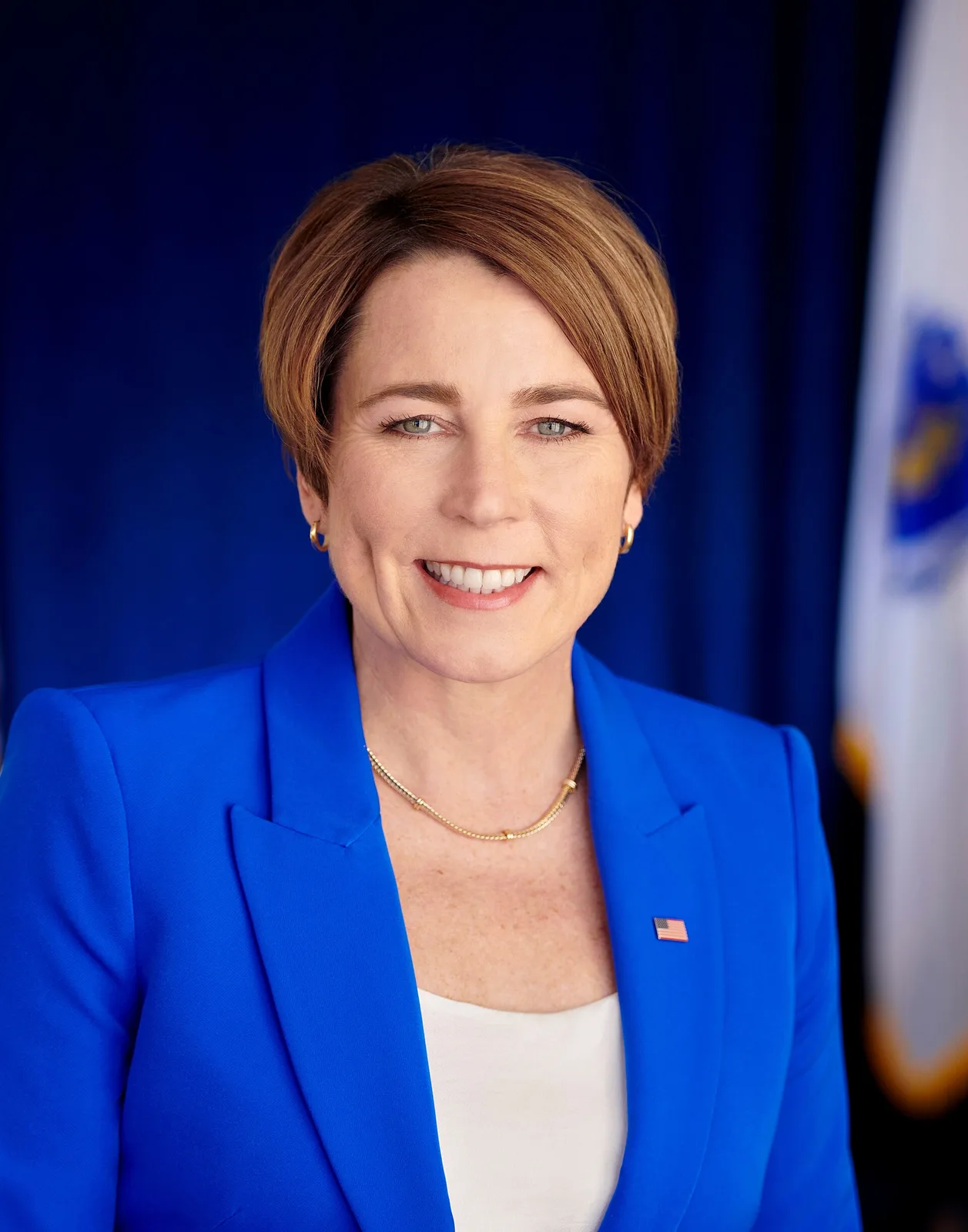
Maura Healey
- Party
- Democrat
- In Office Since
- January 5, 2023
- Elected
- November 8, 2022
- Term Ends
- January 2027
- Born
- January 8, 1971, Hampton, NH
- Education
- Harvard College (BA); Northeastern University School of Law (JD)
- Prior Role
- Massachusetts Attorney General (2015–2023)
Maura Healey is the 73rd Governor of Massachusetts and, with Oregon's Tina Kotek (elected the same night in November 2022), one of the first two openly lesbian governors in United States history. She is also the first woman ever elected governor of Massachusetts. A former Harvard basketball player and professional athlete in Austria, Healey served two terms as Massachusetts Attorney General, becoming the first openly gay statewide elected official in Massachusetts history, before winning the governorship by 29 points in 2022. She has focused on housing affordability, climate policy, and economic competitiveness.
Other Current State Officials
Lieutenant Governor
Kim Driscoll
In office since January 2023. Former mayor of Salem, Massachusetts (2006–2023), one of the longest-serving mayors in Salem's history. She oversaw Salem's transformation into a thriving tourism and innovation economy. As Lieutenant Governor she focuses on workforce development, housing, and climate resilience.
Attorney General
Andrea Campbell
In office since January 2023. The first Black person elected Attorney General in Massachusetts history. A former Boston City Councilor who grew up in foster care after losing her twin brother to gun violence, Campbell has focused on protecting reproductive rights, gun safety enforcement, and consumer protection.
Secretary of the Commonwealth
Bill Galvin
In office since 1995, the longest-serving Secretary of the Commonwealth in Massachusetts history. Galvin oversees elections, business registration, securities regulation, and the state archives. He is one of the most prominent election administrators in the country, known for expanding voter access and fighting election fraud.
The Massachusetts General Court
Massachusetts State Senate
- Seats: 40 members
- Terms: 2-year terms
The upper chamber. Massachusetts senators serve 2-year terms, all 40 seats are competitive at every election cycle. Democrats hold 35 of 40 seats in the 2025-2026 session.
Massachusetts House of Representatives
- Seats: 160 members
- Terms: 2-year terms
The lower chamber. All 160 seats are on the ballot every two years. The House is known for its powerful Speaker position. Democrats hold 134 of 160 seats in the 2025-2026 session, with 25 Republicans and one unenrolled member.
Massachusetts's U.S. Senators
U.S. Senator
Elizabeth Warren
Massachusetts's senior senator, Warren is one of the most prominent progressive voices in the Democratic Party. A Harvard Law professor and consumer protection advocate who founded the Consumer Financial Protection Bureau, she won her Senate seat in 2012 by defeating incumbent Republican Scott Brown. She ran for president in 2020, ultimately suspending her campaign after Super Tuesday. She sits on the Senate Banking, Finance, and Armed Services Committees.
U.S. Senator
Ed Markey
Massachusetts's junior senator, Markey served in the U.S. House for 37 years before winning the 2013 special election to fill John Kerry's Senate seat. He is best known as the lead Senate sponsor of the Green New Deal resolution alongside Representative Alexandria Ocasio-Cortez. Markey survived a 2020 primary challenge from Representative Joe Kennedy III. He sits on the Senate Foreign Relations and Commerce Committees.
Massachusetts Through the Years
From the Pilgrims to the Revolution to the birth of American industry to the first same-sex marriages in U.S. history, Massachusetts has consistently been where American history turns a corner.
Long before European contact, the land that became Massachusetts was home to dozens of Algonquian-speaking nations. The Wampanoag Confederacy occupied the southeastern portions of what is now Massachusetts, including Cape Cod and the islands. The Massachusett people, who gave the state its name, lived around the bay that would become Boston Harbor.
The Nipmuc, Pocumtuc, and Pennacook peoples inhabited the interior. These nations had sophisticated agricultural systems, seasonal migration patterns, and trade networks stretching throughout the Northeast. Their populations were devastated by European diseases that arrived with early explorers before significant settlement began.
An epidemic, most likely leptospirosis or a viral hepatitis carried by European fishermen and traders, swept the coast from 1616 to 1619 and killed an estimated 75 to 90 percent of the Native people between the Merrimack River and Cape Cod. The Pilgrims settled in 1620 on the cleared fields of the abandoned Wampanoag village of Patuxet, and Governor William Bradford wrote of finding the ground strewn with the unburied bones of the dead.
The peace between Plymouth and the Wampanoag sachem Ousamequin, called Massasoit, held for about 55 years but collapsed into King Philip's War in 1675 to 1676, named for his son Metacom. Proportional to population it was among the deadliest wars in American history: dozens of English towns were attacked and about a dozen destroyed, thousands of Native people were killed or sold into slavery in the Caribbean, and Metacom's severed head was displayed on a pike in Plymouth for two decades.
The Wampanoag survived. The Mashpee Wampanoag Tribe and the Wampanoag Tribe of Gay Head (Aquinnah) on Martha's Vineyard are both federally recognized today, and the Mashpee spent years fighting in federal court in the 2010s to keep their reservation land in trust. A decades-long effort has also revived the Wôpanâak language, which had no fluent speakers for more than a century.
On November 9, 1620, the Mayflower arrived off Cape Cod carrying 102 passengers, Separatist Pilgrims and 'Strangers' (non-Separatists) who had contracted to settle in the Virginia Colony. Before landing, 41 male passengers signed the Mayflower Compact, one of the earliest self-governing documents in the Western world and a foundational text of American democracy.
The Pilgrims established Plymouth Colony with the help of Tisquantum (Squanto), a Wampanoag man who had previously been kidnapped to Europe and returned, and Massasoit, the Wampanoag sachem who negotiated a peace treaty that lasted 50 years.
The Mayflower had been bound for the mouth of the Hudson River, at the northern edge of the Virginia Company's patent, but rough seas turned it back to Cape Cod in November 1620. Because they were landing outside their charter's bounds, some of the non-Separatist passengers argued they were bound by no government at all, which is why the leaders drew up the Compact to bind everyone to 'just and equal laws' before anyone went ashore.
The first winter killed roughly half of the 102 passengers, and at one point only a handful were well enough to care for the sick. Squanto, who spoke English because he had been kidnapped by an English captain in 1614 and sold in Spain before making his way home, taught the survivors to plant corn and where to fish, and brokered their alliance with Massasoit.
The 1621 harvest feast later mythologized as 'the first Thanksgiving' was a three-day event attended by about 90 Wampanoag men; it was not repeated as a tradition and was barely mentioned again for two centuries. Plymouth Colony never received a royal charter and was absorbed into the larger Province of Massachusetts Bay in 1691.
A decade after the Pilgrims, a much larger wave of Puritan settlers arrived under the Massachusetts Bay Company charter. Led by Governor John Winthrop, who famously described the new colony as 'a city upon a hill,' the Puritans established Boston in 1630 and rapidly built the most populous English colony in North America.
The Puritans established the first public school in America (Boston Latin, 1635), the first university in America (Harvard, 1636), and the first regularly published newspaper in America (the Boston News-Letter, 1704). Their vision of a godly society, though theocratically rigid, planted the seeds of the democratic and educational institutions that would later define Massachusetts.
The Great Migration brought roughly 20,000 English settlers to Massachusetts Bay between 1630 and 1642, when the outbreak of the English Civil War slowed the flow. Winthrop's phrase 'a city upon a hill,' from a lay sermon likely delivered before or during the crossing, was largely forgotten until the 20th century, when politicians from John F. Kennedy to Ronald Reagan revived it as a statement of American purpose.
The Puritan establishment enforced conformity harshly: it banished Roger Williams in 1636, tried Anne Hutchinson for heresy in 1637, and hanged four Quakers on Boston Common between 1659 and 1661, including Mary Dyer. The Massachusetts Body of Liberties of 1641, however, was one of the first legal codes in the English-speaking world to set limits on government power, and the 1647 'Old Deluder Satan' law required every town of 50 households to hire a teacher.
The colony operated for decades as a near-independent Puritan commonwealth until England revoked its charter in 1684. The 1691 replacement charter made Massachusetts a royal province, imposed a crown-appointed governor, and ended the rule that only male church members could vote, replacing it with a property qualification.
Between February 1692 and May 1693, more than 200 people in Salem Village (now Danvers) and surrounding communities were accused of witchcraft. Twenty people were executed, 14 women and 6 men, most by hanging; one man, Giles Corey, was pressed to death with heavy stones. The hysteria began among a group of young girls who claimed to be afflicted by witchcraft, spread rapidly through the community, and was amplified by a court that accepted 'spectral evidence' (dreams and visions).
The trials are now studied as a cautionary tale about mass hysteria, the dangers of religious extremism, and the failure of due process. The Massachusetts legislature formally apologized to the victims in 1711, and the last victim was officially exonerated in 2001.
The crisis unfolded against real fear: a brutal frontier war with the French and their Native allies to the north, a lapsed colonial charter, and a stream of refugees from ruined Maine settlements into Essex County, several of the key accusers among them. Historians have also noted that the accused clustered on the wealthier, commercially oriented eastern side of Salem Village while accusers clustered on the poorer farming west, mapping the trials onto a local economic rift.
The special Court of Oyer and Terminer that Governor William Phips created in May 1692 admitted 'spectral evidence,' testimony that an accuser had seen the defendant's ghostly shape, which made the charges almost impossible to disprove. Increase Mather's tract Cases of Conscience, arguing that 'it were better that ten suspected witches should escape than that one innocent person should be condemned,' helped turn elite opinion, and Phips dissolved the court in October 1692.
Judge Samuel Sewall stood in Boston's Old South Church in 1697 to have his public confession of guilt read aloud, the only judge to recant, and juror Thomas Fisk issued a written apology on behalf of the jury. The colony made restitution payments to some families in 1711, but formal legislative exoneration of the remaining names dragged on until 1957 and a final 2001 act, and in 2022 Massachusetts cleared the last convicted woman, Elizabeth Johnson Jr., after a middle-school class researched her case.
More than any other colony, Massachusetts was the crucible of American independence. The Boston Massacre (March 5, 1770), in which British soldiers killed five colonists, inflamed anti-British sentiment. The Boston Tea Party (December 16, 1773), in which colonists dumped 342 chests of British East India Company tea into Boston Harbor, led directly to the punitive Intolerable Acts. On April 19, 1775, British troops marched from Boston toward Concord to seize colonial weapons.
Paul Revere rode through the night to warn colonial militiamen. At Lexington and Concord, the 'Shot Heard 'Round the World' was fired, launching the American Revolution. The Siege of Boston followed, ending with the British evacuation in March 1776.
London's response to the Tea Party, the Coercive Acts of 1774, closed the port of Boston until the tea was paid for, stripped Massachusetts of much of its charter self-government, and moved the capital temporarily to Salem. Colonists called them the Intolerable Acts, and the other colonies sent food and money to blockaded Boston and convened the First Continental Congress in Philadelphia that September.
Revere was one of several riders that night, and he never finished his route; he was detained by a British patrol between Lexington and Concord, and it was Samuel Prescott who carried the alarm the rest of the way. At the North Bridge in Concord, militia returning fire on regulars produced the first British deaths of the war, the moment Ralph Waldo Emerson later called the 'shot heard round the world' in his 1837 'Concord Hymn.'
The retreating British column took heavy fire from militia lining the road back to Boston and lost 273 men killed, wounded, or missing that day. The eleven-month Siege of Boston ended when Henry Knox hauled cannon captured at Fort Ticonderoga across the winter countryside and the Americans fortified Dorchester Heights overnight, forcing General William Howe to evacuate 11,000 troops and about 1,000 Loyalists by sea on March 17, 1776, still marked in Suffolk County as Evacuation Day.
In the 1820s, Boston merchant Francis Cabot Lowell and his associates built the first fully integrated textile mill in America in the town that would bear his name, Lowell, Massachusetts. The Lowell mills used the power of the Merrimack River and introduced a new model of industrial labor: thousands of young women from New England farms, housed in company boarding houses, working 12-14 hour days in massive factory buildings.
The Lowell system spread throughout New England and defined the American factory model for decades. Lowell is today a National Historical Park, a preserved record of the birth of American industrialization and the labor movement that responded to it.
Francis Cabot Lowell had memorized the workings of British power looms during a visit to Lancashire and Scotland, evading laws that forbade exporting the technology, and with mechanic Paul Moody he reproduced a working loom in Waltham in 1814, the first factory anywhere to turn raw cotton into finished cloth under one roof. The Boston Manufacturing Company's investors, the 'Boston Associates,' used the profits to build the far larger complex at Lowell after his death.
The Lowell mill workforce was 80 to 90 percent young women, many sending wages home or saving for a dowry or schooling, and the company published a literary magazine, the Lowell Offering, written by the operatives. When owners cut wages, the women organized some of the first factory walkouts in the country, in 1834 and 1836, and in the 1840s the Lowell Female Labor Reform Association petitioned the legislature for a ten-hour day.
As nativism and cheaper labor grew, the mills shifted to Irish immigrant families after the 1840s and later to French Canadians, Greeks, and Poles. New England's textile industry then moved south to the Carolinas and Georgia in the early 20th century for lower wages and no unions, and Lowell's and Lawrence's mills largely stood empty by the 1950s; Congress created Lowell National Historical Park in 1978 to preserve and reinterpret the canal-and-mill district.
The 54th Massachusetts Volunteer Infantry Regiment was one of the first official Black military units in the United States Army during the Civil War. Led by Colonel Robert Gould Shaw, a young white officer from a Boston abolitionist family, the 54th was composed primarily of free Black men from across the North. On July 18, 1863, the regiment led the assault on Fort Wagner, a Confederate stronghold near Charleston, South Carolina.
Nearly half the regiment was killed or wounded in the attack. Though the fort was not taken, the bravery of the 54th helped change Northern opinion about Black soldiers and paved the way for the large-scale recruitment of African Americans into the Union Army. A memorial to Shaw and the 54th stands on Boston Common across from the State House.
Governor John Andrew raised the regiment in early 1863 with recruiters including Frederick Douglass, two of whose sons enlisted, and abolitionists put up money for bounties equal to those paid white soldiers. When the War Department nonetheless offered the men 10 dollars a month against the 13 paid white troops, the entire regiment refused all pay for 18 months rather than accept the lower rate, until Congress equalized it in 1864.
At Fort Wagner on July 18, 1863, Sergeant William Harvey Carney carried the national flag to the parapet, was shot several times, and brought the colors back saying they had never touched the ground; in 1900 he became one of the first African Americans awarded the Medal of Honor. Colonel Shaw was killed on the wall and buried by the Confederates in a mass grave with his men, an act meant as an insult that his family chose to treat as an honor.
Augustus Saint-Gaudens spent 14 years on the bronze relief memorial on Boston Common, unveiled in 1897, showing Shaw on horseback among the marching soldiers, unusual for the era in depicting Black men as individuals. The 54th's story reached a wide modern audience through the 1989 film Glory, and about 200,000 Black soldiers ultimately served in the Union Army and Navy.
John Fitzgerald Kennedy was born in Brookline, Massachusetts in 1917 and grew up in a prominent Irish-Catholic political family. He represented Massachusetts in the U.S. House and Senate before winning the 1960 presidential election against Richard Nixon in one of the closest elections in American history, becoming the first Catholic president and the youngest elected president in U.S. history at age 43.
His presidency, marked by the Cuban Missile Crisis, the early space race, the Civil Rights movement, and the founding of the Peace Corps, was cut short by his assassination in Dallas on November 22, 1963. Kennedy's Brookline birthplace is a National Historic Site.
Kennedy's grandfathers were both Boston political figures: John F. 'Honey Fitz' Fitzgerald was a congressman and mayor of Boston, and Patrick J. Kennedy was a ward boss and state legislator. His father, Joseph P. Kennedy, made a fortune in banking, film, and liquor importing, chaired the new Securities and Exchange Commission under Franklin Roosevelt, and served as ambassador to Britain from 1938 to 1940.
Kennedy commanded the patrol torpedo boat PT-109 in the Pacific; after a Japanese destroyer cut it in half in 1943 he swam wounded crewmen to safety and towed one by a life-jacket strap in his teeth, and the episode became central to his political image. He won a House seat from Boston in 1946, moved to the Senate by defeating Henry Cabot Lodge Jr. in 1952, and won a Pulitzer Prize for Profiles in Courage in 1957.
The first-ever televised presidential debates, against Nixon in 1960, are widely credited with helping him win by about 112,000 popular votes out of 68 million. His younger brothers extended the dynasty: Robert F. Kennedy served as attorney general and then senator from New York before his own 1968 assassination, and Edward M. 'Ted' Kennedy held the Massachusetts Senate seat from 1962 until his death in 2009.
On May 17, 2004, Massachusetts became the first state in the United States to legalize same-sex marriage, following the Massachusetts Supreme Judicial Court's ruling in Goodridge v. Department of Public Health. The court held 4–3 that denying marriage licenses to same-sex couples was unconstitutional under the Massachusetts Constitution.
Hundreds of couples lined up outside city halls across the state to obtain licenses beginning at midnight. The Massachusetts ruling set off a national debate about marriage equality that would eventually lead to the U.S. Supreme Court's 2015 ruling in Obergefell v. Hodges, which made same-sex marriage legal nationwide.
The Goodridge decision was written by Chief Justice Margaret Marshall, who as a young lawyer in South Africa had been an anti-apartheid student leader. The lead plaintiffs, Hillary and Julie Goodridge, had been together for years and sought the license in part so their daughter's family would have legal standing.
Opponents, led by Governor Mitt Romney, tried to block the ruling by reviving a colonial-era 1913 law barring marriages that would be void in a couple's home state, which kept most out-of-state same-sex couples from marrying in Massachusetts until the law was repealed in 2008. A proposed state constitutional amendment to overturn Goodridge cleared one constitutional convention in 2007 but fell short of the votes needed at the second, ending the repeal effort.
By the time of Obergefell in 2015, about 37 states and the District of Columbia already allowed same-sex marriage, and roughly 25,000 same-sex couples had married in Massachusetts. Studies by the Massachusetts Department of Public Health and others found no measurable effect on the state's overall marriage or divorce rates in the years that followed.
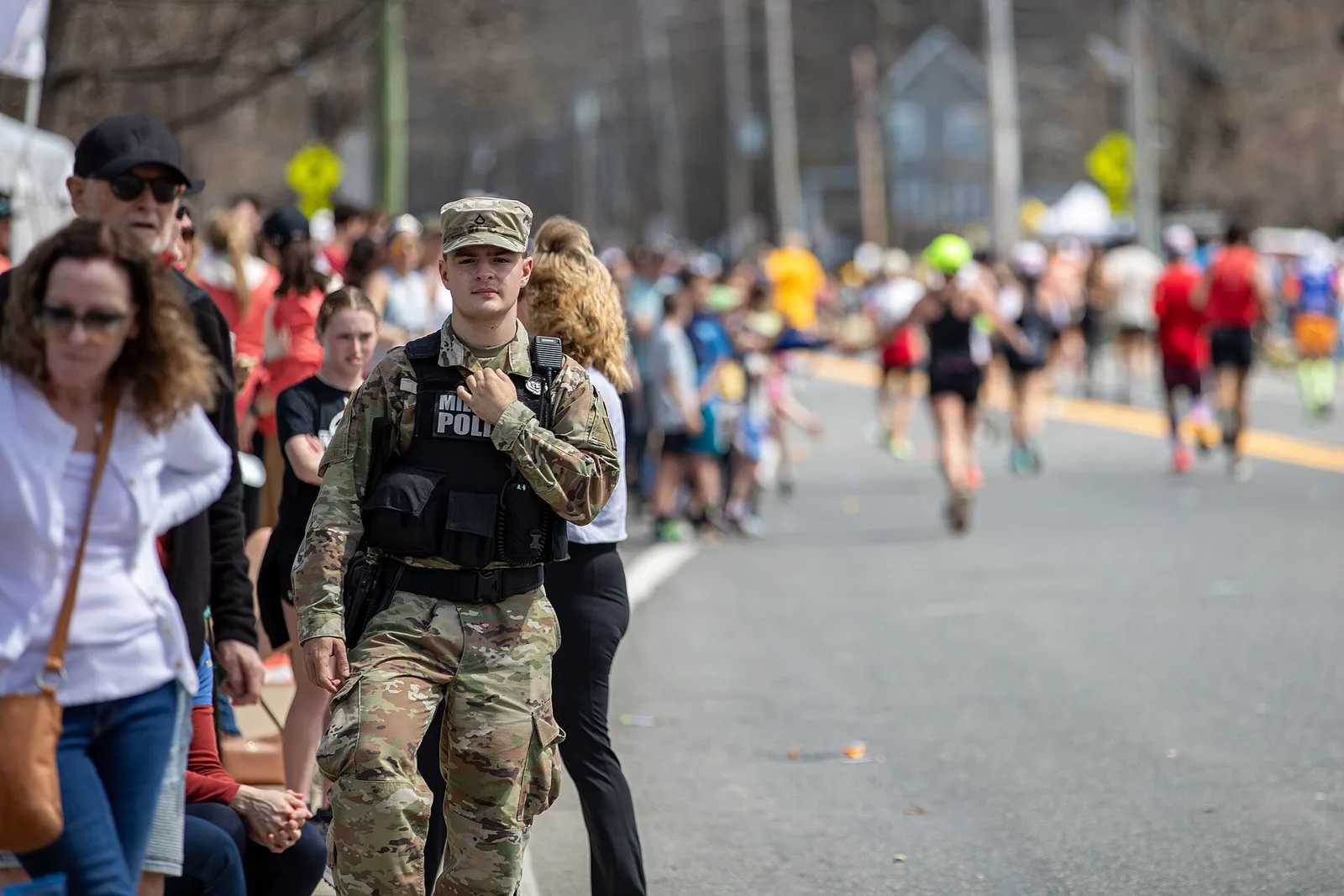
Massachusetts's Defining Moments in American History
These are the events that didn't just shape Massachusetts, they changed the nation.
On the night of December 16, 1773, members of the Sons of Liberty disguised as Mohawk Indians dumped 342 chests of British East India Company tea into Boston Harbor, protesting taxation without representation. The act of defiance was an act of economic sabotage that shocked the British Empire and united the American colonies against Parliamentary overreach.
The Boston Tea Party is widely considered one of the most significant acts of protest in American history, a direct catalyst for the Revolutionary War that followed.
The trigger was the Tea Act of 1773, which actually lowered the price of legal tea by letting the near-bankrupt East India Company sell directly in the colonies; colonists objected because buying the cheaper tea would mean accepting Parliament's right to tax them. Three tea ships, the Dartmouth, Eleanor, and Beaver, sat at Griffin's Wharf while Governor Thomas Hutchinson refused to let them leave without unloading, and a mass meeting of several thousand at the Old South Meeting House failed to break the standoff.
The roughly 5,000 pounds of destroyed tea was worth about 9,000 to 10,000 pounds sterling, on the order of one to two million dollars today, and the raiders were disciplined enough to sweep the decks and replace a broken padlock afterward. The term 'Tea Party' was not used until the 1820s; participants at the time simply called it 'the destruction of the tea.'
Parliament answered with the Coercive Acts of 1774, closing the port of Boston and curbing Massachusetts self-rule, which pushed the colonies to convene the Continental Congress. Benjamin Franklin, then in London, called the destruction 'an act of violent injustice on our part' and urged the tea be paid for; Boston never did.
On April 19, 1775, British regulars marching from Boston toward Concord to seize colonial munitions exchanged fire with colonial militiamen at Lexington and Concord. The 'shot heard round the world' marked the beginning of armed conflict in the American Revolution.
Paul Revere's midnight ride the night before, and the Minutemen who stood on Lexington Green, became enduring symbols of American courage and self-determination. Massachusetts was where the fight for independence was literally begun.
General Thomas Gage sent about 700 troops out of Boston in secret to seize a cannon and powder store the Provincial Congress had gathered at Concord. The lanterns hung in the Old North Church steeple, 'one if by land, two if by sea,' signaled that the regulars were crossing the Charles by boat, and multiple riders, Revere, William Dawes, and later Samuel Prescott, spread the alarm through a pre-arranged network across Middlesex County.
On Lexington Green about 77 militia under Captain John Parker faced the column at dawn; a shot of unknown origin set off a volley that left eight townsmen dead. At Concord's North Bridge hours later the militia, by then numbering in the hundreds, fired on the regulars and killed several, the first time Americans deliberately shot at the King's troops.
The British march back to Boston turned into a 16-mile gauntlet of fire from behind stone walls and buildings, and by nightfall the regulars had lost 273 killed, wounded, or missing to the colonists' roughly 95. Longfellow's 1860 poem 'Paul Revere's Ride' and Emerson's 1837 'Concord Hymn' fixed the day in national memory, and Massachusetts and Maine still observe Patriots' Day on the third Monday in April.
In November 1620, the Mayflower arrived off the coast of what is now Massachusetts with 102 passengers, Separatists fleeing religious persecution and others seeking opportunity. Before landing, they signed the Mayflower Compact, one of the earliest frameworks for self-governance in America.
The Plymouth Colony they founded, though small and struggling, planted seeds of democratic governance, religious liberty, and community self-determination that grew into the foundational values of the American republic.
The Separatists had already fled England for Leiden in the Netherlands around 1608, and left after a decade fearing their children were losing their English identity and that war with Spain was coming. Only about 40 of the passengers were members of their congregation; the rest were craftsmen, servants, and hired hands the London investors sent along, whom the Pilgrims called 'Strangers.'
The Compact was signed by 41 adult men on November 11, 1620, while the ship lay at anchor off Provincetown, and it bound signers into a 'civil body politic' that would make its own laws, a practical response to being outside any chartered jurisdiction rather than a theory of democracy. John Quincy Adams in 1802 was among the first to praise it publicly as a foundational American document.
Plymouth stayed small, perhaps 7,000 people by 1690, and was always overshadowed by the Puritan colony to its north, which absorbed it in 1691. Its outsized place in national memory came in the 19th century through Forefathers' Day observances, Felicia Hemans's poem 'The Landing of the Pilgrim Fathers,' and the promotion of Plymouth Rock, first identified by a 94-year-old man in 1741, as a national relic.
Founded in 1636 as a training college for Puritan ministers, Harvard University is the oldest institution of higher education in the United States. Over nearly four centuries, Harvard has shaped American law, medicine, science, politics, and culture to an extraordinary degree.
Eight U.S. presidents, 161 Nobel laureates, and countless influential figures in every field have walked its grounds. Massachusetts has long been the intellectual capital of the nation, and Harvard its greatest institution.
The Great and General Court of Massachusetts Bay voted 400 pounds to found the college in 1636, and it took the name of John Harvard, a young minister who died in 1638 and left it his library of about 400 books and half his estate. The first printing press in the English colonies was set up beside it in Cambridge in 1638, and printed the Bay Psalm Book in 1640.
Harvard slowly shed its religious purpose: it dropped the ministerial focus, and a bitter 1805 fight over a liberal theology professor helped split American Congregationalism and gave the school a Unitarian cast. Under President Charles W. Eliot from 1869 to 1909 it adopted the elective curriculum, built modern professional schools of law, medicine, and business, and became a research university on the German model.
The endowment, built over centuries of gifts and investment, is the largest of any university in the world, and Harvard's admissions practices have repeatedly set national precedent, including the 1978 Bakke opinion that cited its plan approvingly and the 2023 Supreme Court decision in Students for Fair Admissions v. Harvard that struck down race-conscious admissions nationwide.
Massachusetts was the intellectual and moral engine of American abolitionism. William Lloyd Garrison published The Liberator in Boston beginning in 1831. Frederick Douglass escaped slavery and found his public voice in Massachusetts.
The 54th Massachusetts Infantry, the first Black regiment raised in the North, became a symbol of Black courage and equality. Massachusetts was the first state to ban slavery through a court ruling in 1783, and its abolitionist community built the political and moral case that eventually made emancipation possible.
Slavery in Massachusetts ended not by statute but through lawsuits: an enslaved woman known as Mumbet, later Elizabeth Freeman, and a man named Quock Walker sued for their freedom in 1781, and the state's high court ruled in the Walker case in 1783 that slavery was incompatible with the new 1780 constitution's declaration that 'all men are born free and equal.' By the 1790 census, Massachusetts reported no enslaved people, the only state to do so.
Garrison's American Anti-Slavery Society, founded in 1833, demanded immediate and unconditional emancipation and was long treated as dangerously radical; a Boston mob dragged Garrison through the streets by a rope in 1835. Douglass gave his first major address to a white audience at an 1841 antislavery meeting in Nantucket and published his Narrative from Boston in 1845.
Massachusetts abolitionists ran Underground Railroad stations, resisted the 1850 Fugitive Slave Act, and in 1854 a crowd tried to storm a Boston courthouse to free the captured freedom-seeker Anthony Burns, who was marched to a ship past 50,000 onlookers under federal guard. The state's senators Charles Sumner and Henry Wilson were among the most uncompromising antislavery voices in Congress; Sumner was beaten nearly to death on the Senate floor in 1856 for a speech against slavery in Kansas.
Notable Massachusettans
John Adams
2nd President of the United States, born in Braintree (now Quincy); Founding Father, diplomat, and author of the Massachusetts Constitution
John Quincy Adams
6th President of the United States, born in Braintree; son of John Adams and the only former president elected to the U.S. House, where he served 17 years after leaving the White House
Benjamin Franklin
Founding Father, inventor, diplomat, and printer; born in Boston's Milk Street in 1706
John F. Kennedy
35th President of the United States; born in Brookline; first Catholic president and the youngest elected to the office
Paul Revere
Boston silversmith and patriot; his midnight ride on April 18, 1775 warned colonial militiamen of the approaching British army
Samuel Adams
Founding Father and political organizer; orchestrated the Boston Tea Party and was a leading voice for independence
Emily Dickinson
One of America's greatest poets; spent nearly her entire life in Amherst; only 10 of her nearly 1,800 poems were published in her lifetime
W.E.B. Du Bois
Groundbreaking civil rights leader, sociologist, and author of The Souls of Black Folk; born in Great Barrington
Ralph Waldo Emerson
Philosopher and essayist; leading figure of the Transcendentalist movement; lived in Concord
Dr. Seuss (Theodor Geisel)
Author and illustrator of The Cat in the Hat, Green Eggs and Ham, and over 60 other beloved children's books; born in Springfield
State Symbols & Quick Facts
| Nickname | "The Bay State" |
| Capital | Boston |
| Largest City | Boston |
| Statehood | February 6, 1788 (6th state) |
| Population | ~7.1 million (2025 est.) |
| Area | 10,554 sq miles (44th largest) |
| State Bird | Black-capped Chickadee |
| State Flower | Mayflower (Trailing Arbutus) |
| State Tree | American Elm |
| State Fish | Atlantic Cod |
| State Marine Mammal | Right Whale |
| State Insect | Seven-spotted Ladybug |
| State Sport | Basketball (invented in Springfield, 1891) |
| State Song | All Hail to Massachusetts |
| State Motto | Ense petit placidam sub libertate quietem ("By the sword we seek peace, but peace only under liberty") |
| Time Zone | Eastern Time |
| Bordering States | NH, VT, NY, CT, RI |
Did You Know?
Harvard University, founded in 1636, is the oldest university in the United States, established just six years after Boston itself was founded.
The American Revolution began in Massachusetts. The first shots of the war were fired at Lexington and Concord on April 19, 1775, a date still celebrated as Patriots' Day, a Massachusetts state holiday.
Basketball was invented in Springfield, Massachusetts in December 1891 by Dr. James Naismith, a physical education instructor who needed an indoor winter activity for his students. The Naismith Memorial Basketball Hall of Fame is in Springfield.
Kendall Square in Cambridge, a single square mile next to MIT, is home to more biotechnology and pharmaceutical companies per acre than anywhere else on Earth, earning it the nickname 'the most innovative square mile on the planet.'
Massachusetts was the first state in the United States to legalize same-sex marriage, on May 17, 2004, following the Supreme Judicial Court's ruling in Goodridge v. Department of Public Health.
The Boston Marathon, run annually on Patriots' Day (third Monday in April) since 1897, is the world's oldest annual marathon and one of the most prestigious road races on Earth.
The Mayflower Compact, signed aboard the Mayflower in Provincetown Harbor on November 11, 1620, was one of the first written frameworks for self-government in the Western world, a direct ancestor of American constitutional democracy.
Massachusetts has two U.S. presidents who were born within miles of each other in the same town: John Adams (born 1735) and John Quincy Adams (born 1767) were both born in Braintree, today's Quincy.
Gloucester, Massachusetts has been an active commercial fishing port since 1623, making it the oldest continuously operating fishing port in the United States, over 400 years old.
The 'Big Dig', Boston's Central Artery/Tunnel Project, completed in 2007, was the most expensive highway project in U.S. history at the time, rerouting Interstate 93 underground through downtown Boston and fundamentally transforming the city's waterfront.
Quick Facts and Common Questions
Short answers to the questions people most often ask about Massachusetts: its abbreviation, why it is a commonwealth, its capital, and its place in Congress.
Massachusetts's two-letter postal abbreviation is MA. The U.S. Census Bureau places it in the Northeast region, in the New England division, and about 7.03 million people lived there in the 2020 census.
Massachusetts became the 6th state on February 6, 1788, when its convention ratified the U.S. Constitution by a vote of 187 to 168. It grew out of Plymouth Colony, founded by the Mayflower Pilgrims in 1620, and the Massachusetts Bay Colony, founded in 1630; the two were joined under one charter in 1691.
Yes. Its official name is the Commonwealth of Massachusetts, set by its 1780 constitution, drafted mainly by John Adams. That constitution is the oldest written constitution still in effect anywhere in the world. Kentucky, Pennsylvania, and Virginia also call themselves commonwealths.
The name comes from the Massachusett people, who lived around Massachusetts Bay. It is an Algonquian word usually translated as "at the great hill," thought to refer to the Great Blue Hill south of Boston.
Boston has been the seat of government since the Massachusetts Bay Colony settled there in 1630, and it is also the state's largest city. The Massachusetts State House, designed by Charles Bulfinch and completed in 1798, is known for its gold-covered dome.
Massachusetts borders five states: New Hampshire and Vermont to the north, New York to the west, and Connecticut and Rhode Island to the south. Its eastern side is Atlantic coastline, including Cape Cod and the islands of Martha's Vineyard and Nantucket.
Massachusetts was at the center of the road to independence. Colonists dumped British tea into Boston Harbor in the Boston Tea Party on December 16, 1773, and the first battles of the Revolutionary War were fought at Lexington and Concord on April 19, 1775. Read more in U.S. history.
Massachusetts is known as "The Bay State." Its motto is "Ense petit placidam sub libertate quietem," Latin for "By the sword we seek peace, but peace only under liberty." Its state bird is the black-capped chickadee, its flower is the mayflower, and its tree is the American elm.
Based on the 2020 census, Massachusetts has 9 seats in the U.S. House of Representatives, the same as before, which gives it 11 votes in the Electoral College.
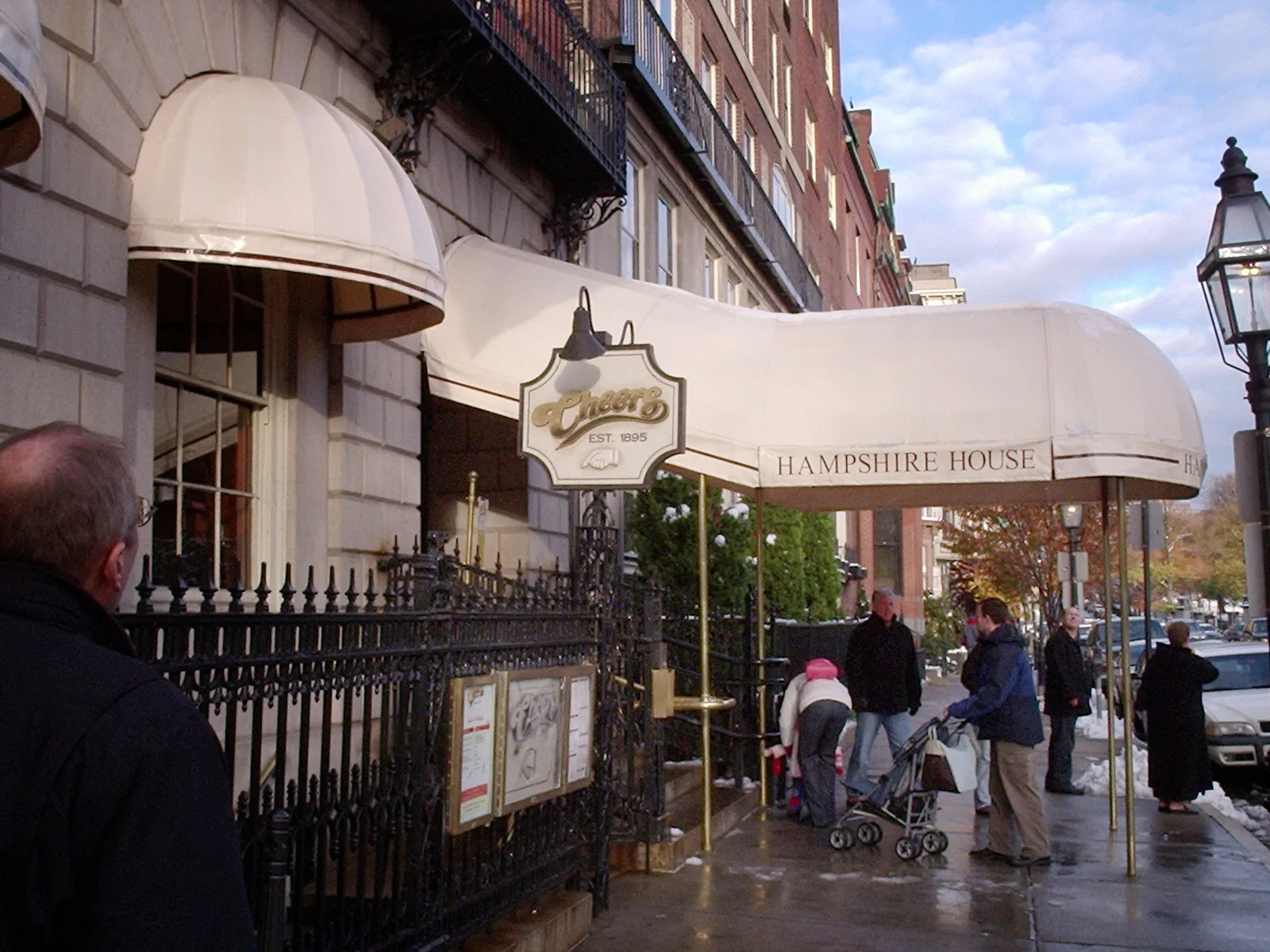
Cheers Bar (Bull & Finch Pub), Boston
The bar where everybody knows your name. Founded in 1969 as the Bull & Finch Pub, this Beacon Hill institution became one of the most famous bars in the world after NBC producers chose its iconic facade as the exterior setting for the hit sitcom 'Cheers,' which ran for eleven seasons from 1982 to 1993. The show went on to win 28 Emmy Awards and is widely regarded as one of the greatest television comedies ever made.
About Cheers Bar (Bull & Finch Pub), Boston
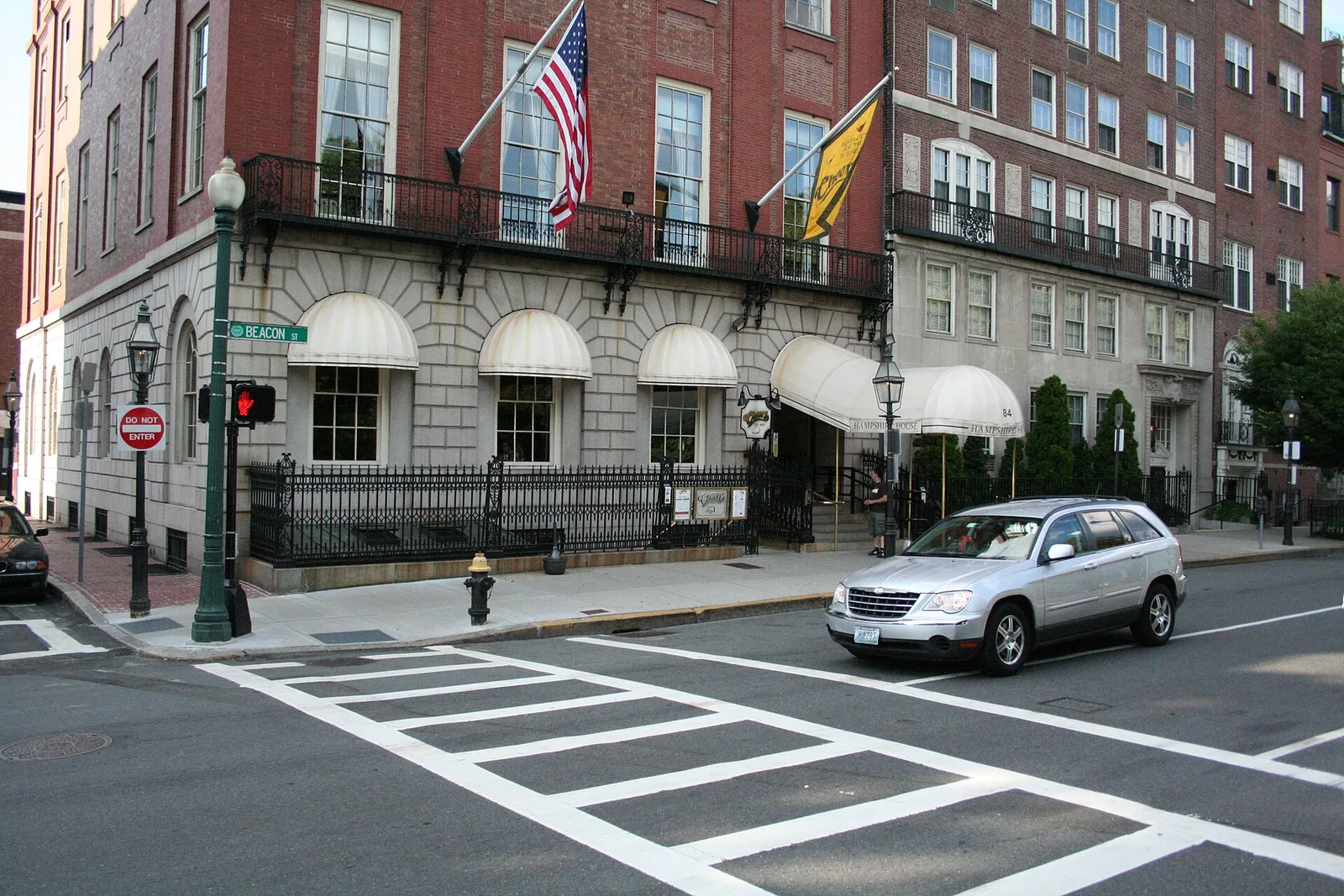
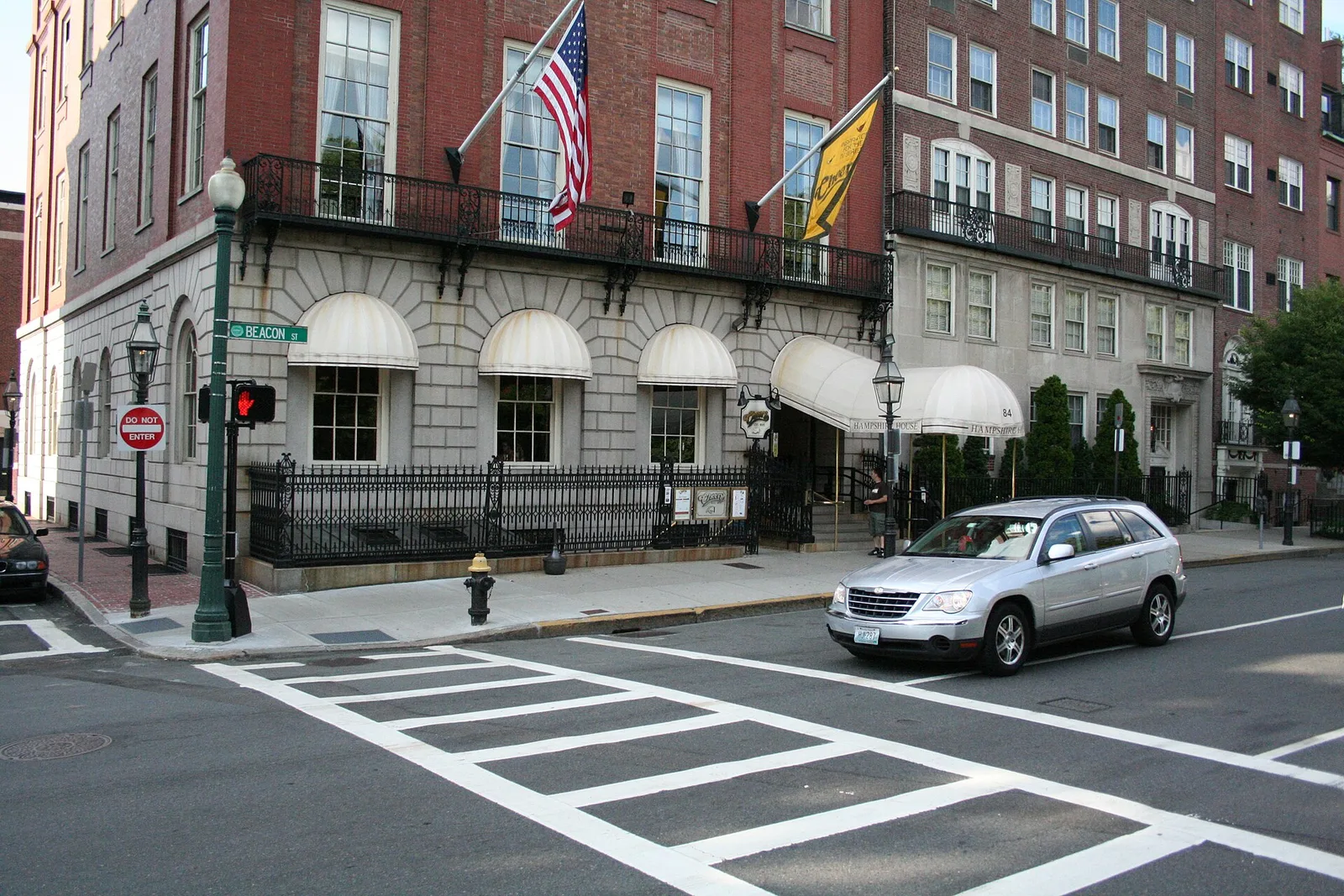
The bar known worldwide as Cheers opened in 1969 as the Bull & Finch Pub, in the garden-level basement of the Hampshire House, a 1910 townhouse at 84 Beacon Street facing the Boston Public Garden. Thomas Kershaw and a partner built it as an English-style pub, and its name is a pun on the Boston architect Charles Bulfinch.
In 1981, NBC location scouts working on a new sitcom picked the pub's brick facade and red awning for the show's establishing shot; the deal covered the exterior only, for a nominal payment often reported as one dollar.
'Cheers' premiered on September 30, 1982, nearly finished last in the ratings its first year, and was saved by critical praise and an Emmy for best comedy; it went on to run 11 seasons and 275 episodes and to spin off 'Frasier.'
The show made the little basement bar a destination: it now draws close to a million visitors a year, most of them surprised that the cramped real interior looks nothing like the roomy Paramount soundstage set they remember. The pub was renamed Cheers in the early 2000s, and the Kershaw family still owns it.
- Designation
- Boston Cultural Landmark
- Location
- 84 Beacon Street, Beacon Hill, Boston, Massachusetts
- Founded
- Founded 1969 (as Bull & Finch Pub)
- Annual Visitors
- ~1 million
How a Neighborhood Pub Became a Legend
The Hampshire House is a Georgian Revival townhouse designed by the society architect Ogden Codman Jr. and finished in 1910 for a wealthy Boston family; its name nods to Hampshire, England.
Kershaw bought the building in 1968 and turned the servants'-level basement into the Bull & Finch, bringing in the mahogany bar, fittings, and paneling from England.
The upper floors run today as the Hampshire House function hall, an event and wedding venue with a wood-paneled Oak Room overlooking the Public Garden, still operated by the Kershaw family's company.
The house sits at the foot of Beacon Hill, and its front rooms have one of the best private views in Boston, straight across the garden lagoon to the Swan Boats.
For its first dozen years the Bull & Finch was a genuine neighborhood bar, small, dim, and known to Beacon Hill regulars rather than tourists. Its name honored Charles Bulfinch, the Boston architect of the Massachusetts State House and part of the U.S. Capitol.
In 1982, the year 'Cheers' premiered, Boston Magazine named it the best neighborhood bar in the city, the reputation that had drawn the NBC scouts in the first place.
The show's creators, brothers Glen and Les Charles and director James Burrows, wanted a real, unglamorous corner bar for the exterior, and the Bull & Finch fit; only the outside was ever filmed.
Through the 1980s and 1990s the pub leaned into the connection, adding a gift shop, Cheers signage, and memorabilia, while the actual room stayed a basement pub that could seat only a few dozen people.
'Cheers' ran 275 episodes over 11 seasons and ended on May 20, 1993, with a 98-minute finale watched by an estimated 80 to 93 million people, among the largest television audiences in U.S. history.
The cast included Ted Danson as the bar's ex-ballplayer owner Sam Malone, Shelley Long and later Kirstie Alley as his foils, and Rhea Perlman, George Wendt, John Ratzenberger, Woody Harrelson, Kelsey Grammer, and Bebe Neuwirth around the bar.
The show won 28 Primetime Emmy Awards, including Outstanding Comedy Series four times, from a then-record 117 nominations.
Its final scene, Sam alone straightening pictures and telling a late knock 'we're closed,' is regularly ranked among the best series endings, and the 'Cheers' world continued for another decade on the spin-off 'Frasier.'
The Bull & Finch was renamed Cheers in the early 2000s, and a second, exact-replica bar built to look like the television set opened at Quincy Market near Faneuil Hall in 2001.
That replica location closed for good in 2020 during the pandemic, leaving the Beacon Hill original as the only Cheers bar in Boston.
The original is open daily from late morning to 2 a.m., serving a mix of neighbors and visitors, with a gift shop and a menu of pub food and local beer.
Its decor plays up a fictional 19th-century founding date drawn from the show's back story rather than the real 1969 opening, which regularly confuses first-time visitors.
The Neighborhood Behind the Bar
Beacon Hill and Boston's Civic History
Beacon Hill is named for a warning beacon, a tar barrel hoisted on a mast, that stood on its summit from the 1630s to alert the colony to attack.
In the early 1800s developers cut the hill down by roughly 60 feet, using the gravel to fill the Mill Pond and other flats, and laid out the brick Federal-style streets that survive today.
Charles Bulfinch, whose name the pub borrowed, designed the Massachusetts State House at the top of the hill in 1798; its dome, first shingled and then sheathed in copper by Paul Revere's firm, was gilded in gold leaf in 1874.
Beacon Hill is a federally designated National Historic Landmark District, protecting the neighborhood's 19th-century brick architecture and gaslit streetscape. The Bull & Finch Pub / Cheers sits at the district's edge, directly across Beacon Street from the Boston Public Garden.
Things to Do Near Cheers Bar
Visit the Original Cheers Bar
The bar at 84 Beacon Street is open daily from 11 a.m. to 2 a.m.; the entrance is down a short flight of steps from the sidewalk, under the red awning where visitors take the standard photo.
Inside it is a single low-ceilinged basement room with a mahogany bar, far smaller than the television set, hung with cast photos and show memorabilia.
A gift shop off the bar sells Cheers merchandise, and the kitchen serves pub standards and local beer, including Samuel Adams, brewed a few miles away.
The upstairs Hampshire House, reached through the same building, is a separate event space and not part of the bar visit.
Beacon Hill Walking Tour
From the pub, Beacon Street and the lanes climbing the hill make up one of the best-preserved 19th-century neighborhoods in the country, brick rowhouses, gas lamps, and cobbled lanes like Acorn Street.
The walk passes the Massachusetts State House and its gold dome, the Nichols House Museum, and, on the hill's north slope, the African Meeting House, the oldest surviving Black church building in the United States.
Louisburg Square, a private garden square, has long housed writers and, more recently, a U.S. Secretary of State turned presidential nominee.
Boston Common, the oldest public park in the country and set aside in 1634, and the Public Garden, the first public botanical garden in the country, lie directly across Beacon Street.
Boston Freedom Trail
The Freedom Trail is a 2.5-mile line of red brick set into the sidewalk, laid out in 1951, that links 16 sites tied to the American Revolution.
It starts on Boston Common a block from the pub and runs past the State House, the Granary Burying Ground, the Old State House and the Boston Massacre site, Faneuil Hall, Paul Revere's House, and the Old North Church.
It ends across the river in Charlestown at the Bunker Hill Monument and the USS Constitution, 'Old Ironsides,' the oldest commissioned warship afloat.
The full walk takes two to four hours, and both the National Park Service and the Freedom Trail Foundation run guided tours from the Common.
Legacy and Challenges
Preserving an Authentic Neighborhood Bar
As Beacon Hill property values climbed and Boston tourism grew, the pressure on a bar drawing close to a million visitors a year has been to become a pure tourist stop.
The Kershaw family, owners since 1969, have kept the Beacon Hill room close to its original form rather than expanding or rebuilding it to match the television set.
The bar still works as a neighborhood spot in slow hours, and its charitable work, long associated with the bartender Eddie Doyle, has raised substantial sums for Boston causes.
The tension between being a working pub and a landmark is the bar's defining management problem, and it is one shared by other 'TV location' businesses around the country.
Loss of the Faneuil Hall Location
The second Cheers, at Quincy Market beside Faneuil Hall, opened in 2001 as a licensed, faithful reconstruction of the show's interior, down to the bar rail and the 'Norm' stool.
It gave visitors what the original could not, a room that actually looked like the show, and it operated for nearly two decades.
It closed permanently in 2020 during the COVID-19 shutdowns, one of many Faneuil Hall Marketplace tenants that did not reopen.
Its closure left the cramped Beacon Hill basement as the only place in Boston carrying the Cheers name.
Honoring Eddie Doyle's Legacy
Eddie Doyle tended bar at the Bull & Finch for about 35 years, from the 1970s until his retirement in 2009, and was one of the most recognized figures on Beacon Hill.
He is often described as the real-life embodiment of the show's 'where everybody knows your name' spirit, greeting regulars and tourists alike by name.
Over his decades behind the bar he organized fundraising drives that brought in large sums for local hospitals, schools, and neighborhood causes.
Doyle died in January 2026 at age 85, and the bar and the neighborhood marked his passing as the loss of a Boston institution in his own right.
Inside the Bull & Finch Pub, the bar that inspired a television legend
At a Glance
Did You Know?
NBC producers paid owner Thomas Kershaw exactly $1 for the right to use the Bull & Finch Pub's exterior as the establishing shot for every episode of Cheers. The deal covered only the facade, no interior shots, which is why the actual bar looks nothing like the spacious TV set, which was built entirely on a Hollywood soundstage.
The Cheers series finale in 1993 was watched by approximately 93 million viewers, making it one of the most-watched television finales in American history, trailing only M*A*S*H. The show won 28 Emmy Awards over its run, including Outstanding Comedy Series four times (1983, 1984, 1989, and 1991).
Beloved bartender Eddie Doyle worked at the Bull & Finch Pub for decades and was widely considered the real-life inspiration for Ted Danson's character Sam Malone. When NBC producers first visited the bar in 1981, it was Doyle's warmth and friendliness with customers that helped convince them this was the right place to anchor their show.
If you visit and notice a sign reading 'Established 1895,' don't be confused, that's the fictional founding date of the Cheers bar as it exists inside the TV show's universe. The real Bull & Finch Pub was founded in 1969. The 1895 date is a fun piece of in-universe storytelling that the bar has leaned into as part of its decor.
Plan Your Visit
Location
84 Beacon Street, Beacon Hill, Boston, Massachusetts
Designation
Boston Cultural Landmark
Hours
Open daily 11am to 2am
Admission
Free to enter. Food and drink available. Gift shop on premises. Reservations accepted for parties of six or more.
Getting There
Take the MBTA Green Line to Arlington or Park Street station. The bar is a short walk from Boston Common and directly across from the Public Garden. Street parking is limited, the T is strongly recommended.