
A Depression, a Committee, and a Bill That Changed Retirement
The Great Depression exposed a country with no organized safety net for old age. In under a year and a half, Roosevelt's Committee on Economic Security turned that crisis into the Social Security Act, a law that survived a Supreme Court challenge and started paying its very first check within five years.
The bank failures and mass unemployment of the early 1930s wiped out the personal savings millions of older Americans had counted on for retirement. By the middle of the decade, roughly half of Americans over 65 lacked enough income to be self-supporting, and only about 30 states had any old-age pension law on the books, most paying small, inconsistent benefits to a fraction of those who needed them.
Before Social Security, an elderly American who couldn't work and had no family to rely on often ended up in a local poorhouse or almshouse, an institution that had existed in America since the colonial era. Eliminating that outcome was an explicit goal of the law Congress would pass in 1935, not just an incidental benefit.
Public pressure for a federal answer built around the Townsend Plan. Dr. Francis Townsend, a physician in Long Beach, California, proposed in 1933 a flat $200-a-month pension for every citizen over 60, funded by a national sales tax, on the condition the money be spent within 30 days. By 1935 the movement claimed thousands of Townsend Clubs and millions of members, and historians credit it with pushing Congress to act quickly on the administration's more modest plan.
State-level pensions had spread but reached almost no one. The Fraternal Order of Eagles had lobbied state legislatures since the 1920s, and by 1935 about 28 states plus the Alaska and Hawaii territories had old-age assistance laws. The Social Security Administration's own history notes these programs together covered only about 3 percent of the elderly, with average benefits near 65 cents a day, and several existed on paper with no money appropriated to pay them.
President Roosevelt established the Committee on Economic Security by executive order on June 29, 1934, chaired by Labor Secretary Frances Perkins and given roughly six months to design a national plan for economic security, covering old age, unemployment, and dependent children.
Perkins later said she had told Roosevelt she would only accept the Cabinet post if he committed to pursuing unemployment and old-age insurance. Her department's staff, led by executive director Edwin Witte of the University of Wisconsin, did the technical work of drafting the actual framework the Committee would send to Congress.
Roosevelt insisted the old-age program be financed by a dedicated payroll tax on workers rather than out of general revenue. He explained the choice in political rather than economic terms, saying the contributions gave workers "a legal, moral, and political right to collect their pensions," and that "with those taxes in there, no damn politician can ever scrap my social security program."
The Committee held a National Conference on Economic Security in November 1934 and considered a national health insurance component, but dropped it after the American Medical Association's organized opposition threatened to sink the entire bill. Health insurance for the elderly would not be enacted until Medicare, 30 years later.
Roosevelt sent the Economic Security Bill to Congress on January 17, 1935. It was renamed the Social Security Act during committee work and bundled together old-age insurance, a new state-federal unemployment insurance system, and federal grants for aid to the blind, dependent children, and the needy elderly.
To secure the votes of southern Democrats in Congress, the bill's old-age insurance section excluded agricultural and domestic workers, about a fifth of the national workforce and disproportionately Black Americans in the South, from coverage entirely. That exclusion wasn't closed until later amendments beginning in 1950.
The House Ways and Means Committee and Senate Finance Committee held hearings through the winter of 1935. The House passed the bill 372 to 33 on April 19, and the Senate passed it 77 to 6 on June 19, with a conference committee resolving the differences that summer, a lopsided bipartisan margin rarely matched by later entitlement legislation.
One late fight nearly derailed it. The "Clark Amendment," offered by Senator Bennett Champ Clark of Missouri, would have let employers with their own private pension plans opt out of the federal system. It passed the Senate but was dropped in conference in exchange for a promise to study the question, a study that never produced a carve-out.
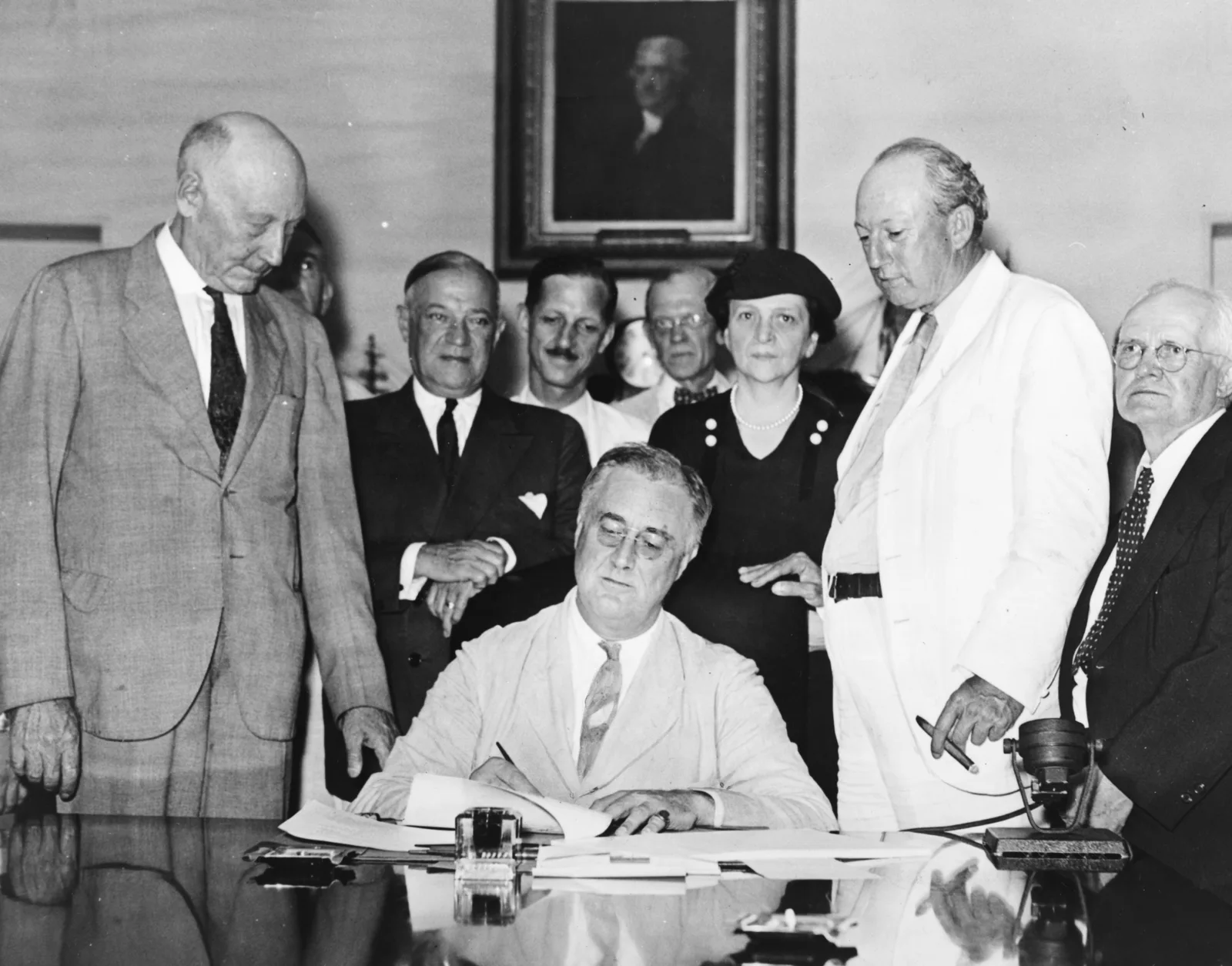
Roosevelt signed the Social Security Act in the White House Cabinet Room on August 14, 1935, with Frances Perkins among those present. Title II of the law created old-age insurance, the program most Americans now simply call Social Security, funded by a new payroll tax established under Title VIII.
The same law also created the unemployment insurance system and federal grants for aid to the blind, dependent children, and needy elderly, so 'Social Security' originally named a whole bundle of New Deal programs, not just the retirement benefit the phrase usually means today.
The Act created a three-member, bipartisan Social Security Board to run the new system. Former New Hampshire governor John Winant was its first chairman, and the Board was folded into the new Federal Security Agency in 1939 before becoming today's Social Security Administration in 1946.
For its first decade the contributory retirement program was smaller than the means-tested welfare it sat beside. Title I old-age assistance, jointly funded by the states, paid monthly checks to more elderly Americans than Title II did until the early 1950s, because Title II benefits did not begin until 1940 and covered only workers with a recent earnings record.
Payroll tax collection began January 1, 1937, at 1% each on employers and employees on wages up to $3,000 a year. That May, the Supreme Court upheld the law's constitutionality in Helvering v. Davis, ruling that Congress's power to tax and spend for the general welfare covered old-age insurance.
A companion case decided the same day, Steward Machine Co. v. Davis, upheld the Act's unemployment insurance provisions. Together, the two rulings removed the last serious legal threat to the entire Social Security Act just two years after it was signed.
Helvering v. Davis was brought by a shareholder of the Edison Electric Illuminating Company of Boston trying to stop the firm from paying the tax. The Court ruled 7 to 2, with Justice Benjamin Cardozo writing that the concept of the general welfare is not static and that old-age poverty was "a problem of the largest scope," national in its dimensions and beyond the power of any single state to solve.
The decisions came just weeks after the Senate had rejected Roosevelt's plan to add justices to the Court, and in the same term as NLRB v. Jones & Laughlin Steel. Taken together, they marked the Supreme Court's acceptance of the constitutional basis for the modern federal social-insurance and regulatory state.
Ida May Fuller, a retired legal secretary from Ludlow, Vermont, received the first monthly retirement check ever issued under the new law on January 31, 1940, check number 00-000-001, in the amount of $22.54.
Fuller had paid only $24.75 in Social Security payroll taxes over three years, 1937 through 1939, but she lived to age 100 and ultimately collected $22,888.92 in total benefits before her death in 1975, an early, vivid illustration of a program funded by continuous new contributions rather than each retiree's own withheld savings.
Before 1940 the program had paid only one-time lump sums to workers who reached 65 or to the families of workers who died. The 1939 Amendments converted it to recurring monthly benefits and moved the start date up two years from the 1942 date set in the original 1935 law.
In that first year about 222,000 people received monthly benefits, and the average retired-worker payment was roughly $22 a month, close to Fuller's. Social Security numbers themselves had first been issued through post offices beginning in November 1936, with around 35 million assigned within a few months.
From a Retirement Check to a Full Social Insurance System
Over the next 37 years, Congress rebuilt Social Security piece by piece, adding survivors and dependents, disability insurance, Medicare, and automatic cost-of-living adjustments, each expansion covering more Americans and more of life's financial shocks than the original 1935 law ever attempted.
The 1939 Amendments, signed August 10, 1939, added benefits for a retired worker's spouse and minor children and for the survivors of a worker who died, transforming the program from individual retirement insurance into family-based social insurance. The amendments also moved the first monthly payments up from the originally planned 1942 start to January 1940.
The same law shifted Social Security's funding partly away from the original plan to build up a very large reserve fund, toward a more pay-as-you-go model. That financing philosophy debate, how much reserve the program should hold versus rely on current payroll taxes, has echoed through nearly every reform fight since, including the crisis Congress faced in 1983.
The 1939 law also created the Federal Old-Age and Survivors Insurance Trust Fund as a distinct legal account and established a Board of Trustees to report annually to Congress on its condition. That annual Trustees Report is still the document every modern solvency projection, including the 2032 and 2034 dates on this page, comes from.
The survivors provision quickly became one of the program's largest functions. Because a young worker who dies leaves a spouse and children potentially decades of benefits, the Social Security Administration has long described the coverage a 30-year-old worker earns as equivalent to a large life-insurance and disability-insurance policy carried for the whole family.
The 1950 Amendments raised benefits by roughly 77%, the first increase since the program began, and extended mandatory coverage to millions of workers previously excluded, including most nonfarm self-employed workers, closing much of the gap left by the 1935 law's original exclusions.
The same amendments extended optional coverage to state and local government employees for the first time. Many public-sector workers still remain outside Social Security today because their employer offers a separate public pension system instead, a patchwork that dates directly back to this 1950 choice.
The 77% increase was so large partly because benefits had been frozen through the 1940s while prices roughly doubled during and after World War II. Congress had let the real value of the average check erode until it was below the means-tested Title I welfare payment, and the 1950 law was written to make contributory Social Security the larger of the two again.
The 1950 amendments also brought in regularly employed farm and domestic workers who had been left out in 1935, and 1954 amendments added most remaining farm operators and self-employed professionals. By the late 1950s roughly 90 percent of American jobs were covered, up from about 60 percent in 1940.
The 1956 Amendments created Disability Insurance (DI), paying monthly benefits to permanently and totally disabled workers ages 50 to 65, the first time Social Security covered anything besides retirement and survivors.
The new DI trust fund was kept legally and financially separate from the Old-Age and Survivors Insurance (OASI) fund used for retirement and survivor benefits, a split that still exists today. It's why the 2032 and 2034 depletion dates discussed later on this page are two different projections, not one.
Disability coverage had been debated since the 1930s and repeatedly blocked, largely by the American Medical Association and insurance interests who feared it was a step toward national health insurance and doubted disability could be objectively defined. The key disability amendment passed the Senate in 1956 by just two votes, 47 to 45.
The 1956 law set the strict standard still used today: a medically determinable physical or mental impairment expected to last at least a year or result in death, preventing "substantial gainful activity." It also created the state Disability Determination Services, which still make the initial medical decision on most claims under federal rules.
The 1960 Amendments removed the age-50 minimum, extending disability eligibility to workers of any age with dependents, after President Eisenhower had vetoed a similar expansion in 1958 over cost concerns.
The 1960 law only passed after supporters added stricter medical-review requirements for disability claims, a trade-off, broader eligibility paired with tighter verification, that has recurred in nearly every disability-benefit debate since.
Enrollment grew faster than the 1956 actuaries had forecast, and by 1965 the DI rolls held more than a million disabled workers. The program's cost and its appeals backlog would prompt Congress to tighten standards again in 1980 and, controversially, to launch a wave of eligibility reviews in the early 1980s that courts and Congress later forced the agency to roll back.
The 1965 amendments also loosened the definition slightly, replacing the requirement that a disability be "of long-continued and indefinite duration" with the current "expected to last at least 12 months" test, and added benefits for the disabled adult children of retired or deceased workers.
President Lyndon Johnson signed the Social Security Amendments of 1965 at the Harry S. Truman Library in Independence, Missouri, on July 30, 1965, creating Medicare and Medicaid and presenting former President Truman, a longtime advocate of national health insurance, with the first Medicare card.
Medicare was structured with Part A hospital insurance funded through its own new payroll tax, mirroring how OASDI is funded, and voluntary Part B medical insurance funded through beneficiary premiums and general federal revenue. That two-track design still shapes how Medicare's finances are discussed differently from Social Security's.
The 1965 law was the product of a decades-long fight. Truman had proposed universal health insurance in 1945 and been beaten back by the American Medical Association's "socialized medicine" campaign; the Kennedy and Johnson administrations narrowed the goal to the elderly, and Ways and Means chairman Wilbur Mills assembled the final three-part structure of Part A, Part B, and Medicaid in committee.
Enrollment was immediate and large. About 19 million Americans over 65 signed up in Medicare's first year, and the program was credited with rapidly desegregating Southern hospitals, since federal payments were conditioned on compliance with the 1964 Civil Rights Act.
The 1972 Amendments, signed that October, directed that benefits be automatically adjusted each year for inflation starting in 1975, ending the earlier practice of Congress voting ad hoc benefit increases. The same law created Supplemental Security Income (SSI), a federalized income floor for low-income elderly, blind, and disabled Americans that took effect in 1974.
A technical flaw in how the new automatic cost-of-living formula interacted with wage growth, later called 'double indexing,' accidentally overstated future benefits. That flaw became the single biggest driver of the financing crisis Congress had to correct in 1977, and it fed directly into the larger crisis resolved in 1983.
Congress had raised benefits five times between 1965 and 1972, including a 20 percent increase in the same 1972 law, and members on both sides wanted to take the annual increase out of election-year politics. The automatic COLA is now tied to the Consumer Price Index for Urban Wage Earners and Clerical Workers, the CPI-W, measured from the third quarter of one year to the next.
SSI replaced a patchwork of federal-state programs for the aged, blind, and disabled poor with a single national payment administered by the Social Security Administration but funded from general revenue, not payroll taxes. It is a means-tested welfare program that happens to share an agency with Social Security, and roughly 7 million people receive it today.
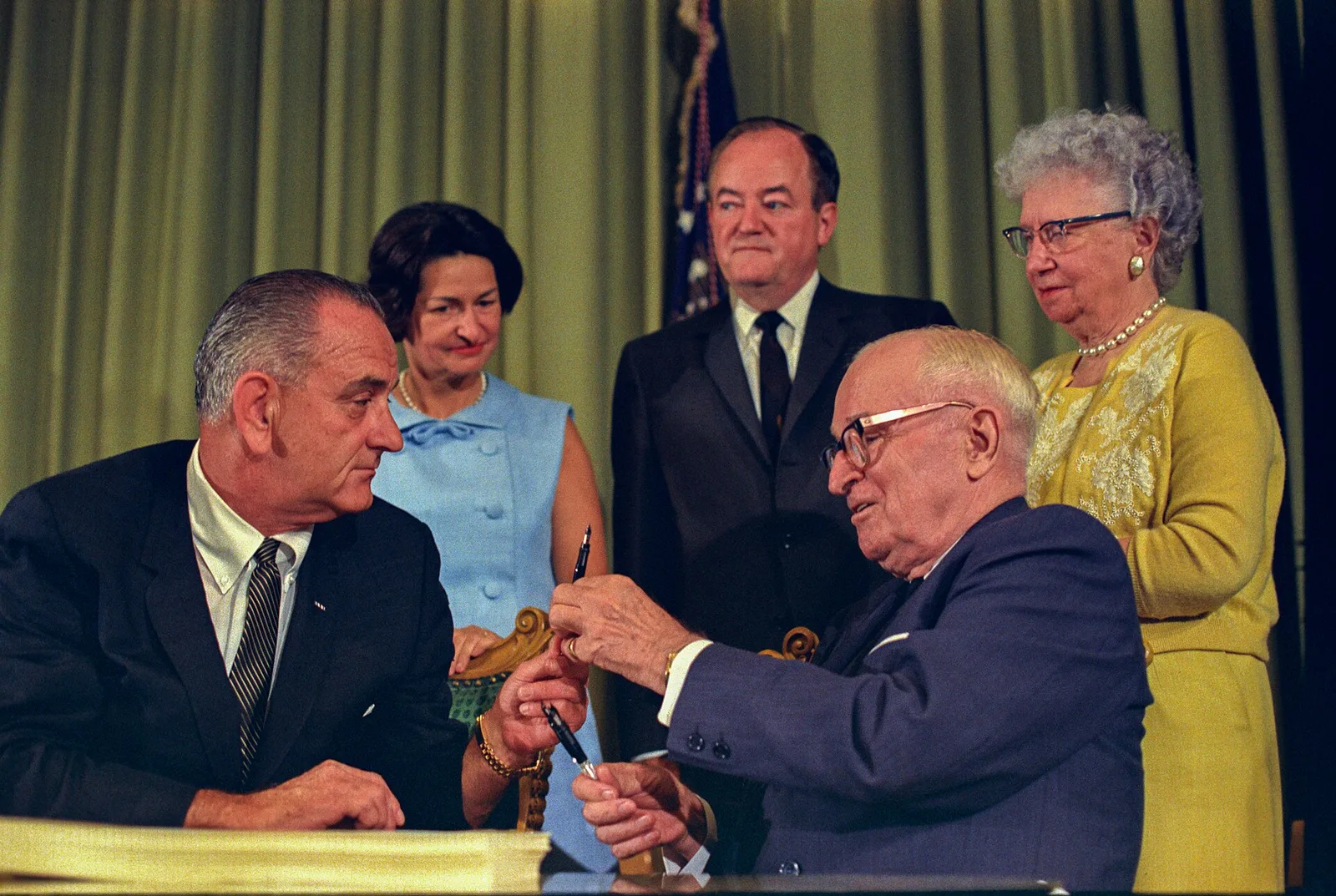
LBJ signs the Social Security Amendments of 1965, creating Medicare and Medicaid, at the Truman Library, with former President Truman on hand to receive the first Medicare card.
Weeks From Missing a Payment, Then a Bipartisan Deal
By the early 1980s, the trust fund was weeks from being unable to pay benefits on time. A commission led by Alan Greenspan produced a compromise that raised revenue, trimmed future benefits, and passed with bipartisan support, the last time Congress fixed Social Security's finances for the long run.
The 1977 Amendments, signed December 20, 1977, corrected the 1972 double-indexing error and raised payroll taxes to shore up short-term financing, projected at the time to keep the program solvent well into the next century.
Those projections were quickly overtaken by the high inflation and high unemployment, 'stagflation,' of the late 1970s and early 1980s, which simultaneously cut payroll tax revenue and pushed cost-of-living-driven benefit costs up faster than expected, reopening the financing crisis within just a few years.
The 1977 law also created the current benefit formula, which indexes a worker's past earnings to average wage growth before applying a progressive, three-bracket "bend point" formula that replaces a higher share of a low earner's wages than a high earner's. That structure is still in place today.
The people who moved from the old formula to the new one over a five-year transition, workers born from 1917 through 1921, received noticeably smaller benefits than slightly older neighbors with identical earnings. The "notch baby" grievance generated congressional mail and hearings for two decades, but no Congress ever voted to change it.
With the OASI trust fund only months from being unable to pay full benefits on time, President Reagan created the National Commission on Social Security Reform by Executive Order 12335 on December 16, 1981, chaired by economist Alan Greenspan, with members appointed by both the White House and congressional leaders of both parties.
The 15-member commission included prominent figures from both parties, including Senator Bob Dole and future Senate Finance Committee chairman Daniel Patrick Moynihan, and deadlocked for over a year before a smaller 'Gang of Nine' negotiated the actual compromise in secret over the 1982-83 holidays.
The commission was created after a political disaster. In May 1981 the administration had proposed deep cuts to early-retirement benefits, and the Senate voted 96 to 0 against considering any plan that "precipitously and unfairly" cut benefits for people about to retire. A bipartisan commission was the face-saving way to reopen the issue after the 1982 midterms.
The back-channel talks ran between White House chief of staff James Baker and aides to Speaker Tip O'Neill, with Senator Moynihan and Dole bringing the deal back to the full commission. Twelve of the fifteen members signed the final report in January 1983; the three House Republican members dissented, objecting to the tax increases.
The commission's January 1983 report recommended closing roughly two-thirds of the projected long-range shortfall through revenue changes, mainly by moving up payroll tax increases already scheduled for later years, and roughly one-third through benefit-side changes, including a six-month delay of that year's cost-of-living adjustment and a phased increase in the retirement age.
The package also brought new federal employees and employees of nonprofit organizations into Social Security for the first time, and, for the first time, made a portion of benefits subject to federal income tax for higher-income beneficiaries, both provisions that still generate revenue for the program today.
The commission itself could not agree on how to raise the retirement age and left that piece to Congress. On the House floor, Representative J.J. Pickle of Texas won a vote to phase the full retirement age up to 67; an alternative to instead cut benefits across the board lost narrowly.
The taxation-of-benefits provision was designed so the revenue flows back into the trust funds rather than to general spending. The income thresholds that trigger it, $25,000 for an individual and $32,000 for a couple, were deliberately left un-indexed for inflation, so a rising share of beneficiaries has owed tax on part of their benefits every year since 1984.
Reagan signed Public Law 98-21 on the South Lawn of the White House on April 20, 1983, flanked by House Speaker Tip O'Neill, Senate Majority Leader Howard Baker, and the other bipartisan congressional leaders who had worked on the deal, a rare instance of a major entitlement overhaul passing with support from both parties.
The law phased the full retirement age up from 65 to 67 in two stages, with a long pause at age 66 for people born 1943 through 1954. The increase only finished reaching a full age 67 for people born in 1960 or later, meaning the last group affected by the 1983 law is only now finishing that decades-long phase-in.
The House passed the conference report 243 to 102 and the Senate 58 to 14 in late March 1983, with the trust fund projected to miss a July payment if nothing passed. The Treasury had already begun planning to borrow from the Medicare trust fund to cover Social Security checks.
The 1983 changes were designed to build a large trust-fund surplus during the working years of the baby boom, to be drawn down as they retired. That surplus peaked at about $2.9 trillion in 2020, and its planned drawdown, now underway, is the reason the Trustees project the reserves running out in the 2030s.
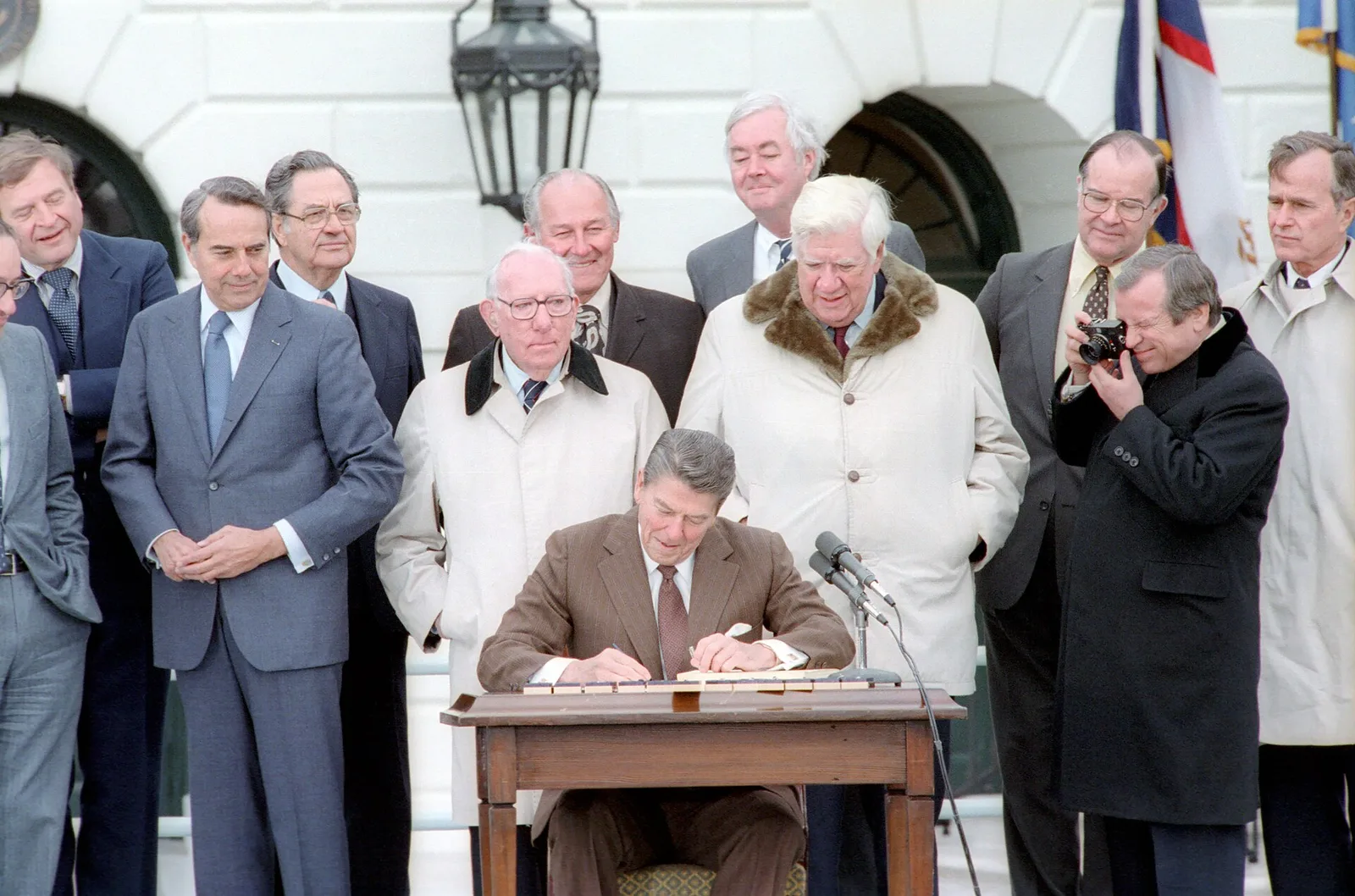
Reagan signs the Social Security Amendments of 1983 on the South Lawn, with Speaker Tip O'Neill, Senate Majority Leader Howard Baker, and other congressional leaders from both parties who negotiated the rescue package.
How the Trust Fund Actually Works
Every paycheck subject to Social Security tax sends 6.2% from the employee and a matching 6.2% from the employer, 12.4% total, to the Treasury, which deposits it into the OASI and DI trust funds the same day it's withheld, before any of it is spent on current benefits. Self-employed workers pay both halves themselves.
The combined 12.4% rate has been in place since 1990, under a schedule Congress set in the 1977 and 1983 Amendments, apart from a temporary 2011-2012 payroll tax holiday that cut it to 10.4%, even as the taxable wage base it applies to has risen from $3,000 in 1937 to $184,500 in 2026 to keep pace with wage growth, according to the Social Security Administration.
The tax is levied under the Federal Insurance Contributions Act, which is why it appears as "FICA" on a pay stub, often lumped together with the separate 1.45% Medicare Hospital Insurance tax that has no wage cap. The two are legally distinct and flow to different trust funds.
The trust funds are not general Treasury accounts. By law the money can be spent only on benefits and administrative costs for the Old-Age, Survivors, and Disability programs, and administrative costs have run under 1 percent of benefits paid for decades, among the lowest overhead of any large benefit program in the federal government.
Any payroll tax revenue collected in a given year beyond what's needed to pay that year's benefits is, by law, immediately loaned to the U.S. Treasury in exchange for special-issue government bonds. These bonds exist only for the trust funds and can't be bought or sold on the open market like an ordinary Treasury bond.
That arrangement is why the trust funds' $2.56 trillion in combined reserves, as of the end of 2025, isn't a pile of cash sitting in a vault. It's a claim on the U.S. government, backed by the same full faith and credit as every other form of federal debt, redeemable on demand to help pay benefits.
The interest rate on new special-issue bonds is set monthly by a formula in the Social Security Act, tied to the average yield on marketable Treasury securities with at least four years to maturity. The trust funds cannot shop for a better rate, and they cannot lose principal to a market downturn.
This intragovernmental lending is the reason the roughly $2.5 trillion the trust funds hold is counted inside the total national debt but outside the "debt held by the public" figure. When the trust funds redeem bonds to pay benefits, the Treasury must raise that cash from taxes or new public borrowing, which is why the drawdown adds to publicly held debt even though it does not change total spending.
It already earns interest, just not from the stock market. By law, the Social Security Act restricts the trust funds to interest-bearing obligations issued by the U.S. Treasury, not stocks, corporate bonds, or even an ordinary bank savings account. New special-issue bonds earned an average 4.3% in 2025, though the fund's effective rate across its entire portfolio was a lower 2.6%, since it still holds older bonds bought when interest rates were lower, according to the SSA Office of the Chief Actuary.
Congress has considered lifting that restriction more than once and never has. A 1994-96 advisory council floated investing up to 40% of the trust fund in equities, and President Clinton's 1999 State of the Union proposed having the government directly invest 15% of the fund, about $600 billion, in the stock market. Both stalled over the same two objections raised from both parties: a program that must reliably pay checks every month regardless of the economy would be exposed to years like 2008 or 2022, when stocks lost 20-40% of their value, and the federal government would become one of the single largest shareholders in corporate America, raising concern about political influence over private companies.
The restriction is not an oversight. The 1935 and 1939 Congresses debated it explicitly and chose Treasury-only investment so the program's assets could never be blamed for a stock-market panic and so no administration could steer a national investment fund toward favored industries.
Comparisons to state and corporate pension funds, which do hold stocks, understate a key difference: those funds can and do cut promised benefits or demand higher contributions when markets fall, while Social Security benefits are set in statute and paid to 70 million people who have little ability to absorb a mid-retirement cut.
The bonds are real, legally enforceable federal debt, not an accounting fiction. The government is obligated to redeem them at face value plus accrued interest whenever the trust funds need cash, exactly as it would for a bond held by any other investor.
The more accurate criticism is that the trust funds' assets are a claim on the same general federal budget that already runs its own large annual deficits. Redeeming the bonds doesn't create new money, it requires the Treasury to raise the cash elsewhere, through taxes or additional borrowing, the same as any other federal obligation coming due.
The government has already been redeeming these bonds routinely. Social Security's total cost has exceeded its non-interest income every year since 2010, so the Treasury has been paying interest and cashing in principal to cover the gap, and it has never missed doing so.
The label also cuts both ways: every marketable Treasury bond held by a pension fund, a bank, or the government of Japan is equally an "IOU" backed only by the government's taxing power. The trust-fund bonds carry the same full-faith-and-credit guarantee, which is why the Trustees treat them as assets rather than as nothing.
Social Security has always been a pay-as-you-go system. The payroll taxes collected from today's workers primarily fund the benefits paid to today's retirees, rather than growing in a personal account tied to each worker's own contributions, which is why the ratio of workers to beneficiaries matters enormously to the program's finances.
In 1950, roughly 16 workers paid in for every beneficiary. By 2025 that ratio had fallen to about 2.7 workers per beneficiary, according to SSA Trustees data, driven by longer life expectancy and lower birth rates, the core demographic pressure behind every financing projection on this page.
The design was a deliberate choice made during the Depression: a fully funded system would have taken decades to accumulate reserves before it could pay meaningful benefits, and the elderly poor of the 1930s and 1940s needed money immediately. Paying early retirees far more than they contributed, as with Ida May Fuller, was the point, not a flaw.
Because benefits are defined by a statutory formula rather than an account balance, they carry protections a private account cannot: they are adjusted for inflation every year, they continue for life no matter how long the retiree lives, and they extend to a spouse and to survivors. They also carry a risk a private account does not, which is that Congress can change the formula.
Depletion doesn't mean the program runs out of money and stops paying benefits entirely. Incoming payroll tax revenue keeps flowing in every payday. It means the reserve of bonds built up in earlier decades to supplement that revenue would be exhausted.
By law, the trust funds can't pay out more than they have. Once reserves hit zero, benefits would automatically be reduced across the board to match incoming revenue, an estimated 78% of scheduled benefits payable from the OASI fund alone starting in the fourth quarter of 2032, unless Congress changes the law before then, per the SSA Board of Trustees' 2026 report.
There is no statutory mechanism for how an across-the-board cut would be applied, whether every check would shrink by the same percentage on the same day or payments would be delayed. The Social Security Administration has never had to make that call, and legal scholars disagree about whether beneficiaries could sue for the full scheduled amount.
Every previous close call was resolved by Congress before the deadline. The 1977 and 1983 laws each passed with the trust fund months from trouble, and in 2015 Congress reallocated tax revenue to the DI fund with only weeks to spare. Whether that pattern holds for the 2030s date is the central open political question about the program.
The Same Math the 1983 Commission Faced, on a Longer Clock
Social Security's underlying problem hasn't changed since 1983: a shrinking ratio of workers to beneficiaries means scheduled benefits are growing faster than dedicated payroll tax revenue. Here's where the numbers stand per the SSA Board of Trustees' 2026 report, and the menu of options Congress has to close the gap.
The 2026 Trustees Report, at a Glance
The combined program's 75-year actuarial deficit is estimated at 4.42% of taxable payroll, roughly $31 trillion on a present-value basis, according to the Committee for a Responsible Federal Budget's analysis of the 2026 Trustees Report.
What Could Fix It
None of these options are mutually exclusive, and Congress has combined several of them in every major fix since 1935. They're presented here as the menu of options economists and policymakers actually discuss, not as a recommendation of any one path.
Only earnings up to the taxable maximum, $184,500 in 2026, are subject to the Social Security payroll tax, so income above that threshold, mostly earned by the highest-paid workers, currently isn't taxed for Social Security at all.
The SSA's Office of the Chief Actuary has scored several versions of this idea. Depending on whether workers would receive credit toward higher future benefits for the newly taxed earnings, estimates range from closing roughly 58% to about 73% of the program's 75-year shortfall on its own.
The cap is not arbitrary. It is indexed each year to the national average wage, and it has been set since 1977 so that roughly 90 percent of all covered earnings fall below it. Rising wage inequality has pushed the actual share taxed down to about 82 to 83 percent, which is part of why the shortfall grew.
Because benefits are also capped, eliminating the tax cap without a matching benefit change would sharply weaken the link between what high earners pay and what they get back, a link supporters have historically argued protects the program politically. Most detailed proposals therefore phase in a new upper bracket or a "donut hole" that leaves a band of income untaxed.
The combined 12.4% payroll tax rate has not changed since 1990 (apart from the temporary 2011-2012 tax holiday), even though life expectancy and total benefits paid have both risen substantially since then.
SSA actuaries estimate an immediate, permanent increase of roughly 3 to 4 percentage points, to about 15-16% combined, would be enough on its own to close the entire 75-year shortfall, though a smaller increase phased in gradually would need to start sooner to have a comparable effect.
For a worker earning the 2026 median wage of roughly $60,000, each additional percentage point of combined rate is about $600 a year, split between employee and employer. Economists generally conclude that the employer half is ultimately borne by workers through lower wages, so the full cost falls on labor.
Polling by AARP and the National Academy of Social Insurance has repeatedly found gradual payroll-tax increases among the more publicly acceptable fixes, but no Congress has voted to raise the rate since 1983, and the 2011-12 temporary payroll tax "holiday" cut it instead, with the lost revenue reimbursed to the trust funds from general funds.
The 1983 law's increase from 65 to 67 only finished phasing in for people born in 1960 or later. A further increase, to 68 or 69, has been proposed repeatedly since as a way to reflect continued gains in life expectancy.
Because the program already reduces benefits for early claiming and increases them for delayed claiming, raising the retirement age closes a comparatively modest share of the shortfall on its own. In practice it functions as an across-the-board benefit cut concentrated on people who can't work longer for health or job-market reasons.
Life expectancy gains since 1983 have been very unevenly distributed. Research by the Social Security Administration and the National Academies finds that men in the top fifth of the earnings distribution gained several years of life expectancy at 65 over recent decades, while men in the bottom fifth gained little or none, so a uniform age increase cuts lifetime benefits most for lower earners.
The earliest eligibility age of 62, when about a third of workers still claim, was not touched in 1983 and would remain unchanged under most age-increase proposals, meaning the main effect is a larger permanent reduction for people who claim early.
The automatic cost-of-living adjustment created in 1972 is currently based on the CPI-W, a general urban-worker price index. Some economists argue it understates the healthcare-heavy spending patterns of retirees; switching to a 'chained CPI' would produce smaller annual increases, while switching to an experimental elderly-focused index (CPI-E) would likely produce larger ones.
Because COLAs compound over a retirement that can last decades, even a small formula change has an outsized long-term effect. Chained CPI is typically estimated to close a modest share of the shortfall, while CPI-E would add to it rather than close it.
Chained CPI, which accounts for consumers substituting cheaper goods when prices rise, runs about 0.25 to 0.3 percentage points lower than CPI-W each year. It was part of President Obama's 2013 budget offer and was dropped after opposition from both parties; AARP and many Democrats call it a benefit cut, and some Republicans opposed pairing it with tax increases.
The Bureau of Labor Statistics has published the experimental CPI-E since 1982 and cautions it is based on a small sample and does not capture the discounts and different retail outlets older shoppers use, so switching to it would mean building a new, dedicated price index first.
The trust funds are currently restricted by law to interest-bearing U.S. Treasury securities, no stocks, corporate bonds, or index funds. Proposals to change that go back decades, including a 1999 Clinton administration plan to directly invest 15% of the trust fund in the stock market and a 2024 bipartisan proposal from Senators Bill Cassidy and Tim Kaine to borrow $1.5 trillion and invest it for 75 years.
The Center for Retirement Research estimates capping any equity allocation at 40% of trust fund assets, phased in over 15 years, would give Social Security less than 7% ownership of the overall U.S. stock market. Using the historical 6.5% real return, that could meaningfully help close the shortfall; using the more conservative 4.0% real return most economists now forecast going forward, it would offset only a modest share of a large borrowing-based plan's cost, leaving open the harder question of who bears the risk if actual returns fall short.
The main model for keeping politics out of such a fund is the Federal Thrift Savings Plan, whose stock holdings track broad index funds through an independent board that is barred from voting shares to influence company behavior. Critics counter that even passive federal ownership on that scale is unprecedented and hard to unwind.
The 2024 Cassidy-Kaine concept would not touch the existing trust funds at all; it would create a separate investment fund seeded with borrowed money, betting that 75 years of market returns exceed the interest on the debt, with the current trust funds acting as a backstop if the bet falls short. It has not advanced to a committee vote.
Because the retirement (OASI) and disability (DI) trust funds are legally separate, Congress can shift a portion of the combined 12.4% payroll tax rate from one fund to the other without changing the total rate workers pay, exactly what it did in 2015 to avert a DI depletion date that was then only months away.
The Disability Insurance fund isn't projected to deplete on its own during the 75-year projection window, so a similar reallocation toward OASI could push back the 2032 depletion date. Actuaries note this would only redistribute which fund runs low first, not fix the combined program's underlying long-range shortfall.
The DI fund's finances improved sharply after the mid-2010s as the large baby-boom cohort aged out of disability and into retirement benefits, and as new claims fell from their recession-era peak. That is why the 2026 Trustees Report shows DI comfortably funded across the full projection period while OASI is not.
Congress has reallocated the rate between the two funds about a dozen times since 1980, in both directions, so it is a well-worn tool. On its own, though, it is a timing device: the widely cited "combined" 2034 date already assumes the two funds are treated as one, which current law does not actually permit without a vote.
Ten Facts Worth Knowing
A quick-reference set of facts drawn from the sourced material throughout this page, useful for a fast read or a classroom discussion starter.
Social Security's first payroll tax rate in 1937 was just 1% on wages up to $3,000. The taxable maximum has grown to $184,500 in 2026, still taxed at the combined 12.4% rate in effect since 1990.
Ida May Fuller, the first person to receive a monthly retirement check, paid only $24.75 in Social Security taxes over three years but collected $22,888.92 in benefits before she died in 1975 at age 100.
The Social Security card was never legally intended as a national ID. The 1935 Act didn't even mention a card, the agency created one administratively just to help track workers' earnings.
Roughly 70 million Americans, more than one in five people in the country, received a Social Security or SSI payment at the end of 2025, according to the SSA.
The average monthly retirement benefit was about $2,082 in May 2026, according to the SSA's Monthly Statistical Snapshot.
Social Security is mandatory spending, funded automatically by its dedicated payroll tax, so it's largely exempt from the annual congressional appropriations fights that shut down other parts of government.
The worker-to-beneficiary ratio has fallen from about 16-to-1 in 1950 to roughly 2.7-to-1 in 2025, the single biggest driver of the program's long-range financing gap.
Social Security has never missed a scheduled payment in its 90-plus year history, even in 1983, when the trust fund came within weeks of being unable to pay benefits on time.
Alan Greenspan, who chaired the 1981-83 commission that rescued Social Security, went on to lead the Federal Reserve for nearly 19 years starting in 1987.
The 1935 Act originally excluded agricultural and domestic workers, disproportionately Black Americans in the South, from old-age insurance. Amendments starting in 1950 gradually closed that gap.
Have a Concern? Who to Contact
Only Congress can change how Social Security is funded or paid out. Here's how to reach the Social Security Administration directly, the two congressional committees with jurisdiction over the program, and your own elected representatives.
Social Security Administration
Questions about your own benefits, an application, or a payment
- 1-800-772-1213 (TTY 1-800-325-0778)
- Mon-Fri, 8am-7pm local time
- Mail: Office of Public Inquiries and Communications Support, 1100 West High Rise, 6401 Security Blvd., Baltimore, MD 21235
House Ways & Means Committee
The House committee with jurisdiction over Social Security law
- (202) 225-3625
- 1139 Longworth House Office Building, Washington, DC 20515
Senate Finance Committee
The Senate committee with jurisdiction over Social Security law
- (202) 224-4515
- 219 Dirksen Senate Office Building, Washington, DC 20510
Your U.S. Representative
Only Congress can change how Social Security is funded
- Find and message your own House member directly
Your U.S. Senators
Every state has two, regardless of party
- Find contact info for both of your senators
Most congressional offices take messages through their official website's contact form rather than a public email inbox, which is why the links above go to official House and Senate directories rather than an email address.
Sources & Further Reading
- Social Security Administration - History
- SSA Office of the Chief Actuary - 2026 OASDI Trustees Report
- SSA Press Release - 2026 Trustees Report
- National Archives - Milestone Documents, Social Security Act
- Committee for a Responsible Federal Budget
- Congressional Research Service (via Congress.gov)
- Bipartisan Policy Center
This page draws on the Social Security Administration's own published history and the SSA Office of the Chief Actuary's 2026 OASDI Trustees Report, the National Archives' milestone documents on the 1935 Social Security Act, and nonpartisan fiscal analysis from the Committee for a Responsible Federal Budget, the Congressional Research Service, and the Bipartisan Policy Center. The 1935 signing photograph is a public domain U.S. government work from the Library of Congress via Wikimedia Commons; the 1965 and 1983 signing photographs are public domain U.S. government works from the Truman and Reagan Presidential Libraries, part of the National Archives.