
Barter, Foreign Coin, and a Century of Currency Chaos
The United States did not start with a national currency, it spent nearly a century figuring out what money even was. Colonists bartered, relied on foreign coins that happened to arrive through trade, and watched colony after colony print its own paper money with no coordination between them, a mess the framers of the Constitution were still cleaning up a century later.
Massachusetts Bay Colony issued paper bills of credit in 1690 to pay soldiers returning from a failed expedition against Quebec during King William's War, since the colony's treasury was empty and coin was scarce. Historians widely credit this as the first paper money issued by any government in the Western world, predating similar experiments in Europe by decades.
Other colonies followed with their own paper bills of credit over the next several decades, each issuing notes with no coordination between them, so a Massachusetts note might be worthless or heavily discounted in Virginia, foreshadowing the currency chaos that would plague the country for the next century and a half.
The 1690 issue totaled about 7,000 pounds in bills ranging from 5 shillings to 5 pounds, and the colony promised to accept them for tax payments and eventually redeem them in coin. When the bills sagged in value, Massachusetts made them receivable for taxes at a 5 percent premium in 1692, an early government attempt to prop up a paper currency by guaranteeing demand for it.
Britain grew alarmed as colonies leaned on paper emissions, and Parliament passed the Currency Act of 1751 restricting New England's bills and the Currency Act of 1764 extending limits to all the colonies. Colonial resentment of those restrictions is often listed among the economic grievances that fed the Revolution.
Britain restricted the export of its own coin to the colonies and never supplied enough of it, so colonists relied heavily on foreign coins that arrived through trade, above all the Spanish silver dollar, also called the "piece of eight" because it could be physically cut into eight wedge-shaped "bits" for small change. Minted in Spanish America, it circulated so widely that it became the most common coin in the 13 colonies.
The Spanish dollar's dominance is why the new United States adopted "dollar," not "pound," as its currency unit after independence, and many historians trace the dollar sign ($) itself to a handwritten abbreviation of the Spanish peso that gradually simplified into a stroke through an "S," according to the Smithsonian's National Numismatic Collection.
The Spanish milled dollar carried about 387 grains of fine silver, and colonial assemblies published official conversion tables pegging local "pounds" to it, though the rates differed from colony to colony. Cutting a coin into "bits" worth 12.5 cents each is why a quarter is still called "two bits" in American slang.
Alexander Hamilton studied the actual silver content of worn Spanish dollars in circulation before recommending the U.S. dollar's weight in his 1791 Report on the Establishment of a Mint. The new American dollar was set close to the Spanish coin's silver content so the two could circulate side by side, which they did until Congress ended foreign coins' legal-tender status in 1857.
With no power to tax and an army to pay for the Revolutionary War, the Continental Congress began issuing paper "Continental Currency" in 1775, printed by Philadelphia firms including Hall & Sellers, Benjamin Franklin's former printing partners, who used actual pressed leaves in the printing plates as a crude anti-counterfeiting measure.
Congress kept issuing more Continental Currency to cover the war's mounting costs, and with nothing but a promise behind it, the notes lost value fast. By 1779 Congress had issued roughly $241 million in face value, and by war's end the notes traded at a small fraction of that, giving rise to the lasting phrase "not worth a Continental."
The first emission, authorized June 22, 1775, was $2 million; Congress ordered eleven more over the next four years. Because it could not tax, Congress asked the states to withdraw their shares through state taxes, but few did, so the supply kept growing while the backing did not.
By 1780 Congress effectively devalued the currency itself, offering to swap old Continentals for new notes at 40 to 1. The debacle shaped the framers: the Constitution gave Congress power to "borrow" and "coin" money but pointedly omitted any power to "emit bills of credit," language the 1787 convention struck from an earlier draft.
In 1785, the Continental Congress formally adopted the dollar as the new nation's money unit, building on decimal-currency proposals from Continental Congress officials and choosing a base-ten system, 100 cents to a dollar, instead of Britain's confusing pounds, shillings, and pence.
That decision still echoes in the Constitution ratified two years later: Article I gave Congress the sole power to "coin Money" and barred the states from coining their own or making anything but gold and silver coin legal tender, a direct response to the states' competing and often worthless paper currencies of the 1780s, per the National Archives' record of the Constitutional Convention.
Thomas Jefferson's 1784 "Notes on the Establishment of a Money Unit" argued for decimals on the ground that ordinary people could do the arithmetic, and Robert Morris had floated a related decimal plan in 1782. Congress adopted the dollar unit on July 6, 1785, and specified the subdivisions in 1786, years before a Mint existed to strike them.
The choice made the United States one of the first countries, after Russia's decimal ruble of the early 1700s, to adopt a decimal national currency; France followed with the decimal franc in the 1790s, and Britain did not decimalize the pound until 1971. The Constitution's grant to "coin Money" and "regulate the Value thereof," plus its bar on state coinage and state paper money, locked the decimal dollar in as the sole national standard.
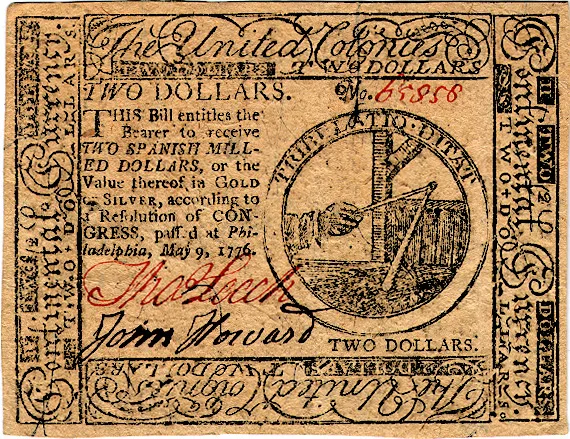
A 1776 Continental Currency note, the paper money Congress printed to finance the Revolutionary War before it had any way to back it, and which lost most of its value before the war was over.
A Mint, and Then a Century of Mismatched Money
The 1792 Coinage Act finally gave the country a Mint and a legal definition of the dollar, but coins alone couldn't meet the young economy's demand for money. For the next 70 years, thousands of competing state banknotes filled the gap, until the Civil War forced Congress to finally standardize the nation's paper currency.
The Coinage Act of April 2, 1792, established the U.S. Mint and defined the dollar in law for the first time, setting it at 371.25 grains of pure silver and tying gold and silver together at a fixed 15-to-1 ratio, a system known as bimetallism. The Mint's first building, built that year on Seventh Street in Philadelphia, was the first federal building constructed under the new Constitution, according to the U.S. Mint's own history.
The Act named astronomer and scientist David Rittenhouse as the Mint's first director, and, in a detail often repeated in Mint histories, made debasing the coinage or embezzling Mint metal punishable by death, a measure of how seriously the young government treated the integrity of its new money.
The Act authorized ten denominations: the gold eagle ($10), half eagle, and quarter eagle; the silver dollar, half dollar, quarter, dime, and half dime; and the copper cent and half cent. Hamilton derived the 371.25-grain silver dollar from assays of circulating Spanish dollars, and the Act fixed the mint price of gold near $19.39 an ounce.
The Mint was first placed under the Department of State, made an independent agency in 1799, and finally moved into the Treasury Department in 1873. Its Philadelphia site ran as a genuine early federal factory, with horse-powered and later steam-powered rolling and stamping machinery.
The Mint struck a small trial batch of silver half dismes in 1792 before its building was even finished, then began regular production in 1793 with copper half cents and cents, the country's first circulating federal coinage. Silver half dimes, half dollars, and dollars followed in 1794, and the first dimes and quarters in 1796, and the first gold coins, five-dollar half eagles and ten-dollar eagles, in 1795.
Even with a national Mint running, the country did not have enough coins to meet demand for ordinary transactions for decades afterward, so foreign coins, especially the Spanish dollar, remained legal tender in the United States until Congress finally ended that status in 1857, per the U.S. Mint's published history.
The roughly 1,500 half dismes of 1792 are traditionally, but not reliably, said to have been struck partly from Martha Washington's silverware. Regular 1793 cent production began in March; the Mint's first delivery was 11,178 "chain cents" (about 36,000 were struck in all) before public dislike of the chain design, read as an ill omen for a nation founded on liberty, forced a quick redesign.
Coin shortages persisted because depositors of gold and silver had to wait weeks for the Mint to return struck coins, so many kept using bullion or foreign coin. Small change stayed so scarce that private merchants issued their own copper tokens well into the 1830s and again during the Civil War.
With no federal paper currency yet, state-chartered banks issued their own notes, and by the eve of the Civil War an estimated 8,000 to 10,000 varieties of state banknotes circulated across the country, each with its own design and each only as good as the issuing bank's own reserves. Some "wildcat" banks deliberately located in remote areas specifically to make redemption difficult.
Counterfeiting was rampant enough that merchants relied on published guides, so-called "bank note reporters" and "counterfeit detectors," updated regularly to help tell real notes from fakes across the thousands of designs in circulation, a currency landscape historians commonly point to as one of the most confusing in American history.
Under the "free banking" laws many states passed in the 1830s and 1840s, almost anyone meeting minimum capital and bond-deposit rules could open a bank and issue notes. A solid Boston bank's note might pass at par in New York, while a frontier bank's note traded at a 5 to 50 percent discount depending on distance and reputation.
Thompson's Bank Note Reporter, published in New York from 1842, listed thousands of banks with the current discount on their notes and descriptions of known forgeries. Economic historians estimate that in some years up to a third of the notes in circulation were counterfeit or issued by banks that had already failed.
The National Banking Acts of 1863 and 1864 let banks obtain a federal charter and issue a uniform National Bank Note in exchange for depositing U.S. bonds with the Comptroller of the Currency, giving the country its first truly standardized paper currency. The central-banking gap this still left unfilled, the country had no lender of last resort until 1913, is covered in depth on this site's Federal Reserve page.
To finish the job, Congress imposed a 10 percent tax on state banknotes in 1865, making them unprofitable to issue and effectively driving the old patchwork of thousands of local currencies out of circulation within a few years, according to the Federal Reserve's own historical account of the Acts.
The Acts also created the Office of the Comptroller of the Currency inside the Treasury to charter and supervise national banks, an office that still exists. A national bank bought federal bonds equal to at least a third of its capital, deposited them, and could then issue notes up to 90 percent of the bonds' value, tying the new currency directly to the government's war debt.
The 10 percent tax, effective in 1866, worked: state banknote circulation collapsed from about $240 million in 1863 to under $4 million by 1868. Many state banks survived by shifting to checking-account banking, which the tax did not touch, an unintended nudge toward the check-based system that dominated the next century.
A War Forces the First American Fiat Money
The Union's Civil War financing crisis produced something the country had never had before: paper money backed by nothing but the government's own word. The greenback survived a constitutional challenge, a Supreme Court reversal, and 17 years of trading below gold before it finally became as good as gold, literally, in 1879.
The Union's mounting war costs and a wave of bank runs led banks and the Treasury to suspend paying out gold and silver coin for paper claims in December 1861, leaving the government short on hard currency just as it needed to pay soldiers, suppliers, and its own debts on an unprecedented scale.
Treasury Secretary Salmon P. Chase, personally uneasy about paper money's inflationary risks, concluded the government had no realistic alternative to printing money it could not immediately back in gold, setting up the Legal Tender Act that followed two months later.
The war was costing the Union roughly $1.75 million a day by late 1861, against annual federal revenue that had been under $60 million before the war. A failed loan syndication and the diplomatic Trent Affair with Britain triggered the December 1861 suspension of specie payments by New York banks, and the Treasury followed.
Chase financed the war through three channels: taxes, including the first federal income tax in 1861; bonds, marketed to ordinary citizens by the banker Jay Cooke; and paper money. An Ohio hard-money man, Chase accepted the greenback reluctantly and later, as Chief Justice, wrote the opinion in Hepburn v. Griswold striking down part of the law he had administered.
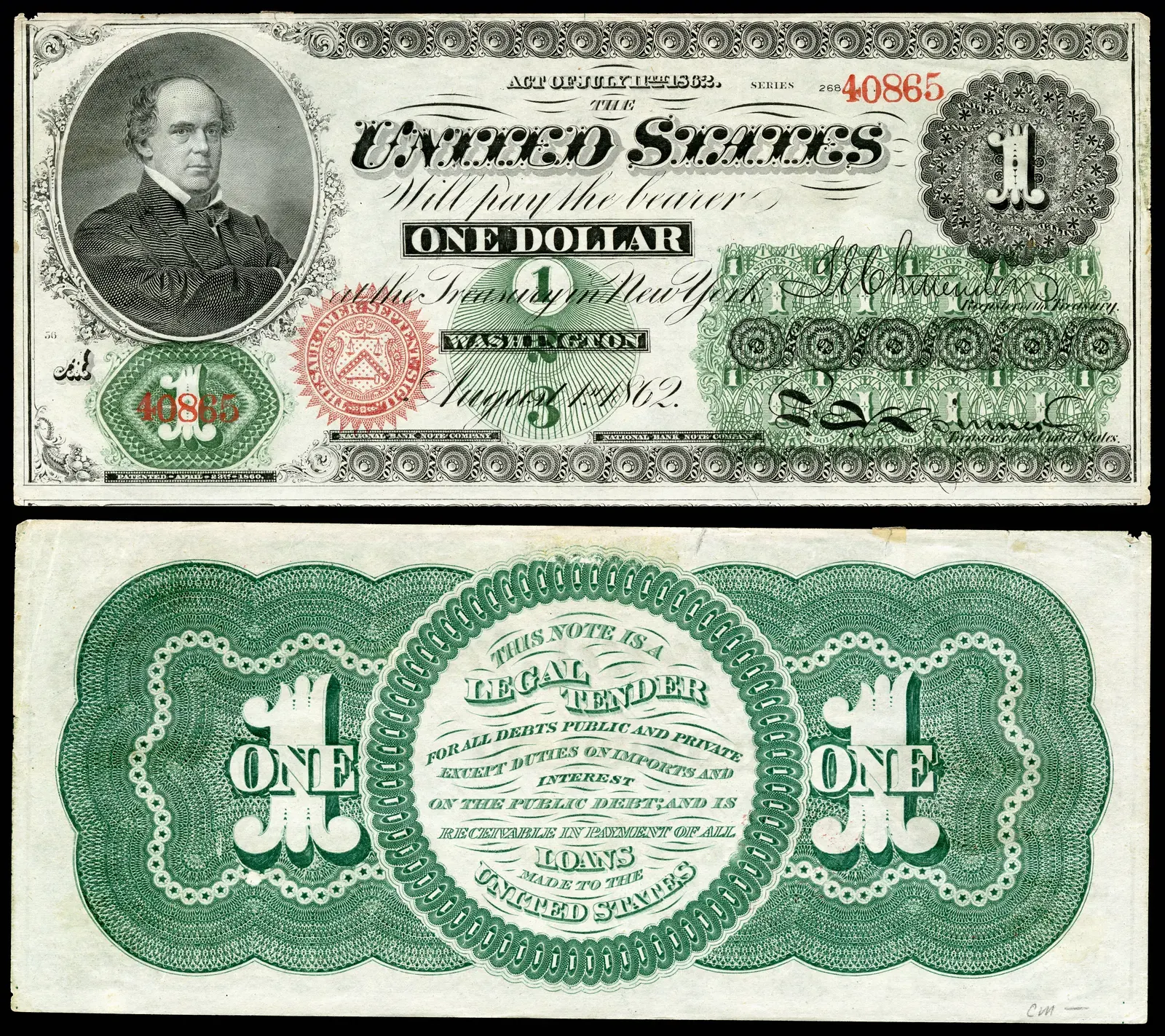
President Lincoln signed the Legal Tender Act on February 25, 1862, authorizing $150 million in United States Notes and declaring them legal tender for nearly all debts, public and private, the first paper currency the federal government had issued as pure fiat money, backed by law rather than by a promise of gold or silver on demand.
The notes were printed with green ink on the back, partly a deliberate anti-counterfeiting choice since the black-and-white photography of the era could not reliably reproduce color, and the public quickly nicknamed them "greenbacks," a name that stuck to U.S. paper currency long after the original notes stopped circulating.
The Act made United States Notes legal tender for all debts "public and private" except import duties, which still had to be paid in gold, and interest on federal bonds, also paid in gold. That carve-out kept a permanent demand for gold and let the government service its debt in hard money.
The design was executed by the American Bank Note Company and the National Bank Note Company under contract before the Bureau of Engraving and Printing took the work in-house. The $1 note carried Chase's own portrait, a piece of self-promotion by a Treasury Secretary with presidential ambitions.
Congress authorized additional rounds of United States Notes over the next two years, and by the war's end roughly $450 million in greenbacks were in circulation, financing a large share of the Union's war effort alongside new income taxes and war bonds sold directly to the public.
Because greenbacks were not redeemable in gold, they traded at a floating discount to gold coin on New York's "Gold Room" exchange, and that gap widened and narrowed with Union battlefield fortunes, becoming a daily, closely watched barometer of confidence in the war effort itself.
Congress authorized three tranches of $150 million each, in February and July 1862 and March 1863, capping United States Notes at $450 million. The greenback's gold value bottomed near 35 cents on the dollar in mid-1864 after Confederate general Jubal Early's raid threatened Washington, then recovered as Union victories mounted.
The wartime paper also included "fractional currency," paper notes for 3, 5, 10, 25, and 50 cents issued from 1862 because people were hoarding coins, along with interest-bearing legal tender notes. Postage stamps briefly circulated as small change until the fractional notes replaced them.
In Hepburn v. Griswold (1870), the Supreme Court ruled that applying the Legal Tender Act to debts contracted before 1862 was unconstitutional, but the decision barely survived a year. After two new justices appointed by President Grant joined the Court, it reversed course in Knox v. Lee and Parker v. Davis, known together as the Legal Tender Cases (1871), upholding Congress's power to make paper money legal tender.
The reversal, decided by a court whose composition Grant had just reshaped, drew sharp accusations of court-packing at the time, and it settled, for the rest of American history, the basic constitutional question of whether the federal government can issue paper money not backed by gold or silver.
Hepburn was decided 4 to 3 on February 7, 1870, with Chief Justice Chase writing that making paper legal tender for pre-existing debts was not a power "appropriate and plainly adapted" to any enumerated end. That same day, Grant nominated William Strong and Joseph Bradley to fill two vacancies.
On May 1, 1871, the reconstituted Court decided Knox v. Lee and Parker v. Davis 5 to 4, overruling Hepburn under Congress's war and currency powers. In Juilliard v. Greenman (1884) the Court went further, holding Congress could issue legal tender paper in peacetime too, the ruling that still governs.
The 1875 Specie Payment Resumption Act set January 1, 1879, as the date the Treasury would resume redeeming greenbacks in gold coin on demand, and after several years spent quietly building up a gold reserve, the Treasury met that deadline without incident, and greenbacks began trading at full parity with gold for the first time since the war.
United States Notes continued circulating in small, fixed amounts for nearly a century afterward alongside newer currency types, and the Treasury stopped issuing new ones in the early 1970s, though existing greenbacks still in the hands of collectors remain legal tender today, per the Treasury Department's own currency history.
The 1875 Act let the Treasury sell bonds for gold to build a reserve and retire some greenbacks as national bank notes expanded, shrinking the greenback float toward $300 million before Congress froze it in 1878. By resumption day the Treasury held about $135 million in gold against roughly $346 million in notes.
Resumption held because almost no one showed up to redeem: with greenbacks now "as good as gold," the public preferred the lighter paper. The roughly $346.7 million greenback total was frozen by law and drifted down only slightly over the next century; United States Notes were formally discontinued in 1971 and the survivors stay legal tender.
Why Silver Lost, and Then Why Gold Did Too
Silver and gold were legally tied together as money from 1792 onward, until an 1873 law that barely made news at the time turned into the defining political fight of the late 19th century. The gold standard eventually won, only to be dismantled itself by the 1970s, leaving the dollar backed by nothing but the government's promise, exactly like the greenback had been a century earlier.
The original Coinage Act set a legal exchange ratio of 15 ounces of silver to 1 ounce of gold, meaning both metals were legal tender at a fixed rate. That fixed ratio never quite matched the two metals' shifting market values, and under Gresham's Law, whichever metal was worth more on the open market than its official mint ratio tended to get hoarded, melted, or shipped overseas rather than spent.
Congress adjusted the ratio to roughly 16-to-1 in 1834, which undervalued silver again, and combined with the flood of new gold from the 1848 California Gold Rush, silver dollars had largely vanished from everyday commerce by the 1850s and 1860s, worth more as bullion than as coin.
The 15 to 1 ratio matched world markets in 1792 but slipped as European demand shifted; by the 1810s and 1820s gold was worth about 15.6 to 1 in Europe, so gold flowed out of the United States and the country ran on silver and paper.
Gresham's Law, "bad money drives out good," ran in both directions across the century: when silver was legally overvalued, silver circulated and gold was hoarded; after 1834, when gold was overvalued, gold circulated and full-weight silver coins were melted. True simultaneous circulation of both metals at face value almost never lasted.
The Coinage Act of 1873, a broad technical overhaul of mint law, quietly dropped the standard silver dollar from the list of coins the Mint would strike, a change that drew little attention at the time since silver dollars were already barely circulating.
Within a few years, massive new silver strikes at Nevada's Comstock Lode and other Western mines crashed silver's market price, and silver producers and inflation-minded farmers and debtors, who wanted the Mint to buy their now-cheap silver at the old favorable rate, recast the 1873 law as a secret betrayal engineered by gold interests and bankers, a charge later branded the "Crime of '73" that most historians attribute more to unlucky timing than an actual conspiracy, according to the U.S. Mint's own account of the episode.
The 1873 Act took three years and thirteen drafts to pass and was debated openly by Congress and the Treasury; Europe was demonetizing silver around the same time as nations moved to gold. The domestic silver dollar had last circulated widely in the 1830s, so its removal was barely noticed in 1873.
Everything changed when Comstock and other output roughly tripled U.S. silver production in the 1870s and the market ratio blew past 30 to 1. Silver interests argued that, but for the 1873 law, the Treasury would have had to buy all that silver at 16 to 1, and "free silver" became a mass political movement across the farm belt for 25 years.
Responding to mounting political pressure from the Free Silver movement, Congress passed the Bland-Allison Act in 1878 over President Hayes's veto, requiring the Treasury to buy between $2 million and $4 million worth of silver every month and coin it into silver dollars, a partial win for silver advocates that stopped well short of their goal of unlimited silver coinage.
The compromise satisfied almost no one fully: silver-mining states wanted far more purchasing, while sound-money advocates in the Northeast worried that any government silver buying at all would eventually flood the country with depreciated currency and drive gold out of circulation.
The House had passed Richard Bland's free-coinage bill; Senator William Allison amended it down to the $2 million to $4 million monthly floor. Hayes vetoed it as inflationary on February 28, 1878, and Congress overrode him the same day, 196 to 73 in the House and 46 to 19 in the Senate.
Between 1878 and 1890 the Treasury bought the legal minimum, coining more than 378 million "Morgan" silver dollars, most of which sat unused in vaults because the public preferred paper silver certificates redeemable for them. Millions were still bagged in Treasury vaults when they were sold to collectors in the 1960s and 1970s.
The Sherman Silver Purchase Act of 1890 nearly doubled down on Bland-Allison, requiring the Treasury to buy 4.5 million ounces of silver every month and pay for it with new notes redeemable in either gold or silver, a choice that let holders drain the Treasury's gold reserve simply by choosing gold at redemption.
That steady gold drain, combined with a broader loss of investor confidence, is widely cited by economic historians as a direct contributor to the Panic of 1893, one of the worst financial crises the country had experienced to that point.
The required 4.5 million ounces a month was close to the entire U.S. output, and the new Treasury Notes of 1890 were redeemable in gold or silver at the government's option, which in practice meant gold. The Act passed as part of a bargain in which silver-state senators backed the McKinley Tariff.
Holders promptly redeemed the new notes for gold and either exported or hoarded it, a maneuver contemporaries called "the endless chain." The Treasury's free gold reserve fell from about $190 million in 1890 toward the $100 million level widely seen as the danger point.
As the gold reserve fell toward a politically alarming threshold in 1893, President Grover Cleveland, a committed gold-standard Democrat, pushed for and won repeal of the Sherman Silver Purchase Act, a move that outraged the silver wing of his own party and left Democrats openly divided between gold and silver factions heading into the next presidential election.
Cleveland's administration also arranged for a private banking syndicate led by J.P. Morgan to replenish the Treasury's gold reserve through a bond sale in 1895, a deal that shored up confidence in the gold standard but became a political liability, fueling accusations that Cleveland had sold monetary policy to Wall Street.
The gold reserve dipped below $100 million in April 1893; within months hundreds of banks and dozens of railroads failed and unemployment reached an estimated 12 to 18 percent. Cleveland called a special session of Congress and, after a bruising fight, won repeal of the Sherman purchase clause on November 1, 1893.
Repeal did not stop the gold drain, and the Treasury sold bonds for gold four times from 1894 to 1896, including the February 1895 sale to a Morgan-Belmont syndicate that netted the bankers a quick profit and handed silver Democrats a potent "Wall Street" talking point for 1896.
At the 1896 Democratic National Convention, 36-year-old William Jennings Bryan electrified delegates with a speech demanding the free and unlimited coinage of silver at 16-to-1, closing with the line "you shall not crucify mankind upon a cross of gold," a performance that won him the party's presidential nomination on the spot.
Republican William McKinley, campaigning on an unwavering gold-standard platform and backed by a then-unprecedented fundraising operation run by Mark Hanna, defeated Bryan that November, and the result is generally regarded by historians as the decisive political verdict against bimetallism in American politics.
Bryan's speech closed the convention debate on the platform's money plank, and delegates nominated him the next day on the fifth ballot. The Populist Party also endorsed him, fusing with the Democrats, while "Gold Democrats" bolted to run a separate ticket under John M. Palmer.
Hanna's operation raised an estimated $3.5 million or more, much of it from banks and corporations alarmed by free silver, versus roughly $500,000 for Bryan, who campaigned by rail across 27 states. McKinley won 271 electoral votes to 176, carrying the industrial Northeast and Midwest.
President McKinley signed the Gold Standard Act on March 14, 1900, formally defining the dollar solely in terms of a fixed weight of gold and establishing a dedicated gold reserve fund to redeem paper currency, closing off, in law, the bimetallism debate that had dominated American politics for a generation.
The Act mostly confirmed a gold standard that had already existed in practice since the 1879 resumption of specie payments, but it removed any remaining legal ambiguity about silver's status and marked the high-water mark of the classical gold standard in the United States, a system that would last barely three decades before the Great Depression forced it to bend.
The Act defined the dollar as 25.8 grains of gold, nine-tenths fine, about $20.67 per fine ounce, and created a $150 million gold reserve fund the Treasury had to keep topped up by selling bonds if needed. Silver dollars and certificates kept circulating but were now clearly subsidiary coinage.
Passage was eased by a run of prosperity after 1897, driven partly by huge new gold discoveries in the Klondike, South Africa, and Colorado and by the cyanide extraction process, which expanded the money supply and quietly delivered much of what the inflationists had wanted, without silver.
Amid the Great Depression's banking panic, President Franklin Roosevelt's 1933 executive order required Americans to turn in most gold coin and bullion for paper currency, and the 1934 Gold Reserve Act that followed revalued gold and ended domestic gold convertibility for ordinary citizens for good, even as the dollar stayed pegged to gold internationally at $35 an ounce under the 1944 Bretton Woods system.
The last formal link between paper money and precious metal for everyday Americans broke in 1968, when the Treasury ended silver certificates' redemption for silver bullion, and the final tie to gold broke on August 15, 1971, when President Nixon ended foreign governments' ability to convert dollars into gold too, the "Nixon Shock" that made the dollar the fully fiat currency it remains today, backed by nothing but the full faith and credit of the United States.
Executive Order 6102 of April 1933 required most privately held gold coin, bullion, and certificates to be exchanged for other currency at $20.67 an ounce; the Gold Reserve Act of January 1934 then revalued gold to $35 an ounce, a devaluation that raised the paper value of the government's gold stock and gave it room to expand credit.
Under Bretton Woods the dollar was fixed to gold at $35 for foreign central banks, and other currencies were fixed to the dollar. Persistent U.S. deficits made that promise unsustainable; Nixon closed the gold window in 1971, the last fixed gold price was abandoned in 1973, and Congress legalized private gold ownership again in 1974.
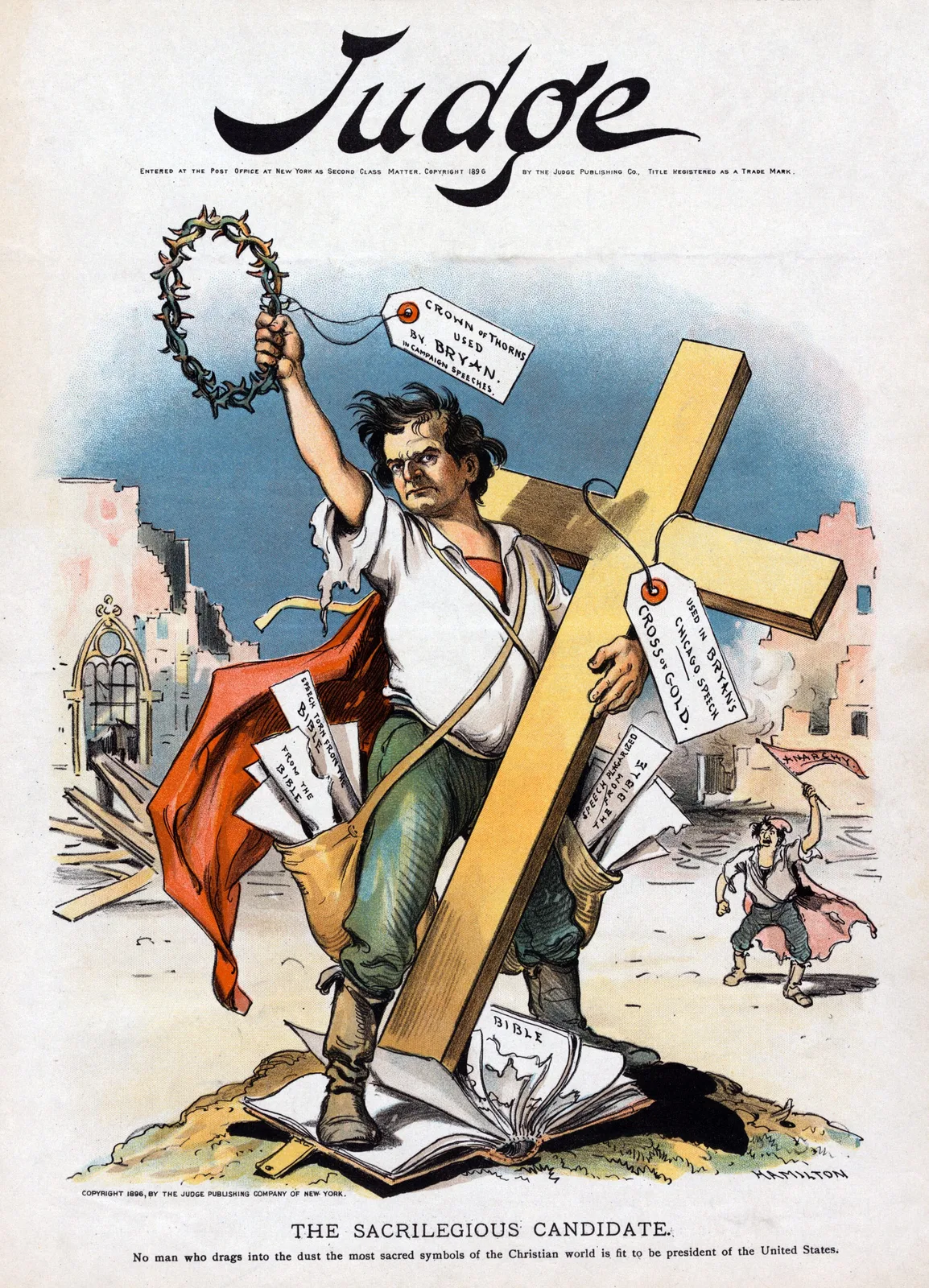
An 1896 cartoon responding to William Jennings Bryan's "Cross of Gold" speech, the moment the gold-versus-silver fight became the central issue of a presidential election.
Two Agencies, One Job: Making It Hard to Fake
Every dollar bill in circulation was printed by the Bureau of Engraving and Printing, and every coin was struck by the U.S. Mint, both agencies of the Treasury Department. Between the special paper, the engraved plates, and a rotating set of anti-counterfeiting features, making money today is a far more deliberate process than it was in the era of thousands of competing banknotes.
Congress created the Bureau of Engraving and Printing in 1862, inside the Treasury Department, specifically to print the new greenback currency the Legal Tender Act had just authorized, taking that job away from the private banknote companies that had printed money for individual states and banks before the war.
Today the BEP is the sole producer of Federal Reserve Notes, the paper currency in every American's wallet, and operates from two facilities: its original Washington, D.C. building and a second plant in Fort Worth, Texas, opened in 1991 as the first U.S. currency ever printed outside the nation's capital, according to the BEP's own history.
The BEP began printing in-house in 1863 in the basement and attic of the Treasury building, with the trimming and separating of notes done largely by young women it hired for the work. It did not get its own dedicated building until 1880, and the current main building on 14th Street in Washington opened in 1914.
The Bureau prints billions of notes a year, the exact "currency order" set annually by the Federal Reserve Board, and also produces other engraved federal products such as White House invitations and military commission certificates. It does not make coins; that is the separate U.S. Mint.
U.S. currency is printed on a special blend of 75 percent cotton and 25 percent linen, not ordinary wood-pulp paper, giving it the distinctive crisp, cloth-like feel that helps it survive a trip through the washing machine far better than a regular sheet of paper. Tiny red and blue synthetic fibers are distributed randomly through the material as a basic anti-counterfeiting feature.
That cotton-linen paper is only part of the security picture: modern notes above the $5 use intaglio printing, in which ink is forced under heavy pressure into finely engraved recessed lines on a steel plate, producing the raised, textured detail in the portraits and borders that is extremely difficult to replicate with an ordinary printer or copier.
The cotton-linen paper has been supplied since 1879 by a single company, Crane & Co. of Massachusetts, under a contract Congress renews; using one long-term supplier is itself a security measure, since the raw substrate is as controlled as the finished notes. Making or possessing "distinctive paper" outside that contract is a federal crime.
Since 1990 most denominations also carry a polymer security thread embedded in the paper, and the redesigned $100 note released in 2013 added a woven 3-D security ribbon with images that shift as the note tilts, a feature the BEP spent years learning to manufacture reliably, which delayed that note's release.
Since a major redesign effort began in the 1990s, the BEP has added features like color-shifting ink on a bill's numeral that appears to change color when tilted, an embedded security thread that glows a specific color under ultraviolet light and differs by denomination, and a watermark portrait visible only when the note is held up to light.
A joint Advanced Counterfeit Deterrence committee made up of the BEP, the Federal Reserve, and the U.S. Secret Service reviews and recommends new security features roughly every seven to ten years, timed to stay ahead of whatever new copying or printing technology counterfeiters have started exploiting.
The U.S. Secret Service was created in 1865, as a Treasury bureau, specifically to fight counterfeiting, then estimated to affect a third or more of circulating currency; presidential protection was added only decades later. The Service still runs the investigations behind the periodic design changes.
The 1990s redesign was driven partly by the spread of color copiers and desktop publishing and by the "Superdollar," a very high-quality $100 counterfeit. Today counterfeits are a small share of currency in circulation, on the order of one note in ten thousand by Fed estimates, and casual passers are more common than sophisticated printing operations.
Coin production starts with large coils of metal alloy that the Mint punches into blank discs, a step called blanking. The blanks are then annealed (heated to soften the metal), washed, and run through an upsetting mill that raises a rim around the edge before they are ready for striking.
In the striking press, two engraved dies, one for each side of the coin, stamp the design onto the blank under tremendous pressure, producing thousands of coins an hour. The finished coins are inspected, counted, and bagged for shipment, largely the same sequence of steps the Mint has used since the 18th century, per the U.S. Mint's published production overview.
Circulating coins are struck once; higher-quality "proof" collector coins are struck two or more times on polished dies and blanks for sharper detail and mirror fields. The dime, quarter, half dollar, and dollar are "clad," a copper core bonded between copper-nickel layers, a switch Congress made in 1965 when rising silver prices made the old 90 percent silver coins worth more than face value.
The Mint strikes on the order of ten to fifteen billion circulating coins a year for the Federal Reserve. The cent and nickel have for years cost more than face value to make, about 3.7 cents per penny in fiscal 2024; after years of proposals to drop the coin, the Treasury ordered an end to penny production in 2025, and the Mint struck its last circulating cents that November.
The U.S. Mint currently strikes coins at four facilities: Philadelphia and Denver produce the everyday circulating coins found in pocket change, San Francisco strikes mostly proof and collector coins, and West Point, New York, produces bullion coins like the American Eagle series along with some collector issues.
Most coins carry a small mint mark, a letter identifying which facility struck it (P for Philadelphia, D for Denver, S for San Francisco, W for West Point), a tradition that traces back to the Coinage Act era, when Congress wanted a way to trace any coin found to be underweight or debased back to a specific mint.
The Mint has run many sites over its history, including branch mints at Charlotte, Dahlonega, and New Orleans opened in the 1830s to coin locally mined gold and silver, and Carson City, Nevada near the Comstock Lode. Those closed by the early 20th century; the modern four are Philadelphia (1792), San Francisco (1854), Denver (coining since 1906), and West Point (an official mint since 1988).
Philadelphia coins have carried a "P" mint mark on the nickel and larger coins since 1980 (and on the 1942-45 silver wartime nickels), while the cent had no mark except in 2017, so a markless modern cent is almost always a Philadelphia strike. The Denver facility is the single largest coin-producing plant in the world by volume.
Printing a note costs only a small fraction of its face value, so the government profits from the gap between what a bill costs to produce and what it is worth once it enters circulation, a difference economists call seigniorage. Per the BEP's own published unit-cost figures, a $1 or $2 note costs only a few cents to print, while a $100 note, carrying far more security features, costs several times that.
That seigniorage profit does not go to the BEP itself, since the BEP only bills the Federal Reserve for its production cost, not face value. The actual profit shows up on the Federal Reserve's books once the currency enters circulation, and it ultimately flows to the U.S. Treasury as part of the Fed's annual remittance of earnings, a link this site's Federal Reserve page covers from the Fed's side of the ledger.
In recent BEP figures a $1 note has cost roughly 3 cents to produce and a $100 note around 9 cents, so the note-printing side of seigniorage is large. Coin seigniorage is smaller and sometimes negative: the Mint reports a profit on quarters and dollars but a loss on every cent and nickel.
Currency in circulation, about $2.3 trillion in Federal Reserve Notes as of the mid-2020s, is a liability on the Fed's balance sheet offset by interest-earning assets like Treasury securities. The interest on those assets, minus the Fed's costs, is remitted to the Treasury each year, tens of billions of dollars in most recent years, which is the practical form the seigniorage profit takes.
From the Printing Press to Your Wallet
Newly printed currency doesn't go straight from the Bureau of Engraving and Printing to a bank teller, it passes through the Federal Reserve first, which orders it, owns it, and distributes it to the banking system. What happens next, and eventually to a worn-out bill, is a cycle the Fed manages continuously to keep just enough cash moving through the economy.
The BEP does not sell currency directly to banks or the public. Instead, the Federal Reserve Board forecasts how much new currency the economy will need each year, based on factors like economic growth, worn-out currency coming out of circulation, and seasonal demand, and orders that amount from the BEP, paying only the cost of production.
Once printed, the new notes become a liability on the books of the regional Federal Reserve Banks, and because the Fed only pays the BEP's production cost rather than the note's face value, the government's seigniorage profit ends up as Fed income rather than a line item at the Bureau itself.
The annual print order is set by the Board's Cash Product Office in consultation with the Reserve Banks, and roughly 85 to 95 percent of it each year is simply to replace worn notes being destroyed, not to expand the supply.
The Fed records the notes at face value as a liability when they leave its vaults into circulation while its offsetting assets earn interest, so issuing currency is profitable for the government, the accounting form of seigniorage.
The 12 regional Federal Reserve Banks and their branch cash offices distribute currency and coin to roughly 8,000 depository institutions, banks, savings and loans, and credit unions, that hold accounts directly with the Fed, typically shipping cash by contracted armored carrier. Smaller institutions without a direct Fed relationship instead get their cash through a larger correspondent bank.
Ordering runs both directions: banks request extra cash from their Reserve Bank ahead of predictable demand spikes, like the holiday shopping season, and deposit their surplus or worn currency back to the Fed the rest of the year, keeping the total amount of cash in the banking system roughly matched to what the public actually wants to hold.
The Reserve Banks and their roughly 28 cash-handling offices form the wholesale layer between the BEP and the Mint on one side and commercial banks on the other. When a bank orders cash, the Fed ships it and debits the bank's reserve account for the face value.
To discourage banks from needlessly shuttling cash back and forth, the Fed runs a custodial-inventory program and charges cross-shipping fees. Armored carriers such as Brink's and Loomis move the physical currency under strict Fed packaging and authentication standards.
Every note that comes back to a Federal Reserve Bank is run through high-speed sorting machines that check its authenticity and physical condition. Bills judged too worn, torn, or dirty for further use are pulled out and shredded, while bills still in good shape are recirculated back out to banks.
How long a bill lasts depends heavily on how often it changes hands: a $1 bill, passed from wallet to register constantly, typically wears out within several years, while a $100 bill, more often saved than spent, can stay in circulation for well over a decade, according to Federal Reserve currency-lifespan data. Shredded currency has been repurposed over the years into everything from compost to roofing material to novelty souvenir bags sold at some Reserve Bank gift shops.
The processing equipment can check tens of thousands of notes an hour for denomination, authenticity, and fitness, using image sensors and tests for the security thread and magnetic ink. Notes that fail the fitness test are shredded on site, and the Fed destroys billions of notes a year this way.
The Fed's published average lifespans run from about 6.5 years for a $1 note to 22.9 years for a $100 note, with the $5 the shortest at under 5 years because it circulates hard and is handled roughly. Shredded currency is mostly landfilled or composted, with small souvenir bags and brief building-product experiments the exceptions.
Coins are dramatically more durable than paper currency and can stay in circulation for decades without needing replacement, so unlike paper money, the Mint's ongoing production is driven mainly by growing demand for pocket change and by coins that simply fall out of circulation into jars, couch cushions, and storm drains rather than by coins wearing out.
Because so many coins get set aside and forgotten rather than spent, the Federal Reserve periodically runs public awareness campaigns encouraging people to deposit or exchange the coins sitting idle in their homes, since the Mint would otherwise need to strike more new coins to meet the same everyday demand.
A circulating coin is generally expected to last 30 years or more, so Mint output tracks economic activity and coin "leakage" into jars and fountains rather than replacement of worn coins. Estimates of the value of coins sitting idle in American homes run into the tens of billions of dollars.
The COVID-19 pandemic caused a sharp coin-circulation slowdown in 2020 as businesses closed and people stopped spending cash, prompting a U.S. Coin Task Force and Fed and Mint appeals for people to deposit or spend their change. It was a shortage of movement, not of coins, and it eased as commerce reopened.
Ten Facts Worth Knowing
A quick-reference set of facts drawn from the sourced material throughout this page, useful for a fast read or a classroom discussion starter.
Massachusetts issued the first paper money by any government in the Western world in 1690, nearly a century before the United States existed.
The Spanish silver dollar was colonial America's most common coin, and its widespread use is why the new nation called its currency the "dollar" instead of the "pound."
Continental Currency lost so much value during the Revolutionary War that "not worth a Continental" became a lasting phrase for something worthless.
The Coinage Act of 1792 made debasing U.S. coinage a crime punishable by death, a measure of how seriously the young government guarded its new money.
Greenbacks got their nickname from being printed with green ink on the back, partly because black-and-white photography of the 1860s couldn't reproduce color, deterring counterfeiters.
William Jennings Bryan's 1896 "Cross of Gold" speech won him the Democratic nomination at age 36, but he still lost the general election to gold-standard Republican William McKinley.
The dollar's last formal links to precious metal broke in stages: silver certificate redemption ended in 1968, and foreign governments' ability to convert dollars into gold ended in 1971.
U.S. currency paper is 75 percent cotton and 25 percent linen, not wood pulp, which is why a dollar bill can survive a trip through the washing machine.
Most coins carry a mint mark showing which of the four active U.S. Mint facilities struck it: Philadelphia, Denver, San Francisco, or West Point.
A $100 bill can stay in circulation for well over a decade because it changes hands far less often than a $1 bill, which tends to wear out within just a few years.
Sources & Further Reading
- U.S. Bureau of Engraving and Printing, The Buck Starts Here: How Money Is Made
- U.S. Mint, Coinage Act of April 2, 1792
- U.S. Mint, History of the U.S. Mint
- U.S. Mint, Historic Coin Production
- U.S. Mint, Mint History: The 'Crime of 1873'
- Federal Reserve History, National Banking Acts of 1863 and 1864
- Federal Reserve Bank of New York, How Currency Gets into Circulation
- Board of Governors of the Federal Reserve System, The Role of the Federal Reserve (Coin)
- U.S. Department of the Treasury, Currency and Coins
- Library of Congress, [A "Greenback"; one dollar bill, 1862]
- Library of Congress, Fac-simile of the First Money Coined by the United States, Continental Currency 1776
- Library of Congress, Inside Adams, The Cost of Independence: Highlights from the Early American Paper Money Collection
- National Archives, Founders Online, Design of Coinage, [24 March] 1792
- Smithsonian National Museum of American History, National Numismatic Collection
- Wikimedia Commons, Cross of Gold Speech Cartoon (Grant Hamilton, Judge magazine, 1896)
This page draws on the U.S. Mint's and Bureau of Engraving and Printing's own published histories, Federal Reserve and Federal Reserve Bank of New York educational material on currency production and circulation, the Library of Congress and National Archives' primary-source records of colonial and Revolutionary -era currency, and the Smithsonian's National Numismatic Collection. The 1862 one-dollar note and 1776 Continental Currency note images are public domain U.S. government works from the Wikimedia Commons National Numismatic Collection archive; the 1896 political cartoon is a public domain work first published before 1931.