
What The State Department Does
Established July 27, 1789, The U.S. Department of State is one of the fifteen Cabinet-level departments of the U.S. federal government.
The State Department is the United States government's lead agency for foreign affairs. It manages diplomatic relations with foreign governments, represents U.S. interests at the United Nations and other international bodies, negotiates treaties and international agreements, and coordinates the country's response to global crises, from wars to pandemics to natural disasters.
Day to day, the department runs the U.S. Foreign Service, the roughly 13,000 diplomats who staff embassies and consulates in more than 170 countries. Ambassadors, who serve as the president's personal representative in each country, report through the State Department chain of command up to the Secretary of State, who is the president's principal foreign policy adviser.
The department also performs services that touch millions of ordinary Americans directly. It issues U.S. passports, provides emergency assistance to American citizens in trouble abroad, adjudicates visa applications for foreign travelers and immigrants, and administers educational exchange programs like the Fulbright Program.
Its budget, about $60 billion including foreign operations, is a small fraction of the roughly $850 billion Defense budget, a gap that former secretaries and defense officials of both parties have repeatedly cited in arguing that diplomacy is underfunded relative to the military. The department is organized into regional bureaus (one per part of the world) and functional bureaus (arms control, human rights, counterterrorism, economic affairs, and others) under the Secretary and deputy secretaries.

The Secretary of State
The Secretary of State leads The State Department, sits on the President's Cabinet, and is confirmed by a majority vote of the U.S. Senate.
Current Secretary of State
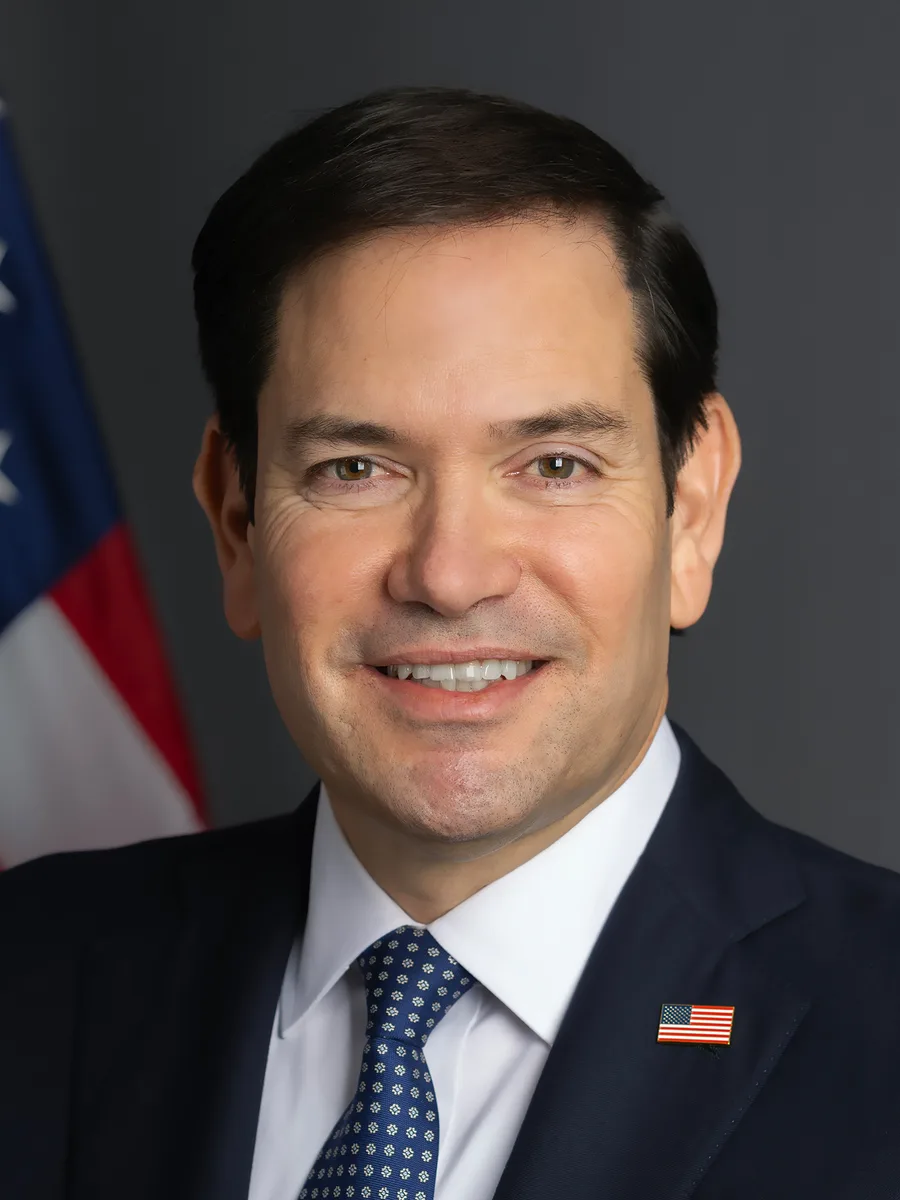
Marco Rubio
In office since
January 21, 2025
Prior role: U.S. Senator from Florida (2011-2025)
Marco Rubio was confirmed as the 72nd Secretary of State on January 21, 2025, becoming the first Cuban American to hold the office. He spent fourteen years in the U.S. Senate representing Florida, where he served on the Senate Foreign Relations Committee and the Senate Select Committee on Intelligence, and ran for the Republican presidential nomination in 2016.
Before his Senate career, Rubio served in the Florida House of Representatives, including two years as Speaker of the House. He was also appointed to serve concurrently as national security adviser during parts of 2025, the first time since Henry Kissinger in 1973-75 that one person has led both the State Department and the National Security Council staff.
Major Sub-Agencies & Bureaus
The State Department carries out its mission through operating divisions and sub-agencies, each with its own specific mandate.
The Foreign Service is the corps of career diplomats who staff American embassies and consulates around the world. Foreign Service Officers rotate between postings every two to three years, serving in political, economic, consular, management, and public diplomacy roles, and are frequently posted to hardship or high-danger locations as part of their career progression.
Admission is highly competitive, requiring the Foreign Service Officer Test and a full day of oral assessments; fewer than 5% of applicants in a typical year are ultimately hired. Ambassadors are drawn both from career Foreign Service ranks and from political appointees nominated by the president and confirmed by the Senate.
The service is deliberately kept separate from the civil service: officers commit to worldwide availability, can be assigned anywhere the department needs them, and are subject to an "up or out" promotion system in which those not promoted within set time limits must leave. It totals roughly 13,000 officers plus a similar number of specialists (security agents, IT, medical, and others).
By long tradition, the ratio of career to political ambassadors runs about 70 to 30, with political appointees more common in wealthy allied capitals such as London, Paris, and Tokyo. The American Foreign Service Association, the officers' professional association and union, periodically criticizes large donors being named to sensitive posts.
This bureau issues U.S. passports (more than 20 million in a typical year) and adjudicates visa applications from foreign nationals seeking to visit, study, or immigrate to the United States. It also runs the Office of Overseas Citizens Services, which assists Americans abroad who are arrested, hospitalized, or affected by a natural disaster or evacuation.
During the COVID-19 pandemic, the bureau coordinated one of the largest peacetime repatriation efforts in U.S. history, helping bring more than 100,000 Americans home from over 135 countries in a matter of weeks after commercial flights were grounded worldwide.
Consular Affairs is unusual in the federal government because it is almost entirely fee-funded: passport and visa fees, not appropriations, cover most of its budget. That makes its finances sensitive to swings in international travel, as the pandemic showed when application volume collapsed and processing backlogs later ballooned.
The bureau also maintains the Consular Lookout and Support System and shares data with the Department of Homeland Security, and it issues the Country Information pages and travel advisories (levels 1 through 4) that many Americans consult before trips abroad.
Historically, most non-military U.S. foreign aid was administered by the U.S. Agency for International Development (USAID), an independent agency that worked closely with State. In 2025, the Trump administration moved to shut down USAID as a standalone agency and folded its remaining functions and programs into the State Department, consolidating foreign assistance decision-making under the Secretary of State.
State Department-run assistance programs today include the President's Emergency Plan for AIDS Relief (PEPFAR), disaster relief coordinated through the Bureau of Population, Refugees, and Migration, and security assistance to allied governments, all now administered inside the department rather than through a separate aid agency.
U.S. foreign aid totals roughly $60 billion a year across all agencies, historically less than 1 percent of the federal budget, a figure Americans routinely overestimate in polls by a wide margin. Major recipients in recent years have included Ukraine, Israel, Egypt, Jordan, and Ethiopia.
The 2025 consolidation drew lawsuits and sharp debate: supporters argued it ends duplication and puts aid firmly under diplomatic control, while critics, including former officials of both parties and humanitarian groups, warned that cutting staff and pausing programs disrupted food, health, and refugee assistance and ceded influence to other powers.
Diplomatic Security protects U.S. embassies, consulates, and their personnel worldwide, and its special agents also protect the Secretary of State and visiting foreign dignitaries inside the United States. It is one of the largest security and law enforcement operations in the federal government, spanning more than 270 posts overseas.
The bureau was significantly reformed after the 1998 East Africa embassy bombings and again after the 2012 attack on the U.S. diplomatic compound in Benghazi, Libya, both of which prompted Congress to mandate stronger physical security standards for U.S. facilities abroad.
Its special agents are sworn federal law enforcement officers who investigate passport and visa fraud (a common tool in human-trafficking and terrorism cases), run the Rewards for Justice program that pays for information on terrorists, and provide the security detail for the Secretary, one of the few Cabinet officials with round-the-clock protection.
Physical standards now trace to the Inman Report after the 1983 Beirut embassy bombing, which set setback distances and blast-resistance rules for new construction. The Bureau of Overseas Buildings Operations carries out the resulting multibillion-dollar program of building fortified "new embassy compounds."
From July 27, 1789 to Today
The predecessor of The State Department was the Department of Foreign Affairs, created earlier that same year. Here is how the department reached its current form.
Congress created the Department of Foreign Affairs on July 27, 1789, making it the first federal executive department established under the new Constitution, weeks before either the War Department or the Treasury. Thomas Jefferson became the first Secretary of State later that same year.
Congress renamed the agency the Department of State just months later, in September 1789, after also assigning it a handful of domestic duties, including custody of the Great Seal of the United States, a responsibility the department still holds today.
For much of the 19th century the department also handled the census, the mint, federal land patents, copyrights, and the publication of the laws, before those functions moved to other agencies. It kept custody of the original signed Constitution and Declaration of Independence until 1921, when both went to the Library of Congress; they moved to the National Archives in 1952.
For its first century, the United States sent only lower-ranked 'ministers' to foreign capitals rather than ambassadors, reflecting the young country's modest global standing. Congress authorized the rank of ambassador in 1893, and the United States exchanged its first ambassadors with major powers shortly after.
The shift, authorized by Congress in 1893, reflected America's growing economic weight, which grew further after the Spanish-American War of 1898, after which the U.S. acquired overseas territories and began behaving more like the great powers of Europe on the diplomatic stage.
The first U.S. ambassador was Thomas F. Bayard, sent to London in 1893. Until then the highest American diplomatic rank abroad was "envoy extraordinary and minister plenipotentiary," a deliberate republican rejection of what the founders saw as monarchical pomp.
The Rogers Act of 1924 merged the separate diplomatic and consular services into a single, professional U.S. Foreign Service, establishing competitive examinations and a merit-based career system instead of political patronage appointments for most diplomatic posts.
This reform is considered the founding document of the modern American diplomatic corps, and the exam-based entry system it created, though updated many times since, remains the basic model the Foreign Service uses to recruit officers today.
The Foreign Service Act of 1946 and a major rewrite in 1980 later added the "up or out" promotion rules, the Senior Foreign Service, locality and hardship pay, and the grievance system. Until a 1971 court settlement, women in the Foreign Service were required to resign upon marriage.
The Foreign Assistance Act of 1961, signed by President Kennedy, consolidated existing foreign aid programs and created the U.S. Agency for International Development to administer them, formally separating long-term development assistance from short-term diplomatic and military aid programs.
USAID operated as an independent agency for more than six decades, working under the foreign policy guidance of the Secretary of State, until the Trump administration dissolved it as a standalone agency in 2025 and absorbed its remaining functions into the State Department itself.
The 1961 law grew out of the Marshall Plan and the Point Four technical-assistance program of the Truman years, and it was paired with the creation of the Peace Corps the same year. It remains the core legal authority for U.S. foreign aid, amended repeatedly but never fully replaced.
The November 1979 seizure of the U.S. Embassy in Tehran, where 52 American diplomats and citizens were held hostage for 444 days, exposed severe gaps in embassy security and triggered a fundamental rethinking of how the department protects its personnel abroad.
The crisis, combined with a wave of later attacks on U.S. missions, led Congress to steadily strengthen and professionalize what became the Bureau of Diplomatic Security, giving it broader law enforcement authority and a much larger budget for embassy hardening worldwide.
The 1983 truck bombings of the U.S. Embassy and Marine barracks in Beirut, which together killed hundreds, prompted the Inman Report and the Omnibus Diplomatic Security and Antiterrorism Act of 1986, which formally created the Bureau of Diplomatic Security and the Diplomatic Security Service.
Defining Moments
Events that reshaped the department's authority, structure, or public role.
Named for Secretary of State George C. Marshall, the European Recovery Program provided more than $13 billion (well over $150 billion in today's dollars) to rebuild Western European economies after World War II. It is widely credited with stabilizing postwar Europe and containing the spread of Soviet influence.
Marshall received the Nobel Peace Prize in 1953 for the plan, one of five Secretaries of State to win it (with Elihu Root, Frank Kellogg, Cordell Hull, and Henry Kissinger), and the program remains the standard historical reference point whenever large-scale U.S. foreign assistance is proposed or debated.
Marshall outlined the idea in a June 1947 commencement speech at Harvard, offering aid to all of Europe, including the Soviet Union and its satellites; Moscow refused and barred the Eastern bloc from joining. Sixteen Western European countries formed the Organization for European Economic Co-operation (later the OECD) to coordinate the funds.
The aid ran from 1948 to 1952 and was administered by a separate Economic Cooperation Administration, an early model for later development agencies. Recipients used it to buy American food, fuel, and machinery, so it also boosted U.S. exports and was politically easier to sell to Congress for that reason.
Secretary of State Cyrus Vance played a central role in the negotiations that produced the Camp David Accords, brokered by President Carter between Israeli Prime Minister Menachem Begin and Egyptian President Anwar Sadat over thirteen days at the presidential retreat in Maryland.
The resulting 1979 Egypt-Israel Peace Treaty was the first peace agreement between Israel and an Arab state, and it remains in force today, making it one of the State Department's most consequential and durable diplomatic achievements of the twentieth century.
Begin and Sadat shared the 1978 Nobel Peace Prize. Under the treaty Israel withdrew from the Sinai Peninsula it had captured in 1967, and the United States committed to large, ongoing annual aid packages to both countries that continue to this day.
Sadat was assassinated by Egyptian militants in 1981, in part over the treaty, and no other Arab state signed a peace agreement with Israel until Jordan in 1994. The "land for peace" framework and U.S.-hosted summit diplomacy it modeled shaped later negotiations, including Oslo and the 2020 Abraham Accords.
On September 11, 2012, attackers assaulted the U.S. diplomatic compound in Benghazi, Libya, killing U.S. Ambassador J. Christopher Stevens and three other Americans. It was the first killing of a sitting U.S. ambassador since 1979.
The attack prompted an Accountability Review Board investigation, multiple congressional investigations, and a major overhaul of security standards and staffing at high-risk diplomatic posts, changes that reshaped how the department assesses risk at overseas facilities to this day.
The independent Accountability Review Board, led by veteran diplomat Thomas Pickering and former Joint Chiefs chairman Michael Mullen, found "systemic failures and leadership and management deficiencies" in two State Department bureaus and made 29 recommendations, most of which the department adopted.
Congress held years of hearings; a select House committee's 2016 report ran more than 800 pages. The investigations also surfaced Secretary Hillary Clinton's use of a private email server, which became a major issue in the 2016 presidential campaign.
Notable Programs & Initiatives
A selection of the programs The State Department runs, and what each one is actually for.
Established by Congress in 1946 at the initiative of Senator J. William Fulbright, the Fulbright Program is the U.S. government's flagship international educational exchange program, sending American students and scholars abroad to study and teach while bringing foreign counterparts to the United States.
More than 400,000 people from over 160 countries have participated since the program's founding, including dozens of Nobel laureates, and it remains one of the most visible and widely respected tools of American public diplomacy worldwide.
Fulbright originally funded the exchanges by letting foreign governments pay off their World War II debts to the United States in local currency, which was then used for scholarships in those countries. Today it is funded by an annual congressional appropriation plus contributions from about 160 partner governments.
Alumni include heads of state, cabinet ministers, and 40-plus Nobel laureates, and the program is overseen by a presidentially appointed Fulbright Foreign Scholarship Board. It is administered for the State Department largely by nonprofit partners such as the Institute of International Education.
The President's Emergency Plan for AIDS Relief, launched by President George W. Bush in 2003 and administered through the State Department, is the largest commitment by any nation to address a single disease in history, credited with saving more than 25 million lives worldwide through HIV testing, prevention, and treatment programs.
PEPFAR operates in more than 50 countries and has consistently drawn bipartisan support in Congress since its creation, making it one of the rare foreign assistance programs to be reauthorized repeatedly across administrations of both parties.
The program has spent over $110 billion since 2003 and at its peak supported antiretroviral treatment for roughly 20 million people and HIV testing for tens of millions a year, working through ministries of health, faith-based groups, and organizations like the Global Fund.
Its long bipartisan streak frayed in the 2020s over disputes about whether recipient organizations could be linked to abortion services, delaying a clean five-year reauthorization, and the 2025 foreign-aid restructuring and funding pauses disrupted supply chains that clinics in Africa depend on.
Consular officers at U.S. embassies and consulates worldwide interview and adjudicate millions of visa applications each year, covering categories ranging from tourism and business travel to student visas and permanent immigration, applying immigration law set by Congress and enforced jointly with the Department of Homeland Security.
Visa policy is one of the most direct ways the State Department affects everyday international travel and business, since a change in visa processing times or eligibility rules can immediately affect tourism, university enrollment, and cross-border commerce.
The department issues roughly 10 million nonimmigrant visas and around half a million immigrant visas in a normal year, and it runs the Diversity Visa lottery and the monthly Visa Bulletin that governs green-card wait times. Citizens of about 40 countries can skip the visa entirely under the Visa Waiver Program.
A visa is only permission to travel to a U.S. port of entry; Customs and Border Protection makes the final admission decision. Consular decisions to refuse a visa are generally not reviewable by any court, a doctrine known as consular nonreviewability.
While the Treasury Department's Office of Foreign Assets Control administers most sanctions programs, the State Department leads the diplomatic strategy behind them, building international coalitions to pressure foreign governments, sanctioning human rights abusers, and negotiating the terms under which sanctions might eventually be lifted.
Sanctions diplomacy has become an increasingly central tool of U.S. foreign policy in recent decades, used in place of military action in cases ranging from Russia's invasion of Ukraine to North Korea's nuclear weapons program.
State runs specific sanctions authorities of its own, including the Global Magnitsky program targeting individual human-rights abusers and corrupt officials, terrorism and weapons-proliferation designations, and the annual determinations that name state sponsors of terrorism.
Coordinating sanctions with allies multiplies their effect: the post-2022 measures on Russia involved the European Union, the United Kingdom, Japan, and others acting in near lockstep, freezing central-bank reserves and capping oil prices. Critics note broad sanctions can harm civilian populations and push targeted states toward alternative financial systems.
How This Affects Everyday Americans
For most Americans, the State Department's most direct touchpoint is the passport in their desk drawer. Every U.S. passport is issued by the department's Bureau of Consular Affairs, and every American who runs into trouble abroad, whether a lost passport, a medical emergency, or a natural disaster, can call on a U.S. embassy or consulate for help.
The department's diplomatic work also shapes prices at the store and jobs at home. Trade agreements, sanctions on foreign adversaries, and diplomatic disputes over tariffs all flow through State Department channels before they show up as higher or lower prices on store shelves or as hiring decisions at export-dependent American companies.
Beyond individual travelers, the department's security and stability work overseas, from counterterrorism cooperation to disaster response, is aimed at preventing crises abroad from spilling over into direct costs and risks for people at home, whether through refugee flows, disrupted supply chains, or the deployment of American troops.
The department also decides who gets to visit or move to the United States: a foreign student, tourist, or fiance meets a U.S. consular officer before ever boarding a plane, and the travel advisories the department publishes shape where Americans, and their tour operators and insurers, are willing to go.
Quick Facts & Figures
Key statistics and reference information about The State Department.
| Established | July 27, 1789 |
| Headquarters | Harry S. Truman Building, Washington, D.C. |
| Current Secretary | Marco Rubio |
| Annual Budget | ~$60 billion (FY2025, incl. foreign operations) |
| Employees | ~75,000, including locally employed overseas staff |
| Predecessor Agency | Department of Foreign Affairs (1789) |
| Succession Order | 4th in line for the presidency |
| Website | state.gov |
Did You Know?
The State Department was the very first federal agency created under the Constitution, established weeks before either the War Department or the Treasury Department in 1789.
The Secretary of State is the official custodian of the Great Seal of the United States, still used to authenticate certain U.S. government documents today.
The State Department operates about 275 diplomatic posts, one of the two largest diplomatic networks in the world; China's has been slightly larger since 2019, according to the Lowy Institute.
Thomas Jefferson was the first Secretary of State, and six Secretaries of State in all (Jefferson, Madison, Monroe, John Quincy Adams, Van Buren, and Buchanan) went on to become president, more than any other Cabinet post.
In 2025, USAID was dissolved as an independent agency and its remaining foreign assistance functions were absorbed into the State Department.