
The History of American Taxes
A country born in a fight over taxes had to learn how to tax itself. This is how it happened, from the Stamp Act to the modern income tax.
Taxes and the Revolution
Between 1764 and 1774, Parliament tried several ways to raise money in the American colonies. Each one ran into the same objection: Parliament had no right to tax people who elected no one to it.
Tax history at a glance
| First British tax meant to raise money in the colonies | The Sugar Act of 1764 |
|---|---|
| First direct tax Parliament placed on the colonies | The Stamp Act of 1765, repealed in 1766 |
| Boston Tea Party | December 16, 1773: 342 chests of tea dumped into Boston Harbor |
| First federal tax law | The Tariff Act, signed by George Washington on July 4, 1789 |
| First federal tax on an American-made product | The 1791 excise on distilled spirits, which led to the Whiskey Rebellion |
| First federal income tax | 1861, during the Civil War; expired in 1872 |
| Income tax made permanent | The 16th Amendment, ratified February 3, 1913 |
| Paycheck withholding begins | 1943, during World War II |
| Largest source of federal revenue today | Individual income taxes, about half of all revenue |
The taxes that led to independence
Britain won the Seven Years' War (called the French and Indian War in America) in 1763, but the war nearly doubled its national debt, and it planned to keep about 10,000 soldiers in North America. Prime Minister George Grenville decided the colonists should help pay for their own defense. That decision set off the long argument told on the Pre-US History page.
The Sugar Act, passed on April 5, 1764, actually cut the duty on foreign molasses in half, from six pence to three pence a gallon. The old 1733 duty had been so high that merchants simply smuggled molasses and bribed customs officers. Grenville's plan was a lower tax that would actually be collected.
The law also added duties on sugar, wine, coffee, and cloth, and it tightened enforcement. Ship captains had to file more paperwork, and smuggling cases could be tried in a vice-admiralty court in Halifax, Nova Scotia, where a judge, not a local jury, decided the case.
What bothered colonial leaders was the purpose. Earlier trade laws had been written to steer trade toward Britain. The Sugar Act said openly that its goal was raising revenue in America. In 1764 Boston lawyer James Otis published a pamphlet arguing that taxing colonists who had no vote in Parliament took their property without their consent.
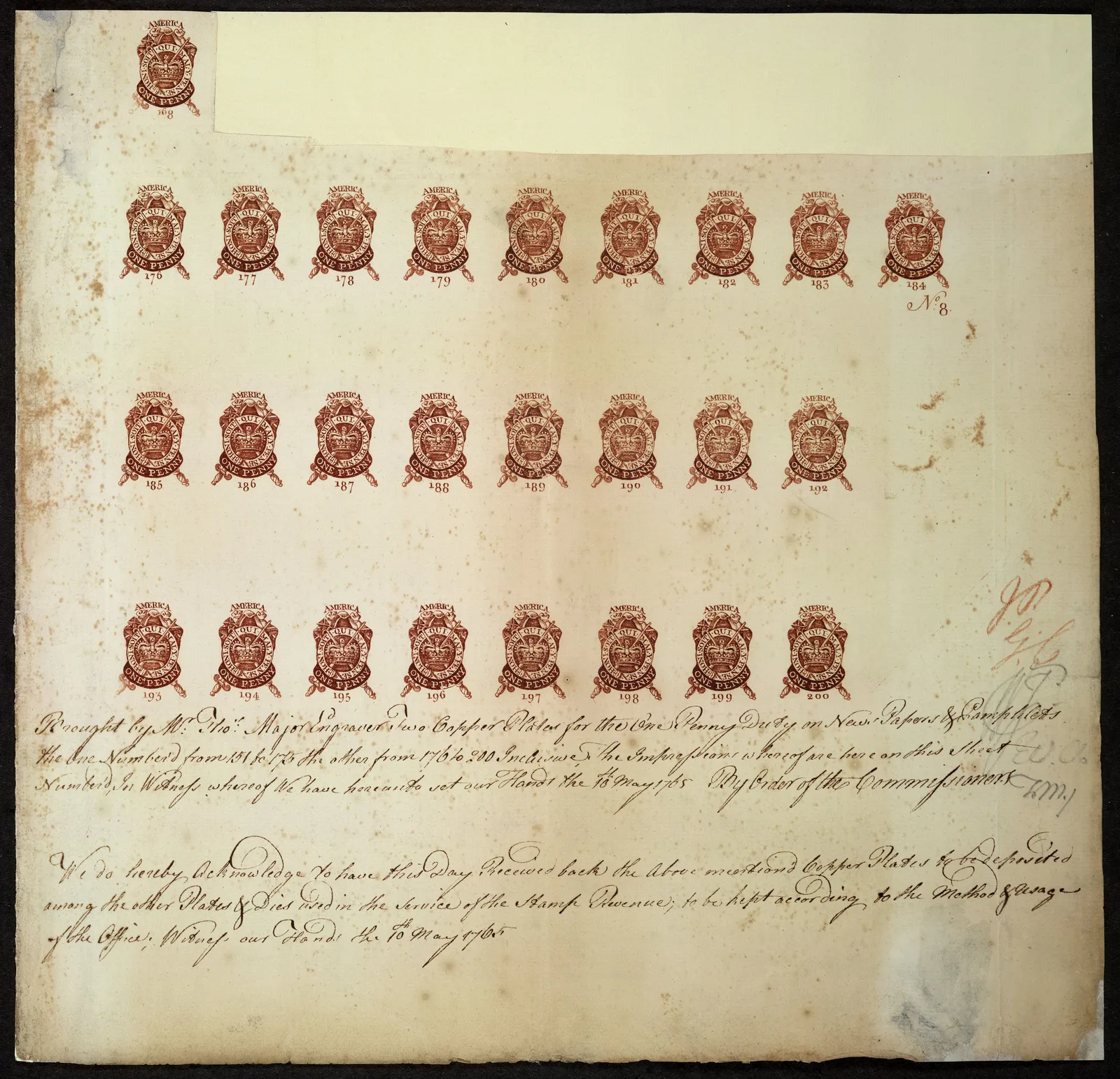
Parliament passed the Stamp Act on March 22, 1765, to take effect November 1. It required that newspapers, pamphlets, legal documents, licenses, ship's papers, playing cards, and dice carry a stamp bought from royal distributors, paid in British money. It was the first direct tax Parliament had ever laid on the colonies.
Because it hit printers, lawyers, merchants, and tavern keepers, the most vocal people in colonial towns, the opposition spread fast. Printers had special reason to object, since every newspaper page was taxed; the story of how they pushed back is part of the history of the free press in America.
In May 1765 Patrick Henry pushed the Virginia Resolves through the House of Burgesses, declaring that only Virginia's own assembly could tax Virginians. In October, delegates from nine colonies met in New York as the Stamp Act Congress and adopted a Declaration of Rights and Grievances. It professed loyalty to the king but denied that Parliament could tax them.
Crowds made the law impossible to enforce. In Massachusetts, a Boston crowd hanged an effigy of stamp distributor Andrew Oliver on August 14, 1765, and he resigned. British merchants hurt by colonial boycotts lobbied for repeal, and Parliament repealed the tax on March 18, 1766. The same day it passed the Declaratory Act, insisting it could make laws for the colonies 'in all cases whatsoever.'
Charles Townshend, Britain's chief finance minister, tried a different approach in 1767. Instead of a tax inside the colonies, he placed import duties on glass, lead, painters' colors, paper, and tea. Some colonists had said they objected only to internal taxes, and Townshend expected duties at the ports to be easier to accept.
The money had a pointed purpose. It would pay the salaries of royal governors and judges, who until then had depended on colonial assemblies for their pay. Colonists saw that as a way to free royal officials from local control. A new Board of Customs Commissioners was set up in Boston to collect the duties.
John Dickinson answered in his 'Letters from a Farmer in Pennsylvania' (1767 and 1768), which argued that Parliament could regulate trade but could not use duties simply to raise revenue. Merchants in Boston, New York, and Philadelphia signed agreements to stop importing British goods, and colonial women made homespun cloth instead of buying imports.
British troops arrived in Boston in 1768 to support the customs officers. Tension with residents ended in the Boston Massacre on March 5, 1770, when soldiers fired into a crowd and killed five people, part of the larger story on the U.S. History page. That same day, Prime Minister Lord North proposed repealing the duties. Parliament dropped all of them except the tax on tea, kept to show it still had the right.
The Tea Act of May 10, 1773, did not create a new tax. It let the struggling East India Company sell its huge surplus of tea directly to the colonies through chosen agents, and it refunded British duties on that tea. The result was legal tea cheaper than the Dutch tea smugglers sold, even with the old Townshend duty of three pence a pound still attached.
Colonial leaders saw a trap. If Americans bought the cheaper tea, they would be paying the Townshend tax and accepting Parliament's right to levy it. Merchants also feared a government-backed company could take over other trades. In New York and Philadelphia, the tea ships were turned away; in Charleston, the tea was unloaded and locked in a warehouse.
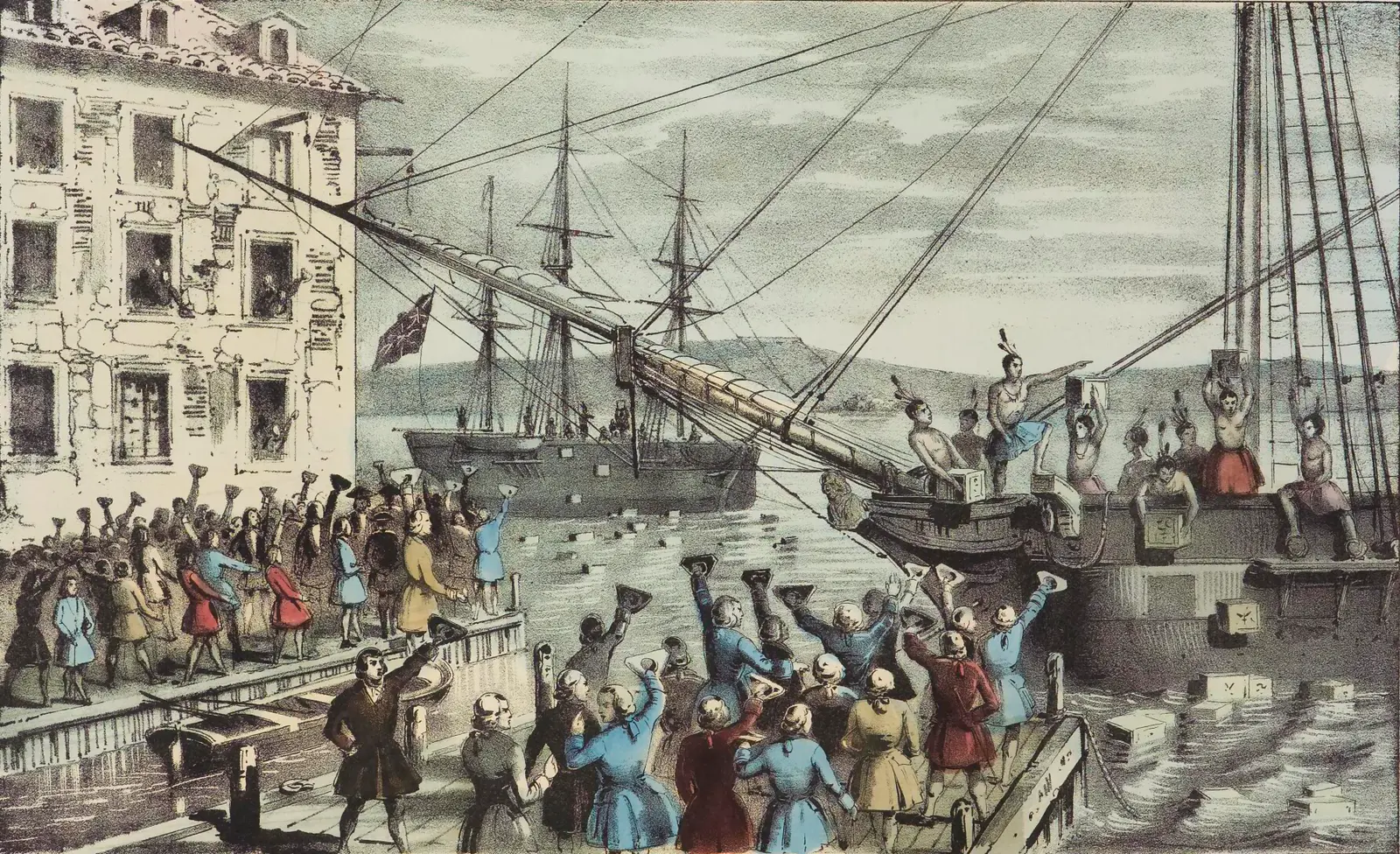
In Boston, Governor Thomas Hutchinson refused to let the ships leave without unloading. On the night of December 16, 1773, a group of men, some disguised as Mohawks, boarded the Dartmouth, the Eleanor, and the Beaver and dumped 342 chests of tea into the harbor. The tea was worth roughly 10,000 pounds sterling.
Parliament answered in 1774 with the laws colonists called the Intolerable Acts. The Boston Port Act closed the harbor on June 1, 1774, until the tea was paid for. Other colonies rallied to Boston. In October 1774, 51 women in Edenton, North Carolina, signed a pledge to give up British tea, and delegates met that fall in the First Continental Congress.
British officials answered colonial complaints with the idea of 'virtual representation.' In a 1765 pamphlet, Treasury official Thomas Whately argued that every member of Parliament represented all British subjects, including colonists, just as members represented the many people in Britain who could not vote.
Colonial writers rejected that. They argued that under English tradition, going back to Magna Carta and the 1689 Bill of Rights, a free people could be taxed only by representatives they chose. For Americans, those representatives sat in their own colonial assemblies, which had taxed them for decades. A Parliament 3,000 miles away, with no American members, could not consent for them.
The argument made it into the Declaration of Independence. Among the charges against King George III it lists 'imposing Taxes on us without our Consent.' The country marked the 250th anniversary of that document in 2026, covered on the America's 250th page.
The slogan still has a living use. Residents of Washington, D.C., pay federal income taxes but have only a non-voting delegate in the House of Representatives and no senators, and since 2000 the city's license plates have carried a version of the phrase. Residents of Puerto Rico, who also lack voting members of Congress, pay federal payroll taxes but generally do not pay federal income tax on income earned on the island.
A New Nation Learns to Tax
The first American national government could not tax at all, and it nearly failed for lack of money. The Constitution fixed that, and within ten years the new government faced two armed revolts against its taxes.
From no taxing power to two tax rebellions
The Articles of Confederation, in force from 1781 to 1789, gave Congress no power to tax. Article VIII said the states would raise the money through their own taxes, in proportion to the value of each state's land. Congress could only send the states a bill, called a requisition, and hope they paid.
They mostly did not. The states had their own war debts and angry taxpayers, and they paid only a small part of what Congress requested. Congress could not reliably pay the Continental Army, the interest on its loans from France and the Netherlands, or its other bills.
Superintendent of Finance Robert Morris and others tried to fix the problem with an 'impost,' a 5 percent duty on imports that would go straight to Congress. Changing the Articles required every state to agree. Rhode Island refused in 1782, and a second plan in 1783 died when New York attached conditions in 1786. The framers of the Constitution remembered that failure.
In 1786 and 1787, farmers in western Massachusetts, squeezed by heavy state taxes that had to be paid in hard money, closed courts to stop foreclosures in what became known as Shays' Rebellion. A militia paid for by Boston merchants broke up the uprising in early 1787, but the scare convinced many leaders that the national government needed real power, including the power to tax.
The first power the Constitution gives Congress, in Article I, Section 8, is the power 'To lay and collect Taxes, Duties, Imposts and Excises, to pay the Debts and provide for the common Defence and general Welfare of the United States.' Duties, imposts, and excises must be 'uniform throughout the United States,' so Congress cannot tax one state's goods at a different rate.
The framers kept a lesson from the colonial fight. Article I, Section 7 says 'All Bills for raising Revenue shall originate in the House of Representatives,' the chamber elected directly by the people and, at the time, the only one that was. The Senate can amend tax bills but cannot start them.
The framers also added limits. Congress may not tax exports from any state, a protection Southern states demanded for crops like tobacco and rice. 'Direct' taxes had to be divided among the states by population, using the same census count used to apportion House seats. That count included three-fifths of enslaved people, which tied slavery to both representation and taxes.
In Federalist No. 12, Alexander Hamilton predicted that most federal money would come from duties on imports, which were easy to collect at a few ports and fell on consumers indirectly. He was right. For more than a century, tariffs paid for most of what the federal government did.
James Madison introduced a tariff bill in the House in April 1789, weeks after the First Congress met. President George Washington signed the Tariff Act on July 4, 1789, the thirteenth anniversary of independence. Its stated purposes were supporting the government, paying the national debt, and 'the encouragement and protection of manufactures.'
The law set a duty of 5 percent of value on most imported goods and higher fixed duties on items such as molasses, nails, and hemp. Goods brought in on American-owned ships paid 10 percent less, a boost to American shipping.
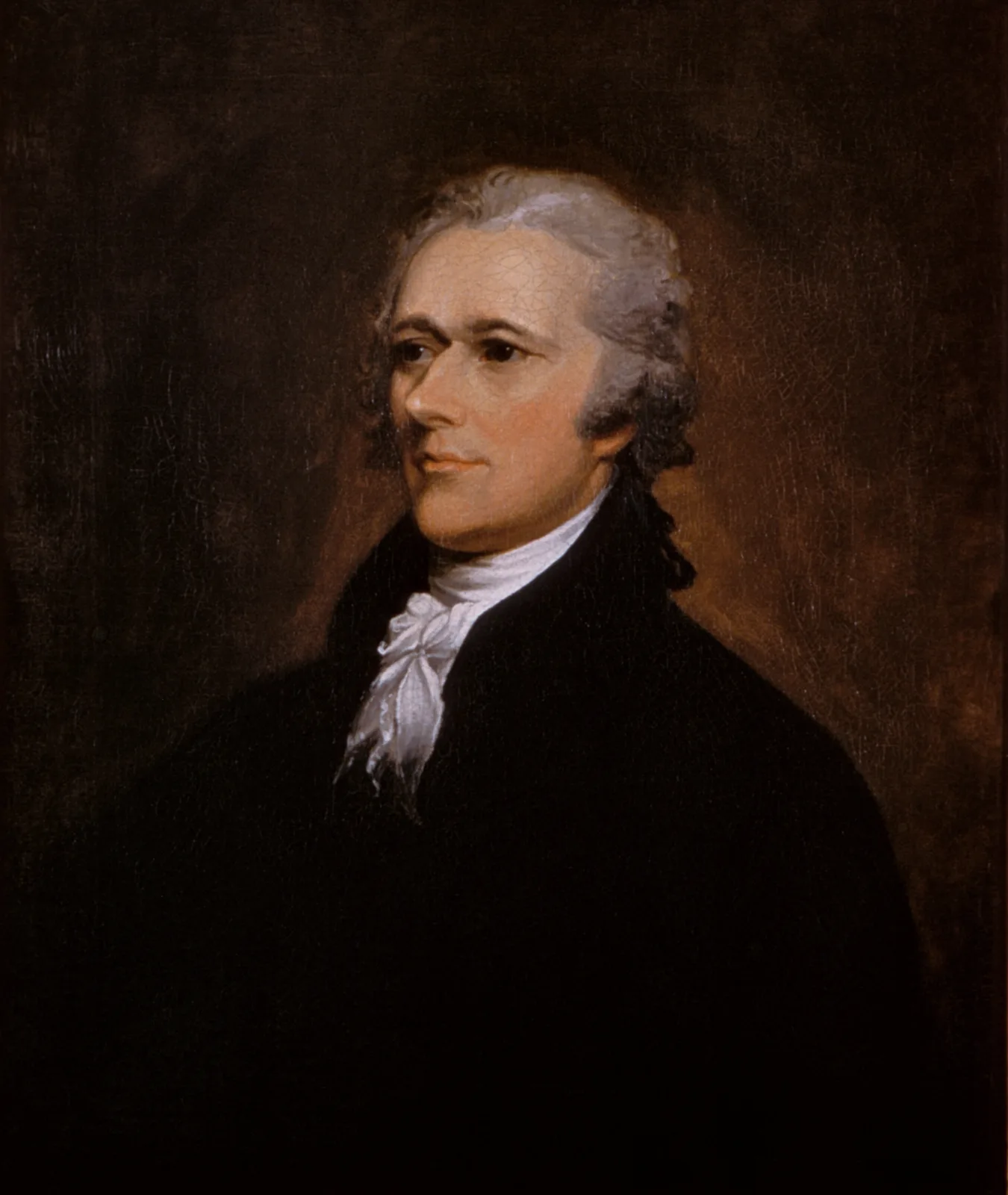
On July 31, 1789, Congress passed the Collection Act, which divided the coast into customs districts with federal collectors at each port. On September 2 it created the Department of the Treasury, with Alexander Hamilton as its first Secretary, to run the whole system.
To stop smugglers, Hamilton asked Congress for armed boats. The Revenue Cutter Service, created on August 4, 1790, is the ancestor of today's Coast Guard, one of the nation's armed forces. A nation that broke away partly over customs duties had made customs duties its main source of money within months.
Hamilton's plan to have the federal government take over the states' war debts in 1790 meant it needed more money than tariffs alone could raise. On March 3, 1791, Congress passed an excise on distilled spirits, the first federal tax on a product made in the United States. Distillers could pay by the gallon or a yearly fee based on the size of their stills.
The tax landed hardest on small farmers in western Pennsylvania and other frontier areas. Shipping grain over the mountains was expensive, so farmers turned it into whiskey, which was easier to move and was used in place of cash. Large distillers in the East could pay a lower rate per gallon, and accused tax dodgers had to stand trial in federal court in faraway Philadelphia.
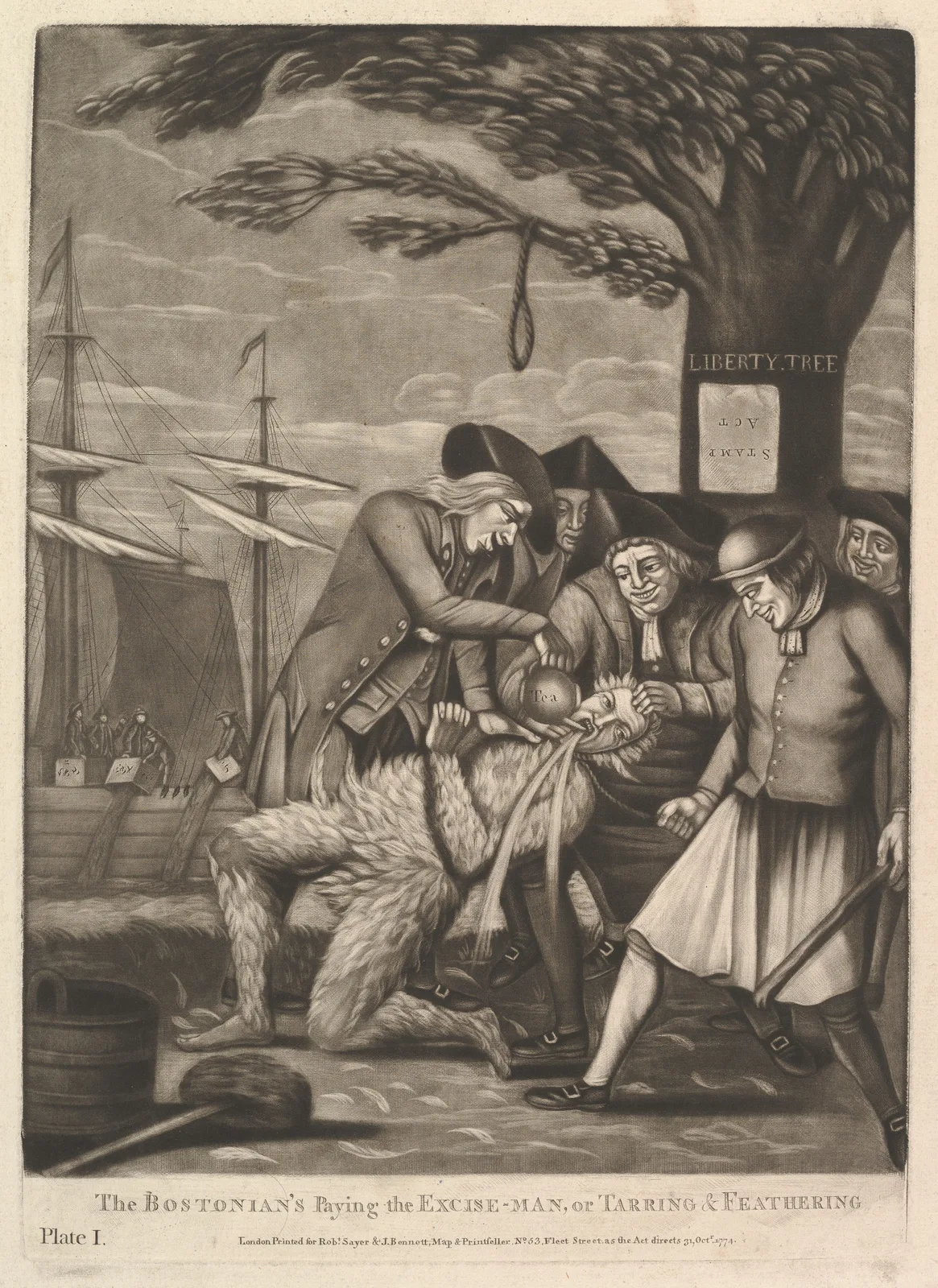
Resistance grew for three years. Tax collectors were harassed and some were tarred and feathered. In July 1794, armed men attacked the home of federal tax inspector John Neville near Pittsburgh, and about 7,000 people rallied at Braddock's Field on August 1. Some talked of attacking Pittsburgh.
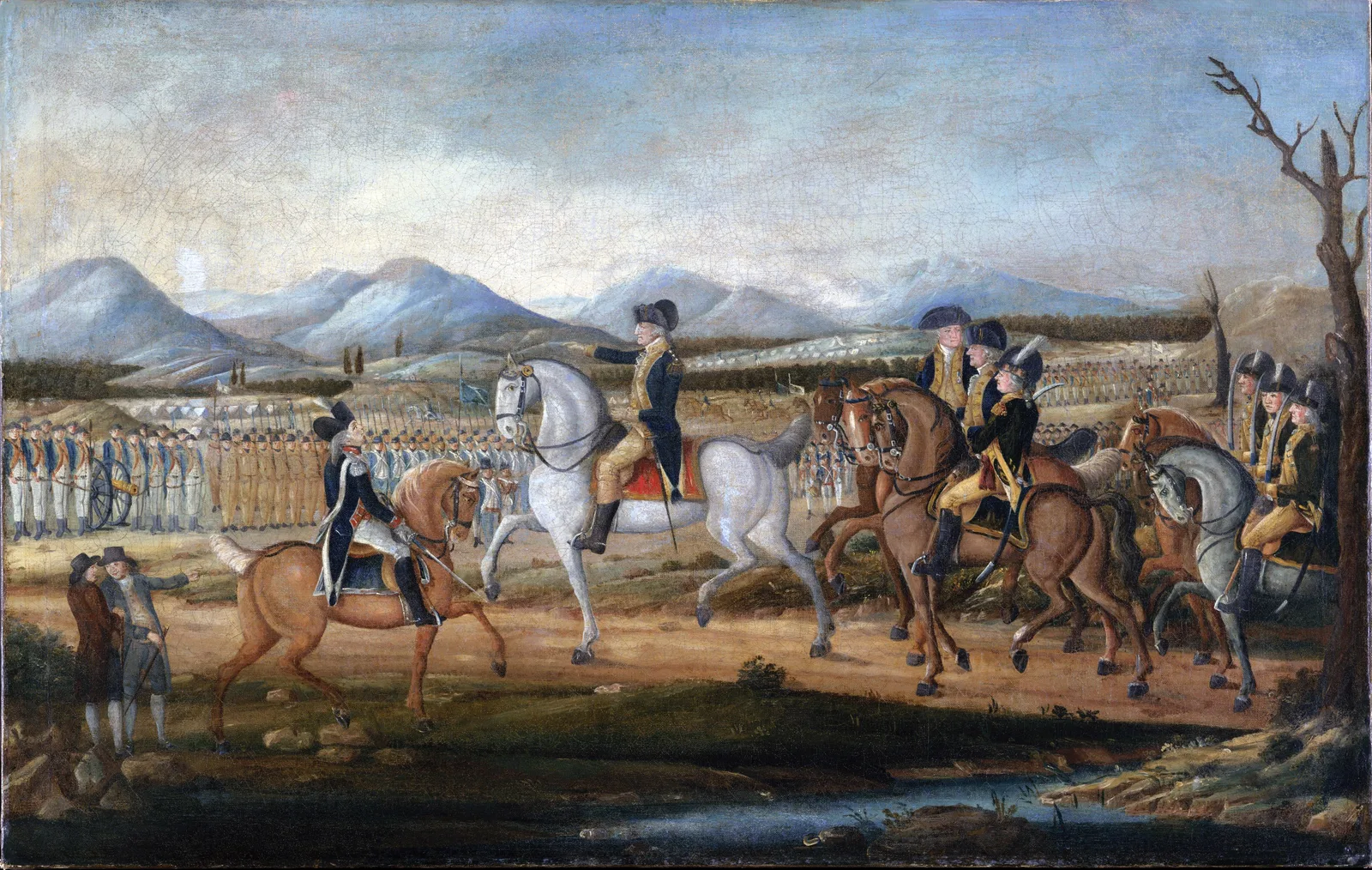
Washington used the Militia Act of 1792, which required a federal judge to certify that the courts could not enforce the law. After Justice James Wilson did so, the President called up about 13,000 militiamen from four states and rode with them as far as Bedford, Pennsylvania. The rebels scattered without a battle. Two men were convicted of treason, and Washington pardoned both.
In 1798, with an undeclared naval war against France under way, Congress passed the nation's first direct federal tax. It raised $2 million, divided among the states by population as the Constitution required, and was assessed on houses, land, and enslaved people.
Assessors went door to door measuring houses and counting windows. In southeastern Pennsylvania, many German-speaking farmers saw it as an echo of the hated taxes of Europe. In March 1799, auctioneer John Fries led a group of armed men who forced a U.S. marshal in Bethlehem to release prisoners arrested for resisting the tax.
President John Adams sent federal troops, and Fries and others were arrested. Fries was tried twice for treason, convicted, and sentenced to hang. In May 1800, against the advice of his cabinet, Adams pardoned him and the other condemned men, deciding that resisting a tax was not the same as making war on the United States.
The house tax and the Army raised to enforce it hurt the Federalists. In the election of 1800, Thomas Jefferson's Democratic-Republicans, who had attacked the taxes, won the presidency and Congress, a turning point covered in the history of political parties.
In 1802, at Jefferson's urging, Congress repealed every internal federal tax, including the whiskey excise. For the next decade the government lived almost entirely on tariffs and on sales of public land.
Treasury Secretary Albert Gallatin used the surplus to pay down the national debt, even after the Louisiana Purchase of 1803 added millions in new borrowing.
The War of 1812 broke that model. British warships blockaded American ports, and tariff revenue collapsed just as war costs soared. Congress doubled tariff rates, borrowed heavily, and in 1813 brought back internal taxes and a direct tax. The fighting is covered in the U.S. military history page.
Once peace returned, Congress repealed the wartime internal taxes in 1817. The pattern of the next century was set: tariffs and land sales in peacetime, and new internal taxes only when war made them necessary.
The Tariff Century
For more than a hundred years, the federal government lived mostly on tariffs, taxes on imported goods. Fights over those tariffs shaped party politics, nearly split the Union in 1832, and still matter today.
How tariffs paid for the government
From 1789 until the Civil War, customs duties supplied nearly all federal revenue. The Congressional Research Service puts their share at about 90 percent before the War of 1812 and about 85 percent in the decades after it. Most of the rest came from selling public land in the West.
That arrangement had political advantages. There was no federal tax collector at most people's doors, and the cost of the tax was hidden in the price of imported goods. It also meant the government's income rose and fell with trade, collapsing in wars and depressions.
Tariffs served two goals that sometimes pulled against each other. A revenue tariff is set low enough that goods keep coming in and paying duty. A protective tariff is set high to keep foreign goods out so American factories can grow. The 1816 tariff was the first designed mainly to protect, and Henry Clay built his 'American System' around protective tariffs.
Because tariff rates were set item by item, every bill became a contest among industries. Iron makers, wool growers, sugar planters, and textile mills all sent representatives to Washington, an early form of the lobbying that still shapes tax bills.
The Tariff of 1828 raised duties so high, above 50 percent on many taxed imports, that its Southern opponents named it the Tariff of Abominations. Manufacturing states in the North gained protection. The South, which sold cotton abroad and bought manufactured goods, argued that it paid higher prices while Northern industry collected the benefit.
Vice President John C. Calhoun of South Carolina secretly wrote the 'South Carolina Exposition and Protest' in 1828. It argued that a state could declare a federal law unconstitutional and refuse to enforce it inside its borders, a theory called nullification.
When the Tariff of 1832 lowered rates only modestly, a South Carolina convention adopted the Ordinance of Nullification on November 24, 1832, declaring both tariffs void in the state after February 1, 1833. President Andrew Jackson answered on December 10 with a proclamation that called nullification incompatible with the Union, and he asked Congress for authority to use force.
Calhoun resigned as Vice President and took a Senate seat to lead the fight. Senator Henry Clay brokered a way out: on March 2, 1833, Jackson signed both a Force Bill and a Compromise Tariff that lowered rates step by step over ten years. South Carolina withdrew its ordinance against the tariffs, then symbolically nullified the Force Bill.
Tariff and land revenue grew so fast in the early 1830s that the government paid off its entire national debt in January 1835, the only time in American history it has been debt free. In 1836 Congress began handing the surplus to the states.
Through the 1840s and 1850s, Democrats generally pushed rates down, with the Walker Tariff of 1846 and the Tariff of 1857, while Whigs and then Republicans favored protection. On March 2, 1861, two days before leaving office, President James Buchanan signed the Morrill Tariff, which raised rates after most Southern members of Congress had left.
Some later writers claimed the tariff was a main cause of the Civil War. Most historians disagree, pointing to the secession declarations of the Southern states themselves, which center on slavery. The tariff of the 1850s was also among the lowest of the century.
The war made the old revenue system impossible. The Union raised tariffs repeatedly to pay for the fighting, and it also created new internal taxes and the first federal income tax, covered in the next tab.
After the Civil War, high protective tariffs stayed in place, and tariffs again became the government's largest source of money, alongside excise taxes on liquor and tobacco. By the 1880s the government ran large surpluses, and President Grover Cleveland devoted his entire 1887 message to Congress to cutting tariffs.
Tariffs were the main dividing line between the parties for decades. Republicans passed the McKinley Tariff of 1890 and the Dingley Tariff of 1897, raising rates; Democrats cut them with the Wilson-Gorman Tariff of 1894 and the Underwood Tariff of 1913, which paired lower tariffs with the new income tax.
The Smoot-Hawley Tariff of June 17, 1930, raised duties on thousands of imported goods early in the Great Depression. More than 1,000 economists signed a public letter urging President Herbert Hoover to veto it. Canada, European nations, and others retaliated with tariffs of their own, and world trade shrank sharply over the next few years.
The State Department's Office of the Historian notes that economists still debate how much Smoot-Hawley deepened the Depression, since trade was already falling. Its political lesson was clearer, and it shaped how the United States approached trade after World War II, a story told on the America's world standing page.
The Constitution gives the power to set tariffs to Congress. After Smoot-Hawley, Congress passed the Reciprocal Trade Agreements Act of 1934, which let the President negotiate tariff cuts with other countries without a new vote on every rate. It was the start of a long transfer of day-to-day trade power to the executive branch.
After World War II, the United States helped create the General Agreement on Tariffs and Trade in 1947, and average tariffs fell through rounds of negotiation. By the late twentieth century, customs duties brought in only about 1 to 2 percent of federal revenue.
Congress also passed laws letting the President raise tariffs in specific situations: Section 232 of the Trade Expansion Act of 1962 for national security, Section 301 of the Trade Act of 1974 for unfair foreign trade practices, and Section 122 of that same law for short-term balance of payments problems. The balance between these laws and Congress's own power is part of the larger story of legislative versus executive powers.
Those delegated powers became the center of a major legal fight in 2025 and 2026, when tariffs once again became a large source of federal money. The Modern Taxes tab covers what happened.
The Income Tax
The federal income tax started as a Civil War emergency, was struck down by the Supreme Court, and came back for good with a constitutional amendment in 1913. Two world wars turned it into a tax most working Americans pay.
How the income tax arrived and grew
Congress passed the first federal income tax on August 5, 1861, a 3 percent tax on incomes over $800 a year. It was replaced before any money was collected by the Revenue Act of July 1, 1862, which President Abraham Lincoln signed. It taxed incomes from $600 to $10,000 at 3 percent and higher incomes at 5 percent.
The 1862 law also created the office of Commissioner of Internal Revenue, the ancestor of today's Internal Revenue Service. It taxed liquor, tobacco, playing cards, carriages, and many other goods and services, required licenses for many trades, and withheld tax from the pay of federal employees.
Rates rose again in 1864, to as much as 10 percent on the highest incomes. Income tax lists were sometimes published in newspapers, so neighbors could see what others paid.
After the war, support faded. Congress cut the rates and let the income tax expire in 1872. The liquor and tobacco taxes stayed and, together with tariffs, paid for the government for the rest of the century. In 1881, in Springer v. United States, the Supreme Court ruled that the Civil War income tax had been constitutional.
By the 1890s, farmers' groups and the Populist Party wanted a graduated income tax so that wealthy Americans, not just consumers paying tariffs, would carry more of the cost of government. The Wilson-Gorman Tariff Act of 1894 included a 2 percent tax on incomes over $4,000, which reached only a small share of households.
The Supreme Court struck it down in Pollock v. Farmers' Loan & Trust Co. in 1895. The Court held that a tax on income from property, such as rents, interest, and dividends, was a 'direct' tax, which the Constitution required to be divided among the states by population.
The Court first ruled in April 1895, then reheard the case and decided on May 20, 1895, by a 5 to 4 vote, that the whole tax was invalid. Apportioning an income tax by population made no sense, since a poor state with many people would owe as much as a rich one, so the ruling ended the federal income tax for nearly two decades.
Pollock became one of the most criticized decisions of its era. It is one of only a handful of Supreme Court rulings later overturned by a constitutional amendment, a group that appears among the landmark Supreme Court cases.
In 1909, Congress debated adding an income tax to a tariff bill. Conservative leaders offered a compromise: a 1 percent tax on corporate income, framed as an excise to avoid the Pollock problem, plus a constitutional amendment allowing an income tax. Some supporters of the deal expected the states never to ratify the amendment.
Congress approved the amendment on July 12, 1909. Its single sentence reads: 'The Congress shall have power to lay and collect taxes on incomes, from whatever source derived, without apportionment among the several States, and without regard to any census or enumeration.'
The states ratified it far faster than its opponents expected, as the progressive movement gained strength in both parties. It reached the three-fourths mark on February 3, 1913, and Secretary of State Philander Knox certified it on February 25. It sits with the other changes to the Constitution on the amendments page.
The amendment did not create a tax. It only removed the requirement that income taxes be divided among the states by population. Congress still had to pass a law, which it did eight months later.
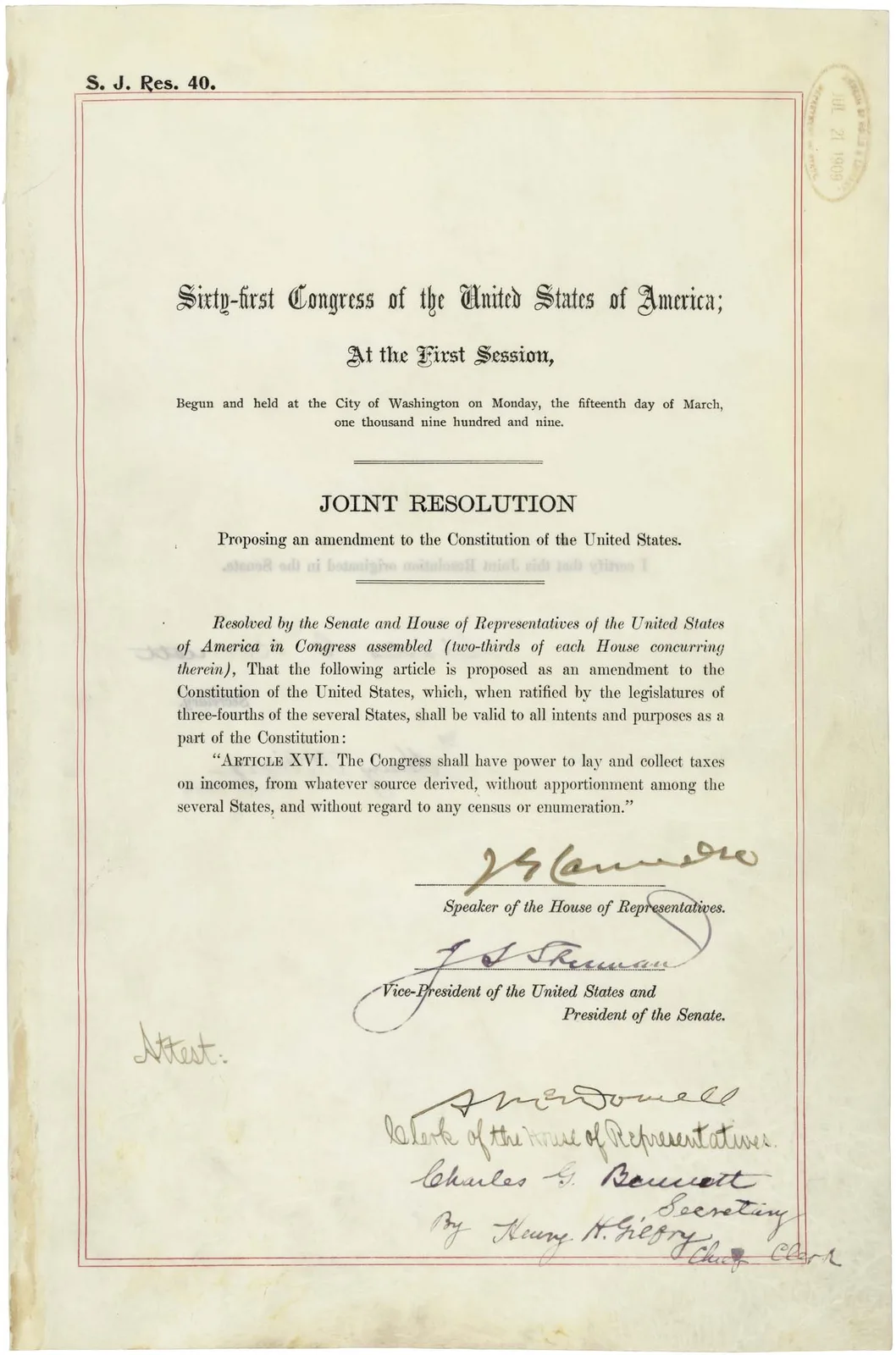
President Woodrow Wilson signed the Revenue Act of 1913, also called the Underwood-Simmons Act, on October 3, 1913. It cut tariff rates and created a permanent income tax to make up the lost money.
The tax was 1 percent on income above $3,000 for a single person and $4,000 for a married couple, far more than most workers earned. Extra 'surtaxes' rose to 6 percent on income over $500,000, for a top rate of 7 percent. Only a small share of Americans, mostly the wealthy, owed anything.
The first Form 1040 was three pages plus a page of instructions, and returns were due March 1, 1914. In December 1913, Congress also created the Federal Reserve, so 1913 remade both how the government raised money and how the country's money was managed.
Within a few years the income tax would pass tariffs as the government's biggest source of money, a change that came with World War I.
The Revenue Act of 1916 raised income tax rates and created the federal estate tax, a tax on large fortunes passed on at death. Congress had used inheritance taxes briefly during earlier wars, but the 1916 tax has remained in some form ever since.
When the United States entered World War I in 1917, Congress raised rates sharply and added an excess profits tax on businesses. By 1918 the top income tax rate reached 77 percent on income above $1 million.
Income and profits taxes became the federal government's largest source of revenue during the war, and tariffs never regained first place. The number of people filing returns also grew, though most families still owed nothing.
In the 1920s, Treasury Secretary Andrew Mellon argued that lower rates would spur investment and bring in more revenue, and Congress cut the top rate to 25 percent by 1925. When the Great Depression slashed revenue, the Revenue Act of 1932 raised the top rate to 63 percent.
World War II turned the income tax from a tax on the well-off into one paid by most working Americans. The Revenue Act of 1942, which President Franklin Roosevelt called the greatest tax bill in American history, lowered exemptions so far that millions of wage earners owed tax for the first time.
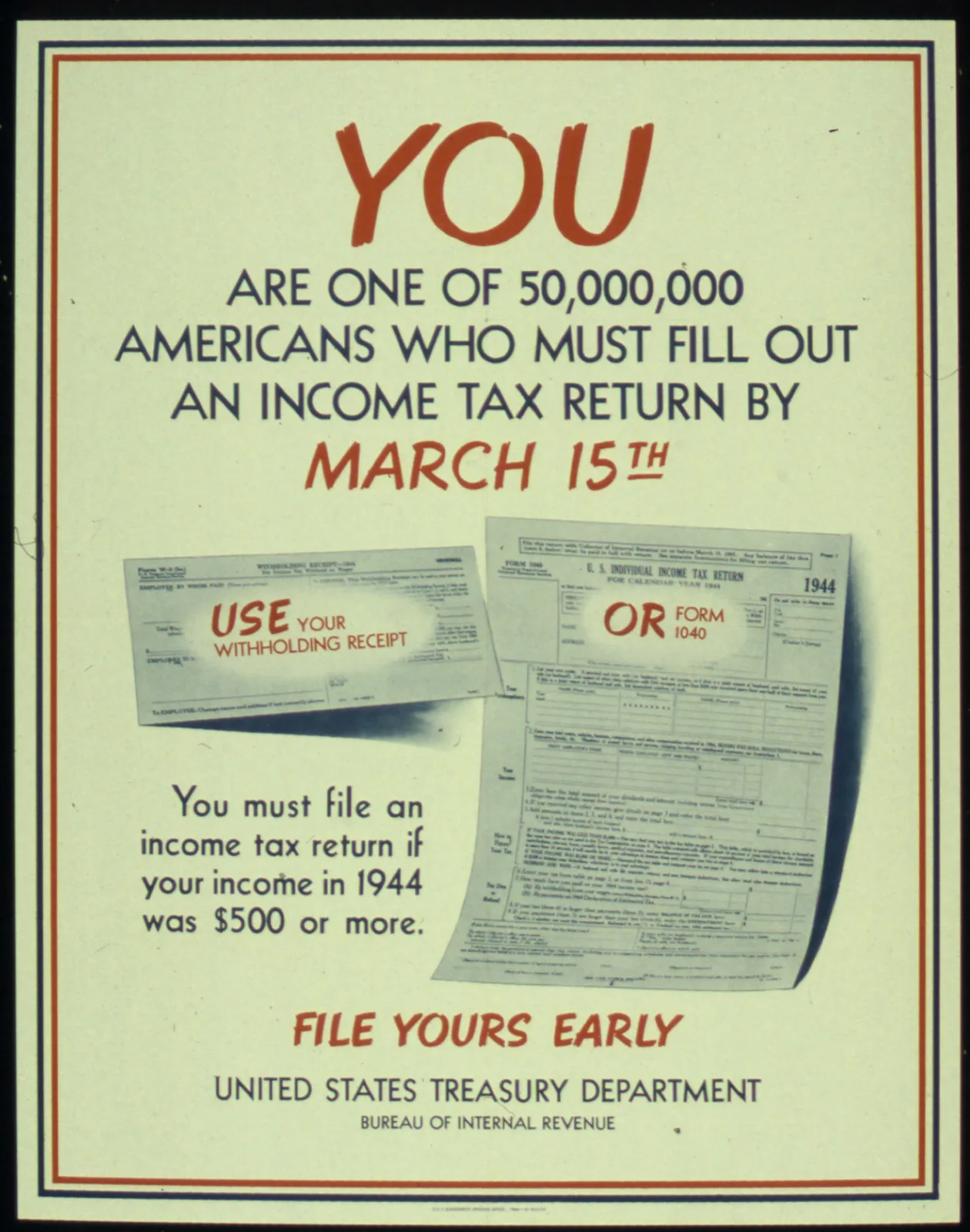
The Treasury had to teach a nation to pay. It commissioned a 1942 Walt Disney cartoon, 'The New Spirit,' in which Donald Duck happily files his return, and posters like the one on this page told readers they were one of 50 million Americans who had to file.
Collecting a year's tax in one lump sum was too hard for new taxpayers, so the Current Tax Payment Act of 1943 created payroll withholding, the system in which employers take tax out of each paycheck. To make the switch, Congress forgave most of one year's tax, an idea promoted by Beardsley Ruml, treasurer of R.H. Macy & Co. and chairman of the Federal Reserve Bank of New York.
The top rate reached 94 percent in 1944 and 1945, on income over $200,000. Withholding stayed after the war, and the income tax has been the federal government's largest source of revenue ever since.
Modern Taxes
Since World War II, Congress has raised and cut income tax rates many times, added payroll taxes for Social Security and Medicare, and, after 2025, turned back to tariffs. Here is where the money comes from now.
Where federal revenue comes from (fiscal year 2025)
| Source | About | Share |
|---|---|---|
| Individual income taxes | $2.7 trillion | About 52% |
| Payroll taxes (Social Security and Medicare) | $1.7 trillion | About 33% |
| Corporate income taxes | $453 billion | About 9% |
| Customs duties (tariffs) | $195 billion | About 4% |
| Everything else | About $0.15 trillion | About 3% |
| Total | About $5.2 trillion | 100% |
Figures are rounded from the Congressional Budget Office's final review of fiscal year 2025, which ended September 30, 2025. Other sources include excise taxes, estate and gift taxes, and money the Federal Reserve sends to the Treasury. In fiscal year 2026, total receipts rose to about $5.4 trillion, while corporate income taxes fell to about $381 billion and customs duties to about $173 billion.
The top income tax rate over time
| Year | Top rate | What changed |
|---|---|---|
| 1913 | 7% | First permanent income tax |
| 1918 | 77% | World War I |
| 1925 | 25% | Mellon tax cuts |
| 1932 | 63% | Great Depression |
| 1944 | 94% | World War II peak |
| 1965 | 70% | Revenue Act of 1964 cuts take full effect |
| 1982 | 50% | Economic Recovery Tax Act of 1981 |
| 1988 | 28% | Tax Reform Act of 1986 |
| 1993 | 39.6% | 1993 budget law |
| 2003 | 35% | 2001 and 2003 tax cuts |
| 2013 | 39.6% | American Taxpayer Relief Act of 2012 |
| 2018 | 37% | Tax Cuts and Jobs Act of 2017 |
| 2026 | 37% | Made permanent by the 2025 tax law |
The top rate applies only to income above the highest bracket's starting point, which has ranged from $500,000 in 1913 to about $200,000 in the 1940s and over $600,000 today. Few people ever paid the highest wartime rates on much of their income. Source: Tax Policy Center, historical highest marginal income tax rates.
How today's system took shape
The Social Security Act of August 14, 1935, created a separate tax to pay for old-age pensions. Starting January 1, 1937, workers and employers each paid 1 percent on the first $3,000 of wages. The full story of the program is on the Social Security page.
President Franklin Roosevelt wanted the tax tied to each worker's own record. He reasoned that workers who had paid in would feel a legal and moral right to their benefits that no future Congress could easily take away.
Medicare, created in 1965, added a hospital insurance tax starting in 1966. Today workers and employers each pay 6.2 percent for Social Security, up to a yearly wage cap, and 1.45 percent for Medicare on all wages. Self-employed people pay both halves.
Payroll taxes now bring in about a third of federal revenue. Because they start with the first dollar of wages, many lower- and middle-income workers pay more in payroll taxes than in federal income tax.
A poll tax is a flat fee charged to every person, and in parts of the country it became a fee for the right to vote. After Reconstruction, Southern states adopted poll taxes, often combined with literacy tests, to keep Black citizens and many poor white citizens from voting.
The tax was often due months before an election, and in some states unpaid amounts piled up from year to year. Even a dollar or two was a real barrier for sharecroppers and laborers who earned little cash.
The 24th Amendment, ratified on January 23, 1964, banned poll taxes in federal elections. In Harper v. Virginia Board of Elections (1966), the Supreme Court ruled that poll taxes in state elections also violated the Constitution. The fight is told in full on the voting rights page.
It is a reminder that tax law can do more than raise money. A tax can be designed to change who takes part in public life.
Top income tax rates stayed above 90 percent through the 1950s, though deductions and shelters meant few people paid them on much income. President John F. Kennedy proposed broad rate cuts, and President Lyndon Johnson signed the Revenue Act of 1964, which lowered the top rate to 70 percent by 1965.
President Ronald Reagan signed the Economic Recovery Tax Act of 1981, which cut rates across the board and dropped the top rate to 50 percent. It also began adjusting tax brackets for inflation starting in 1985, so rising prices alone would no longer push people into higher brackets. Congress raised some taxes again in 1982 and 1984 as deficits grew.
The Tax Reform Act of 1986, passed with support from both parties, traded lower rates for fewer special breaks. It cut the top individual rate to 28 percent and the top corporate rate from 46 percent to 34 percent, closed many tax shelters, and removed millions of low-income Americans from the income tax rolls.
Major tax laws since then have often moved through the budget reconciliation process described on the federal budget page, which lets a tax bill pass the Senate with a simple majority.
President George H.W. Bush signed a 1990 budget deal that raised the top rate to 31 percent, breaking his 'no new taxes' pledge. President Bill Clinton's 1993 budget law raised it to 39.6 percent and passed without a single Republican vote. The 1997 tax law created the child tax credit.
President George W. Bush signed tax cuts in 2001 and 2003 that lowered the top rate to 35 percent and cut taxes on dividends and capital gains. Because they passed through reconciliation, they were written to expire, which avoided a Senate filibuster. The American Taxpayer Relief Act of 2012 made most of them permanent but restored the 39.6 percent rate on the highest incomes.
President Donald Trump signed the Tax Cuts and Jobs Act on December 22, 2017. It cut the corporate rate from 35 percent to 21 percent permanently. Its individual cuts, including a top rate of 37 percent and a nearly doubled standard deduction, were set to expire after 2025, and it capped the deduction for state and local taxes at $10,000.
On July 4, 2025, exactly 236 years after Washington signed the first tariff, Trump signed the One Big Beautiful Bill Act. It made the 2017 individual rates permanent, raised the cap on the state and local tax deduction, and added temporary deductions for tip and overtime income. Supporters said it prevented a large tax increase; critics, including many budget analysts, pointed to its cost in added federal debt.
Beginning in 2025, President Trump used executive orders under the International Emergency Economic Powers Act (IEEPA), a 1977 law, to place new tariffs on imports from most countries. Customs revenue rose from about $77 billion in fiscal year 2024 to about $195 billion in fiscal year 2025, according to the Congressional Budget Office, about 4 percent of all federal revenue.
Small businesses and 12 states sued, arguing that IEEPA's power to 'regulate' imports did not include a power to tax them. The administration argued the law gave the President broad authority in a national emergency, including over tariffs.
On February 20, 2026, in Learning Resources, Inc. v. Trump, the Supreme Court ruled 6 to 3 that IEEPA does not authorize tariffs. Chief Justice John Roberts wrote that the Framers gave 'Congress alone' the power to impose tariffs in peacetime, and that the Court was skeptical Congress had hidden that power inside the word 'regulate.' The ruling did not affect tariffs imposed under other trade laws.
After the decision, the President announced a temporary worldwide tariff under Section 122 of the Trade Act of 1974, which allows tariffs of up to 15 percent for 150 days unless Congress extends them. The tariff, set at 10 percent, took effect on February 24, 2026, and expired on July 24 because Congress did not extend it. On May 7, the Court of International Trade ruled 2 to 1 that it was unlawful, and the government appealed. The administration replaced it with new tariffs of 10 or 12.5 percent on imports from about 60 trading partners under Section 301. The government also began refunding the tariffs the Supreme Court struck down, about $130 billion of the $166 billion eligible by the end of fiscal year 2026, according to Congressional Budget Office figures. The fight was, at its core, the same question the colonists raised in 1765: who has the power to tax.
In fiscal year 2026, which ended September 30, 2026, the federal government collected about $5.4 trillion, up from about $5.2 trillion in fiscal year 2025, according to the Congressional Budget Office. About half came from individual income taxes and about a third from payroll taxes. How that money is spent is broken down on the federal budget breakdown page.
Corporate income taxes brought in about $381 billion in fiscal year 2026, down from about $453 billion the year before, partly because of the 2025 tax law. Customs duties fell to about $173 billion, about 3 percent of revenue, from about $195 billion in fiscal year 2025, as the government refunded the tariffs the Supreme Court struck down. Excise taxes on fuel, alcohol, tobacco, and airline tickets, along with estate and gift taxes, made up most of the rest.
States and cities run their own tax systems. Property taxes, the oldest kind in America, still pay for most local government and public schools. Mississippi adopted the first modern statewide sales tax in 1932, during the Depression. Wisconsin's 1911 income tax was the first modern state income tax, and today nine states do not tax wages.
The argument the colonists started never ended. Americans still debate how much government should collect, who should pay, and who should decide. What changed is that the people paying now elect the people who set the taxes.
Timeline
The major tax laws, revolts, and court rulings in American history, in order. Select an entry to read more.
Parliament cuts the duty on foreign molasses to three pence a gallon but enforces it strictly, and adds duties on sugar, wine, and coffee.
It is the first British law that openly says its purpose is raising revenue in the colonies, and Boston lawyer James Otis attacks it in print.
Parliament requires stamps on newspapers, legal documents, licenses, and playing cards, the first direct tax it has laid on the colonies.
Delegates from nine colonies meet in New York in October and deny Parliament's right to tax them. Crowds force stamp distributors to resign, and the act is repealed in March 1766.
New import duties on glass, lead, paint, paper, and tea are meant to pay royal governors and judges.
Colonial merchants answer with boycotts. In 1770 Parliament repeals every duty except the one on tea.
The Tea Act lowers the price of East India Company tea while keeping the three-pence Townshend tax on it.
On December 16, men disguised as Mohawks dump 342 chests of tea into Boston Harbor. Parliament closes the port in 1774.
The list of grievances against King George III includes 'imposing Taxes on us without our Consent.'
The new states begin taxing their own residents to pay for the war.
The Articles leave Congress with no power to tax, only the power to ask the states for money.
A plan for a 5 percent federal import duty fails when Rhode Island refuses in 1782, since changes require every state's approval.
Massachusetts farmers squeezed by state taxes and debts close courts to block foreclosures.
The uprising, put down in early 1787, adds urgency to the Constitutional Convention.
Article I gives Congress the power to lay and collect taxes, duties, imposts, and excises.
Revenue bills must start in the House, exports cannot be taxed, and direct taxes must be divided among the states by population.
George Washington signs the Tariff Act on July 4, 1789, setting a 5 percent duty on most imports.
Congress creates customs districts that summer and the Treasury Department on September 2.
Congress taxes distilled spirits on March 3, the first federal tax on a product made in the United States.
It helps pay for the federal takeover of the states' Revolutionary War debts.
Armed resistance in western Pennsylvania peaks in July with an attack on a tax inspector's home.
Washington calls up about 13,000 militiamen, and the uprising collapses without a battle.
The Supreme Court upholds a federal tax on carriages, ruling it is not a 'direct' tax that must be divided by population.
It is one of the first cases in which the Court considers whether an act of Congress is constitutional.
Congress lays a $2 million direct tax on houses, land, and enslaved people to prepare for a possible war with France.
In 1799 John Fries leads armed resistance in Pennsylvania. He is sentenced to death for treason, and President Adams pardons him in 1800.
Congress repeals the whiskey excise and every other internal tax.
Tariffs and land sales pay for the government until the War of 1812 forces internal taxes back from 1813 to 1817.
Congress raises tariffs to their highest level yet. Southern opponents give the law its nickname.
Vice President John C. Calhoun secretly writes the case for nullification.
South Carolina declares the federal tariffs void inside the state. President Jackson calls nullification incompatible with the Union.
In March 1833 a compromise tariff and a Force Bill end the standoff.
Tariff and land revenue let the government retire its entire debt in January 1835.
It is the only time the United States has had no national debt.
After a first income tax law in 1861 that was never collected, Lincoln signs the Revenue Act of 1862: 3 percent on incomes from $600 to $10,000 and 5 percent above that.
The law creates the office of Commissioner of Internal Revenue, the forerunner of the IRS. The income tax expires in 1872.
The Supreme Court strikes down the income tax of 1894 by a 5 to 4 vote, calling a tax on income from property a direct tax.
The ruling blocks a federal income tax until the Constitution is amended.
The 16th Amendment is ratified on February 3. In October, the Revenue Act of 1913 sets a 1 percent tax on income above $3,000, with a top rate of 7 percent.
The first Form 1040 is due March 1, 1914.
The Revenue Act of 1916 creates a tax on large estates passed on at death, which still exists today.
World War I soon pushes the top income tax rate to 77 percent.
Congress raises duties on thousands of goods early in the Great Depression, and trading partners retaliate.
In 1934 Congress begins letting the President negotiate tariff cuts.
Workers and employers each start paying 1 percent on the first $3,000 of wages.
Medicare's payroll tax is added in 1966.
The Current Tax Payment Act requires employers to withhold income tax from wages.
The wartime income tax now reaches most working Americans, and the top rate hits 94 percent in 1944.
The 24th Amendment bans poll taxes in federal elections, ratified January 23, 1964.
A month later, President Johnson signs broad income tax cuts first proposed by President Kennedy.
A bipartisan law cuts the top individual rate to 28 percent and closes many tax shelters.
The corporate rate falls from 46 percent to 34 percent.
The corporate rate is cut to 21 percent and the top individual rate to 37 percent.
The individual cuts are written to expire after 2025.
On July 4, 2025, President Trump signs a law making the 2017 individual tax rates permanent.
New tariffs more than double customs revenue, to about $195 billion in fiscal year 2025.
On February 20, the Court rules 6 to 3 in Learning Resources, Inc. v. Trump that the International Emergency Economic Powers Act does not authorize tariffs.
The opinion says the Constitution gives the power to impose tariffs in peacetime to Congress alone.
A 10 percent replacement tariff under Section 122 of the Trade Act of 1974 takes effect February 24 and expires July 24, when new Section 301 tariffs replace it.
Customs revenue falls to about $173 billion in fiscal year 2026 as the government refunds the struck-down tariffs.
Frequently Asked Questions
Not exactly. The Tea Act of 1773 made legal tea cheaper. Colonists objected because buying it meant paying a tax Parliament had imposed without their consent, and because it gave one company a government-backed advantage.
The Tariff Act of 1789, a duty on imported goods that George Washington signed on July 4, 1789. The first federal tax on an American-made product was the 1791 excise on distilled spirits, which led to the Whiskey Rebellion.
Congress first taxed income during the Civil War, in 1861 and 1862, and let that tax expire in 1872. An 1894 income tax was struck down by the Supreme Court in 1895. The income tax became permanent after the 16th Amendment was ratified in 1913.
Mostly with tariffs on imported goods, which supplied about 85 to 90 percent of federal revenue before the Civil War, according to the Congressional Research Service, plus sales of public land. After the Civil War, taxes on liquor and tobacco joined tariffs as major sources.
In fiscal year 2026, about half of the roughly $5.4 trillion the government collected came from individual income taxes and about a third from Social Security and Medicare payroll taxes, according to the Congressional Budget Office. Corporate taxes were about 7 percent and tariffs about 3 percent.
Sources & Further Reading
- National Archives: The Constitution (full text)
- National Archives: The Declaration of Independence
- National Archives: Articles of Confederation
- National Archives: 16th Amendment
- Office of the Historian: Parliamentary Taxation of the Colonies, 1763 to 1775
- Office of the Historian: Protectionism in the Interwar Period (Smoot-Hawley)
- U.S. House History: The First Tariff Act
- U.S. House History: The Tariff of Abominations
- U.S. Senate: The Tariff of Abominations
- Yale Avalon Project: South Carolina Ordinance of Nullification (1832)
- U.S. Treasury: History of the Treasury
- Congressional Research Service: U.S. Federal Government Revenues, 1790 to the Present
- George Washington's Mount Vernon: The Whiskey Rebellion
- Federal Judicial Center: United States v. John Fries
- Justia: Pollock v. Farmers' Loan & Trust Co. (1895)
- Justia: Hylton v. United States (1796)
- Supreme Court: Learning Resources, Inc. v. Trump (2026)
- Congressional Budget Office: Monthly Budget Review, Fiscal Year 2025
- Congressional Budget Office: Monthly Budget Review, Summary for Fiscal Year 2026
- Tax Policy Center: Historical Highest Marginal Income Tax Rates
- Social Security Administration: Historical Background of the Program
- Congress.gov: H.R. 1, One Big Beautiful Bill Act (2025)
- Congress.gov: H.R. 1, Tax Cuts and Jobs Act (2017)
Dates, tax rates, and dollar figures come from the laws themselves, the Constitution, Supreme Court opinions, and the agencies and historians listed above. Revenue figures for 2025 are from the Congressional Budget Office. Where historians disagree, such as how much the 1930 tariff deepened the Great Depression, the page says so.