The President's Cabinet
15 departments. Hundreds of agencies. Millions of employees. The Cabinet is how one president manages the day-to-day operations of the most complex government on earth.
Teaching the Cabinet? Free reading paths and classroom resources for teachers cover this page and the rest of the executive branch.
What Does the President's Cabinet Do?
Think of the president as a CEO running the most complex organization on earth. The Cabinet is their board of directors: 15 department heads, each responsible for a massive slice of how the country operates, who report directly to the president and serve as their top advisers.
Each Cabinet member runs a department of the federal government, from the military (War) to diplomacy (State) to taxes (Treasury) to healthcare (HHS). Together they employ over 4 million people and manage a budget of roughly $7 trillion per year. The Cabinet sits inside the executive branch, one of the three branches of government that share federal power.
Every one of those 15 department heads must be nominated by the president and confirmed by a majority of the Senate. When a post is vacant, a deputy usually runs it in an "acting" capacity under the Federal Vacancies Reform Act of 1998, which limits how long an unconfirmed official can serve.
The order in which the departments were created is also their order of precedence and their place in the line of presidential succession: State first, then Treasury, Defense, and the Attorney General, down to Homeland Security, the most recently established. Cabinet membership itself confers no legal power; a secretary's authority comes entirely from the statute that created the department they lead.
The Cabinet's Core Purpose
No single person can manage everything the federal government does. The Cabinet allows the president to delegate authority across specialized areas while keeping the executive branch unified under one leader. Cabinet members carry out the president's agenda within their departments, or leave if they can't.
Where Did It Come From?
The Cabinet isn't explicitly created by the Constitution. The Constitution only hints at it, giving the president the power to require written opinions from the "principal Officers" of the executive departments. George Washington turned that vague authority into a real institution.
Washington started with just four department heads in 1789: State, War, Treasury, and the Attorney General. He met regularly with these advisers as a group, and the practice became standard for every president that followed. James Madison is generally credited with first using the word "Cabinet" for the group, borrowing it from British usage.
The Cabinet grew as the country did, reaching 15 departments with the addition of Homeland Security in 2002. The membership has also shifted: the Postmaster General sat in the Cabinet until 1971, when the Post Office became the independent U.S. Postal Service, and the War and Navy departments were merged into Defense in 1947. Presidents may also grant Cabinet rank to other officials, such as the White House Chief of Staff or the U.S. Trade Representative, a list that changes with each administration.
From Andrew Jackson onward, presidents have often relied more on informal advisers than on the formal Cabinet; Jackson's critics coined the term "kitchen cabinet" for his. Modern Cabinet meetings are largely ceremonial, and most real advising happens one department at a time or through the White House staff and the National Security Council.
What the Constitution Says
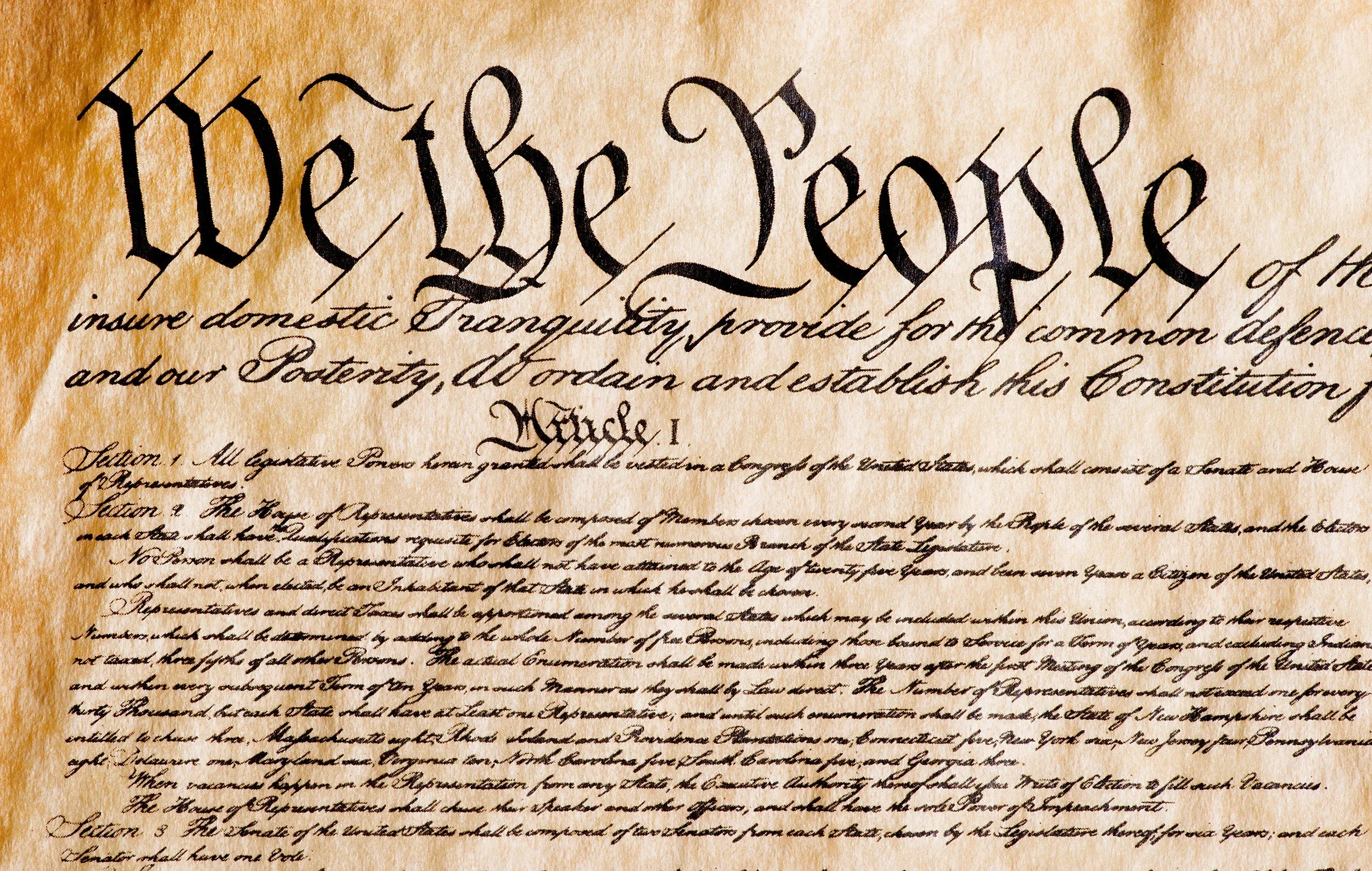
Article II, the slim constitutional basis for the Cabinet (Public Domain)
The Constitution barely mentions the Cabinet at all. It gives the president power to nominate department heads and require their written opinions, that's essentially it. The entire Cabinet system as we know it today grew from tradition and practice, not explicit constitutional design.
The Senate confirmation requirement is one of the key checks in the system. A president can nominate whoever they want, but every Cabinet secretary must be confirmed by a Senate majority vote. This has occasionally led to dramatic confirmation battles, rejected nominees, and political standoffs.
"He may require the Opinion, in writing, of the principal Officer in each of the executive Departments, upon any Subject relating to the Duties of their respective Offices... and he shall nominate, and by and with the Advice and Consent of the Senate, shall appoint... Officers of the United States."
In short: The president can ask department heads for written advice. The president nominates Cabinet members, but the Senate must confirm them with a majority vote. That's the entire constitutional basis for the Cabinet.
How Cabinet Members Are Appointed
Getting into the Cabinet isn't quick or easy. Here's the full process from nomination to first day on the job:
President Nominates
After winning the election, the president-elect announces their Cabinet picks, usually between November and January. There's no formal requirement for experience, though most nominees have relevant backgrounds in government, business, military, or law.
FBI Background Check
Every nominee undergoes an extensive FBI background investigation. Financial records, personal history, foreign contacts, and past conduct are all reviewed. This process can take weeks.
Senate Committee Hearing
Each nominee appears before the relevant Senate committee for hours of public questioning. Defense nominees go before the Armed Services Committee. AG nominees face the Judiciary Committee. These hearings can be intense, and are often televised.
Committee Vote
The committee votes on whether to recommend the nominee to the full Senate. A negative committee vote doesn't automatically kill a nomination, the full Senate can still vote, but it's a major obstacle.
Full Senate Vote
The full Senate votes on confirmation. A simple majority (51 votes) is needed. Since 2013, the filibuster cannot be used to block Cabinet confirmations, so the majority party can confirm nominees without opposition support.
Sworn In
Once confirmed, the nominee is sworn into office and immediately begins running their department. They serve at the pleasure of the president, meaning they can be fired at any time, for any reason, without Senate involvement.
Recess Appointments
The Constitution lets the president fill a vacancy without Senate confirmation by making a recess appointment while the Senate is in recess. A recess appointee can serve until the end of the Senate's next session. In NLRB v. Noel Canning (2014), the Supreme Court limited this power: a Senate break of fewer than 10 days is presumptively too short, and brief "pro forma" sessions, where the Senate gavels in and out without doing business, count as sessions. Since that ruling, the Senate has routinely held pro forma sessions during breaks, which has kept recess appointments rare.
What Happens at a Cabinet Meeting?
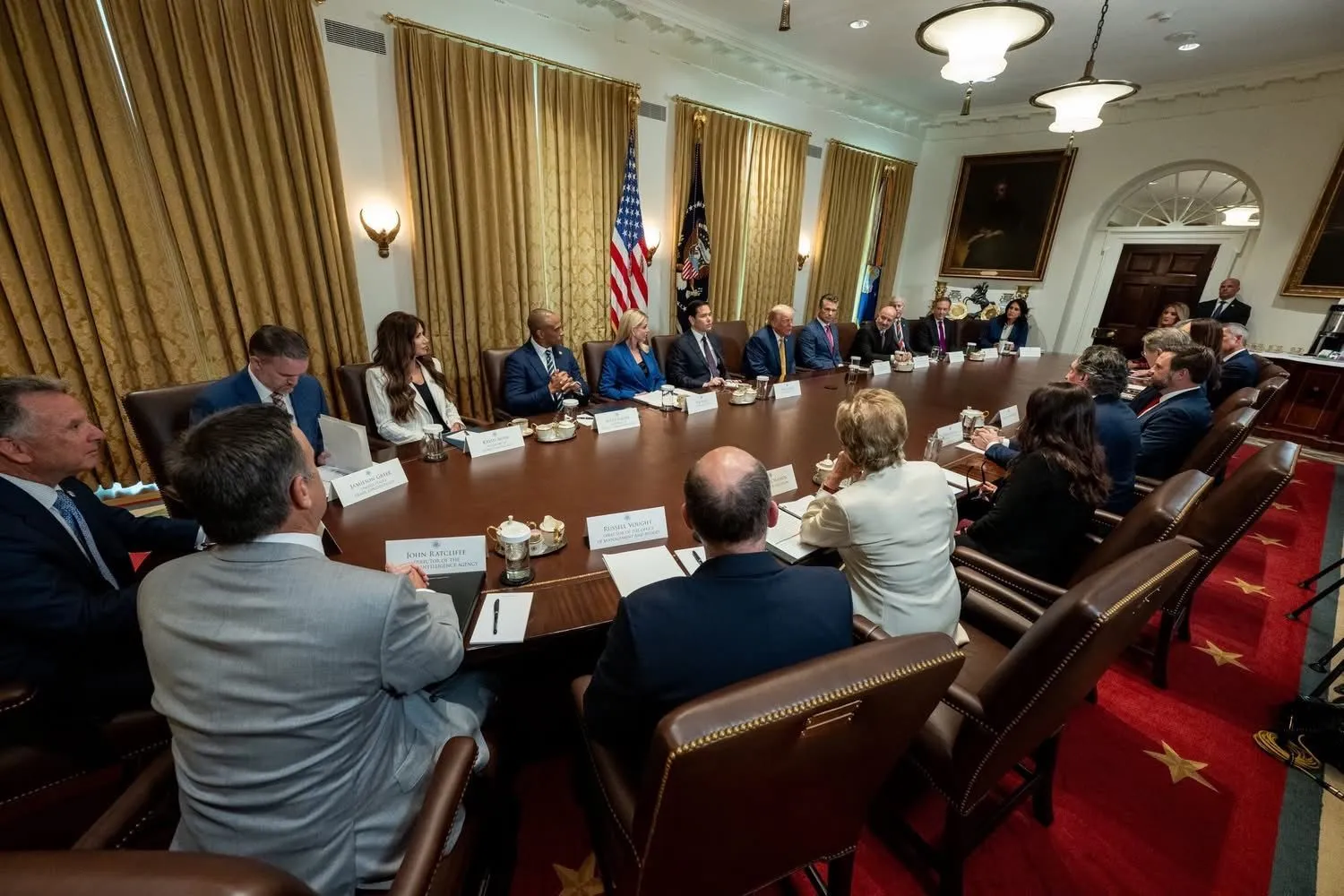
A Cabinet meeting in the Cabinet Room of the White House, the long table, the flags, and 15 department heads (Public Domain)
Cabinet meetings take place in the Cabinet Room, the long, formal conference room next to the Oval Office in the West Wing. The president sits at the center of the table, with the VP opposite. Each secretary has an assigned seat based on the order their department was established.
There's no required schedule, presidents hold Cabinet meetings as often or rarely as they choose. Some presidents meet weekly. Others meet only occasionally, preferring one-on-one sessions with individual secretaries. In practice, much of the real work happens in smaller sub-Cabinet meetings, deputy secretary meetings, and direct calls between the president and individual department heads.
The Cabinet doesn't vote. This isn't a democracy, the president hears advice from their Cabinet but makes all final decisions alone. A popular story holds that Lincoln polled his Cabinet on a major decision, heard every adviser vote no, and announced, "Seven nays, one aye, the ayes have it." Historians have not found the line in the record, but it captures how the system works: the Cabinet advises, and the president decides.
The 15 Cabinet Departments
Listed in order of presidential succession. Current members reflect President Trump's second-term Cabinet as of September 2026.
Department of State
#1America's diplomacy arm. The State Department manages relationships with nearly every country in the world, runs about 270 embassies and consulates, issues U.S. passports, and negotiates treaties and executive agreements. The Secretary of State is the president's principal foreign-policy adviser.
It was the first executive department Congress created, on July 27, 1789, originally as the "Department of Foreign Affairs." Thomas Jefferson was the first Secretary. For its first century it also handled domestic duties such as the census and the patent system before those moved elsewhere.
The Secretary of State is fourth in the line of presidential succession, the highest-ranking Cabinet officer, and six Secretaries have gone on to become president. The Foreign Service, a merit-based corps of diplomats posted abroad on rotation, dates to the Rogers Act of 1924.
Roughly a third of the department's staff are locally hired employees at overseas posts. The department also runs the U.S. Agency for International Development's foreign-aid programs, which were folded into State in a 2025 reorganization.
Current Secretary (as of Sept. 2026)
Marco Rubio
Did You Know?
The State Department was the very first executive department Congress created, on July 27, 1789.
Department of the Treasury
#2Manages the government's money: collecting federal taxes through the IRS, borrowing through Treasury securities, producing currency and coins, and paying the government's bills. It also sets much of U.S. economic and financial-regulatory policy and administers economic sanctions.
Congress created it on September 2, 1789, and Alexander Hamilton, its first Secretary, used it to assume state Revolutionary War debts, found a national bank, and establish federal credit. Hamilton's face is on the $10 bill produced by the department he built.
The IRS, by far Treasury's largest bureau, processes more than 160 million individual returns a year and collects about 95 percent of all federal revenue. The Bureau of Engraving and Printing makes paper currency; the U.S. Mint makes coins.
The Office of Foreign Assets Control administers sanctions programs that can freeze the U.S. assets of foreign governments, companies, and individuals, and the Financial Crimes Enforcement Network (FinCEN) tracks money laundering. The Secretary chairs the interagency Financial Stability Oversight Council created after the 2008 crisis.
Current Secretary (as of Sept. 2026)
Scott Bessent
Did You Know?
Alexander Hamilton, the first Treasury Secretary, appears on the $10 bill his own department prints.
Department of War
#3The largest department by far, overseeing the Army, Navy, Air Force, Marine Corps, and Space Force (the Coast Guard sits under Homeland Security in peacetime). Its legal name is still the Department of Defense, but it has used the title Department of War since September 2025. The Secretary is the principal civilian adviser to the president on military policy and is second in the military chain of command, after the president.
It was created by the National Security Act of 1947, which merged the old War and Navy departments and, in a 1949 amendment, named the combined body the Department of Defense. The same law created the Air Force, the CIA, and the National Security Council.
Its base budget of roughly $850 billion a year is close to half of all federal discretionary spending and larger than the military budgets of the next several countries combined. About a third goes to operations and maintenance, with the rest split among personnel, procurement, and research.
Headquarters is the Pentagon in Arlington, Virginia, long the largest office building in the world by floor area and still one of the largest (India's Surat Diamond Bourse surpassed it in 2023). The department is the only federal agency that has never passed a full financial audit, failing every attempt since the first in 2018.
Current Secretary (as of Sept. 2026)
Pete Hegseth
Did You Know?
The Department of War is the largest single employer in the world, with roughly 2.9 million service members and civilians.
Department of Justice
#4The federal government's law firm and its largest law-enforcement organization. The Attorney General is the nation's chief prosecutor and legal adviser, and the department runs the FBI, DEA, ATF, U.S. Marshals Service, and Bureau of Prisons, and represents the United States before the Supreme Court through the Solicitor General.
The office of Attorney General was created in the Judiciary Act of 1789 as a part-time job with no staff; Congress did not build the Department of Justice around it until 1870, largely to enforce Reconstruction-era civil rights laws in the South.
The department both prosecutes federal crimes, from public corruption to drug trafficking to terrorism, and enforces civil statutes covering voting rights, employment discrimination, antitrust, and the environment. It also runs the immigration courts, which sit in the executive branch rather than the judiciary.
By long-standing internal policy the department is expected to make prosecution decisions free of White House political direction, a norm reinforced after Watergate; the Attorney General is nonetheless a presidential appointee removable at will. The FBI director serves a fixed 10-year term set by a 1976 law.
Current Secretary (as of Sept. 2026)
Todd Blanche
Did You Know?
The Attorney General is the only Cabinet head not titled "Secretary"; the office predates its department by 81 years.
Department of the Interior
#5Manages most federally owned land and natural resources: the National Park Service, the Bureau of Land Management, the Fish and Wildlife Service, the U.S. Geological Survey, and the Bureau of Reclamation's dams and water projects. It also administers the federal government's trust relationship with Native American tribes through the Bureau of Indian Affairs.
Congress created it in 1849 as a catch-all "home department" for functions that did not fit elsewhere, at various times including the census, patents, pensions, and the D.C. jail, before those responsibilities were moved out.
It oversees about 500 million acres, roughly a fifth of the land in the United States, concentrated in the West and Alaska, plus 1.7 billion acres of the offshore Outer Continental Shelf. Grazing, timber, mineral, and offshore energy leases on that land generate billions of dollars a year, much of it shared with states.
The department administers relations with 574 federally recognized tribes and manages about 55 million acres held in trust for them, along with running or funding tribal schools and law enforcement. It also operates the National Park System's 400-plus units, which draw hundreds of millions of visits a year.
Current Secretary (as of Sept. 2026)
Doug Burgum
Did You Know?
Interior manages roughly one out of every five acres of land in the United States.
Department of Agriculture
#6Far more than farms: the USDA inspects meat, poultry, and eggs, runs the national forests through the Forest Service, funds rural infrastructure and housing, supports agricultural research, and administers the country's largest nutrition programs.
Abraham Lincoln signed it into being in 1862 and called it "the people's department" because most Americans then worked in agriculture; it was raised to Cabinet rank in 1889.
Nutrition assistance is now the bulk of its spending. SNAP (formerly food stamps) serves roughly 40 million people, and the school breakfast and lunch programs feed close to 30 million children on a typical school day. These programs are reauthorized about every five years in the Farm Bill.
The Forest Service, housed here rather than in Interior, manages about 193 million acres of national forests and grasslands and now spends a large and growing share of its budget on wildfire suppression. USDA also runs the federally subsidized crop insurance program that covers most U.S. farm acreage.
Current Secretary (as of Sept. 2026)
Brooke Rollins
Did You Know?
Lincoln created the USDA in 1862 and called it "the people's department" when half of Americans were farmers.
Department of Commerce
#7A collection of agencies that gather data about the country and promote U.S. business abroad. It runs the Census Bureau, the Bureau of Economic Analysis (which computes GDP), the Patent and Trademark Office, the National Institute of Standards and Technology, and NOAA.
It began in 1903 as the combined Department of Commerce and Labor, and became the standalone Department of Commerce in 1913 when Labor split off. Herbert Hoover was an unusually activist Secretary in the 1920s before becoming president.
The department's data products underpin much of American public and business life: the once-a-decade census determines congressional apportionment and the distribution of hundreds of billions in federal funds, and NIST maintains the official U.S. standards for time, weight, and measurement.
NOAA, its largest component, includes the National Weather Service, which issues every tornado warning and hurricane forecast, along with the fisheries service and ocean and satellite programs. Commerce also administers export controls that can bar U.S. technology from specific foreign companies.
Current Secretary (as of Sept. 2026)
Howard Lutnick
Did You Know?
The National Weather Service is part of NOAA, which is part of the Commerce Department.
Department of Labor
#8Enforces the laws that set a floor under working conditions: the federal minimum wage and overtime rules (through the Wage and Hour Division), workplace safety (through OSHA and the Mine Safety and Health Administration), and protections for retirement and health plans (through the Employee Benefits Security Administration).
President William Howard Taft signed it into existence on his last day in office in March 1913, splitting it off from Commerce after decades of lobbying by organized labor. Frances Perkins, Secretary from 1933 to 1945, was the first woman in the Cabinet and a principal architect of the New Deal.
Its Bureau of Labor Statistics produces the monthly jobs report and the Consumer Price Index, the inflation measure used to set Social Security's annual cost-of-living adjustment and to index parts of the tax code.
The department also runs federally funded job-training and apprenticeship programs, administers unemployment insurance jointly with the states, and, through the Occupational Safety and Health Administration created in 1971, sets and enforces standards that federal analyses credit with a large long-run drop in the workplace fatality rate.
Current Secretary (as of Sept. 2026)
Keith Sonderling (Acting Secretary)
Did You Know?
Frances Perkins, Labor Secretary from 1933 to 1945, was the first woman ever to serve in a president's Cabinet.
Dept. of Health & Human Services
#9The federal government's largest department by spending. It runs Medicare and Medicaid through the Centers for Medicare & Medicaid Services, the CDC, the FDA, the National Institutes of Health, the Indian Health Service, and Head Start.
It was created in 1953 as the Department of Health, Education, and Welfare; education split into its own department in 1979 and the remainder was renamed Health and Human Services.
Its budget, well over $1.7 trillion a year, is larger than the entire national budget of all but a handful of countries. Most of that is mandatory spending on Medicare and Medicaid, which together cover more than 150 million people.
The NIH is the world's largest public funder of biomedical research, awarding most of its roughly $47 billion budget as grants to universities and institutes. The FDA regulates products accounting for about a fifth of every consumer dollar spent in the United States, from prescription drugs to most of the food supply.
Current Secretary (as of Sept. 2026)
Robert F. Kennedy Jr.
Did You Know?
HHS spends more money than any other federal department, over $1.7 trillion a year, most of it on Medicare and Medicaid.
Dept. of Housing & Urban Development
#10Administers federal housing policy: rental assistance for low-income households, public housing, homelessness grants, the Federal Housing Administration's mortgage insurance, and enforcement of the Fair Housing Act against discrimination in renting and lending.
It was created in 1965 as part of Lyndon Johnson's Great Society. Robert C. Weaver, its first Secretary, was the first Black American to serve in a president's Cabinet.
The FHA, which HUD absorbed, has insured tens of millions of home mortgages since 1934, allowing buyers to qualify with down payments as low as 3.5 percent; it charges borrowers premiums rather than drawing on tax dollars in most years.
HUD's rental programs, chiefly the Housing Choice "Section 8" vouchers and public housing, assist roughly 5 million households, but because they are funded at a fixed annual level rather than as an entitlement they reach only about one in four eligible families. The department also distributes Community Development Block Grants that give localities flexible money for infrastructure and housing.
Current Secretary (as of Sept. 2026)
Scott Turner
Did You Know?
HUD's first Secretary, Robert C. Weaver, was the first Black American to hold a Cabinet post.
Department of Transportation
#11Oversees the federal role in every mode of transportation: highways, transit, aviation, rail, pipelines, and maritime shipping. Its agencies include the Federal Aviation Administration, the Federal Highway Administration, the National Highway Traffic Safety Administration, and the Federal Railroad Administration.
It was created in 1966 by consolidating about 30 existing agencies and bureaus that had been scattered across the government, and opened for business in 1967.
Most of its money passes through to states as formula grants, much of it from the Highway Trust Fund financed by the federal fuel tax, which has not been raised since 1993 and now requires regular transfers from the general fund to stay solvent. The 2021 Infrastructure Investment and Jobs Act added roughly $550 billion in new spending over five years.
The FAA operates the world's busiest air traffic control system, handling on the order of 45,000 flights a day, and certifies the airworthiness of civil aircraft. NHTSA sets vehicle safety standards and orders recalls; the Pipeline and Hazardous Materials Safety Administration regulates the 2.6-million-mile pipeline network.
Current Secretary (as of Sept. 2026)
Sean Duffy
Did You Know?
The Department of Transportation was assembled in 1966 out of about 30 previously separate agencies.
Department of Energy
#12Despite the name, its single largest job is the U.S. nuclear weapons program: designing, maintaining, and securing the warhead stockpile through the semi-autonomous National Nuclear Security Administration. It also cleans up Cold War weapons-production sites, funds energy research, and runs the national laboratories.
It was created in 1977 during the energy crises of that decade, merging the Atomic Energy Commission's successor agencies with energy programs from Interior and elsewhere.
Roughly half its budget goes to defense-related nuclear work, including the multi-decade, multi-hundred-billion-dollar environmental cleanup at sites such as Hanford in Washington State. It also manages the Strategic Petroleum Reserve, the world's largest emergency crude-oil stockpile.
The department operates 17 national laboratories, among them Los Alamos, Oak Ridge, Lawrence Livermore, and the Fermi and SLAC accelerator labs, which do both classified weapons work and open scientific research. Its Energy Information Administration publishes the government's official energy statistics.
Current Secretary (as of Sept. 2026)
Chris Wright
Did You Know?
About half the Energy Department's budget goes to nuclear weapons and Cold War site cleanup, not to energy policy.
Department of Education
#13The smallest Cabinet department by headcount. It does not run schools or set curriculum; those are state and local jobs. By law it is responsible for federal aid to schools and colleges, enforcement of federal civil rights and disability laws in education, national education statistics, and the federal student-loan portfolio.
It was split off from Health, Education, and Welfare and given Cabinet status in 1979 under Jimmy Carter, over objections that education should remain a state matter, a debate that has continued ever since.
The federal government supplies only about 8 to 10 percent of total K-12 funding. The largest K-12 programs are Title I aid for schools serving low-income students and special-education grants under the Individuals with Disabilities Education Act. Since 2025 the department has cut its staff roughly in half, from about 4,100 to about 2,200, and has signed or announced interagency agreements under which other departments administer many of its programs, including Title I and career and technical education through the Department of Labor, special education through Health and Human Services, and civil-rights and student-privacy enforcement through Justice.
Its Office of Federal Student Aid oversees roughly $1.6 trillion in outstanding student loans held by about 43 million borrowers and disburses Pell Grants to several million lower-income college students each year. In March 2026 the department signed an agreement under which the Treasury Department takes over day-to-day management of the loan portfolio. Congress has not abolished the department, so these programs remain its legal responsibility.
Current Secretary (as of Sept. 2026)
Linda McMahon
Did You Know?
With about 2,200 employees after 2025 staff cuts, the Education Department has the smallest staff of any Cabinet agency, yet it remains legally responsible for roughly $1.6 trillion in federal student loans.
Department of Veterans Affairs
#14Provides health care, disability compensation and pensions, education benefits (the GI Bill), home-loan guarantees, and burial services to about 18 million living veterans and their families.
The Veterans Administration was created in 1930 to consolidate scattered veterans' programs; it was elevated to a Cabinet department in 1989 under George H.W. Bush.
The Veterans Health Administration runs the largest integrated health system in the country, roughly 170 medical centers and more than 1,000 outpatient clinics, treating about 9 million enrolled veterans a year. The 2022 PACT Act expanded eligibility for conditions tied to toxic exposures and is projected to add hundreds of billions of dollars in benefits over a decade.
The department's benefits side processes millions of disability claims and has struggled at times with large backlogs. Most VA medical care is funded a year in advance so it is not interrupted by government shutdowns.
Current Secretary (as of Sept. 2026)
Doug Collins
Did You Know?
The VA runs the largest integrated health care system in the United States, treating about 9 million veterans a year.
Department of Homeland Security
#15The newest Cabinet department, created after the September 11, 2001 attacks. It brings together border and immigration enforcement (Customs and Border Protection, Immigration and Customs Enforcement, and Citizenship and Immigration Services), aviation security (TSA), disaster response (FEMA), the Coast Guard, the Secret Service, and the federal cybersecurity agency CISA.
The Homeland Security Act of 2002 merged 22 existing agencies with about 180,000 employees into one department, the largest federal reorganization since the creation of the Defense Department in 1947.
It is the third-largest Cabinet department by staff. Its component agencies had long histories elsewhere: the Coast Guard traces to 1790, the Secret Service to 1865 (moved from Treasury), and FEMA to 1979.
The consolidation has drawn ongoing criticism from Congress and government auditors over management and morale, and DHS employee-satisfaction scores have frequently ranked near the bottom among large federal agencies, though several components rank well on their own.
Current Secretary (as of Sept. 2026)
Markwayne Mullin
Did You Know?
DHS was assembled in 2002 by merging 22 federal agencies, the biggest government reorganization in more than 50 years.
Cabinet-Level Positions
Beyond the 15 official departments, presidents typically elevate several other positions to "Cabinet-level" status, meaning those officials attend Cabinet meetings and have direct access to the president. These aren't Cabinet secretaries, but they're treated as equals in practice. The list changes with each president; the U.S. Ambassador to the United Nations, for example, has had Cabinet rank under some presidents but not in the current administration:
Vice President
JD Vance
Constitutionally separate but attends Cabinet meetings
White House Chief of Staff
Susie Wiles
Manages the White House staff and West Wing operations. Whether this post carries Cabinet rank varies by president.
Director of National Intelligence
Jay Clayton
Oversees all 18 US intelligence agencies
CIA Director
John Ratcliffe
Heads the Central Intelligence Agency
Director of OMB
Russell Vought
Manages the federal budget process
US Trade Representative
Jamieson Greer
Negotiates trade agreements and policy
EPA Administrator
Lee Zeldin
Environmental protection policy
Small Business Administration Administrator
Kelly Loeffler
Backs loans, counseling, and contracting help for small businesses
The Cabinet and Presidential Succession
Cabinet secretaries are part of the presidential line of succession, meaning if both the president and everyone above them in line is unable to serve, Cabinet members step in. The order follows the date each department was established:
Important caveat: Not all Cabinet members are eligible for the presidency. To be in the line of succession, a Cabinet member must meet the constitutional requirements: natural-born US citizen, at least 35 years old. Foreign-born secretaries (even naturalized citizens) are skipped in the line of succession.
Keep Exploring
The Cabinet is one part of the executive branch. These pages pick up where this one leaves off.
Frequently Asked Questions
The Cabinet is the President's 15 department heads. Each runs a major part of the federal government, reports directly to the President, and serves as one of the President's top advisers.
The Cabinet has 15 executive departments, a number reached when Homeland Security was added in 2002. Presidents may also give Cabinet rank to other officials, such as the White House Chief of Staff or the U.S. Trade Representative.
Not by name. Article II only lets the President require written opinions from the principal officers of the executive departments. The Cabinet grew from George Washington's practice of meeting with his department heads as a group.
The President nominates each department head, the nominee goes through an FBI background check and a Senate committee hearing, and the full Senate must confirm the nominee by a majority vote.
Quick Facts
Where to Find It
Did You Know?
The word 'Cabinet' isn't in the Constitution
Not once. The founders described the president's advisers as 'principal Officers' of executive departments. The term 'Cabinet' came from a British tradition and entered common American usage in the early 1800s. Today it's everywhere, except in the actual document that created the government.
Lincoln kept his rivals in the Cabinet
When Abraham Lincoln formed his Cabinet in 1861, he famously included several men who had run against him for president and considered themselves more qualified. His Secretary of State William Seward initially tried to take over the government. Lincoln won the power struggle quietly and effectively. Historian Doris Kearns Goodwin's book about this is titled 'Team of Rivals.'
One Cabinet member always stays away from the State of the Union
During the annual State of the Union address, when the president, VP, and most of the Cabinet are all in the Capitol together, one Cabinet member is kept at a secret location. This 'designated survivor' ensures someone in the line of succession is always safe. The TV show 'Designated Survivor' dramatized this scenario.
Cabinet members can't be members of Congress
The Constitution prohibits members of Congress from simultaneously holding executive branch positions. When a senator or House member is nominated for a Cabinet position, they must resign their congressional seat before taking the oath of the new office, usually right after the Senate confirms them. This is why you sometimes see Cabinet nominees leaving Congress mid-term.