
Split vs. Unified Congress
Sometimes one party runs the White House, the House, and the Senate. More often since 1945, power has been divided. Here is what each setup means, what it tends to produce, and what it costs.
Who Controls What
Three elected bodies have to agree before almost any law passes: the House, the Senate, and the President. When one party holds all three, government is unified. When the parties share them, it is divided, and when the House and Senate themselves are run by different parties, Congress is split.
24 of 41
Congresses since 1945 with divided government
8
Split Congresses (House and Senate run by different parties) since 1981
60
Senate votes needed to end most filibusters, even under unified control
3
Midterms since 1934 in which the President's party gained House seats
Government is unified when one party holds the presidency and a majority in both the House of Representatives and the Senate. Reporters often call this a "trifecta." It is the arrangement that, on paper, gives a party the easiest path to turning its campaign promises into law.
Since 1945 the country has had unified government in 17 of 41 Congresses. Democrats held it for long stretches under Presidents Truman, Kennedy, and Johnson, and again under Carter, Clinton (1993-95), Obama (2009-11), and Biden (2021-23). Republicans held it under Eisenhower (1953-55), George W. Bush (2003-07), and Donald Trump (2017-19 and again from 2025).
Unified does not mean unlimited. The Senate's filibuster rule means most bills still need 60 of 100 votes to come to a final vote, and since 1979 a party has held 60 Senate seats only once, for about six months in all between July 2009 and February 2010. A party with a narrow majority also has to keep nearly every one of its own members on board.
That is why unified governments lean on a few special paths that need only a simple majority: budget reconciliation bills and confirmations of nominees. (Convicting an official in an impeachment trial is different: it takes two-thirds of the senators present.) Much of what a unified government passes on party lines travels through those channels.
Government is divided whenever the President's party does not control both chambers of Congress. It comes in two forms. In the first, the other party holds both the House and the Senate, as Democrats did against Presidents Nixon, Ford, Reagan (1987-89), and George H. W. Bush, and Republicans did against Clinton (1995-2001) and Obama (2015-17).
In the second form, Congress itself is split: one party runs the House and the other runs the Senate, so the President has allies in one chamber and opponents in the other. That has happened in 8 of the 23 Congresses since 1981.
Divided government is a product of the Constitution's design. The Framers set up separate elections for the House, the Senate, and the President, on different schedules, so that each could check the others. The page on separation of powers explains why they built it that way. They did not plan for political parties, but the system they built lets voters hand different parties different pieces of power.
Since 1945, divided government has been the more common result, in 24 of 41 Congresses. Since 1969 it has been the norm, in 20 of 29 Congresses through 2027.
A split Congress is one where the House majority and the Senate majority belong to different parties. Because a bill has to pass both chambers in identical form before it can go to the President, each chamber's majority can stop the other's bills. The page on why Congress has two chambers covers how the two houses were designed to check each other.
In a split Congress, each chamber often passes bills it knows the other will never take up. Those bills show voters what the majority would do with full control, but they rarely become law. What does pass is usually must-pass legislation (spending bills, the defense bill, debt-limit increases) or a deal both sides negotiated.
Split Congresses since 1981: 1981-87 (Republican Senate, Democratic House, under Reagan), most of 2001-03 (after a senator's party switch handed the Senate to Democrats under George W. Bush), 2011-15 (Republican House, Democratic Senate, under Obama), 2019-21 (Democratic House, Republican Senate, under Trump), and 2023-25 (Republican House, Democratic Senate, under Biden).
A split Congress also splits the work of checking the President. The chamber the President's party controls usually confirms nominees and protects the administration, while the opposition chamber holds hearings, issues subpoenas, and, as in 2019, can impeach.
The majority in the House elects the Speaker of the House, who decides which bills reach the floor and when. Through the Rules Committee, the majority also sets the terms of debate, including whether members may offer amendments at all.
In the Senate, the majority party chooses the Senate Majority Leader, who by custom gets the first right to be recognized on the floor and so controls the schedule. The majority also decides which of the President's nominees get hearings and votes, which matters most for judges and Cabinet officers.
In both chambers the majority party holds every committee chair and a majority of the seats on nearly every committee (the House and Senate ethics committees are split evenly between the parties). Chairs decide which bills get hearings, which witnesses are called, and, in most committees, when to issue subpoenas. That is why a change in control changes so much about what gets investigated.
Control does not give a party the power to pass anything it wants. In the House a slim majority can lose a vote if a handful of its own members defect. In the Senate the minority keeps the filibuster, and every senator keeps the ability to slow the floor down. Control is mostly the power to decide what gets considered, not what passes.
Nobody votes for "divided government" on the ballot. It comes out of hundreds of separate races held on different schedules. All 435 House seats are up every two years, but senators serve six-year terms and only about a third of the Senate is elected at a time, so a single election can change one chamber without touching the other. The page on how elections work walks through the calendar.
The biggest driver is the midterm. In every midterm since 1934 except three (1934, 1998, and 2002), the President's party has lost seats in the House. A President who starts with unified government often loses it two years later. The midterm elections page covers that pattern in depth.
Ticket splitting, voting for one party for President and the other for Congress, used to produce divided government even in presidential years. Eisenhower won in a landslide in 1956 while Democrats held both chambers, and Nixon won 49 states in 1972 with Democrats again holding Congress. Ticket splitting has become much rarer in recent decades, so divided government now comes mostly from midterms and from very close Senate maps.
Some voters say they prefer divided government on purpose, as a way to keep either party from going too far. Political scientists disagree about how many voters actually think this way, but the idea that power should be checked runs through the Constitution itself.
When One Party Holds Everything
Unified government lets a party move its agenda faster and makes it clear who is in charge. It also weakens oversight of the President and, history shows, often sets up a backlash at the next election.
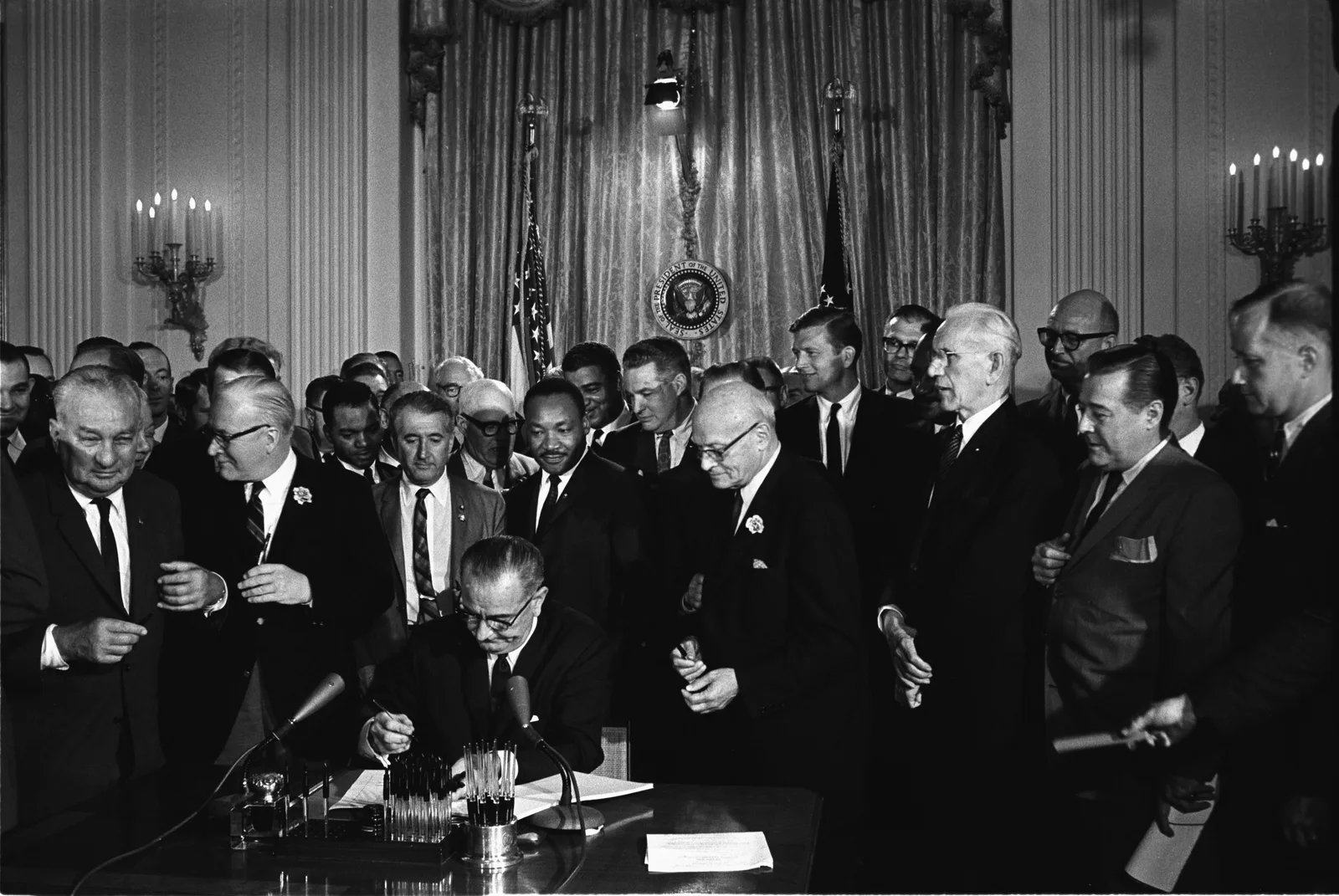
With the White House and both chambers, a party can pass the laws it campaigned on without first winning over the other side. The best-known example is the burst of laws in 1964 and 1965 under President Lyndon Johnson and a large Democratic Congress, including the Civil Rights Act of 1964, the Voting Rights Act of 1965, and Medicare and Medicaid. The civil rights history page tells that story.
Both parties have used unified control the same way. Democrats passed the Affordable Care Act in 2010, the American Rescue Plan in 2021, and the Inflation Reduction Act in 2022. Republicans passed the Tax Cuts and Jobs Act in 2017 and the One Big Beautiful Bill Act in 2025. Several of those went through budget reconciliation, which needs only a simple majority in the Senate.
Unified government can also make routine business smoother. When the President and both chambers share priorities, spending bills, the annual defense bill, and nominations are easier to agree on, though not always on time.
Even so, many of the most important unified-government laws still drew votes from the other party. The Civil Rights Act needed Republican votes to break a filibuster by Southern Democrats in 1964, and the 2021 infrastructure law passed the Senate 69 to 30 under unified Democratic control.
When one party holds everything, voters can tell who is in charge. If the economy, prices, or a crisis go well or badly, the governing party cannot easily blame the other side for blocking it. Many political scientists see that clarity as a real benefit, because elections only work as a check if voters can tell whom to reward or punish.
Voters have used that clarity, often harshly. After two years of unified Democratic government, Republicans gained 54 House seats in 1994 and 63 in 2010. After two years of unified Republican government, Democrats gained about 40 House seats in 2018.
Under divided government, responsibility gets blurry. Each side can argue that the other caused a shutdown or a failed bill, and voters often punish the President's party at the next midterm whichever chamber actually blocked a measure.
Clear responsibility also pushes a governing party to deliver. Knowing it will own the results, a party with unified control has a strong incentive to pass something on its top issues before the next election.
Congress's committees can investigate the executive branch, subpoena documents, and call officials to testify. When the President's own party runs those committees, they tend to use those powers far less against the administration. The chairs share the President's goals, and a damaging hearing could cost their party the next election.
Researchers have measured this. Political scientist David Mayhew, in the second edition of Divided We Govern (2005), found that high-profile congressional investigations of the executive branch have become strongly tied to divided government, especially since the 1990s.
The pattern shows up in impeachment, Congress's strongest check. Every President the House has impeached (Andrew Johnson in 1868, Bill Clinton in 1998, and Donald Trump in 2019 and 2021) was impeached by a House controlled by the other party. The impeachment page covers each case.
Inspectors general, courts, the press, and the minority party still watch a unified government, and members sometimes break with their own President. But the committee chairs with subpoena power belong to the President's party, which makes a sustained investigation less likely.
Laws passed by one party alone can be less stable. If the other party wins power later, it has every reason to undo them. The Affordable Care Act passed in 2010 with no Republican votes, the Republican House voted dozens of times over the next six years to repeal it, and a repeal bill failed in the Senate by a single vote in July 2017.
The same thing happens in the other direction. The 2017 Tax Cuts and Jobs Act passed with no Democratic votes, and because it went through reconciliation, its individual tax cuts were written to expire after 2025. That set up a new fight, which Republicans settled with their 2025 law extending those cuts.
Unified government can also tempt a party to stretch its power in ways that later backfire, such as changing Senate rules. When Democrats ended the filibuster for most nominees in 2013, Republicans used the same precedent in 2017 to extend it to Supreme Court nominees. The page on the filibuster covers those changes.
Supporters of unified government reply that some laws only pass this way, and that many laws passed mostly on party lines, including Medicare's prescription drug benefit (2003) and the Affordable Care Act, survived and became part of daily life even after control changed hands.
Narrow majorities and the filibuster mean unified governments fail often. In 2017, Republicans controlled everything but could not pass a replacement for the Affordable Care Act. In 2021 and 2022, Democrats controlled everything but could not pass their larger Build Back Better plan, and settled for the smaller Inflation Reduction Act.
Unified government does not prevent shutdowns either. The 35-day shutdown that began December 22, 2018, started under unified Republican control, and the 43-day shutdown of October and November 2025, the longest in history, happened under unified Republican control too. The Senate still needed 60 votes to pass a spending bill.
Divisions inside a party matter as much as divisions between parties. Members from swing districts and members from safe seats want different things, and in a narrow majority any small group can block a bill. The left and right in politics page explains the wings within each party.
In practice, then, unified control mostly changes which bills get a vote and which nominees get confirmed. Big legislation still needs either near-perfect party unity or some votes from the other side.
When Power Is Shared
Divided government forces the parties to bargain and gives Congress a strong reason to watch the President closely. It also makes gridlock, shutdown fights, and stalled nominations more likely.
Under divided government, nothing becomes law unless both parties accept it, so the laws that do pass tend to have broad support and tend to last. In 1983, President Reagan and Speaker Tip O'Neill agreed to the Social Security Amendments, which raised the retirement age over time and shored up the program's finances. The Social Security page covers what that deal did.
In 1986 a Republican President, a Republican Senate, and a Democratic House passed the Tax Reform Act, which lowered rates and closed many loopholes. In 1990, President George H. W. Bush and a Democratic Congress passed the Americans with Disabilities Act and major Clean Air Act amendments.
In 1996, President Clinton and a Republican Congress passed welfare reform, and in 1997 they agreed on a balanced budget deal. In 2015, President Obama and a Republican Congress replaced No Child Left Behind with the Every Student Succeeds Act.
Political scientist David Mayhew studied 267 major laws passed from 1946 to 1990 and found that divided governments passed important laws at about the same rate as unified ones. His finding, first published in 1991, is still one of the most cited results about how American government works.
When the other party controls a chamber of Congress, it controls the committees, the subpoenas, and the hearings. That makes it far more likely that problems in the executive branch come to light. The Senate Watergate hearings of 1973 and the Iran-Contra hearings of 1987 both took place under a Democratic Congress investigating a Republican administration.
The same thing has happened in the other direction. A Republican House created a select committee in 2014 to investigate the 2012 attack in Benghazi, Libya, during the Obama administration, and Republican committees held many other hearings on the administration from 2011 to 2017.
A Senate controlled by the other party also takes a harder look at nominees. A Democratic Senate rejected Supreme Court nominee Robert Bork in 1987, and a Republican Senate declined to hold hearings for nominee Merrick Garland in 2016. The Supreme Court page covers how justices are confirmed.
Supporters say this is the Constitution working as designed: ambition checking ambition. Critics answer that oversight under divided government can turn into a partisan weapon used mainly to damage the President before the next election. Both views have examples behind them.
Because each party can block the other, divided government makes sudden, sweeping changes hard. Voters who worry about either party going too far often see that as a benefit: whatever passes has to be acceptable to people on both sides.
Some economists have argued that divided government also restrains federal spending. The country ran budget surpluses from fiscal 1998 through fiscal 2001, after the 1997 balanced budget deal between a Democratic President and a Republican Congress. The national debt page shows how the debt has changed over time.
The evidence on spending is mixed. Large deficits also grew under divided government in the 1980s, and both parties have cut taxes and raised spending when they held full control. A brake on new policy is not the same as a brake on borrowing.
Divided government also tends to push big decisions into must-pass bills, which can produce sudden changes of its own, such as the automatic spending cuts (the "sequester") that came out of the 2011 debt-limit deal.
The most common complaint about divided government is that it stops Congress from dealing with problems at all. Political scientist Sarah Binder of the Brookings Institution measured gridlock as the share of major issues on the national agenda that Congress left unresolved, and found it rises with divided government and with polarization between the parties. The page on how a bill becomes law shows how many points there are where a bill can stall.
Gridlock has grown as the parties have moved further apart. When each party had many moderate members, as in the 1950s through the 1980s, divided governments could build cross-party coalitions. With fewer members in the middle, there are fewer votes to trade.
Under gridlock, long-term issues tend to wait: immigration law, the long-term finances of Social Security and Medicare, and the federal budget process itself. Congress keeps the government running with short-term measures instead of settling those questions.
When Congress stalls, Presidents of both parties have turned to executive action instead, which can be reversed by the next President. The page on executive orders versus laws explains the difference.
Divided government turns deadlines into bargaining chips. The 1995-96 shutdowns (21 days at their longest) came from a fight between President Clinton and a new Republican Congress over the budget. The 2013 shutdown lasted 16 days during a split Congress. The continuing resolutions and shutdowns page lists every one.
The debt limit has produced its own standoffs. In 2011, a Republican House and a Democratic Senate and President reached a deal only on August 2, the last days before the Treasury said it would run out of borrowing room. Three days later, Standard & Poor's lowered the U.S. credit rating for the first time ever. In 2023 another split Congress settled a debt-limit fight with the Fiscal Responsibility Act on June 3, days before the deadline.
These standoffs have real costs. The Congressional Budget Office estimated that the 2018-19 shutdown reduced the economy's output by $11 billion, $3 billion of which was never recovered.
Shutdowns are not unique to divided government, though. The two longest shutdowns, the partial shutdown of 2018-19 and the full shutdown of 2025, both began under unified Republican control, because the Senate filibuster still required votes from the minority party.
Under divided government, each side has a reason to make the other look bad before the next election. Bills get written to force uncomfortable votes rather than to pass, and hearings can become campaign events.
The President's veto becomes a bigger part of governing. President George W. Bush vetoed one bill in his first six years with a Republican Congress, then 11 more after Democrats won both chambers in 2006, and Congress overrode four of them. The page on the veto explains how overrides work.
Nominations can stall too. When the Senate belongs to the other party, judges and executive officials may wait months for a vote or never get one, leaving courts and agencies short-staffed.
Because voters cannot always tell who blocked what, they often blame the President's party for everything. That can reward obstruction: a party that stops the President's agenda may be punished less than the President who failed to pass it.
Split and Unified Government Since 1945
Every arrangement has produced major laws and major failures. These turning points show what each kind of control actually did.
In the 1946 midterms Republicans won both chambers for the first time since 1928, creating divided government under Democratic President Harry Truman. Truman ran for reelection in 1948 against what he called the "do-nothing Congress."
The label stuck, but the 80th Congress passed major laws. It enacted the Taft-Hartley labor law over Truman's veto in June 1947, and it worked with him to pass the Marshall Plan to rebuild Europe in 1948, along with the National Security Act of 1947, which created the CIA, the National Security Council, and the forerunner of the Department of Defense.
Truman won in 1948 and Democrats retook Congress, restoring unified government. The episode set a pattern still seen today: a President running against an opposition Congress, and voters handing power back and forth.
Republican Dwight Eisenhower had unified government only in 1953-55. Democrats won Congress in 1954 and kept it for the rest of his presidency, even as Eisenhower won reelection in a 1956 landslide.
Divided government did not stop major laws. On June 29, 1956, Eisenhower signed the Federal-Aid Highway Act, passed by a Democratic Congress, which funded the Interstate Highway System. Congress also passed the Civil Rights Act of 1957, the first civil rights law since Reconstruction.
Eisenhower worked closely with two Texas Democrats, Senate Majority Leader Lyndon Johnson and Speaker Sam Rayburn. The parties then each had liberal and conservative wings, which made cross-party coalitions easier to build than they are today.
After the 1964 election, President Lyndon Johnson had large Democratic majorities in both chambers. The 89th Congress (1965-67) passed the Voting Rights Act, Medicare and Medicaid, federal aid to elementary and secondary schools, and a new immigration law that ended national-origin quotas.
Unified control was decisive, but not the whole story. The Civil Rights Act of 1964 and the Voting Rights Act of 1965 both needed Republican votes to overcome filibusters led by Southern Democrats. The Voting Rights page covers the 1965 law.
The backlash followed the familiar pattern. In the 1966 midterms Democrats lost 47 House seats, though they kept control of both chambers.
Republican Richard Nixon never had a Republican Congress. Even so, his first term produced major laws with a Democratic Congress, including the Clean Air Act of 1970 and the law creating the Occupational Safety and Health Administration, both signed in December 1970.
Divided government also meant a Congress willing to investigate the President. The Senate Watergate Committee began televised hearings in May 1973, and the House Judiciary Committee approved articles of impeachment in July 1974. Nixon resigned on August 9, 1974.
In 1973, Congress also passed the War Powers Resolution over Nixon's veto and, in 1974, the Congressional Budget and Impoundment Control Act, both meant to reclaim power from the presidency.
Ronald Reagan's 1980 win came with the first Republican Senate since 1953-55, while Democrats kept the House. For six years each party held one chamber.
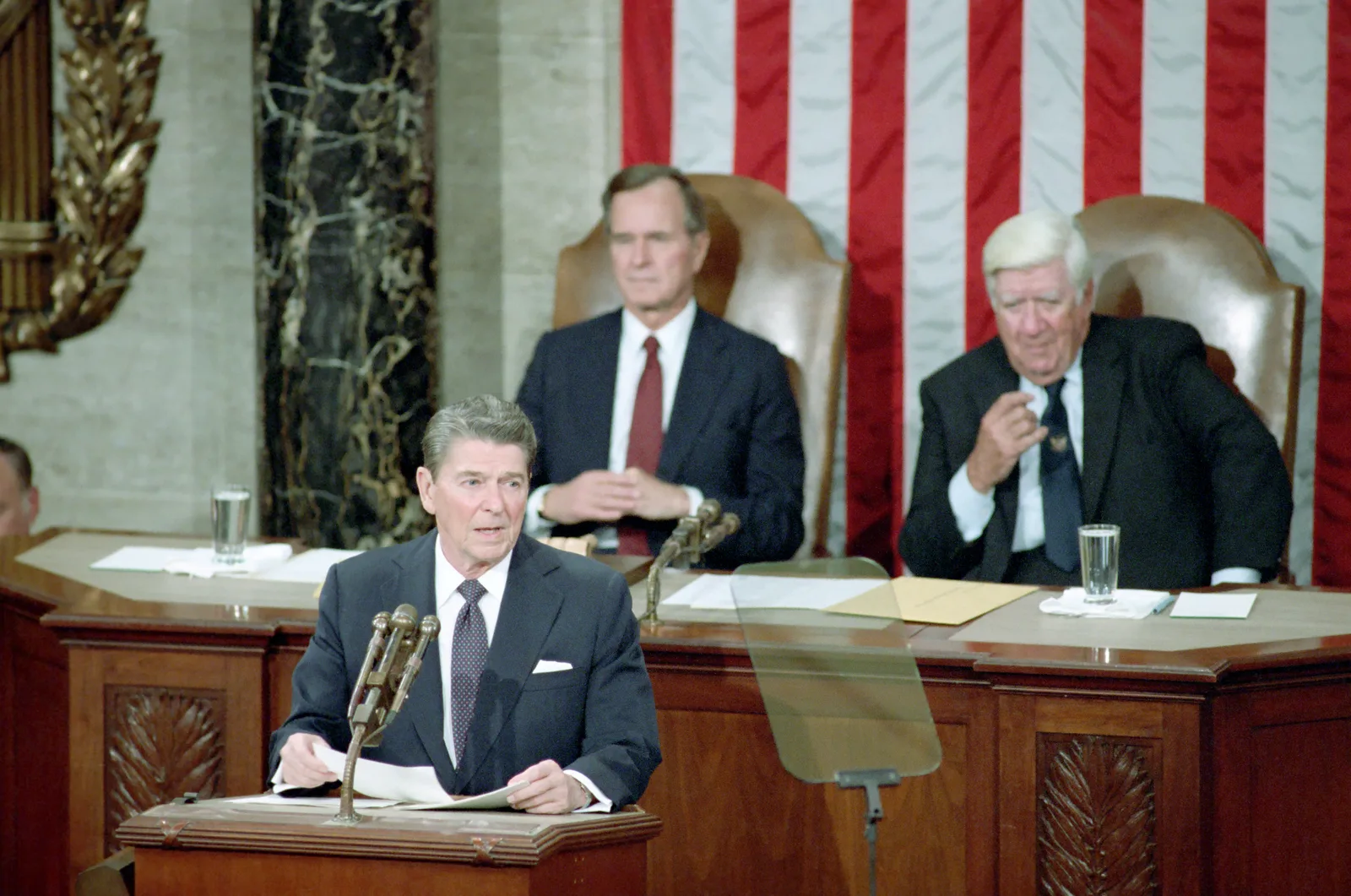
The split Congress produced the 1981 tax cuts, the 1983 Social Security rescue negotiated with Speaker Tip O'Neill, and the Tax Reform Act of 1986, which Reagan signed on October 22, 1986. The hero photo at the top of this page shows Reagan's 1986 State of the Union, with a Republican Vice President and a Democratic Speaker seated behind him.
Democrats retook the Senate in 1986, and the Iran-Contra hearings of 1987 followed under a fully Democratic Congress.
In 1994, two years into unified Democratic government under Bill Clinton, Republicans gained 54 House seats and won the House for the first time in 40 years, along with the Senate.
The new majority clashed with Clinton over the budget, leading to two shutdowns in November 1995 and from December 1995 to January 1996. The two sides then reached major deals: welfare reform in August 1996 and the Balanced Budget Act of 1997. The budget showed a surplus from fiscal 1998 through 2001.
The same divided government brought Clinton's impeachment by the Republican House in December 1998. The Senate acquitted him in February 1999.
The 2000 election left the Senate tied 50-50, with Republican Vice President Dick Cheney breaking ties, giving Republicans unified government under George W. Bush.
On June 6, 2001, Senator Jim Jeffords of Vermont left the Republican Party to become an independent who voted with Democrats, handing the Senate to Democrats and creating a split Congress. Republicans won the Senate back in 2002, one of the three midterms since 1934 in which the President's party gained House seats.
Unified Republican government from 2003 to 2007 produced the Medicare prescription drug benefit and further tax cuts. After Democrats won both chambers in 2006, Bush issued 11 of his 12 vetoes.
Under unified Democratic government, President Barack Obama signed the Affordable Care Act on March 23, 2010, after it passed the Senate with exactly 60 votes in December 2009. No Republicans in either chamber voted for it.
In the 2010 midterms, Republicans gained 63 House seats and took the majority, the largest midterm swing since 1938. Divided government returned in January 2011.
The split Congress that followed brought the 2011 debt-limit standoff, the first downgrade of the U.S. credit rating, the 2013 shutdown, and few major laws. Republicans won the Senate too in 2014.
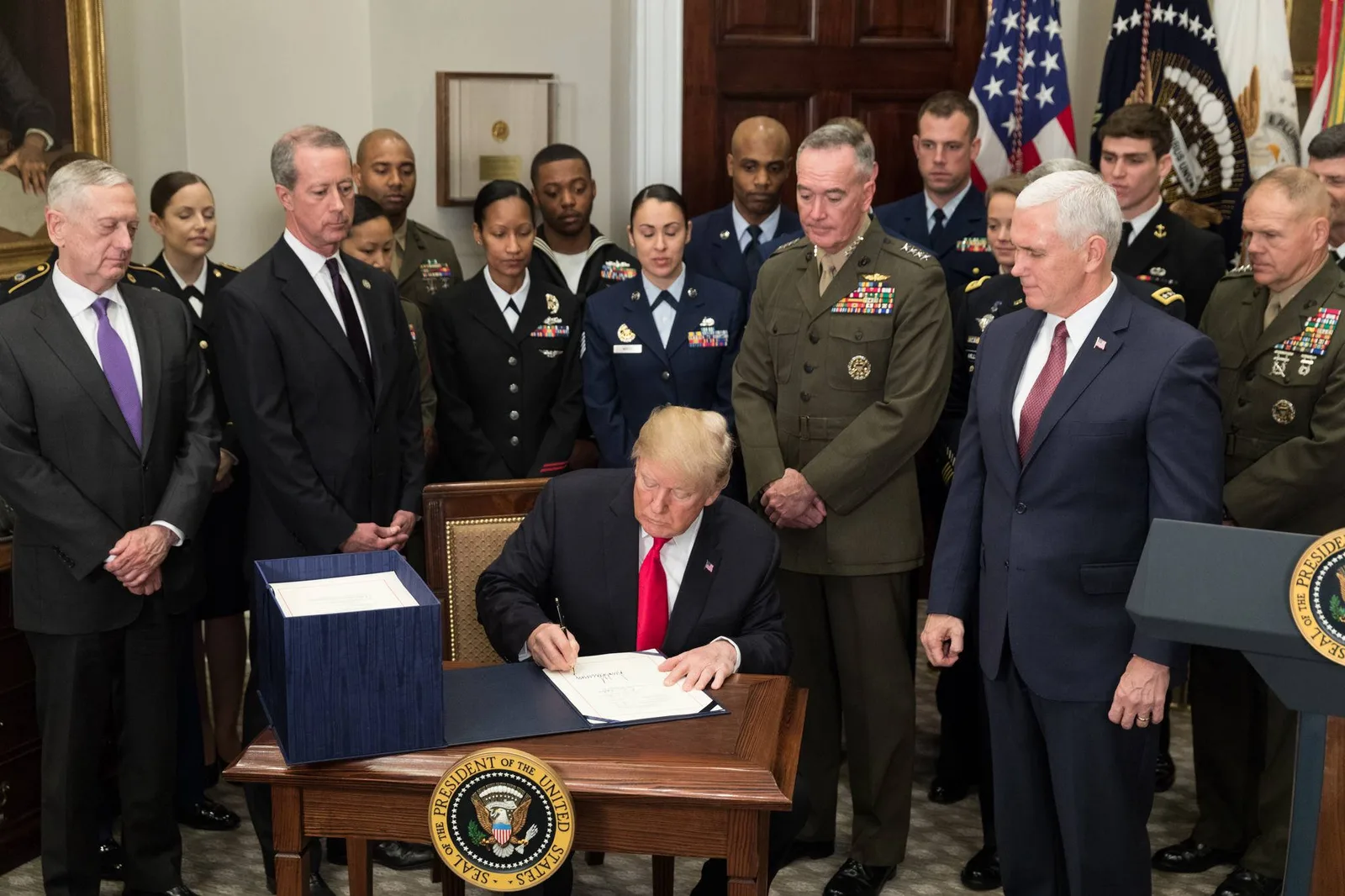
Donald Trump took office in 2017 with Republican majorities in both chambers. Congress passed the Tax Cuts and Jobs Act through reconciliation, and Trump signed it on December 22, 2017. The Senate also confirmed Neil Gorsuch and Brett Kavanaugh to the Supreme Court.
Unified control had limits. The effort to repeal and replace the Affordable Care Act failed in the Senate 49 to 51 in July 2017, and a shutdown over border wall funding began on December 22, 2018, while Republicans still held both chambers.
In the 2018 midterms Democrats gained about 40 House seats, creating a split Congress that impeached Trump in December 2019. The Republican Senate acquitted him in February 2020.
Joe Biden began his term with a narrow Democratic House and a Senate split 50-50, with Vice President Kamala Harris breaking ties. Democrats passed the American Rescue Plan and the Inflation Reduction Act through reconciliation, with Harris casting the tie-breaking vote that passed the Inflation Reduction Act.
Other major laws passed with votes from both parties, including the 2021 infrastructure law and the 2022 CHIPS and Science Act. Democrats' larger Build Back Better plan stalled when they could not hold all 50 of their senators.
Republicans won the House in 2022, creating another split Congress. In October 2023 the House voted to remove Speaker Kevin McCarthy, the first time a Speaker had been removed by a vote of the House. The What Congress Is Working On page tracks today's Congress.
The 2024 election returned Donald Trump to the presidency with Republican majorities in both chambers. Congress passed the One Big Beautiful Bill Act through reconciliation, and Trump signed it on July 4, 2025.
Spending fights continued even under unified control. A full government shutdown ran 43 days, from October 1 to November 12, 2025, the longest in history, because Senate Republicans needed Democratic votes to reach 60. A four-day partial shutdown followed from January 31 to February 3, 2026, and a separate shutdown of the Department of Homeland Security ran 76 days, from February 14 to April 30, 2026.
The House and Senate were on the ballot in the midterm elections of November 3, 2026. Control of the 120th Congress, which begins January 3, 2027, will be settled once each state certifies its results, which are unofficial until then. You can read the full text of the Constitution to see the two-year House terms and staggered six-year Senate terms the Framers set in Article I.
Common Questions About Split and Unified Government
Divided government means the President's party does not control both chambers of Congress. A split Congress is one kind of divided government, where the House and Senate themselves are run by different parties. When the other party holds both chambers, government is divided but Congress is not split.
Yes. Since 1945, government has been divided in 24 of 41 Congresses and unified in 17. Since 1969, it has been divided in 20 of 29 Congresses.
Not necessarily. Political scientist David Mayhew found that divided and unified governments passed important laws at about the same rate from 1946 to 1990. Other research, by Sarah Binder of the Brookings Institution, finds that divided government and polarization leave more major issues unresolved.
No. Most bills still need 60 votes in the Senate to overcome a filibuster, and narrow majorities can lose votes to defections. Unified governments rely on budget reconciliation, which needs only a simple majority, for many party-line laws.
Since 1934, the President's party has gained House seats in only three midterms: 1934, 1998, and 2002. Voters often use the midterm to check the President, and a President who starts with unified government frequently loses it two years later.
Sources & Further Reading
- U.S. House: Party Divisions of the House, 1789 to Present
- U.S. Senate: Party Division
- Mayhew, Divided We Govern (Yale University Press)
- Brookings: Sarah Binder, Polarized We Govern?
- The American Presidency Project: Midterm election seat changes
- Congressional Budget Office: Effects of the 2018-2019 shutdown
- U.S. Senate: Jim Jeffords's party switch, 2001
- Congress.gov: Bills and laws by Congress
- U.S. Senate: Vetoes, 1789 to Present
- National Archives: Federal-Aid Highway Act of 1956
Party control of each Congress follows the official party division records of the U.S. House (History, Art & Archives) and the U.S. Senate Historical Office. Research findings come from David R. Mayhew's Divided We Govern (Yale University Press) and Sarah Binder's work on legislative gridlock at the Brookings Institution. Dates of laws come from Congress.gov and the National Archives. Counts run through the 119th Congress (2025-27); control of the 120th will be settled once the November 3, 2026 midterm results are certified.