About Michigan
Michigan takes its name from the Ojibwe word "mishigamaa," meaning "large water" or "large lake," referring to Lake Michigan, the vast body of fresh water that defines the state's western boundary. French explorers and missionaries who arrived in the Great Lakes region in the 1600s adopted the indigenous name for the lake and applied it to the surrounding territory. The name "Michigane" appeared in French records as early as 1672. Michigan's connection to the Great Lakes is fundamental to its identity and economy: the state is surrounded by four of the five Great Lakes and has more than 11,000 inland lakes, giving it more freshwater coastline than any other state in the nation.
Michigan is the only state in the contiguous United States made up of two separate peninsulas. Hold up your right hand, palm out, that is the Lower Peninsula, the shape every Michigan resident uses to show where they are from. The Upper Peninsula, connected since 1957 by the Mackinac Bridge, is wilder and more remote, a land of dense forest, copper mines, and people who call themselves Yoopers. Together these two peninsulas contain more Great Lakes shoreline than any other state except Alaska, and more inland lakes than any state in the nation.
Michigan's modern identity is inseparable from the automobile. Henry Ford built his first Model T here. General Motors was born here. The moving assembly line, arguably the most consequential manufacturing innovation in history, was perfected here. The auto industry created one of the most prosperous working-class communities in American history during the mid-20th century, filling Detroit and Flint and Pontiac and Saginaw with factory workers earning wages that built the American middle class. And when that industry declined, struck by oil shocks, foreign competition, and structural change, Michigan bore the brunt more acutely than almost any other state.
Michigan is now navigating a transition as consequential as any in its history: the shift from internal combustion to electric vehicles. The state that built the old automotive economy is betting billions that it can build the new one, with EV battery plants, autonomous vehicle research, and a workforce that has been making precision machines for over a century.
Michigan's Five Regions
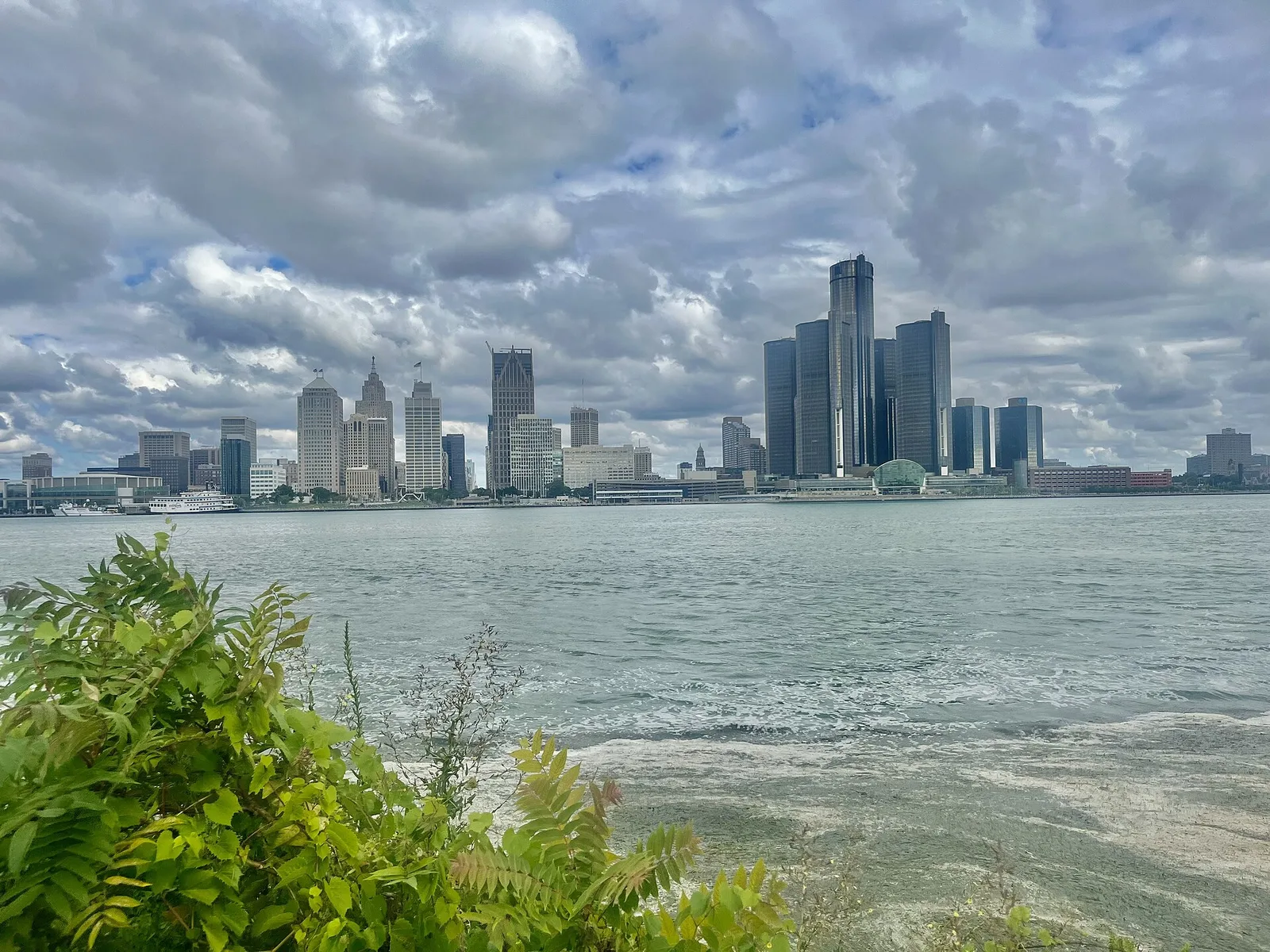
Detroit is the beating heart of Michigan, the city that invented the American middle class through the assembly line, and the city that paid the steepest price when the industrial economy contracted. Metro Detroit today encompasses a complex patchwork of the city proper (population roughly 620,000) and dozens of wealthy and working-class suburbs that collectively make up the nation's 14th-largest metropolitan area. The auto industry's headquarters, GM's Renaissance Center in downtown Detroit, Ford's campus in Dearborn, Stellantis in Auburn Hills, anchor the regional economy.
Detroit's cultural legacy is extraordinary: Motown music, the Detroit techno scene, iconic architecture, the Tigers and Lions and Red Wings and Pistons. The city has experienced significant revitalization in its downtown and midtown areas, though deep poverty and inequality persist in many neighborhoods.
Detroit peaked at 1.85 million people in 1950, the fourth-largest U.S. city, then lost about two-thirds of that population over 70 years to suburbanization, disinvestment, and the 1967 unrest, bottoming near 620,000 in the 2020 census, its lowest since 1910. The 2013 Chapter 9 bankruptcy, the largest municipal filing in U.S. history at more than 18 billion dollars, was resolved in 2014 through the 'Grand Bargain,' in which foundations and the state put up about 800 million dollars to shore up pensions and keep the Detroit Institute of Arts collection from being sold.
Southeast Michigan is sharply divided by municipal boundaries: 8 Mile Road separates Detroit from the wealthier suburbs of Oakland County, and the region has long been one of the most residentially segregated metros in the country, a legacy of racial covenants, redlining, and the 1974 Supreme Court decision Milliken v. Bradley, which blocked cross-district school desegregation. Dearborn, home to Ford's headquarters and the Henry Ford Museum, has one of the highest concentrations of Arab Americans in the United States.
Recent downtown investment has been led by Quicken Loans founder Dan Gilbert, whose Bedrock firm owns dozens of downtown buildings, and by the Ilitch family, owners of Little Caesars, the Red Wings, and the Tigers, who built the District Detroit around Little Caesars Arena. Detroit's three casinos, authorized by a 1996 statewide vote, are the only commercial (non-tribal) casinos in Michigan.
West Michigan is a different world from Detroit, more conservative, more Dutch Reformed Protestant in heritage, and defined economically by its furniture industry and, increasingly, healthcare and technology. Grand Rapids is Michigan's second-largest city and the economic capital of western Michigan. The city is home to major healthcare systems (Corewell Health, Spectrum Health, and others that collectively make it one of the nation's largest per-capita healthcare markets), the global headquarters of Meijer and Amway, and a growing technology sector.
Steelcase and Herman Miller (now MillerKnoll) make west Michigan the furniture capital of the world. The region is also known for its extensive arts community, Grand Rapids hosts ArtPrize, one of the largest and most attended art competitions in the world.
The area was settled heavily by Dutch Calvinist immigrants beginning with a religious colony founded at Holland in 1847, and towns such as Holland and Zeeland still hold a Tulip Time festival each May; Calvin University and the Christian Reformed Church remain headquartered in Grand Rapids. That heritage helped make Kent and Ottawa counties among the most reliably Republican in Michigan for generations, though Grand Rapids itself has trended Democratic in recent cycles.
West Michigan money underwrote a large share of Michigan's conservative political infrastructure through the DeVos family, heirs to the Amway direct-sales fortune based in Ada; Betsy DeVos served as U.S. Secretary of Education from 2017 to 2021, and Dick DeVos ran for governor in 2006. The Van Andel and Meijer families, the latter having founded the supercenter chain in Greenville in 1934, have similarly shaped the region's hospitals, research institutes, and public spaces.
Grand Rapids poured public and private money into a 'Medical Mile' along Michigan Street starting in the 2000s, anchored by the Van Andel Institute research center, a Michigan State University medical campus, and Corewell Health's Butterworth hospital, turning a former manufacturing city into a regional health hub. ArtPrize, founded by Rick DeVos in 2009, awards some of the largest cash prizes in the art world, decided partly by public vote, and briefly made Grand Rapids one of the most-visited art destinations in the country each fall.
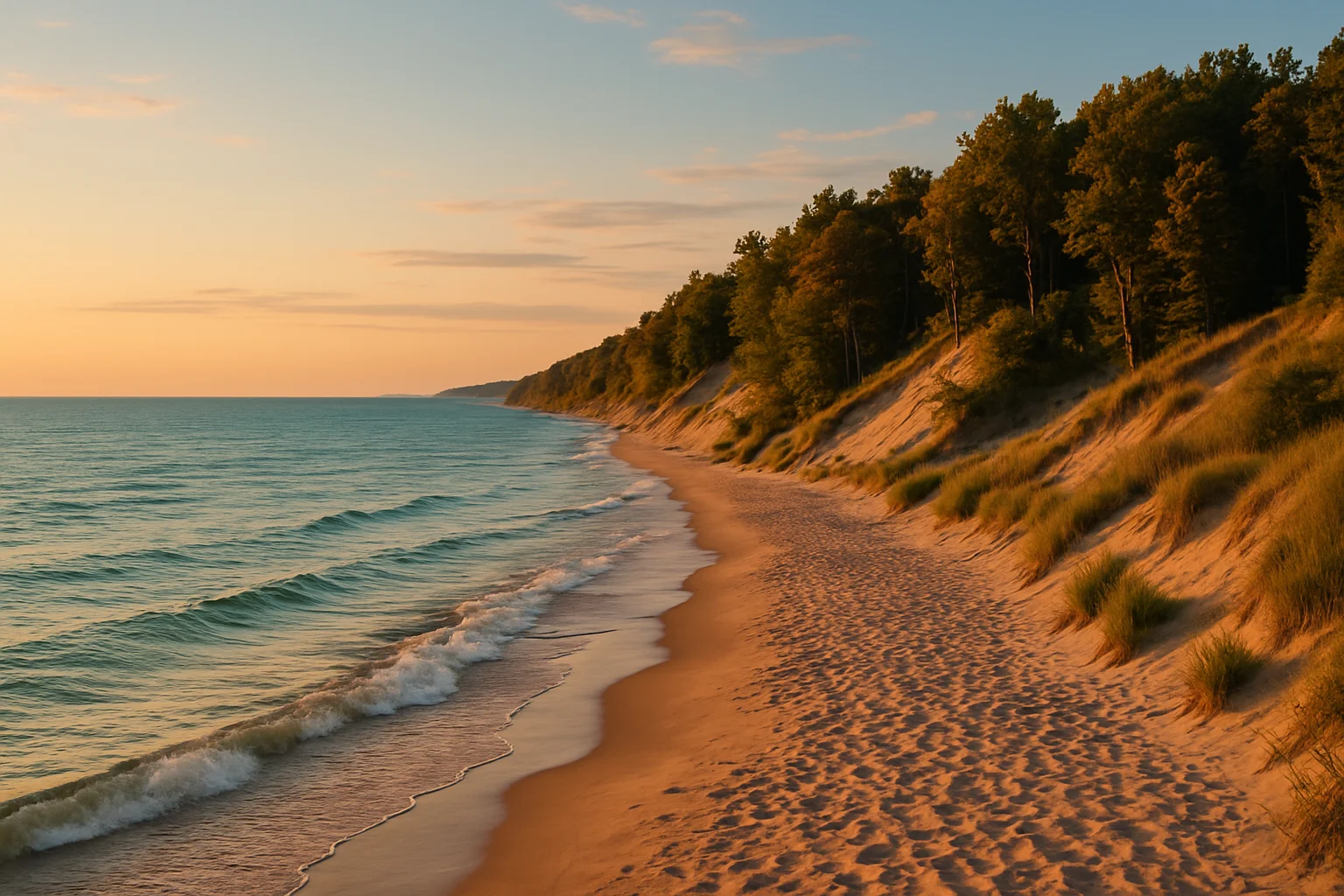
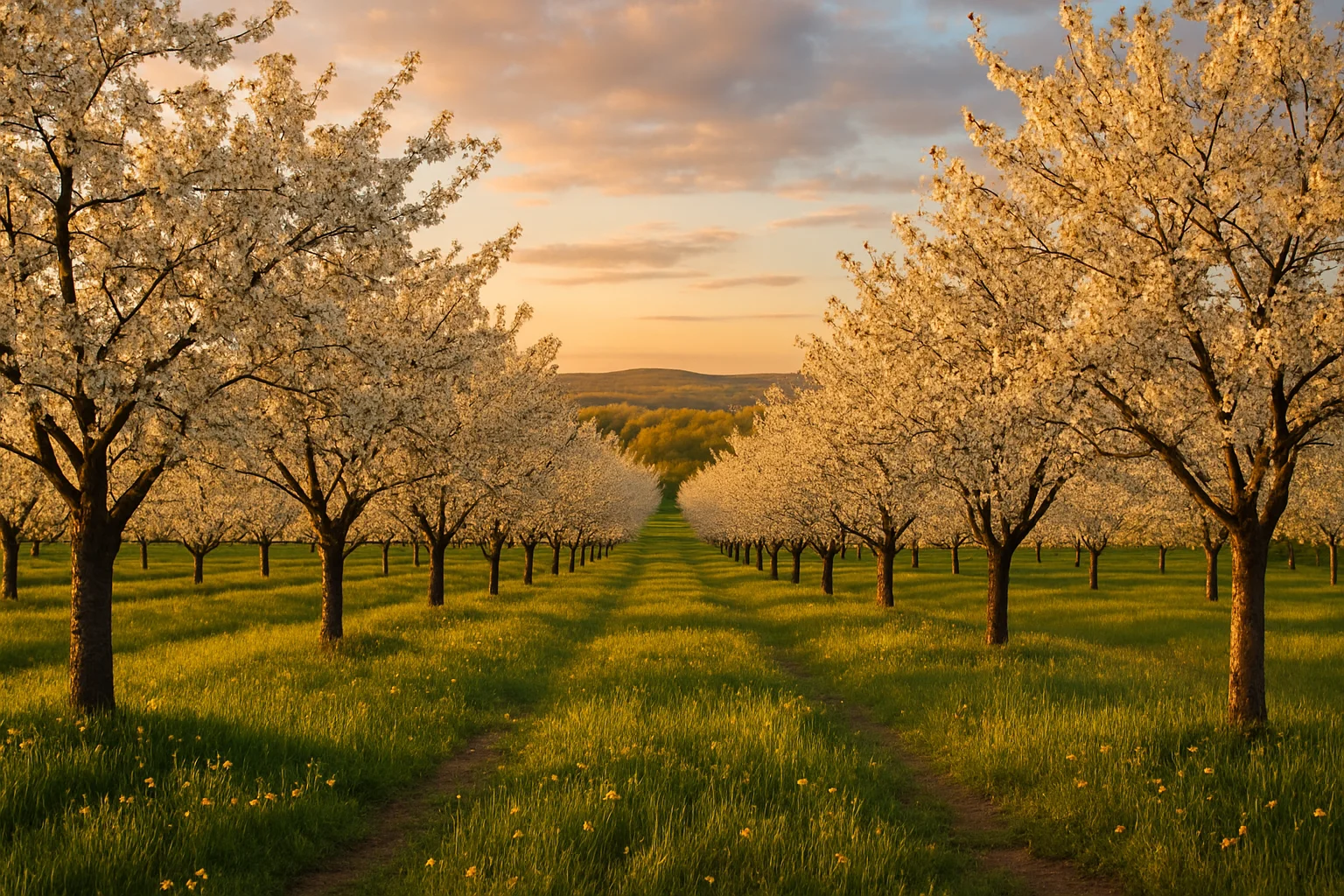
North of a rough line from Traverse City to Bay City, Michigan's Lower Peninsula becomes a landscape of forests, inland lakes, sand dunes, and small resort towns that bear little resemblance to the industrial south. This is vacation Michigan, the cherries, the beaches, the ski hills, the wineries. Traverse City is the crown jewel of northern Michigan, situated on Grand Traverse Bay with a vibrant food-and-drink scene, a major cherry industry, and direct access to Sleeping Bear Dunes National Lakeshore.
Petoskey, Charlevoix, Harbor Springs, and Boyne City are among the resort towns that have attracted wealthy second-home buyers for generations. The Straits of Mackinac, where Lake Michigan and Lake Huron meet, is crossed by the Mackinac Bridge, the gateway to the Upper Peninsula and one of Michigan's most iconic structures.
The resort economy here dates to the railroad and steamboat era of the 1870s and 1880s, when Petoskey's Bay View and other Methodist and Chautauqua summer colonies drew visitors from Chicago, Cincinnati, and St. Louis; Ernest Hemingway spent boyhood summers at the family cottage on Walloon Lake and set several early stories in the area. Petoskey stones, fossil coral from a 350-million-year-old sea, are found on the beaches and are Michigan's state stone.
The region's fortunes swing hard with the seasons and the economy: summer and fall-color weekends fill every room, while winter depends on lake-effect snow and the ski hills, and the 2008 downturn and second-home price swings hit the area sharply. Traverse City, the largest city north of Grand Rapids, has grown into a year-round destination with a nationally noticed restaurant scene, the National Cherry Festival, and the Traverse City Film Festival that filmmaker Michael Moore ran from 2005 to 2019.
Underlying the tourism is a live infrastructure fight: the Line 5 oil and gas pipeline, built by Enbridge in 1953, runs along the lakebed through the Straits of Mackinac, and the state and the company have battled in court since 2019 over shutting it down versus encasing it in a tunnel, with a Great Lakes oil spill as the stakes. The Mackinac Bridge, 26,372 feet between anchorages, is maintained by a state authority funded entirely by tolls.
The Upper Peninsula, or the 'U.P.', is Michigan's most remote and distinctive region. Separated from the Lower Peninsula by the Straits of Mackinac and connected since 1957 by the Mackinac Bridge, the U.P. has a culture and identity all its own. 'Yoopers' (UP residents) are known for their resilience, their Finnish and Scandinavian heritage, their particular dialect (da UP, eh?), and their devotion to hunting, fishing, snowmobiling, and the outdoors.
The U.P. was once one of the most productive copper and iron mining regions in the world, the Keweenaw Peninsula produced enormous quantities of copper in the 19th and early 20th centuries. Today the economy relies on tourism, government, timber, and the many visitors drawn to Pictured Rocks National Lakeshore, Tahquamenon Falls, and Isle Royale National Park.
The Keweenaw copper rush of the 1840s was the first major mineral rush in U.S. history, predating the California gold rush, and its mines, mostly worked by Cornish, Finnish, Italian, and Slavic immigrants, produced more than 11 billion pounds of copper before the last closed in 1968; Congress created Keweenaw National Historical Park in 1992 to preserve the district. The bitter 1913 to 1914 copper strike included the Italian Hall disaster, in which 73 people, most of them children, were crushed to death in a stairway panic at a strikers' Christmas party.
Iron, not copper, is the U.P.'s surviving mining industry: the Marquette and Menominee iron ranges still feed the Tilden mine near Ishpeming, one of the last operating iron mines in the United States, whose taconite pellets move by rail and ore boat to the steel mills of the lower Great Lakes. The Eagle nickel and copper mine near Marquette, opened in 2014, is the state's newest.
The U.P. holds about 3 percent of Michigan's people across roughly a third of its land, and periodic, never-serious statehood movements would name the resulting state 'Superior.' Northern Michigan University in Marquette and Michigan Technological University in Houghton, founded in 1885 as a mining school, are the region's largest institutions, and Sault Ste. Marie, Michigan's oldest city, dating to a French mission of 1668, sits at the locks that carry more freight tonnage than the Panama and Suez canals combined.
The center of Michigan's Lower Peninsula is its governmental and industrial heartland. Lansing is the state capital and home to state government and Michigan State University's sprawling campus in adjacent East Lansing.
Flint, once one of the most important General Motors cities in the world, suffered catastrophically as auto manufacturing declined, its bankruptcy, population loss, and devastating 2014-2019 water crisis (in which the city's water supply was contaminated with lead due to government failures at every level) made it a national symbol of industrial decline and institutional failure. The Saginaw Valley, running from Flint north through Saginaw and Bay City to Midland (home to Dow Chemical), remains an important but economically challenged part of mid-Michigan.
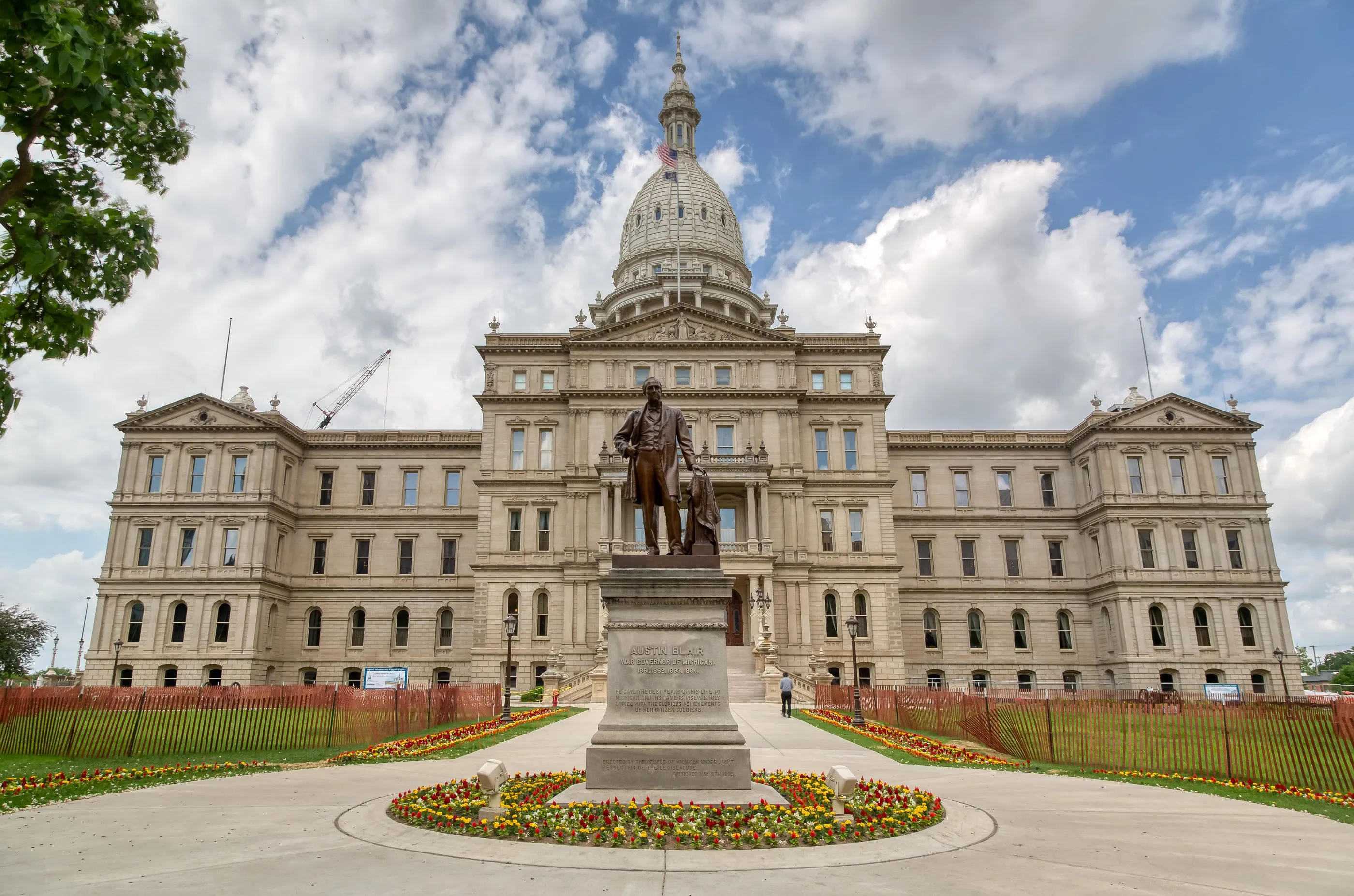
Lansing became the capital in 1847 when the legislature moved the seat of government from Detroit, then a vulnerable border town, to an almost unsettled spot in the interior forest; the current Elijah Myers-designed capitol was dedicated in 1879. General Motors still builds Cadillacs and Chevrolets at Lansing Grand River and Lansing Delta Township, and Michigan State University, a land-grant institution founded in 1855, enrolls roughly 50,000 students just east of the city.
Flint was the birthplace of General Motors in 1908 and of the 1936 to 1937 sit-down strike that made the United Auto Workers a force, and GM employed around 80,000 people there at its 1970s peak; that fell below 8,000 by the 2000s, the collapse chronicled in Michael Moore's 1989 film 'Roger and Me.' The city's population dropped from about 200,000 in 1960 to under 100,000, and a state-appointed emergency manager controlled its finances during the water crisis.
The 2014 switch of Flint's water source to the improperly treated Flint River exposed up to 100,000 residents to lead and is linked to a Legionnaires' disease outbreak that killed at least 12 people; criminal charges against state officials, including former Governor Rick Snyder, were filed, dismissed on procedural grounds, and largely not refiled, and a 626 million dollar civil settlement was approved in 2021. Midland, 40 miles north, is a company town built around Dow, founded there in 1897, and its Dow-funded institutions include the Herbert H. Dow-designed Dow Gardens and an Alden B. Dow architectural legacy.

Economy
Michigan's economy is being rebuilt around the same industries that built it the first time, with batteries and software replacing carburetors and transmissions as the key technologies.
General Motors, Ford Motor Company, and Stellantis, the Detroit Three, are all headquartered in the metro Detroit area. Michigan's automotive supply chain extends deep into the state, with hundreds of parts manufacturers, toolmakers, and engineering firms spread from Detroit to Lansing to Flint and beyond.
The industry employs hundreds of thousands of Michigan workers directly and supports an enormous ecosystem of services, logistics, and professional firms. When the auto industry struggles, as it did in the 2008 financial crisis, Michigan's entire economy feels it.
The 2008 to 2009 collapse was near-total: General Motors and Chrysler both filed for bankruptcy in 2009 and were kept alive by roughly 80 billion dollars in federal loans through the Troubled Asset Relief Program, Ford alone avoided bankruptcy by mortgaging its assets in 2006. Michigan's unemployment rate peaked above 14 percent in 2009, the highest of any state, and the state lost around 800,000 jobs during the 2000s, a decade local economists call Michigan's 'lost decade.'
The industry recovered sharply in the 2010s, and Michigan still assembles more vehicles than any other state and hosts the headquarters and technical centers where most U.S. models are engineered. The United Auto Workers, founded in Detroit in 1935, negotiates its national contracts with the Detroit Three from Michigan; its six-week strike against all three companies in the fall of 2023 won roughly 25 percent wage increases over the contract's life.
Suppliers matter as much as the automakers: firms such as Lear, BorgWarner, and the bankrupt-and-reborn Delphi and Visteon are Michigan-rooted, and the state's tool-and-die shops make the stamping dies used industry-wide. Michigan also leads the nation in automotive research and development spending, concentrated in a corridor from Dearborn through Warren to Auburn Hills.
The state has attracted billions in electric vehicle and battery manufacturing investment, including a massive Ford EV assembly plant in Marshall (BlueOval Battery Park Michigan), GM battery facilities across the state, and dozens of EV startups and suppliers. Ann Arbor has emerged as a global hub for autonomous vehicle technology, the University of Michigan's Mcity testing facility and the presence of major tech companies have made it one of the leading AV research centers in the world.
The Whitmer administration has aggressively pursued EV manufacturing deals, framing it as Michigan's chance to own the next generation of the industry it built the last.
The state created a multibillion-dollar incentive fund, the Strategic Outreach and Attraction Reserve, in 2021 after losing a large Ford battery plant to Kentucky and Tennessee, and used it to land Ford's roughly 3.5 billion dollar BlueOval Battery Park lithium-iron-phosphate plant in Marshall in 2023. That project drew unusual bipartisan criticism because the battery technology is licensed from the Chinese company CATL, prompting federal scrutiny and a temporary pause before construction resumed at reduced scale.
General Motors is converting its Factory Zero plant on the Detroit-Hamtramck line to build electric trucks and the Hummer EV, and its joint venture Ultium Cells is building battery plants tied to Michigan supply lines. GM's Warren Technical Center, opened in 1956 and designed by Eero Saarinen, remains the company's main engineering campus.
The autonomous-vehicle side is centered on Ann Arbor, where the University of Michigan's 32-acre Mcity proving ground opened in 2015 as the first purpose-built test town for driverless cars, and on the state-owned American Center for Mobility at the former Willow Run bomber site. Michigan also converted a stretch of Interstate 94 between Detroit and Ann Arbor into a testbed for connected-vehicle infrastructure.
The state is the nation's top producer of tart cherries, the Traverse City area around Grand Traverse Bay produces over 75% of the country's tart cherry crop annually, thanks to the moderating influence of Lake Michigan. Michigan is also a top producer of blueberries, apples, asparagus, dry beans, sugar beets, and floriculture products.
The state has developed a thriving craft beverage industry, Michigan has more craft breweries than almost any other state, and its wine industry along the Lake Michigan Shore is producing nationally recognized wines. Dairy farming and beef cattle remain important across the state.
Michigan grows the large majority of the U.S. tart-cherry crop from orchards on the Old Mission and Leelanau peninsulas near Traverse City, which hosts the National Cherry Festival each July, and it is a national leader in dry edible beans, celery, cucumbers for pickles, Niagara and Concord grapes for juice, and potted geraniums and Easter lilies. A late frost in 2012 destroyed roughly 90 percent of that year's fruit crop, a warning about the industry's exposure to a warming, more erratic spring.
Dairy is the state's single largest agricultural sector by value, and Michigan milk production has kept rising even as farm numbers fall, with large operations concentrated around the Thumb and the Grand Rapids area; the fairlife and Great Lakes Cheese plants built in the 2020s added major in-state processing. Sugar beets grown in the Saginaw Valley and Thumb support the grower-owned Michigan Sugar Company, one of the largest beet-sugar producers in the country.
Grand Rapids brands itself 'Beer City' and Michigan has more than 400 breweries, led by Bell's in Kalamazoo and Founders in Grand Rapids, both later bought by larger firms. The wine industry, clustered in five federally designated growing areas near Lake Michigan and on the Leelanau and Old Mission peninsulas, has grown to hundreds of vineyards specializing in Riesling and cold-hardy hybrids.
The University of Michigan in Ann Arbor is one of the great public research universities in the world, consistently ranked among the top 10 public universities nationally, a major medical center, and an economic engine for the Ann Arbor region. Michigan State University in East Lansing is one of the nation's top agricultural and research institutions. Henry Ford Health, Beaumont Health (now Corewell Health), and the University of Michigan Health System are among the state's largest employers.
The Detroit Medical Center serves as a major academic medical complex in the city. Healthcare employs more Michiganders than any other single sector.
The University of Michigan enrolls about 52,000 students in Ann Arbor and runs the largest research operation of any U.S. public university, spending well over 1.8 billion dollars a year, and its 1817 founding in Detroit predates statehood by two decades. Michigan State, chartered in 1855 as the nation's pioneer land-grant college and the model for the 1862 Morrill Act, houses the College of Human Medicine and the largest osteopathic medical school in the country.
The 2016 to 2018 prosecution of Larry Nassar, a sports-medicine doctor at MSU and USA Gymnastics, for decades of sexual abuse of hundreds of young athletes led to a 500 million dollar university settlement, the resignation of MSU's president, and federal legislation on athlete protection. It remains one of the largest institutional-abuse scandals in American higher education.
Hospital consolidation reshaped the sector in the 2020s: Spectrum Health of Grand Rapids and Beaumont Health of metro Detroit merged in 2022 to form Corewell Health, now the state's largest employer with more than 60,000 workers, and Michigan Medicine, Henry Ford Health, and Detroit's Wayne State University medical school anchor the southeast. Michigan's 2014 Healthy Michigan Plan expanded Medicaid to more than 600,000 additional residents.
Sleeping Bear Dunes National Lakeshore on the Lake Michigan shore is one of the most spectacular landscapes in the Midwest. Mackinac Island, accessible only by ferry or small plane, is one of the most visited tourist destinations in the Great Lakes region, no motor vehicles are permitted on the island, and horses and bicycles are the primary transportation. Traverse City is a destination for wine, cherries, and outdoor recreation.
The Upper Peninsula draws hunters, snowmobilers, backpackers, and visitors to the Pictured Rocks National Lakeshore. Michigan's two Great Lakes peninsulas create year-round outdoor recreation opportunities across all four seasons.
Mackinac Island banned automobiles in 1898, and the ban still holds: about 500 year-round residents and roughly a million summer visitors move by horse-drawn carriage, bicycle, or on foot, and the 1887 Grand Hotel has the longest porch in the world at 660 feet. The whole island became Michigan's first state park in 1895 after briefly serving, from 1875, as the second national park in the country after Yellowstone.
Pictured Rocks near Munising was designated the first national lakeshore in the United States in 1966, and Sleeping Bear Dunes followed in 1970; Isle Royale, a roadless island in Lake Superior closer to Canada than to Michigan, became a national park in 1940 and hosts the longest-running predator-prey study in the world, tracking wolves and moose since 1958. Michigan's state park system, begun in 1919, now covers more than 100 parks visited tens of millions of times a year.
Winter tourism is real money in the north: the Upper Peninsula routinely records 200 or more inches of snow, Keweenaw County sometimes over 300, feeding thousands of miles of groomed snowmobile trail, and downhill resorts such as Boyne Mountain and Crystal Mountain anchor the northern Lower Peninsula. The 51-mile Mackinac Bridge, opened in 1957, carries the annual Labor Day walk that draws tens of thousands.
The state is home to a significant defense and aerospace manufacturing sector, General Dynamics Land Systems in Sterling Heights builds the Abrams main battle tank, the primary tank of the U.S. Army. L3Harris, BAE Systems, and dozens of other defense contractors maintain Michigan facilities.
The state's deep metalworking, stamping, and precision machining base, built around automotive manufacturing, translates directly into defense production capability. Michigan contributed enormously to American military might during World War II, when the Detroit area's auto plants were converted to produce tanks, jeeps, aircraft engines, bombers, and ammunition at a scale and speed the world had never seen.
The Detroit Arsenal in Warren, opened in 1941 as the Detroit Tank Arsenal under Chrysler management, built roughly a quarter of all U.S. tanks in World War II and is still the Army's headquarters for ground-vehicle development, home to the TARDEC research center and thousands of engineering jobs. General Dynamics Land Systems runs the adjacent plant in Sterling Heights that produces and upgrades the M1 Abrams, the only heavy-tank production line in the country.
Selfridge Air National Guard Base near Mount Clemens, established in 1917, is one of the oldest continuously operating military airfields in the United States and supports thousands of jobs; the Air Force announced in 2023 that it would base new F-15EX fighters there. Michigan's congressional delegation has fought for decades to keep both Selfridge and the Battle Creek Air National Guard base off the federal closure list.
The state's WWII output was staggering in scale: beyond Willow Run's B-24 bombers, Detroit-area plants built the great majority of American military trucks and jeeps, Packard produced Rolls-Royce Merlin aircraft engines under license, and Michigan factories turned out artillery, shells, and radar sets. Franklin Roosevelt's 'Arsenal of Democracy' phrase, coined in a December 1940 fireside chat, was aimed squarely at Detroit.
How Michigan's Government Works
Michigan's state government follows the standard three-branch structure: the Executive (Governor), the Legislative (the Michigan Legislature), and the Judicial (the Michigan Supreme Court, which has seven justices elected in nonpartisan elections serving 8-year terms).
The Governor serves a four-year term and is limited to two consecutive terms. Michigan holds its gubernatorial elections in midterm years. The Governor has strong executive authority, including the power of a line-item veto on appropriations bills, allowing the Governor to strike specific spending items without rejecting an entire budget.
Michigan's political landscape shifted dramatically in 2022, when Democrats won the governorship (re-electing Gretchen Whitmer), and flipped both the State Senate and the State House, giving Democrats unified control of state government for the first time since 1983. The Democratic trifecta produced a burst of legislation including repeal of the state's right-to-work law, expansion of civil rights protections, and major clean energy legislation. Republicans won back the State House in November 2024, 58 to 52, ending the trifecta.
Michigan has one of the most consequential state supreme courts in the country, in a state where the auto industry, labor law, tort litigation, and environmental regulation intersect at high stakes, the court's ideological balance matters enormously. Justices run in nominally nonpartisan elections but are nominated by party conventions.
Governor of Michigan
Current Governor
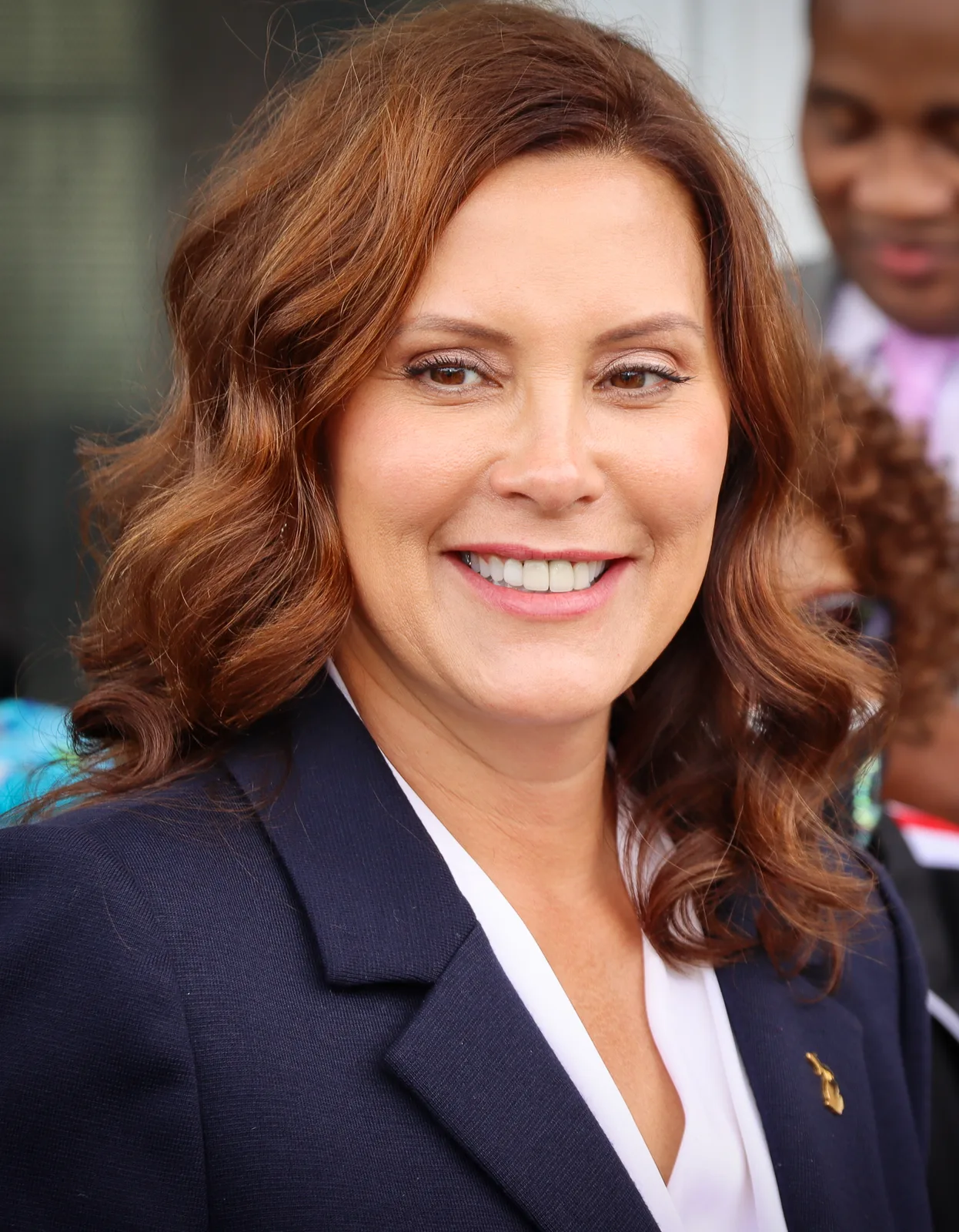
Gretchen Whitmer
- Party
- Democrat
- In Office Since
- January 1, 2019
- Re-elected
- November 8, 2022
- Term Ends
- January 2027
- Born
- August 23, 1971, East Lansing, MI
- Education
- Michigan State University (BA); Detroit College of Law at MSU (JD)
- Prior Role
- Michigan State Senate Minority Leader (2011–2015); Michigan State Representative (2001–2006)
Gretchen Whitmer is Michigan's 49th Governor and the second woman to hold the office, after Jennifer Granholm (2003 to 2011). She gained national prominence during the COVID-19 pandemic for her early and aggressive public health orders, which made her both a national Democratic hero and the target of a foiled domestic terrorism plot in 2020, when a group of men were arrested for planning to kidnap her. Re-elected by nearly 11 points in 2022, she has focused on infrastructure ("fix the damn roads"), clean energy, and the EV transition. She was considered a serious contender for the 2024 Democratic presidential nomination before President Biden withdrew.
Other Current State Officials
Lieutenant Governor
Garlin Gilchrist II
In office since January 2019, re-elected 2022. A former technology entrepreneur and Detroit city official, Gilchrist is Michigan's first Black lieutenant governor. He focuses on economic opportunity, technology policy, and broadband access.
Attorney General
Dana Nessel
In office since January 2019, re-elected 2022. Michigan's first openly LGBTQ+ statewide official. Nessel has pursued aggressive consumer protection, environmental enforcement, and civil rights litigation, including challenging the Trump administration's rollback of LGBTQ+ protections.
Secretary of State
Jocelyn Benson
In office since January 2019, re-elected 2022. A former dean of Wayne State University Law School, Benson has expanded voting access in Michigan and vigorously defended the state's 2020 election results against pressure from President Trump and his allies. She has become a national figure in election administration.
The Michigan Legislature
Michigan State Senate
- Seats: 38 members
- Terms: 4-year terms
The upper chamber. All 38 Michigan senators are elected together to 4-year terms. Since voters approved Proposal 1 in 2022, legislators may serve a combined 12 years in the House and Senate (the 1992 limits were two Senate terms and three House terms). Democrats flipped the Senate in 2022, the first time they held it since 1983.
Michigan House of Representatives
- Seats: 110 members
- Terms: 2-year terms
The lower chamber. All 110 House seats are on the ballot every two years. Members are covered by the 12-year combined limit adopted in 2022. Democrats flipped the House in 2022, completing Michigan's first Democratic trifecta since 1983; Republicans have held it since January 2025, 58 to 52.
Michigan's U.S. Senators
U.S. Senator
Gary Peters
Michigan's senior senator, Peters previously served in the U.S. House representing Michigan's 9th District and before that as Michigan's state lottery commissioner and a member of the Rochester Hills City Council. He sits on the Senate Homeland Security and Armed Services Committees. Peters won re-election in 2020 over Republican John James in one of the closest Senate races of the cycle. He is not seeking a third term, so his seat is open on the November 2026 ballot.
U.S. Senator
Elissa Slotkin
Michigan's junior senator, Slotkin won the November 2024 Senate election in a competitive race, succeeding the retiring Debbie Stabenow. A former CIA analyst and Defense Department official who served in Iraq, Slotkin represented Michigan's 7th Congressional District (later 8th District) in the House from 2019 to 2025. She is known for her national security expertise and centrist positioning on economic issues.
Michigan Through the Years
From early settlement to the present day. Tap any era to read more.
Long before European arrival, the Great Lakes region was home to the Anishinaabe peoples, a group of related Algonquian-speaking nations that included the Ojibwe (Chippewa), Ottawa (Odawa), and Potawatomi. These three nations formed a political and military alliance called the Council of Three Fires, which controlled enormous stretches of the Great Lakes basin for centuries. The Ojibwe were masters of the vast northern forests and lake country of the Upper Peninsula and northern Lower Peninsula.
The Ottawa dominated the Straits of Mackinac and were central to the fur trade. The Potawatomi lived across the southern Lower Peninsula. Michigan's place names, Michigan (from the Ojibwe 'mishigamaa,' meaning 'large water'), Mackinac, Kalamazoo, Saginaw, Muskegon, are almost entirely Indigenous in origin.
In 1763, after the French defeat in the Seven Years' War, the Ottawa war leader Pontiac organized a broad uprising against the British and besieged Fort Detroit for roughly six months, part of a coordinated war in which allied nations captured most British posts in the western Great Lakes. The conflict pushed London to issue the Proclamation of 1763 barring colonial settlement west of the Appalachians, one of the grievances that fed the Revolution.
Federal treaties in 1795, 1807, 1819, 1821, and 1836 forced the Anishinaabe to cede most of present-day Michigan, and an 1830s removal effort sent some Potawatomi west to Kansas, the 'Trail of Death,' though many Ottawa and Ojibwe bands resisted removal and stayed. The 1836 Treaty of Washington, which transferred roughly the northern half of the Lower Peninsula and the eastern Upper Peninsula, explicitly reserved Anishinaabe rights to hunt and fish on the ceded land.
Those treaty rights were vindicated in modern courts: a 1979 federal ruling, United States v. Michigan, affirmed Ojibwe and Ottawa fishing rights in the Great Lakes, and today Michigan has twelve federally recognized tribes, including the Grand Traverse Band, the Sault Ste. Marie Tribe of Chippewa, and the Bay Mills Indian Community, which operate businesses, courts, and one of the first tribal casinos in the country.
French explorer and entrepreneur Antoine de la Mothe Cadillac founded Fort Pontchartrain du Détroit ('of the strait') on July 24, 1701, on the narrow waterway connecting Lake Erie to Lake Huron. Cadillac envisioned Detroit as the key to French control of the interior of North America, a fortified trading post that could command the entire Great Lakes system.
His instinct was correct: Detroit became the most strategically important location in the Great Lakes region and changed colonial hands from France to Britain (1760) to the United States (nominally 1783, actually 1796). The city Cadillac founded would become the automotive capital of the world two centuries later.
Detroit is the oldest major city in the Midwest, and its long French period left a permanent mark: the oldest neighborhoods were laid out in narrow 'ribbon farms' running back from the river, which is why streets such as Beaubien, St. Antoine, and Riopelle still carry French family names. The 1805 fire that destroyed nearly the entire wooden town produced the city's Latin motto, 'Speramus meliora; resurget cineribus,' 'We hope for better things; it shall rise from the ashes.'
Britain held Detroit for thirteen years after the 1783 peace treaty was supposed to hand it over, finally leaving in 1796 under Jay's Treaty, and briefly retook it during the War of 1812 when the American general William Hull surrendered the fort without a fight in August 1812, one of the war's worst U.S. humiliations. Oliver Hazard Perry's 1813 victory on Lake Erie forced the British out for good.
Detroit served as the capital of Michigan Territory and then the young state until the seat of government moved to Lansing in 1847, largely because an interior capital was seen as safer from British Canada and better for developing the state's center. The city then grew as a shipping, shipbuilding, stove-making, and railcar center in the decades before the automobile.
Michigan was admitted to the Union on January 26, 1837, as the 26th state. Statehood came after an unusual episode: the Toledo War, a bloodless dispute with Ohio over a narrow strip of land at the southern border. Michigan eventually accepted the compromise that gave Ohio the Toledo Strip in exchange for the Upper Peninsula.
At the time, Michigan considered itself cheated. Within decades, the discovery of enormous copper and iron deposits in the Upper Peninsula would make it one of the most economically valuable pieces of land in the nation, and Michigan's loss of Toledo looked considerably less tragic.
The Toledo Strip mattered because it held the planned Lake Erie terminus of the Wabash and Erie Canal, then the region's key trade route. In 1835 Michigan's 24-year-old acting governor, Stevens T. Mason, and Ohio's governor Robert Lucas both marched militia to the border; the only casualty of the standoff was a sheriff's deputy stabbed with a penknife during a scuffle in a tavern.
Congress imposed the settlement in June 1836 as a condition of admission, and a Michigan convention grudgingly accepted it that December in what was nicknamed the 'Frostbitten Convention.' Michigan entered the Union on January 26, 1837, and Mason, elected in his own right, became at 24 the youngest state governor in American history.
The compromise's value became clear fast: geologist Douglass Houghton's 1841 report confirmed the Keweenaw copper deposits, and the Marquette iron range was located in 1844, giving Michigan mineral wealth that the Toledo farmland could never have matched. Ohio and Michigan formally 'settled' the dispute with a friendly ceremony only in 1915, and the two states still stage a mock 'war' around their football rivalry.
Henry Ford founded the Ford Motor Company in Detroit on June 16, 1903. William Durant founded General Motors in Flint in 1908. Within a decade, Michigan had become the center of what would become the most consequential industry in American history.
Detroit's combination of access to Great Lakes shipping, proximity to iron and coal, a skilled machinist workforce, and the entrepreneurial energy of the early 20th century made it the natural home of the automobile. The industry would transform not just Michigan but American life itself, reshaping cities, suburbs, landscapes, and daily life across the country.
Ransom E. Olds was arguably first: his Olds Motor Works built the curved-dash Oldsmobile in Detroit and then Lansing from 1901 and was the first company to mass-produce a low-priced American car, more than 400 in its opening year. Detroit already had a dense base of machine shops, marine-engine builders, and carriage and stove makers whose workers and suppliers the car makers drew on.
Ford failed twice before the Ford Motor Company stuck in 1903, incorporated with about 28,000 dollars from a dozen investors including coal dealer Alexander Malcomson and the Dodge brothers, who supplied engines and later founded their own company. The Model T arrived in 1908 at 850 dollars and the price fell for years afterward as volume rose.
Billy Durant, a Flint carriage magnate, built General Motors in 1908 as a holding company that quickly absorbed Buick, Oldsmobile, Cadillac, and Oakland (later Pontiac); he lost control to bankers in 1910, regained it, and lost it for good in 1920, after which Alfred P. Sloan reorganized GM into the multi-brand, multi-division model that the whole industry copied.
Henry Ford's engineers at the Highland Park Ford Plant introduced the moving assembly line in 1913–1914, reducing the time to build a Model T from over 12 hours to 93 minutes. This innovation, breaking complex manufacturing into specialized sequential tasks moving past stationary workers, was one of the most consequential inventions in economic history.
It made the automobile affordable for ordinary Americans, created the modern factory, defined 20th-century capitalism, and established the model of mass production that spread across every manufacturing industry in the world. Ford's $5-a-day wage (roughly double the prevailing rate) attracted workers from across the U.S. and the world, beginning the Great Migration of Black Americans to Detroit.
Ford announced the 5-dollar day on January 5, 1914, cutting the workday to eight hours and roughly doubling pay, in large part to fix brutal turnover: the Highland Park plant had been hiring more than 50,000 people a year to keep about 14,000 jobs filled. The offer drew crowds so large that police turned fire hoses on job seekers outside the plant gates in the freezing January of 1914.
The wage came with strings. Ford's 'Sociological Department' sent investigators into workers' homes to check on thrift, sobriety, cleanliness, and 'Americanism' before granting the full rate, and the company ran a mandatory English-language school for its many immigrant employees. The line work itself was numbingly repetitive, and critics from Charlie Chaplin's 'Modern Times' to sociologists used Ford's plant as the emblem of dehumanized labor.
Detroit's Black population grew from around 6,000 in 1910 to more than 120,000 by 1930 as Southern migrants came for auto work, though most were confined to the lowest-paid foundry jobs and to a small, overcrowded district called Black Bottom by restrictive housing practices. The demographic shift set up the housing and job conflicts that shaped Detroit for the rest of the century.
When the United States entered World War II after Pearl Harbor, President Franklin Roosevelt turned to Detroit. In a radio address, he called on the nation's industry to arm America, and Michigan answered. The auto plants of Detroit and its surroundings were converted to produce tanks, jeeps, aircraft engines, bombers, ammunition, and military vehicles at a scale that staggered the imagination.
The Willow Run plant, built by Ford near Ypsilanti specifically for wartime production, produced a B-24 Liberator bomber every hour at its peak, one complete aircraft every 63 minutes. Michigan's wartime production was a decisive factor in Allied victory. The factory workers who made it happen, including the iconic 'Rosie the Riveter', transformed the American workforce.
Willow Run, designed by Ford production chief Charles Sorensen and covering more than 3.5 million square feet under one roof, struggled for its first year and a half, was mocked as 'Willit Run,' then hit its stride, turning out 8,600 B-24s, roughly half of all produced. One of its riveters, Rose Will Monroe, was cast in a wartime promotional film and became a real-life face of the 'Rosie the Riveter' figure.
The war effectively ended the Depression in Michigan: the auto industry stopped making civilian cars entirely from February 1942 to late 1945, and defense contracts and the resulting labor shortage pulled hundreds of thousands of new workers into Detroit factories, including large numbers of women and a second wave of Black migrants from the South. Michigan received a larger share of federal war-production dollars than any state but a few.
The rapid, crowded influx also produced violence: a fight at the Belle Isle park on June 20, 1943, escalated into three days of racial rioting across Detroit that killed 34 people, 25 of them Black, injured hundreds, and required federal troops to end. Wartime housing projects such as the Sojourner Truth homes had already drawn armed white mobs in 1942.
Berry Gordy Jr., a former Ford assembly line worker, founded Motown Records in Detroit in 1959, initially operating out of a house on West Grand Boulevard that he named 'Hitsville U.S.A.' Over the next decade, Gordy assembled one of the most remarkable rosters in music history, Stevie Wonder, Diana Ross and the Supremes, Marvin Gaye, the Temptations, the Four Tops, Martha and the Vandellas, Smokey Robinson, and the Jackson 5.
Motown's sound, tight, pop-infused R&B built around the Funk Brothers house band, crossed racial lines at a time when American radio and society were rigidly segregated, and became the most successful Black-owned business in American history to that point.
Gordy borrowed 800 dollars from his family's savings fund to start the company and ran his songwriting and production teams on a quality-control system borrowed from the auto plants, holding weekly meetings where staff voted on which records to release. Between 1961 and 1971 Motown placed more than 100 songs in the Billboard Top 10, and acts such as the Supremes rivaled the Beatles on the American charts in the mid-1960s.
The label groomed its artists for mainstream and white audiences through an in-house 'Artist Development' operation that coached choreography, diction, and stage manners, a strategy that got Black performers onto national television and into venues that had been closed to them. Marvin Gaye's 1971 album 'What's Going On,' about Vietnam, poverty, and the environment, marked Motown's shift toward socially conscious music after Gordy initially resisted releasing it.
Gordy moved the company's headquarters to Los Angeles in 1972 to expand into film and television, a blow Detroit still resents, and sold Motown Records to MCA in 1988 for about 61 million dollars. The original Hitsville U.S.A. house on West Grand Boulevard is now the Motown Museum, one of Detroit's most visited cultural sites.
On July 23, 1967, police raided an unlicensed bar (a 'blind pig') on 12th Street in Detroit, sparking five days of civil unrest that left 43 dead, over 1,000 injured, 7,200 arrested, and 2,000 buildings destroyed. The '67 rebellion, called a riot by some, a rebellion by others, was one of the most destructive civil disturbances in 20th-century American history. It accelerated white flight to the suburbs, devastated Detroit's tax base, and set the city on a decades-long trajectory of population loss and economic decline.
The causes were deep: decades of housing segregation, police brutality, unemployment, and concentrated poverty. Detroit has never fully recovered its pre-1967 population, which peaked at 1.8 million in 1950.
The immediate flashpoint was a raid on a blind pig at 12th Street and Clairmount that was celebrating the return of two Black servicemen from Vietnam; police arrested all 82 people inside, and a crowd gathered as they were held on the street. A near-all-white police force, the near-total exclusion of Black Detroiters from the building trades and many factory departments, and the 1950s demolition of the Black Bottom neighborhood for highways and 'urban renewal' had built up the grievances.
Governor George Romney sent in the Michigan National Guard and President Lyndon Johnson ordered in the 82nd and 101st Airborne divisions, the first use of federal troops in a Northern city since the 1863 draft riots. Of the 43 dead, most were Black and many were killed by law enforcement or troops; the Kerner Commission that Johnson appointed afterward famously warned that America was 'moving toward two societies, one black, one white, separate and unequal.'
The aftermath accelerated a decline already underway: Detroit lost hundreds of thousands more residents in the following decade, property values and the tax base fell, and insurers and lenders redlined much of the city. Coleman Young, elected in 1973 as Detroit's first Black mayor, would govern a city whose population and revenue kept shrinking under him for two decades.
Two catastrophic government failures defined Michigan's 2010s. In July 2013, the City of Detroit filed for Chapter 9 bankruptcy protection, the largest municipal bankruptcy in United States history, with over $18 billion in debt. The bankruptcy led to painful pension cuts for retired city workers and a years-long restructuring before Detroit emerged from bankruptcy in December 2014.
Then in 2014, state-appointed emergency managers switched Flint's water supply from Detroit's system to the Flint River as a cost-saving measure, without properly treating the corrosive river water. The result was catastrophic: lead leached from aging pipes into the drinking water of Flint's predominantly Black, low-income population, exposing nearly 100,000 residents, including thousands of children, to toxic lead levels. The Flint water crisis became a national symbol of environmental injustice and government failure.
Detroit's bankruptcy was navigated by emergency manager Kevyn Orr and federal judge Steven Rhodes, and its centerpiece was the 'Grand Bargain,' in which national and local foundations, the state, and the Detroit Institute of Arts together pledged roughly 816 million dollars over 20 years to limit cuts to city pensions, which were still trimmed by about 4.5 percent, and to protect the museum's collection from being sold to creditors. Detroit exited court supervision in December 2014.
In Flint, state regulators failed to require corrosion-control chemicals that federal rules mandate, and for 18 months officials dismissed residents' complaints about discolored, foul water even as a General Motors plant stopped using it because it was rusting engine parts. A Virginia Tech research team and a local pediatrician, Dr. Mona Hanna-Attisha, independently documented the lead in 2015, forcing the state to switch the city back to Detroit water and acknowledge the crisis.
The crisis was tied to a Legionnaires' disease outbreak that killed at least 12 people and sickened dozens more. Fifteen state and local officials were criminally charged, including former Governor Rick Snyder; the Michigan Supreme Court voided the charges in 2022 over a flawed grand-jury procedure, and most were not refiled. A 626 million dollar civil settlement, most of it paid by the state, was approved in 2021, and Flint spent years replacing thousands of lead service lines.
Michigan's Defining Moments in American History
These are the events that didn't just shape Michigan, they changed the nation.
On December 1, 1913, Henry Ford introduced the moving assembly line at his Highland Park plant, a production method that transformed not just the automobile industry but the entire global economy. By bringing the work to the worker rather than the worker to the work, Ford slashed the time to build a Model T from 12 hours to 93 minutes.
He then paid workers $5 a day, double the prevailing wage, so they could afford to buy what they built. Ford's methods created both modern manufacturing and the American middle class.
The line was assembled from pieces already in use elsewhere, the disassembly lines of Chicago meatpacking, conveyor systems in flour mills and breweries, interchangeable parts from the federal armories, and Ford engineers spent 1913 timing every motion and adding sub-assembly lines feeding the main one. The magneto line came first, then the engine, then final assembly in 1914.
The payoff was scale and price: a Model T that cost 850 dollars in 1908 fell to under 300 dollars by the mid-1920s, and Ford built more than 15 million of them before production ended in 1927, at times more than half of all cars on Earth. Rivals had to copy the method or die, and 'Fordism' entered several languages as a name for high-wage, high-volume industrial capitalism.
The same techniques hardened work discipline: jobs were deskilled into seconds-long tasks, the line set the pace, and Ford fiercely resisted unions until a 1937 confrontation at the Rouge plant, the 'Battle of the Overpass,' in which company security beat United Auto Workers organizers. Ford was the last of the Detroit automakers to recognize the UAW, in 1941.
In 1959, Berry Gordy Jr. founded Motown Records in Detroit with an $800 loan. What emerged was a record label that defined American pop music for a generation: Diana Ross and the Supremes, Stevie Wonder, Marvin Gaye, The Temptations, the Jackson 5.
Motown's music crossed racial lines at a moment when America was deeply divided, playing on both Black and white radio stations, performing on both white-owned and Black-owned stages. The Motown Sound was a soundtrack to the civil rights era, joyful and insistent that Black artists deserved to be heard everywhere.
The 800-dollar loan came from the Gordy family's Ber-Berry cooperative savings fund, and Gordy applied the discipline he had learned on the Lincoln-Mercury line, a house band called the Funk Brothers, staff songwriters like Holland-Dozier-Holland, a quality-control meeting every Friday morning, and an Artist Development unit that drilled the acts in choreography and etiquette. Between 1961 and 1971 the label put more than 100 singles in the Billboard Top 10.
Motown deliberately built a sound that would play on white Top 40 radio, and it worked: the Supremes scored 12 number-one hits, and Motown acts appeared on 'The Ed Sullivan Show' and toured the still-segregated South, where the label's own Motortown Revue buses were shot at and its integrated audiences were a quiet act of desegregation. Martin Luther King Jr.'s speeches were released on a Motown spoken-word subsidiary.
As the decade turned, the artists pushed past the pop formula: Marvin Gaye's 'What's Going On' (1971) and Stevie Wonder's run of albums from 'Music of My Mind' (1972) to 'Songs in the Key of Life' (1976) turned Motown toward social commentary and full artistic control. Gordy relocated the company to Los Angeles in 1972 and sold the record label in 1988; the Hitsville house is now the Motown Museum.
In the winter of 1936-37, United Auto Workers members staged a sit-down strike at the General Motors plants in Flint, Michigan, refusing to leave the factories and preventing GM from using replacement workers. After 44 days, GM recognized the UAW as the bargaining representative for its workers.
The victory transformed American labor relations. Benefits and working conditions won by Michigan auto workers set standards that spread nationwide, creating the pattern for the post-war middle-class prosperity that defined 20th-century America.
The strike began on December 30, 1936, when workers occupied Fisher Body Plant No. 1 and later the crucial Chevrolet engine plant No. 4, choosing to sit inside rather than picket outside so the company could not simply hire replacements and run the machines. On January 11, 1937, police tried to storm Fisher Body No. 2 in freezing weather; strikers drove them back with hinges, bottles, and fire hoses in a clash the press called the 'Battle of the Running Bulls,' with more than a dozen people shot.
Michigan's newly elected Democratic governor, Frank Murphy, mobilized the National Guard but pointedly refused to use it to evict the strikers, and instead pressed GM to negotiate; President Roosevelt also leaned on the company. GM, unable to produce cars, its output had fallen from 50,000 vehicles a week to a few thousand, recognized the UAW as bargaining agent for the strikers on February 11, 1937.
Chrysler settled within weeks, and by decade's end the sit-down tactic had spread to rubber, steel, and retail before the Supreme Court ruled sit-down strikes illegal in 1939. The UAW grew from a few thousand members in 1936 to hundreds of thousands, and the pattern bargaining it won, employer-paid health insurance in 1950, cost-of-living raises, and pensions, became the template for unionized industrial America.
On July 23, 1967, a police raid on an unlicensed bar in Detroit's predominantly Black Virginia Park neighborhood sparked five days of civil unrest that killed 43 people, injured 1,189, and left 2,000 buildings destroyed. The Detroit Rebellion, as many residents call it, was among the deadliest urban uprisings of the civil rights era.
It accelerated white flight from the city, hastened deindustrialization, and profoundly shaped American debates about policing, urban policy, and structural racism in ways that remain unresolved today.
It was the deadliest of the roughly 160 urban uprisings across the United States in the summer of 1967, and President Johnson ordered nearly 5,000 Army paratroopers into the city alongside the Michigan National Guard. Detroit had been considered a national 'model city' for race relations, with a Black middle class, Black auto-union leadership, and federal antipoverty money, which made the scale of the violence especially jarring to policymakers.
The Kerner Commission, appointed by Johnson days later and reporting in 1968, blamed 'white racism' and documented how policing, housing, and hiring discrimination had produced the conditions; its warning that the country was splitting into 'two societies, separate and unequal' became one of the most quoted sentences in American social history. The commission's spending recommendations were largely not adopted.
One incident, the killing of three young Black men at the Algiers Motel by police and guardsmen during the unrest, produced no convictions and became a lasting symbol of impunity, later the subject of John Hersey's book and Kathryn Bigelow's 2017 film 'Detroit.' The city's population fell below one million by 1990 and kept falling for another 20 years.
The Great Lakes hold 21 percent of the world's surface fresh water. Michigan, with more freshwater coastline than any other state, has led the fight to protect this irreplaceable resource.
The Great Lakes-St. Lawrence River Basin Water Resources Compact, signed in 2008 after years of Michigan-led negotiation, established the first binding legal framework to govern Great Lakes water withdrawals. In a century likely to be defined by water scarcity, Michigan's stewardship of the Great Lakes may prove to be one of the most consequential environmental decisions in American history.
The push for a compact grew out of a 1998 permit, quickly withdrawn amid outcry, that would have let a company ship Lake Superior water to Asia in tankers, and out of long-running Sun Belt interest in piping Great Lakes water west. The agreement, negotiated among eight states and two Canadian provinces and ratified by Congress in 2008, generally bars new diversions of water outside the lakes' drainage basin, with narrow exceptions for communities that straddle the divide.
The rules were tested almost immediately by Waukesha, Wisconsin, a city just outside the basin with radium-contaminated wells, which won approval in 2016 to draw Lake Michigan water and return treated wastewater, the first such exception and a closely watched precedent. A Michigan case involving a Nestle bottling operation near Evart drew similar attention to how the compact treats water sold in containers.
Michigan touches four of the five Great Lakes and has more than 3,000 miles of Great Lakes coastline, more than any other state, and about 21 percent of the world's surface fresh water sits in the lakes. State and federal spending through the Great Lakes Restoration Initiative, funded since 2010, targets invasive species such as Asian carp, toxic algal blooms in Lake Erie, and legacy industrial contamination in harbors and river mouths.
Notable Michiganders
Henry Ford
Founded Ford Motor Company in 1903; invented the moving assembly line; transformed American manufacturing and daily life
Berry Gordy Jr.
Founded Motown Records in Detroit in 1959; built the most successful Black-owned business of his era; launched the careers of Stevie Wonder, Diana Ross, Marvin Gaye, and dozens of other legends
Stevie Wonder
Motown legend, born in Saginaw; one of the best-selling music artists of all time and a pioneering force in R&B, soul, and pop
Aretha Franklin
"The Queen of Soul", though born in Memphis, Franklin was raised in Detroit and is inextricably linked to the city and its music
Diana Ross
Lead singer of The Supremes and solo superstar; born and raised in Detroit; one of the bestselling female artists in history
Gerald Ford
38th President of the United States; raised in Grand Rapids; the only person to serve as both Vice President and President without being elected to either office
Magic Johnson
NBA Hall of Famer and five-time champion with the Los Angeles Lakers; born in Lansing; one of the greatest point guards in basketball history
Charles Lindbergh
First to fly solo nonstop across the Atlantic Ocean (1927); born in Detroit, raised in Minnesota
Madonna
"The Queen of Pop", born in Bay City; one of the best-selling music artists of all time and a global cultural icon
Eminem
Rapper and record producer; raised in Warren and Detroit; one of the best-selling music artists in history and widely regarded as one of the greatest rappers of all time
State Symbols & Quick Facts
| Nickname | "The Great Lakes State" (also: "The Wolverine State") |
| Capital | Lansing |
| Largest City | Detroit |
| Statehood | January 26, 1837 (26th state) |
| Population | ~10.1 million (2025 est.) |
| Area | 96,714 sq miles total (11th largest, incl. water) |
| State Bird | American Robin |
| State Flower | Apple Blossom |
| State Tree | Eastern White Pine |
| State Fish | Brook Trout |
| State Stone | Petoskey Stone (fossilized coral) |
| State Reptile | Painted Turtle |
| State Song | My Michigan |
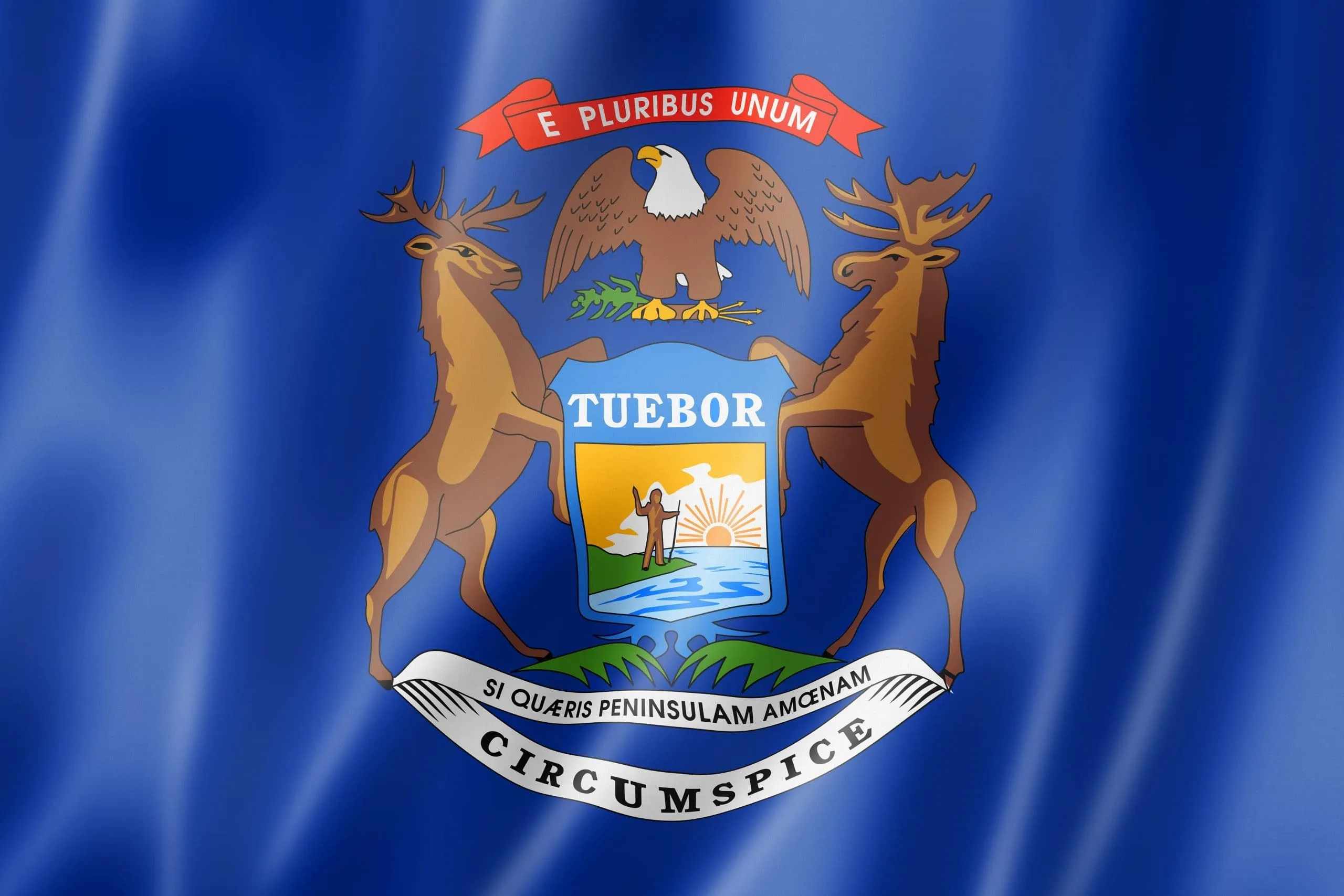
| State Motto | Si quaeris peninsulam amoenam circumspice ("If you seek a pleasant peninsula, look about you") |
| Time Zone | Eastern (most); Central (western U.P.) |
| Bordering States | OH, IN, WI (by land) |
| Great Lakes Bordered | Superior, Michigan, Huron, Erie (4 of 5) |
Did You Know?
Michigan is the only state in the contiguous United States made up of two separate peninsulas, the Lower Peninsula (shaped like a mitten) and the Upper Peninsula, connected by the Mackinac Bridge.
Michigan borders 4 of the 5 Great Lakes, Superior, Michigan, Huron, and Erie, giving it more Great Lakes shoreline (3,200+ miles) than any state except Alaska.
The state motto means 'If you seek a pleasant peninsula, look about you', one of the most apt state mottos in the country for a state that literally looks like a hand raised in greeting.
Michigan produces over 75% of the nation's tart cherries, almost entirely from the Traverse City area, where the moderating effect of Lake Michigan creates ideal growing conditions.
Detroit is the birthplace of the American automobile industry, all three of America's major automakers (GM, Ford, and Stellantis) are headquartered in the metro area.
The Mackinac Bridge, connecting the Lower and Upper Peninsulas, is one of the longest suspension bridges in the world at nearly 5 miles. Before it opened in 1957, crossing between peninsulas required a ferry.
Motown Records, founded in a Detroit house in 1959 by Berry Gordy Jr., launched the careers of Stevie Wonder, Diana Ross, Marvin Gaye, Smokey Robinson, the Temptations, and dozens of other legendary artists.
The University of Michigan was founded in 1817, nearly 20 years before Michigan became a state in 1837, making it one of the oldest public universities in the country.
Michigan has more than 11,000 inland lakes totaling more than 1,300 square miles of water, and no point in the state is more than about 85 miles from a Great Lake.
During World War II, the Ford Willow Run plant near Ypsilanti produced a complete B-24 Liberator bomber every 63 minutes at its peak, exemplifying Michigan's role as the 'Arsenal of Democracy.'
Quick Facts and Common Questions
Short answers to the questions people most often ask about Michigan: its abbreviation, how it became a state, its capital, and its place in Congress.
Michigan's two-letter postal abbreviation is MI. The U.S. Census Bureau places it in the Midwest region, in the East North Central division, and about 10.08 million people lived there in the 2020 census.
Michigan became the 26th state on January 26, 1837. Its land was part of the Northwest Territory, and Congress created the Michigan Territory in 1805.
In 1835 and 1836 Michigan and Ohio both claimed a strip of land that included the port of Toledo, and both sent militia to the area, though there was almost no bloodshed. Congress settled the dispute by giving the Toledo Strip to Ohio and the western Upper Peninsula to Michigan, and Michigan accepted the deal to gain statehood.
The name comes from the Ojibwe word "mishigami," meaning "large water" or "large lake," first applied to Lake Michigan.
Lansing has been the capital since 1847. Detroit was the capital from statehood until then, and lawmakers moved it to the more central and then-small Lansing partly because Detroit sat right on the border with British Canada. The current State Capitol was completed in 1879.
Michigan is made up of two peninsulas. By land it borders Ohio and Indiana to the south and Wisconsin to the west of the Upper Peninsula. It touches four of the five Great Lakes, Superior, Michigan, Huron, and Erie, and faces the Canadian province of Ontario across the water. The Mackinac Bridge, opened in 1957, links the two peninsulas.
Michigan is called "The Great Lakes State" and "The Wolverine State." Its motto is "Si quaeris peninsulam amoenam circumspice," Latin for "If you seek a pleasant peninsula, look about you." Its state bird is the American robin, its flower is the apple blossom, and its tree is the eastern white pine.
Based on the 2020 census, Michigan lost a seat and now has 13 in the U.S. House of Representatives, which gives it 15 votes in the Electoral College.
Detroit became the center of the American auto industry in the early 1900s. In 1913 Henry Ford introduced the moving assembly line at his Highland Park plant, which cut the time to build a Model T dramatically, and Ford, General Motors, and Chrysler all grew into giants based in the Detroit area.
Sleeping Bear Dunes National Lakeshore
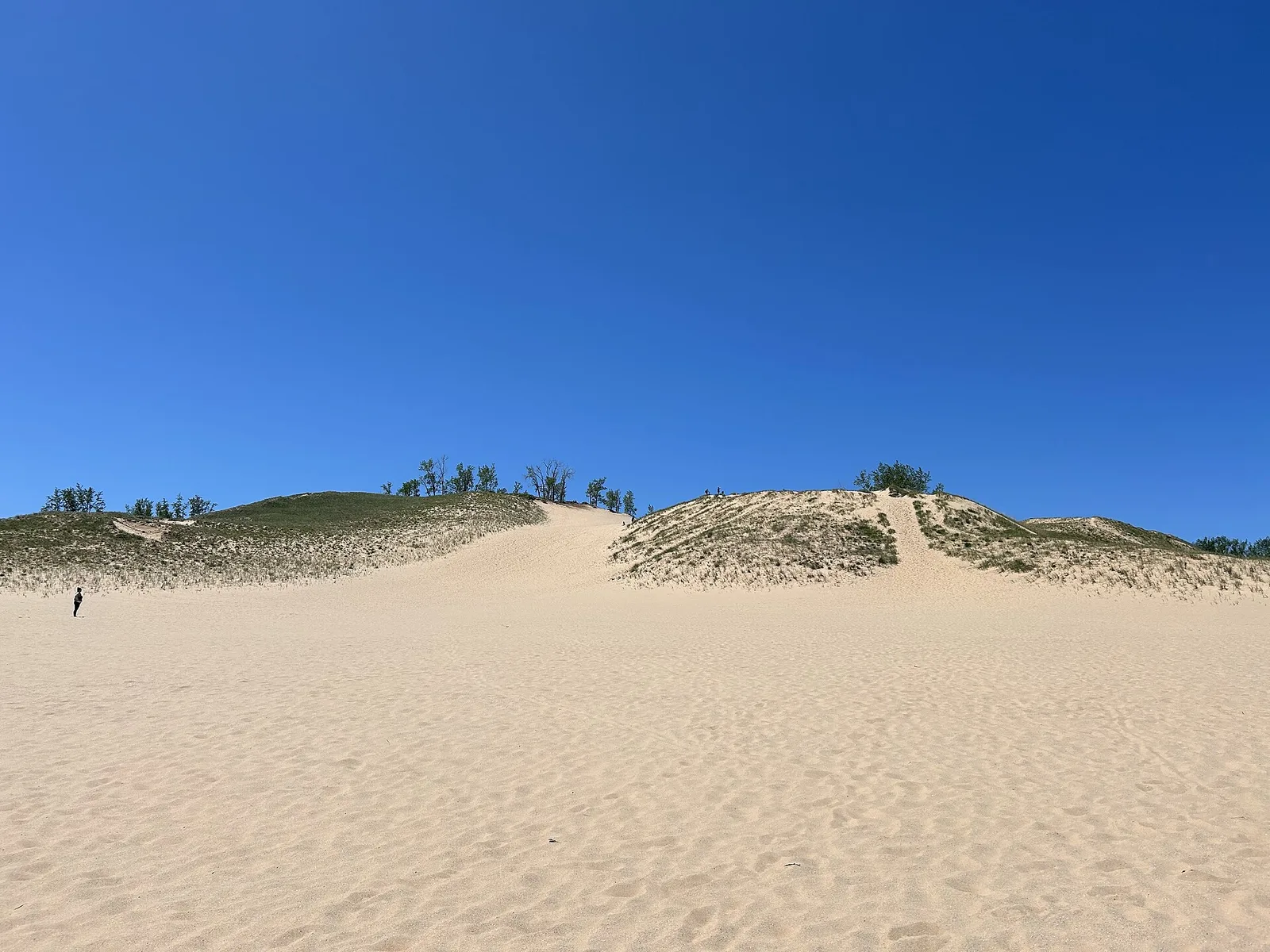
Towering Sand Dunes Rising 400 Feet Above the Crystal Waters of Lake Michigan
About Sleeping Bear Dunes National Lakeshore
Sleeping Bear Dunes National Lakeshore protects about 35 miles of Lake Michigan shore and roughly 71,000 acres of northwestern Lower Michigan, including North and South Manitou islands offshore.
Its signature feature is 'perched' dunes: sand piled on top of a glacial plateau, so the dune faces stand as much as 450 feet straight above the water, far higher than an ordinary beach dune.
Congress created the lakeshore on October 21, 1970, after a 12-year fight led by Senator Philip Hart against strong local opposition to the federal government buying up the shore.
The park takes its name from an Anishinaabe story of a mother bear who swam Lake Michigan ahead of a fire; her cubs drowned and became the Manitou islands, and she became a dark, tree-covered dune on the bluff, now largely eroded away.
- Designation
- National Lakeshore
- Location
- Leelanau and Benzie Counties, northwestern Lower Michigan
- Established
- October 21, 1970
- Annual Visitors
- ~1.6 million
Sleeping Bear's Natural Zones
The dunes sit on the Sleeping Bear Plateau, a glacial moraine, and are built of sand blown up the face of the roughly 400-foot bluff by west winds off the lake.
Where wind strips the beachgrass and other plants that hold the sand, a bare 'blowout' opens and grows fast, and the migrating dunes bury living forest on one edge while uncovering the bleached ghost forest of long-dead trees on the other.
The 'Sleeping Bear' of the legend was a distinct dark, wooded knob on the bluff into the early 1900s; wind erosion has since cut it down to a low, mostly bare mound.
The Dune Climb, a steep 110-foot wall of loose sand off M-109, is the park's most popular stop and the start of a punishing round-trip trek to the lakeshore and back.
The park's beaches are pale, fine quartz sand, clean enough that it squeaks underfoot, with water clear enough to see the bottom in 20 feet or more.
That clarity is partly natural and partly the work of invasive zebra and quagga mussels, which filter the lake and have stripped out much of the plankton that once clouded it.
Lake Michigan has no tide, but its level swings about six feet over years to decades; a record high in 2020 chewed back bluffs and beaches across the park and closed sections of trail and road.
The open beaches and low dunes are the most important nesting ground in the country for the Great Lakes piping plover, an endangered shorebird down to roughly 70 to 80 breeding pairs; the park fences nests and runs a salvage-and-rearing program with University of Michigan biologists.
Away from the dunes, the park's interior is northern hardwood forest of American beech and sugar maple, with hemlock, yellow birch, and basswood in the damper hollows.
Stands of it were never cleared, and some trees are old enough to count as old growth; the golden canopy against the blue lake is one of Michigan's iconic fall scenes.
The beech are now dying from beech bark disease, a fungus-and-insect combination spreading across the region, opening gaps that maple and invasive plants fill.
Preserved farmsteads at Port Oneida and the Glen Haven cannery village, both in the park, show how this forest was logged, farmed, and then let go over the past 150 years.
Ferries run in summer from Leland's Fishtown to both islands, which lie a few miles offshore and once served as fuel-wood stops and harbors of refuge for Great Lakes steamers.
South Manitou has a natural deep harbor, an 1871 lighthouse tower, the rusting hulk of the freighter Francisco Morazan aground since 1960, and the 'Valley of the Giants,' a grove of white cedars up to 500 years old.
North Manitou, about 15,000 acres, was a private hunting preserve before the park; Congress designated most of it wilderness in 1984, and it is reached only by backpackers with a permit.
Both islands still carry the traces of 19th- and early-20th-century farms, and North Manitou's introduced deer, which multiplied wildly, have been culled for decades to let the forest recover.
Indigenous Connections
Odawa (Ottawa) and Ojibwe (Chippewa) Nations
Odawa and Ojibwe people, part of the wider Anishinaabe, have lived along this coast and the Leelanau Peninsula for centuries, fishing the lake, tapping maple, and growing corn in the sandy soils near the shore.
The Sleeping Bear story is theirs, and 'Manitou,' the name of the islands, is the Anishinaabe word for a spirit being.
Treaties in 1836 and 1855 ceded most of northern Michigan but reserved land for Odawa and Ojibwe communities in the Leelanau area; the modern Grand Traverse Band regained full federal recognition in 1980 after it had been improperly terminated.
The Grand Traverse Band of Ottawa and Chippewa Indians is a federally recognized nation headquartered in Peshawbestown, Michigan, within the park's watershed. The tribe operates a casino and has been an active partner in efforts to restore native fish populations to Lake Michigan streams within the national lakeshore.
Experiencing Sleeping Bear Dunes
Dune Climb and Overlook Hike
The route starts up the Dune Climb itself, a 110-foot pitch of soft sand, then crosses about 1.7 miles of open dune plateau to a bluff-top view and a steep drop to the Lake Michigan beach.
Round trip to the water and back is roughly 3.5 to 4 miles, with no shade, no water, and a hard climb over the dune on the return that catches many people out.
The Park Service posts blunt warnings here and answers numerous heat and exhaustion calls every summer, some requiring carry-outs.
Most families do only the first climb and the plateau, turning around before the descent to the lake.
Pierce Stocking Scenic Drive
The 7.4-mile one-way loop runs through dune and beech-maple forest to a string of overlooks, the highest being the Lake Michigan Overlook, a platform about 450 feet above the water.
The lumberman Pierce Stocking cut the road in the 1960s and ran it as a private toll drive; the Park Service took it over and named it for him after his death in 1976.
At the Lake Michigan Overlook a very steep sand slope tempts visitors to run down toward the water; getting back up is nearly impossible, and rescues here are frequent and, by park policy, billed to the person rescued.
The drive is open roughly late April through November, closes in winter, and is popular with cyclists as well as cars.
Sleeping Bear Heritage Trail Cycling
The paved Sleeping Bear Heritage Trail, built in segments between 2012 and 2020, now runs about 22 miles from Empire north past Glen Arbor.
It links the Dune Climb, the Pierce Stocking drive entrance, the Glen Haven historic village, and the towns of Empire and Glen Arbor, mostly on its own right-of-way away from cars.
Bike rentals are available in Empire and Glen Arbor, and the trail connects to the Crystal River and Bay View hiking loops.
Rolling glacial terrain gives it some real climbs, and lake and dune views open up along much of the route.
Conservation Challenges
Invasive Species in Lake Michigan
More than 180 non-native species have entered the Great Lakes, many through ocean ships' ballast water after the St. Lawrence Seaway opened the lakes to overseas traffic in 1959.
Sea lamprey, a parasitic eel, collapsed the native lake trout in the mid-1900s; it is now held down by a basin-wide control program, and stocked Pacific salmon keep the invasive alewife in check while supporting a big sport fishery.
Zebra and, later, quagga mussels now carpet the lake bottom by the trillions, filtering out the plankton at the base of the food web; the water is clearer but far less productive.
Round goby, spiny water flea, and other newcomers keep arriving, and the park monitors its streams, where native brook trout and restoration work for coaster brook trout and lake sturgeon are underway.
Dune Fragility and Off-Trail Hiking
The perched dunes hold their shape only because beachgrass, sand cherry, and the threatened Pitcher's thistle knit the surface together with roots.
A single trampled path through that cover can open a blowout that grows into a moving gap of bare sand, destabilizing acres of dune.
The Park Service bars off-trail travel on any vegetated dune, fences the worst spots, and reseeds beachgrass.
The tension is real, because walking on the dunes is exactly what visitors come to do, so the park channels them onto the bare, non-vegetated faces and marked routes.
Great Lakes Water Level Fluctuation
Lake Michigan's level, which shares a datum with Lake Huron, has swung about six feet since records began, driven by precipitation, evaporation, and ice cover rather than any dam.
It hit a record low in 2013 and a record high in 2020, a fast reversal that eroded bluffs, undermined stairs and parking, and closed parts of the Heritage Trail and the D.H. Day and Peterson Road areas.
A warming climate is expected to make the swings larger and faster, with less winter ice to protect the shore from storms.
The park is treating some shoreline infrastructure as expendable and moving other facilities back from the bluff edge.
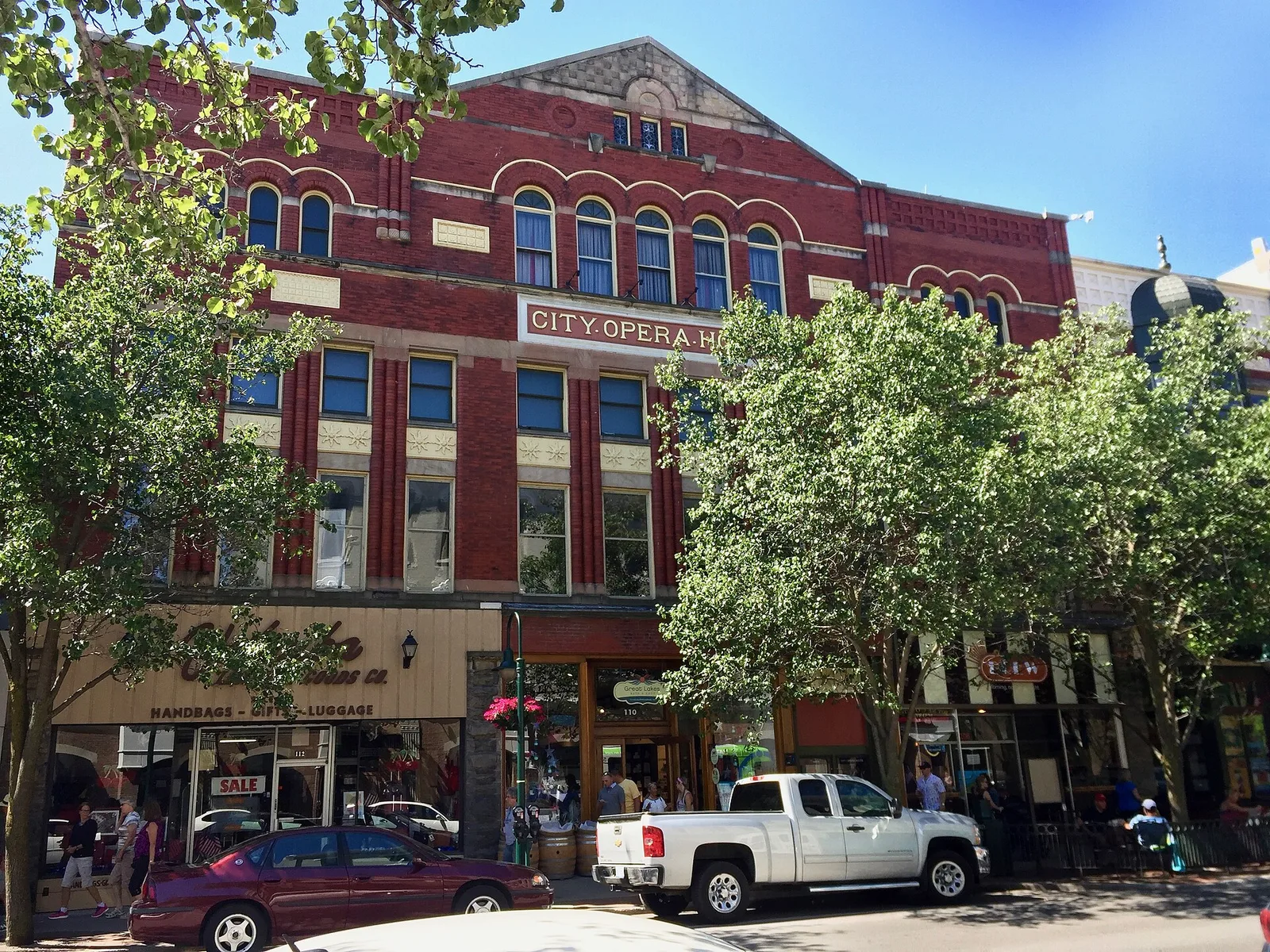
Traverse City, Michigan
At a Glance
Did You Know?
In 2011, Good Morning America viewers voted Sleeping Bear Dunes National Lakeshore 'The Most Beautiful Place in America,' a designation that doubled the park's visitation and required the park to adapt its visitor management strategy.
Lake Michigan's water is so clear at the national lakeshore that on calm days you can see the sandy bottom at depths of 20 to 30 feet, a clarity that rivals tropical saltwater destinations.
South Manitou Island contains a grove of ancient white cedar trees, some over 500 years old and never logged, that scientists have used to build climate records stretching back centuries.
Plan Your Visit
Location
Leelanau and Benzie Counties, northwestern Lower Michigan
Designation
National Lakeshore
Best Time to Visit
Late June through September for swimming; late September and October for spectacular fall color
Admission
$25 per vehicle (7-day pass); free with America the Beautiful annual pass