

About Georgia
Georgia was named in honor of King George II of Great Britain, who granted the colonial charter in 1732 to James Oglethorpe and a board of trustees. The practice of naming colonies after reigning monarchs or members of the royal family was common, and Oglethorpe needed royal favor to secure the land grant and funding for his ambitious colony. Georgia was the last of the thirteen original colonies to be established, founded with the dual goals of providing a new start for England's poor and creating a military buffer between the British colonies and Spanish Florida. The name Georgia honoring an English king has remained through independence, the Civil War, and into the present day.
Georgia is the largest state east of the Mississippi River by land area and one of the fastest-growing states in the country. Founded in 1733 as the last of the thirteen original colonies, it has spent nearly three centuries at the center of American history, from the Revolution to the Civil War to the Civil Rights Movement to the Senate runoffs that determined control of Congress in 2021.
Atlanta is the undisputed capital of the American South, a city of 6 million in its metro area that hosts more corporate headquarters, more film production, and more international air traffic than any city in the region. Coca-Cola was born here. Delta Air Lines is based here. The CDC is headquartered here. Martin Luther King Jr. was born, preached, and is buried here.
Beyond Atlanta, Georgia is a state of remarkable geographic and cultural diversity: Blue Ridge mountain towns in the north, the antebellum grandeur of Savannah on the coast, vast agricultural plains in the south, and a corridor of college towns and small cities in between. Its red clay soil, sweet Vidalia onions, and Georgia peaches are as much a part of its identity as its skyline.

Geography, Four Distinct Regions
Georgia spans from Appalachian mountain peaks in the north to subtropical coast in the southeast, one of the most geographically diverse states in the South.
The northern tip of Georgia is defined by the southern end of the Appalachian Mountains, the Blue Ridge range, with peaks topping 4,000 feet, dense hardwood forests, and cold mountain rivers famous for trout fishing. Dahlonega, site of America's first major gold rush (1828), sits at the edge of the mountains.
The Appalachian Trail's southern terminus is at Springer Mountain. This region draws hikers, leaf-peepers, and those escaping Atlanta's summer heat.
The Dahlonega gold rush of 1828, the first major one in U.S. history and twenty years before California's, also accelerated the removal of the Cherokee, whose national capital at New Echota was in this region. A federal mint at Dahlonega struck gold coins until the Civil War, and the state capitol dome in Atlanta is still leafed in Dahlonega gold.
The mountains are now Atlanta's playground and its water supply. Lake Lanier, a Corps of Engineers reservoir on the Chattahoochee, provides most of metro Atlanta's drinking water and has been the object of a decades-long 'water war' among Georgia, Alabama, and Florida that reached the Supreme Court. Fast-growing counties like Cherokee and Forsyth on the metro's northern edge are among the wealthiest in the state.
Greater Atlanta is the economic, cultural, and political center of the American South. The city proper is home to 500,000 people, but the 29-county metro area houses over 6 million, making it one of the ten largest metros in the country.
Atlanta hosts the world's busiest airport, the headquarters of Coca-Cola, Delta Air Lines, Home Depot, and UPS, the Centers for Disease Control and Prevention, and a booming film and technology industry. The Piedmont plateau on which Atlanta sits also includes the college towns of Athens and Macon.
Atlanta was rebuilt from Sherman's ashes as a rail and later an airline hub, and it marketed itself as 'the city too busy to hate,' desegregating with less violence than most of the South. It became the country's premier Black political and business center: it has had a Black mayor continuously since 1974, and it is home to Ebenezer Baptist Church and the largest cluster of historically Black colleges in the world.
Metro Atlanta added more people in the 2010s than any U.S. metro except Dallas and Houston, sprawling across a dozen counties with little zoning coordination and some of the worst traffic in the country. That growth flipped Georgia politically: diversifying suburbs like Gwinnett and Cobb, once reliably Republican, delivered the state to Joe Biden in 2020 and two Democratic senators in 2021.
Georgia's 100-mile Atlantic coast is one of the most ecologically rich and historically preserved shorelines in the South. Savannah, founded in 1733 as Georgia's first city, is famous for its antebellum architecture, Spanish moss-draped squares, and preserved historic district, consistently ranked among the most beautiful cities in America.
The Golden Isles (Jekyll Island, St. Simons Island, Sea Island, and Cumberland Island) offer barrier island beaches, maritime forests, and Gilded Age history. The Port of Savannah is one of the busiest container ports in the country.
Savannah was laid out by James Oglethorpe in 1733 on a grid of 24 wards, each with a public square, one of the first planned cities in America; 22 of the squares survive, and the historic district's near-demolition in the 1950s sparked one of the country's earliest big preservation movements. The Savannah College of Art and Design now owns dozens of restored downtown buildings.
The Sea Islands off the coast are the heartland of Gullah Geechee culture, the language and traditions of enslaved West Africans and their descendants, who were relatively isolated on the rice and cotton plantations here. Cumberland Island, mostly a national seashore, has wild horses and the ruins of a Carnegie estate, and offshore the Kings Bay submarine base drives the regional economy.
South Georgia is the agricultural heartland of the state, flat, hot, and deeply rural. This is peanut country: Georgia produces more peanuts than any other state, and the region is also a major grower of pecans, cotton, blueberries, and sweet Vidalia onions. Plains, Georgia, birthplace and home of President Jimmy Carter, sits in this region.
Valdosta and Albany anchor the larger towns. The Okefenokee Swamp, one of the largest intact freshwater ecosystems in North America, sprawls across the southeastern corner.
This is the poorest and most rural part of the state, a stretch of small farm towns where population has been flat or falling for generations. Georgia grows about half the U.S. peanut crop here, along with pecans, cotton, blueberries, and Vidalia onions, and the Flint River aquifer that irrigates it is another front in the tri-state water war. Plains, population under 600, produced Jimmy Carter, the 39th president.
Southwest Georgia's Albany was a hard-fought civil rights battleground; the 1961-62 'Albany Movement' was one of the few campaigns Martin Luther King Jr. considered a defeat, and many counties in the region are still majority Black. The Okefenokee Swamp, roughly 700 square miles of blackwater and cypress in the southeast corner, is a national wildlife refuge that has been repeatedly threatened by proposed mining on its edge.

Economy
Georgia's economy ranks among the top ten in the nation, driven by Atlanta's corporate and tech sector, world-class logistics infrastructure, and a surging manufacturing base.
Atlanta hosts the global headquarters of Coca-Cola, Delta Air Lines, Home Depot, UPS, and CNN, and has become one of the fastest-growing technology hubs in the country. Major tech firms including Microsoft, Google, and Salesforce have large Atlanta presences. Georgia Tech in Midtown Atlanta produces engineering talent that feeds both local startups and national companies.
Georgia is home to 18 Fortune 500 headquarters, more than any state in the Southeast, most of them in metro Atlanta: Home Depot, UPS, Delta, Coca-Cola, Southern Company, and payments giants Global Payments and NCR among them. A cluster of payment-technology firms around Atlanta, sometimes called 'Transaction Alley,' processes a large majority of all U.S. card transactions.
Georgia Tech, in Midtown Atlanta, is one of the top engineering schools in the country and the main pipeline for the region's tech workforce; its 'Tech Square' has drawn corporate innovation labs from around the world, and metro Atlanta has become one of the fastest-growing tech job markets in the U.S., helped by costs far below the coasts.
The tech workforce is disproportionately Black, and Atlanta has been called a capital of Black entrepreneurship. The city is also a media center: CNN was founded here by Ted Turner in 1980, and Tyler Perry built one of the largest film studios in the country on a former Army base south of downtown.
Georgia's generous film tax credits, up to 30% on production costs, have made it the dominant film production state outside of California. Pinewood Atlanta Studios (now Trilith) near Atlanta has hosted Avengers, Black Panther, Spider-Man, Stranger Things, The Walking Dead, and dozens of other major productions. The film industry generates billions annually and has created a thriving local crew and production infrastructure.
Georgia's film tax credit is uncapped and transferable, the most generous in the country, and it has made the state a rival to California and, some years, the top place in the world for feature-film production. Productions spent about $4.4 billion in the state in fiscal 2022, and the credit cost roughly $1.3 billion, which has drawn recurring scrutiny over whether the return justifies the cost.
The Marvel Cinematic Universe is largely made in Georgia: 'Black Panther,' the 'Avengers' films, and dozens more were shot at the Fayette County complex now called Trilith, along with 'Stranger Things,' 'The Walking Dead,' and 'The Hunger Games.' A full crew base, sound stages, and vendor economy have grown up around Atlanta.
The industry has become politically entangled: after Georgia passed a restrictive abortion law in 2019, several studios and stars threatened boycotts, and the governor and the industry have periodically clashed over the credit. Production has kept growing anyway, and the state now trains film workers through its technical colleges and a 'Georgia Film Academy.'
Hartsfield-Jackson Atlanta International Airport has been the world's busiest airport by passenger traffic for more than two decades, handling over 100 million passengers annually. Delta Air Lines, headquartered in Atlanta, is one of the world's largest airlines.
The Port of Savannah is the largest single-terminal container port in the Western Hemisphere and a critical gateway for goods moving through the Southeast. Georgia's central location in the eastern US makes it a natural logistics hub.
Hartsfield-Jackson's dominance rests on Delta's decision to make Atlanta a hyper-connecting hub; a common Southern saying is that whether you're bound for heaven or hell, you have to change planes in Atlanta. The airport supports an estimated 60,000 on-site jobs and is the single largest employer in Georgia.
The Port of Savannah is the third-busiest container port in the country and grew fast after a decades-long, roughly $1 billion project to deepen the Savannah River shipping channel finished in 2022. Warehouses have spread along the I-16 and I-75 corridors, and the state has poured money into rail and inland 'ports' to move Savannah's cargo north.
Georgia is the top peanut-producing state in the country, growing about half of all U.S. peanuts. It is also the nation's largest producer of broiler chickens, the poultry industry is worth over $17 billion to the state.
Vidalia sweet onions, grown only in a specific region of Southeast Georgia, are one of the most famous regional agricultural products in America. Georgia peaches, while less dominant than California's in total volume, remain central to the state's identity.
Agriculture and food processing are Georgia's largest industry overall, worth more than $70 billion a year across the whole supply chain. Poultry alone is a roughly $30 billion industry concentrated in the north around Gainesville, 'the poultry capital of the world,' and it relies heavily on immigrant labor in its processing plants.
Vidalia sweet onions may legally be grown only in about 20 counties around Vidalia, protected by a federal marketing order, and 'the Peach State' grows a small share of U.S. peaches but treats them as an identity. Climate is a growing risk: Hurricane Michael in 2018 wiped out much of the pecan and cotton crop in the southwest and cost the industry billions.
Georgia has attracted massive manufacturing investment in recent years. Rivian is building its largest production facility near Atlanta. Hyundai opened a major EV plant in Bryan County.
SK Innovation, LG Energy Solution, and other battery manufacturers have established facilities in the state. Kia has manufactured vehicles in West Point since 2010. Georgia's combination of low costs, strong logistics, and aggressive incentive programs has made it a top destination for manufacturing investment.
Georgia landed two of the largest economic-development deals in its history within a year: Hyundai's roughly $7.6 billion 'Metaplant' near Savannah, which opened in 2024 to build electric SUVs and batteries, and Rivian's planned $5 billion truck factory east of Atlanta, backed with about $1.5 billion in state incentives and slowed by local opposition and construction delays.
A battery supply chain has followed: SK On built one of the largest EV battery plants in the country near Commerce, and other Korean and Japanese suppliers have set up in northeast Georgia. The incentive strategy draws criticism over cost per job, but it has made Georgia, by some counts, the top state for EV and battery investment.

How Georgia's State Government Works
Georgia operates a three-branch state government under a constitution last substantially revised in 1983. The General Assembly consists of a 56-member Senate and a 180-member House of Representatives, one of the largest state legislatures in the country, reflecting Georgia's size and population.
Georgia is a majority-Republican state at the statewide level, though Atlanta and its suburbs have trended increasingly competitive. The state attracted intense national attention in 2020 and 2021 when it delivered its electoral votes to a Democratic presidential candidate for the first time since 1992 and then elected two Democratic U.S. Senators in runoff elections.
Georgia uses a two-round runoff system: if no candidate wins more than 50% of the vote in a general election, a runoff between the top two candidates is held several weeks later. This system has produced some of the most closely watched political contests in modern American history.
Governor of Georgia
Current Governor
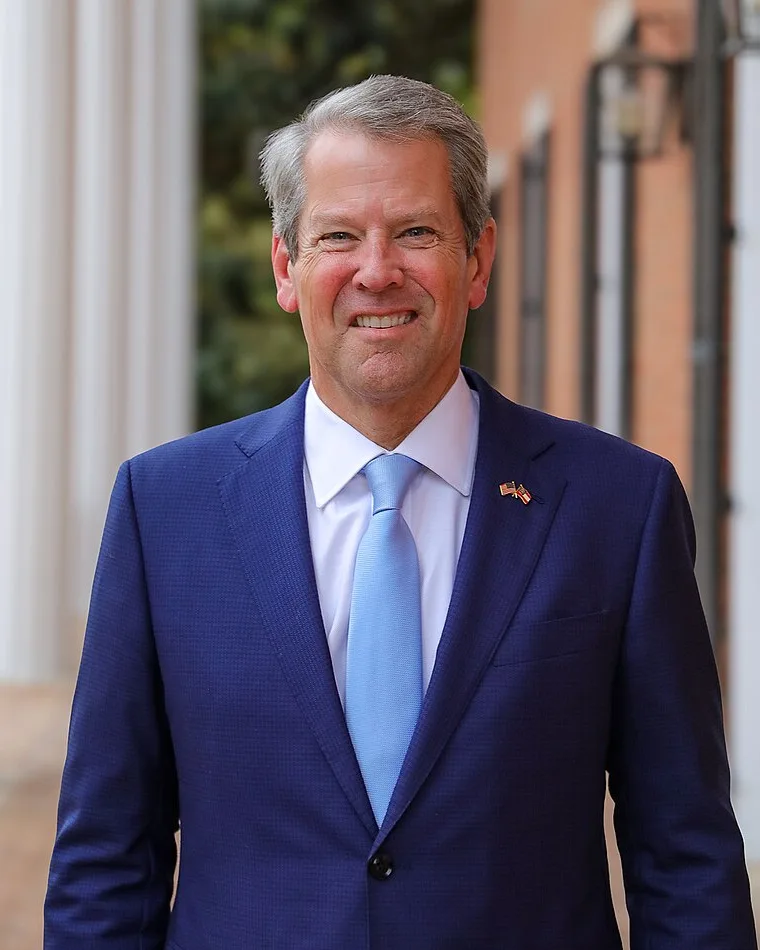
Brian Kemp
- Party
- Republican
- In Office Since
- January 14, 2019
- Elected
- 2018, re-elected 2022 (+8 pts)
- Term Ends
- January 2027
- Born
- November 2, 1963, Athens, Georgia
- Education
- University of Georgia (BS, Agriculture)
- Prior Role
- Georgia Secretary of State (2010-2018)
Brian Kemp is the 83rd Governor of Georgia. A businessman and former state senator, he served as Secretary of State before winning a tight 2018 governor's race. He gained national attention in 2020 when he certified Georgia's presidential election results despite pressure to do otherwise, then won a comfortable re-election in 2022.
Other Current State Officials
Lieutenant Governor
Burt Jones
In office since January 2023. Former state senator from Jackson County. Focuses on rural development and economic policy.
Attorney General
Chris Carr
In office since 2016, re-elected 2018 and 2022. Former director of the Governor's Office of Economic Development.
Secretary of State
Brad Raffensperger
In office since 2019, re-elected 2022. Gained national attention for refusing to alter Georgia's 2020 presidential election results despite intense pressure.
The Georgia General Assembly
Georgia State Senate
- Seats: 56 members
- Terms: 2-year terms
The upper chamber. Georgia is one of the few states where senators serve 2-year terms rather than 4-year terms, meaning the entire Senate is on the ballot every election cycle alongside the House.
Georgia House of Representatives
- Seats: 180 members
- Terms: 2-year terms
The lower chamber. Georgia's House is one of the largest lower chambers in the South with 180 members. All seats are up for election every two years, making the entire legislature competitive simultaneously.
Georgia's U.S. Senators
U.S. Senator
Jon Ossoff
Won a nationally watched January 2021 runoff election against Republican incumbent David Perdue. At 33, became the youngest U.S. Senator at the time of his election and the first Jewish senator from the South since 1879. A documentary filmmaker and investigative journalism producer before entering politics. Focuses on infrastructure, veterans' issues, and Georgia's growing technology sector.
U.S. Senator
Raphael Warnock
Senior pastor of Ebenezer Baptist Church in Atlanta, the same church where Dr. Martin Luther King Jr. preached. Won a January 2021 special election runoff against Republican Kelly Loeffler, then won a full six-year term in the 2022 runoff against Republican Herschel Walker. Georgia's first Black U.S. Senator. Focuses on health care, voting rights, and economic opportunity.
Georgia Through the Years
From early settlement to the present day. Tap any era to read more.
Georgia was home to two powerful Indigenous confederacies before European colonization. The Muscogee (Creek) Nation dominated central and southern Georgia, while the Cherokee Nation controlled the mountainous north. Both had sophisticated governments, agriculture, and trade networks. The Cherokee Nation, in particular, developed a written alphabet, constitution, and newspaper in the early 1800s, before being forcibly removed on the Trail of Tears in 1838-1839.
The Cherokee capital was New Echota, near present-day Calhoun, where a national council met and the bilingual Cherokee Phoenix newspaper began printing in 1828 using Sequoyah's syllabary. The Cherokee adopted a written constitution in 1827 modeled on the U.S. document, with an elected principal chief and a bicameral legislature.
The discovery of gold near Dahlonega in 1828 set off the first major U.S. gold rush and intensified white pressure for Cherokee land. Georgia extended state law over the Cherokee Nation, and in Worcester v. Georgia (1832) the U.S. Supreme Court ruled the state had no authority there, a decision President Andrew Jackson and Georgia both ignored.
Under the Treaty of New Echota, signed in 1835 by a minority faction, the Cherokee were forced west. Roughly 16,000 people were removed in 1838-1839, and thousands died of exposure, disease, and starvation on the route the Cherokee call the Trail of Tears. The Creek had been removed a few years earlier, in 1836-1837, after the Creek War of 1836.
General James Oglethorpe founded the colony of Georgia in 1733 as a haven for England's debtors and a buffer against Spanish Florida. Savannah became the first planned city in America, laid out on a grid of public squares that still defines the city today.
Georgia was the southernmost and last of the 13 original colonies. Unlike other Southern colonies, Oglethorpe initially banned slavery, though that prohibition was repealed within 20 years.
The Trustees who governed early Georgia also banned rum and lawyers and limited land holdings, hoping to build a colony of small independent farmers. The bans were unpopular and widely evaded, and settlers pushing to grow rice and cotton lobbied successfully to legalize slavery in 1751; the colony reverted to direct royal control in 1752.
Oglethorpe's military purpose was tested at the Battle of Bloody Marsh on St. Simons Island in 1742, where his forces turned back a Spanish invasion from Florida and effectively secured Georgia for Britain. The first colonists had arrived aboard the ship Anne, and among the early settlers were a group of Protestant refugees from Salzburg who founded the town of Ebenezer.
Georgia ratified the U.S. Constitution on January 2, 1788, becoming the fourth state to join the Union. Georgia's delegates to the Constitutional Convention included William Few and Abraham Baldwin, who both signed the document. Georgia entered the Union as an agricultural slave state whose plantation economy would shape its politics and culture for the next century, and well beyond.
Georgia's ratifying convention in Augusta approved the Constitution unanimously, 26 to 0, in a single day. The state's frontier planters wanted a strong national government mainly for protection against the Creek Nation on its western border, and that security interest outweighed the anti-federalist objections raised in larger states.
In 1795 the legislature sold roughly 35 million acres of western land, most of present-day Alabama and Mississippi, to speculators for about $500,000 in the Yazoo land fraud, after nearly every legislator was bribed. Voters threw out the legislature, which repealed the sale in 1796 and publicly burned the records.
The repeal produced the Supreme Court case Fletcher v. Peck (1810), the first time the Court struck down a state law as unconstitutional, holding that the original land grants were binding contracts. Georgia ceded its western claims to the federal government in 1802 in exchange for a promise, only partly kept, to extinguish Indian land titles within the state.
Georgia was a Confederate state and a critical industrial and agricultural supplier to the Southern war effort. Atlanta, a major railroad hub, was a Union military target.
In 1864, Union General William T. Sherman captured Atlanta (prompting Confederate General Hood to evacuate and burn much of it), then led his famous 'March to the Sea' through central Georgia to Savannah, cutting a 60-mile-wide path of destruction intended to break the Confederate will to fight. Atlanta's burning and reconstruction became central to Georgia's post-war identity.
Georgia voted to secede on January 19, 1861, and Augusta held the Confederacy's largest gunpowder factory, the Confederate Powder Works, which produced most of the South's powder. Sherman's campaign for Atlanta ran from May to September 1864 and included the costly Confederate defeat at the Battle of Kennesaw Mountain.
Sherman offered Atlanta to President Lincoln as 'a Christmas gift' when he reached Savannah on December 21, 1864. His troops tore up rail lines, burned crops, and freed enslaved people as they marched; his Special Field Order No. 15, issued in Savannah in January 1865, set aside coastal land for freedpeople in what became the phrase 'forty acres and a mule,' a promise the federal government soon reversed.
Near Americus, the Confederate prison camp at Andersonville held about 45,000 Union prisoners in 1864-1865, of whom roughly 13,000 died of disease, exposure, and malnutrition. Its commandant, Henry Wirz, was tried and hanged after the war, one of the only such executions. Georgia was readmitted to the Union in 1870, the last state to rejoin.
Atlanta was the beating heart of the American Civil Rights Movement. Dr. Martin Luther King Jr. was born on Auburn Avenue in Atlanta in 1929, preached at Ebenezer Baptist Church, and led the Southern Christian Leadership Conference from the city. Georgia was the site of crucial sit-ins, marches, and legal battles.
The Student Nonviolent Coordinating Committee (SNCC) operated from Atlanta. John Lewis, longtime Georgia Congressman, was among the movement's bravest leaders, nearly beaten to death on the Edmund Pettus Bridge in Selma.
Georgia's county unit system, which weighted rural counties far more heavily than urban ones in Democratic primaries, kept segregationists in power until the Supreme Court struck it down in Gray v. Sanders (1963), the case that produced the phrase 'one person, one vote.' Lester Maddox won the governorship in 1966 after gaining fame for refusing to serve Black customers at his Atlanta restaurant.
SNCC ran a long, difficult voter-registration campaign in southwest Georgia, and the Albany Movement of 1961-1962 was a rare setback for King, whose protests failed to move the segregationist city government. King was arrested at an Atlanta sit-in in October 1960; a phone call from John F. Kennedy to Coretta Scott King, and Robert Kennedy's call to the judge, helped secure his release and is credited with shifting Black votes to Kennedy that fall.
Atlanta elected Maynard Jackson as its first Black mayor in 1973, and Andrew Young, a King lieutenant, served as a Georgia congressman, U.S. ambassador to the United Nations, and Atlanta mayor. John Lewis represented Atlanta in Congress from 1987 until his death in 2020.
Georgia became the focal point of American political life in 2020 and 2021. Joe Biden became the first Democratic presidential candidate to win Georgia since 1992, by fewer than 12,000 votes.
Secretary of State Brad Raffensperger, a Republican, refused pressure to alter the results, recording a phone call with President Trump that became central to subsequent legal proceedings. Georgia then held two Senate runoffs in January 2021, both won by Democrats, flipping Senate control and reshaping the national political landscape.
The shift followed a decade of demographic change and a large voter-registration drive led by Stacey Abrams, who narrowly lost the 2018 governor's race to Brian Kemp and founded the group Fair Fight. The official margin was 11,779 votes, the exact number Trump asked Raffensperger to 'find' in the recorded January 2, 2021 call.
In 2021 the legislature passed Senate Bill 202, a wide-ranging election law that added a voter-ID requirement for mail ballots, shortened runoff periods, and limited drop boxes; supporters called it election security and opponents called it voter suppression. In protest, Major League Baseball moved its 2021 All-Star Game out of Atlanta.
In August 2023 a Fulton County grand jury indicted Trump and 18 others under Georgia's racketeering (RICO) statute over efforts to overturn the state's result, the fourth criminal case against a former president that year. Georgia's two U.S. senators as of 2021 are Raphael Warnock, senior pastor of King's Ebenezer Baptist Church, and Jon Ossoff.
Georgia's Defining Moments in American History
These are the events that didn't just shape Georgia, they changed the nation.
Martin Luther King Jr. was born on January 15, 1929 in Atlanta, Georgia. He led the Montgomery Bus Boycott, organized the March on Washington, delivered 'I Have a Dream,' and became the moral voice of the Civil Rights Movement.
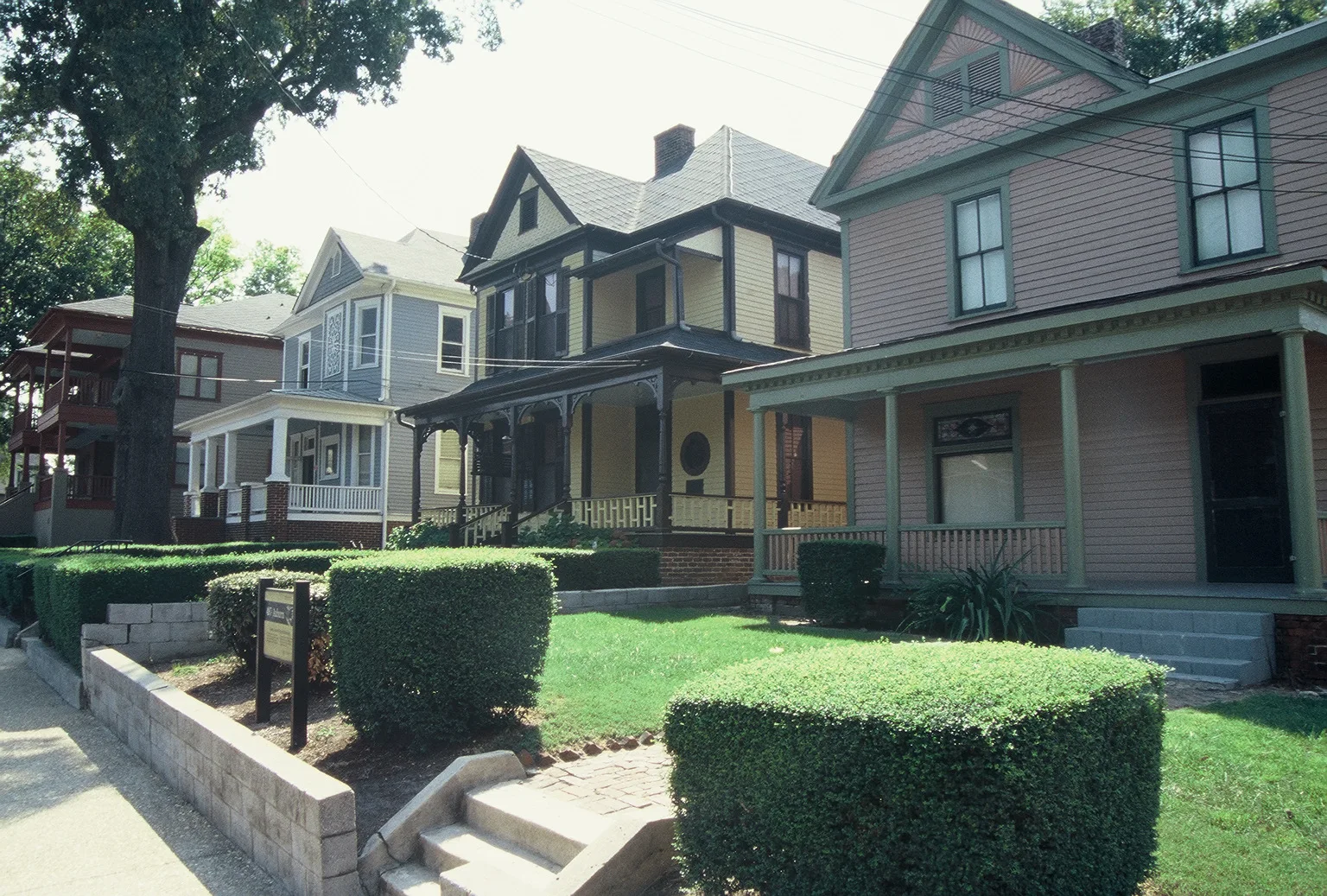
He was assassinated in Memphis on April 4, 1968. His birthplace, Ebenezer Baptist Church, and gravesite are all on Auburn Avenue in Atlanta, now the Martin Luther King Jr. National Historical Park, one of the most visited national parks in the Southeast.
King grew up in the Sweet Auburn district, a stretch of Auburn Avenue that was one of the wealthiest Black commercial corridors in the country in the early 20th century. He was the son and grandson of Ebenezer pastors, entered Morehouse College at 15, and was co-pastor at Ebenezer with his father when he died.
In 1964 King became the youngest person to that point to receive the Nobel Peace Prize, at 35. Georgia was slow to honor him: the state did not adopt a paid King holiday until 1986, and for years observed Confederate Memorial Day on the same weekend. His widow, Coretta Scott King, founded the King Center next to Ebenezer in 1968 and led it until 1994.
Hartsfield-Jackson Atlanta International Airport has been the world's busiest airport by total passenger traffic every year since 1998 except pandemic-hit 2020 (when Guangzhou ranked first), handling over 100 million passengers annually. It is the hub for Delta Air Lines and a connecting point for travelers across North America, Latin America, and beyond.
The airport is not just a transportation asset; it is the engine of Georgia's economy, supporting hundreds of thousands of jobs and billions in commerce.
The site began in 1925 when the city of Atlanta leased an abandoned auto racetrack called Candler Field, named for Coca-Cola magnate and former mayor Asa Candler. Mayor William B. Hartsfield championed its growth for decades, and the airport carries his name along with that of Maynard Jackson, the city's first Black mayor, who pushed the current terminal's construction and its minority-contracting requirements.
The airport calls itself a roughly $65 billion annual economic engine for the region and is the largest single employer in Georgia, with tens of thousands of on-site workers. Its location within a two-hour flight of 80 percent of the U.S. population is a core reason Delta and, before it, Eastern Air Lines built connecting hubs there.
Atlanta hosted the Centennial Olympic Games in 1996, the 100th anniversary of the modern Olympic movement. The games brought 197 nations and over 10,000 athletes to Georgia and are credited with transforming Atlanta into a truly global city.
The Olympics accelerated downtown redevelopment, expanded the airport, and raised Georgia's international profile. They were marred by the Centennial Olympic Park bombing, a domestic terrorism attack that killed two people and injured 111, but the games went on and Georgia's legacy endured.
The winning bid, led by Atlanta lawyer Billy Payne and Andrew Young, beat Athens, Greece, which had expected to host the centennial games and was bitterly disappointed. The bid leaned on Atlanta's identity as the home of Coca-Cola, a top Olympic sponsor, and CNN, and the games were financed almost entirely with private money rather than public funds.
The Olympic Stadium was rebuilt after the games as Turner Field, home of the Atlanta Braves until 2017, when it was converted for Georgia State University football. Security guard Richard Jewell, first hailed as a hero for spotting the bomber's backpack, was wrongly treated as a suspect for months; the actual bomber, Eric Rudolph, was not caught until 2003 and later pleaded guilty.
Notable Georgians
Martin Luther King Jr.
Civil rights leader, Nobel Peace Prize winner, and preacher, born in Atlanta
Jimmy Carter
39th President of the United States and Nobel Peace Prize laureate, born in Plains
Ray Charles
Pioneer of soul music who blended gospel, R&B, and pop, born in Albany
Ty Cobb
Baseball legend with a .366 career batting average, born in Narrows
Julia Roberts
Academy Award-winning actress and one of Hollywood's biggest stars, born in Smyrna
Juliette Gordon Low
Founder of the Girl Scouts of America, born in Savannah
State Symbols & Quick Facts
| Nickname | "The Peach State" / "Empire State of the South" |
| Capital | Atlanta |
| Largest City | Atlanta |
| Statehood | January 2, 1788 (4th state) |
| Population | ~11.1 million (2025 est.) |
| Area | 59,425 sq mi, 24th largest state |
| Motto | Wisdom, Justice, and Moderation |
| State Bird | Brown Thrasher |
| State Flower | Cherokee Rose |
| State Tree | Southern Live Oak |
| State Animal | White-tailed Deer |
| State Fish | Largemouth Bass |
| State Fruit | Peach |
| State Vegetable | Vidalia Sweet Onion |
| State Song | "Georgia on My Mind" |
| Time Zone | Eastern Time (UTC−5 / UTC−4) |
| Borders | Tennessee & North Carolina (N), South Carolina (NE), Atlantic Ocean (SE), Florida (S), Alabama (W) |
Did You Know?
Hartsfield-Jackson Atlanta International Airport has been the world's busiest airport by passenger traffic every year since 1998 except pandemic-hit 2020, handling more than 100 million travelers annually. It is so large that it has its own internal subway system.
The Coca-Cola Company was founded in Atlanta in 1886, when pharmacist John Pemberton mixed the first batch in a backyard. The secret formula has been kept in a vault at the World of Coca-Cola museum in Atlanta ever since.
Vidalia sweet onions can only legally be labeled 'Vidalia' if grown in a specific 20-county region of Southeast Georgia, similar to how Champagne can only come from a specific region of France. They are mild enough to eat like an apple.
Georgia produces more filmed entertainment than any state outside California. Major film and television productions, including Marvel's Avengers series, Black Panther, Stranger Things, and The Walking Dead, are filmed almost entirely in Georgia.
Georgia grows approximately half of all peanuts produced in the United States, far more than any other state. President Jimmy Carter, from Plains, Georgia, was a peanut farmer before entering politics.
Quick Facts and Common Questions
Short answers to the questions people most often ask about Georgia: its abbreviation, who it was named for, its capital, and its place in Congress.
Georgia's two-letter postal abbreviation is GA. The U.S. Census Bureau places it in the South region, in the South Atlantic division, and about 10.7 million people lived there in the 2020 census.
Georgia became the 4th state on January 2, 1788, when its convention unanimously ratified the U.S. Constitution. It was the last of the original 13 colonies to be founded.
Georgia was named for King George II of Great Britain, who granted the colony's charter in 1732. James Oglethorpe and the first colonists founded Savannah in February 1733.
Atlanta has been the capital since 1868, and voters confirmed it as the permanent capital in 1877. Earlier capitals included Savannah, Augusta, Louisville, and Milledgeville, which served from 1807 to 1868. The current State Capitol, topped with a gold-leaf dome, was completed in 1889.
Georgia borders five states: Tennessee and North Carolina to the north, South Carolina to the east, Florida to the south, and Alabama to the west. Its eastern coast lies on the Atlantic Ocean.
Georgia is best known as "The Peach State" and is also called the Empire State of the South. Its motto is "Wisdom, Justice, and Moderation." Its state bird is the brown thrasher, its flower is the Cherokee rose, and its tree is the southern live oak.
Based on the 2020 census, Georgia has 14 seats in the U.S. House of Representatives, the same as before, which gives it 16 votes in the Electoral College.
Jimmy Carter, born in Plains in 1924, is the only president born in Georgia. He served as governor of Georgia from 1971 to 1975 and as the 39th president from 1977 to 1981, and received the Nobel Peace Prize in 2002.
Okefenokee National Wildlife Refuge
The Land of Trembling Earth, One of North America's Largest Intact Freshwater Ecosystems
About Okefenokee National Wildlife Refuge
The Okefenokee is the largest blackwater swamp in North America, a shallow peat-filled basin of about 438,000 acres in southeastern Georgia, of which some 353,000 acres were set aside as federal wilderness in 1974.
President Franklin Roosevelt established the national wildlife refuge by executive order on March 30, 1937, after two failed attempts to exploit the swamp: a company dug a drainage canal from the east side in the 1890s and gave up, and the Hebard Cypress Company then logged it from 1909 to 1927, running railroads on pilings and cutting hundreds of millions of board feet of timber.
The basin was a lagoon behind an offshore barrier island roughly a quarter million years ago; that old dune line, Trail Ridge, still forms the swamp's eastern rim and acts as a natural dam. Water leaves the basin as the headwaters of two rivers, the Suwannee flowing southwest to the Gulf of Mexico and the St. Marys flowing east to the Atlantic.
The name comes from a Hitchiti phrase usually rendered 'trembling earth,' for the floating peat mats, called batteries, that quake underfoot. The refuge holds one of the densest alligator populations anywhere and more than 200 bird species, and in 2024 it was formally nominated as a UNESCO World Heritage Site.
- Designation
- National Wildlife Refuge, National Natural Landmark
- Location
- Waycross, Georgia (Ware and Charlton Counties)
- Established
- 1937
- Annual Visitors
- ~600,000
Habitats of the Okefenokee
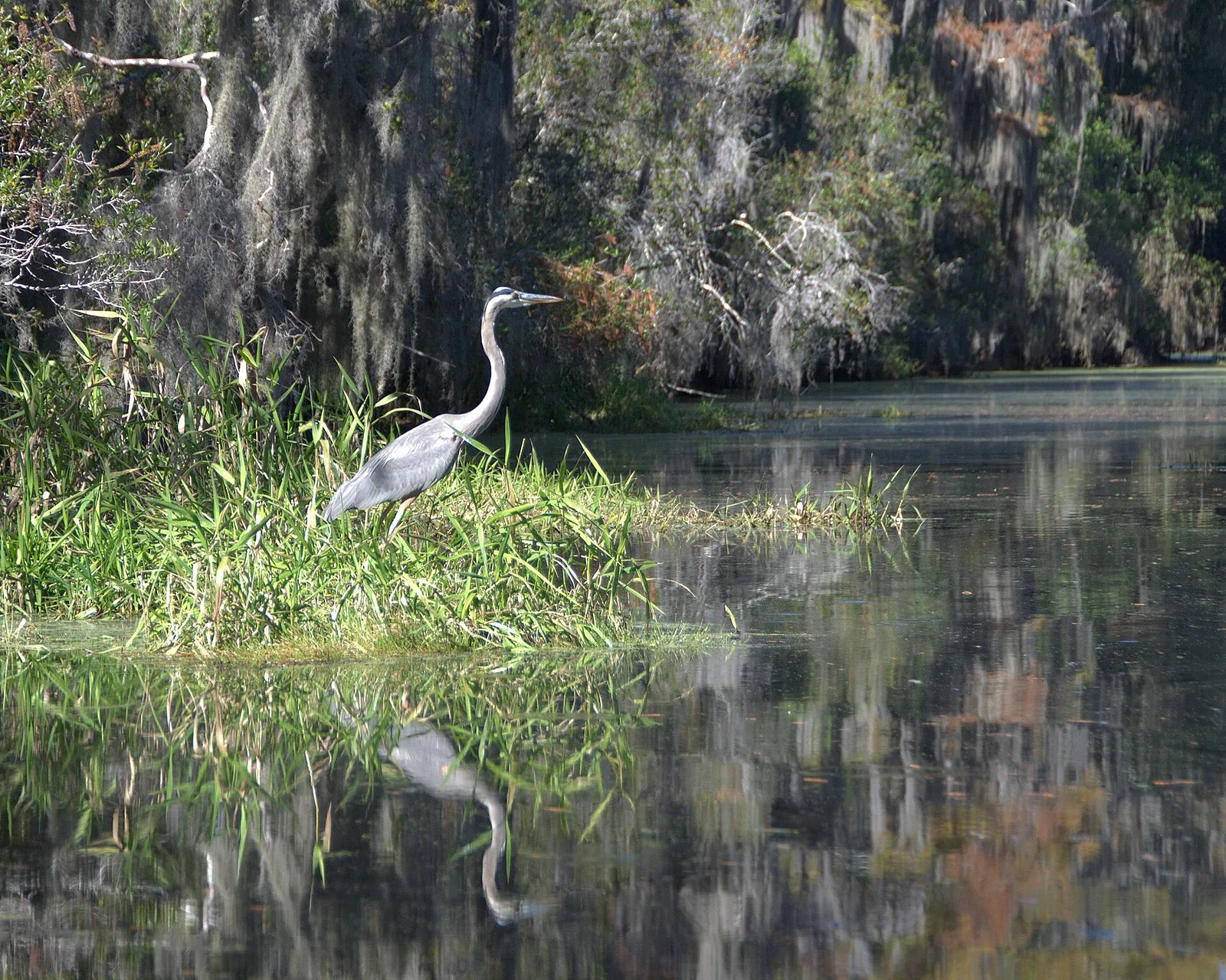
Stands of pond cypress and bald cypress hung with Spanish moss rise from tannin-black water and give the Okefenokee its familiar look; the oldest trees are several centuries old.
Much of today's forest is regrowth: the Hebard company cut most of the mature cypress between 1909 and 1927, and stumps of the giants are still visible in the water.
The trees are rookery habitat. Herons, egrets, anhingas, ibis, and wood storks nest and roost in the canopy over open water, where the height and the alligators below give some protection from predators.
Cypress 'knees,' woody projections from the roots, break the surface throughout these forests; their exact function is still debated, but they may help anchor the shallow-rooted trees in soft peat.
Batteries are mats of peat, decomposed plant matter, that have built up on the swamp bottom and then broken loose as decomposition gases lift sections free to float.
They can be firm enough to walk on and to grow shrubs and even pine trees, yet they shift and quiver with a footstep or a change in water level, which is what the swamp's name describes.
As a battery ages it can weld itself to the bottom and to neighboring mats, and over centuries the process builds the wooded tree islands, called 'houses,' scattered through the swamp.
The wet edges of batteries and prairies are where the Okefenokee's carnivorous plants grow, golden club, several pitcher plant species, sundews, and bladderworts, all adapted to the low-nutrient acid water.
Roughly 60,000 acres of the swamp are open 'prairie,' shallow water covered in water lily, golden club, maidencane, and sedges rather than trees.
These prairies are the swamp's richest feeding grounds, holding large numbers of sandhill cranes, herons, egrets, and wintering ducks, and they are the easiest place for paddlers to see wildlife.
Many of the prairies opened up after fires burned off the peat and the shrubs; without periodic fire they slowly fill back in with brush and cypress.
The water is the color of strong tea from tannins leached out of decaying leaves and peat; it is naturally acidic and low in nutrients but clean, and it stains without harming.
The islands within the swamp and the higher sandy ground around it, Trail Ridge included, carry longleaf pine and wiregrass, one of the most species-rich and most reduced ecosystems in North America.
Longleaf forest once covered an estimated 90 million acres across the Southeast and now survives on roughly 3 percent of that; the refuge protects a significant piece of what remains.
The system depends on fire every few years to hold back hardwoods and open the ground for wiregrass and hundreds of groundcover plants, so the refuge deliberately burns thousands of acres a year.
The uplands support the endangered red-cockaded woodpecker, which nests only in living old pines, along with gopher tortoises, indigo snakes, and Bachman's sparrows.
Indigenous Connections
Seminole and Creek (Muscogee) Peoples
Muscogee (Creek) and later Seminole communities lived in and around the Okefenokee for generations, using its islands as village and garden sites and its waters for fish, turtle, and waterfowl.
As the United States forced the Creek and Seminole out of the Southeast in the 1820s and 1830s, the swamp's roadless interior sheltered people resisting removal; the U.S. Army mounted expeditions into it during the Second Seminole War, and a few families held out on the islands for years.
The last Native residents were pushed out by the late 1830s, but Billys Island, one of the largest, still carries a name tied to the Seminole leader Billy Bowlegs and the people who sheltered there.
The Seminole Tribe of Florida and the Muscogee (Creek) Nation are the principal federally recognized successor nations; the Muscogee (Creek) Nation formally opposed the proposed Trail Ridge mine in 2024. The Okefenokee landscape remains culturally significant to descendants of the people who sheltered here.
Hitchiti-Speaking Peoples
Hitchiti was a Muskogean language spoken across southern Georgia and northern Florida and was one of the main languages of the Lower Creek towns before removal.
The swamp's name, and many place names across the region, came into English from Hitchiti words carried by traders and settlers.
Linguists group Hitchiti closely with Mikasuki, which is still spoken by most members of the Miccosukee Tribe and many Florida Seminole, so the language line did not end with removal but continues under another name.
Hitchiti proper has no first-language speakers today, but its close relative Mikasuki remains a living language in Florida, and Hitchiti is preserved in scholarship and in place names across the Southeast, the Okefenokee among them.
Adventures in the Okefenokee
Wilderness Canoe and Kayak Trips
The best way to see the Okefenokee is by canoe or kayak on about 120 miles of marked water trails that wind from open prairie into narrow, cypress-shaded 'runs.'
Overnight trips of one to five days follow set routes and require a permit for a specific night on a specific platform; the wooden sleeping platforms sit above the water because there is almost no dry ground.
Permits for the popular routes are released 60 days out and are often gone within minutes, and trips can be canceled on short notice when water levels drop too low to paddle.
Day routes leave from all three entrances: the Suwannee Canal area on the east, Stephen C. Foster State Park on the west, and the Swamp Park on the north.
Chesser Island Boardwalk
The 0.75-mile Chesser Island Boardwalk, near the east entrance, crosses prairie marsh and cypress swamp on pilings and ends at the 40-foot Owls Roost Tower with a view over the prairie.
It gives a close look at alligators, wading birds, and carnivorous plants without a boat, and it is wheelchair accessible.
The trail passes the Chesser Island Homestead, a tin-roofed cabin the Chesser family built in 1927; the family had farmed and trapped on the island since about 1858.
The homestead, with its cane mill and smokehouse, is kept as a picture of the hardscrabble 'swamper' life that ended when the refuge was created.
Wildlife Photography and Birding
The Okefenokee is one of the top wildlife-photography spots in the Southeast, with alligators, sandhill cranes, herons, anhingas, and wood storks all easy to approach from a boat or boardwalk.
Each of the three entrances opens onto different habitat, prairie and canal on the east, deep cypress forest on the west, and a mix on the north, so serious visitors work more than one.
Sandhill cranes are present year-round, with resident Florida sandhills joined by thousands of migratory greater sandhills through the winter.
Spring brings nesting rookeries and blooming golden club and pitcher plants; summer nights fill with frog choruses and the bellowing of male alligators.
Conservation Challenges
Proposed Titanium Mining Near the Refuge
Twin Pines Minerals has sought since 2019 to strip-mine heavy minerals, mainly titanium dioxide, from Trail Ridge, the sand ridge that dams the swamp's eastern edge, on a site about three miles from the refuge boundary near St. George.
The U.S. Geological Survey and the Fish and Wildlife Service have warned that lowering the water table in the ridge could drop water levels across the Okefenokee and make its peat far more likely to burn.
Federal Clean Water Act oversight was dropped in 2020 after a rule change, leaving permitting to Georgia's Environmental Protection Division, which advanced draft permits in 2023 and 2024 over tens of thousands of public comments in opposition.
Georgia lawmakers have repeatedly introduced but not passed a bill to ban mining on Trail Ridge, and the state and conservation groups have explored buying out the company's land; the fight was unresolved as of early 2025.
Fire Management
Fire is natural to the Okefenokee, which historically burned across large areas roughly every 20 to 30 years when droughts dried the peat enough to carry flame.
Recent fires have been huge: the 2007 Bugaboo Fire burned more than 560,000 acres in Georgia and Florida, the largest in Georgia's recorded history, and the 2011 Honey Prairie Fire smoldered in the peat for close to a year.
Peat fires burn below the surface, are nearly impossible to put out, and end only when heavy rain or rising groundwater reaches the burning layer.
The refuge uses prescribed burning on the pine uplands to keep fuel loads down, but it cannot manage the peat itself, and deeper droughts tied to a warming climate raise the odds of a very large fire.
Hydrological Protection
Nearly everything about the Okefenokee, its peat, its wildlife, its fire cycle, depends on keeping water levels within a natural range.
Trail Ridge holds the water in on the east; farming, forestry, and groundwater pumping around the other edges can all pull it down.
The Fish and Wildlife Service and the U.S. Geological Survey run a network of water-level gauges and groundwater wells around and inside the swamp and model how proposed withdrawals would affect it.
The mining proposal has made that monitoring central to a legal and scientific argument over how much disturbance the ridge can take before the swamp itself changes.
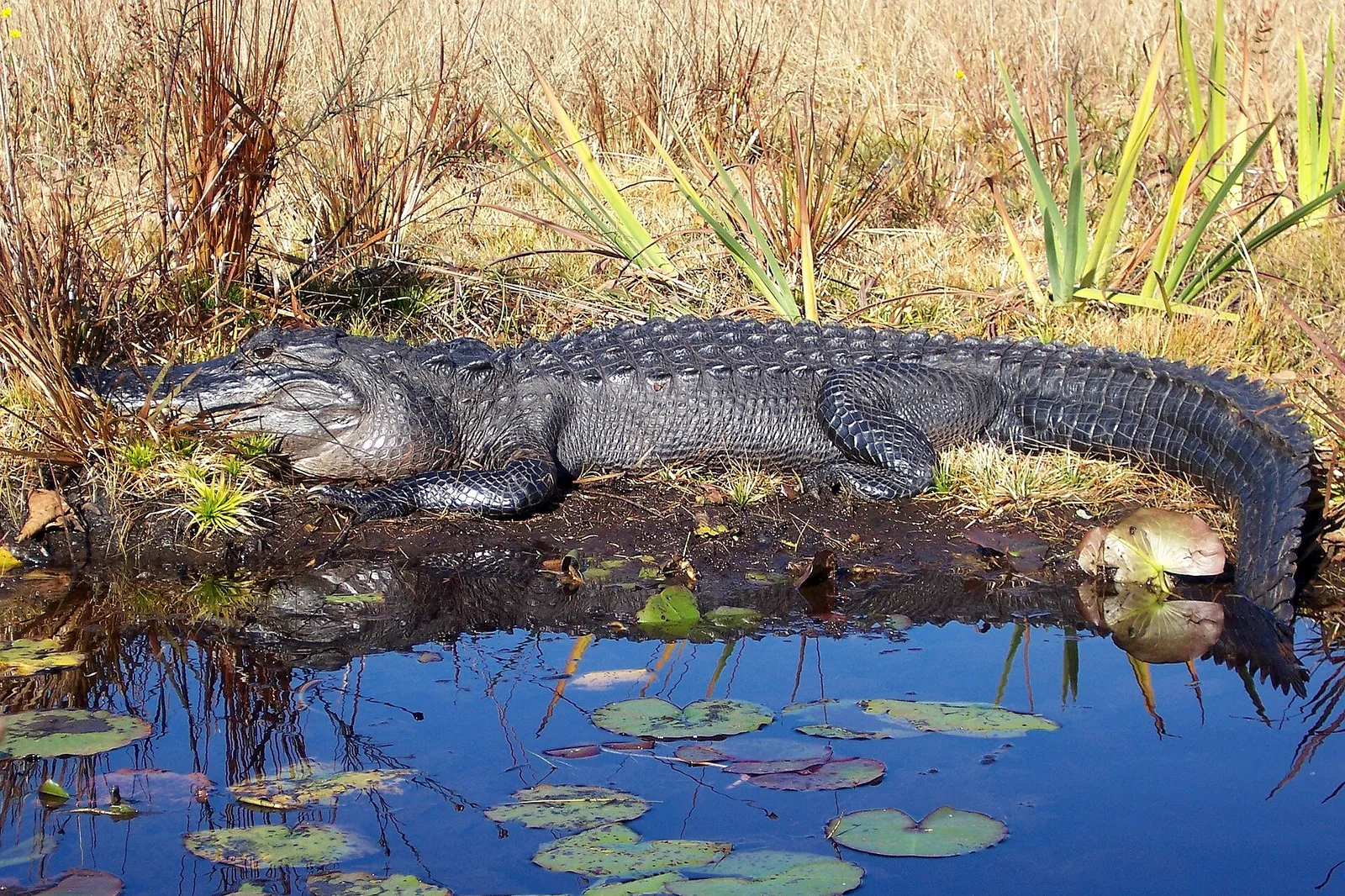
One of thousands of American alligators in the Okefenokee National Wildlife Refuge
At a Glance
Did You Know?
Pogo Possum, the beloved comic strip character created by Walt Kelly, lived in the Okefenokee Swamp. Kelly's strip ran from 1948 to 1975 and included the famous quote: 'We have met the enemy and he is us,' originally written for an Earth Day poster featuring the Okefenokee.
The floating peat islands of the Okefenokee, called batteries, can be thick enough to walk on, yet they tremble and shift because they are not anchored to the swamp bottom. Some have been growing and accumulating organic matter for thousands of years.
The water of the Okefenokee appears dark, almost black, from tannins released by decomposing leaves and vegetation. Despite its color, the water is actually very clean and low in nutrients, creating a distinctive blackwater ecosystem.
The Okefenokee hosts one of the largest concentrations of nesting wood storks in the United States. Wood storks are listed as threatened under the Endangered Species Act, and the refuge provides critical nesting habitat for the species' recovery.
Plan Your Visit
Location
Waycross, Georgia (Ware and Charlton Counties)
Designation
National Wildlife Refuge, National Natural Landmark
Best Time to Visit
October through April for cooler temperatures and fewer insects
Admission
Entry fees vary by entrance; canoe trail permits required for overnight trips