

What The Transportation Department Does
Established October 15, 1966, The U.S. Department of Transportation is one of the fifteen Cabinet-level departments of the U.S. federal government.
The Transportation Department oversees the safety and funding of America's transportation network, including highways, railroads, aviation, pipelines, and maritime shipping. It runs the Federal Aviation Administration, which controls U.S. airspace and certifies aircraft as safe to fly, and the National Highway Traffic Safety Administration, which sets vehicle safety standards and orders recalls.
The department distributes federal highway funding to states through the Federal Highway Administration, drawn primarily from the Highway Trust Fund, financed by federal gas taxes, and it oversees Amtrak, the federally supported national passenger rail system, along with major transit and infrastructure grant programs for cities and states.
Beyond funding and regulation, the department investigates transportation safety more broadly through coordination with the independent National Transportation Safety Board, and its decisions on issues like drone regulation, electric vehicle infrastructure, and self-driving car rules increasingly shape emerging transportation technologies.
Most of the department's money is a pass-through: it distributes highway, transit, and airport funds to states, cities, and airport authorities largely by formula, and its own workforce is concentrated in the FAA, which employs about three-quarters of all DOT staff. Other operating administrations cover pipelines and hazardous materials (PHMSA), commercial trucking and bus safety (FMCSA), and the Maritime Administration, which maintains a reserve merchant fleet.

The Secretary of Transportation
The Secretary of Transportation leads The Transportation Department, sits on the President's Cabinet, and is confirmed by a majority vote of the U.S. Senate.
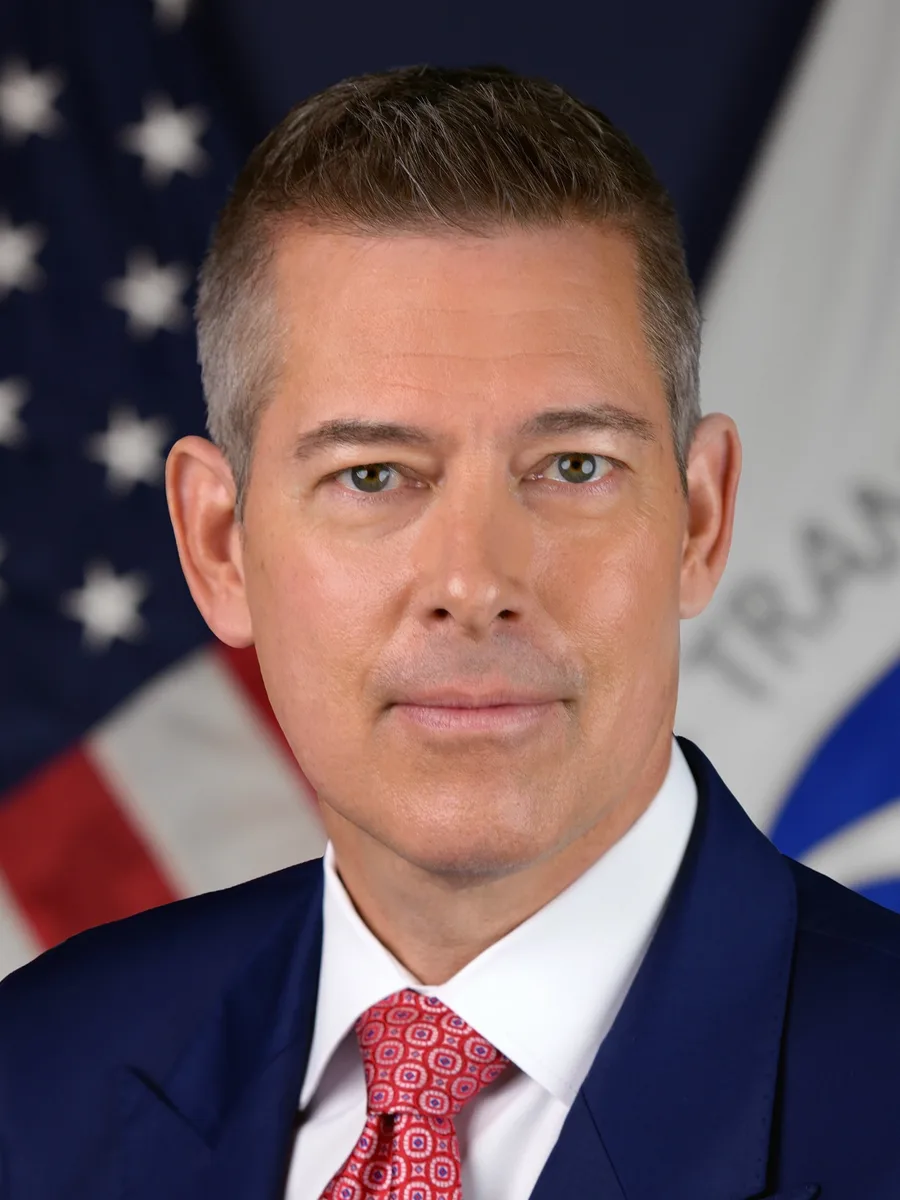
Current Secretary of Transportation
Sean Duffy
In office since
January 28, 2025
Prior role: U.S. Representative from Wisconsin (2011-2019); Fox Business host
Sean Duffy was confirmed as Secretary of Transportation on January 28, 2025. He served four terms in the U.S. House representing Wisconsin's 7th congressional district before leaving Congress in 2019, and later worked as a co-host on Fox Business Network.
Before his political career, Duffy worked as a county prosecutor in Wisconsin and appeared as a cast member on MTV's The Real World in the 1990s. As Transportation Secretary, he has taken a lead role in the department's response to air traffic control staffing shortages and aviation safety reforms.
Major Sub-Agencies & Bureaus
The Transportation Department carries out its mission through operating divisions and sub-agencies, each with its own specific mandate.
The FAA controls all civilian air traffic in U.S. airspace, handling roughly 45,000 flights a day, making it the busiest air traffic control system in the world, and certifies every commercial aircraft, pilot, and airline operating in the United States as meeting federal safety standards.
The FAA has faced sustained scrutiny in recent years over air traffic controller staffing shortages and aging air traffic control technology, issues that drew renewed national attention following a series of high-profile aviation safety incidents and near-misses at major U.S. airports.
The agency employs roughly 45,000 people, including about 14,000 certified air traffic controllers at more than 300 facilities, and is chronically several thousand controllers short of its own staffing targets. Much of its equipment is decades old; a 1988-era system that alerts pilots to hazards failed for hours in January 2023, briefly halting all U.S. departures for the first time since 9/11.
The FAA also runs the aviation trust fund financed by ticket and fuel taxes, regulates commercial spaceflight launches, and writes the rules for drones, which now number well over a million registered aircraft. Unlike most safety regulators it has a legal "dual mandate" that once included promoting the aviation industry, a phrase Congress removed in 1996 after the ValuJet crash.
NHTSA sets federal motor vehicle safety standards, investigates vehicle defects, and can order manufacturers to recall unsafe vehicles or parts, with tens of millions of vehicles recalled for safety defects in a typical year, ranging from faulty airbags to software glitches.
The agency also runs highway safety campaigns like 'Click It or Buckle Up' and collects the national traffic fatality statistics that guide both federal policy and vehicle safety technology requirements, including the eventual mandate for rearview cameras and, more recently, automatic emergency braking systems.
Roughly 40,000 people die on U.S. roads each year, a rate far higher per mile driven than in most other wealthy countries, and NHTSA's statistics show pedestrian and cyclist deaths rising sharply in the 2010s and 2020s even as vehicle occupant deaths fell.
NHTSA also administers the federal fuel-economy (CAFE) standards jointly with the EPA, oversees the 5-Star crash-test rating program consumers see on window stickers, and writes the still-evolving federal framework for automated and self-driving vehicles, an area where it has mostly used exemptions and guidance rather than binding rules.
The Federal Highway Administration distributes federal highway funding to state departments of transportation, primarily financed through the federal gas tax deposited into the Highway Trust Fund, supporting construction and maintenance of the roughly 47,000-mile Interstate Highway System and other federally supported roads.
Because the federal gas tax has not been raised since 1993 while construction costs and vehicle fuel efficiency have both risen substantially, the Highway Trust Fund has required repeated general fund transfers from Congress in recent years to remain solvent, an ongoing structural funding challenge for the agency.
About 90 percent of the agency's budget flows to states as formula grants, and states generally must put up a 20 percent match. The FHWA sets national design and signage standards (the Manual on Uniform Traffic Control Devices is why a stop sign looks the same in every state) and reviews the environmental studies required for large projects.
The federal government owns almost none of the roads it funds; states and localities own and maintain them. The FHWA does directly manage about 30,000 miles of roads on federal land, such as those in national parks and forests, through its Federal Lands Highway program.
The Federal Railroad Administration regulates railroad safety nationwide and provides federal funding and oversight for Amtrak, the government-supported national passenger rail system, along with major rail infrastructure investments like the Northeast Corridor upgrades between Boston and Washington, D.C.
The agency also oversees freight rail safety regulations affecting the extensive private freight rail network that moves the majority of the nation's coal, grain, and other bulk commodities, and its safety investigations have drawn significant attention following high-profile derailments involving hazardous materials.
The FRA has only a few hundred inspectors for roughly 140,000 miles of track, so it relies heavily on railroad self-reporting and audits. It administered the long, contentious rollout of "positive train control," an automatic braking system Congress mandated after a 2008 California collision killed 25; it finally covered the required network in 2020.
The February 2023 Norfolk Southern derailment and chemical burn-off in East Palestine, Ohio, put the agency's freight-safety rules in the spotlight and prompted bipartisan rail-safety bills in Congress over train length, crew size, and trackside detectors.
From October 15, 1966 to Today
The predecessor of The Transportation Department was 35 separate transportation agencies and offices scattered across the federal government. Here is how the department reached its current form.
Congress created the Department of Transportation in 1966, consolidating 35 separate transportation-related agencies and offices scattered across the federal government, including the newly formed FAA (established in 1958) and the existing Bureau of Public Roads, under a single Cabinet department for the first time.
The consolidation was driven partly by the recognition that transportation safety and infrastructure investment decisions were being made in an uncoordinated way across dozens of agencies with overlapping jurisdictions, making unified oversight increasingly necessary as interstate highway construction and air travel both expanded rapidly.
President Johnson proposed the department, and it opened for business in April 1967 with Alan Boyd as the first secretary. Congress deliberately kept the economic regulation of railroads, trucking, and airlines, then handled by the Interstate Commerce Commission and Civil Aeronautics Board, outside the new department; those bodies were later abolished as those industries were deregulated in the late 1970s and 1980s.
The Highway Safety Act of 1970 established the National Highway Traffic Safety Administration to consolidate federal vehicle safety regulation, and the same broader reorganization created the Federal Railroad Administration to oversee rail safety, both agencies emerging from the department's early consolidation efforts.
NHTSA's creation reflected growing public concern over traffic fatalities following Ralph Nader's influential 1965 book Unsafe at Any Speed, which criticized the auto industry's safety record and helped build political momentum for stronger federal vehicle safety regulation.
The underlying authority came from the 1966 National Traffic and Motor Vehicle Safety Act, which for the first time let the federal government set binding safety standards for all new cars. U.S. traffic deaths per mile driven have fallen by roughly 80 percent since the mid-1960s, a decline credited to seatbelts, airbags, drunk-driving enforcement, and safer road design.
Congress created Amtrak in 1970, and it began operations in 1971, taking over intercity passenger rail service from private railroads that had increasingly abandoned the money-losing business in favor of more profitable freight operations, with the Transportation Department providing ongoing federal oversight and funding.
Amtrak has operated at a financial loss for nearly its entire existence and depends on annual federal subsidies to continue operating most of its routes, with only the densely traveled Northeast Corridor between Boston and Washington generating an operating profit in most years.
Amtrak is a government-owned corporation, not an agency; the federal government holds nearly all its stock. It runs about 300 trains a day over roughly 21,000 route miles, but owns only a few hundred of those miles, mostly the Northeast Corridor, and pays private freight railroads to run over the rest, which is a major cause of its chronic delays.
The Aviation and Transportation Security Act of 2001, passed weeks after the September 11 attacks, created the Transportation Security Administration to federalize airport security screening, initially housed within the Transportation Department before moving to the newly created Department of Homeland Security in 2003.
The move of aviation security functions to Homeland Security left the Transportation Department focused on aviation safety and traffic control through the FAA, while security screening became a separate department's responsibility, a division that still occasionally causes public confusion about which agency handles what at airports.
Before 2001, screening was done by private contractors hired by the airlines. The new law required the federal government to hire and train a screening workforce of tens of thousands within a year, one of the fastest federal hiring efforts in history, and to screen all checked baggage for explosives.
The Infrastructure Investment and Jobs Act of 2021 directed more than $550 billion in new federal spending on roads, bridges, rail, and broadband, much of it flowing through Transportation Department grant programs, representing one of the largest infrastructure investments in decades.
The law also funded a nationwide electric vehicle charging network buildout and significant bridge repair funding, responding to a widely cited 2021 infrastructure report card that found thousands of American bridges rated structurally deficient.
The law provided about $110 billion for roads and bridges, $66 billion for rail (the largest federal rail investment since Amtrak's founding), $39 billion for transit, $25 billion for airports, and $7.5 billion for EV charging, alongside new discretionary grant programs the department awards competitively.
Defining Moments
Events that reshaped the department's authority, structure, or public role.
Though authorized under the 1956 Federal-Aid Highway Act, before the Transportation Department itself existed, the roughly 47,000-mile Interstate Highway System took decades to complete, with the Federal Highway Administration overseeing its final major segments into the 1990s.
The interstate system is widely regarded as one of the most transformative public works projects in American history, reshaping commerce, suburban development, and personal mobility nationwide, and it remains the backbone of the department's highway funding and maintenance responsibilities today.
The 1956 law paid 90 percent of construction costs from a new federal gas tax and Highway Trust Fund, and President Eisenhower promoted it partly on Cold War grounds, as a way to move troops and evacuate cities. Final cost estimates ran to well over $100 billion (far more in today's dollars), and the last originally planned segment opened in 1992 in Colorado.
The routing of urban interstates through the hearts of cities in the 1950s and 1960s displaced hundreds of thousands of people, disproportionately in Black neighborhoods, and "freeway revolts" halted planned highways in San Francisco, New York, and other cities. The 2021 law added a program to help reconnect neighborhoods that earlier highways divided.
When most of the FAA's unionized air traffic controllers went on an illegal strike in August 1981, President Reagan fired more than 11,000 striking controllers and banned them from federal service, a decision that reshaped labor relations across the federal government for decades.
The FAA spent years rebuilding its controller workforce afterward, and staffing shortages tracing partly back to this disruption have periodically resurfaced as a persistent operational challenge for the agency, contributing to more recent concerns about controller staffing levels.
Federal law bars federal employees from striking, and the union, PATCO, was decertified. Reagan's willingness to fire the entire workforce is widely cited by labor historians as a turning point that emboldened private employers to take harder lines in strikes through the 1980s.
Because the FAA hired a huge cohort of replacement controllers in the early 1980s, they later became eligible to retire in a bunch around 2010-2015, creating a second staffing crunch, and controllers face mandatory retirement at 56, which keeps the pipeline problem recurring.
Two crashes of Boeing 737 MAX aircraft in 2018 and 2019, which killed 346 people combined, revealed serious flaws in how the FAA had delegated aspects of aircraft safety certification to Boeing itself, prompting a worldwide grounding of the aircraft and a major congressional overhaul of FAA certification oversight in 2020.
The crisis significantly damaged public confidence in the FAA's certification process and led to new legal requirements strengthening the agency's direct oversight role, changes still being implemented as the FAA works to restore its safety oversight credibility.
Both crashes were tied to a flight-control system called MCAS that could push the plane's nose down based on a single sensor, and that pilots had not been told about. The MAX was grounded worldwide for about 20 months, the longest grounding of a U.S. airliner ever.
The Aircraft Certification, Safety, and Accountability Act of 2020 tightened rules on "organization designation authorization," the system that lets manufacturers self-certify routine work. Boeing paid a $2.5 billion settlement, and further quality problems, including a door plug that blew out of a 737 MAX 9 in flight in January 2024, kept the FAA's oversight of the company under scrutiny.
Notable Programs & Initiatives
A selection of the programs The Transportation Department runs, and what each one is actually for.
Financed primarily by the federal gas and diesel tax, unchanged since 1993, the Highway Trust Fund provides the majority of federal highway and transit funding distributed to states, though rising construction costs and improved vehicle fuel efficiency have steadily eroded its purchasing power over time.
Congress has repeatedly transferred general revenue into the trust fund to keep it solvent in recent years, and the long-term question of how to fund highways as vehicles become more fuel-efficient and electric, reducing gas tax revenue, remains one of the department's most significant unresolved policy challenges.
The federal gas tax is 18.4 cents a gallon (24.4 for diesel) and has lost roughly half its real value since 1993. Since 2008 Congress has plugged more than $270 billion in general-fund and other transfers into the trust fund because gas-tax revenue no longer covers the spending Congress authorizes.
Several states are piloting a "road usage charge" that taxes miles driven rather than fuel bought, and the 2021 law funded a national pilot. Electric-vehicle drivers currently pay no federal fuel tax at all, and many states have added flat EV registration fees to compensate.
NHTSA can compel automakers to recall vehicles with safety defects, and tens of millions of vehicles are recalled in a typical year for issues ranging from faulty airbag inflators to software errors, with owners notified directly and repairs performed free of charge by dealers.
The 2014-era Takata airbag recall, which eventually covered tens of millions of vehicles across nearly every major automaker due to airbag inflators that could explode with metal shrapnel, remains the largest automotive safety recall in U.S. history and reshaped how NHTSA investigates supplier-wide safety defects.
The Takata recall covered about 67 million inflators in the U.S. and is linked to more than 25 U.S. deaths; the company filed for bankruptcy in 2017. Because completion rates on recalls are far from 100 percent, millions of affected vehicles remained on the road years later, and NHTSA and automakers still run campaigns to reach the last owners.
Most recalls begin voluntarily after a manufacturer's own analysis or NHTSA's Office of Defects Investigation opens a query based on consumer complaints. NHTSA can also fine automakers for failing to report defects promptly, as it did in multibillion-dollar-adjacent penalties against several companies over ignition switches, unintended acceleration, and delayed reporting.
Funded by the 2021 infrastructure law, this program provides states with federal funding to build a nationwide network of fast-charging stations along major highway corridors, aimed at addressing 'range anxiety' concerns that have historically slowed broader electric vehicle adoption, particularly for long-distance travel.
Implementation has moved more slowly than initially planned, with states navigating complex federal requirements and private charging network partnerships, and the program's future scope has become a subject of ongoing policy debate as electric vehicle adoption rates and federal priorities have shifted.
The program's $5 billion is distributed to states by formula and aims for chargers at least every 50 miles along designated highway corridors, each site with at least four fast-charging ports. Standards require the chargers to work with any brand of car and to meet uptime and payment rules.
By the mid-2020s only a few hundred federally funded charging ports had opened, drawing bipartisan criticism over the pace, and a 2025 administration move to pause the program while rewriting the rules was challenged by several states in court.
The Federal Transit Administration provides grants to help cities build and maintain subway systems, bus networks, and light rail, funding major capital projects through its Capital Investment Grants program, which typically covers up to half the cost of large new transit projects nationwide.
Transit funding has become an increasingly significant part of the department's portfolio as cities look to reduce traffic congestion and emissions, though major transit expansion projects in the U.S. frequently face longer timelines and higher per-mile costs than comparable projects in many other developed countries.
About 80 percent of federal transit dollars go to formula grants that agencies use mostly for maintenance and equipment; the competitive "New Starts" pipeline funds a smaller number of big projects and often takes a decade from application to opening. The FTA also tracks a large "state of good repair" backlog, tens of billions of dollars of overdue rail and bus repairs.
Fare revenue covers only part of transit operating costs, and ridership on many U.S. systems, especially rail, fell sharply during the pandemic and had not fully recovered by the mid-2020s, leaving agencies facing "fiscal cliffs" as federal relief funds ran out.
How This Affects Everyday Americans
Every American who drives on a federal highway, flies on a commercial airline, or rides Amtrak interacts directly with infrastructure and safety systems the Transportation Department funds and regulates, and its FAA air traffic controllers are responsible for the safe passage of roughly 45,000 flights every single day.
NHTSA's vehicle safety recalls directly protect car owners from defects that could cause injury or death, and the department's crash test and safety standard requirements have shaped nearly every safety feature built into modern vehicles, from seatbelts to airbags to backup cameras.
The condition of local roads and bridges, and whether a community has access to public transit or passenger rail, is significantly shaped by how federal transportation funding gets distributed, meaning the department's grant decisions have a direct, visible effect on commute times and infrastructure quality in communities nationwide.
The department's passenger-rights rules decide what an airline owes travelers for a canceled flight or lost bag, its hours-of-service limits govern how long the truck drivers sharing the highway can stay behind the wheel, and its pipeline safety rules apply to the 2.6-million-mile network that pipes natural gas to home furnaces.
Quick Facts & Figures
Key statistics and reference information about The Transportation Department.
| Established | October 15, 1966 |
| Headquarters | William T. Coleman, Jr. and Norman Y. Mineta Federal Building |
| Current Secretary | Sean Duffy |
| Annual Budget | ~$105 billion (FY2025 enacted) |
| Employees | ~55,000 |
| Daily Flights Managed by FAA | ~45,000 |
| Interstate Highway System | ~47,000 miles |
| Website | transportation.gov |
Did You Know?
The FAA handles about 45,000 flights per day in U.S. airspace, making it the busiest air traffic control system in the world.
The federal gas tax that funds most highway spending has not been raised since 1993, even as construction costs and vehicle fuel efficiency have both climbed significantly since then.
TSA airport security screening actually started inside the Transportation Department in 2001 before moving to the newly created Department of Homeland Security in 2003.
The 2014-era Takata airbag recall, overseen by NHTSA, eventually covered tens of millions of vehicles across nearly every major automaker, the largest auto safety recall in U.S. history.
Amtrak has operated at a financial loss for nearly its entire existence since 1971, with only the Northeast Corridor between Boston and Washington typically turning a profit.