
What The Commerce Department Does
Established 1913 (originally created in 1903 as Commerce and Labor), The U.S. Department of Commerce is one of the fifteen Cabinet-level departments of the U.S. federal government.
The Commerce Department's mission is to promote American economic growth and competitiveness. It runs the U.S. Census Bureau, which conducts the constitutionally mandated population count every ten years and produces the economic statistics, including GDP data, that guide decisions across government and private industry.
The department houses the National Oceanic and Atmospheric Administration (NOAA), which issues every hurricane, tornado, and severe weather forecast in the country through the National Weather Service, and the U.S. Patent and Trademark Office, which grants the patents and trademarks that protect American inventions and brands.
Commerce also manages export controls on sensitive technology, particularly semiconductors and other items with potential military applications, negotiates trade policy alongside the U.S. Trade Representative, and sets industrial standards through the National Institute of Standards and Technology.
It is sometimes described as a dozen loosely related agencies under one roof: alongside Census, NOAA, the patent office, and NIST, it runs the Bureau of Economic Analysis (which computes GDP and trade figures), the International Trade Administration (which promotes U.S. exports), the Minority Business Development Agency, and the National Telecommunications and Information Administration, which manages federal use of the airwaves and now billions of dollars in broadband grants.

The Secretary of Commerce
The Secretary of Commerce leads The Commerce Department, sits on the President's Cabinet, and is confirmed by a majority vote of the U.S. Senate.
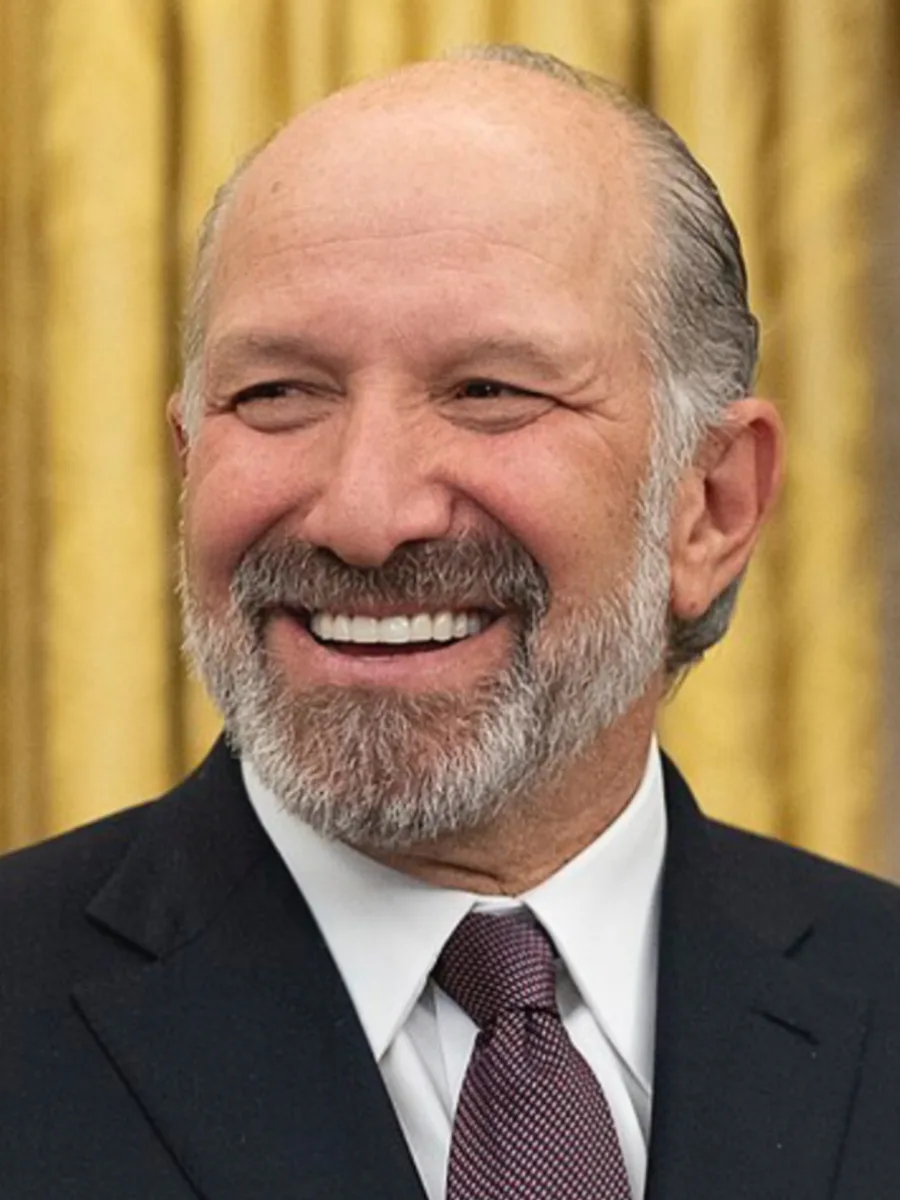
Current Secretary of Commerce
Howard Lutnick
In office since
February 18, 2025 (sworn in February 21)
Prior role: Chairman and CEO, Cantor Fitzgerald
Howard Lutnick was confirmed as Secretary of Commerce on February 18, 2025, and sworn in on February 21. He spent nearly four decades at Cantor Fitzgerald, the financial services firm, rising to chairman and CEO and rebuilding the company after it lost roughly two-thirds of its New York employees in the September 11, 2001 attacks on the World Trade Center.
As Commerce Secretary, Lutnick has taken a lead role in the administration's tariff negotiations with foreign trading partners and oversees the department's export control and semiconductor policy functions, which have become increasingly central to U.S.-China economic competition.
Major Sub-Agencies & Bureaus
The Commerce Department carries out its mission through operating divisions and sub-agencies, each with its own specific mandate.
The Census Bureau conducts the decennial census required by the Constitution, counting every person living in the United States every ten years, data used to apportion congressional seats and Electoral College votes among the states and to distribute hundreds of billions of dollars in federal funding.
Beyond the headline population count, the bureau also produces ongoing surveys like the American Community Survey and monthly economic indicators, including retail sales and housing starts data, that are closely watched by investors, economists, and policymakers throughout the year.
Census data is protected by Title 13, which makes individual responses confidential for 72 years and bars their use against any respondent by any agency, including immigration or law enforcement. A rare breach of that trust, sharing block-level data that helped identify Japanese Americans for internment in the 1940s, was formally acknowledged by the bureau decades later.
The 2020 count drew years of litigation over a proposed citizenship question, which the Supreme Court blocked in 2019, and over the timeline the administration set for finishing the count during the pandemic. The results shifted seven House seats among 13 states.
NOAA's National Weather Service issues every official tornado warning, hurricane forecast, and severe weather alert in the United States, operating a network of satellites, radar stations, and weather balloons that generate the data underlying both government and private-sector weather forecasting.
NOAA also manages fisheries conservation, monitors ocean and atmospheric conditions related to climate change, and operates the National Hurricane Center in Miami, whose storm track forecasts guide evacuation decisions for millions of coastal residents each hurricane season.
The agency runs the polar-orbiting and geostationary weather satellites (the multibillion-dollar GOES and JPSS programs), the 160-plus Doppler radar sites of the NEXRAD network, the fleet of "Hurricane Hunter" aircraft, and the supercomputers that run the forecast models. Its data is released free and is the backbone of essentially every commercial weather app and TV forecast.
NOAA's fisheries service sets catch limits and closures for federal waters under the Magnuson-Stevens Act, and the agency also charts U.S. waters, responds to oil spills, and maintains the tide and sea-level records used in coastal engineering and flood planning.
The Patent and Trademark Office examines and grants U.S. patents, giving inventors exclusive rights to their inventions for a set period, and registers trademarks that protect brand names and logos, processing hundreds of thousands of patent applications and trademark filings each year.
The agency is entirely funded by the fees it collects from applicants rather than general tax revenue, and its decisions play a central role in the American innovation economy, since a granted or denied patent can determine whether a startup's core technology is legally defensible against competitors.
A utility patent lasts 20 years from filing; the office grants roughly 350,000 to 400,000 a year and carries a backlog of hundreds of thousands of pending applications, with a typical wait of about two years for a first decision. The America Invents Act of 2011 moved the U.S. to a "first inventor to file" system and created an in-house tribunal, the Patent Trial and Appeal Board, to review issued patents.
The Supreme Court has repeatedly narrowed what can be patented, ruling that natural DNA sequences (2013) and many abstract software and business methods (Alice v. CLS Bank, 2014) are not eligible, decisions that reshaped whole industries' patent strategies.
NIST maintains the official U.S. measurement standards, from the precise definition of a second to cybersecurity frameworks widely adopted across government and private industry, and its cybersecurity guidelines in particular have become an informal national standard many companies follow even without a legal mandate to do so.
NIST also administers billions of dollars in semiconductor manufacturing incentives created by the 2022 CHIPS and Science Act, funding the construction of new chip fabrication plants in the United States as part of a broader effort to reduce reliance on overseas semiconductor production.
Founded in 1901 as the National Bureau of Standards, it is one of the oldest physical-science labs in the country and holds several Nobel Prizes in physics for work on atomic clocks and laser cooling. Its atomic clocks in Boulder, Colorado, keep official U.S. time, distributed through radio station WWV and network time servers.
NIST's investigation of the World Trade Center collapse produced building-code changes adopted nationwide, and its Cybersecurity Framework and post-quantum encryption standards, finalized in 2024, are used far beyond the U.S. government. It runs no regulatory programs itself.
From 1913 (originally created in 1903 as Commerce and Labor) to Today
The predecessor of The Commerce Department was the Department of Commerce and Labor (1903-1913). Here is how the department reached its current form.
Congress created a combined Department of Commerce and Labor in 1903, reflecting growing federal interest in regulating the rapidly industrializing economy, and placed the new Bureau of Corporations within it to investigate large trusts and monopolies.
The Census Bureau, which had previously operated as a temporary agency reconstituted for each decennial count, became a permanent bureau within the new department that same year, ending the practice of standing up an entirely new census operation from scratch every ten years.
The department absorbed a scattering of existing bureaus, the Lighthouse Board, the Steamboat Inspection Service, the Coast and Geodetic Survey, the Fish Commission, and the Patent Office among them, giving it from the start the grab-bag character it still has.
Congress split the Department of Commerce and Labor into two separate Cabinet departments in 1913, responding to organized labor's push for a dedicated department focused on workers' interests rather than one shared with business regulation, which sometimes created conflicting priorities.
The newly independent Commerce Department retained the Census Bureau, the Bureau of Standards (the ancestor of today's NIST), and other business-focused functions, setting the department's core identity as a business and statistics agency that has remained largely stable ever since.
The split was signed by President Taft on his last day in office. The Bureau of Corporations, Commerce's trust-busting arm, was moved out in 1914 to become part of the new Federal Trade Commission.
President Nixon created the National Oceanic and Atmospheric Administration in 1970 by consolidating the Weather Bureau, the Coast and Geodetic Survey, and several fisheries agencies into a single agency within Commerce, responding to growing public concern about environmental and ocean issues.
NOAA's creation reflected a broader wave of environmental agency-building in the early 1970s that also produced the EPA that same year, and NOAA's weather and ocean forecasting mission has since grown into one of the most publicly visible functions of the entire Commerce Department.
A presidential commission had recommended placing NOAA in a proposed Department of Natural Resources; Nixon instead put it in Commerce, where it has stayed despite periodic proposals to move it to Interior. The Weather Bureau it absorbed dated to 1870, when it was run by the Army Signal Corps.
Commerce's Bureau of Industry and Security significantly expanded its use of export control authority beginning in 2018, restricting sales of advanced semiconductors and other sensitive technology to certain foreign companies and countries over national security concerns, most prominently targeting Chinese telecommunications firms.
These export controls have become an increasingly central tool of U.S. economic and national security policy in the years since, placing the Commerce Department at the center of the broader technology competition between the United States and China.
Congress rewrote the underlying law in the Export Control Reform Act of 2018 and directed Commerce to identify "emerging and foundational technologies" for control. Commerce added Huawei and later hundreds of other Chinese firms to the Entity List, and in 2022 and 2023 issued sweeping rules limiting exports of the most advanced chips and the equipment used to make them.
The CHIPS and Science Act of 2022 directed roughly $52 billion in federal incentives, administered largely through Commerce, to expand domestic semiconductor manufacturing capacity, responding to supply chain shortages exposed during the COVID-19 pandemic and long-term concerns about U.S. reliance on overseas chip production.
The law represents one of the largest industrial policy investments in decades, and Commerce has since negotiated individual funding agreements with major chipmakers to build new fabrication plants across several states, reshaping the geography of American semiconductor manufacturing.
Of the total, about $39 billion is manufacturing grants, with the rest for research, workforce programs, and a separate defense allocation. Commerce set up a new CHIPS Program Office and by the mid-2020s had signed award agreements with Intel, TSMC, Samsung, Micron, and others for plants in Arizona, Ohio, Texas, New York, and elsewhere.
Defining Moments
Events that reshaped the department's authority, structure, or public role.
Herbert Hoover served as Commerce Secretary from 1921 to 1928 and dramatically expanded the department's role and visibility, using it to promote industrial standardization, radio and aviation regulation, and business efficiency before his own election as president in 1928.
Hoover's aggressive expansion of Commerce's mission during this period is widely credited with transforming what had been a relatively minor Cabinet post into a genuinely influential department, and the department's current headquarters building carries his name today.
Under Hoover, Commerce took on regulation of the new radio industry (a role that later passed to the Federal Radio Commission and then the FCC), civil aviation safety through the 1926 Air Commerce Act, and campaigns to standardize everything from brick sizes to automobile tires. He directed federal relief for the catastrophic 1927 Mississippi River flood, which made him a national figure.
Critics later argued that Hoover's faith in voluntary cooperation between government and business, the "associative state," left the department poorly equipped to respond when the Depression hit during his presidency.
NOAA's launch of increasingly sophisticated weather satellites from the 1960s onward transformed hurricane forecasting from a reactive science into a predictive one, giving coastal communities days of advance warning before major storms make landfall, a capability that did not meaningfully exist before the satellite era.
The National Hurricane Center's improved track forecasting, built on this satellite data, is credited with dramatically reducing U.S. hurricane fatalities over the past half-century even as coastal populations and property values in hurricane-prone areas have grown substantially.
The first weather satellite, TIROS-1, launched in 1960. The average error in a National Hurricane Center 3-day track forecast has fallen by more than two-thirds since 1990, so a 3-day forecast today is about as accurate as a 1-day forecast was then, which is why evacuation orders can now be issued earlier and more precisely.
The Galveston hurricane of 1900, before any forecasting infrastructure, killed an estimated 6,000 to 12,000 people, still the deadliest natural disaster in U.S. history. Modern U.S. hurricanes, even very destructive ones, typically kill in the dozens or low hundreds, largely because of warning time.
Beginning in 2025, Commerce Secretary Howard Lutnick took a leading role, alongside the U.S. Trade Representative, in negotiating a broad set of new tariffs and trade agreements with major U.S. trading partners, a significant expansion of Commerce's traditional role in international trade policy.
The negotiations touched nearly every sector of the American economy, from automobiles to agriculture, and placed Commerce at the center of one of the most consequential U.S. trade policy shifts in decades, with effects still being assessed by economists as new agreements take effect.
Commerce's traditional trade tools are the antidumping and countervailing duty investigations run by the International Trade Administration, which determine whether foreign goods are being sold below cost or with unfair subsidies, and "Section 232" national-security investigations into imports such as steel, aluminum, and autos.
Tariff rates are ultimately set by the president under authorities delegated by Congress, and the courts have been asked to weigh which of those statutes reach how far, a question with large stakes for importers and consumers. In Learning Resources v. Trump (February 20, 2026), the Supreme Court held that the International Emergency Economic Powers Act does not authorize tariffs.
Notable Programs & Initiatives
A selection of the programs The Commerce Department runs, and what each one is actually for.
Required by Article I of the Constitution, the census counts every person residing in the United States every ten years and directly determines how many U.S. House seats and Electoral College votes each state receives, as well as how hundreds of billions of dollars in annual federal funding gets distributed to states and communities.
The 2020 census cost more than $15 billion to conduct and faced unprecedented operational challenges from the COVID-19 pandemic, prompting ongoing debate over methodology and funding ahead of the next count scheduled for 2030.
The Constitution requires counting "the whole number of persons" in each state, which the Supreme Court and long practice have read to include noncitizens; efforts to exclude unauthorized immigrants from the apportionment base have not succeeded. The count uses mailed invitations, online and phone response, and door-knocking by hundreds of thousands of temporary "enumerators."
More than 300 federal programs, including Medicaid, SNAP, highway funding, and Title I school aid, use census-derived population data to allocate money, so researchers estimate each uncounted person can cost a state on the order of $1,000 to $2,000 a year in federal funds over the decade.
The Bureau of Industry and Security maintains the Entity List, which restricts specific foreign companies from receiving U.S. technology exports without a special license, used most prominently in recent years to limit advanced semiconductor and chipmaking equipment sales to Chinese firms with suspected military ties.
These export restrictions have become a central battleground in U.S.-China economic relations, with foreign governments and companies closely watching each Commerce Department listing decision for its potential ripple effects across global technology supply chains.
The Entity List now runs to hundreds of pages. A separate "foreign direct product rule" extends U.S. controls to chips made anywhere in the world using American software or equipment, which is why the restrictions reach factories in Taiwan and South Korea as well as the United States.
BIS also enforces the rules, with special agents who investigate illegal exports and diversion; penalties have included large fines against companies that shipped controlled goods to sanctioned destinations, and criminal charges for smuggling chips and chipmaking tools.
Run through NIST, this nationwide network of centers provides small and mid-sized manufacturers with technical assistance on modernization, supply chain issues, and workforce training, helping smaller companies that lack in-house expertise compete against larger, better-resourced competitors.
The program operates in every state through a public-private partnership model, and independent studies have credited it with generating billions of dollars in economic impact and helping preserve manufacturing jobs in communities that might otherwise have lost them to automation or offshoring.
Created in 1988, MEP has about 51 centers (one per state plus Puerto Rico) that are run by universities, nonprofits, or state agencies and are required to match federal money with state and private funds. It reports working with tens of thousands of small manufacturers a year.
The centers help firms adopt automation, meet cybersecurity requirements needed to be a defense supplier, find domestic sources for parts, and train workers, and NIST publishes annual client-survey estimates of jobs created or retained and new sales generated.
Commerce has negotiated individual funding agreements with major semiconductor manufacturers under the CHIPS Act, providing grants and loans to build new advanced chip fabrication facilities in states including Arizona, Ohio, and Texas, aiming to bring more of the world's leading-edge chip production onto U.S. soil.
These investments are intended to reduce U.S. dependence on semiconductor manufacturing concentrated in Taiwan and South Korea, a vulnerability widely seen as a national and economic security risk since the global chip shortages of 2021.
The U.S. share of global chip manufacturing capacity had fallen from about 37 percent in 1990 to roughly 10 percent, and the most advanced chips were made almost entirely in Taiwan and South Korea. The CHIPS grants come with conditions, including a ban on recipients expanding advanced production in China for 10 years and a clawback if projects miss milestones.
The largest awards went to Intel, Taiwan's TSMC, and South Korea's Samsung, each in the billions of dollars, and Commerce also funds smaller projects for older "legacy" chips, packaging, and research, spreading facilities across roughly 20 states.
How This Affects Everyday Americans
The weather forecast Americans check every morning, from local news to phone apps, ultimately traces back to NOAA's National Weather Service data, and the tornado and hurricane warnings that guide evacuation decisions during severe weather come directly from Commerce Department scientists and meteorologists.
The census count every ten years determines how many representatives each state gets in Congress and how federal funding for schools, roads, and hospitals gets distributed in local communities, meaning an undercount can directly cost a community federal resources for the following decade.
Commerce's trade and export control decisions affect the price of imported goods on store shelves and which foreign technology products, like advanced semiconductors, American companies can legally sell or buy, decisions that increasingly show up in the price and availability of consumer electronics.
The GDP and jobs figures the Bureau of Economic Analysis and Census release each month move mortgage and interest rates and shape headlines about whether the economy is growing or shrinking, and NIST's time signal quietly synchronizes the clocks that timestamp bank transactions and coordinate the power grid.
Quick Facts & Figures
Key statistics and reference information about The Commerce Department.
| Established | 1913 (split from Commerce and Labor) |
| Headquarters | Herbert C. Hoover Building, Washington, D.C. |
| Current Secretary | Howard Lutnick |
| Annual Budget | ~$12 billion (FY2025 enacted) |
| Employees | ~44,000 |
| Predecessor Department | Department of Commerce and Labor (1903) |
| Succession Order | 9th in Cabinet order |
| Website | commerce.gov |
Did You Know?
The National Weather Service, which issues every tornado and hurricane warning in the country, is part of NOAA, which sits inside the Commerce Department.
Commerce Secretary Herbert Hoover so dramatically expanded the department's role in the 1920s that its headquarters building is named after him, even though he later became president.
The Commerce Department was originally paired with Labor in a single department from 1903 to 1913, before the two split into the separate departments that exist today.
The 2020 census cost more than $15 billion to conduct, making it one of the most expensive peacetime civilian operations the federal government undertakes on a recurring basis.
The CHIPS Act, largely administered by Commerce, directed roughly $52 billion toward rebuilding domestic semiconductor manufacturing after the 2021 global chip shortage.