
One Airplane in 1909, Then Everything After It
U.S. military aviation began with a single Wright biplane and a Signal Corps unit of three men. What follows is every major milestone in order, from that first purchase to the unveiling of the B-21 Raider.
The United States has rarely led in first flights. It entered World War I with no combat-worthy aircraft of its own design and had to borrow fighters from France and Britain. What it has done, repeatedly, is out-produce and then out-develop rivals once committed: roughly 300,000 aircraft built in World War II, the first practical long-range escort fighter, the first operational stealth aircraft, and the first fifth-generation fighter.
The milestones below are drawn from the fact sheets and histories of the National Museum of the U.S. Air Force, NASA, the Smithsonian National Air and Space Museum, the Naval History and Heritage Command, the Air Force Historical Support Division, and the Congressional Research Service.
Every Milestone, 1907 to Today
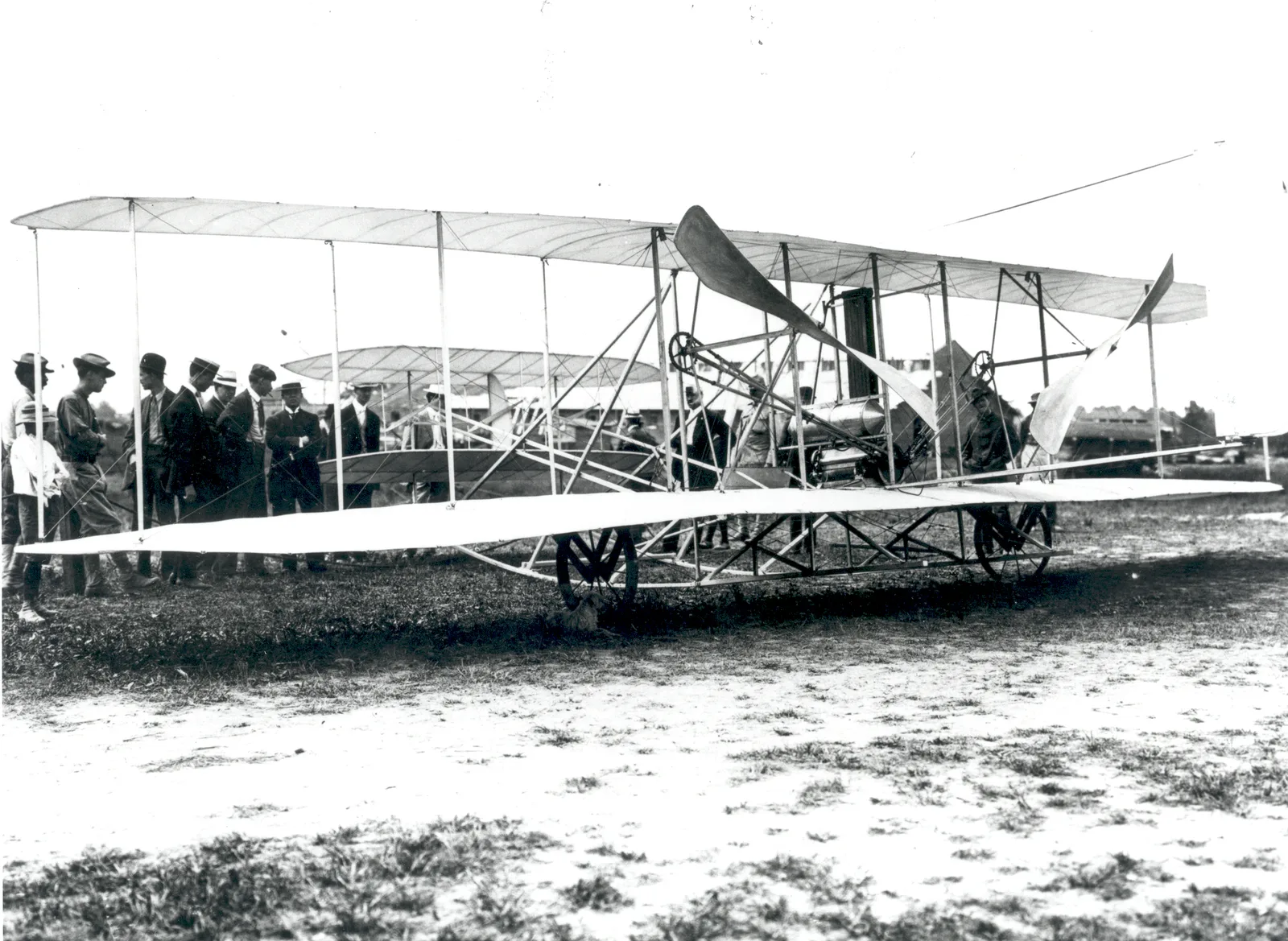
The U.S. Army created an Aeronautical Division within the Signal Corps on August 1, 1907, with an authorized strength of one officer and two enlisted men, and the next year it advertised for a heavier-than-air flying machine able to carry two people at 40 miles per hour for 125 miles.
The Wright brothers won the contract. During acceptance trials at Fort Myer, Virginia, in 1908, a propeller failure sent Orville Wright and Lieutenant Thomas Selfridge crashing to the ground, killing Selfridge and making him the first person to die in a powered airplane. The Wrights returned in 1909 and completed the trials successfully.
The Army formally accepted Signal Corps Airplane No. 1 on August 2, 1909, paying $25,000 plus a $5,000 bonus for exceeding the required speed, a total of $30,000. It was the world's first military airplane bought by any nation.
The Wrights trained the Army's first pilots at a field near College Park, Maryland, and at Fort Sam Houston, Texas. The single aircraft was flown until 1911, then retired and donated to the Smithsonian Institution, where it remains on display.
The 1st Aero Squadron, the Army's first tactical air unit, deployed eight Curtiss JN-3 'Jenny' biplanes to support General John J. Pershing's Punitive Expedition into Mexico after Pancho Villa's 1916 raid on Columbus, New Mexico.
The mission exposed how far behind the United States had fallen. The underpowered Jennys could not climb over the Sierra Madre mountains, propellers cracked in the dry desert air, and within weeks nearly every aircraft was wrecked or grounded. The squadron flew mostly courier and scouting runs.
Congress responded in 1916 with the first substantial aviation appropriation, and again after the U.S. declared war on Germany in April 1917, when it authorized a then-staggering $640 million aviation program.
The United States entered World War I with roughly 250 aircraft, none of them fit for combat, and about 1,200 officers and men in its air arm. Britain, France, and Germany each had thousands of frontline aircraft and years of hard-won combat experience.
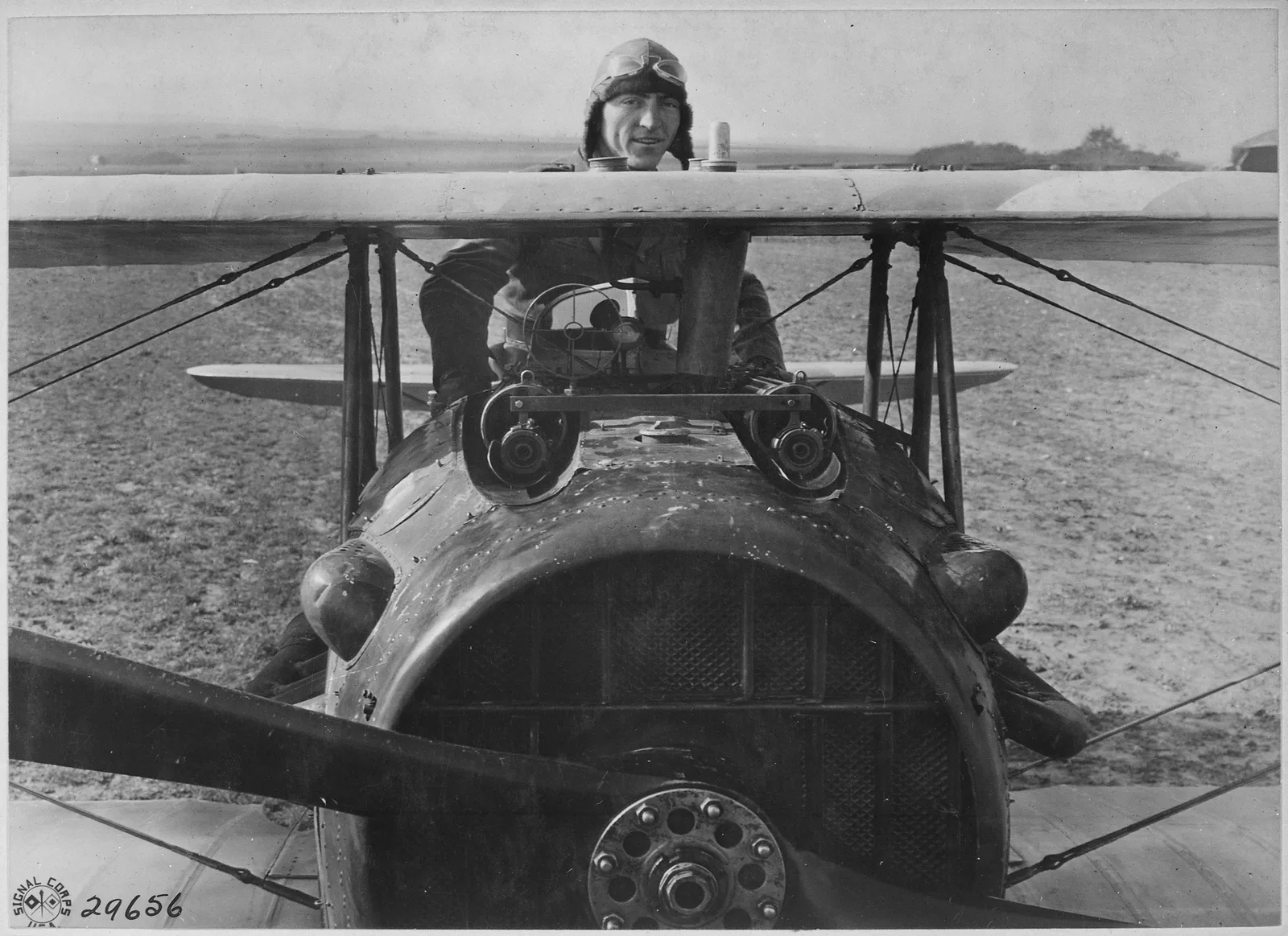
American squadrons went into combat in 1918 flying almost entirely French and British designs, because U.S. industry could not produce a competitive fighter in time. The main types were the French SPAD S.XIII and Nieuport 28 and the British S.E.5a.
The 94th Aero Squadron, the 'Hat in the Ring' squadron, produced the leading American ace, Captain Eddie Rickenbacker, credited with 26 victories in SPADs. Many American volunteers had already been flying for France in the Lafayette Escadrille since 1916.
The one American-built combat aircraft to reach the front in numbers was the Dayton-Wright DH-4, a license-built version of a British bomber fitted with the new American 400-horsepower Liberty engine. About 1,200 reached French airfields before the November 1918 armistice.
Brigadier General William 'Billy' Mitchell coordinated nearly 1,500 Allied aircraft at the Battle of Saint-Mihiel in September 1918, one of the largest concentrations of air power to that point. The war ended with American aviation still dependent on its allies for equipment.
To prove that aircraft had made the surface fleet vulnerable, Billy Mitchell's bombers sank a series of anchored warships in tests off the Virginia Capes in 1921, including the captured German battleship Ostfriesland, which went down in about 20 minutes.
The Navy disputed the results because the ships were stationary and undefended, but the demonstrations drew national attention and hardened Mitchell's public campaign for an independent air force.
After two fatal Navy aviation accidents in 1925, Mitchell accused Army and Navy leadership of 'incompetency, criminal negligence, and almost treasonable administration of the national defense.' He was court-martialed, convicted of insubordination, and resigned from the Army in 1926.
Congress passed the Air Corps Act of 1926 the same year, renaming the Air Service the U.S. Army Air Corps, adding an assistant secretary of war for air, and setting a five-year expansion plan. Mitchell was posthumously honored decades later as a prophet of air power.
In a span of three years the look of military aircraft changed completely. The Martin B-10 bomber, entering service in 1934, was an all-metal monoplane with retractable landing gear, an enclosed cockpit, and internal bomb bay, and it was faster than the biplane fighters meant to intercept it.
The Boeing P-26 'Peashooter,' the Army's first all-metal monoplane fighter, entered service in 1934 but kept an open cockpit, fixed landing gear, and external wire bracing, a transitional design between two eras.
Boeing flew the Model 299, prototype of the B-17 Flying Fortress, on July 28, 1935. On October 30, 1935, it crashed on takeoff at Wright Field because the crew had not released the control surface gust locks, killing two men.
The Army nearly cancelled the B-17 after that crash, but investigators concluded the aircraft was sound and the accident was human error. The response was the printed pilot's preflight checklist, now standard in every cockpit in the world.
With war underway in Europe, President Franklin Roosevelt called in 1940 for the production of 50,000 military aircraft a year, a figure that seemed fantastic when the entire Army Air Corps had fewer than 2,500 aircraft.
The Army Air Forces was established in June 1941 under General Henry 'Hap' Arnold, consolidating the flying units and giving air power near-autonomous control of its own doctrine, training, and procurement while still inside the Army.
The Japanese attack on Pearl Harbor on December 7, 1941, destroyed or damaged nearly 350 American aircraft, most of them on the ground at Hickam and Wheeler Fields, and brought the United States into the war.
American factories then did what had been promised. Over the course of the war the United States built roughly 300,000 military aircraft; in the single peak year of 1944 it produced more than 96,000, more than Germany and Japan combined.
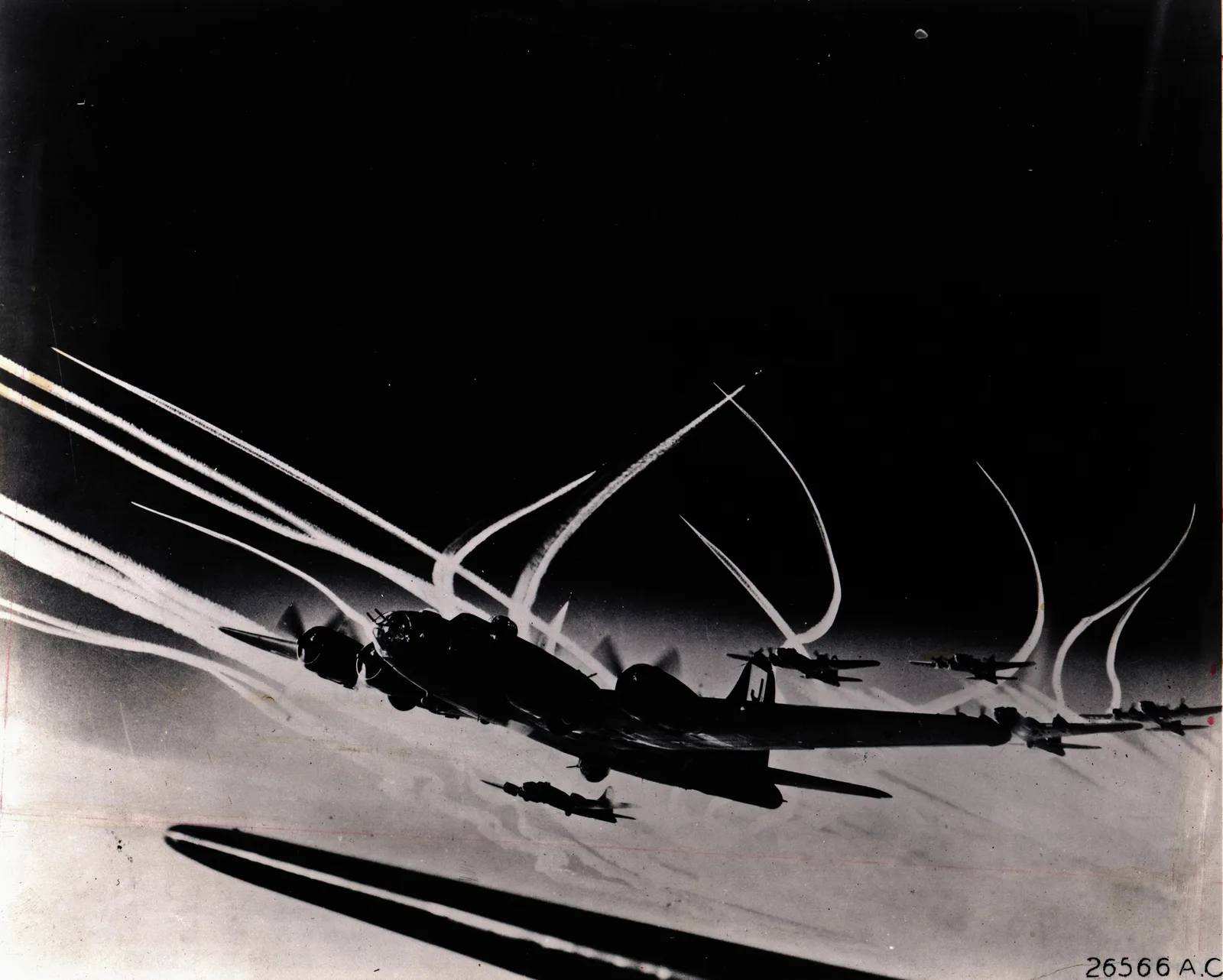
The Eighth Air Force flew unescorted daylight raids into Germany in 1943 on the theory that tight formations of heavily armed B-17s and B-24s could defend themselves. The theory failed. The Schweinfurt-Regensburg missions in August and October 1943 lost around 60 bombers each, roughly a fifth of the force.
The problem was range. Escort fighters could not reach the targets. Everything changed when the P-51 Mustang was fitted with the British Rolls-Royce Merlin engine in late 1943; with drop tanks it could escort bombers all the way to Berlin and back.
By early 1944 American fighters were shooting the Luftwaffe out of the sky over its own territory. Air superiority over the invasion beaches was effectively won before D-Day, June 6, 1944, when the Allies flew more than 14,000 sorties against fewer than 100 by the Germans.
In the Pacific, the Doolittle Raid of April 1942 launched 16 Army B-25 bombers off the carrier Hornet against Tokyo, a small military strike with an outsized effect on morale on both sides.
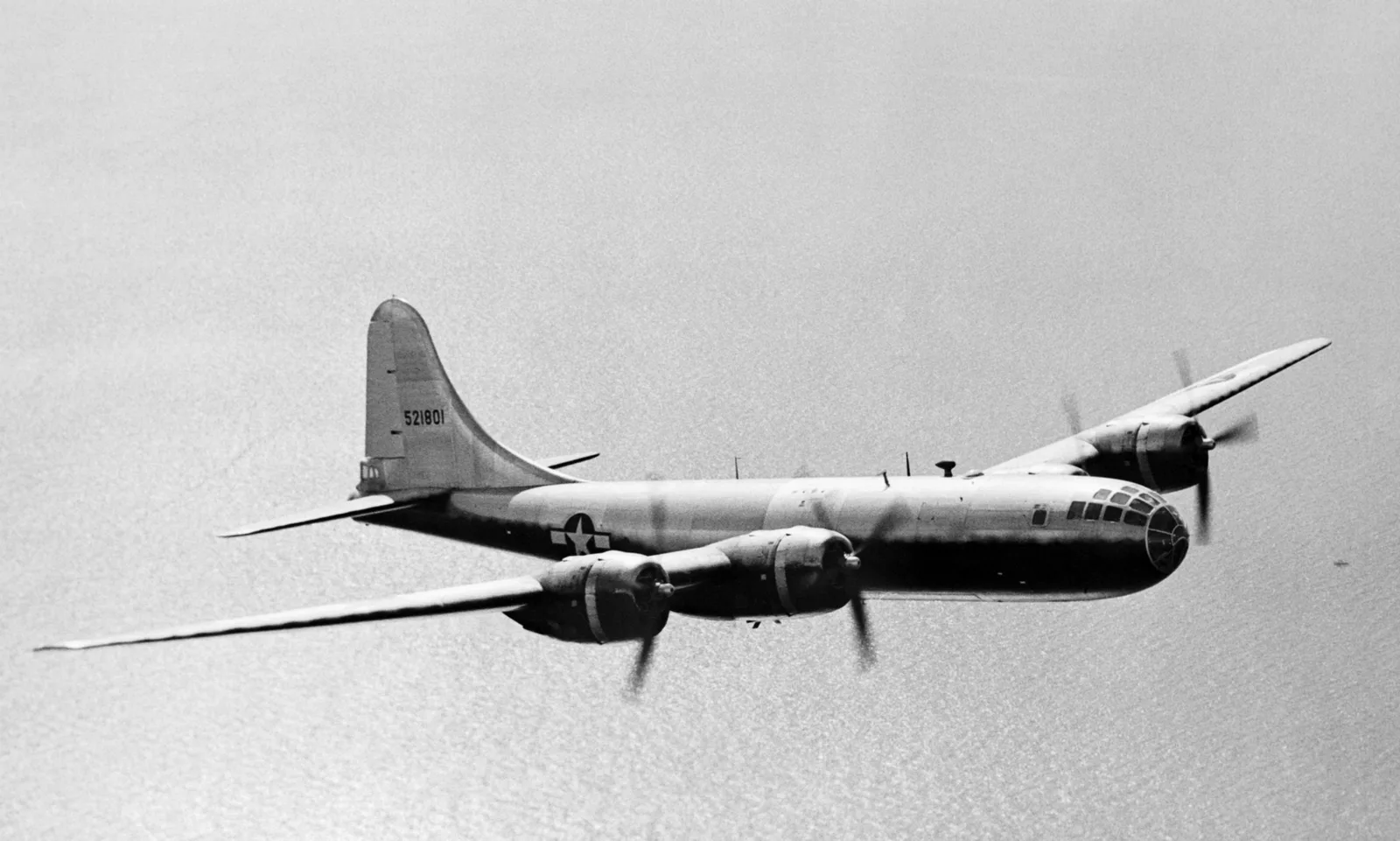
The Boeing B-29 Superfortress was the most advanced bomber of the war: pressurized for high-altitude flight, defended by remote-controlled gun turrets, and able to carry a heavy bomb load across the vast distances of the Pacific.
Its development cost about $3 billion, more than the Manhattan Project that built the weapons it would carry. Early combat use from bases in China was inefficient, so the campaign shifted to the Mariana Islands once they were captured.
General Curtis LeMay switched the B-29s to low-altitude nighttime incendiary attacks in early 1945. The firebombing of Tokyo on the night of March 9 to 10, 1945, killed an estimated 80,000 to 100,000 people and destroyed about 16 square miles of the city.
On August 6, 1945, the B-29 Enola Gay dropped an atomic bomb on Hiroshima, and on August 9 the B-29 Bockscar dropped one on Nagasaki, the only combat use of nuclear weapons in history. Japan announced its surrender on August 15.
The National Security Act of 1947 reorganized the American military and created the United States Air Force as a separate service, equal to the Army and Navy, effective September 18, 1947. General Carl Spaatz became its first chief of staff.
Twenty-six years after Billy Mitchell first demanded it, air power finally had its own service, its own budget line, and its own seat among the Joint Chiefs of Staff.
On October 14, 1947, Air Force Captain Chuck Yeager flew the bullet-shaped, rocket-powered Bell X-1 to Mach 1.06 over the California desert, becoming the first person to exceed the speed of sound in level flight. The achievement was kept secret for months.
The X-1 was the first of a long line of experimental 'X-planes' flown from what became Edwards Air Force Base, aircraft built not for combat but to chart the unknown edges of speed, altitude, and control.
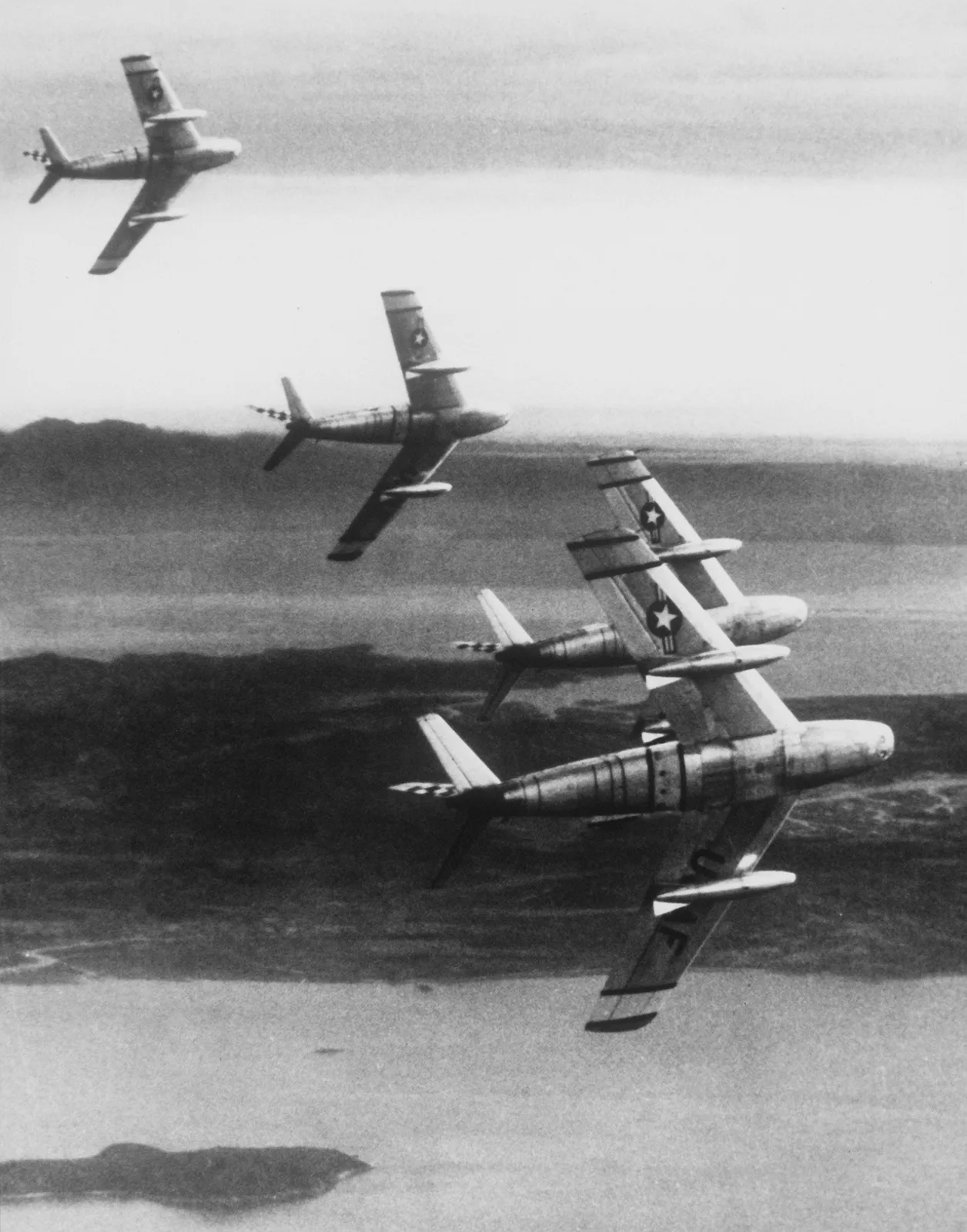
When Soviet-built MiG-15 jets appeared over northwestern Korea in late 1950, they outclassed every American aircraft in theater. The Air Force rushed in the swept-wing F-86 Sabre, and the two fought the first sustained jet-versus-jet air battles in history over a stretch of the Yalu River that pilots called 'MiG Alley.'
Both fighters owed their swept wings to captured German aerodynamic research from World War II. They were closely matched: the MiG climbed higher and hit harder, the Sabre dived faster and had a better gunsight and more experienced pilots.
The Air Force long claimed a kill ratio of about 10 to 1 in the Sabre's favor. Later historical analysis using Soviet records has revised the figure well downward, though the Sabre is still generally credited with air superiority over the battle area.
Korea also showed the limits of the jet. Piston-engined F-51 Mustangs and F4U Corsairs did much of the ground-attack work because they could carry more ordnance, loiter longer, and fly from rough forward strips.
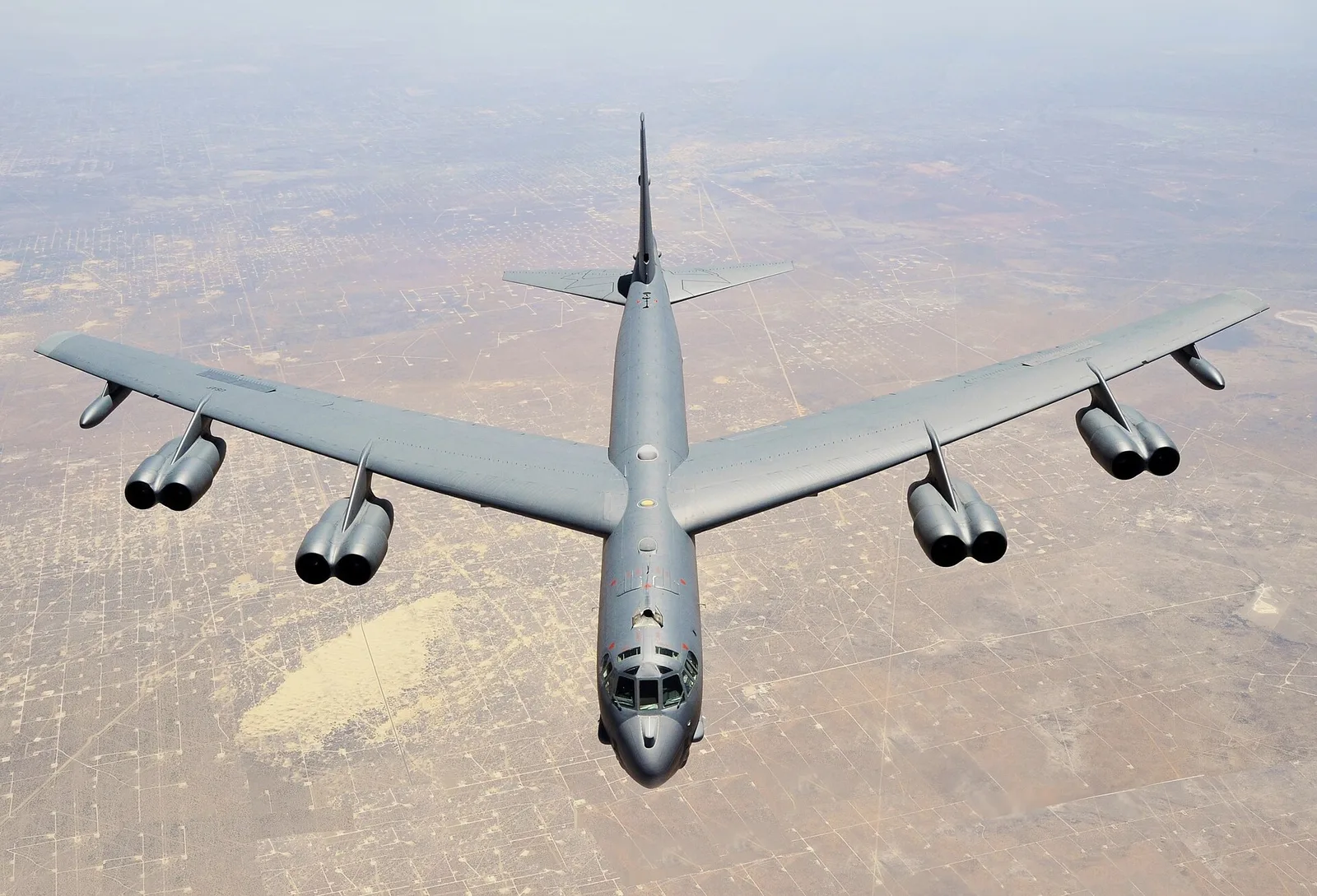
Under General Curtis LeMay, Strategic Air Command built the deterrent force of the early Cold War. The eight-engine B-52 Stratofortress entered service in 1955, joining the B-47 as the delivery system for the growing nuclear stockpile.
From October 1957, SAC kept a portion of its bombers on ground alert able to launch within minutes, and for years flew 'Chrome Dome' missions with armed B-52s airborne around the clock. Several of those flights ended in accidents that scattered nuclear weapons near Palomares, Spain, in 1966 and Thule, Greenland, in 1968.
The Lockheed U-2 spy plane began overflying the Soviet Union in 1956, photographing airfields and missile sites from above 70,000 feet, altitudes thought to be beyond the reach of Soviet defenses.
That assumption failed on May 1, 1960, when a surface-to-air missile brought down the U-2 flown by Francis Gary Powers deep inside the USSR. The capture of a live pilot and intact wreckage handed Moscow a propaganda victory and ended the overflight program.
A U-2 flight over western Cuba on October 14, 1962, brought back photographs that CIA analysts identified as Soviet medium-range ballistic missile sites under construction, triggering the most dangerous confrontation of the Cold War.
For 13 days, low-level RF-8 Crusader and RF-101 Voodoo reconnaissance flights and high-altitude U-2 missions tracked the buildup while the United States imposed a naval quarantine of the island.
On October 27, 1962, a Soviet missile shot down a U-2 over Cuba, killing the pilot, Major Rudolf Anderson, the only combat death of the crisis. President Kennedy chose not to retaliate, and a settlement was reached the next day.
The crisis confirmed that aerial and, increasingly, satellite reconnaissance had become central to national survival. The first successful Corona spy satellite film capsules had already been recovered in 1960, and satellites would soon take over much of the strategic photo mission.
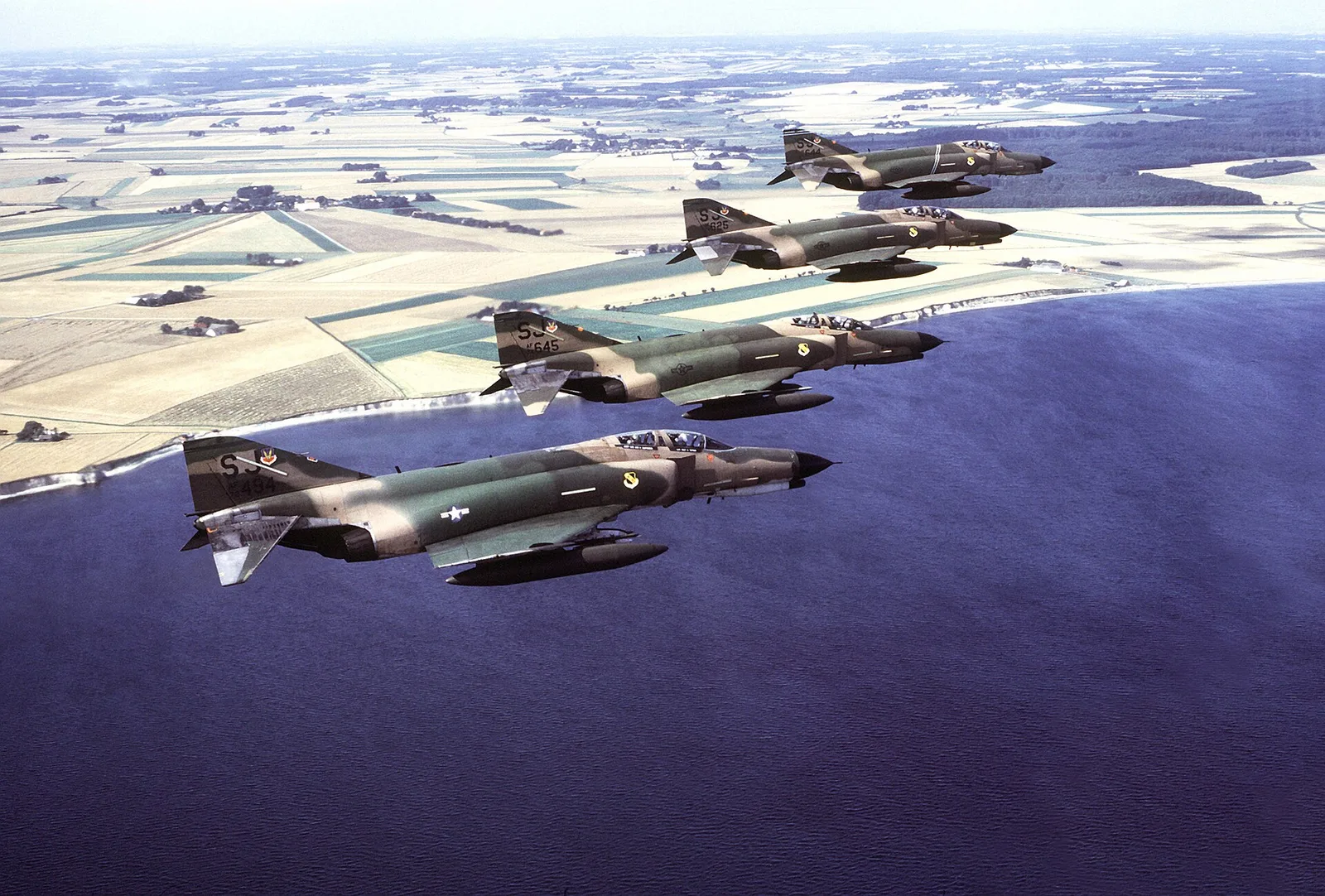
The air war over North Vietnam pitted American F-105 Thunderchiefs and F-4 Phantoms against dense, Soviet-supplied defenses: radar-guided SA-2 surface-to-air missiles, heavy anti-aircraft artillery, and agile MiG-17 and MiG-21 fighters.
Early air-to-air results were poor. Missiles designed to hit bombers performed badly in close-turning dogfights, and many Phantoms carried no gun. The Navy responded by founding its Fighter Weapons School, 'Top Gun,' in 1969; kill ratios improved sharply afterward.
Suppressing the missile sites became its own specialty. 'Wild Weasel' crews flew modified fighters deliberately into SAM engagement zones to bait radars into switching on, then attacked them with anti-radiation missiles.
The war closed with Operation Linebacker II in December 1972, an 11-day B-52 bombing campaign against Hanoi and Haiphong. Fifteen B-52s were shot down. A peace agreement was signed the following month.
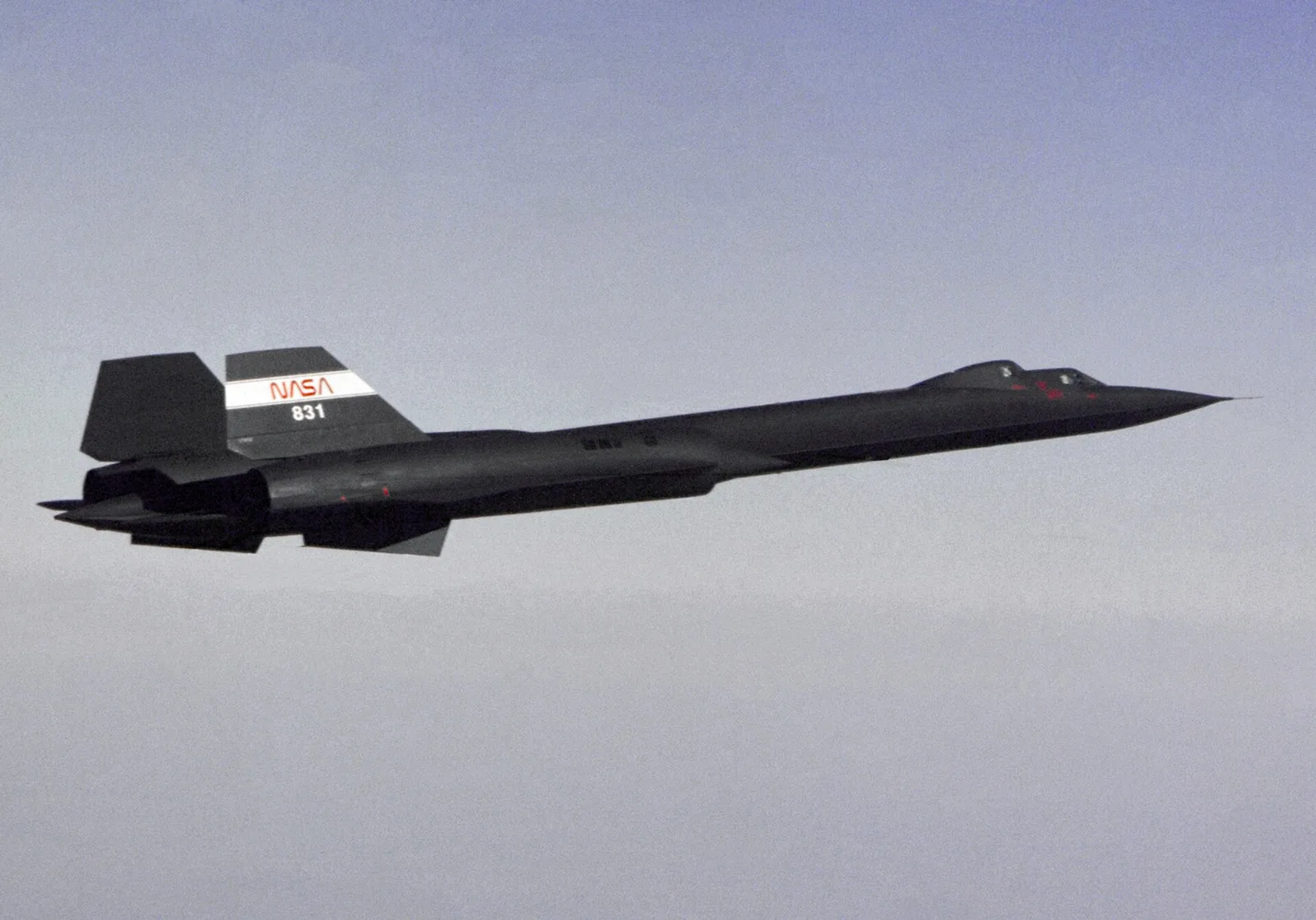
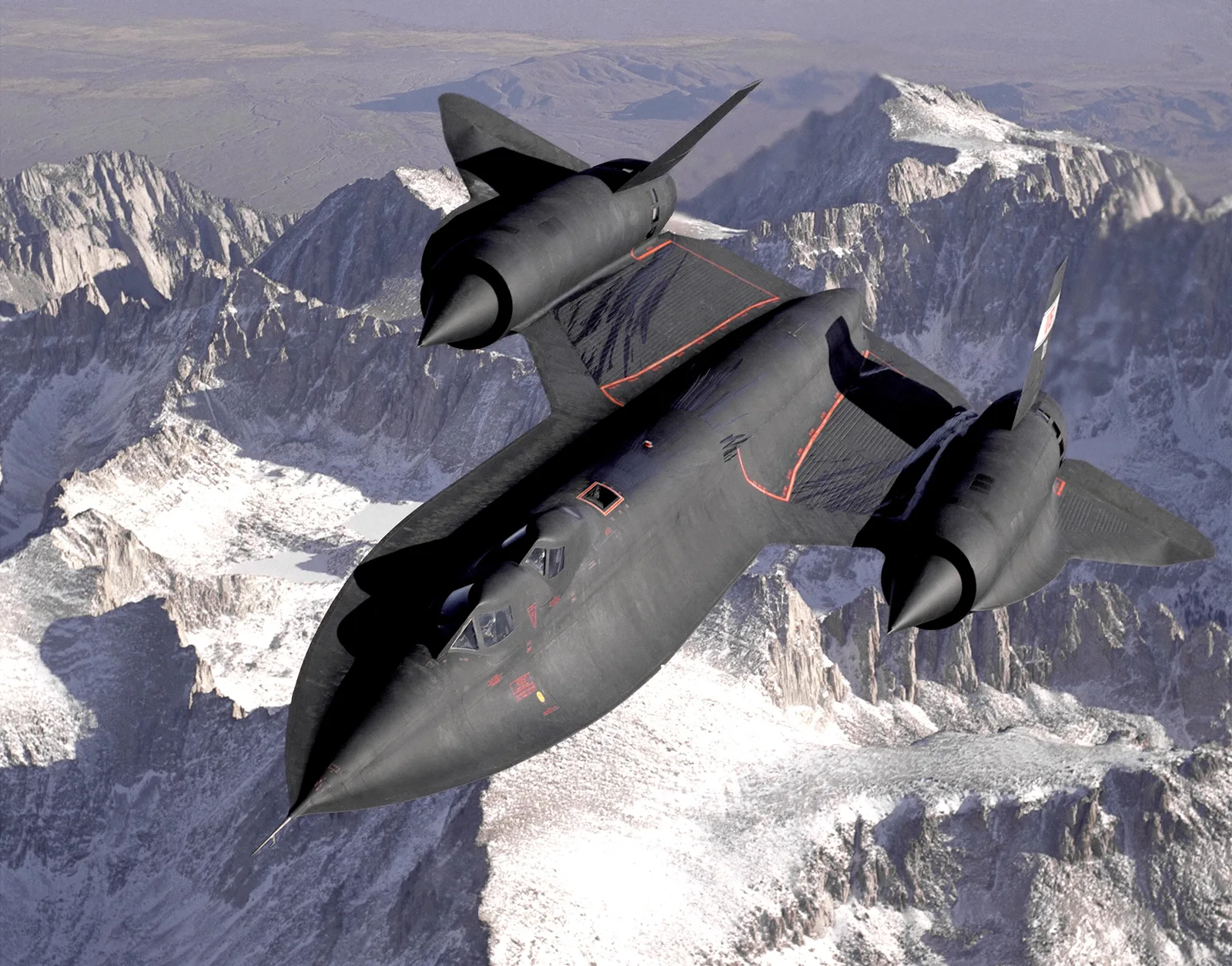
Lockheed's Skunk Works, led by Clarence 'Kelly' Johnson, built the SR-71 Blackbird to replace the U-2 with an aircraft too fast and too high to intercept. It first flew in 1964 and entered Air Force service in 1966.
The SR-71 cruised above Mach 3, faster than a rifle bullet, at 85,000 feet, its titanium skin heating so much in flight that the airframe was built loose on the ground and sealed only once expansion closed the gaps. Much of the titanium was quietly bought through intermediaries from the Soviet Union, the world's main supplier.
Its defense against a surface-to-air missile was simply to accelerate and climb. In 24 years of operations, no SR-71 was ever lost to enemy fire, though crews reported outrunning more than 4,000 missiles fired at them. Of 32 built, 12 were lost to accidents.
The Air Force retired the SR-71 in 1990, briefly returned a few to service in the mid-1990s, and finally stood the fleet down in 1998. NASA flew two as research aircraft until 1999. Its speed and altitude records for an air-breathing crewed jet still stand.
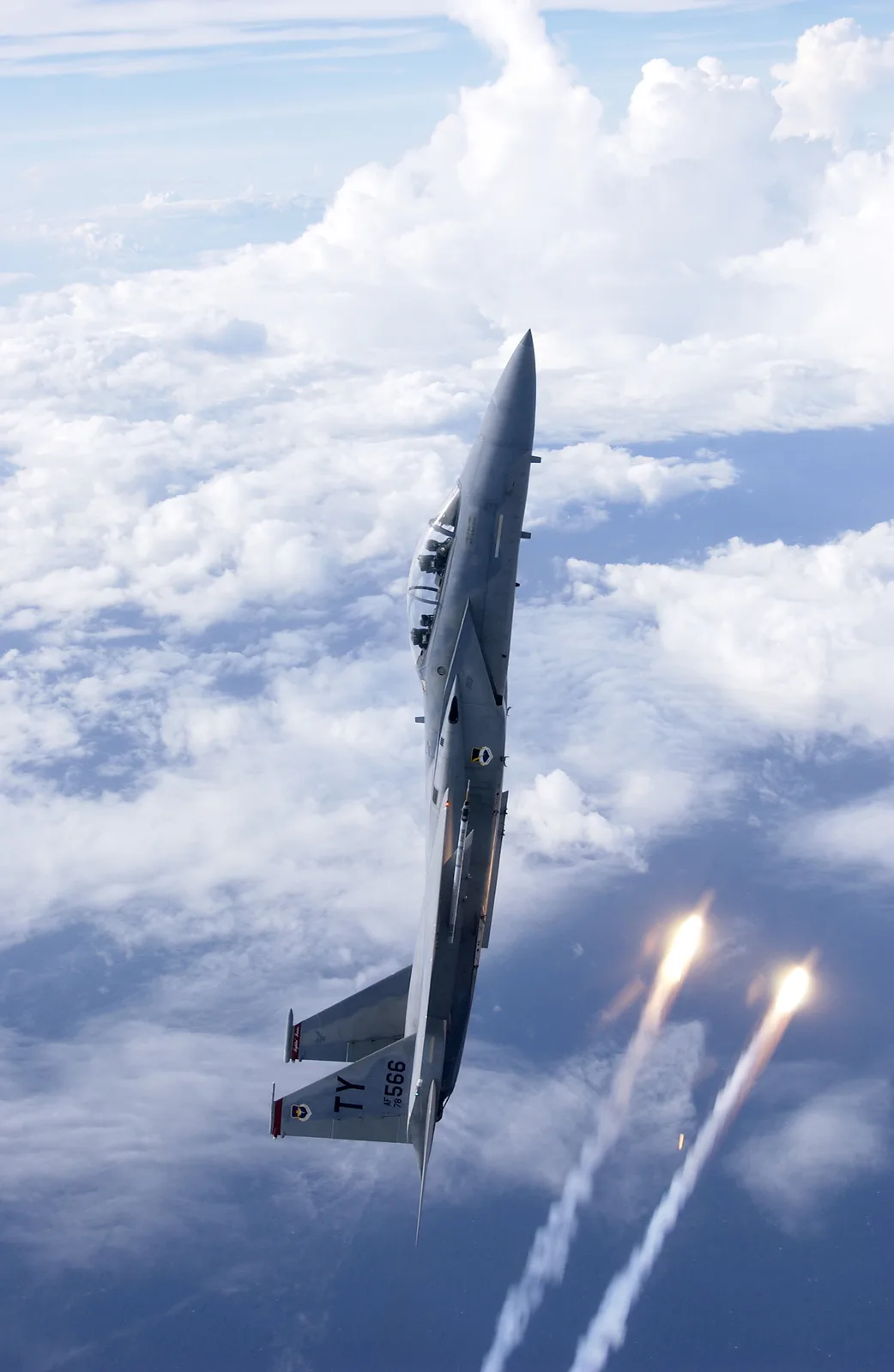
Vietnam convinced the Air Force it had traded away maneuverability for speed and missiles. The answer was a new generation of fighters, nicknamed the 'teen series' for their designation numbers, designed to win a close-in fight.
The F-15 Eagle, first flown in 1972, was a large twin-engine air-superiority fighter built to the slogan 'not a pound for air-to-ground.' It could accelerate while climbing straight up. Across all air forces that have flown it, the F-15 is credited with more than 100 aerial victories and no confirmed air-to-air losses.
The smaller, single-engine F-16 Fighting Falcon, first flown in 1974, introduced a fly-by-wire control system, a reclined seat to help pilots resist g-forces, and a one-piece bubble canopy for all-around vision. More than 4,600 have been built and flown by roughly 25 countries.
The A-10 Thunderbolt II, also first flown in 1972, went the opposite direction: a slow, heavily armored attack aircraft built around a 30-millimeter cannon for supporting troops on the ground.
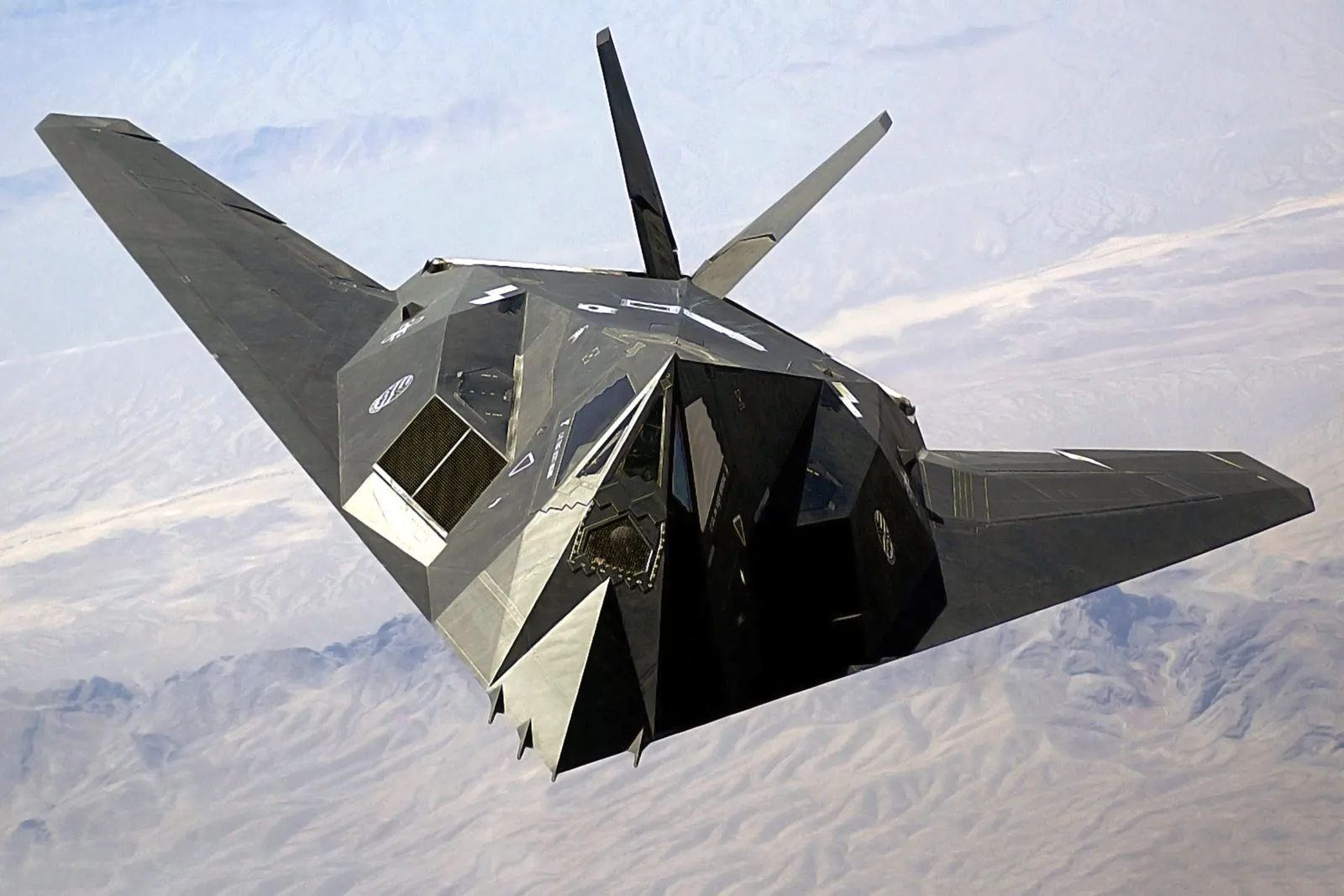
Work on radar-evading shapes, drawing on a Soviet physicist's published equations, produced the Lockheed 'Have Blue' demonstrator in the late 1970s and then the F-117 Nighthawk, which first flew in 1981 and operated in total secrecy from a remote Nevada base.
The F-117's faceted, angular skin scattered radar energy away from the transmitter. The Air Force did not acknowledge the aircraft's existence until 1988. It made its combat debut in the 1989 invasion of Panama.
In the 1991 Gulf War, F-117s flew about 2 percent of the attack sorties in the opening phase but struck roughly 40 percent of the fixed strategic targets, hitting command bunkers in downtown Baghdad while conventional aircraft could not safely approach.
The coalition air campaign established air supremacy over Iraq within days and destroyed much of the Iraqi army from the air before the 100-hour ground offensive. It became the template for how the United States would open every major conflict that followed.
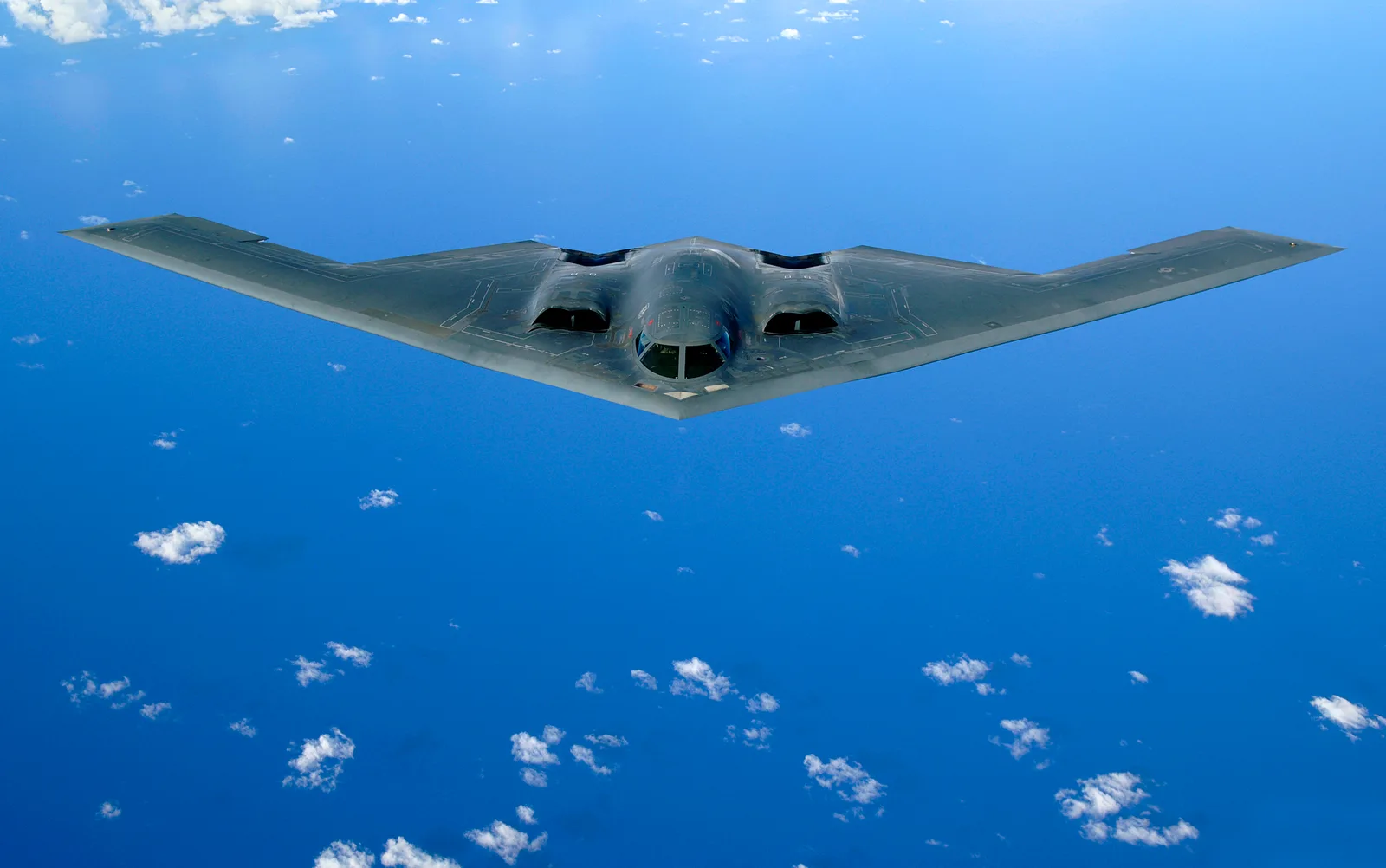
Northrop had built experimental flying wings in the 1940s, and the shape returned four decades later as the B-2 Spirit, a smoothly blended all-wing bomber with no vertical tail and a radar signature reportedly comparable to a small bird.
The B-2 first flew in 1989. Its cost drew intense criticism: with development spread across the program, each of the 21 aircraft built worked out to roughly $2 billion, and Congress cut the planned buy from 132 to 21 as the Cold War ended.
The bomber made its combat debut in 1999 over Kosovo, flying 30-hour round trips from Whiteman Air Force Base in Missouri to drop satellite-guided bombs, then returning home without landing overseas.
That pattern, a stealth bomber striking anywhere on earth from the American heartland, defined the aircraft's role for the next two decades and shaped the requirements for its successor.
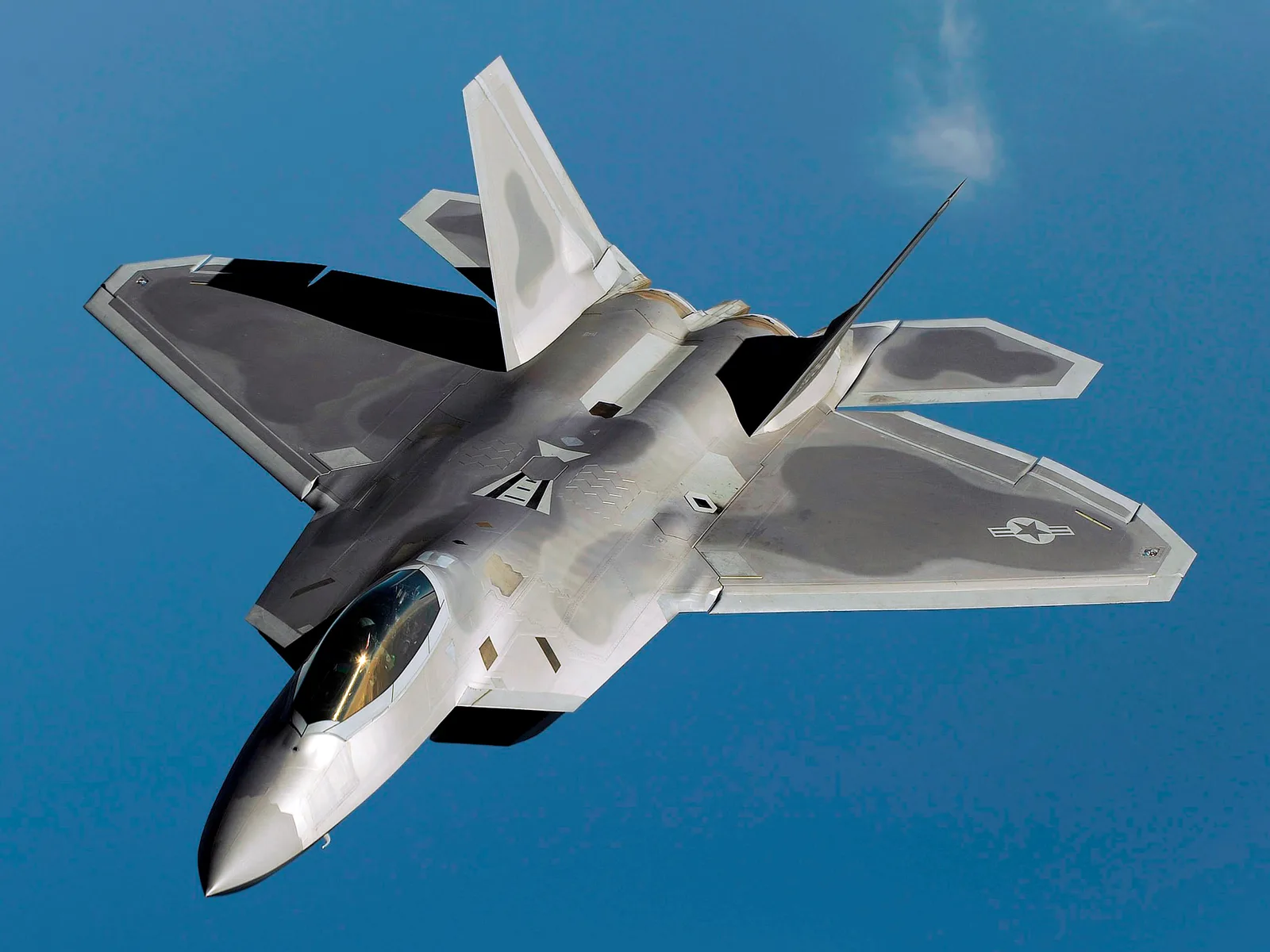
The F-22 Raptor, first flown in 1997 and declared operational in December 2005, was the first fighter to combine four traits later used to define a 'fifth generation' aircraft: all-aspect stealth, the ability to cruise faster than sound without afterburner, thrust-vectoring agility, and fused sensor data presented as a single picture.
It was designed to defeat any future Russian or Chinese fighter and to survive against advanced surface-to-air missiles. In large exercises it has repeatedly posted lopsided simulated kill ratios against fourth-generation fighters.
It was also expensive, and export was prohibited by U.S. law. Congress capped production and the line closed in 2011 after 187 operational aircraft were built, far short of the roughly 750 the Air Force originally wanted.
The small fleet size has been a persistent concern: there are not enough Raptors to be everywhere, and every one lost to an accident cannot be replaced.
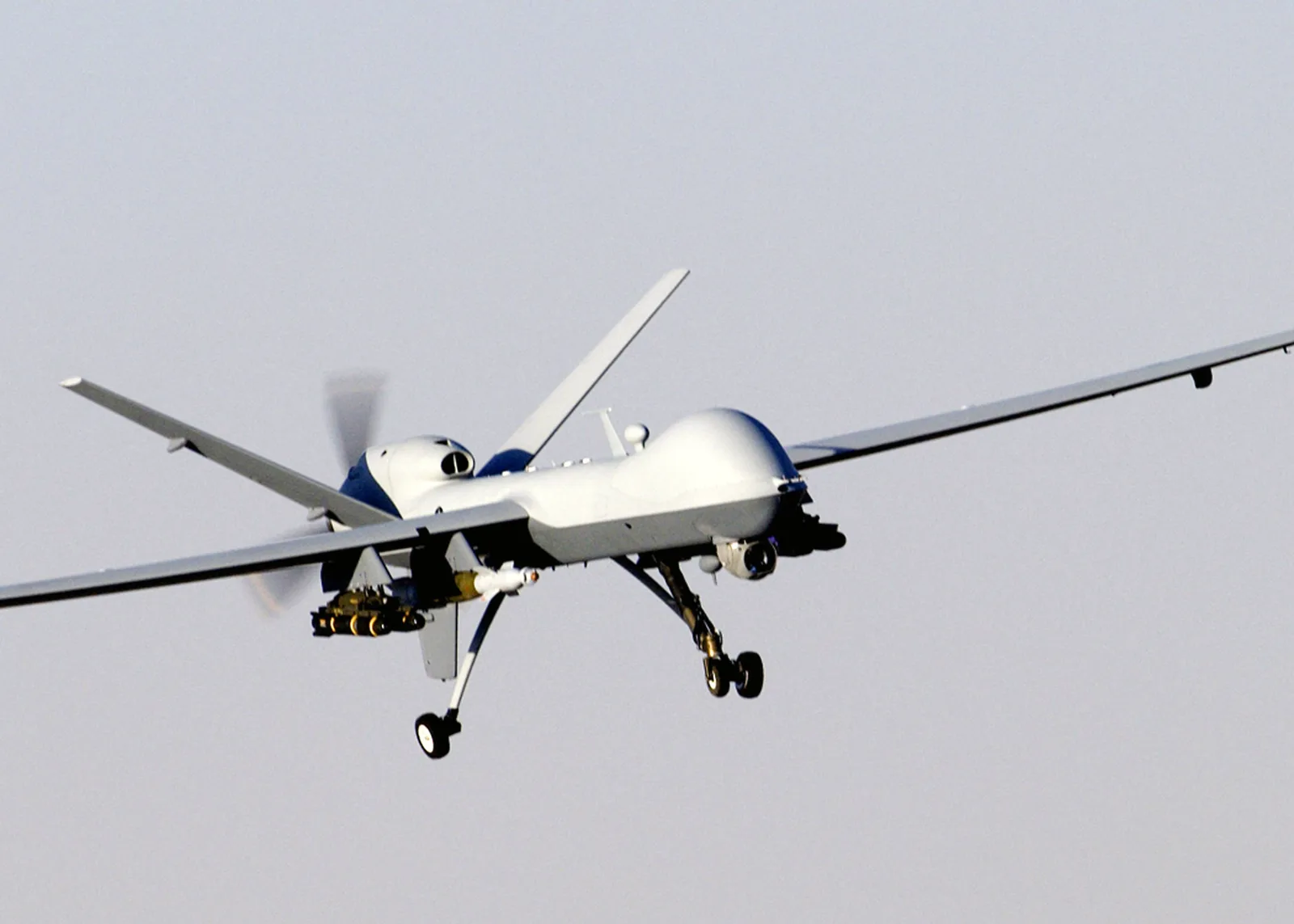
The General Atomics Predator began as an unarmed surveillance drone in the 1990s. After Hellfire missiles were fitted and tested, an armed Predator flew its first strike in Afghanistan in October 2001, weeks after the September 11 attacks.
The larger MQ-9 Reaper followed in 2007: a turboprop-powered 'hunter-killer' able to carry about 3,000 pounds of bombs and missiles on its wing stations and loiter over a target for a day at a time.
The crews fly them by satellite link from bases in the United States, primarily Creech Air Force Base in Nevada, a shift that raised new legal and ethical debate about remote warfare, civilian casualties, and the psychological toll on operators.
By the 2010s remotely piloted aircraft were flying more combat air patrols than any manned type, and the Air Force was training more drone operators than fighter and bomber pilots combined.
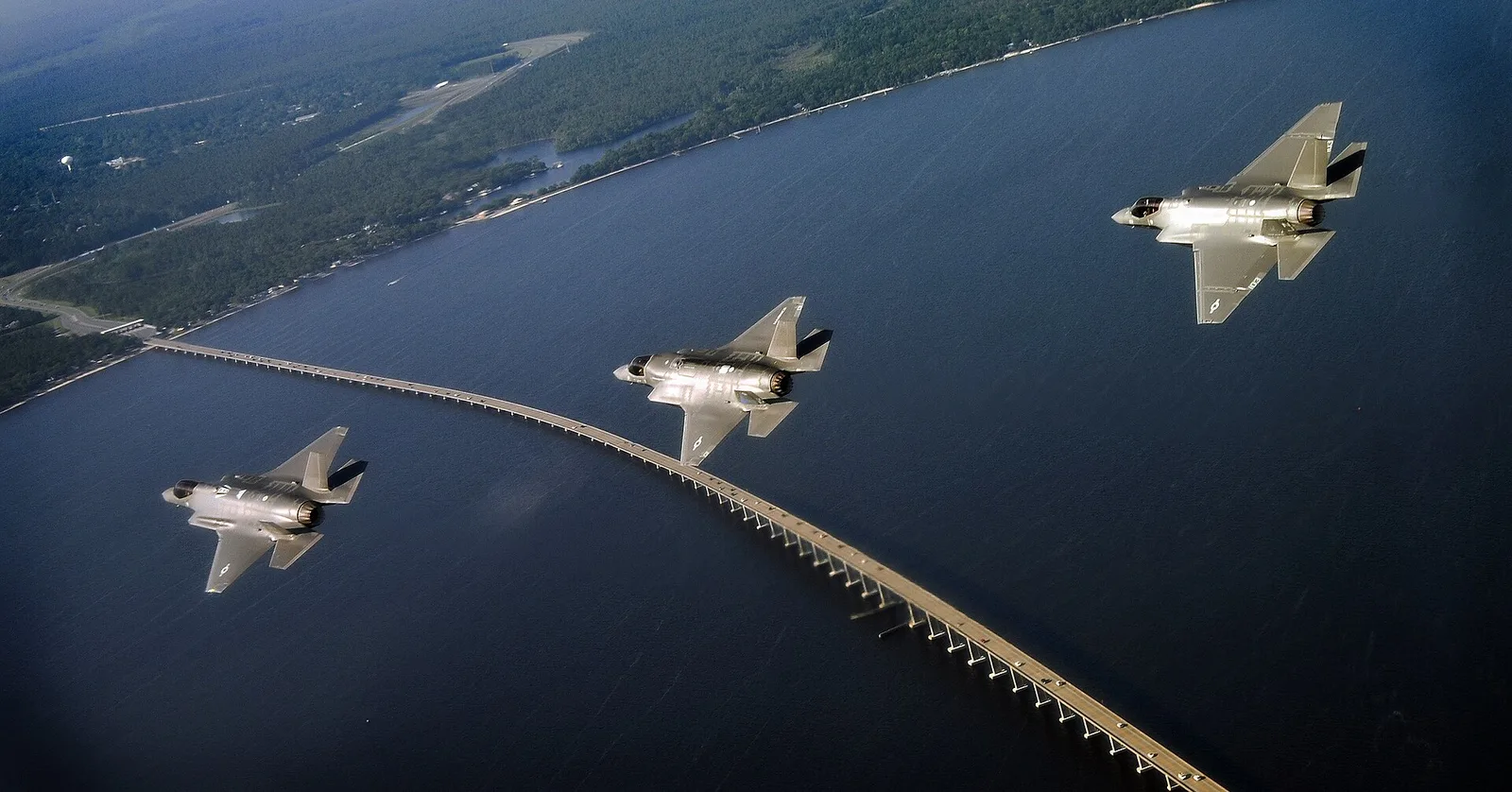
The Joint Strike Fighter program set out to build a single stealthy design in three versions: a conventional F-35A for the Air Force, a short-takeoff, vertical-landing F-35B for the Marine Corps, and a carrier F-35C for the Navy. The F-35A first flew in December 2006.
The aircraft is built around sensor fusion. Radar, infrared, and electronic-warfare data from the jet and from other platforms are combined into one display, and the pilot's $400,000 helmet projects imagery that lets them 'look through' the airframe.
The program has been the most expensive in history. Government auditors put the estimated lifetime cost, development, purchase of about 2,470 U.S. aircraft, and roughly 66 years of operation and sustainment, at more than $1.7 trillion (GAO, 2023).
Despite years of delays and cost growth, the F-35 became the backbone of allied air forces. The Marine Corps declared its version operational in 2015 and the Air Force in 2016, and more than 1,100 have been delivered to the United States and about 20 partner nations.
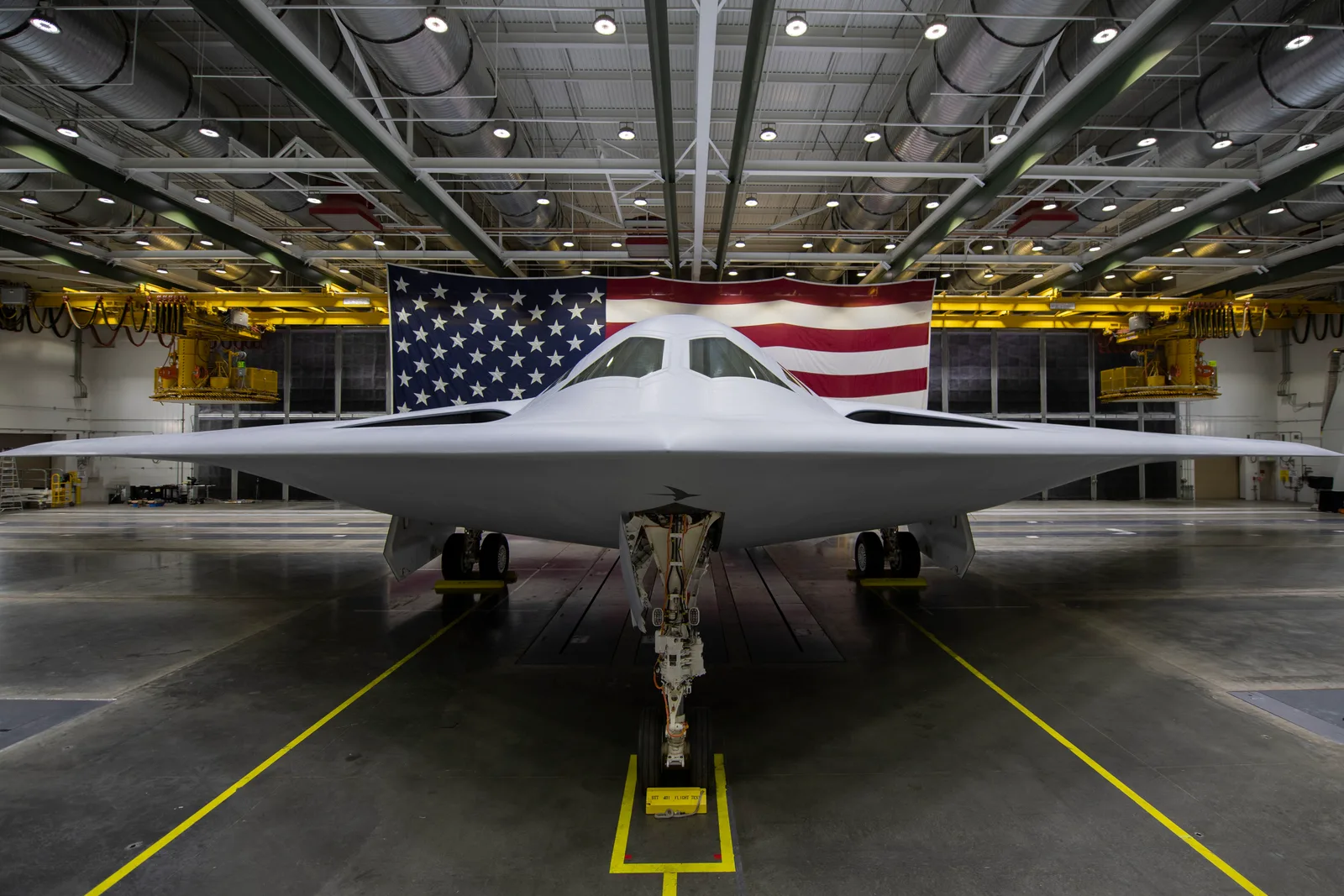
Northrop Grumman's B-21 Raider, a stealth bomber resembling a smaller, refined B-2, was rolled out in December 2022 and made its first flight in November 2023. The Air Force plans to buy at least 100 to replace the B-1 and B-2 fleets.
The B-21 is described as a 'digital' aircraft, designed and tested extensively in software before metal was cut, with an open architecture meant to let new weapons and sensors be added without redesigning the airframe. The target unit cost was set near $700 million in 2022 dollars.
Alongside it, the Air Force and Navy are developing 'sixth generation' crewed fighters under the Next Generation Air Dominance programs (in March 2025 the Air Force picked Boeing's F-47 as its NGAD fighter; the Navy's F/A-XX is separate), expected to fly with teams of uncrewed Collaborative Combat Aircraft acting as sensors, missile carriers, and decoys.
The through-line from 1909 holds: each generation has sought to see first, reach farther, and survive better than the last, and the aircraft that achieve it reshape how the United States fights.
The Aircraft That Defined Each Era
A representative aircraft, or a few, from each period, with what it did, why it mattered, and how it moved the design of American air power forward.
Dawn of Military Flight (1909 to 1918)
From the Army's first $30,000 Wright biplane to the wood-and-fabric fighters American pilots borrowed from France and Britain in World War I.
- Designation
- Signal Corps Airplane No. 1
- In service
- 1909 to 1911
- Role
- Trainer and observation
- Number built
- 1
The Wright Military Flyer was the world's first military aircraft purchased by any government. Built by the Wright brothers to an Army specification calling for a two-seat machine capable of 40 miles per hour, it was accepted on August 2, 1909, for $30,000, which included a $5,000 bonus for exceeding the required speed.
It was a canard biplane: the horizontal control surface sat in front of the pilot, the two pusher propellers were driven by bicycle chains from a single engine, and there was no cockpit, wheels, or brakes. It launched from a rail, sometimes assisted by a falling-weight catapult, and landed on skids.
An earlier version had crashed during 1908 trials at Fort Myer, Virginia, killing Lieutenant Thomas Selfridge, the first fatality in a powered airplane, and badly injuring Orville Wright. The 1909 trials, flown after repairs and redesign, succeeded.
The single aircraft trained the Army's first handful of pilots before being retired in 1911. The Wrights donated it to the Smithsonian, where it hangs in the National Air and Space Museum in Washington.
Why It Mattered
Established the airplane as a military tool and began U.S. military aviation. Every later American combat aircraft traces its institutional lineage to this one machine and the Signal Corps unit created to fly it.
- Designation
- JN-4
- In service
- 1915 to mid-1920s
- Role
- Primary trainer
- Number built
- About 6,800
The Curtiss JN-4, universally called the 'Jenny,' was the aircraft on which the great majority of American and Canadian pilots learned to fly during World War I. Roughly 6,800 were built, more than any other American aircraft of the era.
A forgiving two-seat biplane with the instructor and student in tandem open cockpits, the Jenny was docile enough to survive the mistakes of a beginner. It was powered by the Curtiss OX-5, a 90-horsepower V-8 that was reliable by the standards of 1917 but still prone to failure.
An earlier variant, the JN-3, had equipped the 1st Aero Squadron during the 1916 Punitive Expedition into Mexico, where the type's limited power and fragility in desert conditions were exposed.
After the war the government sold thousands of surplus Jennys for a few hundred dollars each. They became the standard mount of the 1920s 'barnstormers,' the traveling stunt fliers who introduced much of rural America to the airplane.
Why It Mattered
Trained the first mass generation of American military pilots and, as war-surplus, seeded American civil aviation. 'Jenny' became shorthand for the airplane itself in 1920s popular culture.
- Designation
- SPAD S.XIII C.1
- In service
- 1917 to early 1920s
- Role
- Fighter (pursuit)
- Number built
- About 8,470 total; roughly 893 used by U.S. squadrons
The SPAD S.XIII was the principal fighter flown by American squadrons in World War I, because the United States could not field a competitive fighter of its own design before the November 1918 armistice.
A French design, it was a sturdy wood-and-fabric biplane powered by a 220-horsepower Hispano-Suiza V-8, armed with two synchronized machine guns firing through the propeller arc. It was fast in a dive and rugged, but heavy on the controls and unforgiving at low speed.
Captain Eddie Rickenbacker scored most of his 26 credited victories in SPADs with the 94th Aero Squadron, the 'Hat in the Ring' unit. Frank Luke, the 'Arizona Balloon Buster,' flew one until his death in September 1918.
American factories were tooling up to build SPADs and other types under license when the war ended, and the contracts were cancelled. The experience drove home how far U.S. aviation industry lagged its allies.
Why It Mattered
The fighter that carried American pilots through their first air war, and a lasting lesson: the United States entered World War I unable to build a frontline fighter and had to borrow one.
- Designation
- DH-4 'Liberty Plane'
- In service
- 1918 to 1932
- Role
- Day bomber and observation
- Number built
- About 4,850 (U.S. production)
The DH-4 was a license-built American version of a British Airco bomber, re-engineered around the new American 400-horsepower Liberty L-12 engine. It was the only U.S.-built combat aircraft to reach the Western Front in significant numbers, about 1,200 by the armistice.
Crews criticized the placement of the fuel tank between the pilot and observer, which could trap the crew or feed a fire in a crash; the nickname 'flaming coffin' attached to the type, though later analysis found its fire record was not unusually bad.
After the war the DH-4 became the workhorse of the Army Air Service and of the fledgling U.S. Air Mail, which flew rebuilt DH-4s on the first transcontinental routes through the early 1920s.
Repeatedly modernized with welded steel fuselages and better equipment, some DH-4s were still in Army service as late as 1932, an unusually long life for a design of 1916.
Why It Mattered
America's only mass-produced combat aircraft of World War I, and the airframe that carried the Air Service, and the air mail, through the lean years of the early 1920s.
Between the Wars (1919 to 1938)
Open cockpits and wire bracing give way to all-metal monoplanes, retractable gear, and the first bombers faster than the fighters sent to stop them.
- Designation
- P-26
- In service
- 1934 to 1941 (U.S.); later in the Philippines and Guatemala
- Role
- Fighter (pursuit)
- Number built
- 151
The P-26 was the U.S. Army's first all-metal monoplane fighter and its first fighter built by Boeing in quantity. It entered service in 1934 as a clear break from the wood-and-wire biplanes that came before.
It was still a transitional aircraft: the pilot sat in an open cockpit, the landing gear was fixed in streamlined 'trousers,' and the wings were braced with external wire. Its landing speed was high enough that the Army added wing flaps after early accidents, and a taller headrest after several pilots died in nose-over landings.
Powered by a 500-horsepower Pratt & Whitney radial, the 'Peashooter' could reach about 234 miles per hour, fast for 1934 but slow by the time war came.
Philippine Army Air Corps P-26s were among the first Allied aircraft to engage Japanese fighters in December 1941, and a Filipino pilot is credited with downing a Japanese aircraft in one.
Why It Mattered
The bridge between the biplane and the modern fighter: all-metal and monoplane, but still open-cockpit and fixed-gear. Within five years everything about frontline fighter design had moved past it.
- Designation
- B-10
- In service
- 1934 to 1940s
- Role
- Medium bomber
- Number built
- 348 (including export)
The Martin B-10 was the first all-metal monoplane bomber to go into regular service with the Army Air Corps, and when it appeared in 1934 it was faster than any pursuit fighter then in U.S. service, about 210 miles per hour.
It introduced a package of features that quickly became standard: retractable landing gear, an enclosed cockpit, an internal bomb bay, and a rotating nose gun turret, the first on an American bomber.
General Henry Arnold led a flight of ten B-10s on a 8,290-mile round trip from Washington to Alaska and back in 1934, a widely publicized demonstration of the bomber's range and reliability.
The B-10 made every biplane bomber in the world obsolete almost overnight, but aircraft development was so rapid in the 1930s that it was itself outdated by the time the B-17 and B-18 entered service a few years later.
Why It Mattered
The bomber that proved speed and altitude could outrun interception, briefly making the bomber faster than the fighter and pushing pursuit design to catch up.
World War II (1939 to 1945)
American industry builds roughly 300,000 aircraft, the long-range escort fighter is perfected, and the B-29 carries the atomic bomb.
- Designation
- B-17
- In service
- 1938 to 1945 (combat); some to the late 1950s in secondary roles
- Role
- Heavy bomber
- Number built
- 12,731
The B-17 was the aircraft most associated with the American daylight bombing campaign over Europe. A four-engine bomber bristling with up to 13 heavy machine guns, it was designed to fly in tight defensive formations deep into enemy territory without fighter escort.
That doctrine proved costly. On the second Schweinfurt raid in October 1943, 60 of 291 B-17s were shot down and many more written off, loss rates that could not be sustained until long-range escort fighters arrived.
The bomber was famous for absorbing punishment. Aircraft returned with engines out, control surfaces shredded, and large sections of structure missing. Its Norden bombsight was treated as a top secret and promised a precision it rarely achieved in combat conditions.
12,731 were built. The type also served in the Pacific, in maritime patrol, and in air-sea rescue, and a handful flew on into the 1950s as transports and drones.
Why It Mattered
The symbol of the U.S. strategic bombing effort in Europe and a hard lesson in its limits: without escort, even a heavily armed formation could not survive over Germany in 1943.
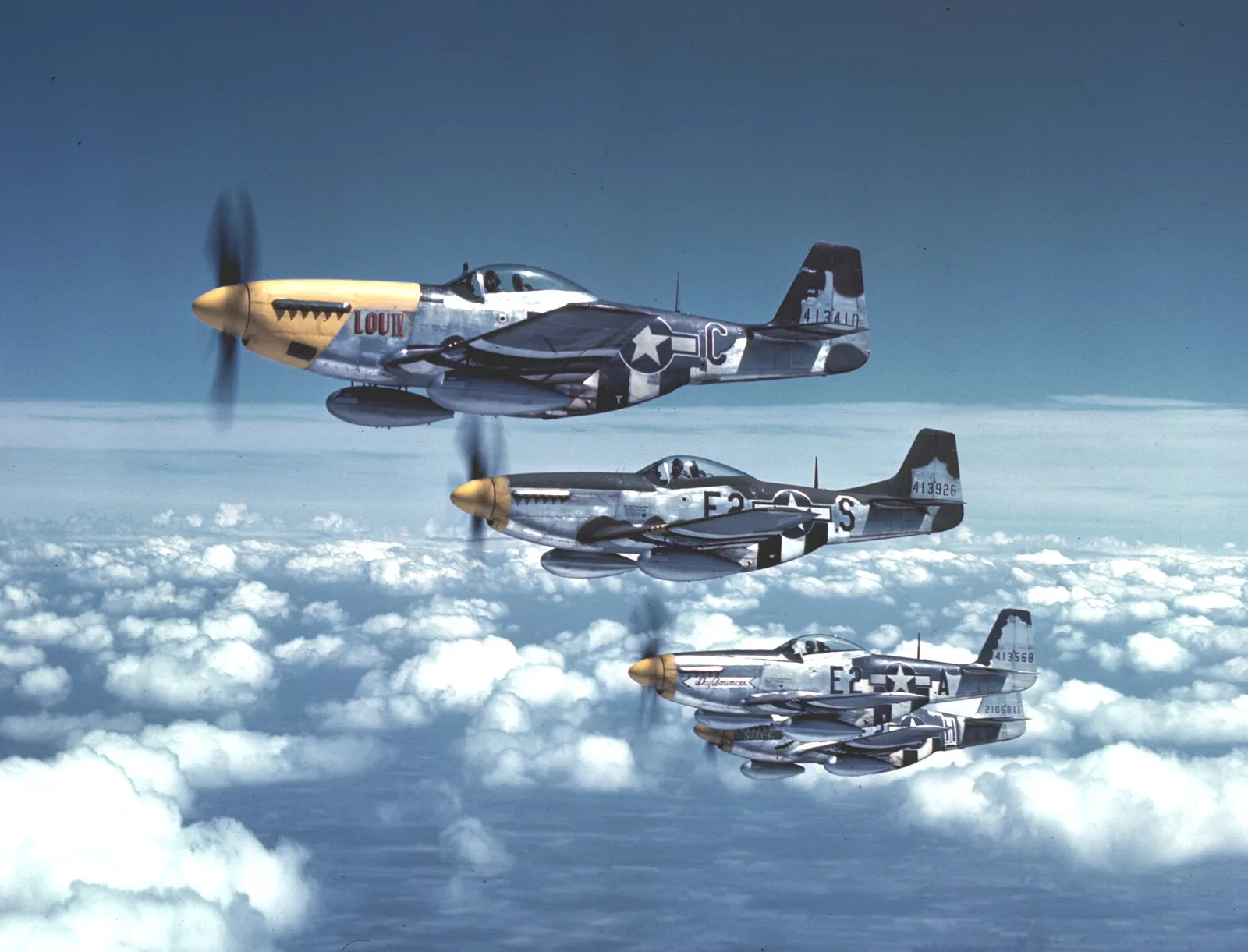
- Designation
- P-51
- In service
- 1942 to 1957 (U.S.); later with many air forces
- Role
- Long-range escort fighter
- Number built
- About 15,000
The P-51 began as a design North American Aviation produced for Britain in 1940. With its original Allison engine it was a capable low-altitude fighter but fell off badly at height.
Fitting the British Rolls-Royce Merlin engine, license-built in the United States by Packard, transformed it. The Merlin-powered P-51B and later P-51D had the speed and high-altitude performance to match German fighters and, crucially, the range.
With external drop tanks the Mustang could escort heavy bombers from England to Berlin and back, roughly 1,600 miles round trip. From early 1944 that ended the Luftwaffe's ability to defend German airspace, and air superiority over the D-Day beaches was won before the invasion.
The Mustang served in Korea as a ground-attack aircraft under the designation F-51, flew with dozens of air forces into the 1980s, and remains among the most sought-after warbirds in private hands.
Why It Mattered
Often called the fighter that made daylight strategic bombing viable. The combination of Merlin engine and long range broke the back of German air defense in the first half of 1944.
- Designation
- P-47
- In service
- 1942 to 1955 (U.S.)
- Role
- Fighter and fighter-bomber
- Number built
- 15,636
The P-47 was the largest and heaviest single-engine, single-seat piston fighter ever mass-produced, weighing nearly eight tons loaded. It was built around a big Pratt & Whitney R-2800 radial engine and a turbosupercharger housed in the rear fuselage.
That size made it a poor low-speed turner but an outstanding high-altitude fighter, a superb diver, and an extremely durable gun platform with eight .50-caliber machine guns.
As Mustangs took over the long-range escort role, the 'Jug' shifted to ground attack. In the months after D-Day, P-47s roamed over France and Germany destroying locomotives, trucks, tanks, and bridges, and its ability to bring pilots home after heavy battle damage became legendary.
More than 15,600 were built, more than any other American fighter. The type equipped Allied air forces including the Free French and Brazilian squadrons in Italy.
Why It Mattered
The workhorse fighter-bomber of the war in Europe after mid-1944, and proof that a fighter could double as a rugged, survivable attack aircraft.
- Designation
- P-38
- In service
- 1941 to 1949 (U.S.)
- Role
- Fighter, escort, and photo reconnaissance
- Number built
- 10,037
The twin-boom, twin-engine P-38 looked like nothing else in the sky. Lockheed built it to a demanding 1937 Army specification for a high-altitude interceptor, and it was the only American fighter in continuous production from before Pearl Harbor to V-J Day.
Its two turbosupercharged Allison engines gave it long range and a heavy nose-mounted battery of four machine guns and a cannon that fired straight ahead without the convergence problems of wing guns.
P-38s flew the mission that killed Admiral Isoroku Yamamoto, architect of the Pearl Harbor attack, intercepting his transport over Bougainville in April 1943 after codebreakers revealed his itinerary. The top two American aces of the war, Richard Bong with 40 victories and Thomas McGuire with 38, both flew Lightnings in the Pacific.
Stripped of guns and fitted with cameras, the F-4 and F-5 photo-reconnaissance versions flew a large share of Allied aerial mapping and pre-strike photography in every theater.
Why It Mattered
The long-range fighter that dominated the Pacific air war and, in its camera-equipped form, did much of the Allied photo-reconnaissance of World War II.
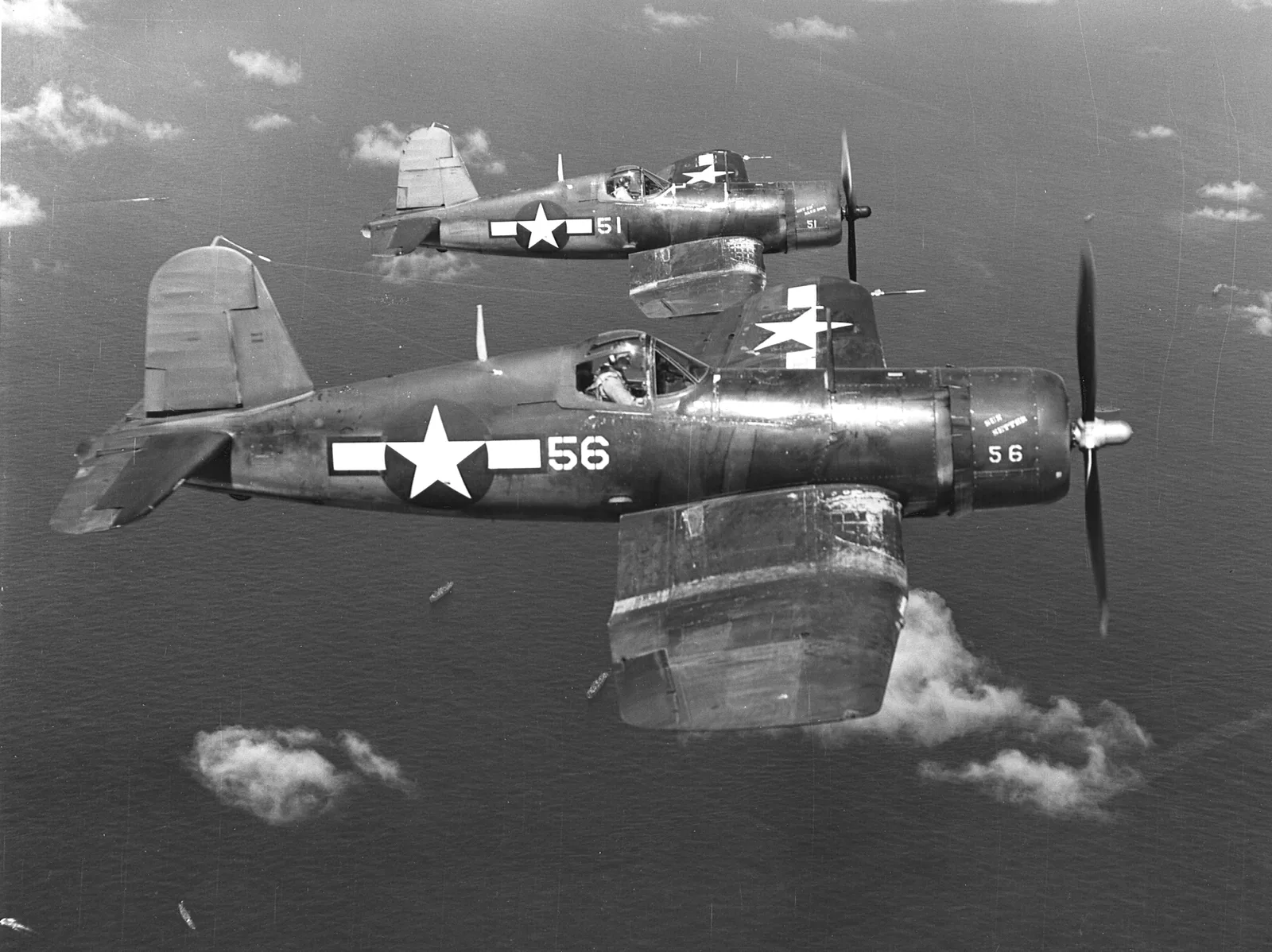
- Designation
- F4U
- In service
- 1942 to 1953 (U.S.); to 1979 with other air forces
- Role
- Carrier and land-based fighter-bomber
- Number built
- 12,571
The Vought F4U Corsair is instantly recognizable by its inverted gull wing, shaped that way to give a very large propeller ground clearance while keeping the landing gear short. It was among the fastest fighters of the war, the first U.S. single-engine fighter to exceed 400 miles per hour in level flight.
Early carrier trials went badly. Poor forward visibility over the long nose and a tendency to bounce on landing led the Navy to send the first Corsairs to Marine Corps land bases in the Pacific while the British navy worked out carrier techniques the U.S. later adopted.
From island airfields in the Solomons, Marine Corsair squadrons, including Gregory 'Pappy' Boyington's 'Black Sheep,' ran up a claimed kill ratio of about 11 to 1 against Japanese aircraft.
The Corsair outlasted the war. It flew ground-attack missions in Korea, and Vought kept it in production until 1953, the longest production run of any American piston-engine fighter. France flew Corsairs until 1964, and the last Corsair combat came in the 1969 'Football War' between Honduras and El Salvador.
Why It Mattered
The highest-performing U.S. Navy fighter of the war and one of its longest-serving, effective from the Solomons in 1943 through close air support in Korea a decade later.
- Designation
- B-29
- In service
- 1944 to 1960
- Role
- Very heavy bomber
- Number built
- 3,970
The B-29 was a generational leap: a pressurized cabin that let the crew fly in shirtsleeves above 30,000 feet, remote-controlled gun turrets aimed through a central fire-control computer, and the range to strike Japan from island bases 1,500 miles away.
Its development cost roughly $3 billion, exceeding the Manhattan Project, and it was rushed into service with unresolved problems, chiefly a tendency for its Wright R-3350 engines to overheat and catch fire.
High-altitude precision bombing of Japan produced disappointing results, so in early 1945 General Curtis LeMay ordered low-level night attacks with incendiaries. The March 9 to 10, 1945, firebombing of Tokyo killed an estimated 80,000 to 100,000 people in a single night.
On August 6 and 9, 1945, the B-29s Enola Gay and Bockscar dropped atomic bombs on Hiroshima and Nagasaki. After the war the B-29 formed the initial nuclear striking force of the new Strategic Air Command and served in Korea before retiring in 1960.
Why It Mattered
The most technically advanced bomber of the war, the delivery aircraft for both the firebombing campaign and the atomic missions, and the foundation of America's early Cold War nuclear force.
Jet Age and Korea (1946 to 1953)
The Air Force becomes its own service, the sound barrier falls, and swept-wing jets meet in the first fighter-versus-fighter combat in history.
- Designation
- F-86
- In service
- 1949 to 1970s (U.S. and allied)
- Role
- Air-superiority fighter
- Number built
- About 9,860 (all variants and license production)
The North American F-86 Sabre was the first American fighter with a swept wing, an aerodynamic feature copied from wartime German research that delayed the drag rise near the speed of sound.
It became famous over Korea, where it was the only United Nations aircraft able to meet the Soviet-built MiG-15 on roughly equal terms. The two dueled over 'MiG Alley' near the Yalu River in history's first large-scale jet-versus-jet combat.
The MiG could climb higher and carried heavier cannon; the Sabre had better high-speed handling, a radar-ranging gunsight, and, on the U.S. side, a core of experienced pilots. The Air Force's wartime claim of a roughly 10-to-1 advantage has been revised downward by later research, but the Sabre is still credited with controlling the contested airspace.
Beyond Korea, the Sabre was license-built in several countries and served with more than 25 air forces, making it one of the most widely used Western fighters of the early Cold War.
Why It Mattered
The West's first swept-wing jet fighter in combat and the benchmark of early jet air-to-air fighting. The Korea experience shaped U.S. fighter design and training for a generation.
- Designation
- B-47
- In service
- 1951 to 1969 (bomber role to 1966)
- Role
- Strategic medium bomber
- Number built
- 2,032
The B-47 looked radical when it flew in 1947: a thin, sharply swept wing carrying six turbojets in underwing pods, a fighter-style bubble canopy, and landing gear in the fuselage with outrigger wheels on the wings because the wing was too thin to house it.
That configuration, swept wing plus podded engines slung ahead of and below it, became the template for essentially every large jet aircraft built since, military or civilian.
More than 2,000 were built, and through the 1950s the B-47 was the numerical backbone of Strategic Air Command's nuclear force, flying from bases in the United States, Britain, Morocco, and Spain, often refueled in the air.
It was demanding to fly and had a thin safety margin, and it was replaced fairly quickly by the intercontinental B-52. No B-47 ever dropped a bomb in combat, though reconnaissance versions flew provocative missions near and sometimes into Soviet airspace.
Why It Mattered
The aircraft that set the shape of the modern jet, swept wing and podded engines, and the workhorse of the U.S. nuclear deterrent through the 1950s.
Cold War and Vietnam (1954 to 1975)
Nuclear-armed bombers stand alert around the clock, spy planes fly at the edge of space, and surface-to-air missiles force a rethink of air power over North Vietnam.
- Designation
- B-52
- In service
- 1955 to present
- Role
- Strategic heavy bomber
- Number built
- 744
The eight-engine B-52 entered service in 1955 as an intercontinental nuclear bomber and, more than 70 years later, is still flying frontline missions. The Air Force plans to operate re-engined B-52s past 2050, which would give some airframes a service life approaching a century.
During the Cold War, B-52s stood nuclear alert on runways and, for years, in the air around the clock. In Vietnam they were adapted to conventional carpet bombing: 'Arc Light' strikes dropped tens of thousands of tons of bombs, and the 11-day 'Linebacker II' campaign of December 1972 sent them against Hanoi, where 15 were shot down.
Later the B-52 became a standoff missile carrier, launching cruise missiles from outside enemy air defenses, and a heavy conventional bomber in the 1991 Gulf War, Afghanistan, and Iraq.
Its longevity comes from sheer capacity, low operating cost compared with stealth bombers, and a roomy airframe that has absorbed decades of new engines, radars, and weapons. Current upgrades include new commercial engines and a modern radar under the designation B-52J.
Why It Mattered
The longest-serving combat aircraft in U.S. history and the constant of American air power: nuclear deterrent, carpet bomber, cruise-missile truck, and precision bomber across every decade since 1955.
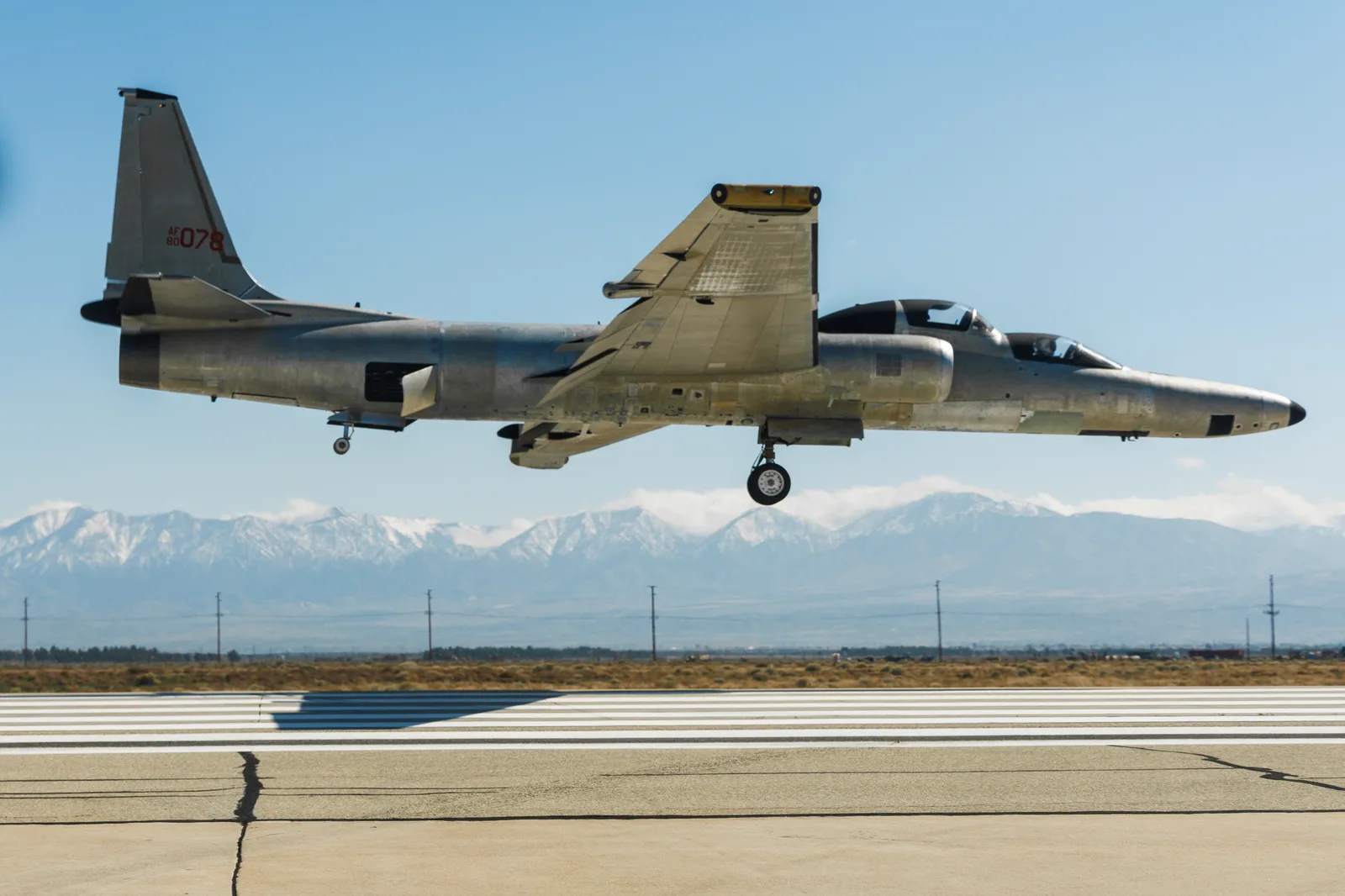
- Designation
- U-2
- In service
- 1956 to present
- Role
- High-altitude reconnaissance
- Number built
- About 104 (all variants)
Built in secret by Lockheed's Skunk Works, the U-2 is essentially a jet-powered glider, with a long, thin, high-aspect-ratio wing that lets it cruise above 70,000 feet, where the air is too thin for conventional aircraft and, in the 1950s, above the reach of Soviet defenses.
That margin of safety proved thinner than hoped. On May 1, 1960, a Soviet surface-to-air missile brought down the U-2 flown by CIA pilot Francis Gary Powers near Sverdlovsk, wrecking a planned U.S.-Soviet summit and ending manned overflights of the USSR.
U-2 photographs identified Soviet missile sites in Cuba in October 1962, triggering the Cuban Missile Crisis, during which another U-2 was shot down over the island, killing its pilot.
The U-2 is extremely difficult to fly, stalling and overspeeding only a few knots apart at altitude, and it lands with a chase car calling out height to the pilot. Repeatedly upgraded, it remains in Air Force service into the 2020s.
Why It Mattered
The aircraft that let the United States see inside the closed Soviet Union before spy satellites existed, and whose 1960 loss showed that even the edge of space was no longer sanctuary.
- Designation
- SR-71
- In service
- 1966 to 1998 (with a mid-1990s reactivation); NASA to 1999
- Role
- Strategic reconnaissance
- Number built
- 32
The SR-71 was designed by Lockheed's Skunk Works under Clarence 'Kelly' Johnson to do what the U-2 could not: survive over hostile territory by flying too fast and too high to be hit. It cruised above Mach 3 at 85,000 feet.
Roughly 92 percent of its structure was titanium, needed to withstand skin temperatures of several hundred degrees from air friction. The United States lacked a domestic supply, so the CIA arranged to buy the metal through front companies from its main source, the Soviet Union.
The airframe was built deliberately loose because it expanded in flight; on the ground its fuel tanks leaked until friction heat sealed them. Its evasive maneuver against a missile launch was simply to accelerate and climb away.
In 24 years of operations no SR-71 was lost to enemy action, though crews were fired on with more than 4,000 surface-to-air missiles. Twelve of the 32 built were lost in accidents. It still holds the official speed and altitude records for an air-breathing crewed aircraft, set in 1976.
Why It Mattered
The fastest and highest-flying crewed jet ever operated, and a demonstration that raw performance, not stealth or countermeasures, could be a survival strategy in its own right.
- Designation
- F-4
- In service
- 1961 to 1996 (U.S.); still flying with other air forces
- Role
- Multirole fighter
- Number built
- 5,195
The F-4 Phantom II began as a U.S. Navy fleet-defense interceptor and was so capable that the Air Force and Marine Corps adopted it too, an unusual case of one airframe serving all three services. It was big, fast at over Mach 2, and could carry a heavy load of missiles and bombs.
In Vietnam it did everything: air-to-air combat, ground attack, reconnaissance, and defense suppression. Early on, its missile-only armament was a liability in close dogfights against smaller MiGs, and later Air Force models added an internal 20-millimeter cannon.
Poor missile performance and kill ratios in the late 1960s prompted the Navy to create its 'Top Gun' Fighter Weapons School in 1969 and the Air Force to overhaul its training. Results improved markedly.
More than 5,000 were built. The Phantom flew with 11 other nations, and the last U.S. examples, radar-jamming 'Wild Weasel' F-4Gs, served until 1996. Some remain in service abroad well into the 21st century.
Why It Mattered
The definitive Western fighter of the 1960s and early 1970s, and the aircraft whose combat record drove the U.S. military to rebuild how it trains fighter crews.
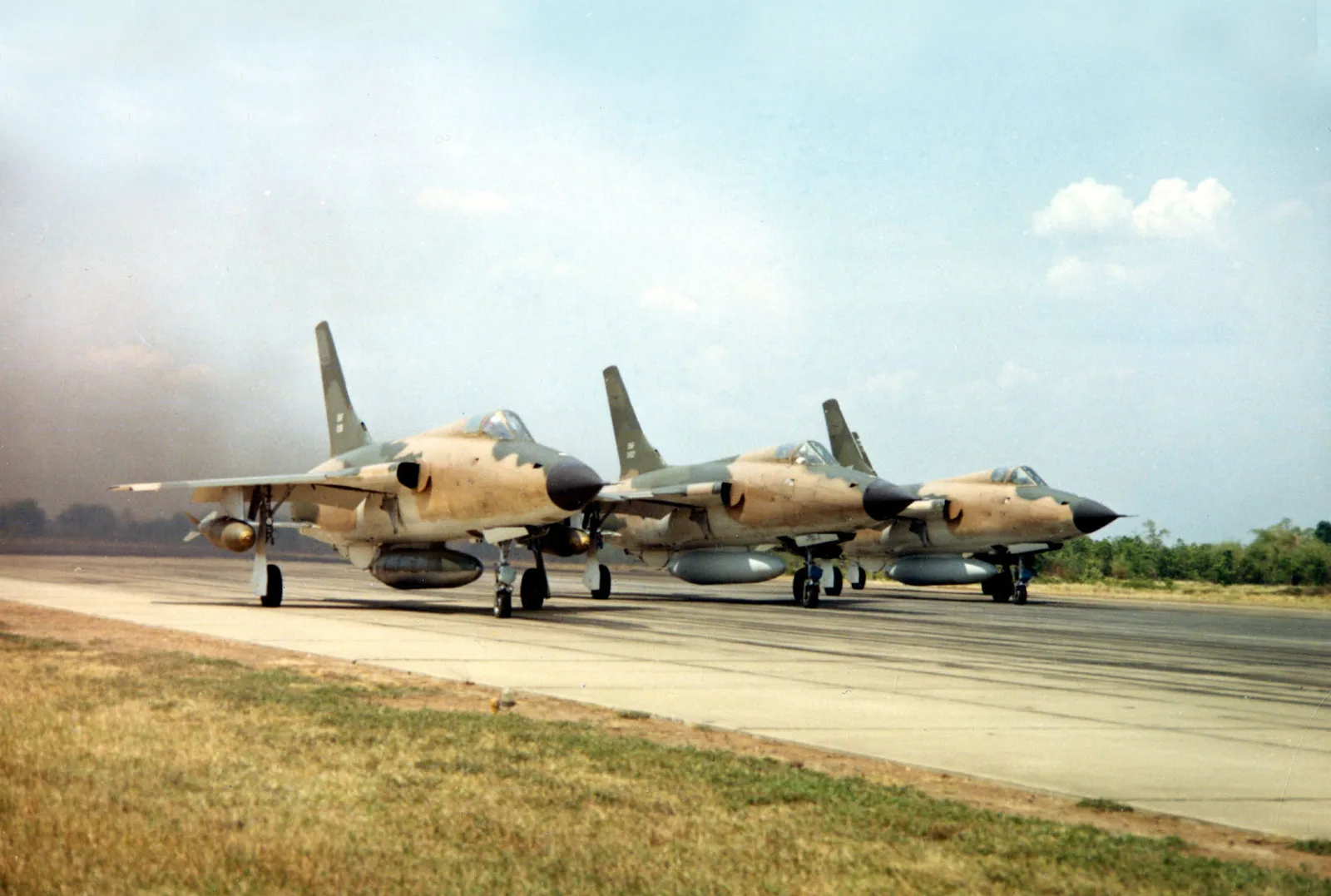
- Designation
- F-105
- In service
- 1958 to 1984 (Air National Guard)
- Role
- Supersonic strike fighter-bomber
- Number built
- 833
The F-105 Thunderchief was the largest single-seat, single-engine combat aircraft the United States ever built. It was designed in the early 1950s for one job: dash in fast and low and deliver a nuclear bomb from an internal weapons bay. Crews called it the 'Thud.'
In Vietnam it was used instead for conventional bombing, and it flew the majority of Air Force strike missions against North Vietnam during Operation Rolling Thunder from 1965 to 1968. It could haul a heavier bomb load than a World War II B-17 and then run away at more than 700 miles per hour at low altitude.
It was also badly exposed. Flying predictable routes into what was then the most heavily defended airspace in the world, F-105 units took punishing losses to anti-aircraft fire and SA-2 surface-to-air missiles. Of 833 built, roughly 380 were lost in Southeast Asia, close to half the fleet.
The two-seat F-105G 'Wild Weasel,' which hunted missile radars, stayed in service after the single-seat strike aircraft were withdrawn, and the last Thunderchiefs flew with the Air National Guard until 1984. The type is also credited with 27.5 MiG kills, most of them scored with its internal 20-millimeter rotary cannon.
Why It Mattered
The workhorse of the air war over North Vietnam, and the clearest case of an aircraft built for one mission, low-level nuclear strike, being spent on another it was never designed to survive.
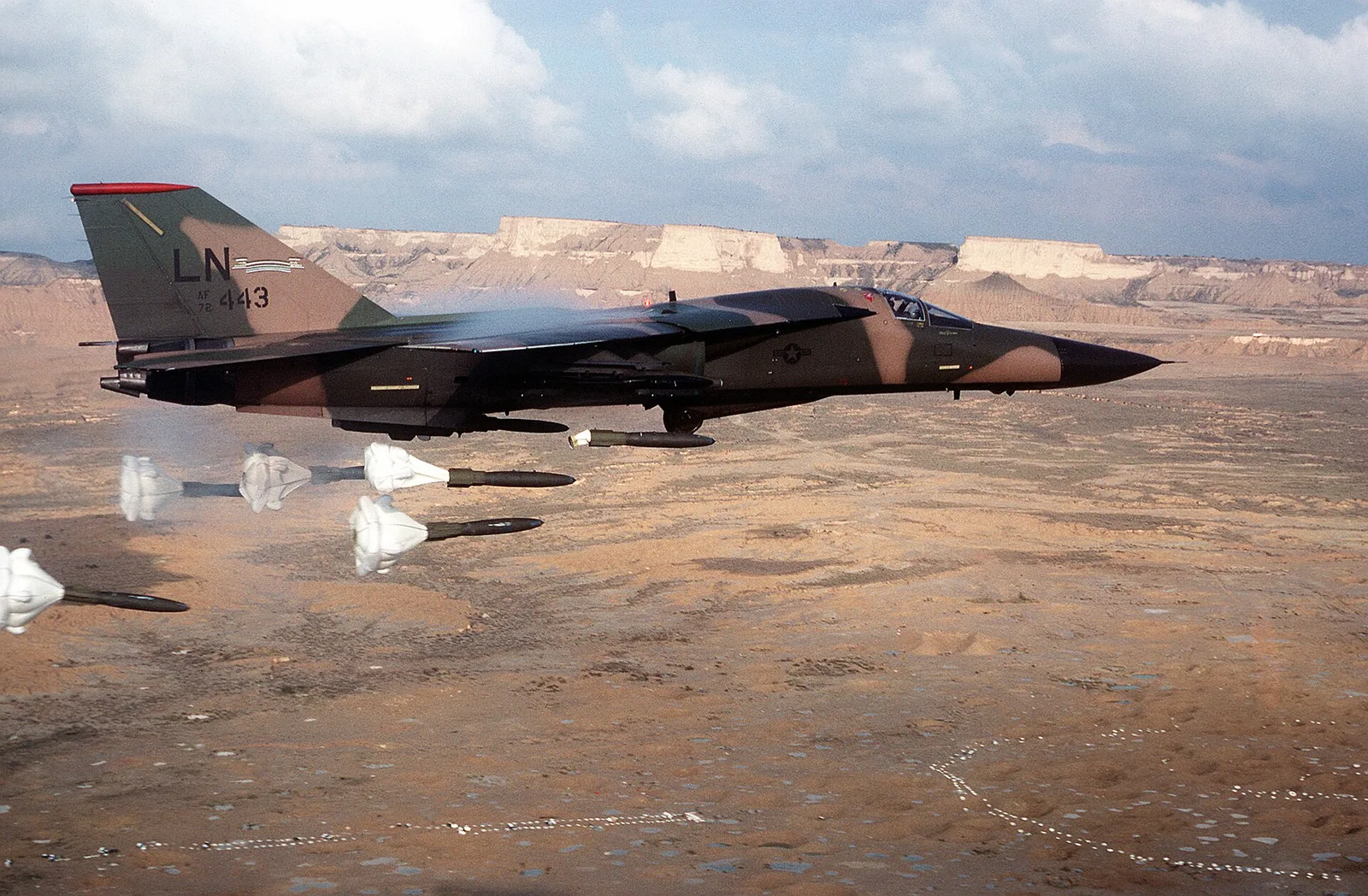
- Designation
- F-111
- In service
- 1967 to 1998 (U.S.); to 2010 with Australia
- Role
- All-weather deep strike, variable-sweep wing
- Number built
- 563
The F-111 introduced two features that became standard on later strike aircraft: a 'swing wing' that swept back for high-speed dashes and forward for efficient cruise and slow landings, and a terrain-following radar that flew the aircraft automatically at a few hundred feet in darkness or bad weather.
It came out of the contentious 1960s TFX program, an attempt to build one airframe for both the Air Force and the Navy. The Navy version was overweight and cancelled. The Air Force version was rushed into Vietnam in 1968, lost three of the first six aircraft deployed to unexplained causes, and was pulled back before returning with far better results in 1972.
At its best the F-111 could do what nothing else of its era could: strike a defended target at night, in any weather, at very low altitude and high speed, with no tanker and no escort. It flew the long-range 1986 strike on Libya round trip from bases in England.
About 563 were built in strike, electronic-warfare (EF-111 Raven), and strategic-bomber (FB-111) versions. The Air Force retired it between 1996 and 1998, and Australia kept its F-111s flying until 2010.
Why It Mattered
The first U.S. aircraft that could reliably strike deep in defended territory alone, at night, in bad weather, and the origin of the variable-sweep wing and terrain-following radar in American service.
Precision and Stealth (1974 to 2000)
The 'teen series' fighters, the tank-killing A-10, and the first aircraft shaped to be nearly invisible to radar.
- Designation
- F-15
- In service
- 1976 to present
- Role
- Air-superiority fighter (later multirole)
- Number built
- About 1,700 (all variants)
The F-15 was the Air Force's answer to reports of a formidable new Soviet fighter and to Vietnam's lesson that speed alone did not win air combat. It was designed uncompromisingly for air superiority, summed up in the program slogan 'not a pound for air-to-ground.'
With two big engines producing more thrust than the aircraft's loaded weight, the Eagle can accelerate while pointed straight up. Its large radar and long-range missiles let it detect and engage targets well beyond visual range.
Across the U.S., Israeli, and Saudi air forces, the F-15 is credited with more than 100 air-to-air victories and no confirmed losses to enemy aircraft, one of the strongest combat records of any modern fighter.
A ground-attack version, the F-15E Strike Eagle, entered service in 1989, and Boeing continues to build a heavily updated model, the F-15EX, for the Air Force in the 2020s, extending the design's production run past 50 years.
Why It Mattered
The most successful air-superiority fighter of the modern era by combat record, and proof that a purpose-built dogfighter with long reach could dominate contested airspace.
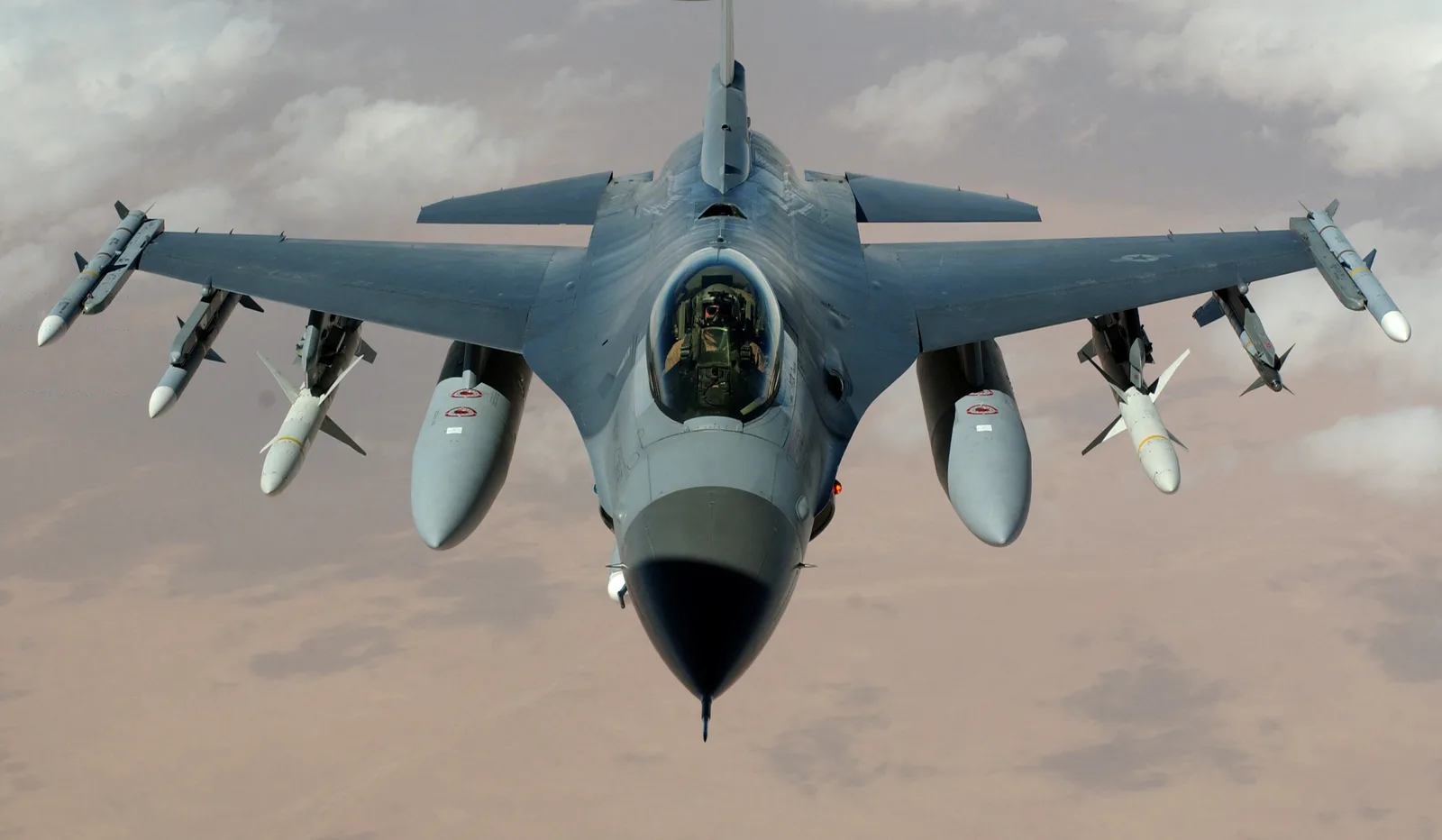
- Designation
- F-16
- In service
- 1978 to present
- Role
- Multirole fighter
- Number built
- More than 4,600
The F-16 came out of the 1970s 'Lightweight Fighter' program, an effort to build a small, agile, affordable fighter as a counterweight to the large and costly F-15. It first flew in 1974, reportedly after an unplanned lift-off during a high-speed taxi test.
It introduced several features new to a production fighter: a fully electronic 'fly-by-wire' control system with no mechanical linkage to the surfaces, a control stick mounted on the right console rather than between the pilot's knees, a seat reclined 30 degrees to help resist g-forces, and a frameless bubble canopy for unobstructed vision.
The design was deliberately made slightly aerodynamically unstable for agility, relying on the flight computer to keep it controllable, a trade that later became standard practice.
More than 4,600 have been built and flown by around 25 air forces, making the F-16 the most widely used Western jet fighter of the past half century and the multirole workhorse of the U.S. Air Force.
Why It Mattered
The fighter that made fly-by-wire, relaxed stability, and the affordable multirole jet the industry norm, and the numerical backbone of the U.S. and allied fighter fleets for decades.
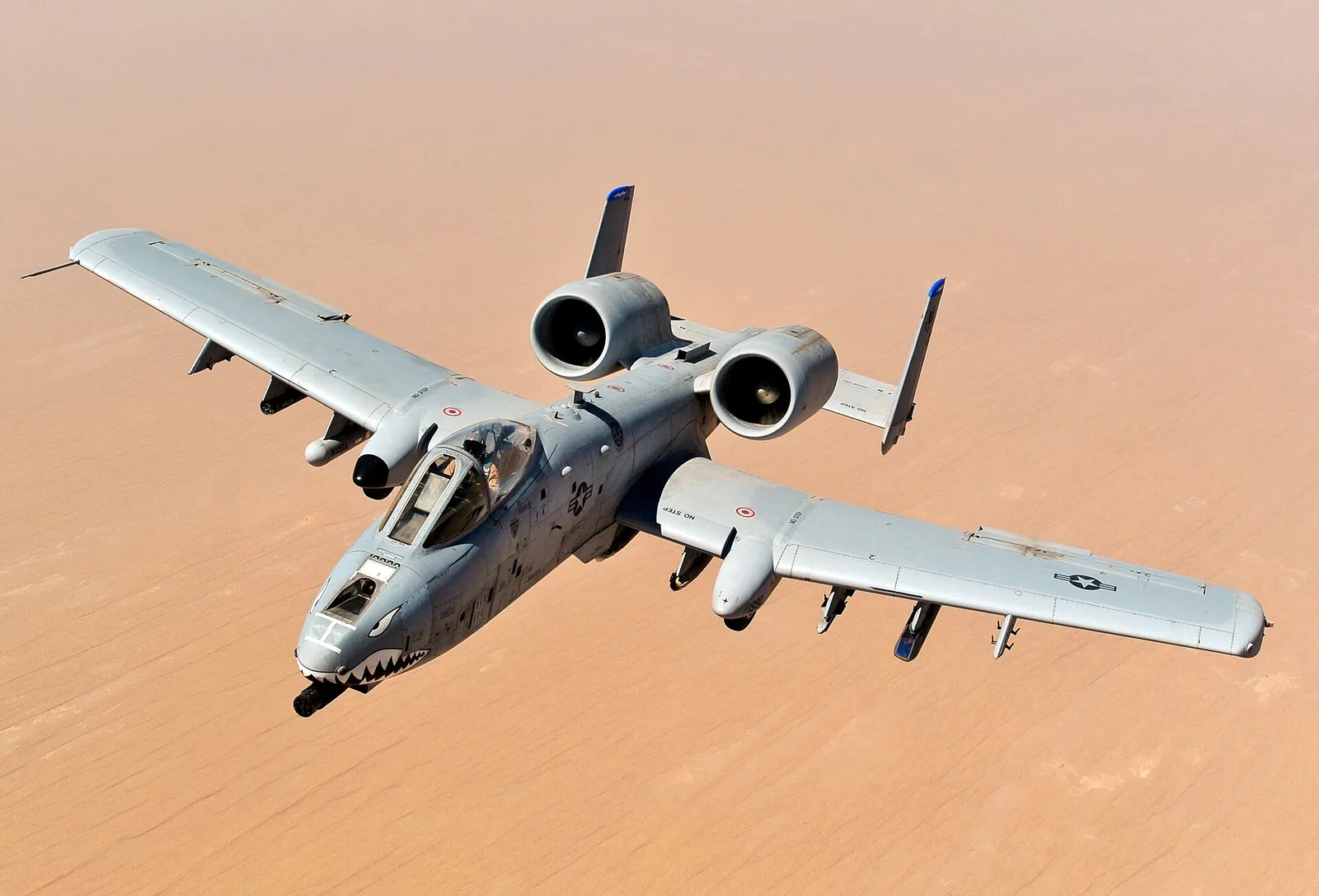
- Designation
- A-10
- In service
- 1977 to present
- Role
- Close air support and forward air control
- Number built
- 716
The A-10 was designed around a gun. The GAU-8/A Avenger, a seven-barrel 30-millimeter cannon roughly the length and weight of a small car, is mounted along the aircraft's centerline, and the airframe was built to carry it.
It is optimized to support troops in contact with the enemy: it flies low and slow, carries a heavy and varied weapons load on 11 hardpoints, and can loiter over a battlefield far longer than a fast jet. The pilot sits in a titanium 'bathtub' able to stop many ground-fire hits, and the flight controls have manual backups.
It proved its worth destroying Iraqi armor in the 1991 Gulf War and providing overwatch for ground troops in Afghanistan and Iraq. Aircraft have returned to base with engines destroyed, hydraulics gone, and large holes in the wings and tail.
The Air Force has repeatedly proposed retiring the A-10 to fund newer aircraft, and Congress has repeatedly intervened to keep it flying. A phased retirement is now underway, with the fleet planned to be gone by the late 2020s.
Why It Mattered
The most specialized close air support aircraft the U.S. has ever fielded, and the center of a decades-long argument between the Air Force and the Army over who should support ground troops and how.
- Designation
- F-117
- In service
- 1983 to 2008 (officially); limited flying continues
- Role
- Stealth attack aircraft
- Number built
- 64 (including 5 prototypes)
The F-117 was the first operational aircraft designed from the outset to be nearly invisible to radar. Its faceted shape, a mosaic of flat panels, scatters radar energy in directions away from the transmitter, a technique made calculable by equations published by a Soviet physicist and applied by Lockheed's Skunk Works.
It was developed and operated in deep secrecy from a remote airfield in Nevada, flown only at night for years. The Air Force did not confirm its existence until 1988. Despite the 'F' for fighter designation, it carries no air-to-air weapons; it is a precision bomber.
Its combat debut came in the 1989 invasion of Panama, and it drew wide attention in the 1991 Gulf War, when F-117s struck heavily defended targets in central Baghdad that other aircraft could not reach.
One was shot down near Belgrade on March 27, 1999, when Serbian forces exploited predictable routing and long radar wavelengths, the only combat loss of the type. It was officially retired in 2008, though a number are kept flying quietly as test and training adversaries.
Why It Mattered
The proof of concept for stealth: an aircraft that could fly into the most heavily defended airspace and strike with precision, changing the expected cost of air defense for every potential adversary.
- Designation
- B-2
- In service
- 1997 to present
- Role
- Stealth strategic bomber
- Number built
- 21
The B-2 is a flying wing: no fuselage, no tail, just a single blended lifting surface with a sawtooth trailing edge. The layout, which Northrop had explored with experimental bombers in the 1940s, minimizes the aircraft's radar and infrared signatures from every angle.
It was a Cold War program that outlived its original purpose. As the Soviet Union collapsed, Congress cut the planned fleet from 132 aircraft to 21. Spreading development costs across so few airframes drove the per-aircraft figure to roughly $2 billion.
The B-2 can carry both conventional precision weapons and nuclear bombs, and its signature mission is the very long-range strike: 30-plus-hour sorties flown from Whiteman Air Force Base in Missouri to targets in Europe, the Middle East, or the Pacific and back, with aerial refueling.
It first saw combat over Kosovo in 1999 and has since struck targets in Afghanistan, Iraq, Libya, and Yemen, and in June 2025 B-2s bombed Iran's Fordow and Natanz nuclear sites in Operation Midnight Hammer. It is being replaced by the B-21 Raider beginning in the late 2020s.
Why It Mattered
The first stealth heavy bomber, and the aircraft that made 'strike anywhere on earth from the continental United States' a routine planning assumption.
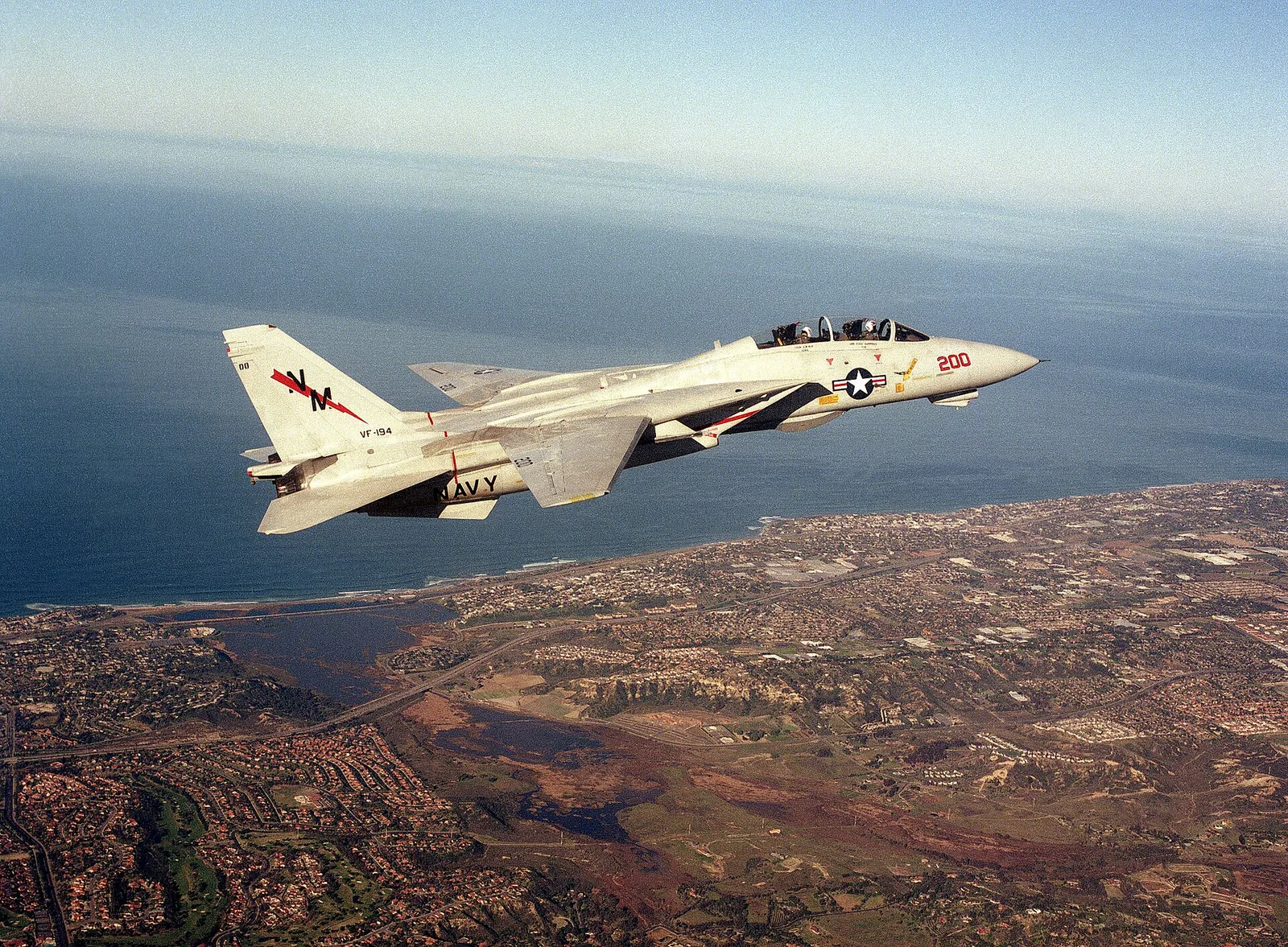
- Designation
- F-14
- In service
- 1974 to 2006 (U.S.); still flown by Iran
- Role
- Carrier-based fleet-defense interceptor
- Number built
- 712
The F-14 Tomcat was the U.S. Navy's answer to the problem of defending an aircraft carrier against Soviet bombers carrying long-range anti-ship missiles. It paired a variable-sweep wing with the powerful AWG-9 radar and the AIM-54 Phoenix missile, which could track and strike targets more than 100 miles away.
The swing wing let a large, long-range interceptor still approach a pitching carrier deck slowly enough to land safely. A crew of two, a pilot and a radar intercept officer, shared the work of finding and engaging targets at extreme range.
Its public image came from the 1986 film 'Top Gun,' but its early service was dogged by unreliable engines that were not properly fixed until the F-14B and F-14D of the late 1980s and 1990s. In its final years it gained a precision ground-attack role, earning the nickname 'Bombcat.'
The Navy retired the Tomcat in 2006 in favor of the F/A-18E/F Super Hornet. The only F-14s still flying belong to Iran, which bought 79 before the 1979 revolution and has kept some airworthy ever since with improvised parts.
Why It Mattered
The longest-reaching air-to-air weapon system the United States has fielded, and the aircraft that defined U.S. carrier fighter aviation, and its pop-culture image, for a generation.
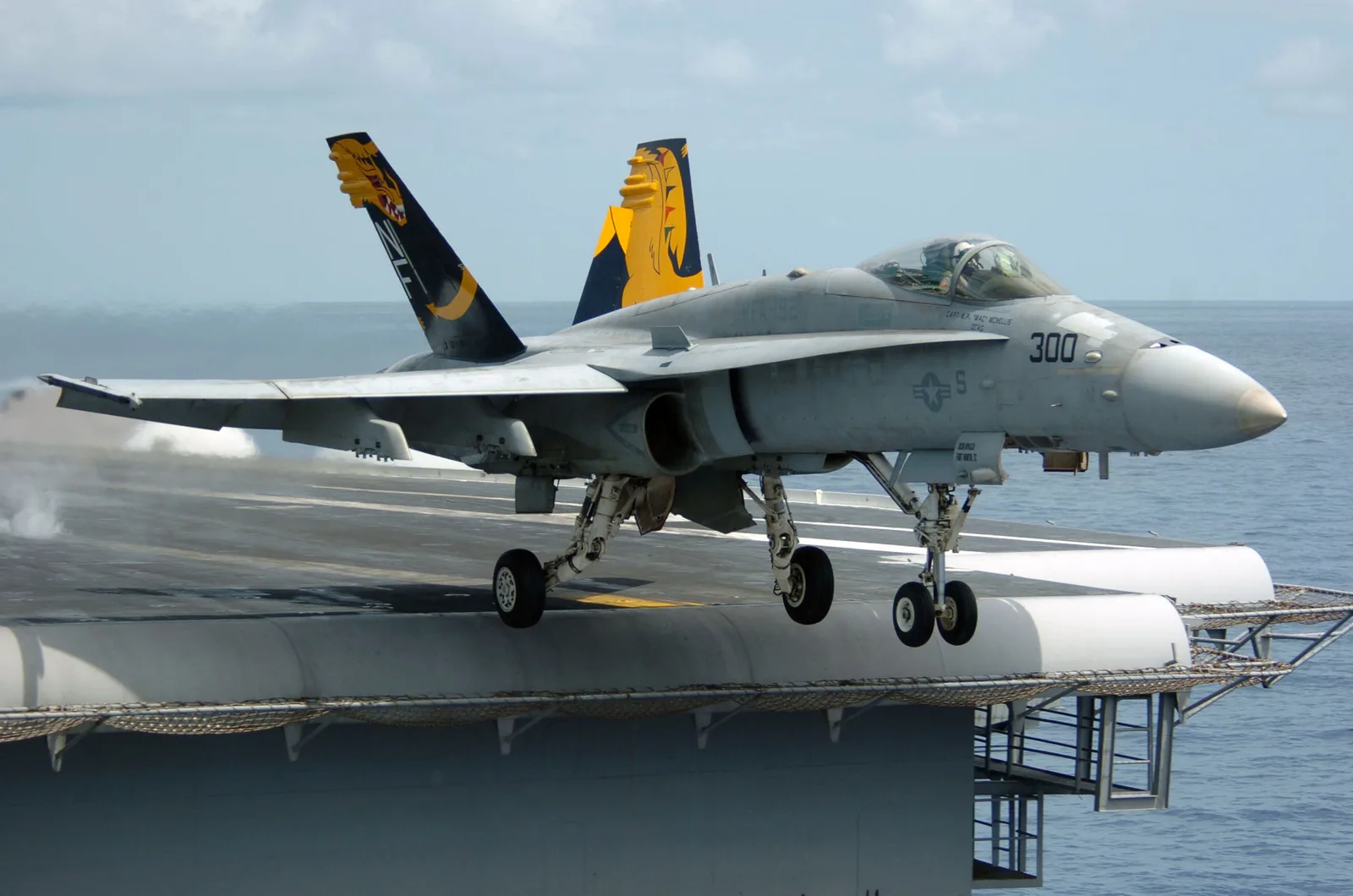
- Designation
- F/A-18
- In service
- 1983 to present
- Role
- Carrier-based multirole strike fighter
- Number built
- About 1,480 Hornets; more than 600 Super Hornets
The F/A-18 Hornet was built to do two jobs the Navy had previously split between separate aircraft: air-to-air fighting and air-to-ground attack. The designation itself, 'F' for fighter and 'A' for attack, states the point. It replaced the A-7 Corsair II and, over time, much of the F-14 and A-6 fleet.
It grew out of the losing entry in the same 1970s Lightweight Fighter contest that produced the F-16. Northrop's YF-17 was redesigned by McDonnell Douglas into a larger, twin-engine aircraft strong enough for catapult launches and arrested landings.
The much larger F/A-18E/F Super Hornet, in service since 2001, is effectively a new aircraft: about 25 percent bigger, with more range, more payload, and more internal room for future electronics. A dedicated electronic-attack version, the EA-18G Growler, replaced the EA-6B Prowler.
Between the original Hornet, the Super Hornet, and the Growler, the F/A-18 family is the backbone of the U.S. Navy carrier air wing and serves with several allied air forces, including Australia, Canada, Finland, and Switzerland.
Why It Mattered
The aircraft that merged the Navy's fighter and attack roles into one airframe, and, as the Super Hornet, the core of the American carrier air wing alongside the F-35C.
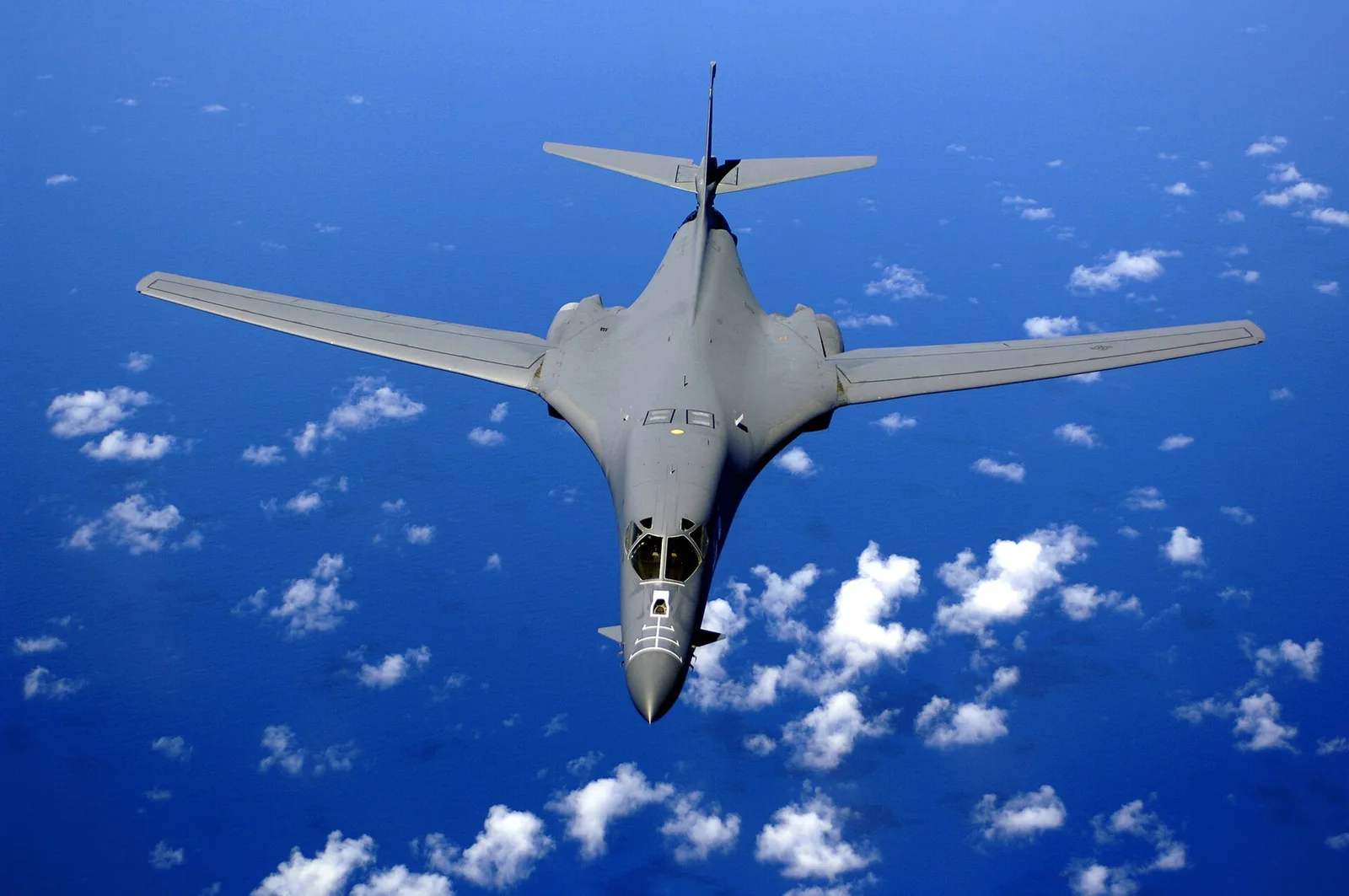
- Designation
- B-1B
- In service
- 1986 to present
- Role
- Supersonic long-range heavy bomber
- Number built
- 104 (4 B-1A prototypes, 100 B-1B)
The B-1 has one of the strangest procurement histories of any American aircraft. The original B-1A, a Mach 2 bomber meant to replace the B-52, was cancelled by President Carter in 1977 in favor of cruise missiles and the still-secret stealth bomber program.
President Reagan revived it in 1981 as the B-1B: slower, at about Mach 1.2, but with a reduced radar signature, more fuel, and more payload. It was meant as an interim bomber to bridge the gap until the B-2 arrived. One hundred were built by 1988.
It carries the largest bomb load, internal and external, of any U.S. bomber. After the Cold War it was converted entirely to conventional bombing and became a mainstay of sustained air campaigns over Afghanistan, Iraq, Syria, and Libya, where its speed and capacity let a handful of aircraft cover a wide area.
The B-1B has also been costly and difficult to maintain, and decades of heavy use have strained and shrunk the fleet. It is scheduled to retire as the B-21 Raider enters service, which would leave the much older B-52 still flying after it.
Why It Mattered
The bomber the United States cancelled, revived, repurposed, and wore out, and the fast, heavy-hauling complement to the B-52 and B-2 in nearly every major air campaign since 2001.
Fifth Generation and Unmanned (2001 to present)
Stealth, supercruise, and sensor fusion become standard, armed drones fly combat missions from bases half a world away, and the next bomber is unveiled.
- Designation
- F-22
- In service
- 2005 to present
- Role
- Air-superiority fighter
- Number built
- 195 (8 test, 187 operational)
The F-22 was the first fighter to bring together the four qualities now used to define a 'fifth generation' aircraft: low-observable stealth from all angles, the ability to cruise above the speed of sound without using fuel-hungry afterburner ('supercruise'), thrust-vectoring engine nozzles for extreme agility, and the fusion of radar, electronic, and off-board data into a single tactical picture.
It was conceived in the 1980s to defeat projected Soviet fighters and modern air defenses. In exercises it has repeatedly produced simulated kill ratios so lopsided against fourth-generation fighters that they are often quoted in triple digits.
By law the F-22 cannot be exported, even to close allies. That, plus its cost, led Congress to end production in 2011 at 187 operational aircraft, roughly a quarter of the Air Force's original goal.
The small fleet is a lasting limitation. There are too few Raptors to sustain a presence everywhere they might be needed, and attrition from accidents cannot be replaced. A successor, the Boeing F-47, was selected in March 2025 under the Next Generation Air Dominance program.
Why It Mattered
The world's first operational fifth-generation fighter, which set the standard, stealth plus supercruise plus sensor fusion, that every advanced fighter program since has had to answer.
- Designation
- F-35
- In service
- 2015 to present
- Role
- Multirole stealth fighter
- Number built
- More than 1,100 delivered (program of record far larger)
The F-35 is built in three versions from one basic design: the F-35A takes off and lands conventionally for the Air Force, the F-35B can take off in a short distance and land vertically for the Marine Corps and several allied navies, and the F-35C has larger wings and a tailhook for U.S. Navy carriers.
Its defining feature is not speed or agility but information. Sensors around the airframe, plus data shared from other aircraft, ships, and satellites, are combined into one picture, and the pilot's helmet, which costs around $400,000, displays imagery that effectively lets them see through the aircraft.
It is the most expensive weapons program in history. U.S. government auditors estimate the lifetime cost, development, buying roughly 2,470 aircraft, and about 66 years of operations and sustainment, at more than $1.7 trillion (GAO, 2023).
After a troubled development marked by delays, software problems, and cost growth, the F-35 has become the standard fighter of the U.S. and allied air forces, with more than 1,100 delivered to the United States and about 20 partner nations.
Why It Mattered
The fighter that spread fifth-generation capability across the U.S. services and the Western alliance, at a scale, and a price, without precedent.
- Designation
- MQ-1 / MQ-9
- In service
- 1995 to 2018 (Predator); 2007 to present (Reaper)
- Role
- Remotely piloted reconnaissance and strike
- Number built
- About 360 Predators; 300-plus Reapers and counting
The Predator entered service in 1995 as an unarmed surveillance drone over the Balkans. After Hellfire missiles were integrated and tested, an armed Predator carried out its first strike in Afghanistan in October 2001, shortly after the September 11 attacks, opening the era of routine drone warfare.
The MQ-9 Reaper, fielded from 2007, is far more capable: a turboprop-powered 'hunter-killer' that carries roughly 3,000 pounds of laser-guided bombs and missiles and can watch or strike a target for around a day without landing.
Crews operate them over combat zones from bases inside the United States, chiefly Creech Air Force Base in Nevada, via satellite link. The model raised debate over the legality and ethics of remote strikes, the risk to civilians, and the strain on operators who watch and act on targets for hours at a time.
By the 2010s the Air Force was flying more combat air patrols with remotely piloted aircraft than with any crewed type and training more drone operators than fighter and bomber pilots combined.
Why It Mattered
The aircraft that made persistent surveillance and remote precision strike an everyday tool of American military operations, and forced a public reckoning with what that means.
- Designation
- RQ-4
- In service
- 2001 to present
- Role
- High-altitude, long-endurance reconnaissance
- Number built
- About 45 (U.S., all blocks)
The RQ-4 Global Hawk is a large uncrewed reconnaissance aircraft with a wingspan comparable to an airliner's, able to fly for more than 30 hours at around 60,000 feet and survey tens of thousands of square miles of terrain in a single mission.
It flies its route autonomously from takeoff to landing; operators task its sensors and monitor systems rather than 'flying' it with a stick. It carries radar, electro-optical, and infrared sensors and signals-intelligence packages depending on the version.
The Global Hawk was intended to take over much of the strategic reconnaissance mission from the crewed U-2, but cost growth and the U-2's superior sensors led to years of debate in Congress over which to keep. The Navy operates a maritime version, the MQ-4C Triton.
A Global Hawk was shot down by an Iranian surface-to-air missile over the Strait of Hormuz in June 2019, a loss with no crew that nonetheless brought the two countries close to a shooting exchange.
Why It Mattered
The first uncrewed aircraft to take on the strategic, high-altitude reconnaissance role historically flown by the U-2 and SR-71, and a case study in the cost of replacing a proven crewed platform.
- Designation
- B-21
- In service
- Expected late 2020s
- Role
- Stealth strategic bomber
- Number built
- 6 in test as of 2024; at least 100 planned
The B-21 Raider is a flying-wing stealth bomber, visually a smaller and more refined descendant of the B-2, developed by Northrop Grumman. It was publicly unveiled in December 2022 and first flew in November 2023.
The Air Force calls it a 'digital bomber': it was designed and extensively tested in software before parts were built, and its systems use an open architecture intended to let new weapons, sensors, and software be added over its life without redesigning the aircraft.
It is meant to be affordable in a way the B-2 was not. The target unit cost was set at roughly $700 million in 2022 dollars, and the Air Force intends to buy at least 100, enough to replace both the B-1 and the B-2.
The first aircraft are being tested at Edwards Air Force Base, and Ellsworth Air Force Base in South Dakota is planned as the first operational base. It is expected to enter service in the second half of the 2020s.
Why It Mattered
The first new American bomber in more than three decades and the template for how the Air Force wants to build aircraft now: designed in software, upgradable by design, and bought in useful numbers.
The Jobs Air Power Is Asked to Do
Aircraft are built around missions. These seven, air superiority, strategic bombing, reconnaissance, close air support, stealth, carrier aviation, and the unmanned turn, explain why the fleet looks the way it does.
Every American air campaign since 1943 has opened with the same goal: defeat the enemy air force and its defenses so that everything else, bombing, reconnaissance, troop support, resupply, can happen with acceptable losses. The term for that condition is air superiority, and total, uncontested control is called air supremacy.
The lesson was learned the hard way over Germany in 1943, when unescorted bombers were savaged, and relearned over North Vietnam in the 1960s, when missile-armed fighters without guns or dogfight training performed poorly. Both cases drove change: the Merlin-engined P-51 in the first instance, and the 'Top Gun' and Red Flag training programs plus the purpose-built F-15 in the second.
The F-15's combat record, more than 100 victories and no losses to enemy aircraft across several air forces, set a standard that shaped the F-22 and F-35. Fifth-generation aircraft pursue air superiority by seeing and shooting first from stealth rather than by out-turning an opponent.
The 1991 Gulf War is the modern benchmark: coalition air forces established air supremacy over Iraq within days, then spent weeks destroying a large fielded army from the air before ground troops advanced. Adversaries have spent the decades since investing in long-range surface-to-air missiles to deny the United States that advantage.
Strategic bombing is the idea, championed by Billy Mitchell and pursued by the Army Air Forces in World War II, that attacking an enemy's factories, oil, transport, and cities can break its ability or will to fight without first defeating its army in the field.
World War II tested it at enormous scale and cost. American daylight 'precision' raids on ball-bearing plants and oil refineries did serious damage but suffered heavy losses and often missed; the campaign's clearest effect came late, when attacks on synthetic fuel plants and railways starved the German military of mobility. In the Pacific, precision gave way to the firebombing of Japanese cities.
The atomic missions of August 1945 seemed to promise that a single bomber could now end a war, and the early Cold War was built around that promise, with the B-47 and B-52 on constant nuclear alert.
Precision-guided weapons changed the arithmetic again. In World War II, hitting a single bridge could take hundreds of bombs and dozens of aircraft; by 1991 a pair of stealth aircraft could destroy dozens of separate targets in one night. The mission survives today in the B-52, B-2, and B-21, and in the long-range conventional strike planning that dominates current Air Force thinking.
Aerial reconnaissance is older than aerial combat. Observation balloons were used in the Civil War, and the first military airplanes, including the Wright Military Flyer, were bought to scout and spot artillery, not to fight. Camera-equipped aircraft mapped the Western Front in World War I, and stripped-down P-38s did much of the Allied photo work in World War II.
The Cold War pushed the mission to extremes of altitude and speed. The U-2 flew above 70,000 feet to photograph Soviet airfields and missile sites; when the Soviets learned to reach that high and shot down Gary Powers in 1960, the SR-71 answered by flying at Mach 3 and 85,000 feet, fast enough to outrun the missiles.
U-2 imagery gave President Kennedy the evidence of Soviet missiles in Cuba in 1962. That same crisis cost the life of a U-2 pilot and underlined how central, and how dangerous, the mission had become.
Reconnaissance satellites, beginning with Corona in 1960, gradually took over the strategic photo mission, and uncrewed aircraft like the RQ-4 Global Hawk and MQ-9 Reaper now provide much of the persistent surveillance. The crewed U-2, remarkably, is still flying in the 2020s.
Close air support means attacking enemy forces that are close enough to friendly troops that the strikes must be closely coordinated to avoid hitting your own side. It is demanding, dangerous, low-altitude work, and it has been a source of friction between the services for decades.
In World War II, P-47 Thunderbolts roving ahead of advancing armies showed how effective it could be. The Marine Corps, which builds its air wings around supporting Marines on the ground, made it central to its doctrine with the Corsair and later the Harrier and F-35B.
The Air Force's commitment has been more contested. Its interest has always leaned toward air superiority and strategic strike, and the Army's frustration on this point is a major reason it developed a large fleet of attack helicopters, the AH-1 Cobra and AH-64 Apache, that it controls directly.
The A-10, forced through by close-support advocates in the 1970s, is the most capable dedicated platform the United States has fielded, and the repeated fights in Congress over retiring it are really arguments about whether the mission deserves a purpose-built aircraft at all. Its planned retirement leaves the role to multirole jets, drones, and helicopters.
Stealth, more precisely 'low observability,' is the art of reducing how strongly an aircraft reflects radar, emits heat, and otherwise announces itself, so that defenders detect it late, at short range, or not at all. It does not make an aircraft invisible; it shrinks the distance and time available to react.
The breakthrough was mathematical. In the 1970s, Lockheed engineers applied equations by a Soviet physicist, Pyotr Ufimtsev, to predict how flat, angled panels would scatter radar energy, producing the faceted 'Have Blue' demonstrator and then the F-117.
The F-117 in the 1991 Gulf War and the B-2 over Kosovo in 1999 proved the concept at the operational level: aircraft flew into the most heavily defended airspace and struck with precision while non-stealth aircraft had to stand off or accept losses.
Stealth is now an assumed feature of any top-tier combat aircraft, F-22, F-35, B-21, and of adversary designs. It is also expensive to build and maintain, and potential opponents are investing heavily in low-frequency radars, networked sensors, and infrared search systems intended to claw back the advantage.
The U.S. Navy has developed its combat aircraft on a parallel track to the Air Force, under an added set of constraints: everything must be strong enough to be slammed onto a deck and yanked to a stop by a cable, compact enough to fit an elevator and a crowded hangar, and able to fly from a runway that pitches and rolls.
Those demands shaped distinctive aircraft. The F4U Corsair's gull wing gave propeller clearance on a short-legged carrier fighter. The F-4 Phantom II was a Navy interceptor before the Air Force wanted it. The F-14 Tomcat's swing wings let a big, long-range fleet-defense fighter still approach the deck slowly.
Catapults and arresting gear are the enabling technology. Steam catapults gave way to an electromagnetic system on the newest carriers, and the 'ball' optical landing aid replaced a signal officer's paddles, but the fundamental skill, flying a precise approach to a 3-degree glideslope and catching one of a few wires, remains among the hardest in aviation.
Today the carrier air wing is built around the F/A-18E/F Super Hornet and the carrier F-35C, with the uncrewed MQ-25 tanker being added to extend their reach, keeping the Navy able to project air power to coastlines without needing a friendly airbase ashore.
For a century, the limiting factor in military aviation was the human in the aircraft: the pilot's endurance, tolerance for g-forces, and, above all, life. Remotely piloted aircraft remove that factor for a growing set of missions.
The change came in stages. Reconnaissance drones flew over the Balkans in the 1990s; an armed Predator struck a target in Afghanistan in 2001; by the 2010s the Air Force flew more combat patrols with uncrewed aircraft than with any crewed type and trained more drone operators than fighter and bomber pilots combined.
The trade-offs are real. Uncrewed aircraft can loiter for a day, be risked over defended territory without a captured-pilot crisis, and be built more cheaply. They also depend on vulnerable satellite links, have been lost to enemy missiles with only equipment at stake, and have concentrated hard legal and ethical questions about remote killing and civilian harm.
The next step is teaming: 'Collaborative Combat Aircraft,' relatively low-cost uncrewed jets designed to fly alongside crewed F-35s and the future F-47 (NGAD) fighter as scouts, missile carriers, jammers, and decoys, letting one pilot direct several aircraft at once.
Records, Costs, and Extremes
A quick-reference set of the fastest, highest, oldest, most-built, and most-expensive, each figure sourced from the material on this page.
| Category | Holder | Figure | Note |
|---|---|---|---|
| Fastest crewed U.S. aircraft | SR-71 Blackbird | 2,193 mph (about Mach 3.3) | Official record set July 28, 1976, and still standing for an air-breathing crewed aircraft. The rocket-powered X-15 research aircraft flew far faster but was air-launched. |
| Highest sustained operational altitude | SR-71 Blackbird / U-2 Dragon Lady | About 85,000 ft (SR-71); above 70,000 ft (U-2) | Both operate in the thin air at the edge of the stratosphere, where the U-2 in particular flies only a few knots above its stall speed and below its maximum. |
| Longest-serving combat aircraft | B-52 Stratofortress | In service since 1955; planned past 2050 | Re-engining and new radar under the B-52J program are intended to keep some airframes flying for close to 100 years. |
| Most-produced U.S. military aircraft | Consolidated B-24 Liberator | 18,482 built (1940 to 1945) | The most-produced American military aircraft and the most-produced multi-engine aircraft in history. The P-47 Thunderbolt, at 15,636, is the most-produced U.S. fighter. |
| Most expensive weapons program in history | F-35 Lightning II | About $1.7 trillion estimated lifetime cost (GAO, 2023) | Covers development, roughly 2,470 U.S. aircraft, and about 66 years of operations and sustainment, per U.S. Government Accountability Office reporting. |
| Highest cost per aircraft | B-2 Spirit | About $2 billion each | Development costs spread across only 21 airframes after the planned buy was cut from 132. The B-21 Raider targets roughly $700 million each in 2022 dollars. |
| Largest gun on a U.S. aircraft | A-10's GAU-8/A Avenger | 30 mm, seven barrels, about 3,900 rounds per minute | The complete cannon system is roughly the size and weight of a compact car; the A-10 airframe was designed around it. |
| SR-71 losses to enemy fire | SR-71 Blackbird | Zero in 24 years | Crews reported outrunning more than 4,000 surface-to-air missiles. Twelve of the 32 built were lost in accidents. |
| F-15 air-to-air record | F-15 Eagle (all operators) | More than 100 victories, no confirmed losses | Across U.S., Israeli, and Saudi service, one of the strongest air-combat records of any fighter in history. |
| Wright Military Flyer top speed | Signal Corps Airplane No. 1 | About 42 mph | The 1908 Army specification required 40 mph; the Wrights earned a $5,000 bonus, on top of the $25,000 price, for beating it. |
Did You Know?
A quick-reference set of facts drawn from the sourced material throughout this page.
Did You Know?
The Army paid the Wright brothers $30,000 for its first airplane in 1909: a $25,000 base price plus a $5,000 bonus for exceeding the required 40 miles per hour.
The printed pilot's preflight checklist was created after the 1935 crash of the B-17 prototype, which took off with its control gust locks still engaged and stalled.
The B-29 Superfortress program cost about $3 billion, more than the Manhattan Project that built the atomic bombs the B-29 would drop.
The United States built roughly 300,000 military aircraft during World War II; in 1944 alone it produced more than 96,000, more than Germany and Japan combined.
About 92 percent of the SR-71 was titanium, and the CIA secretly bought much of it through front companies from the Soviet Union, the world's main supplier.
No SR-71 was ever lost to enemy fire in 24 years of operations; its standard response to a missile launch was simply to accelerate and climb away.
The F-15 Eagle has been credited with more than 100 aerial victories across several air forces and has never been shot down by an enemy aircraft.
The F-35's estimated lifetime cost of about $1.7 trillion makes it the most expensive weapons program in history.
With development costs included, each of the 21 B-2 Spirit bombers worked out to roughly $2 billion, which led to the 1990s quip that it was worth more than its weight in gold (at today's gold prices, it no longer is).
The A-10's seven-barrel 30-millimeter cannon is about the size and weight of a compact car, and the entire aircraft was designed around it.
The B-52 has flown so long that grandparents, parents, and their children have all served as its crew, and the Air Force plans to keep it flying into the 2050s.
By the 2010s the Air Force was training more remotely piloted aircraft operators than fighter and bomber pilots combined.
Sources & Further Reading
- Fact Sheets: Aircraft (full index), National Museum of the United States Air Force
- The 1909 Wright Military Flyer, Smithsonian Institution
- The United States Air Force: origins and early history, Encyclopaedia Britannica
- SR-71 Blackbird history and imagery, NASA
- The U-2 (Dragon Lady) reconnaissance aircraft, Encyclopaedia Britannica
- P-51 Mustang, B-17, B-29, and World War II aircraft profiles, National Museum of the United States Air Force
- The F-86 Sabre and the air war over Korea, Encyclopaedia Britannica
- B-52 Stratofortress fact sheet, U.S. Air Force
- F-15 Eagle and F-16 Fighting Falcon fact sheets, U.S. Air Force
- F-22 Raptor fact sheet, U.S. Air Force
- F-35 Joint Strike Fighter Program: sustainment and cost estimates, U.S. Government Accountability Office
- The Air Force's B-21 Raider Program, Congressional Research Service
- MQ-9 Reaper fact sheet, U.S. Air Force
- Naval aircraft histories: F4U Corsair, F-4 Phantom II, F-14 Tomcat, Naval History and Heritage Command
- History of military aviation and aircraft development, Encyclopaedia Britannica
- Stealth technology and the F-117 Nighthawk, Smithsonian National Air and Space Museum
Aircraft specifications, production totals, and combat records vary between sources and are given here as the figures most commonly cited by the U.S. armed services, NASA, and the Smithsonian. Kill ratios and loss figures from Korea and Vietnam in particular remain debated among historians, and the page notes where that is the case.