
What Is the Federal Court System?
The federal court system is the judicial arm of the U.S. government, it's the network of courts responsible for interpreting and applying federal law across the entire country.
Think of it like a three-story building. The bottom floor, the District Courts, is where almost every federal case begins. It's where trials happen, evidence is presented, and verdicts are delivered. If you lose and think something went legally wrong, you can climb to the second floor: the Circuit Courts of Appeals. They don't retry your case; they review whether the law was applied correctly. If you still feel wronged, you can knock on the door of the top floor, the Supreme Court, though they almost never answer.
The system was created by Congress under Article III of the Constitution and established by the Judiciary Act of 1789, one of the very first laws Congress ever passed, signed just months after George Washington took office.
Federal courts are courts of limited jurisdiction. They can take a case only if it involves federal law or the Constitution, if the United States is a party, or if it is a dispute between citizens of different states worth more than $75,000. That is a narrow slice of all litigation: state courts handle tens of millions of cases a year, while the federal district courts see under 500,000. Some 870 Article III judges, appointed for life by the President and confirmed by the Senate, staff the system, supported by roughly 550 magistrate judges and hundreds of bankruptcy judges who serve fixed terms.
The Three-Level Structure
↑ Cases move upward through appeals. Most never leave Level 1.
How a Case Moves Through Federal Court
Something happens
A crime is committed, a contract is broken, a constitutional right is allegedly violated, or a federal law is at issue. For federal court to be the right place, the matter must involve federal law, the U.S. Constitution, disputes between citizens of different states (over $75,000), or cases where the U.S. government is a party.
This is called 'subject-matter jurisdiction.' Unlike state courts, which can hear almost any kind of dispute, federal courts have 'limited jurisdiction', they can hear only what the Constitution and Congress specifically allow. Congress set the $75,000 diversity threshold in 1996, and it is not adjusted for inflation.
A federal criminal case formally begins only after a grand jury returns an indictment for a felony, or a prosecutor files an 'information' for lesser offenses. A civil case begins when the plaintiff files a complaint and pays the filing fee, currently $405 in district court.
Many disputes must first go through a federal agency before a court will touch them, the EEOC for job discrimination, the Social Security Administration for disability benefits, a requirement known as 'exhausting administrative remedies.'
District Court, The Trial
Your case starts in one of 94 U.S. District Courts. This is where evidence is presented, witnesses testify, and facts are established. A jury (or just a judge, in some cases) decides what actually happened. Most cases end here.
There is at least one district in every state, plus the District of Columbia and Puerto Rico; California, New York, and Texas each have four. About 670 district judgeships are authorized, backed by roughly 550 magistrate judges who handle pretrial matters and, with both parties' consent, entire civil trials.
The Seventh Amendment guarantees a jury in most federal civil cases over $20, and the Sixth Amendment guarantees one in serious criminal cases. In practice, more than 95 percent of federal criminal convictions come from guilty pleas, and the large majority of civil cases settle or are dismissed before any trial.
District judges also decide the pretrial motions that often end a case first, motions to dismiss and motions for summary judgment. On appeal, their factual findings are overturned only for 'clear error,' while their legal conclusions are reviewed fresh, with no deference.
Court of Appeals, Reviewing the Process
If you lose at trial and believe a legal error was made, not just that you disagree with the outcome, you can appeal to your Circuit Court of Appeals. Importantly, this court does NOT retry the facts. Three judges review whether the law was applied correctly.
Panels are drawn from the circuit's active judges, its semi-retired 'senior' judges, and occasionally visiting judges borrowed from other courts. They decide by majority vote and issue a written opinion that binds every district court within the circuit.
The losing side can petition for 'rehearing en banc' before all the circuit's active judges, but that is granted in only a small fraction of cases, usually to settle a conflict between panels or to reconsider the circuit's own precedent.
Circuit courts resolve tens of thousands of appeals a year. A large share are decided on the briefs with no oral argument, and many end in short unpublished orders that resolve the case but set no binding precedent.
Supreme Court, The Last Word
You can ask the Supreme Court to hear your case, but they almost always say no, they only accept about 60–80 cases a year from roughly 4,000 requests. They focus on cases that involve significant constitutional questions or where different circuit courts have disagreed.
It takes four of the nine justices to grant 'certiorari,' a custom called the Rule of Four. A denial creates no precedent and is not a statement that the lower court got it right; it only means four justices did not choose this case.
The Court's near-total control over its own docket dates to the Judges' Bill of 1925, which Chief Justice William Howard Taft pushed through Congress, and a further narrowing in 1988. Before then the Court had a large mandatory docket it could not refuse.
When the Court does decide a case, its ruling binds every federal and state court in the country. It can be undone only by a later Supreme Court decision or, for a holding based on the Constitution itself, a constitutional amendment.
Fast Facts
Federal Court vs. State Court, What's the Difference?
⚖️ Federal Courts Handle…
- Violations of federal law (e.g., federal drug trafficking, bank robbery)
- Constitutional rights violations
- Cases where the U.S. government is a party
- Disputes between citizens of different states (over $75,000)
- Immigration and naturalization cases
- Bankruptcy filings
- Patent, copyright, and trademark disputes
- Antitrust violations
🏛️ State Courts Handle…
- Most criminal cases (murder, assault, theft, DUI)
- Family law (divorce, custody, adoption)
- Personal injury and civil lawsuits
- Landlord-tenant disputes
- Wills, estates, and probate
- Contract disputes under state law
- Traffic violations
- Most everything that affects daily life
Important: The two systems overlap more than you'd think. A single incident can lead to charges in both state and federal court. This doesn't violate the "double jeopardy" rule because they're separate sovereigns, a famous example is Rodney King's case, where officers were acquitted in state court but later convicted in federal court for civil rights violations.
The 13 Circuit Courts of Appeals
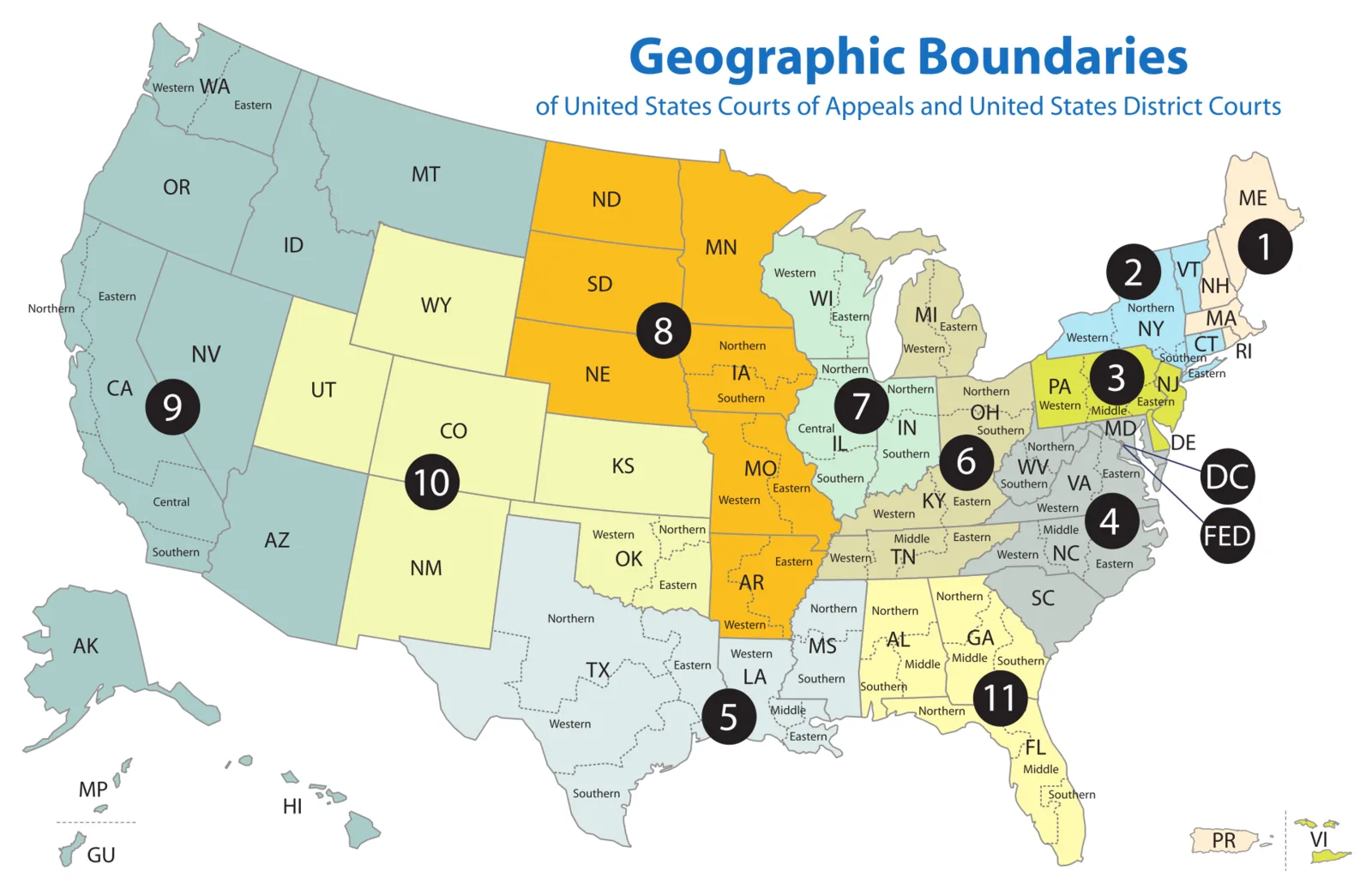
The United States is divided into 12 geographic circuits (numbered 1–11 plus the D.C. Circuit), plus one special-purpose court, the Federal Circuit, that handles certain types of cases nationwide. Each circuit has its own Court of Appeals that reviews decisions made by the district courts within its territory.
Covers: Maine, Massachusetts, New Hampshire, Rhode Island, Puerto Rico
The 1st Circuit is the smallest of the regional circuits by authorized judgeships, with just six seats, and it consistently carries one of the lightest caseloads of the 13 circuits.
Its territory includes the U.S. District Court of Puerto Rico, making it the only regional circuit whose docket regularly includes appeals arising from a legal system shaped by Puerto Rico's Spanish civil-law history.
Justice Stephen Breyer served on the 1st Circuit from 1980, including four years as its chief judge, until President Clinton elevated him to the Supreme Court in 1994. Justice David Souter was confirmed to the same court in 1990 but was nominated to the Supreme Court months later, before he heard a single case on it.
It traces its roots to the Eastern Circuit, one of the three circuits created by the Judiciary Act of 1789; the numbered First Circuit and its court of appeals date to 1891. Its principal courthouse, the John Joseph Moakley U.S. Courthouse on Boston Harbor, opened in 1998.
Covers: Connecticut, New York, Vermont
Because its territory includes New York City, the 2nd Circuit hears an outsized share of the nation's securities, banking, and corporate law appeals, giving it influence over financial regulation far beyond its three-state territory.
Justice Sonia Sotomayor served on the 2nd Circuit for more than a decade before her 2009 Supreme Court appointment, one of several justices whose careers passed through this court.
Judge Learned Hand sat on the 2nd Circuit from 1924 to 1961 and remains one of the most frequently quoted lower-court judges in American law; his cousin Augustus Hand served alongside him. Thurgood Marshall was a 2nd Circuit judge from 1961 to 1965 before leaving to become U.S. Solicitor General.
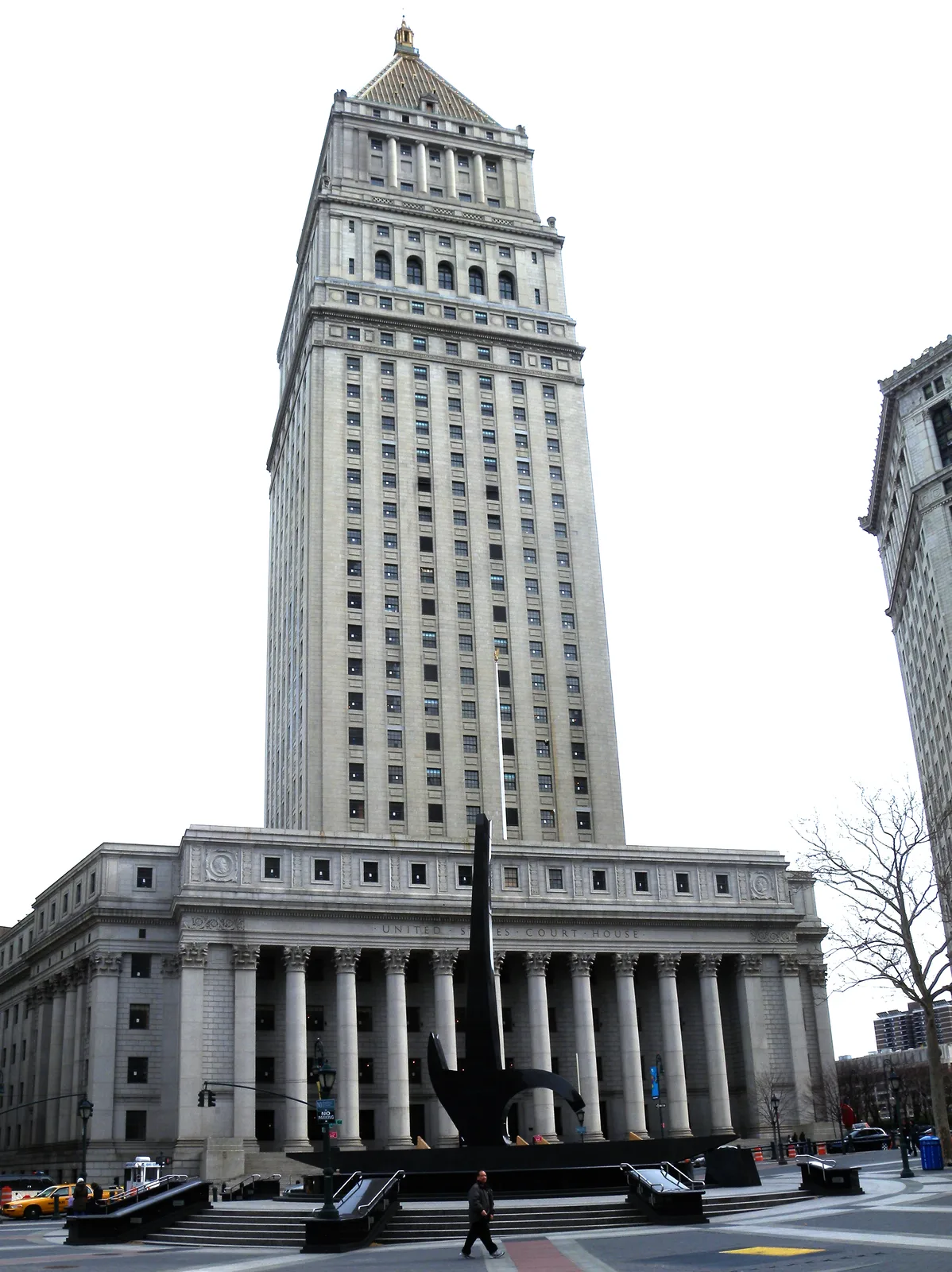
The circuit also carries one of the country's heaviest immigration dockets, driven by the volume of removal cases arising in the New York City area, and it sits at the Thurgood Marshall U.S. Courthouse on Foley Square in Manhattan.
Covers: Delaware, New Jersey, Pennsylvania, U.S. Virgin Islands
More than half of all U.S. publicly traded companies are incorporated in Delaware, so the 3rd Circuit frequently hears federal appeals touching corporate governance and shareholder disputes that shape business law nationwide.
Its territory also includes the U.S. Virgin Islands, making it one of only two regional circuits, along with the 1st, that includes a Caribbean U.S. territory.
Justice Samuel Alito served on the 3rd Circuit from 1990 until his Supreme Court appointment in 2006. The circuit's District of New Jersey is also one of the busiest venues in the country for pharmaceutical patent litigation, because so many drug companies are headquartered in the state.
The court has 14 authorized judgeships and is headquartered at the James A. Byrne U.S. Courthouse in Philadelphia.
Covers: Maryland, North Carolina, South Carolina, Virginia, West Virginia
Because Virginia and Maryland are home to the CIA, NSA, and the Pentagon, the 4th Circuit hears an unusually large share of national-security and classified-information appeals compared with other circuits.
It also covers the Eastern District of Virginia, nicknamed the 'Rocket Docket' for having some of the fastest case-resolution times of any federal trial court, which shapes the pace of appeals reaching this circuit.
The 4th Circuit decided the government's early 'enemy combatant' appeals after the September 11 attacks, including the Yaser Hamdi and Jose Padilla cases, because both men were held at the Naval Consolidated Brig in Charleston, South Carolina, within the circuit; the Supreme Court reviewed both.
For much of the late 20th century the 4th was regarded as the most consistently conservative federal appeals court, though its makeup shifted after a run of appointments beginning in 2009.
Covers: Louisiana, Mississippi, Texas
Until 1981, the 5th Circuit also included Alabama, Florida, and Georgia; Congress split off those states to create the new 11th Circuit because the original 5th's caseload had grown too large for one court to manage.
Before that split, the undivided 5th Circuit issued many of the landmark rulings that enforced school desegregation across the Deep South in the years following Brown v. Board of Education.
With 17 authorized judgeships covering Louisiana, Mississippi, and Texas, the modern 5th Circuit hears a large volume of immigration and border-enforcement appeals because of its position along the southern border, and it sits at the John Minor Wisdom U.S. Courthouse in New Orleans.
Covers: Kentucky, Michigan, Ohio, Tennessee
In 2014, the 6th Circuit became the only federal appeals court to uphold state bans on same-sex marriage, creating a circuit split that the Supreme Court resolved the following year in Obergefell v. Hodges.
The circuit's territory sits entirely within the industrial Midwest and Upland South, and its docket has historically included a large share of labor and employment law appeals tied to the region's manufacturing base.
The 6th Circuit also heard the University of Michigan affirmative-action cases, Grutter v. Bollinger and Gratz v. Bollinger, en banc in 2002 before the Supreme Court took them up and decided both in 2003.
Covers: Illinois, Indiana, Wisconsin
Judge Richard Posner, a pioneer of the law-and-economics movement in legal scholarship, served on the 7th Circuit for more than three decades and authored thousands of opinions that remain widely cited today.
The 7th Circuit covers just three states, one of the smallest territories among the regional circuits, but is frequently cited by legal scholars for the analytical rigor of its opinions.
Frank Easterbrook, another founder of the law-and-economics school, also served on the court and was its chief judge from 2006 to 2013. The circuit sits at the Everett McKinley Dirksen U.S. Courthouse in Chicago.
Covers: Arkansas, Iowa, Minnesota, Missouri, Nebraska, North Dakota, South Dakota
The 8th Circuit covers seven states, second only to the 9th Circuit's nine, stretching from the Canadian border in North Dakota down to Arkansas.
Despite its large territory, the 8th Circuit has a comparatively low population and caseload relative to circuits like the 9th or 2nd, since much of its region is rural.
Justice Harry Blackmun, author of the majority opinion in Roe v. Wade, served on the 8th Circuit from 1959 until his Supreme Court appointment in 1970, spending more time as a lower-court judge than most modern justices.
Covers: Alaska, Arizona, California, Guam, Hawaii, Idaho, Montana, Nevada, Oregon, Washington, N. Mariana Islands
The 9th Circuit is the largest in the country, by far. It covers about 20% of the U.S. population and more than 40% of U.S. land mass. Because of its size and the historically liberal lean of its rulings, it's also the most controversial and the most reversed by the Supreme Court. There have been long-standing proposals to split it into two circuits, but Congress has never acted on them.
Scholars note that the 9th Circuit's high number of total reversals partly reflects how many of its cases the Supreme Court agrees to hear in the first place, its reversal rate, the share of accepted cases that get overturned, is closer to other circuits' rates than the raw reversal count suggests.
With 29 authorized judgeships, the 9th is too large to seat every active judge for a rehearing, so Congress lets it hold a 'limited en banc' with an 11-judge panel, the chief judge plus ten drawn by lot, a practice used by no other circuit.
Justice Anthony Kennedy served on the 9th Circuit from 1975 until President Reagan elevated him to the Supreme Court in 1988.
Covers: Colorado, Kansas, New Mexico, Oklahoma, Utah, Wyoming
Justice Neil Gorsuch served more than a decade on the 10th Circuit before his 2017 Supreme Court appointment, continuing a tradition of the court producing federal appellate judges who move on to the nation's highest bench.
The 10th Circuit's six-state territory spans both the Rocky Mountain West and the southern Great Plains, giving it a docket that regularly includes federal land, energy, and Native American tribal law disputes.
The circuit is headquartered at the Byron White U.S. Courthouse in Denver, named for the Colorado-born justice who sat on the Supreme Court from 1962 to 1993.
Covers: Alabama, Florida, Georgia
Created in 1981 when Congress split the old 5th Circuit, the 11th Circuit inherited many of that court's landmark civil rights precedents as binding law for its own three states.
Florida's large population means the 11th Circuit now carries one of the heavier caseloads among the regional circuits, despite covering only three states.
Because it includes the Southern District of Florida in Miami, the 11th Circuit hears a heavy volume of international drug-trafficking, immigration, extradition, and maritime cases that arrive through South Florida's ports and airports.
Covers: District of Columbia, handles most federal agency and government cases
Don't underestimate the D.C. Circuit because it only covers one city. It's often called the "second most powerful court in America" because it handles virtually all challenges to federal agency rules and regulations, from the EPA to the FCC to the SEC. If a federal agency does something, and someone sues, it usually lands here. Many Supreme Court justices come from this court.
Justices Antonin Scalia, Ruth Bader Ginsburg, Clarence Thomas, John Roberts, and Brett Kavanaugh all served on the D.C. Circuit before their Supreme Court appointments, more than any other circuit has sent to the high court.
Congress has fixed the D.C. Circuit at 11 judgeships and has at times debated shifting some of its seats to busier circuits, since its purely federal docket produces fewer but weightier cases than a typical regional circuit.
Covers: Nationwide, handles patents, international trade, federal claims, and veterans appeals
Unlike the other circuits, the Federal Circuit's jurisdiction is defined by subject matter, not geography. It hears appeals in patent cases from any district court in the country, along with international trade disputes, federal employee and military pay claims, and veterans benefits cases.
The Federal Circuit is the only appellate court besides the Supreme Court with nationwide jurisdiction over patent law, meaning nearly every patent appeal in the country ends up here rather than in a regional circuit.
It was created in 1982 by merging the Court of Customs and Patent Appeals with the appellate division of the U.S. Court of Claims. Congress's goal was to bring uniformity to patent law, which had varied widely from circuit to circuit; since the mid-2000s the Supreme Court has reviewed and reversed its patent rulings far more often than in its first two decades.
🔀 What Is a "Circuit Split"?
Because each circuit is independent, different circuits can reach different conclusions about the same federal law. When the 5th Circuit rules one way and the 9th Circuit rules the opposite way on identical legal questions, that's called a "circuit split."
Circuit splits are actually one of the main reasons the Supreme Court takes a case. When someone in Texas and someone in California have different legal rights under the same federal law, the Supreme Court usually steps in to settle it once and for all.
Specialized Federal Courts
Beyond the district courts and circuit courts, Congress has created a number of specialized courts to handle particular types of cases. These courts have judges with deep expertise in their subject areas and more streamlined procedures for the disputes they're designed to handle.
If you disagree with the IRS about how much tax you owe, you can bring your case here without paying the disputed amount first. The Tax Court hears about 30,000 cases per year and has 19 presidentially appointed judges.
Tax Court judges serve 15-year terms rather than lifetime appointments, and their decisions can still be appealed further to the regional U.S. Circuit Court of Appeals covering the taxpayer's home district.
The court traces to the Board of Tax Appeals that Congress created in 1924; the Tax Reform Act of 1969 converted it into a court of record under Article I. It holds trial sessions in roughly 60 cities so taxpayers do not have to travel to Washington, and most cases settle before trial.
For disputes of $50,000 or less per tax year, taxpayers can elect a simplified 'small tax case' procedure with relaxed rules of evidence, but the tradeoff is that the resulting decision cannot be appealed by either side.
If you believe the federal government owes you money, for a breach of contract, a taking of your property, or certain other claims, you bring your case here. It also hears cases from federal contractors and Native American tribes.
The court's Office of Special Masters separately administers the National Vaccine Injury Compensation Program, deciding claims of injury from covered vaccines outside the ordinary civil lawsuit process.
The court descends from the Court of Claims that Congress established in 1855 to hear monetary claims against the United States. Today it has 16 judges appointed to 15-year terms, sits in the National Courthouse in Washington, and has its rulings reviewed by the Federal Circuit.
The vaccine program it oversees is funded by a 75-cent excise tax on each disease covered per dose of vaccine, has paid out billions of dollars in awards since 1988, and channels most vaccine-injury claims away from regular product-liability suits against manufacturers.
Handles civil cases involving international trade and customs law, things like whether an importer was charged the correct tariff rate, or whether goods were properly classified at the border.
Based in New York City, its judges hold Article III lifetime appointments, unlike judges on the Tax Court or Court of Federal Claims, and major cases can be heard by a three-judge panel rather than a single judge.
It is the successor to the Board of General Appraisers created in 1890 and the later U.S. Customs Court, which Congress renamed and gave full Article III status in 1980. It has nationwide jurisdiction and nine judgeships, no more than five of which may be held by members of the same political party.
Its decisions are appealed to the Federal Circuit and have included prominent challenges to tariffs imposed under trade-remedy statutes and national-security provisions such as Section 232 of the Trade Expansion Act.
Military members are tried under the Uniform Code of Military Justice (UCMJ) in military courts. This is the civilian appellate court that reviews those decisions, sitting above the military services' own courts of criminal appeals.
The court has five civilian judges appointed to 15-year terms, and since 1983 its decisions in certain cases can be further appealed to the U.S. Supreme Court, the only military court whose rulings the Supreme Court can review directly.
Congress created it in 1950 as the Court of Military Appeals when it enacted the UCMJ, and renamed it the U.S. Court of Appeals for the Armed Forces in 1994. Requiring all five judges to be civilians appointed by the President was a deliberate check placed outside the military chain of command.
It reviews only a fraction of courts-martial: review is mandatory in death-penalty cases and certain long sentences, while most other convictions reach the court only if it grants a petition, and it sits at a dedicated courthouse in Washington.
Each federal district has its own bankruptcy court. When individuals or businesses file for bankruptcy protection, their cases are handled here. Bankruptcy judges are not Article III judges, they serve 14-year terms appointed by the circuit court.
More than 300,000 bankruptcy cases are filed in federal courts each year, and because bankruptcy judges are appointed by the circuit court of appeals rather than nominated by the President, they don't go through Senate confirmation.
Bankruptcy courts are units of the district courts, an arrangement Congress adopted after the Supreme Court's 1982 decision in Northern Pipeline v. Marathon held that the previous statute had given non-Article III bankruptcy judges too much judicial power. Congress responded with the Bankruptcy Amendments and Federal Judgeship Act of 1984.
Filings are dominated by Chapter 7 liquidations and Chapter 13 repayment plans for individuals, with Chapter 11 used mostly for business reorganizations. Annual filings topped 1.5 million around 2010 and have fallen sharply since.
If the Department of Veterans Affairs (VA) denies a veteran's benefits claim and the veteran loses their internal appeal at the Board of Veterans Appeals, they can bring their case to this specialized court.
Established by Congress in 1988, decisions from this court can be further appealed to the Federal Circuit, and from there potentially to the Supreme Court, the same appellate path used for patent cases.
The Veterans' Judicial Review Act of 1988 that created it allowed veterans, for the first time, to challenge VA benefits denials in a court outside the agency. The court has nine judges serving 15-year terms and sits in Washington.
It reviews tens of thousands of appeals a year and often remands cases to the VA for more work. Its creation ended a long era in which VA decisions were effectively unreviewable, reinforced by a Civil War-era statute that had capped attorney fees in veterans' claims at $10 and so discouraged veterans from hiring lawyers.
📜 Article I Courts vs. Article III Courts
Not all federal judges have lifetime tenure. Article III judges (district courts, circuit courts, the Supreme Court) are guaranteed salary and lifetime appointments. But many specialized courts, bankruptcy courts, the Tax Court, the Court of Veterans Claims, are "Article I courts" created under Congress's legislative powers.
Article I judges serve fixed terms (8–15 years depending on the court). The tradeoff: Congress can create these courts more flexibly to handle specialized workloads, but the judges don't have the same constitutional independence as Article III judges.
Key Concepts
Federal court proceedings involve a lot of legal language. Here's what the important terms actually mean.
The Constitution (Article III) says federal judges 'shall hold their Offices during good Behaviour', which in practice means for life. They can only be removed through impeachment. This lifetime tenure is intentional: it insulates judges from political pressure so they can make unpopular decisions without fear of losing their job.
The Constitution also forbids Congress from reducing a sitting judge's salary, a second independence guarantee. Impeachment has been used sparingly: the House has impeached only 15 federal judges in all of U.S. history, and the Senate has removed just 8, most recently Judge G. Thomas Porteous of Louisiana in 2010.
Article III judges, on the district courts, circuit courts, Court of International Trade, and the Supreme Court, are nominated by the President and confirmed by the Senate. There are roughly 870 authorized Article III judgeships, and dozens sit vacant at any given time because confirmations frequently stall over politics.
Judges who satisfy an age-and-service formula known as the 'Rule of 80' may take 'senior status,' a semi-retirement in which they keep hearing a reduced caseload while their seat opens for a new appointment. Senior judges handle something like 15 to 20 percent of the federal courts' total work.
Every state has its own court system handling state law. Federal courts handle federal law. Most criminal cases, robbery, assault, murder, happen in state court. Federal court handles things like federal crimes (bank robbery, drug trafficking across state lines), civil rights violations, immigration, patent disputes, and cases involving the U.S. Constitution.
The two systems run side by side under a principle called 'dual sovereignty.' State courts carry the overwhelming majority of the nation's litigation, well over 80 million new cases a year, compared with under 500,000 in the federal district courts.
Some disputes can be filed in either system ('concurrent jurisdiction'), and a defendant sued in state court can sometimes 'remove' the case to federal court if it raises a federal question or involves parties from different states. A few subjects are federal only: bankruptcy, patents, most admiralty, and suits against the United States.
State courts routinely decide federal constitutional questions, and those rulings can be appealed to the U.S. Supreme Court, but only on the federal issue. If a state decision rests on an 'adequate and independent' state-law ground, the federal courts have no power to disturb it.
A court can only hear cases it has legal authority over. Federal courts have 'limited jurisdiction', they can only hear specific types of cases defined by the Constitution and Congress. State courts have 'general jurisdiction', they can hear almost any case. If you go to the wrong court, your case gets dismissed.
Federal subject-matter jurisdiction comes in two main forms: 'federal question' jurisdiction over claims arising under the Constitution or a federal statute, and 'diversity' jurisdiction over disputes between citizens of different states where more than $75,000 is at stake.
Separately, a court needs 'personal jurisdiction', power over the particular defendant, which generally requires that the defendant have meaningful contacts with the state where the court sits. The Supreme Court set that standard in International Shoe Co. v. Washington (1945).
A federal court must confirm it has jurisdiction before it does anything else, and it can raise the question on its own even if neither side does. A judgment entered without jurisdiction is void and can be challenged long after the fact.
Lower courts must follow the rulings of higher courts in their circuit. A district court in California must follow 9th Circuit decisions. All federal courts must follow Supreme Court decisions. This predictability is fundamental to the rule of law, similar cases get similar outcomes. But higher courts can overturn their own earlier decisions when they believe they got it wrong.
'Stare decisis' is Latin for 'to stand by things decided.' Only a case's actual holding, the legal rule needed to decide it, is binding; other statements a court makes along the way are 'dicta' and carry persuasive weight at most.
Before overruling itself, the Supreme Court weighs factors such as whether the old rule has proven unworkable, whether people and institutions have relied on it, and whether the surrounding law has shifted. It has still reversed course many times, from Plessy v. Ferguson (overruled by Brown in 1954) to Bowers v. Hardwick (overruled by Lawrence in 2003) to Roe v. Wade (overruled by Dobbs in 2022).
One circuit is not bound by another circuit's decisions, only by its own precedent and the Supreme Court's. That is exactly how 'circuit splits' arise, and why the Supreme Court then steps in to impose a single nationwide rule.
Normally, appeals are heard by a panel of just 3 judges from the circuit court. In rare and significant cases, the full court can rehear a case 'en banc', meaning all the active judges participate. This happens when a case involves an exceptionally important question of law or when panels within the same circuit have been ruling inconsistently.
A party asks for it by filing a 'petition for rehearing en banc,' but courts grant only a tiny share, often a handful per circuit each year, because assembling every active judge for one case is slow and expensive.
The 9th Circuit, with 29 judgeships, is too large to seat every judge, so Congress lets it hold a 'limited en banc' with an 11-judge panel, the chief judge plus ten chosen by lot. No other circuit uses that arrangement.
An en banc court can overrule the circuit's own prior precedent, something a three-judge panel is not allowed to do. That makes en banc review the main way a circuit corrects itself without waiting for the Supreme Court.
Article III district court judges have heavy caseloads. Magistrate judges, appointed by district court judges for 8-year terms, help by handling preliminary hearings, bail decisions, misdemeanor trials, settlement conferences, and pre-trial matters. With both parties' consent, magistrate judges can also preside over full civil trials.
The office was created by the Federal Magistrates Act of 1968, which replaced the older part-time 'U.S. commissioner' system. There are now roughly 550 full-time and part-time magistrate judges, more than the number of authorized district judgeships.
They are chosen by the district's Article III judges through a merit-selection panel, not nominated by the President or confirmed by the Senate, and can be reappointed to further 8-year terms (four years for part-time seats).
A party may refuse to have a magistrate judge preside over a civil trial without giving any reason. And on major 'dispositive' motions, a magistrate judge issues a recommendation that the district judge reviews fresh before adopting or rejecting it.
Did You Know?
💡 Federal judges can't get a pay cut
The Constitution says federal judges' salaries cannot be reduced while they're in office. This was designed to prevent Congress from punishing judges for unpopular rulings by cutting their pay.
💡 There are thousands of 'senior' judges still working
When an Article III judge reaches a certain age and years-of-service threshold, they can take 'senior status', a form of semi-retirement where they continue hearing cases at a reduced workload. These senior judges handle a significant chunk of the federal caseload.
💡 The federal judiciary is chronically understaffed
Congress sets the number of federal judgeships, but vacancies often sit unfilled for years due to political disagreements over nominees. As of recent years, there were over 60 judicial vacancies at any given time, leading to serious backlogs in some districts.
💡 The Supreme Court is not bound by the Code of Conduct
Every federal judge is bound by the Code of Conduct for United States Judges, except the Supreme Court justices. For most of American history, the Court operated on an informal honor system. In 2023, the justices adopted their own code of conduct for the first time, though it lacks a formal enforcement mechanism.