
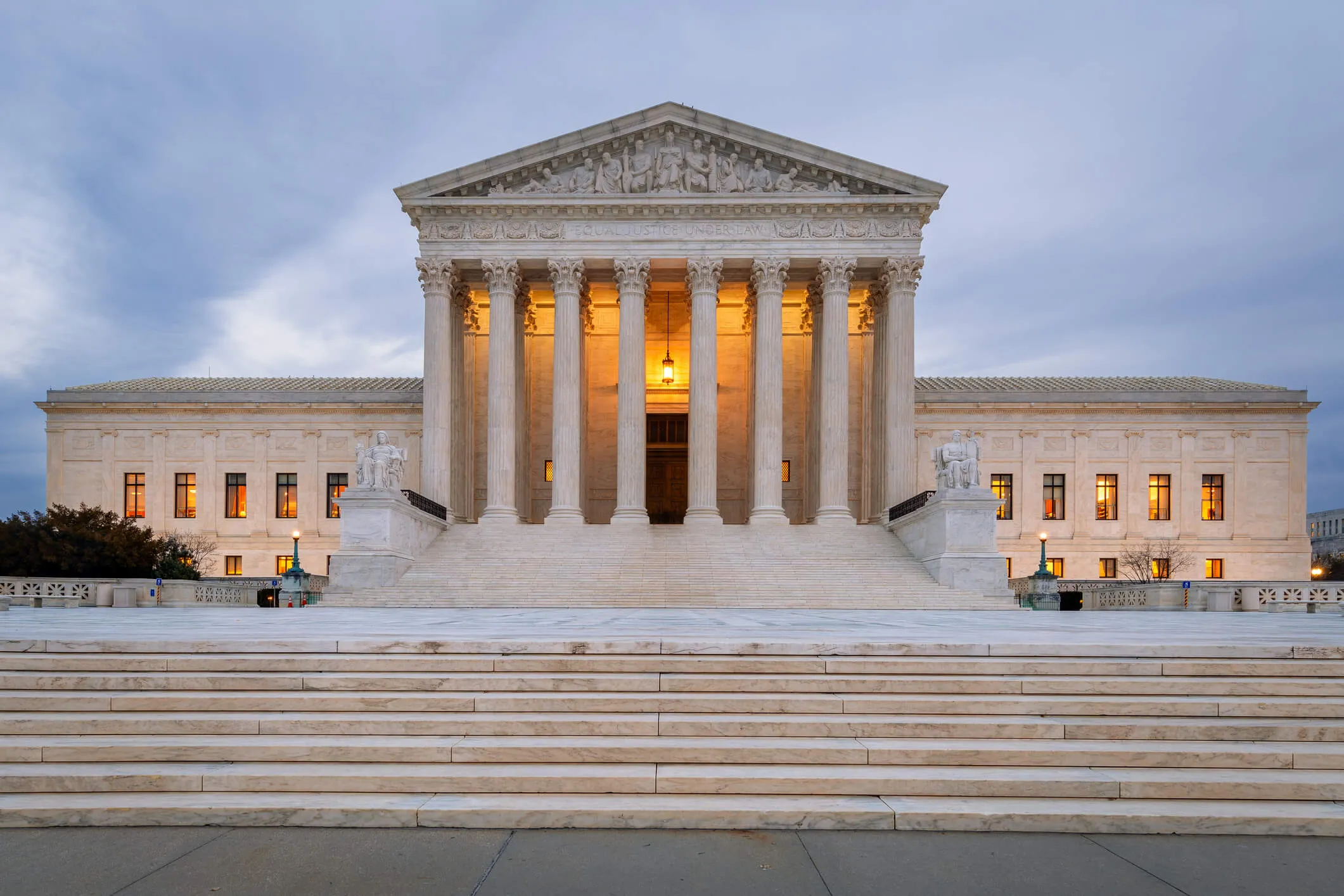
Presidents Before the Supreme Court
From John Adams's orders to the Navy to the tariff and citizenship rulings of 2026: the cases in which a president's action was challenged all the way to the Supreme Court, and how each one came out.
What This Record Covers
Presidents act through executive orders, proclamations, and the rules and decisions of the agencies they direct. When someone harmed by one of those actions sues, the case can climb to the Supreme Court, which decides whether the president or his administration had the power to act. This page lists those cases under the president whose action was challenged, even when the Court ruled years later under a different president.
A case is included when the thing challenged was an action of the executive branch: an order or proclamation, an agency rule or policy, the firing of an official, a seizure of property, an emergency or wartime measure, tariffs, an immigration action, an executive agreement, a pardon, a refusal to spend money Congress provided, or a claim of privilege or immunity. Cases that only tested a law passed by Congress are left out, as are ordinary prosecutions and routine agency decisions about one person's claim.
Each case is sorted by its bottom line for that action. Upheld means the Court ruled on the lawfulness of the action and it survived. Struck down means the Court held it unlawful in whole or in large part, or set it aside. A third group, No Ruling on the Merits, holds cases the Court dismissed, decided only on procedure, split evenly on, or handled with a temporary emergency order. Those are not final rulings, and emergency orders are marked interim.
Each case also carries a tag for what the ruling turned on. Constitutional means the Court decided what the Constitution allows. Statutory means it decided what a law passed by Congress allows, which Congress can change. Many of the best-known losses for presidents were statutory, and the tag makes that visible. For agency rules, the record covers the rulings widely treated as significant, not every regulatory case, so it is a record of the major tests of each administration and not a count of every lawsuit.
The Record in Numbers
263
Cases on this page
92
Upheld
69
Struck down
102
No ruling on the merits
Totals are counted from the case records below and change as rulings are added.
Showing 263 cases
No cases match this filter.
1. George Washington (1789–1797)
No Supreme Court rulings on this administration's actions.
2. John Adams (1797–1801)
Upheld (0)
None
Struck Down (1)
Little v. Barreme (1804)
6 U.S. 170 · Vote: Unanimous
Action challenged: President Adams's 1799 instructions to Navy commanders, sent through the Secretary of the Navy, to seize American vessels sailing to or from French ports; Captain Little seized the Flying Fish on December 2, 1799
The Non-Intercourse Act of February 9, 1799 allowed seizure only of vessels bound to French ports, so the President's broader instructions could not make lawful the seizure of a vessel sailing from one. Captain Little was liable for damages.
No Ruling on the Merits (0)
3. Thomas Jefferson (1801–1809)
Upheld (0)
None
Struck Down (0)
None
No Ruling on the Merits (1)
Marbury v. Madison (1803)
5 U.S. 137 · Vote: 4-0
Action challenged: Secretary of State James Madison's refusal, under President Jefferson, to deliver William Marbury's signed and sealed commission as a justice of the peace
The Court said Marbury had a right to his commission and that withholding it was unlawful, but it held that the section of the Judiciary Act of 1789 giving the Court power to issue the writ in this case was unconstitutional, so it could not order delivery.
Why no ruling: The Court held it had no jurisdiction to issue the writ of mandamus, so no order was entered against the administration
Basis: ConstitutionalRead the case: Marbury v. Madison ↗
4. James Madison (1809–1817)
Upheld (2)
The Thomas Gibbons (1814)
12 U.S. 421 · Vote: Unanimous on the President's authority
Action challenged: President Madison's instruction to privateers of August 28, 1812, ordering them not to interrupt American vessels coming from British ports with British merchandise after the repeal of the Orders in Council
The prize act of 1812 gave the President full authority to issue the instruction, and it protected the ship and cargo from capture. The dismissal of the privateer's claim was affirmed.
Basis: StatutoryRead the case: The Thomas Gibbons ↗Martin v. Mott (1827)
25 U.S. 19 · Vote: Unanimous
Action challenged: President Madison's 1814 call of the New York militia into federal service during the War of 1812, and the court-martial fine of a militiaman who refused to report
Under the Militia Act of 1795 the President alone decides whether an invasion or imminent danger of invasion exists, and his decision is conclusive on everyone else. The fine was upheld.
Struck Down (2)
Brown v. United States (1814)
12 U.S. 110 · Vote: Divided, 2 dissents (Story, joined by one other justice)
Action challenged: Seizure and condemnation, on behalf of the United States and without an act of Congress, of British-owned timber found in Massachusetts after the 1812 declaration of war
The power to confiscate enemy property found in the country at the start of a war belongs to Congress, and the declaration of war did not by itself authorize it. The condemnation was reversed.
Basis: ConstitutionalRead the case: Brown v. United States ↗Gelston v. Hoyt (1818)
16 U.S. 246 · Vote: No dissent (Johnson concurring separately)
Action challenged: Seizure of the ship American Eagle at New York on July 10, 1810 by customs officers acting on President Madison's instructions under the Neutrality Act of 1794
The 1794 act let the President use military and naval forces to enforce a seizure but gave him no power to order a civil seizure, so his instructions did not protect the officers. The damages judgment against them was affirmed.
No Ruling on the Merits (0)
5. James Monroe (1817–1825)
No Supreme Court rulings on this administration's actions.
6. John Quincy Adams (1825–1829)
No Supreme Court rulings on this administration's actions.
7. Andrew Jackson (1829–1837)
Upheld (0)
None
Struck Down (1)
Kendall v. United States ex rel. Stokes (1838)
37 U.S. 524 · Vote: 3 dissents (Taney, Barbour, Catron)
Action challenged: Postmaster General Amos Kendall's refusal to credit mail contractors with the full amount awarded to them by the Solicitor of the Treasury under an act of Congress
When Congress gives an executive officer a specific, ministerial duty, the officer must perform it and the President cannot direct otherwise. A court may compel performance by mandamus.
Basis: BothDecided under President Van BurenRead the case: Kendall v. United States ex rel. Stokes ↗
No Ruling on the Merits (0)
8. Martin Van Buren (1837–1841)
Upheld (1)
Decatur v. Paulding (1840)
39 U.S. 497 · Vote: Judgment affirmed; separate opinions by McLean, Baldwin, and Catron
Action challenged: Refusal by the Secretary of the Navy to pay Susan Decatur, widow of Commodore Stephen Decatur, both a pension under a general law and one under a special resolution of Congress
Deciding the pension claim required the Secretary to interpret the laws and use judgment, so it was an executive duty that a court cannot control by mandamus. The refusal of the writ was affirmed.
Basis: StatutoryRead the case: Decatur v. Paulding ↗
Struck Down (1)
United States v. The Amistad (1841)
40 U.S. 518 · Vote: 1 dissent (Baldwin)
Action challenged: The Van Buren administration's claim in court, made at the request of the Spanish minister, that the Africans found aboard the schooner Amistad be delivered up as property under the 1795 treaty with Spain
The Africans had been kidnapped and were never lawfully slaves, so the treaty with Spain did not require their return. The Court declared them free and rejected the government's claim.
No Ruling on the Merits (0)
9. William Henry Harrison (1841)
No Supreme Court rulings on this administration's actions.
10. John Tyler (1841–1845)
No Supreme Court rulings on this administration's actions.
11. James K. Polk (1845–1849)
Upheld (3)
Fleming v. Page (1850)
50 U.S. 603 · Vote: 1 dissent (McLean)
Action challenged: Collection of tariff duties in 1847 on goods shipped to Philadelphia from Tampico, Mexico, while the port was under U.S. military occupation, following Treasury Department practice during the Mexican War
Military occupation under the President's command did not make Tampico part of the United States, because the President cannot enlarge the nation's boundaries by conquest. Tampico remained a foreign port and the duties were lawfully charged.
Cross v. Harrison (1854)
57 U.S. 164 · Vote: No dissent noted
Action challenged: Collection of import and tonnage duties at San Francisco by the military government of California, under the President's authority, from February 3, 1848 to November 12, 1849
The government set up in California under the President's war power lawfully continued after the peace treaty until Congress provided otherwise, and the duties it collected were lawfully collected.
Leitensdorfer v. Webb (1858)
61 U.S. 176 · Vote: No dissent noted
Action challenged: The provisional government and courts that General Stephen Kearny established in occupied New Mexico in 1846 under the authority of the United States
The officer holding conquered territory for the United States could lawfully set up a provisional government and courts, which stayed in force until Congress replaced them. The judgment resting on those courts was affirmed.
Struck Down (2)
Jecker v. Montgomery (1852)
54 U.S. 498 · Vote: No dissent noted
Action challenged: Condemnation of the captured ship Admittance by a prize court set up at Monterey, California, at the Navy commander's request and with the President's sanction during the Mexican War
Neither the President nor a military officer can create a court in conquered territory with power to decide prize cases, so the Monterey condemnation was void, in part. The Court sent the case back for a lawful prize court to decide whether the capture itself was valid.
Mitchell v. Harmony (1852)
54 U.S. 115 · Vote: 1 dissent (Daniel)
Action challenged: Seizure of an American trader's wagons, mules, and goods at Chihuahua, Mexico, on February 10, 1847 by Lt. Col. David Mitchell on the orders of Colonel Doniphan during the Mexican War
An officer may take private property in wartime only when the danger is immediate and impending or the public need is urgent, and a superior's order is no defense to an unlawful taking. The damages judgment against the officer was affirmed.
No Ruling on the Merits (0)
12. Zachary Taylor (1849–1850)
No Supreme Court rulings on this administration's actions.
13. Millard Fillmore (1850–1853)
Upheld (1)
Ex parte Wells (1856)
59 U.S. 307 · Vote: 3 dissents (McLean on the merits; Curtis and Campbell on jurisdiction)
Action challenged: President Fillmore's conditional pardon of April 23, 1852, changing William Wells's death sentence to life imprisonment
The President's pardon power under the Constitution includes the power to grant a conditional pardon, and a condition the prisoner accepted is binding on him. The Court refused to release Wells.
Struck Down (0)
None
No Ruling on the Merits (1)
United States ex rel. Goodrich v. Guthrie (1855)
58 U.S. 284 · Vote: 1 dissent (McLean); four justices concurred separately
Action challenged: President Fillmore's removal of Aaron Goodrich as chief justice of the Minnesota Territory on October 21, 1851, before the end of his four-year term
The Court held that a court cannot use mandamus to order the Secretary of the Treasury to pay a disputed salary claim out of the Treasury. It did not decide whether the President had power to remove a territorial judge.
Why no ruling: Decided on the limits of mandamus, not on the President's power to remove a territorial judge
Basis: StatutoryDecided under President PierceRead the case: United States ex rel. Goodrich v. Guthrie ↗
14. Franklin Pierce (1853–1857)
No Supreme Court rulings on this administration's actions.
15. James Buchanan (1857–1861)
No Supreme Court rulings on this administration's actions.
16. Abraham Lincoln (1861–1865)
Upheld (3)
The Prize Cases (1863)
67 U.S. 635 · Vote: 5-4
Action challenged: President Lincoln's proclamations of April 19 and April 27, 1861, blockading Southern ports before Congress acted, and the capture of ships under the blockade
A state of civil war existed in fact, and the President had the power to meet it with a blockade without waiting for Congress to declare war. The captures made under the blockade were upheld.
Basis: BothRead the case: The Prize Cases ↗The Grapeshot (1870)
76 U.S. 129 · Vote: No dissent noted
Action challenged: President Lincoln's order of October 20, 1862 establishing a Provisional Court for Louisiana during the military occupation of New Orleans
The President, as commander in chief, properly established the Provisional Court in occupied territory during the war, and Congress could later transfer its cases and judgments to the regular federal courts.
Hamilton v. Dillin (1875)
88 U.S. 73 · Vote: No dissent noted
Action challenged: Treasury Department regulations, issued with President Lincoln's license to trade with insurrectionary areas, charging four cents a pound on cotton bought there, collected at Nashville from August 1863 to July 1864
The charge was a lawful condition of the President's license to trade with the insurrectionary states, authorized by the act of July 13, 1861 and by the war powers of the government, and later confirmed by Congress.
Struck Down (1)
Ex parte Milligan (1866)
71 U.S. 2 · Vote: 9-0 (four justices concurred separately)
Action challenged: Trial and death sentence of Lambdin Milligan, a civilian, by a military commission in Indiana in 1864 under the authority of the President
A military commission had no jurisdiction to try a civilian in a state where the civilian courts were open and operating. Milligan was entitled to be discharged.
No Ruling on the Merits (1)
Ex parte Vallandigham (1864)
68 U.S. 243 · Vote: No dissent (Nelson, Grier, and Field concurred in the result; Miller took no part)
Action challenged: Arrest of former congressman Clement Vallandigham under General Burnside's General Order No. 38 of April 13, 1863 and his trial by military commission; President Lincoln commuted the sentence to banishment beyond Union lines
The Court held it had no power to review the proceedings of a military commission by certiorari, because a commission is not a court within the Court's appellate jurisdiction. It did not rule on whether the arrest and trial were lawful.
Why no ruling: Certiorari refused for lack of jurisdiction over a military commission
Basis: BothRead the case: Ex parte Vallandigham ↗
17. Andrew Johnson (1865–1869)
Upheld (2)
Ex parte Garland (1867)
71 U.S. 333 · Vote: 5-4
Action challenged: President Johnson's July 1865 full pardon of former Confederate senator Augustus H. Garland
The Court gave the pardon full effect, holding that it relieved Garland of all penalties for the offense and that Congress could not bar him from practicing in federal court through a retroactive loyalty oath.
Basis: ConstitutionalRead the case: Ex parte Garland ↗Armstrong v. United States (1872)
80 U.S. 154 · Vote: unanimous
Action challenged: President Johnson's proclamation of December 25, 1868, granting unconditional pardon and amnesty to all who took part in the rebellion
The Court held that the proclamation was a public act that every court must notice and give effect, so a pardoned claimant could recover the proceeds of captured property.
Struck Down (1)
Raymond v. Thomas (1876)
91 U.S. 712 · Vote: unanimous
Action challenged: Military order of General Edward Canby, May 1868, annulling a decree of a South Carolina court during Reconstruction
The Court held the order void, finding that the Reconstruction Acts did not authorize a military commander to set aside a court's decree in a private suit.
No Ruling on the Merits (3)
Mississippi v. Johnson (1867)
71 U.S. 475 · Vote: unanimous
Action challenged: President Johnson's enforcement of the Reconstruction Acts of March 2 and March 23, 1867 (suit to enjoin the President)
The Court refused to let Mississippi file the suit, holding that it has no jurisdiction to enjoin the President in the performance of his official duties.
Why no ruling: Leave to file denied for lack of jurisdiction over the President
Basis: ConstitutionalRead the case: Mississippi v. Johnson ↗Georgia v. Stanton (1868)
73 U.S. 50 · Vote: unanimous
Action challenged: Enforcement of the Reconstruction Acts in Georgia by Secretary of War Stanton, General Grant, and General Pope
The Court dismissed the suit, holding that it raised political questions over which the Court had no jurisdiction.
Why no ruling: Dismissed for want of jurisdiction (political question)
Basis: ConstitutionalRead the case: Georgia v. Stanton ↗Ex parte McCardle (1869)
74 U.S. 506 · Vote: unanimous
Action challenged: Military arrest of Mississippi newspaper editor William McCardle for trial by a military commission under the Reconstruction Acts
After Congress repealed the law that gave the Court jurisdiction over the appeal, the Court dismissed the case without ruling on whether the military detention was lawful.
Why no ruling: Dismissed for want of jurisdiction after Congress withdrew it
18. Ulysses S. Grant (1869–1877)
Upheld (0)
None
Struck Down (0)
None
No Ruling on the Merits (1)
Ex parte Yerger (1869)
75 U.S. 85 · Vote: unanimous
Action challenged: Military arrest and trial of a Mississippi civilian, Edward Yerger, by a military commission under the Reconstruction Acts
The Court held only that it had jurisdiction to review the detention by habeas corpus. It did not rule on whether the military trial was lawful.
Why no ruling: Decided only the Court's jurisdiction; no ruling on the detention
Basis: BothRead the case: Ex parte Yerger ↗
19. Rutherford B. Hayes (1877–1881)
No Supreme Court rulings on this administration's actions.
20. James A. Garfield (1881)
No Supreme Court rulings on this administration's actions.
21. Chester A. Arthur (1881–1885)
Upheld (0)
None
Struck Down (1)
United States v. Perkins (1886)
116 U.S. 483 · Vote: unanimous
Action challenged: Secretary of the Navy's discharge of a naval cadet engineer, June 1883, without a court-martial
The Court held the discharge unlawful, ruling that when Congress vests the appointment of inferior officers in a department head it may limit their removal.
No Ruling on the Merits (0)
22. Grover Cleveland (1885–1889)
Upheld (1)
McAllister v. United States (1891)
141 U.S. 174 · Vote: 6-3
Action challenged: President Cleveland's suspension of Alaska territorial judge Ward McAllister Jr., July 21, 1885
The Court held that territorial judges are not Article III judges and that the President could lawfully suspend one under the Tenure of Office Act.
Struck Down (0)
None
No Ruling on the Merits (0)
23. Benjamin Harrison (1889–1893)
Upheld (1)
Cunningham v. Neagle (1890)
135 U.S. 1 · Vote: 6-2
Action challenged: Attorney General's 1889 instructions assigning a deputy U.S. marshal to protect Justice Stephen Field, with no statute expressly authorizing it
The Court held that the President's duty to see the laws faithfully executed allowed the assignment, so the marshal who killed Field's attacker acted under federal law and could not be tried by California.
Basis: BothRead the case: Cunningham v. Neagle ↗
Struck Down (0)
None
No Ruling on the Merits (0)
24. Grover Cleveland (1893–1897)
Upheld (2)
In re Debs (1895)
158 U.S. 564 · Vote: 9-0
Action challenged: The Cleveland administration's suit of July 2, 1894, for an injunction against the Pullman strike leaders
The Court held that the executive branch may go to court to remove obstructions to interstate commerce and the mails, and it upheld the injunction and the contempt sentences.
Basis: ConstitutionalRead the case: In re Debs ↗Parsons v. United States (1897)
167 U.S. 324 · Vote: unanimous
Action challenged: President Cleveland's removal of U.S. Attorney Lewis E. Parsons Jr., May 26, 1893, before his four-year term ended
The Court held that the President could remove a U.S. attorney before the end of the four-year term set by statute.
Struck Down (0)
None
No Ruling on the Merits (0)
25. William McKinley (1897–1901)
Upheld (2)
Shurtleff v. United States (1903)
189 U.S. 311 · Vote: unanimous
Action challenged: President McKinley's removal of customs general appraiser Ferdinand Shurtleff, May 3, 1899, without notice or a hearing
The Court held that a statute listing causes for removal did not take away the President's general power to remove the officer without stating a cause.
Santiago v. Nogueras (1909)
214 U.S. 260 · Vote: unanimous
Action challenged: General Order No. 88 of June 27, 1899, creating a U.S. provisional court in Puerto Rico under military authority with the President's approval
The Court held that the President, through the military government, could lawfully set up the court in ceded territory until Congress acted, and that its judgments were valid.
Struck Down (7)
The Paquete Habana (1900)
175 U.S. 677 · Vote: 6-3
Action challenged: Navy's capture of two Cuban coastal fishing boats as prizes of war during the 1898 blockade of Cuba
The Court held that international law, which is part of U.S. law, exempts coastal fishing vessels from capture, and it ordered the proceeds returned to the owners.
Basis: StatutoryRead the case: The Paquete Habana ↗De Lima v. Bidwell (1901)
182 U.S. 1 · Vote: 5-4
Action challenged: Collection of tariff duties on goods from Puerto Rico after the 1899 treaty with Spain, as if the island were still a foreign country
The Court held that Puerto Rico stopped being a foreign country under the tariff laws when the treaty was ratified, so the duties were collected unlawfully.
Basis: StatutoryRead the case: De Lima v. Bidwell ↗Dooley v. United States (1901)
182 U.S. 222 · Vote: 5-4
Action challenged: Tariffs on goods shipped to Puerto Rico, set by military order in 1898 and by orders of President McKinley
The Court upheld the duties collected during the military occupation but held, in part, that the President had no power to keep collecting them on goods from the United States after the treaty was ratified on April 11, 1899.
Basis: ConstitutionalRead the case: Dooley v. United States ↗Fourteen Diamond Rings v. United States (1901)
183 U.S. 176 · Vote: 5-4
Action challenged: Customs seizure of rings a soldier brought home from the Philippines, treated as imports from a foreign country
The Court held that the Philippines stopped being a foreign country under the tariff laws when the treaty with Spain was ratified, so no duty was owed.
Basis: StatutoryDecided under President RooseveltRead the case: Fourteen Diamond Rings v. United States ↗Lincoln v. United States (1906)
202 U.S. 484 · Vote: 7-2
Action challenged: President McKinley's order of July 12, 1898, imposing tariffs in the Philippines, as applied to goods from the United States after April 11, 1899
The Court held that the order was a wartime measure whose force over goods from the United States ended when the treaty was ratified, and that Congress had not ratified the later collections. It reaffirmed its 1905 ruling in the same case (197 U.S. 419).
MacLeod v. United States (1913)
229 U.S. 416 · Vote: unanimous
Action challenged: Military authorities' demand for import duties at Manila on a cargo landed in January 1899 at Cebu, a port U.S. forces did not yet hold
The Court held that the payment was an unauthorized exaction, covered neither by the President's tariff order nor by Congress's later ratification, and ordered it refunded.
Ochoa v. Hernandez y Morales (1913)
230 U.S. 139 · Vote: unanimous
Action challenged: Order of the military governor of Puerto Rico, April 4, 1899, shortening the time needed to turn a recorded possession of land into ownership
The Court held the order void, in part, so far as it worked retroactively to take land from its owners without due process of law.
No Ruling on the Merits (0)
26. Theodore Roosevelt (1901–1909)
Upheld (2)
Wilson v. Shaw (1907)
204 U.S. 24 · Vote: unanimous
Action challenged: The Roosevelt administration's acquisition of the Panama Canal Zone and the Treasury's payments for building the canal (taxpayer suit against the Secretary of the Treasury)
The Court held that the United States lawfully acquired the Canal Zone and had the power to build the canal, and that the taxpayer had no ground for relief.
Basis: BothRead the case: Wilson v. Shaw ↗United States v. Grimaud (1911)
220 U.S. 506 · Vote: unanimous
Action challenged: Secretary of Agriculture's forest reserve rules of June 12, 1906, requiring a permit to graze sheep (Regulation 45)
The Court held that Congress could let the Secretary fill in the details of forest reserve management by regulation and that violating the rules could be punished as a crime.
Struck Down (0)
None
No Ruling on the Merits (1)
Reid v. United States (1909)
211 U.S. 529 · Vote: unanimous
Action challenged: President Roosevelt's order of November 1906 discharging without honor the soldiers of three companies of the 25th Infantry after the Brownsville incident
The Court dismissed the soldier's appeal, holding that the statute gave it no jurisdiction to review the district court's judgment. It did not rule on the President's power to order the discharges.
Why no ruling: Writ of error dismissed for want of jurisdiction
Basis: StatutoryRead the case: Reid v. United States ↗
27. William Howard Taft (1909–1913)
Upheld (2)
United States v. Midwest Oil Co. (1915)
236 U.S. 459 · Vote: 5-3
Action challenged: President Taft's order of September 27, 1909, withdrawing public oil lands in California and Wyoming from private entry
The Court held that the President could withdraw the lands without a statute, because Congress had long known of and accepted the practice.
Basis: ConstitutionalDecided under President WilsonRead the case: United States v. Midwest Oil Co. ↗Biddle v. Perovich (1927)
274 U.S. 480 · Vote: 8-0
Action challenged: President Taft's commutation of a death sentence to life in prison, June 5, 1909, without the prisoner's consent
The Court held that the President may commute a death sentence to life imprisonment and that the prisoner's consent is not required.
Struck Down (0)
None
No Ruling on the Merits (0)
28. Woodrow Wilson (1913–1921)
Upheld (6)
Dakota Central Telephone Co. v. South Dakota (1919)
250 U.S. 163 · Vote: 8-1
Action challenged: President Wilson's proclamation of July 22, 1918, taking control of telephone and telegraph systems, and the rates set under it
The Court held that the takeover was a valid use of the war power given by Congress and that the state could not control the telephone rates set under federal control.
Northern Pacific Railway Co. v. North Dakota (1919)
250 U.S. 135 · Vote: 9-0
Action challenged: Railroad rates set by the Director General of Railroads during President Wilson's wartime takeover of the railroads
The Court held that under federal wartime control the United States, and not the state, had the power to set rates for travel and shipping inside the state.
United States ex rel. Milwaukee Social Democratic Publishing Co. v. Burleson (1921)
255 U.S. 407 · Vote: 7-2
Action challenged: Postmaster General's 1917 order revoking the second-class mailing privilege of the Milwaukee Leader under the Espionage Act
The Court upheld the order, holding that the Postmaster General could revoke the privilege of a newspaper that kept publishing material the Espionage Act made nonmailable.
Basis: BothDecided under President HardingRead the case: United States ex rel. Milwaukee Social Democratic Publishing Co. v. Burleson ↗Wallace v. United States (1922)
257 U.S. 541 · Vote: unanimous
Action challenged: President Wilson's wartime dismissal of an Army colonel, General Orders No. 17 of February 13, 1918
The Court held that the officer was lawfully out of the Army once the President appointed and the Senate confirmed a successor to his place, and denied his claim for pay.
Myers v. United States (1926)
272 U.S. 52 · Vote: 6-3
Action challenged: President Wilson's removal of Portland, Oregon, postmaster Frank Myers, February 2, 1920, without the Senate's consent
The Court held that the President alone may remove executive officers he appointed with the Senate's consent, and that a law requiring Senate approval for the removal was unconstitutional.
United States v. Chemical Foundation, Inc. (1926)
272 U.S. 1 · Vote: 7-0
Action challenged: Sale of seized German chemical patents to the Chemical Foundation under President Wilson's executive orders of December 3, 1918, and February 13, 1920
The Court held that the Trading with the Enemy Act let the President authorize the sale and act through another official, and it refused to cancel the sale.
Basis: BothDecided under President CoolidgeRead the case: United States v. Chemical Foundation, Inc. ↗
Struck Down (1)
Burdick v. United States (1915)
236 U.S. 79 · Vote: 8-0
Action challenged: President Wilson's pardon of February 14, 1914, issued to a newspaper editor to make him testify before a grand jury
The Court held that a pardon has no effect unless it is accepted, so the editor could refuse it and still claim his right not to incriminate himself.
Basis: ConstitutionalRead the case: Burdick v. United States ↗
No Ruling on the Merits (1)
Commercial Cable Co. v. Burleson (1919)
250 U.S. 360 · Vote: unanimous
Action challenged: President Wilson's proclamation of November 2, 1918, taking control of undersea cable lines
Because the government had returned the cable lines to their owners, the Court held the cases moot and ordered them dismissed without ruling on the seizure.
Why no ruling: Dismissed as moot
Basis: ConstitutionalRead the case: Commercial Cable Co. v. Burleson ↗
29. Warren G. Harding (1921–1923)
Upheld (0)
None
Struck Down (2)
Mammoth Oil Co. v. United States (1927)
275 U.S. 13 · Vote: 7-0
Action challenged: The Harding administration's lease of Naval Petroleum Reserve No. 3 (Teapot Dome), April 7, 1922
The Court held that the lease was made without authority of law and was procured by fraud, and it affirmed the cancellation.
Pan American Petroleum & Transport Co. v. United States (1927)
273 U.S. 456 · Vote: 8-0
Action challenged: The Harding administration's 1922 contracts and leases of Naval Petroleum Reserve No. 1 (Elk Hills), made after the executive order of May 31, 1921, moved the reserves to the Interior Department
The Court held that the contracts and leases were made without authority of law and were obtained by fraud and corruption, and it affirmed their cancellation.
Basis: StatutoryDecided under President CoolidgeRead the case: Pan American Petroleum & Transport Co. v. United States ↗
No Ruling on the Merits (0)
30. Calvin Coolidge (1923–1929)
Upheld (3)
Ex parte Grossman (1925)
267 U.S. 87 · Vote: 9-0
Action challenged: President Coolidge's December 1923 pardon commuting a jail sentence for criminal contempt of court
The Court held that the President's pardon power covers criminal contempt of a federal court, and it ordered the prisoner released.
Basis: ConstitutionalRead the case: Ex parte Grossman ↗J.W. Hampton, Jr. & Co. v. United States (1928)
276 U.S. 394 · Vote: 9-0
Action challenged: President Coolidge's proclamation raising the tariff on barium dioxide under the flexible tariff provision of the Tariff Act of 1922
The Court held that Congress may let the President adjust tariff rates when it gives him an intelligible principle to follow, and it upheld the higher duty.
Basis: ConstitutionalRead the case: J.W. Hampton, Jr. & Co. v. United States ↗The Pocket Veto Case (1929)
279 U.S. 655 · Vote: unanimous
Action challenged: President Coolidge's pocket veto of a bill presented to him on June 24, 1926, shortly before Congress adjourned its session
The Court held that an adjournment at the end of a session of Congress prevents the President from returning a bill, so the unsigned bill did not become law.
Struck Down (0)
None
No Ruling on the Merits (0)
31. Herbert Hoover (1929–1933)
Upheld (1)
United States v. Smith (1932)
286 U.S. 6 · Vote: unanimous
Action challenged: President Hoover's appointment of George Otis Smith to the Federal Power Commission in December 1930 and his refusal to return the confirmation when the Senate voted to reconsider
The Court held that once the Senate notified the President of its consent and he made the appointment, the Senate could not take its consent back, so Smith held the office lawfully.
Basis: ConstitutionalRead the case: United States v. Smith ↗
Struck Down (0)
None
No Ruling on the Merits (0)
32. Franklin D. Roosevelt (1933–1945)
Upheld (11)
Nortz v. United States (1935)
294 U.S. 317 · Vote: 5-4
Action challenged: Treasury orders of December 28, 1933, and January 15, 1934, approved by the President, requiring holders of gold certificates to turn them in for currency
The Court held that a holder of gold certificates who was paid their face amount in legal currency had shown no actual loss and could not recover more. It did not reach whether the orders were a taking of property.
Basis: ConstitutionalRead the case: Nortz v. United States ↗United States v. Curtiss-Wright Export Corp. (1936)
299 U.S. 304 · Vote: 7-1
Action challenged: Proclamation of May 28, 1934, barring arms sales to Bolivia and Paraguay during the Chaco War
The Court held that Congress could give the President broad discretion to bar the arms sales because of his authority in foreign affairs, and that the proclamation was valid.
Basis: ConstitutionalRead the case: United States v. Curtiss-Wright Export Corp. ↗Isbrandtsen-Moller Co. v. United States (1937)
300 U.S. 139 · Vote: unanimous
Action challenged: Executive Order 6166 (June 10, 1933), abolishing the Shipping Board and moving its work to the Department of Commerce
The Court held that Congress had ratified the transfer made by the executive order in later laws, so an order of the Secretary of Commerce issued under it stood.
Basis: StatutoryRead the case: Isbrandtsen-Moller Co. v. United States ↗United States v. Belmont (1937)
301 U.S. 324 · Vote: 9-0
Action challenged: Executive agreement with the Soviet Union of November 16, 1933 (the Litvinov Assignment), made with recognition of the Soviet government
The Court held that the President could make the agreement without Senate approval and that it overrode New York policy, so the United States could sue to collect the assigned bank deposit.
Basis: ConstitutionalRead the case: United States v. Belmont ↗United States v. George S. Bush & Co. (1940)
310 U.S. 371 · Vote: 8-1
Action challenged: Proclamation 2081 (May 1, 1934), raising the tariff on canned clams from Japan
The Court held that the President's judgment on the facts behind a tariff proclamation under the Tariff Act of 1930 was not open to review by the courts, and it reversed the ruling that had held the proclamation invalid.
Basis: StatutoryRead the case: United States v. George S. Bush & Co. ↗Ex parte Quirin (1942)
317 U.S. 1 · Vote: 8-0
Action challenged: Order of July 2, 1942, creating a military commission to try eight German saboteurs, and Proclamation 2561 of the same date
The Court held that the President had authority to order the saboteurs tried by military commission for offenses against the law of war and that the commission was lawfully set up.
Basis: BothRead the case: Ex parte Quirin ↗United States v. Pink (1942)
315 U.S. 203 · Vote: 5-2
Action challenged: Executive agreement with the Soviet Union of November 16, 1933 (the Litvinov Assignment)
The Court held that the agreement gave the United States title to the New York assets of a nationalized Russian insurance company and that New York could not refuse to give it effect.
Basis: ConstitutionalRead the case: United States v. Pink ↗Hirabayashi v. United States (1943)
320 U.S. 81 · Vote: 9-0
Action challenged: Curfew for persons of Japanese ancestry (Public Proclamation No. 3, March 24, 1942) under Executive Order 9066 (February 19, 1942)
The Court held that the curfew was within the war power of Congress and the President acting together and did not violate the Fifth Amendment.
Basis: ConstitutionalRead the case: Hirabayashi v. United States ↗Yasui v. United States (1943)
320 U.S. 115 · Vote: 9-0
Action challenged: Curfew for persons of Japanese ancestry under Executive Order 9066 (February 19, 1942)
The Court upheld the curfew as applied to a citizen on the authority of Hirabayashi and sent the case back for resentencing.
Basis: ConstitutionalRead the case: Yasui v. United States ↗Korematsu v. United States (1944)
323 U.S. 214 · Vote: 6-3
Action challenged: Civilian Exclusion Order No. 34 (May 3, 1942), issued under Executive Order 9066, removing persons of Japanese ancestry from a West Coast military area
The Court held that the exclusion order was within the war power of Congress and the President at the time it was made, and it affirmed the conviction.
Basis: ConstitutionalRead the case: Korematsu v. United States ↗L. P. Steuart & Bro., Inc. v. Bowles (1944)
322 U.S. 398 · Vote: 8-1
Action challenged: Office of Price Administration order suspending a fuel oil dealer for breaking rationing rules, under the President's power to allocate scarce materials
The Court held that the President's power under the Second War Powers Act to allocate scarce materials included power to cut off supplies to a dealer who broke the rationing rules.
Basis: StatutoryRead the case: L. P. Steuart & Bro., Inc. v. Bowles ↗
Struck Down (5)
A.L.A. Schechter Poultry Corp. v. United States (1935)
295 U.S. 495 · Vote: 9-0
Action challenged: Live Poultry Code, approved by the President on April 13, 1934, under the National Industrial Recovery Act
The Court held that the code was invalid because Congress could not hand the President open-ended power to write codes for industry, and because the code reached business that was not interstate commerce.
Basis: ConstitutionalRead the case: A.L.A. Schechter Poultry Corp. v. United States ↗Humphrey's Executor v. United States (1935)
295 U.S. 602 · Vote: 9-0
Action challenged: Removal of Federal Trade Commissioner William Humphrey by the President on October 7, 1933
The Court held that the President could remove a Federal Trade Commissioner only for the causes named in the statute, and that Congress could set that limit for an agency of this kind.
Panama Refining Co. v. Ryan (1935)
293 U.S. 388 · Vote: 8-1
Action challenged: Executive Orders 6199 (July 11, 1933) and 6204 (July 14, 1933), barring interstate shipment of oil produced above state quotas
The Court held that section 9(c) of the National Industrial Recovery Act gave the President lawmaking power with no standard to guide him, so the executive orders and the regulations issued under them could not be enforced.
Basis: ConstitutionalRead the case: Panama Refining Co. v. Ryan ↗Ex parte Endo (1944)
323 U.S. 283 · Vote: 9-0
Action challenged: War Relocation Authority's continued detention of a loyal citizen of Japanese ancestry
The Court held that the War Relocation Authority had no authority to detain a citizen it conceded was loyal, and ordered her release. It did not decide the constitutional questions.
Basis: StatutoryRead the case: Ex parte Endo ↗Duncan v. Kahanamoku (1946)
327 U.S. 304 · Vote: 6-2
Action challenged: Martial law in Hawaii, declared by the territorial governor on December 7, 1941, and approved by the President, under which civilians were tried in military courts
The Court held that the Hawaiian Organic Act's allowance of martial law did not authorize the military to replace the civilian courts and try civilians in military tribunals.
No Ruling on the Merits (2)
Alabama Power Co. v. Ickes (1938)
302 U.S. 464 · Vote: unanimous
Action challenged: Public Works Administration loans and grants to Alabama cities to build their own electric systems
The Court held that a private power company facing lawful competition from city systems had no legal right at stake and could not challenge the federal loans and grants.
Why no ruling: Decided on standing, the company had no right to sue
Basis: ConstitutionalRead the case: Alabama Power Co. v. Ickes ↗Perkins v. Lukens Steel Co. (1940)
310 U.S. 113 · Vote: 8-1
Action challenged: Secretary of Labor's minimum wage determination for the iron and steel industry under the Walsh-Healey Public Contracts Act
The Court held that companies wishing to sell to the government had no legal right to challenge the wage terms the government set for its own purchases.
Why no ruling: Decided on standing, the companies had no right to sue
Basis: StatutoryRead the case: Perkins v. Lukens Steel Co. ↗
33. Harry S. Truman (1945–1953)
Upheld (9)
In re Yamashita (1946)
327 U.S. 1 · Vote: 6-2
Action challenged: Trial of Japanese General Tomoyuki Yamashita by a U.S. Army military commission in the Philippines, 1945
The Court held that the military commission was lawfully created and had authority to try Yamashita for violations of the law of war, and it denied relief.
Basis: BothRead the case: In re Yamashita ↗Fleming v. Mohawk Wrecking & Lumber Co. (1947)
331 U.S. 111 · Vote: 9-0
Action challenged: Executive Order 9809 (December 12, 1946), merging the Office of Price Administration into a new Office of Temporary Controls
The Court held that the transfer of the price administrator's duties to the Temporary Controls Administrator under the executive order was valid, and that Congress had ratified the order.
Basis: StatutoryRead the case: Fleming v. Mohawk Wrecking & Lumber Co. ↗United States v. United Mine Workers (1947)
330 U.S. 258 · Vote: 7-2 (5-4 on the Norris-LaGuardia Act question)
Action challenged: Government's court order against a coal strike while it ran the mines seized under Executive Order 9728 (May 21, 1946)
The Court held that the Norris-LaGuardia Act did not bar the government from getting an injunction against a strike in mines it had seized. It affirmed the contempt judgment against John L. Lewis and affirmed the judgment against the union after modifying it.
Basis: StatutoryRead the case: United States v. United Mine Workers ↗Ludecke v. Watkins (1948)
335 U.S. 160 · Vote: 5-4
Action challenged: Proclamation 2655 (July 14, 1945), ordering removal of alien enemies judged dangerous, and the Attorney General's removal order of January 18, 1946
The Court held that the Alien Enemy Act of 1798 barred courts from reviewing the removal order and that the President's power under the act continued after the fighting stopped, because the war had not formally ended.
Basis: BothRead the case: Ludecke v. Watkins ↗Johnson v. Eisentrager (1950)
339 U.S. 763 · Vote: 6-3
Action challenged: Trial and imprisonment of German nationals by a U.S. military commission in China, held afterward by the Army in occupied Germany
The Court held that enemy aliens tried and held by the military outside the United States had no constitutional right to seek habeas corpus in American courts.
Basis: ConstitutionalRead the case: Johnson v. Eisentrager ↗United States ex rel. Knauff v. Shaughnessy (1950)
338 U.S. 537 · Vote: 4-3
Action challenged: Exclusion of a soldier's foreign-born wife without a hearing in 1948, under Proclamation 2523 (November 14, 1941) and the entry regulations
The Court held that the Attorney General could exclude an alien without a hearing on security grounds under the 1941 act, the proclamation, and the regulations, and that the War Brides Act did not change that.
Madsen v. Kinsella (1952)
343 U.S. 341 · Vote: 8-1
Action challenged: Trial of an American civilian by a U.S. occupation court in Germany in 1950
The Court held that the United States Court of the Allied High Commission for Germany had jurisdiction to try the wife of an American serviceman for a killing in the American zone.
Basis: BothRead the case: Madsen v. Kinsella ↗Shaughnessy v. United States ex rel. Mezei (1953)
345 U.S. 206 · Vote: 5-4
Action challenged: Attorney General's order of May 10, 1950, permanently excluding a returning resident alien without a hearing, leaving him held on Ellis Island
The Court held that the Attorney General could exclude the alien without a hearing on security grounds and that his continued confinement on Ellis Island was not an unlawful detention.
Basis: BothDecided under President EisenhowerRead the case: Shaughnessy v. United States ex rel. Mezei ↗United States v. Reynolds (1953)
345 U.S. 1 · Vote: 6-3
Action challenged: Air Force's claim of privilege over the accident report on a military aircraft crash
The Court recognized a privilege for military secrets and held that the Air Force's claim was valid, so the government did not have to hand over the accident report.
Struck Down (2)
Joint Anti-Fascist Refugee Committee v. McGrath (1951)
341 U.S. 123 · Vote: 5-3 (no majority opinion)
Action challenged: Attorney General's listing of organizations as Communist under Executive Order 9835, the federal employee loyalty program
The Court ruled that organizations placed on the Attorney General's list without notice or a hearing had stated a valid claim, and it sent the cases back to the trial court. The five justices in the majority gave differing reasons.
Youngstown Sheet & Tube Co. v. Sawyer (1952)
343 U.S. 579 · Vote: 6-3
Action challenged: Executive Order 10340 (April 8, 1952), seizure of the steel mills
The Court held that the President had no power under the Constitution or any act of Congress to seize the steel mills, and it affirmed the order blocking the seizure.
Basis: ConstitutionalRead the case: Youngstown Sheet & Tube Co. v. Sawyer ↗
No Ruling on the Merits (3)
Chicago & Southern Air Lines, Inc. v. Waterman S.S. Corp. (1948)
333 U.S. 103 · Vote: 5-4
Action challenged: President's approval of a Civil Aeronautics Board order on overseas air routes
The Court held that Civil Aeronautics Board orders on overseas and foreign air routes, which need the President's approval, cannot be reviewed by the courts.
Why no ruling: Held not reviewable by the courts, no ruling on whether the order was lawful
Hirota v. MacArthur (1948)
338 U.S. 197 · Vote: per curiam (6-1)
Action challenged: Sentences of the military tribunal in Tokyo set up by General MacArthur as Supreme Commander for the Allied Powers
The Court held that the tribunal was not a tribunal of the United States, so American courts had no power to review its judgments.
Why no ruling: No jurisdiction, the tribunal was not a United States tribunal
Basis: ConstitutionalRead the case: Hirota v. MacArthur ↗Bailey v. Richardson (1951)
341 U.S. 918 · Vote: 4-4
Action challenged: Dismissal of a federal employee on loyalty grounds under the loyalty program of Executive Order 9835
An equally divided Court affirmed the lower court's judgment without an opinion.
Why no ruling: Affirmed by an equally divided Court
Basis: ConstitutionalRead the case: Bailey v. Richardson ↗
34. Dwight D. Eisenhower (1953–1961)
Upheld (4)
Wilson v. Girard (1957)
354 U.S. 524 · Vote: per curiam, 8-0
Action challenged: Decision of the Secretaries of State and Defense (June 4, 1957) to waive U.S. jurisdiction and turn an Army specialist over to Japan for trial
The Court found no constitutional or statutory barrier to the government's waiver of its right to try the soldier, which allowed Japan to prosecute him under the security treaty arrangements.
Basis: BothRead the case: Wilson v. Girard ↗United Steelworkers of America v. United States (1959)
361 U.S. 39 · Vote: per curiam, 8-1
Action challenged: President Eisenhower's use of the Taft-Hartley Act national emergency provisions (October 1959) to seek an injunction halting the nationwide steel strike
The Court upheld the 80-day injunction, holding that the strike imperiled the national safety within the meaning of the Taft-Hartley Act and that the law, as applied, was constitutional.
Cafeteria & Restaurant Workers v. McElroy (1961)
367 U.S. 886 · Vote: 5-4
Action challenged: Navy's withdrawal of a cafeteria worker's security badge at the Naval Gun Factory (November 15, 1956) without a hearing
The Court held that Navy regulations authorized the commanding officer to exclude the worker from the base and that the Fifth Amendment did not require notice and a hearing first.
Basis: BothDecided under President KennedyRead the case: Cafeteria & Restaurant Workers v. McElroy ↗Schick v. Reed (1974)
419 U.S. 256 · Vote: 6-3
Action challenged: President Eisenhower's commutation of a military death sentence to life in prison on the condition of no parole (March 25, 1960)
The Court held that the pardon power in Article II lets a President attach conditions to a commutation, including a bar on parole, and that the condition remained valid.
Struck Down (8)
Peters v. Hobby (1955)
349 U.S. 331 · Vote: 7-2
Action challenged: Loyalty Review Board's 1953 finding against a federal health consultant and his three-year debarment from federal service, under Executive Order 9835
The Court held that the Loyalty Review Board went beyond the powers Executive Order 9835 gave it when it reopened a favorable loyalty ruling on its own motion and debarred Peters. It did not reach the constitutional questions.
Basis: StatutoryRead the case: Peters v. Hobby ↗Cole v. Young (1956)
351 U.S. 536 · Vote: 6-3
Action challenged: Executive Order 10450 (April 27, 1953), the federal employee security program, as used to dismiss a food and drug inspector
The Court held that the 1950 summary suspension law covers only jobs that affect national security, so the dismissal under Executive Order 10450 of an employee in a nonsensitive job was not authorized and violated the Veterans' Preference Act.
Basis: StatutoryRead the case: Cole v. Young ↗Dayton v. Dulles (1958)
357 U.S. 144 · Vote: 5-4
Action challenged: Secretary of State's denial of a passport to a physicist (final decision October 4, 1956) under the passport regulations
Following Kent v. Dulles, decided the same day, the Court held that the Secretary of State denied the passport for reasons Congress had not authorized.
Basis: StatutoryRead the case: Dayton v. Dulles ↗Harmon v. Brucker (1958)
355 U.S. 579 · Vote: per curiam, 8-1
Action challenged: Army policy of issuing less than honorable discharges based on soldiers' activities before induction
The Court held that the Secretary of the Army exceeded his statutory authority, because the type of discharge must be based only on the soldier's military record.
Basis: StatutoryRead the case: Harmon v. Brucker ↗Kent v. Dulles (1958)
357 U.S. 116 · Vote: 5-4
Action challenged: State Department denial of passports to applicants who refused to file affidavits about Communist Party membership, under passport regulations
The Court held that Congress had not authorized the Secretary of State to deny passports because of a citizen's beliefs or associations. It did not reach the constitutional question.
Basis: StatutoryRead the case: Kent v. Dulles ↗Wiener v. United States (1958)
357 U.S. 349 · Vote: 9-0
Action challenged: President Eisenhower's removal of a member of the War Claims Commission (December 10, 1953)
The Court held that the President had no power, under the Constitution or the War Claims Act, to remove a member of a body that decides claims simply to put in someone of his own choosing.
Basis: BothRead the case: Wiener v. United States ↗Greene v. McElroy (1959)
360 U.S. 474 · Vote: 8-1
Action challenged: Defense Department industrial security program, revocation of a defense contractor employee's security clearance (1953) without a chance to confront the witnesses against him
The Court held that neither the President nor Congress had authorized the Defense Department to take away a person's clearance, and with it his job, in a proceeding without confrontation and cross-examination. It did not decide the constitutional question.
Basis: StatutoryRead the case: Greene v. McElroy ↗Vitarelli v. Seaton (1959)
359 U.S. 535 · Vote: 9-0 on the 1954 dismissal, 5-4 on reinstatement
Action challenged: Interior Department's 1954 dismissal of an employee on security grounds under Executive Order 10450
The Court held the dismissal illegal because the Interior Department did not follow its own security regulations, and it ordered the employee reinstated.
Basis: StatutoryRead the case: Vitarelli v. Seaton ↗
No Ruling on the Merits (0)
35. John F. Kennedy (1961–1963)
Upheld (1)
Zemel v. Rusk (1965)
381 U.S. 1 · Vote: 6-3
Action challenged: State Department's 1962 refusal to validate a citizen's passport for travel to Cuba, under the Cuba travel restriction announced January 16, 1961
The Court held that the Passport Act of 1926 authorized the Secretary of State to refuse to validate passports for travel to Cuba and that the refusal did not violate the First or Fifth Amendment.
Struck Down (0)
None
No Ruling on the Merits (0)
36. Lyndon B. Johnson (1963–1969)
Upheld (0)
None
Struck Down (2)
Oestereich v. Selective Service System Local Board No. 11 (1968)
393 U.S. 233 · Vote: 6-3
Action challenged: Selective Service delinquency rules used to take away a divinity student's draft exemption after he returned his registration certificate in protest of the Vietnam War
The Court held that the Selective Service had no statutory authority to use delinquency proceedings to take away an exemption Congress had granted, and that the registrant could challenge the action in court before induction.
Gutknecht v. United States (1970)
396 U.S. 295 · Vote: 8-0
Action challenged: Selective Service delinquency regulations (32 CFR 1642), used in December 1967 to speed up the induction of a registrant who turned in his draft cards in protest
The Court held that Congress had not authorized the Selective Service to use delinquency declarations to punish registrants by speeding up their induction, and it reversed the conviction for refusing induction.
No Ruling on the Merits (1)
Laird v. Tatum (1972)
408 U.S. 1 · Vote: 5-4
Action challenged: Army domestic intelligence program that gathered information on civilian political activity, set up after the civil disorders of 1967 and 1968
The Court held that people who said the Army's data gathering chilled their First Amendment rights, without showing a specific harm to themselves, had not presented a case the courts could decide.
Why no ruling: Decided on justiciability, the challengers showed no specific injury
37. Richard Nixon (1969–1974)
Upheld (5)
Kleindienst v. Mandel (1972)
408 U.S. 753 · Vote: 6-3
Action challenged: Attorney General's refusal (February 1970) to waive the visa ineligibility of Belgian Marxist writer Ernest Mandel, who had been invited to speak at American universities
The Court held that when the executive branch gives a facially legitimate and bona fide reason for refusing a waiver, courts will not look behind it or weigh it against the First Amendment interests of the people who want to hear the visitor.
Basis: ConstitutionalRead the case: Kleindienst v. Mandel ↗Environmental Protection Agency v. Mink (1973)
410 U.S. 73 · Vote: 5-3
Action challenged: Nixon administration's refusal to give members of Congress classified reports prepared for the President on the Cannikin nuclear test
The Court held that the Freedom of Information Act did not allow courts to order release of documents classified under executive order, or to inspect them in private to separate out unclassified parts.
Basis: StatutoryRead the case: Environmental Protection Agency v. Mink ↗Nixon v. Fitzgerald (1982)
457 U.S. 731 · Vote: 5-4
Action challenged: Former President Nixon's claim of immunity from a damages suit over the January 1970 dismissal of an Air Force analyst
The Court held that a President has absolute immunity from civil damages suits based on his official acts.
Bob Jones University v. United States (1983)
461 U.S. 574 · Vote: 8-1
Action challenged: Internal Revenue Service policy, announced in 1970 and set out in Revenue Ruling 71-447, denying tax-exempt status to private schools that discriminate by race
The Court held that the IRS acted within its authority under the tax code in denying tax-exempt status to racially discriminatory private schools, and that doing so did not violate the schools' religious freedom under the First Amendment.
Mitchell v. Forsyth (1985)
472 U.S. 511 · Vote: 5-2 on the judgment (two justices took no part)
Action challenged: Attorney General John Mitchell's authorization of a warrantless domestic security wiretap (November 1970), and his claim of immunity from a damages suit over it
The Court held that the Attorney General is not absolutely immune for national security actions, but that Mitchell had qualified immunity because the law against warrantless domestic security wiretaps was not clearly established in 1970. His immunity claim succeeded in part.
Struck Down (6)
New York Times Co. v. United States (1971)
403 U.S. 713 · Vote: per curiam, 6-3
Action challenged: Nixon administration's suits to stop the New York Times and the Washington Post from publishing the Pentagon Papers
The Court held that the government had not met the heavy burden the First Amendment places on any prior restraint of publication, and it lifted the orders blocking publication.
Basis: ConstitutionalRead the case: New York Times Co. v. United States ↗United States v. United States District Court (1972)
407 U.S. 297 · Vote: 8-0
Action challenged: Warrantless wiretaps in domestic security investigations, approved by Attorney General John Mitchell
The Court held that the Fourth Amendment requires the government to get a warrant from a judge before using electronic surveillance in domestic security cases.
Basis: ConstitutionalRead the case: United States v. United States District Court ↗United States v. Nixon (1974)
418 U.S. 683 · Vote: 8-0
Action challenged: President Nixon's claim of executive privilege (May 1, 1974) against a subpoena for White House tapes in the Watergate cover-up trial
The Court held that a President's general interest in confidentiality must give way to a demonstrated, specific need for evidence in a pending criminal trial, and it ordered the tapes turned over.
Basis: ConstitutionalRead the case: United States v. Nixon ↗Train v. City of New York (1975)
420 U.S. 35 · Vote: 9-0
Action challenged: President Nixon's order (November 22, 1972) to withhold part of the water pollution control funds Congress had authorized, an impoundment
The Court held that the 1972 water pollution law did not allow the administration to allot to the states less than the full amounts Congress had authorized.
Butz v. Economou (1978)
438 U.S. 478 · Vote: 5-4
Action challenged: Claim by the Secretary of Agriculture and department officials of absolute immunity from a damages suit over a 1970 enforcement proceeding
The Court held that federal executive officials generally have only qualified immunity from suits over constitutional violations, although officials acting as judges or prosecutors in agency proceedings are absolutely immune. The claim of blanket immunity was rejected in part.
Harlow v. Fitzgerald (1982)
457 U.S. 800 · Vote: 8-1
Action challenged: Claim by two Nixon White House aides of absolute immunity from a damages suit over the dismissal of an Air Force analyst
The Court held that presidential aides generally have only qualified immunity, which protects them unless their conduct violated clearly established rights a reasonable person would have known. It sent the case back to the trial court.
No Ruling on the Merits (5)
Massachusetts v. Laird (1970)
400 U.S. 886 · Vote: 6-3
Action challenged: Conduct of the Vietnam War without a declaration of war by Congress
The Court denied Massachusetts permission to file an original suit asking it to declare U.S. participation in the war unconstitutional. The order gave no reasons.
Why no ruling: Leave to file the complaint was denied without a ruling on the merits
Basis: ConstitutionalRead the case: Massachusetts v. Laird ↗Committee for Nuclear Responsibility, Inc. v. Schlesinger (1971)
404 U.S. 917 · Vote: unsigned order, 4-3
Action challenged: Atomic Energy Commission's Cannikin underground nuclear test on Amchitka Island, Alaska (November 6, 1971)
The Court denied an application for an injunction to stop the test while a challenge to its environmental impact statement went forward.
Why no ruling: Application for an injunction denied without a ruling on the merits
Basis: StatutoryInterim orderRead the case: Committee for Nuclear Responsibility, Inc. v. Schlesinger ↗Schlesinger v. Holtzman (1973)
414 U.S. 1321 · Vote: in-chambers order by Justice Marshall with seven justices agreeing, Justice Douglas dissenting
Action challenged: Bombing of Cambodia, which a federal district court had ordered halted on July 25, 1973
Justice Marshall, after consulting the other justices, stayed the district court order against the bombing, one day after Justice Douglas had put that order back into effect.
Why no ruling: Stay granted without a ruling on whether the bombing was lawful
Schlesinger v. Reservists Committee to Stop the War (1974)
418 U.S. 208 · Vote: 6-3
Action challenged: Defense Department practice of allowing members of Congress to hold commissions in the military reserves
The Court held that the challengers had no standing, as citizens or as taxpayers, to claim that the practice violated the Constitution's Incompatibility Clause.
Why no ruling: Decided on standing
Basis: ConstitutionalRead the case: Schlesinger v. Reservists Committee to Stop the War ↗Kissinger v. Halperin (1981)
452 U.S. 713 · Vote: per curiam, 4-4
Action challenged: Warrantless wiretap on the home telephone of a National Security Council staff member, and the immunity claims of Nixon, Kissinger, and Mitchell in the damages suit over it
An equally divided Court affirmed the lower court ruling that Nixon, Kissinger, and Mitchell were not absolutely immune from the suit. The ruling set no precedent.
Why no ruling: Affirmed by an equally divided Court
38. Gerald Ford (1974–1977)
Upheld (1)
Federal Energy Administration v. Algonquin SNG, Inc. (1976)
426 U.S. 548 · Vote: 9-0
Action challenged: Proclamation 4341 (January 23, 1975), raising license fees on imported oil, building on the fee system of President Nixon's Proclamation 4210
The Court held that Section 232(b) of the Trade Expansion Act of 1962 lets the President impose license fees on oil imports, not only quotas, and that the law is not an unconstitutional delegation of power.
Struck Down (0)
None
No Ruling on the Merits (0)
39. Jimmy Carter (1977–1981)
Upheld (3)
American Textile Manufacturers Institute, Inc. v. Donovan (1981)
452 U.S. 490 · Vote: 5-3
Action challenged: Occupational Safety and Health Administration cotton dust standard (June 23, 1978)
The Court upheld the standard in large part, holding that the law does not require the agency to weigh costs against benefits when it sets limits on toxic materials. It set aside one provision, a wage guarantee, as not explained.
Basis: StatutoryDecided under President ReaganRead the case: American Textile Manufacturers Institute, Inc. v. Donovan ↗Dames & Moore v. Regan (1981)
453 U.S. 654 · Vote: 9-0 (one justice dissenting in part)
Action challenged: Executive Orders 12276 to 12285 (January 19, 1981) carrying out the Iran hostage agreement, ratified by President Reagan's Executive Order 12294 (February 24, 1981), which suspended claims against Iran in U.S. courts
The Court held that the emergency economic powers law authorized the President to cancel attachments on Iranian assets and order their transfer, and that he could suspend claims pending in U.S. courts, given Congress's long acceptance of presidential claims settlements.
Haig v. Agee (1981)
453 U.S. 280 · Vote: 7-2
Action challenged: State Department's revocation (December 1979) of the passport of a former CIA officer who was exposing agents abroad
The Court held that the Passport Act of 1926 authorized the Secretary of State to revoke a passport when the holder's activities abroad seriously damage national security or foreign policy, and that the revocation did not violate the Constitution.
Struck Down (1)
Industrial Union Department, AFL-CIO v. American Petroleum Institute (1980)
448 U.S. 607 · Vote: 5-4 (plurality)
Action challenged: Occupational Safety and Health Administration standard (February 10, 1978) cutting the workplace exposure limit for benzene from 10 parts per million to 1
The Court set the standard aside, with a plurality holding that the agency must first find that a workplace hazard poses a significant risk before it can regulate it, and that it had not made that finding.
No Ruling on the Merits (1)
Goldwater v. Carter (1979)
444 U.S. 996 · Vote: 6-3 (no majority opinion)
Action challenged: President Carter's termination of the Mutual Defense Treaty with Taiwan without a vote of the Senate or Congress
The Court vacated the lower court ruling and ordered the suit by members of Congress dismissed. Four justices called the dispute a political question and one said it was not ripe.
Why no ruling: Dismissed as a political question or as not ripe, with no majority opinion
Basis: ConstitutionalRead the case: Goldwater v. Carter ↗
40. Ronald Reagan (1981–1989)
Upheld (9)
Chevron U.S.A. Inc. v. Natural Resources Defense Council, Inc. (1984)
467 U.S. 837 · Vote: 6-0
Action challenged: Environmental Protection Agency rule (October 14, 1981) letting states treat a whole plant as a single pollution source under the Clean Air Act
The Court held that the EPA's plantwide definition of a source was a permissible reading of the Clean Air Act, and that courts should defer to an agency's reasonable reading of an unclear statute it administers.
Regan v. Wald (1984)
468 U.S. 222 · Vote: 5-4
Action challenged: Treasury Department's 1982 amendment to the Cuban Assets Control Regulations restricting travel to Cuba
The Court held that the President kept the statutory authority to restrict travel-related transactions with Cuba and that the restrictions did not violate the right to travel under the Fifth Amendment.
Basis: BothRead the case: Regan v. Wald ↗Wayte v. United States (1985)
470 U.S. 598 · Vote: 7-2
Action challenged: Policy of prosecuting only those draft registration resisters who reported themselves or were reported by others, known as passive enforcement
The Court held that the passive enforcement policy did not violate the First Amendment or the equal protection guarantee of the Fifth Amendment.
Basis: ConstitutionalRead the case: Wayte v. United States ↗Japan Whaling Association v. American Cetacean Society (1986)
478 U.S. 221 · Vote: 5-4
Action challenged: Executive agreement with Japan (November 13, 1984) under which the Secretary of Commerce did not certify Japan for exceeding international whaling quotas
The Court held that the law did not require the Secretary of Commerce to certify Japan and that his decision to secure Japan's future compliance by agreement was a reasonable reading of the statutes.
Department of the Navy v. Egan (1988)
484 U.S. 518 · Vote: 5-3
Action challenged: Navy's denial of a security clearance to a civilian employee (1983) and his removal for lack of it
The Court held that the Merit Systems Protection Board has no authority to review the substance of a security clearance decision, noting the President's authority over national security information.
Basis: StatutoryRead the case: Department of the Navy v. Egan ↗National Treasury Employees Union v. Von Raab (1989)
489 U.S. 656 · Vote: 5-4
Action challenged: U.S. Customs Service drug testing program (announced May 1986) for employees seeking certain positions
The Court held that testing employees who apply for drug interdiction jobs or jobs that require carrying a firearm, without individual suspicion, is reasonable under the Fourth Amendment. It sent back the part of the program covering jobs with access to classified material, so the program was upheld in part.
Basis: ConstitutionalDecided under President BushRead the case: National Treasury Employees Union v. Von Raab ↗Skinner v. Railway Labor Executives' Association (1989)
489 U.S. 602 · Vote: 7-2
Action challenged: Federal Railroad Administration regulations (1985) requiring drug and alcohol tests of railroad crews after major accidents
The Court held that the tests are searches under the Fourth Amendment but are reasonable without a warrant or individual suspicion, given the government's interest in rail safety.
Basis: ConstitutionalDecided under President BushRead the case: Skinner v. Railway Labor Executives' Association ↗Rust v. Sullivan (1991)
500 U.S. 173 · Vote: 5-4
Action challenged: Department of Health and Human Services regulations (1988) barring federally funded family planning clinics from counseling or referring patients for abortion
The Court held that the regulations were a permissible reading of Title X of the Public Health Service Act and did not violate the First or Fifth Amendment.
Reno v. Flores (1993)
507 U.S. 292 · Vote: 7-2
Action challenged: Immigration and Naturalization Service regulation (1988) limiting the release of detained immigrant children to parents, guardians, or close adult relatives
The Court held that the regulation, on its face, did not violate due process and was within the Attorney General's authority under the immigration laws.
Struck Down (2)
Motor Vehicle Manufacturers Association v. State Farm Mutual Automobile Insurance Co. (1983)
463 U.S. 29 · Vote: 9-0 in part, 5-4 in part
Action challenged: National Highway Traffic Safety Administration's rescission (October 1981) of the rule requiring airbags or automatic seat belts in new cars
The Court held that the rescission was arbitrary and capricious because the agency did not adequately explain it, and it sent the matter back to the agency.
Bowen v. American Hospital Association (1986)
476 U.S. 610 · Vote: 5-3 (plurality)
Action challenged: Department of Health and Human Services rules (effective February 1984) on medical care for handicapped newborns, known as the Baby Doe rules
The Court held that the mandatory parts of the rules were not authorized by Section 504 of the Rehabilitation Act of 1973.
Basis: StatutoryRead the case: Bowen v. American Hospital Association ↗
No Ruling on the Merits (5)
Heckler v. Chaney (1985)
470 U.S. 821 · Vote: 9-0
Action challenged: Food and Drug Administration's refusal to take enforcement action against the use of approved drugs in lethal injections
The Court held that an agency's decision not to take enforcement action is presumed to be beyond review by the courts under the Administrative Procedure Act.
Why no ruling: The agency's refusal to act was held not subject to judicial review
Basis: StatutoryRead the case: Heckler v. Chaney ↗Burke v. Barnes (1987)
479 U.S. 361 · Vote: 6-2
Action challenged: President Reagan's pocket veto of H.R. 4042, a 1983 bill tying military aid to El Salvador to human rights certifications
The Court held that the case was moot because the bill had expired by its own terms, and it did not decide whether the pocket veto was valid.
Why no ruling: Dismissed as moot
Basis: ConstitutionalRead the case: Burke v. Barnes ↗Reagan v. Abourezk (1987)
484 U.S. 1 · Vote: per curiam, 3-3
Action challenged: State Department's denial of visas to foreign speakers invited by Americans, on the ground that their entry would harm the public interest
An equally divided Court affirmed the lower court ruling, which had sent the visa denials back for further review. The ruling set no precedent.
Why no ruling: Affirmed by an equally divided Court
Basis: StatutoryRead the case: Reagan v. Abourezk ↗Webster v. Doe (1988)
486 U.S. 592 · Vote: 6-2
Action challenged: CIA Director's dismissal of an employee in 1982 after he disclosed that he was gay
The Court held that the Director's dismissal decisions under the National Security Act cannot be reviewed under the Administrative Procedure Act, but that courts may hear constitutional claims arising from a dismissal. It sent those claims back to the trial court.
Why no ruling: Decided only which claims courts may review, the constitutional claims were sent back
Basis: BothRead the case: Webster v. Doe ↗Lujan v. Defenders of Wildlife (1992)
504 U.S. 555 · Vote: 7-2
Action challenged: Interior and Commerce Department rule (1986) limiting Endangered Species Act consultation to actions in the United States and on the high seas
The Court held that the environmental groups had no standing to challenge the rule because they had not shown a concrete and imminent injury that a court ruling would redress.
Why no ruling: Decided on standing
41. George H.W. Bush (1989–1993)
Upheld (2)
Franklin v. Massachusetts (1992)
505 U.S. 788 · Vote: 9-0 on the judgment
Action challenged: Counting of federal employees serving overseas in the 1990 census figures used to apportion seats in the House, sent to Congress by President Bush
The Court held that the President is not an agency whose actions can be reviewed under the Administrative Procedure Act, and that counting overseas federal employees in their home states was consistent with the Constitution.
Basis: BothRead the case: Franklin v. Massachusetts ↗Sale v. Haitian Centers Council, Inc. (1993)
509 U.S. 155 · Vote: 8-1
Action challenged: Executive Order 12807 (May 24, 1992), directing the Coast Guard to return Haitians intercepted at sea without asylum screening
The Court held that neither the Immigration and Nationality Act nor the United Nations refugee treaty limits the President's power to order the return of migrants intercepted on the high seas.
Basis: StatutoryDecided under President ClintonRead the case: Sale v. Haitian Centers Council, Inc. ↗
Struck Down (0)
None
No Ruling on the Merits (1)
Dalton v. Specter (1994)
511 U.S. 462 · Vote: 9-0
Action challenged: President Bush's approval (July 1991) of the base closure commission's recommendations, including closing the Philadelphia Naval Shipyard
The Court held that courts could not review the decision, because the President is not an agency under the Administrative Procedure Act and the base closure law left the choice to his discretion.
Why no ruling: The President's decision was held not subject to judicial review
42. Bill Clinton (1993–2001)
Upheld (1)
Whitman v. American Trucking Associations, Inc. (2001)
531 U.S. 457 · Vote: 9-0
Action challenged: EPA's 1997 revised national air quality standards for ozone and particulate matter
The Clean Air Act's standard-setting provision is not an unconstitutional delegation of legislative power, and EPA may not consider costs in setting the standards. The standards survived, but in part the Court held EPA's policy for implementing the ozone standard unreasonable and sent it back.
Basis: BothDecided under President BushRead the case: Whitman v. American Trucking Associations, Inc. ↗
Struck Down (4)
Clinton v. Jones (1997)
520 U.S. 681 · Vote: 9-0
Action challenged: President Clinton's claim that a sitting president is immune from a civil suit over conduct before he took office until his term ends
The Constitution does not give a sitting president immunity from civil suits over unofficial conduct, and the separation of powers did not require the trial court to postpone the case until he left office.
Basis: ConstitutionalRead the case: Clinton v. Jones ↗Clinton v. City of New York (1998)
524 U.S. 417 · Vote: 6-3
Action challenged: President Clinton's 1997 cancellations, under the Line Item Veto Act, of a spending provision in the Balanced Budget Act of 1997 and a tax benefit in the Taxpayer Relief Act of 1997
The cancellations were invalid because the Line Item Veto Act let the president change enacted laws without following the Presentment Clause of Article I.
Basis: ConstitutionalRead the case: Clinton v. City of New York ↗Department of Commerce v. United States House of Representatives (1999)
525 U.S. 316 · Vote: 5-4
Action challenged: Census Bureau plan to use statistical sampling in the 2000 census to set the population counts used to apportion House seats
The Census Act prohibits the use of statistical sampling to determine the population for apportioning seats in the House of Representatives. The Court did not reach the constitutional question.
Food and Drug Administration v. Brown & Williamson Tobacco Corp. (2000)
529 U.S. 120 · Vote: 5-4
Action challenged: FDA's 1996 rule asserting authority over tobacco products and restricting their sale and marketing to young people
Congress did not give the FDA authority to regulate tobacco products as customarily marketed, so the rule exceeded the agency's power under the Food, Drug, and Cosmetic Act.
No Ruling on the Merits (0)
43. George W. Bush (2001–2009)
Upheld (5)
Munaf v. Geren (2008)
553 U.S. 674 · Vote: 9-0
Action challenged: Planned transfer of U.S. citizens held by American forces in Iraq to Iraqi authorities for criminal prosecution
Federal courts have habeas jurisdiction over American citizens held overseas by U.S. forces, but they may not use it to block the transfer of people detained in a foreign country to that country for prosecution.
Basis: BothRead the case: Munaf v. Geren ↗Republic of Iraq v. Beaty (2009)
556 U.S. 848 · Vote: 9-0
Action challenged: President Bush's May 2003 determination, under the Emergency Wartime Supplemental Appropriations Act, making the terrorism exception to foreign sovereign immunity inapplicable to Iraq
The President's exercise of the authority Congress gave him validly made the terrorism exception inapplicable to Iraq, so Iraq could no longer be sued in federal court under it.
Ashcroft v. al-Kidd (2011)
563 U.S. 731 · Vote: 8-0
Action challenged: Alleged post-September 11 policy of Attorney General Ashcroft of using material witness warrants to detain terrorism suspects
An objectively reasonable arrest under a valid material witness warrant cannot be challenged as unconstitutional on the basis of the alleged motive behind it, and Ashcroft was entitled to immunity from the suit.
National Aeronautics and Space Administration v. Nelson (2011)
562 U.S. 134 · Vote: 8-0
Action challenged: Background checks of federal contract employees carried out under a 2004 presidential directive on identification standards
Assuming the Constitution protects a right to informational privacy, the background-check questions asked of contract employees did not violate it.
Basis: ConstitutionalDecided under President ObamaRead the case: National Aeronautics and Space Administration v. Nelson ↗Zivotofsky v. Kerry (2015)
576 U.S. 1 · Vote: 6-3
Action challenged: State Department refusal, under its policy on Jerusalem, to record Israel as the place of birth on the passport of a U.S. citizen born in Jerusalem, despite a 2002 statute
The President has the exclusive power to recognize foreign nations, and the statute requiring the State Department to record Israel as the birthplace of citizens born in Jerusalem unconstitutionally infringed on that power.
Struck Down (6)
Hamdi v. Rumsfeld (2004)
542 U.S. 507 · Vote: 6-3 (plurality)
Action challenged: Military detention of a U.S. citizen as an enemy combatant without charges or a hearing
Congress authorized the detention of enemy combatants in the circumstances alleged, but due process requires that a citizen held in the United States as an enemy combatant get a meaningful chance to contest the basis for his detention before a neutral decisionmaker. The detention without such a hearing was rejected in part and the case was sent back.
Basis: BothRead the case: Hamdi v. Rumsfeld ↗Gonzales v. Oregon (2006)
546 U.S. 243 · Vote: 6-3
Action challenged: Attorney General Ashcroft's 2001 interpretive rule declaring that prescribing drugs for assisted suicide violates the Controlled Substances Act
The Controlled Substances Act does not authorize the Attorney General to bar doctors from prescribing regulated drugs for use in physician-assisted suicide under a state law that permits it.
Basis: StatutoryRead the case: Gonzales v. Oregon ↗Hamdan v. Rumsfeld (2006)
548 U.S. 557 · Vote: 5-3
Action challenged: Military commissions created under President Bush's Military Order of November 13, 2001, to try Guantanamo detainees
The military commission set up to try Hamdan was not authorized by Congress, and its structure and procedures violated the Uniform Code of Military Justice and the Geneva Conventions.
Basis: StatutoryRead the case: Hamdan v. Rumsfeld ↗Massachusetts v. Environmental Protection Agency (2007)
549 U.S. 497 · Vote: 5-4
Action challenged: EPA's 2003 denial of a petition to regulate greenhouse gas emissions from new motor vehicles
Massachusetts had standing to sue, greenhouse gases are air pollutants under the Clean Air Act, and EPA's reasons for refusing to decide whether they endanger public health or welfare were not grounded in the statute.
Boumediene v. Bush (2008)
553 U.S. 723 · Vote: 5-4
Action challenged: Detention of foreign nationals at Guantanamo Bay as enemy combatants with habeas corpus review barred by section 7 of the Military Commissions Act of 2006
Detainees held at Guantanamo Bay have the constitutional privilege of habeas corpus, and section 7 of the Military Commissions Act was an unconstitutional suspension of the writ because the review procedures Congress provided were not an adequate substitute.
Basis: ConstitutionalRead the case: Boumediene v. Bush ↗Medellin v. Texas (2008)
552 U.S. 491 · Vote: 6-3
Action challenged: President Bush's Memorandum for the Attorney General of February 28, 2005, directing state courts to give effect to the International Court of Justice's Avena judgment
The Avena judgment is not directly enforceable federal law, and the President's memorandum could not make it binding on state courts without action by Congress.
Basis: ConstitutionalRead the case: Medellin v. Texas ↗
No Ruling on the Merits (10)
Cheney v. United States District Court for the District of Columbia (2004)
542 U.S. 367 · Vote: 7-2
Action challenged: Vice President Cheney's refusal to turn over records of the National Energy Policy Development Group in a suit under the Federal Advisory Committee Act
The court of appeals was wrong to conclude it could not consider stopping discovery against the Vice President unless he first asserted executive privilege. The case was sent back for that court to weigh the separation-of-powers objections.
Why no ruling: Sent back to the court of appeals to reconsider the discovery orders; the Court did not decide whether the task force records had to be disclosed
Basis: ConstitutionalRead the case: Cheney v. United States District Court for the District of Columbia ↗Rasul v. Bush (2004)
542 U.S. 466 · Vote: 6-3
Action challenged: Detention of foreign nationals at Guantanamo Bay Naval Base without access to U.S. courts
Federal courts have jurisdiction under the habeas corpus statute to hear challenges by foreign nationals held at Guantanamo Bay to the legality of their detention.
Why no ruling: Decided only that federal courts had jurisdiction to hear the detainees' petitions, not whether the detentions were lawful
Basis: StatutoryRead the case: Rasul v. Bush ↗Rumsfeld v. Padilla (2004)
542 U.S. 426 · Vote: 5-4
Action challenged: President Bush's 2002 order designating U.S. citizen Jose Padilla an enemy combatant and placing him in military custody
Padilla's habeas petition was filed in the wrong court and named the wrong official. It had to be filed in South Carolina against the commander of the brig where he was held.
Why no ruling: Decided on where and against whom the habeas petition had to be filed, not on the lawfulness of the detention
Basis: StatutoryRead the case: Rumsfeld v. Padilla ↗Hein v. Freedom From Religion Foundation, Inc. (2007)
551 U.S. 587 · Vote: 5-4 (plurality)
Action challenged: Conferences held by the White House Office of Faith-Based and Community Initiatives, created by executive order, and challenged under the Establishment Clause
Taxpayers do not have standing to bring an Establishment Clause challenge to executive branch spending paid for out of general appropriations.
Why no ruling: Decided on taxpayer standing, not on whether the conferences violated the Establishment Clause
Basis: ConstitutionalRead the case: Hein v. Freedom From Religion Foundation, Inc. ↗Winter v. Natural Resources Defense Council, Inc. (2008)
555 U.S. 7 · Vote: 5-4
Action challenged: Navy sonar training exercises off Southern California conducted without an environmental impact statement
The Court vacated the challenged parts of a preliminary injunction that restricted the Navy's use of sonar, holding that the balance of equities and the public interest in military training favored the Navy.
Why no ruling: Vacated a preliminary injunction on the balance of equities; the Court did not decide whether the Navy had violated environmental law
Al-Marri v. Spagone (2009)
555 U.S. 1220 · Vote: unsigned order
Action challenged: President Bush's 2003 order designating Ali Saleh Kahlah al-Marri, a lawful U.S. resident, an enemy combatant and placing him in military custody
Before argument, the Court granted a motion to dismiss the case as moot.
Why no ruling: Dismissed as moot
Ashcroft v. Iqbal (2009)
556 U.S. 662 · Vote: 5-4
Action challenged: Detention of Arab and Muslim men after the September 11 attacks under a policy attributed to Attorney General Ashcroft and FBI Director Mueller
Iqbal's complaint did not plead enough facts to state a claim that Ashcroft and Mueller adopted the detention policy for the purpose of discriminating on the basis of race, religion, or national origin.
Why no ruling: Decided on the sufficiency of the complaint, not on the lawfulness of the detention policy
Kiyemba v. Obama (2010)
559 U.S. 131 · Vote: per curiam
Action challenged: Continued detention at Guantanamo Bay of Uighur detainees no longer held as enemy combatants, and the government's refusal to release them into the United States
Because most of the detainees had since received offers to resettle in other countries, the Court vacated the judgment and sent the case back to the court of appeals to consider the new facts.
Why no ruling: Vacated and sent back because of changed facts; no ruling on the merits
Zivotofsky v. Clinton (2012)
566 U.S. 189 · Vote: 8-1
Action challenged: State Department refusal, under its policy on Jerusalem, to record Israel as the place of birth on the passport of a U.S. citizen born in Jerusalem, despite a 2002 statute
The dispute over the passport statute was not a political question, so the courts could decide it. The case was sent back for a ruling on the merits.
Why no ruling: Decided only that the courts could hear the case; the merits were decided in Zivotofsky v. Kerry (2015)
Ziglar v. Abbasi (2017)
582 U.S. 120 · Vote: 4-2
Action challenged: Detention of noncitizens after the September 11 attacks under a policy of Attorney General Ashcroft and other officials, challenged in a suit for damages
The detainees could not bring a damages suit under Bivens against the officials over the detention policy. One claim against a jail warden was sent back for further review.
Why no ruling: Decided that no damages remedy was available, not whether the detention policy was lawful
44. Barack Obama (2009–2017)
Upheld (2)
Environmental Protection Agency v. EME Homer City Generation, L.P. (2014)
572 U.S. 489 · Vote: 6-2
Action challenged: EPA's 2011 Cross-State Air Pollution Rule (the Transport Rule) limiting power plant emissions that cross state lines
EPA's rule was a permissible reading of the Clean Air Act's Good Neighbor Provision, and the agency could consider costs in dividing emission reductions among upwind states.
King v. Burwell (2015)
576 U.S. 473 · Vote: 6-3
Action challenged: IRS rule making Affordable Care Act tax credits available to people who buy insurance on the federal exchange
The Affordable Care Act makes tax credits available on exchanges run by the federal government as well as on exchanges run by the states.
Basis: StatutoryRead the case: King v. Burwell ↗
Struck Down (6)
Burwell v. Hobby Lobby Stores, Inc. (2014)
573 U.S. 682 · Vote: 5-4
Action challenged: Department of Health and Human Services rules requiring employer health plans to cover contraceptives
As applied to closely held for-profit corporations whose owners object on religious grounds, the contraceptive coverage requirement violated the Religious Freedom Restoration Act.
Basis: StatutoryRead the case: Burwell v. Hobby Lobby Stores, Inc. ↗National Labor Relations Board v. Noel Canning (2014)
573 U.S. 513 · Vote: 9-0
Action challenged: President Obama's January 4, 2012, recess appointments of three members of the National Labor Relations Board
The appointments were invalid because the Senate was holding pro forma sessions and the three-day break between them was too short to count as a recess under the Recess Appointments Clause.
Basis: ConstitutionalRead the case: National Labor Relations Board v. Noel Canning ↗Utility Air Regulatory Group v. Environmental Protection Agency (2014)
573 U.S. 302 · Vote: 5-4 in part, 7-2 in part
Action challenged: EPA rules requiring stationary sources to obtain Clean Air Act permits based on greenhouse gas emissions, including the 2010 Tailoring Rule
EPA could not require a source to get a permit solely because of its greenhouse gas emissions and could not rewrite the statute's emission thresholds, so the rules were set aside in part. EPA could require sources already needing permits for other pollutants to use the best available control technology for greenhouse gases.
Michigan v. Environmental Protection Agency (2015)
576 U.S. 743 · Vote: 5-4
Action challenged: EPA's finding that it was appropriate and necessary to regulate hazardous air pollutants from power plants, the basis of its 2012 Mercury and Air Toxics Standards
EPA interpreted the Clean Air Act unreasonably when it treated cost as irrelevant to the decision to regulate power plants.
Basis: StatutoryRead the case: Michigan v. Environmental Protection Agency ↗National Labor Relations Board v. SW General, Inc. (2017)
580 U.S. 288 · Vote: 6-2
Action challenged: President Obama's designation of Lafe Solomon as acting general counsel of the National Labor Relations Board, and Solomon's continued service after being nominated for the post
The Federal Vacancies Reform Act bars a person nominated to fill a vacant Senate-confirmed office from serving in that office in an acting capacity, so Solomon's continued service after his nomination violated the Act.
Basis: StatutoryDecided under President TrumpRead the case: National Labor Relations Board v. SW General, Inc. ↗West Virginia v. Environmental Protection Agency (2022)
597 U.S. 697 · Vote: 6-3
Action challenged: EPA's Clean Power Plan, the 2015 rule limiting carbon dioxide emissions from existing power plants
Congress did not give EPA authority under section 111(d) of the Clean Air Act to set emission limits based on shifting electricity generation from coal to cleaner sources, the approach the Clean Power Plan took.
Basis: StatutoryDecided under President BidenRead the case: West Virginia v. Environmental Protection Agency ↗
No Ruling on the Merits (4)
United States v. Texas (2016)
579 U.S. 547 · Vote: 4-4 (equally divided)
Action challenged: Department of Homeland Security memorandum of November 20, 2014, creating Deferred Action for Parents of Americans and Lawful Permanent Residents (DAPA)
An equally divided Court affirmed the lower court judgment, which left in place a preliminary injunction blocking the program. The order set no precedent.
Why no ruling: Affirmed by an equally divided Court
Basis: StatutoryRead the case: United States v. Texas ↗West Virginia v. Environmental Protection Agency (2016)
577 U.S. 1126 · Vote: 5-4 (unsigned order)
Action challenged: EPA's Clean Power Plan, the October 23, 2015, rule limiting carbon dioxide emissions from existing power plants
The Court stayed the Clean Power Plan while challenges to it were pending in the court of appeals.
Why no ruling: Order granting a stay pending review; no ruling on the rule's lawfulness
Zubik v. Burwell (2016)
578 U.S. 403 · Vote: per curiam
Action challenged: Rules giving religious nonprofit organizations an accommodation from the contraceptive coverage requirement, which required them to notify the government or their insurer of their objection
The Court vacated the lower court judgments and sent the cases back so the parties could try to reach an approach that met both sides' concerns. It expressed no view on the merits.
Why no ruling: Vacated and sent back without a ruling on the merits
Basis: StatutoryRead the case: Zubik v. Burwell ↗National Association of Manufacturers v. Department of Defense (2018)
583 U.S. 109 · Vote: 9-0
Action challenged: The 2015 Waters of the United States Rule issued by EPA and the Army Corps of Engineers
Challenges to the rule must be filed in federal district courts, not directly in the courts of appeals.
Why no ruling: Decided only which court hears challenges to the rule, not whether the rule was lawful
Basis: StatutoryDecided under President TrumpRead the case: National Association of Manufacturers v. Department of Defense ↗
45. Donald Trump (2017–2021)
Upheld (4)
Trump v. Hawaii (2018)
585 U.S. 667 · Vote: 5-4
Action challenged: Proclamation 9645 (September 24, 2017), the third travel ban restricting entry from eight countries
The Court held that the proclamation was a lawful use of the President's authority under 8 U.S.C. 1182(f) and that the challengers were not likely to succeed on their Establishment Clause claim. In December 2017 it had let the proclamation take full effect while the appeals were pending.
Basis: BothRead the case: Trump v. Hawaii ↗Little Sisters of the Poor Saints Peter and Paul Home v. Pennsylvania (2020)
591 U.S. 657 · Vote: 7-2
Action challenged: 2017 and 2018 rules exempting employers with religious or moral objections from the Affordable Care Act's contraceptive coverage requirement
The Court held that the departments had authority under the Affordable Care Act to create the exemptions and that the rules were free of procedural defects under the Administrative Procedure Act.
Trump v. United States (2024)
603 U.S. 593 · Vote: 6-3
Action challenged: Former President's claim of immunity from federal criminal prosecution for acts taken in office after the 2020 election
The Court held that a former President has absolute immunity from criminal prosecution for acts within his core constitutional powers and at least presumptive immunity for other official acts, but no immunity for unofficial acts. It sent the case back to sort the charged conduct into those categories.
Mullin v. Al Otro Lado (2026)
609 U.S. 258 · Vote: 6-3
Action challenged: Border "metering" policy of turning back asylum seekers at full ports of entry, begun in 2016 and set out in 2018 Customs and Border Protection and Homeland Security memoranda
The Court held that a person stopped on the Mexican side of the border has not arrived in the United States, so the Immigration and Nationality Act did not require officers to inspect such a person or allow an asylum application.
Struck Down (4)
Department of Commerce v. New York (2019)
588 U.S. 752 · Vote: 5-4
Action challenged: Commerce Secretary's March 26, 2018 decision to add a citizenship question to the 2020 census
The Court held that the decision did not violate the Enumeration Clause or the Census Act, but it set the decision aside in part because the reason the Secretary gave did not match the evidence, and sent the matter back to the agency.
Department of Homeland Security v. Regents of the University of California (2020)
591 U.S. 1 · Vote: 5-4
Action challenged: Rescission of the Deferred Action for Childhood Arrivals (DACA) program, announced September 5, 2017
The Court held that the decision to end DACA was arbitrary and capricious under the Administrative Procedure Act because the agency did not consider important aspects of the problem. It rejected the equal protection claim.
Trump v. Vance (2020)
591 U.S. 786 · Vote: 7-2
Action challenged: President's claim of absolute immunity from a state grand jury subpoena for his financial records while in office
The Court held that Article II and the Supremacy Clause do not categorically bar, or require a heightened standard for, a state criminal subpoena to a sitting President.
Basis: ConstitutionalRead the case: Trump v. Vance ↗Garland v. Cargill (2024)
602 U.S. 406 · Vote: 6-3
Action challenged: Bureau of Alcohol, Tobacco, Firearms and Explosives rule of December 26, 2018 classifying bump stocks as machineguns
The Court held that the agency exceeded its statutory authority, because a semiautomatic rifle fitted with a bump stock is not a "machinegun" under federal law.
No Ruling on the Merits (14)
Trump v. International Refugee Assistance Project (2017)
582 U.S. 571 · Vote: per curiam
Action challenged: Executive Order 13780 (March 6, 2017), the second travel ban suspending entry from six countries and refugee admissions
The Court let the order take effect against foreign nationals with no bona fide relationship to a person or entity in the United States while it reviewed the case. In October 2017 it vacated the lower court judgments as moot after the order's entry provisions expired.
Why no ruling: Partial stay of injunctions; the case was later dismissed as moot
Azar v. Garza (2018)
584 U.S. 726 · Vote: per curiam
Action challenged: Office of Refugee Resettlement policy (March 2017) barring shelters from facilitating abortions for unaccompanied minors in federal custody
After the minor obtained an abortion, the Court vacated the appeals court ruling against the government and ordered her individual claim for an injunction dismissed as moot.
Why no ruling: Dismissed as moot
Basis: ConstitutionalRead the case: Azar v. Garza ↗Trump v. East Bay Sanctuary Covenant (2018)
No. 18A615 · Vote: unsigned order (5-4)
Action challenged: Proclamation 9822 (November 9, 2018) and the accompanying rule denying asylum to people who crossed the southern border between ports of entry
The Court denied the government's request to put the asylum rule back into effect while it appealed an order blocking it. Justices Thomas, Alito, Gorsuch, and Kavanaugh would have granted the stay.
Why no ruling: Emergency order denying a stay, no ruling on the merits
Barr v. East Bay Sanctuary Covenant (2019)
No. 19A230 · Vote: unsigned order (2 noted dissents)
Action challenged: Interim final rule of July 16, 2019 denying asylum to people who passed through another country without seeking protection there
The Court stayed the injunctions against the rule, allowing it to take effect nationwide while the government appealed. Justices Sotomayor and Ginsburg dissented.
Why no ruling: Emergency order granting a stay, no ruling on the merits
Trump v. Karnoski (2019)
No. 18A625 · Vote: unsigned order (5-4)
Action challenged: Policy restricting military service by transgender people (Presidential Memorandum of August 25, 2017, and the Defense Department policy of March 2018)
The Court stayed a preliminary injunction, allowing the policy to take effect while appeals continued. Justices Ginsburg, Breyer, Sotomayor, and Kagan would have denied the stay.
Why no ruling: Emergency order granting a stay, no ruling on the merits
Trump v. Sierra Club (2019)
No. 19A60 · Vote: unsigned order (5-4)
Action challenged: Transfer of $2.5 billion in Defense Department funds to border wall construction after the national emergency declaration of February 15, 2019 (Proclamation 9844)
The Court stayed an injunction and allowed the money to be spent, saying the government had made a sufficient showing that the challengers had no cause of action. After the next administration stopped the construction, the Court vacated the lower court judgments in Biden v. Sierra Club (2021).
Why no ruling: Emergency order granting a stay; the case was later vacated without a merits ruling
Department of Homeland Security v. New York (2020)
No. 19A785 · Vote: unsigned order (5-4)
Action challenged: Public charge rule of August 2019, widening the grounds for denying green cards to immigrants likely to use public benefits
The Court stayed nationwide injunctions against the rule, allowing it to take effect while appeals continued. Justices Ginsburg, Breyer, Sotomayor, and Kagan would have denied the stay.
Why no ruling: Emergency order granting a stay, no ruling on the merits
Ross v. National Urban League (2020)
No. 20A62 · Vote: unsigned order (1 noted dissent)
Action challenged: Commerce Department and Census Bureau decision (August 2020) to end 2020 census field operations early
The Court stayed an injunction that had required the count to continue through October 31, 2020, allowing the Census Bureau to end field operations. Justice Sotomayor dissented.
Why no ruling: Emergency order granting a stay, no ruling on the merits
Trump v. Mazars USA, LLP (2020)
591 U.S. 848 · Vote: 7-2
Action challenged: President's challenge to congressional committee subpoenas for his personal financial records
The Court held that the lower courts had not taken adequate account of the separation of powers concerns raised by congressional subpoenas for a President's information, and it sent the cases back for review under a new set of considerations.
Why no ruling: Vacated and remanded for the lower courts to apply a new test; the subpoenas were neither upheld nor struck down
Basis: ConstitutionalRead the case: Trump v. Mazars USA, LLP ↗Trump v. New York (2020)
592 U.S. 125 · Vote: per curiam (6-3)
Action challenged: Presidential Memorandum of July 21, 2020 directing that people in the country unlawfully be excluded from the census count used to apportion House seats
The Court held that the challengers had not shown standing and that the dispute was not ripe, because it was not yet known how the memorandum would be carried out. It ordered the case dismissed for lack of jurisdiction.
Why no ruling: Decided on standing and ripeness
Basis: ConstitutionalRead the case: Trump v. New York ↗Wolf v. Innovation Law Lab (2020)
No. 19A960 · Vote: unsigned order (1 noted dissent)
Action challenged: Migrant Protection Protocols ("Remain in Mexico"), announced December 2018 and begun January 2019
The Court stayed an injunction, allowing the policy to continue while the government sought review. Justice Sotomayor would have denied the stay. After the next administration ended the policy, the Court vacated the lower court ruling as moot in Mayorkas v. Innovation Law Lab (2021).
Why no ruling: Emergency order granting a stay; the case was later dismissed as moot
Biden v. Knight First Amendment Institute at Columbia University (2021)
No. 20-197 · Vote: unsigned order
Action challenged: President Trump's blocking of critics from his Twitter account while in office
After the change of administration, the Court vacated the appeals court ruling that the blocking violated the First Amendment and ordered the case dismissed as moot.
Why no ruling: Dismissed as moot
Basis: ConstitutionalDecided under President BidenRead the case: Biden v. Knight First Amendment Institute at Columbia University ↗Trump v. Thompson (2022)
No. 21A272 · Vote: unsigned order (1 noted dissent)
Action challenged: Former President Trump's claim of executive privilege over White House records sought by the House January 6 committee
The Court declined to block the National Archives from releasing the records, noting that the appeals court had found the privilege claims would fail even if made by a sitting President. Justice Thomas would have granted the request.
Why no ruling: Emergency order denying a stay and injunction, no ruling on the merits
Loper Bright Enterprises v. Raimondo (2024)
603 U.S. 369 · Vote: 6-3
Action challenged: National Marine Fisheries Service rule of February 2020 requiring herring boats to pay for federal monitors
The Court overruled the Chevron doctrine, holding that courts must use their own judgment in deciding whether an agency acted within its statutory authority. It sent the challenge to the rule back to the lower courts without deciding whether the rule was lawful.
Why no ruling: Vacated and remanded without deciding whether the rule was lawful
46. Joe Biden (2021–2025)
Upheld (2)
Biden v. Texas (2022)
597 U.S. 785 · Vote: 5-4
Action challenged: Homeland Security Secretary's memoranda of June 1 and October 29, 2021 ending the Migrant Protection Protocols
The Court held that ending the program did not violate the Immigration and Nationality Act and that the October 29 memoranda were valid final agency action.
Basis: StatutoryRead the case: Biden v. Texas ↗Bondi v. VanDerStok (2025)
604 U.S. 458 · Vote: 7-2
Action challenged: Bureau of Alcohol, Tobacco, Firearms and Explosives rule of 2022 treating certain weapon parts kits and unfinished frames and receivers ("ghost guns") as firearms
The Court held that the rule was not inconsistent on its face with the Gun Control Act of 1968, rejecting a facial challenge to it.
Struck Down (1)
Biden v. Nebraska (2023)
600 U.S. 477 · Vote: 6-3
Action challenged: Education Secretary's August 2022 plan to cancel up to $20,000 in federal student loan debt per borrower under the HEROES Act
The Court held that the HEROES Act did not authorize the Secretary to create the loan forgiveness program.
Basis: StatutoryRead the case: Biden v. Nebraska ↗
No Ruling on the Merits (14)
Alabama Association of Realtors v. Department of Health and Human Services (2021)
594 U.S. 758 · Vote: per curiam (6-3)
Action challenged: Centers for Disease Control and Prevention order of August 3, 2021 extending the nationwide eviction moratorium
The Court lifted a stay and let a judgment vacating the moratorium take effect, saying the challengers were virtually certain to succeed in showing that the agency had exceeded its authority under the Public Health Service Act.
Why no ruling: Emergency ruling on a stay; it ended the moratorium in practice without a final merits judgment
Basis: StatutoryInterim orderRead the case: Alabama Association of Realtors v. Department of Health and Human Services ↗Austin v. U.S. Navy SEALs 1-26 (2022)
No. 21A477 · Vote: unsigned order (3 noted dissents)
Action challenged: Navy COVID-19 vaccination requirement (Defense Secretary's order of August 24, 2021) as applied to service members seeking religious exemptions
The Court partly stayed an injunction, allowing the Navy to consider vaccination status in deployment, assignment, and other operational decisions. Justices Thomas, Alito, and Gorsuch dissented.
Why no ruling: Emergency order granting a partial stay, no ruling on the merits
Biden v. Missouri (2022)
595 U.S. 87 · Vote: per curiam (5-4)
Action challenged: Health and Human Services rule of November 5, 2021 requiring COVID-19 vaccination for staff at facilities funded by Medicare and Medicaid
The Court stayed two injunctions and allowed the rule to take effect, finding that the Secretary likely had statutory authority to issue it.
Why no ruling: Emergency ruling on a stay, no final merits judgment
National Federation of Independent Business v. OSHA (2022)
595 U.S. 109 · Vote: per curiam (6-3)
Action challenged: Occupational Safety and Health Administration emergency standard of November 5, 2021 requiring COVID-19 vaccination or weekly testing at employers with 100 or more workers
The Court stayed the rule, finding that the challengers were likely to succeed in showing that the agency lacked statutory authority to impose it.
Why no ruling: Emergency ruling on a stay; the rule was blocked and later withdrawn without a final merits judgment
Biden v. Feds for Medical Freedom (2023)
No. 23-60 · Vote: unsigned order (1 noted dissent)
Action challenged: Executive Order 14043 (September 9, 2021) requiring COVID-19 vaccination for federal civilian employees
After the order was revoked, the Court vacated the appeals court ruling that had upheld an injunction against it and directed that the injunction be vacated as moot. Justice Jackson dissented from the vacatur.
Why no ruling: Dismissed as moot
Basis: StatutoryRead the case: Biden v. Feds for Medical Freedom ↗Department of Education v. Brown (2023)
600 U.S. 551 · Vote: 9-0
Action challenged: Education Secretary's August 2022 student loan forgiveness plan (procedural challenge by two borrowers)
The Court held that the two borrowers lacked Article III standing to challenge the plan.
Why no ruling: Decided on standing
Basis: ConstitutionalRead the case: Department of Education v. Brown ↗United States v. Texas (2023)
599 U.S. 670 · Vote: 8-1
Action challenged: Homeland Security Secretary's September 30, 2021 guidelines setting priorities for immigration arrests and removals
The Court held that Texas and Louisiana lacked Article III standing to challenge the enforcement guidelines.
Why no ruling: Decided on standing
Basis: ConstitutionalRead the case: United States v. Texas ↗Biden v. Missouri (2024)
No. 24A173 · Vote: unsigned order
Action challenged: Education Department's 2023 SAVE income-driven student loan repayment plan
The Court denied the government's request to lift an appeals court injunction that had blocked the plan, and said it expected the appeals court to rule promptly.
Why no ruling: Emergency order denying a request to vacate an injunction, no ruling on the merits
Department of Education v. Louisiana (2024)
603 U.S. 866 · Vote: per curiam (5-4 in part)
Action challenged: Education Department rule of April 2024 implementing Title IX, including its treatment of gender identity
The Court denied the government's request to let most of the rule take effect in the States that had won preliminary injunctions. Four Justices would have narrowed the injunctions to the three disputed provisions.
Why no ruling: Emergency order denying a partial stay, no ruling on the merits
Department of Homeland Security v. Texas (2024)
No. 23A607 · Vote: unsigned order (5-4)
Action challenged: Border Patrol agents' cutting of razor wire that Texas placed along the Rio Grande near Eagle Pass
The Court vacated an appeals court injunction that had barred federal agents from cutting or moving the wire while the case continued. Justices Thomas, Alito, Gorsuch, and Kavanaugh would have left the injunction in place.
Why no ruling: Emergency order vacating an injunction, no ruling on the merits
FDA v. Alliance for Hippocratic Medicine (2024)
602 U.S. 367 · Vote: 9-0
Action challenged: Food and Drug Administration decisions in 2016 and 2021 easing the conditions for prescribing and dispensing mifepristone
The Court held that the doctors and medical groups who sued lacked Article III standing to challenge the agency's actions.
Why no ruling: Decided on standing
Basis: ConstitutionalRead the case: FDA v. Alliance for Hippocratic Medicine ↗Murthy v. Missouri (2024)
603 U.S. 43 · Vote: 6-3
Action challenged: White House and federal agency communications urging social media platforms to remove or limit posts, chiefly about COVID-19 and elections
The Court held that the two States and five social media users lacked Article III standing to seek an injunction against the officials and agencies.
Why no ruling: Decided on standing
Basis: ConstitutionalRead the case: Murthy v. Missouri ↗Ohio v. Environmental Protection Agency (2024)
603 U.S. 279 · Vote: 5-4
Action challenged: Environmental Protection Agency's 2023 "Good Neighbor" federal plan limiting ozone-forming emissions that cross state lines
The Court stayed enforcement of the plan against the States and companies that applied, finding they were likely to succeed in showing that the agency had not reasonably explained it.
Why no ruling: Emergency ruling on a stay, no final merits judgment
West Virginia v. Environmental Protection Agency (2024)
No. 24A95 · Vote: unsigned order (1 noted dissent)
Action challenged: Environmental Protection Agency's 2024 rule limiting carbon emissions from coal and new gas power plants
The Court declined to block the rule while a challenge to it was pending in the appeals court. Justice Thomas would have granted the stay, and Justice Alito took no part.
Why no ruling: Emergency order denying a stay, no ruling on the merits
47. Donald Trump (2025–Present)
Upheld (1)
Trump v. Slaughter (2026)
609 U.S. 422 · Vote: 6-3
Action challenged: Removal without cause of Federal Trade Commissioners Rebecca Slaughter and Alvaro Bedoya in 2025
The Court held that the law allowing Federal Trade Commissioners to be removed only for cause violates the separation of powers. A September 22, 2025 order had allowed the removal to stand while the case was heard.
Basis: ConstitutionalRead the case: Trump v. Slaughter ↗
Struck Down (2)
Learning Resources, Inc. v. Trump (2026)
607 U.S. 229 · Vote: 6-3
Action challenged: Tariffs imposed under the International Emergency Economic Powers Act, including Proclamation 10886 and Executive Orders 14193, 14194, 14195, and 14257 (2025)
The Court held that the International Emergency Economic Powers Act does not authorize the President to impose tariffs.
Basis: StatutoryRead the case: Learning Resources, Inc. v. Trump ↗Trump v. Barbara (2026)
No. 25-365 · Vote: 6-3
Action challenged: Executive Order 14160 (January 20, 2025) denying citizenship to children born in the United States to parents present unlawfully or temporarily
The Court held that children born in the United States to parents who are in the country unlawfully or temporarily are citizens at birth under the Fourteenth Amendment, and it affirmed the injunction against the order. Justice Kavanaugh agreed with the result on statutory grounds only.
Basis: ConstitutionalRead the case: Trump v. Barbara ↗
No Ruling on the Merits (33)
A.A.R.P. v. Trump (2025)
605 U.S. 91 · Vote: per curiam (7-2)
Action challenged: Removal of Venezuelan detainees in northern Texas under Proclamation 10903, the Alien Enemies Act proclamation of March 2025
The Court barred the government from removing the detainees under the Act while the case continued, holding that notice given about 24 hours before removal, with no information on how to contest it, did not satisfy due process. It did not decide whether the proclamation was lawful. An emergency order of April 19, 2025 had first paused the removals.
Why no ruling: Injunction pending further proceedings; the lawfulness of the proclamation was left to the lower courts
Bessent v. Dellinger (2025)
604 U.S. 1117 · Vote: unsigned order
Action challenged: Removal of Hampton Dellinger as head of the Office of Special Counsel (February 7, 2025)
On February 21, 2025 the Court held the government's request in abeyance, leaving in place a short order that kept Dellinger in office. On March 6, 2025 it denied the request as moot.
Why no ruling: Emergency application held in abeyance, then denied as moot
Department of Education v. California (2025)
604 U.S. 650 · Vote: per curiam (5-4)
Action challenged: Education Department's termination of teacher training grants in February 2025
The Court stayed an order that had required the grants to be reinstated, finding that the government was likely to show the district court lacked jurisdiction because claims for payment belong in the Court of Federal Claims.
Why no ruling: Emergency order granting a stay, no ruling on the merits
Department of Homeland Security v. D.V.D. (2025)
606 U.S. 901 · Vote: unsigned order (3 noted dissents)
Action challenged: Homeland Security policy of removing people to countries other than their own ("third countries") without notice or a chance to raise a fear of torture
The Court stayed a preliminary injunction that had required notice and an opportunity to object before a third-country removal. Justices Sotomayor, Kagan, and Jackson dissented.
Why no ruling: Emergency order granting a stay, no ruling on the merits
Department of State v. AIDS Vaccine Advocacy Coalition (2025)
No. 24A831 · Vote: unsigned order (5-4)
Action challenged: Freeze on foreign aid payments under Executive Order 14169 (January 20, 2025)
The Court refused to vacate a district court order requiring the government to pay for foreign aid work already completed, and told the district court to clarify what the government must do. Justices Alito, Thomas, Gorsuch, and Kavanaugh dissented.
Why no ruling: Emergency order denying a request to vacate a lower court order, no ruling on the merits
Basis: StatutoryInterim orderRead the case: Department of State v. AIDS Vaccine Advocacy Coalition ↗Department of State v. AIDS Vaccine Advocacy Coalition (2025)
No. 25A269 · Vote: unsigned order (3 noted dissents)
Action challenged: Proposed rescission of $4 billion in appropriated foreign aid, sent to Congress in a special message under the Impoundment Control Act shortly before the funds expired on September 30, 2025
The Court stayed an injunction that had required the funds to be obligated, saying the government had made a sufficient showing that the Impoundment Control Act precludes the challengers' suit. Justices Kagan, Sotomayor, and Jackson dissented.
Why no ruling: Emergency order granting a stay, no ruling on the merits
Basis: StatutoryInterim orderRead the case: Department of State v. AIDS Vaccine Advocacy Coalition ↗McMahon v. New York (2025)
No. 24A1203 · Vote: unsigned order (3 noted dissents)
Action challenged: Education Department reduction in force of March 2025 and Executive Order 14242 (March 20, 2025) on closing the department
The Court stayed an injunction that had required the department to reinstate the employees it had dismissed. Justices Sotomayor, Kagan, and Jackson dissented.
Why no ruling: Emergency order granting a stay, no ruling on the merits
National Institutes of Health v. American Public Health Association (2025)
606 U.S. 998 · Vote: unsigned order (5-4 in part)
Action challenged: National Institutes of Health termination in 2025 of research grants under new agency priorities
The Court stayed the district court's judgments vacating the grant terminations, citing Department of Education v. California, and otherwise denied the government's request. Four Justices would have denied the stay in full and four would have granted it in full.
Why no ruling: Emergency order granting a stay in part, no ruling on the merits
Basis: StatutoryInterim orderRead the case: National Institutes of Health v. American Public Health Association ↗Noem v. Abrego Garcia (2025)
No. 24A949 · Vote: unsigned order (no noted dissents)
Action challenged: Removal of Kilmar Abrego Garcia to El Salvador in March 2025 despite an immigration court order barring it
The Court left in place the requirement that the government facilitate Abrego Garcia's release from custody in El Salvador, and told the district court to clarify its order that the government "effectuate" his return, with regard for the executive branch's role in foreign affairs.
Why no ruling: Emergency order granting in part and denying in part, no ruling on the merits
Noem v. Doe (2025)
605 U.S. 961 · Vote: unsigned order (2 noted dissents)
Action challenged: Homeland Security notice of March 25, 2025 ending parole for about 500,000 people from Cuba, Haiti, Nicaragua, and Venezuela
The Court stayed a district court order that had blocked the mass termination of parole, allowing it to take effect during the appeal. Justices Jackson and Sotomayor dissented.
Why no ruling: Emergency order granting a stay, no ruling on the merits
Noem v. National TPS Alliance (2025)
605 U.S. 909 · Vote: unsigned order (1 noted dissent)
Action challenged: Homeland Security Secretary's February 2025 decisions vacating an extension of, and ending, Temporary Protected Status for Venezuelans
The Court stayed a district court order that had postponed the termination, allowing it to take effect during the appeal. Justice Jackson would have denied the stay. On October 3, 2025 (No. 25A326) the Court also stayed the district court's final judgment setting the decisions aside.
Why no ruling: Emergency order granting a stay, no ruling on the merits
Noem v. Vasquez Perdomo (2025)
No. 25A169 · Vote: unsigned order (3 noted dissents)
Action challenged: Immigration stops in the Los Angeles area in 2025 that challengers said were based on apparent ethnicity, language, location, and type of work
The Court stayed a district court order that had restricted the grounds on which agents could make investigative stops. Justices Sotomayor, Kagan, and Jackson dissented.
Why no ruling: Emergency order granting a stay, no ruling on the merits
Office of Personnel Management v. American Federation of Government Employees (2025)
No. 24A904 · Vote: unsigned order (2 noted dissents)
Action challenged: Mass firing of probationary federal employees at six agencies in February 2025
The Court stayed an injunction that had required the fired employees to be reinstated, saying the nonprofit groups on whose claims the injunction rested had not shown standing. Justices Sotomayor and Jackson would have denied the stay.
Why no ruling: Emergency order granting a stay on standing grounds, no ruling on the merits
Basis: ConstitutionalInterim orderRead the case: Office of Personnel Management v. American Federation of Government Employees ↗Social Security Administration v. American Federation of State, County, and Municipal Employees (2025)
No. 24A1063 · Vote: unsigned order (3 noted dissents)
Action challenged: Access by the Department of Government Efficiency (DOGE) team to Social Security Administration records
The Court stayed a preliminary injunction, allowing the DOGE team at the agency to see the records while the appeal continued. Justice Kagan would have denied the stay, and Justices Jackson and Sotomayor dissented.
Why no ruling: Emergency order granting a stay, no ruling on the merits
Basis: StatutoryInterim orderRead the case: Social Security Administration v. American Federation of State, County, and Municipal Employees ↗Trump v. American Federation of Government Employees (2025)
No. 24A1174 · Vote: unsigned order (1 noted dissent)
Action challenged: Executive Order 14210 (February 11, 2025) and an implementing memorandum directing agencies to plan large reductions in force
The Court stayed an injunction against the order and memorandum, saying the government was likely to succeed in showing they were lawful. Justice Jackson dissented.
Why no ruling: Emergency order granting a stay, no ruling on the merits
Trump v. Boyle (2025)
No. 25A11 · Vote: unsigned order (3 noted dissents)
Action challenged: Removal without cause of three members of the Consumer Product Safety Commission in May 2025
The Court stayed an order reinstating the commissioners, saying the case was controlled by its earlier order in Trump v. Wilcox. Justices Kagan, Sotomayor, and Jackson dissented.
Why no ruling: Emergency order granting a stay, no ruling on the merits
Trump v. CASA, Inc. (2025)
606 U.S. 831 · Vote: 6-3
Action challenged: Executive Order 14160 (January 20, 2025) limiting birthright citizenship
The Court held that universal injunctions likely exceed the authority Congress gave the federal courts, and it partly stayed the injunctions against the order to the extent they were broader than needed to give the plaintiffs complete relief. It did not decide whether the order was lawful.
Why no ruling: Decided on universal injunctions, not on the order's lawfulness
Trump v. Illinois (2025)
No. 25A443 · Vote: unsigned order (3 noted dissents)
Action challenged: President's October 4, 2025 order calling Illinois National Guard members into federal service for deployment in the Chicago area
The Court refused to lift an order blocking the deployment of the Guard in Illinois. Justice Kavanaugh concurred in the judgment, and Justices Alito, Thomas, and Gorsuch dissented.
Why no ruling: Emergency order denying a stay, no final ruling on the merits
Trump v. J.G.G. (2025)
604 U.S. 670 · Vote: per curiam (5-4)
Action challenged: Proclamation 10903 (March 2025) invoking the Alien Enemies Act to remove Venezuelan nationals alleged to be members of Tren de Aragua
The Court vacated orders blocking the removals, holding that such challenges must be brought as habeas corpus petitions in the district where a detainee is held. It also held that detainees must get notice and a reasonable chance to seek habeas relief before removal.
Why no ruling: Decided on the form and venue of the suit, not on whether the proclamation was lawful
Trump v. Orr (2025)
No. 25A319 · Vote: unsigned order (3 noted dissents)
Action challenged: State Department policy under Executive Order 14168 (January 20, 2025) requiring passports to show sex at birth
The Court stayed a class-wide injunction, allowing the policy to take effect, and said the government was likely to succeed on the equal protection and Administrative Procedure Act claims. Justices Jackson, Sotomayor, and Kagan dissented.
Why no ruling: Emergency order granting a stay, no ruling on the merits
Trump v. Wilcox (2025)
605 U.S. 922 · Vote: unsigned order (3 noted dissents)
Action challenged: Removal without cause of Gwynne Wilcox from the National Labor Relations Board and Cathy Harris from the Merit Systems Protection Board
The Court stayed orders reinstating the two officials, saying the government was likely to show that both boards exercise considerable executive power. Justices Kagan, Sotomayor, and Jackson dissented.
Why no ruling: Emergency order granting a stay, no ruling on the merits
U.S. DOGE Service v. Citizens for Responsibility and Ethics in Washington (2025)
No. 24A1122 · Vote: unsigned order (3 noted dissents)
Action challenged: Claim that the U.S. DOGE Service, created by Executive Order 14158 (January 20, 2025), is not an agency subject to the Freedom of Information Act
The Court stayed discovery orders against the DOGE Service and sent the case back for the orders to be narrowed, citing separation of powers concerns about discovery into internal executive branch communications. Justices Sotomayor, Kagan, and Jackson would have denied the request.
Why no ruling: Emergency order on discovery, no ruling on the merits
Basis: BothInterim orderRead the case: U.S. DOGE Service v. Citizens for Responsibility and Ethics in Washington ↗United States v. Shilling (2025)
No. 24A1030 · Vote: unsigned order (3 noted dissents)
Action challenged: Executive Order 14183 (January 27, 2025) and the Defense Department policy barring transgender people from military service
The Court stayed a preliminary injunction, allowing the policy to take effect while appeals continued. Justices Sotomayor, Kagan, and Jackson would have denied the stay.
Why no ruling: Emergency order granting a stay, no ruling on the merits
Blanche v. Perlmutter (2026)
No. 25A478 · Vote: unsigned order
Action challenged: Removal of Shira Perlmutter as Register of Copyrights in 2025
The Court denied the government's request to let the removal take effect during the appeal, stating that the denial was not a ruling on the merits. It had deferred the request in November 2025 until it decided Trump v. Slaughter and Trump v. Cook.
Why no ruling: Emergency order denying a stay, no ruling on the merits
Department of Homeland Security v. D.V.D. (2026)
No. 26A406 · Vote: unsigned order
Action challenged: Homeland Security guidance on removing people to third countries, set aside by a district court judgment of February 25, 2026
The Court stayed the district court's judgment against the guidance and agreed to hear the case on the merits, with argument set for its December 2026 session.
Why no ruling: Emergency order granting a stay; the merits are to be argued in December 2026
Department of Homeland Security v. League of Women Voters (2026)
No. 26A308 · Vote: per curiam (6-3)
Action challenged: Expansion of the SAVE citizenship verification system to check voter rolls using Social Security records, under Executive Order 14248 (March 2025)
The Court stayed a judgment that had set the modified program aside, finding that the challengers' claims under the Social Security Act, the Privacy Act, and the Administrative Procedure Act were likely to fail.
Why no ruling: Emergency order granting a stay, no ruling on the merits
Basis: StatutoryInterim orderRead the case: Department of Homeland Security v. League of Women Voters ↗Mullin v. Doe (2026)
609 U.S. 324 · Vote: 6-3
Action challenged: Homeland Security Secretary's termination of Temporary Protected Status for Syria (September 2025) and Haiti (November 2025)
The Court held that the Temporary Protected Status statute bars courts from reviewing non-constitutional challenges to a termination, and that the Haitian plaintiffs were unlikely to prove their claim that the decision was motivated by race. It reversed the orders that had postponed the terminations.
Why no ruling: Held that the statute bars review of most claims and that the equal protection claim was unlikely to succeed; no final ruling on lawfulness
Basis: BothRead the case: Mullin v. Doe ↗Mullin v. Friends of the Ruidosa Church (2026)
No. 26A560 · Vote: per curiam (1 noted dissent)
Action challenged: Homeland Security Secretary's 2026 waivers of environmental and other laws to build border barriers in the Big Bend Sector of Texas
The Court stayed an injunction that had halted the construction, noting that the statute allows only constitutional claims against such waivers and that the challengers' claim, though styled as constitutional, alleged that the Secretary exceeded his statutory authority. Justice Jackson would have denied the stay.
Why no ruling: Emergency order granting a stay on jurisdictional grounds, no ruling on the merits
National Park Service v. National Trust for Historic Preservation in the United States (2026)
609 U.S. 1068 · Vote: per curiam (5-4)
Action challenged: Replacement of the White House East Wing with a new structure that includes a ballroom, begun October 2025
The Court stayed an injunction that had halted most above-ground construction, finding that the government was likely to show the preservation group lacked standing. It stated that it was not deciding whether the project was lawful.
Why no ruling: Emergency order granting a stay on standing grounds, no ruling on the merits
Basis: ConstitutionalInterim orderRead the case: National Park Service v. National Trust for Historic Preservation in the United States ↗Trump v. California (2026)
609 U.S. 1032 · Vote: per curiam (6-3)
Action challenged: Executive Order 14399 (March 2026) on federal elections, directing state citizenship lists, election crime enforcement priorities, and a Postal Service rulemaking on mailed ballots
The Court stayed an injunction against the order, finding that the government was likely to show the States lacked standing and that their claims were not ripe because the order only directs federal officials. It said its ruling did not mean any step taken to carry out the order would be lawful.
Why no ruling: Emergency order granting a stay on standing and ripeness grounds, no ruling on the merits
Trump v. Cook (2026)
609 U.S. 528 · Vote: 5-4
Action challenged: President's August 2025 attempt to remove Federal Reserve Governor Lisa Cook for cause
The Court refused to let the removal take effect while the lawsuit continues, finding that the government had not shown it was likely to prevail on its arguments, including that the President's finding of cause cannot be reviewed by the courts.
Why no ruling: Ruling on a stay application after oral argument; the suit over the removal continues
Trump v. Kingdom (2026)
No. 26A416 · Vote: unsigned order (2 noted dissents)
Action challenged: Bureau of Prisons restrictions on gender-affirming medical care for transgender inmates
The Court denied the government's request for a stay of a lower court order against the restrictions. Justices Thomas and Alito would have granted the stay.
Why no ruling: Emergency order denying a stay, no ruling on the merits
United States Postal Service v. California (2026)
No. 26A305 · Vote: unsigned order (2 noted dissents)
Action challenged: Postal Service final rule of August 2026 on election ballot mail, issued after Executive Order 14399 directed a rulemaking
The Court refused to lift a preliminary injunction against the rule, saying the government was unlikely to succeed in its challenge to the injunction and that the equities did not favor a stay. Justices Alito and Thomas dissented.
Why no ruling: Emergency order denying a stay, no final ruling on the merits
Common Questions About Presidents and the Supreme Court
Yes. If someone with a real injury sues and the case reaches the Court, the justices can hold that an order goes beyond the president's power under the Constitution or under the laws Congress has passed. Youngstown Sheet & Tube Co. v. Sawyer (1952), which rejected President Truman's seizure of the steel mills, is the best-known example.
A constitutional ruling decides what the Constitution itself allows, and only an amendment or a later Court can change it. A statutory ruling decides what a law passed by Congress allows, so Congress can respond by changing the law. Many rulings against presidents are statutory.
Cases are listed under the president whose action was challenged. Lawsuits take years, so the Court often rules after that president has left. President Carter's orders ending the Iran hostage crisis, for example, were upheld in 1981 under President Reagan.
No. An emergency order only decides whether a policy stays in effect while the lawsuit continues. It is not a ruling on whether the policy is lawful, so those orders are listed under No Ruling on the Merits and marked interim.
Sources & Further Reading
- Supreme Court of the United States: Opinions of the Court
- Justia: U.S. Supreme Court Center (opinions by volume)
- Cornell Legal Information Institute: Supreme Court collection
- Oyez: Supreme Court cases
- Constitution Annotated (Congress.gov): Article II, Executive Branch
- Federal Register: Executive Orders
Every case name, year, citation, vote, and outcome was checked against the Supreme Court's opinion, Justia, Cornell's Legal Information Institute, or Oyez; each case links to the page it was checked against. Cases are listed under the president whose action was challenged. Classifying a split ruling as upheld or struck down is a judgment about its bottom line, and the holding says so when a ruling went partly each way. Rulings are current through November 11, 2026.