

Gold Mountain
They called California Gam Saan, Gold Mountain. They came from southern China with debts to repay and families to feed, and they built more of this country than history has ever given them credit for.
The men who crossed the Pacific in the 1840s and 1850s came mostly from Guangdong Province in southern China, especially the Pearl River Delta and the rural county of Taishan (Toishan). Their language was Cantonese, not Mandarin, and for roughly a century afterward Cantonese remained the dominant tongue of Chinese America.
China was in crisis. Defeat in the First Opium War of 1839 to 1842 forced the Qing dynasty to cede Hong Kong and open treaty ports, and the Second Opium War followed from 1856 to 1860. The Taiping Rebellion, which raged from 1850 to 1864 and killed an estimated 20 million people or more, was centered in the same southern provinces the emigrants left.
Rural Guangdong was crowded and poor. Repeated flooding of the Pearl River, failed harvests, and violent local feuds known as the Punti-Hakka Clan Wars pushed families toward the coast. News of gold in California, which the Cantonese called Gam Saan, or Gold Mountain, spread through Hong Kong, where brokers arranged passage.
Most men traveled under the credit-ticket system, borrowing the roughly 40 to 50 dollars for steerage passage against future wages, a debt that took years to repay. Nearly all intended to earn money and return home; a large share never did, and for decades the community was overwhelmingly male.
At the start of 1848 there were fewer than 325 Chinese in the entire United States. Within four years, after the discovery of gold at Sutter's Mill, the number reached about 25,000, and by 1880 it stood near 105,000, roughly a tenth of California's population and a far larger share of its labor force.
Chinese miners often worked claims that white miners had abandoned as played out, in large cooperative crews, and their success bred resentment. California's Foreign Miners' Tax, first passed in 1850 and revived in 1852, charged non-citizen miners a monthly fee; through the 1860s that tax, paid overwhelmingly by Chinese miners, supplied a large share of the entire state budget.
Pushed off the richest ground, many Chinese moved to San Francisco, where a cluster of stores, boarding houses, and temples along Sacramento Street, which the Chinese called Tang People's Street, grew into the first Chinatown in the United States. By the 1870s it held tens of thousands of residents.
The community organized around district associations tied to home regions in Guangdong. These combined into the Chinese Consolidated Benevolent Association, popularly the Chinese Six Companies, which arbitrated disputes, ran Chinese-language schools, shipped the bones of the dead home for burial, and hired lawyers to fight discriminatory laws.
From the start, Chinese immigrants faced organized hostility backed by the courts. In People v. Hall (1854) the California Supreme Court extended a statute barring testimony by "Black, Mulatto, or Indian" witnesses to cover Chinese witnesses, making it nearly impossible to prosecute a white person for a crime against a Chinese person.
The 1871 Chinese massacre in Los Angeles saw a mob of about 500 storm the small Chinatown on Calle de los Negros and kill at least 17 Chinese men and boys, most by lynching. It was among the largest mass lynchings in American history; eight men were convicted of manslaughter, and all were freed on a technicality within a year.
Expulsions followed across the West. In September 1885, white miners at Rock Springs, Wyoming Territory, killed at least 28 Chinese and burned the camp, and in 1885 and 1886 mobs drove the entire Chinese populations out of Tacoma and Seattle. The federal government paid indemnities to China but prosecuted almost no one.
The courts were not entirely closed. In In re Look Tin Sing (1884) the federal circuit court in California held that a man born in Mendocino County to Chinese parents was a U.S. citizen by birth, an early ruling that pointed toward the Supreme Court's decision in Wong Kim Ark fourteen years later.
In the 1860s the Central Pacific Railroad, building east from Sacramento, turned to Chinese labor after white workers proved scarce and quick to quit. Hiring began in 1865, and at the peak the company employed 10,000 to 15,000 Chinese workers, roughly 80 to 90 percent of its construction force.
They were given the deadliest work: hand-drilling and blasting the fifteen tunnels through the granite of the Sierra Nevada, handling volatile nitroglycerin, and being lowered in baskets to set charges on cliff faces. The winter of 1866 to 1867 was one of the worst on record; avalanches buried whole camps, and the death toll, never officially counted, is estimated from the hundreds into the low thousands.
Chinese workers earned about 26 to 35 dollars a month and paid for their own food and housing, while white workers earned similar cash wages but were fed by the company. In June 1867 as many as 3,000 Chinese workers in the high Sierra struck for 40 dollars a month and an eight-hour day in the tunnels; the railroad cut off their food and supplies and broke the strike within about a week.
The line met the Union Pacific at Promontory Summit, Utah, on May 10, 1869. Chinese crews had laid the celebrated "ten miles of track in one day" the month before. No Chinese worker appears in the famous golden-spike photograph, and the contribution went largely unacknowledged until later scholarship and a 2014 U.S. Department of Labor Hall of Honor induction.
The Burlingame Treaty of 1868, negotiated for China by former U.S. minister Anson Burlingame, recognized China's right to control its own emigration and guaranteed Chinese subjects in the United States the same travel and residence rights as citizens of the most favored nation. It was the high point of the relationship, and Chinese immigration rose in the years after.
The treaty pointedly withheld one thing: it stated that nothing in it gave Chinese immigrants a right to naturalize. The Naturalization Act of 1870, rewritten after the Civil War to admit "persons of African descent," deliberately left Chinese immigrants out, fixing their status as "aliens ineligible for citizenship."
The depression that began with the Panic of 1873 hardened opinion in the West. Labor groups, above all Denis Kearney's Workingmen's Party of California and its slogan "The Chinese must go," blamed Chinese workers for low wages, and both major parties competed for the anti-Chinese vote in close national elections.
In 1879 Congress passed the Fifteen Passenger Bill to cap Chinese arrivals; President Hayes vetoed it as a treaty violation but sent a commission to Beijing. The resulting Angell Treaty of 1880 let the United States "regulate, limit, or suspend" but not absolutely prohibit Chinese labor immigration, clearing the legal path for the Exclusion Act two years later.

Chinese workers built the most difficult half of the first transcontinental railroad and were largely absent from the completion ceremony at Promontory Summit in 1869.
The Only Law That Banned a Race
The Chinese Exclusion Act of 1882 was the first and only federal law in American history to bar immigration based on a specific ethnicity. It stayed in force for 61 years.
The Page Act of 1875, named for Representative Horace F. Page of California, was the first restrictive federal immigration law. It barred the entry of "Oriental" contract laborers brought without consent and of women brought for "immoral purposes."
Enforcement fell almost entirely on Chinese women. U.S. consular officials in Hong Kong subjected prospective female emigrants to interrogations and physical examinations, and the number of Chinese women entering the country fell by more than half in the years immediately after.
The law deepened an already severe gender imbalance. By 1880, Chinese men in the United States outnumbered Chinese women by more than twenty to one, which suppressed family formation and the growth of a second generation for decades.
The Page Act set the template for what followed: immigration control through moral suspicion, wide administrative discretion at the port, and a burden of proof placed on the immigrant. It stayed in force and was folded into later exclusion legislation.
On May 6, 1882, President Chester A. Arthur signed the Chinese Exclusion Act, the only federal law in American history to bar a specific nationality by name. It suspended the immigration of Chinese laborers for ten years and explicitly barred Chinese immigrants already present from ever becoming naturalized citizens.
Merchants, teachers, students, diplomats, and travelers were exempt, but they had to carry certificates issued by the Chinese government and countersigned by U.S. officials. Chinese laborers who wished to leave and return needed a separate "return certificate," creating a heavily policed paperwork regime.
Arthur had vetoed an earlier version that set a twenty-year suspension, calling it a breach of the 1880 Angell Treaty; Congress trimmed it to ten years and he signed. The votes in both chambers were lopsided, with opposition concentrated among a few Northeastern senators.
Sold as temporary, the Act was renewed in 1892, made permanent in 1904, and not repealed until 1943. The U.S. Chinese population fell from about 105,000 in 1880 to roughly 61,000 by 1920.
The Scott Act, signed October 1, 1888, went further than any prior law: it immediately voided every outstanding return certificate held by a Chinese laborer who had left the country, and prohibited their re-entry.
An estimated 20,000 to 30,000 Chinese residents who had traveled to China with valid papers, including hundreds already aboard ships at sea, were locked out permanently, cut off from property, businesses, and families in the United States.
One of them, Chae Chan Ping, a laborer who had lived in San Francisco since 1875, sued. In Chae Chan Ping v. United States (1889), the Chinese Exclusion Case, the Supreme Court ruled unanimously that Congress's power to exclude foreigners was an inherent attribute of sovereignty that could override an existing treaty and was not subject to judicial review.
That "plenary power" doctrine, that the political branches hold nearly unchecked authority over immigration, has never been overturned and still shapes U.S. immigration law today.
The Geary Act of 1892, authored by Representative Thomas J. Geary of California, extended exclusion for another ten years and added an internal-passport system: every Chinese resident had to obtain a photo "certificate of residence" and carry it at all times.
A Chinese person found without the certificate could be arrested and, unless "one credible white witness" vouched for their lawful residence, sentenced to up to a year of hard labor and then deported. The Act also denied Chinese detainees bail during habeas corpus proceedings.
The Chinese Six Companies organized mass civil disobedience, urging the roughly 110,000 Chinese in the country not to register and raising money for a test case. In Fong Yue Ting v. United States (1893) the Supreme Court upheld the law 5-3, holding that deportation was not "punishment" and so required none of the protections of a criminal trial.
With the test case lost and mass deportation looming, most Chinese residents registered after Congress extended the deadline. The certificate-of-residence requirement remained in effect for decades.
Wong Kim Ark was born in San Francisco around 1873 to Chinese parents who were lawful permanent residents running a business there. After a trip to China, he was denied re-entry in 1895 on the theory that, as the child of Chinese subjects, he had never been "subject to the jurisdiction" of the United States and so was not a citizen.
The Supreme Court ruled 6-2 in March 1898 that the Fourteenth Amendment's Citizenship Clause guarantees citizenship to virtually everyone born on U.S. soil, with narrow exceptions for the children of diplomats and of enemy occupiers. Justice Horace Gray's opinion rested on the centuries-old English common-law rule of citizenship by place of birth.
The dissent by Chief Justice Melville Fuller warned that the ruling would confer citizenship on the children of a class Congress had declared could never naturalize, and argued for citizenship by descent instead. The majority rejected that view.
Wong Kim Ark remains the controlling precedent for birthright citizenship. It is cited whenever the scope of the Citizenship Clause is litigated, and it is why a child born in the United States is a citizen regardless of the parents' immigration status.
The Angel Island Immigration Station opened in San Francisco Bay in 1910 and operated until a 1940 fire destroyed the administration building. It processed arrivals from around the Pacific, but its central purpose was to enforce the Chinese exclusion laws.
Where Ellis Island processed most European arrivals in hours or days, Chinese arrivals at Angel Island were held in locked barracks for an average of two to three weeks, and sometimes for months, while inspectors cross-examined them and their U.S. relatives separately on minute details of village life to expose "paper" claims.
Detainees, especially those facing deportation, carved and brushed hundreds of classical-style Chinese poems into the wooden walls; more than 200 have been recovered and preserved. The barracks are now a National Historic Landmark and museum.
Of the roughly 100,000 Chinese who passed through Angel Island, a markedly higher share were turned back than at Ellis Island, by various estimates from 5 to nearly 20 percent in different years. The station's records, long sealed, are now a major genealogical resource for Chinese American families.
With China a wartime ally against Japan after 1941, the Chinese Exclusion Act had become a propaganda weapon for Tokyo, which pointed to it as proof that the United States viewed the war in racial terms. Madame Chiang Kai-shek addressed Congress in February 1943 pressing for repeal.
On December 17, 1943, President Franklin Roosevelt signed the Magnuson Act, repealing the exclusion laws and, for the first time, allowing Chinese immigrants to become naturalized U.S. citizens.
The practical opening was tiny. The Act placed China under the national-origins quota system at an annual limit of 105 immigrants, counted by a race-based formula so that ethnic Chinese anywhere in the world fell under it, against roughly 66,000 for Great Britain.
Larger change came through the War Brides Act of 1945 and a 1946 law letting Chinese wives of U.S. citizens enter outside the quota; several thousand Chinese women arrived in the late 1940s, and the community's sex ratio began to normalize for the first time in a century.
The Immigration and Nationality Act of 1965, also called the Hart-Celler Act, signed by President Lyndon Johnson beside the Statue of Liberty on October 3, 1965, abolished the national-origins quota system that had shaped U.S. immigration since 1924.
In its place came hemispheric caps and preference categories emphasizing family reunification and needed skills. The new system took full effect in 1968.
The effect on Chinese America was transformative. A population that had hovered between roughly 100,000 and 240,000 for decades passed 800,000 by 1980, 1.6 million by 1990, and about 5.2 million by the 2020 census, counting people of Chinese origin alone or in combination.
Post-1965 arrivals were far more varied than earlier waves: Mandarin speakers from Taiwan and later mainland China alongside the historic Cantonese community, graduate students and engineers alongside garment and restaurant workers, and, after 1989, asylum seekers. Chinese is now the most spoken language in U.S. homes after English and Spanish.
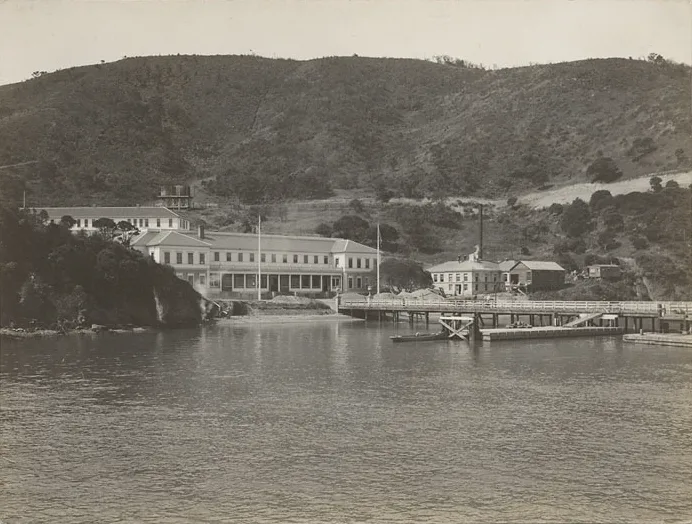
From 1910 to 1940, Angel Island in San Francisco Bay detained Chinese immigrants for weeks or months. Many carved poetry into the barrack walls.
Building a World Within a World
Excluded from most of American civic life, Chinese Americans built their own institutions, fought in their own courts, and created communities that endured against extraordinary pressure.
Barred by restrictive covenants from most neighborhoods, by discrimination from most trades, and by law from citizenship, Chinese Americans concentrated in dense urban enclaves. San Francisco's, dating to the early 1850s, is the oldest in North America; New York's, centered on Mott, Pell, and Doyers Streets, grew from a few hundred residents in the 1870s.
These districts ran the parallel institutions the wider society denied them: Chinese-language newspapers, temples and churches, native-place and family associations, rotating credit clubs, Chinese schools, and hospitals. The Chinese Consolidated Benevolent Association, or Six Companies, served as an unofficial municipal government and diplomatic voice.
Tourism cut both ways. From the 1900s, "slumming" tours sold outsiders a lurid, staged version of Chinatown, while merchants rebuilding San Francisco's quarter after the 1906 earthquake deliberately chose pagoda rooflines and "Oriental" facades to attract visitors and signal permanence.
Chinatowns were at once a refuge and a boundary: protection from a hostile society and a line that society enforced. Many still anchor Chinese American civic life, though gentrification and suburban "ethnoburbs" such as Monterey Park, California, have shifted the population's center of gravity since the 1980s.
The exclusion laws exempted the foreign-born children of U.S. citizens. The 1906 San Francisco earthquake and fire destroyed the city's birth and municipal records, so a Chinese man could now claim native birth with little fear of contradiction, and then report the births of children, real or invented, on trips to China.
Each reported child created an immigration "slot." Brokers sold these slots, together with a coaching book detailing the paper family's home, ancestry, and village layout, for sums that could reach a laborer's yearly wages. Buyers took on the paper surname and identity for life.
Inspectors at Angel Island tried to break the claims with marathon interrogations, asking applicant and sponsor hundreds of questions separately: the number of steps to the house, the direction the village well faced, who lived in the third house in the second row. Discrepancies meant deportation.
The practice was common enough that the government ran a "Chinese Confession Program" from 1956 to 1966, under which people could disclose their true identities in exchange for legal status. Many Chinese Americans still carry paper-family names, and separating real from paper lineage is a routine part of Chinese American genealogy.
Locked out of manufacturing, unions, many licensed trades, and any work alongside white coworkers, Chinese immigrants clustered in businesses that needed little capital, little English, and no white approval: hand laundries, restaurants, and small groceries.
Laundry work was not a Chinese tradition; it was an American niche. It required a few dollars of equipment and a storefront, and white launderers largely disdained it. By 1900, roughly one in four employed Chinese men in the United States worked in a laundry, and in some Eastern cities the share was higher.
Cities pushed back with targeted ordinances. San Francisco's laundry rules produced Yick Wo v. Hopkins (1886), in which the Supreme Court struck down a permit law enforced almost entirely against Chinese owners and held that the Equal Protection Clause protects noncitizens against discriminatory administration of a neutral law.
The restaurant trade followed a parallel path. Americanized dishes like chop suey spread nationally in the early 1900s, and a 1915 legal ruling that treated the owners of substantial Chinese restaurants as exempt "merchants" made food service one of the few lawful channels for new arrivals.
Denied the vote, Chinese Americans turned to litigation, and in the late nineteenth century they were among the heaviest users of the federal courts of any group. Between the 1880s and 1900s, Chinese litigants filed an estimated 10,000 or more habeas corpus petitions in San Francisco's federal courts challenging exclusion at the port.
The Six Companies bankrolled a coordinated legal strategy, retaining prominent white attorneys and choosing test cases carefully. Their challenges produced precedents that reached far beyond the Chinese community: Yick Wo v. Hopkins (1886) on equal protection and Wong Kim Ark (1898) on birthright citizenship, and, on the losing side, Chae Chan Ping (1889) and Fong Yue Ting (1893) on Congress's plenary power.
They organized outside court too. Against the Geary Act of 1892 the Six Companies ran a nationwide non-registration campaign, and in 1905 Chinese merchants in China and America mounted a boycott of American goods to protest exclusion, one of the first mass consumer boycotts in Chinese history.
This record complicates the old image of a passive community waiting out persecution. Chinese Americans lost most of the biggest constitutional fights but won many individual ones, and their cases helped build early American civil rights and immigration law.
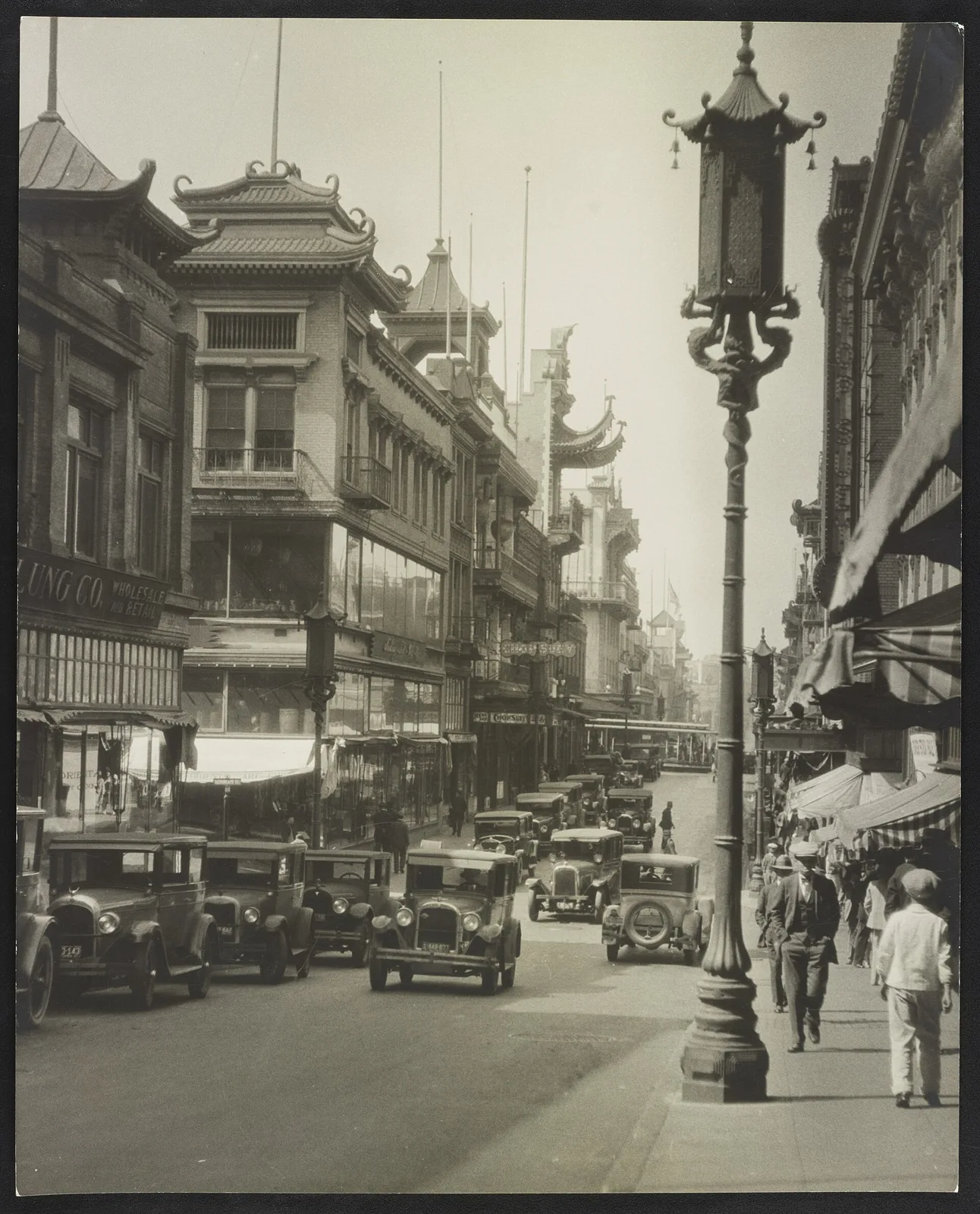
San Francisco's Chinatown, founded in the 1850s, is the oldest in North America and remains one of the most densely populated urban neighborhoods in the United States.
Wong Kim Ark and the Foundation of Birthright Citizenship
In 1898, the Supreme Court ruled in United States v. Wong Kim Ark that a man born in San Francisco to Chinese parents was a United States citizen by birth, regardless of his parents' ineligibility for naturalization. The ruling held that the Fourteenth Amendment's guarantee of citizenship applied to anyone born on U.S. soil to parents who were legal permanent residents. This decision established the legal foundation for birthright citizenship in America and remains one of the most consequential immigration rulings in Supreme Court history. It was won by a cook from Chinatown who refused to accept that the country of his birth was not his country.
From Exclusion to Excellence
The 1965 Immigration Act opened the door that had been locked for 83 years. What followed was one of the most remarkable stories of immigrant achievement in American history.
Even though most were still barred from citizenship, an estimated 13,000 to 20,000 Chinese Americans served in the U.S. armed forces in World War II, in every branch and theater. In some mainland communities a very high share of draft-age men were inducted, partly because so many lived apart from families and had no dependents.
The 14th Air Service Group and other largely Chinese American units supported operations in the China-Burma-India theater. Chinese Americans also crewed merchant ships and worked in West Coast shipyards and aircraft plants that had recently refused to hire them.
Their service was cited directly in the 1943 debate over repealing the Exclusion Act, and veterans gained a path to citizenship under the Magnuson Act and wartime expansions of a 1935 law covering Asian veterans of World War I.
The GI Bill then let Chinese American veterans attend college and buy homes, speeding movement out of the Chinatowns into professions and, over time, the suburbs. Hazel Ying Lee and Maggie Gee flew as Women Airforce Service Pilots; Lee died in a 1944 crash and was at first refused burial in a segregated cemetery.
A second major wave arrived after 1943 and especially after 1965: students, scientists, and professionals from Taiwan and Hong Kong, refugees from the 1949 Communist victory on the mainland, and later, after 1979 and 1989, immigrants and asylum seekers from the People's Republic.
Cold War policy actively drew this group in. Refugee-relief laws let stranded Chinese students stay, and U.S. universities and defense laboratories absorbed Chinese-trained engineers and physicists in large numbers.
In 1966 a New York Times Magazine article popularized the phrase "model minority" to describe Japanese and, soon, Chinese Americans. Scholars have criticized the label ever since: it hides wide income and education gaps within the community, discounts continuing discrimination, and has been used to argue that other minority groups simply lack a comparable work ethic.
The stereotype coexists with a persistent "perpetual foreigner" assumption. High-profile episodes, the 1982 killing of Vincent Chin in Detroit and the 1999 espionage prosecution of Los Alamos scientist Wen Ho Lee, which collapsed to a single minor guilty plea, kept alive the idea that Chinese Americans' loyalty was conditional.
Chinese Americans have contributed disproportionately to American science. Chien-Shiung Wu, "the First Lady of Physics," designed and ran the 1956 experiment that disproved the conservation of parity; the 1957 Nobel Prize went to the theorists Tsung-Dao Lee and Chen-Ning Yang, both Chinese-born, but not to Wu.
More laureates followed: Steven Chu shared the 1997 Nobel Prize in Physics and served as U.S. Secretary of Energy from 2009 to 2013; Daniel Tsui shared the 1998 physics prize; Roger Tsien shared the 2008 Nobel Prize in Chemistry.
In medicine, David Ho's team at the Aaron Diamond AIDS Research Center pioneered the triple-drug combination therapy of the mid-1990s that turned HIV infection into a survivable chronic condition, work that made him Time's 1996 Person of the Year.
In industry, Chinese Americans co-founded or led major technology firms, among them Jerry Yang at Yahoo, Jensen Huang at Nvidia, Eric Yuan at Zoom, and Lisa Su at AMD. The 1965 Act's skills-based preferences concentrated this talent, and Chinese-born researchers remain heavily represented in U.S. science and engineering doctoral programs.
About 5.2 million people of Chinese descent live in the United States today, making them the largest Asian-origin group, roughly a quarter of the Asian American population. The biggest concentrations are in California and the New York metro area, with fast growth in Texas, Washington, and Massachusetts.
The community spans extremes. Median household income for Chinese Americans is above the U.S. average, yet poverty rates in the historic urban Chinatowns of New York, San Francisco, and Boston remain high, and about one in five Chinese Americans has limited English proficiency.
Chinese Americans have reached the top ranks of public life: Elaine Chao as Secretary of Labor and of Transportation, Gary Locke as governor of Washington and ambassador to China, Judy Chu as the first Chinese American woman in Congress, and figures such as Yo-Yo Ma, I. M. Pei, Maya Lin, and Vera Wang in the arts and design.
The exclusion era is now formally acknowledged. The Senate in 2011 and the House in 2012 passed resolutions expressing regret for the Chinese Exclusion Act, and in 2021 Congress passed the COVID-19 Hate Crimes Act after a sharp rise in anti-Asian violence during the pandemic.
Notable Chinese Americans
Chien-Shiung Wu
Physicist called the First Lady of Physics; her 1956 experiment disproved the law of conservation of parity
Wong Kim Ark
San Francisco cook whose 1898 Supreme Court victory established birthright citizenship for all persons born in the U.S.
I.M. Pei
Architect who designed the Louvre Pyramid, the National Gallery of Art East Building, and the Rock and Roll Hall of Fame
Steven Chu
Nobel Prize in Physics (1997); U.S. Secretary of Energy under President Obama
Yo-Yo Ma
Cellist widely regarded as the greatest living classical musician; cultural ambassador and recipient of the Presidential Medal of Freedom
David Ho
Virologist who developed the combination antiretroviral therapy that transformed HIV from a fatal disease into a manageable condition
Elaine Chao
First Asian American woman to serve in a U.S. Cabinet position; Secretary of Labor and Secretary of Transportation
Jerry Yang
Co-founder of Yahoo, one of the first major internet companies, born in Taiwan and raised in California
Sources & Further Reading
- Office of the Historian, U.S. State Department, Chinese Immigration and the Chinese Exclusion Acts
- Library of Congress, Chinese Immigration to the United States
- Smithsonian, Chinese Americans and the Transcontinental Railroad
- Supreme Court Historical Society, United States v. Wong Kim Ark
- Stanford University, Chinese Railroad Workers in North America Project
- Angel Island Immigration Station Foundation
Immigration statistics are drawn from U.S. Census records, the National Archives, and federal immigration databases. Legal history is sourced from the Supreme Court Historical Society and the Library of Congress. Railroad workforce figures are from the American Immigration Council and Stanford University's Chinese Railroad Workers in North America Project.