About the U.S. Virgin Islands
The U.S. Virgin Islands is an archipelago of approximately 50 islands and cays in the northeastern Caribbean, about 40 miles east of Puerto Rico. Three main islands, St. Thomas, St. John, and St. Croix, hold virtually the entire population of about 87,000 people (87,146 in the 2020 Census, down from 106,405 in 2010). A fourth island, Water Island in Charlotte Amalie Harbor, is much smaller with only a few hundred residents. The islands are the easternmost point of the United States, and their position at the meeting of the Atlantic Ocean and the Caribbean Sea gives them some of the clearest, most turquoise water in the world.
The USVI has a layered history unlike any other U.S. territory. It is the only territory purchased from a European power in the 20th century, bought from Denmark in 1917 for $25 million in gold. Before American ownership, it spent 245 years as a Danish colony, a period that left an architectural legacy, a cultural character, and a civic holiday, Emancipation Day, commemorating an 1848 act of freedom that preceded Lincoln's Emancipation Proclamation by 15 years. Before Danish rule, the islands passed through Spanish, Dutch, French, and English hands in the free-for-all of early Caribbean colonialism.
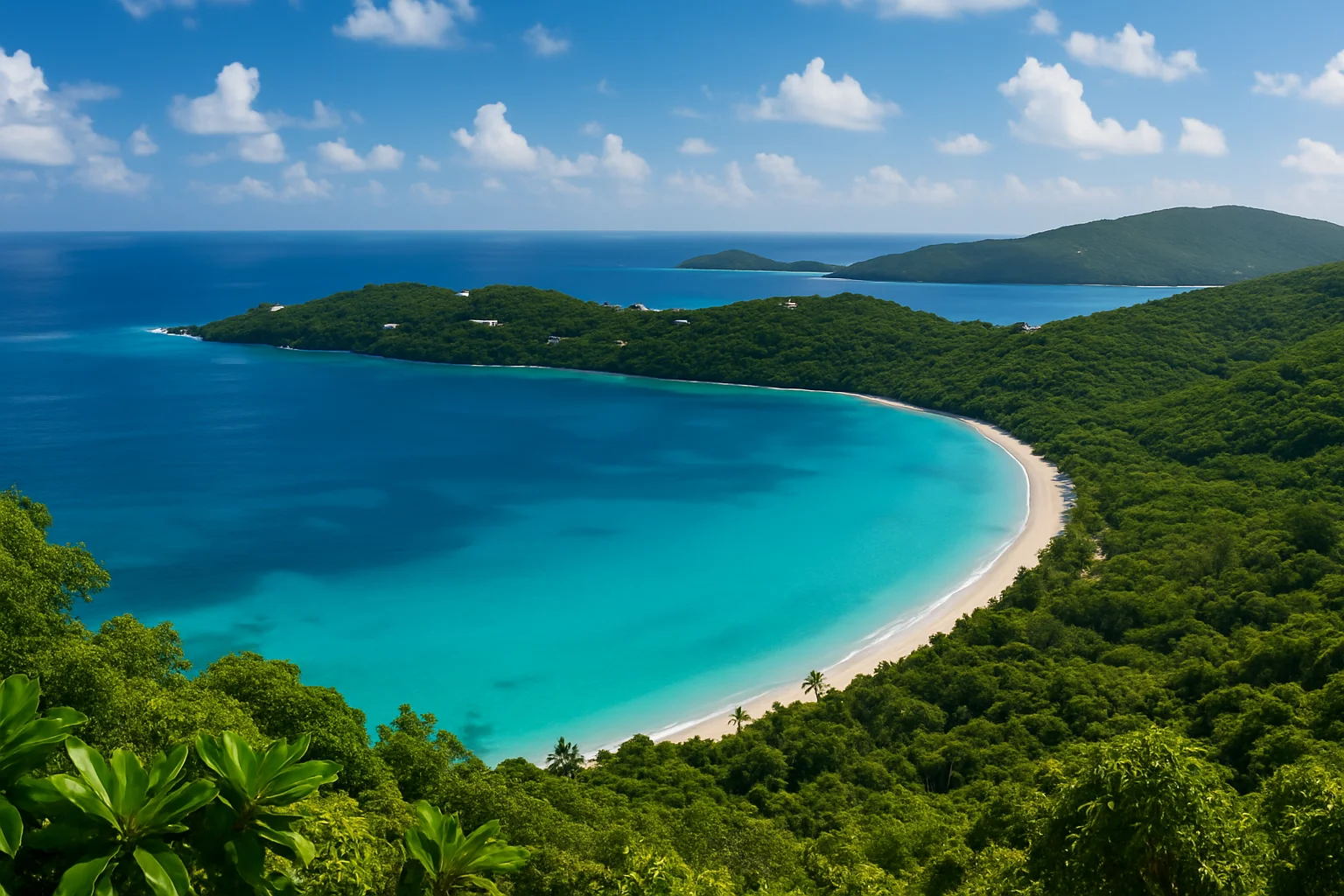
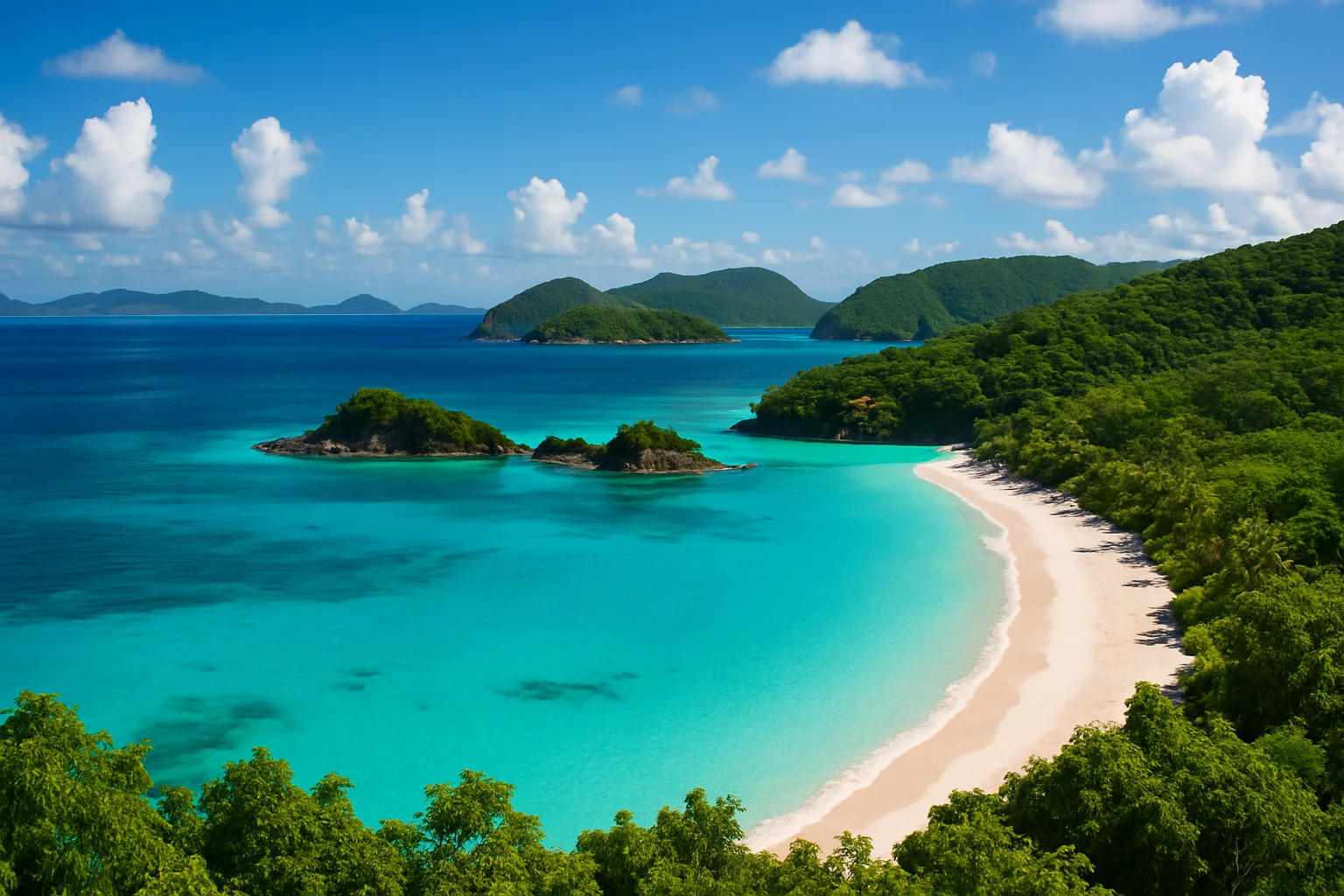
Today the USVI is best known to most Americans as a beach destination, and its beaches, particularly Magens Bay on St. Thomas and Trunk Bay on St. John, are among the finest in the Caribbean. But beneath the postcard surface is a territory grappling with the same fundamental questions as the other four inhabited territories: the democratic deficit of citizens without a presidential vote, an economy vulnerable to external shocks, and the long-unresolved question of what political relationship with the United States best serves its people.
The U.S. Virgin Islands' Four Main Islands
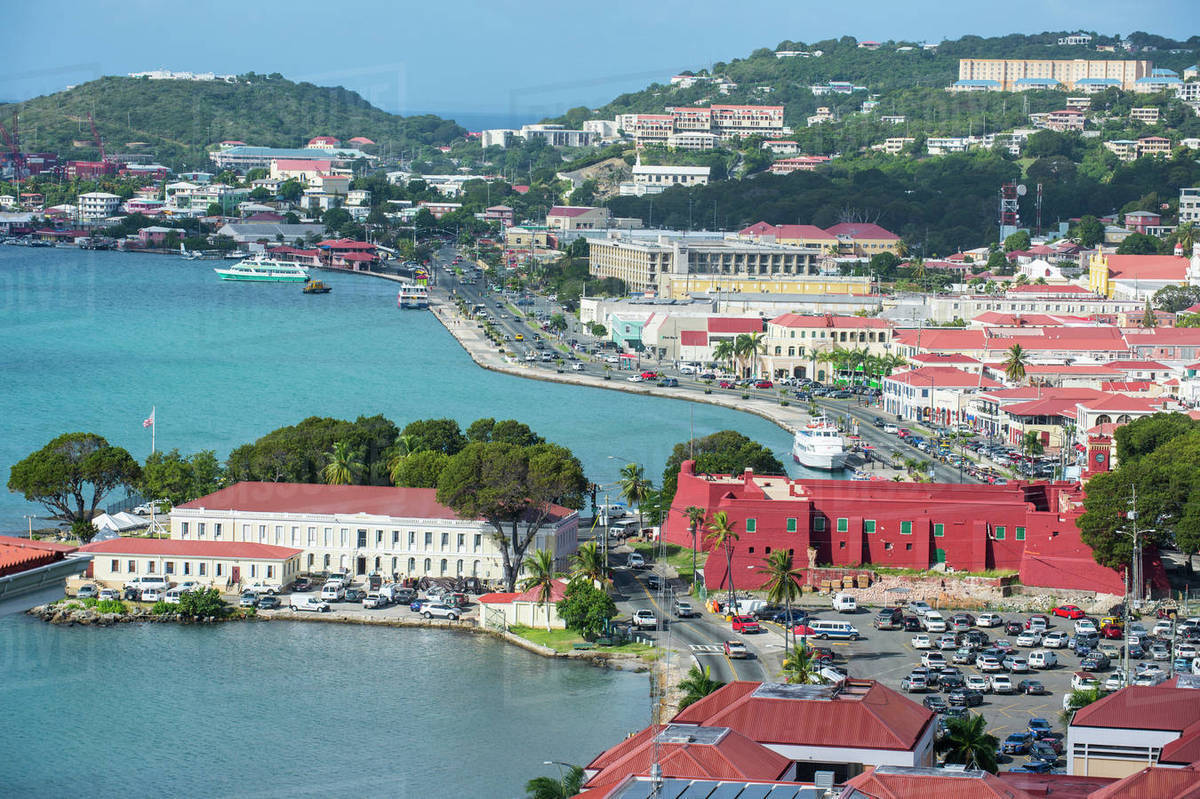
St. Thomas is the most populated and commercially developed of the main islands, home to the territorial capital, Charlotte Amalie, and the cruise infrastructure that drives the USVI economy. Charlotte Amalie's harbor, one of the finest natural harbors in the Caribbean, has been a trading center since the Danish period, and its duty-free district draws millions of cruise passengers a year.
The island's hills give dramatic views of the harbor and surrounding cays, Magens Bay is regularly ranked among the world's most beautiful beaches, and the University of the Virgin Islands has its main campus there. St. Thomas was badly damaged by Hurricane Irma in September 2017 and by Maria two weeks later.
Charlotte Amalie's old town, with its stepped 'Street of 99 Steps,' Danish warehouses, and Fort Christian of 1680, is a National Historic Landmark district, and the town holds the second-oldest synagogue in the Western Hemisphere still in use, dating to 1833. Blackbeard's Castle, a 1679 Danish watchtower, anchors a cluster of hilltop historic sites.
About half the territory's roughly 87,000 people live on St. Thomas, and it is the transport hub: Cyril E. King Airport handles most air arrivals, and ferries run from Charlotte Amalie and Red Hook to St. John, Water Island, and the British Virgin Islands. The east-end area around Red Hook and the offshore cays concentrates the marine and charter-yacht industry.
St. John is the smallest of the three main islands and the most protected, with roughly two-thirds of its land in the Virgin Islands National Park, established in 1956 largely through land bought and donated by Laurance Rockefeller. The park protects tropical forest, pre-Columbian and colonial-era sites, and some of the best reefs and beaches in the Caribbean.
Trunk Bay, with its underwater snorkeling trail, is one of the most photographed beaches in the world. St. John is reachable only by ferry from St. Thomas, a limit that has kept it a quiet, nature-focused destination with a permanent population of about 4,000. Hurricane Irma catastrophically damaged the island in 2017.
The land Rockefeller assembled had been the Caneel Bay plantation and resort; the resort closed after the 2017 storms and, as of the mid-2020s, had not reopened amid a dispute between the National Park Service and the leaseholder over cleanup and terms, leaving a prime stretch of shoreline idle. The Annaberg sugar-plantation ruins on the north shore preserve a windmill, a rum still, and the story of the island's enslaved workers.
St. John was the site of one of the earliest and longest slave rebellions in the Americas: in 1733 enslaved Africans, many from the Akwamu of present-day Ghana, seized the Danish fort and held much of the island for about six months before a French force from Martinique put the revolt down. The population outside the park is squeezed by second-home development, and Cruz Bay, the main town, struggles with housing costs and utility reliability.
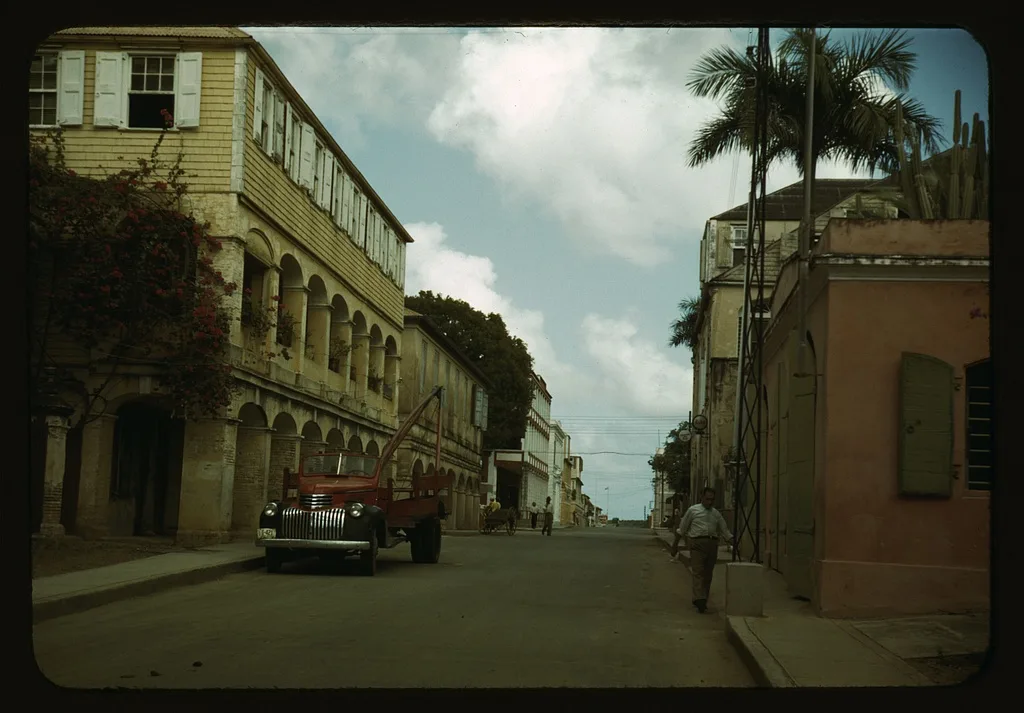
St. Croix is the largest U.S. Virgin Island by area and the most culturally distinct, about 40 miles south of St. Thomas and St. John in a separate island group. Its Danish-era architecture in Christiansted and Frederiksted is more intact than on any other island, and its culture has a Caribbean character residents proudly distinguish from the tourist-commercial feel of St. Thomas.
St. Croix was the engine of the colonial plantation system, with more than 100 sugar estates by the mid-to-late 1700s, after Denmark bought the island in 1733, that made the Danish West Indies among the most profitable colonies in the Caribbean. Today it holds the rum distilleries, the former HOVENSA refinery site, and a tourism built on diving, history, and calm winter beaches; Buck Island Reef National Monument offshore has one of the most intact elkhorn coral formations left in the Caribbean.
The island's Danish towns are National Historic Landmark districts, and its forts, Christiansvaern in Christiansted and Frederik in Frederiksted, are National Park Service sites; it was at Fort Frederik that the 1848 emancipation was proclaimed. The 1878 'Fireburn' labor revolt, in which laborers led by women remembered as the 'Queens' burned much of Frederiksted and dozens of estates, is commemorated on the island.
St. Croix lost population after the HOVENSA closure and again after the 2017 storms and is now home to fewer than half the territory's residents, though it is the seat of the university's agricultural station and a growing Frederiksted arts scene. It hosts a long-running Ironman-distance triathlon and a Crucian Christmas Festival carnival that runs into January, distinct from St. Thomas's spring carnival.
Water Island, officially the fourth major U.S. Virgin Island, sits in Charlotte Amalie Harbor less than a mile from St. Thomas. With only a few hundred residents and essentially no commercial development, it is reached by a short ferry from the St. Thomas waterfront and offers a quiet retreat from the town.
The island was a U.S. Army installation during World War II and passed through several federal agencies before being deeded to the Government of the Virgin Islands in 1996. Beyond Water Island, dozens of smaller cays and uninhabited islands are scattered through USVI waters, many popular for day sails and snorkeling.
The Army built Fort Segarra, a partly underground coastal-defense complex, on Water Island in the 1940s to guard the submarine base and the harbor; it was never fully armed, and its bunkers and gun mounts are now overgrown. The CIA leased the island in the 1950s and used it as a training site before the government transfer.
Water Island became the USVI's fourth 'main' island only in 1996, and residents still work around gaps left by the late transfer, with no paved public roads, school, or clinic, so children ferry to St. Thomas. Hassel Island in the harbor, mostly national park land, and Little St. James, once owned by Jeffrey Epstein and sold to a private buyer in 2023 after the territory's 2022 settlement with his estate, are among the better-known smaller cays.
How the U.S. Virgin Islands Makes Its Living
The USVI economy is heavily dependent on tourism and federal transfers, with rum production and the remnants of an oil refining industry rounding out a picture of economic vulnerability to external shocks.
Tourism is the economic foundation of the U.S. Virgin Islands, accounting for roughly 60 to 70 percent of GDP and employing most of the private-sector workforce. St. Thomas is one of the most visited cruise destinations in the world, with Charlotte Amalie's duty-free shopping district drawing millions of passengers a year, while St. John draws a higher-end eco-tourism market around the Virgin Islands National Park.
St. Croix is less dependent on cruise ships and more culturally distinct, drawing visitors for its Danish colonial towns, Buck Island Reef, and calm winter beaches. The industry was hammered by Hurricanes Irma and Maria in September 2017, which wrecked hotel infrastructure on St. Thomas and St. John and took years to rebuild.
Cruise arrivals recovered faster than overnight stays after 2017, and by the early 2020s St. Thomas was again among the busiest cruise ports in the Caribbean, though residents debate how little of the duty-free retail money stays on-island. Villa and short-term rentals boomed during the pandemic as mainland Americans, needing no passport, chose the territory over foreign beaches.
The tourism economy is squeezed by cost: fuel, food, and building materials all arrive by ship, electricity is among the most expensive in the U.S., and airlift is limited, with most flights routed through San Juan or Miami. The Water and Power Authority's debt and frequent outages, and the slow federal buildout of a storm-resistant grid, are recurring threats to the visitor economy.
The U.S. Virgin Islands hosts two of the most significant rum producers in the country: Diageo's Captain Morgan distillery on St. Croix and Beam Suntory's Cruzan Rum, also on St. Croix. The islands share the federal rum 'cover-over' with Puerto Rico, under which most of the U.S. excise tax collected on rum made in the territories is returned to the territorial government.
That flow generates hundreds of millions of dollars a year for the USVI government, one of its most important revenue sources, and the territory has lobbied consistently to keep and expand it. The rum industry directly employs several hundred people and supports broader agricultural and service jobs.
Diageo moved Captain Morgan production from Puerto Rico to a new St. Croix distillery in 2010 after the USVI offered a roughly 30-year package of tax breaks and a share of the cover-over money used to subsidize the company. Puerto Rico protested to Congress that the territories were in a subsidy 'race to the bottom,' and bills to cap how much of the rebate can be passed to distillers have been introduced repeatedly without passing.
The cover-over rate itself is not permanent: it is set at $10.50 per proof gallon in law but has been topped up to $13.25 by temporary 'extenders' that Congress renews every few years, so a lapse would cut the territory's budget sharply. The rebate is calculated on all rum sold in the U.S., not just USVI rum, so cheaper imported rum still generates money for the territory.
For decades the Hess Oil Virgin Islands refinery on St. Croix, later a Hess-PDVSA joint venture called HOVENSA, was one of the largest oil refineries in the Western Hemisphere and the single largest private employer in the USVI. At its peak it processed hundreds of thousands of barrels a day, employed thousands, and was a major source of government revenue.
HOVENSA shut its refinery in 2012, citing competition from newer plants, a blow from which St. Croix has only partly recovered; the closure drove population loss and years of effort to redevelop the site. A new operator, Limetree Bay, reopened part of the facility as a refinery in 2021 but shut it again within months after an incident that rained oil droplets on nearby homes and contaminated cisterns.
The plant's history is one of the territory's worst environmental legacies: a plume of more than 40 million gallons of leaked petroleum spread under the site over decades, one of the largest underground oil spills in U.S. history, and HOVENSA went through bankruptcy in 2015 owing the government back taxes and abandoning pension obligations.
Limetree Bay went bankrupt too in 2021, and the site was sold again to Port Hamilton Refining and Transportation, which has sought EPA permission to restart it while St. Croix residents and environmental groups have fought a full restart, citing the 2021 releases and the plant's age. The associated oil-storage terminal, one of the largest in the hemisphere, has kept operating throughout.
The Government of the Virgin Islands is among the largest employers in the territory, and federal transfers, Medicaid, SNAP, and other benefits, are a significant part of household income. Like other territories, the USVI receives federal benefits at capped rates well below what a comparable state would get.
The territory's finances have been chronically strained, especially after the HOVENSA closure and the 2017 hurricanes, and the government has repeatedly faced shortfalls requiring borrowing and cuts. Federal disaster money after 2017 poured billions into the islands, but much flowed through federal agencies and contractors rather than the local budget.
The USVI's public pension system is severely underfunded and was projected to run out of assets in the 2020s until the legislature in 2021 dedicated part of the rum cover-over and other revenues to keep it solvent. The territory also carries heavy debt from bonds backed by that same rum money, which limits how much of it is actually available for spending.
The USVI got a non-voting delegate to the U.S. House in 1973, and unlike Puerto Rico it has never been placed under a federal financial control board, though its bond ratings have fallen deep into junk territory. Governors have periodically floated, and voters have not adopted, ideas like a constitutional convention or an independent status study to address the structural fiscal gap.
The USVI's local economy includes artisanal fishing, small-scale agriculture, tropical fruit, vegetables, and some cattle on St. Croix, and a service sector aimed at residents rather than tourists. Fishing, both subsistence and commercial, is culturally important and supports livelihoods on all three main islands.
Agriculture is limited by terrain, poor soil, and cheap imports, but local produce commands premium prices at farmers markets. The bay rum tradition of St. John has had a small craft revival. Water Island, the smallest of the four main islands with a few hundred residents, is almost entirely residential.
St. Croix has the territory's only real farmland, on the flatter south-central plain, and the University of the Virgin Islands runs a land-grant agricultural experiment station there; the annual Agriculture and Food Fair on St. Croix is one of the biggest local events. Water is scarce enough that most homes collect rain in cisterns, a building-code requirement, and drought and hurricane contamination are recurring problems.
Federal fishery rules are a constant friction: seasonal closures and catch limits on grouper, conch, and lobster set by the Caribbean Fishery Management Council are widely resented by local fishers, and expanded marine protections around other U.S. islands have raised fears of similar restrictions. Roughly 85 percent of the territory's food is imported.
What Does "Unincorporated Territory" Mean for the USVI?
The U.S. Virgin Islands is an unincorporated organized territory of the United States. "Unincorporated" means that not all provisions of the U.S. Constitution automatically apply, only those the Supreme Court has deemed "fundamental rights" under the Insular Cases framework. "Organized" means that Congress has passed an Organic Act establishing civilian government, in this case the Revised Organic Act of 1954, which remains the governing federal statute for the USVI.
USVI residents have been U.S. citizens since 1927, ten years after the territory was acquired from Denmark. The citizenship grant came through a 1927 act of Congress, was broadened in 1932, and was carried forward in the Organic Act of 1936 and the Revised Organic Act of 1954. Despite citizenship, USVI residents face the same democratic deficits as residents of the other unincorporated territories: no vote for President, no voting representation in Congress, and federal benefits at rates below what states receive.
One notable distinction: the USVI has never successfully ratified its own constitution. Five constitutional conventions have been held without producing a constitution that took effect, most recently the 2007 to 2009 convention, whose draft Congress returned for revisions in 2010. The territory is still governed by the 1954 federal Organic Act rather than a locally ratified constitution, a situation it shares only with Guam among the five inhabited territories.
Rights: USVI Residents vs. State Residents
| Right or Benefit | USVI Residents | State Residents |
|---|---|---|
| U.S. Citizenship | ✅ Yes (since 1927) | ✅ Yes |
| Vote for President | ❌ No | ✅ Yes |
| Voting Rep. in Congress | ❌ Non-voting delegate only | ✅ Yes |
| U.S. Senate representation | ❌ None | ✅ 2 senators |
| Serve in U.S. military | ✅ Yes | ✅ Yes |
| Medicaid / SNAP benefits | ⚠️ Capped (not full match) | ✅ Full federal match |
| Social Security / Medicare | ✅ Yes | ✅ Yes |
| Federal income tax | ❌ Pay USVI income tax instead | ✅ Pay federal income tax |
| Move freely to mainland | ✅ Yes | ✅ Yes |
| Electoral votes | ❌ None | ✅ Based on population |
How the USVI's Government Works
The U.S. Virgin Islands government is organized into three branches under the Revised Organic Act of 1954, the federal statute that still serves as the territory's governing document in the absence of a locally ratified constitution. The executive branch is led by the Governor, directly elected to a four-year term. The legislative branch is the unicameral Virgin Islands Legislature of 15 senators. The judicial branch includes the Superior Court and Supreme Court of the Virgin Islands for local matters.
The Governor administers the Government of the Virgin Islands (GVI), which includes all territorial executive departments and agencies, the public school system, Roy Lester Schneider Hospital on St. Thomas and Juan F. Luis Hospital on St. Croix, and public utilities. The Governor serves a maximum of two consecutive four-year terms. Unlike the CNMI and Puerto Rico, the USVI does not have a separately elected Lieutenant Governor; the Lieutenant Governor runs jointly with the Governor on a single ticket.
For federal matters, the U.S. District Court for the District of the Virgin Islands is the federal trial court. Appeals from the federal district court go to the U.S. Court of Appeals for the 3rd Circuit in Philadelphia, not the 1st Circuit that covers Puerto Rico. Since 2012, decisions of the Virgin Islands Supreme Court go directly to the U.S. Supreme Court, as a state high court's would.
Governor of the U.S. Virgin Islands
Current Governor
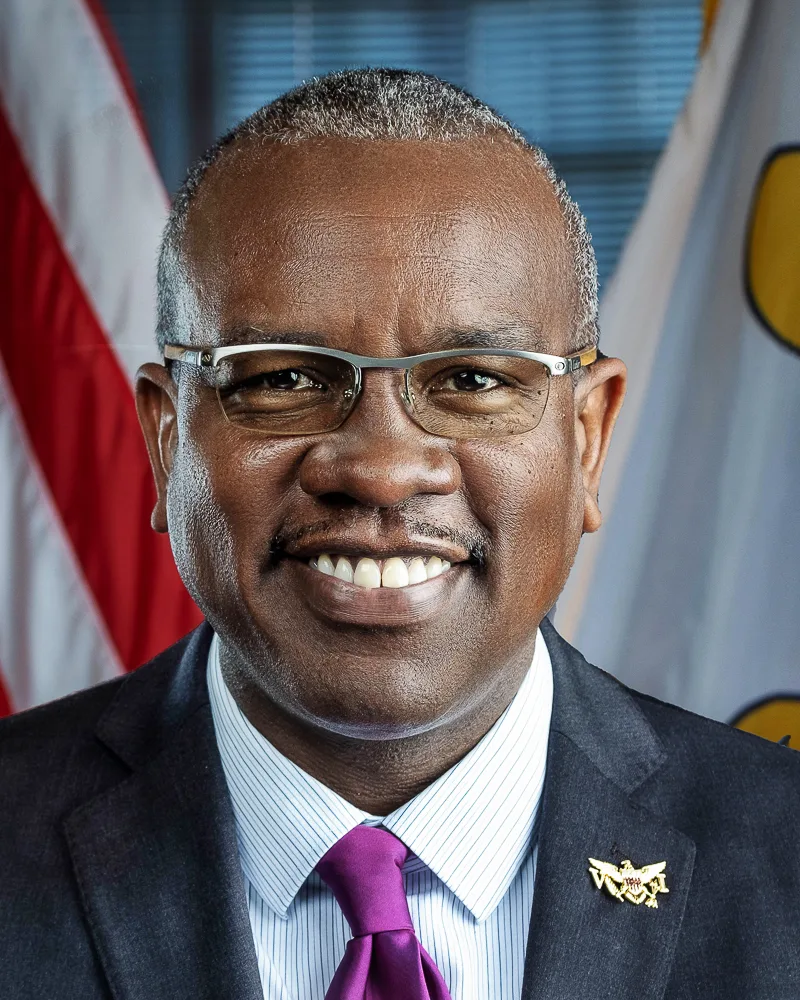
Albert Bryan Jr.
- Party
- Democrat
- In Office Since
- January 7, 2019
- Re-elected
- November 8, 2022
- Term Ends
- January 2027
- Born
- St. Croix, U.S. Virgin Islands
- Education
- Howard University; University of the Virgin Islands
- Prior Role
- USVI Commissioner of Labor; private business
Albert Bryan Jr. is the 16th Governor of the U.S. Virgin Islands, a St. Croix native who served as Commissioner of Labor before winning the 2018 gubernatorial election and being re-elected in 2022. He has focused his administration on post-hurricane recovery and reconstruction, economic diversification, the redevelopment of the former HOVENSA refinery site on St. Croix, and improving the territory's fiscal position. His tenure has coincided with significant federal infrastructure investment from the Infrastructure Investment and Jobs Act.
Other Current Territorial Officials
Lieutenant Governor
Tregenza Roach
In office since January 2019, re-elected 2022 on the Bryan ticket. A former educator, senator, and longtime USVI political figure, Roach oversees several executive departments and focuses on education reform and cultural preservation. The Lieutenant Governor runs jointly with the Governor on a single ticket.
Attorney General
Gordon C. Rhea
USVI Attorney General since October 2024, appointed by the Governor and confirmed by the Legislature; he succeeded Ariel Smith (2023 to 2024). A longtime Virgin Islands attorney, Rhea is also a noted Civil War historian. The AG leads the Department of Justice of the Virgin Islands, handles criminal prosecution and civil enforcement under territorial law, and represents the territorial government in litigation.
President of the Legislature
Milton E. Potter
President of the 36th Virgin Islands Legislature since January 2025, succeeding Novelle Francis Jr. A senator from the St. Thomas-St. John district. The Legislature President is elected by the 15 senators from among their membership and presides over the unicameral chamber. The USVI Legislature meets in Charlotte Amalie on St. Thomas.
The Virgin Islands Legislature
Virgin Islands Legislature (Unicameral)
- Seats: 15 senators
- Terms: 2-year terms
- Elections: All 15 seats on the ballot every two years
- Elected: 7 from St. Croix district, 7 from St. Thomas/St. John district, 1 at-large
The Virgin Islands Legislature is unicameral, with senators elected from two geographic districts and one at-large seat, ensuring representation for both the St. Croix and St. Thomas/St. John island groups. The legislature has authority over local laws and the territorial budget, subject to congressional supremacy and the Governor's veto.
The USVI's Non-Voting Delegate to Congress
U.S. House Delegate (Non-Voting)
Stacey Plaskett
Stacey Plaskett has represented the USVI as its non-voting delegate since 2015, making her one of the most prominent territorial delegates in Congress. She gained national recognition in 2021 when she served as an impeachment manager in the second impeachment trial of President Trump, the first non-voting delegate ever to serve in that role. She can vote in committees but not on the House floor on final passage of legislation.
What the Delegate cannot do: Vote on final passage of any legislation affecting the roughly 87,000 U.S. citizens of the Virgin Islands. The USVI has no Senate representation.
The USVI Court System
The USVI has its own court system for local matters. The Superior Court of the Virgin Islands is the primary trial court for local matters. The Supreme Court of the Virgin Islands (three justices appointed by the Governor) is the territory's highest local court. For federal matters, the U.S. District Court for the District of the Virgin Islands is the federal trial court. Federal appeals go to the U.S. Court of Appeals for the 3rd Circuit in Philadelphia rather than the 1st Circuit (which covers Puerto Rico), and since 2012 the Virgin Islands Supreme Court's decisions go directly to the U.S. Supreme Court.
📋 Current Officials
For the most current list of USVI government officials, visit vi.gov.
The U.S. Virgin Islands Through the Years
From Taino settlements to Danish sugar colonies, from a $25 million gold purchase to two Category 5 hurricanes in two weeks, the USVI has lived a history as turbulent as the waters that surround it.
The Virgin Islands were inhabited for thousands of years before European contact by successive waves of Amerindian peoples. The earliest known arrivals reached the islands roughly 3,000 years ago, followed by Arawak-speaking peoples from South America who brought agriculture, pottery, and more complex social organization.
At contact the islands sat on a frontier between the Taíno of the larger islands and the Kalinago (Carib) expanding north through the Lesser Antilles; Carib resistance made the region among the last in the Caribbean to fall to Europe. The indigenous population of the Virgin Islands was effectively destroyed within a century through disease, enslavement, and violence.
The best-studied early site is at Salt River on St. Croix, a large Igneri and later Taíno village with the only ceremonial ball court found in the Lesser Antilles; it is preserved as the Salt River Bay National Historical Park and Ecological Preserve, co-managed by the Park Service and the territory.
Salt River is also the one documented spot where Columbus's expedition landed on what is now U.S. soil: a shore party of his second voyage clashed with Kalinago there on November 14, 1493, in what is often called the first armed encounter between Europeans and Native people in the future United States. Columbus named St. Croix 'Santa Cruz' and the archipelago for Saint Ursula's 11,000 virgins.
Columbus sailed through the Virgin Islands on his second voyage in 1493, naming them Las Once Mil Vírgenes for the legend of Saint Ursula. Spain claimed the islands but never seriously colonized them, using the Virgins mostly as a hunting ground for capturing Kalinago to enslave.
The vacuum drew other powers: the Dutch, English, French, and Danes all set up temporary or permanent footholds in the 1600s, and St. Croix passed among Dutch, English, Spanish, French, and Knights of Malta ownership before Denmark bought it from France in 1733. Denmark planted a permanent settlement on St. Thomas in 1672, beginning a 245-year colonial period, the longest unbroken European possession in the Caribbean.
St. Thomas's early Danish colony nearly failed from disease and hurricanes, and the Danish West India and Guinea Company, a chartered trading firm, ran the islands as a business until the Danish crown bought it out in 1754. The company's other main line of trade was slaving forts on the Gold Coast of West Africa.
Denmark's neutrality was the islands' asset: as a small power not at war with the others, it could offer St. Thomas as a port open to ships and merchants of every nation, one reason the harbor filled while Spanish and English islands stagnated under trade monopolies.
The Danish period turned the Virgin Islands into one of the most profitable colonial enterprises in the Caribbean. St. Thomas became the most important free port in the region, a neutral hub where merchants of all nations traded goods, including enslaved people, and Charlotte Amalie grew into one of the busiest ports in the hemisphere.
The Danish West Indies, above all St. Croix with roughly 100 sugar estates, became major sugar producers on the labor of enslaved Africans, who by the mid-1700s outnumbered the white population by about ten to one. Denmark was among the first nations to abolish the transatlantic slave trade, in a 1792 decree effective 1803, but slavery itself continued.
On July 3, 1848, following a mass rebellion on St. Croix led by a man remembered as General Buddhoe, Governor General Peter von Scholten declared all enslaved people in the Danish West Indies free, acting on his own authority ahead of Copenhagen. Emancipation Day is now the most important civic holiday in the USVI.
Freedom did not bring rights: an 1849 labor law tied ex-slaves to annual plantation contracts, and low wages and harsh conditions produced the 1878 'Fireburn' revolt on St. Croix, led largely by women, that burned much of Frederiksted and dozens of estates. Sugar declined as European beet sugar undercut cane, and the islands slid into a poverty that helped push Denmark to sell them.
The United States had attempted to purchase the Danish West Indies twice before: an 1867 treaty was ratified by Denmark but rejected by the U.S. Senate, and a 1902 treaty was ratified by the Senate but rejected by the Danish upper house by a single vote.
World War I overcame the obstacles: the U.S. feared Germany might occupy Denmark and seize the islands, whose harbors guarded the approaches to the Panama Canal. The U.S. bought the islands on March 31, 1917, for 25 million dollars in gold, then the largest per-acre purchase in American history, and Danish voters had approved the sale in a referendum. The islands were renamed and their residents made U.S. nationals; citizenship followed in 1927.
The sale was tied to a secret side agreement in which the United States recognized Danish sovereignty over all of Greenland, which mattered decades later when the U.S. built bases there. The transfer ceremony on St. Thomas took place on March 31, 1917, days before Congress voted to enter the war (the Senate on April 4 and the House on April 6), and the islands were promptly put under U.S. Navy rule.
Navy administration was widely seen as harsh and racially discriminatory; a 1927 congressional visit and reporting by the NAACP helped spur the shift to civilian rule under the Interior Department in 1931. The purchase remains the last time the United States bought inhabited territory, and the handover is commemorated every March 31 as Transfer Day.
U.S. citizenship was extended to Virgin Islanders by an act of Congress in 1927, and the islands stayed under Navy administration until 1931, when civilian government began under the Department of the Interior. The first elected governor took office only in 1970; before that, presidents appointed them.
The Revised Organic Act of 1954, still the territory's governing charter, set up the current framework, including the unicameral legislature. The post-war decades saw tourism begin to dominate as cheaper air travel and rising American incomes opened the Caribbean to middle-class travelers, and St. John's 1956 designation as a national park shaped its development permanently.
The New Deal poured money into the islands through the Virgin Islands Company, a federal corporation that ran sugar and rum production and public works from 1934, and Prohibition's repeal in 1933 revived the rum industry that would later anchor the government's budget. Governor Paul Pearson led early reforms as an appointed governor in the 1930s.
Alexander Hamilton spent part of his childhood on St. Croix, clerking in Christiansted before a hurricane and a widely praised essay he wrote about it helped send him to New York in 1772, a connection the territory has promoted heavily since the 2015 musical. Virgin Islanders such as newspaper editor Rothschild Francis pressed Washington for citizenship and civil rights in the 1920s.
In September 2017, the U.S. Virgin Islands suffered one of the most devastating disaster sequences in American territorial history. Hurricane Irma, a Category 5 storm with sustained winds of 185 mph, struck St. Thomas and St. John on September 6, destroying much of the tourism infrastructure, stripping hillsides bare, and leaving thousands homeless.
Before recovery could begin, Hurricane Maria hit on September 19, adding damage on St. Croix. The federal response, strained by Irma and about to be overwhelmed by Maria's catastrophic strike on Puerto Rico, was widely criticized as slow. Damage from both storms topped 10 billion dollars, and tourism took years to rebuild.
The storms knocked out power territory-wide, some areas for months, forced the evacuation of hospital patients to the mainland, destroyed schools, and pushed thousands of residents off-island, deepening a population decline that had begun with the HOVENSA closure. Both public hospitals, Schneider Regional on St. Thomas and Juan F. Luis on St. Croix, were so damaged that the territory ran on modular field facilities for years.
Congress appropriated billions for recovery, and by the early 2020s the USVI was undertaking one of the largest per-capita federal rebuilding programs in the country, replacing schools, hospitals, and public housing and hardening the electric grid. Progress has been slow and uneven, and the double hurricane made storm resilience the central question of every major infrastructure decision in the territory.
The USVI's Defining Moments in American History
These are the events that didn't just shape the U.S. Virgin Islands. They tested America's commitments to its citizens and revealed enduring truths about territorial governance.
On July 3, 1848, Governor General Peter von Scholten of the Danish West Indies stood at Fort Frederik in Frederiksted, St. Croix, and proclaimed all enslaved people in the Danish colonies free, after a mass uprising led by an enslaved man known as General Buddhoe. Von Scholten acted without authorization from Copenhagen, which had been moving slowly toward emancipation.
He was recalled to Denmark and court-martialed; though ultimately acquitted, he never returned to the islands. The 1848 emancipation came 15 years before the Emancipation Proclamation and 17 years before the Thirteenth Amendment ended slavery in the United States, and July 3 remains the most important civic holiday in the U.S. Virgin Islands.
The rebellion was carefully organized: on July 2 an estimated 8,000 people gathered at Frederiksted demanding freedom by that evening, and the colonial garrison was too small to stop them, so von Scholten chose proclamation over a bloodbath. 'Buddhoe,' generally identified as Moses Gottlieb, a sugar-boiler on the La Grange estate, was arrested despite promises of amnesty and deported, and his later fate is unknown.
Freedom without land or rights led to the 1878 'Fireburn' labor revolt, and full civil equality came only in stages under U.S. rule. The bronze statue outside Fort Frederik of a laborer blowing a conch shell, and the annual Emancipation Day ceremony there, keep the 1848 events at the center of Crucian identity.
The purchase of the Danish West Indies for 25 million dollars in gold on March 31, 1917, was the culmination of 50 years of American strategic interest in the islands' harbors as a Caribbean naval base. The timing was driven by World War I and the fear that Germany would seize neutral Denmark and gain a position astride the sea lanes to the Panama Canal.
The deal, concluded in haste as the United States was about to enter the war, transferred about 133 square miles and roughly 26,000 residents to American sovereignty without consulting them. The islanders became U.S. nationals but not citizens, a status not corrected until 1927, and the 25 million dollar price was the highest the United States had ever paid for territory.
Danish voters ratified the sale in a December 1916 referendum after a bitter debate, and a secret U.S. pledge not to object to Danish sovereignty over Greenland was part of the bargain. The formal handover on St. Thomas came on March 31, 1917, days before Congress voted to enter World War I, and the islands were promptly put under U.S. Navy rule.
It remains the last time the United States bought inhabited territory (the Northern Mariana Islands joined later by negotiated covenant). Transfer Day, March 31, is a territorial holiday, and the 2017 centennial, months before the hurricanes, prompted renewed debate about whether a people bought and transferred without a vote should still lack presidential voting rights and a voting member of Congress.
No U.S. jurisdiction in the modern era has been through what the U.S. Virgin Islands went through in September 2017: two Category 5 hurricanes in 13 days. Irma, with sustained winds of 185 miles per hour, struck St. Thomas and St. John on September 6, destroying much of the tourism infrastructure, stripping the vegetation from entire hillsides, and leaving thousands homeless.
Before recovery could meaningfully begin, Hurricane Maria struck on September 19, hitting St. Croix hardest. The federal disaster response was stretched thin by the sequential storms and overwhelmed by Maria's concurrent catastrophic strike on Puerto Rico. Cumulative damage exceeded 10 billion dollars, tourism took years to rebuild, and the storms accelerated an already troubling population decline.
The territory's two hospitals were so badly damaged that patients had to be evacuated to the mainland and the islands ran on temporary modular hospitals for years. Schools shifted to double sessions and tents, the power grid was down for months in places, and the water system, dependent on desalination and cistern collection, was badly disrupted.
Recovery has been one of the largest per-capita federal rebuilding efforts in the country, replacing schools, hospitals, and public housing and hardening the electric grid, but it has moved slowly, hampered by the islands' remoteness, contractor shortages, and disputes over land title. The 2017 season made climate-driven storms the defining constraint on the territory's future.
When HOVENSA, the Hess-PDVSA oil refinery on St. Croix, announced in January 2012 that it would stop refining, it set off the worst economic crisis in the USVI's modern history. At its peak the refinery was one of the largest in the Western Hemisphere, employed thousands directly and indirectly, and was a major source of government revenue.
The shutdown, driven by competition from newer refineries and shifting oil markets, devastated St. Croix's economy, drove population loss, and left a huge contaminated industrial site. It showed with painful clarity how a small territory with an undiversified economy cannot absorb the sudden loss of a dominant employer.
The site had one of the largest underground petroleum spills in U.S. history, more than 40 million gallons that had leaked over decades, and HOVENSA went through bankruptcy in 2015 owing the territory back taxes and abandoning pension obligations. A successor, Limetree Bay, briefly restarted a refinery in 2021 before an incident that showered oil on nearby homes and cisterns forced an EPA shutdown.
Limetree Bay then went bankrupt too, and the refinery was sold again, with residents and environmental groups fighting a full restart. The storage terminal, one of the biggest in the hemisphere, has kept operating, and successive territorial governments have been caught between the jobs and revenue the plant could bring back and the environmental record that makes many Crucians want it closed for good.
Unlike Puerto Rico, which ratified its own constitution in 1952, the U.S. Virgin Islands has never adopted a local constitution. Five constitutional conventions have been held, in 1964, 1971, 1977, 1980, and 2007 to 2009; the 2009 draft was approved by delegates, but Congress returned it in 2010 with a resolution urging changes to provisions such as references to 'ancestral' and 'native' Virgin Islanders that critics said created different classes of citizenship.
The territory continues to be governed by the Revised Organic Act of 1954, a federal statute passed by Congress rather than a locally ratified document, making the USVI the only inhabited U.S. territory without its own constitution. The failure reflects both the difficulty of local consensus and Congress's ultimate authority over territorial governance.
The 2009 draft would also have exempted 'ancestral native' Virgin Islanders from property taxes and given them special voting rights on future status questions; the U.S. Justice Department found several provisions unconstitutional, President Obama transmitted those objections to Congress, and the convention declined to reconvene to fix them, so the document lapsed.
Behind the drafting fights is an unresolved status question: the USVI, like Puerto Rico, has held non-binding votes and studies on statehood, independence, and enhanced self-government without reaching a durable answer, and it remains on the United Nations list of non-self-governing territories. Voters approved calling a sixth convention in a 2020 referendum, but it has not yet been funded and seated.
Territory Symbols and Quick Facts
| Official Status | Unincorporated Organized U.S. Territory |
| Capital | Charlotte Amalie, St. Thomas |
| Largest City | Charlotte Amalie |
| U.S. Territory Since | March 31, 1917 (purchased from Denmark) |
| Purchase Price | $25 million in gold (approx. $570 million today) |
| Citizenship Granted | February 25, 1927 (Revised Organic Act) |
| Population | 87,146 (2020 Census) |
| Area | 133 sq miles (3 main islands, ~50 smaller cays) |
| Main Islands | St. Thomas, St. John, St. Croix, Water Island |
| Location | Caribbean Sea, 18°N 64°W |
| Distance from Mainland | ~1,100 miles southeast of Miami |
| Distance from PR | ~40 miles east of Puerto Rico |
| Time Zone | Atlantic Standard Time (UTC-4, no DST) |
| Official Language | English |
| Territorial Bird | Bananaquit (Sugar Bird) |
| Territorial Flower | Yellow Elder (Yellow Cedar) |
| Territorial Tree | Genip (Guinep) |
| Territorial Song | "Virgin Islands March" |
| Currency | U.S. Dollar |
| Delegate to Congress | Non-voting Delegate to U.S. House |
| Presidential Vote | None. Territory residents cannot vote for President. |
Did You Know?
The U.S. Virgin Islands was purchased from Denmark in 1917 for $25 million in gold, the equivalent of approximately $570 million today. It remains the only U.S. territory that was purchased from a European power in the 20th century. The United States had tried and failed to buy the islands twice before, in 1867 and 1902.
Emancipation Day, July 3, is the most important civic holiday in the U.S. Virgin Islands. It commemorates the 1848 unilateral proclamation of freedom for all enslaved people in the Danish West Indies by Governor Peter von Scholten, following a rebellion on St. Croix. Denmark had abolished the slave trade in 1792 but not slavery itself; von Scholten acted without authorization from Copenhagen.
St. John's Virgin Islands National Park protects approximately two-thirds of the island's land area, including pristine tropical forest, pre-Columbian archaeological sites, and some of the finest coral reefs in the Caribbean. The park was largely created through a land donation by Laurance Rockefeller, who purchased land on St. John in the 1950s specifically to protect it from development.
Charlotte Amalie on St. Thomas was one of the most important free ports in the Western Hemisphere during the Danish colonial period. Ships from all nations could trade there without paying duties, making it the commercial hub of the 18th-century Caribbean and one of the largest slave trading ports in the Americas.
The U.S. Virgin Islands is the only U.S. jurisdiction where traffic drives on the left side of the road, a legacy of the Danish and British colonial periods. This creates the unusual situation where American-made cars with left-hand steering wheels drive on the left.
In September 2017, the USVI was struck by two Category 5 hurricanes within two weeks: Irma on September 6 and Maria on September 19. No other U.S. jurisdiction in modern recorded history has been hit by two Category 5 storms in a single season.
St. Croix's Buck Island Reef National Monument contains one of the most intact elkhorn coral formations remaining in the Caribbean. The underwater snorkeling trail at Buck Island was the first underwater national monument trail in the United States when it was established in 1961.
The U.S. Virgin Islands has the highest per capita rum production of any U.S. jurisdiction. The federal government returns a significant portion of federal excise taxes collected on USVI rum to the territorial government, providing hundreds of millions of dollars annually, making rum excise rebates one of the most important revenue sources for the territorial budget.
Despite being a U.S. territory for over a century, the U.S. Virgin Islands has never adopted its own constitution. Five constitutional conventions, in 1964, 1971, 1977, 1980, and 2007 to 2009, have failed to produce one that took effect; Congress sent the 2009 draft back for revisions in 2010, and voters approved calling a sixth convention in 2020. The territory is still governed by the Revised Organic Act of 1954, a federal statute rather than a locally ratified constitution.
Tim Duncan, widely considered the greatest power forward in NBA history and a five-time NBA champion with the San Antonio Spurs, was born and raised in St. Croix. He was a competitive swimmer as a child before switching to basketball after Hurricane Hugo destroyed the island's only Olympic-size pool in 1989.
Quick Facts and Common Questions
Short answers to the questions people most often ask about the U.S. Virgin Islands: where they are, how the United States bought them, and what that means for the people who live there.
The U.S. Virgin Islands are in the Caribbean Sea, about 40 miles east of Puerto Rico. The three main islands are St. Croix, St. Thomas, and St. John, along with Water Island and about 50 small cays. About 87,000 people lived there in the 2020 census, and the capital is Charlotte Amalie on St. Thomas.
The United States bought the islands from Denmark, which had ruled them as the Danish West Indies, for $25 million in gold. The treaty was signed in August 1916, and the transfer took place on March 31, 1917, now celebrated as Transfer Day. During World War I the U.S. wanted to keep a rival power from using the islands as a naval base near the approaches to the Panama Canal.
The U.S. Virgin Islands are an organized, unincorporated territory of the United States. The Revised Organic Act of 1954 sets up their government, and Congress has decided that only selected parts of the U.S. Constitution apply there. The Navy governed the islands until 1931, when oversight passed to the Department of the Interior.
Yes. A 1927 law made most residents U.S. citizens, and later laws extended citizenship to everyone born in the islands. Newcomers follow the same path to citizenship as in the rest of the country.
Voters have elected their own governor since 1970. The territory has a 15-member, one-house legislature, its own Superior Court and, since 2007, its own Supreme Court, while federal cases go to the District Court of the Virgin Islands. The Office of Insular Affairs coordinates federal policy.
Since 1973 the U.S. Virgin Islands has elected one non-voting delegate to the U.S. House of Representatives, who can vote in committee but not on the final passage of bills. The territory has no votes in the Electoral College, so residents cannot vote in the general election for president, though the parties include the islands in their nominating contests.
Yes. The U.S. Virgin Islands is the only place in the United States where traffic drives on the left side of the road, a custom kept from Danish times, even though most cars are built for driving on the right.
On July 3, 1848, thousands of enslaved people on St. Croix rose up and demanded their freedom, led by a man known as General Buddhoe. The Danish governor, Peter von Scholten, proclaimed emancipation that day, and the territory still celebrates July 3 as Emancipation Day.
Sources & Further Reading
- U.S. Virgin Islands, Office of Insular Affairs
- Definitions of Insular Area Political Organizations, Office of Insular Affairs
- 2020 Census Island Areas Data Products, U.S. Census Bureau
- Christiansted National Historic Site, National Park Service
- Directory of Representatives, U.S. House of Representatives