
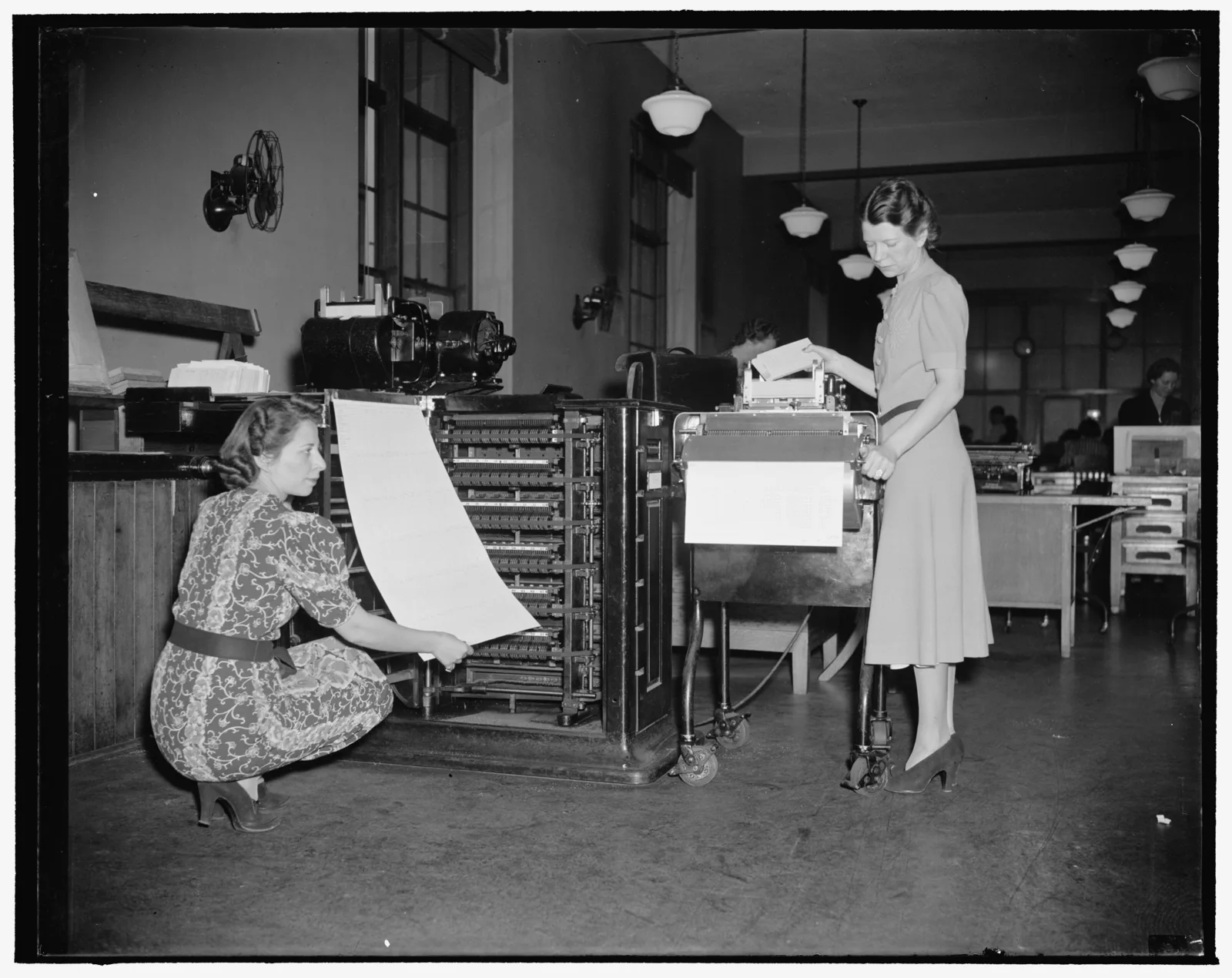
One Sentence in the Constitution, Two and a Half Centuries of Consequences
The census began as a single constitutional requirement, count everyone every ten years, with almost no detail about how. Every part of the modern system, the permanent bureau, the fixed House size, the mail-in questionnaire, grew out of practical crises Congress had to solve along the way.
Article I, Section 2 of the Constitution requires an "actual Enumeration" of the population every ten years, the single sentence that created the census as a permanent constitutional institution rather than a one-time colonial exercise. The framers needed it to solve a specific problem at the Constitutional Convention: how to divide House seats and direct taxes fairly among states of wildly different populations, and the compromise language they settled on originally counted enslaved people as three-fifths of a person for these purposes, a provision later nullified by the 14th Amendment in 1868.
The Constitution does not specify how the count should actually be conducted, leaving Congress broad latitude that has been exercised very differently across the 24 censuses taken since, from door-to-door U.S. Marshals in 1790 to online response portals in 2020.
The three-fifths ratio was borrowed from a 1783 proposal under the Articles of Confederation for apportioning tax requisitions among the states, then repurposed at the 1787 Convention to also govern House representation. Madison's convention notes record the trade as explicit: Southern delegates accepted a population basis for direct taxes in exchange for counting three-fifths of enslaved people toward representation.
The clause fixed the first census "within three Years after the first Meeting of the Congress" and every ten years after, making the United States the first nation to constitutionally require a regular population count tied to political representation. Congress has never missed the decennial count, though once, after 1920, it failed to act on the results.
U.S. Marshals and their assistants conducted the first census in 1790 under Secretary of State Thomas Jefferson's supervision, counting roughly 3.9 million people across the original states and territories with just six questions per household, far fewer than any census since. There was no census bureau, no printed forms in the modern sense, and no statistical staff; marshals simply rode their districts, asked the required questions, and returned handwritten tallies to Philadelphia, then the national capital.
The original 1790 census returns for several states, including Virginia, were later lost, most likely destroyed when British troops burned Washington in 1814. The National Archives has since reconstructed partial population figures for some of those states using surviving tax and other secondary records.
The six questions recorded the household head's name and counts of free white males 16 and older, free white males under 16, free white females, all other free persons, and slaves. Both Washington and Jefferson privately believed the 3.9 million total undercounted the true population, an early instance of the undercount concern that still shadows the census.
Marshals were paid by results and worked without standardized forms until 1830, buying their own paper and ruling their own columns. The 1790 count produced the first reapportioned House of 105 members and set direct-tax shares, and Jefferson sent the printed results to European governments as evidence of American growth.
For its first century, the census was run by a temporary office reassembled from scratch every ten years, with no permanent staff, no institutional memory, and no ability to conduct research between counts. Congress created a permanent Census Bureau in 1902, later folded into the Department of Commerce, giving the country its first standing statistical agency dedicated to demographic and economic data collection year-round rather than only once a decade.
The 1902 act followed decades of criticism that temporary census offices, reassembled with new staff every ten years, produced inconsistent and error-prone counts. The new permanent bureau also absorbed responsibility for a growing list of ongoing economic censuses, including manufacturing and agriculture, that had previously been scattered across other agencies.
The temporary 1890 census office had hired roughly 47,000 people and then disbanded entirely, losing its trained staff and its punch-card tabulating expertise, which Herman Hollerith had pioneered for that count on machines that later grew into IBM. Rebuilding from zero each decade was the specific inefficiency the 1902 law targeted.
Placed in the new Department of Commerce and Labor in 1903, the permanent bureau took on the economic censuses of manufactures, agriculture, and mining and began issuing annual statistical abstracts. It has operated continuously since and is now the largest statistical agency in the federal government.
After Congress notoriously failed to reapportion House seats at all following the 1920 Census, lawmakers passed the Permanent Apportionment Act of 1929, fixing the House at 435 seats and creating an automatic process that no longer required a fresh vote of Congress every decade. The law initially left open which mathematical formula should divide those seats among the states; Congress settled the question in 1941 by adopting the method of equal proportions, developed by Harvard mathematician Edward Huntington, as the permanent, binding apportionment formula, detailed further in the Apportionment Mechanics tab.
Congress had experimented with several competing apportionment formulas in earlier decades, including methods associated with Thomas Jefferson, Alexander Hamilton, and Daniel Webster, each of which could occasionally assign a seat differently from the exact same census numbers, before settling on Huntington's method as the more mathematically consistent choice in 1941.
The 1929 Act made reapportionment automatic: after each census the President sends Congress a statement of each state's population and the resulting seat count under the method used in the previous apportionment, and the new numbers take effect unless Congress affirmatively passes a different law within a set period. Congress has never overridden the automatic result since.
The 1941 choice of equal proportions was informed by a National Academy of Sciences panel that compared the rival methods and found Huntington's minimized the relative difference in district size between any pair of states. The same 1941 law fixed the count of automatic seats at one per state and the total at 435, the figures still in force.
Beginning with the 1970 Census, the Bureau shifted its primary counting method from door-to-door enumerators visiting every household to mailed paper questionnaires that most households filled out themselves and returned by mail, with in-person follow-up reserved for non-responding addresses. This "mailout-mailback" model dramatically cut costs and became the dominant method for the next five decades, though rural and some hard-to-count areas continued to rely more heavily on in-person enumeration.
The shift sharply reduced the number of temporary enumerators the Bureau needed to hire nationwide compared with earlier door-to-door censuses, though it also introduced new self-response accuracy concerns that later censuses tried to address through expanded advertising and community outreach programs.
The 1960 census had piloted mail delivery of forms in a few areas; 1970 made mailout-mailback the primary method for about 60 percent of the population, mostly in urban areas with reliable postal address lists, while rural areas still received enumerator visits. Mail response that year was about 78 percent.
The change moved the census from an interview conducted by a stranger to a form filled out in private, which researchers credit with improving candor on income and household-relationship questions. Self-response has been the backbone of every census since, and the enumerator workforce shrank from roughly 160,000 in 1960 toward a smaller core plus follow-up staff.
The 2020 Census was the first in American history to actively invite every household to respond online or by phone as the primary method, with paper forms still mailed to homes but promoted as a secondary option, and it was also the first census conducted amid a global pandemic, which forced the Bureau to delay and compress its field operations. It became one of the most legally contested censuses in decades, discussed in detail in the Undercounts & Legal Fights tab, over both a proposed citizenship question and a new statistical privacy method.
Roughly two-thirds of households ultimately self-responded to the 2020 Census, a rate the Bureau considered solid given the pandemic disruption, with online responses accounting for the majority of all self-responses for the first time in the census's history.
The Bureau spent much of the 2010s building and testing an internet instrument and a re-engineered field-management system, and a 2018 end-to-end test in Providence County, Rhode Island was the only full dress rehearsal after budget limits cancelled two other planned test sites. About 80 percent of self-responses in 2020 came online, with phone and paper making up the rest.
COVID-19 forced the Bureau to suspend field operations in March 2020, extend the self-response window, and compress Nonresponse Followup into the fall. It delivered apportionment counts on April 26, 2021, nearly four months past the usual December 31 deadline, and the detailed redistricting file in August 2021 rather than April.
Counting 330 Million People Is Harder Than It Sounds
A constitutional requirement to count everyone sounds simple until you consider the logistics: hundreds of millions of people, hard-to-reach populations, strict legal deadlines, and a confidentiality guarantee that has to survive contact with the rest of the federal government. Here's how the Bureau actually pulls it off.
The census is not a program Congress could simply defund or skip; it is a direct constitutional obligation under Article I, Section 2, which requires an actual enumeration of the population every ten years, with the first having taken place "within three Years after the first Meeting of the Congress." That same clause is also the source of the House's apportionment among the states, meaning the count and the political consequences that flow from it have been constitutionally linked since the founding.
Because the requirement is constitutional rather than statutory, Congress cannot cancel a census outright, though it does set the detailed rules for how the Census Bureau conducts it through Title 13 of the U.S. Code, and it controls the Bureau's budget, which has been a recurring point of political leverage over how well-funded and how accurate a given census turns out to be. Underfunding a census in the years leading up to it, as happened heading into the 2020 count before Congress restored funding, can directly compromise field testing, address-list updates, and outreach in hard-to-count communities.
Title 13 directs the Secretary of Commerce to take the census "in such form and content as he may determine" and to report the population totals to the President within nine months of Census Day. It also authorizes the mid-decade economic censuses and the American Community Survey, and it makes census response legally mandatory, though prosecutions for non-response are effectively unheard of.
Funding follows a predictable curve, low in the early planning years and peaking in the year of the count. The Government Accountability Office placed the 2020 Census on its High Risk List in 2017 after early-decade budgets fell short and two of three planned field tests were cancelled; Congress restored funding in 2018 and 2019, and the count proceeded.
The census uses a "usual residence" rule: people are counted at the place where they live and sleep most of the time as of Census Day, April 1st of the census year, regardless of citizenship or immigration status. This means the census counts every person residing in the United States, citizens and non-citizens alike, a design choice rooted in the Constitution's own text, which refers to counting the "whole Number of free Persons" and, after the 14th Amendment, simply the "whole number of persons," not the whole number of citizens or voters.
Special residence rules apply to specific groups: U.S. military personnel and federal civilian employees stationed overseas are counted in their home state of record for apportionment purposes even though they are physically abroad on Census Day, while college students are counted at their school address rather than their parents' home, and people in institutional settings such as prisons, nursing homes, and college dormitories are counted at that facility under a "group quarters" enumeration process distinct from ordinary household counting. Short-term visitors and foreign tourists are explicitly not counted at all.
The "whole number of persons" standard was tested and upheld in Evenwel v. Abbott (2016), where the Supreme Court unanimously rejected an argument that Texas had to draw state legislative districts by eligible-voter population rather than total population. Total population, including children and non-citizens, remains the constitutional basis for both apportionment and redistricting.
Before each census the Bureau publishes a detailed "Residence Criteria and Residence Situations" rule resolving edge cases: a newborn alive on April 1 is counted, a person who died after April 1 is still counted, and someone with two homes is counted where they spend most of the year. A 2020 attempt to exclude unauthorized immigrants from the apportionment base was left unresolved when the administration changed before the Supreme Court ruled on the merits in Trump v. New York.
Every census since 1970 has relied primarily on self-response: households receive an invitation to complete the questionnaire themselves, by mail, phone, or, since 2020, online, using an address the Bureau has compiled and continually updated between census cycles. The Bureau considers a strong self-response rate essential to accuracy and cost control, since self-response is both cheaper and, in aggregate, more reliable than data collected through follow-up visits.
For every address that does not self-respond after repeated mail reminders, the Bureau deploys temporary field workers for a phase called Nonresponse Followup, or NRFU, who visit the address in person, sometimes multiple times, to obtain the count directly from a resident or, failing that, from a neighbor, landlord, or administrative records as a last resort. NRFU is the single most expensive and logistically demanding part of the entire census operation, historically requiring the temporary hiring of several hundred thousand workers nationwide for a period of only a few months.
The Bureau builds and maintains the Master Address File year-round, partly through a program in which local and tribal governments review and correct the address list for their area. In 2020 the initial self-response invitation went to about 143 million housing units.
NRFU in 2020 employed roughly 500,000 temporary workers, fewer than earlier plans because the Bureau expanded its use of a proxy response from a knowledgeable neighbor and of administrative records from the IRS, Social Security, and other agencies to resolve stubborn non-responding addresses. Enumerators used smartphones with a route-optimization app, a first for the census.
Title 13 of the U.S. Code makes it a federal crime, punishable by fine and imprisonment, for any Census Bureau employee to disclose individually identifiable census responses to any other person or agency, including other parts of the federal government, for any purpose other than the statistical work Title 13 itself authorizes. Individual responses are sealed from public release, including from courts, law enforcement, and immigration authorities, for 72 years under a separate law, after which the National Archives releases the original historical records for genealogical and research use.
This confidentiality wall is not merely a policy preference the Bureau could waive; it is the legal foundation the Bureau relies on to argue, including in litigation over the 2020 citizenship question discussed in the Undercounts & Legal Fights tab, that response data cannot lawfully be used against a respondent. Critics of specific proposed questions have argued the legal protection may not fully overcome respondents' practical fear of answering honestly, a distinction between what the law promises and what a nervous household actually believes.
The penalty under Title 13 is up to five years in prison and a fine of up to $250,000. Since 1954 the Bureau has been barred from sharing responses with any other agency, a wall Congress strengthened after Bureau data was used during World War II to help identify Japanese American neighborhoods for internment, a use then legal under a wartime suspension of the confidentiality rule and now prohibited.
The 72-year rule, set by a 1978 agreement between the Bureau and the National Archives and later codified, keeps individual records sealed for 72 years; the 1950 census records were released in April 2022. Aggregated statistics appear far sooner, but only after disclosure-avoidance processing so no individual can be identified from a small-area table.
Beyond ordinary households, the Bureau runs distinct, specialized operations for populations that don't fit a normal mail-and-visit model. "Group quarters" enumeration covers people living in prisons, nursing homes, college dormitories, military barracks, and similar institutional settings, coordinated directly with each facility's administration rather than through an individual household questionnaire. A separate, intensive operation called Service-Based Enumeration counts people experiencing homelessness by visiting shelters, soup kitchens, and known outdoor locations over a short, specifically scheduled window, since this population cannot be reached through a mailed address list at all.
The Bureau also runs targeted outreach for other historically undercounted groups, including rural and remote populations counted through an "Update Leave" process where a worker drops off a questionnaire rather than relying on mail delivery, and tribal lands enumerated in direct partnership with tribal governments. Despite these specialized operations, the Bureau's own post-census accuracy studies, covered in the Undercounts & Legal Fights tab, have repeatedly found that several of these same populations remain measurably undercounted relative to the general population.
Group-quarters enumeration in 2020 covered about 8 million people in roughly 300,000 facilities. Prisoners are counted at the correctional facility, a rule that shifts population and therefore representation toward the mostly rural areas where prisons sit, which is why roughly a dozen states now reallocate incarcerated people to their last home address for their own redistricting.
Service-Based Enumeration in 2020 ran September 22 to 24, counting people at shelters, food vans, and pre-identified outdoor locations. Update Leave, in which a worker hand-delivers a questionnaire where there is no city-style mail delivery, covered about 6.5 million housing units, and enumeration on tribal lands is done in consultation with each tribal government, which can choose the method used.
A modern decennial census is one of the largest temporary undertakings the federal government runs in any form. The 2020 Census cost the federal government roughly $15.6 billion across its full decade-long cycle of planning, testing, execution, and data processing, according to the Government Accountability Office, making it the most expensive census in American history in nominal terms, though not necessarily after adjusting for population growth and inflation compared to earlier counts.
To conduct the actual count, the Bureau temporarily hired several hundred thousand short-term enumerators and support staff, a hiring surge so large that census employment briefly shows up as a measurable, if temporary, bump in national jobs data every ten years. Recruiting enough workers, especially for the door-to-door Nonresponse Followup phase, has become steadily harder each cycle, a challenge the Bureau has met partly by raising pay rates in hard-to-recruit areas and partly by expanding the use of administrative records, such as tax and benefit-program data already held by other federal agencies, to fill in counts for addresses that never respond at all.
The GAO's roughly $13.7 billion early life-cycle estimate for 2020 rose over the decade to about $15.6 billion, driven by IT development, pandemic-related field costs, and workforce shortfalls. Adjusted per housing unit counted, cost has risen every decade since 1970, a major reason the Bureau pushed the cheaper internet response option.
The 1950 census employed about 140,000 temporary workers; 1990 peaked near 500,000; 2000 hired about 850,000; and 2010 about 635,000. Because these workers are on the payroll for only a few weeks in spring, Bureau of Labor Statistics analysts routinely note and seasonally adjust for the temporary spike in federal employment in census years.
A Fixed Number of Seats, a Growing Country
The House has had exactly 435 seats since 1929, so every ten years the same fixed pool has to be redivided among a country that keeps growing and shifting. The math behind that redivision is precise, largely invisible to voters, and has real winners and losers every single cycle.
The House of Representatives grew steadily in size for the country's first 140 years, roughly tracking population growth, reaching 435 seats after the 1910 Census. Following the 1920 Census, Congress deadlocked over how to reapportion those seats without shrinking any state's existing delegation and simply never passed a reapportionment law at all, the only decade in American history this happened, leaving the House unchanged through the entire 1920s despite a full new census having been taken.
The Permanent Apportionment Act of 1929 resolved the crisis by fixing the House permanently at 435 seats (with brief, temporary exceptions when Alaska and Hawaii were admitted as states in 1959) and establishing an automatic formula so Congress would never again have to hold a fresh vote to reapportion. One direct consequence, largely invisible to most voters, is that the average congressional district has grown enormously since 1929: from roughly 280,000 people per district after the 1930 Census to more than 760,000 people per district after the 2020 Census, since the House itself cannot grow to keep pace with the national population.
The House grew from 65 members in 1789 to 105 after the 1790 census and kept expanding roughly every decade so that no state would have to lose seats, reaching 386 after 1900 and 435 after 1910. The 1911 law that set 435 also required districts to be contiguous, compact, and roughly equal in population; the block-level data states now use to draw equal districts came later, under a 1975 law (P.L. 94-171).
Alaska and Hawaii temporarily raised the House to 437 in 1959, but it reverted to 435 at the next apportionment in 1963. Since then, every reapportionment reshuffles the same 435 seats, so a seat gained by one state is always a seat lost by another, which is why the process is politically zero-sum among the states.
Since 1941, apportionment has used a single, congressionally mandated mathematical formula called the method of equal proportions, developed by Harvard mathematician Edward Huntington building on earlier work by Joseph Hill, a Census Bureau statistician. The method starts by giving every state its constitutionally guaranteed first seat automatically, then assigns each remaining seat, one at a time, to whichever state has the highest "priority value" at that moment, a number calculated by dividing the state's population by the geometric mean of its current and next seat count. This process repeats 385 times (435 seats minus the 50 automatic first seats) until every seat is assigned.
Congress had experimented with several competing apportionment formulas earlier in its history, including methods developed by Thomas Jefferson, Daniel Webster, and Alexander Hamilton, each of which can produce a slightly different seat allocation from the same census numbers and which occasionally produced paradoxical results, such as a state losing a seat even though its population grew faster than the national average. The method of equal proportions was chosen specifically because it minimizes the relative difference in representation per person between any two states better than the alternatives Congress had tried, and it has remained the binding legal standard for every apportionment since 1941 without further congressional revision.
The priority-value list is computed once and used to hand out seats 51 through 435 in descending order. In 2020 the 435th and final seat went to Minnesota, which kept its eighth seat by an estimated 26 people; the 436th seat, the first that would have been assigned had the House been larger, would have gone to New York.
Because the method is fixed by the 1941 statute, apportionment is essentially arithmetic once the state totals are certified, and the Bureau publishes the full priority-value table so the result can be independently checked. The last serious congressional debate over changing the method was in the 1940s; proposals to switch to the Webster method surface occasionally but have never advanced.
Article I, Section 2 guarantees every state at least one representative in the House no matter how small its population, a floor that overrides whatever the equal proportions formula would otherwise produce for the very smallest states. This is why Wyoming, the least populous state, has exactly one House seat despite having a population smaller than many individual congressional districts elsewhere in the country, while Montana, only slightly more populous, has grown to two seats as of the 2020 apportionment.
This guarantee creates a measurable, and constitutionally unavoidable, disparity in representation per capita between the smallest and largest states, since Wyoming's single district represents roughly 580,000 people while Delaware's single district, the nation's largest, represents nearly 990,000, and districts in multi-district states average about 760,000, all drawn from the same fixed pool of 435 seats. The disparity has been challenged in court more than once, including a case brought after the 2000 Census, but the Supreme Court has consistently upheld it as flowing directly from the Constitution's own explicit text rather than from any statute Congress could be ordered to fix.
Six states held exactly one seat after the 2020 census: Alaska, Delaware, North Dakota, South Dakota, Vermont, and Wyoming, while Montana moved back to two. A single-seat state is not redistricted for the House at all; its entire population is one at-large district.
The Supreme Court dismissed a challenge to the apportionment method and the one-seat floor in Department of Commerce v. Montana (1992), holding that the choice among reasonable apportionment methods is committed to Congress and that Montana had no constitutional right to a second seat. The roughly two-to-one range in district size between the smallest and largest states therefore stands.
The 2020 apportionment, announced by the Census Bureau in April 2021, shifted seats among 13 states. Texas gained two seats, and Colorado, Florida, Montana, North Carolina, and Oregon each gained one, reflecting a broader multi-decade population shift toward the South and West. California lost a House seat for the first time in its history as a state, a symbolically significant reversal for the state that has gained seats after nearly every census since statehood, and Illinois, Michigan, New York, Ohio, Pennsylvania, and West Virginia each lost one seat as well.
Several of these shifts were exceptionally close under the equal-proportions formula: New York, for example, missed retaining its 27th seat by a margin the Census Bureau calculated at just 89 people statewide, an outcome close enough that it fed directly into disputes discussed in the Undercounts & Legal Fights tab over whether specific populations were undercounted in ways that could have changed the seat count. Because apportionment directly sets each state's Electoral College vote total as well, discussed further below, these same 2020 shifts also altered the presidential electoral map for the 2024 and 2028 elections.
The 2020 shifts were the smallest in modern history: only seven seats changed hands, versus twelve after 2010 and seventeen after 1980. Texas's gain of two brought it to 38 seats and 40 electoral votes, and Florida reached 28 seats.
On the losing side, California fell to 52 seats and New York to 26. West Virginia's loss continued a long decline from a peak of six seats in the 1950s to two, and the reshaped Electoral College first applied in the 2024 presidential election.
Federal law sets specific delivery deadlines that turn the raw headcount into usable political numbers on a strict schedule. The Census Bureau must deliver the national apportionment totals, the actual new seat count for every state, to the President by December 31st of the census year, who then transmits them to the new Congress convening in January. The more detailed, block-level population data states actually need to redraw district lines, called the redistricting data (P.L. 94-171) file, follows separately, with a statutory deadline of April 1st of the year after the census.
This staggered schedule means states typically have less than a full year between receiving usable redistricting data and needing final maps in place ahead of the next regular election cycle, a genuinely tight window that has occasionally been disrupted further, as it was after the 2020 Census when pandemic-related delays pushed the detailed data's delivery back several months past its usual date, compressing many states' redistricting timelines even more than usual.
The P.L. 94-171 file, named for a 1975 law, breaks the country into roughly 8 million census blocks with counts by race, ethnicity, voting age, and housing occupancy, the detail states need to comply with the Voting Rights Act and the equal-population rule.
After 2020 the pandemic pushed apportionment delivery to April 26, 2021 and the redistricting file to August 12, 2021, compressing the window before 2022 primaries. Several states with early-2022 candidate-filing deadlines had to move them or run under court-drawn interim maps.
Because the House has been frozen at 435 seats since 1929 while the national population has nearly tripled over the same period, from about 123 million in 1930 to more than 331 million in 2020, the average congressional district has grown from roughly 280,000 constituents to more than 760,000, making U.S. House districts among the largest, per representative, of any national lower legislative chamber in the world's major democracies.
This has become its own point of political debate distinct from redistricting or apportionment method disputes: advocacy groups and some members of Congress periodically propose expanding the House itself, often citing the "Wyoming Rule," a proposal to set the House's total size so that even the smallest state's single district matches the average size elsewhere, which would require several hundred additional seats under current population figures. No such expansion has been seriously taken up by Congress since the 435 seat cap was set in 1929, making it, along with the D.C. statehood debate it sometimes gets linked to, one of the more durable pieces of unfinished business in the modern apportionment system.
At the first census the ratio was about one representative per 34,000 people; the 1929 cap froze the ratio, and it now stands near one per 761,000. The U.S. has the largest population-per-lower-house-member of any OECD democracy, compared with roughly one per 100,000 in the United Kingdom and one per 116,000 in Germany.
Expansion proposals include the Wyoming Rule (about 573 seats under 2020 numbers), the cube-root rule favored by some political scientists (about 692 seats), and a 2020 recommendation by the American Academy of Arts and Sciences' Commission on the Practice of Democratic Citizenship to add at least 150 seats. None has come to a vote, and enlarging the chamber would require only a statute, not a constitutional amendment.
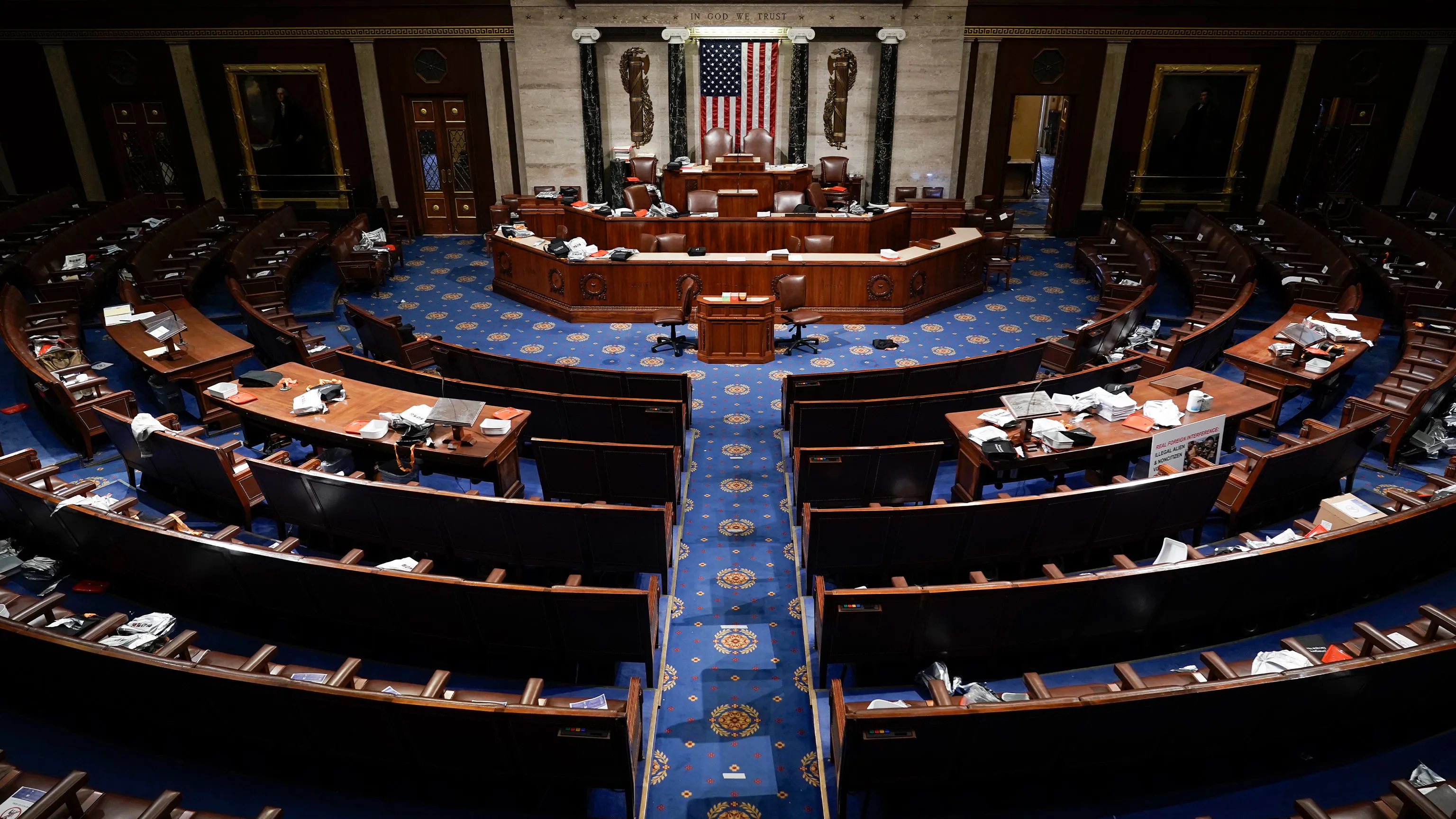
The House chamber holds exactly 435 voting members, a size fixed by law since 1929 regardless of how much the national population grows between censuses.
The Count Reaches Far Past the House Floor
Congressional apportionment is the most visible consequence of the census, but it is far from the only one. The same headcount sets the Electoral College map, supplies the raw material for every redistricting fight in the country, and steers trillions of dollars in federal spending most Americans never connect back to a census form.
Census data does far more than decide House seats; it is the statistical backbone for how the federal government distributes an enormous share of its annual spending. The George Washington Institute of Public Policy has estimated that census-derived data guides the distribution of roughly $2.8 trillion per year in federal funds across more than 100 major programs, including Medicaid, the Supplemental Nutrition Assistance Program (SNAP), Title I education funding for low-income schools, Section 8 housing assistance, and federal highway construction formulas.
Because most of these formulas key directly off population counts, poverty rates, age distribution, or other census-derived statistics for a specific city, county, or state, an undercount in a given area does not just cost that area political representation, it can measurably reduce the federal funding that community receives for the entire following decade, since most of these formula programs are not retroactively corrected between censuses. This funding dimension is a central reason advocacy groups devote so much effort to encouraging census participation in historically undercounted communities, independent of the count's effect on congressional apportionment.
The Counting for Dollars project at George Washington University identified 353 federal programs that used census-derived data to distribute about $2.8 trillion in fiscal 2021, up from 316 programs in fiscal 2016. The five largest by dollar value are Medicaid, the Medicare Part B premium subsidy, SNAP, highway planning and construction grants, and Section 8 housing vouchers.
Researchers there estimated that each person missed in the 2010 census cost their state an average of roughly $1,800 per year in reduced federal funding over the following decade, though the figure varies widely by state because the formulas interact. Because most formula grants are not recalculated between censuses, an undercount's fiscal cost compounds for ten years.
A state's Electoral College vote total is not calculated independently; it is simply the state's number of House seats plus its two senators, which means every ten-year apportionment shift automatically and immediately changes the presidential electoral map for the following two presidential elections. When Texas gained two House seats after the 2020 Census, it correspondingly gained two electoral votes, while California's loss of a House seat cost it an electoral vote as well.
This link between the census and presidential elections is why apportionment fights, including the citizenship-question and differential-privacy disputes covered in the Undercounts & Legal Fights tab, routinely draw the same kind of intense partisan and legal attention as a redistricting fight over individual congressional districts, even though apportionment itself only decides how many seats and electoral votes each state gets, not where any district line is actually drawn.
The link means the census indirectly shapes presidential outcomes, since the same election held under a different decade's apportionment would carry a different Electoral College margin. Analysts noted that the 2020 reapportionment added net electoral votes to several states that had recently leaned Republican, though the effect on any specific future election depends on how those states actually vote.
The District of Columbia is a special case: it is enumerated in the census and, under the 23rd Amendment, receives electoral votes equal to the smallest state (three), but it has no voting House seat and its residents are not part of any state's apportionment population. U.S. territories are counted in their own censuses but receive neither House seats nor electoral votes.
Every congressional and state legislative district in the country is drawn using the Census Bureau's block-level redistricting data file, the same P.L. 94-171 dataset referenced in the Apportionment Mechanics tab, which breaks the entire country down into census blocks, the smallest geographic unit the Bureau tabulates, each with its own official population count. State and independent redistricting commissions build district maps by assembling these blocks into larger district shapes that must, under most states' rules, contain equal population.
Because this file is the sole official population source used for redistricting nationwide, any undercount or overcount in a specific community does not just affect that community's own representation, it can shift how many people effectively "belong" to a neighboring district once maps are redrawn, a dynamic explored in far more depth on this site's dedicated Redistricting & Gerrymandering page, which covers how mapmakers actually use this data to build district lines.
The P.L. 94-171 file was created by a 1975 law so states would have a uniform, block-level dataset with the racial and voting-age detail needed to comply with the Voting Rights Act. Before 1975, states pieced district populations together from whatever local data they had, producing wide inconsistencies.
The 2020 file was the first processed with differential privacy, and several states' redistricting offices reported that counts for very small or sparsely populated blocks were noisier than in 2010, though the Bureau's rules keep state and county totals exact. Courts in the 2020s redistricting cycle generally accepted the file as the controlling population source despite those objections.
The decennial census itself asks a deliberately short list of questions, primarily just counting people and basic demographics, precisely because it must reach the entire population. Detailed questions about income, employment, commute times, housing costs, and disability status instead come from the American Community Survey (ACS), a separate, continuous survey the Census Bureau has run since 2005 that samples a rotating few million households every year rather than counting everyone at once.
Confusing the two is common but they serve distinct legal purposes: only the decennial census count is used for congressional apportionment, while ACS data feeds many of the detailed federal funding formulas described above and is the source for the far more granular demographic and economic statistics researchers, journalists, and local governments cite about specific communities between census years.
The ACS replaced the decennial census "long form," which through 2000 had gone to about one in six households. The ACS samples roughly 3.5 million addresses a year and pools responses into one-year estimates for larger areas and five-year estimates for areas as small as a census tract or block group.
Because it is a sample rather than a full count, every ACS figure carries a published margin of error, and for small areas those margins can be large. Response to the ACS is legally mandatory like the decennial census, and it is the source for widely cited statistics on poverty, health-insurance coverage, commuting, language, and housing-cost burden.
Every state also uses decennial census data to reapportion its own state legislative chambers, state house and state senate districts, applying the one-person-one-vote principle the Supreme Court established for state legislatures in Reynolds v. Sims (1964). Unlike congressional apportionment, which uses the single nationally mandated method of equal proportions, states are free to set their own rules for how state legislative seats are allocated among counties or regions, so long as the resulting districts are reasonably equal in population.
This means a single census count effectively triggers dozens of separate, simultaneous redistricting processes nationwide every ten years, one federal congressional map per state plus two state legislative chamber maps in most states, all built from the same underlying block-level data but governed by each state's own distinct constitutional and statutory rules.
Reynolds v. Sims (1964) and Wesberry v. Sanders (1964) together required both houses of a state legislature and U.S. House districts within a state to be drawn to near-equal population, ending the era when rural counties held disproportionate power in many statehouses. State legislative districts are allowed somewhat more population deviation, generally up to about 10 percent total, than congressional districts, which courts hold to near-zero deviation.
About a dozen states now use independent or bipartisan commissions rather than the legislature to draw some or all maps, following ballot initiatives in Arizona (2000), California (2008 and 2010), Michigan (2018), and Colorado (2018). Each still builds its maps from the same P.L. 94-171 census file.
Census and American Community Survey data are also foundational to decisions well outside government itself. Retailers and real estate developers use small-area population and income data to decide where to open new stores or build housing; emergency management agencies use household and age-distribution data to plan evacuation routes and disaster response resources; and public health researchers rely on the same data to identify underserved areas for clinics and outreach programs.
Because so much of the private economy quietly depends on this data being accurate and current, business and civic groups, not just political advocacy organizations, have historically joined census outreach and "get out the count" campaigns, an unusual coalition that spans the political spectrum precisely because the data's usefulness is not itself a partisan matter, even when specific census questions or methods, covered next, have become deeply partisan fights.
The Bureau also runs the Economic Census every five years and the Annual Business Survey, and its County Business Patterns and population-estimates programs are used to define market areas, site retail and health facilities, and calibrate the samples for nearly every other national survey, public and private.
This is why groups like the U.S. Chamber of Commerce, the National Association of Realtors, and local United Way chapters have funded complete-count campaigns alongside civil rights organizations, a coalition unusual in American public life for spanning the political spectrum, united by a shared interest in data accuracy rather than any policy position.
A Count This Consequential Was Never Going to Be Uncontested
Because so much money and political power ride on the exact numbers, the census has been a recurring target of legal and political fights for more than two centuries, from the constitutional compromise over how to count enslaved people to a 2019 Supreme Court fight over a single proposed question.
The Constitution's original apportionment formula counted each enslaved person as three-fifths of a free person for the purposes of both representation and direct taxation, a deliberate compromise between Southern delegates who wanted enslaved people counted fully to boost their states' representation and Northern delegates who objected to counting enslaved people as "population" at all, given they had no political rights. The provision inflated the political power of slaveholding states in the House and the Electoral College for eight decades. Section 2 of the 14th Amendment, ratified in 1868, formally repealed the three-fifths clause and required the "whole number of persons" be counted in every state, the constitutional language still in force today.
Historians estimate the clause gave slaveholding states roughly a dozen extra House seats, and a matching number of Electoral College votes, by the early 1800s beyond what a count of only free persons would have produced.
The clause's effect was concrete in early national politics: the added Southern House seats and electoral votes are why historians have argued it tipped the 1800 presidential election to Thomas Jefferson, whose critics called him the "Negro President" for that reason, and it shaped the selection of Speakers and the makeup of House committees for decades.
Section 2 of the 14th Amendment replaced the three-fifths rule with a full count of "the whole number of persons in each State" and added a never-enforced penalty reducing a state's representation if it denied the vote to adult male citizens. The full-count language is the standard still applied, and it means apportionment counts everyone regardless of citizenship or voter eligibility.
Following the 1920 Census, which for the first time showed a majority of Americans living in urban rather than rural areas, Congress deadlocked over reapportioning House seats and, remarkably, never passed a reapportionment law at all that decade. Rural-state representatives, who stood to lose seats to fast-growing cities, blocked action for years, leaving the House's composition unchanged from the 1910 apportionment for the entire 1920s despite a fresh constitutional census having been completed. The episode directly led to the Permanent Apportionment Act of 1929, discussed in the Overview tab, which was designed specifically to make sure this kind of deliberate congressional inaction could never happen again.
The stalemate was driven largely by rural lawmakers who represented a shrinking share of the national population and had a direct incentive to block any reapportionment that would shift seats toward booming cities like New York and Chicago.
Reapportionment on the 1920 numbers would have moved seats from Southern and Midwestern farm states to industrial states with large immigrant populations, which nativist arguments about the immigrant share of city populations were used to resist. Bills passed the House in 1921 and 1927 but died in the Senate or in conference.
The failure meant the 1924 and 1928 presidential elections used an Electoral College based on 1910 population. The 1929 Act's automatic mechanism was the direct fix, and reapportionment has happened on schedule every decade since.
Ahead of the 2000 Census, the Census Bureau proposed using statistical sampling to adjust the final count for a well-documented undercount problem, primarily affecting racial minorities, renters, and children, that traditional door-to-door counting had never fully solved. In a 5-4 decision, the Supreme Court ruled that federal law governing congressional apportionment specifically requires an actual enumeration rather than a statistically adjusted estimate, barring the Bureau from using sampling to adjust the official apportionment count, though the ruling left the door open to using sampling for other statistical purposes not tied to apportionment itself.
Because the ruling turned on a technical reading of the Census Act rather than the Constitution itself, Congress could in theory authorize sampling for apportionment purposes in the future simply by amending the statute the Court interpreted, an option it has not exercised since.
The Bureau's plan would have used a large post-census sample survey to correct the head count before apportionment, projecting it would recover several million people missed disproportionately in minority, renter, and child populations. The House sued, and the case was decided months before the 2000 count began.
The 5-4 majority read the Census Act's 1976 amendments as permitting sampling for most purposes but the older "actual Enumeration" language and a specific proviso as forbidding it for apportionment. The Bureau then counted 2000 by traditional methods and separately published, but did not use, sample-adjusted numbers, making the same choice again in 2010 and 2020.
Utah sued after narrowly missing an additional House seat to North Carolina following the 2000 Census, arguing the Bureau's use of "hot-deck imputation," a statistical method for estimating the number of residents at addresses where no direct response could be obtained, amounted to the same kind of prohibited sampling the Court had barred in the 1999 case. The Supreme Court disagreed, upholding imputation as a permissible, narrower method distinct from broad statistical sampling, allowing North Carolina to keep the seat Utah had sought.
Utah separately argued that Mormon missionaries and other U.S. citizens stationed overseas should be counted toward its population the same way military personnel are, a related claim the courts also rejected, one of several state-level fights the case set off over exactly who counts as a state's population.
Utah trailed North Carolina for the 435th seat by 856 people. It contended that imputation, filling in a count for an address when repeated visits yield nothing by copying data from a similar nearby household, was unlawful sampling; the Court held 5-4 that imputation fills gaps in an enumeration rather than replacing it with an estimate, and is permitted.
Utah's companion argument, that its many Latter-day Saint missionaries serving abroad should be counted toward the state as overseas military and federal civilian employees are, also failed, with the Court and the Bureau treating private citizens overseas as outside the apportionment population. Utah gained a fourth seat anyway after the 2010 census through ordinary population growth.
The Trump administration's Commerce Department announced plans to add a citizenship question to the 2020 Census questionnaire for the first time since 1950, a move critics argued, and internal agency documents later suggested, was intended to depress self-response rates in immigrant and Hispanic communities, thereby reducing their counted population and political representation. In a 5-4 decision written by Chief Justice John Roberts, the Supreme Court blocked the question, not on the grounds that a citizenship question would be unconstitutional in principle, but because the administration's stated rationale for adding it, that the Justice Department needed the data for Voting Rights Act enforcement, was, in the Court's words, "contrived" and did not match the evidence in the record.
Commerce Secretary Wilbur Ross had said the Justice Department requested the question, but files later surfaced from a deceased Republican redistricting consultant showing the idea had been proposed years earlier specifically as a way to shift redistricting advantage toward non-Hispanic white voters.
A citizenship question had appeared on the census long-form sample through 2000 but not on the form sent to every household since 1950. The Bureau's own analysis projected that adding it in 2020 would depress self-response in households with noncitizens by several percentage points, driving up costs and still yielding a less accurate count.
Roberts's controlling opinion accepted that a citizenship question is not inherently unconstitutional and that the Secretary has broad discretion over the questionnaire, but held that courts may set aside an agency action when the stated reason is pretextual, and the record showed the Voting Rights Act rationale was contrived. The administration dropped the question in July 2019 rather than pursue a remand.
For 2020, the Census Bureau adopted "differential privacy," a statistical technique that deliberately injects carefully calibrated random noise into published data at small geographic levels to make it mathematically much harder to re-identify individuals by cross-referencing census data with other public datasets, a genuine vulnerability the Bureau's own researchers had demonstrated existed with the 2010 method. Several states and demographic researchers objected that the added noise measurably distorted population figures for small places, particularly small towns and tribal areas, prompting Alabama to sue the Bureau in Alabama v. U.S. Department of Commerce (2021), a challenge a three-judge federal panel ultimately rejected, allowing the Bureau to proceed with differential privacy for the 2020 release.
The Bureau adopted the technique after its own researchers showed that combining published 2010 census statistics with other public and commercial datasets could re-identify specific individuals, a vulnerability that grows more severe every year as the amount of outside data available to cross-reference against keeps expanding.
Differential privacy adds noise governed by a tunable "privacy-loss budget," and the Bureau adjusted that budget several times in 2020 and 2021 in response to comments from states and researchers, keeping state population totals and, ultimately, county totals exact while allowing more noise at the block level.
The three-judge panel in Alabama v. Department of Commerce (2021) found Alabama had not shown concrete injury from the method and that the Bureau's confidentiality obligation under Title 13 justified it. The Bureau has said future censuses and the American Community Survey will continue to use formal privacy methods, with ongoing consultation about the accuracy trade-off for small areas.
The Census Bureau's own Post-Enumeration Survey, an independent quality-check survey conducted after the main count to estimate how accurate it was, found that the 2020 Census undercounted the Black population by an estimated 3.3 percent, the Hispanic or Latino population by 4.99 percent, American Indian and Alaska Native people living on reservations by 5.64 percent, and overcounted the non-Hispanic white population by 1.64 percent and the Asian population by 2.62 percent, broadly consistent with an undercount pattern the Bureau has documented, in varying degrees, in every census for decades.
The 2020 undercount pattern was broadly similar in direction, though not identical in size, to the undercounts documented after the 2010 and 2000 censuses, suggesting the disparities reflect a persistent structural challenge in how the census reaches certain communities rather than a one-time anomaly caused by the pandemic alone.
The Post-Enumeration Survey independently re-canvasses a sample of about 160,000 housing units and matches the results to census records. For 2020 it found the national count had a small, statistically insignificant net overcount of 0.24 percent, masking large offsetting errors: undercounts of Black, Hispanic, and on-reservation Native American residents and young children, and overcounts of non-Hispanic white and Asian residents.
State-level coverage estimates released in 2022 found statistically significant net undercounts in six states, including Texas and Florida, and net overcounts in eight, including Minnesota and New York, meaning some states that gained or lost seats by tiny margins may have done so partly because of coverage error. The Bureau does not adjust the official apportionment or redistricting numbers for these findings; they inform planning for the next census instead.
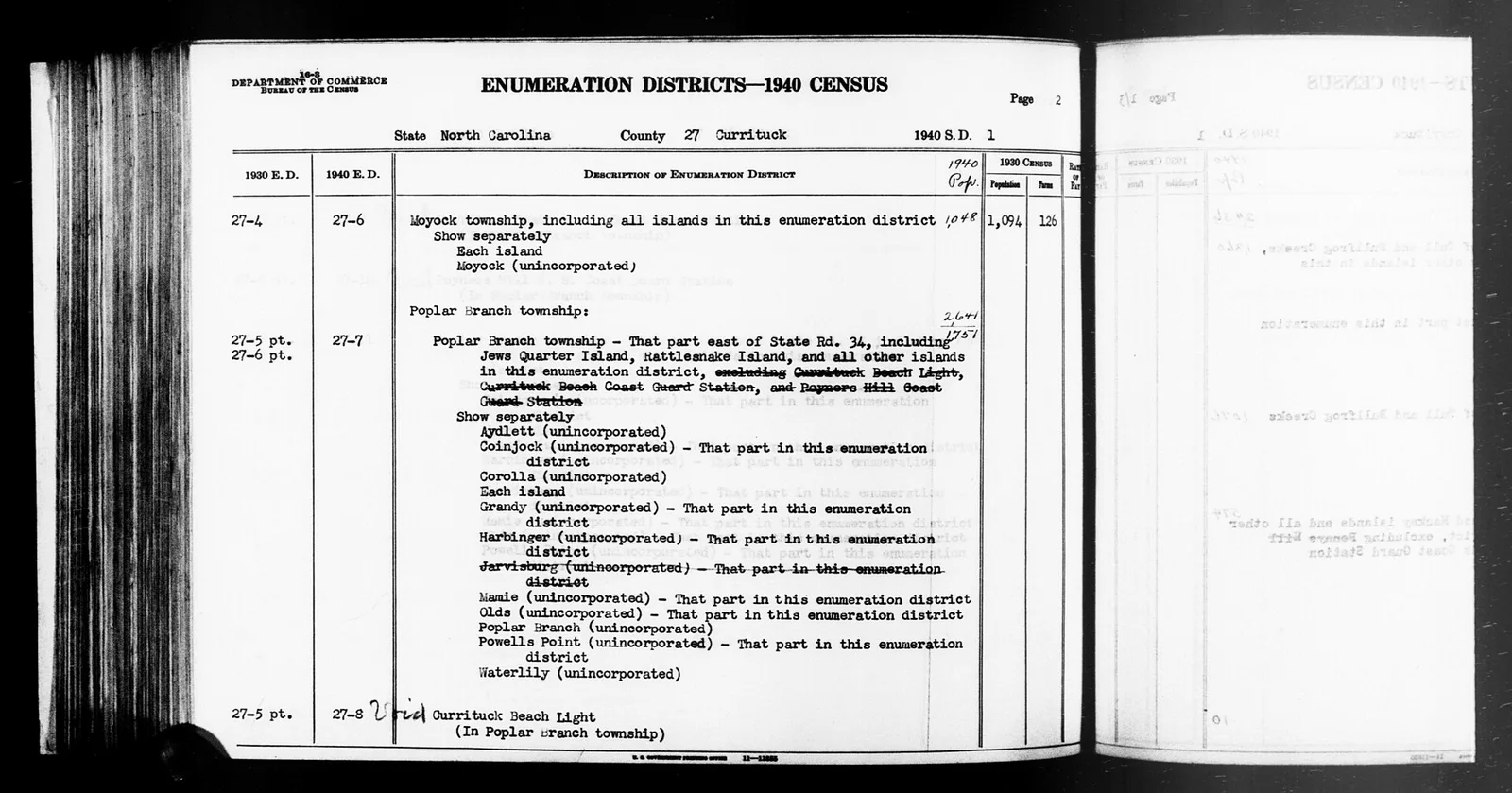
The exact questions on a census form, and who is legally required to answer them, have been a recurring point of dispute since long before the 2020 citizenship question fight.
Ten Facts Worth Knowing
A quick-reference set of facts drawn from the sourced material throughout this page, useful for a fast read or a classroom discussion starter.
The Constitution's original apportionment formula counted each enslaved person as three-fifths of a free person, a provision that inflated slaveholding states' political power for nearly 80 years until the 14th Amendment repealed it in 1868.
Congress simply failed to reapportion House seats at all after the 1920 Census, the only time in American history this has happened, because rural lawmakers resisted shifting power to fast-growing cities.
The House of Representatives has been fixed at 435 seats since 1929, even though the national population has nearly tripled since then, meaning the average district today represents more than 760,000 people.
New York missed keeping a House seat after the 2020 Census by a margin the Census Bureau calculated at just 89 people statewide, out of a state population of about 20 million.
A single sentence in the Constitution created the census as a permanent institution: Article I, Section 2 requires an "actual Enumeration" every ten years, the same clause that ties the count directly to congressional apportionment.
It is a federal crime for a Census Bureau employee to disclose an individual's census answers to any other person or agency, including law enforcement or immigration authorities, for any non-statistical purpose.
In 2019 the Supreme Court blocked a proposed citizenship question from the 2020 Census, not because such a question would be unconstitutional, but because the administration's official justification for adding it didn't match the evidence in the record.
Census data guides the distribution of roughly $2.8 trillion a year in federal funding across more than 100 programs, from Medicaid to highway construction, according to the George Washington Institute of Public Policy.
A state's Electoral College vote total is just its House seats plus its two senators, so every ten-year apportionment shift automatically redraws the presidential electoral map for the next two elections.
The Census Bureau's own post-census accuracy survey found the 2020 count undercounted the Black population by 3.3 percent and the Hispanic population by nearly 5 percent, while overcounting the non-Hispanic white population.
Sources & Further Reading
- National Archives, Constitution Annotated: Article I, Section 2 (Enumeration Clause)
- U.S. Census Bureau, History: 1790 Overview
- U.S. Census Bureau, Congressional Apportionment
- U.S. Census Bureau, Computing Apportionment (Method of Equal Proportions)
- U.S. Census Bureau, 2020 Census Apportionment Results
- U.S. Census Bureau, 2020 Census Undercounts in Six States, Overcounts in Eight (Post-Enumeration Survey)
- U.S. Government Accountability Office, 2020 Census: Cost and Quality Reporting
- Cornell Legal Information Institute, Department of Commerce v. U.S. House of Representatives (1999), Supreme Court opinion
- Oyez / Supreme Court of the United States, Utah v. Evans (2002)
- Supreme Court of the United States, Department of Commerce v. New York (2019)
- U.S. District Court (M.D. Ala.), Alabama v. U.S. Department of Commerce (2021)
- George Washington Institute of Public Policy, Counting for Dollars 2020
- National Conference of State Legislatures, Redistricting and the Census
- Encyclopaedia Britannica, United States Census
This page draws on the U.S. Constitution and its Annotated Constitution guide published by Congress.gov, official U.S. Census Bureau documentation of its history, apportionment methodology, and 2020 accuracy studies, the U.S. Government Accountability Office's cost and quality reporting, published Supreme Court opinions and Oyez case summaries, and the George Washington Institute of Public Policy's research on census-guided federal funding. Apportionment results and post-census accuracy figures are from the 2020 Census cycle and will be superseded by 2030 Census results.