
About Arizona
The origin of the name Arizona is debated, but the most widely accepted explanation is that it derives from the O'odham word "ali sonak," meaning "small spring" or "place of the small spring," referring to a silver-mining area near present-day Nogales. Spanish missionaries and settlers in the 1700s recorded the name as "Arizonac" or "Arizona" for a specific location, and it eventually spread to refer to the broader region. When the United States acquired the territory after the Mexican-American War in 1848, the name Arizona was applied to the southwestern portion of the New Mexico Territory before the Arizona Territory was created in 1863.
Arizona is a land of extremes and breathtaking beauty. Famous worldwide for the Grand Canyon, it also contains vast deserts, pine forests, snow-capped mountains, and vibrant cities.
Once a mining and agricultural territory, Arizona has transformed into a major Sun Belt economic powerhouse with strengths in technology, aerospace, tourism, and healthcare. Its population has boomed in recent decades, drawn by warm weather, job opportunities, and lifestyle.
The state is also home to 22 federally recognized tribes and a deep Indigenous heritage that stretches back thousands of years.
Geography, Three Main Regions
Arizona's diverse landscapes range from scorching deserts to cool mountain forests.
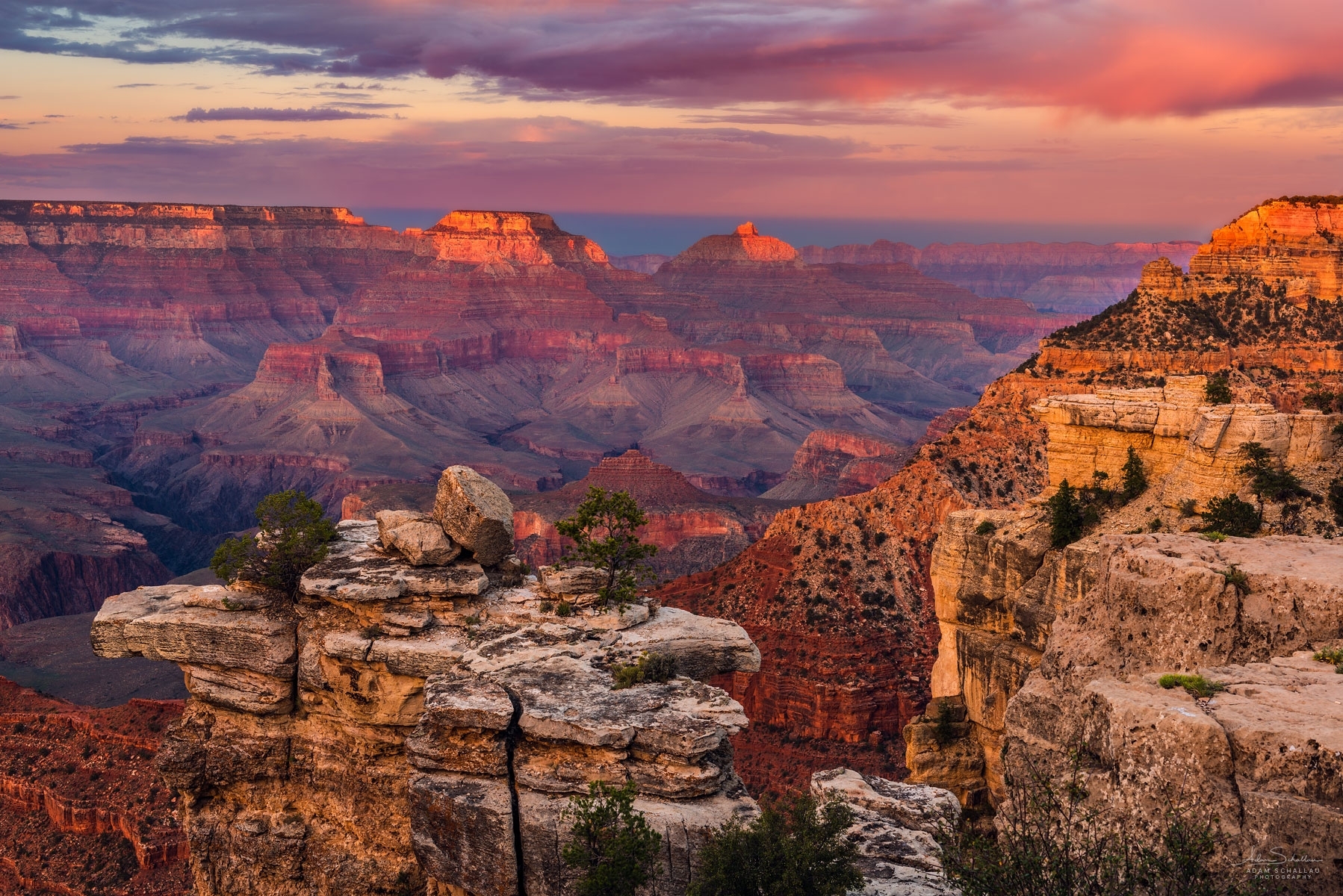
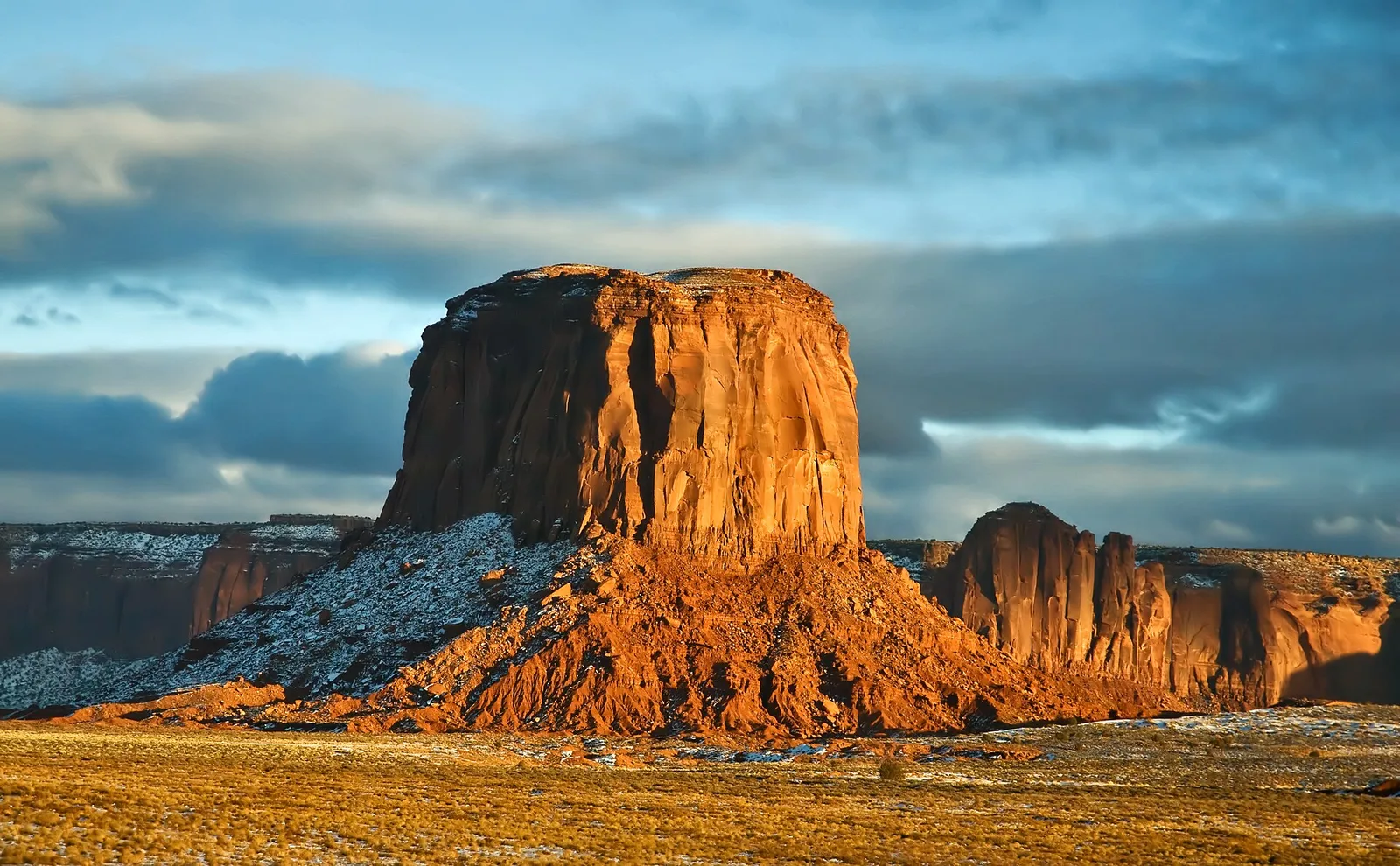
Home to the world-famous Grand Canyon, Monument Valley, and the Painted Desert. This high-elevation region features dramatic canyons, mesas, buttes, and ancient volcanic peaks. Flagstaff and the Navajo and Hopi reservations are here. Winters can be cold with snow, while summers are mild.
Monument Valley, entirely within the Navajo Nation, became internationally famous largely because director John Ford filmed several Western movies there starting with Stagecoach in 1939, cementing its sandstone buttes as the visual shorthand for the American West.
The Grand Canyon is a mile deep, up to 18 miles wide, and 277 river miles long, and its walls expose nearly two billion years of rock. It draws close to five million visitors a year, mostly to the South Rim, and the Colorado River that carved it now runs so short of water that Lake Powell and Lake Mead have both fallen to record lows in the 2020s.
The Navajo Nation, the largest reservation in the country at about 27,000 square miles, spreads across the plateau into New Mexico and Utah, and the smaller Hopi reservation sits entirely inside it; Old Oraibi on the Hopi mesas has been lived in since around 1100, one of the oldest continuously occupied villages in North America. Flagstaff, at 7,000 feet, has a major observatory where Pluto was discovered in 1930 and is home to Northern Arizona University.
A mountainous band running diagonally across the state, including the Mogollon Rim and White Mountains. This is Arizona's 'pine country' with forests, lakes, and outdoor recreation. Prescott and Sedona (famous for its red rocks) are located here.
The Mogollon Rim stretches roughly 200 miles and rises as much as 2,000 feet above the desert floor below, marking the southern edge of the Colorado Plateau. Sedona's famous red rocks get their color from the same iron-oxide-stained sandstone found in some of the Grand Canyon's layers.
This band holds the largest contiguous ponderosa pine forest in the world, running from near Flagstaff across the Rim into New Mexico. It is also the state's fire country: the 2002 Rodeo-Chediski and 2011 Wallow fires were each the largest in Arizona history in their time, and the 2013 Yarnell Hill Fire killed 19 members of the Granite Mountain Hotshots near Prescott, the deadliest wildland-firefighter loss in decades.
Prescott was the first territorial capital, chosen in 1864 partly to keep the government away from Confederate-leaning Tucson; the seat later moved to Tucson, back to Prescott, and finally to Phoenix in 1889. Sedona's red-rock scenery and New Age reputation now draw more than three million visitors a year to a town of about 10,000, straining its roads and housing.
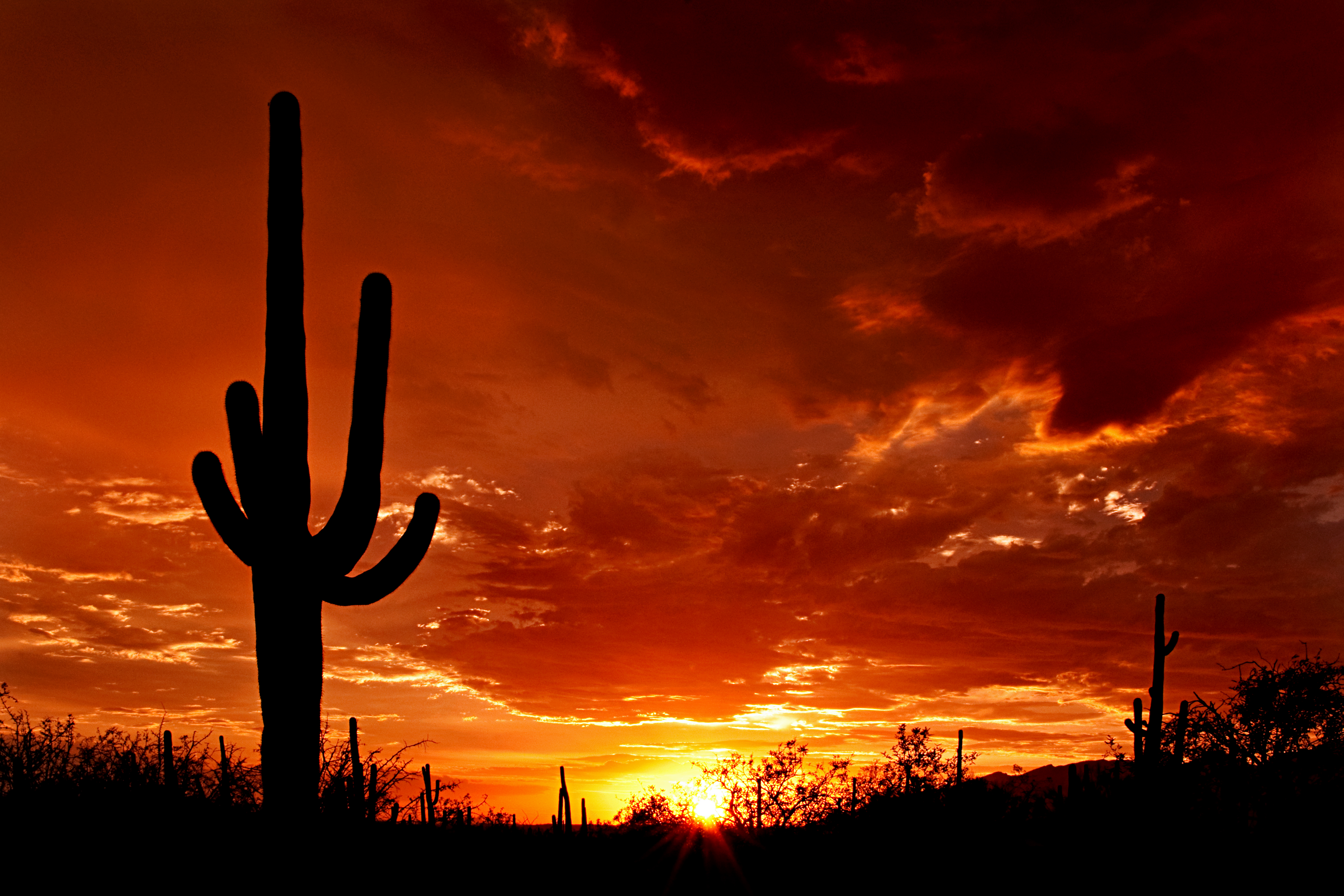
The Sonoran Desert dominates this region, hot, arid, with iconic saguaro cacti. Phoenix and Tucson, the state's two largest cities, are here. This area includes 'sky islands', isolated mountain ranges rising dramatically from the desert floor.
The Sonoran Desert is the only place on Earth where the saguaro cactus grows in the wild, and a single saguaro can take 75 years to grow its first arm. The region's isolated 'sky island' mountain ranges pack ecosystems as different as Canadian forest and Mexican desert into a single peak.
Phoenix is the fifth-largest city in the United States and the fastest-growing big city of the past two decades; its metro area, the 'Valley of the Sun,' passed five million people in the 2020s, sprawling across former farmland. That growth rests on the Central Arizona Project, a 336-mile aqueduct completed in 1993 that lifts Colorado River water nearly 3,000 feet uphill to Phoenix and Tucson.
The Sonoran Desert here is one of the wettest deserts on Earth, with two rainy seasons, and it supports more species than any other North American desert. Summer highs in Phoenix regularly top 110 degrees; the city recorded 31 straight days at or above 110 in July 2023, and heat now kills hundreds of people a year in the county. Tucson, the older city, sits beside Saguaro National Park and the University of Arizona.
Economy
Arizona has a diverse modern economy anchored by high-tech manufacturing, tourism, and services.
Arizona has attracted massive investments from companies like TSMC, Intel, and others. The state is positioning itself as a leader in semiconductor production. Aerospace, defense, and electronics manufacturing are also major drivers.
TSMC's investment in its Phoenix-area chip fabs ranks among the largest foreign direct investments in U.S. history, while Intel has operated its Chandler campus since the 1980s, making the Phoenix metro one of the longest-running centers of American chip manufacturing.
TSMC's north Phoenix project has grown to three planned fabrication plants and a committed investment of about $65 billion, backed by billions in federal CHIPS Act money, with the first fab reaching production in late 2024. Intel is spending roughly $20 billion to expand its Chandler campus, and suppliers such as Amkor and NXP have followed them to the state.
Arizona's pitch to chipmakers is cheap land, few earthquakes, an aerospace-trained workforce, and, crucially, water: fabs use millions of gallons a day, and the state has required new plants to recycle most of it. The buildout has strained construction labor and drawn debate about whether a desert metro dependent on a shrinking river should be adding heavy industrial water users.
Tourism is a huge economic engine. The Grand Canyon, Sedona, Monument Valley, and desert resorts bring billions in revenue. Phoenix and Tucson are major hubs for winter visitors and spring training baseball (Cactus League).
The Cactus League's spring training games draw well over a million fans to the Phoenix area every March, an annual tradition cities across the Valley have competed to host since the Cleveland Indians and Chicago Cubs first trained in Arizona back in 1947.
Tourism brings in more than $25 billion a year and supports around 200,000 jobs. Scottsdale's resorts and golf courses, the WM Phoenix Open (the best-attended golf tournament in the world, drawing more than 700,000 fans across a week), and the NASCAR season finale at Phoenix Raceway anchor a winter economy built on people escaping colder places.
Arizona's Native nations run some of the largest casinos in the region under a 2002 gaming compact, and reservations like the Navajo and Hopi market cultural tourism at Monument Valley, Canyon de Chelly, and the mesa villages. Grand Canyon National Park alone contributes over a billion dollars a year to the communities around it.
Phoenix has become a bioscience hub with the Phoenix Biomedical Campus. Mayo Clinic, Banner Health, and university research drive innovation in healthcare and life sciences.
Mayo Clinic's Arizona campus, which opened in Scottsdale in 1987, was the health system's first location outside Minnesota, and it now anchors a biomedical research cluster that includes the Translational Genomics Research Institute and Arizona State University's biodesign programs.
Health care is now the largest private employer in metro Phoenix. Banner Health, based in the city, is one of the biggest nonprofit hospital systems in the country, and Arizona's fast-aging population and steady retiree influx keep demand climbing.
The Phoenix Biomedical Campus downtown houses a University of Arizona medical school, and the Translational Genomics Research Institute, founded in 2002, is known for cancer and neurological genomics; ASU opened its own medical school in partnership with Mayo. The Mayo campus in Scottsdale runs one of the largest organ-transplant programs in the United States.
Arizona hosts major Air Force bases (Luke, Davis-Monthan) and is home to companies involved in aircraft, missiles, and defense technology. The state's clear skies and vast open spaces make it ideal for testing.
Davis-Monthan Air Force Base hosts the 309th Aerospace Maintenance and Regeneration Group, nicknamed 'the Boneyard,' which stores more than 4,000 retired military aircraft in the desert's dry air, making it the largest aircraft storage and preservation facility in the world.
Luke Air Force Base west of Phoenix is the largest F-35 pilot-training base in the world, Davis-Monthan in Tucson is the longtime home of the A-10 attack jet and a major combat search-and-rescue operation, and Fort Huachuca near Sierra Vista is the Army's main center for military intelligence and drone training.
Private industry is anchored by Honeywell Aerospace, headquartered in Phoenix, and Raytheon's Tucson missile plant, which builds the Standard Missile, Tomahawk, and Javelin and employs well over 10,000 people, making it Tucson's largest private employer. Boeing builds the Apache attack helicopter in Mesa.
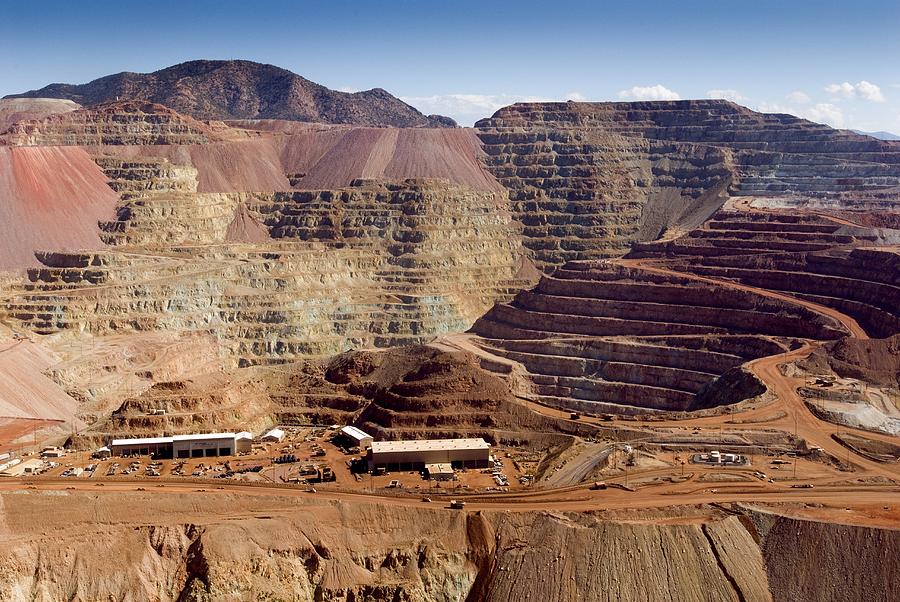
Arizona is the leading copper-producing state in the U.S. Mining has been central to the state's economy since the 19th century, though it now shares the stage with high-tech and services.
Arizona produces roughly two-thirds of all the copper mined in the United States, and the Morenci mine in the state's southeast corner is the largest copper mine in North America, an open pit visible from space.
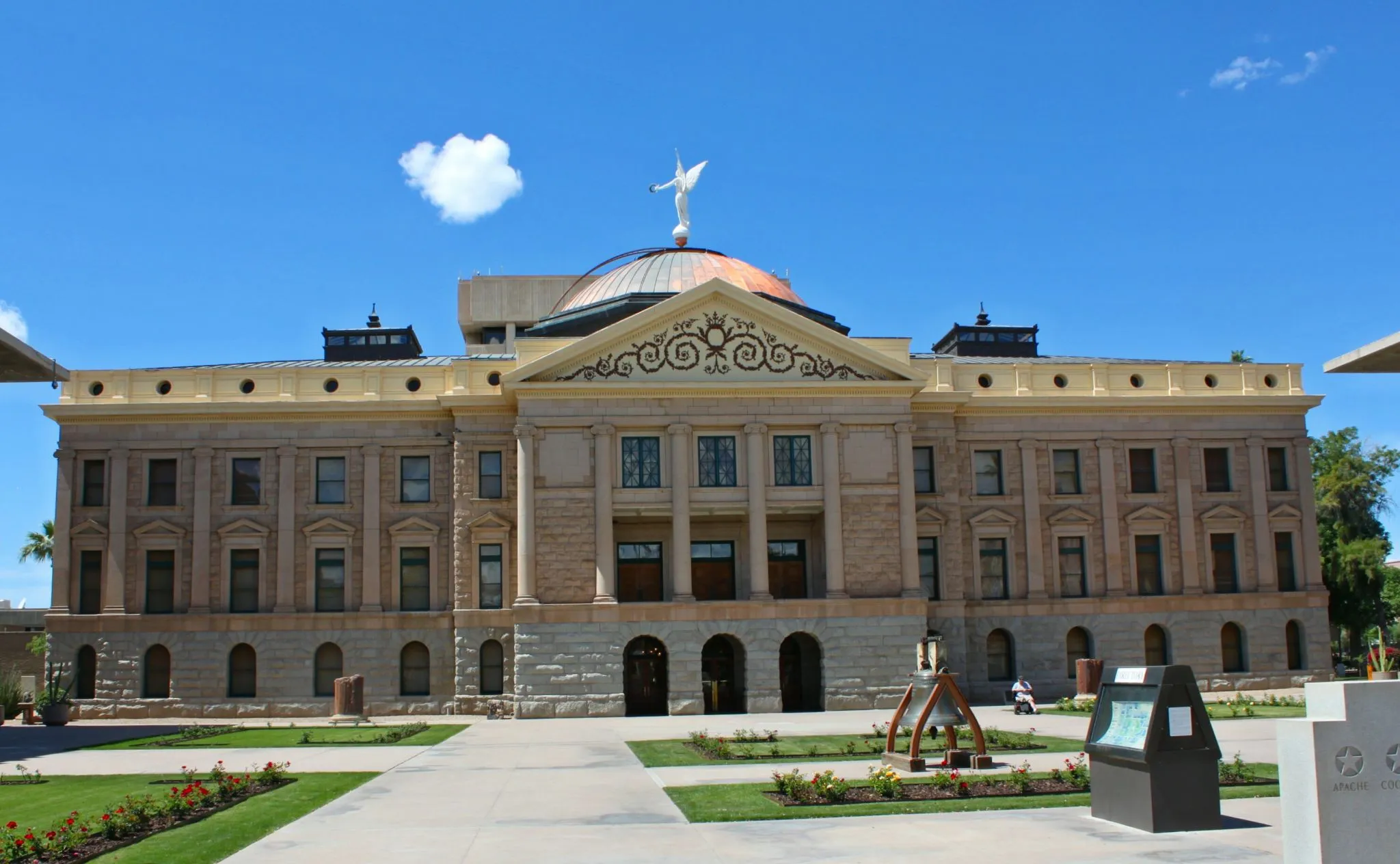
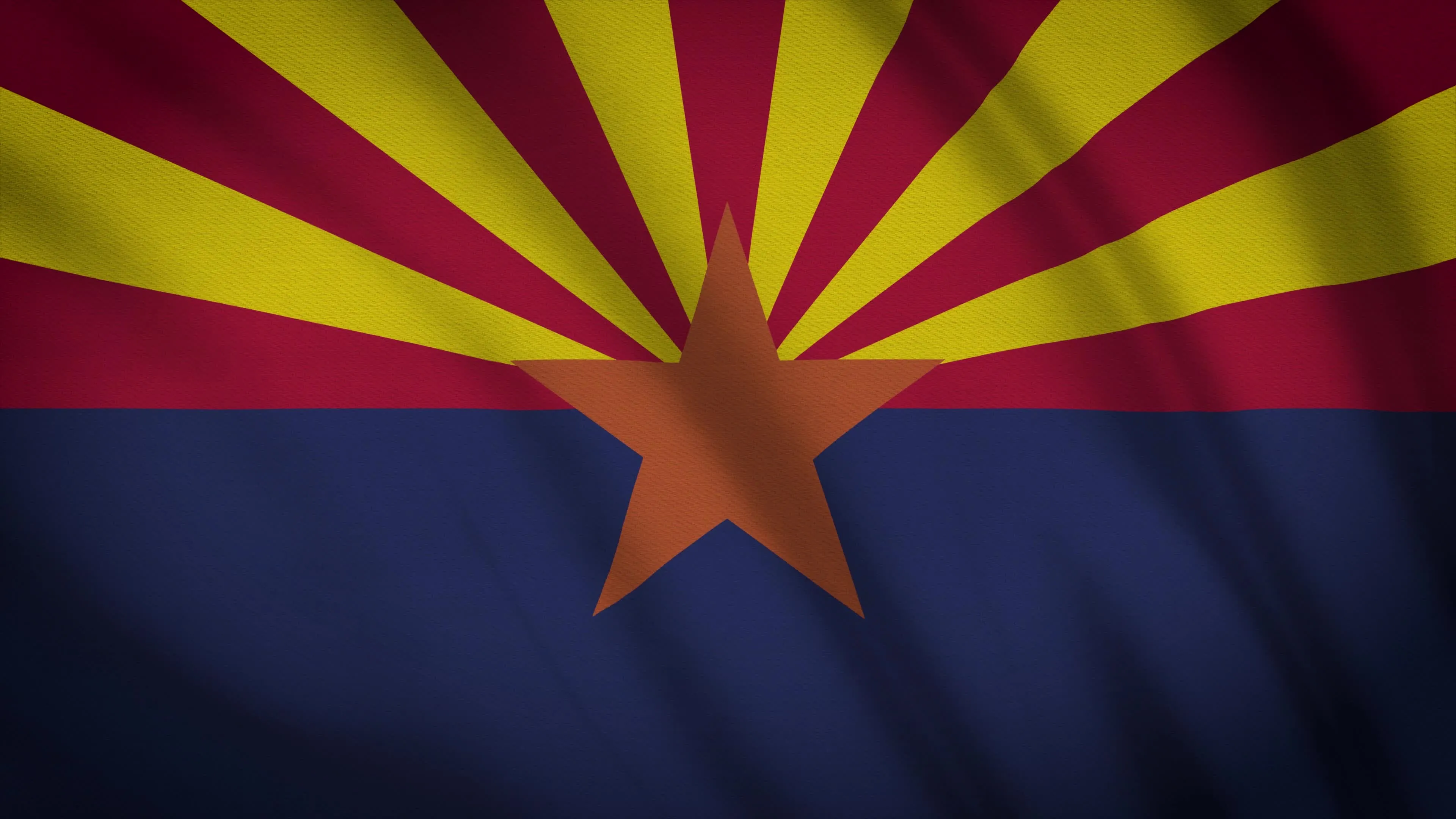
Five copper towns, Bisbee, Jerome, Globe, Miami, and Morenci, built Arizona's early economy, and copper still appears on the state flag and in the copper dome of the capitol. The 'Big Five' mining companies dominated territorial and early state politics so completely that Arizona was sometimes called a 'copper colony.'
The proposed Resolution Copper mine near Superior would sit on a site sacred to the San Carlos Apache called Oak Flat, holds one of the world's largest undeveloped copper deposits, and has been fought over in Congress and the courts for more than a decade. Arizona also produces molybdenum, silver, and large volumes of sand and gravel.
How Arizona's State Government Works
Arizona has a three-branch system similar to the federal government: executive (Governor), legislative (bicameral), and judicial. The state operates under a constitution adopted in 1910.
Arizona politics are competitive and often reflect national divides. The state has a strong tradition of independent voters and has become a key battleground in recent elections.
Governor of Arizona
Current Governor
Katie Hobbs

- Party
- Democrat
- In Office Since
- January 2, 2023
- Elected
- 2022
- Term Ends
- January 2027
- Born
- December 28, 1969, Long Beach, California
- Education
- B.S., Northern Arizona University
- Prior Role
- Arizona Secretary of State (2019-2023)
Katie Hobbs is a former social worker and state senator who served as Arizona Secretary of State before becoming Governor. She is the fifth woman to serve as governor of Arizona, after Rose Mofford, Jane Dee Hull, Janet Napolitano, and Jan Brewer.
Other Current State Officials
Attorney General
Kris Mayes
In office since 2023.
* Official information as of early 2025. Always verify current officeholders at az.gov.
The Arizona State Legislature
Arizona State Senate
- Seats: 30 members
- Terms: 2-year terms
The upper chamber. Arizona is one of a small number of states where senators serve 2-year rather than 4-year terms. Each of Arizona's 30 legislative districts elects one senator and two House members. Term limits restrict members to 3 consecutive Senate terms (6 years).
Arizona House of Representatives
- Seats: 60 members
- Terms: 2-year terms
The lower chamber. Each legislative district elects two representatives, making Arizona's House one of the more proportional lower chambers in the country. Term limits restrict members to 4 consecutive terms (8 years).
Arizona's U.S. Senators
U.S. Senator
Mark Kelly
Former NASA astronaut and U.S. Navy captain. Elected in 2020 and re-elected in 2022. Husband of former Congresswoman Gabby Giffords.
U.S. Senator
Ruben Gallego
U.S. Marine veteran and former U.S. Representative. Elected to the Senate in 2024.
Arizona Through the Years
From ancient civilizations to statehood and the modern era. Tap any era to read more.
The Hohokam, Ancestral Puebloans (Anasazi), and Mogollon peoples thrived in Arizona for centuries, building sophisticated irrigation systems, cliff dwellings, and pueblos.
The Hohokam built hundreds of miles of irrigation canals in the Phoenix area, some of the most extensive pre-industrial canal engineering in North America, and several of today's modern Phoenix-area canals still follow paths first dug by Hohokam engineers over a thousand years ago.
At its height around 1300, the Hohokam network in the Salt and Gila river valleys supported tens of thousands of people, with canals up to 20 miles long dug using stone tools. The culture collapsed by about 1450, probably from drought, floods that wrecked the canal heads, and salt buildup in over-irrigated fields; 'Hohokam' is an O'odham word meaning roughly 'those who are gone.'
Farther north, Ancestral Puebloans built the cliff dwellings at Canyon de Chelly and Betatakin and the Wupatki pueblos near Flagstaff, which grew after the eruption of Sunset Crater around 1085 briefly improved the soil. The Navajo, Apache, and other Athabascan-speaking peoples arrived later, probably in the 1400s or 1500s, into a landscape the earlier farmers had largely left.
Marcos de Niza becomes the first European to explore the region. Francisco Vázquez de Coronado follows in 1540 seeking the Seven Cities of Gold.
Coronado's expedition never found the fabled Seven Cities of Gold, but a detachment he sent out under García López de Cárdenas became the first Europeans to lay eyes on the Grand Canyon, in 1540, though it would be another three centuries before it was explored in depth.
Spain never really settled Arizona, but Jesuit missionaries did. Father Eusebio Kino built a chain of missions among the O'odham in the 1690s and early 1700s, including San Xavier del Bac south of Tucson, whose present church, 'the White Dove of the Desert,' was finished in 1797 and is still an active parish on the Tohono O'odham reservation.
A Spanish presidio was built at Tubac in 1752 after an O'odham revolt, and the garrison moved to Tucson in 1775, making Tucson the oldest continuously occupied European-founded settlement in Arizona. The whole region passed to independent Mexico in 1821 and to the United States a generation later.
The Treaty of Guadalupe Hidalgo transfers much of present-day Arizona to the United States.
The Treaty of Guadalupe Hidalgo transferred roughly 525,000 square miles of Mexican territory to the United States for $15 million, a cession that included present-day California, Nevada, Utah, and most of what is now Arizona and New Mexico.
The Mormon Battalion, about 500 U.S. Army volunteers, marched through southern Arizona in 1846 and opened the first wagon road across the region. The 1848 treaty put the border along the Gila River, leaving Tucson and the best route for a southern railroad on the Mexican side, which is why the United States soon negotiated to move the line south.
For Arizona's Native nations the change of flag meant little at first; the Apache in particular stayed militarily dominant across much of the territory for another 40 years. Mexican and Mexican American families who had lived in the Tucson and Santa Cruz valleys for generations became U.S. citizens under the treaty, and their descendants remain a large part of southern Arizona.
The U.S. buys southern Arizona from Mexico, completing the state's modern southern border.
The purchase was driven largely by the U.S. desire for a southern transcontinental railroad route through terrain with a gentler grade than the mountain passes further north, and the United States paid Mexico $10 million for the roughly 30,000 square miles involved.
Negotiated by the railroad promoter James Gadsden and signed in 1853, it added the land south of the Gila, including Tucson, Yuma, and the future Tombstone; the Senate trimmed the original area before ratifying it. It was the last major territorial acquisition in the contiguous United States.
The new land was governed at first from Santa Fe as part of New Mexico Territory, and Arizonans' resentment at distant rule fed the movement for a separate territory. The southern transcontinental line the purchase was meant to enable did not actually reach Tucson until 1880.
President Lincoln signs the bill creating the Arizona Territory during the Civil War.
The Union organized Arizona as a separate territory partly in response to Confederate sympathizers in the region, who had briefly declared their own 'Confederate Arizona Territory' in 1861, prompting federal officials to move quickly to secure the area under Union control.
Weeks after Lincoln signed the act in February 1863, gold was found near what became Prescott, and the new territorial government set up there in 1864 rather than in Confederate-leaning Tucson. The first legislature is remembered for the 'Howell Code,' its founding set of laws.
Territorial Arizona lasted 49 years, longer than almost any other, held back by its small population, its reputation for violence, and Eastern doubts about its Mexican and Native majority. The economy for those decades was mining and the Army: a string of forts garrisoned the campaigns against the Apache that did not end until Geronimo's surrender in 1886.
The legendary shootout in Tombstone between the Earp brothers and the Clanton-McLaury gang.
The famous gunfight actually lasted only about 30 seconds and took place in a narrow vacant lot beside the corral, not inside it. Three men on the Clanton-McLaury side were killed, and Wyatt Earp emerged as the only participant on either side who was not wounded.
Tombstone in 1881 was a silver boomtown of some 7,000 people, and the fight was less good versus evil than a local feud between the town-based, Republican Earps and the rural, Democratic 'Cowboys,' tangled up with cattle rustling and cross-border smuggling. Virgil Earp was the town marshal; Wyatt and Morgan were deputized for the day.
The gunfight's fame came later, mostly from Wyatt Earp's own retelling to a biographer in the 1920s and from more than a dozen Hollywood films. In the months after, Morgan Earp was assassinated and Wyatt led a vendetta ride that killed several Cowboys before he left Arizona for good. Tombstone's mines flooded in the 1880s, and the town now survives almost entirely on tourism.
Arizona becomes the last contiguous state admitted to the Union on Valentine's Day.
President William Howard Taft initially vetoed Arizona's proposed state constitution because it allowed voters to recall judges from office. Arizona temporarily removed the provision to gain statehood on February 14, 1912, then voted to restore it almost immediately afterward.
Arizona had sought statehood for decades and been rebuffed; in 1906 Congress offered to admit it only if it merged with New Mexico into one large state, and Arizona voters rejected the idea by more than five to one. Statehood on February 14, 1912, made Arizona the last of the 48 contiguous states.
The 1912 constitution was one of the most Progressive in the country, with the initiative, referendum, and recall, and Arizona women won the vote that year, eight years before the 19th Amendment. The same era's laws barred most Asian immigrants from owning land, and Native Americans born in Arizona could not vote in state elections until a 1948 court ruling.
Completion of the massive dam on the Colorado River provides water and power to the Southwest.
At the time of its completion, Hoover Dam was the largest concrete structure and the largest hydroelectric power station on Earth. More than 100 workers died during construction, and the dam created Lake Mead, still the largest reservoir by volume in the United States.
The dam was authorized by the Boulder Canyon Project Act of 1928 and built in five years by a consortium called Six Companies; the government town of Boulder City, Nevada, was created to house the workers and banned gambling and alcohol. Most of the deaths came from heat and rockfalls rather than the concrete pours.
For Arizona the dam's real importance was the storable water it created and the 1922 Colorado River Compact that divided the flow. Arizona refused to ratify the compact for 22 years, fearing California would take too much, and even sent its National Guard to the river in 1934 to block work on a downstream dam. The state finally signed on in 1944, clearing the way for the Central Arizona Project decades later.
Arizona's Defining Moments in American History
These are the events that didn't just shape Arizona, they changed the nation.
Carved by the Colorado River over millions of years, the Grand Canyon is one of the most spectacular natural features on Earth and a UNESCO World Heritage Site.
President Theodore Roosevelt declared the Grand Canyon a national monument in 1908 after visiting in 1903 and urging Americans to 'leave it as it is,' but Congress did not grant it full national park status until 1919, delayed for over a decade by mining and grazing interests that opposed federal protection.
John Wesley Powell led the first documented river expedition through the canyon in 1869, a three-month trip in wooden boats that lost several men. The canyon's walls record nearly two billion years of Earth history, and their layers helped 19th-century geologists work out the immense age of the planet.
The park now draws close to five million visitors a year, almost all to the South Rim, and its biggest management fights are over crowding, sightseeing-aircraft noise, and a proposed tramway on the eastern rim that the Navajo Nation Council rejected in 2017. The Havasupai Tribe still lives at the bottom of a side canyon, the only community inside the park.
Arizona produces more copper than any other state. Mining shaped the economy, politics, and culture of the state from the late 1800s onward.
In 1917, a sheriff-led posse in Bisbee forcibly rounded up more than a thousand striking copper miners and deported them by train to the New Mexico desert without food or water, an incident known as the Bisbee Deportation that remains one of the most notorious events in American labor history.
Copper wealth also gave Arizona outsized influence in Washington through Senator Carl Hayden, who represented the state from 1912 to 1969, the first 57 years of its statehood, and used a long career on the Appropriations Committee to deliver the dams, highways, and eventually the Central Arizona Project that made the modern state possible.
Copper still runs through Arizona's identity: it is on the flag, in the capitol dome, and in the 'Five C's', copper, cattle, cotton, citrus, and climate, that schoolchildren once learned as the pillars of the economy. Only copper and climate still carry real weight, but the mines, and the fights over new ones like Resolution Copper at Oak Flat, remain a defining Arizona argument.
The Arizona senator's 1964 presidential run helped lay the groundwork for the modern conservative movement.
Goldwater lost the 1964 election to Lyndon Johnson in a landslide, carrying only six states, but the grassroots conservative organization his campaign built trained a generation of activists who went on to help elect Ronald Reagan sixteen years later.
Goldwater's 1960 book 'The Conscience of a Conservative' and his 1964 nomination pulled the Republican Party away from its Eastern establishment toward the Sun Belt and the West. His vote against the Civil Rights Act of 1964, which he cast on federalism grounds, cost him nationally but helped him carry five Deep South states, the start of a regional realignment.
In his later Senate years Goldwater became known for blunt independence: he told Nixon to resign during Watergate, backed the 1978 treaty to hand back the Panama Canal, and in retirement supported abortion rights and gays serving openly in the military, feuding with the religious right his own movement had helped empower. Arizona named its largest wilderness area and an Air Force range for him.
Notable Arizonans
Cochise
Chiricahua Apache leader who fiercely resisted the forced removal of his people for over a decade
Barry Goldwater
U.S. Senator and 1964 Republican presidential nominee who shaped modern conservatism
Sandra Day O'Connor
First female Supreme Court Justice, raised on an Arizona cattle ranch
Cesar Chavez
Labor rights leader who co-founded the United Farm Workers, born in Yuma
Linda Ronstadt
Grammy-winning rock and pop singer, born in Tucson
Frank Lloyd Wright
Pioneering architect who founded Taliesin West in Scottsdale as his winter home
State Symbols & Quick Facts
| Nickname | "The Grand Canyon State" |
| Capital | Phoenix |
| Largest City | Phoenix |
| Statehood | February 14, 1912 (48th state) |
| Population | ~7.62 million (2025 est.) |
| Area | 113,998 sq mi, 6th largest state |
| Motto | Ditat Deus (God Enriches) |
| State Bird | Cactus Wren |
| State Flower | Saguaro Cactus Blossom |
| State Tree | Palo Verde |
| State Gem | Turquoise |
| State Mammal | Ringtail |
| State Reptile | Arizona Ridge-nosed Rattlesnake |
| State Song | "Arizona" and "Arizona March Song" |
| Time Zone | Mountain Time (UTC−7); no Daylight Saving Time observance |
| Borders | California (W), Nevada (NW), Utah (N), Colorado (NE), New Mexico (E), Mexico (S) |
Did You Know?
Arizona does not observe Daylight Saving Time (except on the Navajo Nation).
The saguaro cactus can live up to 200 years and grow over 40 feet tall.
Arizona has the largest percentage of its land designated as Indian reservations of any state.
Phoenix is the hottest major city in the U.S. and the 5th largest city in the country.
Arizona has more than 100 wineries, clustered in three wine regions around Sonoita, Willcox, and the Verde Valley.
The world's largest collection of telescopes is in Arizona, thanks to clear desert skies.
Arizona is home to 13 species of rattlesnakes, more than any other state.
Quick Facts and Common Questions
Short answers to the questions people most often ask about Arizona: its abbreviation, how it became a state, its capital, and its place in Congress.
Arizona's two-letter postal abbreviation is AZ. The U.S. Census Bureau places it in the West region, in the Mountain division, and about 7.15 million people lived there in the 2020 census.
Arizona became the 48th state on February 14, 1912, the last of the 48 contiguous states to join the Union. It is sometimes nicknamed the "Valentine State" because of its Valentine's Day admission.
In 1911 President William Howard Taft vetoed Arizona's statehood because its proposed constitution let voters recall judges. Arizona removed the provision and was admitted in 1912, and later that year its voters put the judicial recall back into the state constitution.
The origin is not certain. The most widely cited explanation traces it to "Arizonac," a Spanish-era name for a place in what is now Sonora, Mexico, near a 1736 silver discovery, which may come from an O'odham phrase meaning "small spring."
Most of Arizona came to the United States from Mexico in 1848 under the treaty that ended the Mexican-American War, and the southern strip, including Tucson, was added by the Gadsden Purchase in 1853. Congress created the Arizona Territory, separate from New Mexico Territory, on February 24, 1863.
Phoenix has been the capital since 1889. The territorial capital was first at Fort Whipple and then Prescott in 1864, moved to Tucson in 1867, returned to Prescott in 1877, and moved to Phoenix in 1889, where it stayed after statehood.
Arizona borders California, Nevada, Utah, and New Mexico, and touches Colorado at a single point, the Four Corners, where Arizona, Colorado, New Mexico, and Utah meet. To the south it borders the Mexican states of Sonora and Baja California.
Arizona is known as "The Grand Canyon State." Its motto is "Ditat Deus," Latin for "God Enriches." Its state bird is the cactus wren, its flower is the saguaro cactus blossom, and its tree is the palo verde.
Based on the 2020 census, Arizona has 9 seats in the U.S. House of Representatives, the same as before, which gives it 11 votes in the Electoral College.
No. Arizona has not observed daylight saving time since 1968 and stays on Mountain Standard Time all year. The Navajo Nation in northeastern Arizona is the main exception and does observe daylight saving time.
Sources & Further Reading
- Census Regions and Divisions, U.S. Census Bureau
- 2020 Census Apportionment Results, U.S. Census Bureau
- Distribution of Electoral Votes, National Archives
- Arizona State Library, Archives and Public Records
- Gadsden Purchase, 1853-1854, Office of the Historian, U.S. Department of State
- Daylight Saving Time, National Institute of Standards and Technology
Grand Canyon National Park
One of the Seven Natural Wonders of the World
About Grand Canyon National Park
The Grand Canyon is one of the most complete geological records on Earth: a 277-mile chasm the Colorado River has cut over the past five to six million years, exposing rock that spans nearly two billion years. From rim to river a hiker passes layer after layer of the Paleozoic era before finally reaching the Vishnu Basement Rocks, among the oldest exposed rock on the continent.
Between the flat-lying Paleozoic layers and the ancient basement rock lies the Great Unconformity, a gap of more than a billion years where the rock that should record that time is simply missing, eroded away before the Cambrian seas returned. It is one of the most studied missing intervals in geology.
John Wesley Powell led the first documented boat expedition through the canyon in 1869, naming many of its features and making it nationally famous. The land became a forest reserve in 1893, a game reserve in 1906, a national monument under Theodore Roosevelt in 1908, and finally a national park on February 26, 1919.
Today the park covers about 1.2 million acres and draws close to six million visitors a year, the great majority to the South Rim, generating hundreds of millions of dollars for northern Arizona. The canyon is so central to state identity that Arizona's nickname and license plates both invoke it.
- Designation
- UNESCO World Heritage Site (1979)
- Location
- Northwestern Arizona, Coconino and Mohave counties
- Established
- February 26, 1919
- Annual Visitors
- ~6 million per year
- Size
- 1,902 square miles (1.2 million acres)
- Depth
- 6,093 feet (over 1 mile) at its deepest point
Reading the Rocks, 2 Billion Years of Earth History
The youngest rock layer, formed from a warm shallow sea that covered the region during the Permian period. Rich in marine fossils including brachiopods, crinoids, and sponges. This is the rock you stand on at the rim.
Because limestone dissolves slowly in slightly acidic rainwater, the Kaibab layer has developed small sinkholes and solution caves near the rim over thousands of years, and it is the surface almost every visitor overlook and trailhead sits on.
It resists erosion better than the soft shales beneath it, so it acts as a protective cap. Where the Kaibab has been breached, the canyon widens quickly, which is why side canyons fan out rapidly just below the rim.
It records the last time a sea covered northern Arizona, roughly 270 million years ago. Every younger layer that once lay above it here has been stripped away by later erosion, so the rim surface is itself a kind of unconformity.
Pale white to cream-colored cliffs formed from ancient desert sand dunes, similar to the Sahara. Fossilized animal trackways are preserved in this layer, the footprints of reptiles crossing the dunes before they turned to stone.
Geologists estimate the original dunes stood several hundred feet tall, comparable to dune fields found today in the Sahara or Namib deserts, before they were buried, compacted, and slowly cemented into solid sandstone over millions of years.
The frozen dune bedding, called cross-bedding, dips consistently toward the south, which tells geologists the prevailing winds blew from the north when this was a coastal desert near the equator on the supercontinent Pangaea.
Its pale band is visible for miles along the canyon walls, and together with the Kaibab cliff above it the Coconino forms the near-vertical upper wall that stops most casual hikers well short of the river.
The deep red and orange layers that give the canyon much of its dramatic color. Formed in river deltas, floodplains, and shallow marine environments during the Pennsylvanian and Permian periods.
The Supai Group is actually four distinct sub-layers deposited over roughly 30 million years, as sea levels repeatedly rose and fell across the region, alternating between river channels, floodplains, and shallow seas.
The Esplanade Sandstone at the top of the group forms the broad red terrace, the Esplanade, that backpackers on the remote western routes follow for miles between the rim cliffs and the inner canyon.
The iron oxide that stains these beds red also washes down over the gray Redwall Limestone below, which is the reason that cliff looks red from a distance even though the rock itself is gray.
A massive 500-foot cliff-forming layer that appears red but is actually gray limestone stained by iron oxide washing down from above. This vertical wall is one of the most imposing barriers for hikers attempting to reach the canyon floor.
The layer contains extensive cave systems carved into the limestone, including Redwall Cavern, which explorer John Wesley Powell's 1869 river expedition estimated was large enough to seat thousands of people, though later measurements found it somewhat smaller.
It formed on the floor of a warm, clear Mississippian sea about 340 million years ago and is packed with the fossils of crinoids, corals, and brachiopods that lived on that sea bottom.
Its caves preserve some of the canyon's richest records of the recent past: Stanton's Cave near the river held split-twig figurines left by people about 4,000 years ago, along with the bones of extinct condors and Harrington's mountain goat.
Forms the broad flat 'Tonto Platform' visible from the rim. Deposited in a shallow sea during the Cambrian explosion, when complex animal life first diversified on Earth. Contains some of the canyon's most significant fossils.
This layer preserves fossil evidence from the Cambrian explosion, the geologically rapid burst roughly 500 million years ago when most major animal body plans still seen today first appeared, and trilobite fossils are commonly found within the shale.
The three formations of the Tonto Group, the Tapeats Sandstone, Bright Angel Shale, and Muav Limestone, record a sea advancing eastward across the eroded basement between about 525 and 505 million years ago, so each formation is slightly younger toward the east.
The soft Bright Angel Shale erodes into the wide Tonto Platform that carries the Tonto Trail for nearly 70 miles across the canyon, the main east-west route through the middle of the gorge.
The dark, twisted metamorphic rocks at the very bottom of the inner gorge. Among the oldest exposed rocks on Earth's surface. These rocks were once buried 12 miles deep and subjected to temperatures of 750°C before being uplifted and exposed by erosion. When you touch them, you are touching rock nearly as old as the Earth itself.
These rocks are the eroded root of an ancient mountain range that geologists believe once stood as tall as today's Himalayas, a range that was completely worn down by erosion long before the Colorado River began carving the canyon we see now.
Directly above the dark schist runs the Great Unconformity, where roughly 1.2 billion years of missing time separates rock about 1.7 billion years old from Tapeats Sandstone about 525 million years old resting straight on top of it.
In places the basement also holds the pink Zoroaster Granite, molten rock that laced through the schist about 1.4 billion years ago, and tilted slabs of the younger Grand Canyon Supergroup that survived only where fault blocks dropped them down out of the reach of erosion.
Indigenous Peoples of the Canyon
Havasupai Tribe
The Havasupai, 'people of the blue-green water,' have lived in and around the canyon for centuries, farming the Havasu Creek side canyon in summer and hunting the plateau in winter. Their village of Supai, reachable only by an 8-mile trail, mule, or helicopter, is the most remote inhabited community in the contiguous United States and still receives its mail by pack train.
When the national park and the earlier reserves were drawn, the Havasupai were confined to a 518-acre parcel around Supai while their plateau hunting and grazing lands were absorbed into the park and the national forest.
After a decades-long campaign, the Grand Canyon National Park Enlargement Act of 1975 returned about 185,000 acres of plateau land to the tribe, at the time the largest restoration of federal land to a Native nation in United States history.
Reservation of 188,077 acres inside the canyon. The tribe operates a lodge and campground that requires advance reservations (often booked out a year ahead). Population: approximately 700.
Hualapai Tribe
The Hualapai, 'people of the tall pines,' hold a reservation of nearly a million acres along 108 miles of the canyon's southwestern rim. It was set aside in 1883, after the tribe had been forcibly marched to a camp on the Colorado River in the 1870s and later allowed to return home.
In 2007 the tribe opened the Skywalk at Grand Canyon West, a horseshoe-shaped glass walkway cantilevered 70 feet out over the rim and roughly 4,000 feet above the river.
Grand Canyon West lies outside the national park and runs under tribal rather than Park Service rules, which is why helicopter tours that land on the canyon floor and other activities banned inside the park are available there.
Reservation of nearly 1 million acres along 108 miles of the canyon's South Rim. Tourism is a major economic driver for the tribe.
Navajo Nation
The Navajo Nation, the largest reservation in the country at about 17.5 million acres, borders the park along the Little Colorado River and the eastern end of the canyon, and the canyon figures in Navajo creation accounts.
The confluence of the Little Colorado and the Colorado is sacred in both Navajo and Hopi tradition. A 2017 plan to build a tramway and resort there, the 'Grand Canyon Escalade,' was defeated by the Navajo Nation Council after heavy tribal and environmental opposition.
Navajo, Hopi, Havasupai, and other nations pressed for lasting protection of the surrounding plateau, and in August 2023 President Biden designated the roughly 917,000-acre Baaj Nwaavjo I'tah Kukveni National Monument around the park, permanently barring new uranium mining claims on that land.
Navajo Nation spans 17.5 million acres across Arizona, Utah, and New Mexico. Canyon de Chelly National Monument is jointly managed by the NPS and Navajo Nation.
Ancestral Puebloans
The canyon holds more than 4,300 recorded archaeological sites, including cliff dwellings, granaries, and rock art left by Ancestral Puebloan peoples (formerly called Anasazi) and their Cohonina neighbors, who farmed the rims and inner canyon from roughly 200 to 1200 CE.
Tusayan Pueblo on the South Rim, built around 1185 CE and now a small museum with a self-guided trail, is the most accessible of these sites; most of the rest are closed to the public to protect them from looting and damage.
Drought and social upheaval led these communities to leave the canyon by about 1200 CE, moving south and east to the Hopi mesas and the pueblos of the Rio Grande and Little Colorado.
Their descendants include the Hopi, Zuni, and other Pueblo peoples who maintain ceremonial connections to the canyon today.
Major Trails
Bright Angel Trail
Bright Angel is the most popular corridor trail in the park, dropping from the South Rim village along the Bright Angel Fault, a natural break in the cliffs that Indigenous people and early prospectors used for the same reason.
Ralph Cameron ran the trail as a private toll route in the early 1900s, charging a dollar a head, and the Park Service did not gain full control until 1928 after a long fight over his mining claims.
Rest houses at 1.5 and 3 miles and a ranger station and water at Havasupai Gardens (renamed from Indian Garden in 2022) at 4.8 miles make it the safest way down, but reaching the river and returning is a 19-mile day with about 4,400 feet of climbing on the way out.
A major 2023 and 2024 project rebuilt long sections and added new water lines and shade shelters, part of continuing work to cut the number of heat rescues that spike on this trail every summer.
South Kaibab Trail
The South Kaibab follows a ridgeline the whole way to the river, giving unobstructed views in every direction but no shade and no water anywhere on the route.
The Park Service built it in 1924 and 1925 specifically to break Ralph Cameron's toll monopoly on the Bright Angel Trail, blasting it straight down an open spur instead of following a side canyon.
Ooh Aah Point at 0.9 miles, Cedar Ridge at 1.5 miles, and Skeleton Point at 3 miles are the recommended day-hike turnarounds; below Skeleton Point the trail commits to the inner gorge.
Most rim-to-rim and river hikers descend the South Kaibab and climb out on Bright Angel, using the shorter, steeper trail for the cooler morning descent and the trail with water for the hot climb out.
Rim Trail
The Rim Trail runs about 13 miles from the South Kaibab trailhead west to Hermits Rest, paved and nearly level for most of its length and served by free shuttle buses at frequent stops.
It strings together the historic district's landmarks, including the 1905 El Tovar Hotel and several Mary Colter buildings such as Hopi House (1905) and Lookout Studio (1914), all National Historic Landmarks.
Much of the paved section is wheelchair accessible, and it offers the canyon's classic sunrise and sunset views with no descent below the rim.
The unpaved western portion beyond Powell Point is quieter, and the whole trail can be walked one way with the shuttle taken back.
North Rim Trails
The North Rim sits about 1,000 feet higher than the South Rim, is forested in spruce and fir, and receives only about a tenth of the park's visitors.
Deep snow closes the North Rim to vehicles from roughly mid-October to mid-May, and the road in from Jacob Lake is not plowed during that stretch.
The North Kaibab is the only maintained trail to the river from this side, about 14 miles one way, passing Roaring Springs, the source that feeds piped drinking water to both rims through the Transcanyon Waterline.
In July 2025 the Dragon Bravo Fire destroyed the historic Grand Canyon Lodge and other North Rim buildings and closed that side of the park for the rest of the season, on top of repeated breaks in the aging waterline; a full pipeline replacement is now underway.
Conservation Challenges
Colorado River Water Crisis
The 1922 Colorado River Compact split the river between an Upper and Lower Basin on the assumption of about 16.4 million acre-feet a year. The river has since averaged well below that, and tree-ring studies show the early 1900s were an unusually wet stretch to have measured against.
Lakes Powell and Mead, the two largest reservoirs in the country, fell to record lows in 2022, close to the elevations below which Glen Canyon Dam and Hoover Dam can no longer generate hydropower or, eventually, pass water downstream.
In 2023 Arizona, California, and Nevada agreed to cut roughly 3 million acre-feet of use through 2026 in exchange for federal payments, a stopgap while the seven basin states and Mexico negotiate longer-term rules to take effect after 2026.
Below Glen Canyon Dam the water running through the canyon is now cold and clear reservoir water rather than the warm, silty flow that carved it, a change that has reshaped beaches, rapids, and the native fishery downstream.
Uranium Mining Threat
High-grade uranium ore fills vertical 'breccia pipe' formations in the plateaus around the canyon, and mining claims on that ground date back to the Cold War.
The Obama administration withdrew about 1 million acres around the park from new mining claims for 20 years in 2012; the mining industry challenged the withdrawal without success up to the Supreme Court, which declined to hear the case in 2021.
The Pinyon Plain Mine (formerly Canyon Mine), on a claim predating the withdrawal just south of the park, began hauling ore in 2024 over the objections of the Havasupai, who fear contamination of the aquifer that feeds Havasu Creek.
President Biden's 2023 Baaj Nwaavjo I'tah Kukveni National Monument made the 2012 withdrawal permanent across the roughly 917,000 acres it covers, though it did not extinguish valid existing claims such as Pinyon Plain.
Invasive Species
Glen Canyon Dam turned the Colorado through the canyon into cold, clear water, which favors introduced rainbow and brown trout over native fish adapted to a warm, silty river.
The humpback chub, a torpedo-shaped native found almost nowhere else on Earth, fell to a few thousand adults. Managers responded with trout removal, moving young chub into warmer tributaries, and experimental 'high-flow' dam releases that rebuild sandbars and backwaters.
Those efforts worked well enough that the chub was downlisted from endangered to threatened in 2021, one of the few clear wins in the canyon's long fish-recovery story.
Warming reservoir water is now letting smallmouth bass slip through the dam into the canyon, a voracious predator that managers regard as a bigger long-term threat to native fish than the trout ever were.
Overtourism
Visitation roughly doubled between the 1970s and the late 2010s to near six million a year, almost all of it funneled into a few square miles of the South Rim.
Parking, water, and sewer systems at Grand Canyon Village routinely run at capacity in summer, and the park has studied timed-entry reservations for the busiest months.
Havasu Falls on the Havasupai reservation, reached by the same 8-mile trail as Supai village, now requires permits that sell out within minutes when the tribe releases them each February.
A free shuttle-bus network carries millions of riders a year to keep private cars off the busiest rim roads, and the Grand Canyon Railway still brings visitors up from Williams as it has, with one long interruption, since 1901.
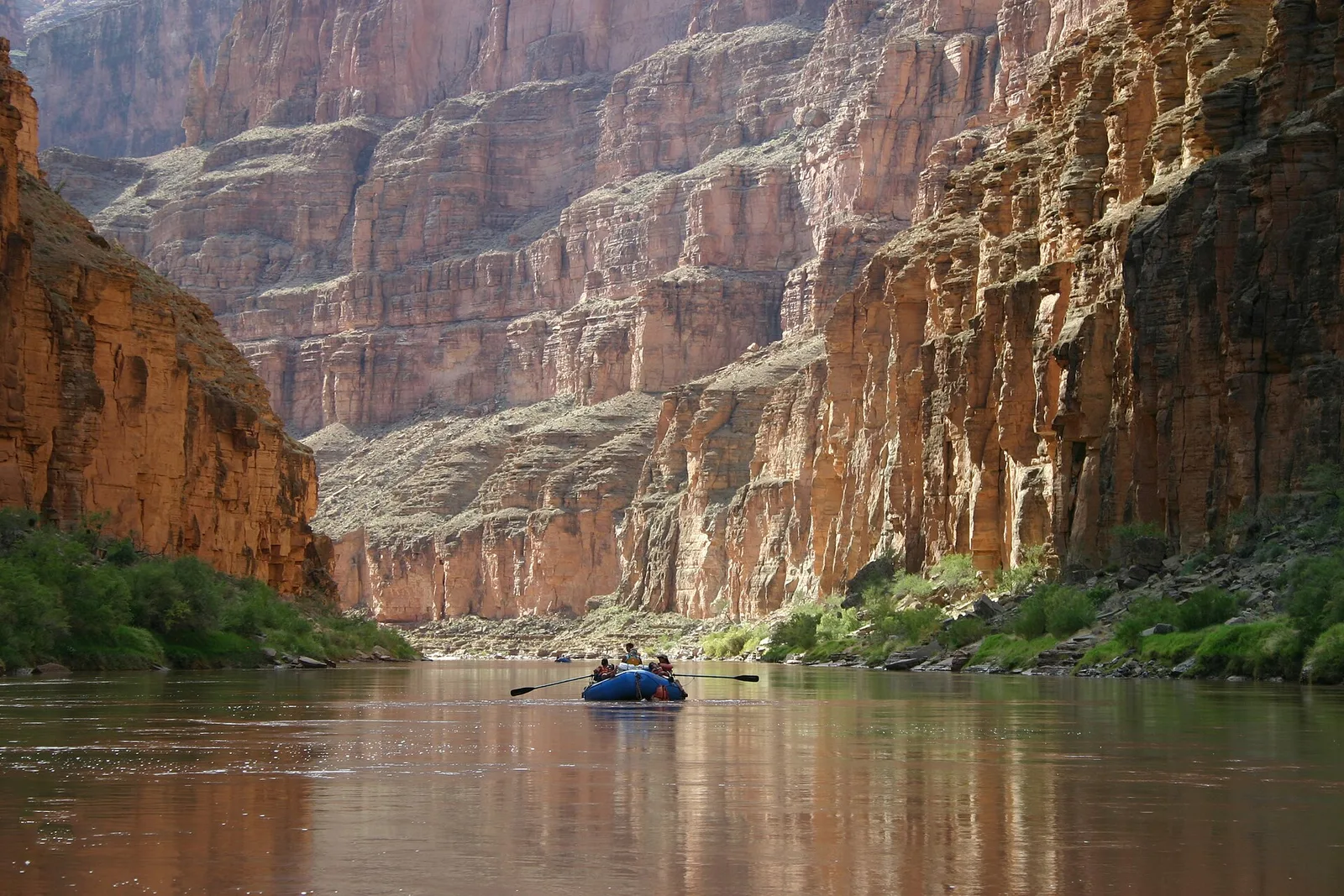
The Colorado River carved this canyon over 5-6 million years, and it's still cutting deeper today.
Grand Canyon By the Numbers
Did You Know?
California condors were brought back from the brink of extinction here. The Grand Canyon is one of the few places on Earth where you can reliably spot this 10-foot wingspan bird that once soared over Ice Age megafauna.
The temperature difference between the rim and the canyon floor can exceed 25°F. Hiking into the canyon in summer means descending into temperatures regularly exceeding 110°F at the bottom.
The Grand Canyon Railway has operated since 1901, running vintage steam and diesel trains from Williams, Arizona to the South Rim, the same route Teddy Roosevelt took when he first visited in 1903.
The canyon is so vast it has its own weather systems. Clouds form inside the canyon and storms can be raging on the canyon floor while the rim is clear and sunny.
The Grand Canyon is one of the best places on Earth for stargazing. It was designated an International Dark Sky Park in 2019, one of the largest on the planet.
The pink rattlesnake found only in the Grand Canyon, the Grand Canyon rattlesnake, evolved its distinctive coloring to match the canyon's pink limestone, making it one of the most locally adapted species in North America.
Planning a Visit
Location
Northwestern Arizona, Coconino and Mohave counties
Designation
UNESCO World Heritage Site (1979)
Best Time to Visit
March-May and September-November. Summer is brutally hot in the canyon; winter offers solitude and snow on the rim.
Entry Fee
$35 per vehicle (valid 7 days). America the Beautiful Annual Pass ($80) covers all national parks.
South Rim
Open year-round. Most facilities, visitor centers, and trail access. 80 miles south of Page, AZ.
North Rim
Open mid-May to mid-October only. Higher elevation, cooler, far fewer crowds. 215 miles from South Rim by road.
Lodging Inside the Park
Phantom Ranch at the canyon bottom requires reservations up to 13 months in advance. South Rim lodges book quickly, plan far ahead.
Official NPS Website
nps.gov/grca, reservations, permits, trail conditions, and ranger programs.