
The American Flag
Thirteen stripes for the colonies that started it. Fifty stars for the states it became. Two hundred and forty-nine years of history stitched into red, white, and blue.
Before There Was a Flag, There Was an Argument
The flag did not spring fully formed from a single genius mind. It evolved through protest flags, colonial traditions, a one-sentence congressional resolution, and the work of many hands over many years.
Before the United States had a flag, the colonies flew a bewildering variety of banners. Many were variations of the British Union Jack, reflecting the colonists' sense of themselves as Englishmen. Striped flags began appearing as early as 1765, when Sons of Liberty groups in Boston flew a flag of nine red and white vertical stripes. Captain Abraham Markoe's Philadelphia Light Horse Troop carried a flag of thirteen blue and silver stripes in 1775. These early striped flags, born of protest, almost certainly influenced the design that became the Stars and Stripes.
Some of these early protest flags carried mottos rather than stars, such as the "Don't Tread on Me" Gadsden flag, designed around 1775 by South Carolina statesman Christopher Gadsden and flown by the Continental Navy's first commander-in-chief, Esek Hopkins, aboard his flagship.
The pine tree was a favorite New England device. Massachusetts privateers and the colony's navy flew a white flag with a green pine tree and the motto "An Appeal to Heaven," a phrase from the philosopher John Locke, and Washington's own schooner fleet used a version of it in 1775. Other units carried the rattlesnake cut into thirteen segments under the words "Join, or Die," a cartoon Benjamin Franklin had first printed in 1754.
There was no single "colonial flag." Regiments, ships, and militia companies each designed their own, and many carried personal or unit standards rather than any shared emblem. The need for one common national flag only became pressing once the colonies began fighting as a union in 1775.
The first flag to represent the united colonies as a whole was the Grand Union Flag, also known as the Continental Colors. It flew from late 1775 and featured thirteen red and white stripes with the British Union Jack in the upper-left canton. General George Washington raised it over his headquarters at Prospect Hill in Cambridge, Massachusetts, on January 1, 1776. It was simultaneously the flag of the Continental Army and the unofficial national ensign. The irony was unmistakable: America's first national banner contained the flag of the country it was fighting. The Grand Union Flag captured the political moment perfectly, the colonies were united in resistance but had not yet declared full independence. Once they did, a new flag without another country inside it was inevitable.
The Grand Union Flag was first flown at sea even earlier than Washington's Prospect Hill raising, hoisted aboard Commodore Esek Hopkins's flagship Alfred on the Delaware River in December 1775, several weeks before its more famous appearance on land.
The design closely resembled the striped ensign of the British East India Company, familiar enough that it would not read instantly as open rebellion, and it served the Continental Army and Navy through 1776 and into 1777.
The Grand Union Flag was never formally retired by law; it simply fell out of use once the Stars and Stripes was resolved in June 1777. Reproductions still fly today at Prospect Hill Park in Somerville, Massachusetts, near the site of Washington's raising.
On June 14, 1777, the Marine Committee of the Second Continental Congress passed the first Flag Resolution, a single sentence that created the Stars and Stripes: "Resolved, That the flag of the United States be thirteen stripes, alternate red and white; that the union be thirteen stars, white in a blue field, representing a new constellation." The resolution was remarkably sparse. It specified colors, numbers, and a metaphor (a new constellation among the world's nations), but left everything else open: the arrangement of the stars, the number of points on each star, the exact proportions of the flag. That ambiguity would produce decades of variation. June 14 is celebrated annually as Flag Day in honor of this resolution. President Harry Truman made it a national day of observance in 1949.
Congress did not publicize the Flag Resolution at the time it passed; it went almost unnoticed in the press, and no known record survives of a flag being made or flown specifically in response to it during 1777 itself, a striking gap given how central the date later became to flag tradition.
The measure came from the Marine Committee and was probably aimed first at ships, which needed a recognizable national ensign to avoid being treated as pirates. Land forces kept carrying regimental colors for years, and the Stars and Stripes did not appear widely on Army standards until the 1830s and 1840s.
Congress passed later Flag Acts in 1794 and 1818 to update the design, but the 1777 wording, "thirteen stripes, alternate red and white" and "thirteen stars, white in a blue field," remains the legal foundation and is still quoted in the modern codification at Title 4 of the U.S. Code.
The popular legend that Betsy Ross, a Philadelphia seamstress, designed and sewed the first Stars and Stripes is almost certainly wrong, or at least greatly oversimplified. The story did not surface until 1870, when her grandson William Canby presented it to the Historical Society of Pennsylvania, thirty-four years after her death. No contemporary letters, diaries, or records support it. What we do know is that Ross was a skilled flagmaker who received payment from the Pennsylvania State Navy Board on May 29, 1777, for making ships' colors. The historical consensus among scholars is that Francis Hopkinson, a New Jersey delegate to the Continental Congress and signer of the Declaration of Independence, is the most likely designer. Hopkinson submitted an invoice to Congress in 1780 explicitly claiming credit for designing "the flag of the United States of America" along with other patriotic emblems. Congress declined to pay him, arguing he was a government employee. No illustration of his design survives. As historian Marla Miller wrote, the flag, like the Revolution it represents, was the work of many hands.
Hopkinson also claimed credit for designing other government emblems, including a proposed Great Seal of the United States and elements of the Continental currency, suggesting he saw himself as something like an early national symbol designer for the new government rather than a one-time flag contributor.
Hopkinson's 1780 invoice asked to be paid in "a Quarter Cask of the public Wine." The Treasury refused, noting that he was not the only person consulted and was already a salaried official. His claim is still the earliest known assertion of authorship by anyone.
The design almost certainly drew on existing pieces: the red-and-white stripes of the Sons of Liberty and the Grand Union Flag, and a field of stars borrowed from heraldic tradition. Historians generally treat the flag as a committee product refined by many hands rather than one inventor's creation.
Even if Betsy Ross did not design the Stars and Stripes, she was a real person who deserves her place in the story. Born Elizabeth Griscom in Philadelphia in 1752, she trained as an upholsterer and ran her own business after the death of her first husband, John Ross, in 1776. She made flags, tents, and uniforms for Continental forces throughout the Revolution, and she continued making flags for fifty years. She remarried twice and lived until 1836. The legend of her meeting with Washington, Morris, and George Ross to design the flag, and her suggestion to use five-pointed stars instead of six, was spread by newspapers and magazines in the 1870s and entered the school curriculum, becoming one of the most durable founding myths in American culture. The question of Betsy Ross's role, her biographer Marla Miller argues, should not be one of design but of production and entrepreneurship: she was a woman running a successful business in a time when that was remarkable.
The Betsy Ross House in Philadelphia, now a museum, was purchased and restored beginning in the 1890s specifically because of the growing popularity of the legend, meaning much of the physical site tourists visit today was shaped by the myth's popularity rather than by verified historical records of Ross's life there.
The 1870 account came from William Canby, who said his aunt had told him the story; several Ross descendants signed affidavits supporting it, but all were recollections given decades after the fact. No Washington document, no congressional record, and no 1776 newspaper mentions the meeting.
Her documented flag work, by contrast, is real. Pennsylvania State Navy Board records show a May 1777 payment to "Elizabeth Ross" for making ships' colors, and she kept her upholstery and flag shop running for another half century, and her daughter Clarissa Sidney Wilson carried on the business, making government flags until 1857.
Anatomy of the Flag
Canton (Union)
The blue rectangle in the upper-left corner containing the stars. The word canton comes from heraldry. The stars section is also called the union.
Hoist
The vertical edge of the flag attached to the pole. Flag proportions and star sizes are calculated relative to the hoist. The official U.S. flag has a hoist-to-fly ratio of 10:19.
Fly
The horizontal length of the flag, the free edge that waves in the wind. On a standard 3x5 flag, the fly is 5 feet.
Field
The thirteen alternating stripes: seven red and six white, always beginning and ending with red.
Obverse and Reverse
The obverse is the side where the union is in the upper-left from the viewer's perspective. The reverse is the other side, where the union appears in the upper-right.
Star arrangement
Nine offset horizontal rows: five rows of six stars alternating with four rows of five stars, governed by Executive Order 10834 (1959).
A Living Document in Fabric
The flag has been officially changed 26 times since 1777. Its 27th and current design has been flying since 1960. Each version tells you the size of the country that flew it.
The Flag Resolution creates the Stars and Stripes: thirteen alternating red and white stripes and thirteen white stars on a blue field. Because the resolution does not specify star arrangement, dozens of different configurations appear. Some flags have stars in rows, some in circles, some scattered. Some stars have five points, others six or eight. The flag is already a family of designs rather than a single standard.
Two especially well-documented early variants were the so-called "Betsy Ross flag," with stars arranged in a circle, and the "Cowpens flag," with stars arranged in a rectangle with one star in each corner and one in the center, though which specific units, if any, actually carried these exact patterns during the Revolution remains debated by flag historians.
A common naval pattern set the stars in offset rows of three, two, three, two, and three. The circular "Betsy Ross" ring and the "Cowpens" layout are simply the two best-remembered options among many that flagmakers used.
The 13-star flag was replaced in 1795 but never abolished. A 13-star Navy jack and boat flag stayed in use into the twentieth century, and the design is still manufactured and flown today as a symbol of the founding.
The second Flag Act adds two stars and two stripes to represent Vermont and Kentucky, admitted to the Union in 1791 and 1792. The result is a flag of fifteen stars and fifteen stripes, the only American flag ever to have more than thirteen stripes. This is the flag that flew over Fort McHenry during the British bombardment in September 1814, inspiring Francis Scott Key to write the poem that became the national anthem. It is the flag that Mary Pickersgill sewed, thirty feet by forty-two feet, now preserved at the Smithsonian's National Museum of American History.
The 15-star flag remained the official design for 23 years, longer than the original 13-star flag had lasted, even as Ohio, Louisiana, Indiana, and Mississippi (plus Tennessee in 1796) were admitted to the Union during that period without their own stars being formally added, since the 1795 law had established no automatic process for future additions.
The 1794 act added a stripe as well as a star for each new state, on the idea that both should grow. That quickly proved impractical, and after 1818 the stripe count was frozen at thirteen for good.
The Fort McHenry garrison flag has since lost roughly eight feet of its fly end and one entire star to a century of souvenir-clipping by families who treated fragments as relics, so the flag now measures about 30 by 34 feet rather than its original 30 by 42.
With five more states admitted since 1795 and the flag growing unwieldy, War of 1812 naval hero Captain Samuel C. Reid proposes a solution to Congress: permanently fix the stripes at thirteen to honor the original colonies, and add one star for each new state, effective every July 4 following a state's admission. Congress agrees. President James Monroe signs the Flag Act on April 4, 1818. The logic that governs the flag to this day, thirteen stripes for the founding, stars for the growth, was settled. The twenty-star flag that results will be replaced repeatedly as the nation expands.
Reid's proposal reportedly drew on a sample flag his own household helped sew as a model to show Congress what the new format would look like, one of several private citizens whose informal contributions shaped the flag's design despite having no formal government role in adopting it.
Reid was a War of 1812 hero whose privateer, the General Armstrong, had fought off a much larger British squadron at Fayal in the Azores in 1814. His wife, Louisa Reid, sewed the model flag that hung in the House chamber while members debated the change.
The 1818 act set the timing rule still in force: a new star is added only on the Fourth of July following a state's admission, so a state admitted in, say, November waits until the next Independence Day to appear on the flag.
When eleven Southern states secede between 1860 and 1861, the Union never removes their stars from the flag. Through the Civil War the flag keeps every one of their stars even as new stars are added for new states, a deliberate statement that the Union considered secession illegal and the Confederate states still part of the United States. The flag becomes the most powerful symbol of the Union cause. Confederate soldiers fight under the Stars and Bars, and later the Confederate battle flag, but the Stars and Stripes flies over every Union position, and eventually over the recaptured Confederate states.
Some Union officials faced practical pressure during the war to remove the Southern stars, arguing their continued presence implicitly recognized secession as a legitimate accomplished fact, but the federal government held firm on keeping every star throughout the conflict as a matter of constitutional principle.
The star count still rose during the war as new states entered: Kansas made 34 stars in 1861, West Virginia 35 in 1863, and Nevada 36 (admitted in 1864, its star added on July 4, 1865), the last rushed into the Union partly to help Lincoln's re-election and the passage of the Thirteenth Amendment.
After Fort Sumter fell in April 1861, its lowered garrison flag was carried through Northern cities as a rallying object at recruitment and war-bond events. Major Robert Anderson raised that same flag over the recaptured fort exactly four years later, on April 14, 1865, the day Lincoln was shot.
When New Mexico and Arizona join the Union, bringing the total to forty-eight states, President William Howard Taft issues an executive order standardizing the flag's proportions and the arrangement of stars for the first time. Six rows of eight stars each, every star pointing straight up. For 135 years the flag had no officially mandated star arrangement; now it does. The 48-star flag that results serves for forty-seven years through World War I, the Great Depression, World War II, and Korea, longer than any previous design at the time.
Taft's 1912 order followed decades of inconsistent private manufacturing, in which flag makers had used dozens of different star arrangements with no legal standard to follow, creating real confusion about what an official government flag was even supposed to look like before this order settled the question.
Even the government had disagreed with itself: an 1818 board had recommended a single "great star" made of smaller stars, and the Army and Navy long used different layouts. Taft's order also fixed the flag's proportions as a ratio, hoist to fly of 1 to 1.9, that still governs official flags.
The 48-star flag flew from 1912 to 1959 and is the flag most associated with both world wars. Millions survive, so unlike 49-star flags they carry little value for collectors today.
Alaska becomes the 49th state on January 3, 1959. A 49-star flag becomes official on July 4, 1959, but it serves for barely a year, one of the shortest-lived flag designs in American history.
Because the 49-star flag served for less than thirteen months before Hawaii's admission required a 50th star, original 49-star flags are considered rare among flag collectors today and can carry significant value specifically because so few were manufactured during such a short official period.
The 50-star flag that soon replaced it was designed by an Ohio high school student, Robert Heft, for a class project in 1958, anticipating Hawaii's statehood. His teacher gave it a B-minus, and it was later selected from thousands of submissions as the official design.
The 49-star flag was official from July 4, 1959, to July 3, 1960. Because Hawaii's admission was already certain when Alaska joined, some manufacturers skipped the 49-star flag altogether and tooled up directly for 50 stars, which is why authentic period 49-star flags are so scarce.
Hawaii becomes the 50th state on August 21, 1959. President Eisenhower signs Executive Order 10834, adopting the 50-star flag, which first flies officially on July 4, 1960, over Fort McHenry, the same fort that inspired the national anthem 146 years earlier. The 50-star design is the 27th and longest-serving version of the American flag. On July 4, 2007, it surpassed the 48-star flag's record to become the longest-used design in the flag's history. It has been unchanged for more than 65 years.
Executive Order 10834 remains in force today and sets the 50-star design. If Congress admitted a new state, the 1818 Act would add a star on the following July 4, but a new arrangement of 51 stars would have to be adopted, traditionally by a new presidential order.
The order spells out the flag's geometry in fractions of the hoist: the blue canton is 7/13 of the hoist tall and covers the top seven stripes, each star's diameter is 0.0616 of the hoist, and the fifty stars sit in nine rows, alternating rows of six and five.
Federal planners have long kept ready-made arrangements for 51 through 55 stars on file, so admitting a new state would require only the automatic addition of a star on the following July 4. Proposed 51-star layouts have circulated for decades alongside statehood debates over the District of Columbia and Puerto Rico.
The High Schooler Who Designed the 50-Star Flag
In 1958, seventeen-year-old Robert G. Heft, a junior at Lancaster High School in Ohio, submitted a redesigned flag as a class project, anticipating that Alaska and Hawaii were about to become states. He spent more than twelve hours cutting one hundred stars by hand and sewing them onto his grandparents' 48-star flag in alternating rows of six and five. His teacher, Stanley Pratt, gave it a B-minus. Pratt told him that if he could get his design accepted in Washington, he would change the grade. Heft wrote letters and made phone calls. When Alaska and Hawaii were admitted and submissions for a new flag poured in by the thousands, President Eisenhower selected a design identical to Heft's. Pratt changed the grade to an A. The flag Heft sewed at his grandparents' kitchen table became the flag of the United States, first raised officially on July 4, 1960, at Fort McHenry. Heft passed away in 2009. The story of his design, while slightly embellished in some retellings, is substantially verified by contemporaneous newspaper accounts.
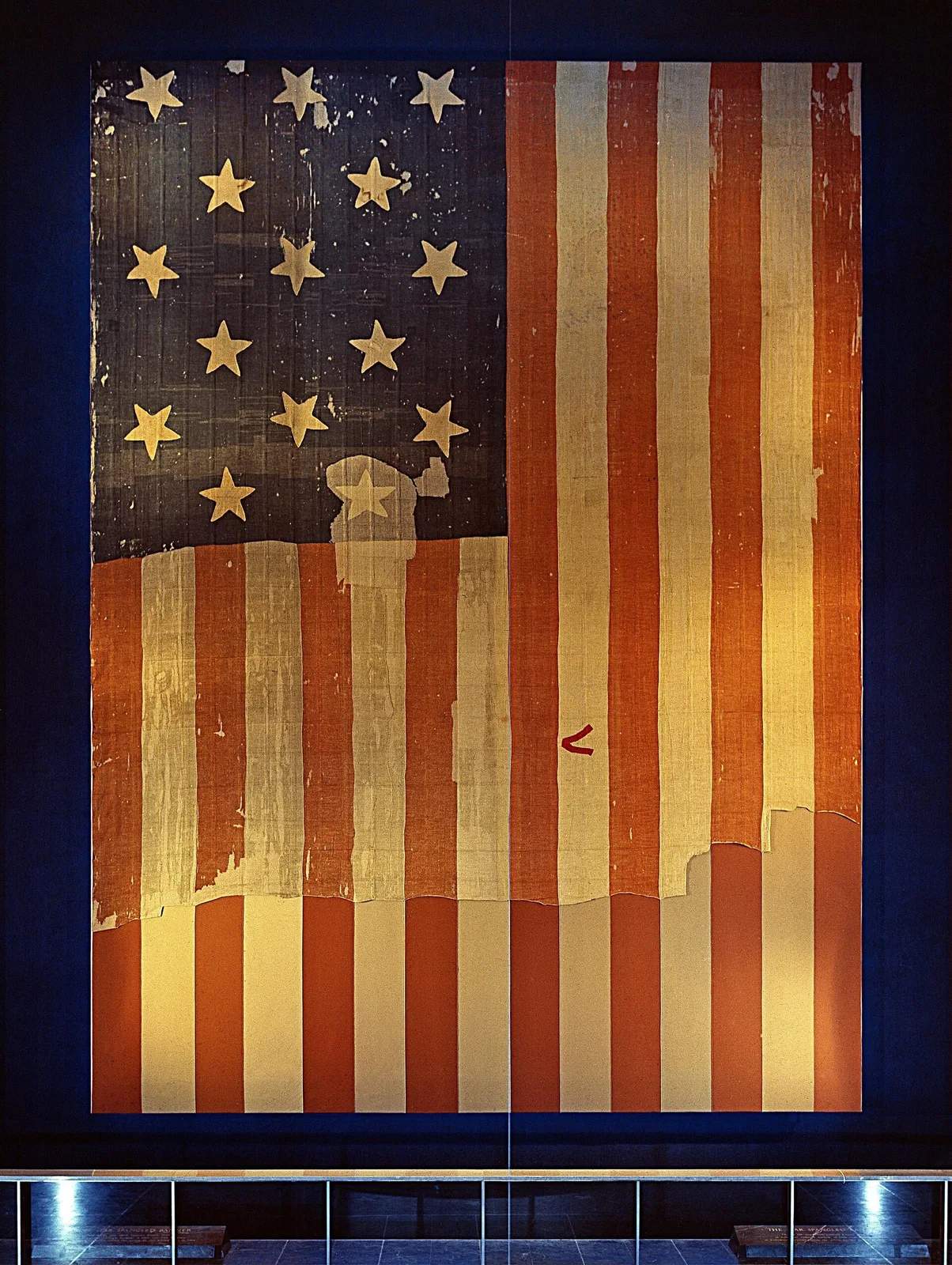
The original Star-Spangled Banner, 30 by 42 feet, sewn by Mary Pickersgill in 1813, now preserved at the Smithsonian.
Symbol of a Nation
Every element of the flag has a story. Not all of them are what tradition claims, and the honest history is more interesting than the legend.
The colors of the American flag have suggested meanings, but no official symbolism was established at the time the flag was adopted. The most widely cited explanation comes from Charles Thomson, who helped design the Great Seal of the United States. In his report to Congress, Thomson described the colors on the seal as follows: white for purity and innocence, red for hardiness and valor, and blue for vigilance, perseverance, and justice. Since the flag uses the same colors as the seal, these descriptions are commonly applied to the flag as well. The most honest answer, however, is that the colors were almost certainly chosen because they were the colors of the British Union Jack, inherited through the Continental Colors, and no formal symbolic meaning was assigned to them at the founding.
Congress never formally adopted Thomson's color symbolism for the flag itself; it applies, strictly speaking, only to the Great Seal, which is why careful flag reference works describe the meanings as commonly associated with the flag rather than legally established for it.
Thomson's 1782 seal report is the source most often quoted. He wrote that white "signifies purity and innocence," red "hardiness & valour," and blue "vigilance, perseverance & justice," and noted that these were "the colours of the flag of the United States of America."
The exact shades are defined for official use. Federal specifications call for "Old Glory Red" and "Old Glory Blue," matched to a government color standard, a deep crimson and a dark navy, not the brighter tones seen on many inexpensive reproductions.
The thirteen alternating red and white horizontal stripes represent the thirteen original colonies that declared independence from Great Britain in 1776: Connecticut, Delaware, Georgia, Maryland, Massachusetts, New Hampshire, New Jersey, New York, North Carolina, Pennsylvania, Rhode Island, South Carolina, and Virginia. The number has not changed since the Flag Act of 1818 permanently fixed it. No matter how many states join the Union, the stripes remain thirteen, a permanent tribute to the nation's founding. The flag always begins and ends with a red stripe, so there are seven red stripes and six white.
Because the stripe count has been legally frozen since 1818, the American flag is one of the few national flags whose main design element deliberately does not grow or change to reflect the country's current size, unlike the stars, which are added with every new state.
The stripes run horizontally, unlike the vertical bars of the 1765 Sons of Liberty flag; the horizontal arrangement may simply have followed the East India Company ensign that shaped the Grand Union Flag.
The count is one of the flag's unbreakable rules. The only time it ever changed was the fifteen-stripe flag of 1795 to 1818, after which Congress locked it at thirteen so the design would always point back to the founding no matter how large the country grew.
The fifty white five-pointed stars on the blue canton, known as the union, represent the fifty states currently in the Union. The stars are arranged in nine offset horizontal rows, alternating between rows of six and rows of five. The concept dates to the very first flag resolution of 1777, which described the stars as representing a new constellation, a sovereign nation rising among the established powers of the world with each state as an equal point of light. Stars are added on the July 4 following a state's admission, as required by the Flag Act of 1818. The star arrangement is governed by Executive Order 10834, signed by President Eisenhower in 1959, which specifies precise proportions down to the exact diameter of each star relative to the flag's hoist.
The nine-row, offset arrangement used since 1960 was chosen partly because it produces a visually balanced rectangle for exactly 50 stars; earlier configurations for other star counts, such as 48 or 49, used different row patterns, since no single geometric arrangement works cleanly for every possible number of states.
Every state gets an identical star, there is no larger star for older or bigger states, reflecting the constitutional idea that each state enters the Union as an equal member.
The 50-star field has been unchanged since July 4, 1960, by a wide margin the longest-serving version of the flag; it passed the 48-star flag's record on Independence Day 2007. A 51st state's star would be added on the next Fourth of July, using a layout federal planners have kept prepared in advance.
The blue rectangle in the upper-left corner of the flag is called the canton, or more formally the union. Its blue color has been associated with vigilance, perseverance, and justice. The canton's design traces directly to the first Flag Resolution of 1777, which specified that the union be thirteen stars, white in a blue field. Before stars were placed in the canton, the Grand Union Flag carried the British Union Jack in that position. Replacing the Union Jack with American stars was the symbolic act of declaring independence in fabric: this nation no longer had another country inside its flag.
Flag etiquette specifically forbids ever placing the canton anywhere but the upper-left when the flag is displayed normally, a rule strict enough that displaying the flag upside down, union to the bottom, is itself defined in the Flag Code as a recognized signal of distress.
"Canton" is a heraldic term for a rectangular section in a flag's upper corner. On the U.S. flag it spans the top seven stripes and 40 percent of the flag's length, and it is also called the "union" because it represents the states joined together.
On items where the flag "faces" a direction, such as a soldier's right shoulder patch, the canton is placed at the flag's own upper right, so the star field points forward as if the flag were streaming in the wind of an advance.
The American flag has three major nicknames, each with its own origin. Stars and Stripes is the oldest and most descriptive, in use since the founding era. The Star-Spangled Banner comes from Francis Scott Key's 1814 poem, which became the national anthem. Old Glory is the most personal: it was the name given by sea captain William Driver to his large American flag in 1831. Driver kept that flag hidden during the Civil War and revealed it when Union forces captured Nashville in 1862. The name stuck and spread, becoming one of the most affectionate names for the flag in American life.
William Driver was a merchant ship captain originally from Massachusetts who later settled in Nashville, and after his death in 1886 he was buried there beneath a gravestone marker reading simply "Old Glory" above his name, a lasting tribute to the nickname he coined.
"The Star-Spangled Banner" first meant only the specific 15-star flag at Fort McHenry, then Key's song, and finally the flag in general. Congress made the song the official national anthem in 1931, after decades of unofficial use by the Army and Navy.
Driver's original "Old Glory," a 10-by-17-foot flag with an anchor and stars added over the years, survives at the Smithsonian's National Museum of American History, donated by his descendants in 1922.
The Flag at the Defining Moments of American Life
The flag has been raised in triumph, lowered in mourning, planted on the Moon, and burned in protest. Each act is part of the same argument about what America is and what it means.
On the night of September 13, 1814, the British fleet bombarded Fort McHenry in Baltimore Harbor for twenty-five hours in one of the most intense naval attacks in the War of 1812. Held under British guard aboard an American truce ship behind the fleet, American lawyer Francis Scott Key had come to negotiate the release of a prisoner and was detained as the bombardment began. Through the night he watched the battle, and when dawn came, the garrison flag, thirty feet by forty-two feet and sewn by flag maker Mary Pickersgill, was still flying. Key pulled a letter from his pocket and began writing. The poem he produced, Defense of Fort M'Henry, was set to the tune of a popular British drinking song and became the national anthem by act of Congress in 1931. The original Star-Spangled Banner is now on display at the Smithsonian's National Museum of American History, restored and preserved, one of the most visited objects in any American museum.
Mary Pickersgill was paid $405.90 for making the flag, a considerable sum at the time, and she completed the work with help from her daughter, two nieces, and an indentured African American servant girl, sewing pieces so large the work reportedly had to be laid out on the floor of a nearby brewery.
Pickersgill actually made two flags for the fort: the enormous garrison flag for fair weather and a smaller 17-by-25-foot storm flag. Recent scholarship suggests the storm flag flew during the rainy overnight bombardment and the giant garrison flag was raised at dawn, the moment Key described.
The surviving banner is fragile wool bunting with cotton stars. Over the decades, families snipped off fragments as relics, and by the time it came to the Smithsonian, on loan in 1907 and as a permanent gift in 1912, it had shrunk from 30 by 42 feet to roughly 30 by 34, with one star cut out entirely.
On February 23, 1945, Associated Press photographer Joe Rosenthal captured the image of six Marines raising the American flag on Mount Suribachi during the Battle of Iwo Jima. The photograph became the most reproduced image in the history of photography, won the Pulitzer Prize, and inspired the Marine Corps War Memorial in Arlington, Virginia. The flag in the famous photograph was actually the second flag raised that day; a smaller flag had been raised earlier in the morning. The image arrived in the United States while the battle was still raging, and its emotional power, the flag raised at terrible cost on a Pacific island thousands of miles from home, made it an instant symbol of American sacrifice and determination in the final months of World War II.
Three of the six men in Rosenthal's photograph, Franklin Sousley, Harlon Block, and Michael Strank, were killed in action before the Battle of Iwo Jima ended, and the identities of the men pictured were misreported for decades, with the Marine Corps issuing a formal correction in 2016 after new forensic photo analysis.
The Marine Corps' final identification, completed after further review in 2019, lists the raisers as Ira Hayes, Franklin Sousley, Michael Strank, Harlon Block, Harold Schultz, and Harold Keller. Hayes, a Pima man from Arizona, was pulled home for a war-bond tour, struggled with the sudden fame and with alcoholism, and died of exposure in 1955 at age 32.
Rosenthal's photo was so striking that he was long accused of staging it; he had not, though a separate posed group shot taken minutes later added to the confusion. The image helped raise an estimated $26 billion in war bonds on the 1945 tour and became the model for the 32-foot bronze Marine Corps War Memorial dedicated in 1954.
On July 20, 1969, astronaut Neil Armstrong became the first human to set foot on the Moon, and shortly afterward he and Buzz Aldrin planted a specially modified American flag on the lunar surface. Because there is no atmosphere on the Moon and therefore no wind, the flag was fitted with a horizontal rod along the top to keep it extended. Five more flags were planted during subsequent Apollo missions. The flags planted during the earlier missions have likely been bleached white by decades of unfiltered solar radiation. The flag on the Moon was not intended as a territorial claim; NASA was explicit that it was a symbol of humanity's achievement, not American sovereignty, consistent with the Outer Space Treaty of 1967.
NASA specifically avoided planting a United Nations flag alongside the American one, a decision shaped partly by a congressional directive that only the American flag be used, even though the mission itself was framed publicly, in the plaque left on the lunar module, as being undertaken "for all mankind."
The Lunar Flag Assembly was designed in a hurry by NASA engineer Jack Kinzler for about $5.50 in materials, an off-the-shelf nylon flag on a telescoping aluminum crossbar. The bar did not fully extend on Apollo 11, leaving a rippled look that many viewers mistook for wind.
Buzz Aldrin later said the Apollo 11 flag was knocked flat by the exhaust of the ascent engine as the crew lifted off. Photographs from lunar orbiters decades later show the flags from Apollo 12, 16, and 17 still standing, though almost certainly bleached featureless by ultraviolet light.
In the immediate aftermath of the September 11 attacks, a photograph by Thomas E. Franklin captured three firefighters raising an American flag in the rubble of the World Trade Center. The image, reminiscent of the Iwo Jima photograph, circulated around the world within hours and became one of the defining images of the national response to the attacks. In the days that followed, American flags appeared everywhere: in windows, on cars, on bridges, in front of fire stations, on the streets of cities that had never seen so many flags. Demand for flags overwhelmed suppliers. The spontaneous outpouring was described by many observers as the most widespread display of the flag in American history.
The flag in Thomas Franklin's photograph was later lost after being passed among various custodians in the chaos following the attacks, and its authenticated whereabouts remained disputed for years among several flags claimed to be the original.
The flag itself had come from a nearby yacht. The three firefighters, George Johnson, Dan McWilliams, and Billy Eisengrein, raised it on a pole in the debris on the afternoon of September 11, and it was later flown at Yankee Stadium, aboard the aircraft carrier Theodore Roosevelt, and at the 2002 Winter Olympics.
In 2016 a man walked into a fire station in Everett, Washington, and handed over a flag matching the photo's dimensions and fiber wear. Forensic analysis for the National September 11 Memorial and Museum concluded it was very likely, though not certain to be, the original, and it is now in the museum's collection.
In 1984, Gregory Lee Johnson burned an American flag outside the Republican National Convention in Dallas as a political protest. He was convicted under a Texas law prohibiting flag desecration. The case reached the Supreme Court, which ruled 5-4 in Texas v. Johnson (1989) that flag burning is a form of symbolic speech protected by the First Amendment. Justice William Brennan wrote for the majority that the government may not prohibit the expression of an idea simply because society finds the idea itself disagreeable. Congress responded by passing the Flag Protection Act of 1989, which the Supreme Court also struck down in United States v. Eichman (1990). The flag remains a symbol that Americans argue over precisely because it means something deep enough to argue about.
Congress attempted to preempt exactly this kind of ruling by passing the Flag Protection Act of 1989 within weeks of the Texas v. Johnson decision, but the Supreme Court struck that federal law down too in United States v. Eichman the following year, reaffirming the same First Amendment principle at the national level.
The 5-4 lineup did not track the usual ideological split: Brennan, Marshall, Blackmun, Scalia, and Kennedy formed the majority, while Rehnquist, White, O'Connor, and Stevens dissented. Justice Kennedy wrote separately that the case forced him to a conclusion he personally disliked.
Since 1990, Congress has repeatedly tried to pass a constitutional amendment permitting flag-desecration bans. It cleared the House several times but always fell short in the Senate, most narrowly in 2006, when it failed by a single vote.
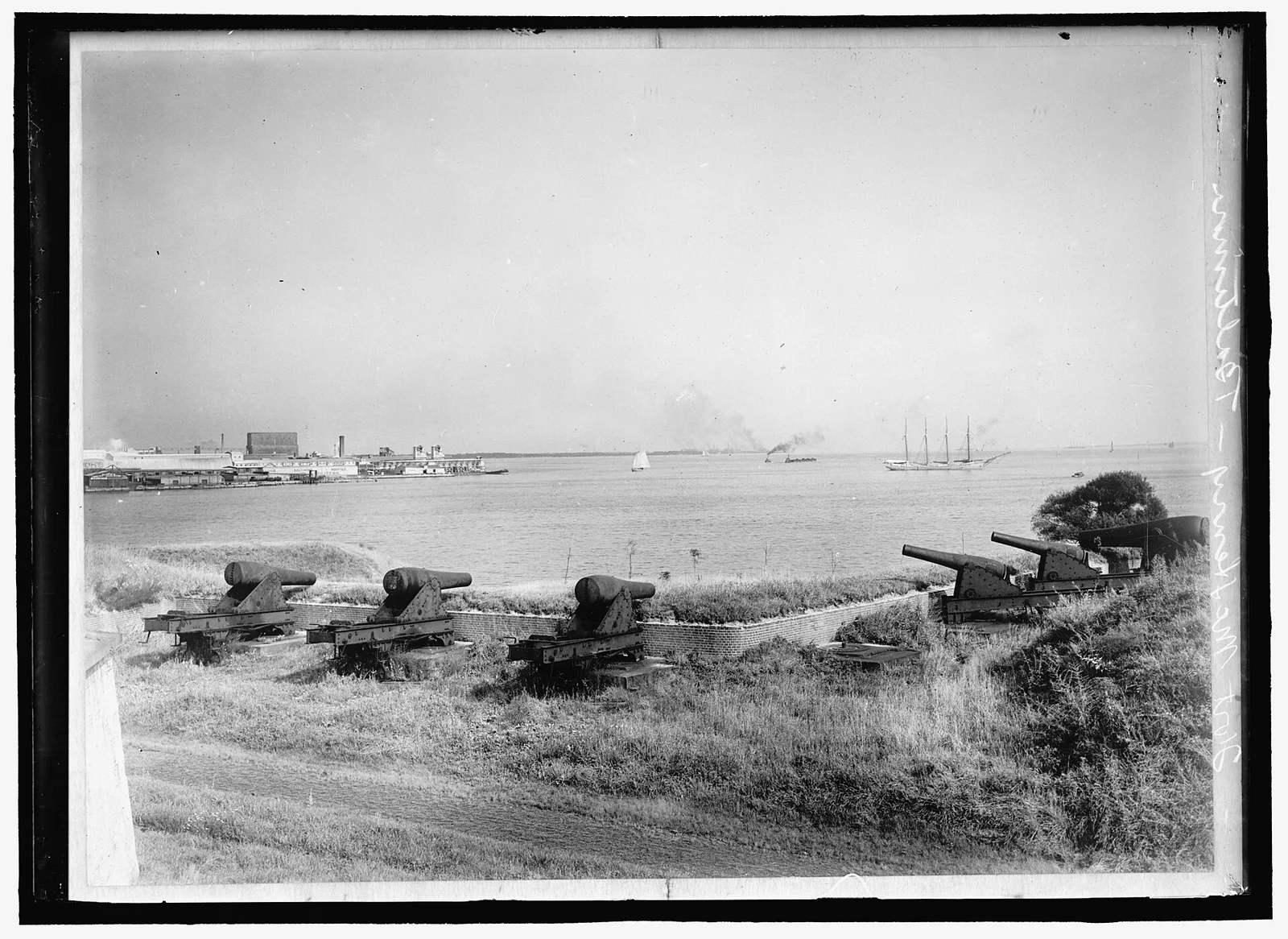
Fort McHenry in Baltimore Harbor, where the garrison flag inspired Francis Scott Key to write what became the national anthem.
The U.S. Flag Code: How to Honor the Flag
Congress adopted the Flag Code in 1942 to establish uniform guidelines for civilian display and care of the flag. It is a statement of custom and respect, not a criminal statute.
The U.S. Flag Code is a set of federal guidelines, first published on June 14, 1923 (Flag Day) and adopted by Congress in 1942, governing how the flag should be displayed and treated. It is important to understand what the Flag Code is not: it carries no criminal penalties for civilians. The Supreme Court's ruling in Texas v. Johnson (1989) established that flag burning and other forms of flag desecration are protected speech under the First Amendment. Some states have their own flag codes with penalties, but federal law imposes none. The Flag Code is a statement of custom and respect, not a criminal statute.
Some states had passed their own flag-desecration statutes with real criminal penalties before Texas v. Johnson; those state laws were rendered unenforceable by the decision, since the First Amendment protection the Court recognized applies against state government action just as it does against federal law.
The code lives at Title 4 of the U.S. Code, Chapter 1, and uses the word "should" throughout rather than "shall" or "must." It carries no enforcement mechanism for private citizens and is binding only where a military service or federal agency writes it into its own regulations.
Congress has amended it over the years, adjusting the salute during the anthem and adding rules about folding flags for veterans' funerals, but the core remains a code of etiquette. Common modern practice, flag clothing, flag napkins, flags left up overnight unlit, technically departs from it with no legal consequence.
The Flag Code specifies that the flag should normally be displayed only from sunrise to sunset, and may be displayed around the clock only if properly illuminated during darkness. It should not be displayed in inclement weather unless an all-weather flag is used. When hung vertically or flat, the union (the blue star field) is always in the upper left from the observer's perspective. When displayed on a wall behind a podium or stage, the union goes to the flag's own right, which is the audience's left. The flag should never touch the ground, be used as clothing, be used as a tablecloth, or be used for any commercial purpose.
The Flag Code also recognizes continuous, round-the-clock display without illumination restrictions at certain locations designated by presidential proclamation or long-standing custom, including Fort McHenry, the U.S. Capitol grounds, and the Marine Corps War Memorial depicting the Iwo Jima flag raising.
When other flags share a single halyard with the U.S. flag, it goes on top; on separate adjacent poles of equal height, it is raised first and lowered last and stands at its own right, the viewer's left, in a line of flags. In peacetime no other flag flies above it on American soil, with the U.N. flag at U.N. headquarters as a customary exception.
The code also says the flag should not be draped over a vehicle, used to cover a ceiling, or marked with words or drawings. A flag used to cover a casket is placed with the union at the head and left shoulder and is never lowered into the grave or allowed to touch the ground.
Flying the flag at half-staff (sometimes called half-mast) is a sign of mourning. The president may order flags to half-staff to mark the death of government officials or national tragedies. On Memorial Day, the flag is flown at half-staff from sunrise until noon, then raised to full staff for the remainder of the day. The proper procedure is to raise the flag to the top of the pole first, then lower it to half-staff, and to raise it again to full staff before lowering it at the end of the day. The flag should never be lowered directly to half-staff without first being raised to the top.
State governors hold independent authority to order flags lowered to half-staff within their own states, which is why flags at state buildings sometimes fly at half-staff to mark a state-specific loss even when federal buildings elsewhere in the country continue flying at full staff.
Federal law sets automatic half-staff periods: 30 days after the death of a president or former president, 10 days after a vice president, chief justice, or House speaker, and until burial for members of Congress and certain other officials. Peace Officers Memorial Day, May 15, is a half-staff day unless it falls on Armed Forces Day.
A 2007 law extended the governor's half-staff authority to cover the death of a service member from that state, and gave the same power to the mayor of the District of Columbia, which is why flags are sometimes at half-staff in one state and full staff in another.
The Pledge of Allegiance was written by Francis Bellamy in 1892 for a national school celebration of Columbus Day and was published in the Youth's Companion magazine. It received its official title in 1945. Congress included it in the Flag Code in 1942. The phrase under God was added by Congress in 1954. When reciting the Pledge, all should stand facing the flag with the right hand over the heart. Men not in uniform should remove any non-religious headdress. Persons in uniform should render the military salute. The full text: I pledge allegiance to the Flag of the United States of America, and to the Republic for which it stands, one Nation under God, indivisible, with liberty and justice for all.
The phrase "under God" was added in 1954 amid Cold War-era efforts to distinguish the United States from officially atheistic Soviet communism, a change that has since prompted several Supreme Court challenges arguing it violates the First Amendment's Establishment Clause, none of which have succeeded in striking it down.
Bellamy's original text said "my Flag"; it was changed in stages between 1923 and 1924 to "the Flag of the United States of America" so that immigrants would not be pledging to their country of origin. The Pledge originally came with the "Bellamy salute," an outstretched arm, which was dropped during World War II because it resembled the fascist salute and replaced with the hand over the heart.
In West Virginia State Board of Education v. Barnette (1943), the Supreme Court ruled that public schools may not compel students to recite the Pledge, overturning a decision from just three years earlier. Students may stand silently or remain seated.
When a flag is no longer fit for display due to wear, fading, or damage, the Flag Code specifies that it should be destroyed in a dignified way, preferably by burning. The customary ceremony involves folding the flag in the traditional triangular shape, placing it on a fire of sufficient intensity to consume it completely, rendering a salute, reciting the Pledge of Allegiance, and observing a moment of silent reflection. After the flag is consumed, the ashes are buried. Many Veterans of Foreign Wars posts and American Legion posts conduct retirement ceremonies, particularly on Flag Day and around Veterans Day. The practice of burning a worn flag as a mark of respect is often confused with burning a flag as protest; they are legally and ceremonially distinct acts.
The American Legion alone reports collecting and properly retiring several hundred thousand worn flags every year through organized ceremonies nationwide, a volume that reflects how many households and businesses fly flags regularly enough that a steady, ongoing disposal system has become necessary.
Nylon and polyester flags, now the most common, give off toxic fumes when burned, so many veterans' groups and recycling programs now cut the flag apart, separating the stripes from the union so the star field is never severed, and bury or recycle the pieces instead of open-air burning.
Some towns and organizations run year-round flag drop-off boxes, often at town halls, VFW and American Legion posts, or Scout troops, and large ceremonial retirements are commonly held on Flag Day, June 14, and around Independence Day.
Quick Reference: Do and Do Not
Proper Practice
- Display from sunrise to sunset, or 24 hours if illuminated
- Raise briskly, lower ceremoniously
- When hanging vertically, union (stars) in upper left from observer's view
- Fly at half-staff on Memorial Day until noon, then full staff
- Stand with right hand over heart during the Pledge and Anthem
- Retire worn flags by dignified burning
- Display the flag on the right side when carried in a procession
Improper Use
- Never let the flag touch the ground
- Never use as clothing, bedding, or drapery
- Never display with union (stars) facing down except as distress signal
- Never use for advertising or commercial purposes
- Never display a damaged or torn flag
- Never fly smaller than other flags at the same level
- Never fly in inclement weather unless an all-weather flag
Note: The Flag Code carries no criminal penalties for civilians. The Supreme Court ruled in Texas v. Johnson (1989) that flag burning as political protest is protected speech under the First Amendment. State laws on flag desecration vary.
Flag Day, June 14
Flag Day commemorates the Flag Resolution of June 14, 1777. It has been observed in various communities since the nineteenth century. President Harry Truman signed legislation making June 14 a national day of observance on August 3, 1949. It is not a federal holiday, but the flag should be displayed on Flag Day as part of the national observance.
The flag flying over 2026's celebrations marks a milestone of its own, see America's 250th Anniversary for a look back at 250 years since 1776.
Sources & Further Reading
- National Flag Foundation, Flag History and Evolution
- Smithsonian National Museum of American History, The Star-Spangled Banner
- American Battlefield Trust, History of the American Flag
- National Archives, Flag Resolution of 1777
- Library of Congress, Formation of the Flag
- U.S. Flag Code, 4 U.S.C. Chapter 1
- National Archives Foundation, The Stars and Stripes Forever
Flag design and origin history is drawn from the National Flag Foundation, the American Battlefield Trust, the National Archives Foundation, and the Smithsonian National Museum of American History. Flag Code text is from 4 U.S.C. Chapter 1. The Robert Heft account is drawn from contemporaneous newspaper records and the National Flag Foundation. The Betsy Ross analysis draws on academic historians including Marla Miller and Laurel Thatcher Ulrich.