

About Missouri
Missouri takes its name from the Missouri River and the Missouri people, a Siouan-speaking nation who lived along the river. The word "Missouri" is believed to come from a Miami-Illinois word meaning "town of the large canoes" or possibly from an Algonquian word meaning "people with wooden canoes." French explorers who encountered the Missouri people in the late 1600s recorded the name for the river, and it was applied to the territory when the United States acquired it as part of the Louisiana Purchase in 1803. Missouri became a state in 1821 as part of the Missouri Compromise, which attempted to balance the admission of slave and free states as the nation expanded westward.
Missouri occupies the geographic and historical heart of the United States, a state that borders more other states than almost any other, sits at the confluence of the nation's two greatest river systems, and served for over a century as the literal departure point for Americans heading west. Every wagon train on the Oregon Trail, every prospector headed for California, every Mormon pioneer bound for Utah, they all came through Missouri first. The Gateway Arch that rises 630 feet above the St. Louis riverfront is not just a monument to a city; it is the nation's monument to its own westward ambition.
Missouri is also a state of remarkable cultural production. Mark Twain grew up on the Mississippi River in Hannibal and gave the world Tom Sawyer and Huckleberry Finn. Walt Disney grew up in Marceline and Kansas City and built an entertainment empire whose aesthetic was shaped by Missouri small-town life. T.S. Eliot was born in St. Louis. Langston Hughes was born in Joplin. Chuck Berry invented the guitar riff in St. Louis. The Kansas City jazz scene produced Charlie Parker. Harry Truman from Independence made the decision that ended World War II.
Missouri today is a purple state turned reliably red at the presidential and statewide level, even as Kansas City and St. Louis remain Democratic strongholds. It is a state with a sophisticated urban economy, aerospace, healthcare, financial services, automotive manufacturing, and a vast, deeply conservative rural hinterland. The tension between those two Missouris is the defining political dynamic of the state and, in many ways, of the nation.

Missouri's Five Regions
St. Louis sits at the confluence of the Missouri and Mississippi rivers, a position that made it the logical 'Gateway to the West', the staging point for every major western expedition and migration in the 19th century. The city was founded by French fur traders in 1764 and grew into the fourth-largest city in the United States by 1900, a booming industrial and commercial center with elaborate architecture, a world-class symphony, and a deep German and Irish immigrant heritage.
Today the St. Louis metro area of roughly 2.8 million anchors Missouri's eastern economy, home to Boeing's military aircraft production, BJC HealthCare and Washington University in St. Louis (consistently among the nation's top research universities), Centene, Edward Jones, and a thriving biomedical research sector. Downtown St. Louis has struggled with population loss and urban decay but retains extraordinary assets: the Gateway Arch National Park, Busch Stadium (Cardinals), Enterprise Center (Blues), Forest Park, and a remarkable collection of Victorian and early-20th-century architecture.
The city's population, which peaked at 856,000 in 1950, has declined to under 300,000 as residents moved to surrounding counties, a persistent civic challenge.
St. Louis has been a separate city, not part of any county, since a 'Great Divorce' from St. Louis County in 1876, an arrangement city leaders then thought would free it from rural taxes but that now leaves the region split among the city and more than 88 separate municipalities in the county, with fragmented police, courts, and school districts. Repeated 20th and 21st-century attempts to reunite the city and county, most recently a 2019 'Better Together' plan, have failed at the ballot or in the legislature.
Kansas City straddles the Missouri-Kansas border and is the economic and cultural capital of the western Great Plains. The city grew as a cattle, grain, and railroad hub in the late 19th century, its stockyards were among the largest in the world, and Kansas City barbecue developed in the meatpacking district as workers smoked and slow-cooked less desirable cuts of beef to tender perfection.
The result, slow-smoked brisket, burnt ends, and pulled pork slathered in thick, sweet, tangy sauce, is considered by many the definitive American barbecue style. Kansas City's jazz scene of the 1930s and 1940s produced some of the most important musicians in American history, including Charlie 'Bird' Parker, Count Basie, and Lester Young.
Today Kansas City is a city of fountains, it has more than any city in the world except Rome, and a booming economy anchored by Sprint (now T-Mobile Midwest), Hallmark Cards, H&R Block, and a growing technology sector. The Kansas City Chiefs (back-to-back Super Bowl champions) have made the city a football capital, and the Country Club Plaza, Westport, and the Power & Light District are thriving entertainment destinations.
The metro straddles the state line, with about 60 percent of its 2.4 million people on the Missouri side; the two halves compete so aggressively with tax incentives to lure company headquarters back and forth across State Line Road that Missouri and Kansas signed a 2019 truce to stop the practice. Political boss Tom Pendergast ran the Missouri side as a machine from the 1920s until a 1939 federal tax-fraud conviction, and it was Pendergast who gave a young Harry Truman his start in politics.
Kansas City opened a 2-mile downtown streetcar line in 2016, since extended, and in 2023 became the largest U.S. city to make its entire bus system fare-free. The new Kansas City International Airport terminal opened in 2023 at a cost of about 1.5 billion dollars, and the Chiefs and Royals are pressing for new or renovated stadiums, with the Royals having lost a 2024 Jackson County sales-tax vote to fund a downtown ballpark.
The Ozark Plateau dominates south-central Missouri, an ancient, heavily eroded highland of limestone bluffs, clear spring-fed rivers, dense oak-hickory forest, and deep sinkholes that makes this one of the most geologically interesting landscapes in the central United States. The Ozarks are older than the Rockies, older than the Appalachians in their geological ancestry, and they run from southern Missouri through northwestern Arkansas.
Missouri's Ozarks support one of the most robust outdoor recreation economies in the Midwest: float trips down the Current, Jacks Fork, and Eleven Point rivers (much of which is protected as the Ozark National Scenic Riverways, the first national riverway in the U.S.); Table Rock Lake and Lake of the Ozarks for boating; and Branson, the country music and family entertainment capital that draws millions of visitors a year to its live theater shows, amusement parks, and resort hotels.
The Ozarks have a distinctive culture, Scots-Irish settler heritage, strong religious traditions, and an independent political character that has swung hard toward the Republican Party in recent decades.
Springfield, at the western edge of the plateau, is Missouri's third-largest city, the headquarters of the Assemblies of God Pentecostal denomination and of the Bass Pro Shops outdoor-retail empire, whose 'Wonders of Wildlife' museum and flagship store draw millions of visitors. The town was also the site of the 1865 'Wild Bill' Hickok gunfight generally regarded as the first true quick-draw duel of the Old West.
The region holds some of Missouri's poorest counties, and the drug researcher and journalist accounts of the 2000s made the Ozarks a national symbol of rural methamphetamine production before pseudoephedrine controls curbed home 'cooking,' a milieu dramatized in the novel and film 'Winter's Bone' and the Netflix series 'Ozark.' Mark Twain National Forest, spread across the plateau in a patchwork, and dozens of large caves, Missouri is called 'the Cave State' with more than 7,500 of them, underpin the tourism economy alongside the float streams.
The Missouri River cuts a wide, muddy arc across the state from Kansas City to St. Louis, and the corridor along its banks has historically been the agricultural and political spine of Missouri. Jefferson City, the state capital, sits on a bluff above the Missouri River roughly midway between the two major metros, a deliberate compromise location chosen precisely because it was between St. Louis and Kansas City.
Jefferson City (population about 43,000) is small for a state capital but houses state government, the Missouri Supreme Court, and a significant government-adjacent professional sector. Columbia, 30 miles north of Jefferson City, is home to the University of Missouri (Mizzou), the state's flagship public university and one of the oldest public universities west of the Mississippi (founded 1839).
Columbia has grown into one of Missouri's most dynamic cities, with healthcare, technology, and education driving its economy. The river corridor's fertile bottomlands produce soybeans, corn, and wine grapes, the Hermann wine region, settled by Germans in the 1840s, is one of the oldest continuously operating wine regions in the country.
The University of Missouri, founded in 1839 as the first public university in the Louisiana Purchase territory, is the region's largest employer and runs the state's only comprehensive academic medical center and its lone Division I public research campus; the 1908 founding of the world's first journalism school there gave rise to the widely used ethics code known as 'the Missouri Method.' Fall 2015 protests over the administration's handling of racist incidents forced the resignations of the system president and campus chancellor and drew national attention.
Jefferson City was carved out of wilderness specifically to be the capital, named for Thomas Jefferson, and its domed 1917 capitol, the third on the site after two burned, is faced with Carthage marble quarried in southwest Missouri and decorated with a Thomas Hart Benton mural cycle that scandalized legislators in 1936 by depicting Boss Pendergast and a lynching. The 1855 Gasconade Bridge disaster nearby, when a train carrying dignitaries to the Pacific Railroad's opening plunged through a collapsing span, killed about 30 people and was one of the deadliest early U.S. rail accidents.
Missouri's Bootheel, the angular protrusion in the state's southeastern corner that juts down between Arkansas and Tennessee, is geographically, culturally, and economically more similar to the Deep South than to the rest of Missouri. The Bootheel's flat, fertile Delta soil, drained and cleared of swampland in the early 20th century, is some of the most productive cotton and soybean land in America. Cotton was the primary crop for most of the 20th century, worked by Black sharecroppers in conditions that echoed the plantation system; the mechanization of cotton farming in the 1940s and 1950s displaced hundreds of thousands of Black workers and accelerated the Great Migration northward.
Today the Bootheel produces rice, soybeans, corn, and cotton in enormous quantities. Cape Girardeau, at the northern end of southeast Missouri on the Mississippi River, is the region's largest city, a conservative college town (Southeast Missouri State University) and the birthplace of Rush Limbaugh.
Poplar Bluff and Sikeston anchor the Bootheel economy. The region's poverty rates are among the highest in Missouri, echoing its Deep South character.
The Bootheel exists because of one man: planter John Hardeman Walker lobbied Congress in 1818 to 1820 to run the new state's southern line east from the 36°30' parallel to the St. Francis River and then south to 36°, capturing his lands, so Missouri dips below the compromise line it otherwise defined. The land was a vast cypress swamp until the Little River Drainage District, chartered in 1907, dug more channels than the Panama Canal moved earth to drain roughly 1.2 million acres into farmland.
The 1939 Missouri Sharecroppers' Roadside Demonstration, in which about 1,500 evicted Black and white sharecroppers led by the minister Owen Whitfield camped along U.S. Highways 60 and 61 in the January cold to protest landlords cutting them off from federal crop payments, drew national coverage and pushed the New Deal to build resettlement communities such as Cropperville. Mechanized cotton picking after World War II ended most of that labor, and many families left for the industrial North.

Economy
Missouri's economy is anchored by aerospace and defense manufacturing, automotive assembly, healthcare, a deep financial services sector, and the agricultural bounty of its river valleys and Ozark hills.
Boeing's F/A-18 Super Hornet and F-15 Eagle production facility in St. Louis, heir to the McDonnell Douglas legacy, has built tens of thousands of military aircraft that have flown for the U.S. Navy, Air Force, and dozens of allied nations. McDonnell Douglas (later merged with Boeing) built the Mercury and Gemini spacecraft capsules that carried American astronauts into space in the 1960s, making St. Louis a foundational city in the American space program before it became synonymous with Silicon Valley.
Emerson Electric, headquartered in St. Louis, is a global industrial technology and defense electronics company with over 85,000 employees worldwide. Scott Air Force Base in the Metro East region is one of the most important military installations in the country, home to U.S. Transportation Command, which coordinates all U.S. military logistics globally.
Fort Leonard Wood in the Ozarks is a major Army training installation. Missouri's defense manufacturing ecosystem employs tens of thousands and generates billions in federal contracts annually.
The St. Louis site's biggest recent win came in 2018, when the Air Force chose Boeing's design for the T-7A Red Hawk trainer jet, its first all-new training aircraft in decades, to be built there, followed by the MQ-25 Stingray carrier-based refueling drone; Boeing has invested in new advanced-manufacturing buildings near St. Louis Lambert airport for the programs. Whiteman Air Force Base near Knob Noster is the only operational base for the B-2 stealth bomber and will host its successor, the B-21 Raider.
Missouri is consistently one of the top cattle-producing states in the nation, with millions of beef cattle grazing the Ozark hills and river bottoms. Soybeans and corn dominate the crop landscape, particularly in the fertile river bottomlands and the Bootheel's flat Delta soil. Missouri's hog industry is substantial, the state ranks among the top pork producers in the country.
The agricultural economy supports an extensive food processing and agribusiness sector centered in Kansas City, which is one of the most important agricultural commodity markets in the world. The Kansas City Board of Trade and the major grain elevators and stockyards that made Kansas City the 'Paris of the Plains' in the 19th century have evolved into a sophisticated agribusiness financial center. Missouri is also a significant wine producer, the Hermann area in the Missouri River Valley has been producing wine since German immigrants settled there in the 1840s.
Missouri consistently ranks second in the nation, behind Texas, in number of farms, with roughly 85,000 to 95,000 of them, most under 300 acres, and second in beef cow inventory, with about 4 million head. The state's fragmented, family-scale farm structure reflects its position on the border of the Corn Belt, the Ozark cattle country, and the Delta.
The Kansas City area is home to the largest concentration of animal-health and nutrition companies in the world, an 'Animal Health Corridor' running toward Manhattan, Kansas, that includes Boehringer Ingelheim, Ceva, and dozens of others and accounts for a large share of global animal-health sales. The U.S. Department of Agriculture also moved two research agencies, the Economic Research Service and the National Institute of Food and Agriculture, to the Kansas City area in 2019.
The Missouri wine industry that German settlers built at Hermann and Augusta was, before Prohibition, second in U.S. output only to Ohio, and Missouri vine cuttings sent to France in the 1870s helped save the European wine industry from the phylloxera aphid by providing resistant rootstock. Augusta was named the first federally designated American Viticultural Area in 1980, ahead of Napa Valley.
Ford Motor Company's Kansas City Assembly Plant in Claycomo is one of the most important truck-producing facilities in the country, manufacturing the F-150 and F-Series Super Duty trucks, the best-selling vehicles in America for over four decades. General Motors operates a major assembly plant in Wentzville (west of St. Louis) that produces the Chevrolet Colorado, GMC Canyon, Chevrolet Express, and GMC Savana vans. Together, the Ford and GM plants directly employ thousands of UAW members and support a substantial automotive supply chain ecosystem across the state.
The presence of two major assembly plants, one anchoring each major metro area, gives Missouri unusual automotive manufacturing diversity and resilience. Both facilities have undergone significant modernization investment in recent years to produce next-generation truck and van platforms.
Missouri once had far more auto plants: Chrysler ran two large assembly plants at Fenton, near St. Louis, that together employed more than 5,000 people before closing in 2008 and 2009 during the industry's collapse, and a St. Louis Ford plant at Hazelwood closed in 2006. The state responded in 2010 with the Missouri Manufacturing Jobs Act, a tax-incentive package aimed specifically at keeping the Claycomo and Wentzville plants, which Ford and GM then chose for major new investment.
The Claycomo plant, opened in 1957, is one of Ford's largest and builds the F-150 pickup, the best-selling vehicle in the United States for more than four decades, along with the Transit van; it employs roughly 7,000 workers across two shifts. GM's Wentzville plant, opened in 1983, is the company's only midsize-pickup plant, building the Chevrolet Colorado and GMC Canyon plus full-size cargo vans, with about 4,000 workers.
The plants are a barometer of the industry's fights: Wentzville workers were on the picket line for six weeks during the United Auto Workers' 2023 strike against all three Detroit automakers, and both Missouri plants have seen extended shutdowns from the 2021 to 2022 semiconductor shortage and periodic retooling. Automotive and parts manufacturing remains one of Missouri's largest manufacturing employers.
St. Louis is home to three of the major integrated health systems in the country: BJC HealthCare (which operates Barnes-Jewish Hospital, one of the top hospitals in the nation, in affiliation with the Washington University School of Medicine), SSM Health (a Catholic health system with dozens of hospitals across multiple states), and Mercy Health. Washington University School of Medicine in St. Louis is consistently ranked among the top medical schools in the world and anchors a sophisticated biomedical research and life sciences ecosystem in the St. Louis metro area. Centene Corporation, one of the largest health insurance companies in the United States (specializing in Medicaid managed care), is headquartered in St. Louis and is the largest company in Missouri by revenue.
The University of Missouri health system anchors healthcare services across central Missouri. Healthcare and social assistance collectively employ more Missourians than any other industry.
Centene grew from a single Milwaukee health plan bought by Elizabeth Brinn into a Fortune 25 company after moving to St. Louis, riding the expansion of privately managed Medicaid and Affordable Care Act marketplace plans; it reported revenue above 150 billion dollars in the 2020s, making it Missouri's largest company, before a 2024 to 2025 retrenchment and headquarters-space cutbacks. Express Scripts, the pharmacy-benefit manager now owned by Cigna, is also headquartered in the St. Louis suburb of Berkeley.
Washington University's Genome Institute was one of the leading centers of the Human Genome Project, contributing roughly a quarter of the finished sequence published in 2003, and the university and BJC announced a multibillion-dollar rebuild of the Barnes-Jewish and Children's hospital campus in the 2020s. The 39 North district in Creve Coeur, anchored by the Donald Danforth Plant Science Center and a former Monsanto research campus, concentrates Missouri's plant-science and agtech startups.
Missouri expanded Medicaid only after voters approved it in a 2020 ballot measure and the state Supreme Court ordered the legislature to fund it in 2021, extending coverage to more than 300,000 additional low-income adults. Rural hospital finances remain fragile, and several Missouri hospitals in small towns such as Kennett and Fulton have closed or sharply cut services since 2014.
Edward Jones, one of the largest investment advisory firms in the United States with thousands of individual-advisor branch offices across the country, is headquartered in Des Peres, Missouri, a St. Louis suburb. Stifel Financial, a significant investment bank and brokerage, is headquartered in St. Louis. Enterprise Rent-A-Car, the largest rental car company in the world by fleet size, is headquartered in Clayton, Missouri, a St. Louis suburb, and remains a major privately-held Missouri company.
Peabody Energy, the world's largest private-sector coal company, is headquartered in St. Louis. Kansas City's financial sector is anchored by the Federal Reserve Bank of Kansas City (one of the 12 Federal Reserve banks, with jurisdiction over the Tenth District) and a growing fintech and payments technology sector built around the city's legacy as a major commerce hub.
Missouri is the only state that hosts two of the twelve regional Federal Reserve banks: the St. Louis Fed, long associated with monetarist economics and its widely used FRED economic-data service, and the Kansas City Fed, whose annual Jackson Hole symposium in Wyoming is the most closely watched central-banking conference in the world. The split dates to a 1914 political compromise when the reserve districts were drawn.
Edward Jones operates more than 15,000 one-broker branch offices across North America, more retail locations than any other brokerage, and is structured as a partnership owned by its advisors. Enterprise Holdings, still controlled by the Taylor family that founded it in a St. Louis basement in 1957 as 'Executive Leasing,' owns the Enterprise, National, and Alamo brands and is the largest car-rental company in the world with a fleet of roughly 2 million vehicles.
Peabody Energy, founded in Chicago in 1883 and headquartered in St. Louis since 2004, ships coal from mines in Wyoming's Powder River Basin, Illinois, and Australia; it went through Chapter 11 bankruptcy in 2016 as U.S. coal demand fell and emerged much smaller. Kansas City's payments cluster grew out of the mid-20th-century mail-order and finance economy and now includes card processors and the trading firms drawn by the Board of Trade's historic wheat-futures market, absorbed by the Chicago exchange in 2012.
The Gateway Arch National Park in St. Louis, anchored by Eero Saarinen's 630-foot stainless steel arch, the tallest man-made monument in the Western Hemisphere, is one of the most visited national park sites in the country. St. Louis's Forest Park, site of the 1904 World's Fair, is one of the largest urban parks in the United States and houses the acclaimed St. Louis Art Museum, the Missouri History Museum, the Saint Louis Zoo, and the St. Louis Science Center, all free to the public.
Kansas City is renowned for its jazz heritage (the 18th and Vine Jazz District preserves the neighborhood where Charlie Parker developed bebop), its barbecue (Kansas City-style slow-smoked brisket and burnt ends are considered by many the pinnacle of American BBQ), and the Country Club Plaza, the nation's first outdoor shopping district. Branson, in the Ozarks, is a country music and family entertainment destination drawing millions annually.
The Lake of the Ozarks is one of the largest man-made lakes in the country and a major recreational destination.
The lake was formed in 1931 when Union Electric completed Bagnell Dam on the Osage River, creating a reservoir with about 1,150 miles of shoreline, more than the California coast, and it now supports a summer economy of condominiums, marinas, and the raucous 'Party Cove' boating scene, plus the state's largest state park. Branson, farther south, grew from the 1907 novel 'The Shepherd of the Hills' into a live-entertainment town with dozens of theaters seating more than 50,000 people combined, drawing an older, church-and-family tourist market that peaks in the fall.

How Missouri's Government Works
Missouri's state government follows the standard three-branch structure: the Executive (Governor), the Legislative (the Missouri General Assembly, a 34-seat Senate and 163-seat House of Representatives), and the Judicial (the Missouri Supreme Court, with seven justices selected through a merit-selection system called the Nonpartisan Court Plan, sometimes called the 'Missouri Plan,' which has been adopted by dozens of other states).
The Governor serves a four-year term limited to two consecutive terms (though a governor who completes less than two years of a predecessor's term may run for two full terms of their own). Republicans have held the governorship since 2005 and currently hold supermajorities in both legislative chambers. Missouri was considered a swing state as recently as the early 2000s, it voted for George W. Bush in 2000 by just 3 points, but has shifted dramatically rightward and voted for Donald Trump by 18+ points in 2020 and 2024.
Missouri's judiciary is selected through the Nonpartisan Court Plan, developed in 1940, in which a nonpartisan commission nominates candidates for appellate and Supreme Court vacancies; the Governor appoints from that list; and judges then face periodic retention votes. This system was designed to insulate the judiciary from political patronage and has been widely regarded as a model for judicial selection.
Missouri's merit selection system for judges, developed in 1940, has been adopted in some form by over 30 other states and is considered one of Missouri's most significant contributions to American governance. It replaced the old system of partisan judicial elections with a professional nomination process designed to prioritize judicial qualifications over political connections.
Governor of Missouri
Current Governor
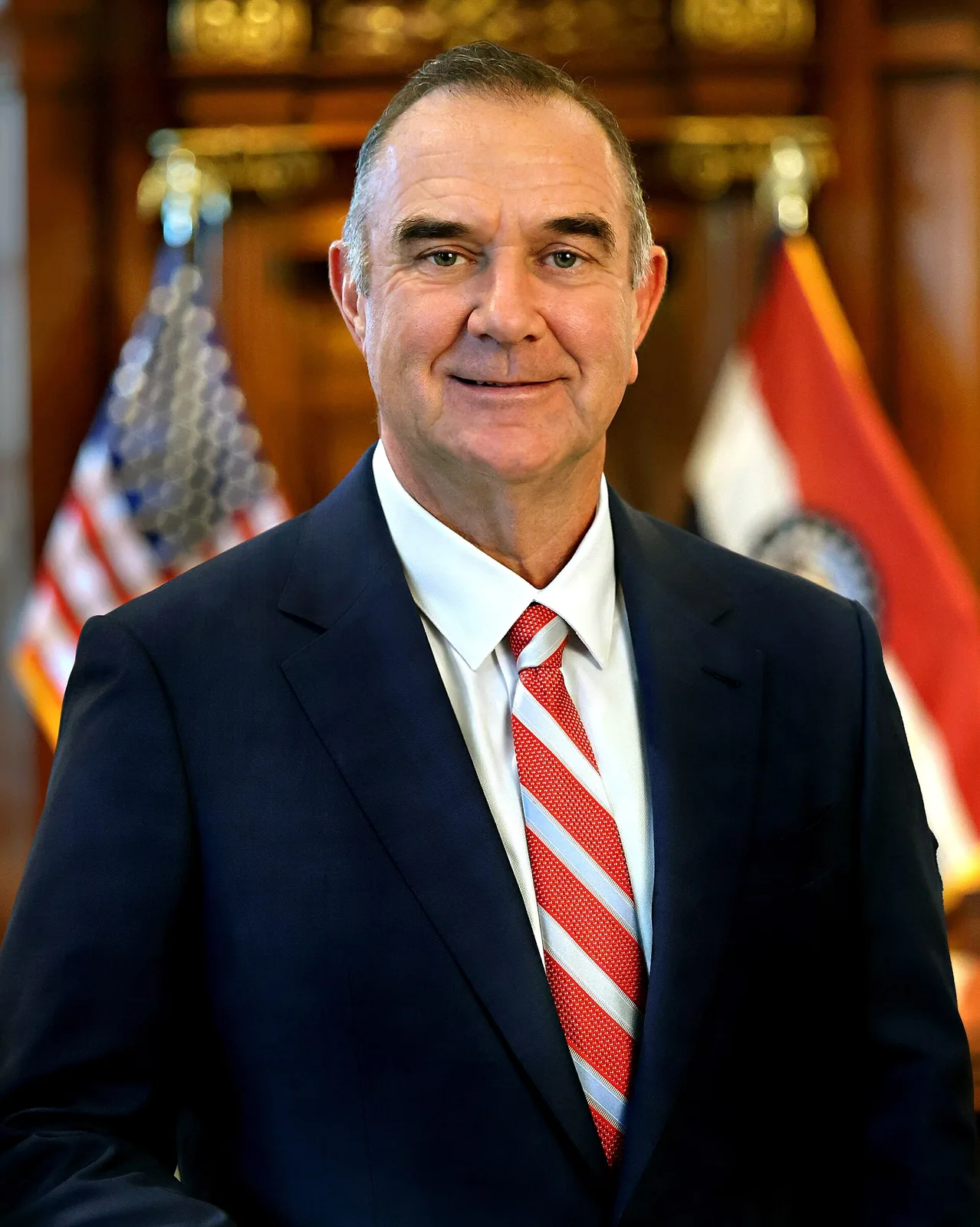
Mike Kehoe
- Party
- Republican
- In Office Since
- January 13, 2025
- Elected
- November 5, 2024
- Term Ends
- January 2029
- Background
- Automotive dealer (Kehoe Auto Group, Jefferson City); businessman
- Prior Role
- Missouri State Senator, District 6 (2010–2018); Lieutenant Governor (2019–2025)
Mike Kehoe is Missouri's 57th Governor. A Jefferson City businessman who built a career in automotive dealerships before entering politics, Kehoe served eight years in the Missouri Senate, including as Senate Majority Leader, before being elected Lieutenant Governor under Mike Parson in 2018. He won the 2024 Republican gubernatorial primary over Secretary of State Jay Ashcroft and defeated Democratic nominee Crystal Quade in the general election. His administration has focused on economic development, workforce training, and continuing Missouri's business-friendly posture.
Other Current State Officials
Lieutenant Governor
Dave Wasinger
In office since January 2025. A former Missouri State Senator from the Lake Saint Louis area, Wasinger won the November 2024 election. As Lieutenant Governor, he presides over the Missouri Senate and serves on several state boards and commissions.
Attorney General
Catherine Hanaway
Appointed by Governor Mike Kehoe and sworn in September 8, 2025, after Andrew Bailey (attorney general 2023 to 2025) left to become co-deputy director of the FBI. Hanaway was U.S. Attorney for the Eastern District of Missouri and the first woman to serve as Speaker of the Missouri House.
Secretary of State
Denny Hoskins
In office since January 2025. A former Missouri State Senator, Hoskins won the SOS seat after Jay Ashcroft left to run (unsuccessfully) for governor in the 2024 primary. He oversees elections, business registration, and the Missouri State Archives.
The Missouri General Assembly
Missouri State Senate
- Seats: 34 members
- Terms: 4-year terms
The upper chamber. Half of the 34 Senate seats are up for election every two years. Senators are limited to 8 years of service. Republicans hold a supermajority.
Missouri House of Representatives
- Seats: 163 members
- Terms: 2-year terms
The lower chamber. All 163 House seats are on the ballot every two years. Representatives are limited to 8 years. Republicans hold a supermajority, making Missouri's House one of the most conservative legislative bodies in the country.
Missouri's U.S. Senators
U.S. Senator
Josh Hawley
Missouri's senior senator, Hawley was elected in 2018 defeating Democratic incumbent Claire McCaskill and won re-election in November 2024. A Yale Law graduate and former Missouri Attorney General, Hawley is one of the most prominent conservatives in the Senate, known for his populist economic nationalism, his opposition to Big Tech, and, on January 6, 2021, for raising his fist toward protesters gathered outside the Capitol before it was breached and for objecting that day to certifying Pennsylvania's electoral votes.
U.S. Senator
Eric Schmitt
Missouri's junior senator, Schmitt won the 2022 open-seat election after Roy Blunt retired. A former Missouri State Treasurer and Attorney General, Schmitt made his name as AG filing dozens of lawsuits against the Biden administration, challenging COVID mandates, immigration policies, and federal regulatory overreach. He sits on the Armed Services, Commerce, and Judiciary committees.
Missouri Through the Years
From the great Indigenous nations to the cotton kingdom to the Civil War's turning point at Vicksburg, from the birth of the blues to the Civil Rights Movement's most defining moments, Missouri's history is America's history at its most concentrated and unsparing.
The land that would become Missouri was home to several significant Indigenous nations before European contact. The Osage, one of the most powerful nations in the central interior of North America, controlled much of present-day Missouri and Kansas, organizing their society around seasonal buffalo hunts on the Great Plains and agricultural villages along the river bottoms.
Osage warriors were renowned, and the nation maintained its sovereignty and influence well into the 19th century. The Missouri tribe, from whom the state takes its name, lived along the Missouri River and gave Europeans their first name for it: 'Missouri' likely derives from an Illinois word meaning 'those who have dugout canoes' or 'town of the large canoes.' Smallpox epidemics introduced by early European contact devastated both the Osage and Missouri populations significantly before sustained European settlement began.
Long before the Osage, the region around present-day St. Louis was the heartland of the Mississippian mound-building culture, and St. Louis was called 'Mound City' for the dozens of earthworks, including the 34-foot Big Mound, that stood there until 19th-century developers leveled them. Across the river, Cahokia was the largest city north of Mexico around 1100, with a population estimated near 15,000 to 20,000 and a central plaza pyramid, Monks Mound, larger at its base than the Great Pyramid of Giza.
The Osage ceded their claims to almost all of Missouri in treaties of 1808 and 1825 and were removed first to Kansas and then, in the 1870s, to a reservation in Indian Territory that they had the foresight to buy outright. That land turned out to sit over a huge oil field, and the resulting 'headright' payments made the Osage briefly the wealthiest people per capita in the world in the 1920s, and the targets of the murder conspiracy documented in the book and film 'Killers of the Flower Moon.'
Missouri today has no reservation and no federally recognized tribe headquartered in the state, the result of near-total removal by the 1830s. The Osage Nation, based in Pawhuska, Oklahoma, maintains cultural and repatriation ties to Missouri sites, and place names, Osage, Neosho, Nishnabotna, Niangua, keep the Indigenous presence on the map.
French explorers Jacques Marquette and Louis Joliet paddled down the Mississippi River in 1673, passing the mouth of the Missouri River and noting in their journals the force and turbulence of its waters. René-Robert Cavelier, Sieur de La Salle, descended the full length of the Mississippi in 1682 and claimed the entire river basin for France, naming the territory Louisiana for King Louis XIV.
These expeditions established France's claim to the interior of North America and set in motion a century of French influence over the region. French fur traders and missionaries established relationships with Indigenous nations throughout the Mississippi and Missouri river systems, and French missionaries established missions and trading posts that would become the seeds of permanent European settlement.
The first lasting European settlement in Missouri was Ste. Genevieve, founded around 1750 by French Canadians from the Illinois Country to farm the fertile Mississippi bottomland known as le grand champ and to work the lead mines inland. Its surviving vertical-log 'poteaux-en-terre' houses are the largest concentration of French colonial architecture in North America, and Congress made the town a national historical park in 2018.
France secretly ceded Louisiana west of the Mississippi to Spain in 1762, so the men who founded St. Louis in 1764 built a French town that was legally Spanish for the next 40 years, governed lightly from New Orleans. Spanish officials encouraged American settlers, including Daniel Boone, who moved to the Femme Osage valley around 1799 and served as a local magistrate.
Lead, not fur, proved Missouri's most durable colonial industry: the mines around Mine à Breton (Potosi) and the later 'Old Lead Belt' and 'Viburnum Trend' in the southeast made Missouri the leading lead-producing state in the U.S. for most of the 19th and 20th centuries, a legacy that also left the town of Herculaneum and parts of the southeast with serious lead-contamination cleanups.
On February 15, 1764, Pierre Laclède Liguest and his 13-year-old stepson Auguste Chouteau established a fur trading post on the western bank of the Mississippi River, just south of the confluence of the Missouri, on a limestone bluff that Laclède described as 'one of the finest sites in which to form a settlement.' He named it for King Louis IX of France, who was also the patron saint of the reigning French king. Laclède's instinct was impeccable, the site commanded the confluence of the two greatest river systems in North America, making it the natural hub of continental trade.
Within decades, St. Louis was the most important city west of the Appalachians. It would serve as the departure point for every major western expedition, including Lewis and Clark's Corps of Discovery, and would grow into one of the great industrial cities of the 19th century.
The Chouteau family that Laclède founded turned St. Louis into the command center of the North American fur trade, and the transfer of Upper Louisiana to the United States was formally enacted there in a ceremony known as 'Three Flags Day,' March 9 to 10, 1804, when the Spanish, then briefly French, then American flags were raised in succession. St. Louis had roughly 1,000 residents at the time.
Steamboats reached St. Louis in 1817, and the city became the transfer point between the deep-draft boats of the lower Mississippi and the shallow-draft boats of the Missouri and upper river, making it a commercial choke point for the entire western river system. By 1870 it was the fourth-largest city in the United States and briefly campaigned to have the national capital moved there.
German immigration transformed the city: by 1860 St. Louis was more than half foreign-born, with Germans the largest group, and their overwhelmingly anti-slavery, pro-Union politics, organized in militia companies, are a major reason Missouri's largest city stayed firmly in the Union in 1861. The German brewing tradition also produced Anheuser-Busch, founded in 1852 and by 1900 the largest brewery in the world.
The Louisiana Purchase of 1803 transferred an enormous swath of central North America, including all of present-day Missouri, from France to the United States for approximately $15 million. The purchase instantly doubled the size of the young republic and opened the American interior to exploration and settlement. President Thomas Jefferson dispatched Meriwether Lewis and William Clark to explore the new territory.
Their Corps of Discovery departed from Camp Dubois (near present-day Hartford, Illinois, directly across from St. Louis) on May 14, 1804, paddled up the Missouri River, crossed the Rockies with the help of Sacagawea, and reached the Pacific Ocean in November 1805. Their return to St. Louis in September 1806 was celebrated as a national triumph, and their reports of the lands and peoples they encountered opened the vast American West to a generation of trappers, traders, settlers, and eventually millions of overland emigrants.
Jefferson bought Louisiana almost by accident: he had sent envoys to Paris in 1803 to buy only New Orleans and West Florida for about 10 million dollars, and Napoleon, needing cash for a European war and having just lost an army to yellow fever and revolution in Haiti, offered the entire territory instead. The final price of roughly 15 million dollars worked out to about four cents an acre for some 828,000 square miles.
The purchase's constitutionality troubled Jefferson, who believed in strict limits on federal power and privately doubted he had authority to acquire territory or promise its residents citizenship, but he set the scruple aside and the Senate ratified the treaty in October 1803. The deal removed a foreign power from the Mississippi, the outlet for every farm west of the Appalachians, which had been the young country's central strategic anxiety.
William Clark returned to St. Louis to spend the rest of his career as the federal government's chief official for Indian affairs in the West, negotiating dozens of treaties, many of them land cessions, from an office and museum in the city. Meriwether Lewis was appointed governor of Louisiana Territory, based in St. Louis, but struggled in the job and died in 1809 of gunshot wounds on the Natchez Trace in an apparent suicide.
Missouri's path to statehood forced the young republic to confront the question it had been avoiding since independence: could a slave state enter the Union, and if so, on what terms? Missouri applied for statehood as a slave state in 1819, triggering a congressional crisis.
The Missouri Compromise of 1820, brokered by House Speaker Henry Clay of Kentucky, admitted Missouri as the 24th state on August 10, 1821, while simultaneously admitting Maine as a free state to maintain the balance between slave and free states in the Senate. The compromise also prohibited slavery north of the 36°30' parallel in all remaining Louisiana Purchase territory, a line that held for 34 years until the Kansas-Nebraska Act of 1854 reopened the question and set the nation on a path to civil war.
Missouri's statehood marked the first time a slave state entered the Union from the Louisiana Purchase territory, and the crisis it provoked revealed the fundamental instability at the heart of the American constitutional order.
A second crisis followed almost immediately: Missouri's proposed constitution included a clause barring free Black people from entering the state, which several Northern states said violated the federal Constitution's guarantee that citizens of each state enjoy the privileges of citizens in every state. Henry Clay brokered a 'Second Missouri Compromise' in 1821 under which Missouri promised never to pass a law abridging the rights of U.S. citizens, a pledge it then largely ignored, and only on that condition was statehood finally proclaimed on August 10, 1821.
For three decades, Missouri was the literal departure point for the greatest voluntary mass migration in human history. The Oregon Trail, the California Trail, the Santa Fe Trail, and the Mormon Trail all began in Missouri, in St. Joseph, Independence, Westport (now part of Kansas City), and Franklin. Between 1840 and 1869, an estimated 400,000 men, women, and children assembled their wagon trains in Missouri towns and set out across the Great Plains and Rocky Mountains for Oregon, California, Utah, and the Southwest.
Missouri outfitters, merchants, ferrymen, and guides grew rich equipping and guiding the emigrant trains. The state's riverboat industry on the Missouri and Mississippi rivers was the logistics backbone of western expansion, everything that moved west came through Missouri first. Hannibal, Mark Twain's hometown on the Mississippi River, was a thriving steamboat port that embodied the commercial energy of this era.
The Santa Fe Trail opened first, in 1821, when the trader William Becknell hauled goods from Franklin, Missouri, to newly independent Mexico's northern capital and came back with a profit that started a caravan trade; the road later carried U.S. troops into the Mexican-American War. Independence and Westport, on the Missouri River bend at the western edge of the state, became the main 'jumping-off' towns because that was the farthest a wagon could travel by river before starting overland.
The Mormon migration began in Missouri under duress rather than choice: Latter-day Saints who had gathered in Jackson County in the 1830s, declaring it the site of Zion, were driven out by mobs, and after the 1838 'Mormon War' Governor Lilburn Boggs issued Executive Order 44, the so-called 'Extermination Order,' directing that Mormons be expelled from the state or killed. It was formally rescinded only in 1976.
Missouri's outfitting economy collapsed almost overnight when the transcontinental railroad was completed in 1869, ending the wagon-train era, but the state's identity as the 'Gateway to the West' had been fixed, and the trails' ruts are still visible at sites such as Arrow Rock and the Santa Fe Trail crossing near New Franklin.
Missouri's Civil War experience was uniquely brutal. The state was a border state, it did not secede, and the Union maintained control of the state government, but it had a large slaveholding population and deep Confederate sympathies, particularly in the Little Dixie region along the Missouri River. The result was not a conventional war of armies but a prolonged, savage guerrilla conflict that devastated communities across the state for four years.
Confederate guerrilla bands led by William Quantrill, 'Bloody Bill' Anderson, and others, and Union militia retaliation, reduced entire counties to ruin. The Lawrence Massacre (1863), in which Quantrill's raiders crossed into Kansas and murdered 150 unarmed civilians, was one of the worst atrocities of the entire war.
Among the young Confederate guerrillas who rode with Bloody Bill Anderson were Frank and Jesse James, whose postwar bank and train robbing careers would make them the most famous outlaws in American history. Missouri supplied troops to both sides of the conflict, tearing families and communities apart.
The war's opening move in Missouri came in May 1861 when Nathaniel Lyon's federal troops seized a pro-secession militia camp near St. Louis and then fired into a hostile crowd, killing about 28 people in the 'Camp Jackson Affair,' which pushed the fence-sitting state toward armed conflict. Lyon drove the elected pro-Confederate governor, Claiborne Fox Jackson, out of the capital, and a rump legislature and a convention installed a Union government; both a Union and a Confederate 'government of Missouri' claimed the state for the rest of the war, and Missouri's star appears on both the U.S. and Confederate flags of the period. In retaliation for guerrilla raids, Union General Thomas Ewing's 1863 Order No. 11 forcibly depopulated four western Missouri counties, and roughly 27,000 people fought or died in more than 1,000 battles and skirmishes on Missouri soil, more military engagements than any state but Virginia and Tennessee.
The Louisiana Purchase Exposition of 1904, better known as the St. Louis World's Fair, was the most extravagant world's fair in American history to that point, drawing nearly 20 million visitors over seven months to a 1,200-acre site in Forest Park. Built to celebrate the centennial of the Louisiana Purchase, the fair showcased American industrial and cultural achievement to the world and introduced visiting crowds to then-novel American innovations: the ice cream cone (vendors reportedly ran out of cups and began rolling waffles into cones), the hot dog in a bun, iced tea, and Dr Pepper (though many of these origin stories are contested).
The fair coincided with the 1904 Summer Olympics, the first Olympic Games held in the United States, which were also in St. Louis, though poorly organized and controversially restricted. The Judy Garland song 'Meet Me in St. Louis, Louis' captured the city's excitement about hosting the event, though it was written for a film set during the fair's era.
Forest Park, transformed for the fair, remains one of the great urban parks in America, and several of its 1904 buildings still stand.
The fair also had a dark side that later historians have foregrounded: its anthropology exhibits displayed more than 1,000 Indigenous people from the Philippines, Japan, Africa, and the Americas, including a group of Filipino Igorot people and the Apache leader Geronimo, in 'living villages' organized to illustrate a racial hierarchy with white Americans at the top. The Palace of Fine Arts survived as the St. Louis Art Museum, and the fair's Flight Cage became part of the Saint Louis Zoo.
Harry S. Truman of Independence, Missouri, the only Missourian ever elected President of the United States, assumed the presidency on April 12, 1945, hours after Franklin Roosevelt's death, with no knowledge of the atomic bomb program Roosevelt had kept secret from him. Within four months, Truman made the most consequential decision in the history of warfare: to use atomic bombs against Japan.
The bombs dropped on Hiroshima (August 6) and Nagasaki (August 9) killed between 129,000 and 226,000 people and forced Japan's surrender on August 15, ending World War II. Truman also oversaw the Marshall Plan (rebuilding Europe), the Berlin Airlift, the creation of NATO, the desegregation of the U.S. military (Executive Order 9981, 1948), and the Korean War.
His 1948 election victory, predicted by virtually no one, including the Chicago Tribune, which infamously printed 'Dewey Defeats Truman', is one of the greatest political upsets in American history. The Harry S. Truman Library and Museum in Independence preserves his legacy.
Truman's route to the presidency ran through Missouri machine politics: he was elected a Jackson County judge, an administrative post, with the backing of Boss Tom Pendergast, then to the U.S. Senate in 1934, where opponents jeered him as 'the senator from Pendergast' until he built a national reputation chairing a wartime committee that exposed billions of dollars in defense-contract waste. Roosevelt picked him for vice president in 1944 and died 82 days into the term. Truman left office in 1953 with low approval ratings that historians have since revised sharply upward, and he retired to Independence, where he took daily walks and answered his own phone.
The Gateway Arch, the 630-foot stainless steel catenary arch on the St. Louis riverfront, was dedicated on October 28, 1965, completing a monument that had been in design and construction since 1947. Designed by Finnish-American architect Eero Saarinen (who died in 1961 before its completion), the Arch is the tallest man-made monument in the Western Hemisphere and one of the most recognizable structures in the world.
Inside, small tram pods carry visitors to an observation deck at the top, from which both Missouri and Illinois are visible for miles in every direction. The Arch sits at the edge of the Old Courthouse, where Dred Scott sued for his freedom in the 1840s before the Supreme Court's catastrophic 1857 Dred Scott decision denied the citizenship of all Black Americans, slave or free.
The Arch's surroundings were redesigned and reopened as Gateway Arch National Park in 2018, integrating the riverfront and the Old Courthouse into a unified park that tells the complex story of American westward expansion.
The monument's origins trace to a Depression-era civic booster, Luther Ely Smith, who in 1933 proposed clearing 40 blocks of the decaying riverfront, the original French colonial core of St. Louis, and replacing it with a memorial; the demolition happened in 1939 to 1942, and the site sat as a parking lot for two decades. Saarinen won the 1948 design competition, but steel shortages, funding fights, and a rail line running through the grounds delayed construction to 1963. Two workers' lives were expected to be lost building it, per the era's grim norms, but none were, and the 630-foot legs, each rising as an independent cantilever, were joined at the top on October 28, 1965.
On August 9, 2014, Michael Brown, an 18-year-old unarmed Black man, was shot and killed by a Ferguson, Missouri, police officer. Ferguson is a St. Louis suburb that had undergone dramatic demographic change, from majority-white to majority-Black, while its police force, municipal courts, and city government remained almost entirely white.
The U.S. Department of Justice investigation that followed the shooting found that Ferguson's city government had systematically exploited its Black residents through a pattern of unconstitutional policing, predatory municipal fines, and a court system designed to generate revenue rather than justice. The protests that erupted in Ferguson and spread nationally in 2014, met with heavily militarized police response, accelerated the Black Lives Matter movement and forced a national conversation about the relationship between predominantly Black communities and the law enforcement systems that serve them.
The Ferguson moment, six years before George Floyd's murder, was the opening act of a reckoning that reshaped American policing policy debates.
A St. Louis County grand jury declined to indict Officer Darren Wilson in November 2014, and a separate Justice Department review found the physical and forensic evidence did not support a federal civil-rights charge against him; a wave of unrest followed the grand jury announcement, and the phrase 'hands up, don't shoot,' though later disputed as an account of the shooting itself, became a national protest slogan. The DOJ's parallel investigation of the Ferguson Police Department, released in March 2015, produced a consent decree still in force, and its findings, that officials pressured police and courts to hit revenue targets by fining poor Black residents, prompted Missouri to cap the share of a city's budget that can come from traffic fines. Ferguson elected its first Black mayor in 2020, and Wesley Bell, the county prosecutor elected on a reform platform in 2018, reviewed and again closed the case without charges in 2020.
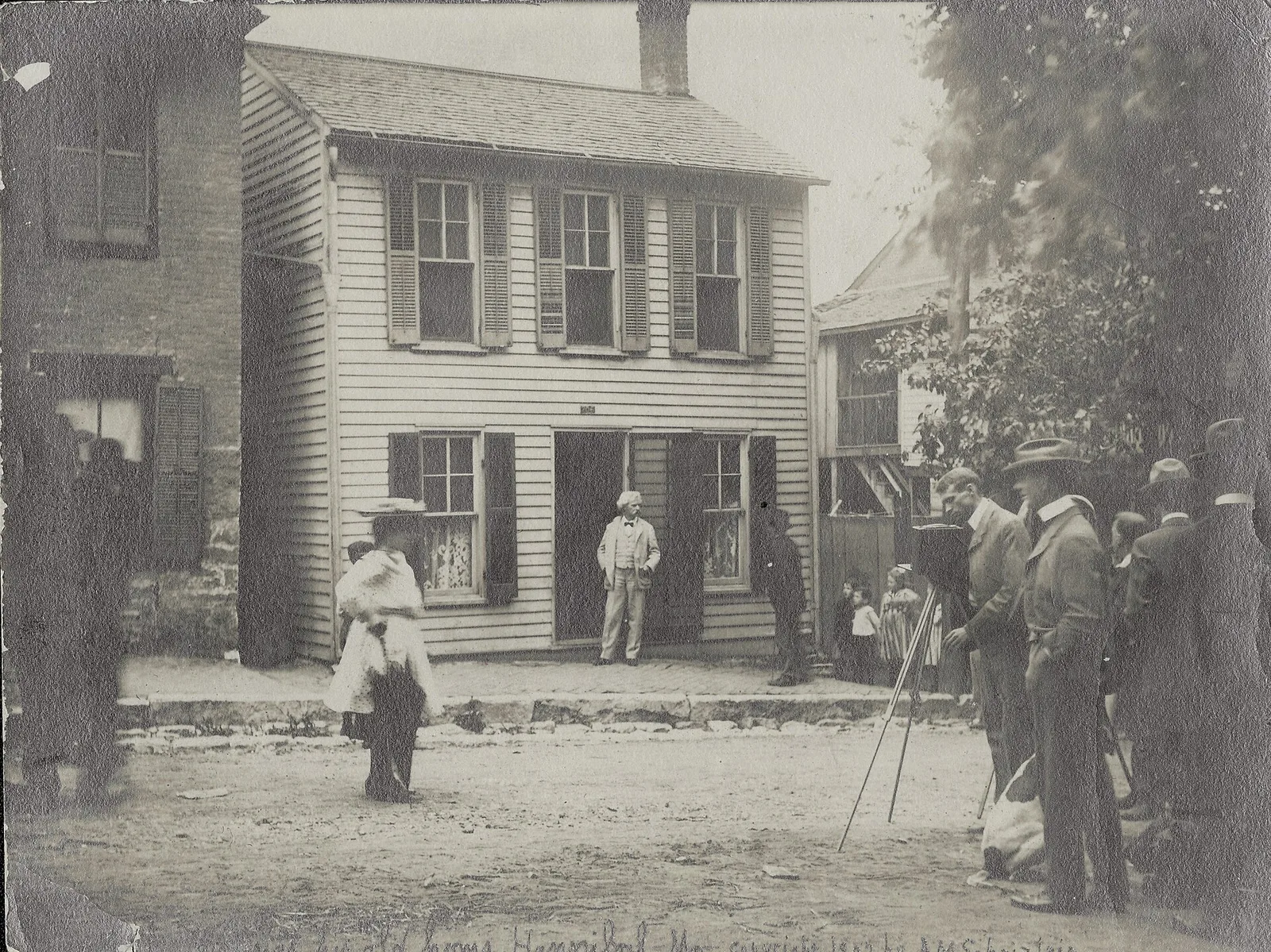
Missouri's Defining Moments in American History
These are the events that didn't just shape Missouri, they changed the nation.
St. Louis, Missouri, was the embarkation point for nearly every major westward expedition in American history. Lewis and Clark launched their Corps of Discovery from the St. Louis area in 1804. The Santa Fe Trail, the Oregon Trail, and the California Trail all began in Missouri.
The Pony Express originated in St. Joseph. The Gateway Arch, the tallest man-made monument in the Western Hemisphere, commemorates Missouri's role as the literal gateway through which the American West was explored, settled, and incorporated into the nation.
The geography made the role: St. Louis and the Missouri River towns sat at the last point steamboats could reliably reach before the overland journey began, so wagon trains formed up in Independence, Westport, and St. Joseph each spring, timed to leave after the prairie grass greened for the oxen but early enough to clear the mountains before snow. An estimated 400,000 people crossed on the Oregon, California, and Mormon trails between 1841 and 1869, and perhaps one in ten died along the way, mostly of cholera.
Missouri was also where the West was studied and administered: William Clark ran federal Indian affairs for the whole western frontier from St. Louis for three decades, the American Fur Company's Chouteau family directed a continental trade network from the city, and the U.S. Army's Jefferson Barracks, opened south of St. Louis in 1826, was the largest military post in the country and the launching point for campaigns across the Plains.
The completion of the transcontinental railroad in 1869 and the Eads Bridge across the Mississippi at St. Louis in 1874, the first major steel bridge in the world, shifted the pattern from river-and-wagon to rail, but the 'Gateway' idea stuck and was made monumental by the Arch a century later.
When Missouri applied for statehood in 1819 as a slave state, it triggered the first great national crisis over the expansion of slavery. The Missouri Compromise of 1820 admitted Missouri as a slave state paired with Maine as a free state, and prohibited slavery above the 36-30 parallel in the remaining Louisiana Purchase territory.
It held for a generation, but when the Kansas-Nebraska Act of 1854 dissolved it, the resulting violence in 'Bleeding Kansas' and the political realignment that followed put the nation on the path to Civil War.
The crisis erupted in February 1819 when Representative James Tallmadge of New York attached an amendment to the Missouri statehood bill that would have barred bringing more enslaved people into the state and gradually freed those already there. The House, where the free states had a growing majority, passed it; the Senate, evenly split at 11 slave and 11 free states, killed it, and the deadlock consumed Congress for more than a year.
The compromise Henry Clay assembled did three things: it admitted Missouri with slavery, split Maine off from Massachusetts as a free state to keep the Senate balanced at 12 and 12, and drew a line at 36 degrees 30 minutes north across the rest of the Louisiana Purchase, with slavery banned above it, except in Missouri itself, which pokes above the line. Thomas Jefferson, then 76, wrote that the sectional line 'like a fire bell in the night, awakened and filled me with terror.'
The 1854 Kansas-Nebraska Act, pushed by Illinois senator Stephen Douglas, repealed the 36°30' restriction and let territorial settlers vote slavery up or down, and pro- and anti-slavery Missourians poured across the border to sway Kansas elections, sometimes violently. The Supreme Court then declared the Missouri Compromise unconstitutional in the 1857 Dred Scott case, ruling Congress had never had power to bar slavery from a territory.
Dred Scott was an enslaved man from Missouri who sued for his freedom, arguing that time spent in free territories had made him free. In 1857, the Supreme Court, led by Chief Justice Roger Taney, ruled that Black Americans, free or enslaved, were not citizens and had no right to sue in federal court. The court further declared that Congress had no power to ban slavery from territories.
The decision electrified the North, energized the new Republican Party, and made Abraham Lincoln's political career. Many historians consider it the worst Supreme Court decision in history and a direct cause of the Civil War.
Scott, enslaved to an Army surgeon, had lived for years at posts in Illinois, a free state, and Wisconsin Territory, where the Missouri Compromise banned slavery, before returning to St. Louis; he first sued in the Old Courthouse there in 1846 under a long-standing Missouri principle of 'once free, always free.' A St. Louis jury actually ruled for Scott in 1850, but the Missouri Supreme Court reversed it in 1852, explicitly abandoning its own precedents because, the majority wrote, 'times now are not as they were.'
Chief Justice Roger Taney's 1857 opinion went far beyond the case, holding that people of African descent 'had no rights which the white man was bound to respect' and could never be U.S. citizens, and that the Fifth Amendment's protection of property barred Congress from prohibiting slavery in any territory, which struck down the heart of the Missouri Compromise. Two justices dissented at length.
Rather than settle the slavery question, the decision inflamed it, and Abraham Lincoln built his 1858 Senate campaign and his 1860 presidential run around opposing it. Scott himself was freed by his owners weeks after the ruling and died of tuberculosis in St. Louis in 1858; he and his wife Harriet are buried in the city, and a granddaughter attended the 2017 dedication of a statue of them at the Old Courthouse.
Jesse James, born in Clay County, Missouri in 1847, became the most famous outlaw in American history. Leading the James-Younger Gang from 1866 to 1882, he robbed banks, stagecoaches, and trains across the Midwest.
But his legend, built by sympathetic newspaper coverage and dime novels, cast him as a Robin Hood of the South, a former Confederate guerrilla striking back at Northern banks and railroads. James was murdered by a gang member for reward money in 1882, and the mythology that followed defined the American outlaw archetype for generations of Western literature and film.
The James brothers learned their trade in the Civil War: as teenagers they rode with the pro-Confederate bushwhackers of William Quantrill and 'Bloody Bill' Anderson, and Jesse was badly wounded in 1865. The gang is often credited with the first successful daylight bank robbery in U.S. peacetime, at Liberty, Missouri, in February 1866, and later robbed the first moving train in Missouri, at Gads Hill in 1874.
John Newman Edwards, a former Confederate officer and editor of the Kansas City Times, deliberately built the Robin Hood image in editorials and a book, casting the robberies as continued resistance by ex-Confederates against carpetbagger banks and the hated railroads. An 1875 Pinkerton raid on the James family farm near Kearney that killed Jesse's young half-brother and maimed his mother turned much of Missouri opinion further in the outlaws' favor.
Governor Thomas Crittenden secretly offered a large reward, and on April 3, 1882, gang member Bob Ford shot Jesse in the back of the head in his St. Joseph home as James stood on a chair to dust a picture. Ford was convicted of murder and pardoned the same day, the ballad 'that dirty little coward' made him infamous, and the James farm and the St. Joseph house are both museums today.
In the 1920s and 30s, Kansas City developed a jazz style all its own: hard-swinging, blues-drenched, built on riffing horn sections and an insistent 4/4 beat that would come to define American popular music. Count Basie built his legendary orchestra in Kansas City. Charlie Parker, the genius who revolutionized jazz with bebop, was born there.
The Kansas City sound traveled north and east, influencing bebop, rhythm and blues, and eventually rock and roll. Missouri's musical contribution to American culture rivals that of any state in the nation.
The scene ran on machine politics: Boss Tom Pendergast kept Kansas City 'wide open' through Prohibition, so clubs along 12th Street and in the 18th and Vine district had liquor, gambling, and steady work for musicians when bands were starving elsewhere, and jam sessions ran until dawn. Out of that pressure cooker came the head arrangement and the extended solo, the Count Basie Orchestra's swing, and the young alto player Charlie Parker, who left for New York in 1939 and helped invent bebop.
Kansas City's music was inseparable from Missouri's other great contributions to American sound. Scott Joplin, the 'King of Ragtime,' lived and published in Sedalia and St. Louis around 1900, and his 'Maple Leaf Rag' was the first instrumental sheet music to sell a million copies; ragtime fed directly into jazz. Decades later Chuck Berry, working out of St. Louis, fused blues and country into the guitar vocabulary of rock and roll with records like 'Maybellene' (1955) and 'Johnny B. Goode.'
The infrastructure faded when Pendergast fell in 1939 and reform crackdowns closed the clubs, and much of 18th and Vine was cleared or left to decay, but the district was partly rebuilt in the 1990s around the American Jazz Museum and the Negro Leagues Baseball Museum, and Kansas City still supports a live-jazz circuit that trades on the legacy.
Notable Missourians
Harry S. Truman
Born in Lamar, 1884; 33rd President of the United States; ordered the atomic bombing of Japan, desegregated the military, oversaw the Marshall Plan; one of the most consequential presidents of the 20th century
Mark Twain
Born Samuel Langhorne Clemens in Florida, MO, 1835; grew up in Hannibal; author of The Adventures of Tom Sawyer and Adventures of Huckleberry Finn, the 'Great American Novel'; his wit and Missouri River boyhood defined American literature
Walt Disney
Born in Chicago, 1901, but grew up in Marceline and Kansas City, Missouri; founded the Walt Disney Company; created Mickey Mouse; revolutionized animation, theme parks, and entertainment; Marceline's Main Street directly inspired Disney's Main Street USA
T.S. Eliot
Born in St. Louis, 1888; Nobel Prize in Literature (1948); author of The Waste Land and Four Quartets; one of the most influential poets of the 20th century and a defining figure of literary modernism
Langston Hughes
Born in Joplin, 1902; poet, novelist, and playwright of the Harlem Renaissance; 'The Weary Blues'; his vivid portraits of Black American life made him one of the most important writers of the 20th century
Chuck Berry
Born in St. Louis, 1926; rock and roll pioneer whose guitar riffs, showmanship, and songwriting ('Johnny B. Goode,' 'Maybellene,' 'Roll Over Beethoven') defined the genre and directly inspired the Beatles, Rolling Stones, and virtually every rock musician that followed
Maya Angelou
Born in St. Louis, 1928; raised in Arkansas and California; poet, memoirist, and civil rights activist; I Know Why the Caged Bird Sings (1969) is one of the most important autobiographies in American literature
Ginger Rogers
Born in Independence, 1911; actress and dancer who partnered with Fred Astaire in a series of beloved 1930s musicals; Academy Award winner (Kitty Foyle, 1940); one of Hollywood's golden-age icons
Sheryl Crow
Born in Kennett, 1962; nine-time Grammy Award-winning singer-songwriter; 'All I Wanna Do,' 'If It Makes You Happy,' 'Soak Up the Sun'; one of the most successful female rock artists of the 1990s and 2000s
Brad Pitt
Born in Shawnee, Oklahoma, 1963, but grew up in Springfield, Missouri; Academy Award-winning actor and producer; one of Hollywood's most bankable stars across four decades of film
State Symbols & Quick Facts
| Nickname | "Show-Me State" |
| Capital | Jefferson City |
| Largest City | Kansas City |
| Statehood | August 10, 1821 (24th state) |
| Population | ~6.2 million (2025 est.) |
| Area | 69,707 sq miles (21st largest) |
| State Bird | Eastern Bluebird |
| State Flower | White Hawthorn Blossom |
| State Tree | Flowering Dogwood |
| State Fish | Channel Catfish |
| State Insect | Honeybee |
| State Song | Missouri Waltz |
| State Motto | Salus populi suprema lex esto ("The welfare of the people shall be the supreme law") |
| Time Zone | Central |
| Bordering States | Iowa, Illinois, Kentucky, Tennessee, Arkansas, Oklahoma, Kansas, Nebraska |
| Border Count | 8 states, tied for most of any U.S. state |
Did You Know?
Missouri borders 8 states, Iowa, Illinois, Kentucky, Tennessee, Arkansas, Oklahoma, Kansas, and Nebraska, tied with Tennessee for the most of any U.S. state. Its central position made it the literal Gateway to the West.
The Gateway Arch in St. Louis is 630 feet tall, taller than the Washington Monument (555 ft) and the Statue of Liberty on her pedestal (305 ft). It is the tallest man-made monument in the Western Hemisphere.
Kansas City has more fountains than any city in the world except Rome, over 200 documented fountains, a distinction the city has embraced as part of its identity since the City Beautiful movement of the early 20th century.
The 1904 St. Louis World's Fair is widely credited with popularizing the ice cream cone, the hot dog in a bun, and iced tea in America. Whether or not each of these was actually invented there is debated, but the fair introduced all three to mass audiences.
Mark Twain's real name was Samuel Langhorne Clemens. He was born in Florida, Missouri, grew up on the Mississippi River in Hannibal, and took his pen name from a riverboat sounding term ('mark twain' means two fathoms of water, barely safe depth for a steamboat).
Walt Disney grew up in Marceline, Missouri, and Marceline's Main Street so strongly influenced his aesthetic that Main Street USA in every Disney theme park worldwide is modeled on it. Disney has called Marceline 'the most important part of my life.'
Missouri is the only state in the nation where two cities, St. Louis and Kansas City, anchor opposite ends of a major metropolitan corridor in the same state. The two cities are rivals in sports, culture, and civic identity, separated by 250 miles of Missouri River valley.
The Pony Express, which carried mail from St. Joseph, Missouri, to Sacramento, California, in 10 days (using a relay of 184 riders and 400 horses), operated for just 18 months in 1860–1861 before the transcontinental telegraph made it obsolete, yet it became one of the most romanticized enterprises in American history.
Two U.S. presidents have deep Missouri roots: Harry Truman, the only president born in the state, and Ulysses S. Grant, who married a Missourian, Julia Dent, and farmed land in St. Louis County in the 1850s.
The famous 'Show-Me State' motto is usually attributed to Congressman Willard Duncan Vandiver, who said in an 1899 speech: 'I come from a state that raises corn and cotton and cockleburs and Democrats, and frothy eloquence neither convinces nor satisfies me. I am from Missouri. You have got to show me.'
Quick Facts and Common Questions
Short answers to the questions people most often ask about Missouri: its abbreviation, the Missouri Compromise, its capital, and its place in Congress.
Missouri's two-letter postal abbreviation is MO. The U.S. Census Bureau places it in the Midwest region, in the West North Central division, and about 6.15 million people lived there in the 2020 census.
Missouri became the 24th state on August 10, 1821. Its land was part of the Louisiana Purchase, and it was organized as the Missouri Territory in 1812.
Missouri's request to join as a slave state set off a fierce debate in Congress. Under the Missouri Compromise of 1820, Missouri was admitted as a slave state, Maine as a free state, and slavery was banned in the rest of the Louisiana Purchase lands north of latitude 36°30'. The Kansas-Nebraska Act of 1854 repealed that line.
The state and river are named for the Missouri people. The name comes from an Illinois word often translated as "people of the big canoes" or "people who have dugout canoes."
Jefferson City, named for Thomas Jefferson, has been the capital since 1826. St. Charles served as the temporary capital from 1821 until the government moved to Jefferson City, a site chosen near the center of the state on the Missouri River. The current State Capitol was completed in 1917.
Missouri borders eight states, tied with Tennessee for the most of any state: Iowa, Illinois, Kentucky, Tennessee, Arkansas, Oklahoma, Kansas, and Nebraska. The Mississippi River forms its eastern border.
The nickname suggests Missourians are skeptical and want proof before they believe something. It is often credited to an 1899 speech by Missouri congressman Willard Vandiver, who said, "I'm from Missouri; you have got to show me," though the phrase may be older. The motto is "Salus populi suprema lex esto," Latin for "Let the welfare of the people be the supreme law."
Based on the 2020 census, Missouri has 8 seats in the U.S. House of Representatives, the same as before, which gives it 10 votes in the Electoral College.
Harry S. Truman, born in Lamar in 1884 and raised in Independence, is the only president from Missouri. He served as the 33rd president from 1945 to 1953, and his home in Independence is now a National Historic Site.
The Gateway Arch in St. Louis, completed in 1965, is 630 feet tall and 630 feet wide at its base, making it the tallest human-made monument in the United States. It honors the city's role as the starting point for westward expansion and is part of Gateway Arch National Park.
Sources & Further Reading
- Census Regions and Divisions, U.S. Census Bureau
- 2020 Census Apportionment Results, U.S. Census Bureau
- Distribution of Electoral Votes, National Archives
- Missouri State Archives, Missouri Secretary of State
- Missouri Compromise, National Archives
- Gateway Arch National Park, National Park Service
- Harry S Truman National Historic Site, National Park Service
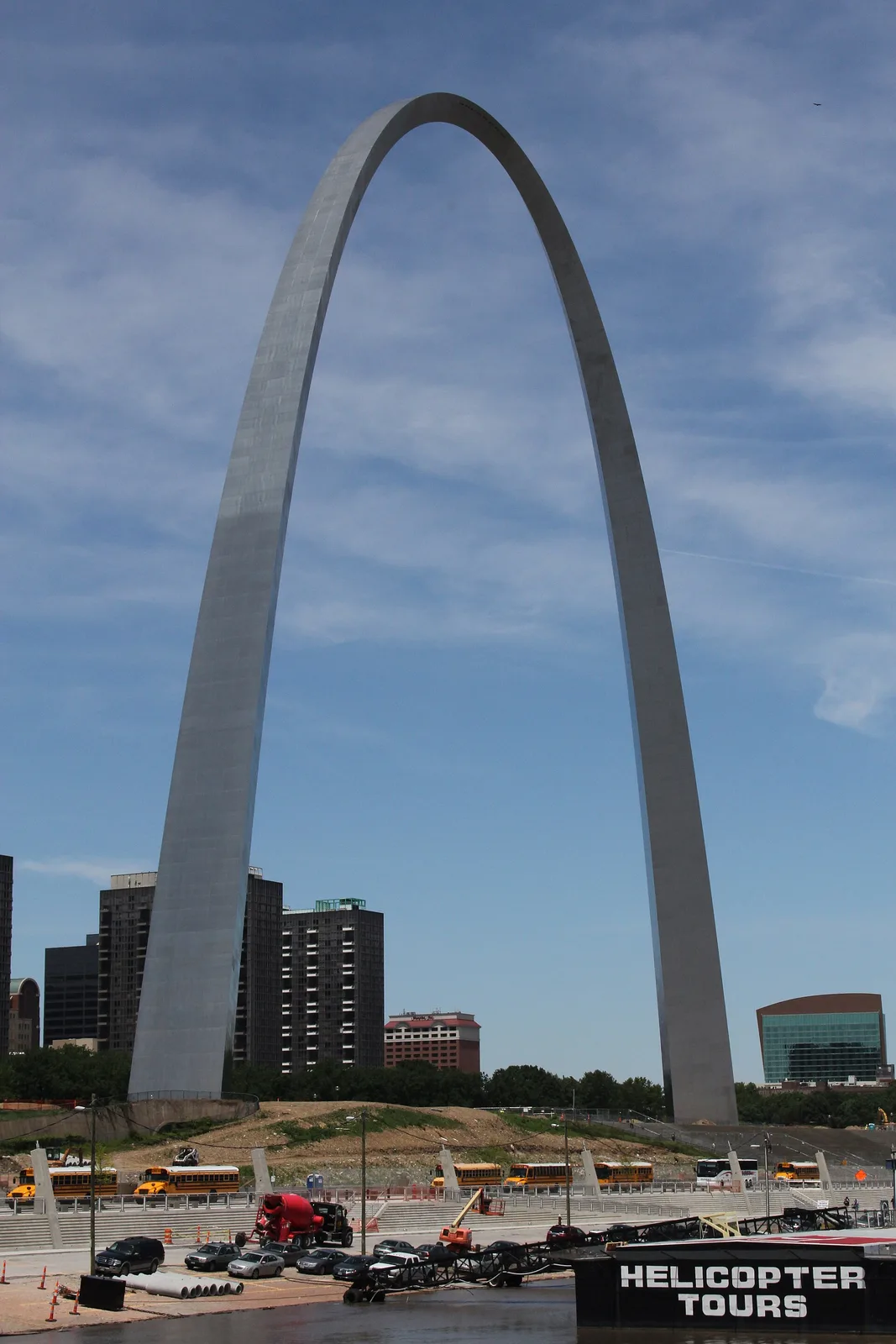
Gateway Arch National Park
The Nation's Gateway to the West, an Engineering Marvel on the Banks of the Mississippi
About Gateway Arch National Park
Gateway Arch National Park is the smallest unit called a national park, about 91 acres on the St. Louis riverfront, built around the 630-foot stainless steel Gateway Arch, the tallest monument in the country.
It was created in 1935 as the Jefferson National Expansion Memorial, to mark St. Louis's role as the staging point for Lewis and Clark and for the wagon trains bound for Oregon, California, and Santa Fe; the 40 blocks of 19th-century warehouses on the site were demolished to clear the ground, and construction then stalled through the Depression and the Second World War.
The Finnish-American architect Eero Saarinen won a national design competition in 1947 with a 'weighted catenary,' the inverted curve of a hanging chain; he died in 1961, and the arch was built between 1963 and 1965.
Congress renamed the memorial Gateway Arch National Park in February 2018, at the end of a $380 million public-private overhaul that added a new underground museum and a landscaped deck over the highway linking the arch grounds to the Old Courthouse downtown.
- Designation
- National Park
- Location
- St. Louis, Missouri, on the west bank of the Mississippi River
- Established
- February 22, 2018 (as National Park; monument since 1935)
- Annual Visitors
- ~2 million
The Park's Key Sites
The arch is exactly as wide at the base as it is tall, 630 feet each way, and its shape is a flattened catenary weighted so the legs carry the load down to the foundations.
Its skin is stainless steel over an inner wall of carbon steel, with the space between filled with concrete for the lower 300 feet and stiffened with steel above; it holds 886 tons of stainless steel, the most ever used in one project.
The two legs were built up separately from the ground, and on October 28, 1965, the final section had to be forced into a gap at the top; firefighters sprayed water on the sunlit south leg to cool and shrink it enough for the piece to fit.
A tram of eight small barrel-shaped cars in each leg, designed in about two weeks by Dick Bowser, rotates to stay level as it climbs the curve to the observation room, a four-minute ride up.
The museum, rebuilt underground beneath the arch and reopened in 2018, tells the story of United States expansion from the 1803 Louisiana Purchase to about 1900.
Its six galleries cover Lewis and Clark, the fur trade, the Oregon and Santa Fe trails, the railroads, and the wars and treaties that took Native land, arranged so visitors move roughly forward in time.
The rebuild was a deliberate reframing: the old 1970s museum centered on white pioneers, and the new one gives far more space to Native nations, African Americans, Mexican residents of the Southwest, and women.
It is free, unlike the tram, and connects directly to the arch's north and south leg entrances.
The Old Courthouse, two blocks west of the arch and part of the park, was built between 1839 and 1862 and carries one of the first cast-iron domes in the country, predating the U.S. Capitol's.
Enslaved people were sold at auction on its east steps into the 1860s, and it was here in 1846 that Dred and Harriet Scott filed the freedom suit that became Dred Scott v. Sandford, decided against them by the Supreme Court in 1857.
It is also where Virginia Minor sued in 1872 for the right to vote as a citizen; the Supreme Court rejected that claim in 1875, ruling that the Fourteenth Amendment did not give women the vote.
The building closed in 2021 for a full renovation and reopened in 2025 with new exhibits and, for the first time, an accessible entrance and an elevator to the courtrooms.
The park's cobblestone levee is the site of the historic St. Louis wharf, where hundreds of steamboats a year tied up through the mid-1800s to load furs, lead, hemp, and passengers.
Just upstream stands the Eads Bridge, finished in 1874, the first major bridge to use steel as its main structural material and the first bridge across the Mississippi below the Missouri; it still carries road traffic and light rail.
Riverboat cruises run from the levee in season, and the paved riverfront trail ties into the regional Confluence Greenway.
The riverfront also floods: the 1993 flood put the levee and the lower arch grounds under water, and high water closes this part of the park in most spring seasons.
Indigenous Connections
Osage Nation and Cahokia Mound Builders
Directly across the river, at Cahokia, stood the largest city in North America north of Mexico around 1100 CE, home to perhaps 10,000 to 20,000 people and to Monks Mound, the biggest earthwork in the Americas.
St. Louis itself was once called 'Mound City' for the roughly two dozen mounds within it, almost all leveled during 19th-century construction; only Sugarloaf Mound, bought back by the Osage Nation in 2009, still stands.
The Osage were the dominant power in the region when the French arrived and controlled the Missouri and Arkansas river country; treaties in 1808, 1818, and 1825 stripped away their Missouri land, and they were pushed to Kansas and then Oklahoma.
The Cahokia Mounds State Historic Site, directly across the river from the Gateway Arch, is a UNESCO World Heritage Site managed by the state of Illinois. The Osage Nation, headquartered in Pawhuska, Oklahoma, was removed from Missouri in the early 19th century. The Gateway Arch museum includes exhibits on the Indigenous peoples displaced by westward expansion.
Experiencing Gateway Arch
Arch Tram Ride to the Top
The tram is the arch's signature experience: eight cars per leg, five passengers each, in cramped barrel-shaped pods that tilt to stay level as they follow the curve.
The ride is about four minutes up and three down, ending in a narrow observation room at 630 feet with small windows looking east over the river and west over downtown.
Tickets are timed and sell out on summer days and weekends, so most visitors book online in advance, and an airport-style security screening is required to enter.
The pods are tight and the ceilings low, and the park warns visitors who are claustrophobic or have mobility limits; a documentary film and the museum are alternatives.
Old Courthouse Tour
The Old Courthouse is a short walk from the arch across the new highway-deck park, and admission is free.
Rangers lead talks in the restored courtrooms on the Dred Scott and Virginia Minor cases and on the courthouse's role in the domestic slave trade.
The four-story rotunda, painted with 1880s lunette murals, is one of the grandest interiors in St. Louis and is open whenever the building is.
New exhibits added in the 2025 reopening cover the full sweep of the building's history, including cases brought by women and by free and enslaved Black St. Louisans.
Riverfront Walk and Cycling
The arch grounds, redesigned by the landscape architect Michael Van Valkenburgh and reopened in 2018, have about five miles of paved paths winding through 200 trees and two reflecting ponds.
The paths connect north to the Eads Bridge and Laclede's Landing and south toward the stadium district, and tie into the regional Confluence and Riverfront trails.
The cobblestone levee below the arch is a launch point for Mississippi riverboat cruises in the warm months.
The grounds are open and free at all hours, and the lawn is a common spot for events, festivals, and Fourth of July fireworks under the arch.
Park Stewardship
Urban Park Challenges
Gateway Arch is a national park inside a downtown, so it deals with the issues of a city park, panhandling, vandalism, wear on the lawns, alongside the demands of a top tourist attraction.
For decades the arch grounds were cut off from the city by a sunken interstate, which the 2018 project finally covered with a landscaped land bridge to reconnect them.
The Gateway Arch Park Foundation, a private partner, now helps fund operations, programming, and maintenance that federal appropriations alone would not cover.
Keeping a 1960s monument, a 19th-century courthouse, and a new museum in repair on a small budget is a constant balancing act.
Mississippi River Flooding
The park sits on the floodplain, and the Mississippi regularly rises over the cobblestone levee and onto the lower grounds in spring.
The 1993 flood, the largest on record here, closed the grounds and the Old Courthouse for weeks and came within a few feet of the underground museum.
A floodwall and pumps protect the arch's foundations and the museum, and the leg entrances sit well above the historic flood line.
More frequent large floods on the Mississippi mean the park now plans for longer and more regular closures of the riverfront.
Stainless Steel Maintenance
The arch's skin is Type 304 stainless steel, chosen because it resists corrosion and needs no paint, but it does streak, stain, and collect grime.
Studies since the 1990s have found surface pitting, carbon-steel staining, and even graffiti scratched into the reachable lower legs, and engineers have debated whether and how to clean the full surface.
A full exterior wash has never been done; it would require custom rigging to reach 630 feet of curved steel and carries a risk of doing more harm than good.
For now the Park Service inspects the skin on a schedule, monitors the pitting, and treats the reachable lower sections.
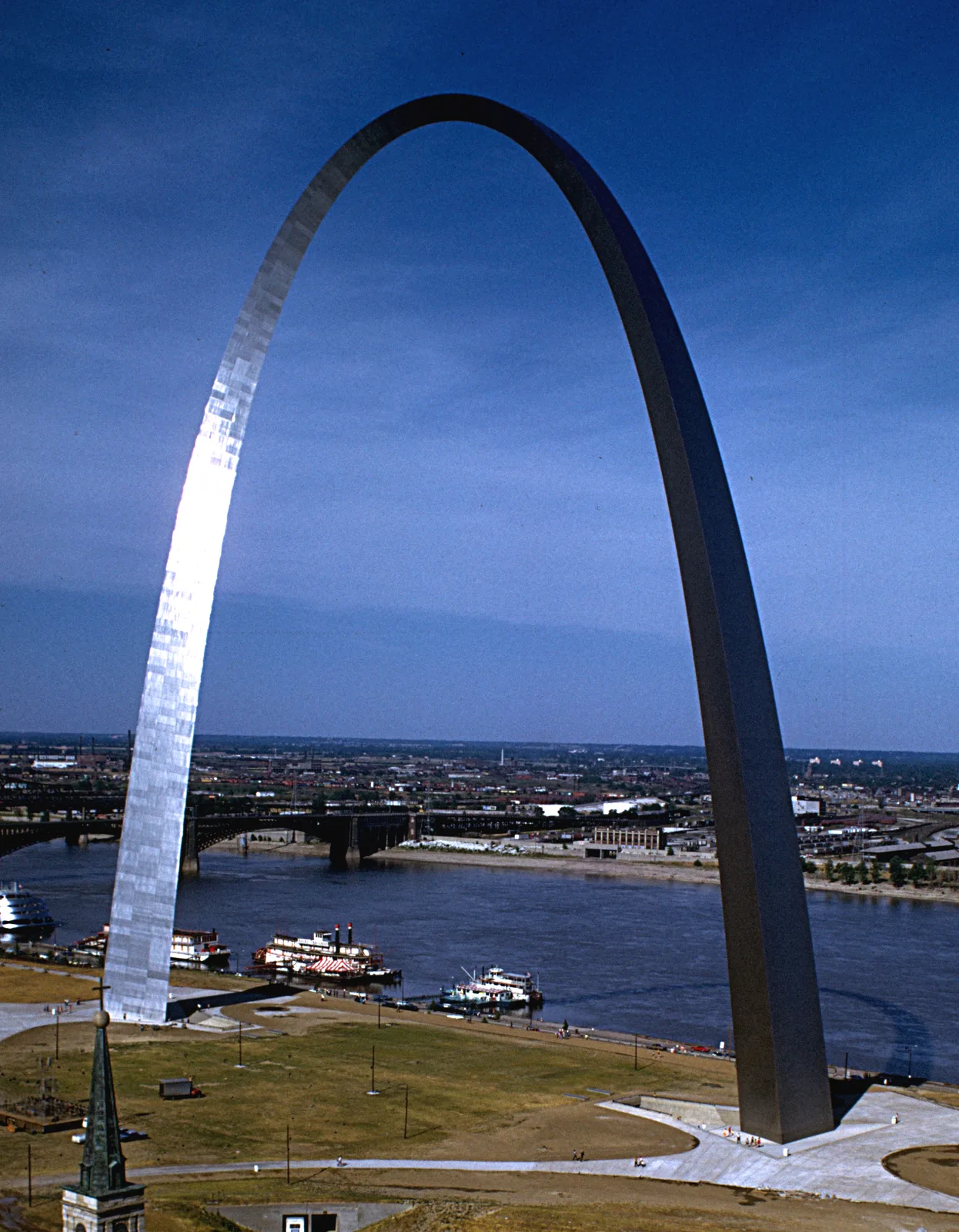
The Mississippi River at St. Louis, the historic gateway to America's western frontier
At a Glance
Did You Know?
The two legs of the Gateway Arch were built from opposite sides and met perfectly in the middle at the top, with a gap of only 1/64 of an inch, an engineering feat requiring the arch legs to be cooled with fire hoses on a hot October day in 1965 to fit together.
The Old Courthouse on the park grounds is where Dred Scott and his wife Harriet sued for their freedom in 1846. After losing in Missouri courts, the case went to the US Supreme Court, which ruled in 1857 that enslaved people had no standing to sue, accelerating the nation's path to Civil War.
In 1804, Meriwether Lewis and William Clark launched their Corps of Discovery from the Missouri River just north of St. Louis. The arch commemorates this departure as the symbolic 'gateway' to the western half of the continent they were the first Americans to formally explore.
Plan Your Visit
Location
St. Louis, Missouri, on the west bank of the Mississippi River
Designation
National Park
Best Time to Visit
Spring and fall for mild temperatures; summer for the full range of programming and riverboat excursions
Admission
Museum and grounds free; tram tickets $15 adult, $8 child; book in advance at archpark.org