About Kentucky
The name Kentucky comes from an Iroquoian word whose exact meaning has been debated for centuries. The most common translation offered is "dark and bloody ground," though linguists have questioned this interpretation. Other proposed meanings include "land of tomorrow," "meadowland," "at the head of the river," and "prairie." The name was recorded by European explorers in the 1700s for the river that cuts through the region, and the territory took the river's name when it became a state in 1792. Kentucky was the first state carved out of territory west of the Appalachian Mountains, and its admission as the 15th state in 1792 marked the beginning of American westward expansion beyond the original coastal colonies.
Kentucky sits at the crossroads of the American South and Midwest. Bordered by seven states and the Ohio River to the north, it has always been a place where different cultures, landscapes, and loyalties meet. That tension, between North and South, tradition and progress, rural and urban, defines much of what makes Kentucky unique.
The state is famous worldwide for three things above almost everything else: bourbon whiskey, thoroughbred horse racing, and the Kentucky Derby. But there's far more here, from the Appalachian mountains in the east, to the world's longest cave system at Mammoth Cave, to two of America's most consequential presidents sharing a birthplace less than 100 miles apart.
Kentucky became the 15th state in 1792, making it the first state admitted west of the Appalachian Mountains. It has been shaping American history, and American culture, ever since.
Kentucky's Five Regions
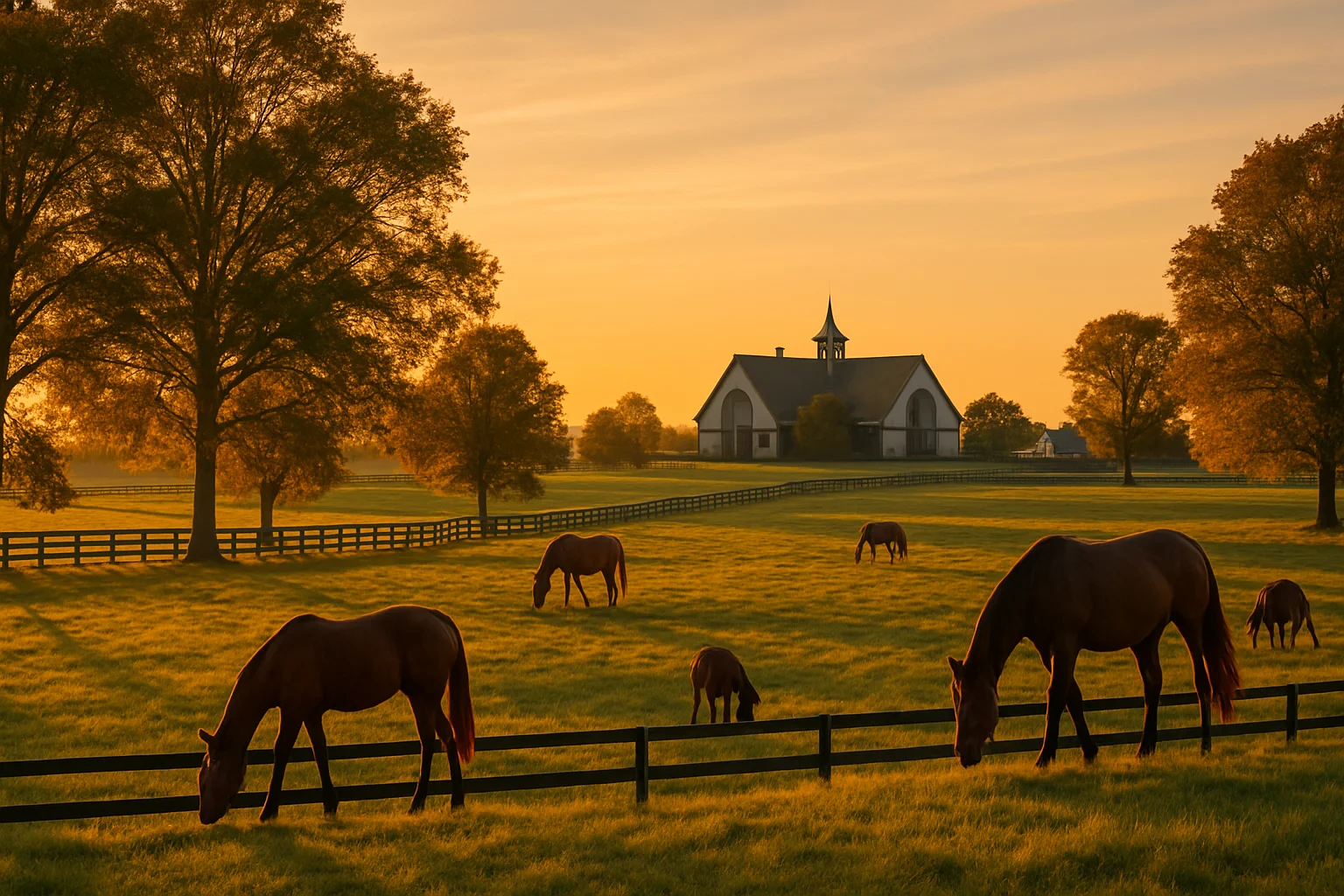
The rolling, fertile heartland of Kentucky surrounding Lexington and Frankfort. This is horse country, famous for its distinctive blue-tinted grass, white fences, and thoroughbred farms. The state capital and many of Kentucky's oldest estates are here.
The bluegrass itself gets its bluish-green tint from tiny purple buds that bloom in early summer, most visible in fields at dawn when sunlight hits them at a low angle. The region's limestone-rich soil, ideal for growing strong bones in young horses, is a major reason the area became the center of Thoroughbred breeding.
The Inner Bluegrass sits on a dome of Ordovician limestone, roughly 450 million years old, that weathers into deep phosphate-rich soil; the same rock gives the region its caves, sinkholes, and clear springs. Lexington, founded in 1775 and named for the Massachusetts battle before news of it had even been confirmed, calls itself the 'Horse Capital of the World' and has used one of the first urban growth boundaries in the country, adopted in 1958, to keep horse farms from being paved over.
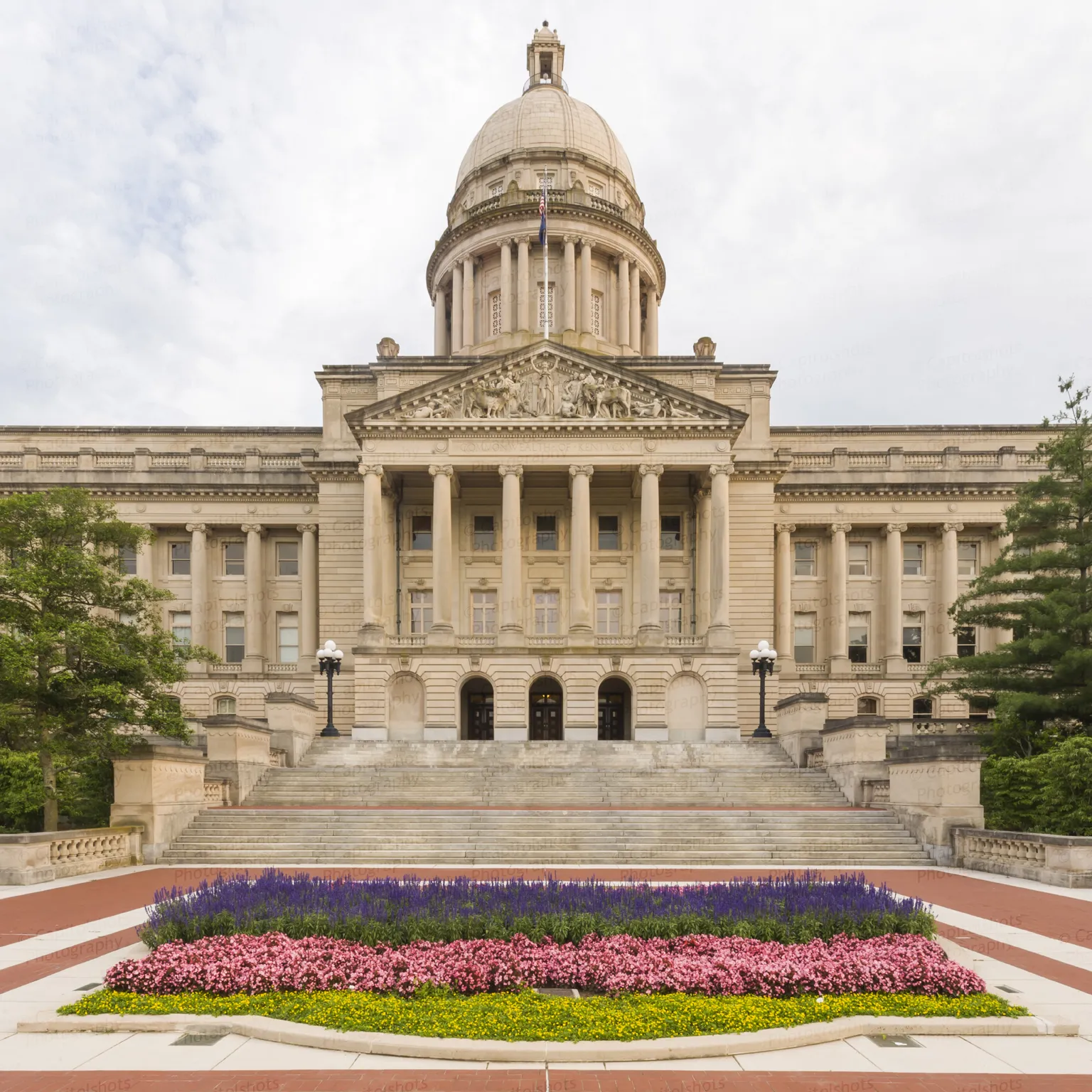
Frankfort became the compromise capital in 1792 because it lay between the rivals Lexington and Louisville and a group of local landowners offered land, materials, and cash to secure it. The current Beaux-Arts capitol opened in 1910, and the grounds include the grave of Daniel Boone, reinterred there from Missouri in 1845 in a move Missourians still dispute.
The Bluegrass is also horse country's social landscape: Keeneland race course and sales pavilion, the Red Mile harness track (opened 1875), and hundreds of named farms such as Calumet and Claiborne, where the 1973 Triple Crown winner Secretariat is buried. Bourbon, Woodford, and Scott counties form part of the Kentucky Bourbon Trail, and Berea, at the region's southern edge, is known for its craft schools and tuition-free Berea College.
The rugged eastern part of Kentucky is part of the Appalachian Mountains. This region was historically defined by coal mining and has faced significant economic challenges as the coal industry declined. It is also home to stunning natural scenery and strong cultural traditions.
The region is home to Breaks Interstate Park, sometimes called the 'Grand Canyon of the South,' a five-mile gorge carved by the Russell Fork River. As coal mining jobs declined sharply from their mid-20th-century peak, many eastern Kentucky communities have worked to build tourism and outdoor recreation as new economic anchors.
The Cumberland Gap, where Kentucky, Virginia, and Tennessee meet, is a natural pass through the mountains used for millennia by bison and Native travelers and then by an estimated 200,000 to 300,000 settlers who followed Boone's Wilderness Road into Kentucky before 1800; it is now a national historical park. Pine Mountain and Black Mountain, the latter Kentucky's highest point at 4,145 feet, mark the state's rugged southeastern rim.
Coal made and then unmade the region's towns. Harlan County was the scene of the 'Bloody Harlan' mine wars of the 1930s and the 1973 to 1974 Brookside strike filmed in the Oscar-winning documentary 'Harlan County, USA,' and Lynch, built entirely by U.S. Steel in 1917, was once one of the largest company towns in the country. Since 2000 the eastern coalfield counties have lost population faster than almost anywhere in the eastern United States.
In July 2022 catastrophic flooding on the North Fork of the Kentucky River and its tributaries killed at least 45 people across Breathitt, Knott, Letcher, Perry, and neighboring counties and destroyed thousands of homes, one of the deadliest flood events in state history. Recovery efforts have paired federal disaster aid with plans to move some housing off the narrow, flood-prone valley floors onto reclaimed strip-mine benches.
The western portion of the state borders the Mississippi River and shares cultural ties with Tennessee and Missouri. It includes the Land Between the Lakes recreation area and is known for agriculture, especially soybeans and corn.
Land Between the Lakes sits on a peninsula formed by Kentucky Lake and Lake Barkley, two of the largest reservoirs in the eastern United States, both created by Tennessee Valley Authority dam projects in the mid-20th century as part of a broader regional flood-control and electrification effort.
Creating Land Between the Lakes displaced hundreds of families and several small communities in the 1960s when the federal government bought out the land 'between the rivers'; the area is now a 170,000-acre National Recreation Area run by the U.S. Forest Service, with a bison and elk range and a restored 1850s working farm called The Homeplace. The Jackson Purchase, the eight westernmost counties, was bought from the Chickasaw Nation in 1818 in a treaty negotiated by Andrew Jackson and Isaac Shelby, Kentucky's first governor.
Paducah, at the mouth of the Tennessee River on the Ohio, was a major steamboat and rail town and later home to a Cold War uranium-enrichment plant that operated from 1952 to 2013 and left a large federal environmental-cleanup site. The city has since rebranded around the arts, winning a UNESCO 'Creative City' designation for its National Quilt Museum and its Lowertown artist-relocation district.
Western Kentucky is the state's grain belt, with flat, fertile ground along the Ohio and Mississippi bottomlands producing most of Kentucky's corn and soybeans, and the New Madrid Seismic Zone runs beneath the far southwest, capable of major earthquakes like those of 1811 to 1812 that briefly reversed the Mississippi and created Reelfoot Lake just over the Tennessee line. On December 10, 2021, a long-track tornado tore through Mayfield and Dawson Springs, killing dozens and leveling much of downtown Mayfield, including a candle factory where workers were on shift.
Kentucky's largest city sits on the Ohio River at the Indiana border. Louisville is home to the Kentucky Derby, the Louisville Slugger Museum, and a thriving food and bourbon scene. It is the state's economic engine and largest metropolitan area.
Louisville has manufactured the iconic Louisville Slugger baseball bat since 1884, and the company's downtown factory and museum, marked by a 120-foot bat leaning against its facade, remains one of the city's most recognizable landmarks.
Louisville was founded in 1778 at the Falls of the Ohio, the river's only major rapids, which forced boats to portage and made the site a natural trade and transfer point; it is named for King Louis XVI of France. The Louisville and Portland Canal, opened in 1830, was the first canal around the falls and is still in use, and the city grew into a major shipping, tobacco, and bourbon center by the mid-1800s.
Kentucky's largest city and Jefferson County merged into a single 'Louisville Metro' government in 2003, raising the city's official population to roughly 620,000 and its metro area, which spills across the river into southern Indiana, to about 1.3 million. Louisville leans notably more Democratic than the rest of the state and, with Lexington, accounts for a large and growing share of Kentucky's population and economy.
Muhammad Ali was born and raised here, and the Muhammad Ali Center opened downtown in 2005; the airport was renamed Louisville Muhammad Ali International in 2019. UPS runs its Worldport global air hub at the airport, sorting millions of packages a night and making the company one of the largest employers in the state, and Churchill Downs, in the city's South End, has drawn a Kentucky Derby crowd of more than 150,000 nearly every year since the 1970s.
This region includes Mammoth Cave National Park, the world's longest known cave system, and Bowling Green, home to Corvette manufacturing and Western Kentucky University. The area blends outdoor tourism with growing industrial development.
Mammoth Cave has more than 400 miles of surveyed passageways, making it over twice as long as the world's next-longest known cave system. It was designated a UNESCO World Heritage Site in 1981 and a Biosphere Reserve in 1990.
The cave sits in the Pennyroyal karst, a belt of sinkhole-pitted limestone where surface streams vanish underground; the surveyed passages have grown from about 150 miles in 1972, when explorers connected Mammoth to the neighboring Flint Ridge system, to more than 425 miles today, and cavers expect the total to keep climbing. Bitter competition over cave tourism in the early 20th century, the 'Kentucky Cave Wars,' saw operators post misleading signs and even fight over the 1925 entrapment and death of cave explorer Floyd Collins, a national news sensation.
Bowling Green, the region's largest city, is the home of Western Kentucky University and, since 1981, the only General Motors plant that builds the Chevrolet Corvette; the National Corvette Museum next to the plant made headlines in 2014 when a sinkhole opened under its display floor and swallowed eight cars. GM has invested repeatedly in the plant, including a mid-engine redesign that began production in 2019.
The region straddles Interstate 65 between Louisville and Nashville, and Bowling Green has been one of the faster-growing metro areas in Kentucky, drawing distribution centers, an Amazon fulfillment operation, and a large refugee-resettlement community, particularly Bosnians who arrived after the 1990s Balkan wars. Mammoth Cave National Park draws around half a million visitors a year and is a designated International Dark Sky Park.

Economy
Kentucky's economy blends deep-rooted traditions like bourbon and horses with modern manufacturing and healthcare.
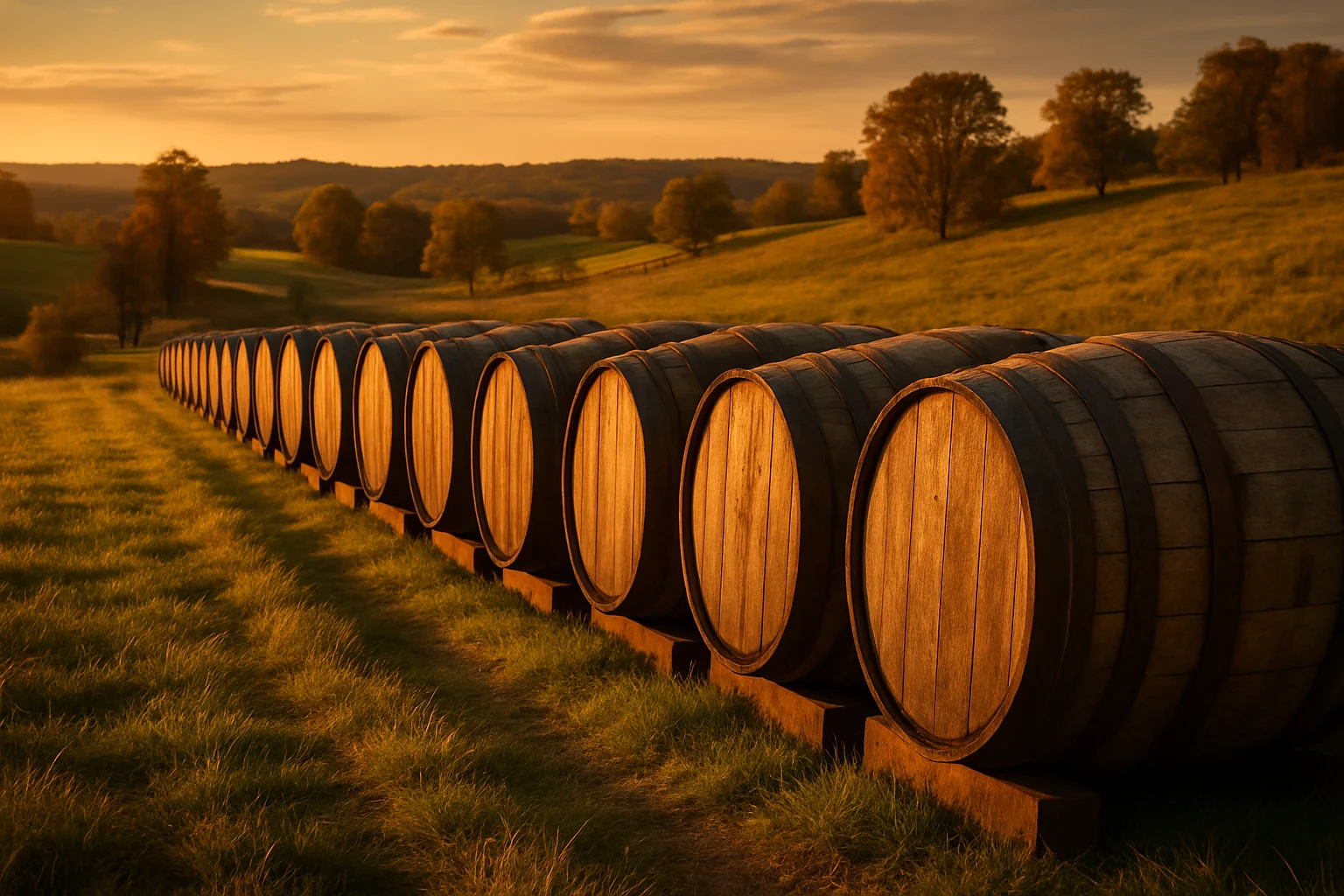
The state has more barrels of aging bourbon than it has people, over 10 million barrels at any given time. Distilling is one of the fastest-growing industries in the state.
By federal law, bourbon must be made in the United States from a grain mix that is at least 51 percent corn and aged in new, charred oak barrels, it does not legally have to be made in Kentucky, though the state's limestone-filtered water and long distilling tradition are why it produces the overwhelming majority of the world's supply.
Congress declared bourbon 'a distinctive product of the United States' in a 1964 resolution, and the industry ties its heritage to Bourbon County, laid out in 1785 while Kentucky was still part of Virginia and named for the French royal house that had aided the Revolution. The modern boom followed decades of decline after Prohibition (1920 to 1933) nearly wiped the industry out and only a handful of distilleries held medicinal-whiskey licenses to survive it.
The Kentucky Distillers' Association counts more than 2 million barrels filled a year and an inventory that passed 12 million barrels in the 2020s, and the state levies a property tax on aging barrels that generates tens of millions of dollars a year for local schools and governments. A June 2019 fire at a Jim Beam warehouse in Woodford County destroyed about 45,000 barrels and sent bourbon runoff into a creek, killing fish for miles, one of several warehouse collapses and fires that have drawn scrutiny to how the spirit is stored.
Sazerac's Buffalo Trace in Frankfort, Beam Suntory, Brown-Forman (maker of Woodford Reserve and Old Forester and, in Tennessee, Jack Daniel's), Heaven Hill in Bardstown, and Maker's Mark in Loretto anchor the industry, and craft distilleries have multiplied since a 2016 state law let them sell bottles and cocktails on site. Bardstown promotes itself as the 'Bourbon Capital of the World.'
The Thoroughbred horse industry contributes over $4 billion to the state economy annually. The Kentucky Derby, held every May at Churchill Downs in Louisville, is the longest-running sporting event in the United States.
Churchill Downs opened in 1875, and its iconic twin spires, added in 1895, have become one of the most recognized sports landmarks in the world, appearing on everything from the track's own logo to countless works of art and photography.
The University of Kentucky in Lexington houses the Gluck Equine Research Center, the leading academic center for horse health, and the Keeneland sales complex nearby is the world's largest Thoroughbred auction house, regularly selling more than a billion dollars of bloodstock a year and setting a record with a $16 million yearling in 2024. The Kentucky Horse Park, a state park opened in 1978, hosted the 2010 World Equestrian Games, the first time that event was held outside Europe.
The industry is not only Thoroughbreds: Kentucky also leads the nation in raising American Saddlebreds and is a major center for Standardbred harness racing and for the Tennessee Walking Horse trade along the southern border. A 2012 University of Louisville study put the equine industry's total economic impact on the state near $3 billion and roughly 40,000 jobs.
Racing's economics rest on a fragile base. Historical Horse Racing machines, slot-like terminals introduced at Kentucky tracks in 2011 and explicitly authorized by the legislature in 2021 after a court challenge, now generate more money wagered than live racing and fund higher purses. The 2023 deaths of a dozen horses at Churchill Downs in the weeks around the Derby forced a meet to be suspended and moved, intensifying scrutiny of the sport's safety record.
Ford also has significant operations in Louisville. Manufacturing employs more Kentuckians than any other private sector.
Toyota's Georgetown plant, which opened in 1988, is the company's largest manufacturing facility anywhere in the world by vehicle output, producing well over 500,000 cars annually, including the Camry.
Ford has built vehicles in Louisville since 1913 and runs two plants there, the Louisville Assembly Plant and the Kentucky Truck Plant, which together employ more than 10,000 people and build the Super Duty pickups, the Expedition, and the Lincoln Navigator. In 2021 Ford and SK On announced BlueOval SK, a roughly $5.8 billion pair of electric-vehicle battery plants in Hardin County, one of the largest single private investments in state history.
Kentucky ranks among the top states for cars and light trucks assembled per year and is the leading producer of aluminum in the United States, feeding the auto industry from mills such as Logan Aluminum in Russellville and Novelis in the west. The state has no general sales tax on manufacturing machinery and has used large incentive packages to land plants, a strategy that also brought a General Electric appliance complex, Appliance Park in Louisville, which dates to 1951.
The sector is cyclical and exposed to trade policy: the 2008 to 2009 recession and the 2020 pandemic each idled Kentucky assembly lines for weeks, and a 2018 to 2019 round of tariffs on imported steel and aluminum raised input costs across the state's metal and auto plants. Even so, roughly one in eight private-sector workers in Kentucky is in manufacturing, a higher share than the national average.
While coal employment has declined, energy, including natural gas and growing renewable sectors, remains important to the state's economy.
Kentucky's coal production peaked at well over 100 million tons a year in the late 20th century and has declined sharply since, driven largely by competition from cheaper natural gas and lower-cost coal mined in Wyoming's Powder River Basin.
Coal mining employment in Kentucky fell from around 38,000 in the late 1970s and about 18,000 as recently as 2011 to roughly 4,000 to 5,000 by the early 2020s, and eastern counties such as Harlan, Letcher, and Pike have lost a fifth or more of their population since 2000. The Blackjewel bankruptcy in 2019 left Harlan County miners with bounced paychecks; they blockaded a coal train on the tracks for nearly two months until they were paid.
The 1972 Buffalo Creek disaster was in neighboring West Virginia, but Kentucky has had its own coal-slurry failures, including a 2000 Martin County impoundment breach that released an estimated 300 million gallons of sludge into streams, and the industry's legacy of mountaintop-removal mining has left thousands of acres of altered ridgeline across the eastern coalfield. Federal black-lung benefit claims from Appalachian Kentucky miners rose sharply in the 2010s as a severe form of the disease reappeared in younger workers.
Kentucky still generates the large majority of its electricity from coal, one of the highest shares in the country, which has kept industrial power rates low but slowed the shift to other sources. Utilities have begun retiring aging coal units, and the state is now home to growing solar development and to the Wolf Hills and other utility-scale projects, while eastern Kentucky pursues federal grants to build solar, tourism, and technology on former mine land.
Major systems like Norton Healthcare, Baptist Health, and UK HealthCare employ tens of thousands statewide. The University of Kentucky and University of Louisville both operate major academic medical centers.
The University of Kentucky's Markey Cancer Center holds a National Cancer Institute designation, placing it among a select group of cancer centers nationwide recognized for meeting rigorous research and treatment standards.
Louisville is a national hub for the aging-care and health-services business: Humana, one of the country's largest health insurers with tens of billions in annual revenue, is headquartered downtown, and the city promotes a cluster of long-term-care and home-health companies it brands 'the Health Enterprises Network.' The sector's importance grew as Kentucky's 2014 expansion of Medicaid under the Affordable Care Act, carried out through the state exchange 'kynect,' cut the uninsured rate from about 20 percent to under 8 percent, one of the largest drops of any state.
That coverage gain matters because Kentucky carries some of the nation's worst health burdens: it has ranked at or near the top for cancer deaths, especially lung cancer, for smoking rates, and for drug-overdose deaths, which exceeded 2,000 a year in the state during the height of the opioid and fentanyl crisis. Rural hospitals have closed or cut services in counties such as Fulton and Nicholas, leaving wide gaps in access across the coalfield and the far west.
Kentucky was an early and hard-hit front of the prescription-opioid epidemic, and the state was among the first to sue Purdue Pharma, settling for $24 million in 2015; later multistate settlements with drug makers and distributors are sending hundreds of millions of dollars to Kentucky through a state opioid-abatement commission. The University of Louisville's hand-transplant program performed the first successful hand transplant in the United States in 1999.
Cattle and poultry farming are also major contributors. The fertile Bluegrass region is among the most productive farmland in the eastern United States.
Kentucky was the nation's leading tobacco producer for much of the 20th century, but a 2004 federal buyout ended the decades-old price-support and quota system that had propped up the crop, accelerating its decline and pushing many farmers toward other crops and cattle.
Kentucky has more farms than any state except Missouri, Texas, and a few others, roughly 70,000 of them, most small and family-run, and it has long been the largest cattle state east of the Mississippi River, with well over 2 million head. Poultry, mainly broiler chickens grown under contract for companies such as Tyson and Perdue in the western Pennyrile counties, has become the state's single largest agricultural commodity by cash receipts, ahead of horses, corn, and soybeans.
The federal tobacco buyout, formally the Fair and Equitable Tobacco Reform Act of 2004, paid Kentucky quota holders and growers an estimated $2.5 billion over ten years to give up the quota system dating to the New Deal. The number of tobacco farms in the state collapsed from tens of thousands to a few thousand larger operations, and burley tobacco, once grown on nearly every Bluegrass farm as a cash supplement, is now a specialty crop.
Half of the roughly $2 billion Kentucky received from the 1998 national tobacco Master Settlement Agreement was directed by state law into agricultural diversification, funding the Kentucky Agricultural Development Fund that helped farmers move into beef genetics, greenhouses, wine grapes, and produce. Hemp, legal to grow again under a 2014 federal pilot and the 2018 Farm Bill, became a notable Kentucky crop, though the market for CBD boomed and then crashed within a few years.
How Kentucky's Government Works
Like the federal government, Kentucky's state government is divided into three branches: the Executive (led by the Governor), the Legislative (the Kentucky General Assembly), and the Judicial (the state court system).
The Governor serves a four-year term and may serve two consecutive terms. Kentucky is one of a handful of states that holds its gubernatorial elections in odd-numbered years, meaning the Governor's race doesn't happen at the same time as federal elections.
The Kentucky General Assembly is the state legislature. It has two chambers: the Senate (38 members, 4-year terms) and the House of Representatives (100 members, 2-year terms). Republicans hold supermajorities in both chambers as of 2026.
Governor of Kentucky
Current Governor
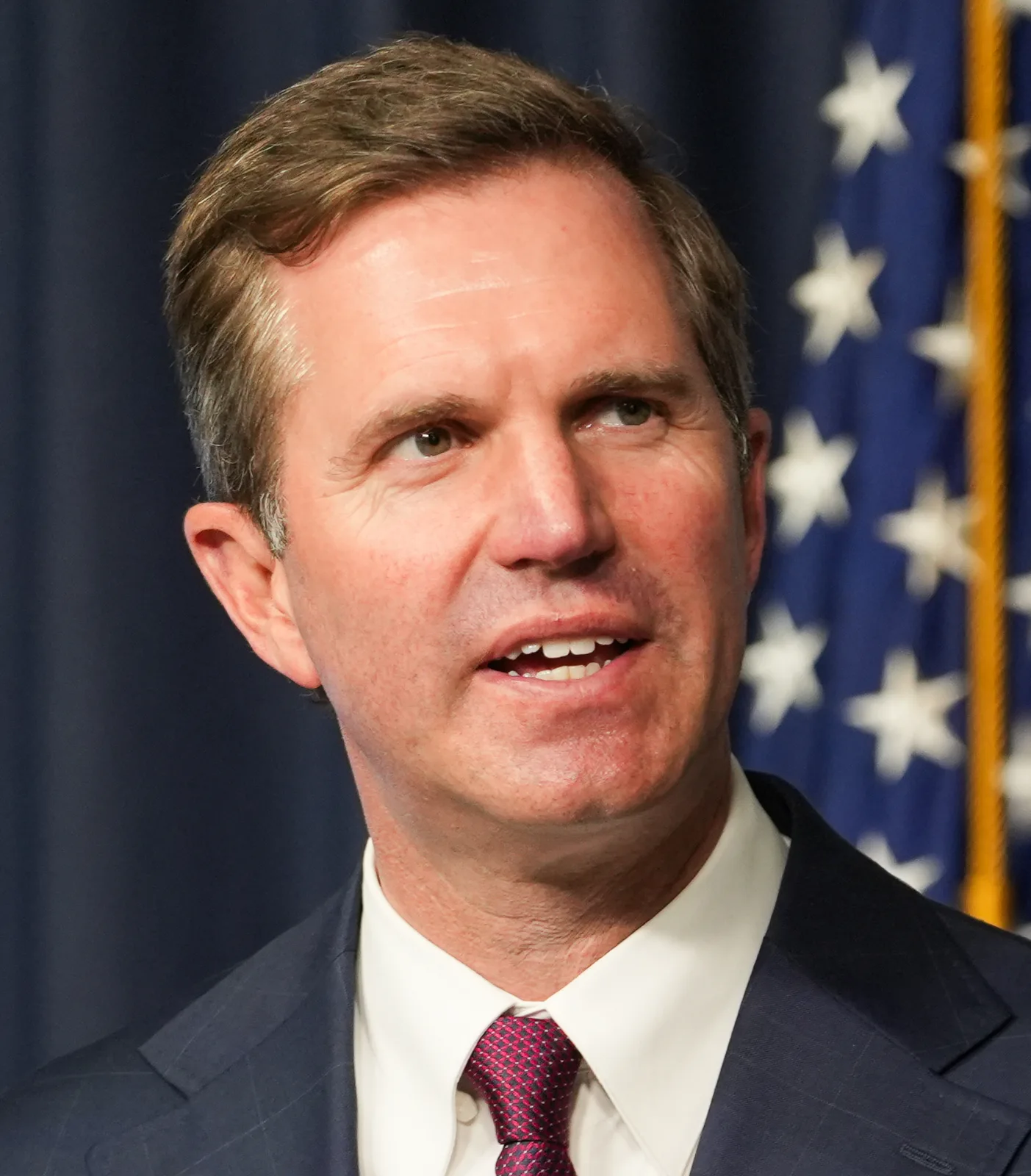
Andy Beshear
- Party
- Democrat
- In Office Since
- December 10, 2019
- Elected
- 2019, re-elected 2023
- Term Ends
- December 2027 (term-limited)
- Born
- November 29, 1977, Madisonville, KY
- Education
- Vanderbilt University, University of Virginia School of Law
- Prior Role
- Kentucky Attorney General (2016–2019)
Andy Beshear is the 63rd Governor of Kentucky, a Democrat who has won statewide office twice in a heavily Republican state. His father, Steve Beshear, also served as governor from 2007 to 2015, making them one of the few father-son governor pairs in U.S. history. Before becoming governor, Beshear served as Kentucky's Attorney General. He is term-limited and cannot seek re-election; the next gubernatorial election is November 2027.
Other Current State Officials
Lieutenant Governor
Jacqueline Coleman
In office since December 2019, re-elected 2023. Former educator and founder of the Workforce Cabinet's Work Ready Kentucky Scholarship program. Focuses on education, workforce development, and early childhood literacy.
Attorney General
Russell Coleman
In office since January 2024. Former federal prosecutor and ex-FBI agent who served as U.S. Attorney for the Western District of Kentucky. Focuses on consumer protection, public corruption, and drug trafficking enforcement.
Secretary of State
Michael Adams
In office since January 2020, re-elected 2023. Election attorney and former state elections board member. Known for modernizing Kentucky's election infrastructure and expanding access to absentee voting. Term-limited in 2027.
The Kentucky General Assembly
Kentucky State Senate
- Seats: 38 members
- Terms: 4-year terms
The upper chamber. Kentucky senators serve staggered 4-year terms, with roughly half the chamber up for election every two years. Republicans took Senate control in 2000 and now hold a supermajority.
Kentucky House of Representatives
- Seats: 100 members
- Terms: 2-year terms
The lower chamber. All 100 seats are on the ballot every two years. Republicans took House control in 2016 for the first time in nearly a century, a dramatic shift for a state that was a Democratic stronghold for most of the 20th century.
Kentucky's U.S. Senators
U.S. Senator
Mitch McConnell
One of the longest-serving senators in American history, McConnell has represented Kentucky since 1985. He served as Senate Majority Leader and Minority Leader at various points, making him one of the most powerful legislative figures in modern American politics. In February 2025, he announced he would not seek re-election, his seat is open in November 2026.
U.S. Senator
Rand Paul
A board-certified ophthalmologist and libertarian-leaning Republican, Paul has served since 2011 and was re-elected in 2022. Known for opposing government spending, defending civil liberties, and breaking with his party on foreign policy. He ran for the Republican presidential nomination in 2016.
Kentucky Through the Years
From Daniel Boone's Wilderness Road to Muhammad Ali's Louisville, Kentucky has been shaping American history for over 200 years.
Before European contact, Kentucky was home to Cherokee, Shawnee, and Chickasaw peoples. The land was used as a shared hunting ground, its name likely derives from an Iroquoian word meaning 'meadowland' or 'land of tomorrow.'
Because Kentucky functioned mainly as a contested shared hunting ground between rival Native nations rather than a location of permanent villages, early European settlers mistakenly viewed it as unclaimed 'empty' land, a misunderstanding that fueled later conflict over settlement rights.
Kentucky was in fact heavily inhabited far earlier. The Adena and later Fort Ancient cultures built villages and burial and effigy mounds along the Ohio and its tributaries between roughly 500 BC and AD 1700; sites such as Wickliffe Mounds in the far west and the Adena mound at Mount Horeb near Lexington survive, and the enormous Angel Mounds town lies just across the Ohio in Indiana. Bison, hunted across the region into the 1790s, cut the wide trails, 'traces,' that many later roads followed.
The Shawnee held towns on the Ohio's north bank in what is now Ohio and used the Kentucky side intensively for hunting, while the Cherokee claimed the southeast and the Chickasaw the far west. It was Cherokee leaders who sold a vast tract of central Kentucky to Richard Henderson's Transylvania Company at the Treaty of Sycamore Shoals in March 1775, a private purchase the Crown and later Virginia both declared illegal; the Cherokee leader Dragging Canoe reportedly warned the buyers they had bought 'a dark and bloody ground.'
That phrase became a nickname for Kentucky through the Revolutionary years, when Shawnee and other nations, backed by the British at Detroit, raided the new stations relentlessly. No tribe was left with recognized land in Kentucky after a series of cessions ending with the 1818 Jackson Purchase, and the state today has no federally recognized tribe, though it created a Native American Heritage Commission in 1996.
Explorer Daniel Boone blazed the Wilderness Road through the Cumberland Gap, opening Kentucky to large-scale settlement. The Transylvania Company hired Boone to lead a party of settlers through the Appalachians into what was then Virginia territory.
Shortly after blazing the trail, Boone's party founded Fort Boonesborough on the Kentucky River, one of the first permanent European settlements in the region and a frequent target of attacks during the Revolutionary War-era conflicts with Native American nations allied with the British.
James Harrod's party had actually founded Harrodstown, now Harrodsburg, in 1774, a year before Boonesborough, making it the oldest permanent settlement in Kentucky. Boone's route ran about 200 miles from the Holston River through the Cumberland Gap and on to the Kentucky River, and for years it was a rough packhorse trace, not passable by wagon until Virginia widened it in 1796.
The stations endured a hard war. In 1778 Boone was captured by the Shawnee and adopted by Chief Blackfish before escaping to warn Boonesborough of a coming assault, which the fort survived after a ten-day siege in September. At the Battle of Blue Licks in August 1782, ten months after Yorktown, a Kentucky militia force was ambushed and routed by British-allied Shawnee and Loyalists, losing about 70 men including Boone's son Israel, in what is often called the last battle of the Revolution.
Migration surged once the fighting eased: Kentucky's population went from a few hundred settlers in 1775 to about 73,000 in the 1790 census and over 220,000 by 1800. Most came down the Wilderness Road or floated the Ohio River on flatboats from Pittsburgh, and land-title chaos from overlapping Virginia claims, including several of Boone's own, sent many early arrivals, Boone among them, on to Missouri.
Kentucky became the 15th state on June 1, 1792, the first state west of the Appalachian Mountains to join the Union. Frankfort was chosen as the state capital.
Kentucky was carved out of counties that had belonged to Virginia, and its statehood required Virginia's formal consent, since the new Constitution had not yet been tested by a state splitting away from an existing one.
Kentuckians held ten statehood conventions in Danville between 1784 and 1792 to work out separation terms with Virginia, a slow process driven partly by anger that the Confederation Congress had considered giving up American navigation rights on the Spanish-controlled lower Mississippi, the outlet for every Kentucky farm's crops. A few figures, including the general and later exposed Spanish agent James Wilkinson, flirted with breaking away from the Union entirely.
The 1792 state constitution, written mostly at a Danville convention, was democratic for its day, with no property requirement to vote or hold office, but a proposal by the Baptist minister David Rice and others to bar or phase out slavery was defeated, and Kentucky entered the Union as a slave state. Isaac Shelby, a Revolutionary War hero of Kings Mountain, became the first governor.
Frankfort was chosen as capital in 1792 over Lexington and Louisville, and Kentucky rewrote its constitution three more times, in 1799, 1850, and 1891; the 1891 document, heavily amended but never replaced, is still in force and is one of the longest state constitutions in the country. Kentucky was the 15th state and the second, after Vermont in 1791, admitted after the original 13.
Kentucky tried to remain neutral at the start of the Civil War but ultimately stayed in the Union. Notably, both President Abraham Lincoln (Union) and Confederate President Jefferson Davis were born in Kentucky, within about 100 miles of each other.
Kentucky's official neutrality collapsed in September 1861 after Confederate troops entered the state first, prompting the state legislature to formally align with the Union, though a rival Confederate government-in-exile continued to claim Kentucky throughout the war.
The Confederate general Leonidas Polk broke the neutrality by seizing Columbus on the Mississippi in September 1861; Ulysses S. Grant immediately took Paducah in response. Kentucky's shadow Confederate government was organized at Russellville in November 1861, admitted to the Confederacy, and gave the rebel flag its 13th star, but it never governed and spent the war in exile.
Roughly 100,000 Kentuckians fought for the Union and about 25,000 to 40,000 for the Confederacy, and more than 23,000 Black Kentuckians enlisted in the U.S. Colored Troops, the second-highest number of any state, because enlistment was one of the few routes to freedom in a Union state where the Emancipation Proclamation did not apply. Camp Nelson, near Nicholasville, became a major recruiting and refugee center where the families of Black soldiers gathered, and a notorious 1864 expulsion of those families in freezing weather, which killed many, helped push Congress to free the wives and children of Black soldiers by law.
The war's major Kentucky battle was Perryville in October 1862, a bloody tactical draw that ended the Confederate invasion of the state, and the guerrilla raider John Hunt Morgan ranged widely across the commonwealth. Kentucky did not ratify the 13th Amendment until 1976 and rejected the 14th and 15th at the time, and in the decades after the war popular memory shifted so sharply toward the Confederacy that the state became known, in a historian's phrase, as having 'seceded after the war ended.'
The first Kentucky Derby was run at Churchill Downs in Louisville on May 17, 1875. The race has been held every year since, earning the nickname 'The Most Exciting Two Minutes in Sports.' It is the oldest continuously held major sporting event in the United States.
The race was the creation of Colonel Meriwether Lewis Clark Jr., grandson of explorer William Clark, who modeled it after England's Epsom Derby and France's Grand Prix de Paris following a tour of European racetracks.
Thirteen of the fifteen jockeys in that first Derby were Black, and Black riders won 15 of the first 28 runnings; Oliver Lewis rode the winner Aristides in 1875, and Isaac Burns Murphy, born enslaved near Lexington, won three Derbies in the 1880s and 1890s and was the first jockey elected to the racing Hall of Fame. Jim Crow rules and violence had pushed Black jockeys almost entirely out of the sport by 1920, and no Black rider won again until 2000.
Churchill Downs nearly failed in its early decades and was rescued in 1902 by a group led by bookmaker Matt Winn, who turned the Derby into a national spectacle with heavy promotion, the mint julep, and the garland of roses that gave the race the name 'Run for the Roses.' The song 'My Old Kentucky Home,' written by Stephen Foster in 1853 and adopted as the state song in 1928, has been played before the race since at least 1921; the legislature changed one line of its lyrics in 1986 to remove a racial slur.
The Derby is the first leg of American Thoroughbred racing's Triple Crown, followed by the Preakness and the Belmont Stakes, a sweep achieved only 13 times, most recently by Justify in 2018. The 1970s produced its most famous winners, Secretariat, whose 1973 Derby record of 1:59.40 still stands, and Seattle Slew and Affirmed, and the 2019 running ended in the first disqualification of a first-place finisher in Derby history when Maximum Security was taken down for interference.
The United States Bullion Depository at Fort Knox was completed in 1936. It holds a significant portion of the nation's gold reserves and has become a symbol of national security and financial stability.
The depository was built in the years following a 1933 executive order requiring Americans to surrender most privately held gold to the federal government. It reportedly holds roughly 147 million ounces of gold today, though the vault's contents have not been independently audited by outside parties in decades.
Fort Knox itself is a large U.S. Army post established in 1918 and named for Henry Knox, Washington's artillery chief and the first Secretary of War; the bullion depository is a separate Treasury facility on the post, built of granite, concrete, and steel with a blast door reportedly weighing more than 20 tons. The Army moved its Armor School and the Patton Museum's tank collection from Fort Knox to Fort Benning, Georgia, after a 2005 base-realignment decision, and the post is now home to Army Human Resources Command.
During World War II the depository was used to safeguard originals of the Declaration of Independence, the Constitution, the Gettysburg Address, a Gutenberg Bible, and the English Magna Carta, and it later held reserves of morphine and, briefly, the Hungarian crown jewels. The gold has been shown to outsiders only twice, to a congressional and press delegation in 1974 and again to Treasury and congressional officials in 2017.
The holdings, listed at a statutory book value of $42.22 an ounce, would be worth well over $400 billion at 21st-century market prices, and 'the gold at Fort Knox' has become a stock American phrase for anything supremely secure. Recurring claims that the vault is empty have never been substantiated, and the Mint says its holdings are counted and sealed under a long-standing joint audit.
Cassius Clay, later Muhammad Ali, was born in Louisville on January 17, 1942. He would become heavyweight boxing champion of the world three times and one of the most celebrated athletes in history.
Clay changed his name to Muhammad Ali in 1964 after joining the Nation of Islam. In 1967, he refused induction into the U.S. Army on religious grounds, a decision that cost him his boxing license and heavyweight title for three years before the U.S. Supreme Court unanimously overturned his conviction in 1971.
Clay grew up in Louisville's segregated West End, took up boxing at 12 after his bicycle was stolen, and won a gold medal at the 1960 Rome Olympics as a light heavyweight. He turned professional under the backing of a group of white Louisville businessmen, the Louisville Sponsoring Group, and shocked the sport by beating Sonny Liston for the heavyweight title in Miami in February 1964, announcing his membership in the Nation of Islam the next day.
After his 1971 Supreme Court win he regained the title from George Foreman in the 1974 'Rumble in the Jungle' in Zaire and fought Joe Frazier three times, including the 1975 'Thrilla in Manila.' Diagnosed with Parkinson's disease in 1984, he lit the Olympic cauldron in Atlanta in 1996, and when he died in 2016 his funeral procession drew tens of thousands into the streets of Louisville before burial at Cave Hill Cemetery.
As coal employment declined in eastern Kentucky, the state worked to diversify its economy through automotive manufacturing, bourbon tourism, and technology. The bourbon industry in particular experienced explosive growth, becoming a major driver of tourism and tax revenue.
The Kentucky Bourbon Trail, launched in 1999 by the Kentucky Distillers' Association, has grown into one of the state's largest tourism draws, with participating distilleries recording millions of visits a year by the 2020s.
Distillers have poured billions of dollars into new and expanded facilities since about 2010, and the number of licensed Kentucky distilleries grew from a handful to more than 100, helped by a 2014 law allowing on-site sales and by the repeal of a long-standing extra tax on distilled-spirits sales, phased out under a 2023 law. Bourbon-and-barrel property taxes and tourism spending now contribute well over a billion dollars a year to the state economy.
Automakers kept expanding too: beyond Toyota's Georgetown plant, Ford's Louisville operations, and the 2021 BlueOval SK battery announcement in Hardin County, Kentucky landed an AESC battery plant in Bowling Green and remains one of the top vehicle-producing states per capita. The state also drew large distribution and logistics operations built around the UPS Worldport air hub in Louisville and the Amazon air hub that opened at the Cincinnati/Northern Kentucky airport in 2021.
The transition has been uneven. Eastern Kentucky's coal counties have continued to lose people and jobs faster than almost any region in the country, and state programs such as SOAR (Shaping Our Appalachian Region), created in 2013, and federal grants have pushed broadband, tourism, agriculture, and reclaimed-mine-land redevelopment as replacements, with limited results so far. Louisville and Lexington, by contrast, have grown steadily and now hold a large share of the state's population and economic output.
Kentucky's Defining Moments in American History
These are the events that didn't just shape Kentucky, they changed the nation.
Abraham Lincoln was born on February 12, 1809, in a one-room log cabin on Sinking Spring Farm in Hardin County, Kentucky. The 16th President of the United States, who guided the nation through its greatest crisis and signed the Emancipation Proclamation, began life in one of the most modest circumstances imaginable.
The site is now a national memorial, and Lincoln's Kentucky roots shaped his frontier values, self-education, and deep connection to ordinary working people.
Thomas and Nancy Lincoln lost the Sinking Spring farm to a defective land title, one of the tangled Virginia-era claims that plagued early Kentucky, and moved the family to nearby Knob Creek, where Lincoln said his earliest memories formed, before crossing the Ohio River into free Indiana in 1816 when Abraham was seven. Lincoln later wrote that the move was made 'partly on account of slavery' and partly because of the land-title trouble.
The birthplace was nearly forgotten until a private group bought the farm in 1905, and a marble memorial building designed by John Russell Pope was dedicated over a symbolic log cabin by President Theodore Roosevelt in 1911; it became a national park unit and is now Abraham Lincoln Birthplace National Historical Park. The cabin inside is a period structure, not provably the original, a fact the Park Service now states plainly.
Kentucky's divided identity followed Lincoln his whole life: his wife, Mary Todd, came from a prominent slaveholding Lexington family, several of whose sons fought and died for the Confederacy, and Kentucky voters gave Lincoln fewer than 1 percent of their ballots in 1860 and did not back him in 1864 either. The state that produced him would not ratify the amendment abolishing slavery until 1976.
Kentucky is the birthplace of bourbon whiskey, America's only native spirit. While the exact origin is disputed, Kentucky's limestone-filtered water, fertile corn fields, and ideal aging climate made it the natural home of bourbon production.
By the 19th century, Kentucky distilleries were shipping barrels down the Ohio and Mississippi rivers to New Orleans, and bourbon became woven into American culture, diplomacy, and identity. Today Kentucky produces 95% of the world's bourbon supply.
The story that a Baptist preacher named Elijah Craig 'invented' bourbon by aging corn whiskey in charred barrels around 1789 is folklore; corn whiskey was distilled all over the early frontier, and charring likely began as a way to clean reused barrels or to mimic aged French brandy. The 1791 federal excise tax on whiskey that set off the Pennsylvania Whiskey Rebellion pushed many small distillers west into Kentucky, where corn grew well and the Ohio River offered a route to market.
Federal law shaped the modern product: the Bottled-in-Bond Act of 1897, one of the first U.S. consumer-protection laws, guaranteed a whiskey's age and proof under government supervision, and a 1964 congressional resolution named bourbon a distinctive product of the United States that no other country may label as such. Prohibition from 1920 to 1933 shut nearly every distillery, and only six firms held permits to sell 'medicinal' whiskey through pharmacies.
Bourbon nearly died again in the 1970s and 1980s as drinkers switched to vodka and light spirits, and distilleries survived by exporting and by creating high-end 'small batch' and 'single barrel' bottlings, starting with Blanton's in 1984. The category then boomed worldwide from the 2000s on, and by the 2020s aging bourbon inventory in Kentucky exceeded 12 million barrels, more than two and a half for every resident of the state.
The Kentucky Derby, held at Churchill Downs in Louisville since 1875, is the oldest continuously held major sporting event in the United States. Known as the Run for the Roses, it draws more than 150,000 spectators and a global television audience every first Saturday in May.
The Derby has become a cultural institution, combining elite thoroughbred racing with elaborate fashion, mint juleps, and the singing of My Old Kentucky Home, a ritual as distinctly American as any in sports.
The race is run at one and a quarter miles for three-year-old horses, and its field is capped at 20, filled by a points system earned in qualifying races around the world, so a Derby entry is itself a career achievement. Winning connections receive a purse in the millions and a blanket of more than 400 roses, and a Derby win sharply raises a stallion's later stud value, tying the sport's economics back to Kentucky's breeding farms.
The Derby has been run every year since 1875, including through two world wars, though the 1945 running was delayed to June by a wartime ban on horse racing and the 2020 race was moved from May to September because of the COVID-19 pandemic and run before empty stands. Attendance regularly tops 150,000, second only to the Indianapolis 500 among single-day U.S. sporting events, and the infield has its own raucous tradition distinct from the hats and juleps of Millionaires Row.
The event is not without controversy: a dozen horse deaths at Churchill Downs around the 2023 Derby led the track to suspend racing and move its meet to another Kentucky course while safety reviews were conducted, and the 2021 winner Medina Spirit was disqualified in 2022 after a failed drug test, stripping trainer Bob Baffert of the victory and drawing a multi-year ban. The federal Horseracing Integrity and Safety Authority, created by Congress in 2020, now sets national medication and safety rules for the sport.
Kentucky was a border state that officially declared neutrality at the outbreak of the Civil War, a position that quickly became untenable. Both Abraham Lincoln and Jefferson Davis, the presidents of the Union and the Confederacy, were born in Kentucky within a year of each other.
Brothers literally fought on opposite sides of the conflict. Kentucky's eventual alignment with the Union was critical, as Lincoln famously said: 'I hope to have God on my side, but I must have Kentucky.'
Keeping Kentucky mattered strategically because the Ohio River was the Union's front line and the state controlled the mouths of the Cumberland and Tennessee rivers, the invasion routes into the Confederate heartland that Grant used in 1862. Losing Kentucky, Lincoln wrote, would be nearly the same as losing 'the whole game,' likely forcing the surrender of Missouri and Maryland as well.
The divided-family theme was literal at the top: four of Mary Todd Lincoln's brothers and half-brothers served the Confederacy, one dying at Shiloh, and Confederate general Ben Hardin Helm, married to Mary's half-sister, was killed at Chickamauga in 1863, news that reportedly devastated the Lincolns. Senator John J. Crittenden of Kentucky, whose last-ditch 1860 compromise plan failed, had two sons who became generals, one Union and one Confederate.
Kentucky stayed in the Union but was placed under martial law and a Union military governor for much of the war, and heavy-handed federal enforcement, especially the enlistment and emancipation of enslaved Kentuckians, turned much of white opinion bitterly against the Union cause even as the fighting ended. In the decades afterward Kentucky raised far more monuments to Confederate soldiers than to its larger Union contribution, the pattern that led one historian to remark that Kentucky 'joined the Confederacy after Appomattox.'
Louisville-born Cassius Clay, who became Muhammad Ali after joining the Nation of Islam, refused military induction in 1967 citing religious objections to the Vietnam War. 'I ain't got no quarrel with them Viet Cong,' he declared. The U.S. government stripped him of his heavyweight title, and he was convicted of draft evasion.
The Supreme Court unanimously reversed his conviction in 1971. Ali's stand cost him three prime years of his career but galvanized anti-war sentiment and became one of the most consequential acts of conscience in American sports history.
Ali applied for conscientious-objector status as a minister of the Nation of Islam; the government rejected it, and on April 28, 1967, he refused three times to step forward when his name was called at the Houston induction center. Within hours the New York State Athletic Commission suspended his license and stripped his title, and other states followed, so he did not fight again until October 1970, from age 25 to nearly 29, the physical peak of a heavyweight's career.
He was convicted of draft evasion in June 1967, sentenced to five years and a $10,000 fine, and freed on appeal while the case worked through the courts. Public opinion, hostile at first, shifted as the war grew unpopular, and Ali spoke on dozens of college campuses during his exile, becoming a central figure of the antiwar and Black-freedom movements.
In Clay v. United States (1971) the Supreme Court ruled 8 to 0 that the government had never specified which legal ground for denying his claim it was relying on, and reversed the conviction on that narrow basis. Ali's refusal is now widely honored, and Louisville renamed its airport for him in 2019 and gave him a citywide funeral in 2016.
State Symbols & Quick Facts
| Nickname | "The Bluegrass State" |
| Capital | Frankfort |
| Largest City | Louisville |
| Statehood | June 1, 1792 (15th state) |
| Population | ~4.6 million (2025 est.) |
| Area | 40,408 sq miles (37th largest) |
| State Bird | Kentucky Cardinal |
| State Flower | Goldenrod |
| State Tree | Tulip Poplar |
| State Song | "My Old Kentucky Home" |
| State Horse | Thoroughbred |
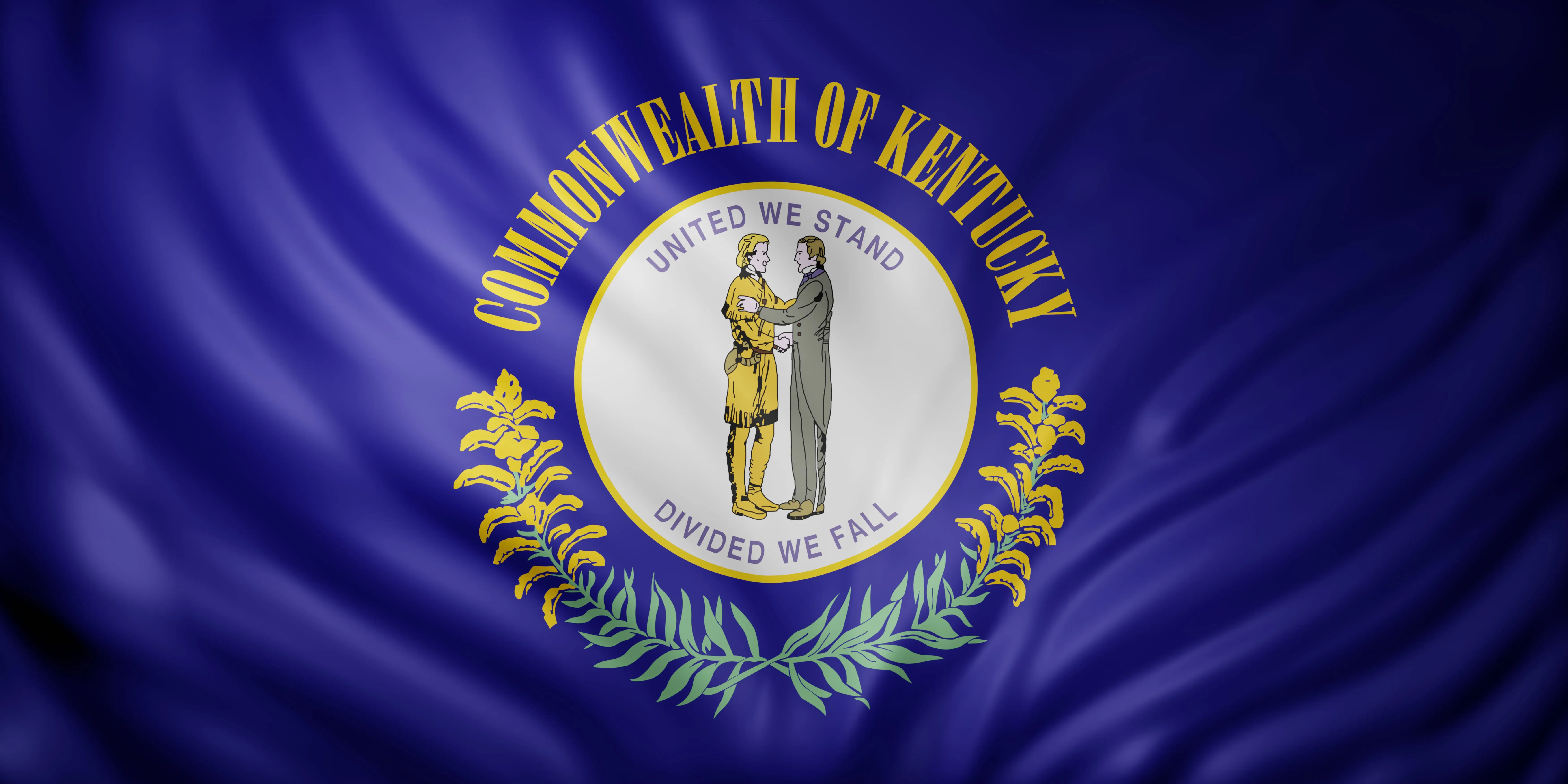
| Motto | United We Stand, Divided We Fall |
| Time Zone | Eastern (most) / Central (western tip) |
| Borders | TN, VA, WV, OH, IN, IL, MO |
Did You Know?
Kentucky has one of the most extensive networks of navigable waterways of any state, roughly 1,900 miles, bounded by the Ohio River to the north and the Mississippi to the west.
Mammoth Cave is the world's longest known cave system, with over 400 miles of explored passages.
The first American performance of a Beethoven symphony took place in Lexington, Kentucky, in 1817.
Kentucky produces about 95% of the world's bourbon whiskey.
The song 'Happy Birthday to You' was written by two Louisville sisters, Mildred and Patty Hill, in 1893.
Kentucky bluegrass isn't actually blue, it produces blue-purple buds in spring that give fields a bluish tint from a distance.
Corvette has been manufactured exclusively in Bowling Green, Kentucky since 1981.
The Kentucky Derby has been run every year since 1875, it was never cancelled, even during World War II.
Fort Knox holds approximately 4,600 tons of gold bullion in its vault.
Abraham Lincoln and Jefferson Davis, presidents of the two opposing sides in the Civil War, were both born in Kentucky.
Quick Facts and Common Questions
Short answers to the questions people most often ask about Kentucky: its abbreviation, how it became a state, its capital, and its place in Congress.
Kentucky's two-letter postal abbreviation is KY. The U.S. Census Bureau places it in the South region, in the East South Central division, and about 4.51 million people lived there in the 2020 census.
Kentucky became the 15th state on June 1, 1792, the first state west of the Appalachian Mountains. Before that it was part of Virginia, as Kentucky County and later a group of Virginia counties, and Virginia agreed to the separation.
Yes. The state's official name is the Commonwealth of Kentucky, one of four states, along with Massachusetts, Pennsylvania, and Virginia, that call themselves commonwealths. The word reflects a government based on the common consent of the people; legally, a commonwealth is a state like any other.
The name probably comes from an Iroquoian word. It is often said to mean "on the meadow" or "land of tomorrow," but the exact meaning is uncertain.
Frankfort has been the capital since 1792, when it was chosen over larger towns such as Lexington and Louisville. The current State Capitol, with a dome modeled on the Hôtel des Invalides in Paris, was completed in 1910.
Kentucky borders seven states: Tennessee, Virginia, West Virginia, Ohio, Indiana, Illinois, and Missouri. The Ohio River forms its entire northern border, and the Mississippi River forms its western edge.
Kentucky is known as "The Bluegrass State," for the bluegrass that grows in its central region. Its motto is "United We Stand, Divided We Fall." Its state bird is the cardinal, its flower is the goldenrod, its tree is the tulip poplar, and its state horse is the Thoroughbred.
Based on the 2020 census, Kentucky has 6 seats in the U.S. House of Representatives, the same as before, which gives it 8 votes in the Electoral College.
Kentucky was a slave state that stayed in the Union. It declared itself neutral in 1861, and after Confederate troops entered the state that September, the legislature sided with the Union. Both wartime presidents were born in Kentucky: Abraham Lincoln near Hodgenville in 1809, and Confederate president Jefferson Davis in Fairview in 1808.
Sources & Further Reading
Mammoth Cave National Park
The World's Longest Known Cave System, With Over 400 Miles of Explored Passageways
About Mammoth Cave National Park
Mammoth Cave National Park protects the longest known cave in the world: more than 400 miles of it have been surveyed, and geologists think the connected system may run well past 600.
The cave lies in Mississippian limestone roughly 325 million years old, capped by a hard layer of sandstone and shale that acts like a roof, keeping the upper passages dry and stopping them from dissolving away, which is why Mammoth has so many long, dry, walkable corridors.
Its levels record the drop of the Green River: as the river cut down over millions of years, the water table fell in steps, and each pause carved a tier of passage, dry above and still-flowing below.
Congress established the park on July 1, 1941; UNESCO named it a World Heritage Site in 1981 and part of an International Biosphere Reserve in 1990. People have been going into the cave for at least 4,000 years, and it has been a paying tourist attraction since about 1816.
- Designation
- National Park, UNESCO World Heritage Site, International Biosphere Reserve
- Location
- Mammoth Cave, Edmonson County, Kentucky
- Established
- July 1, 1941
- Annual Visitors
- ~600,000
Inside the World's Longest Cave
Native people entered Mammoth Cave more than 4,000 years ago to mine gypsum, mirabilite, and epsom salt by cane-torch light, leaving gourd cups, woven sandals, and torch stubs that the dry air has preserved.
In 1935 miners found a body, called 'Lost John,' crushed under a boulder he had been prying loose for gypsum about 2,000 years earlier; he was displayed for decades, then removed from view in 1976.
During the War of 1812, when the British blockade cut off imported gunpowder, the operators Charles Wilkins and Hyman Gratz mined the cave's nitrate-rich dirt for saltpeter using dozens of enslaved workers.
The wooden pipes, leaching vats, and ox-cart tracks from that operation still sit in the Rotunda and Booth's Amphitheatre, and when the war ended and the price collapsed, the owners turned to charging tourists instead.
Guided tours began around 1816, making Mammoth Cave one of the oldest tourist attractions in the country still operating.
The cave's early guides were enslaved men, above all Stephen Bishop, who from 1838 crossed the Bottomless Pit, found Echo River and its blind fish, and drew a map of the cave from memory that was used for decades.
Nick and Mat Bransford also guided while enslaved, and after emancipation the Bransford family kept guiding for three more generations, into the 1930s.
In 1842 the cave's owner, Dr. John Croghan, built stone huts inside and moved in tuberculosis patients, betting the stable air would cure them; several died, the experiment failed within a year, and two of the huts still stand along the Historic Tour.
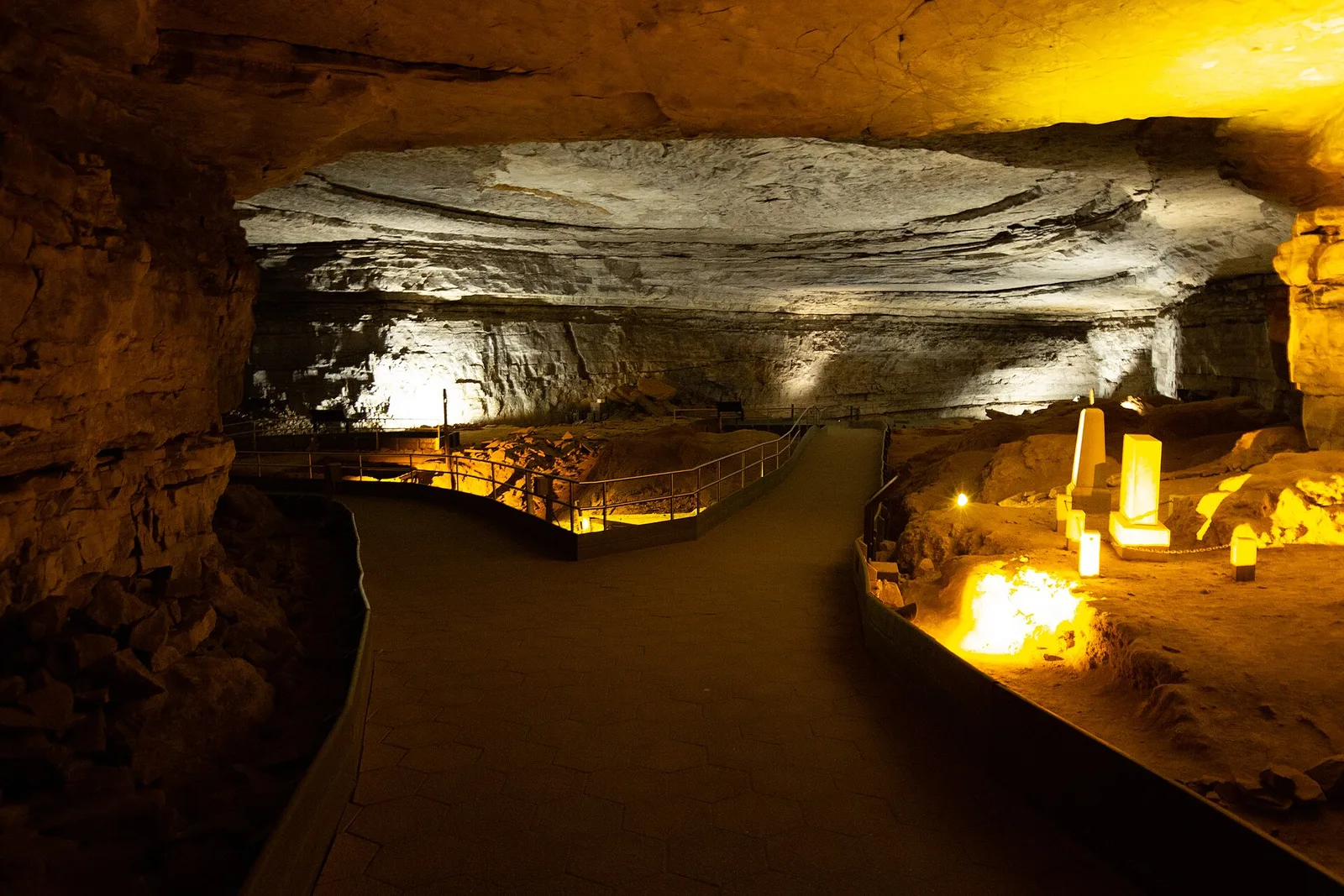
Mammoth Cave has roughly five main levels, stacked like the floors of a building, each cut when the Green River sat at a particular height and then abandoned as the river dropped lower.
The upper levels are broad, dry tubes, Broadway and the Main Cave, floored with dust and old sediment, because the protective caprock keeps water from seeping in and forming stalactites.
The lower levels still carry water: Echo River, the River Styx, and other streams flow toward the Green River and flood in wet weather.
Most of the mapped length has come from linking Mammoth to neighboring caves: the Flint Ridge connection in 1972 made it the world's longest, and Roppel Cave was joined in 1983.
More than 130 animal species use the cave, and about a dozen are 'troglobites,' found only in caves and unable to survive on the surface.
The best known is the Kentucky cave shrimp, a translucent, eyeless shrimp about an inch long that lives nowhere else on Earth and is federally endangered.
The northern cavefish has no eyes and no pigment and navigates by rows of pressure-sensing bumps on its head, reading the ripples of prey in total darkness.
Endangered Indiana bats and gray bats once hibernated here by the hundreds of thousands; disturbance and altered airflow drove them out long ago, and the park has been reworking cave entrances to try to bring them back.
Indigenous Connections
Pre-Columbian Peoples (Unnamed Cultures)
The oldest evidence of people in Mammoth Cave dates to the Late Archaic, around 4,000 years ago, and cave use continued into the Early Woodland period about 2,000 years ago.
These miners traveled two to three miles into the cave by torchlight to gather gypsum and other minerals, and the constant 54-degree air has kept their torches, sandals, and food remains intact.
Cave use stopped abruptly around 2,000 years ago, for reasons still unknown, and the deep cave was not entered again until the saltpeter miners of the early 1800s.
The specific tribal affiliations of ancient cave miners are not definitively established. Various Woodland and Fort Ancient peoples are believed to have used the cave. No single present-day nation claims continuous occupation, but several consult with NPS on protection of the archaeological record.
Shawnee and Cherokee Nations
By the 1600s and 1700s the Shawnee held much of the Ohio Valley north of Kentucky and the Cherokee the mountains to the southeast, and both used central Kentucky as hunting ground, along with the Chickasaw and others.
Kentucky was contested country with few permanent towns in the century before American settlement, part of why it was called a 'dark and bloody ground.'
A run of treaties and land purchases, including the 1775 Transylvania Purchase from the Cherokee and cessions after the 1794 Battle of Fallen Timbers, opened Kentucky to settlers and pushed both nations out.
Both nations were removed from Kentucky through treaties and military force in the late 18th and early 19th centuries. Their descendants in Oklahoma and North Carolina maintain cultural connections to their ancestral Kentucky homeland.
Exploring Mammoth Cave
Historic Tour
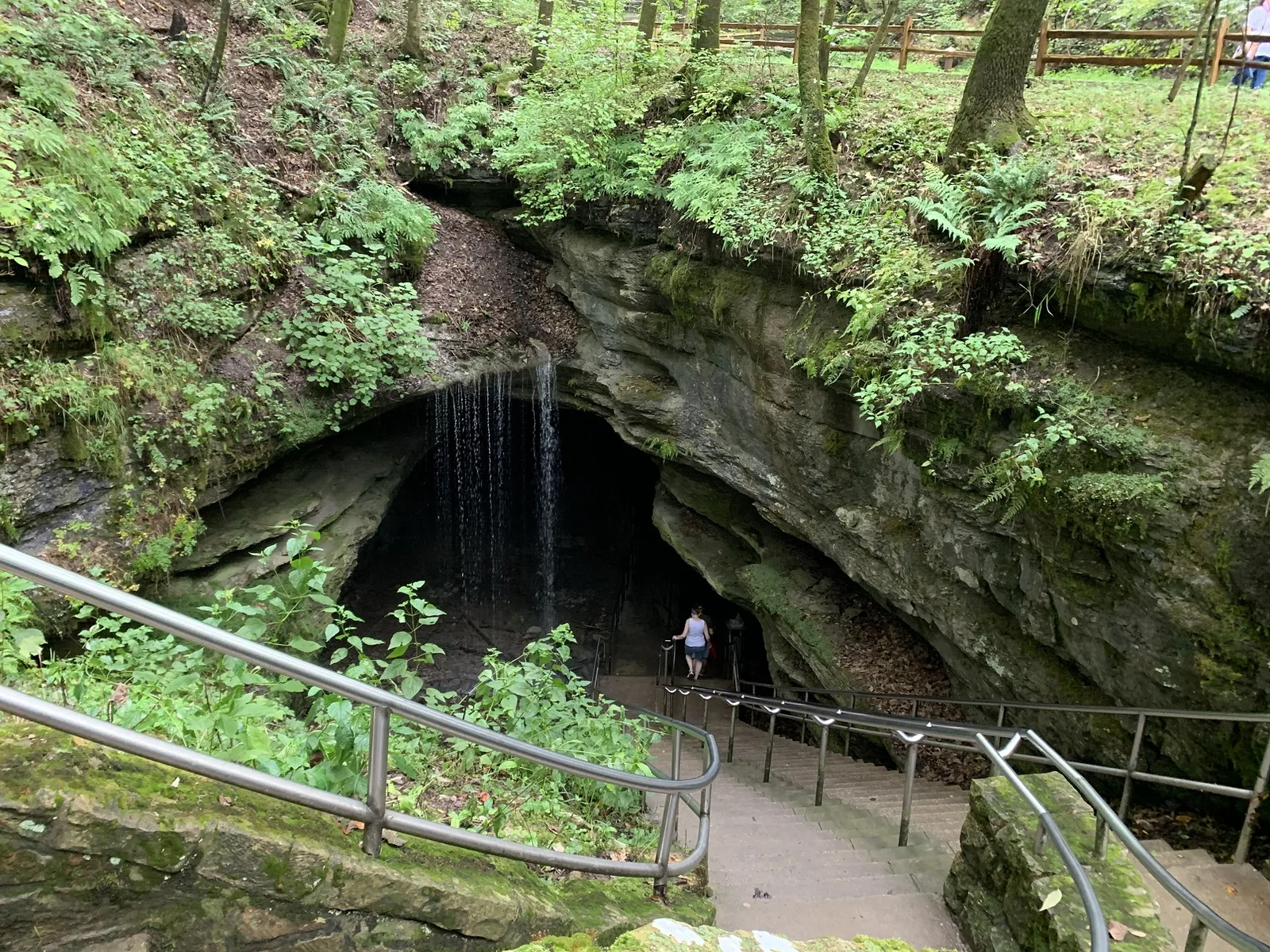
The Historic Tour, about two miles and two hours, follows the route tourists have walked since the early 1800s, in through the cave's natural Historic Entrance with its small waterfall.
It passes the saltpeter works in the Rotunda, the tuberculosis huts, Booth's Amphitheatre, where 19th-century visitors held concerts and church services, and Fat Man's Misery, a tight winding passage.
It climbs the 155 steps of the Mammoth Dome tower, a steel stairway up a vertical shaft carved by dripping water.
Rangers use the walk to tell the cave's human story, the enslaved guides in particular, rather than treating it only as a geology tour.
Domes and Dripstones Tour
This tour enters through a man-made shaft, the New Entrance, blasted in 1921 during the era of competing private show caves.
It drops on roughly 500 stairs through a series of 'domes and pits,' vertical shafts where surface water pours in at the edge of the caprock.
Because water reaches this part of the cave, it has the stalactites, flowstone, and draperies the dry upper passages lack, ending at Frozen Niagara, a broad orange sheet of flowstone.
The steep stairs and low ceilings make it one of the more demanding standard tours, and it is not suitable for anyone with mobility or heart limits.
Green River Ferry and Surface Trails
Above ground the park has about 85 miles of trail through oak-hickory forest, along the Green and Nolin rivers, and out to backcountry sinkholes and springs.
The Green River Ferry, a small cable-guided ferry, still carries cars across the river inside the park, continuing a crossing that has operated here since the 1840s.
The rivers are open to canoes and kayaks, with about 25 miles of the Green flowing through the park past cave springs and bluffs.
The forest here has recovered from heavy 19th- and early-20th-century logging and farming and is now managed as backcountry, with prescribed fire on the ridgetops.
Conservation Challenges
Groundwater Contamination
Mammoth Cave is a karst landscape: rain does not run off in streams but sinks straight into the ground through sinkholes and flows underground to the cave, with little of the natural filtering that soil provides elsewhere.
The area that drains into the cave reaches well beyond the park, so farm chemicals, septic waste, road salt, and spills from Interstate 65 and nearby towns can all show up in cave streams.
Dye-tracing studies by the U.S. Geological Survey have mapped those flow paths, and a 1980s project built a regional sewer system to stop raw sewage from the town of Park City reaching the cave.
The endangered cave shrimp and cavefish are sensitive to that pollution, so protecting them means protecting water quality across a roughly 2,000-square-mile area the park does not control.
White-Nose Syndrome
White-nose syndrome, caused by a cold-loving fungus first found in New York in 2006, reached Mammoth Cave in 2013 and has killed most of several bat species across the eastern United States.
The fungus grows on hibernating bats, rouses them to burn through their fat reserves in the dead of winter, and can wipe out more than 90 percent of a colony.
Mammoth Cave's bat numbers were already far below their historic levels, but the disease has hit its remaining little brown and tricolored bats hard.
The park screens cave-tour visitors, asks them not to wear clothing or gear used in other caves, and runs decontamination mats at the exits to slow the spread.
Cave Climate Management
Roughly half a million people a year go underground here, and each visitor adds heat, moisture, breath, and lint to a cave whose formations and ecosystem depend on stable conditions.
Body heat and lighting have dried and discolored formations near the busiest routes, and shed clothing lint builds up as visible gray fuzz on the rocks along the trails.
The park has installed airlock doors at cave entrances so tour traffic does not change the natural airflow, which in turn governs temperature, humidity, and where bats can roost.
Tour group sizes, routes, and lighting are all managed with those effects in mind, and volunteer 'lint camps' periodically clean the most-used passages.
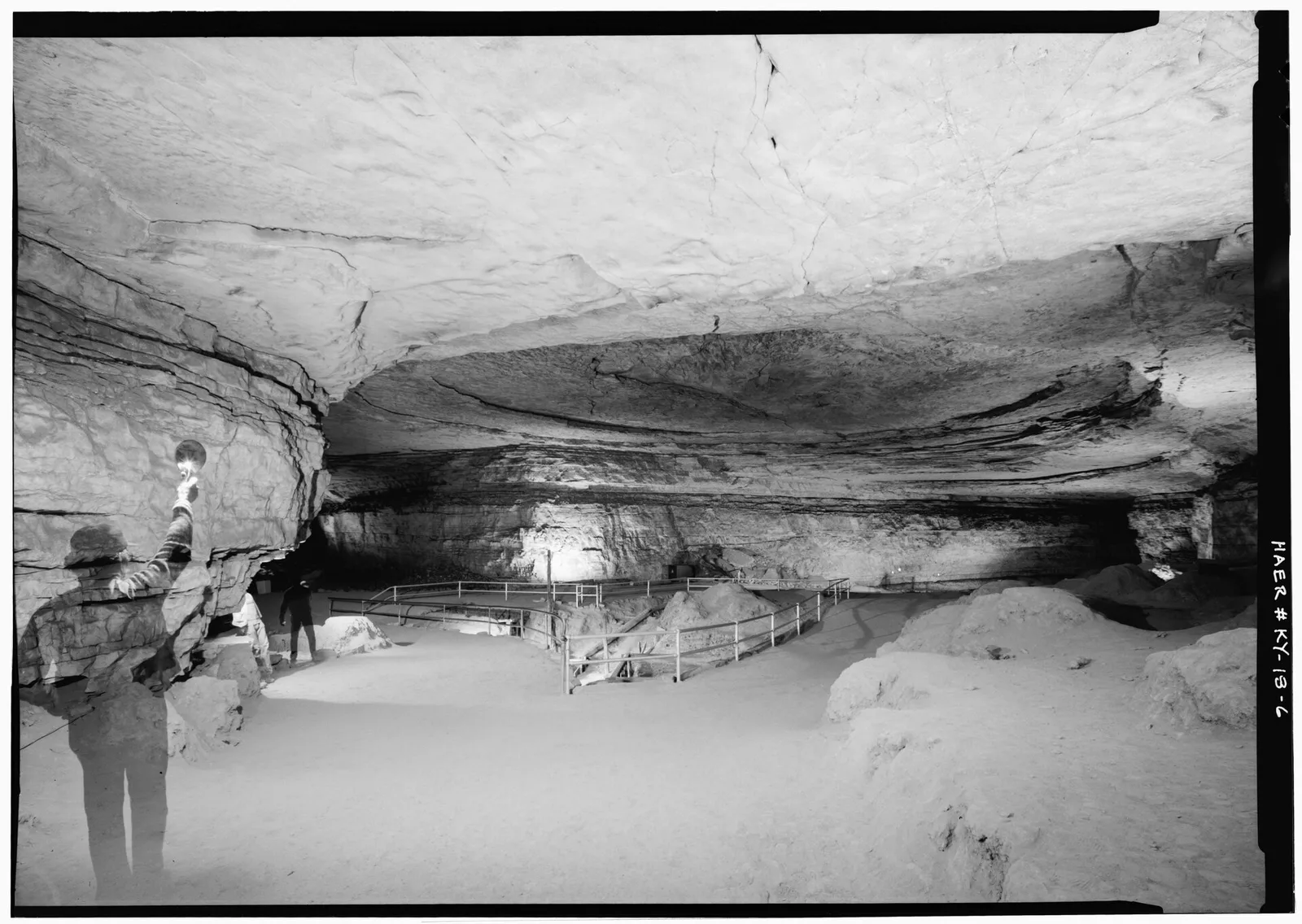
The Historic Tour passes rooms where Stephen Bishop guided explorers 180 years ago
At a Glance
Did You Know?
Enslaved guide Stephen Bishop mapped the deepest reaches of Mammoth Cave in the 1830s and 1840s, creating the first comprehensive map of the cave using nothing but an oil lamp.
In the 1840s, tuberculosis patients lived inside the cave for weeks at a time, as doctors believed the constant temperature and humidity would cure the disease. The experiment failed, but the stone huts built for patients still stand.
The northern cavefish found in Mammoth Cave's underground streams is completely eyeless and transparent, with no pigmentation. Its eyes began developing as embryos but are reabsorbed before birth, a result of millions of years of evolution in total darkness.
Plan Your Visit
Location
Mammoth Cave, Edmonson County, Kentucky
Designation
National Park, UNESCO World Heritage Site, International Biosphere Reserve
Best Time to Visit
Year-round; cave stays 54°F; book tours in advance, especially summer weekends
Admission
Tours from $8 to $30 per person depending on length and type