A Right Older Than the Republic Itself
Trial by jury did not begin with the United States. It arrived here already centuries old, rooted in a 1215 charter forced on an English king, carried across the Atlantic as an expectation of English subjects, and named directly as a grievance in the Declaration of Independence. By the time the Constitution's framers sat down to write, jury trial was the one individual right they agreed on almost without debate.
Clause 39 of Magna Carta, the charter English barons forced King John to seal in 1215, declared that no free man could be imprisoned, dispossessed, or destroyed except by "the lawful judgment of his peers or by the law of the land." The clause was written to limit a king's power over the nobility, not to create anything resembling a modern trial jury, but American colonists and the Constitution's framers repeatedly invoked it centuries later as the philosophical root of trial by jury.
By the time English colonists settled in North America, jury trial had developed into an established feature of English common law, and colonial charters routinely guaranteed it to settlers as a right of English subjects. That inherited expectation is why, when colonial governors and the Crown began interfering with local juries in the 1760s and 1770s, colonists experienced it as the loss of a right they already possessed, not the denial of something new.
The 1215 charter's "judgment of peers" meant trial by one's social equals, barons judged by barons, not the random cross-section of today. The trial jury emerged over the next two centuries after the Fourth Lateran Council abolished trial by ordeal in 1215, forcing English courts to find another way to decide disputed facts.
English jurors themselves later won protection in Bushel's Case (1670), which held that a juror could not be fined or jailed for a verdict a judge disliked, after jurors refused to convict Quakers William Penn and William Mead. That principle, that a jury's verdict is its own, crossed to the colonies and underlies the modern rule that an acquittal cannot be appealed.
Printer John Peter Zenger was prosecuted for seditious libel after his newspaper, the New York Weekly Journal, published articles criticizing New York's royal governor, William Cosby. Under the law as it then stood, truth was not a defense to libel, and the judge instructed the jury accordingly; Zenger's lawyer, Andrew Hamilton, argued anyway that a jury should acquit if the published statements were true, according to the National Archives' account of the trial.
The jury acquitted Zenger despite the judge's instructions, a result historians and legal scholars generally treat as an early, vivid example of jury nullification, a jury's practical power to refuse to convict under a law or set of facts it considers unjust, discussed further in the Rights & Duties tab. The case did not immediately change libel law, but it became a touchstone the founding generation cited when arguing for both press freedom and the jury's role as a check on government power.
Andrew Hamilton, a 59-year-old Philadelphia lawyer with no relation to Alexander Hamilton, told the jury they had "the right beyond all dispute to determine both the law and the fact," and the jury deliberated only about ten minutes before returning "not guilty."
New York did not make truth a defense to libel by statute until 1805, and the Supreme Court did not constitutionalize the point for public officials until New York Times v. Sullivan (1964). But the acquittal became a fixture of American civic memory, cited by John Adams and others as proof a jury of ordinary citizens could stand between the government and an unpopular speaker.
The Declaration of Independence lists, among its specific grievances against King George III, that he assented to acts "depriving us in many cases, of the benefits of Trial by Jury." The grievance referred in large part to Parliament's Administration of Justice Act of 1774, which allowed British officials accused of crimes in the colonies to be tried in England or another colony instead of before a local jury, effectively removing colonial juries from cases colonists cared about most.
Placing jury trial among the Declaration's formal list of grievances, alongside taxation without representation and the quartering of troops, signaled how central the founding generation considered the right; it was not treated as one privilege among many but as a defining feature of self-government they believed the Crown had deliberately stripped away.
The Administration of Justice Act was one of the Coercive Acts Parliament passed to punish Massachusetts after the Boston Tea Party. Colonists called it the "Murder Act" because they believed it would let royal soldiers kill colonists and escape a local jury by being tried in Britain.
The First Continental Congress in 1774 had already resolved that colonists were "entitled... to the great and inestimable privilege of being tried by their peers of the vicinage." The state constitutions written in 1776 and 1777 all restated the jury right, setting the stage for its inclusion in Article III.
The original 1787 Constitution, ratified before the Bill of Rights was even proposed, already guaranteed jury trial in Article III, Section 2: "The Trial of all Crimes, except in Cases of Impeachment, shall be by Jury." It is one of the few individual protections in the Constitution's original text, alongside habeas corpus, the bans on bills of attainder and ex post facto laws, and the ban on religious tests for office, written four years before the first ten amendments took effect, a placement that reflects how little debate the framers needed on the basic principle compared to other rights fought over during ratification.
Article III's guarantee applied only to criminal trials and said nothing about grand juries, civil juries, or jury size, gaps the Fifth, Sixth, and Seventh Amendments would fill in 1791. Even so, its early, uncontested inclusion in the main constitutional text is why some legal historians describe jury trial as the right the framers considered least controversial and most essential of all.
Article III also fixed venue, requiring a criminal trial "be held in the State where the said Crimes shall have been committed," a direct answer to the grievance about trials moved to England. The Convention discussed a civil-jury guarantee but left it out, partly because civil practice varied so much among the states.
Alexander Hamilton devoted much of Federalist No. 83 to defending that omission, arguing a rigid civil-jury rule would be unworkable given state differences. The Federalists' promise to add civil-jury protection by amendment helped several states ratify, and the Seventh Amendment delivered on it in 1791.
The Fifth Amendment requires that no person be held to answer for "a capital, or otherwise infamous crime" without a grand jury indictment, formally writing the grand jury's screening role into the Constitution. The Sixth Amendment, ratified the same year, separately guarantees a criminal defendant "the right to a speedy and public trial, by an impartial jury of the State and district wherein the crime shall have been committed," the provision that governs the ordinary trial jury discussed throughout this page.
Together, the two amendments created a two-jury system, one jury (grand) to decide whether formal charges should even be filed, and a separate jury (petit) to decide guilt or innocence at trial, a structure explained in detail in the Grand vs. Petit Juries tab. As the Legal Fights tab shows, the Supreme Court later held that the Fifth Amendment's grand jury requirement, unlike the Sixth Amendment's trial jury guarantee, does not bind state courts.
The grand jury dates to the Assize of Clarendon in 1166 and reached the colonies as a body of local citizens who both investigated crime and shielded neighbors from baseless royal prosecution. Colonial grand juries in the 1760s and 1770s repeatedly refused to indict printers and protest leaders, part of why the framers wrote the institution into the Fifth Amendment.
The Sixth Amendment's "impartial jury of the State and district" language was drawn largely from Virginia's 1776 declaration of rights. The "vicinage" idea, a jury from the community where the crime occurred, was a deliberate contrast to the distant trials colonists had protested in the Declaration.
The Seventh Amendment, also ratified in 1791, extends the jury right beyond criminal law: "In Suits at common law, where the value in controversy shall exceed twenty dollars, the right of trial by jury shall be preserved." It was added specifically because several of the Constitution's ratifying conventions had objected that the original document said nothing about juries in civil disputes, a gap Anti-Federalists considered a serious omission during the ratification debates.
The Seventh Amendment is unusual among the Bill of Rights in that the Supreme Court has never applied it against state courts through the Fourteenth Amendment, meaning it directly governs only federal civil trials; nearly every state constitution nonetheless guarantees a similar right to a civil jury trial on its own terms, a detail covered further in the Grand vs. Petit Juries tab.
The $20 threshold has never been raised and, unadjusted for inflation, now covers essentially every federal civil suit; it is one of the few dollar figures fixed in the Constitution. The amendment also bars federal judges from re-examining a jury's factual findings except under the rules of the common law.
Courts apply the amendment using a "historical test": a jury is required for claims that would have been tried "at law" in 1791 England, such as contract, debt, and tort, but not for "equitable" claims like injunctions. Modern statutory claims are sorted into one bucket or the other, which is why some federal cases have a jury and others are decided by a judge.
For much of American history, federal and state courts filled jury pools through a "key man" system, in which local jury commissioners personally selected names they considered suitable, a practice that let commissioners systematically and often deliberately exclude racial minorities and women from jury service for generations. Congress replaced this system for federal courts with the Jury Selection and Service Act of 1968 (28 U.S.C. § 1861 et seq.), which requires jurors to be selected at random from a source list, in practice almost always voter registration rolls, that reasonably reflects a fair cross-section of the district.
The 1968 Act declared, as a matter of federal policy, that "all litigants in Federal courts entitled to trial by jury shall have the right to grand and petit juries selected at random from a fair cross section of the community," language the Supreme Court would draw on directly in later cases like Taylor v. Louisiana (1975) and Duren v. Missouri (1979), both covered in the Legal Fights tab. Most states adopted broadly similar random-selection statutes for their own courts in the decades that followed.
Under the old system, jury commissioners often drew names from country-club rosters, church lists, or personal acquaintance. Congress acted after a 1966 Judicial Conference report and hearings documenting that the practice was excluding Black citizens, women, blue-collar workers, and the young across the country.
The Act created the "master jury wheel" filled at random from voter lists, required each district to file a written jury plan, and gave litigants a statutory way to challenge "substantial failure to comply." Later amendments added the fair-cross-section language and allowed supplementing voter lists with driver's license and state ID records.
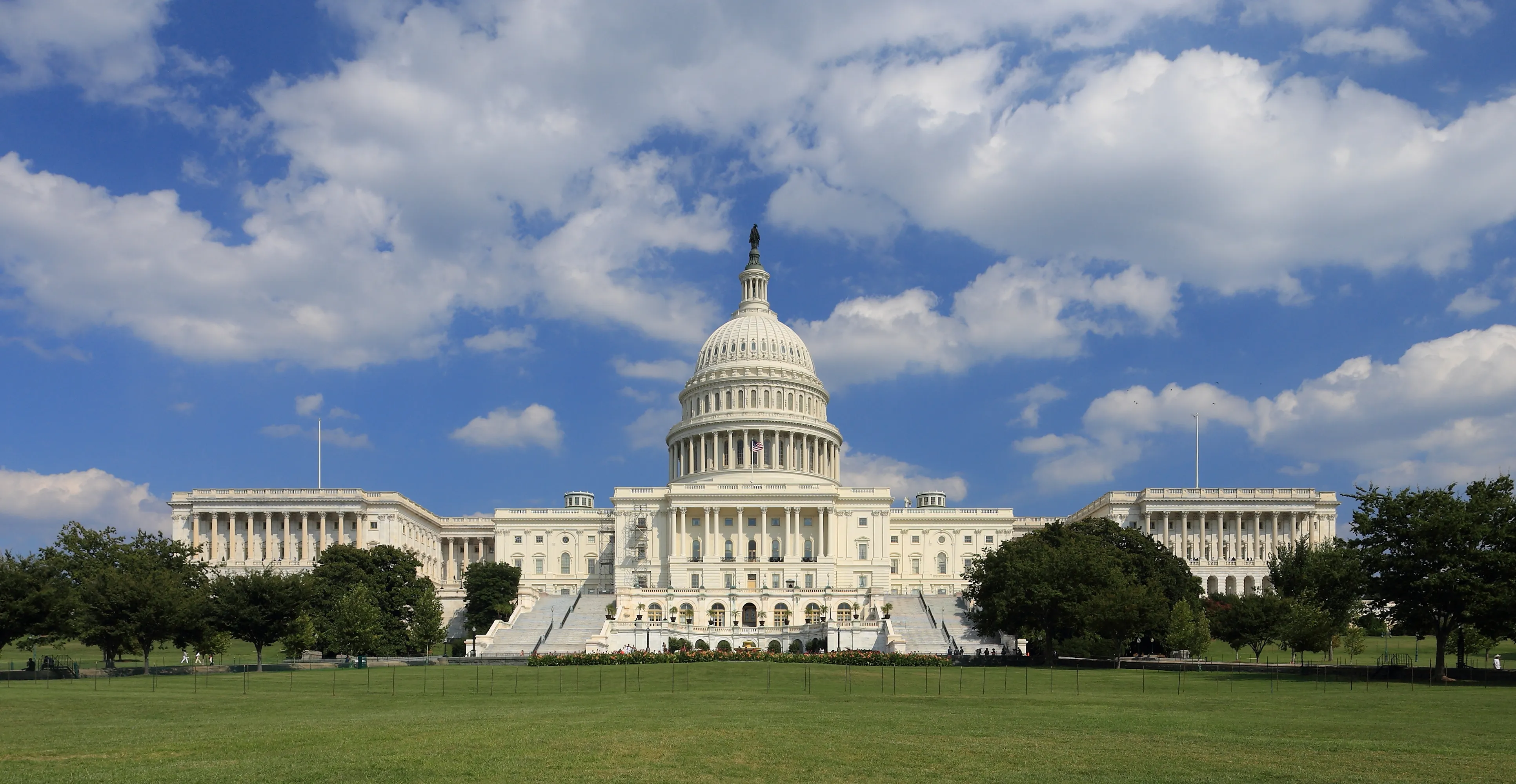
Congress replaced the old "key man" jury-selection system, which had let local commissioners hand-pick jurors, with random selection from the community when it passed the Jury Selection and Service Act of 1968.
From Summons to Verdict, a System With Real Rules
Most people's contact with the court system begins with a plain envelope: a jury summons. What happens between that summons and a finished trial, who is eligible, what excuses actually work, how attorneys narrow a jury pool, and what a juror is paid, is governed by a specific set of federal and state rules, not informal custom.
Federal courts assemble jury pools under the Jury Selection and Service Act of 1968, which requires random selection from a source list that reasonably reflects the district's population, in practice almost always voter registration rolls, sometimes supplemented with state driver's license or identification records to widen the pool beyond registered voters alone. This random-selection requirement directly replaced the older "key man" system, under which local jury commissioners hand-picked names they personally considered qualified, a system the U.S. Courts' own history of the Act describes as having enabled decades of systematic exclusion.
State court systems generally use a similar random-draw approach under their own statutes, though the specific source lists vary; many states also pull from tax rolls or state ID and utility-customer records to widen the pool further. Being a registered voter or a licensed driver in a district is, practically speaking, the main way a person's name lands in a jury wheel, which is why people who are neither sometimes go years without ever receiving a summons.
Each federal district's jury plan specifies its source lists and how often the master wheel is refilled, typically every two to four years after a federal election. From the master wheel the clerk draws a "qualified wheel" of people who returned an eligibility questionnaire and were found qualified, and summonses for specific trial weeks are drawn from that.
Relying mainly on voter rolls has a known side effect: groups that register at lower rates, including younger adults, lower-income residents, and some minority communities, appear less often in jury pools. About half the states now add driver's license or state ID lists, and a few add tax filers, specifically to broaden the pool.
Federal law sets baseline juror qualifications in 28 U.S.C. § 1865: a prospective juror must be a U.S. citizen at least 18 years old, must have lived in the judicial district for at least one year, must be able to read, write, speak, and understand English well enough to complete the juror qualification form, and must have no mental or physical condition that would prevent satisfactory jury service. A person is permanently disqualified from federal jury service while currently under felony indictment, or after a prior felony conviction for which civil rights have not been legally restored.
State eligibility statutes track these same basic categories, citizenship, age, residency, and no disqualifying felony record, but each state sets its own exact rules independently, so felony-disqualification standards and the process for restoring eligibility after a conviction vary considerably from state to state. Active-duty military status does not automatically disqualify someone from service, though a commanding officer can certify that a service member's absence would materially affect military readiness, a narrow exemption preserved from the original 1968 Act.
The English-literacy requirement is applied through the qualification questionnaire itself; courts provide interpreters for witnesses and parties but not, as a rule, for jurors, on the theory that a juror must directly understand testimony and instructions. New Mexico's constitution is a notable exception, barring disqualification of a juror for not speaking English and providing juror interpreters.
Felony disqualification is the single biggest categorical exclusion: studies estimate roughly 19 million Americans have a felony record, and in many states that record bars jury service permanently or until a formal restoration of rights. A few states impose no felony bar at all, while others restore eligibility automatically once a sentence is complete.
The 1968 Jury Selection and Service Act eliminated most of the broad occupational exemptions that had let entire professions, lawyers, clergy, teachers, and others, opt out of federal jury service automatically. Today, federal law recognizes only a narrow exempt group: active-duty members of the armed forces, members of a fire or police department, and certain public officers actively engaged in official duties. Almost every other request to avoid service is now handled individually as a case-by-case excuse or postponement, not a blanket exemption.
A court's chief judge or clerk can excuse or, more commonly, temporarily postpone a person's jury service on a showing of "undue hardship or extreme inconvenience," a standard that typically covers being a sole caregiver with no reasonably available child care, significant financial hardship from lost income, or a documented medical condition, using criteria each federal district publishes in its own jury plan. Deferral to a later date, rather than outright excusal, is the more common outcome, since it preserves the person in the jury pool rather than removing them from it entirely.
Before 1968, federal law let doctors, lawyers, dentists, ministers, and public officials skip jury duty automatically, and many states exempted teachers, nurses, sole proprietors, and parents of young children. The 1968 Act's near-total elimination of those categories was meant to make juries look more like the community.
Age is the main remaining categorical excuse: federal law and most states let people over 70 or 75 decline service on request, and many states excuse a primary caregiver for a young child or a disabled dependent. Full-time students are excused or deferred in many states, and breastfeeding mothers have an explicit excuse in a growing number of jurisdictions.
Voir dire, French for "to speak the truth," is the questioning process courts use to narrow a summoned jury pool, called a venire, down to the jurors who will actually hear a case. Depending on a court's local practice, a judge, the attorneys for each side, or both, question prospective jurors about potential biases, personal connections to the parties or witnesses, and life experiences that might affect their ability to judge the case fairly.
Two kinds of challenges can remove a prospective juror during voir dire: challenges for cause, which are unlimited in number and require an attorney to convince the judge a specific juror cannot be impartial, and peremptory challenges, a fixed, limited number of strikes each side may use without stating a reason, subject to the race- and gender-based limits described in the Rights & Duties tab. Federal Rule of Criminal Procedure 24 generally allows the defense 10 peremptory challenges and the prosecution 6 in a non-capital felony trial, with different totals set for capital cases and misdemeanors.
In federal court and many state courts the judge conducts most of the questioning, sometimes from questions the lawyers submit; in other states, notably parts of Texas and California, lawyers do extended questioning themselves, and jury selection in a major case can take days. Written juror questionnaires are common in high-publicity trials.
A challenge for cause succeeds when a juror admits or plainly shows an inability to be fair, a close relationship to a party, or a fixed opinion about the case, and there is no limit on the number. Peremptory strikes are capped (20 each in a federal capital case, 3 each in a federal misdemeanor) and, since Batson, cannot be based on race or gender.
Federal jurors are paid $50 for each day of service under 28 U.S.C. § 1871, a rate that increases to $60 per day once a trial juror has served more than 10 days on the same trial, plus mileage reimbursement for travel between home and the courthouse, according to the U.S. Courts' published juror fee schedule. State courts set their own jury pay independently, and many pay considerably less than the federal rate, in some states only a small per-day stipend.
Separately from pay, the Jury System Improvement Act of 1978 makes it illegal for an employer to fire, threaten, or coerce a permanent employee because of federal jury service, and every state has its own version of this job-protection guarantee for state court jury duty. Federal law does not, however, require an employer to keep paying an employee's regular salary during jury service, so whether a juror receives their normal pay on top of the modest court-paid fee depends entirely on the individual employer's policy or a union contract, not on federal law.
The federal $50 rate has not been raised in more than two decades; adjusted for inflation it would be roughly double that today. State jury pay ranges widely: a handful of states pay $40 to $50 a day, but many pay $10 to $25, and New Jersey and a few others pay $5 for the first several days.
Because court fees rarely cover lost wages, jury service falls hardest on hourly workers and the self-employed, and studies link low pay and no wage replacement to higher no-show rates and less economically diverse juries. A few jurisdictions have piloted "lengthy trial funds" that pay higher daily amounts for jurors serving on trials past a set number of days.
A federal jury summons is a court order, not a request. Under 28 U.S.C. § 1864, a court can require a no-show juror to appear and explain the failure, and a person who fails to appear without a valid excuse can be held in contempt of court and fined, though in practice most federal courts issue a warning letter or a follow-up order before escalating to a formal contempt proceeding.
State courts enforce jury summonses under their own separate penalty statutes, and how strictly those penalties are actually pursued varies widely by county and court, some jurisdictions actively pursue fines or bench warrants against repeat no-shows to protect a shrinking jury pool, while others rarely escalate past a second notice, a documented gap between the formal law on the books and typical day-to-day enforcement that court administrators around the country continue to grapple with.
Federal courts almost always send a "failure to appear" notice giving the person a chance to explain or reschedule before any sanction, and formal contempt findings against no-show jurors are rare. Some state counties send a show-cause order and can impose fines of $100 to $1,500 or, occasionally, a brief jail term, while others effectively do nothing.
Nationally, courts report "yield" problems: a large share of summonses are returned undeliverable or ignored, and appearance rates in many urban courts run well under half. Court administrators generally see better pay, shorter service terms, and easy online rescheduling as more effective than punishment for keeping the pool full.
Two Very Different Juries, Often Confused for One
The Constitution actually created two separate kinds of jury with two very different jobs: a grand jury that screens whether formal charges should even be filed, and a petit, or trial, jury that decides the case itself. They differ in size, secrecy, standard of proof, and even in which one the Fourteenth Amendment requires states to use at all.
A federal grand jury is an investigative body, not a trial jury. Federal Rule of Criminal Procedure 6(a) sets its size at 16 to 23 members, and its job is to review evidence a prosecutor presents and decide whether probable cause exists to formally charge someone with a federal felony, a decision called an indictment. Grand jury proceedings are one-sided: only the prosecutor presents evidence, no judge is present in the room, and the person under investigation has no right to testify or to have a defense attorney present.
A federal grand jury needs at least 12 of its members to agree, or "concur," before returning an indictment, known formally as a "true bill"; if fewer than 12 agree, the grand jury returns a "no bill," and the prosecutor cannot bring federal felony charges on that evidence without presenting new or additional evidence to a later grand jury, per the U.S. Courts' own description of federal grand jury procedure.
A grand jury sits for a set term, often 18 months for a regular federal grand jury and up to 36 months for a "special" grand jury investigating complex matters, meeting periodically rather than for a single case. It can subpoena witnesses and documents, and a witness who refuses without a valid privilege can be jailed for civil contempt until they comply or the term ends.
Because only the prosecution presents and the standard is merely probable cause, grand juries indict in the large majority of cases; the former New York judge Sol Wachtler's line that a prosecutor could get a grand jury to "indict a ham sandwich" is often quoted. Federal defendants can and often do waive indictment and be charged by "information" instead, usually as part of a plea agreement.
A petit jury, the ordinary "trial jury" most people picture when they hear the phrase jury duty, decides the actual outcome of a case, guilt or innocence in a criminal trial, or liability and damages in a civil trial, after hearing evidence and argument from both sides in open court with a judge presiding. "Petit," from the French word for "small," simply distinguishes this smaller trial jury from the larger grand jury and carries no implication about which is more important.
Federal criminal trial juries have 12 members under Federal Rule of Criminal Procedure 23, unless the parties agree in writing, with the court's approval, to a smaller number, and a federal criminal conviction requires a unanimous verdict. Federal civil trial juries can have between 6 and 12 members under Federal Rule of Civil Procedure 48, and a federal civil verdict must also be unanimous unless the parties stipulate otherwise before trial.
The trial jury is the "finder of fact": it decides what happened, applies the law as the judge instructs, and, in a criminal case, must find each element proven "beyond a reasonable doubt." The judge decides questions of law and, in most states, sets the sentence after a guilty verdict, though juries decide death sentences under Ring v. Arizona (2002).
Alternate jurors are selected alongside the main panel and hear the whole trial in case a juror falls ill or is excused; they are dismissed before deliberations begin unless a substitution is needed. In a long or high-profile trial a court may seat four or more alternates.
The Fifth Amendment requires that no person be held to answer for "a capital, or otherwise infamous crime" without a grand jury indictment, but the Supreme Court held in Hurtado v. California (1884) that this specific requirement is not incorporated against the states through the Fourteenth Amendment's Due Process Clause. States remain free to prosecute felonies without ever convening a grand jury, so long as the defendant receives an adequate alternative procedural safeguard, typically a judicial preliminary hearing to confirm probable cause exists.
As a result, roughly half of U.S. states still require a grand jury indictment for at least some categories of serious felony charges, while the other half let prosecutors file charges directly through a document called an "information," usually after a preliminary hearing before a judge, a split that has persisted with little change since Hurtado was decided in 1884.
Hurtado was one of the earliest cases refusing to "incorporate" a Bill of Rights guarantee against the states, decided decades before the Court began applying most of the first eight amendments to state governments. It has never been overruled, and the grand jury clause remains one of the few criminal-procedure protections that binds only federal court.
The states that keep grand juries for felonies are concentrated in the East and South; many Western states adopted the "information" system when they wrote their constitutions in the late 1800s as a Progressive-era efficiency reform. Even in information states, grand juries are often still used for public-corruption and organized-crime cases because of their subpoena power.
Federal Rule of Criminal Procedure 6(e) imposes strict secrecy on federal grand jury proceedings: grand jurors, prosecutors, court reporters, and interpreters present in the room are generally barred from disclosing what happened before the grand jury, including what evidence was presented and how individual jurors voted, with violations punishable as contempt of court. The rule exists to encourage witnesses to speak freely, protect the reputation of people investigated but never charged, prevent a target from fleeing or tampering with evidence, and shield grand jurors from outside pressure.
Witnesses who testify before a grand jury are a notable exception to this secrecy: a witness is generally free to publicly discuss their own testimony afterward if they choose to, since the secrecy obligation binds the people running the proceeding, not the witnesses who appear before it. Courts can, in the limited circumstances Rule 6(e) itself defines, authorize disclosure of grand jury material, for example to a later grand jury or in connection with a related judicial proceeding.
Rule 6(e) lists specific exceptions: disclosure to other federal prosecutors and investigators for their duties, to another grand jury, when "preliminarily to or in connection with a judicial proceeding," and, since 2001, to share foreign-intelligence or counterterrorism information. A court order is required for most of these.
High-profile fights over grand jury secrecy have included congressional requests for the Mueller investigation's grand jury material; courts have generally held that Congress is not automatically entitled to Rule 6(e) material and must fit an exception. The secrecy obligation is permanent, it does not lapse when the grand jury's term ends.
The Constitution's text never specifies an exact jury size, and the Supreme Court has allowed real variation as a result. In Williams v. Florida (1970), the Court upheld Florida's use of 6-member juries in non-capital state criminal trials, reasoning that the traditional number 12 was a historical accident of English common law rather than a constitutional requirement. In Ballew v. Georgia (1978), the Court drew a floor, unanimously holding that a 5-member jury is too small to reliably promote group deliberation and provide a fair possibility of a representative cross-section, making 6 the constitutional minimum.
Federal criminal trials still use 12-member juries as a matter of Federal Rule of Criminal Procedure 23, not constitutional command, while states remain free to use smaller 6-member juries for lesser offenses, a choice a number of states have made, particularly for misdemeanor trials, to reduce the burden of jury service and move court dockets more quickly.
Twelve became standard in England by the 14th century, and Blackstone's Commentaries, widely read by the framers, treated it as fixed. In Williams the Court called that number a "historical accident" and said the "essential feature" of a jury is group deliberation, community participation, and a chance at a representative cross-section, all of which a six-person jury could still provide.
About a third of states use six-person juries for at least some lesser offenses, and Florida uses them for non-capital felony trials, though its capital cases have always used 12 jurors (a 2016 change after Hurst v. Florida concerned how those jurors vote on a death sentence). In Burch v. Louisiana (1979) the Court held that a six-person criminal jury must be unanimous, no non-unanimous verdicts are allowed at the minimum size.
Criminal juries protect a defendant against the government's power to take away liberty, so criminal defendants have jury-trial and grand-jury rights the Constitution spells out directly in the Fifth and Sixth Amendments. Civil juries, by contrast, resolve disputes between private parties, or between a private party and the government in a non-criminal matter, over money, property, or other claims, and their constitutional basis comes from the Seventh Amendment rather than the Fifth or Sixth.
The Seventh Amendment's civil jury guarantee is one of the few provisions of the Bill of Rights the Supreme Court has never incorporated against the states, so it directly binds only federal civil courts. Nearly every state constitution nonetheless includes its own separate guarantee of a civil jury trial, so the practical right to a civil jury exists almost everywhere in practice, even though it does not flow from the federal Seventh Amendment itself outside of federal court.
Only "serious" criminal charges trigger the federal jury right; under Baldwin v. New York (1970) an offense carrying six months or less can be tried without a jury, and "petty" offenses like many traffic and municipal-code violations are routinely decided by a judge. Once the potential sentence exceeds six months, the jury right attaches.
In practice, jury trials are rare: roughly 2 percent of federal criminal cases and a similar or smaller share of civil cases actually reach a jury, because most criminal cases end in plea bargains and most civil cases settle or are decided on motions, a trend scholars call the "vanishing jury trial."
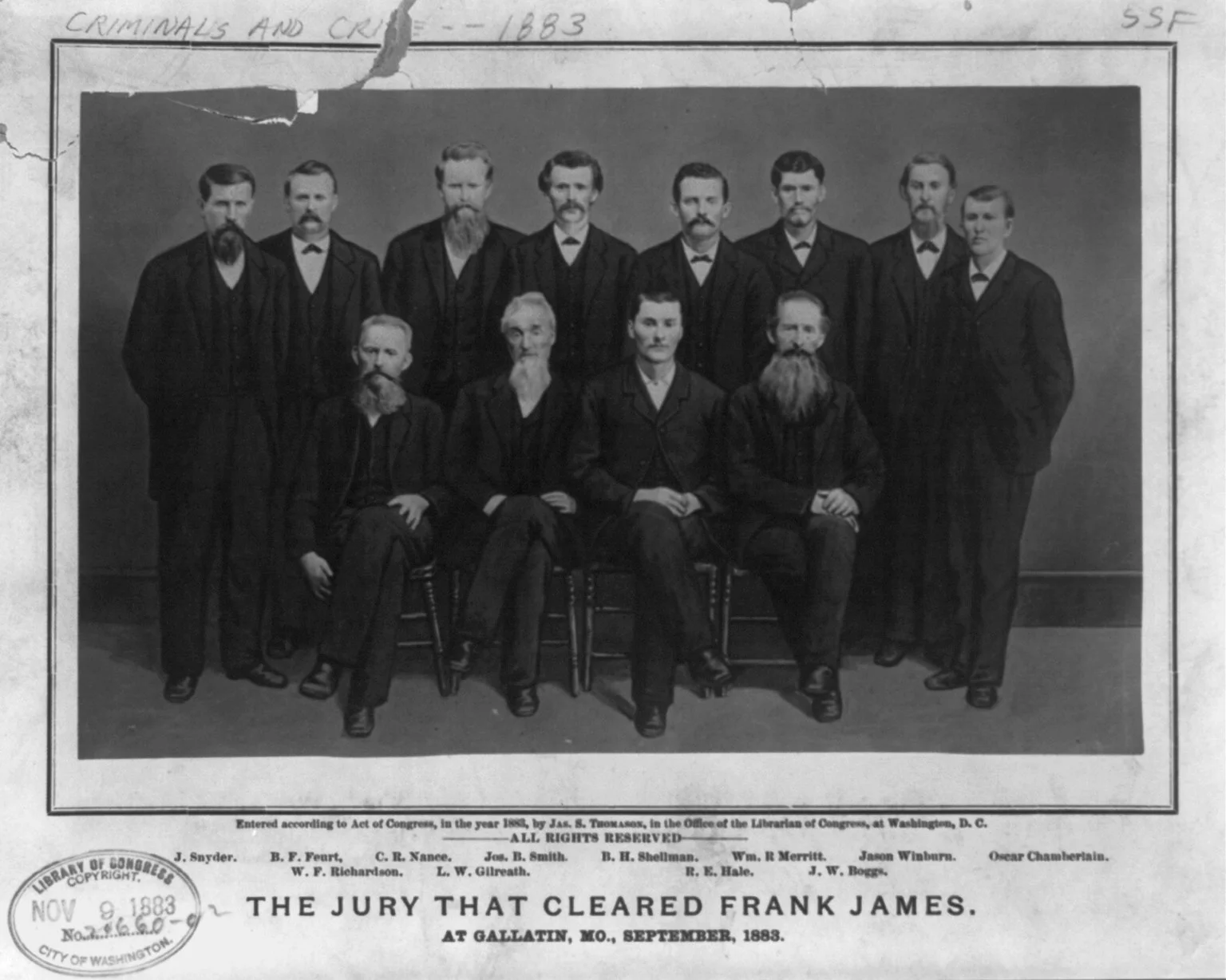
A 12-member petit jury photographed at Gallatin, Missouri, in September 1883, the same all-male, all-white composition that later Supreme Court rulings on race and gender in jury selection, covered in the Legal Fights tab, would eventually require states to open up.
Serving on a Jury Comes With Real Protections, and Real Limits
A juror is not a passive bystander in the eyes of the law. Jurors have specific legal protections against intimidation and retaliation, a real but quietly acknowledged power to acquit against the evidence, and a duty to reach a genuinely unanimous verdict in serious criminal cases, obligations and powers most jurors are never formally told about in plain terms.
The Sixth Amendment's guarantee of an "impartial jury" has been read by the Supreme Court to include a right to a jury pool drawn from a fair cross-section of the community, not a right to any particular jury's exact makeup. Duren v. Missouri (1979) set out a three-part test for proving a fair-cross-section violation: the excluded group must be a "distinctive" group in the community, its representation in jury pools must not be fair and reasonable relative to its share of the population, and the underrepresentation must result from systematic exclusion built into the selection process itself, not random chance.
This right belongs to the defendant, and by extension the community, not to any individual who wants to serve as a juror; a defendant cannot successfully challenge a conviction merely because their own trial jury happened to lack diversity, but must show the selection process systematically excludes a distinctive group over time, the standard applied when the Court struck down the systematic exclusion of women from jury pools in Taylor v. Louisiana (1975).
The cross-section requirement applies to the jury pool, not the final 12; a defendant has no right to any particular demographic mix on the seated jury. "Distinctive groups" recognized by courts include race, national origin, and gender; economic class, age, and religion have generally been held not to qualify.
Proving systematic exclusion usually requires statistical evidence across many jury pools, which defendants rarely have, so successful fair-cross-section challenges are uncommon. Where they succeed, the remedy is a new, properly drawn jury, not automatic acquittal.
Jury nullification occurs when a jury acquits a defendant despite evidence that would support a conviction, effectively declining to apply the law as written to the facts of the case, usually because jurors believe the law itself, or its application to this particular defendant, is unjust. The practice has deep American roots: the 1735 acquittal of publisher John Peter Zenger on seditious libel charges, covered in the Overview tab, is widely cited as an early example, and Northern juries occasionally refused to convict people charged under the Fugitive Slave Act of 1850 for helping enslaved people escape to freedom.
American courts generally do not tell jurors they have this power. Federal and most state courts have held that while a jury has the raw ability to nullify, since a "not guilty" verdict cannot be appealed or overturned by the prosecution, judges are not required to instruct jurors that nullification is a legitimate option, and some courts have removed jurors who tried to encourage fellow jurors to nullify during deliberations, an unresolved tension between the jury's practical power and its formal legal role.
The Supreme Court acknowledged the jury's power in Sparf v. United States (1895) but held 7-2 that judges need not tell juries about it and should instruct them to follow the law. Modern courts treat nullification as a byproduct of two firmer rules: a general acquittal need not be explained, and the Double Jeopardy Clause bars appealing or retrying an acquittal.
Historically, juries nullified in both directions: Northern juries refused to convict under the Fugitive Slave Act, but Southern juries also refused to convict white defendants for violence against Black citizens well into the 20th century. Courts today may dismiss a seated juror who tells others they will not follow the law.
Unlike a challenge for cause, which requires an attorney to give the judge a specific reason a particular juror cannot be impartial, a peremptory challenge historically let either side strike a limited number of prospective jurors for any reason, or no stated reason, at all, a discretion described briefly in the How Jury Duty Works tab.
That discretion is no longer unlimited. Batson v. Kentucky (1986) barred prosecutors from using peremptory strikes to remove jurors because of their race, Georgia v. McCollum (1992) extended the same rule to criminal defendants' own peremptory strikes, and J.E.B. v. Alabama ex rel. T.B. (1994) extended it again to strikes based on gender. An attorney who suspects an improper strike can raise a "Batson challenge," triggering a three-step process: the challenger must show circumstances suggesting discrimination, the striking party must offer a race- or gender-neutral reason for the strike, and the trial judge must decide whether that stated reason is genuine or a pretext.
Before Batson, Swain v. Alabama (1965) had required a defendant to prove a prosecutor struck Black jurors "in case after case," a nearly impossible burden. Batson lowered it to a pattern in the defendant's own trial plus other suspicious circumstances, and Edmonson v. Leesville Concrete (1991) extended the rule to civil cases.
Critics say almost any neutral-sounding reason can be offered, so Batson challenges rarely succeed. Washington State's Court Rule 37 (2018) lets a judge deny a strike if "an objective observer could view race as a factor," without proof of intent, and Arizona in 2022 became the first state to abolish peremptory challenges entirely.
Federal criminal trials, and now, since 2020, all state criminal trials for serious offenses, require a unanimous jury verdict to convict, a rule the Legal Fights tab covers in detail. Deliberation itself is largely unstructured by law: jurors elect their own foreperson and discuss the evidence privately with no judge or attorneys present, taking as long as they need, though a judge can, in limited circumstances, give a supplemental instruction, sometimes called an "Allen charge," urging a deadlocked jury to keep working toward a verdict without abandoning any juror's honestly held views.
A jury that genuinely cannot reach unanimous agreement after extended deliberation is declared a "hung jury," resulting in a mistrial. The case is not automatically over, since prosecutors generally retain the option to retry it before a new jury, a decision that turns on the strength of the evidence, resource constraints, and prosecutorial discretion rather than any fixed legal rule.
The "Allen charge," from Allen v. United States (1896), asks minority jurors to reconsider their views in light of the majority's; many states have softened or banned it as coercive, and a judge cannot ask how the numerical split stands or which way it leans.
Federal Rule of Criminal Procedure 31 allows a partial verdict, guilty on some counts and deadlocked on others, and permits the court, on request, to poll each juror individually after a verdict is announced. If polling reveals a juror does not actually agree, the judge sends the jury back to deliberate or declares a mistrial.
Tampering with, threatening, or attempting to intimidate a juror is itself a federal crime under 18 U.S.C. § 1503, and every state has an equivalent jury-tampering law. Courts also have inherent authority to seal a juror's name and address from the public record in a specific case when there is a genuine risk of intimidation or retaliation, a step taken periodically in cases involving organized crime, terrorism, or unusually intense media attention.
In rare, extreme cases, a federal court can empanel a fully "anonymous jury," withholding jurors' names even from the attorneys trying the case, a practice that traces to United States v. Barnes (1977), an organized-crime prosecution in New York where the trial judge concluded ordinary safeguards were insufficient to protect jurors from potential intimidation. Appellate courts have since required trial judges to make specific findings of a genuine risk before taking the unusual step of anonymizing a jury.
Jury tampering under 18 U.S.C. 1503 and 1504 covers threats, bribes, and even writing to a juror about a pending case, and carries up to 10 years, more if the case involves a violent crime. Retaliating against a juror for a verdict is a separate federal offense under 18 U.S.C. 1513.
When a court anonymizes a jury it must give a neutral explanation to the jurors, usually "to protect your privacy," so anonymity does not imply the defendant is dangerous. The practice has spread from organized-crime and terrorism cases to a growing number of other high-profile trials.
Sequestration, isolating a jury from outside contact, media coverage, and often even their own families for the length of a trial, is a discretionary tool a judge can order in cases likely to draw heavy publicity or where there is a specific risk jurors will be exposed to prejudicial outside information, not a routine or default practice. The large majority of American trials, criminal and civil, proceed without any sequestration at all.
Because sequestration is expensive, logistically demanding, and disruptive to jurors' lives, judges typically reserve it for a small number of genuinely high-profile cases and increasingly rely on narrower alternatives instead, such as specific instructions not to read or watch news coverage of the case and prohibitions on independent research, reflecting a broader shift in how courts try to protect jury impartiality without the blunt instrument of full isolation.
Sequestration was more common before the Supreme Court's Sheppard v. Maxwell (1966), which reversed a murder conviction because "massive, pervasive and prejudicial publicity" denied a fair trial and directed judges to control publicity by other means: continuances, change of venue, careful voir dire, and strict admonitions.
When sequestration is ordered, jurors stay in a hotel under supervision, with monitored phone calls, censored newspapers, and escorted family visits, for the length of the trial and deliberations. The O.J. Simpson jury in 1995 was sequestered for about 265 days, one of the longest in U.S. history.
A Century and a Half of Deciding Who Gets to Serve, and How
The jury system described in the Constitution's original text left enormous questions unanswered: how many jurors, whether states must follow the same rules as federal courts, and who could be excluded and on what grounds. The Supreme Court has spent nearly a century and a half answering those questions case by case, often only after a specific defendant's conviction forced the issue.
West Virginia law at the time limited jury service to white men only. Taylor Strauder, a Black man convicted of murder by an all-white jury, challenged his conviction, arguing the state's racial exclusion violated the Fourteenth Amendment's Equal Protection Clause.
The Supreme Court agreed, holding for the first time that a state law categorically barring Black citizens from jury service was unconstitutional. The ruling did little to end racial exclusion from juries in practice; states and localities continued excluding Black citizens for nearly a century through facially race-neutral tools, discretionary "key man" selection, poll-tax-linked voter rolls, and simple administrative discretion, a gap that later legislation, including the 1968 Jury Selection and Service Act, was written specifically to close.
Justice Strong's opinion held that excluding Black citizens from juries by law was "a stimulant to that race prejudice which is an impediment to securing... equal justice," and it let defendants remove such cases to federal court. It was decided the same day as Ex parte Virginia, which upheld a federal indictment of a state judge for excluding Black jurors.
Yet Strauder had little practical effect for 80 years. The Court struck individual instances, such as Norris v. Alabama (1935) in the Scottsboro case, without dislodging the pattern; only the Civil Rights Act of 1964, the Voting Rights Act of 1965, and the 1968 Jury Act changed it structurally.
Joseph Hurtado was charged with murder in California through a prosecutor's information rather than a grand jury indictment, a procedure California's constitution permitted. Hurtado argued this violated the Fifth Amendment's grand jury requirement, which he claimed was binding on the states through the Fourteenth Amendment's Due Process Clause.
The Supreme Court disagreed, holding that "due process of law" does not require every specific procedural protection found elsewhere in the Bill of Rights, and that a state may substitute an adequate alternative, in California's case a judicial preliminary hearing, for a formal grand jury indictment. Hurtado remains good law today and is the reason roughly half of U.S. states still do not require grand jury indictments for felony charges.
The 7-1 decision reasoned that if "due process" required a grand jury simply because the Fifth Amendment mentions it, the Fifth Amendment's separate mention of due process would be redundant. California's substitute, a preliminary hearing before a magistrate who finds probable cause, was deemed adequate.
Hurtado is the origin of the modern split between "indictment" states and "information" states. It stands in contrast to the later incorporation of the Sixth Amendment jury right in Duncan v. Louisiana (1968): the Court has treated the trial jury as fundamental to ordered liberty but the grand jury as a procedure states may replace.
Gary Duncan, a Black teenager in Louisiana, was convicted of simple battery, then classified as a misdemeanor carrying up to two years in prison, by a judge alone, with no jury, since Louisiana law at the time allowed judge-only trials for that offense. Duncan argued the Sixth Amendment's jury-trial guarantee should apply to the states through the Fourteenth Amendment.
The Supreme Court agreed, holding that the right to a jury trial for "serious" criminal offenses, generally those carrying more than six months of potential imprisonment, is a fundamental right the Fourteenth Amendment requires states to honor, formally incorporating the Sixth Amendment's criminal jury-trial guarantee against the states for the first time.
Duncan had been sentenced to 60 days and a $150 fine for allegedly slapping a white teenager's arm during a roadside encounter amid school-desegregation tensions in Plaquemines Parish. Justice White's majority surveyed the jury's history and called it "fundamental to the American scheme of justice."
The Court did not require juries for "petty" offenses; Baldwin v. New York (1970) fixed the line at a maximum penalty of more than six months. Duncan is a centerpiece of "selective incorporation," the process by which the Warren Court applied most of the Bill of Rights' criminal-procedure guarantees to the states in the 1960s.
Johnny Williams was tried and convicted of robbery by a 6-member jury under Florida law, which used smaller juries than the traditional 12 for non-capital cases. Williams argued the Sixth Amendment required exactly 12 jurors, a number rooted in centuries of English common-law practice.
The Supreme Court disagreed, holding that 12 was a historical accident rather than a constitutional command, and that a 6-member jury could still fulfill the Sixth Amendment's purpose so long as it remained large enough to promote genuine deliberation and a fair possibility of a representative cross-section, a floor the Court would define more precisely eight years later in Ballew v. Georgia.
Justice White's opinion said the "essential feature" of a jury is the interposition of laypeople's common sense between the accused and the state, plus group deliberation and community participation, functions a six-person jury could still serve. The Court found no clear evidence that 12 was constitutionally required at the founding.
The decision opened the door to smaller state juries and to federal six-person civil juries. Later empirical work cited in Ballew v. Georgia (1978) suggested six-person juries deliberate less thoroughly and are less representative, so the Court set six as the floor and, in Burch v. Louisiana (1979), held that a six-person jury must be unanimous.
Louisiana law at the time required women to file a written declaration of willingness before being included in jury pools at all, a step not required of men, resulting in jury venires that were overwhelmingly or entirely male. Billy Taylor, convicted by an all-male jury, challenged the law as violating his Sixth Amendment right to a jury drawn from a fair cross-section of the community.
The Supreme Court agreed, striking down Louisiana's opt-in system and holding that systematically excluding a distinctive group, in this case women, from jury pools violates the fair-cross-section requirement regardless of whether individual women were technically free to volunteer, establishing the framework the Court would formalize four years later in Duren v. Missouri.
Only Louisiana still had a female opt-in rule when Taylor was decided; the Court had upheld a similar Florida rule in Hoyt v. Florida (1961) on the theory that women were "the center of home and family life." Taylor overruled that reasoning, holding women are a "distinctive" group whose systematic absence undermines the jury's legitimacy.
The ruling applied only prospectively, so it did not overturn past convictions by all-male juries, but it forced every state to open jury pools to women on the same terms as men within a few years, setting up Duren v. Missouri (1979) and the three-part test still in use.
Claude Davis Ballew was convicted by a 5-member jury under a Georgia law allowing juries as small as 5 in certain misdemeanor cases, following the Supreme Court's 1970 ruling in Williams v. Florida that 6-member juries were constitutional. Ballew argued a jury that small could no longer function the way the Sixth Amendment required.
The Supreme Court agreed unanimously, drawing a constitutional floor at 6 jurors. The justices cited research suggesting that juries smaller than 6 deliberate less effectively, are more susceptible to a single dominant personality, and are statistically less likely to include a member of a significant minority group within the community, concerns that outweighed the modest efficiency gains a 5-member jury offered.
Justice Blackmun's opinion leaned heavily on social-science studies showing that as juries shrink below six, error rates rise, verdicts become less consistent, and a lone holdout is more easily pressured. Some justices concurred only in the result, uneasy about drawing constitutional lines from empirical research.
Ballew fixed six as the constitutional minimum for a criminal jury, and Burch v. Louisiana the next year held that a six-person criminal jury must reach a unanimous verdict. Larger juries could, until Ramos v. Louisiana (2020), still convict non-unanimously in Louisiana and Oregon.
Missouri law let any woman automatically excuse herself from jury service simply by requesting it, resulting, in the county where Billy Duren was tried, in jury pools that were only about 15 percent women despite women making up over half the county's population. Duren challenged his conviction, arguing the exemption system systematically excluded women from jury service.
The Supreme Court agreed and, in the same decision, formally set out the three-part test still used today to evaluate fair-cross-section claims: the excluded group must be "distinctive," its representation in jury pools must not be fair and reasonable relative to the group's share of the community, and the underrepresentation must result from systematic exclusion built into the selection process itself, not random variation.
In Jackson County, women were about 54 percent of the adult population but only about 26.7 percent of those summoned and roughly 14.5 percent of the weekly jury panels, because Missouri let any woman decline by checking a box. The Court found that gap flowed from the exemption itself and met all three prongs.
The Duren test governs fair-cross-section claims to this day. Missouri, like other states, responded by ending the automatic female excuse; the case is often paired with Taylor as the decisions that finally integrated American jury pools by sex.
A Kentucky prosecutor used peremptory challenges to strike all four Black prospective jurors from the panel in James Batson's criminal trial, leaving an all-white jury to convict him. Batson argued the strikes were racially motivated, but under existing precedent, prosecutors had wide, effectively unreviewable discretion to use peremptory challenges for any reason or no reason.
The Supreme Court reversed course, holding that the Equal Protection Clause bars prosecutors from using peremptory strikes to exclude jurors based on race, and creating the three-step "Batson challenge" procedure still used today, later extended to defendants' own strikes in Georgia v. McCollum (1992) and to gender-based strikes in J.E.B. v. Alabama (1994).
Before Batson, Swain v. Alabama (1965) had required proof that a prosecutor struck Black jurors "in case after case, whatever the circumstances," a nearly impossible burden. Batson lowered it to a pattern in the defendant's own trial plus other suspicious circumstances.
Studies show Batson is easily evaded because almost any neutral-sounding reason can be offered, and several states have since adopted rules that bar strikes an "objective observer" could see as race-linked, or, in Arizona, abolished peremptory challenges altogether.
In a paternity and child-support case, Alabama used its peremptory strikes to remove male jurors, resulting in an all-female jury, prompting a challenge on the losing male defendant's behalf on appeal, arguing gender-based strikes were as constitutionally suspect as the race-based strikes Batson had barred eight years earlier.
The Supreme Court agreed, extending Batson's reasoning to hold that peremptory strikes based on a juror's gender also violate the Equal Protection Clause, reasoning that gender, like race, is not a reliable proxy for bias or partiality and that using it as a strike criterion perpetuates harmful stereotypes about men's and women's capacity for impartial judgment.
Justice Blackmun's majority held that "gender, like race, is an unconstitutional proxy for juror competence and impartiality." Alabama had struck men on the assumption they would favor the man in a paternity and child-support case.
The Court left open whether Batson extends to other classifications; lower courts have split on sexual orientation, with the Ninth Circuit (SmithKline v. Abbott, 2014) barring strikes based on it, and have generally declined to extend it to religion or age.
Evangelisto Ramos was convicted of murder in Louisiana by a 10-2 jury vote, non-unanimous but sufficient under Louisiana law at the time, one of only two states, along with Oregon, that still permitted non-unanimous verdicts for serious felony convictions, a practice with roots traceable to Jim Crow-era efforts, documented in Louisiana's own 1898 constitutional convention records, to dilute Black jurors' influence on verdicts.
The Supreme Court struck down non-unanimous jury verdicts for serious state criminal offenses, holding 6-3 that the Sixth Amendment's unanimity requirement, long settled for federal criminal trials, applies to the states with equal force through the Fourteenth Amendment, formally overruling the fractured 1972 decisions in Apodaca v. Oregon and Johnson v. Louisiana that had allowed the practice to persist for nearly five decades.
Louisiana adopted the 10-2 rule at its 1898 constitutional convention, whose stated purpose, in the convention's own record, was to "establish the supremacy of the white race"; Oregon's dated to a 1934 measure passed amid anti-immigrant sentiment. Justice Gorsuch's majority recounted this history at length.
In Edwards v. Vannoy (2021) the Court held Ramos does not apply retroactively on collateral review, so prisoners whose non-unanimous convictions were already final generally cannot use it, though Louisiana and Oregon set up their own review processes for many of those cases.
Ten Facts Worth Knowing
A quick-reference set of facts drawn from the sourced material throughout this page, useful for a fast read or a classroom discussion starter.
The right to a jury trial is the only individual right guaranteed in both the original 1787 Constitution and the Bill of Rights, appearing in Article III as well as the Fifth, Sixth, and Seventh Amendments.
Federal grand juries have 16 to 23 members and need at least 12 to agree before returning an indictment, roughly double the size of the ordinary 12-person trial jury most people picture.
Louisiana and Oregon allowed non-unanimous jury verdicts for serious felonies until the Supreme Court struck the practice down nationwide in Ramos v. Louisiana (2020), a rule with documented roots in Jim Crow-era efforts to dilute Black jurors' votes.
The word "petit," as in petit jury, comes from the French word for "small" and has nothing to do with the trial jury being less important than a grand jury.
Federal trial jurors are paid $50 a day under 28 U.S.C. § 1871, rising to $60 a day after 10 days of service on the same trial, though many state courts pay considerably less.
The 1968 Jury Selection and Service Act replaced a decades-old "key man" system, under which local jury commissioners hand-picked jurors, a practice that had let commissioners systematically exclude racial minorities and women.
A jury's power to acquit despite evidence of guilt, jury nullification, traces back to the 1735 trial of printer John Peter Zenger, an early milestone historians credit with helping establish American press freedom.
The Seventh Amendment's right to a jury trial in civil cases is one of the few provisions of the Bill of Rights the Supreme Court has never applied to state courts, though nearly every state constitution guarantees the right separately.
Prosecutors and criminal defendants alike are barred from striking jurors based on race or gender, a rule built from three separate Supreme Court cases decided between 1986 and 1994: Batson, McCollum, and J.E.B.
Roughly half of U.S. states still require a grand jury indictment for felony charges, a split traceable to the Supreme Court's 1884 ruling in Hurtado v. California that the Fifth Amendment's grand jury clause does not bind the states.
Sources & Further Reading
- U.S. Courts, Juror Qualifications
- U.S. Courts, Handbook for Trial Jurors Serving in the United States District Courts
- U.S. Courts, Jury Service
- Administrative Office of the U.S. Courts, Types of Juries
- National Archives, Declaration of Independence: A Transcription
- National Archives, The Bill of Rights: A Transcription
- Library of Congress, Magna Carta: Muse and Mentor
- Oyez / Justia, Hurtado v. California (1884)
- Oyez, Duncan v. Louisiana (1968)
- Oyez, Williams v. Florida (1970)
- Oyez, Taylor v. Louisiana (1975)
- Oyez, Ballew v. Georgia (1978)
- Oyez, Duren v. Missouri (1979)
- Oyez, Batson v. Kentucky (1986)
- Oyez, J.E.B. v. Alabama ex rel. T.B. (1994)
- Oyez, Ramos v. Louisiana (2020)
- National Center for State Courts, Jury Management
This page draws on the Administrative Office of the U.S. Courts' published guidance on jury service, juror qualifications, and grand jury procedure, the National Archives' transcriptions of the Declaration of Independence and the Bill of Rights, the Library of Congress's Magna Carta exhibit materials, the National Center for State Courts' research on state jury systems, and published Supreme Court opinions and Oyez / Justia case summaries for every case cited in the Legal Fights tab.