
The U.S. Intelligence Community
Eighteen agencies collect secrets for the United States. Who they are, what they are allowed to do, and who watches them when almost everything they do is classified.
Who Is in the Intelligence Community
The Intelligence Community is not one agency. It is 18 separate organizations: two independent agencies, nine inside the Department of War (Defense), and seven inside other departments, coordinated by the Director of National Intelligence.
18
Agencies in the Intelligence Community
$73.3B
National Intelligence Program, fiscal 2025
1947
National Security Act creates the CIA
11
Judges on the FISA Court
The Director of National Intelligence (DNI) heads the whole Intelligence Community. The job was created by the Intelligence Reform and Terrorism Prevention Act, signed on December 17, 2004, after the 9/11 Commission concluded that no one was in charge of making the agencies share what they knew. The first DNI, John Negroponte, was sworn in in April 2005.
Before 2004, the Director of Central Intelligence ran the CIA and, on paper, coordinated everyone else too. The 2004 law split those jobs. The DNI is now the President's principal intelligence adviser, oversees the President's Daily Brief, and builds and manages the budget for the National Intelligence Program.
The ODNI is a fairly small headquarters staff in McLean, Virginia, rather than an agency that runs spies or satellites. It includes the National Counterterrorism Center, which pools terrorism information from every agency, the National Counterintelligence and Security Center, and the National Intelligence Council, which writes National Intelligence Estimates, the community's formal judgments on major questions.
The DNI and the principal deputy are nominated by the President and confirmed by the Senate. In August 2025 the office announced a restructuring that cut its workforce by about 40 percent, from roughly 1,850 people, and closed several of its centers, including the Foreign Malign Influence Center.
The CIA is the government's main agency for human intelligence: recruiting people abroad who can provide secrets. It was created by the National Security Act of 1947 and formally began operating on September 18, 1947, as the successor to the wartime Office of Strategic Services. It is one of only two independent agencies in the Intelligence Community; the other is the ODNI.
The CIA is organized into directorates for analysis, operations, science and technology, digital innovation, and support. Its analysts write a large share of the President's Daily Brief. It is also the agency the President normally uses for covert action, secret operations meant to influence events abroad without the U.S. role being visible, under Executive Order 12333.
The 1947 law draws a hard line at home: the CIA has no police, subpoena, or law enforcement powers and no internal security functions inside the United States. That limit exists because Congress did not want an American secret police, and violations of it in the 1960s and 1970s became a central finding of the Church Committee.
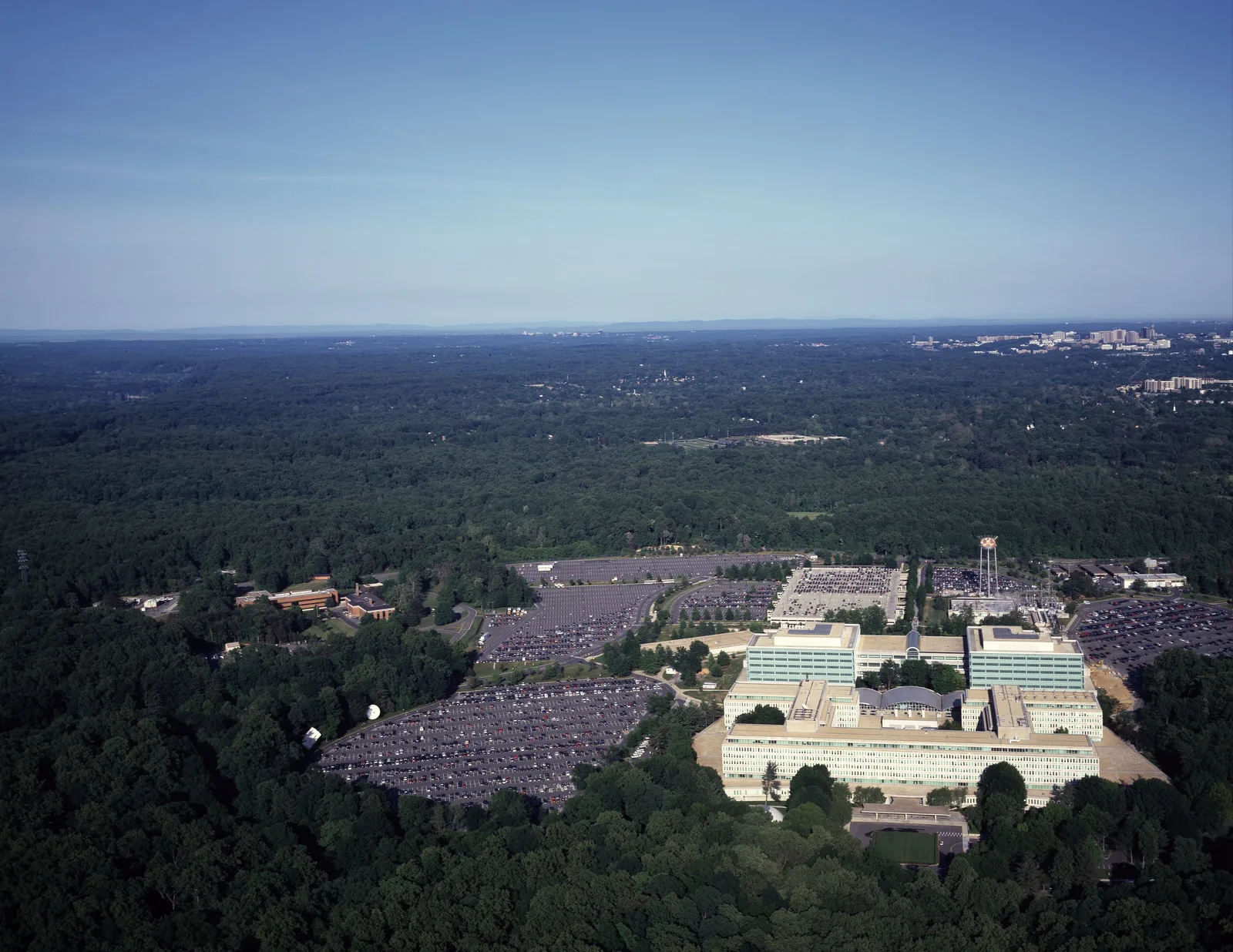
The agency's headquarters, the George Bush Center for Intelligence, is in Langley, Virginia. Its Original Headquarters Building opened in 1961. The CIA Act of 1949 allows it to keep its budget, staff size, and organization secret, so the public does not know exactly how many people it employs or what it spends.
The NSA collects signals intelligence, the communications and electronic signals of foreign governments, militaries, and terrorist groups, and breaks the codes that protect them. Its second mission is cybersecurity: protecting the government's own classified networks and setting the encryption standards for national security systems.
President Harry Truman created the NSA by a classified memorandum on November 4, 1952, out of the earlier Armed Forces Security Agency. Its existence was so closely held that insiders joked the initials stood for "No Such Agency." It sits inside the Department of War (Defense), and since 1972 it has shared leadership with the Central Security Service, which coordinates the military's code breakers.
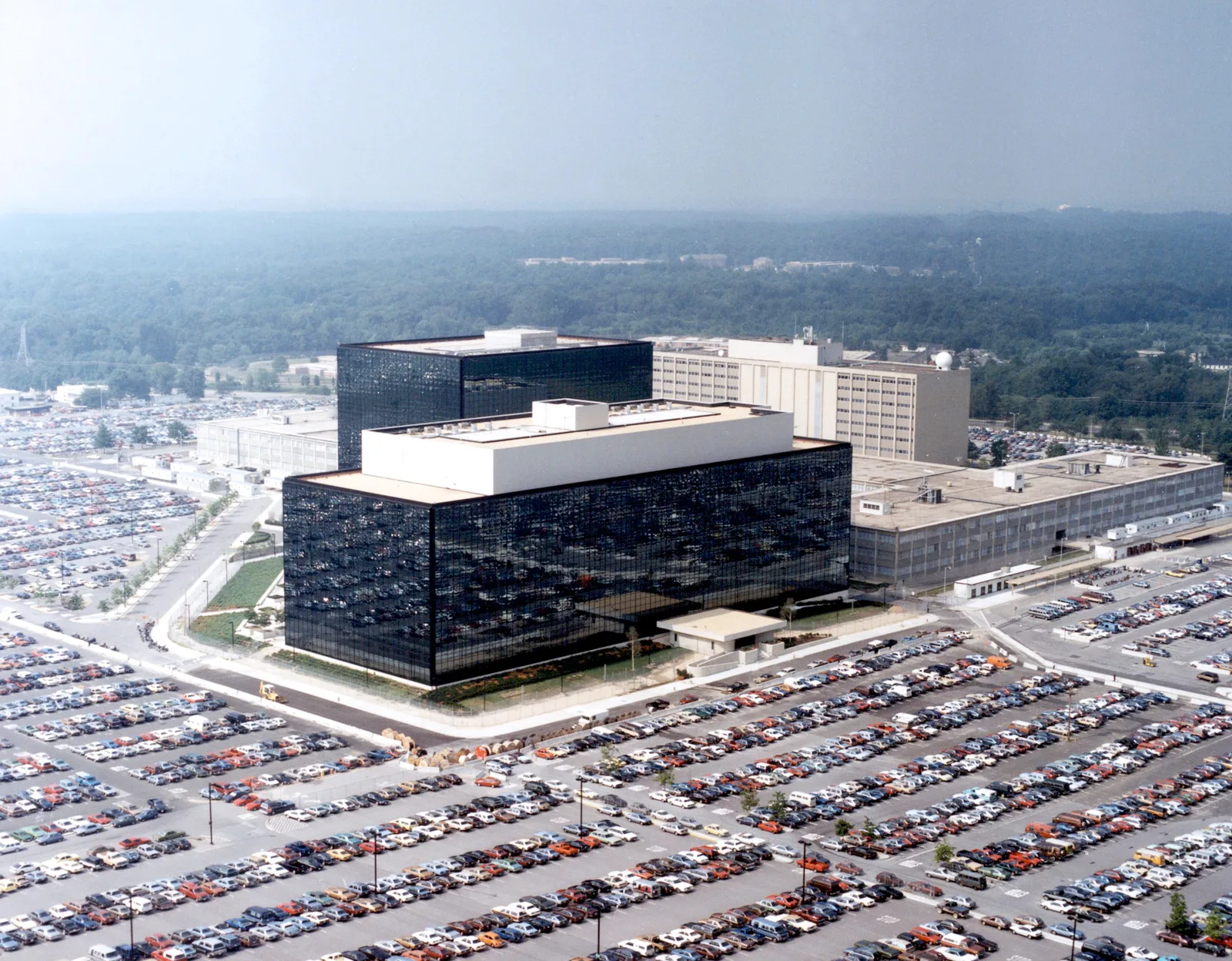
Its headquarters is at Fort George G. Meade in Maryland. Since U.S. Cyber Command was created in 2009 and 2010, one four-star military officer has led both organizations, an arrangement known as the "dual hat." Officials have debated for years whether to split the two jobs.
The NSA is the agency at the center of most modern surveillance debates. Its bulk collection of Americans' phone records, disclosed in 2013, and its collection under Section 702 of the Foreign Intelligence Surveillance Act are covered in the History and Debates tabs of this page.
The FBI is the only member of the Intelligence Community that is also a full law enforcement agency. It is part of the Department of Justice, and it leads the government's work against foreign spies and terrorists inside the United States, while also investigating federal crimes.
It began on July 26, 1908, as a small corps of special agents created by Attorney General Charles Bonaparte, and took the name Federal Bureau of Investigation in 1935. J. Edgar Hoover led it for 48 years, from 1924 until his death in 1972, a tenure that later revealed both the bureau's skill and its abuses.
After Hoover, Congress required Senate confirmation of FBI directors and, in 1976, limited them to a single term of no more than 10 years, as the Cabinet page explains. The term is meant to keep the director from serving one President for too long, but a President can still fire a director at any time.
After the September 11 attacks, the FBI made preventing terrorism its top priority and in 2005 created a National Security Branch to house its counterterrorism, counterintelligence, and intelligence work. Because it can open investigations of Americans, the FBI's intelligence work is governed by Attorney General Guidelines, first issued in 1976 in response to the Church Committee's findings.
Nine of the 18 members sit inside the Department of War (Defense): the NSA, the Defense Intelligence Agency, the National Geospatial-Intelligence Agency, the National Reconnaissance Office, and the intelligence elements of the Army, Navy, Air Force, Marine Corps, and Space Force. Together they serve both national leaders and commanders in the field.
The Defense Intelligence Agency (DIA), created on October 1, 1961, is the military's main source of analysis on foreign armed forces and weapons, and it runs the Defense attaché offices in U.S. embassies. The National Geospatial-Intelligence Agency (NGA) analyzes satellite and aerial imagery and makes the maps and geographic data the military and other agencies use. It began in 1996 as the National Imagery and Mapping Agency and took its current name in 2003.
The National Reconnaissance Office (NRO) builds, launches, and operates the nation's spy satellites. It was founded in 1961, but the government did not admit it existed until September 18, 1992. Its first program, CORONA, photographed the Soviet Union from orbit between 1960 and 1972 and was declassified in 1995.
The service elements are the oldest: the Navy's Office of Naval Intelligence dates to 1882. The newest member, Space Force intelligence, joined in January 2021 as the 18th. The armed forces page covers the services themselves. Spending for military intelligence is reported separately, as the Military Intelligence Program, which was $29.8 billion in fiscal 2024.
Six smaller members sit inside civilian departments besides the FBI. The State Department's Bureau of Intelligence and Research (INR), created in 1946 from the analysis branch of the wartime OSS, is one of the smallest, and it gives diplomats independent analysis. It became known for dissenting in 2002 from the community's judgment that Iraq was rebuilding nuclear weapons, a judgment that turned out to be wrong.
The Treasury Department's Office of Intelligence and Analysis, created in 2004, tracks the money behind terrorist groups, weapons programs, and sanctioned governments, and its work supports the sanctions Treasury imposes. The Drug Enforcement Administration's Office of National Security Intelligence joined the community in 2006 to share what drug investigations learn about foreign threats.
The Energy Department's Office of Intelligence and Counterintelligence draws on the scientists at the national laboratories to assess foreign nuclear weapons programs and energy security, and it protects the labs from foreign spying.
The Department of Homeland Security's Office of Intelligence and Analysis shares threat information with state and local police and private companies, and Coast Guard Intelligence supports the Coast Guard's maritime security and law enforcement missions. Counting these six, the FBI, the nine defense elements, the CIA, and the ODNI gives the community's total of 18.
How American Intelligence Grew
For most of its history the United States had no permanent spy service. Wars, surprise attacks, and scandals built the system piece by piece, and each scandal added a new rule.
Spying is older than the country. During the American Revolution, George Washington ran networks of agents, including the Culper Ring in British-occupied New York, and the Continental Congress created a Committee of Secret Correspondence in 1775 to gather information from abroad.
After each war, those efforts were shut down. The first permanent intelligence office was the Navy's Office of Naval Intelligence, created on March 23, 1882, to study foreign navies at a time when the U.S. fleet was falling behind. The Army followed with its Military Information Division in 1885.
These offices were small and focused on foreign militaries. The United States still had no national intelligence service, no code-breaking agency in peacetime, and no organization responsible for pulling information together for the President.
On July 26, 1908, Attorney General Charles Bonaparte created a force of special agents in the Justice Department, the start of what became the FBI. During and after World War I it took on new domestic security work, and in 1919 and 1920 it helped carry out the Palmer Raids, mass arrests of suspected radicals that were widely criticized for ignoring legal protections.
In 1919 the State and War Departments funded a secret code-breaking office in New York, run by Herbert Yardley and known as the Black Chamber. It broke Japanese diplomatic codes during the 1921 Washington Naval Conference, giving U.S. negotiators an advantage.
Secretary of State Henry Stimson cut off its funding in 1929, and it closed. Code breaking survived in the Army's Signal Intelligence Service and the Navy, which went on to break Japanese codes before and during World War II.
The surprise attack on Pearl Harbor on December 7, 1941, exposed the cost of having no central intelligence service. Warning signs existed, but they were scattered across the Army, the Navy, and the State Department, and no one was responsible for putting them together.
On June 13, 1942, President Franklin Roosevelt created the Office of Strategic Services (OSS), led by William "Wild Bill" Donovan. During World War II it ran spies, sabotage teams, and support for resistance groups behind enemy lines, and its research branch hired scholars to analyze the enemy's economy and politics.
At its peak the OSS employed about 13,000 people. President Harry Truman disbanded it in October 1945, but its people and methods became the foundation of the CIA two years later.
President Truman signed the National Security Act on July 26, 1947. It created the Central Intelligence Agency, the National Security Council to advise the President, and the position of Director of Central Intelligence to coordinate intelligence across the government.
The same law reorganized the military under a single Secretary of Defense and created the Air Force as a separate service. A 1949 amendment named the combined body the Department of Defense, the department this site covers as the Department of War.
The act said the CIA could perform "other functions and duties" related to intelligence as the National Security Council directed. Presidents read that phrase as authority for covert action, and within a few years the CIA was running secret operations abroad, including its role in the 1953 overthrow of Iran's prime minister and a 1954 coup in Guatemala.
On November 4, 1952, President Truman created the National Security Agency by a classified memorandum, combining the military's code-breaking work under one director. For years, the government did not publicly acknowledge it.
The NSA grew into the largest agency in the Intelligence Community in the Cold War, listening to Soviet military communications from ground stations, ships, aircraft, and later satellites.
Its work at home was also secret. Under a program later named SHAMROCK, from 1945 to 1975 the major telegraph companies gave the government copies of international telegrams leaving the United States, a practice the Church Committee later called probably the largest government interception program affecting Americans ever undertaken.
On April 17, 1961, about 1,400 Cuban exiles trained and equipped by the CIA landed at the Bay of Pigs to overthrow Fidel Castro. The invasion failed within three days, and about 1,200 men were captured. President John F. Kennedy publicly took responsibility, and CIA Director Allen Dulles left office that November.
The same year brought new agencies: the Defense Intelligence Agency was created in October 1961 to give the military a single analysis agency, and the National Reconnaissance Office was set up in secret to run spy satellites.
Eighteen months later, intelligence had its best-known success. On October 14, 1962, a U-2 spy plane photographed Soviet nuclear missile sites under construction in Cuba. Those photographs gave Kennedy time to choose a naval quarantine and negotiate before the missiles were ready.
In December 1974, The New York Times reported that the CIA had spied on American antiwar activists, in violation of its charter. In January 1975 the Senate created a special committee chaired by Senator Frank Church of Idaho to investigate the intelligence agencies, and the House created its own, the Pike Committee.
The Church Committee found that the CIA had plotted to kill foreign leaders, including Fidel Castro, that the FBI had run a secret program called COINTELPRO to disrupt American political groups, and that the NSA had read Americans' international telegrams for 30 years. Its final reports were released in 1976.
The investigations reshaped oversight. The Senate created a permanent Select Committee on Intelligence in May 1976, the House followed in July 1977, and in 1976 President Gerald Ford issued an executive order banning political assassination.
President Jimmy Carter signed the Foreign Intelligence Surveillance Act (FISA) on October 25, 1978. For the first time, the government needed a court order to wiretap people inside the United States for foreign intelligence purposes.
FISA created a special court of federal judges, the Foreign Intelligence Surveillance Court, to hear those requests in secret, and a review court to hear appeals. The government has to show probable cause that the target is a foreign power or an agent of one.
FISA covered surveillance inside the country. It left most collection abroad, and collection of foreigners' communications, to executive branch rules, which is why later fights over the NSA turned on how much of the modern internet's traffic passes through the United States.
On December 4, 1981, President Ronald Reagan signed Executive Order 12333, which is still the basic charter of the Intelligence Community. It assigns each agency its job, requires procedures approved by the Attorney General for collecting information about Americans, and bans assassination.
Five years later came the Iran-Contra affair. Members of the National Security Council staff secretly sold arms to Iran, hoping to free American hostages in Lebanon, and sent some of the proceeds to the Contra rebels in Nicaragua, even though Congress had restricted that aid. The scheme became public in November 1986.
Congress responded by tightening the rules for covert action. A 1991 law requires the President to approve every covert action in a written "finding" and to report it to the intelligence committees, and it bars covert action meant to influence U.S. politics, media, or public opinion.
The attacks of September 11, 2001, killed nearly 3,000 people and are often compared with Pearl Harbor as a failure of warning. The CIA had tracked two of the hijackers to a meeting in Malaysia in January 2000 and knew at least one of them held a U.S. visa, but they were not placed on a watch list until August 2001, after both were already in the United States.
Congress passed the USA PATRIOT Act six weeks later, and President George W. Bush signed it on October 26, 2001. It broadened the government's ability to obtain business records, eased information sharing between intelligence and criminal investigators, and expanded National Security Letters. The Privacy and Surveillance page explains how those powers were later used.
Separately, the President secretly authorized the NSA to monitor some international communications of people in the United States without FISA court orders. The New York Times disclosed that program in December 2005, and it was later brought under the court's supervision.
The 9/11 Commission released its final report on July 22, 2004. It found that the agencies had information that, shared and put together, might have revealed the plot, and it called the government's failure a failure of imagination as well as of organization.
Its main recommendation was a single leader for the whole community. The Intelligence Reform and Terrorism Prevention Act, signed on December 17, 2004, created the Director of National Intelligence and the National Counterterrorism Center.
A second inquiry soon added to the pressure. A presidential commission on Iraq's weapons of mass destruction reported in March 2005 that the community's prewar judgments had been "dead wrong" on almost every point, and it recommended changes to how analysts state their confidence and handle weak sources.
The FISA Amendments Act, signed on July 10, 2008, added Section 702. It lets the government collect the communications of foreigners reasonably believed to be outside the United States, with the help of U.S. communications companies, without an individual court order for each target.
Instead, the FISA Court approves the overall rules each year. Because foreigners talk to Americans, the program also collects Americans' messages, and how agencies may search that data for Americans has been the central Fourth Amendment question in every renewal since.
The same law gave telephone companies legal immunity for helping with the earlier warrantless program, which ended the lawsuits filed against them.
In June 2013, documents taken by NSA contractor Edward Snowden revealed that the agency was collecting records of nearly every phone call made in the United States under Section 215 of the PATRIOT Act, and described the PRISM program run under Section 702.
The disclosures set off the largest public debate over surveillance since the 1970s. The Guardian and The Washington Post, which first published the stories, shared the 2014 Pulitzer Prize for Public Service. Snowden was charged under the Espionage Act and has lived in Russia since 2013.
In May 2015 a federal appeals court ruled that the phone-records program went beyond what Section 215 allowed. Weeks later, on June 2, 2015, the USA FREEDOM Act ended the government's bulk collection of phone records and created a panel of outside experts who can argue before the FISA Court.
Congress renewed Section 702 in April 2024 with the Reforming Intelligence and Securing America Act, which extended it for two years and added new limits on FBI searches. It was set to expire in April 2026.
In 2026 the renewal fight ran out of time. Congress passed short extensions in April, but in June the House voted 198 to 218 against another one, and the law lapsed on June 12, 2026, for the first time since 2008. As of October 2026, Congress had not passed a renewal.
Collection did not stop. The FISA Court approved the program's yearly certifications in March 2026, and collection under them can continue until about March 2027. What a lapse does stop is the government's power to issue new directives to companies or approve new certifications until Congress acts.
Who Watches the Watchers
Intelligence agencies work in secret, so the usual checks of a free press and public debate only partly reach them. Congress, a special court, inspectors general, and presidential orders fill the gap.
Congress oversees intelligence mainly through two committees created after the Church Committee: the Senate Select Committee on Intelligence (1976) and the House Permanent Select Committee on Intelligence (1977). Their members hold security clearances and meet in secure rooms where classified material can be discussed.
Each year the committees write an Intelligence Authorization Act, which sets policy and spending levels for the agencies, much of it in a classified annex. They also question officials in closed hearings, review covert actions, and confirm, through the Senate committee, the nominees for top intelligence posts.
For the most sensitive covert actions, the law lets the President limit notice to eight members, known as the Gang of Eight: the leaders of both parties in the House and Senate and the chairs and ranking members of the two intelligence committees. Critics say this leaves most members unable to judge programs they fund.
Committee members generally cannot reveal classified information publicly. The Senate rule that created its committee does allow it to vote to release information over the executive branch's objection, the process the committee used in 2014 to publish the summary of its report on the CIA's detention and interrogation program.
The Foreign Intelligence Surveillance Court has 11 federal district judges, appointed by the Chief Justice of the Supreme Court for staggered seven-year terms. They come from at least seven of the judicial circuits, and three must live within 20 miles of Washington, D.C.
The court hears requests for surveillance orders under FISA, usually with only government lawyers present, because the targets cannot be told. It also reviews and approves the yearly certifications and procedures for Section 702, rather than individual targets.
Because the court rarely heard an opposing side, critics described it as a rubber stamp; the government answered that many applications are changed or withdrawn before a ruling. The USA FREEDOM Act of 2015 created a panel of outside experts, called amici curiae, whom the court must appoint in cases raising novel or significant legal questions, and it required declassification of major opinions where possible.
Appeals go to a three-judge Foreign Intelligence Surveillance Court of Review, and from there the government can ask the Supreme Court to hear the case. Recent FISA Court opinions released to the public have found repeated FBI violations of the rules for searching Section 702 data, which shaped the 2024 reforms.
Federal law defines covert action as activity meant to influence political, economic, or military conditions abroad where the U.S. government's role is not meant to be apparent or acknowledged. Traditional spying, diplomacy, and normal military activity are not covered.
The Hughes-Ryan Amendment of 1974 first required the President to personally approve covert actions and tell Congress about them. After Iran-Contra, a 1991 law required that every covert action be authorized in a written presidential finding, normally before it begins, and reported to the intelligence committees.
A finding cannot authorize anything that breaks the Constitution or federal law, and no covert action may be aimed at influencing U.S. political processes, public opinion, policies, or media. Executive Order 12333 adds a ban on assassination, which has stood since 1976.
Congress cannot veto a covert action directly, but it controls the money. The committees can refuse funding, and Congress has done so before: the Boland Amendments of the 1980s cut off aid to the Contras, which is what made the Iran-Contra scheme illegal.
Each major intelligence agency has an inspector general, an internal watchdog who investigates waste, fraud, and misconduct. The CIA's became an independent office created by law in 1989, and Congress created an Inspector General of the Intelligence Community in 2010 to look across all 18 members.
Intelligence employees cannot legally take classified information to the press. Instead, the Intelligence Community Whistleblower Protection Act of 1998 gives them a lawful route: they can report an "urgent concern" to their inspector general, who passes a credible complaint to the DNI and then to the intelligence committees.
Later laws and a 2012 presidential directive protect intelligence employees from retaliation, such as losing a security clearance, for using these channels. A 2019 complaint filed through this route, about a phone call between President Donald Trump and the president of Ukraine, led to the House's first impeachment of Trump.
Inspectors general publish some findings, and their unclassified reports are a main source of public knowledge about how the agencies follow their rules. Several of their reports, including reviews of FBI surveillance applications, have been cited by both critics and defenders of the agencies.
For 50 years the total intelligence budget was secret, even though the Constitution requires a regular public account of federal spending. The government first released a total, $26.6 billion for fiscal 1997, in response to a lawsuit by the Federation of American Scientists.
Since a 2007 law that put the 9/11 Commission's recommendations into effect, the DNI has had to disclose the total for the National Intelligence Program after each fiscal year. For fiscal 2025 the total was $73.3 billion, down from $76.5 billion in fiscal 2024, according to ODNI.
The Defense Department separately discloses the Military Intelligence Program, which pays for intelligence that supports military operations: $29.8 billion in fiscal 2024. Both toplines pass through the regular federal budget process, but the money is spread across other accounts so that it is not visible line by line.
Everything below the topline, including how much each agency gets, stays classified. Supporters say releasing more would help foreign rivals; critics say it makes it impossible for the public, and most of Congress, to judge whether the money is well spent.
Much of the rulebook for intelligence comes from the President, not Congress. Executive Order 12333 requires each agency to follow procedures approved by the Attorney General before collecting, keeping, or sharing information about Americans, and agencies must report possible violations to oversight offices.
The Privacy and Civil Liberties Oversight Board, an independent agency with five members, reviews counterterrorism programs for their effect on Americans' rights. It was proposed by the 9/11 Commission and became independent in 2007. Its 2014 report found that the NSA's bulk phone-records program had not made a concrete difference in any counterterrorism investigation it reviewed.
In January 2025 the President removed the board's three Democratic members, leaving it without enough members to act, and the removals were challenged in federal court. The dispute is part of a broader fight over how far presidential power extends over independent agencies.
Inside each agency, general counsels and civil liberties officers review programs, and the Justice Department's National Security Division reviews FISA applications. These checks are real but internal, which is why Congress and the courts remain the main outside checks.
Debates and Your Rights
The same tools that find foreign threats can be turned on Americans. These are the documented episodes, and the current arguments, that shape where the lines are drawn.
From 1956 to 1971, the FBI ran COINTELPRO, a set of secret programs to watch and disrupt American groups it considered threats. Its targets ranged from the Communist Party and the Ku Klux Klan to the Black Panthers, antiwar groups, and mainstream civil rights organizations.
The bureau wiretapped Martin Luther King Jr., with approval from Attorney General Robert Kennedy in 1963, and in 1964 mailed him an anonymous letter that he read as urging him to kill himself. The civil rights history page tells more of that story.
The program came to light after activists broke into an FBI field office in Media, Pennsylvania, on March 8, 1971, and mailed stolen files to newspapers. Hoover ended COINTELPRO the next month. At the same time, the CIA's Operation CHAOS, which ran from 1967 to 1974, compiled files on about 7,200 Americans, despite the ban on CIA domestic security work.
The Church Committee concluded that the agencies had targeted Americans for their political beliefs and lawful protest. The FBI's Attorney General Guidelines, first issued in 1976, were written to stop it from happening again, and they still govern when the FBI may open an investigation.
From 1953 to 1973, the CIA ran MKUltra, a program of research into mind control and interrogation that included giving LSD and other drugs to people who did not know they were being drugged. Army scientist Frank Olson died in 1953 after a fall from a New York hotel window, days after CIA officers secretly dosed him.
In 1973 CIA Director Richard Helms ordered most MKUltra records destroyed. About 20,000 surviving documents, found in a financial records center, became public through a Freedom of Information Act request in 1977 and led to Senate hearings that year.
Also in 1973, Director James Schlesinger asked employees to report any past activity that might have broken the CIA's charter. The result was a nearly 700-page compilation known as the "Family Jewels," covering domestic surveillance, wiretaps of journalists, and assassination plots. The CIA released it in 2007, after a FOIA request.
These records matter because they are the documentary basis for the rules that came after. The ban on assassination, the limits on testing on people without consent, and the requirement to report illegal activity to oversight bodies all trace back to what these files revealed.
Intelligence is judged by its failures because its successes are usually secret. The 9/11 Commission found that the agencies did not share or act on warning signs before the attacks, and the Senate Intelligence Committee concluded in 2004 that most of the key judgments in the October 2002 estimate on Iraq's weapons were overstated or not supported by the underlying intelligence.
The Iraq Survey Group, the U.S. team that searched Iraq after the 2003 invasion, reported in 2004 that it found no stockpiles of chemical or biological weapons and no active nuclear program. The failure led to new standards requiring analysts to state their confidence and identify weak sources.
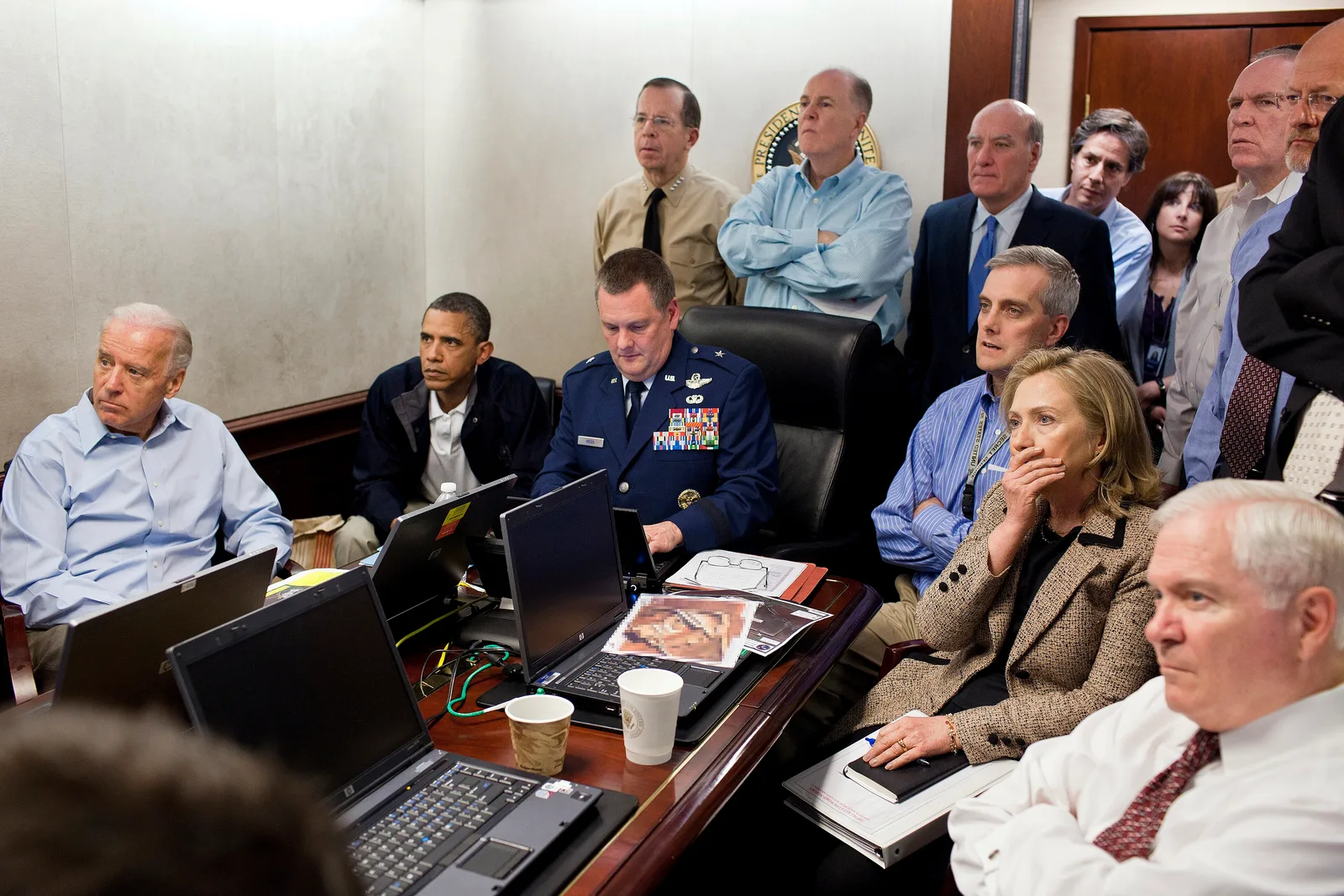
The record also includes documented successes. Aerial photographs revealed Soviet missiles in Cuba in 1962, and a years-long CIA effort traced Osama bin Laden through a courier to a compound in Abbottabad, Pakistan, where U.S. Navy SEALs killed him on May 2, 2011, local time.
Both kinds of outcome feed the same debate: how much secrecy and power agencies need to find real threats, and how much oversight is needed to catch mistakes and abuses before they become disasters.
After the September 11 attacks, the CIA held terrorism suspects in secret overseas prisons, known as black sites, and used "enhanced interrogation techniques," including waterboarding, on some of them. Justice Department legal opinions written in 2002 said these methods were lawful; later administrations withdrew those opinions.
The Senate Intelligence Committee's study of the program found that the CIA held at least 119 detainees and waterboarded three of them. Its 525-page summary, released on December 9, 2014, concluded that the techniques were not an effective way to get accurate information. The CIA disputed several of those findings in its own published response.
President Barack Obama ordered the program closed on January 22, 2009, limiting interrogations to the methods in the Army Field Manual, and a 2015 law, the McCain-Feinstein amendment, wrote that limit into statute. The Geneva Conventions page explains the international rules on the treatment of prisoners.
The debate continues over what the program produced, who should have been held responsible, and how much of the full 6,700-page report should be made public. The full report remains classified.
Section 702 targets foreigners abroad, but it collects Americans' messages whenever they communicate with those targets. Agencies, including the FBI, may then search the collected data using an American's name, email address, or phone number. Critics call these "backdoor searches" because no warrant is required.
The numbers have changed sharply. ODNI's transparency reports estimated the FBI ran up to about 3.4 million searches for Americans' information in 2021, about 200,000 in 2022, and about 57,000 in 2023, after the FBI changed its procedures and Congress and the FISA Court pressed for limits.
In April 2024 a House amendment to require a warrant for most of these searches failed on a tied vote, 212 to 212. Supporters of the program, including officials of both parties, say a warrant requirement would slow urgent investigations and that 702 information appears in a large share of the President's Daily Brief.
Opponents across the political spectrum argue that searching for Americans' private messages should require the same warrant the Fourth Amendment requires everywhere else. One federal district court agreed in a January 2025 criminal case, though the ruling binds only that case. With the law lapsed in June 2026, that question is again before Congress.
Common Questions About U.S. Intelligence
There are 18: two independent agencies (the Office of the Director of National Intelligence and the CIA), nine in the Department of War (Defense), including the NSA, and seven in other departments, including the FBI. Space Force intelligence became the 18th member in January 2021.
The CIA mainly collects intelligence from people abroad and carries out covert action, and it has no law enforcement powers at home. The NSA collects and decodes foreign communications and signals and protects government networks. The FBI is a law enforcement agency that also leads counterintelligence and counterterrorism inside the United States.
The Senate and House intelligence committees oversee them and approve their budgets, the FISA Court must approve surveillance inside the United States, inspectors general investigate misconduct, and presidential orders such as Executive Order 12333 set rules for collecting information about Americans.
The National Intelligence Program received $73.3 billion in fiscal 2025, according to the Office of the Director of National Intelligence. Military intelligence is counted separately and was $29.8 billion in fiscal 2024. Spending by individual agency is classified.
The law expired on June 12, 2026, when Congress did not renew it, and as of October 2026 it had not been renewed. Collection continues under certifications the FISA Court approved in March 2026, which last until about March 2027.
Sources & Further Reading
- ODNI: Members of the Intelligence Community
- ODNI: FY 2025 National Intelligence Program Budget
- Congressional Research Service: Defense Primer, National and Defense Intelligence
- CIA: History of the CIA
- NSA: History
- FBI: A Brief History
- U.S. Senate: The Church Committee
- Office of the Historian: National Security Act of 1947
- The 9/11 Commission Report
- Senate Intelligence Committee: Committee Study of the CIA's Detention and Interrogation Program
- Foreign Intelligence Surveillance Court
- Privacy and Civil Liberties Oversight Board
- National Archives: Executive Order 12333
- Brennan Center: Section 702, 2026 Resource Page
- National Security Archive: The CIA's Family Jewels
Agency descriptions follow the Office of the Director of National Intelligence, the agencies' own histories, and the Congressional Research Service. Historical findings come from the Church Committee and 9/11 Commission reports, the Senate Intelligence Committee's published reports, and the National Archives. Budget figures are the official toplines disclosed under 50 U.S.C. 3306(b). Section 702 status is current as of October 2026.