About Guam
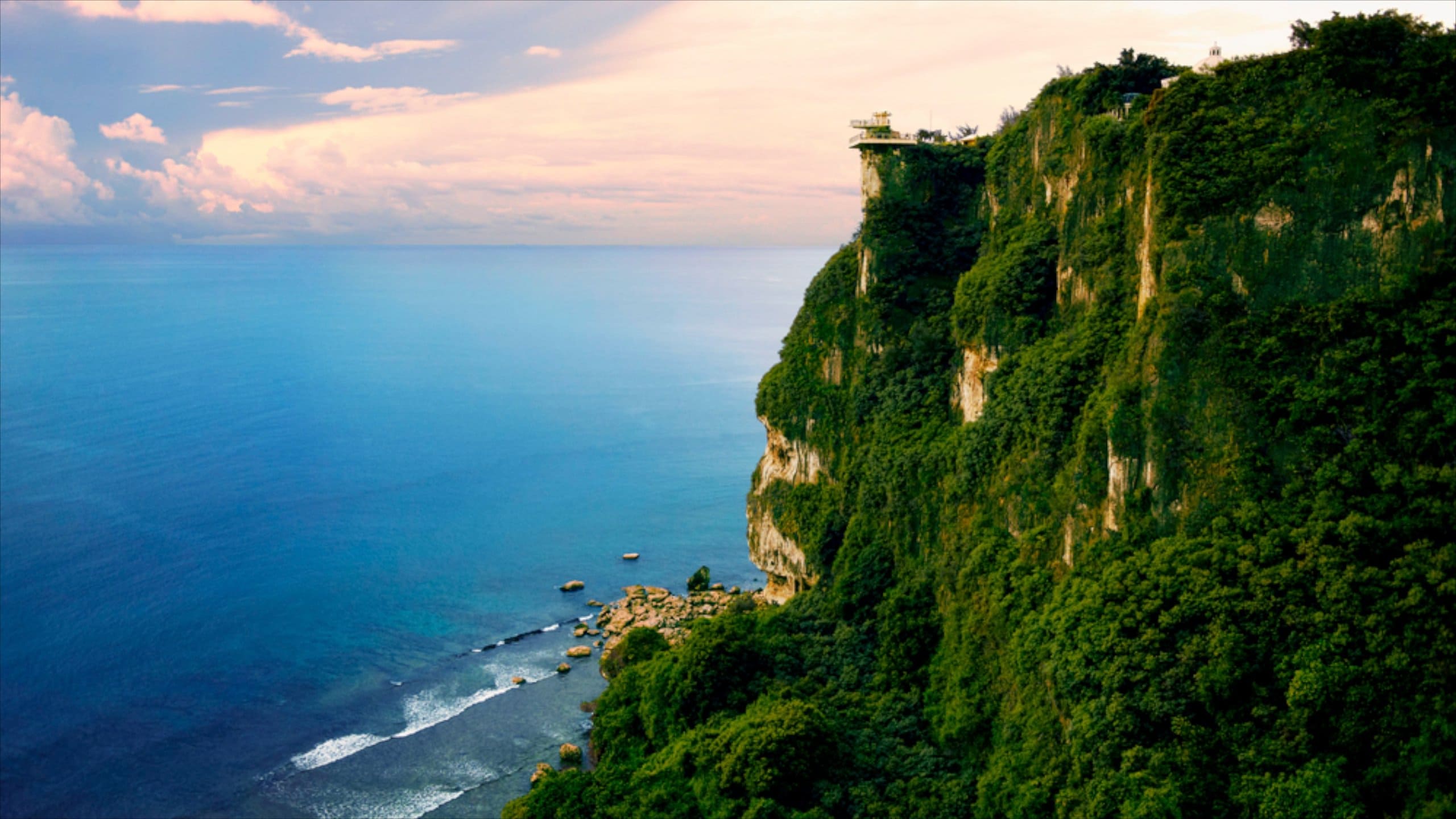
Guam is a 212-square-mile island at the southern end of the Mariana Islands chain in the western Pacific Ocean, approximately 3,800 miles west of Hawaii and 1,500 miles east of the Philippines. It is the largest island in Micronesia and the westernmost point of the United States, so far west that it is tomorrow here when it is still today on the American mainland. The motto "Where America's Day Begins" is geography as identity.
The Chamorro people, Guam's indigenous inhabitants, have lived on the island for approximately 4,000 years. They survived Spanish colonization, which arrived in 1668 and reduced the Chamorro population by as much as 95 percent through warfare and disease. They survived Japanese occupation from 1941 to 1944, a 31-month period of forced labor, internment, and violence that left deep wounds in the island's collective memory. And they have lived under American sovereignty since 1898, as non-citizen nationals until 1950, and as citizens ever since, though citizens without the right to vote for President.
Today Guam is simultaneously a tropical tourist destination drawing visitors primarily from Japan and South Korea, a critical U.S. military hub that occupies 27 percent of the island's land, and a living Chamorro culture working to preserve its language, traditions, and identity after centuries of colonization. The tension between these three identities, Pacific island, American military outpost, and Chamorro homeland, defines everything about Guam's politics, economy, and culture.
Guam's Five Districts
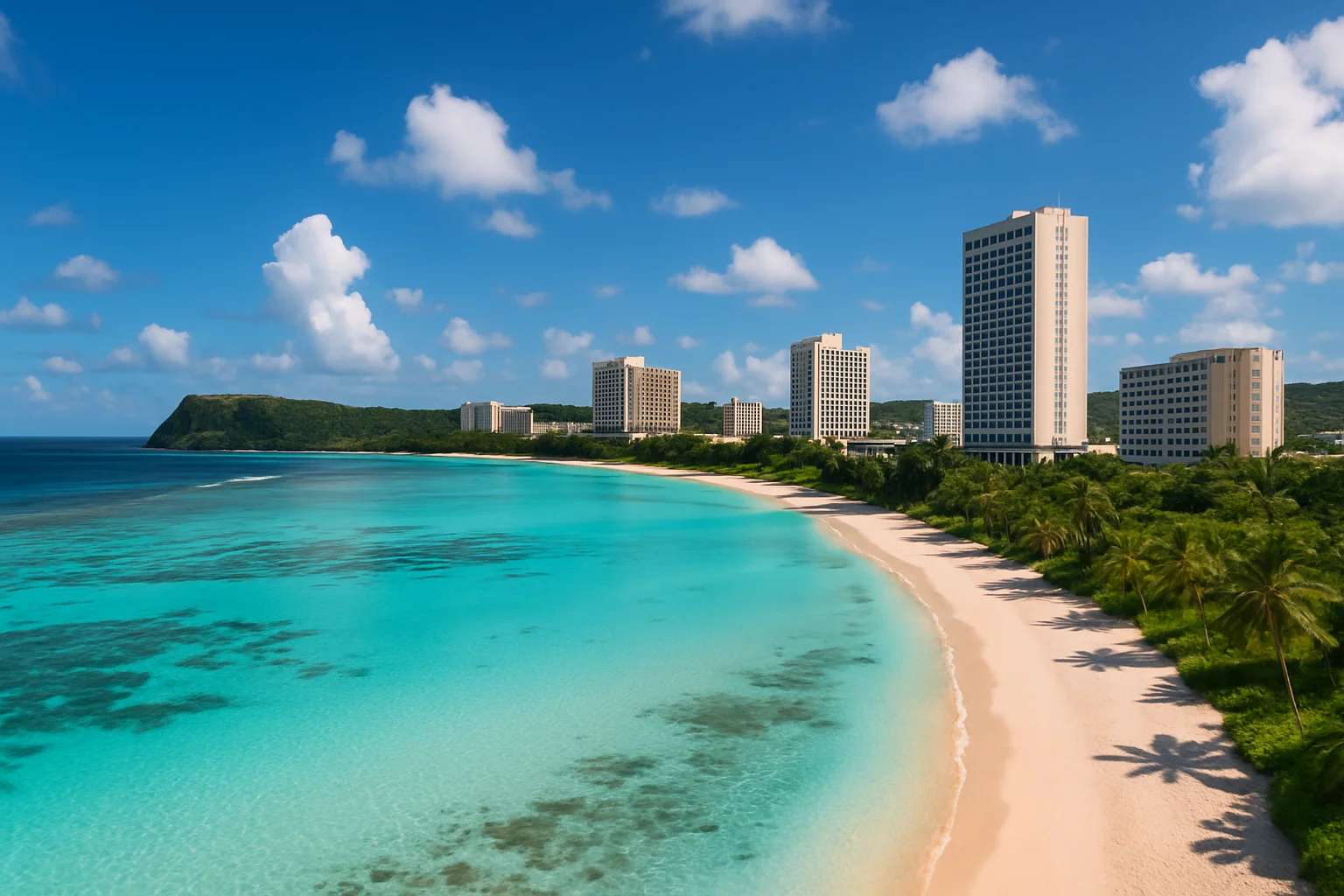
Tumon Bay, on the northwestern coast, is Guam's tourism heart, a crescent of white sand lined with international hotel brands, duty-free malls, restaurants, and the Pleasure Island entertainment strip. This is where the overwhelming majority of Guam's roughly 1.6 million pre-pandemic annual visitors spent their time and money, and it is set apart from the rest of the island.
The bay is a protected marine preserve, one of five created in 1997, where fishing is banned, and it holds beachfront latte-stone sites and old Chamorro burial grounds; 1990s hotel construction repeatedly turned up ancestral remains, forcing redesigns. Its reef was once among the most intact in the western Pacific, but coastal development, sedimentation, and repeated bleaching have degraded it.
Tumon lies in the village of Tamuning, which with neighboring Harmon forms Guam's densest commercial district and the site of Guam Memorial Hospital and the main shopping centers. The strip's economy is tied dollar for dollar to the Japanese and Korean markets, so its restaurants, retail, and wedding-chapel businesses empty out whenever those markets pull back.
The hills above Tumon hold the water tanks that supply the district and the two-lane Marine Corps Drive that carries nearly all of the island's north-south traffic. Two Japanese soldiers were found hiding in those hills in 1960, and Sergeant Shoichi Yokoi held out in the jungle farther south until 1972.
Hagåtña, pronounced ha-GAT-nya and long spelled Agana, is the territorial capital, on a narrow coastal plain on the western side of the island. It is the historic heart of Chamorro civilization and of Spanish colonial rule, though almost nothing of the pre-war city survived the shelling and street fighting of the 1944 recapture.
The reconstructed Plaza de España, the Dulce Nombre de Maria Cathedral-Basilica, the Guam Congress Building, and the Guam Museum anchor the historic core, and Latte Stone Park displays pillars moved there from the Fena Valley. Despite being the capital, Hagåtña has under 1,000 residents, the smallest of Guam's 19 villages; it empties at night.
Before Spanish contact Hagåtña was the largest Chamorro settlement on the island, and it was the seat of the Spanish governor from 1668, of the U.S. Navy governor from 1899, and of the elected civilian government since 1950. The Spanish Bridge and the San Antonio Bridge are among the few colonial structures still standing.
The Paseo de Susana, a peninsula built from wartime rubble bulldozed into the lagoon, holds the island's baseball fields and a small Statue of Liberty replica. Hagåtña floods in heavy rain because it sits below the surrounding limestone plateau, and long-discussed plans to revitalize the quiet downtown have mostly stalled.
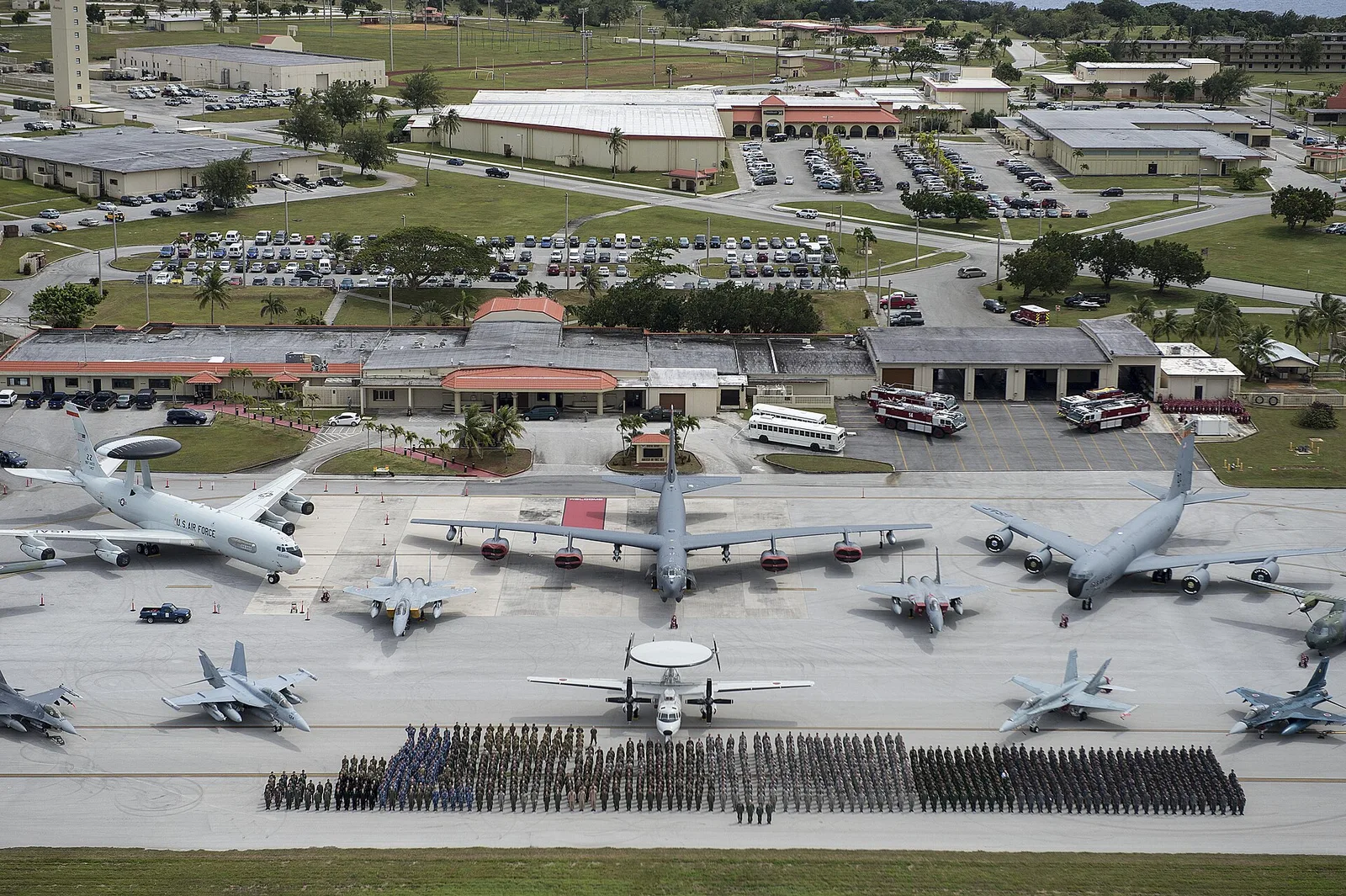
The northern plateau of Guam is a raised limestone shelf dominated by Andersen Air Force Base, the largest Air Force installation in the Pacific, from which B-52s flew Vietnam-era Arc Light missions and where nuclear-capable bombers still rotate. The northern villages of Dededo and Yigo are Guam's most populous, and Dededo is now the site of Marine Corps Base Camp Blaz.
The University of Guam and Guam Community College are in Mangilao on the plateau's eastern edge, and the limestone forests there hold the last remnant native birds and the endangered Mariana fruit bat, nearly wiped out by the invasive brown tree snake.
Because the plateau is porous limestone, all of northern Guam's drinking water is drawn from the Northern Guam Lens Aquifer beneath it, and protecting that aquifer from contamination, including PFAS 'forever chemicals' from firefighting foam at Andersen, is a central environmental fight.
The plateau's northern tip at Litekyan (Ritidian) holds one of Guam's richest concentrations of ancient Chamorro sites, including caves with painted pictographs, inside a national wildlife refuge on former Navy land; a planned Marine Corps live-fire range next to it drew years of protest and lawsuits before a compromise design was adopted.
Apra Harbor, a deep, sheltered natural port on the western coast, is the geographic and strategic anchor of U.S. Navy operations in the western Pacific. Naval Base Guam wraps around the harbor, which handles fast-attack submarines homeported there as well as the commercial cargo that is Guam's supply lifeline.
The Port Authority of Guam's commercial terminal at the head of the harbor moves nearly everything the island consumes, since 80 to 90 percent of goods are imported, so a bottleneck or a typhoon there is felt in every store within days.
The harbor is layered with wrecks: the SMS Cormoran, a German raider scuttled by its own crew in 1917 when the U.S. entered World War I, and the Tokai Maru, a Japanese freighter sunk in 1943, lie touching each other on the bottom, a famous dive where a diver can put a hand on ships from two world wars at once.
Above the harbor, the War in the Pacific National Historical Park preserves Asan and Agat beaches and the ridgelines where U.S. Marines and Army troops came ashore on July 21, 1944. Piti and Santa Rita, the villages around the base, were rebuilt after the war on land the Navy had condemned, a source of lasting land-claim grievances.
The southern half of Guam is volcanic rather than limestone, a landscape of red-earth hills, rivers, and waterfalls, and it is the most traditionally Chamorro part of the island, less developed and more rural, with village and family networks that still organize daily life.
The Cetti Bay overlook, Talofofo Falls, Sella Bay, and the beaches at Inarajan and Merizo are the south's most visited natural sites, and communal food preparation and cultural performance are most alive in the southern villages.
The southern peaks, including Mount Lamlam at 1,332 feet, are sometimes called the tallest mountain on Earth when measured from the floor of the nearby Mariana Trench, the deepest point in any ocean at about 36,000 feet and roughly 200 miles to the southwest. Umatac Bay is where Magellan is generally said to have landed in 1521, an event reenacted there each March.
The south holds Inarajan's protected district of pre-war Spanish-style houses and the Merizo bell tower and convento. It also bears deep war scars: at Tinta and Faha near Merizo, Japanese forces massacred groups of Chamorro men in July 1944, days before liberation, and the sites are marked with memorials.
How Guam Makes Its Living
Guam's economy rests on two pillars that are both essential and beyond local control: tourism driven almost entirely by Asian visitors, and the U.S. military whose presence injects billions into the island while consuming more than a quarter of its land.
Tourism is by far the dominant force in Guam's economy, accounting for roughly 50 to 60 percent of GDP in non-pandemic years and employing much of the private sector workforce. Before COVID-19, Guam received about 1.6 million visitors a year, of whom roughly 75 percent came from Japan and South Korea.
The Tumon Bay resort corridor on the northwestern coast is the heart of that economy, a strip of international hotel brands, duty-free malls, restaurants, and beach activities that is physically and culturally set apart from the rest of the island. The pandemic collapse of 2020 and 2021 was catastrophic, with arrivals falling about 95 percent, and the recovery has lagged the U.S. mainland.
Dependence on just two national markets makes the industry fragile. A 2013 knife attack on tourists in Tumon, the 2017 North Korea missile threat, and Japan's weak yen and slow post-COVID outbound travel each produced sharp booking drops, and the Guam Visitors Bureau has spent years trying to diversify toward South Korea, Taiwan, the Philippines, and the U.S. mainland.
Guam's status shapes the trade: as U.S. soil outside the main customs territory it offers duty-free shopping, and its airport is a hub for United Airlines, which inherited Continental Micronesia's network and still flies the 'Island Hopper' through the Federated States of Micronesia. A territorial hotel occupancy tax ties the government's budget directly to visitor numbers.
The U.S. military occupies roughly 27 percent of Guam's land area, one of the highest shares of any U.S. jurisdiction. Andersen Air Force Base in the north, Naval Base Guam on Apra Harbor (the only deep-water port between Hawaii and the Philippines), and supporting sites make the island the most strategically important U.S. position in the western Pacific.
A long-planned realignment is bringing about 5,000 Marines from Okinawa to Marine Corps Base Camp Blaz in Dededo, the first new Marine Corps base since 1952 and the largest construction project in Guam's history. Guam has been named directly in North Korean missile threats and is defended by an Army THAAD missile-defense battery at Andersen.
The buildup has been contested for decades. A 2010 plan to move about 8,000 Marines and 9,000 dependents at once drew a rare 'environmentally unsatisfactory' rating from the EPA over strain on water, sewers, roads, and the reef, forcing the numbers down and moving a firing range away from the ancient village site at Litekyan. Japan agreed to help fund the move.
Military spending runs roughly 15 to 20 percent of Guam's economy in a normal year and spikes during construction booms, with contracts flowing to local firms and thousands of imported guest workers, mostly Filipino, doing much of the building. In the mid-2020s the Pentagon began fielding the layered Guam Defense System, a multibillion-dollar missile shield aimed at Chinese cruise and hypersonic weapons.
Outside the tourism corridor and the bases, Guam has a small but culturally central farming and fishing sector, where traditional Chamorro practices persist alongside commercial operations. The island imports roughly 80 to 90 percent of its food, a dependency that leaves it acutely exposed to shipping disruptions, as pandemic shortages and typhoon seasons have shown.
Commercial farming is limited by thin soils, frequent typhoons, and land locked up by the military and by development; a few hundred small farms grow bananas, taro, eggplant, long beans, and hot peppers, and the University of Guam's land-grant extension service works on typhoon-resistant crops and biosecurity against the brown tree snake and invasive beetles.
Guam is a transshipment point for the Western Pacific tuna fishery, with foreign longliners offloading at Apra Harbor for air freight to Japan. The Saturday Chamorro Village night market in Hagåtña is the most visible expression of local food culture, with stalls selling kelaguen, red rice, barbecue, and coconut candy.
Fishing is also a legal flashpoint. The 2009 creation of the Marianas Trench Marine National Monument closed large offshore areas, and Chamorro and Carolinian fishers have pressed for guaranteed access to customary grounds. Reef fisheries have declined from overfishing, runoff, and crown-of-thorns starfish outbreaks, prompting periodic limits on nighttime spearfishing and the sale of certain reef fish.
The Government of Guam (GovGuam) is one of the island's largest employers, covering executive agencies, the Guam Department of Education, the University of Guam, Guam Memorial Hospital, and the Guam Power Authority. Because Guam is an unincorporated territory, it receives Medicaid, SNAP, and other benefits at capped rates rather than the open-ended matching formulas states get, so it consistently gets far less federal support per capita than a comparable state.
Guam runs a 'mirror' income tax: under the 1950 Organic Act, residents pay the federal tax code to the territory rather than to Washington, and GovGuam keeps the revenue. That makes the local budget swing with federal tax law and left Guam arguing for years that Washington should reimburse the Earned Income Tax Credit it is forced to pay.
The government has a long record of fiscal stress, cash-flow borrowing, and delayed tax refunds; the class action Paeste v. Government of Guam forced it onto a fixed refund schedule. The Medicaid funding cap has repeatedly pushed Guam Memorial Hospital toward insolvency, and imported diesel gives the island some of the highest electricity rates under the U.S. flag.
Federal agencies also employ thousands directly, through the military commands, the National Weather Service typhoon-warning center, and the courts. The District Court of Guam is an Article IV territorial court whose judges serve ten-year terms rather than for life, and Guam's single non-voting delegate can vote in House committees but not on the House floor.
What Does "Unincorporated Territory" Mean?
Guam is an unincorporated organized territory of the United States. "Unincorporated" means that not all provisions of the U.S. Constitution automatically apply to Guam, only those the Supreme Court has determined are "fundamental rights." This distinction traces to the controversial Insular Cases, a series of Supreme Court decisions from 1901 to 1922 that created a legal framework for governing territories whose populations Congress was not prepared to incorporate into the United States.
"Organized" means that Congress has passed an Organic Act for Guam, the Guam Organic Act of 1950, establishing a civilian government and granting U.S. citizenship to Guam's residents. This distinguishes Guam from unincorporated unorganized territories, which have no Organic Act and minimal civilian governance.
The practical consequences are significant: Guam residents are U.S. citizens who can move freely to the mainland, serve in the military, and receive some federal benefits, but cannot vote for President while residing in Guam, are represented in Congress only by a non-voting delegate, and are subject to federal laws passed by a Congress in which they have no voting voice.
Rights: Territory Residents vs. State Residents
| Right or Benefit | Guam Residents | State Residents |
|---|---|---|
| U.S. Citizenship | ✅ Yes (since 1950) | ✅ Yes |
| Vote for President | ❌ No | ✅ Yes |
| Voting Rep. in Congress | ❌ Non-voting delegate only | ✅ Yes |
| U.S. Senate representation | ❌ None | ✅ 2 senators |
| Serve in U.S. military | ✅ Yes | ✅ Yes |
| Medicaid / SNAP benefits | ⚠️ Capped (not full match) | ✅ Full federal match |
| Social Security / Medicare | ✅ Yes | ✅ Yes |
| Federal income tax | ❌ Pay Guam income tax instead | ✅ Pay federal income tax |
| Move freely to mainland | ✅ Yes | ✅ Yes |
| Electoral votes | ❌ None | ✅ Based on population |
How Guam's Government Works
Guam's government mirrors the three-branch structure of the United States, executive, legislative, and judicial, but operates under a fundamental constraint that no state government faces: the U.S. Congress has plenary (absolute) authority over all U.S. territories and can override, amend, or nullify any territorial law at any time. Guam governs itself in practice, but always subject to that ultimate federal power.
The Governor is directly elected by Guam voters to a four-year term and may serve a maximum of two consecutive terms. The Governor administers GovGuam, which encompasses all territorial executive agencies, public schools, the University of Guam, Guam Memorial Hospital, and Guam Power Authority. Unlike a U.S. state governor, the Guam Governor has no influence over federal military operations on the island, which operate under entirely separate federal authority.
The Guam Legislature is unicameral, a single chamber of 15 senators. The Guam Supreme Court is the territory's highest local court; since 2004 its decisions have been reviewed directly by the U.S. Supreme Court, as a state high court's would be.
Governor of Guam
Current Governor
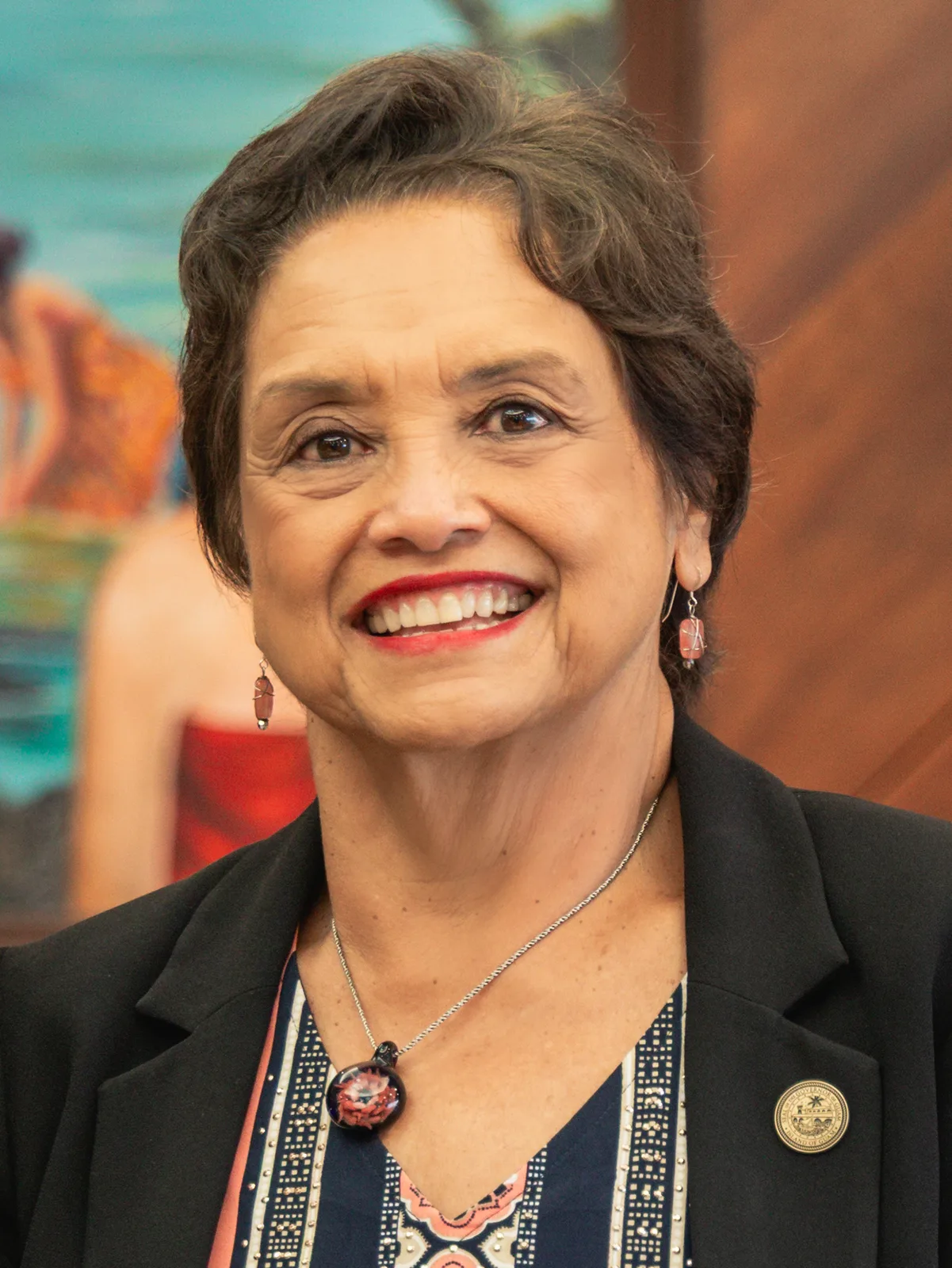
Lou Leon Guerrero
- Party
- Democrat
- In Office Since
- January 7, 2019
- Re-elected
- November 8, 2022
- Term Ends
- January 2027
- Born
- November 8, 1950, Guam
- Education
- California State University, Los Angeles (BS, nursing); UCLA (MPH)
- Prior Role
- Guam Legislature Senator (1995-1999, 2001-2007)
Lou Leon Guerrero is Guam's first female governor, a former nurse and longtime Guam legislator who won election in 2018 and was re-elected in 2022. She has focused on economic recovery from COVID-19's devastating impact on tourism, managing the pressures of the ongoing military buildup, and advancing Chamorro cultural preservation and self-determination.
Other Current Territorial Officials
Lieutenant Governor
Josh Tenorio
In office since January 2019, re-elected 2022 on the Leon Guerrero ticket. A former attorney and Guam Legislature senator, Tenorio focuses on economic development, tourism recovery, and environmental policy. The Lieutenant Governor runs jointly with the Governor on a single ticket.
Attorney General
Douglas Moylan
In office since January 2023. Guam's Attorney General is independently elected to a four-year term, not appointed by the Governor, making it one of the few territorial offices that can be held by a different party than the governor. Moylan has focused on public corruption prosecution and consumer protection.
Speaker of the Guam Legislature
Frank F. Blas Jr.
Speaker since January 2025, after Republicans won a majority in the 38th Guam Legislature. Blas has served in the Legislature from 2007 to 2012, from 2015 to 2017, and since 2021; he succeeded Democrat Therese Terlaje (Speaker 2023 to 2025). The Speaker is elected by the 15-member legislature.
The Guam Legislature
Guam Legislature (Unicameral)
- Seats: 15 senators
- Terms: 2-year terms
- Elections: All 15 seats on the ballot every two years
- Elected: At-large (territory-wide, not by district)
Unlike the 49 U.S. states with bicameral (two-chamber) legislatures, Guam's legislature is unicameral, one chamber handles all legislative functions. Senators are elected territory-wide, meaning every voter in Guam votes for all 15 seats.
Guam's Non-Voting Delegate to Congress
U.S. House Delegate (Non-Voting)
James Moylan
Elected in 2022, Moylan is the first Republican to represent Guam in Congress since 1993. He can introduce legislation, serve on committees, and vote in committee proceedings, but cannot vote on final passage of any bill on the House floor. Guam has zero representation in the U.S. Senate.
What the Delegate cannot do: Vote on final passage of legislation or participate in any vote that determines the law of the land for Guam's 153,000 American citizens.
The Guam Court System
Guam has its own three-tier court system for local matters. The Superior Court of Guam is the trial court. The Supreme Court of Guam (three justices) is the territory's highest local court. For federal matters, the U.S. District Court for the District of Guam is the federal trial court, and its appeals go to the U.S. Court of Appeals for the 9th Circuit. Since 2004, decisions of the Supreme Court of Guam go directly to the U.S. Supreme Court.
📋 Current Officials
For the most current list of Guam government officials, visit governor.guam.gov.
Guam Through the Years
Four thousand years of Chamorro civilization, three colonial powers, one of the Pacific War's most brutal occupations, and an unresolved question of self-determination that stretches into the present.
The Chamorro people, Guam's indigenous inhabitants, reached the Mariana Islands roughly 3,500 to 4,000 years ago, most likely from island Southeast Asia, in one of the longest open-ocean crossings any people had made to that point. Ancient Chamorro society was matrilineal and clan-based, with a hereditary caste system dividing the high-ranking chamorri from the lower manachang.
Its most visible legacy is the latte stone: paired rows of quarried pillars topped with hemispherical capstones called tasa, which raised the floors of high-status houses and canoe sheds. The Chamorros were expert navigators and canoe builders, farmed taro, breadfruit, rice, and coconut, and had a dense, thriving population when Europeans arrived.
The name 'Chamorro' derives from chamorri, the ruling class, and the people increasingly call themselves CHamoru; their language is a Western Austronesian tongue heavily overlaid with Spanish. Spanish accounts describe fleets of fast outrigger sailing canoes, the sakman, that could outrun European ships.
The largest surviving latte site, near the As Nieves quarry in the Fena Valley, includes unfinished pillars up to about 16 feet tall inside what is now a Navy ammunition reserve. Archaeologists split the pre-contact era into a Pre-Latte period before roughly 900 CE and a Latte period after it, when the stone pillars, new pottery styles, and larger villages appear.
Ferdinand Magellan, commanding the first voyage to circle the globe, anchored off Guam on March 6, 1521, the first European known to reach the Mariana Islands. His three surviving ships had crossed the Pacific in about three months with the crews starving and sick with scurvy.
The contact turned violent almost at once: Chamorros, who had no European concept of private property, took goods and a skiff from the fleet, and Magellan sent a party that burned houses and canoes and killed several islanders to recover it. He named the archipelago Islas de los Ladrones, the 'Islands of Thieves,' a slur that stuck on European maps for centuries, then sailed on to the Philippines and was killed there weeks later at Mactan.
Spain claimed the islands but did nothing with them for 147 years; they became a way station where the annual Manila galleon, sailing between Acapulco and Manila from 1565, could take on water and fresh food, trading iron, which the Chamorros prized, for provisions.
In 1668 the Jesuit missionary Diego Luis de San Vitores renamed the archipelago Las Marianas after Mariana of Austria, the queen regent of Spain who funded the mission. Guam still reenacts the Magellan landing during its Discovery Day observances, though some Chamorro activists mark the date instead as the start of colonization.
Permanent Spanish colonization began in 1668, when San Vitores founded a mission at Hagåtña under royal patronage. Chamorro resistance to forced conversion, the killing of San Vitores in 1672, and Spanish reprisals grew into the Spanish-Chamorro Wars, fought intermittently from 1671 to 1698.
Warfare and, above all, introduced disease collapsed the Chamorro population from an estimated 50,000 or more to around 5,000 by 1700, one of the steepest demographic falls recorded anywhere in the Pacific. Survivors were forced off the northern islands and concentrated in a handful of mission villages on Guam under a policy called reducción.
Spanish rule reshaped Chamorro life permanently: Catholicism became central to identity, Spanish surnames are near-universal, and hundreds of Spanish loanwords entered the language, while the seafaring sakman canoe tradition was suppressed and eventually lost. Filipino and Mexican soldiers and settlers brought by Spain mixed into the population.
Because so many died and the remnant was resettled, no full-blooded pre-contact community survived, and modern Chamorro identity fuses indigenous, Spanish, Filipino, and Mexican strands. The northern Mariana Islands stayed largely empty until the 1800s, when Spain allowed Carolinian islanders to settle there, part of why Guam and the CNMI later took separate political paths.
The Spanish-American War transferred Guam to the United States almost by accident. On June 20, 1898, the cruiser USS Charleston shelled the old Spanish forts at the mouth of Apra Harbor; the Spanish garrison, which had no ammunition and did not know a war was on, rowed out to apologize for being unable to return what it assumed was a ceremonial salute.
Spain ceded Guam in the Treaty of Paris of December 10, 1898, along with Puerto Rico and the Philippines. The Chamorro people had no part in the transaction. Washington placed the island under U.S. Navy administration, and the naval governor ruled by decree, with no legislature, no general-jurisdiction courts, and no citizenship for the inhabitants.
Spain sold the rest of the Marianas, the Carolines, and the Marshalls to Germany in 1899, splitting the archipelago; the northern islands passed to Japan after World War I and to U.S. control after World War II, which is why Guam and the Northern Marianas have separate governments today.
Naval rule lasted, apart from the war years, until 1950. Governors banned interracial marriage without permission, censored the mail, and required passes to leave the island, and in 1901 they rejected a petition from Chamorro leaders for a permanent civil government and a bill of rights. A 1936 delegation to Washington seeking citizenship also failed.
On December 8, 1941, hours after Pearl Harbor and across the date line, Japanese aircraft bombed Guam, and troops landed on December 10; the small U.S. Navy garrison surrendered within two days. Japan renamed the island Omiya Jima, 'Great Shrine Island.'
The 31-month occupation brought forced labor on airfields and fortifications, requisition of food and land, beatings, and executions; more than 1,000 Chamorros are estimated to have died, and in the final weeks the entire civilian population was marched into inland concentration camps at Manenggon and elsewhere. U.S. forces retook Guam between July 21 and August 10, 1944, at a cost of about 1,800 American and more than 18,000 Japanese dead.
Chamorros served as guides, laborers, and stretcher-bearers for the returning U.S. forces, and their loyalty during the occupation, at great personal risk, became the central argument for granting citizenship afterward. July 21 is Liberation Day, Guam's largest civic holiday, marked with a parade, a carnival, and memorial services at the massacre sites.
In 2016 Congress finally passed the Guam World War II Loyalty Recognition Act, providing compensation payments to Chamorro survivors of the occupation and to families of those killed, decades after similar programs for other groups. The last Japanese holdout, Sergeant Shoichi Yokoi, was not found until January 1972.
The Guam Organic Act of 1950, signed by President Truman on August 1, granted U.S. citizenship to the people of Guam, 52 years after the island became American soil. It created a civilian government with an elected legislature, a governor, and a federal district court, and moved administration from the Navy to the Department of the Interior.
The delay was deliberate. The Navy had fought citizenship for half a century, and the act passed only after a Chamorro 'walkout' from the powerless Navy-era assembly in 1949, sustained lobbying in Washington, and the Cold War judgment that a disenfranchised Pacific colony was a strategic and propaganda liability.
Citizenship under the Organic Act is statutory, granted by Congress rather than by the Fourteenth Amendment, and it left the core disabilities in place: Guam residents still cannot vote for president, have only a non-voting delegate in Congress, and are bound by laws they have no vote in passing. The act also set up Guam's 'mirror' tax system.
Amendments in 1968 let Guam elect its own governor, first exercised in 1970, and in 1972 gave Guam a delegate to the U.S. House. Guam has drafted its own constitution twice, but voters rejected the 1979 draft, and the Organic Act still serves as the territory's basic charter.
The post-war decades brought elected governors from 1970, a delegate to Congress from 1972, and a series of political-status votes, beginning in 1982, in which a commonwealth arrangement drew the most support (with statehood second), with no federal action following.
They also brought the brown tree snake, a nocturnal predator carried in on military cargo around 1950, which has driven 9 or 10 of Guam's 12 native forest-bird species to extinction in the wild; the ko'ko', or Guam rail, survives only through a captive-breeding program that has begun returning birds to snake-free Rota and Cocos Island.
Guam created a Commission on Decolonization and tried to hold a non-binding political-status vote limited to 'native inhabitants' of Guam and their descendants. A retired Air Force officer sued, and the Ninth Circuit ruled in 2019 (Davis v. Guam) that restricting the electorate by ancestry violated the Fifteenth Amendment, blocking the vote.
The current military buildup, formalized in a 2006 U.S.-Japan agreement, has poured billions into new bases and a Guam missile-defense system while intensifying disputes over water, sewers, traffic, reef, and access to ancient sites at Litekyan. Guam's roughly 153,000 residents remain caught between dependence on federal spending and a century-old demand for a real say in their status.
Guam's Defining Moments in American History
These are the events that didn't just shape Guam. They defined America's relationship with its Pacific territories.
Sergeant Shoichi Yokoi of the Imperial Japanese Army hid in the jungles of southern Guam for nearly 28 years after World War II ended, not surrendering until January 24, 1972, when two Chamorro men checking shrimp traps found him along the Talofofo River. He had lived in a camouflaged underground cave he dug himself, eating frogs, eels, rats, and snails and weaving clothing from the bark of the pago tree.
Yokoi had known since about 1952, from leaflets, that the war was over, but he believed surrender would disgrace him and his family; two comrades who had shared his hideout died in a flood around 1964. On returning to Japan he said, 'It is with much embarrassment that I have returned alive,' a phrase that became a national catchphrase.
He was one of the last Japanese holdouts: Lieutenant Hiroo Onoda came out of the Philippine jungle in 1974, and Private Teruo Nakamura, a Taiwanese conscript, was found on an Indonesian island later that year. Yokoi became a minor celebrity in Japan, married, ran unsuccessfully for parliament, and advocated austere living until his death in 1997.
His cave is preserved as a tourist site near Talofofo Falls, and a replica stands in the Guam Museum. For Chamorros, the Yokoi story is a reminder that the war's violence, including the massacres at Tinta, Faha, and Fena and the Manenggon death march, is within living memory.
The American recapture of Guam between July 21 and August 10, 1944, is the defining event of modern Chamorro history and is commemorated every year as Liberation Day. The 31-month Japanese occupation had meant forced labor, beatings, executions, and, in its final weeks, the forced march of the entire Chamorro population into inland camps.
The invasion put roughly 55,000 U.S. troops ashore on the beaches at Asan and Agat under heavy fire; about 1,800 Americans and more than 18,000 Japanese were killed in three weeks, and the last organized Japanese resistance ended in early August. Chamorro civilians emerged from the camps and, in many accounts, ran through the fighting toward American lines.
The suffering under Japan and the rescue by U.S. forces forged a bond with the American military that still shapes Guam's politics: the island has among the highest per-capita military enlistment and casualty rates of any U.S. jurisdiction, and it broadly supports the military presence even as it resents the loss of land and the lack of a vote.
Liberation Day is Guam's largest holiday, with a mile-long parade through Hagåtña, a weeks-long carnival, and memorial services at the massacre sites. Survivors of the occupation and the descendants of those killed only began receiving federal compensation after the 2016 Guam World War II Loyalty Recognition Act.
From 1898 to 1950, the people of Guam were U.S. nationals but not citizens, a status that left them without the constitutional protections of citizenship and without any vote in the government that ruled them. The Navy administered the island as a possession, with the naval governor holding legislative, executive, and judicial power.
Naval rule was strict: general orders censored the mail, restricted books, required Chamorros to get permission to leave the island, and in the 1920s made English the only language of instruction and briefly ordered Chamorro dictionaries destroyed. Petitions for citizenship and civil government in 1901, 1917, 1925, and 1936 were all rejected in Washington.
The turning point was the 1949 walkout of the Guam Congress, an advisory body with no real power, whose members left in protest after the Navy governor overruled them; the resignation drew national press and helped push the Organic Act through Congress the next year, aided by the Truman administration's view that a colonial Guam undercut U.S. Cold War arguments against imperialism.
The citizenship granted in 1950 is statutory, not constitutional, and remains incomplete: Guam residents still cannot vote for president, and their delegate cannot vote on the House floor. The Supreme Court's Insular Cases, decided from 1901 and never overruled, are the legal basis for treating Guam and the other territories as belonging to but not part of the United States.
In August 2017, North Korea announced a detailed plan to fire four intermediate-range ballistic missiles over Japan and into the sea about 20 to 25 miles off Guam, framing it as a warning over U.S. bomber flights from Andersen Air Force Base and President Trump's 'fire and fury' remark.
The threat put Guam's roughly 160,000 people, who cannot vote for the president setting U.S. policy toward North Korea, at the center of an international crisis. The Guam Homeland Security office issued a two-page preparedness fact sheet advising residents what to do in a nuclear flash, drawing comparisons to Cold War duck-and-cover leaflets.
Guam had been a nuclear-era target before: it was a Strategic Air Command bomber base during the Cold War, B-52s flew Arc Light bombing runs over Vietnam from Andersen from 1965 to 1973, and nuclear-capable bombers have rotated through ever since. The Army's THAAD battery, sent to Andersen in 2013 against exactly this threat, was placed on heightened alert.
North Korea did not carry out the launch, and tensions eased into the 2018 Singapore summit, but the episode accelerated the push for a dedicated Guam missile-defense system. In the mid-2020s the Missile Defense Agency began fielding the layered Guam Defense System, a multibillion-dollar network of radars and interceptors ringing the island.
Since 1982, Guam has held or planned several political-status votes in which commonwealth status drew the most support in 1982, with statehood second, and voters have consistently preferred a closer negotiated relationship over the unincorporated-territory status quo. The federal government has not acted on any of them, and Guam remains on the United Nations list of non-self-governing territories that has existed since 1946.
Guam's Commission on Decolonization sought a non-binding plebiscite offering three choices, statehood, independence, or free association, restricted to 'native inhabitants of Guam,' defined as people made U.S. citizens by the 1950 Organic Act and their descendants. The aim was a genuine act of Chamorro self-determination, since Chamorros are now a minority on their own island, about 33 percent in the 2020 Census (41 percent including people of partly Chamorro ancestry).
Arnold Davis, a white Air Force retiree denied registration for the vote, sued. In Davis v. Guam (2019) the Ninth Circuit held that limiting the electorate by ancestry was a racial classification barred by the Fifteenth Amendment, and the Supreme Court declined to hear an appeal, leaving Guam without a clear legal path to a self-determination vote.
The unresolved status shapes everything from the Medicaid funding cap to the military buildup, which proceeds without Guam having a vote in Congress or a treaty defining the relationship, as the freely associated states of Palau, Micronesia, and the Marshall Islands do. More than 125 years after 1898, political status is still the central question of Guam's relationship with the United States.
Territory Symbols and Quick Facts
| Official Status | Unincorporated Organized U.S. Territory |
| Capital | Hagåtña (formerly Agana) |
| Largest Village | Dededo |
| U.S. Territory Since | December 10, 1898 (Treaty of Paris) |
| Organic Act | August 1, 1950 (U.S. citizenship granted) |
| Population | ~153,000 (2025 est.) |
| Area | 212 sq miles (largest island in Micronesia) |
| Location | Western Pacific Ocean, 13°N 144°E |
| Distance from Mainland | ~3,800 miles west of Hawaii; ~1,500 miles east of Philippines |
| Time Zone | Chamorro Standard Time (UTC+10, no DST) |
| Official Languages | English and Chamorro |
| Territorial Bird | Ko'ko' (Guam Rail) |
| Territorial Flower | Puti Tai Nobiu (Bougainvillea) |
| Territorial Tree | Ifit (Intsia bijuga) |
| Territorial Motto | "Where America's Day Begins" |
| Currency | U.S. Dollar |
| Delegate to Congress | Non-voting Delegate to U.S. House |
| Presidential Vote | None. Territory residents cannot vote for President. |
Did You Know?
Guam is where America's day begins. Due to its position just west of the International Date Line, Guam is among the first U.S. soil to see each new day (only tiny Wake Island, two hours ahead, is earlier). When it is noon on Saturday in Guam, it is 10 PM Friday on the U.S. East Coast during daylight saving time and 9 PM Friday in winter.
The brown tree snake, accidentally introduced around 1950 in military cargo, has driven nine of Guam's twelve native forest bird species to extinction in the wild, including the Guam rail, which survived only in captivity until reintroduced birds established a wild population on Cocos Island; in 2019 it became the second bird ever upgraded from Extinct in the Wild. It is one of the worst invasive species disasters in recorded history.
Guam has been an American territory since 1898, but its residents did not receive U.S. citizenship until 1950, 52 years later. Even today, Guam residents cannot vote in presidential elections despite being American citizens.
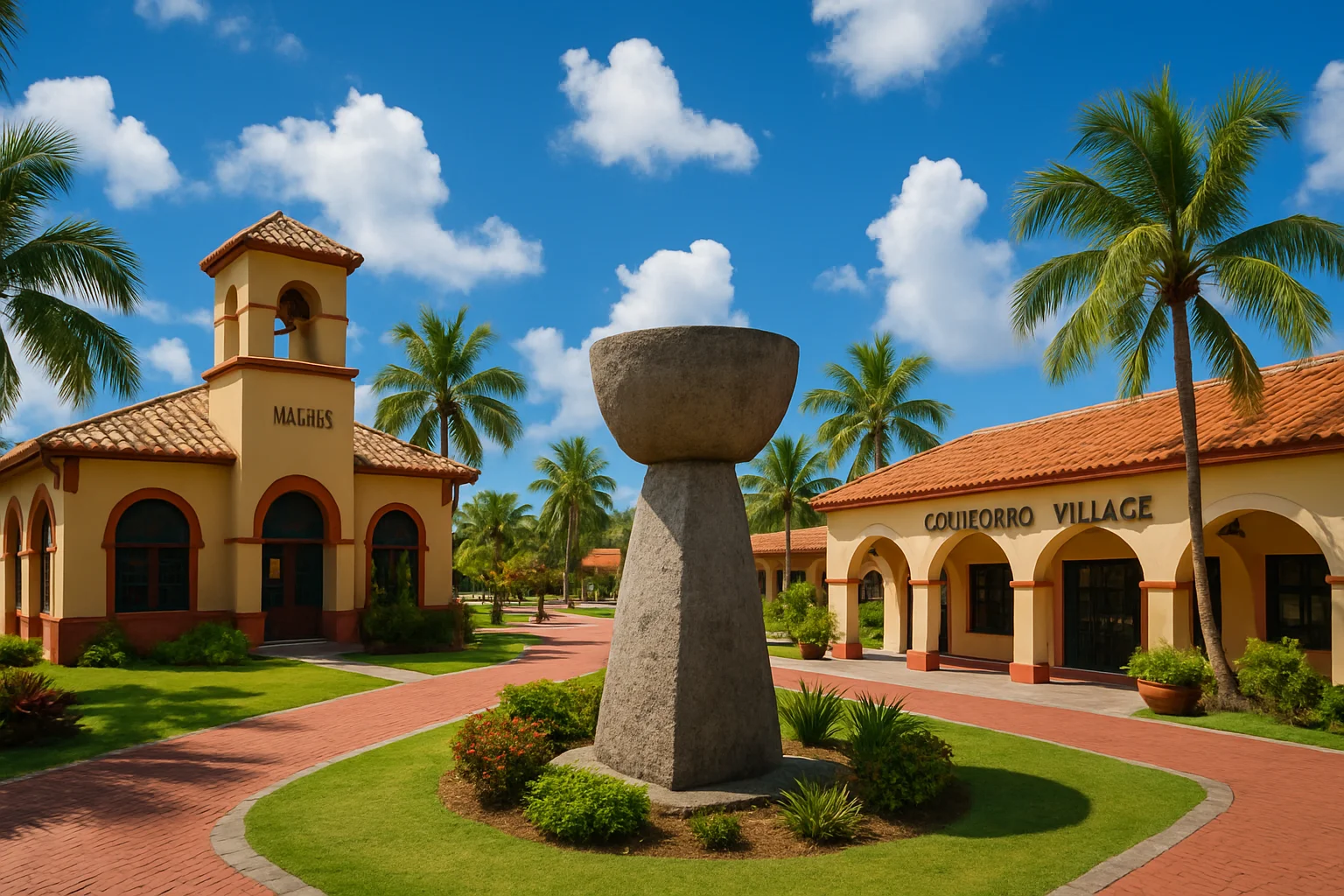
The Chamorro people have lived on Guam for approximately 4,000 years. Their latte stone monuments, limestone pillars topped with hemispherical caps, are the most recognizable symbol of ancient Chamorro civilization.
The U.S. military occupies approximately 27 percent of Guam's total land area, one of the highest military land-use percentages of any U.S. jurisdiction. Andersen Air Force Base alone covers roughly 17 square miles of the northern plateau.
Guam's Apra Harbor is the only deep-water port between Hawaii and the Philippines, making it strategically irreplaceable for U.S. naval operations in the western Pacific.
Before COVID-19, Guam received approximately 1.6 million tourists annually, more than 10 times its resident population, with roughly 75 percent from Japan and South Korea. The pandemic caused a 95 percent collapse in arrivals.
Spanish colonization reduced Guam's Chamorro population from an estimated 50,000-100,000 in 1668 to fewer than 5,000 by the early 18th century, a demographic collapse of 90-95 percent caused by warfare and introduced diseases.
Guam's official motto is 'Where America's Day Begins,' and its time zone, Chamorro Standard Time (UTC+10), means it is 14 hours ahead of the U.S. East Coast during daylight saving time and 15 hours ahead in winter. There is no daylight saving time.
Catholicism, introduced by Spanish missionaries in 1668, is practiced by approximately 85 percent of Guam's population. Nearly every village has a patron saint, and fiesta culture, week-long celebrations of village patron saints, remains one of the most important expressions of Chamorro community life.
Quick Facts and Common Questions
Short answers to the questions people most often ask about Guam: where it is, how it became part of the United States, and what that means for the people who live there.
Guam is the southernmost and largest island of the Mariana Islands, in the western Pacific Ocean, about 3,800 miles west of Hawaii. It is the largest island in Micronesia, about 212 square miles, and about 154,000 people lived there in the 2020 census. Its capital is Hagåtña, and because it lies west of the International Date Line, its motto is "Where America's Day Begins."
Spain ruled Guam for more than two centuries. During the Spanish-American War a U.S. Navy cruiser took the island in June 1898, and Spain ceded Guam to the United States in the Treaty of Paris that December. The Navy governed Guam until 1950, except during the Japanese occupation from December 1941 to 1944.
Japanese forces seized Guam on December 10, 1941, days after the attack on Pearl Harbor, and occupied it for more than two and a half years. U.S. Marines and Army troops landed on July 21, 1944, which Guam celebrates each year as Liberation Day, part of the Pacific campaign of World War II. War in the Pacific National Historical Park preserves the battle sites.
Guam is an organized, unincorporated territory of the United States. It is organized because Congress passed the Guam Organic Act of 1950, which works like a constitution, and unincorporated because Congress has decided that only selected parts of the U.S. Constitution apply there.
Yes. The Guam Organic Act, signed on August 1, 1950, made the people of Guam U.S. citizens, and people born on Guam are U.S. citizens by federal law. Newcomers follow the same path to citizenship as in the rest of the country.
Guam voters have elected their own governor since 1970; before that the governor was appointed in Washington. The territory has a 15-member, one-house legislature and its own Superior Court and Supreme Court, while federal cases go to the District Court of Guam. The Department of the Interior's Office of Insular Affairs coordinates federal policy, and the Department of Defense controls more than a quarter of the island's land.
Since 1973 Guam has elected one non-voting delegate to the U.S. House of Representatives, who can vote in committee but not on the final passage of bills. Guam has no votes in the Electoral College, so residents cannot vote in the general election for president, though Guam holds a nonbinding presidential straw poll.
English and Chamorro are Guam's official languages. The Chamorro people are the Indigenous people of the Mariana Islands, and Guam is also home to large Filipino, Micronesian, and other Asian and Pacific Islander communities.
Sources & Further Reading
- Guam, Office of Insular Affairs
- Definitions of Insular Area Political Organizations, Office of Insular Affairs
- 2020 Census Island Areas Data Products, U.S. Census Bureau
- The Spanish-American War, 1898, Office of the Historian, U.S. Department of State
- War in the Pacific National Historical Park, National Park Service
- Guampedia
- Directory of Representatives, U.S. House of Representatives