Because democracy only works when we understand it
Searches are processed by Cloudflare Workers AI and are not stored.
Searches are processed by Cloudflare Workers AI and are not stored.
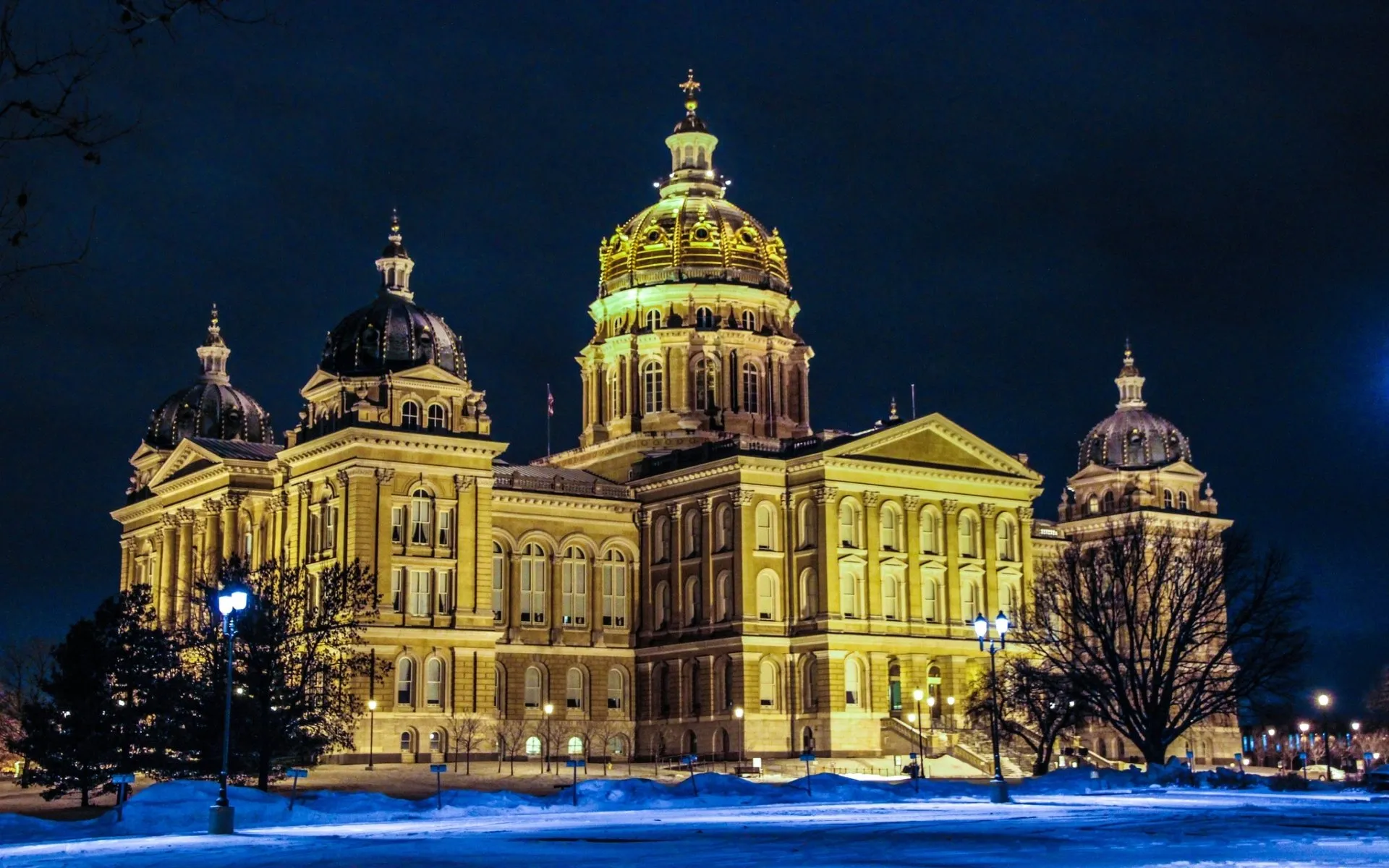
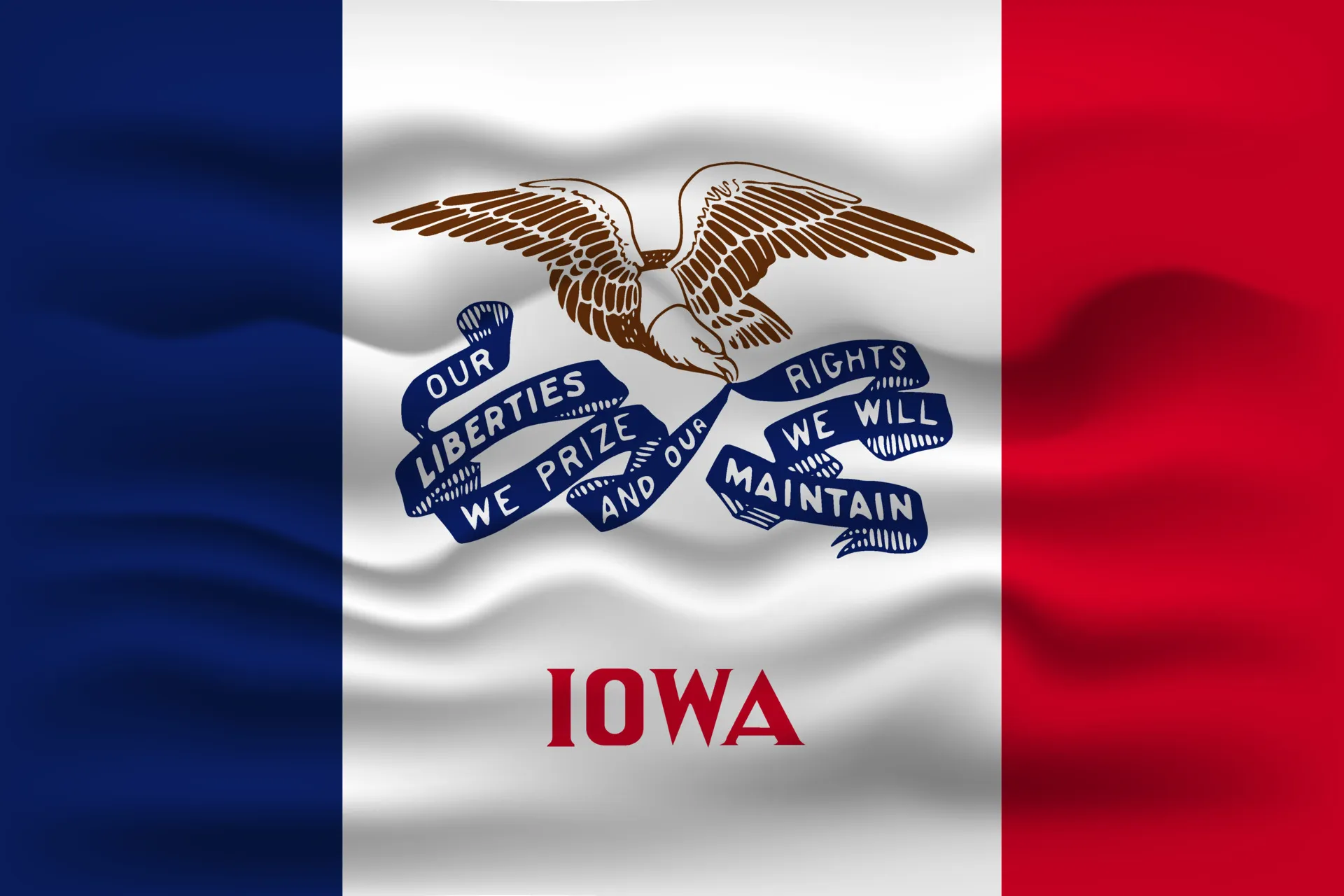
Iowa
State Guide29th StateEst. 1846
Iowa IA
"The Hawkeye State"
America's food factory, where 23 million hogs outnumber people seven to one, where corn and soybean fields feed the nation and the world, and where the Iowa caucuses have launched and ended more presidential campaigns than any single event in American politics. Iowa is also the nation's wind energy leader, quietly proving that the heartland can power the future.
Iowa state finances at a glance
State Debt - FY2024
$8.1 billion
Total state government debt outstanding at the close of fiscal 2024, including long-term bonds and short-term borrowing across state agencies and public universities.
Tax Revenue - FY2024
$12.7 billion
Total Iowa state tax collections in fiscal 2024, led by the general sales tax ($4.6B) and the individual income tax ($3.8B).
Borrowing
Iowa's constitution limits state debt to $250,000, so borrowing is done through revenue bonds and lease agreements issued by state authorities rather than general obligation bonds. These are sold to investors in the municipal market and repaid from dedicated revenues or appropriations. The state reported about $275 million in interest on its debt in fiscal 2024.
Source: U.S. Census Bureau, 2024 Annual Survey of State Government Finances.
29th
State admitted to the Union
3.2M
People, 23M hogs
60%+
Electricity from wind
#1
Ethanol-producing state
…
Last updated:
Iowa's 2026 Midterm Election: Who and What Is on Your Ballot
Hi, Iowa. On Tuesday, November 3, 2026, you're choosing a governor and lieutenant governor, a U.S. senator for an open seat, your member of the U.S. House, the attorney general, secretary of state, auditor, treasurer, and secretary of agriculture, your state legislators, and one constitutional amendment.
This is a midterm election, halfway through the president's term, and nationally it decides who controls Congress for the next two years. It's a year of open seats in Iowa: Gov. Kim Reynolds and Sen. Joni Ernst aren't running again.
Two of the four U.S. House seats are open, too, because their members ran for higher office: Ashley Hinson for the Senate and Randy Feenstra for governor (he lost the June primary to Zach Lahn).
Key dates and how voting works are right below. Use the buttons above to open each race. Facts first; the decision is yours.
Checked against official sources on October 4, 2026
Key Dates
Key Dates
Early voting begins; absentee ballots start going out
Wednesday, October 14
Last day to pre-register and to request an absentee ballot (5 p.m.)
Monday, October 19
Last day of early in-person voting
Monday, November 2
Election Day: polls open 7 a.m. to 8 p.m.; absentee ballots must arrive by 8 p.m.
Tuesday, November 3
How Voting Works in Iowa
Pre-register by 5 p.m. October 19 online, by mail, or at your county auditor's office. Missed it? Iowa lets you register on Election Day at your polling place, or during early voting at the auditor's office, with an ID and proof of where you live.
Early voting runs October 14 through November 2 at your county auditor's office and any satellite sites. Any voter can vote absentee by mail without giving a reason: request a ballot by 5 p.m. October 19, and make sure it reaches the auditor by 8 p.m. on Election Day. A postmark isn't enough.
On Election Day, polls are open 7 a.m. to 8 p.m. Bring ID: an Iowa driver's license or ID card, an Iowa Voter ID card, a U.S. passport, a military or veteran ID, or a tribal ID. If you don't have one, another registered voter in your precinct can attest for you.
Find your polling place and sample ballot through the Secretary of State or your county auditor.
Governor Race
The governor runs Iowa's executive branch, proposes the budget, and can veto bills or line items in spending bills. Governors serve four-year terms with no term limit.
Gov. Kim Reynolds, in office since 2017, isn't running for another term, so the seat is open. The governor and lieutenant governor run together as one ticket.
Candidates and parties are from the Iowa Secretary of State's certified candidate list. Iowa has no official candidate pamphlet.
Positions are summarized from the candidates' own campaign websites, in neutral words and without attacks on opponents. Where a website listed no positions we could read, the card says so.
Governor and Lieutenant Governor of Iowa
Statewide, four-year term, open seat
Democrat Rob Sand, the state auditor, faces Republican Zach Lahn, a farmer and businessman who won a five-way primary. No other candidates qualified for the ballot.
Rob Sand
Democrat
Lieutenant governor:
Dave Muhlbauer
Occupation:
State Auditor; attorney
Government experience:
Iowa State Auditor (2019 to present); former public corruption prosecutor in the Iowa Attorney General's office
What they say they stand for
Wants to restore the auditor's power to find misspent tax dollars.
Would reverse the privatization of Medicaid by executive order.
Would let state employees who can work remotely live anywhere in Iowa, to help small towns.
Wants universal all-day pre-K, paid for by ending private school voucher payments for the wealthiest families, and more oversight of voucher spending.
Would ban state benefits for illegal immigrants and stop H-1B visas for state government and university jobs Iowans can do.
Wants lower taxes, food freedom laws, and a ban on Wall Street hedge funds buying single-family homes.
Wants independent state safety testing of products and antitrust action against agricultural input companies, with a goal of cutting Iowa's cancer rate.
Sets goals of reversing young adults' outmigration and adding 10,000 family farms.
One constitutional amendment is on every Iowa ballot. Iowa has no citizen initiatives, so only the Legislature can send you an amendment, and it has to pass two General Assemblies in a row first. Then it needs a simple majority of the votes cast on it.
Iowa publishes no official voter pamphlet. The explanation and text below come from Senate Joint Resolution 11; the arguments are what supporters and opponents have said publicly.
Today, the Iowa Legislature can raise taxes the same way it passes any bill: a simple majority in the House (51 of 100) and the Senate (26 of 50), plus the governor's signature. Iowa's individual income tax is now a flat 3.8 percent, after cuts passed in 2022 and 2024.
Amendment 1 would add a new article to the Iowa Constitution. Any bill that raises the individual or corporate income tax rate, or the rate of any other tax based on income or on the legal and special reserves credit unions must keep, would need the votes of at least two-thirds of the members elected to each chamber: 67 in the House and 34 in the Senate. The same goes for a bill creating a new state tax on income or those reserves.
Local option taxes aren't covered. A lawsuit claiming a bill needed two-thirds but didn't get it would have to be filed within a year of enactment. Tax cuts would still pass by simple majority.
The Legislature passed it in 2024 (61 to 35 in the House, 31 to 13 in the Senate) and again in 2025 and 2026 (32 to 15 in the Senate, 57 to 21 in the House). Iowa voters turned down a similar three-fifths rule in 1999, with 52 percent voting no.
A YES vote means
The constitution would require a two-thirds vote of the members of both chambers to raise income tax rates or create a new income tax.
A NO vote means
No change; a simple majority of both chambers could still raise income taxes or create new ones.
Reasons people vote yes
Supporters, led by the Make Tax Hikes Harder campaign of Iowans for Tax Relief, say it protects Iowa's recent tax cuts and makes tax increases a last resort, forcing lawmakers to look at spending first.
They say it doesn't make tax increases impossible, it requires broader agreement, and point to other states with similar rules; the National Conference of State Legislatures counts 15. Americans for Prosperity, the Iowa Association of Business and Industry, and the Iowa Credit Union League back it.
Reasons people vote no
Opponents, including Common Good Iowa, the League of Women Voters of Iowa, the Iowa State Education Association, and the Iowa Catholic Conference, say it would let a minority of lawmakers block revenue the state needs in a downturn or disaster and force budget cuts.
They say budget surpluses are temporary but constitutional amendments are hard to undo, and that the cuts would fall hardest on lower-income Iowans who depend on public services.
💵 Taxes and money: No tax change now
Amendment 1 doesn't change any tax rate today. It changes how many lawmakers' votes a future income tax increase would need. No official fiscal estimate was attached to the resolution.
Some ballots will have local questions, like county or school measures. Check your sample ballot with your county auditor.
Senate Races
Every state gets two U.S. senators. The Senate votes on federal laws, confirms judges and cabinet members, and approves treaties. Senators serve six-year terms.
This is an open seat: Joni Ernst, in the Senate since 2015, isn't running again. Iowa's other senator, Chuck Grassley, isn't up until 2028.
Candidates and parties are from the Iowa Secretary of State's certified candidate list. Iowa has no official candidate pamphlet.
Positions are summarized from the candidates' own campaign websites, in neutral words and without attacks on opponents. Where a website listed no positions we could read, the card says so.
U.S. Senator
Statewide, six-year term, open seat
Democrat Josh Turek, a state representative and Paralympic gold medalist, faces Republican U.S. Rep. Ashley Hinson and Libertarian Thomas Laehn.
Josh Turek
Democrat
Occupation:
State representative; former Paralympic basketball player
Government experience:
Iowa House of Representatives (2023 to present)
What they say they stand for
Wants middle-class tax cuts and to close loopholes for billionaires and big corporations.
Wants a federal ban on food price gouging and a minimum wage that rises with inflation.
Wants to ban private equity firms from buying single-family homes and farmland.
Supports the PRO Act to strengthen unions, and wants to repeal SNAP cuts.
Says reproductive decisions belong to women, and points to his bill to repeal Iowa's abortion ban.
Iowa has four seats, all held by Republicans. Iowa draws its maps with a nonpartisan staff agency, the Legislative Services Agency, and the Legislature approves them without amendment; here's how redistricting works elsewhere. Districts 2 and 4 have no incumbent running.
You vote only in the district where you live; your sample ballot shows which one.
Iowa's 4 Districts and Who Holds Them Today
Republican
Each district is colored by the party of the member of Congress who holds it right now, not by who will win in November. Select a district to jump to its race. District lines: U.S. Census Bureau, 120th Congress.
Candidates and parties are from the Iowa Secretary of State's certified candidate list. Iowa has no official candidate pamphlet.
Positions are summarized from the candidates' own campaign websites, in neutral words and without attacks on opponents. Where a website listed no positions we could read, the card says so.
District 1
Southeast Iowa: Davenport, Iowa City, and Burlington
Republican Mariannette Miller-Meeks, in office since 2021, faces Democrat Christina Bohannan for the third election in a row, plus Michael Bridgford, who has no party.
Mariannette Miller-Meeks
Incumbent
Republican
Occupation:
Physician (ophthalmologist); Army veteran
Government experience:
U.S. Representative (2021 to present); Iowa Senate (2019 to 2021); former director, Iowa Department of Public Health
What they say they stand for
The campaign website lists no issue positions we could read, and the candidate hasn't answered the questionnaires we use. See the website for where they stand.
We summarize positions in depth for the Democratic and Republican nominees and incumbents. This candidate didn't answer the questionnaires we use.
District 2
Northeast Iowa: Cedar Rapids, Waterloo, Dubuque, and Mason City
An open seat: Ashley Hinson is running for the U.S. Senate. Republican Joe Mitchell, a former state representative, faces Democratic State Rep. Lindsay James, Libertarian Rick Stewart, and Dave Bushaw, who has no party.
Joe Mitchell
Republican
Occupation:
Developer
Government experience:
Iowa House (elected 2018 at age 21, Iowa's youngest legislator)
What they say they stand for
Takes no corporate PAC money and supports term limits of 12 years in each chamber.
Supports a full ban on stock and prediction market trading by members of Congress.
Wants to secure the border, deport criminal illegal immigrants, and temporarily ban H-1B visas.
Supports an all-of-the-above energy mix, from oil and gas to nuclear, wind, and solar.
Western and north-central Iowa: Sioux City, Council Bluffs, Ames, and Fort Dodge
An open seat: Randy Feenstra ran for governor. Republican Chris McGowan, president of the Siouxland Chamber of Commerce, faces Democrat Dave Dawson, a former state representative.
Chris McGowan
Republican
Occupation:
President, Siouxland Chamber of Commerce; veteran
Government experience:
None in elected office
What they say they stand for
Wants to secure the border and support immigration enforcement.
Supports farmers, landowner rights, and new trade agreements.
The campaign website lists no issue positions we could read, and the candidate hasn't answered the questionnaires we use. See the website for where they stand.