
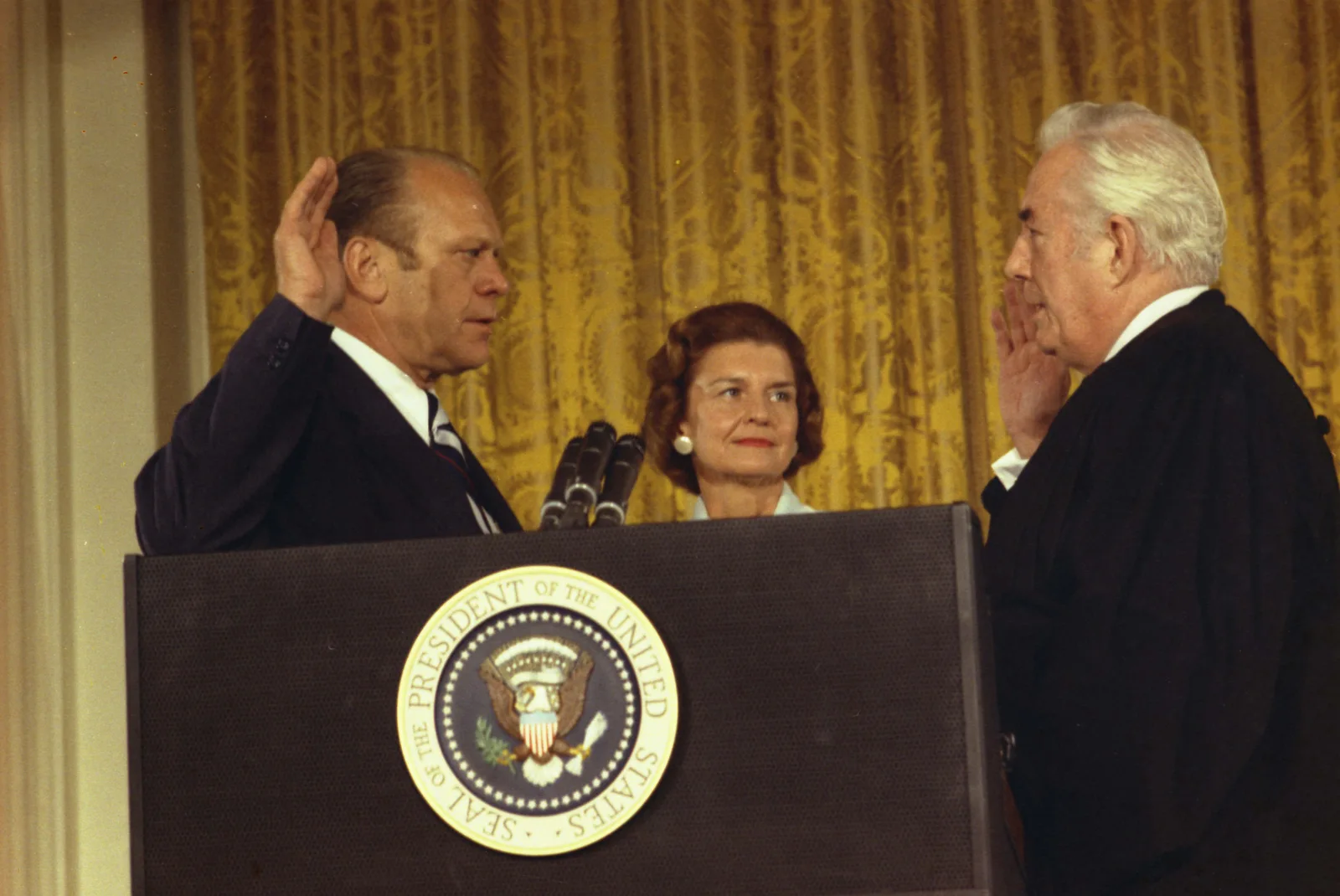
One Sentence in Article II, Three Federal Laws to Fill It In
The Constitution gives Congress the power to decide who acts as president if both the President and Vice President can't serve, but it doesn't say who that should be. Congress has answered that question three times since 1792, each time in a different order.
The Constitution itself says almost nothing about who runs the country if both the President and Vice President are gone. Article II, Section 1 only gives Congress the power to "declare what Officer shall then act as President" in that case. Congress used that power for the first time in the Presidential Succession Act of 1792, which put the President pro tempore of the Senate first in line after the Vice President, followed by the Speaker of the House.
The 1792 Act treated a double vacancy as a temporary emergency rather than a real transfer of power: whoever stepped in as acting president would only serve long enough for Congress to call a special election. That special-election provision was never once used in the 94 years the 1792 Act was in force, but it shows how uneasy the founding generation was with letting anyone outside an elected national ticket hold the office for long.
The choice of congressional leaders was itself a compromise. James Madison argued that Cabinet officers, especially the Secretary of State, were the natural successors, but many members distrusted putting the presidency within reach of the executive's own appointees, and a proposal to name the Chief Justice failed on separation-of-powers grounds. The Senate's President pro tempore was placed first partly because in 1792 the Vice President presided over the Senate and the pro tempore was seen as his natural stand-in.
The word "Officer" in Article II has been debated ever since: some scholars read it to mean only officers of the executive branch, which would make congressional leaders constitutionally ineligible to act as president. That question has never been tested in court because a double vacancy has never occurred, but it is the reason every modern reform proposal has considered dropping the Speaker and President pro tempore from the line.
By the mid-1880s, lawmakers worried the 1792 Act had a dangerous gap: the President pro tempore and Speaker are only elected when Congress is in session, so during a recess, both offices could sit empty at the exact moment the nation needed a successor. That gap became real in November 1885, when Vice President Thomas Hendricks died in office while Congress was out of session, leaving no President pro tempore, no Speaker, and, under the letter of the 1792 Act, arguably no one legally next in line.
Congress responded with the Presidential Succession Act of 1886, which removed its own leaders from the line entirely and replaced them with the President's Cabinet, in the order each department had been created: Secretary of State, Treasury, War, Attorney General, Postmaster General, Navy, and Interior. Cabinet officers are always in office regardless of whether Congress is sitting, which fixed the recess problem, but it also meant an unelected appointee, not an elected officeholder, stood next in line to the presidency for the next 61 years.
The 1885-86 vulnerability was not merely theoretical. Grover Cleveland had taken office in March 1885 with a Republican Senate that adjourned without electing a President pro tempore, and the House would not organize and elect a Speaker until December. For several weeks in late 1885, had Cleveland died, the 1792 Act would have pointed to two empty offices.
Placing the Cabinet in the line also raised its own problem, which drafters of the 1886 Act largely ignored: a Cabinet officer who was not born a U.S. citizen cannot constitutionally act as president, so the line could point to someone ineligible to serve. The natural-born-citizen limit still governs the modern line and is the reason succession can skip past certain secretaries.
President Harry Truman, who had become president himself after FDR's death with almost no preparation, pushed hard to put elected officials back ahead of the Cabinet in the succession line, arguing that a president pro tempore or Speaker answers to voters in a way an appointed Cabinet secretary never does. Congress agreed, and Truman signed the Presidential Succession Act of 1947 on July 18, 1947, restoring the Speaker of the House and the Senate President pro tempore to the line, but this time with the Speaker listed first, ahead of the Senate's leader, reversing the 1792 order.
The 1947 Act is still the law in force today, with one later addition: the USA PATRIOT Improvement and Reauthorization Act of 2005 added the newly created Secretary of Homeland Security to the very end of the Cabinet order, effective 2006, bringing the full line of succession to eighteen positions after the President.
Truman's real motive was partly personal and partly institutional. With no Vice President himself from 1945 to 1949, the man next in line under the 1886 Act was his own Secretary of State, Edward Stettinius and then James Byrnes, and Truman thought it wrong that a president could effectively name his own successor by choosing a Cabinet secretary. Making an elected legislative leader next in line removed that appearance.
Legal scholars have criticized the 1947 order almost since it passed. A Speaker or President pro tempore who succeeds may be of the opposite party from the president who was elected, reversing the voters' choice; the "Officer" question makes their eligibility uncertain; and requiring them to resign their seat to serve (as the Act does) could shrink a narrow congressional majority. Bipartisan commissions after the September 11 attacks urged reform, but Congress has not acted.
The Full Line of Succession Today
Set by the Presidential Succession Act of 1947, as amended in 2006. If the President can't serve, the office passes down this list until it reaches someone able and eligible to take it.
Vice President
Speaker of the House
President pro tempore of the Senate
Secretary of State
Secretary of the Treasury
Secretary of Defense
Attorney General
Secretary of the Interior
Secretary of Agriculture
Secretary of Commerce
Secretary of Labor
Secretary of Health and Human Services
Secretary of Housing and Urban Development
Secretary of Transportation
Secretary of Energy
Secretary of Education
Secretary of Veterans Affairs
Secretary of Homeland Security
Added in 2006, the most recent change to the line
Two Catches Worth Knowing
Anyone who acts as president has to meet the same constitutional qualifications as an elected president: a natural-born U.S. citizen, at least 35 years old, and a U.S. resident for at least 14 years. The Presidential Succession Act itself, at 3 U.S.C. § 19(e), says a Cabinet officer is only eligible to act as president if they are "eligible to the office of President under the Constitution," which quietly skips over any Cabinet secretary who was naturalized rather than born a citizen.
This has been a real gap in modern Cabinets. Foreign-born secretaries of state such as Henry Kissinger and Madeleine Albright, and foreign-born Homeland Security secretaries such as Alejandro Mayorkas, have all held offices technically listed in the line of succession while being constitutionally ineligible to actually act as president, meaning succession would simply skip past them to the next eligible officer in order.
The Act also requires a Cabinet officer to have been confirmed by the Senate for their department post; an "acting" secretary serving under the Federal Vacancies Reform Act is not in the line at all. During periods when several departments are run by acting officials, the effective line of succession can be shorter than the 18 seats on paper.
A Cabinet officer who acts as president under the statute is only an "Acting President" and, by the terms of the 1947 Act, serves only until a Speaker or President pro tempore qualifies or, in a true double vacancy with no elected leaders, until the next scheduled presidential election. Unlike a Vice President under the 25th Amendment, a Cabinet secretary does not become "the President."
For events that gather almost the entire line of succession in one place, most visibly the President's State of the Union address to a joint session of Congress, the federal government designates one Cabinet secretary to skip the event entirely and stay at a secure, undisclosed location instead. That official, informally called the "designated survivor," is briefed and ready to act as president if a catastrophic event were to kill or incapacitate everyone ahead of them in line.
The practice began informally during the Cold War, when nuclear attack was a genuine planning concern, and has continued at every State of the Union and presidential inauguration since. It has no basis in the Presidential Succession Act itself, it is purely an executive branch continuity-of-government practice, but it has become widely known thanks to news coverage and, later, a television drama built around the premise.
Since the September 11 attacks, Congress has adopted its own version: party leaders now keep a few members of the House and Senate away from the chamber during the State of the Union so that each chamber could still function, and after 2001 the House adopted a rule allowing it to operate with a reduced quorum if "catastrophic circumstances" leave many seats vacant. The designated survivor is publicly named a few hours before the speech, and is accompanied by a military aide carrying the nuclear command materials.
The choice is deliberate about eligibility: the designated survivor is always someone constitutionally qualified to serve as president, which is one practical reason a naturalized secretary is never picked. Whether a designated survivor who suddenly had to act would face a legal challenge over the "Officer" question or the natural-born requirement of others skipped in line has never had to be answered.
Four Sections, Ratified February 10, 1967
Proposed by Congress on July 6, 1965 and ratified less than two years later, the 25th Amendment rewrote the rules for presidential succession and disability in four distinct sections. Each one answers a different question the Constitution and earlier federal law had left open.
"In case of the removal of the President from office or of his death or resignation, the Vice President shall become President." That single sentence sounds obvious today, but before 1967 it was actually untested constitutional text. Article II only said the powers and duties of the office "shall devolve on the Vice President," and for over a century historians and lawmakers argued about whether that meant the VP became the actual President or merely an acting president carrying out the job.
Vice President John Tyler settled that argument through sheer nerve in 1841, insisting he was the full President, not a caretaker, after William Henry Harrison died just 31 days into his term. Every VP who succeeded a president afterward followed "the Tyler Precedent," but it remained an informal custom, not settled law, until Section 1 of the 25th Amendment finally wrote it into the Constitution itself in 1967.
Section 1 covers only a permanent vacancy, death, resignation, or removal by impeachment conviction. It does not address temporary inability; that is what Sections 3 and 4 are for. The word "removal" refers to a Senate conviction after House impeachment, the only lawful way to force a president out, and it has never happened.
Nine vice presidents have become president under what is now Section 1: Tyler (1841), Fillmore (1850), Andrew Johnson (1865), Arthur (1881), Theodore Roosevelt (1901), Coolidge (1923), Truman (1945), and Lyndon Johnson (1963) all succeeded on a president's death, and Gerald Ford (1974) succeeded on Nixon's resignation, the only time.
"Whenever there is a vacancy in the office of the Vice President, the President shall nominate a Vice President who shall take office upon confirmation by a majority vote of both Houses of Congress." Before this section existed, the Constitution had no mechanism at all for filling an empty vice presidency, the office simply sat vacant, sometimes for years, until the next scheduled election.
That gap had already happened sixteen times in American history before 1967, including a stretch after Lincoln's assassination when Andrew Johnson served nearly his entire term with no Vice President at all. Section 2 closed the gap for good, and it was put to use twice within thirteen months of each other in 1973 and 1974, a pace of use the amendment's own authors almost certainly never expected.
Section 2 confirmation needs a simple majority of both the House and the Senate, unlike Cabinet or judicial nominees, who need only the Senate. Both 1973-74 nominees, Gerald Ford and Nelson Rockefeller, went through full FBI background investigations and public hearings before both chambers, taking about two and three months respectively.
The provision was a direct answer to the Cold War fear of a "decapitation" strike: if a nuclear attack killed a president, the succession would run into a chain of aging congressional leaders and Cabinet officers rather than a vetted, briefed running mate. Keeping the vice presidency filled keeps a qualified successor in place at all times.
Section 3 lets a president who knows they are about to become temporarily unable to serve, most often for a planned medical procedure, transfer power on their own terms: they send a written declaration to the President pro tempore of the Senate and the Speaker of the House, and "until he transmits to them a written declaration to the contrary, such powers and duties shall be discharged by the Vice President as Acting President."
This is the only part of the 25th Amendment that has been used with any regularity. President Reagan invoked it in 1985 before a colonoscopy, the first time any president had ever used it, and Presidents George W. Bush and Joe Biden each invoked it for the same kind of routine procedure in 2002, 2007, and 2021. In every case, the Vice President served as Acting President for only a few hours before the president reclaimed the office in writing.
Reagan's 1985 letter was hedged: it stated he did not believe the 25th Amendment "should" apply to a brief and expected disability like his, but that he was invoking Section 3 anyway to set a precedent. Later presidents dropped that caveat and simply invoked it, and the transfer and its return are now handled by short, formulaic letters released by the White House.
The Vice President who serves as Acting President under Section 3 holds every power of the office, including command of the armed forces and the nuclear codes, for the duration. In practice the transfers have lasted well under a day and no consequential decision has ever had to be made during one, but the point is that there is always a person legally in charge.
Section 4 covers the scenario the earlier sections don't: a president who is incapacitated but unable, or unwilling, to voluntarily hand over power under Section 3. It lets the Vice President and a majority of the Cabinet declare in writing that the President is unable to serve, which immediately makes the Vice President Acting President, even without the President's agreement.
The section then builds in a dispute process: the President can contest the declaration in writing and immediately reclaim the office, unless the Vice President and Cabinet majority disagree again within four days, at which point Congress has to assemble within 48 hours and decide within 21 days, requiring a two-thirds vote of both chambers to keep the Vice President in charge over the President's objection. It is by far the most legally complex, and the single most consequential, section of the amendment, and in more than half a century it has never once been formally invoked.
The Vice President's signature is essential and cannot be bypassed: a Cabinet acting without the Vice President cannot invoke Section 4, which was a deliberate safeguard against a Cabinet coup. Congress may by law substitute "such other body as Congress may by law provide" for the Cabinet, but it has never done so, so the President's own appointees remain the only group that can start the process.
The high thresholds mean Section 4 favors the sitting president in a genuine dispute. If Congress splits and cannot reach a two-thirds vote in both chambers within 21 days, the President automatically resumes power. The provision was designed to be usable in a clear crisis, a stroke, a coma, a president who has plainly lost touch with reality, and nearly unusable as a tool for policy or political disagreement.
From Tyler in 1841 to Harris in 2021
The rules on paper only matter because they've been tested, repeatedly, by real deaths, resignations, and medical procedures. Here is every major moment that shaped, or was shaped by, the presidential succession process.
President William Henry Harrison died of illness just 31 days after his inauguration, the first sitting president to die in office. Vice President John Tyler immediately traveled to Washington, took the presidential oath, and declared himself the actual President rather than a temporary caretaker, a position some members of his own Cabinet and Congress disputed at the time.
Tyler's critics mockingly called him "His Accidency," but he governed as a full president in every respect, vetoing bills and making appointments, and no one successfully challenged him. Every vice president who has succeeded a president since has followed what became known as the Tyler Precedent, which the 25th Amendment's Section 1 finally made explicit constitutional text in 1967.
Tyler reinforced his claim with theater: he returned unopened any mail addressed to "Acting President" or "Vice President Tyler," and had himself sworn in even though he believed the vice-presidential oath he had already taken was sufficient. The House and Senate each passed resolutions in mid-1841 recognizing him simply as "the President," though the Senate's vote was close.
The stakes were high because Tyler, a former Democrat on the Whig ticket, broke almost immediately with the Whig program, vetoing his own party's national bank bills. His entire Cabinet except the Secretary of State resigned in protest in 1841, and the Whigs expelled him from the party. A settled succession rule mattered precisely because a successor could pursue policies the voters had not chosen.
President Abraham Lincoln was shot at Ford's Theatre on the night of April 14, 1865, and died the next morning. Vice President Andrew Johnson was sworn in within hours of Lincoln's death, at the Kirkwood House hotel in Washington, in one of the fastest presidential transitions in American history up to that point.
Johnson then served almost his entire term with no Vice President at all, since the Constitution at the time had no mechanism for filling that vacancy, a gap that would not be closed for another 102 years, until Section 2 of the 25th Amendment finally addressed it in 1967.
The assassination was part of a wider plot: the same night, a co-conspirator stabbed and gravely wounded Secretary of State William Seward at his home, and a third man assigned to kill Johnson lost his nerve. Had all three succeeded, the line under the 1792 Act would have run to the Senate President pro tempore.
Johnson's lack of a Vice President compounded a bitter presidency. He fought Congress over Reconstruction, was impeached by the House in 1868, and survived removal in the Senate by a single vote. Through all of it, the officer next in line was the Senate President pro tempore, Benjamin Wade, a Radical Republican and a leading advocate of Johnson's conviction, a conflict of interest a filled vice presidency would have avoided.
President James Garfield was shot on July 2, 1881, but did not die until September 19, more than eleven weeks later, during which he was too incapacitated to govern but never formally transferred power to Vice President Chester Arthur. Cabinet members and Garfield's own doctors debated whether Arthur should act as president, but no legal mechanism existed to make that transfer happen while Garfield was still alive.
The 79-day gap exposed a genuine hole in the Constitution: there was no process at all for presidential incapacity short of death, only for a completed vacancy. That specific failure was cited repeatedly by lawmakers eight decades later as one of the strongest arguments for what eventually became Section 4 of the 25th Amendment.
Garfield could sign only a single official document in those eleven weeks, an extradition paper. The Cabinet met repeatedly to debate whether Article II's word "inability" allowed Arthur to step in temporarily and, if so, whether Arthur could later be forced to give the office back if Garfield recovered, a question no one could answer. Fearing they might trigger a permanent, irreversible transfer, they did nothing.
Arthur, who had been placed on the ticket by a rival faction and was widely distrusted, stayed away from Washington and refused to act, partly so he could not be accused of grasping for power. Garfield actually died of infection likely caused by his doctors probing the wound with unsterilized hands and instruments; the bullet was never the immediate cause.
President Woodrow Wilson suffered a severe stroke in October 1919 that left him partially paralyzed and unable to perform many presidential duties for the remaining year and a half of his term. Rather than transfer power to Vice President Thomas Marshall, Wilson's wife Edith Wilson and his physician, Dr. Cary Grayson, managed his schedule, controlled who could see him, and screened which documents reached him, a period historians often call a de facto "stewardship" presidency.
Vice President Marshall was never formally briefed on the true extent of Wilson's condition and never attempted to assert authority, in part because no constitutional process existed for him to do so short of the full Cabinet declaring Wilson unable to serve, which never happened. The Wilson episode became the single most frequently cited historical example when Congress debated and drafted Section 4 of the 25th Amendment nearly fifty years later.
For weeks after the stroke, cabinet business simply stopped. When Secretary of State Robert Lansing began convening Cabinet meetings on his own to keep the government running, Wilson, once he learned of it, forced Lansing to resign in early 1920 for usurping presidential authority. Bills became law without signature because Wilson could not act on them within the constitutional ten days.
The concealment was near-total: the press was told only that the president was suffering from "nervous exhaustion," and senators who visited in December 1919 to gauge his fitness were carefully staged so that only Wilson's good side and hand were visible. He recovered enough to serve out the term but never fully; the episode is the textbook case of a hidden presidential disability.
Vice President Harry Truman had met privately with President Franklin D. Roosevelt only a handful of times before FDR died suddenly of a cerebral hemorrhage on April 12, 1945, and Truman had not been briefed on major wartime matters, including the existence of the Manhattan Project and the atomic bomb, until after he was sworn in as president that same evening.
Truman's abrupt, underprepared succession became a major argument for keeping vice presidents far more closely briefed on national security matters going forward, and Truman himself later became the driving political force behind the Presidential Succession Act of 1947, restoring elected congressional leaders to the line of succession ahead of his own Cabinet.
Truman had been Vice President for only 82 days and later said that when reporters asked him to pray for them, he felt "like the moon, the stars, and all the planets had fallen on me." Within four months he had to decide whether to use the atomic bomb, a weapon he had learned existed less than two weeks into his presidency.
Roosevelt's health had been visibly failing during the 1944 campaign, and party leaders had insisted on replacing Vice President Henry Wallace with Truman precisely because they feared Roosevelt would not survive a fourth term. That the successor was nonetheless kept in the dark led directly to the modern practice of giving the Vice President the same daily intelligence briefing as the President.
President John F. Kennedy was assassinated in Dallas on November 22, 1963. Vice President Lyndon B. Johnson took the presidential oath of office that same afternoon aboard Air Force One at Dallas Love Field, administered by federal judge Sarah T. Hughes, the only time in U.S. history a president has been sworn in on an airplane and the only time a woman has administered the oath.
Johnson then served fourteen months with no Vice President at all, the exact gap Section 2 of the 25th Amendment was written to close. Congress proposed the amendment on July 6, 1965, and the states ratified it on February 10, 1967, making Kennedy's assassination the direct catalyst for closing gaps in the succession process that had existed, unresolved, since Lincoln's death a century earlier.
The assassination sharpened the fear because the next two officers in line were both elderly: Speaker John McCormack was 71 and Senate President pro tempore Carl Hayden was 86. If Johnson, who had a serious heart attack in 1955, had also died, the presidency would have passed to a man in his ninth decade with no national mandate.
The amendment's chief author was Senator Birch Bayh of Indiana, who had chaired a Senate subcommittee on constitutional amendments and had studied the Garfield and Wilson precedents. The American Bar Association helped draft the text, and it moved through Congress in about 18 months, fast for a constitutional amendment.
Vice President Spiro Agnew resigned on October 10, 1973, after pleading no contest to a federal tax evasion charge tied to bribery allegations from his time as Governor of Maryland. President Nixon nominated House Minority Leader Gerald Ford to fill the vacancy under Section 2, and Congress confirmed Ford on December 6, 1973, the first time Section 2 had ever been used.
Less than a year later, on August 9, 1974, Nixon himself resigned over the Watergate scandal, and Ford became president under Section 1, making him the only person to hold the presidency without ever being elected President or Vice President. Ford then nominated Nelson Rockefeller to fill the now-vacant vice presidency, and Congress confirmed Rockefeller on December 19, 1974, meaning Section 2 was invoked twice within thirteen months, filling the presidency and vice presidency with no national election at all.
Nixon reportedly wanted John Connally for the vice presidency but chose Ford because Democratic congressional leaders signaled Ford could be confirmed quickly and Connally could not. For a few weeks in the fall of 1973, before Ford was confirmed, Speaker Carl Albert was first in line to a president who was himself facing possible impeachment.
Ford's own confirmation hearings produced a widely quoted exchange in which he said, "I do not think the public would stand for it," when asked whether a new president could pardon his predecessor, and after taking office he pardoned Nixon on September 8, 1974, a decision that damaged his standing and is often cited as a factor in his narrow 1976 loss. The 1973-74 sequence remains the only time the country has had both a president and vice president who reached office without a national election.
When President Reagan was shot on March 30, 1981, and rushed into roughly two hours of emergency surgery under general anesthesia, his aides prepared, but never had Reagan sign, the letters needed to invoke Section 3, leaving no legal Acting President during the surgery, a gap that renewed serious attention to the amendment's Section 4. Reagan later became the first president to actually use Section 3, on July 13, 1985, before a scheduled colon polyp surgery, making Vice President George H.W. Bush Acting President for about eight hours.
Section 3 has since become a routine, low-drama tool: President George W. Bush invoked it twice, in 2002 and 2007, both times before a colonoscopy, briefly making Vice President Dick Cheney Acting President. President Biden invoked it on November 19, 2021, before his own colonoscopy, making Vice President Kamala Harris Acting President for 85 minutes, the first woman ever to hold presidential power in the United States, even briefly.
The 1985 transfer lasted from about 11:28 a.m. to 7:22 p.m. Vice President Bush spent it at his residence and made no decisions; the White House deliberately kept it quiet to avoid alarming markets or adversaries. The three routine transfers since (George W. Bush in 2002 and 2007, and Biden in 2021) have each been announced by the White House press office with the two letters attached and have drawn little attention.
Section 3's normalization matters because it removes the stigma from a president briefly acknowledging inability. Before 1985, no president had ever admitted, in writing, to being temporarily unfit; the fear was that doing so would look weak. Making it a routine pre-surgery formality means a future president facing a longer or more serious procedure has a low-cost, well-worn path to hand over power on their own terms.
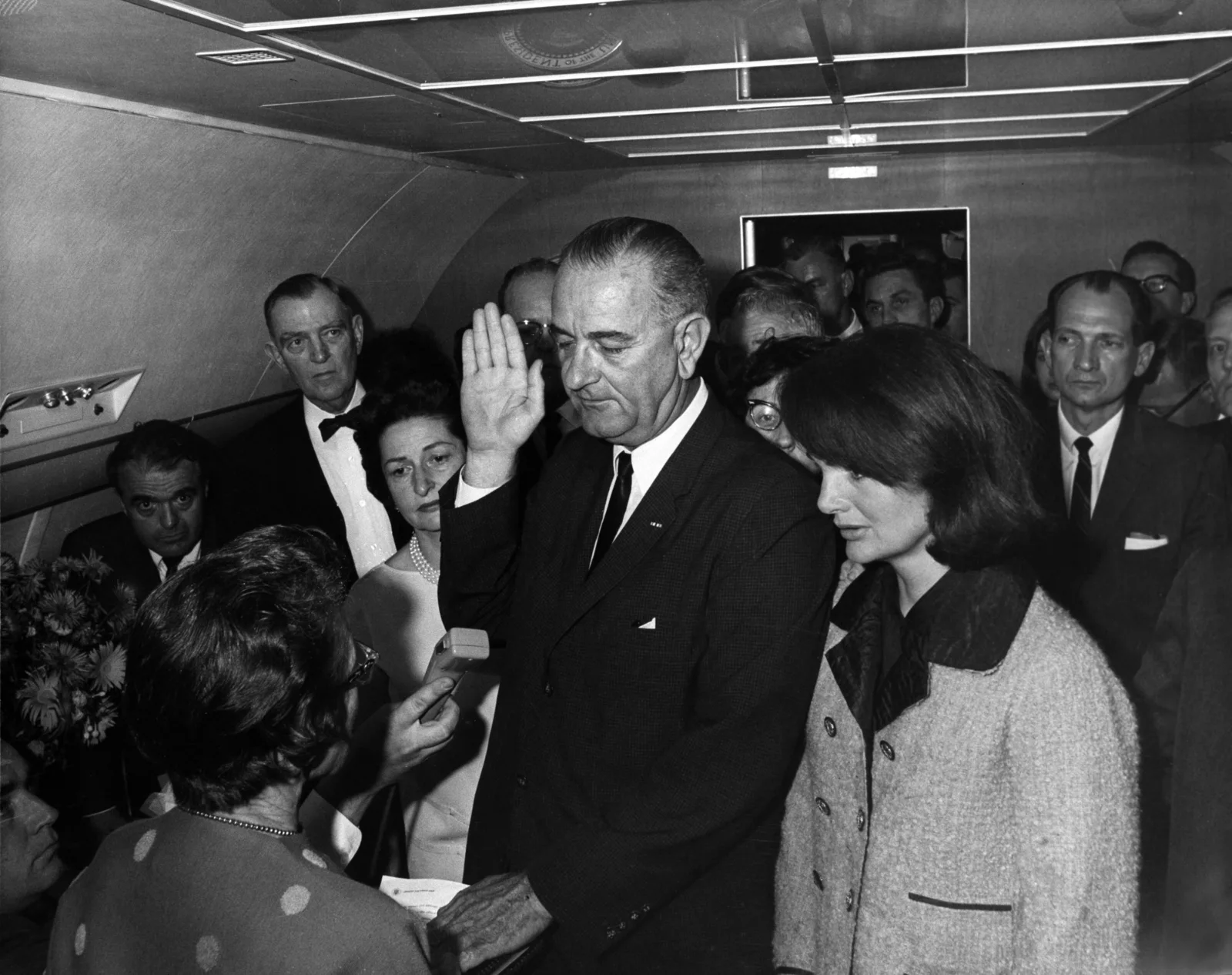
Johnson's swearing-in, the only time a president has taken the oath aboard an aircraft, is the event that directly led Congress to propose the 25th Amendment less than two years later.
The Section Written for a Crisis That Hasn't Happened Yet
Section 4 lets the Vice President and Cabinet remove power from a president who can't discharge the job but won't say so. It is the most carefully negotiated part of the amendment, and, more than half a century later, still the only section never formally used.
Sections 1 through 3 of the 25th Amendment all assume someone, either the departing president or the Vice President and Cabinet acting after a death, is able and willing to trigger the process. Section 4 was written for the one scenario none of those sections cover: a president who is genuinely unable to do the job but does not, or cannot, say so, the exact situation Woodrow Wilson's stroke and James Garfield's 79-day incapacitation had already created decades earlier with no legal remedy available.
Congress debated Section 4 longer and more carefully than any other part of the amendment, holding hearings across several years in the mid-1960s specifically to design a mechanism that could remove power from an incapacitated president without creating an easy tool for a Vice President or Cabinet to simply push out a president they disagreed with politically.
Drafters weighed and rejected several alternatives: giving the decision to the Supreme Court (seen as dragging judges into politics), to a panel of physicians (who would lack democratic legitimacy), and to the Vice President acting alone (too easy to abuse). Requiring the Vice President plus a Cabinet majority, and then a congressional supermajority if contested, was the compromise that could pass.
The amendment's sponsors were explicit that Section 4 was meant for physical or mental inability, not for a president who is merely unpopular, reckless, or pursuing bad policy, which is what impeachment is for. Senator Birch Bayh said on the floor that it was not intended "to be used simply because it is politically expedient."
The Vice President and a majority of the Cabinet (or another body Congress could designate by law, though Congress never has) sign and transmit a written declaration that the President is unable to discharge the duties of the office. The Vice President becomes Acting President the moment that declaration is sent, no waiting period, no vote required first.
The President can respond in writing, declaring themselves able to resume, and regains the office immediately, unless the Vice President and Cabinet majority disagree and send a second declaration within four days. If that happens, Congress must assemble within 48 hours if not already in session, and has 21 days to vote; only a two-thirds vote in both the House and Senate can keep the Vice President as Acting President over the sitting President's objection. Absent that supermajority, the President resumes power.
"Cabinet" here means the heads of the executive departments, currently 15 people, so a majority is eight. Ambiguities remain: it is unclear whether acting secretaries count, and the amendment does not say what happens if the Vice President office is itself vacant, which would leave no one able to sign the declaration at all.
During any Section 4 dispute, the Vice President serves as Acting President the entire time Congress is deliberating, up to 25 days total (4 days plus 21). If Congress fails to muster a two-thirds vote either way, the tie goes to the President, who resumes office. There is no provision for repeated attempts, but nothing bars the Vice President and Cabinet from filing a fresh declaration if the situation continues.
When President Reagan was shot in the chest on March 30, 1981, and underwent roughly two hours of surgery under general anesthesia, he was, by any medical definition, unable to discharge the duties of his office during that window. No one invoked Section 3 or Section 4; the Reagan White House staff has said the necessary letters were drafted but never signed, largely because aides worried the optics of formally transferring power during a national security crisis would look worse than simply managing the gap informally.
Secretary of State Alexander Haig's televised declaration that day, "As of now, I am in control here, in the White House," was constitutionally incorrect, since the Constitution and the Presidential Succession Act placed the Speaker of the House ahead of the Secretary of State, and Haig held no authority to act as president in any case while Reagan was alive. The episode is widely cited by constitutional scholars, including in retrospective analysis published by the Reagan Presidential Library, as the clearest real-world illustration of exactly the gap Section 4 was designed to fill, and of how reluctant officials are to actually use it.
Vice President George H.W. Bush was on a plane returning from Texas and out of secure communication for part of the afternoon. He deliberately chose to helicopter to his residence rather than land on the South Lawn, telling aides, "Only the president lands on the South Lawn," a small gesture aimed at signaling that no transfer of power was underway.
The lasting lesson officials drew was not that the system failed, Reagan survived and resumed work, but that even a clearly incapacitated president can create a legal vacuum because the people around him are afraid to act.
Beyond 1981, Section 4 has come up as a live topic of discussion multiple times without ever being used: after Reagan's assassination attempt, during later public commentary about his health, and again in 2017, when a group of members of Congress introduced the Oversight Commission on Presidential Capacity Act, a bill that would have created a standing medical commission to help evaluate presidential fitness. The bill never advanced out of committee.
No president in the amendment's history has ever had Section 4 invoked against them, and no Vice President has ever signed a Section 4 declaration. The high bar Congress deliberately built into the process, requiring both a Cabinet majority and, if contested, a two-thirds vote of Congress, has functioned exactly as designed: it makes Section 4 available for a genuine crisis while making it extremely difficult to use as a political tool.
Former Deputy Attorney General Rod Rosenstein was reported in 2018 to have discussed, in the abstract, whether Cabinet members might invoke Section 4; Rosenstein said the reports were inaccurate, and nothing came of it. The provision is also periodically raised by commentators about the advanced age of recent presidents and presidential candidates, an argument its authors would say is closer to a policy debate than the incapacity the section addresses.
The recurring pattern, decades of speculation and not a single actual invocation, is itself evidence about how the mechanism works. Its designers wanted it available but rarely reachable, and the political and personal cost of a Vice President and Cabinet moving against a conscious, resisting president has so far proven higher than any group has been willing to pay.
The 25th Amendment never defines what "unable to discharge the powers and duties" actually means, no medical standard, no list of qualifying conditions, and no requirement that a doctor be involved in the Cabinet's determination at all. Constitutional scholars have pointed out that this leaves the term open to interpretation covering anything from a coma to a disputed claim about mental fitness, a breadth some see as necessary flexibility and others see as a real vulnerability.
Congress also never designated the alternate body Section 4 allows it to create in place of the Cabinet, meaning the sitting Cabinet, all presidential appointees who generally owe their jobs to the President they would be evaluating, remains the only body with the power to initiate the process. Scholars across the political spectrum have raised this as a structural tension: the people best positioned to notice an incapacitated president are also the people with the most to lose, professionally and politically, by saying so.
Other unanswered questions include whether the four-day window for a second Cabinet declaration runs on calendar or business days, whether a president can fire Cabinet members mid-dispute to break the majority (and whether such firings would even be valid once the Vice President is Acting President), and whether "Congress" for the 21-day vote means the Congress then sitting or a newly elected one if the dispute straddles a January transition.
Because no piece of Section 4 has ever been litigated or exercised, all of this is scholarly argument rather than settled law. The one point of broad agreement is that a real Section 4 crisis would be resolved as much by politics and public opinion as by the text, which is why the provision is discussed far more often than it is invoked.
A Note on Nonpartisanship
The open questions around Section 4 have been raised by constitutional scholars and lawmakers across the political spectrum, about presidents of both parties, over more than fifty years. USGovExplained.org presents these questions to explain how the process works and where it remains untested, not to suggest any president has met, or should meet, its threshold.
Nine Facts Worth Knowing
A quick-reference set of facts drawn from the sourced material throughout this page, useful for a fast read or a classroom discussion starter.
The 25th Amendment wasn't ratified until 1967, more than a century after Lincoln's assassination first exposed the gap it was written to close.
Section 2 has only ever been used twice, both times in a 13-month span in 1973 and 1974, filling the vice presidency for Gerald Ford and then, after Ford became president, for Nelson Rockefeller.
Gerald Ford is the only U.S. president who was never elected President or Vice President by voters nationwide, he reached both offices through Section 2 and Section 1 of the 25th Amendment.
Section 4, the involuntary transfer of power, has never once been formally invoked in the amendment's history, even during the 1981 Reagan shooting, its closest real-world test.
Kamala Harris became the first woman to hold presidential power in U.S. history on November 19, 2021, serving as Acting President for 85 minutes while President Biden was under anesthesia for a routine colonoscopy.
The current 18-person line of succession can legally skip over a Cabinet secretary who wasn't born a U.S. citizen, since the Constitution's natural-born-citizen requirement still applies to anyone acting as president.
Andrew Johnson served nearly his entire presidential term, after Lincoln's assassination, with no Vice President at all, because no constitutional process existed to fill the vacancy until 1967.
One Cabinet secretary, the "designated survivor," skips every State of the Union address and stays at a secure undisclosed location in case everyone else in the line of succession is killed at the event.
James Garfield lived for 79 days after being shot in 1881 without transferring any power to his Vice President, a gap in the Constitution that went unfixed for another 86 years.
Sources & Further Reading
- National Archives: The Constitution, Amendments 11-27 (25th Amendment)
- U.S. Senate: The Presidential Succession Act
- U.S. Senate: Presidential Succession, 1792
- Congress.gov, Constitution Annotated: Presidential Succession Laws
- Cornell LII: 25th Amendment, Presidential Succession Laws
- National Constitution Center: The 25th Amendment
- Reagan Presidential Library: Who's in Charge? The 25th Amendment and the 1981 Assassination Attempt
- Reagan Presidential Library: The 25th Amendment, Section 3 and July 13, 1985
- USA.gov: Order of Presidential Succession
This page draws on the National Archives' published text and history of the 25th Amendment, the U.S. Senate's official history of the Presidential Succession Act, the Library of Congress's Constitution Annotated, Cornell Law School's Legal Information Institute, the National Constitution Center, and the Reagan Presidential Library's published historical analysis of the amendment's use in 1981 and 1985.