
The Constitutional
Amendments, 11 to 27
After the Bill of Rights came 17 more amendments, abolishing slavery, expanding voting rights, creating the income tax, banning alcohol, and fixing the Constitution's flaws one at a time.
How the Constitution Gets Updated
The founders knew they couldn't get everything right. They built in a way to fix mistakes, adapt to new circumstances, and expand rights over time, the amendment process. But they made it deliberately difficult, so the Constitution couldn't be changed on a political whim.
The Bill of Rights (Amendments 1-10) was ratified all at once in 1791. After that, amendments have come one at a time, each one a hard-fought battle reflecting a crisis, a social movement, or a fundamental flaw in the original design. Seventeen more have been added in the 235 years since.
The pace has varied enormously. The Twenty-sixth Amendment, lowering the voting age to 18, was ratified in about three and a half months in 1971, while the Twenty-seventh, on congressional pay, took more than 202 years. The proposed amendments page explains the process.
Only once has an amendment repealed another: the Twenty-first Amendment of 1933 ended Prohibition, which the Eighteenth had established in 1919. It is also the only amendment ratified by state conventions rather than state legislatures. The full text of each is on the full Constitution page.
"The Congress, whenever two thirds of both Houses shall deem it necessary, shall propose Amendments to this Constitution, or, on the Application of the Legislatures of two thirds of the several States, shall call a Convention for proposing Amendments, which, in either Case, shall be valid to all Intents and Purposes, as Part of this Constitution, when ratified by the Legislatures of three fourths of the several States, or by Conventions in three fourths thereof..."
In short: To add an amendment, you need two-thirds of both the House and Senate to propose it (or two-thirds of state legislatures to call a convention). Then three-fourths of all states, currently 38 of 50, must ratify it. It's a very high bar. Only 27 amendments have made it through in over 230 years.
The Amendments by Era
The amendments didn't come evenly, they came in waves, each one triggered by a national crisis or social movement:
Early Republic (11-12, 1795-1804)
Fixing the Constitution's early flaws, limiting state immunity from lawsuits and fixing the broken Electoral College process that nearly destroyed the young republic.
Civil War Era (13-15, 1865-1870)
The Reconstruction Amendments, abolishing slavery, establishing birthright citizenship and equal protection, and guaranteeing voting rights regardless of race. The most transformative amendments ever ratified.
Progressive Era (16-19, 1913-1920)
A burst of reform: income tax, direct election of senators, the ill-fated Prohibition, and women's suffrage. Four amendments in eight years during America's greatest period of political reform.
New Deal Era (20-22, 1933-1951)
Modernizing the government: fixing the lame duck problem, repealing Prohibition's disaster, and limiting presidential terms after FDR's unprecedented four elections.
Civil Rights Era (23-26, 1961-1971)
Expanding democracy: giving DC a presidential vote, banning poll taxes, clarifying presidential succession, and lowering the voting age to 18 amid Vietnam War protests.
Modern (27, 1992)
The 27th Amendment, originally proposed by James Madison in 1789, was finally ratified 202 years later thanks to a determined college student. Congressional pay raises must wait for the next election.
Amendments 11 Through 27, Fully Explained
Click any amendment to expand the full explanation, historical context, real-world impact, and current debates.
“The Judicial power of the United States shall not be construed to extend to any suit in law or equity, commenced or prosecuted against one of the United States by Citizens of another State, or by Citizens or Subjects of any Foreign State.”
Summary
If you live in Ohio and want to sue the state of Texas for something, you generally can't take that case to federal court. States have what's called 'sovereign immunity', they're protected from certain lawsuits by people who aren't their own citizens.
Why It Was Added, The History
This amendment was a direct reaction to the 1793 Supreme Court case Chisholm v. Georgia, in which a merchant from South Carolina sued the state of Georgia in federal court, and won. State governments were furious. They argued that sovereign states couldn't be dragged into court by private citizens. Congress moved quickly to overrule the decision, and the amendment was ratified in just two years.
Chisholm was decided 4 to 1 in February 1793, with only Justice James Iredell dissenting, and a proposed amendment to reverse it was introduced in Congress the very next day. Congress passed it in March 1794, the states supplied the necessary ratifications by February 1795, and President John Adams formally proclaimed it adopted in 1798.
It was the first amendment adopted after the Bill of Rights and the first ever used to overrule a specific Supreme Court decision, establishing that the amendment process could serve as a check on the Court itself.
How It Changed America
The 11th Amendment is the foundation of 'sovereign immunity', the legal principle that governments can only be sued on their own terms. States today routinely use this protection to limit lawsuits against them. However, Congress can abrogate (remove) this immunity for specific laws under the 14th Amendment, and states can waive it voluntarily.
The Supreme Court has read the amendment far more broadly than its literal text. In Hans v. Louisiana (1890) it held that a state also cannot be sued in federal court by its own citizens, and in Seminole Tribe v. Florida (1996) and Alden v. Maine (1999) it held that Congress generally cannot use its Article I powers to strip a state of immunity, even in the state's own courts.
There are important workarounds. Under Ex parte Young (1908) a plaintiff may sue a state official by name for an order to stop an ongoing violation of federal law, and Congress can lift immunity when it legislates under Section 5 of the 14th Amendment, which the Court accepted for part of the Family and Medical Leave Act in Nevada Department of Human Resources v. Hibbs (2003).
The Ongoing Debate
Critics argue sovereign immunity allows state governments to escape accountability for serious wrongdoing, from civil rights violations to discriminatory employment practices. Supporters argue it protects states from being overwhelmed by litigation and preserves the federal balance of power.
Legal scholars, and dissenting justices in Alden v. Maine, contend that the amendment's text covers only suits by out-of-state and foreign citizens and that the broader doctrine of sovereign immunity was read into the Constitution rather than found in it.
In practice the doctrine means a state that violates a federal statute, on overtime pay, disability access, or patent infringement, often cannot be forced to pay damages unless it consents, pushing enforcement toward suits against individual officials or action by federal agencies.
“The Electors shall meet in their respective states and vote by ballot for President and Vice-President, one of whom, at least, shall not be an inhabitant of the same state with themselves; they shall name in their ballots the person voted for as President, and in distinct ballots the person voted for as Vice-President...”
Summary
When the Electoral College votes, electors now cast two separate ballots, one for president and one for vice president. Before this amendment, electors voted for two people on one ballot, and whoever came in second automatically became VP. That created a system where bitter political opponents could end up running the country together.
Why It Was Added, The History
The original system produced exactly that disaster in 1800. Thomas Jefferson and Aaron Burr were running mates, but they each received 73 electoral votes. With no majority winner, the election went to the House of Representatives, which took 36 rounds of voting over six days before choosing Jefferson. Hamilton backed Jefferson over Burr (a personal rival), contributing to the animosity that led to their famous duel in 1804, the same year this amendment was ratified.
The flaw had already shown itself in 1796, when Federalist John Adams won the presidency but his rival, Democratic-Republican Thomas Jefferson, finished second and became vice president, yoking a president and vice president from opposing parties for four years.
Congress proposed the amendment in December 1803, and enough states ratified it by mid-1804 for it to govern that year's election.
How It Changed America
Every presidential ticket since 1804 has benefited from this amendment. Running mates are now genuinely chosen as partners, not rivals. It also created the modern practice of picking a VP who complements the presidential candidate geographically, ideologically, or demographically.
The amendment also cut the number of candidates the House chooses among in a contingent presidential election from five to three, and it required that the vice-presidential candidate meet the same constitutional qualifications as the president.
By turning the vice presidency into a running-mate slot rather than a runner-up's consolation prize, it set up today's practice of a nominee personally selecting a partner to balance the ticket by region, age, or faction.
The Ongoing Debate
The 12th Amendment also created the contingent election process, if no candidate wins 270 Electoral College votes, the House picks the president with each state delegation getting one vote. The House has used it once, choosing John Quincy Adams in February 1825 even though Andrew Jackson had won more electoral and popular votes. Whether this process is still appropriate for modern elections is an ongoing debate.
Critics point out that in a modern contingent election, a bloc of small-state delegations representing a minority of the population could select a president who lost the national vote, and that a deadlocked House could fail to choose anyone by Inauguration Day.
Under the 20th Amendment and the Electoral Count Reform Act of 2022, if the House has not chosen a president by January 20, the vice president-elect (selected by the Senate) acts as president, a backstop that has never been tested.
“Neither slavery nor involuntary servitude, except as a punishment for crime whereof the party shall have been duly convicted, shall exist within the United States, or any place subject to their jurisdiction.”
Summary
Slavery is illegal everywhere in the United States. No one can be owned as property. No one can be forced to work against their will, except as part of a legal criminal punishment after being convicted of a crime.
Why It Was Added, The History
The 13th Amendment formally ended what the founders had failed to resolve, and what had torn the country apart in a civil war that killed over 600,000 people. Lincoln's Emancipation Proclamation (1863) had freed enslaved people in Confederate states, but it was an executive order that could be reversed. The 13th Amendment made freedom permanent and universal. It was ratified in December 1865, eight months after the Civil War ended.
The Senate passed the amendment in April 1864 by 38 to 6, but it stalled in the House until President Lincoln pressed hard for it after his re-election. The House approved it on January 31, 1865, by 119 to 56, barely clearing the two-thirds bar, and spectators in the gallery erupted in celebration.
It was the first amendment to expand rather than restrain federal power and the first to carry its own enforcement clause, 'Congress shall have power to enforce this article by appropriate legislation,' language then repeated in the 14th and 15th Amendments.
How It Changed America
The 13th Amendment is one of the most consequential in American history, it permanently ended the institution of slavery that had existed in North America since 1619. It also required the former Confederate states to ratify it as a condition of readmission to the Union.
The amendment freed roughly four million people. Secretary of State William Seward certified its ratification on December 18, 1865. Mississippi did not symbolically vote to ratify until 1995 and did not file the paperwork making that official until 2013.
In the Civil Rights Cases (1883) the Supreme Court read the amendment narrowly, but in Jones v. Alfred H. Mayer Co. (1968) it revived the enforcement clause, holding that Congress may ban private racial discrimination in property sales as a 'badge or incident of slavery.'
The Ongoing Debate
The exception clause, 'except as punishment for crime', has sparked intense debate in modern times. Critics argue it created a loophole that allowed Southern states to use prison labor as a continuation of slavery by arresting Black Americans on minor charges. This criticism is central to contemporary discussions about mass incarceration, prison labor, and criminal justice reform.
Across the postwar South the exception fueled 'convict leasing,' in which states leased mostly Black prisoners, often convicted under vague vagrancy and 'pig laws,' to private mines, railroads, and plantations; the practice lasted in some states into the 1920s.
Several states have recently amended their own constitutions to strike similar language, Colorado in 2018, Nebraska and Utah in 2020, and Alabama, Oregon, Tennessee, and Vermont in 2022, and a proposed federal 'Abolition Amendment' to remove the exception has been introduced in Congress.
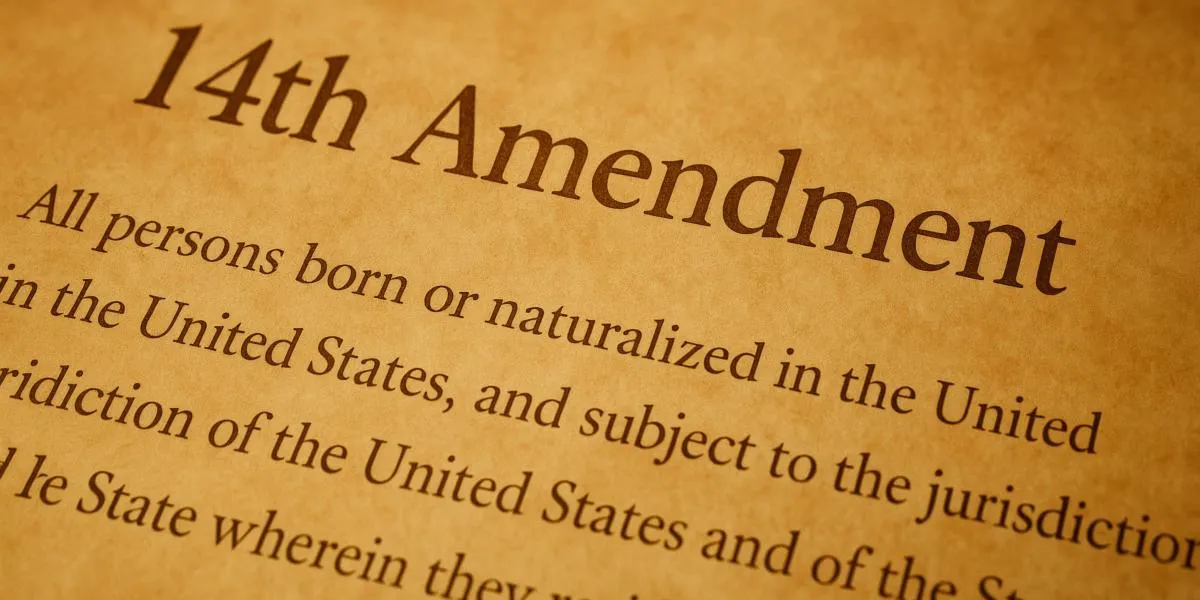
“All persons born or naturalized in the United States and subject to the jurisdiction thereof, are citizens of the United States and of the State wherein they reside. No State shall make or enforce any law which shall abridge the privileges or immunities of citizens of the United States; nor shall any State deprive any person of life, liberty, or property, without due process of law; nor deny to any person within its jurisdiction the equal protection of the laws.”
Summary
Anyone born in the United States is automatically a citizen. States cannot treat people unequally under the law. States cannot take away your life, freedom, or property without a fair legal process. This amendment does what the original Constitution failed to do, it explicitly guarantees equal treatment for everyone.
Why It Was Added, The History
The 14th Amendment was a direct response to the Black Codes, laws passed by Southern states after the Civil War that effectively re-enslaved freed Black Americans by restricting their movement, labor, and legal rights. The amendment was also passed to overrule Dred Scott v. Sandford (1857), which had held that Black people were not citizens. The former Confederate states were required to ratify it as a condition of re-entering the Union.
Congress made ratification a precondition of readmission under the Reconstruction Acts of 1867, and the amendment was declared adopted in July 1868 after the status of several states' votes was disputed.
How It Changed America
The 14th Amendment is the most litigated amendment in US history. Its Equal Protection and Due Process clauses have been the legal foundation for Brown v. Board of Education (school desegregation), Loving v. Virginia (interracial marriage), Obergefell v. Hodges (same-sex marriage), Roe v. Wade, and hundreds of other landmark decisions. Through 'incorporation,' it has also extended most of the Bill of Rights to apply against state governments.
Its reach grew slowly. The Slaughter-House Cases (1873) drained most meaning from the Privileges or Immunities Clause, and Plessy v. Ferguson (1896) read Equal Protection to permit 'separate but equal,' before the modern expansion that began with Brown v. Board of Education in 1954.
The Ongoing Debate
Birthright citizenship, the principle that anyone born on US soil is automatically a citizen, has become one of the most politically charged debates in modern America. Some argue it should be limited to children of citizens or legal residents. Supporters point to the plain text of the amendment and its historical purpose. On June 30, 2026, in Trump v. Barbara, the Supreme Court ruled 6-3 that children born in the U.S. to parents who are unlawfully or temporarily present are citizens at birth, striking down a 2025 executive order.
The Citizenship Clause was written to overturn Dred Scott, and in United States v. Wong Kim Ark (1898) the Court applied it to a child born in the U.S. to Chinese nationals who were themselves barred from citizenship. The meaning of 'subject to the jurisdiction thereof' as applied to children of unauthorized immigrants was settled in their favor by Trump v. Barbara in 2026.
“The right of citizens of the United States to vote shall not be denied or abridged by the United States or by any State on account of race, color, or previous condition of servitude.”
Summary
The government, federal or state, cannot stop you from voting just because of your race, skin color, or the fact that you or your ancestors were enslaved. Every citizen of voting age has the right to vote, regardless of race.
Why It Was Added, The History
The 15th Amendment was the third and final Reconstruction Amendment, ratified five years after the Civil War. It was designed to guarantee Black men the right to vote. The word 'men' is notable, women of all races were still excluded from voting for another 50 years. The amendment passed over fierce Southern opposition and required the remaining former Confederate states to ratify it before being readmitted to Congress.
Ratification was contested even in the North, where several states had rejected Black suffrage in referendums during the 1860s. Congress required Virginia, Mississippi, Texas, and Georgia to ratify both the 14th and 15th Amendments before regaining representation, and the amendment was declared adopted on March 30, 1870.
It split the women's movement. Suffragists Susan B. Anthony and Elizabeth Cady Stanton opposed the amendment for enfranchising Black men while leaving all women out, while Frederick Douglass and others argued Black male suffrage could not be made to wait.
How It Changed America
Despite its clear language, the 15th Amendment was systematically undermined for nearly a century through poll taxes, literacy tests, grandfather clauses, white primaries, and outright violence. It wasn't until the Voting Rights Act of 1965, nearly 100 years after ratification, that the amendment's promise was meaningfully enforced for Black Americans in the South.
The Supreme Court helped hollow it out. United States v. Reese (1876) narrowed the Enforcement Acts, and by 1900 nearly every former Confederate state had rewritten its constitution to disenfranchise Black voters. The Court did strike the Oklahoma grandfather clause in Guinn v. United States (1915) and the Texas white primary in Smith v. Allwright (1944).
Between 1940 and 1970 the share of voting-age Black Southerners who were registered rose from around 3 percent to well over half, most of that gain coming after 1965.
The Ongoing Debate
The Voting Rights Act of 1965 was seen as the law that finally gave teeth to the 15th Amendment. But in Shelby County v. Holder (2013), the Supreme Court struck down a key provision requiring states with histories of voter discrimination to get federal approval before changing voting laws. Critics say this decision opened the door to new voter suppression. Supporters say it removed an outdated burden on states that had changed.
Since Shelby County, the preclearance requirement in Section 5 has been dormant unless Congress adopts a new coverage formula. Section 2, which bars practices that result in racial vote dilution, now does most of the amendment's practical work and was itself narrowed in Brnovich v. Democratic National Committee (2021) and, for redistricting, in Louisiana v. Callais (2026).
“The Congress shall have power to lay and collect taxes on incomes, from whatever source derived, without apportionment among the several States, and without regard to any census or enumeration.”
Summary
Congress can collect taxes on what people and companies earn. The government doesn't have to divide that tax money up by state population. This is what gives the federal government the ability to run an income tax system.
Why It Was Added, The History
Before this amendment, the Supreme Court had ruled in Pollock v. Farmers' Loan & Trust Co. (1895) that a federal income tax was unconstitutional because it wasn't distributed among states based on population. This made it nearly impossible to fund the federal government beyond tariffs and excise taxes. The 16th Amendment overruled Pollock and made the modern income tax system possible.
The country had briefly had an income tax before, to fund the Civil War from 1861 to 1872, and Congress passed another in 1894 that Pollock struck down by a 5-4 vote. President William Howard Taft proposed the amendment in 1909 as a compromise with progressives who wanted an income tax at once.
Ratification was completed on February 3, 1913, when Delaware, Wyoming, and New Mexico pushed the count past the required three-fourths of the states.
How It Changed America
Without the 16th Amendment, the modern federal government could not exist. The income tax funds the military, Social Security, Medicare, highways, national parks, and essentially everything the federal government does. Before its ratification, the federal government was funded almost entirely by tariffs on imported goods.
The first modern income tax, in the Revenue Act of 1913, reached only the top roughly one percent of earners, with a 1 percent base rate and a 7 percent top rate. World War II turned it into a mass tax: the number of filers rose from about 4 million in 1939 to more than 40 million by 1945, and payroll withholding began in 1943.
Today individual and corporate income taxes together supply most federal revenue, alongside the payroll taxes that fund Social Security and Medicare. Tariffs, once the government's main revenue source, now provide only a small fraction.
The Ongoing Debate
The income tax remains one of the most politically contested features of American government. Debates rage constantly over rates, brackets, deductions, corporate taxes, capital gains taxes, and the overall fairness of the system. Some libertarian-leaning groups still argue the amendment was never properly ratified, a claim courts have unanimously rejected.
The top marginal rate has ranged from 7 percent in 1913 to 94 percent during World War II to 37 percent today, and Congress revisits the code constantly, along with the roughly $600 billion annual 'tax gap' between taxes legally owed and taxes actually paid.
'Tax protester' claims that the amendment was never validly ratified, popularized by the activist Bill Benson, have been rejected by every court to consider them, and the IRS lists them among frivolous positions that carry penalties.
“The Senate of the United States shall be composed of two Senators from each State, elected by the people thereof, for six years; and each Senator shall have one vote. The electors in each State shall have the qualifications requisite for electors of the most numerous branch of the State legislatures.”
Summary
Before this amendment, state legislatures, not ordinary voters, chose US senators. The 17th Amendment changed that. Now you vote directly for your senators, just like you vote for your House representative. This made the Senate a more democratic institution.
Why It Was Added, The History
The original system of legislative appointment for senators had become deeply corrupt by the early 1900s. State legislatures were often deadlocked for months or even years over Senate appointments, leaving seats vacant. Wealthy industrialists and political machines openly bribed state legislators for Senate seats. The Progressive Era reform movement pushed hard for direct elections, and the amendment passed with strong public support.
By 1912, roughly 29 states had effectively worked around their legislatures by holding advisory primaries that bound legislators to the popular choice. Deadlocks had left some states without a full Senate delegation for months or years, and the 1900 bribery scandal that led the Senate to refuse William Clark of Montana his seat became a symbol of the problem.
Congress proposed the amendment in May 1912, and it was ratified by April 1913, taking effect for that year's Senate elections.
How It Changed America
The 17th Amendment fundamentally changed the relationship between senators and the public. Senators now answer directly to voters rather than state party bosses. It also meant senators could no longer be easily recalled by state legislatures, they serve out their six-year terms unless they resign or are expelled.
The amendment also set the rule for filling Senate vacancies: a state's governor calls a special election, and, if the state legislature permits, may appoint a temporary senator to serve until that election, the process most states use today.
The Ongoing Debate
Some conservatives and federalists argue the 17th Amendment was a mistake, that it severed the connection between state governments and the federal Senate, weakening the states' ability to check federal power. They argue that when senators were appointed by state legislatures, states had a direct voice in federal legislation. Supporters argue the old system was too corrupt to preserve and that direct democracy is more legitimate.
Repeal resolutions have been introduced in Congress in recent years, none advancing. Defenders of the amendment respond that the pre-1913 system was defined by deadlock and bribery and that no state legislature has petitioned to return to selecting senators itself.
“After one year from the ratification of this article the manufacture, sale, or transportation of intoxicating liquors within, the importation thereof into, or the exportation thereof from the United States and all territory subject to the jurisdiction thereof for beverage purposes is hereby prohibited.”
Summary
Making, selling, or moving alcoholic beverages across the country became illegal one year after this amendment was ratified. It was the first and only time the Constitution was used to ban a legal product entirely.
Why It Was Added, The History
The temperance movement had been building for decades, driven by religious groups and reformers who blamed alcohol for poverty, domestic violence, and crime. World War I provided a final push, grain used for alcohol could feed troops, and many breweries were German-owned. Congress passed the Volstead Act to enforce Prohibition, and the amendment went into effect in January 1920.
The Anti-Saloon League, founded in 1893, ran what is often called the most effective single-issue lobbying campaign in American history. Congress proposed the amendment in December 1917 with a seven-year ratification window, and 46 of the 48 states ratified within about 13 months; only Connecticut and Rhode Island refused.
It was the first amendment to carry a ratification deadline and the first to regulate ordinary private commerce rather than the structure of government. The Volstead Act, passed over President Wilson's veto in October 1919, defined an 'intoxicating' beverage as anything over 0.5 percent alcohol.
How It Changed America
Prohibition did reduce alcohol consumption significantly, but it also created a massive illegal market. Organized crime syndicates like Al Capone's Chicago Outfit made fortunes bootlegging alcohol. Speakeasies (illegal bars) operated openly in every major city. Government corruption spread as police and politicians were bribed. Tax revenue from alcohol disappeared entirely.
Enforcement was badly underfunded: the federal Prohibition Bureau had only about 1,500 agents for the entire country. Liquor cases swamped the federal courts, making up most of the docket in some districts, and urban homicide rates climbed through the 1920s.
Some effects outlasted repeal. Per-capita alcohol consumption stayed below its pre-Prohibition level until the 1970s, and the era permanently expanded federal law-enforcement machinery and the practice of prosecuting organized crime figures for income-tax evasion.
The Ongoing Debate
Prohibition remains the most dramatic policy failure in constitutional history. It is the only amendment ever repealed. Historians debate whether it was an overreach of government power into personal behavior, an early example of good intentions producing terrible consequences, or proof that constitutional amendments should not be used for social engineering. Its legacy colors every modern debate about drug policy and government paternalism.
Scholars still argue over whether it 'worked': drinking and alcohol-related deaths did fall, especially in the early years, but the costs in enforcement, lost revenue, corruption, and organized crime turned public opinion decisively against it by the early 1930s.
“The right of citizens of the United States to vote shall not be denied or abridged by the United States or by any State on account of sex.”
Summary
The government, federal or state, cannot stop any citizen from voting just because they are a woman. Women have the same right to vote as men. This is as simple and clear as any sentence in the Constitution.
Why It Was Added, The History
The women's suffrage movement in America began formally at the Seneca Falls Convention in 1848, where activists passed a Declaration of Sentiments demanding equal rights including the right to vote. It took 72 years of organizing, marching, hunger strikes, and lobbying to win. Tennessee became the deciding 36th state to ratify in August 1920, by a single vote, when 24-year-old state legislator Harry Burn changed his mind after receiving a letter from his mother urging him to 'be a good boy' and support women's suffrage.
A federal suffrage amendment was first introduced in Congress in 1878 and became known as the 'Anthony Amendment.' Congress finally passed it in June 1919, after the National American Woman Suffrage Association's state-by-state campaign and the more militant National Woman's Party's White House pickets, arrests, and force-feedings of hunger strikers in 1917.
How It Changed America
The 19th Amendment doubled the potential electorate overnight. It is one of the largest expansions of voting rights in American history. It gave women the ability to directly participate in shaping the laws that governed their lives for the first time in the nation's history.
About 26 million women became eligible to vote. Turnout among women lagged men's for decades before converging; since 1980, women have voted at a higher rate than men in every presidential election.
The Ongoing Debate
While the amendment's text is universal, Native American women (and men) could not vote in most states until 1924, and many Asian American women faced further barriers. Black women in the South faced the same voter suppression tactics as Black men and were not fully enfranchised until the Voting Rights Act of 1965. The 19th Amendment was a landmark, but it was the beginning of equal voting rights, not the end.
In Leser v. Garnett (1922) the Supreme Court rejected a challenge to the amendment's validity, confirming that ratifying states could not take their approval back. The suffrage movement's own record on race, including the sidelining of Black suffragists such as Ida B. Wells at the 1913 suffrage parade in Washington, is now a standard part of how the era is taught.
“The terms of the President and Vice President shall end at noon on the 20th day of January, and the terms of Senators and Representatives at noon on the 3d day of January, of the years in which such terms would have ended if this article had not been ratified; and the terms of their successors shall then begin.”
Summary
Before this amendment, newly elected presidents didn't take office until March 4, four full months after Election Day. Defeated presidents and members of Congress continued governing for months as unaccountable 'lame ducks.' This amendment moved inauguration to January 20 and the start of congressional terms to January 3, cutting that window nearly in half.
Why It Was Added, The History
In the early 1900s, a four-month gap between election and inauguration made some sense, communication and travel were slow. By the 1930s it had become a serious problem. After FDR won in November 1932, the country had to endure four more months of Herbert Hoover's failed Depression-era leadership while FDR couldn't officially act. Senator George Norris of Nebraska pushed the amendment through, and it was ratified in early 1933.
Norris had introduced versions of the 'Lame Duck Amendment' throughout the 1920s, and the Senate passed it six times before the House agreed. It was proposed in March 1932 and ratified by January 1933, taking effect in October 1933, so the first January 3 opening of Congress came in 1934 and the first January 20 inauguration was FDR's second, in 1937.
How It Changed America
The January 20 inauguration date is now so standard that most people don't realize it was ever different. The amendment also addresses what happens if a president-elect dies between election and inauguration, the vice president-elect becomes president, and Congress handles it if neither is available.
Section 3 covers a president-elect who dies before Inauguration Day (the vice president-elect becomes president) and the case where no president has been chosen by January 20 (the vice president-elect acts as president). Section 4 authorizes Congress to legislate for the death of a contingent-election candidate during the House or Senate process.
The amendment also ended the old December-to-March 'short session' of a Congress that had already been voted out; the newly elected Congress now convenes on January 3.
The Ongoing Debate
Some have argued the lame duck period is still too long, that from November to January 20, a defeated president retains full power including the ability to issue pardons, make appointments, and conduct foreign policy. The period between the November 2020 election and the January 20, 2021 inauguration, and the events of January 6, reignited this debate.
The transition window is still about 11 weeks, and a departing president keeps every power of the office throughout it, including the pardon power and command of the armed forces. Proposals to shorten the period further or to limit lame-duck actions resurface after contentious transitions.
“The eighteenth article of amendment to the Constitution of the United States is hereby repealed. The transportation or importation into any State, Territory, or possession of the United States for delivery or use therein of intoxicating liquors, in violation of the laws thereof, is hereby prohibited.”
Summary
Prohibition is over. Alcohol is legal again. This amendment canceled the 18th Amendment entirely. It's the only time in US history that one constitutional amendment has directly repealed another. The second section still allows individual states to regulate or ban alcohol within their borders.
Why It Was Added, The History
By the early 1930s, the failures of Prohibition were undeniable, organized crime, corruption, disrespect for the law, and lost tax revenue. The Great Depression made the economic argument for repeal even stronger, alcohol taxes could generate badly needed government revenue and create jobs. FDR campaigned partly on repeal. The amendment moved from proposal to ratification in about 288 days, one of the fastest ratifications in history (only the 26th Amendment, at about 100 days, and a few others were quicker).
Congress specified ratification by state conventions rather than legislatures, the only time that method has been used, partly to route around rural, dry-leaning legislatures. Conventions in 38 states acted within about 10 months, and Utah cast the deciding vote on December 5, 1933.
How It Changed America
Alcohol became legal again on December 5, 1933. The federal government was immediately back in the alcohol tax business. Organized crime syndicates lost a major revenue source, though they pivoted to other illegal enterprises. Many states and counties retained their own prohibition laws, and some still do today. Hundreds of 'dry' counties still exist across the United States, particularly in the South.
Section 2 gives states unusually broad power over alcohol within their borders, which is why Mississippi stayed entirely dry until 1966. The Supreme Court has since limited that power where it collides with other constitutional rules, as in Granholm v. Heald (2005), which struck down state laws that let in-state wineries ship directly to consumers while barring out-of-state ones.
The Ongoing Debate
The 21st Amendment is both a historical lesson and an ongoing policy question. It demonstrates that constitutional amendments can be catastrophic mistakes that need to be undone. It also left alcohol regulation to the states, which is why you can drink 18-year-old bourbon in one state and face restrictions in another. The broader debate about whether personal behavior should be regulated at the constitutional level continues to resonate in discussions about drug legalization.
It is the only amendment ratified by state conventions and the only one to repeal another amendment, and it is regularly cited in arguments about whether the Constitution is the right tool for regulating personal conduct, a question that recurs in cannabis- and drug-legalization debates.
“No person shall be elected to the office of the President more than twice, and no person who has held the office of President, or acted as President, for more than two years of a term to which some other person was elected President shall be elected to the office of the President more than once.”
Summary
No one can be elected president more than twice. If you took over as president mid-term and served more than two years, you can only be elected once after that, meaning no one can serve more than 10 years total as president.
Why It Was Added, The History
George Washington set the two-term tradition in 1796 when he voluntarily stepped down. Every president followed that tradition for 144 years, until Franklin D. Roosevelt ran for a third term in 1940 and won, then ran for a fourth in 1944 and won again. He died in office in 1945. After WWII, the Republican-controlled Congress moved quickly to make the two-term limit a constitutional requirement.
The Republican-led 80th Congress proposed the amendment in March 1947, and it was ratified in February 1951. By its own terms it exempted the sitting president, Harry Truman, who briefly considered running again in 1952 before withdrawing after the New Hampshire primary.
How It Changed America
Every president since 1951 has been constitutionally limited to two terms. Some presidents who might have run for a third term, Eisenhower, Reagan, Clinton, Obama, were prevented from doing so. The amendment also means that in a president's second term, they are immediately a 'lame duck', unable to run again, which affects their political leverage.
No one has served more than two terms since ratification. The text does leave one narrow path to nearly 10 years: a vice president who succeeds to the office with less than two years left in the term may still be elected twice in their own right.
The Ongoing Debate
Opinions on term limits have flip-flopped along partisan lines depending on who is in office. Some argue term limits prevent the accumulation of too much power in one person. Others argue they deprive the country of experienced leadership and let voters, not rules, decide how long a president should serve. Some have argued the limit should be extended to three terms or abolished entirely.
Members of both parties have periodically introduced repeal resolutions, and none has come close to passage. Supporters of the limit invoke the anti-monarchical thinking behind Washington's precedent; opponents call it undemocratic to bar voters from re-electing a president they want to keep.
“The District constituting the seat of Government of the United States shall appoint in such manner as the Congress may direct: A number of electors of President and Vice President equal in number to the whole number of Senators and Representatives in Congress to which the District would be entitled if it were a State, but in no event more than the least populous State...”
Summary
Washington DC, the nation's capital, gets to participate in presidential elections. It receives 3 electoral votes, which is the minimum any state gets. Before this amendment, the roughly 800,000 people living in DC had no say at all in who became president.
Why It Was Added, The History
It was an embarrassing contradiction, citizens living in the capital of the world's leading democracy had no vote in presidential elections. DC residents paid federal taxes, served in the military, and lived under federal laws, but couldn't vote for president. The amendment was ratified during the Civil Rights Movement, which highlighted the hypocrisy of denying voting rights to a majority-Black city.
Congress proposed the amendment in June 1960, and the states ratified it in under nine months, by March 29, 1961. The District's population was then roughly 54 percent Black.
How It Changed America
DC has voted in every presidential election since 1964. It consistently votes heavily Democratic. The amendment gave DC 3 electoral votes but no voting representation in Congress, DC still has no voting senators or representatives. Delegate Eleanor Holmes Norton can debate in the House but cannot vote on final legislation.
The District has cast three electoral votes in every election since 1964, always for the Democratic nominee, usually by the widest margin in the country. The amendment caps the District at the electoral-vote total of the least populous state, so it cannot gain a fourth vote no matter how much its population grows.
The Ongoing Debate
DC statehood and full congressional representation remain active political debates. Supporters argue DC residents deserve the same representation as citizens of any state. Opponents argue DC statehood would require a constitutional amendment, that the founders intended the capital to be distinct from states, and that the heavily Democratic city would give one party a permanent advantage in the Senate.
Because the amendment ties the District's electoral votes to its status as the 'seat of Government,' granting statehood to the residential areas would raise the question of whether the 23rd Amendment should be repealed so that the small remaining federal enclave does not keep three electoral votes; the 2020 and 2021 House statehood bills paired statehood with an expedited repeal.
“The right of citizens of the United States to vote in any primary or other election for President or Vice President, for electors for President or Vice President, or for Senator or Representative in Congress, shall not be denied or abridged by the United States or any State by reason of failure to pay any poll tax or other tax.”
Summary
No government, federal or state, can require you to pay a fee or tax in order to vote in a federal election. The vote is free. You cannot be turned away from the polls because you're too poor to pay a voting fee.
Why It Was Added, The History
Poll taxes had been used since Reconstruction specifically to prevent poor Black Americans from voting. Even a small tax, like $1.50, was enough to disenfranchise sharecroppers and domestic workers living in poverty. Five Southern states still had poll taxes for federal elections when this amendment was ratified in 1964, the same year as the Civil Rights Act.
Those five states were Alabama, Arkansas, Mississippi, Texas, and Virginia. In several of them the tax was cumulative, meaning a would-be voter had to pay for every year they had missed, which put voting permanently out of reach for many poor citizens of both races.
How It Changed America
The 24th Amendment eliminated poll taxes for federal elections. Two years later, the Supreme Court ruled in Harper v. Virginia Board of Elections (1966) that poll taxes for state elections also violated the Equal Protection Clause of the 14th Amendment, effectively ending poll taxes everywhere. The amendment is one of several Civil Rights Era reforms that dismantled the legal architecture of voter suppression.
The Voting Rights Act of 1965 reinforced it by directing the Attorney General to challenge any remaining poll taxes in court, and Harper finished the job for state and local elections a year later.
The Ongoing Debate
Modern debates about voter ID laws echo the poll tax debate. Supporters of voter ID laws argue they prevent fraud. Critics argue that requiring government-issued photo ID, which costs money and time to obtain, functions as a modern poll tax that disproportionately affects poor, elderly, and minority voters. Courts have split on this question.
The Supreme Court upheld Indiana's photo-ID law in Crawford v. Marion County Election Board (2008), finding the burden not clearly excessive, while other state ID laws have been struck down on separate grounds. Litigation continues over whether the combined cost of an ID and the underlying birth or residency documents amounts to an unconstitutional charge on voting.
“Section 1: In case of the removal of the President from office or of his death or resignation, the Vice President shall become President. Section 2: Whenever there is a vacancy in the office of the Vice President, the President shall nominate a Vice President who shall take office upon confirmation by a majority vote of both Houses of Congress. Section 3: Whenever the President transmits to the President pro tempore of the Senate and the Speaker of the House of Representatives his written declaration that he is unable to discharge the powers and duties of his office... the Vice President shall immediately assume the powers and duties of the office as Acting President.”
Summary
If the president dies, resigns, or is removed, the VP immediately becomes president. If the VP job is empty, the president nominates a new one who Congress must confirm. A president who knows they'll temporarily be unable to work (like during surgery) can hand power to the VP. And if the president is incapacitated but won't step aside, the VP and Cabinet can take over by notifying Congress.
Why It Was Added, The History
JFK's assassination in 1963 exposed a dangerous gap in the law. LBJ became president with no VP for 14 months. If he had died during that time, Speaker John McCormack, 71 years old and not considered ready for the presidency, would have been next in line. Congress passed the 25th Amendment to create clear, detailed rules for every scenario of presidential incapacity.
Sixteen vice presidents had already left the office empty through death, resignation, or their own succession, with no way to fill it, and the Constitution's original disability language in Article II never defined 'inability' or said who decides. Senator Birch Bayh of Indiana was the amendment's chief author, and it was ratified in February 1967.
How It Changed America
The 25th Amendment has been invoked several times. Section 3 was used when President Reagan underwent surgery in 1985, when President George W. Bush had colonoscopies in 2002 and 2007, and when President Biden had a colonoscopy in 2021. Section 2 was used twice, Gerald Ford was nominated and confirmed as VP in 1973 after Spiro Agnew resigned, and Nelson Rockefeller was confirmed as VP in 1974 after Ford became president.
The 1973-74 sequence was its most consequential use: Ford filled the vacancy left by Agnew's resignation, then succeeded the resigned Nixon, then Rockefeller filled the vice presidency, so for a stretch neither the president nor the vice president had been elected to national office.
The Ongoing Debate
Section 4, the involuntary transfer of power, has never been used, but it has been discussed seriously. During both the final months of the Trump administration and discussions about aging presidents, Section 4 has come up as a potential tool. The bar is deliberately high, it requires the VP and a majority of the Cabinet, but the process itself is unclear about what happens if a president disputes the declaration.
If the president contests the declaration, Section 4 gives Congress 21 days to decide, and it takes a two-thirds vote of both chambers to keep power with the vice president. Scholars have flagged unresolved questions, including exactly which officials count as the 'Cabinet' and how the timetable would work in a fast-moving medical emergency.
“The right of citizens of the United States, who are eighteen years of age or older, to vote shall not be denied or abridged by the United States or by any State on account of age.”
Summary
If you are 18 years old or older and a US citizen, you have the right to vote. No government, federal or state, can deny you the vote just because of your age. The voting age was lowered from 21 to 18.
Why It Was Added, The History
The driving force was the Vietnam War. Young Americans were being drafted at age 18, sent to fight and die in Southeast Asia, but couldn't vote for the politicians who sent them. The rallying cry was: 'Old enough to fight, old enough to vote.' Congress first tried to lower the voting age through regular legislation in the Voting Rights Act of 1970. The Supreme Court ruled that Congress could only do so for federal elections, not state ones. To avoid having two separate voter registration systems, Congress quickly passed this amendment, which was ratified in just 100 days, one of the fastest ratifications in history.
That Supreme Court ruling was Oregon v. Mitchell (1970), decided 5-4, which would have forced states to keep two sets of voter rolls, one for federal contests and one for state and local ones. Congress proposed the amendment in March 1971, and the states completed ratification by July 1, 1971.
How It Changed America
The 26th Amendment added approximately 11 million new voters to the electorate overnight. Young voters (18-24) have been a significant demographic in every election since. The amendment applies to all elections, federal, state, and local. Some jurisdictions have since lowered the local voting age to 16 for municipal elections, arguing that if 18-year-olds can vote, 16-year-olds paying taxes and following laws should too.
Turnout among 18-to-24-year-olds has consistently been the lowest of any age group, though it rose sharply in the 2018 midterms and the 2020 presidential election.
The Ongoing Debate
Some researchers argue that lowering the voting age to 18 didn't produce the engaged youth electorate its supporters hoped for, turnout among 18-24 year olds has historically been the lowest of any age group. Others counter that low youth turnout is a symptom of systemic barriers like student address changes, same-day registration rules, and inconvenient polling locations, not evidence that the voting age should be raised. Some advocate lowering it further to 16.
A handful of cities, including Takoma Park, Maryland, and several in California, have lowered the voting age to 16 for local elections, citing civic-education benefits and the fact that many 16-year-olds work and pay taxes. Opponents question the political maturity of younger teens, and courts have generally treated 18 as a policy floor rather than a ceiling.
“No law, varying the compensation for the services of the Senators and Representatives, shall take effect, until an election of Representatives shall have intervened.”
Summary
If Congress votes to give itself a pay raise, that raise doesn't kick in until after the next congressional election. That way, voters get to weigh in before their representatives start collecting more money. Congress can't vote itself a raise and start collecting it the next day.
Why It Was Added, The History
This is the most improbable amendment in the Constitution's history. James Madison originally proposed it in 1789 as one of the 12 amendments sent to states with the Bill of Rights. Only 6 states ratified it, so it sat dormant. In 1982, University of Texas student Gregory Watson was writing a paper on the amendment process, noticed this ratification was never formally closed, and started a campaign to get more states to ratify it. He got a C on the paper. Over the next decade, his campaign succeeded. By May 7, 1992, 202 years and 10 months after Madison proposed it, enough states had ratified it to become the 27th Amendment. Watson's professor later changed his grade to an A.
Madison's pay proposal was one of two of the original twelve amendments the states did not ratify in 1791; the other, on the size of congressional districts, is technically still pending. When Michigan and New Jersey ratified in May 1992, the National Archivist certified the amendment despite the 203-year gap, and the House and Senate then passed resolutions accepting it.
How It Changed America
The 27th Amendment applies to every pay adjustment for members of Congress. It doesn't prevent raises, it just delays them. Congress has used cost-of-living adjustments and other mechanisms to adjust pay within the amendment's constraints. Congressional pay has largely been frozen in recent years due to political pressure, members have been reluctant to vote themselves raises at all.
In practice the amendment only pushes a raise past the next House election. Since 1989, congressional pay has moved mainly through automatic annual cost-of-living increases under the Ethics Reform Act, a mechanism the courts upheld against a 27th Amendment challenge in Boehner v. Anderson (1992). Members have declined the automatic raise every year since 2009, leaving the salary at $174,000.
The Ongoing Debate
The 27th Amendment's unusual ratification process raised constitutional questions about whether states could ratify an amendment 200 years after it was proposed. Congress accepted the ratification without formally certifying whether the process was valid. Some constitutional scholars argue there should be a time limit on ratification, the same question has come up regarding the Equal Rights Amendment, whose deadline has also been disputed.
In Coleman v. Miller (1939) the Supreme Court said the timeliness of a ratification is a 'political question' for Congress to resolve rather than the courts, and that reasoning is now central to the fight over the Equal Rights Amendment, which three states ratified decades after its deadline.
Notable Amendments That Never Made It
For every amendment that passed, others were proposed and failed. Some of the most revealing, and chilling, are the ones that never made it:
Would have permanently and irrevocably protected slavery from federal interference, essentially making slavery a constitutional right that could never be abolished. It actually passed Congress and was signed by outgoing President Buchanan just before Lincoln took office. Lincoln didn't oppose it, hoping it would prevent secession. Five states took ratifying action before the Civil War rendered it moot.
It was the original proposed 'Thirteenth Amendment,' introduced by Representative Thomas Corwin of Ohio and Senator William Seward of New York. Congress passed it on March 2, 1861, two days before Lincoln's inauguration, and Lincoln noted in his first inaugural address that he had 'no objection' to such a provision being made explicit and unchangeable.
Ohio, Maryland, and Illinois took ratifying action in 1861 and 1862; Ohio and Maryland later voted to rescind. The outbreak of war and the eventual actual 13th Amendment abolishing slavery made it a dead letter, though Congress never formally withdrew it.
Buchanan's signature had no legal effect. The Supreme Court held in Hollingsworth v. Virginia (1798) that proposed amendments do not need the president's approval, which is why presidents rarely sign them; Lincoln's signature on the 13th Amendment resolution in 1865 was also symbolic. The proposed amendments page covers the Corwin Amendment's current status, and the Civil War page covers the crisis it tried to prevent.
Would have explicitly prohibited discrimination based on sex. Passed Congress in 1972 with a 7-year ratification deadline. Only 35 of the needed 38 states ratified it by the deadline, short by 3 states. Congress later extended the deadline. By 2020, Virginia became the 38th state to ratify, but whether ratification after an expired deadline counts is unresolved and being litigated. The ERA remains in legal limbo.
The amendment was first drafted by suffragist Alice Paul in 1923. Congress passed it in 1972 by 354 to 24 in the House and 84 to 8 in the Senate, setting a seven-year deadline that it later pushed to 1982. Thirty-five states ratified by 1977, and five (Idaho, Kentucky, Nebraska, Tennessee, and South Dakota) voted to rescind their approval.
Nevada ratified in 2017, Illinois in 2018, and Virginia in 2020, reaching the 38-state threshold but long after the deadline. The Justice Department's Office of Legal Counsel and a federal court have concluded the deadline is binding; supporters argue Congress can remove it retroactively, and bills to do so have passed the House but stalled in the Senate.
While the federal amendment stalled, about two dozen states added their own equal rights guarantees to their state constitutions, many of them in the 1970s. The proposed amendments page tracks the federal ERA's disputed status in detail.
Would have given Congress the power to regulate or prohibit labor by persons under 18. Only 28 states ratified it, short of the needed 36 (at the time). The Supreme Court's eventual upholding of federal child labor laws under the commerce clause made it largely unnecessary, but it was never formally ratified.
Congress proposed it in 1924 after the Supreme Court struck down two earlier federal child-labor laws, in Hammer v. Dagenhart (1918) and Bailey v. Drexel Furniture Co. (1922). Ratification stalled against opposition from farm groups, textile manufacturers, and, in some states, the Catholic Church, which feared federal control over family and parochial schooling.
The amendment became moot after the Fair Labor Standards Act of 1938 set federal child-labor rules and the Court, in United States v. Darby (1941), overruled Hammer v. Dagenhart and affirmed federal power to regulate labor conditions. Because Congress attached no deadline, the amendment is technically still pending before the states.
The amendment also produced the Supreme Court's leading case on ratification. In Coleman v. Miller (1939), a dispute over whether Kansas could ratify after first rejecting it, the Court held that such timing questions are for Congress to resolve. Child labor rules today are enforced by the Department of Labor.
Would have given Washington DC full representation in Congress, senators and voting House members, as if it were a state. Only 16 of the needed 38 states ratified it before the 7-year deadline expired in 1985. DC statehood legislation has been passed by the House in recent years but stalled in the Senate.
Congress proposed it in August 1978 with a seven-year deadline. The amendment would have repealed the 23rd Amendment and treated the District as a state for purposes of House and Senate representation and the Electoral College, without actually making it a state.
Only 16 states ratified before the deadline ran out in August 1985, with support concentrated in the Northeast and West and most Southern and Mountain West states declining. Since 2000, the District's license plates have carried the slogan 'End Taxation Without Representation.'
The District already has a voice in presidential elections: the Twenty-third Amendment, ratified in 1961, gave it three votes in the Electoral College. The House passed D.C. statehood bills in 2020 and again in 2021, the second by 216-208, but the Senate did not act on either.
Quick Reference
Did You Know?
The Constitution was almost amended to protect slavery forever
In March 1861, just before the Civil War, Congress passed the Corwin Amendment, which would have made slavery permanently protected from federal interference. Lincoln didn't oppose it. Five states took ratifying action before the war made it irrelevant. It's never been formally rejected, technically still 'pending' ratification, though obviously unenforceable.
One amendment was ratified faster than any other
The 26th Amendment, lowering the voting age to 18, was ratified in just 100 days after Congress passed it in 1971. States rushed to ratify because there were already two voter registration systems in place (one for federal elections where 18-year-olds could vote, one for state elections where they couldn't) and the administrative chaos was unworkable.
The 18th Amendment is the only one ever repealed
Of the 27 amendments ever ratified, only one has been struck down by a later amendment. Prohibition (18th) was repealed by the 21st, making alcohol constitutional again in 1933. It remains the most dramatic reversal in constitutional history and a cautionary tale about using the Constitution for social engineering.
Congress tried to give itself an immediate raise, once
The 27th Amendment only exists because Madison anticipated exactly this problem in 1789. Members of the First Congress were already talking about pay raises. Madison specifically wrote this amendment to prevent immediate self-enrichment. It sat dormant for 202 years before becoming law, proof that constitutional provisions don't expire.