Not One System, but Many
The United States has no single government health system. It has at least eight major federal programs, built at different times for different groups of people, run by different agencies under different rules. Together they cover well over a third of the population and account for more than a quarter of the federal budget.
What Counts as Government-Run?
People use the phrase government-run health care to mean very different things. In some programs the government is only the insurer: it pays the bills while private doctors and hospitals provide the care. In others it owns the hospital and employs the surgeon. In still others it simply gives people money, through the tax code, to buy private insurance. The United States does all three at once.
This page covers every program in which federal money pays for medical care, and the agencies that run them, most of which belong to the executive branch departments. It does not cover state and local public hospitals, or private insurance beyond the federal subsidies that support it.
A person can be in more than one program. About 12 million people have both Medicare and Medicaid, many veterans have Medicare as well as VA care, and military retirees over 65 have Medicare and TRICARE together. The enrollment figures on this page should not be added up, because the total would count those people twice.
The numbers are large enough to be hard to picture. Medicare and Medicaid each cover more people than live in California and Florida combined, and the federal government spends more on health than on Social Security, and more than twice what it spends on defense.
The Programs at a Glance
Enrollment is the latest available in November 2026. Costs are federal outlays for fiscal year 2026.
| Program | Who it covers | People | Federal cost | Run by |
|---|---|---|---|---|
| Medicare | People 65 and older, and younger people with long-term disabilities or kidney failure | 70.3 million | $1.28 trillion | Centers for Medicare & Medicaid Services (HHS) |
| Medicaid | Low-income adults, children, pregnant women, people with disabilities, and nursing home residents | 65.7 million | $723 billion (federal share) | Each state, under federal rules set by CMS |
| CHIP | Children in families that earn too much for Medicaid but cannot afford private coverage | 7.2 million | $25 billion (federal share) | Each state, under federal rules set by CMS |
| ACA marketplaces | People who buy their own private insurance, most with a federal tax credit | 23.1 million | $126 billion | CMS (HealthCare.gov) and state exchanges; the IRS pays the credits |
| Veterans Health Administration | Enrolled military veterans | 9.1 million | $113 billion | Department of Veterans Affairs |
| Military Health System (TRICARE) | Active-duty troops, military retirees, and their families | 9.5 million | About $60 billion | Defense Health Agency |
| Indian Health Service | Members of 574 federally recognized tribes | 2.8 million | $10 billion | Indian Health Service (HHS) and tribes themselves |
| Federal employee plans (FEHB and PSHB) | Federal and postal workers, retirees, and their families | 8.2 million | $76 billion (paid to plans) | Office of Personnel Management |
Medicare is shown before premiums ($1.07 trillion after them). The federal employee figure includes premiums paid by workers and retirees. The military figure is a Congressional Research Service estimate; the Treasury statement does not report it separately. People enrolled in two programs are counted in both.
Five Roles the Government Plays
The programs differ less in whom they cover than in what the government actually does. There are five basic arrangements.
In Medicare, the federal government acts as an insurance company. It collects payroll taxes and premiums, sets what it will pay for each service, and pays the claims. It does not own the hospitals or employ the doctors. A person on Medicare sees private physicians and uses private or nonprofit hospitals, and the bill goes to Washington.
Even the claims processing is contracted out. Private companies called Medicare Administrative Contractors handle the paperwork for traditional Medicare, and more than half of all beneficiaries, 36.0 million of 70.3 million in April 2026, are in Medicare Advantage plans run by private insurers that the government pays a fixed monthly amount per person.
Medicare grew out of the same 1935 law that created retirement benefits, and its hospital insurance is funded the same way, through a payroll tax held in a trust fund. The page on Social Security covers how those trust funds work and why they can run short.
This design, public money and private care, is what most other programs on this page copy in one form or another. It is also why arguments about Medicare are usually arguments about prices and payment rules, since the government writes the checks but does not run the operating rooms.
Medicaid and the Children's Health Insurance Program are joint ventures. Each state designs and runs its own program inside federal rules, and the federal government pays a share of every dollar the state spends. There is no single national Medicaid. There are 56 of them, counting the District of Columbia and the territories, with different names, different income limits, and different benefits.
The federal share is set by a formula tied to each state's average income. For fiscal year 2027 it ranges from the legal floor of 50 percent in ten higher-income states, including California, New York, and Massachusetts, up to 77.32 percent in Mississippi. For adults covered under the 2010 expansion, Washington pays 90 percent in every state.
Because the match has no fixed ceiling, federal spending rises automatically when a state enrolls more people or pays providers more. That open-ended structure is the reason Medicaid can absorb a recession or a pandemic quickly, and it is also the feature that proposals for block grants and per-person caps are aimed at.
Most states in turn hire private managed care companies to run day-to-day coverage. A Medicaid card in many states carries an insurance company's logo, even though nearly all of the money behind it comes from state and federal taxpayers.
Three federal systems deliver care directly. The Veterans Health Administration, the Military Health System, and the Indian Health Service own hospitals and clinics and employ the physicians and nurses who work in them. This is the closest thing in the United States to the British model, where the state is the provider, and the Department of Veterans Affairs runs the largest of the three.
The veterans system alone has about 170 medical centers and nearly 1,200 outpatient sites, which makes it the largest integrated health care system in the country. The military system operates hospitals and clinics on bases around the world. The Indian Health Service and the tribes run hospitals, health centers, and village clinics, many in remote places with no other provider for a hundred miles.
None of the three is purely government-run any longer. All of them buy a large and growing share of care from private providers when their own facilities are too far away or too busy. About 40 percent of veterans' care was purchased in the community in fiscal year 2023, according to the Government Accountability Office.
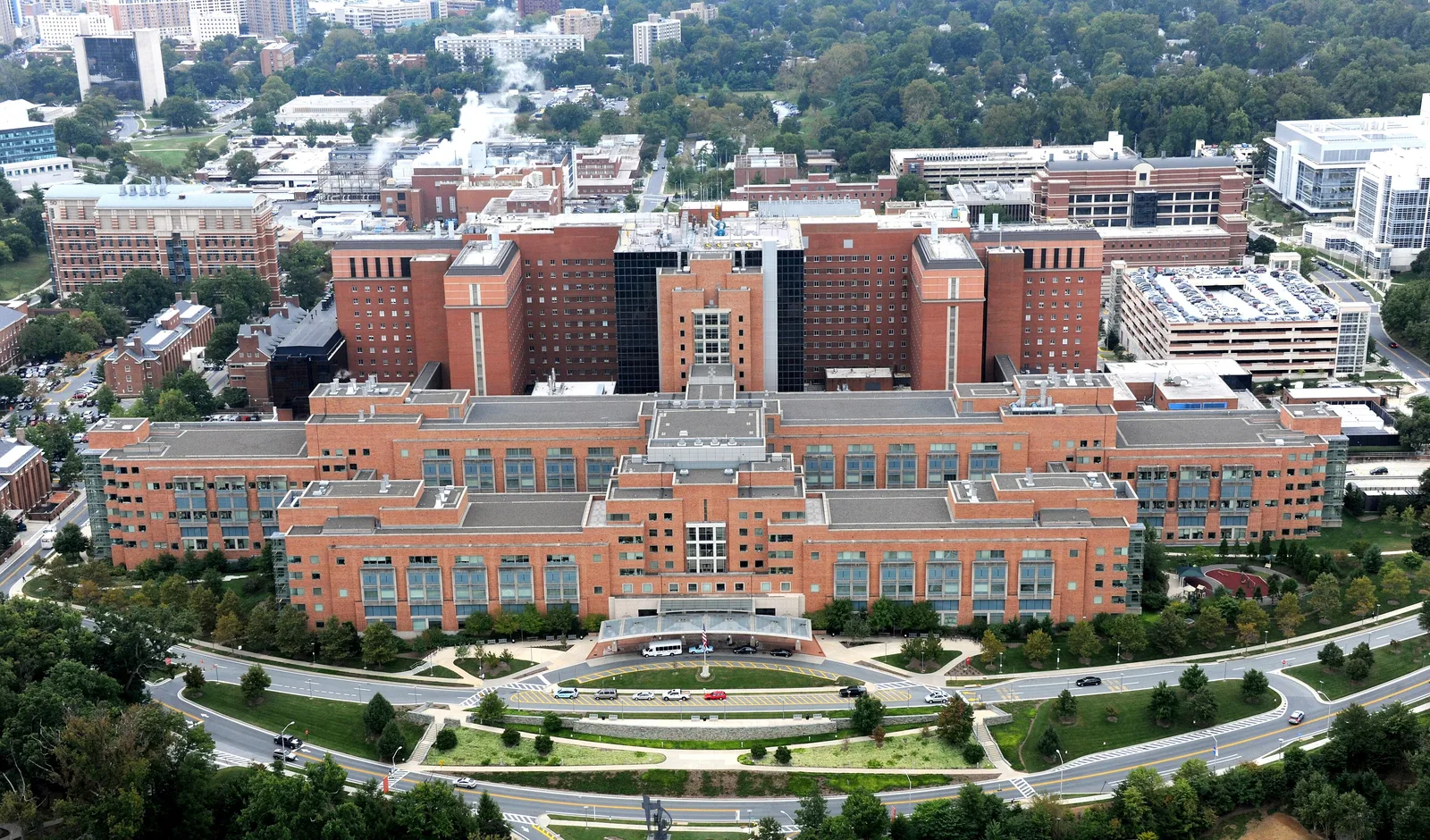
The federal government also runs smaller direct-care systems that rarely make the news: the Bureau of Prisons cares for about 155,000 people in federal custody, the ICE Health Service Corps staffs immigration detention clinics, and the National Institutes of Health operates its own research hospital in Bethesda, Maryland, shown at the top of this page.
Like any large employer, the federal government offers health insurance to its workers. The Federal Employees Health Benefits program, which began covering people in 1960, does not insure anyone itself. The Office of Personnel Management negotiates with private insurers and offers the resulting plans to employees, who choose one each fall during Open Season.
The government pays 72 percent of the average premium across all plans, with a cap of 75 percent of any single plan's premium, and the worker pays the rest. Retirees can keep the coverage, which is one reason the program covers about 8.2 million people, far more than the number of active civilian employees.
Postal workers and retirees moved into their own Postal Service Health Benefits program on January 1, 2025, under the Postal Service Reform Act of 2022. For 2027 the two programs together offer more than 180 plan options from dozens of carriers.
Members of Congress and their staff are a special case. A provision of the 2010 Affordable Care Act moved them out of the federal employee program and requires them to buy coverage through the District of Columbia's insurance exchange, with the government still paying its usual employer share.
The federal government also pays for coverage it has nothing to do with running. The largest example is invisible: money an employer spends on a worker's health insurance is not counted as taxable income. The Congressional Budget Office and the Joint Committee on Taxation put the cost of that exclusion at roughly $470 billion for 2026 when income and payroll taxes are both counted, which makes it one of the largest breaks in the tax code that the IRS administers.
The exclusion began almost by accident. Wage controls during World War II kept employers from raising pay, so they competed for workers with benefits instead, and a 1954 tax law made the favorable treatment permanent. It is the main reason most working-age Americans get insurance through a job.
The second example is the premium tax credit created by the Affordable Care Act. People who buy insurance on a marketplace and earn between one and four times the poverty level get a credit, usually paid straight to the insurer each month, that limits what they owe to a percentage of their income.
Counting the tax break, the credits, and the programs above, government at all levels pays for well over half of the country's health care. The United States does not have one government-run system. It has a private delivery system financed, to a degree many people do not realize, with public money.
Eight Programs and a Safety Net
Each program below was created to cover a group that the private market was not reaching: the old, the poor, children, veterans, soldiers, tribal nations, and the government's own workers. Open any one to see who qualifies, how it works, and what it cost last year.
Medicare is federal health insurance for people 65 and older, people who have received disability benefits for 24 months, and people with permanent kidney failure or ALS. It has four parts. Part A covers hospital stays, Part B covers doctor visits and outpatient care, Part C (Medicare Advantage) is the private-plan alternative to both, and Part D covers prescription drugs.
Most people pay no premium for Part A because they or a spouse paid Medicare payroll taxes for at least ten years. Part B is optional and carries a premium: $202.90 a month in 2026 and $209.40 in 2027, with higher-income enrollees paying more. The Part A hospital deductible is $1,736 in 2026, and out-of-pocket spending on Part D drugs is capped at $2,100 for the year.
Medicare paid out $1.28 trillion in fiscal year 2026, according to the Treasury: $468 billion from the hospital insurance trust fund and $817 billion from the fund for Parts B and D. Enrollees paid back roughly $212 billion in premiums and other receipts, leaving a net cost of $1.07 trillion. The program's own administrative accounts came to $9.2 billion, under 1 percent of the total, a figure that does not include the overhead of the private plans it pays.
The 2022 Inflation Reduction Act gave Medicare the power to negotiate prices for some high-cost drugs for the first time. Negotiated prices for the first ten drugs took effect on January 1, 2026, and prices for fifteen more, including the diabetes and weight-loss drugs Ozempic and Wegovy, take effect in 2027.
Medicaid covers people with low incomes, and it is the largest single source of health coverage in the country outside of employers. In July 2026 it covered 65.7 million people. It pays for about four in ten births, covers most nursing home residents once their savings are gone, and is the main payer for long-term care for people with disabilities, a benefit Medicare does not provide.
Eligibility depends on where a person lives. The Affordable Care Act offered states extra federal money to cover nearly all adults earning up to 138 percent of the poverty level, and 40 states and the District of Columbia have done so. In the ten states that have not, many adults without children cannot qualify at any income.
The federal government spent $723 billion on Medicaid in fiscal year 2026, up from $668 billion the year before. States add their own share on top, which brings total spending to roughly $1 trillion a year. For most states it is the largest source of federal money in the budget.
The 2025 budget law (Public Law 119-21) made the largest changes to the program since it began. Starting January 1, 2027, adults covered under the expansion must document 80 hours a month of work, school, or community service to keep coverage, and their eligibility will be rechecked every six months instead of once a year. The Congressional Budget Office estimated that the law would reduce federal Medicaid spending by about $900 billion over ten years and that about 10 million more people would be uninsured in 2034. The way that law moved through Congress is covered on the page about the federal budget process.
CHIP covers children, and in some states pregnant women, in families that earn too much to qualify for Medicaid but too little to afford private insurance. Congress created it in 1997 with support from both parties, and in July 2026 it covered 7.2 million children.
Like Medicaid it is run by the states with federal matching money, but with two differences. The federal share is higher than a state's regular Medicaid rate, and the money is not open-ended: each state receives a fixed annual allotment. States may run CHIP as part of Medicaid, as a separate program, or as a mix of the two.
Because CHIP is not a permanent entitlement, Congress must renew its funding from time to time. In 2017 the money lapsed for almost four months before a renewal passed. Funding is now authorized through fiscal year 2029.
Together, Medicaid and CHIP cover close to half of all children in the United States. The share of children without any insurance fell from about 14 percent when CHIP began to about 5 percent two decades later, according to Census Bureau surveys.
The marketplaces, also called exchanges, are government-run shopping sites where people without job-based coverage buy private insurance. The federal government runs HealthCare.gov for most states, and about twenty states and the District of Columbia run their own. The plans are private. The government sets the rules they must follow: they cannot turn anyone down or charge more because of a health condition, and they must cover a standard set of benefits.
Most buyers get a premium tax credit that covers part of the monthly bill. From 2021 through 2025 Congress temporarily made those credits larger and extended them to people earning more than four times the poverty level, and enrollment roughly doubled. The larger credits expired on December 31, 2025.
Whether to extend them was the dispute behind the 43-day government shutdown in the fall of 2025, the longest on record, described on the page about continuing resolutions and shutdowns. The House passed a three-year extension in January 2026, but the Senate has not, and as of late November 2026 the larger credits have not been restored.
About 23.1 million people chose a marketplace plan for 2026, 5 percent fewer than the year before. The Treasury's two accounts for premium tax credits and cost-sharing reductions show net outlays of about $126 billion for fiscal year 2026.
The Veterans Health Administration is the one large American health system that the government owns outright. It runs about 170 medical centers and nearly 1,200 outpatient sites, employs its own doctors and nurses, and trains a large share of the country's physicians through partnerships with medical schools that date to 1946.
Not every veteran is covered. Veterans must enroll and are sorted into eight priority groups based on service-connected disabilities, income, and other factors, and the groups at the top pay nothing for care. More than 9.1 million veterans are enrolled.
After a 2014 scandal over hidden wait lists at the Phoenix VA hospital, Congress passed the Veterans Choice Act and then the VA MISSION Act of 2018, which let veterans see private doctors at government expense when the VA cannot see them quickly or nearby. That community care has grown into roughly 40 percent of all VA care. The PACT Act of 2022 then extended eligibility to veterans exposed to burn pits and other toxins, the largest expansion of benefits in decades.
The Treasury recorded $113 billion in outlays from the VA's medical services, support, and facilities accounts in fiscal year 2026. Congress also set aside about $53 billion in a separate Toxic Exposures Fund that pays for both health care and benefits tied to the PACT Act.
The Military Health System has two jobs: keeping troops fit to fight and caring for the wider military family. It serves about 9.5 million people, including active-duty service members, retirees, and their spouses and children. It is part of the Department of War, the name the Defense Department has used since a September 2025 executive order.
Care comes from two sources. Military hospitals and clinics, run since 2018 by the Defense Health Agency instead of the individual services, treat patients directly. TRICARE, the system's insurance arm, pays private doctors and hospitals for everything else through regional contractors. Active-duty members pay nothing, and retirees and families pay modest fees.
TRICARE replaced an older program called CHAMPUS in the mid-1990s. Since 2001, TRICARE for Life has acted as a supplement for military retirees over 65, picking up most of what Medicare does not pay. A dedicated fund for that benefit paid out $13.5 billion in fiscal year 2026.
The Treasury's monthly statement does not break out military health spending on its own line. The Congressional Research Service puts the total at roughly $60 billion a year once the Defense Health Program, medical personnel, and retiree health costs are added together.
The Indian Health Service provides care to about 2.8 million American Indians and Alaska Natives who belong to 574 federally recognized tribes in 37 states. It exists because of treaties and laws in which the United States took on responsibility for tribal health in exchange for land, a history told on the Native American history page.
It is not insurance and it is not an entitlement. Congress gives the service a fixed appropriation each year, and when the money for outside referrals runs low, patients can be turned away for anything short of an emergency. Federal reports have found for decades that the service spends far less per patient than Medicare, Medicaid, or the VA.
Tribes themselves now run most of the system. Under the Indian Self-Determination and Education Assistance Act of 1975, a tribe can take over the federal money and operate its own hospitals and clinics, and tribes and tribal organizations manage more than half of the service's budget, including 22 hospitals and several hundred health centers and Alaska village clinics.
Outlays were $10.1 billion in fiscal year 2026. Since 2023 Congress has given the service part of its budget a year in advance, which kept its clinics open during the 2025 shutdown, a protection it did not have in earlier shutdowns.
The Federal Employees Health Benefits program is the largest employer-sponsored health plan in the country. It covers about 8.2 million federal and postal workers, retirees, and family members through private insurers chosen and overseen by the Office of Personnel Management.
The fund that pays the plans recorded $76 billion in gross payments in fiscal year 2026. That total includes the premiums workers and retirees pay themselves, so the cost to taxpayers is smaller. The government's payment toward retirees' health and life insurance was about $18 billion.
For 2027 the program offers 118 plan options from 45 carriers, and the separate postal program offers 65 options from 17 carriers. The enrollee share of premiums is rising 10.9 percent in the federal program and 8.2 percent in the postal one.
Because it is a regulated market of competing private plans with a fixed employer contribution, the program has often been held up as a model, by supporters of the Medicare drug benefit in 2003 and by designers of the Affordable Care Act marketplaces in 2010.
Nearly 1,400 community health centers, with more than 16,000 sites, receive federal grants to treat anyone who walks in, with fees set by income. They served a record 32.7 million patients in 2025, about one in ten Americans. The centers are private nonprofits, but federal money and federal rules keep them open, and the Health Resources and Services Administration oversees them.
The Bureau of Prisons, part of the Department of Justice, is required by the Constitution to provide medical care to the roughly 155,000 people in its custody. The Supreme Court held in Estelle v. Gamble (1976) that deliberate indifference to a prisoner's serious medical needs violates the Eighth Amendment.
The U.S. Public Health Service Commissioned Corps is one of the country's eight uniformed services. Its several thousand officers, led by the Surgeon General, are doctors, nurses, pharmacists, and engineers who staff the Indian Health Service, federal prisons, and immigration detention clinics, and deploy to disasters and disease outbreaks.
A 1986 law also makes the federal government the guarantor of emergency care for everyone. The Emergency Medical Treatment and Labor Act requires any hospital that accepts Medicare, which is nearly all of them, to examine and stabilize anyone who comes to the emergency room, whether or not the person can pay.

Walter Reed National Military Medical Center in Bethesda, Maryland, the flagship of the Military Health System. The government owns the hospital and employs its staff.
Who Is in Charge
Most federal health programs answer to the Secretary of Health and Human Services, but several other departments and agencies run health care of their own. These are the agencies behind the programs, where they came from, and who leads them in late 2026.
Most federal health programs sit inside one Cabinet department. The Department of Health and Human Services spent about $2 trillion in fiscal year 2026 after its premium and other receipts are subtracted, more than any other department. Secretary Robert F. Kennedy Jr. has led it since February 2025.
The department began in 1953 as Health, Education, and Welfare and took its current name in 1980, when education became its own department. It works through operating divisions that have their own directors, budgets, and histories, some older than the department by more than a century.
Nearly all of the department's money is mandatory spending for Medicare and Medicaid, which flows automatically under permanent law. The part Congress votes on each year, which pays for research, public health, and the department's staff, was $116.4 billion for fiscal year 2026.
In 2025 the department announced plans to cut its workforce sharply and fold several agencies into a new Administration for a Healthy America. Congress did not approve the new agency and funded the department under its existing structure for 2026, and a federal court blocked parts of the layoffs while a lawsuit by a group of states continues.
CMS is the largest purchaser of health care in the United States. It runs Medicare directly, writes the federal rules for Medicaid and CHIP and sends the states their matching money, and operates the federal insurance marketplace. More than 140 million people are covered by a program it oversees.
The agency was created in 1977 as the Health Care Financing Administration, which took Medicare away from the Social Security Administration and Medicaid away from a separate welfare office, and it was renamed in 2001. Its headquarters is in Woodlawn, Maryland, outside Baltimore.
CMS also sets standards. Hospitals, nursing homes, and laboratories must meet its conditions to be paid by Medicare, which gives the agency influence over quality and safety well beyond the patients it insures. The prices it sets for Medicare are the starting point for many private insurance contracts.
Dr. Mehmet Oz has been the administrator since April 2025.
NIH is made up of 27 institutes and centers, each focused on a disease or body system, such as the National Cancer Institute and the National Institute of Allergy and Infectious Diseases. It spent $45.6 billion in fiscal year 2026, and most of that money leaves the agency as grants to universities, medical schools, and research hospitals in every state.
It traces its start to 1887, when a young Marine Hospital Service doctor named Joseph Kinyoun set up a one-room laboratory on Staten Island, New York, to study cholera and other diseases arriving on ships. Congress renamed it the National Institute of Health in 1930.
NIH also treats patients. Its Clinical Center in Bethesda, Maryland, which opened in 1953, is the country's largest hospital devoted entirely to research. Every patient there is a volunteer in a study, and none is billed for care.
Dr. Jay Bhattacharya has been the director since April 2025.
The CDC is the country's public health agency. It tracks diseases, investigates outbreaks, publishes vaccine schedules and health statistics, and sends much of its budget to state and local health departments. It spent $9.9 billion in fiscal year 2026.
It opened on July 1, 1946, in Atlanta as the Communicable Disease Center, the peacetime successor to a wartime office that fought malaria around military bases in the South. That origin is why it is the only major federal health agency based outside the Washington area.
The CDC does not regulate medicines or run insurance programs, and it has little power to order anyone to do anything. Most public health authority in the United States, including quarantine and school vaccine rules, belongs to the states, and the agency works mainly by advising and funding them.
Since January 2025 its director has required Senate confirmation. Dr. Erica Schwartz was confirmed to the post in August 2026.
The FDA decides whether a drug, vaccine, or medical device is safe and effective enough to be sold, and it oversees most of the food supply, cosmetics, and tobacco products. By its own estimate, the products it regulates account for about a fifth of consumer spending.
Its authority dates to the Pure Food and Drug Act of 1906, passed after journalists exposed filthy meatpacking plants and patent medicines laced with undisclosed narcotics. A stronger law followed in 1938, after a liquid sulfa drug mixed with a poisonous solvent killed more than 100 people, many of them children, and it required for the first time that drugs be proven safe before sale.
The agency's net outlays were only $2.5 billion in fiscal year 2026, because almost half of its roughly $7 billion budget is paid by fees that drug and device makers have been charged since 1992 to speed up reviews.
Dr. Marty Makary has been the commissioner since 2025.
The Health Resources and Services Administration pays for care in places and for people the market serves poorly. It funds community health centers, the Ryan White HIV/AIDS program, rural hospital programs, and scholarships that send doctors and nurses to shortage areas, and it oversees the national organ transplant network. It spent $14.7 billion in fiscal year 2026.
The Substance Abuse and Mental Health Services Administration sends block grants to states for addiction treatment and mental health care and runs the 988 Suicide and Crisis Lifeline, which launched nationwide in July 2022. It spent $7.7 billion.
The Agency for Healthcare Research and Quality, at about $300 million, studies which treatments and practices work. The Administration for Community Living funds meals and services that help older and disabled people stay in their homes.
The Indian Health Service is also an HHS agency, though it began in the War Department in the early 1800s and spent a century in the Interior Department before moving to the Public Health Service in 1955.
The Department of Veterans Affairs has three branches: one for health care, one for benefits such as disability payments and the GI Bill, and one for national cemeteries. The Veterans Health Administration is by far the largest, with most of the department's employees.
The department spent $416 billion in fiscal year 2026, but most of that was disability compensation and pensions, at $224 billion. Medical care is the second largest piece.
President Herbert Hoover created the Veterans Administration in 1930 by merging three agencies that served veterans, and it became a Cabinet department in 1989. Doug Collins has been the Secretary since February 2025.
The health administration is led by an Under Secretary for Health, a post that requires Senate confirmation and has often sat vacant or been filled by acting officials for long stretches, as it is in late 2026.
The Defense Health Agency manages TRICARE and, since a reorganization Congress ordered in the 2017 defense bill, runs the military's hospitals and clinics as well. Before that, the Army, Navy, and Air Force each operated their own.
The agency was created in 2013 to cut duplication among the three service medical departments. The Army, Navy, and Air Force surgeons general still exist and remain responsible for the medics, corpsmen, and field hospitals that deploy with combat units.
The best known of its facilities is Walter Reed National Military Medical Center in Bethesda, Maryland, formed in 2011 by merging the Army's Walter Reed hospital in Washington with the National Naval Medical Center. Presidents receive their medical care there.
The agency also runs the Uniformed Services University of the Health Sciences, the federal government's own medical school, which has trained military and Public Health Service physicians since 1976 in exchange for years of service.
The Office of Personnel Management, the government's human resources agency, contracts with insurers for the federal and postal employee health programs and sets the rules those plans must follow.
The Treasury Department and the IRS pay the Affordable Care Act's premium tax credits, enforce the rule that large employers offer coverage, and manage the Medicare trust funds. The Treasury Secretary is the managing trustee of those funds.
The Department of Labor polices job-based health plans under a 1974 law known as ERISA. Most large employers pay their workers' medical claims themselves, and those self-funded plans answer to the Labor Department and are exempt from state insurance regulation.
The Justice Department provides care in federal prisons and, with the HHS inspector general, prosecutes health care fraud. The Treasury recorded $2.5 billion in fiscal year 2026 outlays for the joint fraud and abuse control program that Congress set up in 1996.
228 Years in the Making
Federal health care was not designed. It accumulated, one group at a time, usually after a war, a scandal, or a failed attempt at something larger. This timeline runs from a 1798 law for merchant sailors to the budget fights of 2025 and 2026.
Federal health care is almost as old as the government itself. On July 16, 1798, President John Adams signed An Act for the Relief of Sick and Disabled Seamen. It ordered the master of every American merchant ship to withhold 20 cents a month from each sailor's wages and turn the money over to the customs collector, who used it to pay for the sailors' medical care.
The reasoning was practical. Trade by sea was the young country's economic lifeline, sailors fell ill far from home with no family to nurse them, and port towns did not want to carry the cost. The law produced a chain of marine hospitals in port cities, beginning with Norfolk and Boston.
It was, in effect, a mandatory health insurance program funded by a payroll deduction, passed by a Congress that included many of the men who had written and ratified the Constitution. Both sides of the modern debate over the federal role in health care have cited it.
The loosely run hospital fund was reorganized in 1870 into the Marine Hospital Service under a single Supervising Surgeon, the post that became the Surgeon General.
Six weeks before his death, on March 3, 1865, President Abraham Lincoln signed a law creating a national home for volunteer soldiers disabled in the Civil War. The first branch opened in Togus, Maine, in 1866, and others followed in Ohio, Wisconsin, and Virginia.
The government had paid pensions to wounded soldiers since the Revolution and had opened a Naval Home in Philadelphia earlier in the century, but the scale was new. More than two million men had served in the Union Army, and hundreds of thousands came home with wounds or chronic disease.
The homes gave veterans a bed, meals, and medical care, and their hospitals grew steadily as the residents aged. Several of the original campuses are still VA medical centers today.
Confederate veterans were excluded from the national homes and from federal pensions. Southern states ran their own, far smaller, soldiers' homes.
In 1887 the Marine Hospital Service set up a small bacteriology laboratory in its hospital on Staten Island to identify cholera and yellow fever among arriving ship passengers. That Hygienic Laboratory moved to Washington in 1891 and eventually became the National Institutes of Health.
Congress kept adding duties. The service took charge of quarantine at the ports, examined immigrants at Ellis Island, and investigated epidemics inland. In 1889 its doctors were organized into a uniformed Commissioned Corps, and in 1912 the agency was renamed the Public Health Service.
In 1906 President Theodore Roosevelt signed the Pure Food and Drug Act, which made it a federal crime to sell mislabeled or adulterated food and medicine across state lines. The chemists who enforced it in the Department of Agriculture became the Food and Drug Administration.
By the First World War, then, Washington had the beginnings of a research agency, a disease-control agency, and a drug regulator. What it did not have was any program to pay for ordinary people's medical care.
World War I sent home more than 200,000 wounded Americans, and three separate agencies were responsible for them. In August 1921 Congress combined most of that work in a Veterans' Bureau, which began building a national network of hospitals. In 1930 President Herbert Hoover merged the bureau with the old soldiers' homes and the pension office to form the Veterans Administration.
Also in 1921, on November 2, the Snyder Act gave Congress standing authority to spend money for the relief of distress and conservation of health of American Indians. Federal doctors had been sent to some reservations since the 1830s under treaty promises, but the Snyder Act became the legal foundation for what is now the Indian Health Service.
The Veterans' Bureau got off to a notorious start. Its first director, Charles Forbes, was convicted of defrauding the government on hospital construction contracts and sent to federal prison.
After World War II, General Omar Bradley rebuilt veterans' medicine by tying the hospitals to medical schools, an arrangement that still shapes how American doctors are trained.
When President Franklin Roosevelt's advisers drafted the Social Security Act in 1934, they considered including national health insurance. They dropped it after the American Medical Association made clear it would fight the whole bill. The law that passed in 1935 created old-age pensions and unemployment insurance but no health coverage.
Private coverage filled the gap in an unplanned way. During World War II, federal wage controls stopped employers from raising pay, and the War Labor Board ruled that health benefits did not count as wages. Companies began offering insurance to attract workers, and the tax code treated the benefit as untaxed. Between 1940 and 1950 the number of Americans with hospital insurance rose from about 12 million to more than 75 million.
In November 1945 President Harry Truman asked Congress for a national health insurance plan open to all Americans and paid for through Social Security. Opponents, led again by the medical association, called it socialized medicine, and the proposal never came to a vote.
The result was a system built around the workplace, which left out the two groups least likely to have a job with benefits: the old and the poor.
Congress would not pass health insurance, but it was willing to pay for buildings and science. The Hill-Burton Act of 1946 gave states grants to build hospitals, and over the next three decades it helped pay for nearly 6,800 facilities in more than 4,000 communities, many of them rural towns that had never had one. In return, hospitals had to provide a reasonable amount of care to people who could not pay.
The Communicable Disease Center opened in Atlanta the same year, and research budgets at the National Institutes of Health grew from a few million dollars to hundreds of millions within a decade.
In 1953 President Dwight Eisenhower gathered these agencies into the Department of Health, Education, and Welfare, which gave health a seat in the Cabinet for the first time. Two years later Indian health care moved into it from the Interior Department.
Two more groups gained coverage in the 1950s. The Dependents' Medical Care Act of 1956 gave military families the right to care, and a 1959 law created health benefits for federal civilian employees starting in 1960.
On July 30, 1965, President Lyndon Johnson flew to Independence, Missouri, to sign the bill creating Medicare and Medicaid in front of Harry Truman, who had first proposed something like it twenty years earlier. Johnson handed the 81-year-old former president the first Medicare card.
The law was a combination of three rival ideas, a design its House sponsor, Wilbur Mills, called a three-layer cake. Hospital insurance for the elderly funded by a payroll tax became Medicare Part A. A voluntary plan for doctor bills funded by premiums and general taxes became Part B. An expanded program of grants to states for the medical care of the poor became Medicaid.
About 19 million people enrolled in Medicare when it began on July 1, 1966. Before the law roughly half of Americans over 65 had no hospital insurance. Because hospitals had to comply with the Civil Rights Act of 1964 to be paid, Medicare also ended formal segregation in thousands of Southern hospitals within months, a turning point covered on the civil rights history page.
Medicaid spread more slowly, because each state had to choose to join. Arizona was the last, in 1982.
In 1972 Congress extended Medicare to people under 65 who had received disability benefits for two years, and to anyone with permanent kidney failure. The kidney provision remains the only time the country has guaranteed coverage for a single disease to people of any age.
The Health Maintenance Organization Act of 1973 put federal support behind prepaid group health plans, an idea President Richard Nixon's administration promoted as a way to slow costs. Nixon also proposed a national plan built on an employer mandate in 1974, but it died as the Watergate scandal consumed his presidency.
In 1983 Medicare stopped paying hospitals whatever they billed and began paying a fixed amount per diagnosis, a change that reshaped hospital care for every patient in the country, insured or not.
In 1986 the Emergency Medical Treatment and Labor Act required hospitals to treat emergencies without regard to ability to pay, and the same law, known as COBRA, let workers keep their employer's insurance for a time after leaving a job by paying the full premium themselves.
President Bill Clinton made universal coverage the centerpiece of his first term. His Health Security Act, drafted by a task force led by First Lady Hillary Clinton and sent to Congress in the fall of 1993, would have required employers to provide insurance through regulated regional alliances. It ran to more than 1,300 pages.
Insurers, small business groups, and many Republicans opposed it, and Democrats were divided among competing bills. A television campaign featuring a fictional couple named Harry and Louise turned public opinion, in one of the best-known efforts in the history of lobbying and interest groups. The Senate majority leader declared the bill dead in September 1994 without a floor vote.
Congress then moved in pieces. A 1996 law known as HIPAA limited insurers' ability to deny coverage to people changing jobs and later produced the federal medical privacy rules. Another 1996 law opened VA care to a broader group of veterans.
In 1997 a Republican Congress and a Democratic president created the Children's Health Insurance Program as part of a balanced budget agreement, the largest expansion of public coverage since 1965.
When Medicare began, prescription drugs were a small part of medical care, and the program did not cover them outside a hospital. By 2000 they were central to treating heart disease, diabetes, and cancer, and about a quarter of the elderly had no drug coverage.
President George W. Bush signed the Medicare Modernization Act on December 8, 2003. It created Part D, a voluntary drug benefit delivered entirely through private plans, starting January 1, 2006. The House passed the bill 220 to 215 just before dawn after its leaders held the vote open for nearly three hours.
The law barred the government from negotiating drug prices directly, leaving that to the private plans. That rule stood until the Inflation Reduction Act of 2022 allowed negotiation for a limited number of drugs.
The 2003 law also raised payments to private Medicare plans and renamed them Medicare Advantage. About 5 million people were in such plans at the time. In 2026 the number is 36 million.
President Barack Obama signed the Patient Protection and Affordable Care Act on March 23, 2010. It passed the Senate 60 to 39 on Christmas Eve 2009, with exactly the number of votes needed to end a filibuster, and the House 219 to 212. No Republican voted for it in either chamber.
The law did not create a government insurance plan. It worked through the existing system by expanding Medicaid to more low-income adults, creating marketplaces with tax credits for private insurance, requiring most people to have coverage, and barring insurers from rejecting or overcharging people with medical conditions. Young adults could stay on a parent's plan until age 26.
Opponents challenged it immediately. In NFIB v. Sebelius (2012), the Supreme Court upheld the coverage requirement as a tax by a vote of 5 to 4, but ruled that states could not be forced to expand Medicaid, which made expansion optional. In King v. Burwell (2015) the Court upheld the tax credits in every state, 6 to 3.
The uninsured rate fell from about 16 percent in 2010 to under 9 percent by 2016. A 2017 effort to repeal much of the law failed in the Senate, 49 to 51, in the early morning of July 28. Later that year Congress reduced the penalty for going without insurance to zero.
In April 2014, whistleblowers revealed that staff at the Phoenix VA hospital had kept secret lists to hide how long veterans were waiting for appointments. An inspector general found the practice at facilities across the country, and the Secretary of Veterans Affairs resigned.
Congress responded within months. The Veterans Choice Act, signed August 7, 2014, set aside $10 billion so that veterans facing long waits or long drives could see private doctors. The VA MISSION Act of 2018 made that arrangement permanent and broader.
On August 10, 2022, President Joe Biden signed the PACT Act, which presumes that a list of cancers and respiratory illnesses in veterans of Iraq, Afghanistan, Vietnam, and other deployments were caused by burn pits, Agent Orange, or other toxic exposures. Hundreds of thousands of veterans have enrolled in VA care under it.
The two changes pull in different directions on cost. One sends more veterans into the system, and the other sends more of the system's money out to private providers, and how to balance the two is a standing argument in Congress.
During the COVID-19 emergency, Congress paid states extra money on the condition that no one be removed from Medicaid. Enrollment in Medicaid and CHIP rose from about 71 million in early 2020 to a record of roughly 94 million in the spring of 2023.
The American Rescue Plan of March 2021 enlarged the marketplace tax credits and removed the income cutoff for them, and the Inflation Reduction Act of August 2022 extended those terms through 2025. Marketplace enrollment more than doubled, to over 24 million.
The 2022 law also changed Medicare. It capped insulin at $35 a month, limited annual out-of-pocket drug costs, and authorized price negotiation for certain drugs.
The Medicaid protection ended on March 31, 2023. Over the following year states rechecked every enrollee's eligibility, and more than 25 million people were removed, many for missing paperwork while still eligible, according to KFF, a health policy research group. The national uninsured rate, which had reached a record low near 8 percent, has stayed close to that level: the Census Bureau put it at 7.9 percent, or 26.7 million people, for 2025.
On July 4, 2025, President Donald Trump signed a tax and spending law, Public Law 119-21, passed without Democratic votes through the budget reconciliation process. Its health provisions added work requirements to Medicaid for expansion adults, required more frequent eligibility checks, limited the taxes states use to help pay their share, and tightened marketplace enrollment rules.
That fall, Senate Democrats refused to vote for a temporary spending bill that did not extend the larger marketplace tax credits. The government shut down on October 1, 2025, and stayed closed for 43 days, the longest shutdown on record. It ended on November 12 without an extension, and the larger credits expired at the end of the year.
A full-year spending law signed on February 3, 2026, kept the Department of Health and Human Services in its existing structure, extended Medicare coverage of telehealth visits through 2027, and added new rules for the pharmacy benefit managers that handle drug claims for insurers.
The Medicaid work requirement takes effect on January 1, 2027, so its results are not yet known. The Medicare trustees reported in June 2026 that the hospital insurance trust fund is on course to run short in 2033.
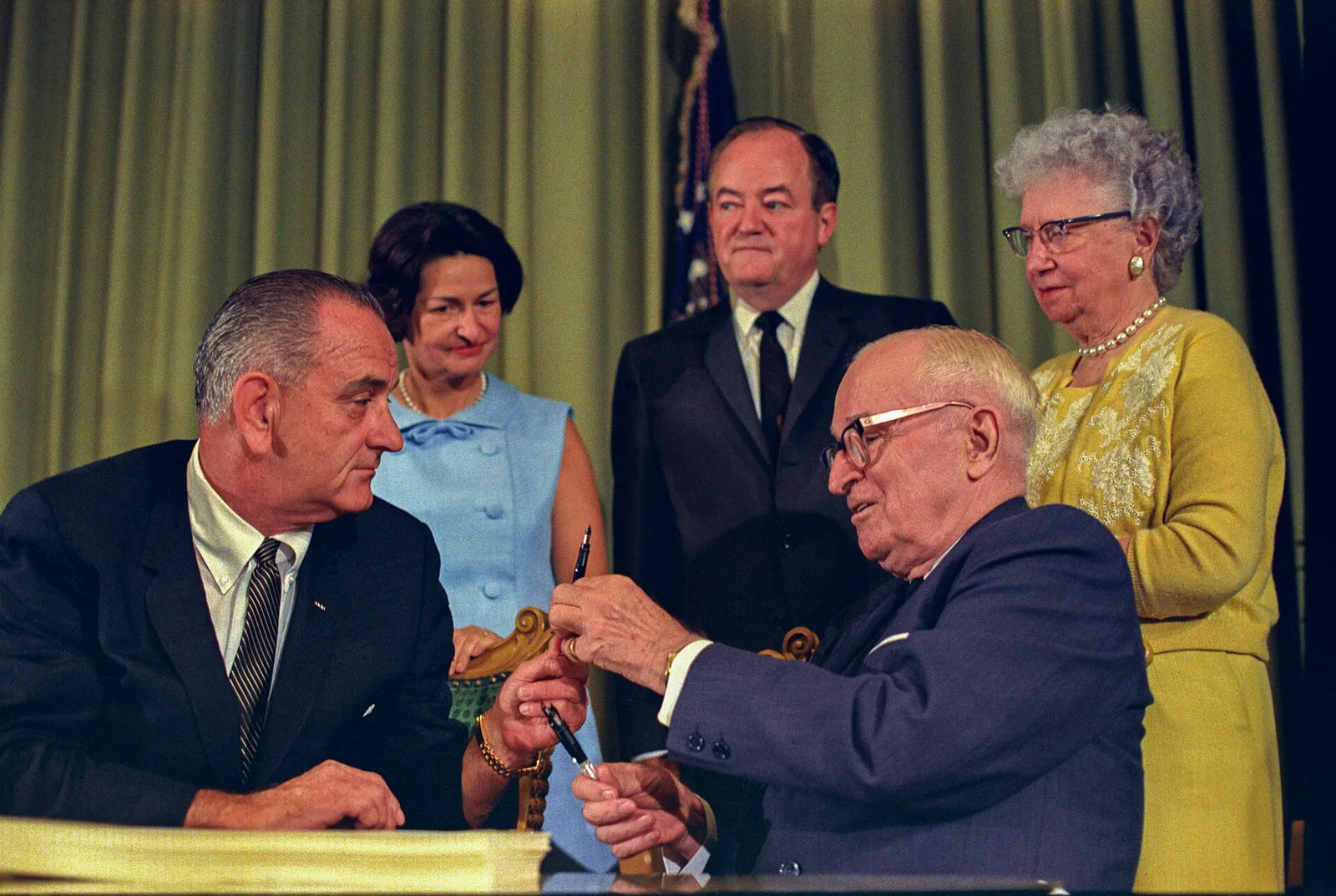
July 30, 1965: President Lyndon Johnson signs Medicare and Medicaid into law at the Truman Library in Independence, Missouri, beside former President Harry Truman.
Following the Dollars
Health care is the largest thing the federal government spends money on. These are the final figures for fiscal year 2026, which ended September 30, from the Treasury's year-end statement.
Federal Health Outlays, Fiscal Year 2026
Each bar is one program or agency, drawn to scale against Medicare. Source: Monthly Treasury Statement for September 2026.
- Medicare$1,285 billion
Gross outlays of both trust funds. After premiums and other receipts, $1,073 billion.
- Medicaid (federal share)$723 billion
Grants to states. States spend roughly $300 billion of their own on top.
- Marketplace tax credits and cost-sharing payments$126 billion
Net of the Treasury statement's two lines for refundable premium tax credits and cost-sharing reductions.
- Veterans medical care$113 billion
Medical services, support, and facilities accounts. The Toxic Exposures Fund is separate.
- Federal employee and retiree health benefits$76 billion
Gross payments to health plans, including the premiums workers and retirees pay.
- National Institutes of Health$46 billion
Medical research, mostly grants to universities and hospitals.
- CHIP (federal share)$25 billion
Children's Health Insurance Fund.
- Health Resources and Services Administration$15 billion
Community health centers, HIV/AIDS care, rural health, workforce training.
- Military retiree health fund (TRICARE for Life)$14 billion
One part of military health spending. The rest is inside the defense budget.
- Indian Health Service$10 billion
Direct care and funds passed to tribally run programs.
- Centers for Disease Control and Prevention$10 billion
Disease tracking, outbreak response, grants to state health departments.
- Substance Abuse and Mental Health Services Administration$8 billion
Block grants to states and the 988 crisis line.
- Food and Drug Administration$2.5 billion
Net of the fees paid by drug and device makers.
The bars cannot be added into one total. Some overlap (the general fund pays into Medicare), some are gross and some net, and military health care is missing because the Treasury statement folds it into defense accounts. For a total, see the first item below.
The federal budget sorts spending into functions. In fiscal year 2026 the Medicare function came to $1,073 billion and the Health function, which holds Medicaid, CHIP, the marketplace credits, research, and public health, came to $1,026 billion. Together that is $2.1 trillion, or about 28 percent of the $7.4 trillion the government spent, as shown on the Federal Budget Breakdown page.
Those two functions leave out the health care that sits inside other parts of the budget. Adding veterans' medical care and the military health system brings the total to roughly $2.3 trillion, close to a third of all federal spending. Medicare alone now costs more than national defense.
The growth is fast. Net Medicare spending rose 7.6 percent in one year, from $997 billion in fiscal year 2025, and federal Medicaid spending rose 8.2 percent. Both grew faster than the economy and faster than federal revenue.
Two forces drive the increase: more people and higher costs per person. More than 10,000 Americans turn 65 every day, and the price and volume of care per patient keep rising. Neither depends on a vote of Congress, since the programs pay automatically for whoever qualifies.
Medicare's hospital insurance is paid for mainly by a payroll tax of 2.9 percent of wages, split evenly between worker and employer, with no cap on the earnings it applies to. Since 2013, individuals earning more than $200,000 pay an additional 0.9 percent.
Medicare Parts B and D work differently. Premiums are set to cover about a quarter of Part B's cost, and most of the rest comes from the Treasury's general fund, meaning income taxes and other revenue. In fiscal year 2026 the general fund transferred $686 billion to the Medicare trust funds, nearly as much as the government spent on Medicaid.
Medicaid, CHIP, veterans' care, military health, the Indian Health Service, and the marketplace credits have no dedicated tax. All of them are paid from general revenue.
Because the government spent about $2 trillion more than it collected in fiscal year 2026, a share of every one of these programs was in effect paid for with borrowed money, which adds to the national debt.
Medicare has two trust funds. The Hospital Insurance fund pays for Part A and depends on the payroll tax. The Supplementary Medical Insurance fund pays for Parts B and D and cannot run dry, because the law sets premiums and general fund transfers each year at whatever level is needed to cover its costs.
The hospital fund can run short. It has been paying out more than it collects, and the Medicare trustees' June 2026 report projects that its reserves will be used up in 2033.
Running out of reserves is not the same as running out of money. Payroll taxes would keep arriving and would cover about 89 percent of the hospital fund's bills. The law does not say what happens to the other 11 percent, and Congress has never let the date arrive.
The trustees have projected a shortfall in almost every report since 1970, with the date as close as two years away in the early 1970s and four years away in 1997. Each time, Congress changed payment rates or taxes before the deadline. The choices are the same now: raise the tax, pay providers less, shift costs to enrollees, or use general revenue.
All health spending in the United States, public and private, reached $5.3 trillion in 2024, according to the actuaries at CMS. That is $15,474 per person and 18.0 percent of the economy, a higher share than in any other wealthy country.
Medicare paid 21 percent of that total and Medicaid, counting the state share, 18 percent. Private health insurance paid 31 percent, and patients paid 11 percent out of their own pockets. The rest came from other public and private programs.
Those figures understate the public share, because a large part of private insurance is paid for by governments as employers and through the tax exclusion for job-based coverage.
The country spends about twice as much per person as the average wealthy nation. Researchers attribute most of the difference to higher prices for hospital care, physician services, and drugs, and to higher administrative costs, and not to Americans using more care.
The Arguments, Side by Side
Americans have argued about the government's role in health care since at least 1945, and the argument has never been settled. Each question below gives the strongest case on each side. The conclusion is yours.
Bills to enroll every resident in one government plan have been introduced in Congress for decades. The idea goes back to Truman's 1945 proposal. No such bill has passed either chamber.
The case for: everyone would be covered automatically, with no one losing insurance when they lose a job. A single payer could cut the billing and administrative work that comes from thousands of different plans, and could use its size to hold down prices the way other countries do. Supporters point to Medicare's low overhead and to the 26.7 million people who remain uninsured.
The case against: it would move trillions of dollars a year in private spending onto the federal budget and require large new taxes. More than 150 million people would have to give up employer coverage that most of them say they are satisfied with. Critics warn that a single buyer paying Medicare-level rates could force hospitals to close or cut services, lengthen waits, and slow the development of new treatments, and that it would put one of the largest sectors of the economy under the control of whichever party holds Washington.
The question underneath: is health coverage something every person should receive through government, or something government should help people obtain on their own?
Within the programs that already exist, the running argument is how much of the work to hand to private insurers. More than half of Medicare enrollees and most Medicaid enrollees are now in privately managed plans paid for with public money.
The case for private plans: competition gives insurers a reason to coordinate care and control waste, and enrollees get to choose. Medicare Advantage plans limit out-of-pocket costs and often add dental, vision, and hearing benefits that traditional Medicare lacks, which is why a majority of beneficiaries pick them.
The case for the public program: the Medicare Payment Advisory Commission, which advises Congress, has estimated that Medicare pays private plans substantially more per person than it would cost to cover the same people in traditional Medicare. Critics add that plans restrict which doctors patients can see and require prior approval for care. Some would go the other way and let people under 65 buy into a public plan.
The question underneath: does competition among private plans save money and improve care, or does a public plan do the same job for less?
The veterans system is the country's largest experiment in government-delivered medicine, and since 2014 Congress has steadily shifted its money toward private providers. Community care now takes up a large and rising share of the VA health budget.
The case for more private care: a veteran should not have to wait weeks or drive hours when a qualified doctor is available down the road. Choice puts pressure on VA facilities to improve, and in rural areas a VA hospital may simply be too far away.
The case for the VA's own system: studies, including reviews by the RAND Corporation, have generally found VA care equal to or better than private care on quality measures, and VA clinicians specialize in combat injuries, prosthetics, and post-traumatic stress in ways few private practices do. Veterans' organizations have warned that each dollar sent outside is a dollar not spent on VA hospitals, and that the system could be hollowed out.
The question underneath: is the government better at running hospitals or at writing checks, and does the answer change depending on who the patients are?
Medicaid began as medical care for people on welfare, mainly poor mothers and children and the elderly and disabled poor. The 2010 expansion extended it to low-income adults without children or disabilities, and the 2025 law attached a work requirement to that group.
The case for work requirements and tighter limits: the program was meant as a safety net for people who cannot support themselves, and its cost to federal taxpayers has more than doubled since 2010. Supporters argue that asking able-bodied adults to work, study, or volunteer 80 hours a month is reasonable, encourages self-sufficiency, and preserves money for the most vulnerable. Some would go further and give each state a fixed sum to design its own program.
The case against: most adults on Medicaid who can work already do, often in jobs with no health benefits. When Arkansas tried a work requirement in 2018, about 18,000 people lost coverage in a few months, and researchers found no increase in employment, with many losing coverage over reporting problems. Opponents say people are healthier and better able to work when they are insured, and that hospitals in poor and rural areas depend on Medicaid payments to stay open.
The question underneath: is Medicaid temporary help for people in hard circumstances, or basic coverage for anyone with a low income?
Americans pay the highest prices in the world for brand-name drugs. From 2003 until 2022, federal law barred Medicare from bargaining over them. The Inflation Reduction Act now lets Medicare negotiate prices for a growing list of older, high-cost drugs with no generic competition.
The case for negotiation: every other large buyer, including the VA and foreign governments, bargains over price, and taxpayers fund much of the basic research behind new drugs through the NIH. CMS reported that the first ten negotiated prices would have saved Medicare about $6 billion had they applied in 2023.
The case against: developing a drug takes years and often costs more than a billion dollars, most candidates fail, and high prices on the successes pay for the failures. Drug makers and some economists argue that when one buyer covering 70 million people names its price, that is price-setting, not negotiation, and that it will reduce investment in new medicines. The Congressional Budget Office estimated the law would result in slightly fewer new drugs over thirty years.
The question underneath: how much future innovation is worth giving up for lower prices today, and who should decide?
With the hospital fund projected to run short in 2033 and overall Medicare spending growing more than 7 percent a year, some change is coming. The disagreement is over who should bear it.
One approach raises revenue: increase the payroll tax, apply it to more kinds of income, or put more general tax money into the program. Supporters say Medicare is a promise people have paid into for their whole working lives, and that the country can afford to keep it.
Another approach slows spending: raise the eligibility age, charge higher-income enrollees more, pay providers and private plans less, or give each enrollee a fixed amount toward the plan of their choice. Supporters say taxes on workers are already high, and that the program's growth is crowding out everything else in the budget.
The question underneath: should the cost fall on today's workers, today's retirees, the doctors and hospitals that are paid by the program, or future taxpayers through borrowing?
None of these questions has a factual answer. They turn on what a person believes government owes its citizens, how much they trust public agencies compared with private companies, and who they think should pay. The history on this page shows the country answering them differently in different decades.
Ten Things Worth Knowing
Quick facts drawn from the sourced material on this page, for a fast read or a classroom discussion starter.
The first federal health program was created in 1798, when Congress required merchant sailors to pay 20 cents a month from their wages toward government-run marine hospitals.
Harry Truman received Medicare card number one on July 30, 1965. His wife, Bess, received the second.
Arizona had no Medicaid program until 1982, seventeen years after the law passed. It was the last state to join.
Kidney failure is the only medical condition that qualifies a person of any age for Medicare. Congress made that decision in 1972.
The federal government runs its own medical school. The Uniformed Services University in Bethesda, Maryland, charges no tuition and pays its students a salary in exchange for military or Public Health Service duty.
The Surgeon General leads a uniformed service. The Public Health Service Commissioned Corps is one of the eight uniformed services of the United States, along with the six armed forces and the NOAA Corps.
Medicaid pays for about four of every ten births in the United States.
Members of Congress do not get their insurance from the federal employee program. Since 2014 they have been required to buy it through the District of Columbia's Affordable Care Act exchange.
Patients at the NIH Clinical Center, the hospital pictured at the top of this page, are never billed. Every one of them is a volunteer in a research study.
About 12 million people are enrolled in Medicare and Medicaid at the same time. Medicare pays first, and Medicaid covers costs such as nursing home care that Medicare does not.
The American Health Trust
David Strickland, who built USGovExplained.org, has written a citizen proposal called the American Health Trust and started a petition for it. The plan would cover everyone living in the United States through an independent nonprofit chartered by Congress, which the proposal describes as separate from any government agency. Its board would seat physicians, hospital administrators, patient advocates, economists, state representatives, and a federal inspector general.
The Trust would be paid for with three new contributions, 3 percent on goods and services, 1.5 percent of pay from employees, and 1.5 percent from employers, plus the money already spent on Medicare, Medicaid, and the other programs on this page as they fold in over eight years. Doctors would bill the Trust under one national fee schedule, administrative costs would be capped at 5 percent, and private insurance would remain available for extra coverage. The proposal says plainly that nobody has run the full math yet.
The petition does not ask Congress to pass the plan. It asks Congress to order an independent feasibility study, hold public hearings on administrative waste in health care, and have the Congressional Budget Office publish an analysis of alternatives to the current financing system. The goal is 400,000 signatures.
This box describes the founder's own proposal and is separate from the reporting on this page. Read it, check it against the figures above, and decide for yourself. Both buttons open americanhealthtrust.org in a new tab.
Frequently Asked Questions
The federal government runs or pays for Medicare, Medicaid, the Children's Health Insurance Program, the Affordable Care Act marketplaces, the Veterans Health Administration, the Military Health System and TRICARE, the Indian Health Service, and health benefits for federal and postal employees. It also funds community health centers and provides care in federal prisons.
Medicare is a federal program for people 65 and older and for some younger people with disabilities, and it works the same way in every state. Medicaid is for people with low incomes, is run by each state under federal rules, and is paid for jointly by the state and the federal government.
In fiscal year 2026 the Medicare and Health functions of the federal budget came to about $2.1 trillion, roughly 28 percent of all federal spending. Adding veterans' and military health care brings the total to about $2.3 trillion.
Yes. The Veterans Health Administration, the Military Health System, and the Indian Health Service own hospitals and clinics and employ the doctors and nurses who work in them. Medicare and Medicaid, by contrast, pay private doctors and hospitals.
Medicare's hospital insurance trust fund is projected to use up its reserves in 2033, according to the trustees' June 2026 report. After that, incoming payroll taxes would still cover about 89 percent of hospital benefits. The parts of Medicare that pay for doctor visits and drugs are funded differently and cannot run short.
Sources & Further Reading
- U.S. Treasury: Monthly Treasury Statement (final fiscal year 2026)
- CMS: Medicare Monthly Enrollment
- CMS: 2026 Medicare Trustees Report
- CMS: National Health Expenditure Fact Sheet
- Medicaid.gov: Medicaid and CHIP Enrollment Data
- CMS: 2026 Marketplace Open Enrollment
- CMS: Medicare Drug Price Negotiation Program
- Veterans Health Administration: About VHA
- Military Health System: About the MHS
- Indian Health Service: IHS Profile
- Office of Personnel Management: Healthcare
- HRSA: Health Center Program
- Census Bureau: Health Insurance Coverage in the United States, 2025
- Federal Register: Federal Medical Assistance Percentages, Fiscal Year 2027
- KFF: Health Provisions in the 2025 Federal Budget Reconciliation Law
- KFF: Status of State Medicaid Expansion Decisions
- U.S. Public Health Service: History
- Social Security Administration: History of Medicare
- VA History Office
- NIH: Office of NIH History
Spending figures are fiscal year 2026 net outlays from the Treasury's Monthly Treasury Statement for September 2026 unless noted as gross. Enrollment figures are the most recent published by each agency as of November 2026 (Medicare, April 2026; Medicaid and CHIP, July 2026; marketplaces, 2026 open enrollment). Estimates of the 2025 budget law's effects are from the Congressional Budget Office as reported by KFF. Officeholders are current as of November 25, 2026.