
A Gift From the People of France
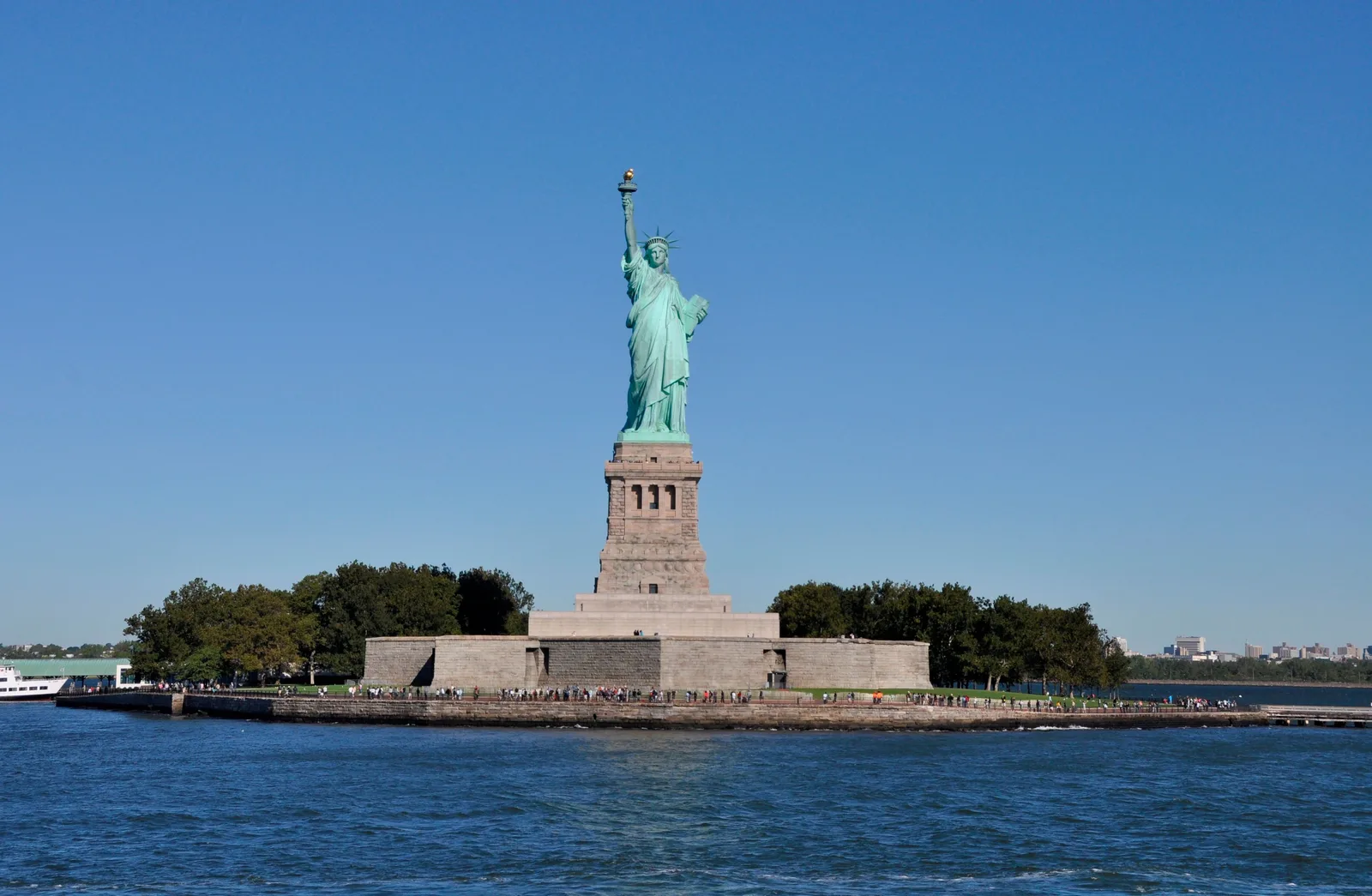
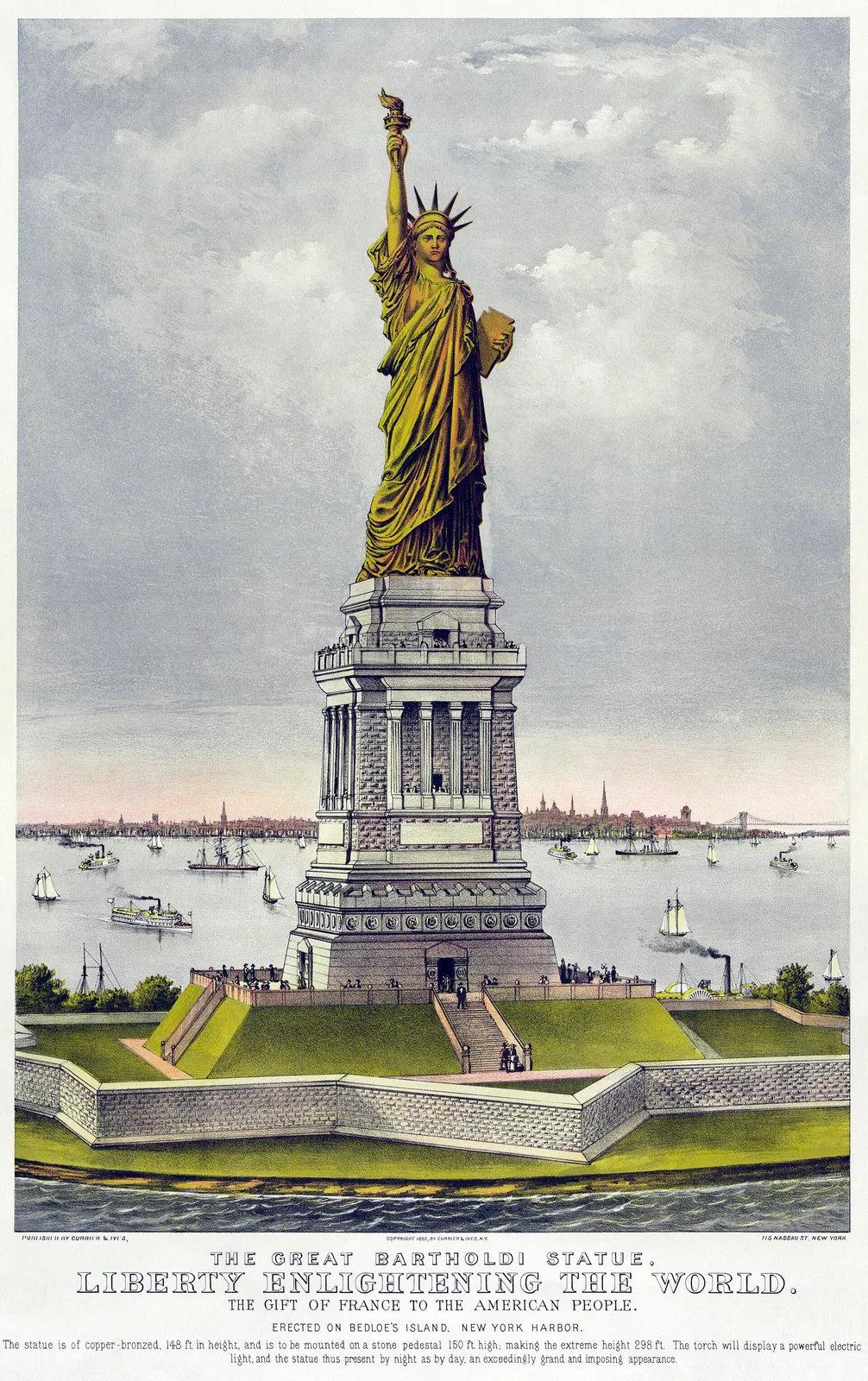
The Statue of Liberty, officially named "Liberty Enlightening the World," stands on Liberty Island in New York Harbor. It was a gift from the people of France to the people of the United States, dedicated on October 28, 1886. France paid for the statue itself, and Americans paid for the pedestal it stands on. Today it is a National Monument run by the National Park Service, part of the Department of the Interior.
The idea came from Édouard de Laboulaye, a French law professor and expert on the U.S. Constitution. In 1865, as the Civil War ended and slavery was abolished, he proposed a monument honoring American independence, the survival of the Union, and the cause of liberty. He also hoped it would inspire the French, who were then living under an emperor, to demand a democratic government of their own.
The sculptor Frédéric Auguste Bartholdi designed the statue, and the engineer Gustave Eiffel, who later built the Eiffel Tower, designed the iron skeleton inside it. Workers in Paris hammered more than 300 sheets of copper by hand into the shape of the robed woman. The architect Richard Morris Hunt designed the granite pedestal, built inside the walls of an old star-shaped Army fort called Fort Wood.
The project nearly failed when the American pedestal fund ran dry in 1884. The newspaper publisher Joseph Pulitzer saved it in 1885 by asking ordinary readers to give whatever they could, and more than 120,000 people did, most of them a dollar or less. Over the next century the statue became a symbol of welcome to the millions of immigrants who sailed past it, a meaning sealed by Emma Lazarus's poem "The New Colossus," which has hung on a plaque in the pedestal since 1903 and is printed in full on the Symbols tab. Its story is part of the larger history of the United States.
At a Glance
305 ft 1 in
Ground to the tip of the torch (NPS)
1886
Dedicated October 28 by President Grover Cleveland
120,000+
Americans who gave to Pulitzer's pedestal fund
3/32 in
Thickness of the copper skin, about two pennies
By the Numbers
| Measurement | Size | Note |
|---|---|---|
| Ground to tip of torch | 305 ft 1 in | About as tall as a 22-story building |
| Top of base to torch | 151 ft 1 in | The statue itself |
| Heel to top of head | 111 ft 1 in | The figure without the raised arm |
| Ground to top of pedestal | 154 ft | Fort Wood's walls and Hunt's pedestal |
| Length of right arm | 42 ft | 12 feet wide |
| Length of hand | 16 ft 5 in | The index finger alone is 8 feet long |
| Head, chin to cranium | 17 ft 3 in | The face is 10 feet wide |
| Length of nose | 4 ft 6 in | Each eye is 2 ft 6 in wide |
| Tablet | 23 ft 7 in long | 13 ft 7 in wide and 2 ft thick |
| Waist | 35 ft wide | |
| Iron framework | 440,000 lbs | Eiffel's pylon and frame |
| Concrete foundation | 54,000,000 lbs | Poured inside Fort Wood |
| Crown | 25 windows | Seven rays |
| Sway in the wind | Up to 3 in | The torch can sway up to 6 inches |
Fast Facts
The statue was the color of a new penny in 1886. The copper took about 30 years to weather into the green coat, called a patina, that protects it today.
Her official name is "Liberty Enlightening the World." She is modeled on Libertas, the Roman goddess of liberty.
She faces southeast, toward the Narrows, the entrance to New York Harbor, to greet ships arriving from the Atlantic.
The torch has been closed to the public since 1916, when German sabotage set off the Black Tom explosion across the harbor. The torch on the statue today is a 1986 replacement covered in 24-karat gold leaf.
Lightning strikes the statue from time to time. The charge runs safely to the ground through the pedestal.
The tablet in her left hand reads JULY IV MDCCLXXVI, the date of the Declaration of Independence in Roman numerals.
From 1886 to 1901 the statue was officially a lighthouse, run by the U.S. Lighthouse Board.
Liberty Island was called Bedloe's Island until Congress renamed it in 1956.
From an Idea to a Landmark
Twenty-one years passed between the first proposal and the dedication. Open each year to read what happened, from the 1865 idea to the museum that opened in 2019.
In 1865, Édouard de Laboulaye, a French political thinker and the leading French expert on the U.S. Constitution, proposed that France give the United States a monument to liberty for the hundredth anniversary of its independence in 1876. According to Bartholdi's later account, the idea came up at a dinner at Laboulaye's home near Versailles that summer.
The timing mattered. The American Civil War had just ended in a Union victory, President Abraham Lincoln had been assassinated, and the Thirteenth Amendment abolishing slavery was being ratified. Laboulaye was president of the French Anti-Slavery Society, founded that same year, and the National Park Service notes that he meant the monument to honor both the Union's survival and the end of slavery.
Laboulaye also had a goal at home. France was ruled by Emperor Napoleon III, and open criticism of the government was risky. Praising American liberty was a way to argue for a democratic republic in France without saying so directly.
Nothing was built for several years. The idea waited until France's political situation changed and a sculptor was ready to take it on.
Frédéric Auguste Bartholdi, a sculptor from Colmar in the French province of Alsace, had recently made a bust of Laboulaye and became the project's sculptor. In 1870 France lost the Franco-Prussian War, Napoleon III fell, and Alsace, Bartholdi's home, was taken by the new German Empire. The loss deepened his interest in a monument to liberty.
Bartholdi sailed to the United States in June 1871 with letters of introduction from Laboulaye. As his ship entered New York Harbor, he saw Bedloe's Island, a small island with an old star-shaped Army fort, and decided it was the place for the statue, where every ship entering the harbor would pass it.
He spent about five months traveling the country by train, meeting politicians, writers, and publishers, including President Ulysses S. Grant. He found interest in the idea but no money and no organization ready to back it.
Bartholdi returned to France in 1872 and reported that Americans were interested and that Bedloe's Island was the ideal site. Laboulaye's group decided to go ahead.
In 1875 Laboulaye approved Bartholdi's plaster model, "Liberty Enlightening the World." In November of that year he and his allies formed the Franco-American Union to plan the project and raise the money, with Laboulaye as its president.
The two countries split the work. The French people would pay for the statue and for shipping it across the Atlantic. The Americans would pay for the pedestal and the foundation it would stand on.
The French fund raised money through dinners, appeals, and public events, and in the spring of 1878 the Union held a lottery, which French law allowed for artistic and charitable causes. According to NPS Historical Handbook No. 11, the statue's final cost was about $250,000, and every bit of it came from the French people; the French government was never asked to pay.
The full amount was subscribed by July 1882. The statue would not be finished in time for the 1876 centennial, so Bartholdi built it in pieces and put the first ones on display to build public support.
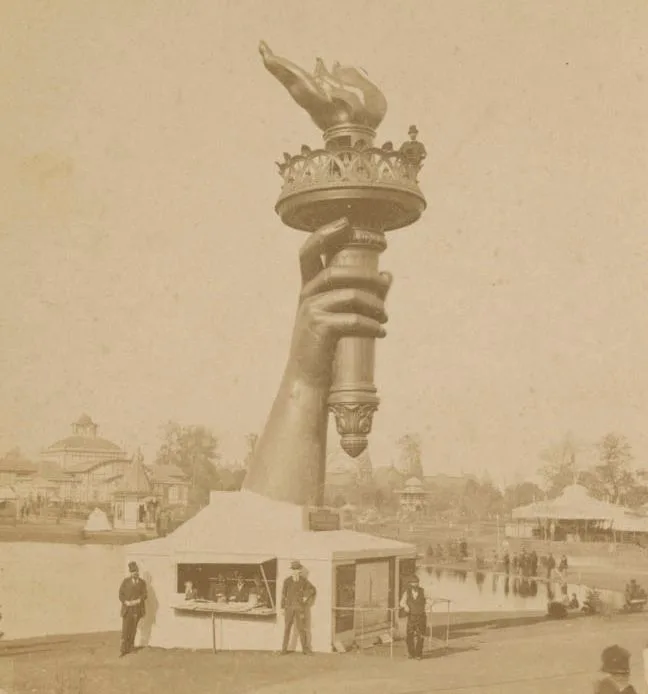
The first finished piece was the right arm holding the torch. It was shown at the Centennial Exposition in Philadelphia, the world's fair celebrating 100 years of American independence, beginning in 1876.
For 50 cents, visitors could climb a ladder inside the arm to the balcony around the torch. The money went to the statue fund, and the arm let Americans see the enormous size of the planned statue for themselves.
After the exposition the arm was moved to Madison Square in New York City, where it stood until 1882 before being returned to France to be joined to the rest of the statue.
Some newspapers in other cities mocked the project as a New York affair. Several cities, including Philadelphia, Boston, and San Francisco, later offered to pay for the whole pedestal if the statue were placed with them instead.
On February 22, 1877, George Washington's birthday, Congress passed a joint resolution accepting the statue as a gift from France. On March 3, his last full day in office, President Grant signed it, authorizing a site in New York Harbor.
General William Tecumseh Sherman, commanding general of the Army, selected Bedloe's Island, following Bartholdi's wish. The Army kept running the island, and its old fort, Fort Wood, would become the base of the pedestal.
In January 1877 an American Committee was formed in New York to raise the pedestal money, chaired by William M. Evarts, a former U.S. Attorney General who soon became Secretary of State. It began with 114 members and grew to more than 400.
The committee first estimated the pedestal at $125,000 and later doubled that estimate. Raising it would prove much harder than anyone expected.
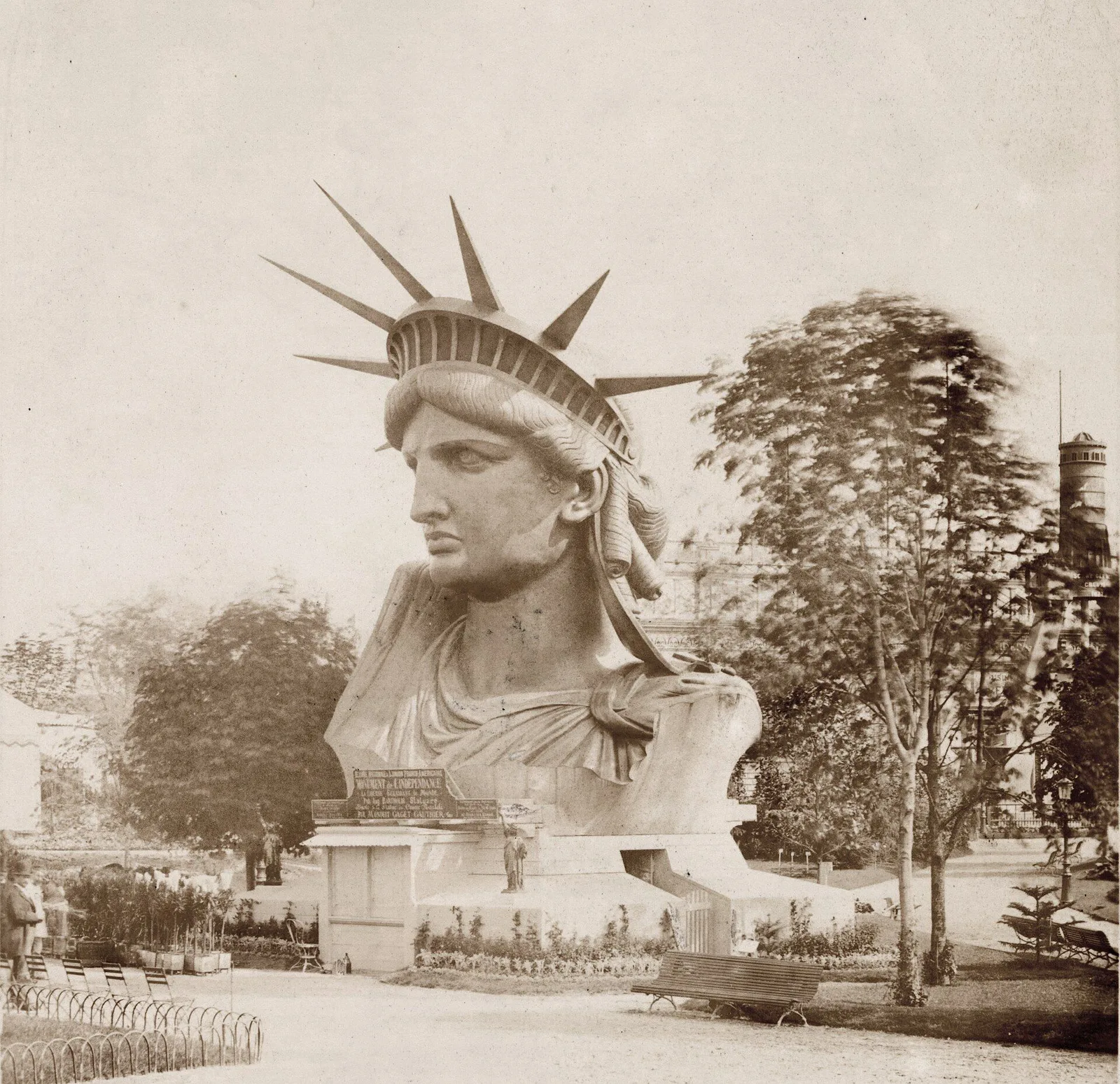
In 1878 the statue's head and shoulders were displayed at the Paris Universal Exposition, another world's fair. Visitors could climb inside the head, and the display helped bring in money for the French fund.
On February 18, 1879, the U.S. Patent Office granted Bartholdi Design Patent No. 11,023 for the statue's design, which let the project control and profit from sales of small models of the statue.
In 1879 the project lost its first engineer. Eugène Viollet-le-Duc, a famous French architect who had planned to fill the lower statue with compartments of sand, died before his design was finished.
Bartholdi then hired Alexandre-Gustave Eiffel, an engineer known for his iron railway bridges, to solve the problem of how to hold a 151-foot copper statue upright against the winds of New York Harbor.
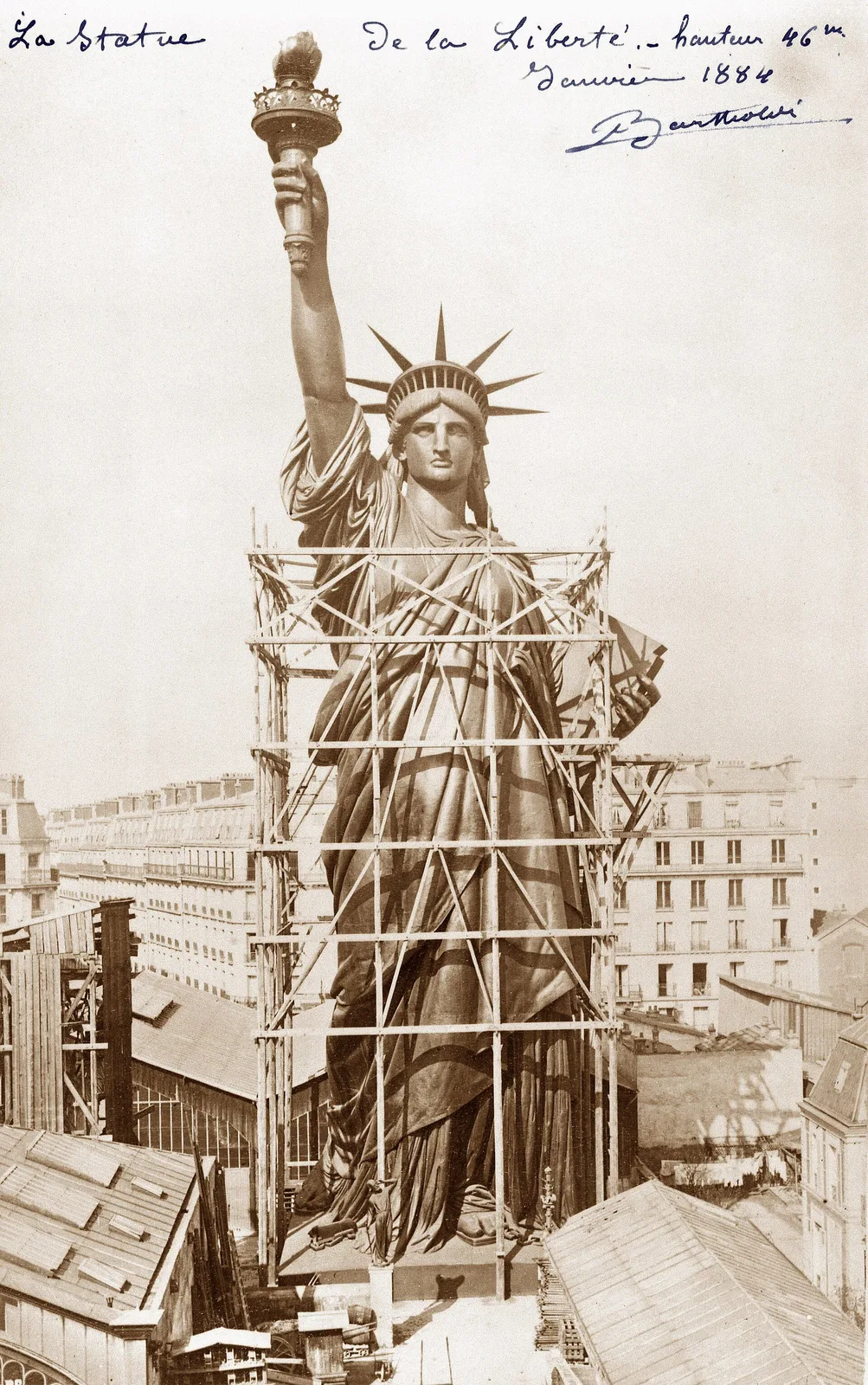
Eiffel designed an iron tower, or pylon, to carry the weight, with a lighter frame of iron straps reaching out to hold the copper skin. In 1881 the copper plates were finished, the first rivet was driven, and assembly began in the yard of the Gaget, Gauthier et Cie workshop near the Parc Monceau in Paris.
As the statue grew above the rooftops, Parisians nicknamed her the "Lady of the Park." In 1881 the American Committee hired the architect Richard Morris Hunt to design the pedestal.
Laboulaye did not live to see the statue finished; he died in 1883. Ferdinand de Lesseps, the builder of the Suez Canal, took his place as president of the Franco-American Union.
The statue was complete by 1884. On July 4, 1884, de Lesseps formally presented it to Levi P. Morton, the U.S. Minister to France, in Paris. It would stand there until the American pedestal was ready.
Ground was broken for the foundation on Bedloe's Island on April 18, 1883, under General Charles P. Stone, the committee's chief engineer. The foundation was poured almost entirely of solid concrete, inside the walls of Fort Wood.
To raise money, the committee held an art and literary auction in late 1883, and the poet Emma Lazarus wrote "The New Colossus" for it on November 2, 1883. The poem was read at the opening and then largely forgotten for almost 20 years.
The cornerstone of the pedestal was laid on August 5, 1884, in a Masonic ceremony led by William A. Brodie, Grand Master of the Grand Lodge of New York.
By the fall of 1884 the money was gone. Work stopped with only about 15 feet of the pedestal built, and the committee warned that without $100,000 more, the gift might have to be refused.
On March 16, 1885, Joseph Pulitzer's newspaper, the New York World, renewed its campaign for the pedestal. Pulitzer scolded the rich for refusing to pay and promised to print the name of every donor, no matter how small the gift, an early example of the free press rallying the public.
Schoolchildren sent pennies, and money arrived from across the country with letters that the World printed. On August 11, 1885, less than five months after the drive began, the paper announced the fund was complete. The Park Service counts more than 120,000 donors and over $100,000 raised, most of it in gifts of about a dollar or less.
Meanwhile the statue was taken apart in Paris, packed into 214 crates holding about 350 pieces, and loaded onto the French Navy ship Isère. It arrived in New York Harbor on June 17, 1885, to a welcome of boats and crowds.
The pedestal was still unfinished, so the crates sat in storage on the island for about a year while workers, now paid, resumed building the 89-foot granite pedestal.
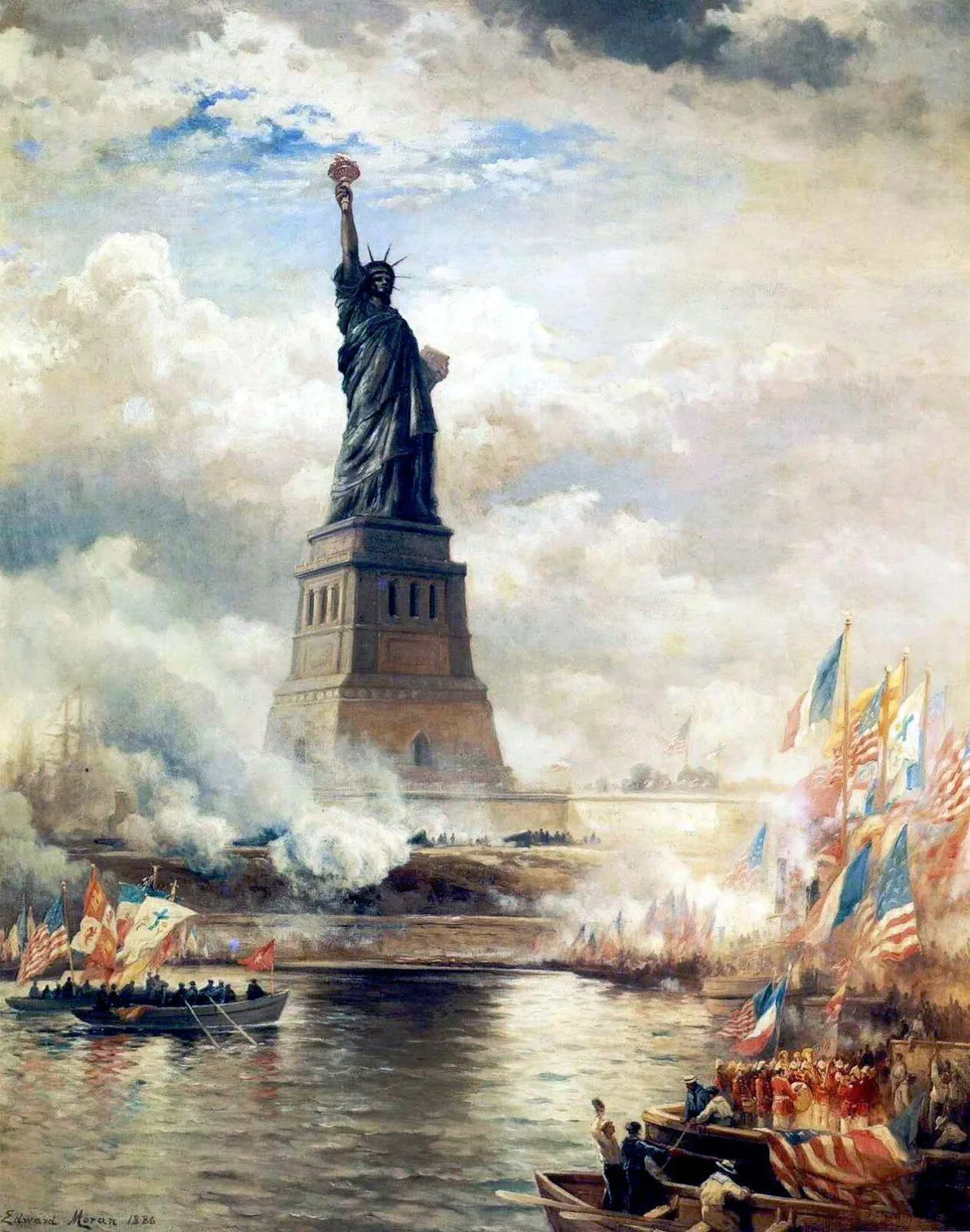
The last stone of the pedestal was set on April 22, 1886, and workers dropped silver coins from their own pockets into the mortar. Crews then riveted the copper pieces back onto the frame, and the statue was finished on October 23.
On October 28, 1886, President Grover Cleveland dedicated the statue. New York held its first ticker-tape parade that morning, with more than a million people watching, and about 300 boats filled the foggy harbor. Bartholdi waited inside the head to drop the French flag covering the face, and he dropped it early, in the middle of a speech. Cleveland accepted the gift, saying, "We will not forget that Liberty has here made her home; nor shall her chosen altar be neglected." His speech is one of many in the site's collection of presidential speeches.
Only about 2,000 to 2,500 invited guests, almost all men, were allowed on the island. Unaccompanied women were refused tickets, so the New York State Woman Suffrage Association chartered a boat and held its own protest in the harbor, pointing out that the nation's great symbol of liberty was a woman while American women could not vote.
The rain-delayed fireworks and illumination took place on November 1. Before the dedication, on October 10, Cleveland had placed the statue under the U.S. Lighthouse Board, making it officially a lighthouse.
Emma Lazarus died in 1887 at age 38, and her poem was little known. In 1901 Georgina Schuyler, a New York arts patron and friend of Lazarus, found the poem and began a campaign to honor her friend at the statue.
In May 1903 a bronze plaque with the full text of "The New Colossus" was mounted on an inner wall of the pedestal. The National Park Service catalog describes it as bronze, about 58 by 74 centimeters.
At first the plaque drew little notice. That changed over the following decades, as the statue became the first sight of America for millions of immigrants arriving through nearby Ellis Island, which opened in 1892.
The original plaque is still on display inside the pedestal, and an exact replica is in the Statue of Liberty Museum, which opened in 2019.
Early on July 30, 1916, German saboteurs set off an explosion at the Black Tom munitions pier in Jersey City, New Jersey, less than a mile from the statue. The United States had not yet entered World War I, and the munitions were headed for Britain and France.
The blast was felt as far away as Philadelphia. Shrapnel damaged the statue's right arm and torch, and the torch has been closed to the public ever since. The National Park Service notes that it is reached only by a narrow 40-foot ladder.
Later that year the sculptor Gutzon Borglum, who would go on to carve Mount Rushmore, redesigned the torch's flame, cutting openings in the copper and fitting it with glass so it could be lit from inside. On December 2, 1916, President Woodrow Wilson attended a ceremony at which new floodlights lit the whole statue for the first time.
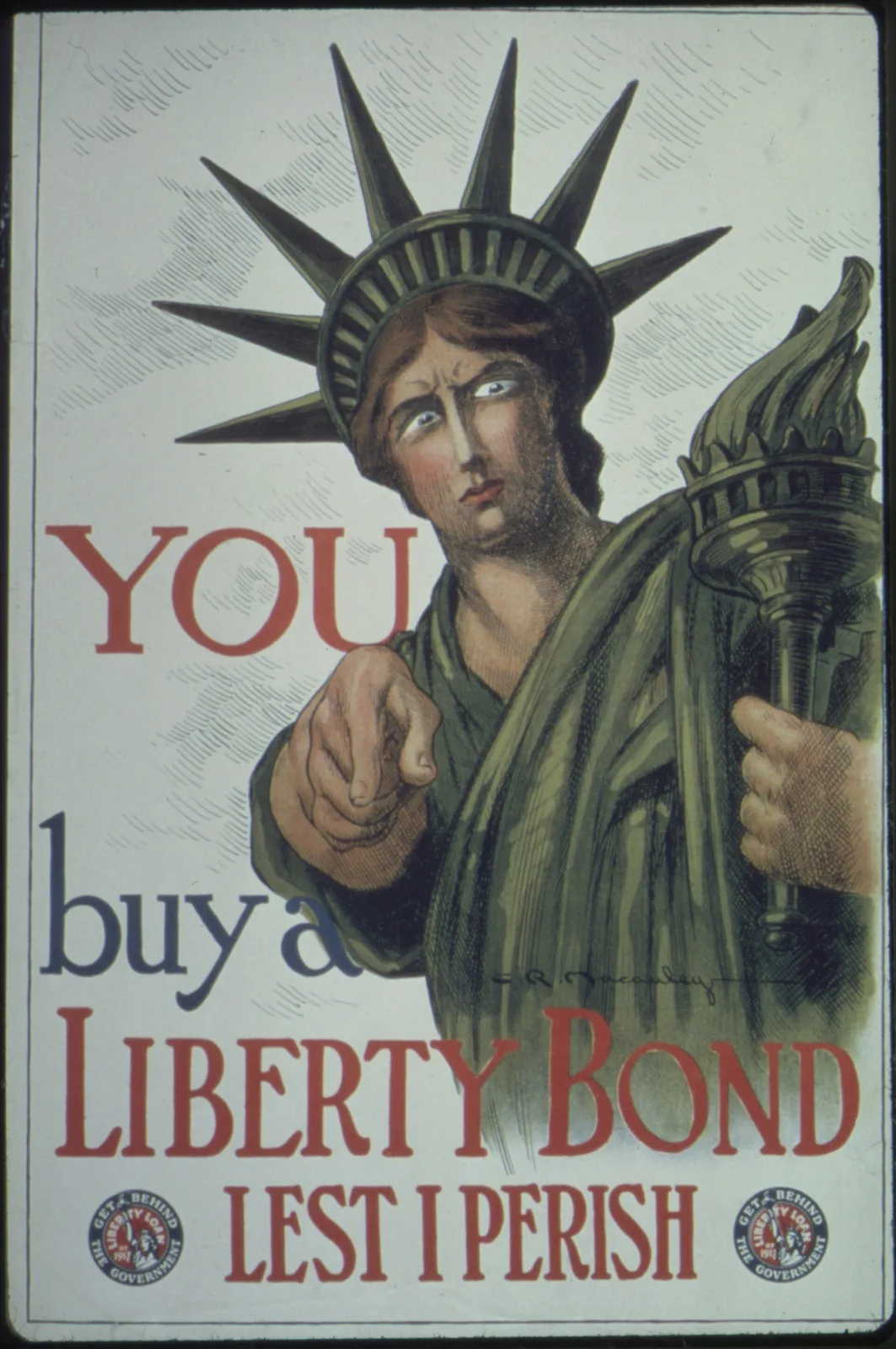
When the United States entered the war in 1917, the government used the statue's image on posters selling Liberty Bonds to pay for the war. The first repairs to the copper skin were made in 1918.
On October 15, 1924, President Calvin Coolidge used the Antiquities Act to declare the statue a National Monument. A President's power to protect places this way is one of the executive powers Congress has granted by law.
In 1933 President Franklin D. Roosevelt moved the statue, along with other national monuments, to the National Park Service. In 1936 he spoke at the statue's 50th anniversary, describing America as a nation built by immigrants, a speech that helped fix the statue's role as a symbol of immigration.
In 1937 the War Department gave up the rest of Bedloe's Island, and the whole island became part of the monument. During World War II the torch was darkened under blackout rules from 1942 to 1945, though visitors could still come.
In 1956, a joint resolution of Congress signed by President Dwight D. Eisenhower renamed Bedloe's Island as Liberty Island.
On May 11, 1965, President Lyndon B. Johnson added Ellis Island to the Statue of Liberty National Monument. On October 3, 1965, he signed the Immigration and Nationality Act at the foot of the statue, ending the national-origins quotas that had limited immigration since the 1920s.
The American Museum of Immigration opened in the base of the pedestal in 1972. It told the story of the immigrants who came through New York.
The statue also became a stage for protest. Veterans against the Vietnam War occupied it for three days in 1971, and other groups draped flags and banners on it over the following years.
In 1984 UNESCO added the statue to its World Heritage List as a masterpiece of the human spirit and a symbol of liberty recognized around the world.
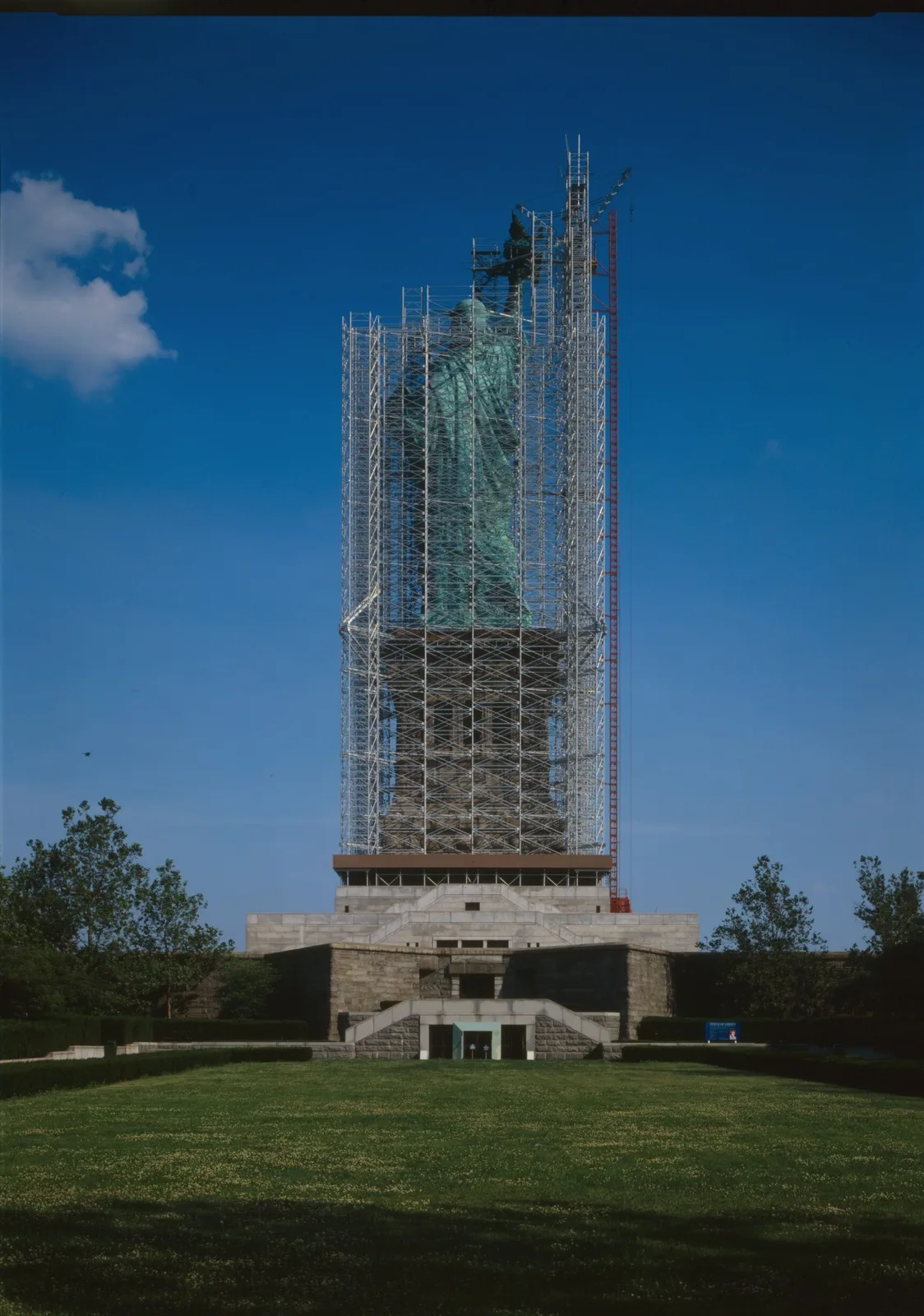
By the 1980s nearly a century of salt air had done serious damage. Rainwater and condensation had corroded the iron straps holding the copper skin, and the raised arm had been mounted slightly out of place in 1886, leaving it weaker than intended.
In 1982 President Ronald Reagan asked Chrysler chairman Lee Iacocca to lead a private fundraising campaign, and the Statue of Liberty-Ellis Island Foundation raised the money from businesses and millions of individual donors. Work began in 1984 in a partnership between the foundation and the National Park Service, with the statue wrapped in scaffolding.
Workers replaced the rusting iron armature bars that hold the skin with stainless steel, removed layers of paint and tar from inside the skin, added a new glass-walled elevator in the pedestal, and replaced the 1886 torch, whose flame had leaked for decades. French craftsmen built the new torch by hand in copper and covered the flame in 24-karat gold leaf.
The restored statue was unveiled at Liberty Weekend, July 3 to 6, 1986, when President Reagan relit the torch and the nation marked the statue's centennial with fireworks and a parade of tall ships.
On September 11, 2001, the morning's first ferry was turned back as the World Trade Center was attacked, and no visitors reached the island that day. The island reopened that December, but the inside of the statue stayed closed.
The pedestal reopened on August 3, 2004, with new security, and the crown reopened on July 4, 2009, for the first time since the attacks.
After the statue's 125th anniversary on October 28, 2011, the interior closed for a year of safety upgrades, including new stairs and elevators. It reopened on October 28, 2012, and the very next day Hurricane Sandy flooded about 75 percent of Liberty Island.
The storm wrecked docks, power lines, and buildings, though the statue itself was unharmed. Liberty Island reopened on July 4, 2013, while repairs went on.
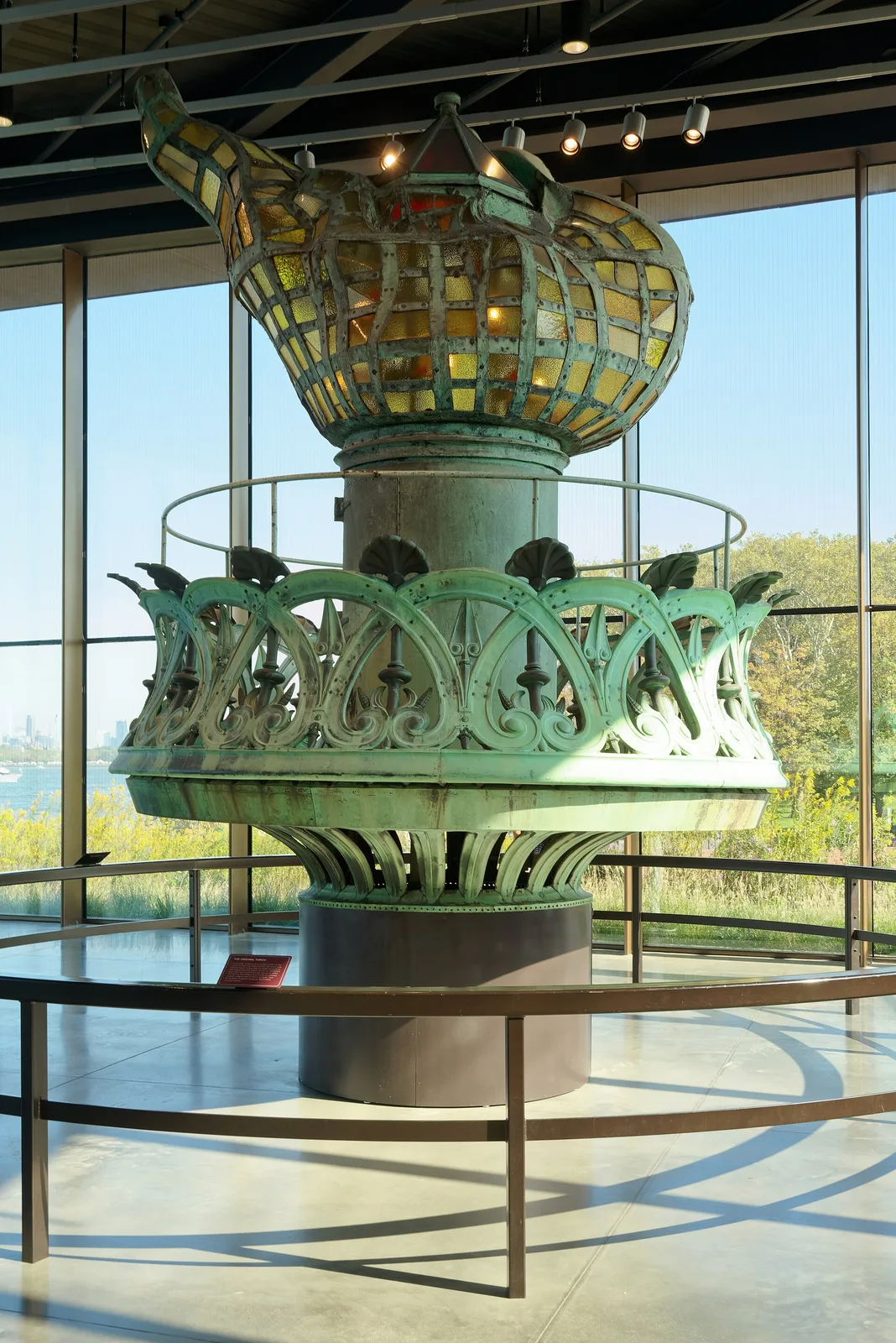
Before 2019, the original 1886 torch was displayed inside the pedestal, where only about 20 percent of visitors had tickets to see it. To let everyone see it, the Statue of Liberty-Ellis Island Foundation built a new museum on the island.
On November 15, 2018, engineers took the 3,600-pound torch apart and moved it across the island to the new building.
The 26,000-square-foot Statue of Liberty Museum opened to the public on May 16, 2019, and every visitor to the island can enter it. The original torch stands in its Inspiration Gallery, behind glass walls with a view of the statue.
The museum also holds a full-size copper model of the statue's face, an exact replica of the New Colossus plaque, and exhibits on the statue's building and meaning.
How Liberty Was Built
The statue is a thin copper skin hung on an iron skeleton, standing on a concrete and granite pedestal. Open each part to see how it was made.
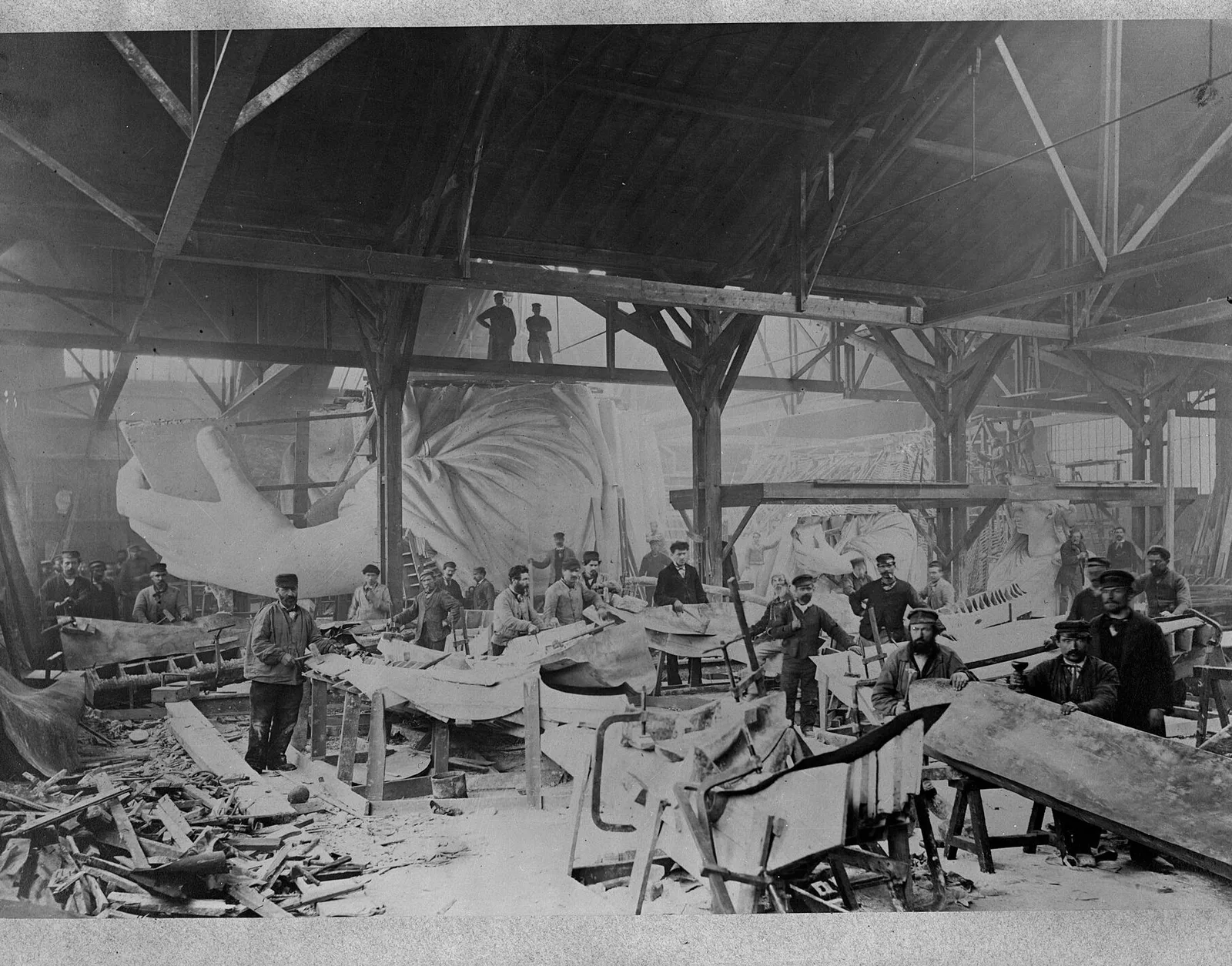
Bartholdi began with small clay and plaster study models. According to NPS Historical Handbook No. 11, his first study model was about 4 feet tall (1.25 meters). He then built a model 2.85 meters tall, and from that a model four times larger, about 36 feet (11 meters) tall.
The 36-foot model was too big to copy in one piece, so it was divided into sections. Each section was enlarged four times again to full size, using about 9,000 separate measurements per section to keep every curve accurate.
From each full-size section, carpenters built wooden molds that matched its shape exactly. These molds were the patterns the copper would be shaped against.
The method was slow but precise. It let a team of craftsmen turn a sculptor's hand-sized model into a figure 151 feet tall without losing the shape of the face or the folds of the robe.
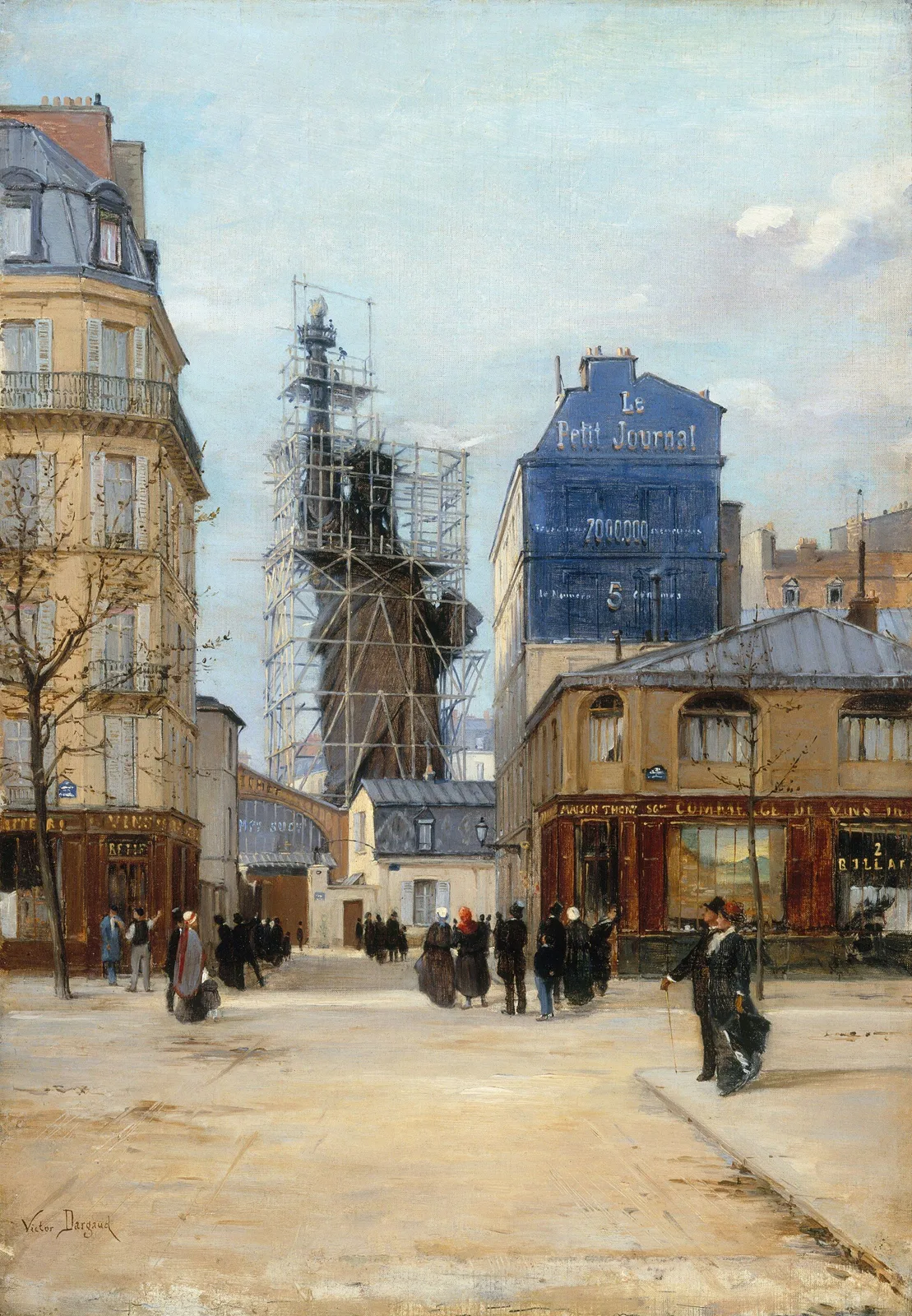
The outside of the statue is made of more than 300 copper sheets, each about 3/32 of an inch thick, which the Park Service compares to two pennies pressed together. Copper was chosen because it is light, easy to shape, and resists rust.
The sheets were shaped with a method called repoussé, a French term meaning "pushed back." Workers at the Gaget, Gauthier et Cie workshop in Paris laid each sheet against its wooden mold and hammered it from behind until it took the mold's shape.
Because the skin is so thin, it could not hold itself up. It hangs on the iron frame inside, like a coat on a hanger, and the pieces were riveted together where they overlapped.
When it was new, the statue was the shiny reddish brown of a new penny. Over about 30 years, exposure to the air turned the copper green. This green coat, called a patina, protects the metal underneath, and when the government considered painting the statue in the early 1900s, public objection helped stop the plan.
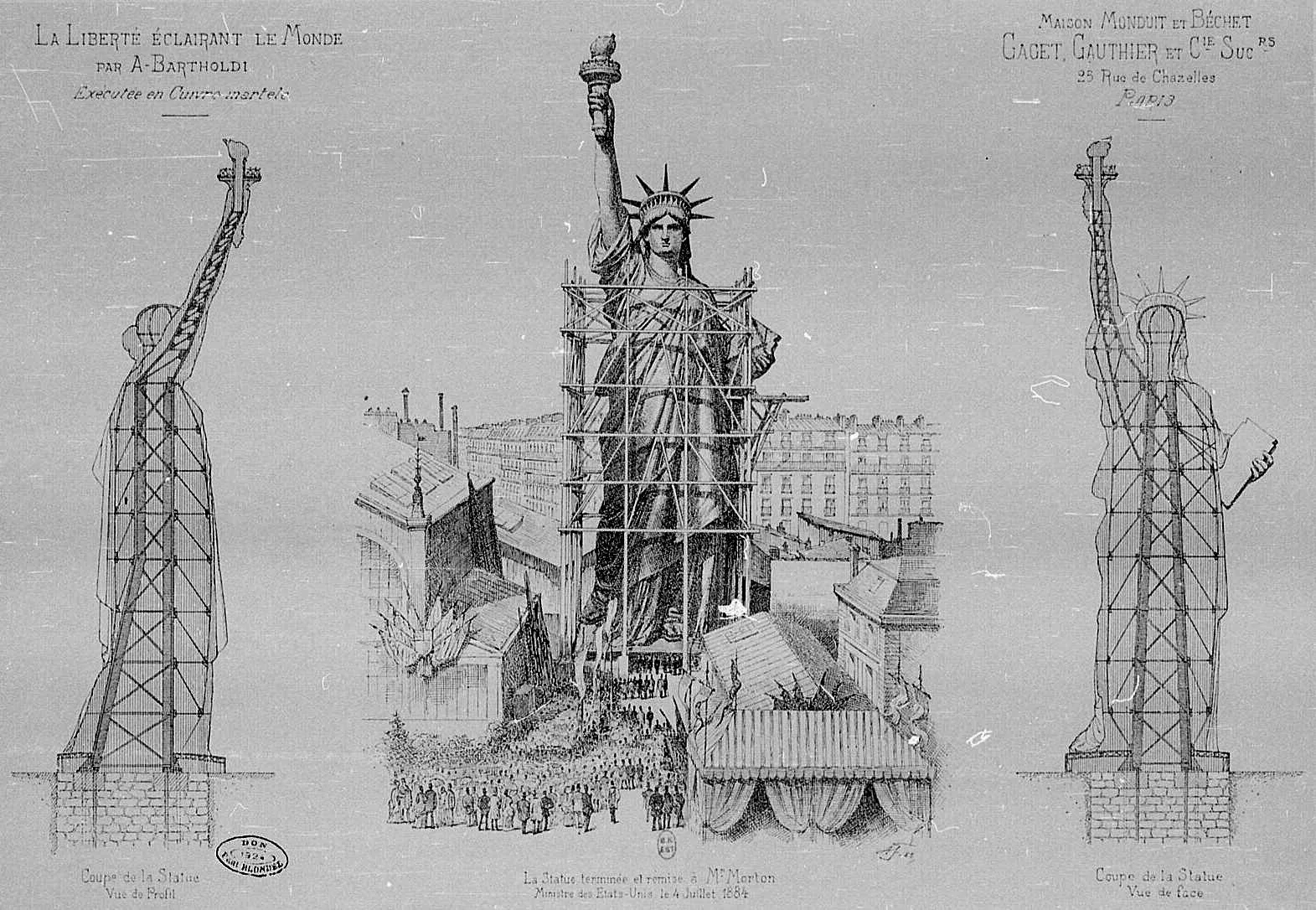
Gustave Eiffel's design, worked out with his engineer Maurice Koechlin, put a tall iron tower, or pylon, in the center of the statue. Four large iron posts run from the base to the top, carrying the statue's weight, according to the Park Service handbook.
Around the pylon, a lighter secondary frame reaches out toward the skin. Thin, flat iron bars, called armature bars, follow the inside of the copper and are connected to it with clips called saddles, so each piece of copper hangs on its own.
The design lets the copper skin move. As the metal heats up and cools down, and as the wind pushes against it, the skin can shift slightly without tearing. The Park Service says the statue can sway up to 3 inches in high winds and the torch up to 6 inches.
The weakness was a reaction between metals. Where iron touched copper, moisture caused corrosion. By the 1980s many of the original iron bars had rusted badly, and the restoration replaced them with stainless steel.
Richard Morris Hunt, one of the best-known American architects of his day, designed the pedestal. His first designs were taller, but he cut the height to keep costs down and to keep the statue from being overwhelmed by its base.
The pedestal rises 89 feet above its foundation. It is a massive core of concrete faced with pink granite from Leete's Island in Connecticut. When it was built, it was one of the largest masses of poured concrete in the world.
Inside, General Charles P. Stone designed the anchoring system. Two sets of iron girders were built into the walls, one near the bottom and a second about 55 feet higher, and iron beams connect them to the statue's frame, tying the statue to the pedestal so the wind cannot tip it over.
The pedestal was finished on April 22, 1886. Today visitors with pedestal tickets can walk out onto its observation level, and the lobby once held the American Museum of Immigration.
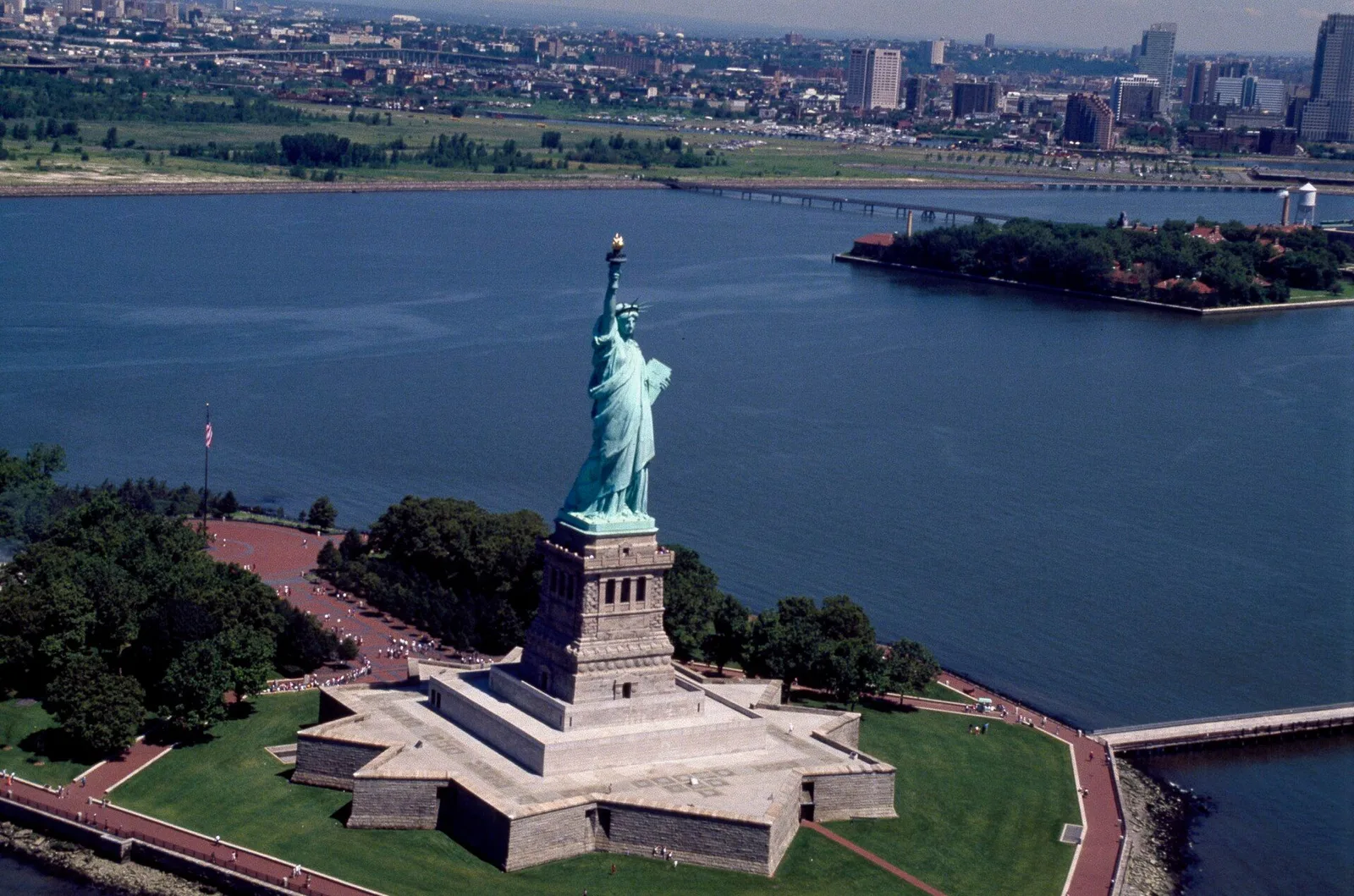
Long before the statue, the island held Fort Wood, an 11-pointed star-shaped fort built by the Army between 1808 and 1811 to defend New York Harbor. In 1814 it was named for Lieutenant Colonel Eleazer D. Wood, killed in the War of 1812.
The star shape let soldiers fire along the walls from many angles. During the Civil War the fort served as a recruiting station and supply depot.
Hunt's pedestal was built in the center of the old fort, and the fort's granite walls became part of the monument's base. From the air, the statue still stands in the middle of the star.
The Army kept a post on the island until 1937. Visitors with pedestal or crown tickets can walk on top of the fort's walls today.
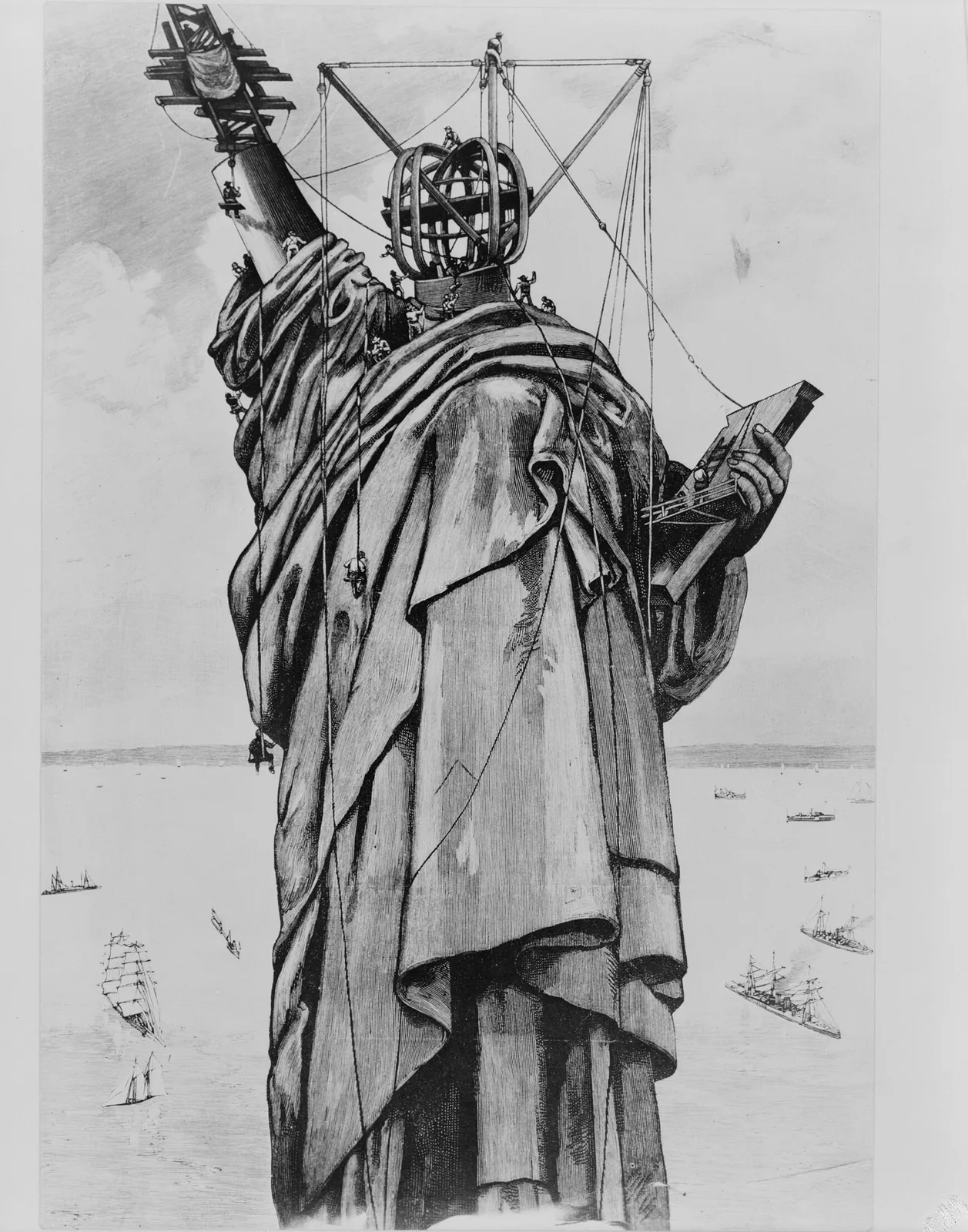
After the statue was presented in Paris in July 1884, it stood there until the American pedestal was ready. In early 1885 workers took it apart piece by piece and marked every piece so it could be reassembled.
The statue was packed into 214 wooden crates holding about 350 pieces. Some crates weighed several tons.
The French Navy ship Isère carried the crates across the Atlantic in a rough crossing, arriving in New York Harbor on June 17, 1885. Crowds and boats turned out to welcome it.
The crates waited on Bedloe's Island for about a year while the pedestal was finished. Reassembly took place in 1886, with workers riveting the copper back onto the frame while hanging from ropes and scaffolds.
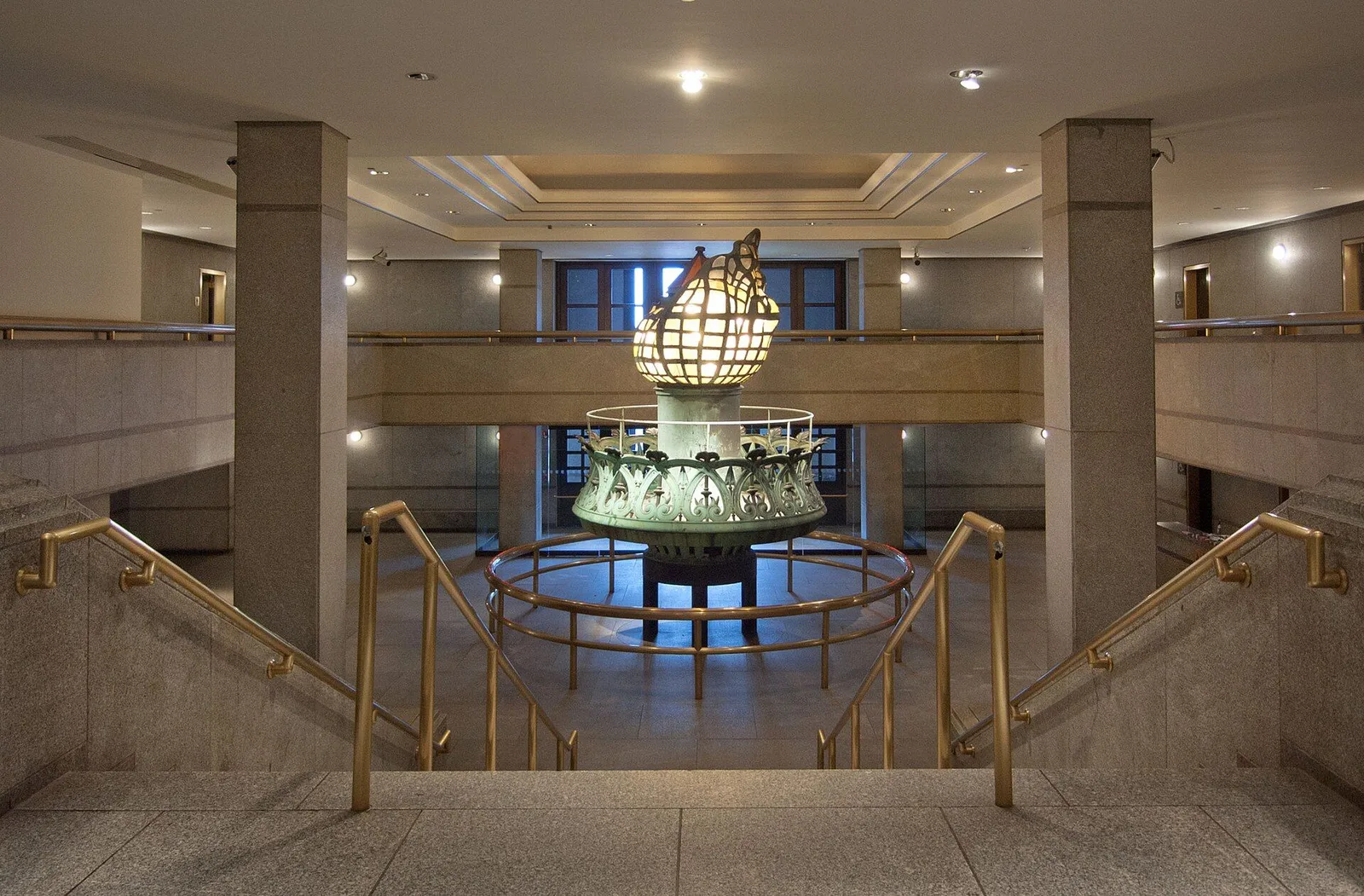
Bartholdi's original torch had a solid copper flame. When the Army Corps of Engineers rejected floodlights for the dedication, holes were cut in the torch so it could be lit from inside, but the light was weak, and as a lighthouse the statue was never very bright.
In 1916 Gutzon Borglum cut away much of the flame's copper and set in hundreds of panes of glass so the torch would glow. The glass let rain and snow leak inside, and over the years the water badly corroded the torch and the arm.
During the 1984 to 1986 restoration the original torch was removed, since its interior support had corroded beyond repair. French craftsmen built a new copper torch based on Bartholdi's original solid design and covered the flame in 24-karat gold leaf, which reflects the sun by day and is lit by floodlights at night.
The original torch was displayed in the pedestal lobby until November 2018, when it was moved to the Statue of Liberty Museum, where every visitor to the island can see it.
What the Statue Says
Every detail of the statue carries a meaning, from the torch to the chain at her feet, and the poem on the plaque gave her a new one. Open each to read more.
The raised torch stands for enlightenment, the light of liberty and reason shining out to the world. It is the reason for the statue's official name, "Liberty Enlightening the World."
Bartholdi drew on the Enlightenment, the 1700s movement of ideas about reason, natural rights, and government by the people that also shaped the Declaration of Independence and the U.S. Constitution.
To many immigrants arriving by ship, the torch came to mean something its creators had not planned. The Park Service notes that many saw it as a sign of welcome rather than of enlightenment.
The torch on the statue today is the 1986 replacement. The 1886 original stands in the Statue of Liberty Museum.
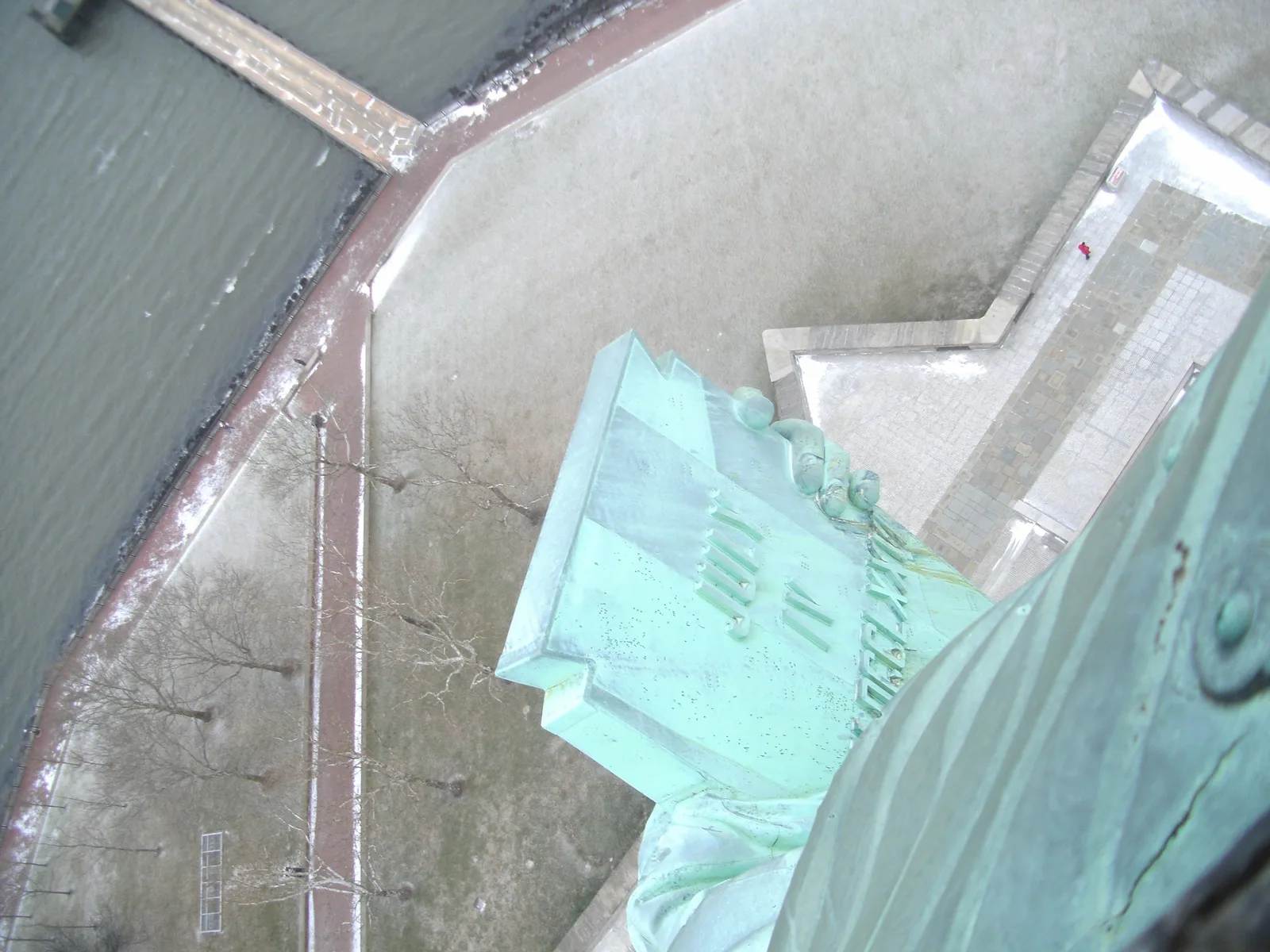
In her left arm the statue holds a tablet shaped like a keystone, the wedge-shaped stone that locks an arch together. It suggests law as the thing that holds liberty in place.
The tablet is inscribed JULY IV MDCCLXXVI, Roman numerals for July 4, 1776, the day the Continental Congress adopted the Declaration of Independence. That date is also the reason for the Fourth of July holiday.
According to the Park Service, the tablet is 23 feet 7 inches long, 13 feet 7 inches wide, and 2 feet thick.
By tying the statue to the Declaration, Bartholdi linked liberty to a specific act of self-government: a people declaring that governments get their power from the consent of the governed.
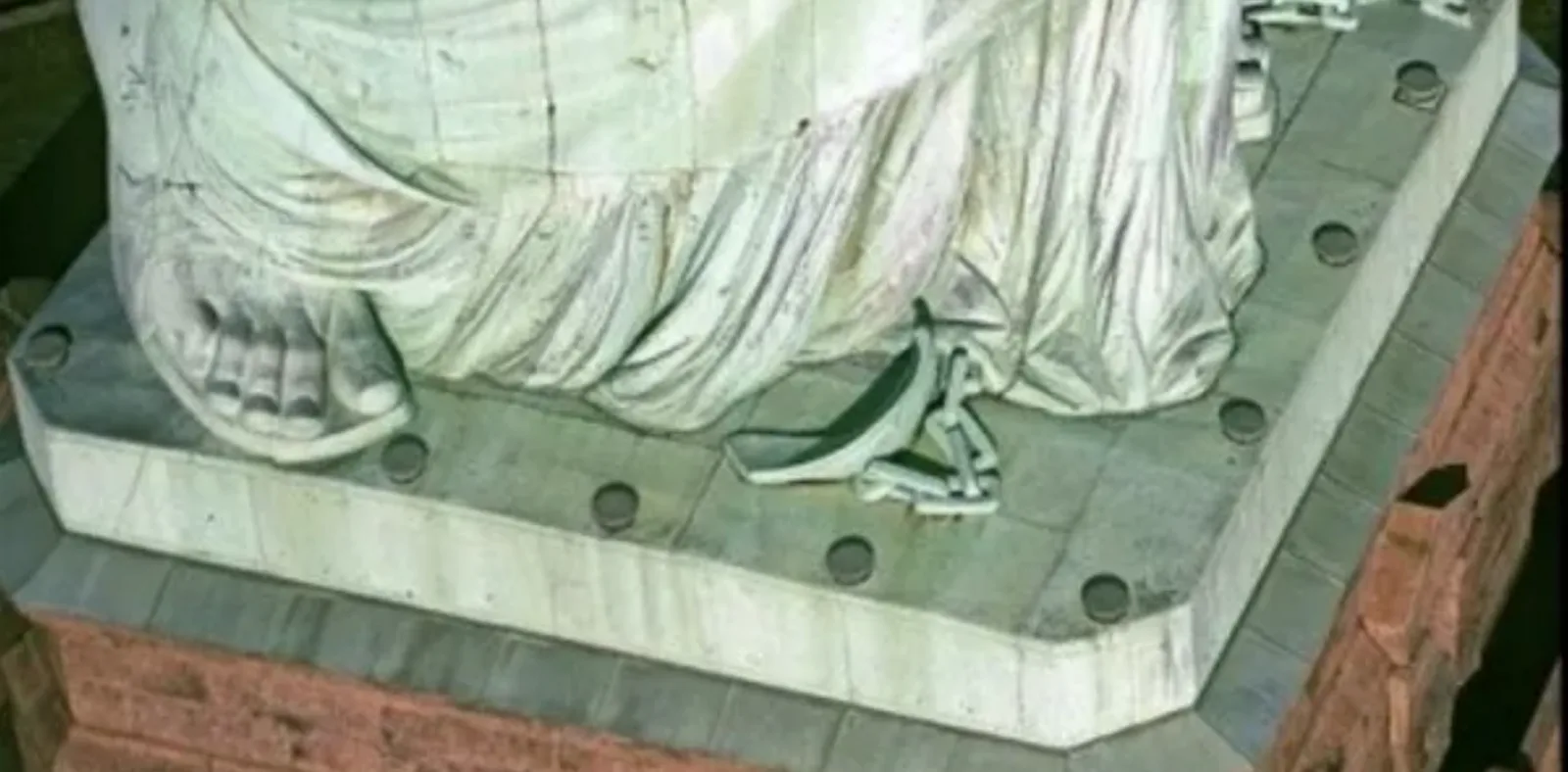
At the statue's feet lies a broken shackle and chain. The Park Service describes a shackle at the right foot, with the chain running under the robe and reappearing in front of the left foot, its end link broken.
The chains cannot be seen from the ground. They are best viewed from the air, which is one reason few visitors know they are there.
The chains are widely read as standing for freedom from tyranny and servitude. The Park Service notes that Laboulaye, an abolitionist, proposed the statue partly to honor the end of slavery after the Civil War, a link explored further in the site's page on Black American history.
The Park Service also records that for many Black Americans in 1886, the statue's promise did not match their lives under segregation and violence. W.E.B. Du Bois wrote that he could not share the hope he believed immigrants felt when they passed it.
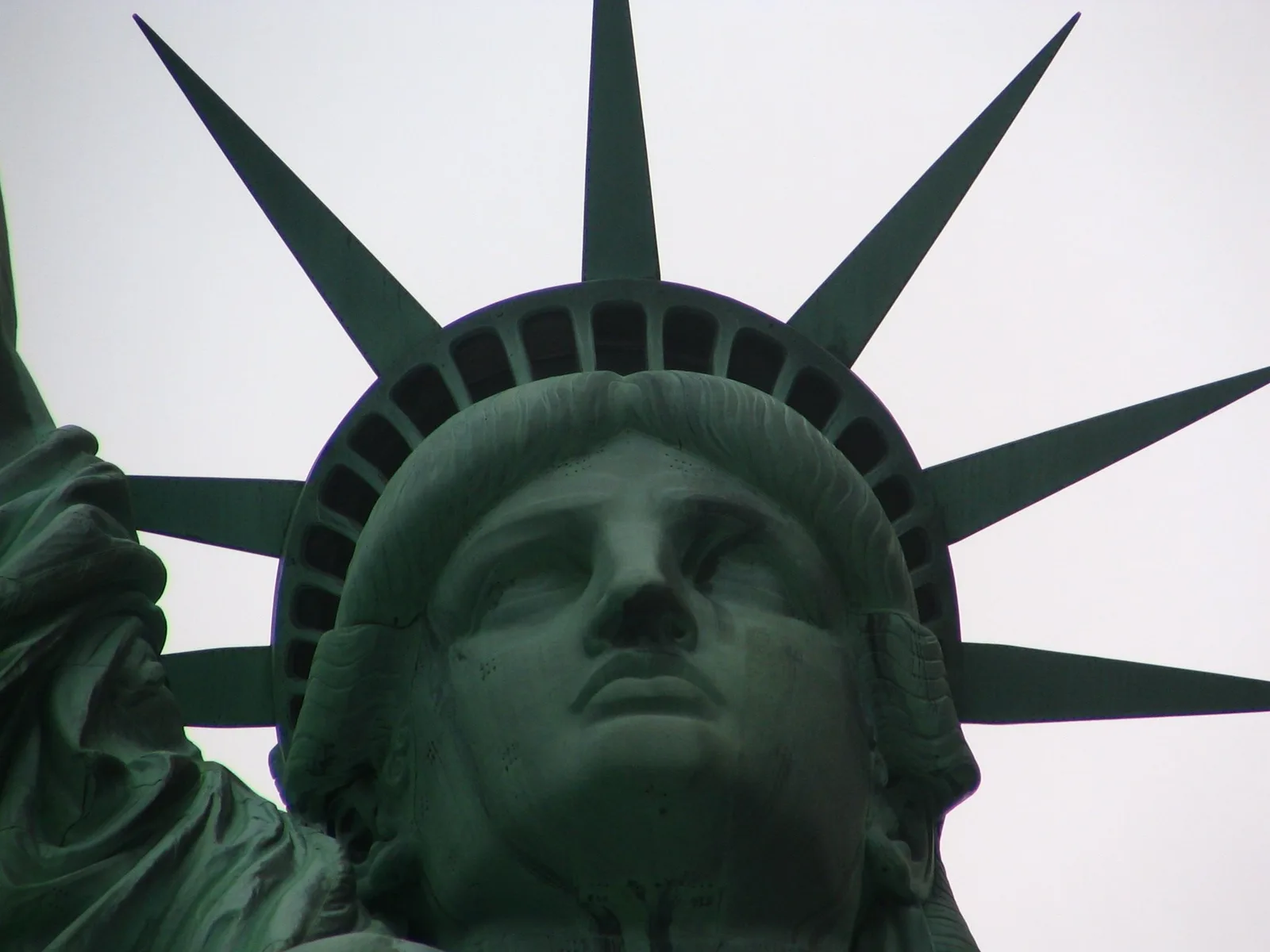
The crown has seven rays. The Park Service explains that the rays represent light, like a halo, fitting the statue's role as Libertas, the Roman goddess of liberty.
A popular explanation says the seven rays stand for the seven continents or the seven seas. Bartholdi did not leave a statement confirming that meaning, so it is best treated as a later tradition.
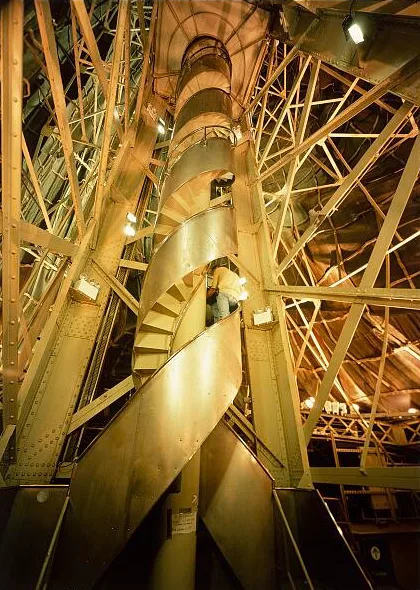
The crown has 25 windows. Visitors with crown tickets climb a narrow double spiral staircase, about the height of 10 floors, to look out of them over the harbor. Crown tickets are limited and often sell out months ahead.
The face beneath the crown is often said to be modeled on Bartholdi's mother, Charlotte. The claim is commonly repeated but has not been confirmed.
The statue is modeled on Libertas, the Roman goddess of liberty. In the Roman Republic, Libertas stood for the freedom of citizens, and freed slaves wore a cap linked to her.
Artists in Europe and America had shown liberty as a woman for centuries, and female figures such as Columbia were already common American symbols when Bartholdi began.
Bartholdi gave his figure a calm, stern face and a long classical robe rather than a soldier's armor. He wanted her to stand for liberty under law, not revolution by force.
Before this commission, Bartholdi had proposed a giant lighthouse figure of a robed woman holding a light for the entrance of Egypt's Suez Canal. Egypt's ruler did not build it. Historians, including writers for the Smithsonian, note the resemblance, though Bartholdi always said the two were separate works.
Emma Lazarus wrote "The New Colossus" on November 2, 1883, and gave it to an art and literary auction raising money for the pedestal. The "brazen giant of Greek fame" in its first line is the Colossus of Rhodes, a huge ancient statue of the sun god Helios. Lazarus contrasted that conqueror with a new kind of giant: a woman welcoming the world's exiles.
Her poem renamed the statue the "Mother of Exiles" and gave her a voice. In the poem the statue speaks to the old nations of Europe: "Give me your tired, your poor, / Your huddled masses yearning to breathe free."
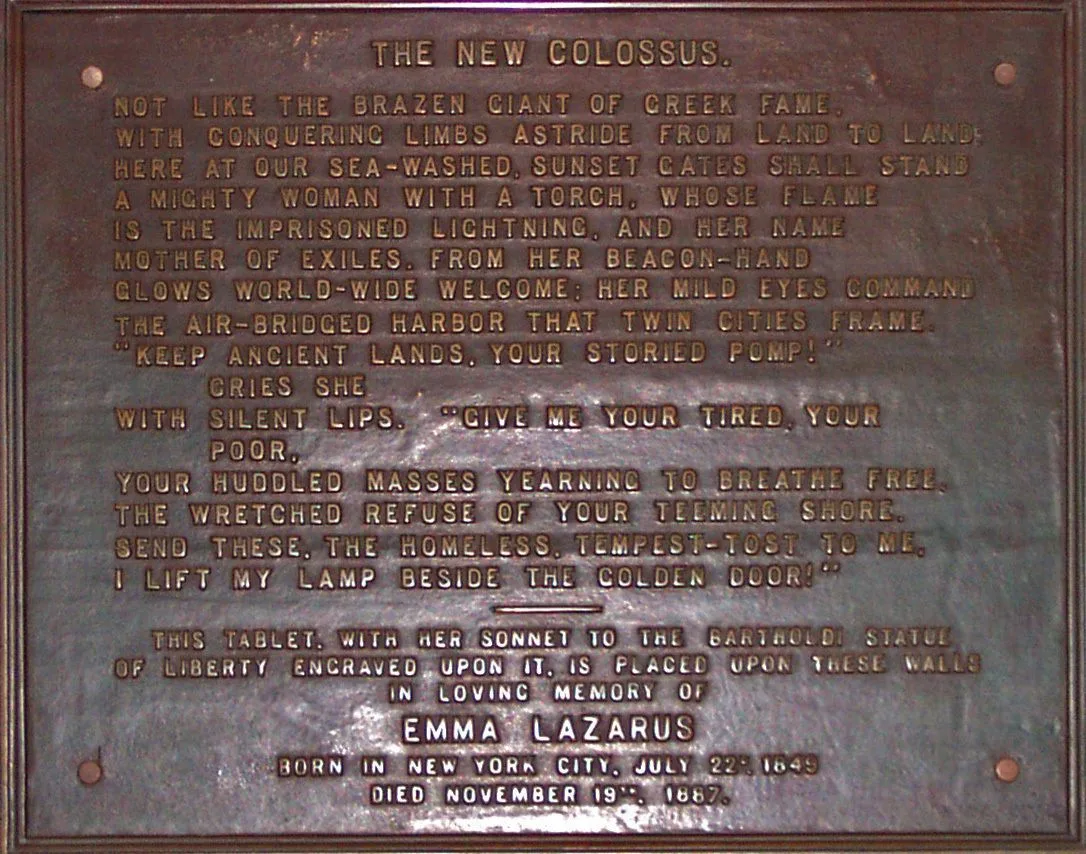
In 1901 Georgina Schuyler, a friend of Lazarus, began a campaign to put the poem on the statue. In May 1903 it was cast on a bronze plaque and mounted inside the pedestal, where the original still hangs today. An exact replica is in the Statue of Liberty Museum.
The poem became famous as millions of immigrants sailed past the statue, and its lines are among the most quoted in American writing. The full poem appears below.
The New Colossus
Emma Lazarus, November 2, 1883
Not like the brazen giant of Greek fame,
With conquering limbs astride from land to land;
Here at our sea-washed, sunset gates shall stand
A mighty woman with a torch, whose flame
Is the imprisoned lightning, and her name
Mother of Exiles. From her beacon-hand
Glows world-wide welcome; her mild eyes command
The air-bridged harbor that twin cities frame.
"Keep, ancient lands, your storied pomp!" cries she
With silent lips. "Give me your tired, your poor,
Your huddled masses yearning to breathe free,
The wretched refuse of your teeming shore.
Send these, the homeless, tempest-tost to me,
I lift my lamp beside the golden door!"
The full poem as it appears on the bronze plaque placed inside the pedestal in 1903. The poem is in the public domain.
The People Behind the Statue
A law professor, a sculptor, two engineers, an architect, a publisher, a poet, and a president each played a part.
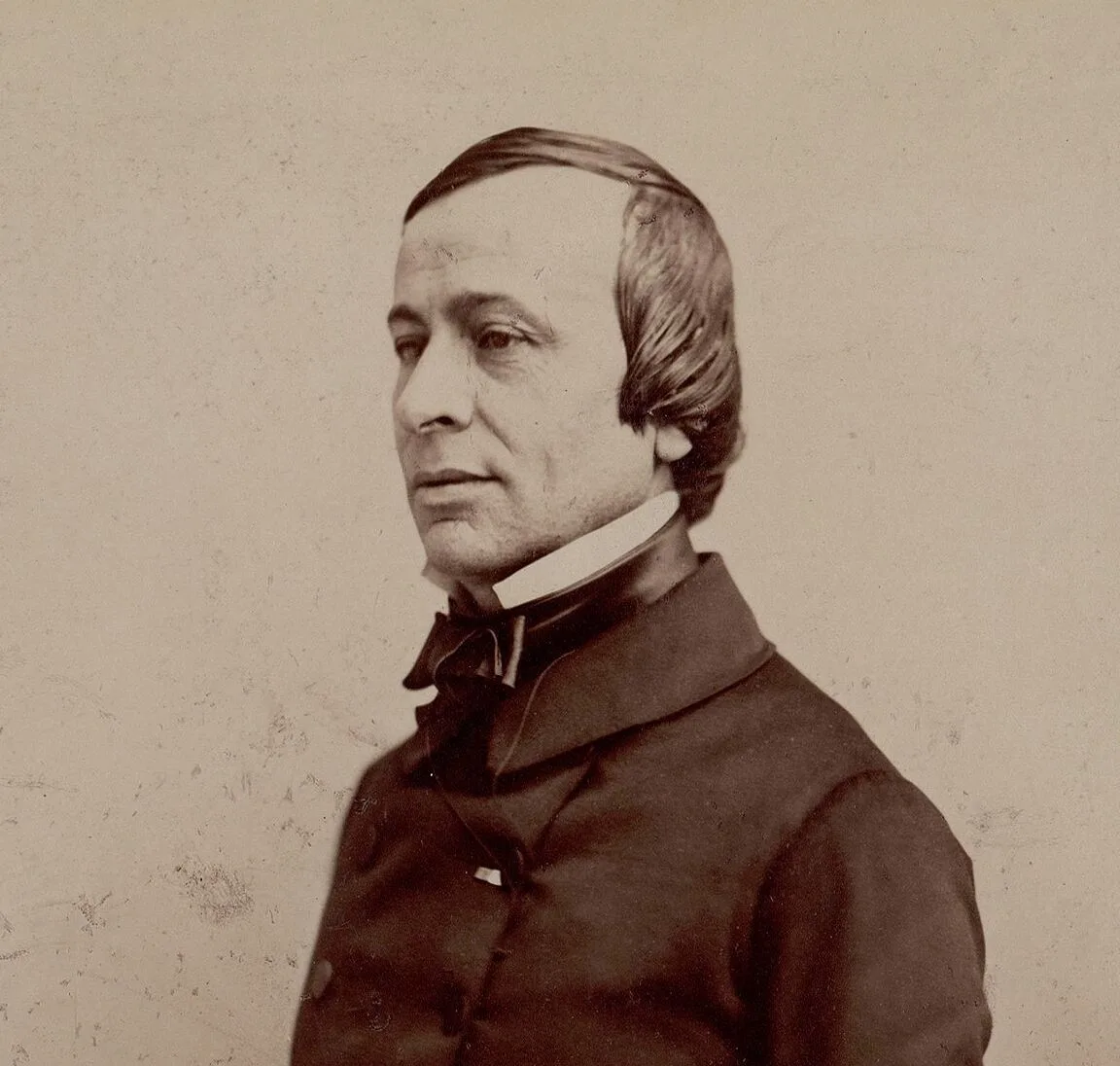
Édouard René de Laboulaye was a French law professor at the Collège de France and the country's leading expert on the U.S. Constitution. He wrote a three-volume history of the United States and admired the American system of government.
He strongly supported President Lincoln and the Union during the Civil War. He was an honorary member of the Union League Club of Philadelphia and president of the French Anti-Slavery Society, which raised money for newly freed Americans after 1865.
In 1865 he proposed the statue as a gift honoring American independence, the Union victory, and the end of slavery, and as a quiet argument for democracy in France. He became president of the Franco-American Union in 1875.
Laboulaye died in 1883, before the statue was finished. He also served in France's legislature after it became a republic in the 1870s.
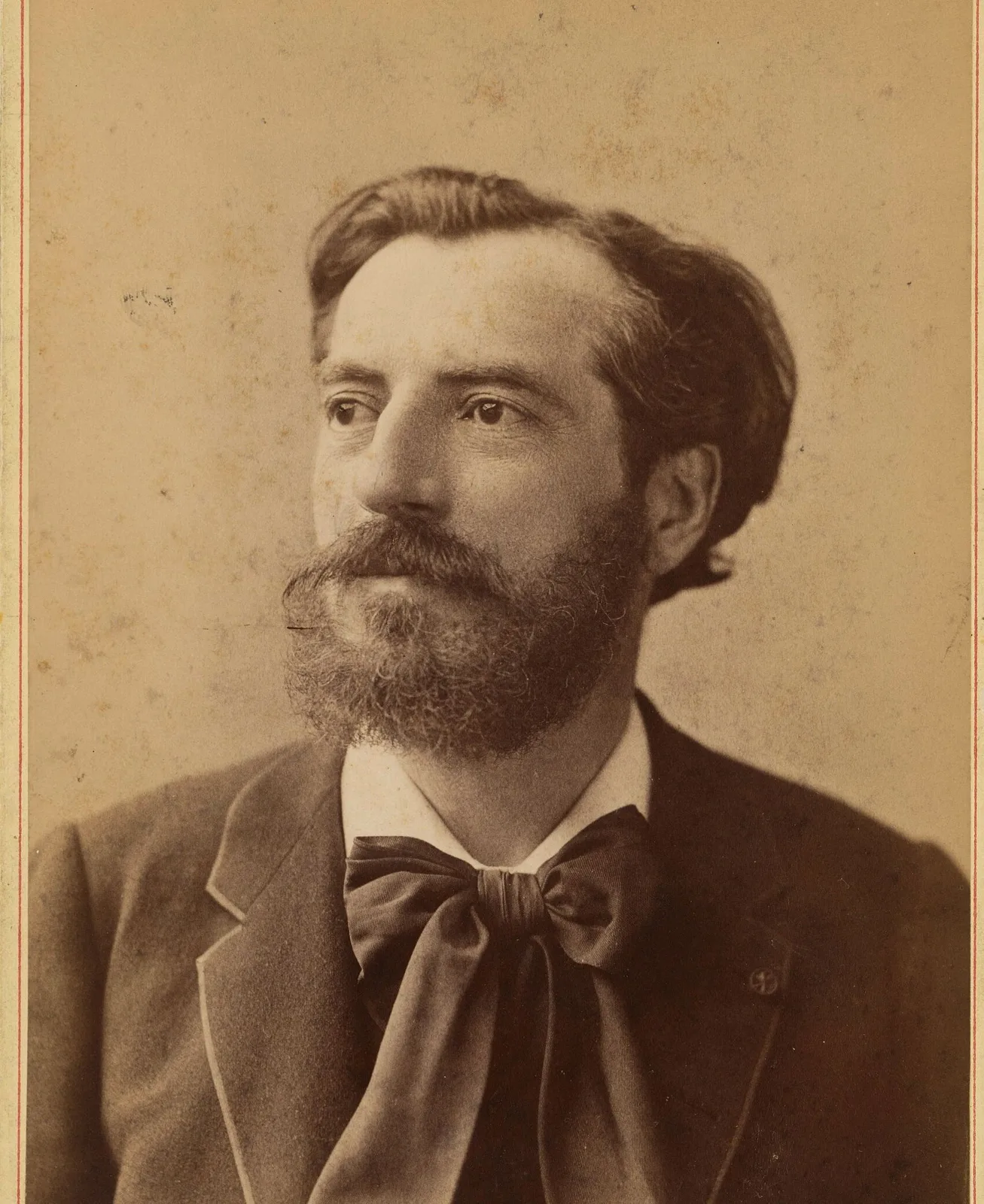
Bartholdi was born in Colmar, in the French province of Alsace, and trained as a painter, architect, and sculptor. He was drawn to monuments on a giant scale.
He served in the Franco-Prussian War, and when Germany took Alsace in 1871, his hometown passed under foreign rule. That same year he sailed to America, chose Bedloe's Island as the site, and promoted the statue across the country.
He spent more than ten years on the project, from the first models to the finished statue, and received a U.S. design patent for it in 1879. On dedication day in 1886 he was the one inside the head who released the flag covering her face.
Bartholdi's other works include the Lion of Belfort, carved into a cliff in eastern France to honor that city's defense in the Franco-Prussian War.
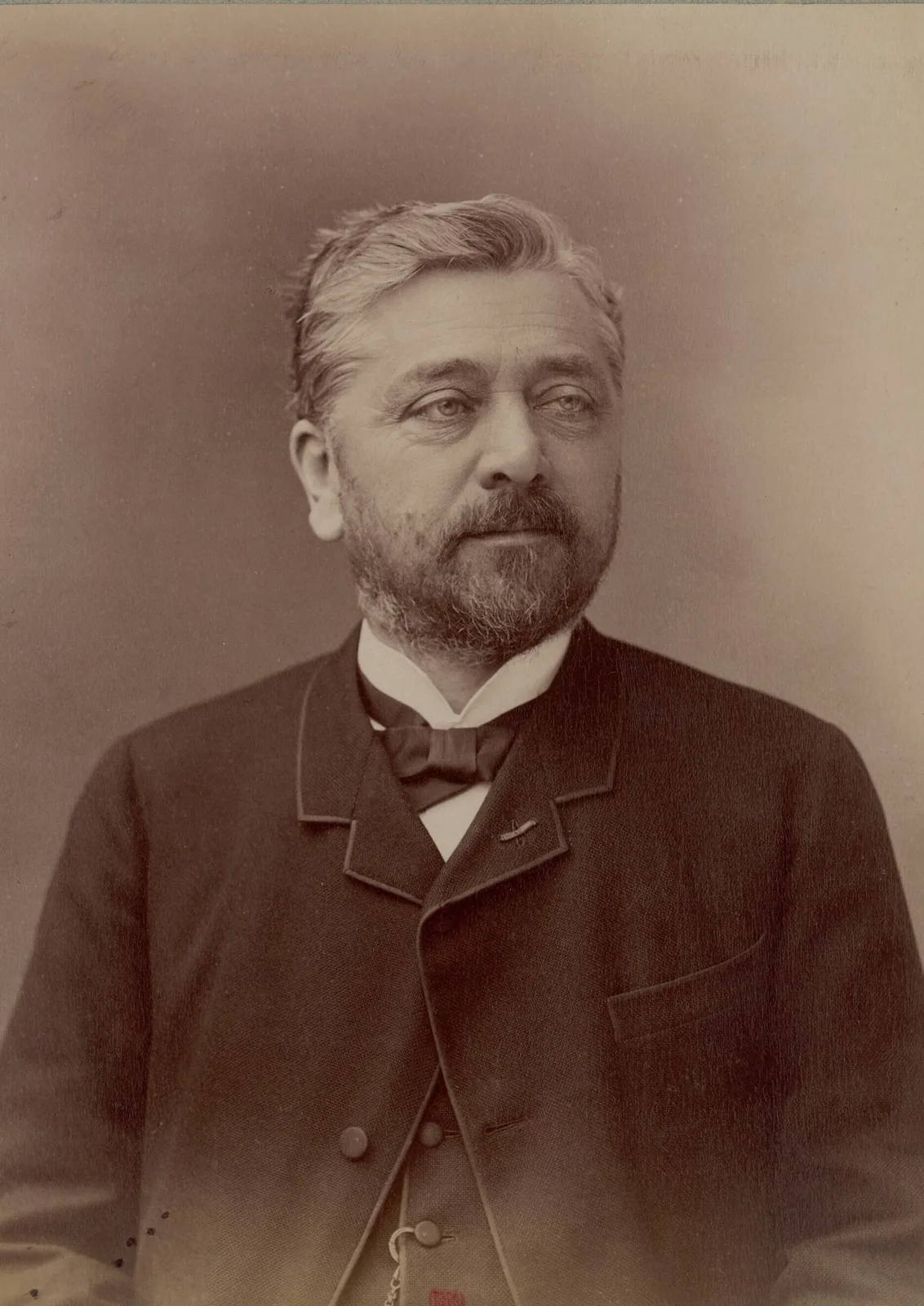
Alexandre-Gustave Eiffel was a French engineer whose company built iron railway bridges and viaducts across Europe. He was an expert on how iron structures behave under wind and weight.
Bartholdi hired him in 1879, after the first engineer, Viollet-le-Duc, died. Eiffel and his engineer Maurice Koechlin designed the iron pylon and the flexible frame that hold the copper skin.
His solution was new for its time: instead of a solid statue, a hollow skin hung on a skeleton that could flex in the wind. Similar thinking later went into the frames of skyscrapers.
Eiffel's company then built the 984-foot Eiffel Tower for the 1889 Paris world's fair, which made his name famous around the world.
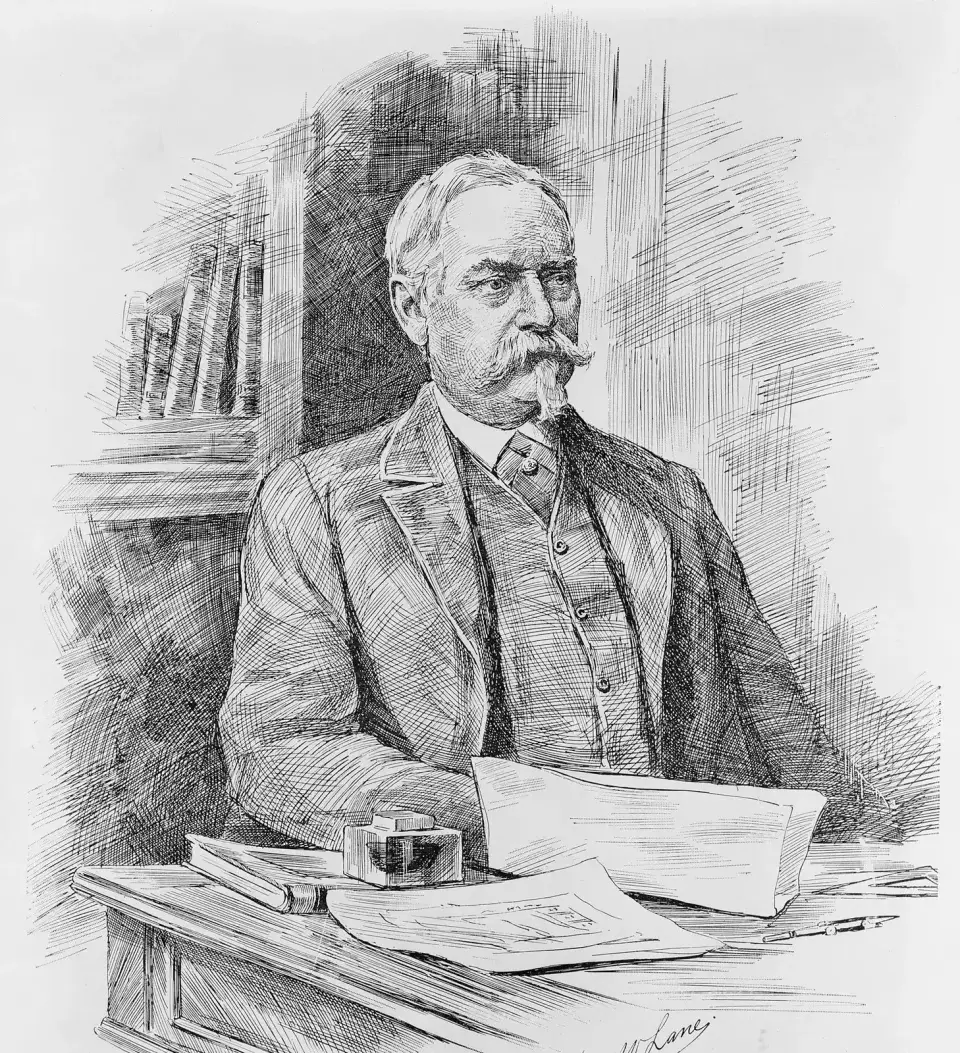
Hunt was the first American to study architecture at the École des Beaux-Arts in Paris, the most respected architecture school of the time. He brought its classical style back to the United States.
The American Committee hired him in 1881 to design the pedestal. He worked through several designs before settling on the 89-foot granite pedestal, with columns and openings that echo ancient monuments.
He was also a founder of the American Institute of Architects and designed some of the country's best-known buildings, including the Biltmore Estate in North Carolina and the Fifth Avenue facade of the Metropolitan Museum of Art.
The pedestal is one of his most visited works, seen by millions of people every year as the base of the statue.
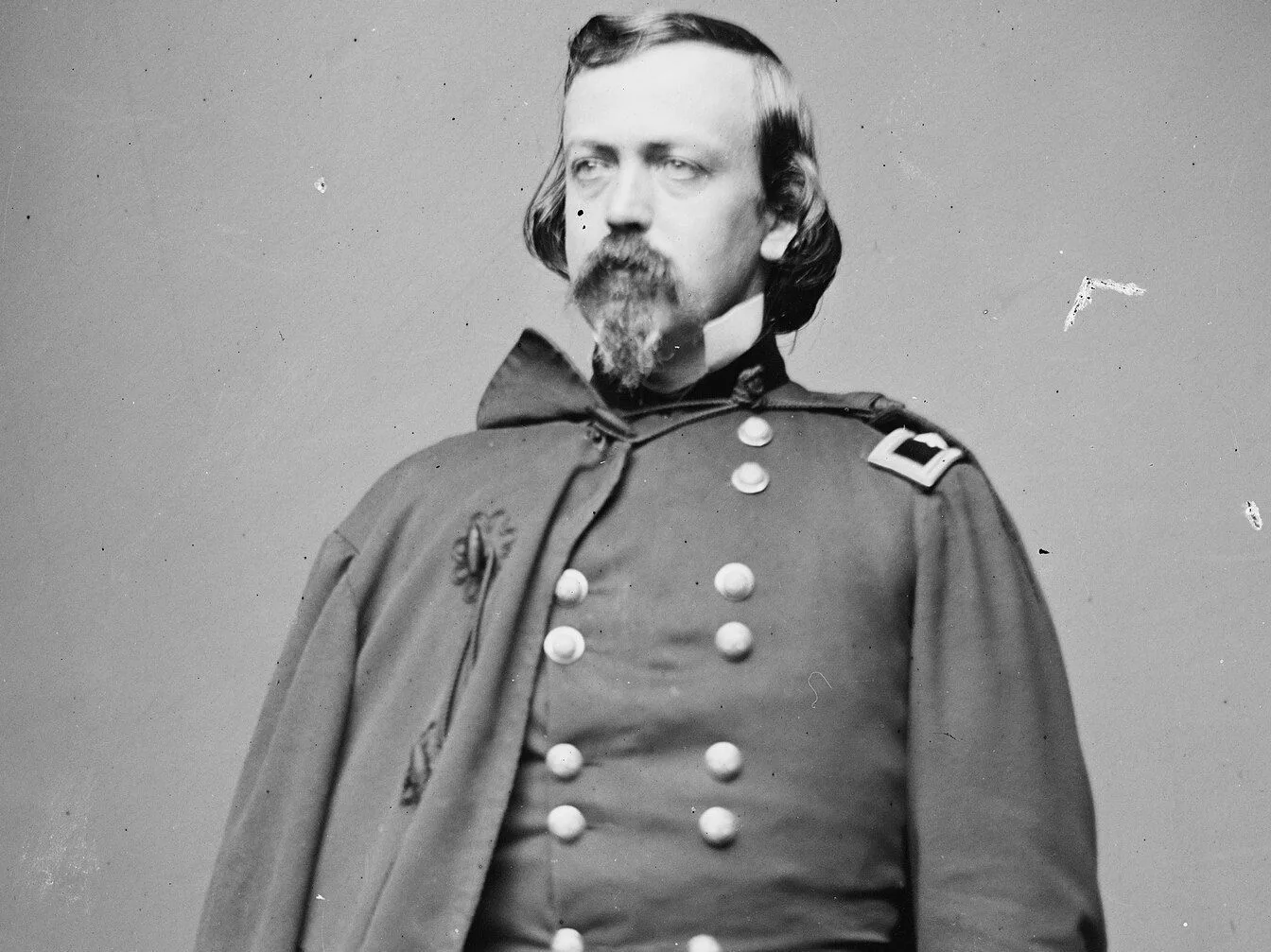
Charles Pomeroy Stone was a West Point graduate and Army officer who served as a Union general early in the Civil War. He later spent more than ten years as chief of staff of the Egyptian army.
In 1883 the American Committee appointed him chief engineer for the pedestal and foundation. He oversaw the concrete foundation poured inside Fort Wood, which the Park Service says weighs about 54 million pounds.
Stone designed the anchoring system of iron girders and tie beams that binds the statue to its pedestal. The Park Service handbook says his method has "proved by the test of years."
He also managed the reassembly of the statue in 1886 and served as grand marshal of the dedication day parade. He died the following year.
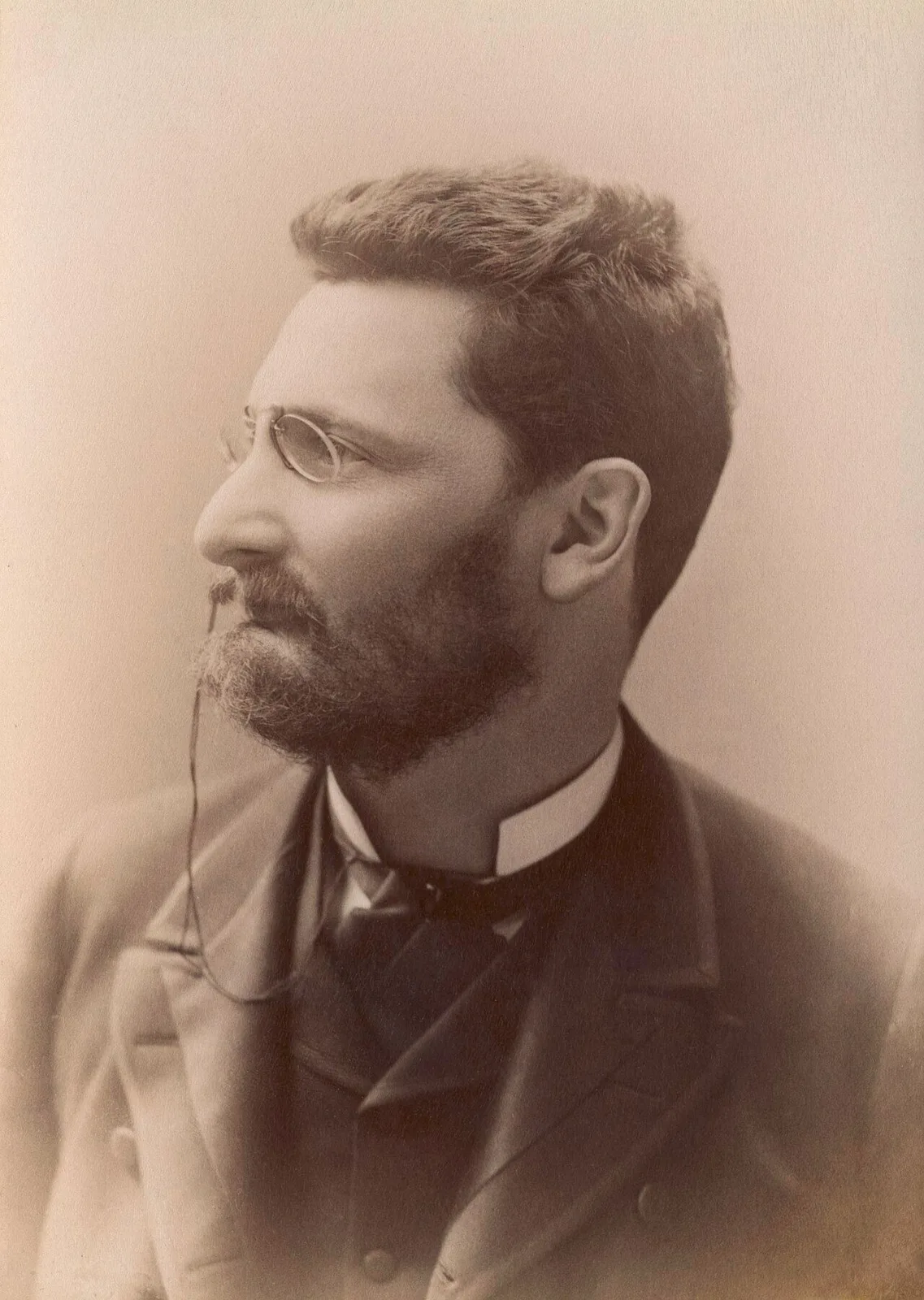
Pulitzer was born in Hungary and came to the United States in 1864 as a young immigrant, serving in the Union Army during the Civil War. He built a newspaper empire, buying the New York World in 1883.
He argued that the statue was a gift to the whole American people, not just to the rich. When the pedestal fund ran out, he used the World to shame wealthy New Yorkers and call on ordinary readers to give.
His campaign, renewed on March 16, 1885, printed the name of every donor. By August 11, 1885, more than 120,000 people had given over $100,000, most of it in gifts of a dollar or less, and the pedestal was saved.
The campaign also made the World one of the most-read newspapers in the country. Pulitzer's will later created the Pulitzer Prizes for journalism, literature, and music, first awarded in 1917.
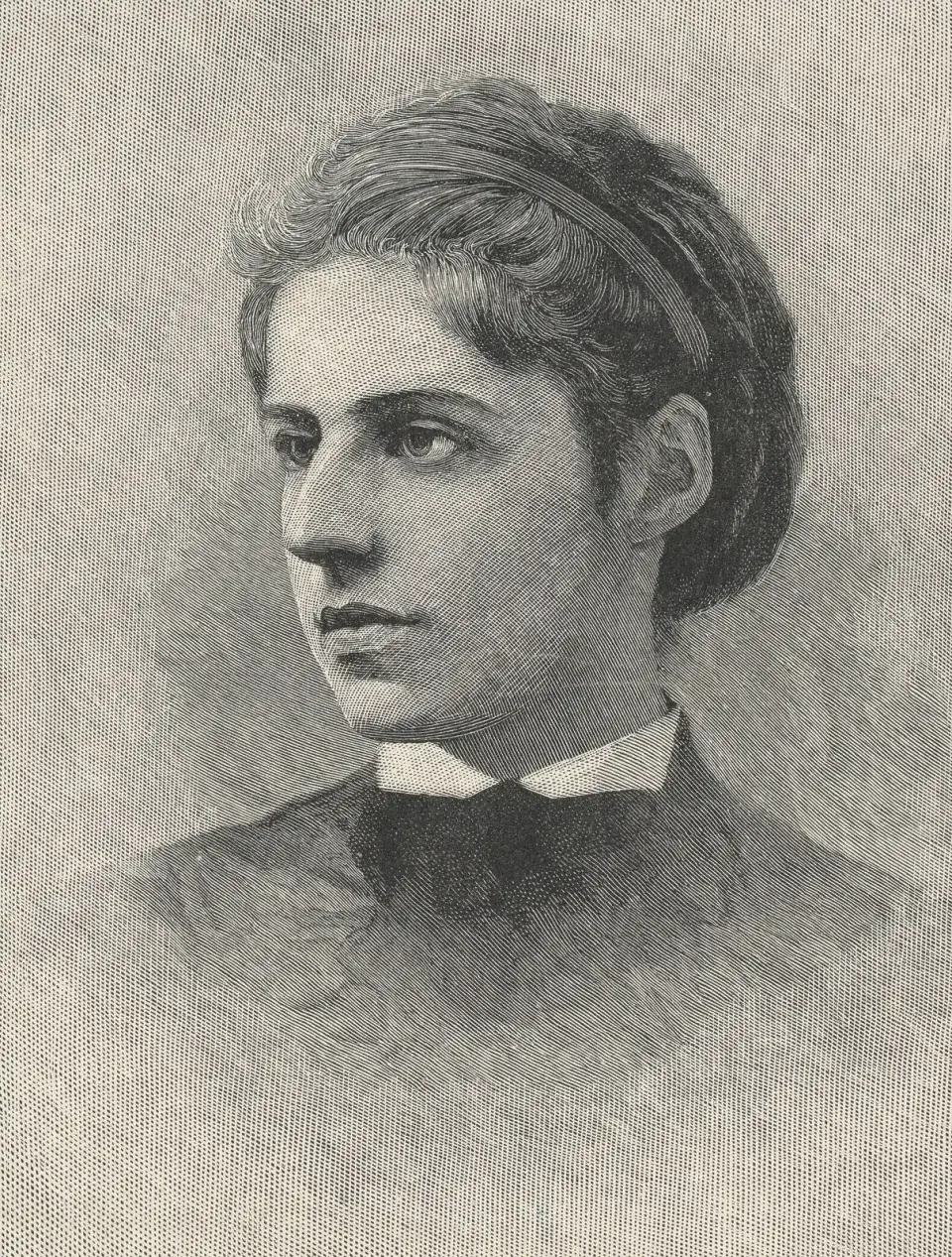
Emma Lazarus was a New York poet from a wealthy Sephardic Jewish family whose ancestors had lived in America since colonial times. She was well known in literary circles and corresponded with writers such as Ralph Waldo Emerson.
In the early 1880s she worked to help Jewish refugees fleeing violent attacks in the Russian Empire who were arriving in New York, an experience that shaped her view of America as a refuge.
She wrote "The New Colossus" on November 2, 1883, for an auction to raise money for the pedestal. The poem cast the statue as the "Mother of Exiles."
Lazarus died in 1887, at age 38, and did not live to see her poem become famous. It was placed on a plaque in the pedestal in 1903, thanks to her friend Georgina Schuyler.
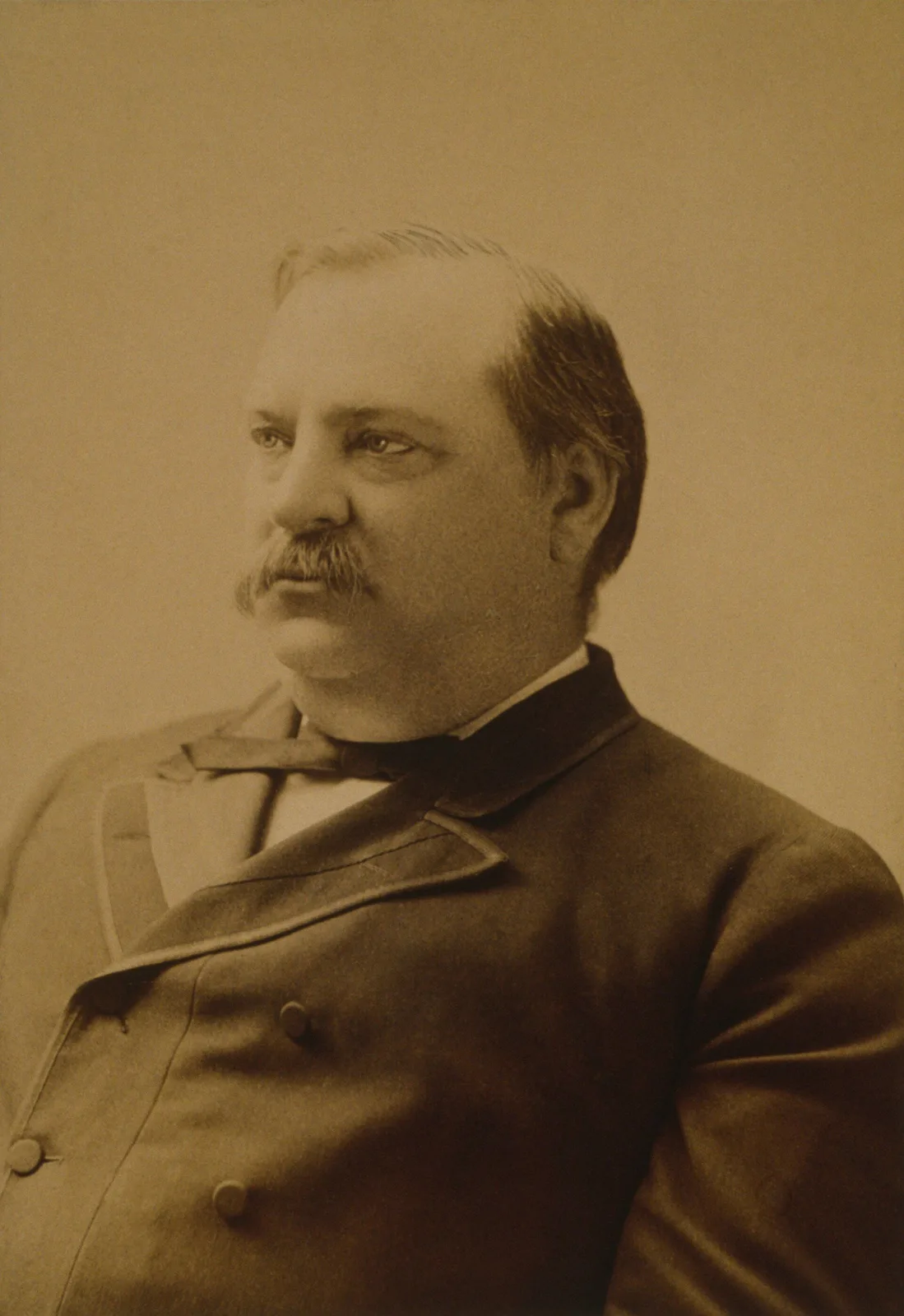
Grover Cleveland was the 22nd and 24th President of the United States, the only President to serve two terms that were not back to back. Before that he was governor of New York.
As governor in 1884, he vetoed a bill that would have given $50,000 in state money to the pedestal. He believed state funds should not pay for it.
As President, he dedicated the statue on October 28, 1886, promising that the nation would not forget "that Liberty has here made her home." Days earlier he had placed the statue under the U.S. Lighthouse Board.
Cleveland's dedication made the statue a national symbol, not just a New York landmark. Later Presidents have returned to it for anniversaries and signings.
Georgina Schuyler was a New York arts patron and philanthropist, a great-granddaughter of Alexander Hamilton, and a friend of Emma Lazarus.
In 1901, years after Lazarus's death, she came across "The New Colossus" in a bookshop and decided it should be placed on the statue as a memorial to her friend.
She led a two-year civic campaign to win approval from the War Department, which then ran the island. The plaque was mounted inside the pedestal in May 1903.
Her effort is the reason the poem is linked to the statue today. Without it, Lazarus's words might have stayed buried in an old book of poems.
Visiting and Caring for Liberty
How the statue is cared for today, how to visit, and where her story goes from here.
The only way to reach Liberty Island is by the Park Service's authorized ferry, Statue City Cruises, which leaves from Battery Park in Manhattan and Liberty State Park in Jersey City, New Jersey. Private boats cannot dock, for security reasons.
The ferry ticket includes the grounds of Liberty Island, the Statue of Liberty Museum, and Ellis Island. The islands charge no entrance fee by law, so a national park pass does not cover the ferry.
Going inside the statue takes a separate pedestal or crown ticket, and both are limited. Crown tickets usually sell out three to four months ahead, and the climb is about 10 floors on a narrow spiral staircase.
Ranger tours are free and first-come, first-served. Pets are not allowed on the ferries or the island, though service animals are.
The Statue of Liberty Museum opened on May 16, 2019, in a 26,000-square-foot building near the island's flagpole. Every visitor to Liberty Island can enter it.
Its centerpiece is the original 1886 torch, moved there in November 2018. It stands in the Inspiration Gallery, where glass walls look out at the statue.
Other exhibits include a full-size copper model of the face, an exact replica of the New Colossus plaque, and displays on how the statue was designed, built, and restored.
The museum's roof is planted with native grasses and has an overlook with views of the harbor and the New York skyline.
Ellis Island, a short ferry ride away, was the nation's busiest immigration station from 1892 to 1954. The Park Service says almost 14 million immigrants entered the United States through New York between 1886 and 1924.
Ellis Island was added to the Statue of Liberty National Monument in 1965. Its main building reopened as the Ellis Island National Museum of Immigration in 1990.
Many Americans can trace an ancestor through Ellis Island's records. Its story ties into the modern debates covered on the site's path to citizenship page.
A common mix-up: the Statue of Liberty stands on Liberty Island, not Ellis Island. Both are federal property run by the Park Service. Liberty Island lies within New York's jurisdiction, though it is closer to New Jersey.
The Park Service watches the statue constantly for wear from salt air, wind, and temperature swings. The green patina protects the copper, so it is never cleaned off or painted.
Webcams mounted on the torch stream views of the harbor and help the public watch the statue from anywhere.
Hurricane Sandy in 2012 showed the island's weakness to storms and rising water. The rebuilt docks, power, and buildings were raised and designed to withstand future flooding.
The statue is protected by federal law as a National Monument, a power the President holds under the Antiquities Act of 1906. The site's page on executive orders explains how Presidents use proclamations like the one that protected it in 1924.
In 1889 Americans living in Paris gave the city a smaller copy of the statue, which stands on the Île aux Cygnes in the River Seine, facing toward New York.
Copies of the statue stand in many other places, from small replicas in American towns to a version in Tokyo Bay. Many were made for Boy Scout and anniversary programs in the 1950s.
The statue appears on coins, stamps, license plates, and posters, and on the reverse of the 2007 Presidential $1 coins. It ranks with the American flag as one of the most recognized symbols of the United States.
Protesters around the world have built their own versions of it. In 1989, students in Beijing's Tiananmen Square raised a 33-foot figure they called the Goddess of Democracy, inspired in part by the statue.
Sources & Further Reading
- Liberty Island: A Chronology, National Park Service
- Statue of Liberty Statistics, National Park Service
- Frequently Asked Questions, National Park Service
- Abolition and the Statue of Liberty, National Park Service
- The Immigrant's Statue, National Park Service
- Emma Lazarus, National Park Service
- Joseph Pulitzer, National Park Service
- Statue of Liberty, Historical Handbook No. 11, National Park Service
- Plaque, "The New Colossus" (museum catalog), National Park Service
- Statue of Liberty's Original Torch Completes Move, National Park Service
- Statue of Liberty, UNESCO World Heritage Centre
- The Woman Who Saved the Statue of Liberty, Smithsonian Magazine
Measurements and dates follow the National Park Service's Statue of Liberty National Monument pages and NPS Historical Handbook No. 11. Where sources differ by a day or a small number (the count of Pulitzer's donors, for example), this page gives the Park Service figure.