Because democracy only works when we understand it
Searches are processed by Cloudflare Workers AI and are not stored.
Searches are processed by Cloudflare Workers AI and are not stored.
Rhode Island
State Guide13th StateEst. 1790
Rhode Island RI
"The Ocean State"
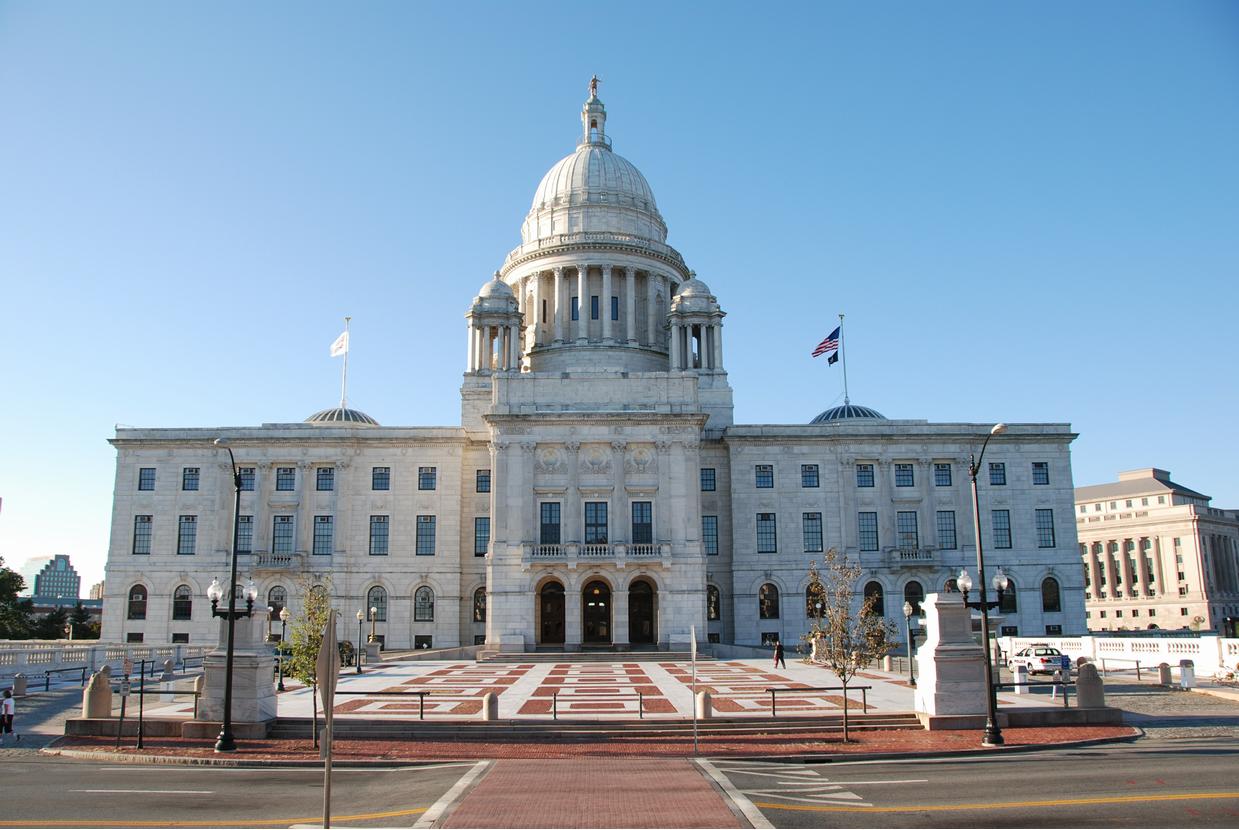
The smallest state in the Union and one of its most consequential. Rhode Island invented religious freedom in America, sparked the Industrial Revolution, gave the world some of its grandest Gilded Age architecture, and was the first colony to declare independence from Britain, then the last to join the new nation it helped create.
Rhode Island state finances at a glance
State Debt - FY2024
$11.4 billion
Total state government debt outstanding at the close of fiscal 2024, including long-term bonds and short-term borrowing across state agencies and public universities.
Tax Revenue - FY2024
$5.3 billion
Total Rhode Island state tax collections in fiscal 2024, led by the general sales tax ($1.6B) and the individual income tax ($1.6B).
Borrowing
Rhode Island issues voter-approved general obligation bonds plus a large amount of appropriation-backed and 'moral obligation' debt through state agencies. All are sold to investors in the municipal market; the state's debt per resident is high for its size. The state reported about $485 million in interest on its debt in fiscal 2024.
Source: U.S. Census Bureau, 2024 Annual Survey of State Government Finances.
1st
Colony to declare independence (1776)
13th
State to ratify the Constitution
1,545
Square miles, smallest U.S. state
1636
Founded by Roger Williams
…
Last updated:
Rhode Island's 2026 Midterm Election: Who and What Is on Your Ballot
Hey there, Rhode Island. On Tuesday, November 3, 2026, you're picking a new governor, one of your U.S. senators, both of your members of Congress, all five general officers, and every seat in the General Assembly.
This is a midterm election, halfway through the president's term, and nationally it decides who controls Congress for the next two years.
One thing's already settled: you're getting a new governor. Gov. Dan McKee lost the Democratic primary in September, the first time since 1994 a sitting Rhode Island governor lost renomination. You'll also see five bond questions that together would let the state borrow $600 million.
Key dates and how voting works are right below. Use the buttons above to open each race. Facts first; the decision is yours.
Checked against official sources on October 6, 2026
Key Dates
Key Dates
Voter registration deadline (already passed; Rhode Island has no Election Day registration in a midterm)
Sunday, October 4
Mail ballot applications due to your local board of canvassers by 4 p.m.
Tuesday, October 13
Early in-person voting begins
Wednesday, October 14
Election Day: polls open 7 a.m. to 8 p.m. (New Shoreham opens at 9 a.m.); mail ballots due by 8 p.m.
Tuesday, November 3
How Voting Works in Rhode Island
If you registered by October 4, you're set. Check your registration, polling place, and sample ballot at vote.ri.gov.
Any voter can vote by mail. Apply by 4 p.m. on October 13, then return your ballot to your local board of canvassers or a drop box by 8 p.m. on Election Day.
Early in-person voting runs for the 20 days before Election Day at your city or town's board of canvassers or another designated location; hours vary by town.
On Election Day, polls are open 7 a.m. to 8 p.m. Bring a photo ID, such as a Rhode Island driver's license, state voter ID card, or U.S. passport. Without one you can cast a provisional ballot. If you're in line at 8 p.m., you can vote.
Governor Race
The governor runs Rhode Island's executive branch, proposes the state budget, and can veto bills. Governors serve four-year terms, limited to two in a row.
The lieutenant governor is elected separately in Rhode Island, not as a ticket with the governor, so that race is its own line on your ballot.
Candidates come from Rhode Island Current's voter guide, because the Department of State's website blocks automated access. Your sample ballot at vote.ri.gov is the final word.
Positions are summarized from the candidates' answers to Rhode Island Current's questionnaire and their own campaign websites, in neutral words and without attacks on opponents. Where neither covered a candidate's positions, the card says so.
Governor of Rhode Island
Statewide, four-year term, open seat
Democrat Helena Foulkes, who beat Gov. Dan McKee in the September primary, faces Republican Aaron Guckian and three independents: Ken Block, Jay Gotra, and C.D. Reynolds.
Helena Foulkes
Democrat
Occupation:
Former president of CVS Pharmacy
Government experience:
None in elected office
What they say they stand for
Calls housing costs the top issue; her "Rhode Home" plan would create 20,000 homes and apartments, paid for with a millionaire's tax.
Wants to raise Medicaid reimbursement rates to keep primary care doctors and nurses in the state.
Proposes a $100 million investment in classroom-to-career programs.
Says renewable energy can lower energy costs while meeting climate goals.
Wants to end the state income tax on Social Security and lower the tax burden overall.
Wants to cut regulations and focus on keeping and growing existing businesses.
Promises a zero-based review of the state budget in his first 90 days.
Supports distributed solar, battery storage, and grid modernization to lower electricity costs.
C.D. Reynolds
Independent
Occupation:
Restaurant worker
Government experience:
None in elected office
What they say they stand for
Proposes a "Pursuit of Happiness Dividend": a $1,000 monthly cash payment to Rhode Island residents, which he puts at $3.2 billion a year.
Supports grid modernization and utility accountability rather than rolling back environmental protections.
Ballot Measures
Five statewide questions this year, all bonds: borrowing $600 million in total, which the state repays with interest over up to 20 years. Each question is voted on separately, and each needs a simple majority.
The General Assembly put them on the ballot in the state budget, which also wrote their wording. Here's what each one funds and what it costs.
Question 1 would let the state borrow up to $275 million for its three public colleges: $165 million for a new Integrated Health Building on the University of Rhode Island's Kingston campus, $50 million for a student success and career readiness center and renovations at Rhode Island College's Adams Library, and $60 million for a new Workforce Innovation Center on the Community College of Rhode Island's Warwick campus.
According to Rhode Island Current's review, URI expects the health building to open in 2031, RIC's library work to finish by 2030, and CCRI's center to be built between 2028 and 2030. Bonds pass with a simple majority.
A YES vote means
The state can borrow up to $275 million for the three college building projects.
A NO vote means
The state can't borrow the money, and the projects aren't funded by this bond.
Reasons people vote yes
We couldn't find official arguments for or against this question; the points below come from news reporting.
The colleges say the buildings would expand health education, clinical training, and career programs to address workforce shortages, and would last 50 to 75 years.
Reasons people vote no
Borrowing adds cost: the state estimates about $166 million in interest, for a total of about $441.3 million.
💵 Taxes and money: State borrowing repaid from the budget, about $441.3 million with interest
General obligation bonds are money the state borrows and pays back, with interest, from the state's general fund (mainly state taxes) over up to 20 years. This question lets the state borrow up to $275 million. It doesn't create or raise any tax by itself.
The state estimates the total cost with interest at about $441.3 million, assuming a 5% interest rate and 20 years of repayment.
What it could cost you
What it could cost you
Per Rhode Island resident, total
About $400
Per Rhode Island resident, per year
About $20
Our arithmetic, not an official estimate: the state's total cost with interest divided by Rhode Island's roughly 1.1 million residents, and spread over 20 years. It shows the size of the borrowing, not a bill: repayment comes out of the state budget, not a separate tax.
Question 2 would let the state borrow up to $120 million to increase and preserve affordable and accessible housing through redevelopment of existing buildings, new construction, property purchases, and infrastructure. At least $25 million must go toward housing built for homeownership, and up to $10 million may support public housing development.
Voters approved a $120 million housing bond in 2024, the largest in state history. Rhode Island Current reports that projects from this one would start by 2028 and finish between 2029 and 2032. Bonds pass with a simple majority.
A YES vote means
The state can borrow up to $120 million for affordable housing and homeownership programs.
A NO vote means
The state can't borrow the money for these housing programs.
Reasons people vote yes
We couldn't find official arguments for or against this question; the points below come from news reporting.
State housing officials point to nearly 3,800 housing permits issued statewide over the past year, and say subsidized projects such as rehabbing long-vacant buildings carry extra costs.
Reasons people vote no
The Rhode Island Public Expenditure Council found that, as of April, $52.2 million from the 2024 bond had financed 200 new rental units, an average of more than $512,000 per unit.
Some, including Democratic governor nominee Helena Foulkes, say bonds aren't the best way to pay for housing because of the interest costs.
💵 Taxes and money: State borrowing repaid from the budget, about $192.6 million with interest
General obligation bonds are money the state borrows and pays back, with interest, from the state's general fund (mainly state taxes) over up to 20 years. This question lets the state borrow up to $120 million. It doesn't create or raise any tax by itself.
The total of about $192.6 million with interest is our arithmetic, using the same 5% rate and 20-year repayment the state uses to estimate the other four questions.
What it could cost you
What it could cost you
Per Rhode Island resident, total
About $175
Per Rhode Island resident, per year
About $9
Our arithmetic, not an official estimate: the state's total cost with interest divided by Rhode Island's roughly 1.1 million residents, and spread over 20 years. It shows the size of the borrowing, not a bill: repayment comes out of the state budget, not a separate tax.
Question 3 would let the state borrow up to $100 million in two parts: $55 million for site development (land purchases, environmental cleanup, utilities, and site preparation, including at Quonset Business Park and Providence's I-195 District) and $45 million for infrastructure supporting the ocean, defense, life sciences, and data analytics industries, such as water-based test ranges.
The governor proposed $115 million; lawmakers cut the site development part by $15 million. Voters approved a similar $60 million industrial facilities bond in 2021. Bonds pass with a simple majority.
A YES vote means
The state can borrow up to $100 million for industrial site development and growth-industry infrastructure.
A NO vote means
The state can't borrow the money for these economic projects.
Reasons people vote yes
We couldn't find official arguments for or against this question; the points below come from news reporting.
The state's Executive Office of Commerce says the money would create ready-to-build sites and support growing industries, and the projects would last at least 50 years.
Reasons people vote no
Rhode Island Current notes the question doesn't name specific projects; the law lists broad eligible categories instead.
💵 Taxes and money: State borrowing repaid from the budget, about $160.5 million with interest
General obligation bonds are money the state borrows and pays back, with interest, from the state's general fund (mainly state taxes) over up to 20 years. This question lets the state borrow up to $100 million. It doesn't create or raise any tax by itself.
The state estimates the total cost with interest at about $160.5 million, assuming a 5% interest rate and 20 years of repayment.
What it could cost you
What it could cost you
Per Rhode Island resident, total
About $146
Per Rhode Island resident, per year
About $7
Our arithmetic, not an official estimate: the state's total cost with interest divided by Rhode Island's roughly 1.1 million residents, and spread over 20 years. It shows the size of the borrowing, not a bill: repayment comes out of the state budget, not a separate tax.
Question 4 would let the state borrow up to $50 million: $45 million to build a new Rhode Island State History Center near the State House in Providence, and $5 million for matching grants, run by the Historical Preservation and Heritage Commission, to cities, towns, and nonprofits for historic sites, museums, and cultural centers.
The State Archives now sit in rented office space on Broad Street in Providence. Secretary of State Gregg Amore has pushed for a new center for years; a larger version was left out of the 2024 bond package. Bonds pass with a simple majority.
A YES vote means
The state can borrow up to $50 million for the history center and preservation grants.
A NO vote means
The state can't borrow the money, and neither project is funded by this bond.
Reasons people vote yes
We couldn't find official arguments for or against this question; the points below come from news reporting.
Supporters, led by Secretary of State Amore, say the archives' rented space is a poor home for the state's historic documents and that the center would put them on public display, with an expected opening in fall 2030.
Reasons people vote no
Borrowing adds cost: the state estimates this question's total with interest at about $80.2 million.
💵 Taxes and money: State borrowing repaid from the budget, about $80.2 million with interest
General obligation bonds are money the state borrows and pays back, with interest, from the state's general fund (mainly state taxes) over up to 20 years. This question lets the state borrow up to $50 million. It doesn't create or raise any tax by itself.
The state estimates the total cost with interest at about $80.2 million, assuming a 5% interest rate and 20 years of repayment.
What it could cost you
What it could cost you
Per Rhode Island resident, total
About $73
Per Rhode Island resident, per year
About $4
Our arithmetic, not an official estimate: the state's total cost with interest divided by Rhode Island's roughly 1.1 million residents, and spread over 20 years. It shows the size of the borrowing, not a bill: repayment comes out of the state budget, not a separate tax.
Question 5 would let the state borrow up to $55 million: $25 million for a new Resilient Rhody Infrastructure Fund to help cities and towns with flooding and coastal hazards; $12 million for state park, beach, and campground facilities; $7 million for Narragansett Bay and watershed restoration; $3 million each for brownfield cleanup, farmland preservation, and open space; and $1 million each for local recreation projects and marine infrastructure such as boat launches.
Most projects are expected to be finished within five years, according to Rhode Island Current. Bonds pass with a simple majority.
A YES vote means
The state can borrow up to $55 million for the environmental and recreation projects.
A NO vote means
The state can't borrow the money for these environmental and recreation projects.
Reasons people vote yes
We couldn't find official arguments for or against this question; the points below come from news reporting.
State leaders say outdoor recreation contributes about $3.3 billion a year to the economy and supports 36,000 jobs, and that the resilience money helps communities prepare for rising seas and storms.
Reasons people vote no
Borrowing adds cost: the state estimates about $33.3 million in interest over 20 years, for a total of about $88.3 million.
💵 Taxes and money: State borrowing repaid from the budget, about $88.3 million with interest
General obligation bonds are money the state borrows and pays back, with interest, from the state's general fund (mainly state taxes) over up to 20 years. This question lets the state borrow up to $55 million. It doesn't create or raise any tax by itself.
The state estimates the total cost with interest at about $88.3 million, assuming a 5% interest rate and 20 years of repayment.
What it could cost you
What it could cost you
Per Rhode Island resident, total
About $80
Per Rhode Island resident, per year
About $4
Our arithmetic, not an official estimate: the state's total cost with interest divided by Rhode Island's roughly 1.1 million residents, and spread over 20 years. It shows the size of the borrowing, not a bill: repayment comes out of the state budget, not a separate tax.
Your city or town may have local questions too. Check your sample ballot at vote.ri.gov.
Senate Races
Every state gets two U.S. senators. The Senate votes on federal laws, confirms judges and cabinet members, and approves treaties. Senators serve six-year terms, staggered so only about a third are up in any election.
Jack Reed's seat is up this year. Sheldon Whitehouse's term runs through 2030.
Candidates come from Rhode Island Current's voter guide, because the Department of State's website blocks automated access. Your sample ballot at vote.ri.gov is the final word.
Positions are summarized from the candidates' answers to Rhode Island Current's questionnaire and their own campaign websites, in neutral words and without attacks on opponents. Where neither covered a candidate's positions, the card says so.
U.S. Senate
Statewide, six-year term
Democrat Jack Reed, in office since 1997, is seeking a sixth term against Republican Ray McKay and independent Michael Bahry.
Jack Reed
Incumbent
Democrat
Occupation:
U.S. Senator; Army veteran (82nd Airborne)
Government experience:
U.S. Senator (1997 to present); U.S. Representative (1991 to 1997); Rhode Island Senate
What they say they stand for
As the top Democrat on the Armed Services Committee, opposes the war with Iran and military action in the Caribbean that Congress didn't authorize.
Wants to end the president's tariffs, which he says raise prices.
Wants to restore enhanced Affordable Care Act tax credits and reverse the 2025 cuts to Medicaid and SNAP.
Supports affordable housing programs such as the Housing Trust Fund and HOME.
Rhode Island has two seats, both held by Democrats. District 1 covers the eastern part of the state, District 2 the western part; here's how redistricting draws those lines. You vote only in the district where you live; your sample ballot shows which one.
Rhode Island's 2 Districts and Who Holds Them Today
Democrat
Each district is colored by the party of the member of Congress who holds it right now, not by who will win in November. Select a district to jump to its race. District lines: U.S. Census Bureau, 120th Congress.
Candidates come from Rhode Island Current's voter guide, because the Department of State's website blocks automated access. Your sample ballot at vote.ri.gov is the final word.
Positions are summarized from the candidates' answers to Rhode Island Current's questionnaire and their own campaign websites, in neutral words and without attacks on opponents. Where neither covered a candidate's positions, the card says so.
District 1
Eastern Rhode Island: Pawtucket, Woonsocket, Newport, and much of Providence
Democrat Gabe Amo, in office since 2023, faces Republican Kellie Keenan and independent Pedro DeSouza.
Gabe Amo
Incumbent
Democrat
Occupation:
U.S. Representative
Government experience:
U.S. Representative (2023 to present); former White House deputy director of intergovernmental affairs
What they say they stand for
Says 10 of the 22 bills he introduced this Congress have bipartisan support, on topics from AI literacy to scams targeting seniors.
Has voted against more immigration enforcement funding without restrictions on how it's used.
Introduced the BETS OFF Act to bar officials with inside information from betting on government actions, and backs a ban on congressional insider trading.
Points to fighting cuts to Medicaid and food assistance.