Because democracy only works when we understand it
Searches are processed by Cloudflare Workers AI and are not stored.
Searches are processed by Cloudflare Workers AI and are not stored.
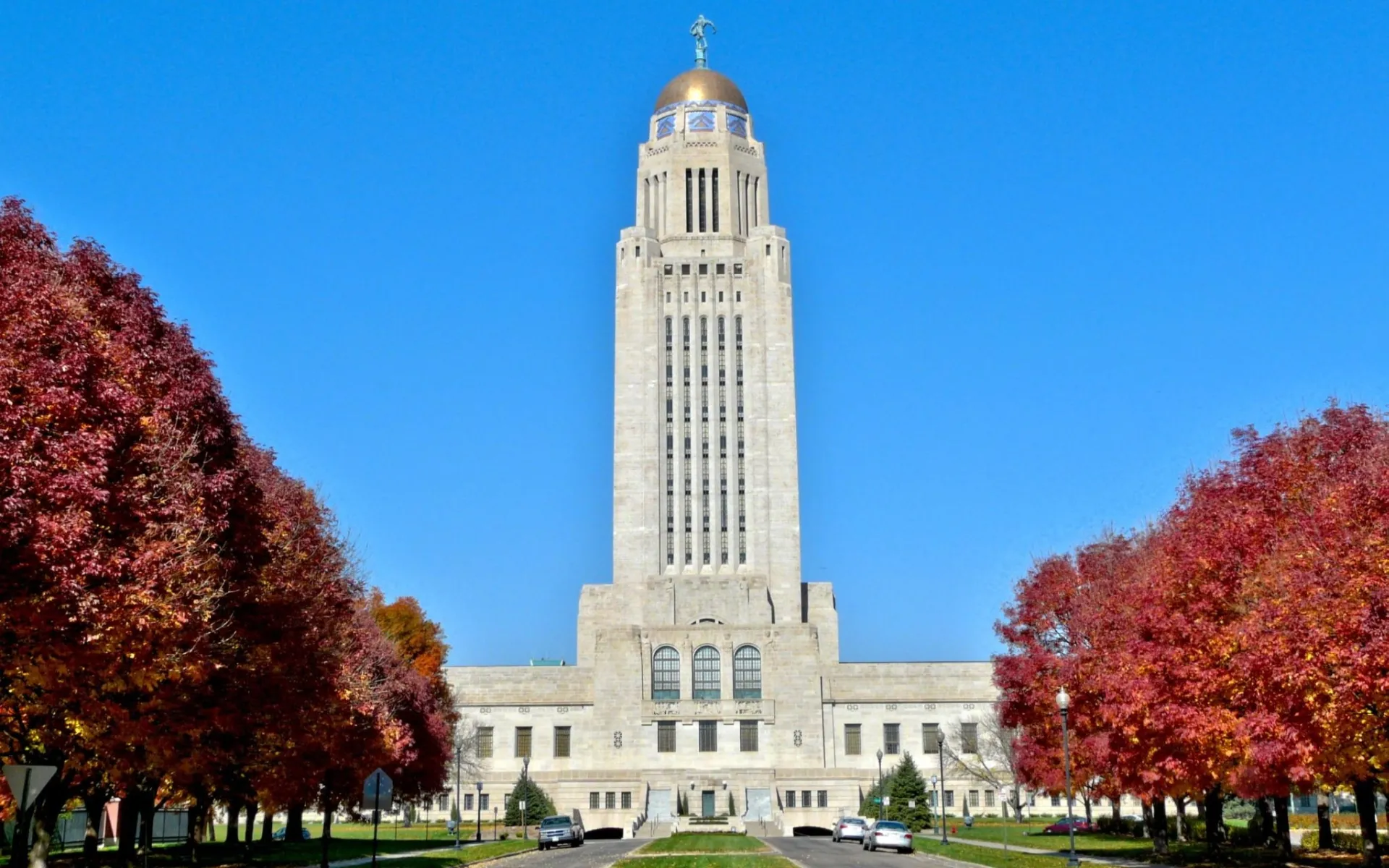
Nebraska
U.S. State37th State • March 1, 1867
Nebraska NE
"The Cornhusker State"
A vast, underestimated state where the Oregon Trail crossed the Great Plains, Warren Buffett built an empire, and the nation's only unicameral state legislature quietly governs a land of corn, cattle, cranes, and sandhills.
Nebraska state finances at a glance
State Debt - FY2024
$3.4 billion
Total state government debt outstanding at the close of fiscal 2024, including long-term bonds and short-term borrowing across state agencies and public universities.
Tax Revenue - FY2024
$8.1 billion
Total Nebraska state tax collections in fiscal 2024, led by the general sales tax ($3B) and the individual income tax ($2.5B).
Borrowing
Nebraska's constitution bars the state from incurring debt above $100,000, so Nebraska issues no general obligation bonds at all. Capital projects are paid for with cash, or financed through certificates of participation and revenue bonds issued by state agencies and the university and sold to investors in the municipal market. The state reported about $79 million in interest on its debt in fiscal 2024.
Source: U.S. Census Bureau, 2024 Annual Survey of State Government Finances.
2.0M
Population
37th
State (1867)
Only
Unicameral State
600K+
Sandhills Cranes
…
Last updated:
Nebraska's 2026 Midterm Election: Who and What Is on Your Ballot
Hello, Nebraska. On Tuesday, November 3, 2026, you're choosing a governor, a U.S. senator, your member of the U.S. House, the attorney general, secretary of state, treasurer, and auditor, and half of the nonpartisan Unicameral, plus four statewide ballot questions.
This is a midterm election, halfway through the president's term, and nationally it decides who controls Congress for the next two years. Nebraska's Senate race is unusual: there's no Democrat on the ballot, and the main challenger is an independent.
The ballot questions cover legislative term limits, two online sports betting measures that work as a pair, and girls' school sports. The Secretary of State's pamphlet has the official arguments for the three citizen initiatives.
Key dates and how voting works are right below. Use the buttons above to open each race. Facts first; the decision is yours.
Checked against official sources on October 5, 2026
Key Dates
Key Dates
In-person early voting opens at your county clerk or election commissioner's office
Monday, October 5
Registration deadline online (before midnight), by mail (postmark), or at the DMV
Friday, October 16
Last day to register in person, and to request an early ballot by mail (6 p.m.)
Friday, October 23
Election Day: polls open 8 a.m. to 8 p.m. Central (7 a.m. to 7 p.m. Mountain); early ballots must arrive by close of polls
Tuesday, November 3
Last day to show photo ID if you voted provisionally without one
Tuesday, November 10
How Voting Works in Nebraska
Register by October 16 online, by mail, or at the DMV, or in person at your county election office by 6 p.m. on October 23.
Any registered voter can vote early by mail; no reason needed. Request a ballot by 6 p.m. on October 23, and get it back to your county election office or a drop box by the time polls close on Election Day; a postmark isn't enough. Some rural counties mail every voter a ballot.
You can also vote early in person at your county election office starting October 5, or at your polling place on Election Day, 8 a.m. to 8 p.m. Central (7 a.m. to 7 p.m. Mountain).
Nebraska requires photo ID to vote. If you don't have it at the polls, you can vote a provisional ballot and show ID to your county election office by November 10. Find your polling place and sample ballot at votercheck.necvr.ne.gov.
Governor Race
The governor runs Nebraska's executive branch, proposes the budget, and can veto bills or line items in spending bills. Governors serve four-year terms and are limited to two in a row. The governor and lieutenant governor run together as one ticket.
Gov. Jim Pillen, in office since 2023, is running for a second term.
Candidates come from the Secretary of State's Final Statewide General Candidate List, certified September 11, 2026. Your sample ballot is the final word.
Positions are summarized from the candidates' own campaign websites, in neutral words and without attacks on opponents.
Governor and Lieutenant Governor of Nebraska
Statewide, four-year term
Republican Jim Pillen faces Democrat Lynne Walz, a former state senator, Rick Beard of the Legal Marijuana NOW Party, and former state senator Brett Lindstrom of the America First Party.
Jim Pillen
Incumbent
Republican
Lieutenant governor:
Joe Kelly
Occupation:
Governor; hog farmer and veterinarian
Government experience:
Governor of Nebraska (2023 to present); University of Nebraska Board of Regents
What they say they stand for
Points to lower overall taxes and lower property tax bills, and wants to keep fixing the tax system while shrinking state spending.
Wants to protect kids from social media, including banning phones in schools.
Backs the Stand with Women Act and bringing back winner-take-all for Nebraska's electoral votes.
Says he'll always stand up for farmers and ranchers, including against misleading fake meat products, and cut red tape.
We summarize positions in depth for the Democratic and Republican nominees and incumbents. This candidate didn't answer the questionnaires we use, and Nebraska publishes no candidate pamphlet.
Brett Lindstrom
America First
Lieutenant governor:
Michael Picard
Occupation:
Former state senator
Government experience:
Nebraska Legislature, District 18 (2015 to 2023)
What they say they stand for
We summarize positions in depth for the Democratic and Republican nominees and incumbents. This candidate didn't answer the questionnaires we use, and Nebraska publishes no candidate pamphlet.
Ballot Measures
Four statewide questions are on every Nebraska ballot. LR19CA was put there by the Legislature; Initiatives 440, 441, and 442 by citizen petition. Each needs a majority of the votes on the question, and a measure only passes if the yes votes also equal at least 35% of all ballots cast.
Initiatives 440 and 441 are a pair: 440 changes the constitution and 441 is the law that sets the rules. The initiatives' summaries and arguments come from the Secretary of State's 2026 pamphlet. The pamphlet doesn't cover LR19CA, so its arguments come from the Legislature's own debate, as reported by the Unicameral Update.
Nebraska voters adopted legislative term limits in 2000 (Initiative 415, 56% to 44%), and they took effect in 2006. Today a state senator can serve two consecutive four-year terms, then has to sit out four years before running again.
LR19CA changes one word in Article III, section 12 of the state constitution: the limit becomes three consecutive terms. The four-year wait afterward stays the same, and serving more than half a term still counts as a full term.
The Legislature passed it 39 to 10 on May 28, 2025 (30 votes were needed). Voters turned down the same change in 2012, 65% to 35%. It needs a majority of the votes on the question.
A YES (FOR) vote means
State senators could serve up to three consecutive four-year terms (12 years) before sitting out.
A NO (AGAINST) vote means
The limit stays at two consecutive four-year terms (8 years).
Reasons people vote for it
Sen. Robert Dover of Norfolk, who introduced it, says that in other states a termed-out lawmaker can move to the other chamber, but Nebraska's one-house Legislature has no other chamber.
Speaker John Arch says experienced members give new senators needed guidance, noting that nearly a third of senators were in their first year when it was debated. Supporters such as Civic Nebraska say constant turnover leaves lobbyists and staff holding the institutional knowledge.
Reasons people vote against it
Opponents such as the Nebraska State Grange say short limits bring new senators in and keep members accountable to their communities.
Sen. Loren Lippincott of Central City argued that open-ended consecutive terms risk the career politicians voters meant to stop, and proposed a lifetime cap of three terms instead. Voters rejected the same change in 2012.
💵 Taxes and money: No tax change
It changes how long state senators can serve; no cost is attached.
In 2020, voters approved casino gambling at licensed horse racetracks. Nebraska now allows sports bets in person at those racetrack casinos, but not online. UNL's summary counts five racetrack casinos (Omaha, Lincoln, Grand Island, Columbus, and Ogallala) and says Nebraska is one of 18 states without online sports betting.
Initiative 440 adds to Article III, section 24 of the constitution so that the gaming laws can include sports wagering over the internet, as long as the person placing the bet is in Nebraska and the bet is offered by an authorized racetrack casino operator.
It works together with Initiative 441, the law that sets up the details. It needs a majority of the votes on the question.
A YES (FOR) vote means
The Nebraska Constitution would allow laws letting people in Nebraska place sports bets online through an authorized racetrack casino operator.
A NO (AGAINST) vote means
The Nebraska Constitution would not be amended in this way.
Reasons people vote for it
Supporters say Nebraskans already bet on sports through illegal offshore sites or by driving to neighboring states, sending tax money out of state.
They say a legal, regulated market keeps that money in Nebraska and would deliver more than $166 million in property tax relief over the next 10 years.
Reasons people vote against it
Opponents say it turns every phone into a casino, sends hundreds of millions of dollars to out-of-state gambling companies, and is funded by those companies.
They say online betting fuels corruption and abuse of athletes, exposes teenagers to aggressive advertising, and would raise social costs without real property tax relief.
💵 Taxes and money: No new tax on you; online betting revenue would be taxed under the existing casino tax
Nebraska already taxes casino revenue at the five licensed racetrack casinos at 20% of gross gaming revenue (state law 9-1203). Of that tax, 70% goes to the Property Tax Credit Cash Fund, 2.5% to the Compulsive Gamblers Assistance Fund, 2.5% to the state General Fund, and 25% to the county and city where the casino sits (9-1204). Online sports bets would fall under the same tax.
No official state fiscal estimate appears in the pamphlet. Supporters say the measures would put more than $166 million into property tax relief over 10 years. A UNL agricultural economics summary cites a study done for supporters estimating $85 million over the first five years, about $17 million a year, which it calculates is about 0.3% of the property taxes Nebraskans paid in 2025.
What it could mean for you
What it could mean for you
Homeowner with a $3,000 property tax bill
About $9 less a year
Farm or business with a $20,000 property tax bill
About $60 less a year
Anyone who doesn't place sports bets
No new tax
Our arithmetic, not an official estimate: 0.3% of each bill, the share UNL calculates from the supporters' study ($17 million a year against $5.59 billion in 2025 property taxes). Actual credits depend on how much is wagered.
Initiative 441 changes the Nebraska Racetrack Gaming Act so that each licensed racetrack casino operator may take sports bets through up to two online platforms run by contracted providers. The bettor must be physically in Nebraska, and the platform's server must be located in Nebraska.
Existing limits stay in place, including no bets on in-state college teams' games and rules keeping prohibited people, such as athletes and coaches, from betting. Operators would check winnings against debts owed to the state before paying out. The State Racing and Gaming Commission would adopt rules by June 1, 2027, and the law becomes operative January 1, 2027.
It needs a majority of the votes on the question. Online betting depends on Initiative 440 also passing, since 441 relies on the constitutional change.
A YES (FOR) vote means
State law would allow and regulate online sports betting through authorized racetrack casino operators or their platform providers.
A NO (AGAINST) vote means
No such law would be enacted.
Reasons people vote for it
Supporters say it creates a safe, regulated online market with consumer protections and oversight by the Nebraska Racing and Gaming Commission.
They say it uses existing gaming law to send 70% of wagering tax revenue to the Property Tax Credit Cash Fund, more than $166 million over the first 10 years.
Reasons people vote against it
Opponents say it puts out-of-state gambling interests ahead of Nebraska taxpayers and student-athletes, sending hundreds of millions of dollars out of state.
They say online betting fuels corruption and abuse of athletes and targets teenagers with advertising, while families face higher social costs and no real property tax relief.
💵 Taxes and money: No new tax on you; online betting revenue would be taxed under the existing casino tax
Nebraska already taxes casino revenue at the five licensed racetrack casinos at 20% of gross gaming revenue (state law 9-1203). Of that tax, 70% goes to the Property Tax Credit Cash Fund, 2.5% to the Compulsive Gamblers Assistance Fund, 2.5% to the state General Fund, and 25% to the county and city where the casino sits (9-1204). Online sports bets would fall under the same tax.
No official state fiscal estimate appears in the pamphlet. Supporters say the measures would put more than $166 million into property tax relief over 10 years. A UNL agricultural economics summary cites a study done for supporters estimating $85 million over the first five years, about $17 million a year, which it calculates is about 0.3% of the property taxes Nebraskans paid in 2025.
What it could mean for you
What it could mean for you
Homeowner with a $3,000 property tax bill
About $9 less a year
Farm or business with a $20,000 property tax bill
About $60 less a year
Anyone who doesn't place sports bets
No new tax
Our arithmetic, not an official estimate: 0.3% of each bill, the share UNL calculates from the supporters' study ($17 million a year against $5.59 billion in 2025 property taxes). Actual credits depend on how much is wagered.
Initiative 442 adds a new section 16 to Article VII of the constitution. Schools would have to designate every athletic team or sport as male, female, or coed, based on biological sex, and teams designated for girls or women could not be open to students of the male sex.
It covers interscholastic, college, and intramural sports at public schools and public colleges, plus private schools and colleges whose teams compete against them. It takes effect on its own, though lawmakers could pass laws to carry it out, and any part found to conflict with federal law would be applied as far as federal law allows.
A voter challenged whether it could appear on the ballot; the Nebraska Supreme Court heard arguments on September 30, 2026, and the measure remains on the ballot. It needs a majority of the votes on the question.
A YES (FOR) vote means
The Nebraska Constitution would require sex-designated school teams and bar students of the male sex from girls' and women's teams.
A NO (AGAINST) vote means
The Nebraska Constitution would not be amended in this way.
Reasons people vote for it
Supporters say it protects fairness, opportunities, and safety for girls, so female athletes aren't forced to compete against biological males.
They point to physical differences in strength, bone density, and size that they say raise injury risk, and say it protects girls from losing scholarships, medals, or tournament spots.
Reasons people vote against it
Opponents say it adds unnecessary limits to the constitution and would make gender verification required for girls and young women, but not for boys.
They say it would let bad actors cast doubt on young athletes who don't fit traditional gender expectations, putting all girls at greater risk of harm and bullying.
💵 Taxes and money: No tax change
It sets eligibility rules for school sports; no cost estimate appears in the pamphlet.
Your ballot may also have county, city, or school district questions. Check your sample ballot at votercheck.necvr.ne.gov.
Senate Races
Every state gets two U.S. senators. The Senate votes on federal laws, confirms judges and cabinet members, and approves treaties. Senators serve six-year terms.
Pete Ricketts was appointed in 2023 and won a special election in 2024 for the rest of the term, which ends this year. Nebraska's other senator, Deb Fischer, isn't up until 2030.
Candidates come from the Secretary of State's Final Statewide General Candidate List, certified September 11, 2026. Your sample ballot is the final word.
Positions are summarized from the candidates' own campaign websites, in neutral words and without attacks on opponents.
U.S. Senator
Statewide, six-year term
Republican Pete Ricketts faces independent Dan Osborn, listed on the ballot as "By Petition", plus Chuck Conboy of the America First Party, Robin Richards of the Nebraska Working People Party, and Mike Marvin of the Legal Marijuana NOW Party.
There is no Democrat: primary winner Cindy Burbank withdrew in July, and the Nebraska Democratic Party is backing Osborn.
Pete Ricketts
Incumbent
Republican
Occupation:
U.S. Senator; businessman
Government experience:
U.S. Senator (2023 to present); Governor of Nebraska (2015 to 2023)
What they say they stand for
Points to $12.7 billion in tax relief as governor, including ending state taxes on Social Security and military benefits, and backed the 2025 federal tax law, including no tax on tips or overtime.
Supports border security and law enforcement, including more Border Patrol agents and resources to fight fentanyl.
Wants to counter China, including bipartisan legislation to stop foreign adversaries from buying farmland.
Backs defense spending, including funding for Offutt Air Force Base and the Sentinel missile program.
We summarize positions in depth for the Democratic and Republican nominees and incumbents. This candidate didn't answer the questionnaires we use, and Nebraska publishes no candidate pamphlet.
Robin Richards
Nebraska Working People
Occupation:
Not available
Government experience:
None in elected office
What they say they stand for
We summarize positions in depth for the Democratic and Republican nominees and incumbents. This candidate didn't answer the questionnaires we use, and Nebraska publishes no candidate pamphlet.
Mike Marvin
Legal Marijuana NOW
Occupation:
Not available
Government experience:
None in elected office
What they say they stand for
His name is on the Secretary of State's certified candidate list, though race coverage reports that he has withdrawn. We summarize positions in depth for the Democratic and Republican nominees and incumbents. This candidate didn't answer the questionnaires we use, and Nebraska publishes no candidate pamphlet.
Nebraska has three seats, all held by Republicans. The Legislature draws the districts; here's how redistricting works. District 2, around Omaha, is open: Rep. Don Bacon isn't running again.
You vote only in the district where you live; your sample ballot shows which one.
Nebraska's 3 Districts and Who Holds Them Today
Republican
Each district is colored by the party of the member of Congress who holds it right now, not by who will win in November. Select a district to jump to its race. District lines: U.S. Census Bureau, 120th Congress.
Candidates come from the Secretary of State's Final Statewide General Candidate List, certified September 11, 2026. Your sample ballot is the final word.
Positions are summarized from the candidates' own campaign websites, in neutral words and without attacks on opponents.
District 1
Eastern Nebraska: Lincoln, Norfolk, Fremont, and Bellevue
Republican Mike Flood, in office since 2022, faces Democrat Chris Backemeyer, a former State Department official, Libertarian Nik Sandman, and Dan Hartong of the America First Party.
Mike Flood
Incumbent
Republican
Occupation:
U.S. Representative; broadcaster
Government experience:
U.S. Representative (2022 to present); Nebraska Legislature, including Speaker
What they say they stand for
Backed the 2025 federal tax law, including no tax on tips, overtime, and Social Security.
Points to votes for border security funding and to cuts in wasteful spending.
Wrote a bipartisan bill to make housing more affordable for Nebraska families.
Points to more than $100 million in federal funding he secured for community projects, and wants to stand up to China.
We summarize positions in depth for the Democratic and Republican nominees and incumbents. This candidate didn't answer the questionnaires we use, and Nebraska publishes no candidate pamphlet.
Dan Hartong
America First
Occupation:
Not available
Government experience:
None in elected office
What they say they stand for
We summarize positions in depth for the Democratic and Republican nominees and incumbents. This candidate didn't answer the questionnaires we use, and Nebraska publishes no candidate pamphlet.
District 2
The Omaha area: Douglas County, Saunders County, and western Sarpy County
An open seat: Don Bacon isn't running again. Republican Brinker Harding, an Omaha city councilman, faces Democrat Denise Powell, a small business owner, and Libertarian Eric Michael Foreman.
Brinker Harding
Republican
Occupation:
Omaha city councilman
Government experience:
Omaha City Council (2017 to present)
What they say they stand for
Wants year-round E15, and Americans paying the same low drug prices as other developed countries.
Wants to protect Social Security, Medicare, and Medicaid, but not for illegal immigrants or able-bodied adults, and wants IVF more accessible.
Supports term limits, a ban on congressional stock trading, and no pay for Congress during shutdowns.
Wants deportation of immigrants who commit violent crimes, body cameras and identifiable uniforms for ICE agents, and nationwide voter ID.
We summarize positions in depth for the Democratic and Republican nominees and incumbents. This candidate didn't answer the questionnaires we use, and Nebraska publishes no candidate pamphlet.
District 3
Western and central Nebraska: Grand Island, Kearney, North Platte, and Scottsbluff
Republican Adrian Smith, in office since 2007, faces Democrat Becky Kelly Stille, David J. Else of the Legal Marijuana NOW Party, Macey Budke of the Nebraska Working People Party, and independent Mark Cohen, listed on the ballot as "By Petition".
Adrian Smith
Incumbent
Republican
Occupation:
U.S. Representative
Government experience:
U.S. Representative (2007 to present); Nebraska Legislature
What they say they stand for
Says he helped write the 2017 and 2025 federal tax laws and wants to keep taxes low.
Opposes abortion and taxpayer funding for it.
Voted to finish the border wall and fund the Border Patrol.
Supports the Second Amendment and opposes new gun control.
We summarize positions in depth for the Democratic and Republican nominees and incumbents. This candidate didn't answer the questionnaires we use, and Nebraska publishes no candidate pamphlet.
Macey Budke
Nebraska Working People
Occupation:
Behavioral health practice manager
Government experience:
None in elected office
What they say they stand for
We summarize positions in depth for the Democratic and Republican nominees and incumbents. This candidate didn't answer the questionnaires we use, and Nebraska publishes no candidate pamphlet.
Mark Cohen
Independent
Occupation:
Former Air Force attorney
Government experience:
None in elected office
What they say they stand for
We summarize positions in depth for the Democratic and Republican nominees and incumbents. This candidate didn't answer the questionnaires we use, and Nebraska publishes no candidate pamphlet.