Because democracy only works when we understand it
Searches are processed by Cloudflare Workers AI and are not stored.
Searches are processed by Cloudflare Workers AI and are not stored.
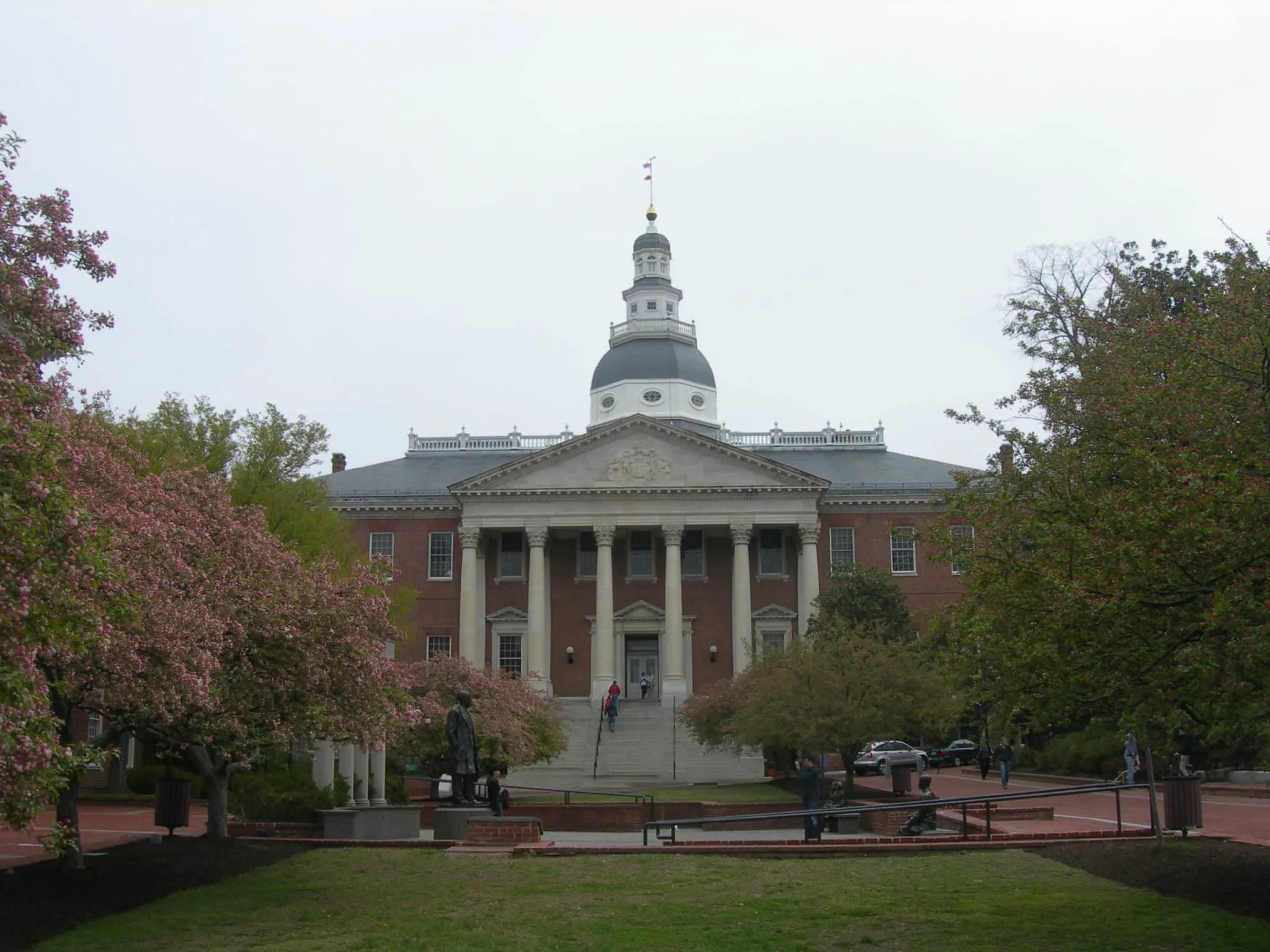
Maryland
U.S. State7th State • April 28, 1788
Maryland MD
"The Old Line State"
Birthplace of the national anthem, the nation's capital, and two of America's greatest abolitionists, Maryland is where American history was made, over and over again.
Maryland state finances at a glance
State Debt - FY2024
$25.9 billion
Total state government debt outstanding at the close of fiscal 2024, including long-term bonds and short-term borrowing across state agencies and public universities.
Tax Revenue - FY2024
$30.9 billion
Total Maryland state tax collections in fiscal 2024, led by the individual income tax ($11B) and the general sales tax ($6.9B).
Borrowing
Maryland issues general obligation bonds backed by a dedicated statewide property tax, along with transportation revenue bonds, sold to investors in the tax-exempt municipal market. The state uses a formal debt affordability process to cap issuance. The state reported about $1.1 billion in interest on its debt in fiscal 2024.
Source: U.S. Census Bureau, 2024 Annual Survey of State Government Finances.
6.2M
Population
7th
State (1788)
#1
US Cybersecurity Hub
200mi
Chesapeake Bay Length
…
Last updated:
Maryland's 2026 Midterm Election: Who and What Is on Your Ballot
Hey there, Maryland. On Tuesday, November 3, 2026, you're choosing a governor and lieutenant governor, the comptroller, the attorney general, your member of the U.S. House, your state legislators, county officials, and judges, plus three statewide ballot questions.
This is a midterm election, halfway through the president's term, and nationally it decides who controls Congress for the next two years. Gov. Wes Moore faces Dan Cox in a rematch of 2022. Maryland has no U.S. Senate race this year.
The biggest question on the ballot is Question 3, on congressional redistricting; it survived two lawsuits and was rewritten by the state Supreme Court in September.
Key dates and how voting works are right below. Use the buttons above to open each race. Facts first; the decision is yours.
Checked against official sources on October 5, 2026
Key Dates
Key Dates
Last day to register to vote ahead of time
Tuesday, October 13
Early voting, 7 a.m. to 8 p.m. daily, including the weekend
October 22 to 29
Last day to request a mail-in ballot by mail, online, or drop box (to have it mailed)
Tuesday, October 27
Election Day: polls open 7 a.m. to 8 p.m.; mail ballots postmarked or in a drop box by 8 p.m.
Tuesday, November 3
How Voting Works in Maryland
Register by October 13 online, by mail, or at the MVA. Missed it? Maryland has same-day registration during early voting and on Election Day; bring a document that proves where you live, like an MVA ID, paycheck, or utility bill.
Early voting runs October 22 to 29, 7 a.m. to 8 p.m. every day, at any early voting center in your county.
Any voter can vote by mail. Request your ballot by October 27 to have it mailed (or by October 30 to download it), then mail it postmarked by Election Day or put it in a drop box by 8 p.m.
On Election Day, polls are open 7 a.m. to 8 p.m. Most voters don't need ID to vote. Find your polling place and sample ballot through the State Board of Elections.
Governor Race
The governor runs Maryland's executive branch and writes the state budget; the General Assembly can cut it and shift money between items but can't raise the total. Governors serve four-year terms, limited to two in a row. The governor and lieutenant governor run together as one ticket.
Candidates and parties are from the State Board of Elections' certified 2026 general election ballots. Maryland has no official candidate pamphlet.
Positions are summarized from the candidates' own campaign websites, in neutral words and without attacks on opponents. Some are from campaign website text as quoted by Ballotpedia. Where a website listed no positions, or we found no campaign website, the card says so.
Governor and Lieutenant Governor of Maryland
Statewide, four-year term
Democratic Gov. Wes Moore, seeking a second term, faces Republican Dan Cox, a former state delegate whom he beat in 2022, Andy Ellis of the Green Party, and Cathy White of the Working Class Party.
Wes Moore
Incumbent
Democrat
Lieutenant governor:
Aruna Miller
Occupation:
Governor; Army veteran; former nonprofit CEO
Government experience:
Governor (2023 to present)
What they say they stand for
Says he's expanding pathways to work, wages, and wealth for every Maryland family.
Points to executive orders to cut red tape and build more homes faster to bring down housing costs.
Points to protecting SNAP food assistance for Maryland families.
We couldn't find a campaign website with issue positions, and the candidate hasn't answered the questionnaires we use.
Andy Ellis
Green
Lieutenant governor:
Owen Silverman Andrews
Occupation:
Not available
Government experience:
None in elected office
What they say they stand for
We summarize positions in depth for the Democratic and Republican nominees and incumbents. This candidate didn't answer the questionnaires we use.
Cathy White
Working Class Party
Lieutenant governor:
Cathy Permut
Occupation:
Not available
Government experience:
None in elected office
What they say they stand for
We summarize positions in depth for the Democratic and Republican nominees and incumbents. This candidate didn't answer the questionnaires we use.
Ballot Measures
Three constitutional amendments are on every Maryland ballot. The General Assembly sent all three with a three-fifths vote of each chamber, and each needs a simple majority of the votes cast on it. Maryland doesn't let citizens put new laws on the ballot by petition, though they can petition a law the legislature passed to a referendum.
The for and against statements below are the official ones posted by the State Board of Elections. Maryland publishes no official arguments, so the reasons people give come from public statements by supporters and opponents, named where we use them.
Maryland state employees bargain contracts with the governor's administration but can't strike. Today, if talks deadlock, a fact-finder makes recommendations that aren't binding, and the governor decides what goes in the budget.
Question 1 would put a requirement in the Maryland Constitution: every budget the governor submits must include the money needed to carry out each state employee contract, whether the terms were agreed to or ordered by a neutral decision-maker. It turns on a companion law (the Arbitration Reform for State Employees Act of 2026) that sets up binding arbitration when talks deadlock: an arbitrator from a national pool must pick one side's last, best, and final offer in full, not split the difference.
Higher education bargaining units are exempt from the arbitration process but not from the budget requirement. The House passed the bill 93 to 35, and final passage on April 10, 2026 was largely along party lines. Gov. Wes Moore signed the companion law.
A FOR vote means
The governor would have to include money in the proposed state budget to pay for agreements between the state and its employees, whether those terms were negotiated or decided by a neutral decision-maker.
An AGAINST vote means
The law about funding agreements between the state and state employees stays the same.
Reasons people vote for
AFSCME Maryland says state employees can't strike, so binding arbitration gives them a fair way to break a deadlock, and the bargaining process is overdue for an update.
Gov. Wes Moore, who signed the companion law, says he supports negotiation reform.
Reasons people vote against
House and Senate Republicans warn the state already projects a $3 billion structural deficit in fiscal 2028 and this could add costs the legislature and governor can't control.
The University System of Maryland opposed it as a possible unfunded mandate, and critics note an arbitrator who isn't elected would have a final say on state pay.
💵 Taxes and money: No tax change; could raise state payroll costs
The Department of Legislative Services estimates state costs rise at least $150,000 a year starting in fiscal 2028 for arbitration services and staff. The effect on pay and benefits can't be reliably estimated but could be significant starting as early as fiscal 2029, depending on how arbitrators' awards compare with the contracts that would have been reached otherwise.
The Commission on Judicial Disabilities investigates complaints about Maryland judges. Today, vacancies are filled by the governor with Senate confirmation, and the Supreme Court of Maryland can name a substitute only with the written consent of the judge under investigation.
Question 2 would let the commission chair recall a former member, or ask the governor to appoint a temporary substitute or extend a current member's term, until a permanent replacement is appointed. Substitutes must meet the same constitutional requirements as the member they replace.
It passed the General Assembly without opposition. The Department of Legislative Services expects no material effect on state finances.
A FOR vote means
Temporary appointments to the commission would be allowed when a member is recused, disqualified, or their term ends without a replacement.
An AGAINST vote means
Current membership rules stay the same, and temporary appointments aren't allowed in those situations.
Reasons people vote for
It keeps judicial discipline cases moving when the commission is short a member, instead of stalling them.
Substitutes must meet the same qualifications as regular members.
Reasons people vote against
We found no organized opposition; it passed the General Assembly unanimously. Temporary members wouldn't go through Senate confirmation.
💵 Taxes and money: No tax change
The Department of Legislative Services expects no material effect on state finances.
The Maryland Constitution requires state legislative districts to be compact and respect natural and political boundaries. In 2022, a state judge applied those rules to congressional districts too and struck down the General Assembly's map. The legislature then passed the map in use today, with seven Democratic-leaning districts and one Republican seat.
Question 3, passed in a 2026 special session, would provide that those requirements apply only to the Maryland Senate and House of Delegates, that nothing in the Maryland Constitution sets criteria for congressional district lines, and that the General Assembly may give the Supreme Court of Maryland original jurisdiction to review a congressional map. Here's how redistricting works.
Two circuit courts ordered it off the ballot in August, but on September 3 the Supreme Court of Maryland ruled 5 to 2 to keep it on, while finding the original summary misleading in part and ordering the ballot to use the purpose language the General Assembly wrote into the law.
A FOR vote means
The constitution's compactness and boundary rules would apply only to state legislative districts, nothing in it would set criteria for congressional districts, and the General Assembly could give the Supreme Court of Maryland original jurisdiction to review a congressional map.
An AGAINST vote means
No change; the 2022 ruling applying the constitution's district rules to congressional maps would stand.
Reasons people vote for
Gov. Wes Moore calls it a response to Republican efforts to undermine voting rights; Democratic leaders, unions, and advocacy groups are campaigning for it.
It would let the General Assembly route any challenge to a congressional map directly to the Supreme Court of Maryland.
Reasons people vote against
Republicans, including Rep. Andy Harris and state Sen. Justin Ready, say it would remove limits on partisan gerrymandering and let the majority party draw congressional lines to its advantage.
Republican delegates, including Ryan Nawrocki and Matt Morgan, say the court should have removed the question rather than rewrite its misleading ballot language.
💵 Taxes and money: No tax change
It changes redistricting rules; no cost is attached.
Many counties have their own charter amendments and bond questions, including Anne Arundel, Baltimore County, Baltimore City, Frederick, Howard, and Prince George's. Check your sample ballot with your county board of elections.
Senate Races
Every state gets two U.S. senators. The Senate votes on federal laws, confirms judges and cabinet members, and approves treaties. Senators serve six-year terms, and only a third of seats are up in any election.
Maryland has no U.S. Senate race this year. Chris Van Hollen's seat is next up in 2028, and Angela Alsobrooks' in 2030.
Maryland has eight seats. Democrats hold seven and Republicans hold one. District 5 is open: Steny Hoyer, in Congress since 1981, isn't running again. If Question 3 passes, the General Assembly could redraw these lines before 2028, but this year's races use the current map.
You vote only in the district where you live; your sample ballot shows which one.
Maryland's 8 Districts and Who Holds Them Today
Republican
Democrat
Each district is colored by the party of the member of Congress who holds it right now, not by who will win in November. Select a district to jump to its race. District lines: U.S. Census Bureau, 120th Congress.
Candidates and parties are from the State Board of Elections' certified 2026 general election ballots. Maryland has no official candidate pamphlet.
Positions are summarized from the candidates' own campaign websites, in neutral words and without attacks on opponents. Some are from campaign website text as quoted by Ballotpedia. Where a website listed no positions, or we found no campaign website, the card says so.
District 1
The Eastern Shore, Harford County, and part of Baltimore County
Republican Andy Harris, in office since 2011 and chairman of the House Freedom Caucus, faces Democrat Dan Schwartz, a consumer protection specialist.
Andy Harris
Incumbent
Republican
Occupation:
U.S. Representative; physician (anesthesiologist)
Government experience:
U.S. Representative (2011 to present); Maryland Senate
What they say they stand for
Says he's fighting to restore fiscal responsibility and protect taxpayer dollars.
Points to his roles as chairman of the House Freedom Caucus and of the Appropriations subcommittee on agriculture.
We summarize positions in depth for the Democratic and Republican nominees and incumbents. This candidate didn't answer the questionnaires we use.
District 5
Southern Maryland and parts of Prince George's and Anne Arundel counties
An open seat: Democrat Steny Hoyer, in Congress since 1981, isn't running again. Democratic Delegate Adrian Boafo faces Republican Chris Chaffee, a builder and farmer.
Adrian Boafo
Democrat
Occupation:
State delegate; former technology company government affairs director
Government experience:
Maryland House of Delegates (current)
What they say they stand for
Wants to raise the federal minimum wage to $15 an hour, tied to inflation.
Wants tax cuts for working families while closing loopholes for big corporations and the wealthiest.
Wants to expand the Child Tax Credit and guarantee universal child care.
Western Maryland, Frederick County, and part of Montgomery County
Democrat April McClain Delaney, in office since 2025, faces Republican Robin Ficker, an attorney and former state delegate, and Green Party candidate Moshe Landman.
April McClain Delaney
Incumbent
Democrat
Occupation:
U.S. Representative; communications attorney
Government experience:
U.S. Representative (2025 to present); former Deputy Assistant Secretary of Commerce
What they say they stand for
Wants partnerships that bring good-paying jobs, support for small businesses, and job training.
Wants to use technology to drive economic development in the district.
Says she'll put progress over partisanship and defend democratic institutions.
We summarize positions in depth for the Democratic and Republican nominees and incumbents. This candidate didn't answer the questionnaires we use.
District 7
Baltimore City and western Baltimore County
Democrat Kweisi Mfume, in office since 2020 (he also served from 1987 to 1996), faces Republican Scott Collier.
Kweisi Mfume
Incumbent
Democrat
Occupation:
U.S. Representative; former NAACP president
Government experience:
U.S. Representative (1987 to 1996, 2020 to present); Baltimore City Council (1978 to 1986)
What they say they stand for
The campaign website lists no issue positions we could read, and the candidate hasn't answered the questionnaires we use. See the website for where they stand.