Because democracy only works when we understand it
Searches are processed by Cloudflare Workers AI and are not stored.
Searches are processed by Cloudflare Workers AI and are not stored.
Kansas
State Guide34th StateEst. 1861
Kansas KS
"The Sunflower State"
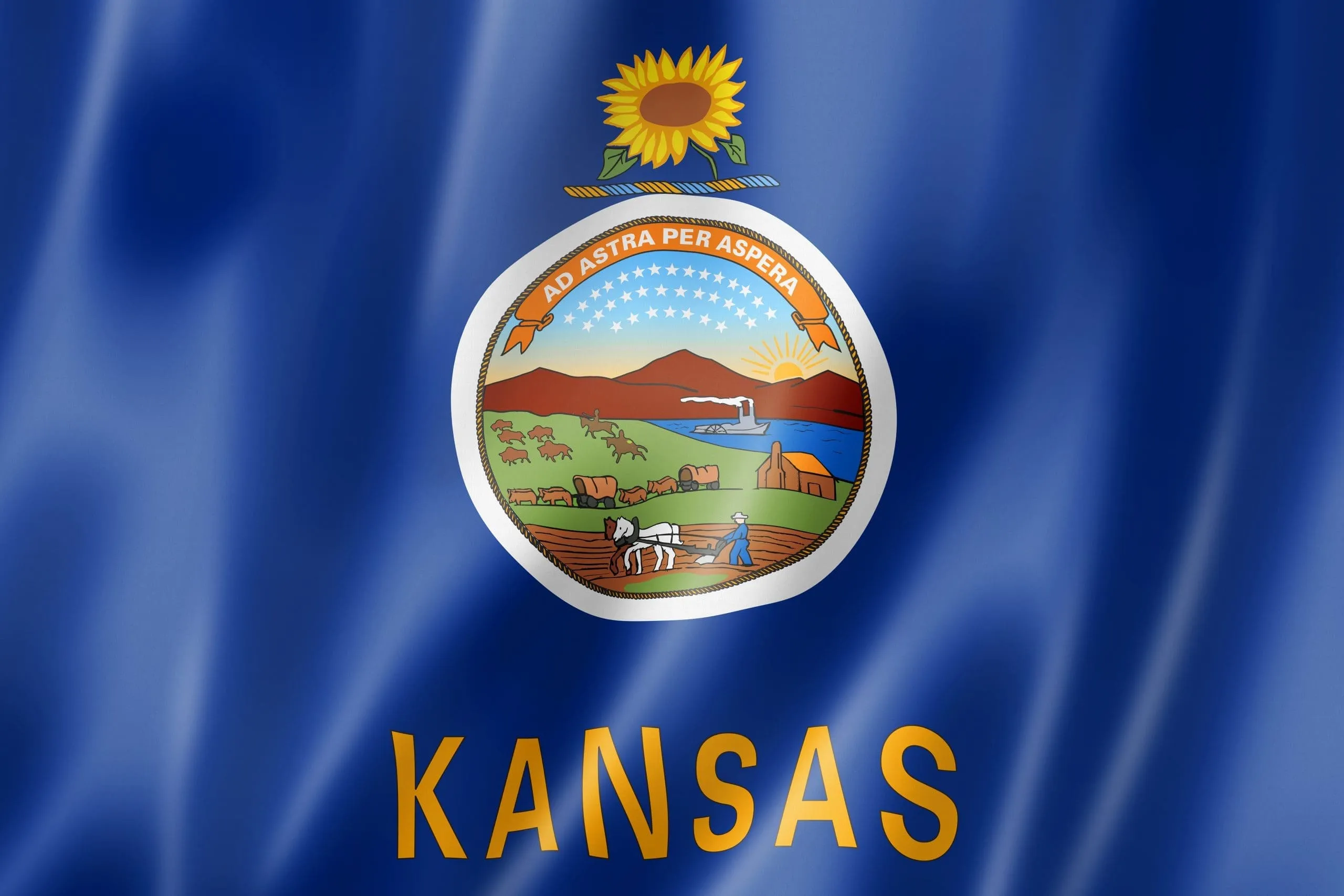
Ad Astra per Aspera, To the Stars Through Difficulties. A state that earned its freedom through a decade of prairie warfare before the Civil War, watched its farms turn to dust during the Dirty Thirties, and quietly built the most productive wheat fields and the most concentrated aerospace industry on Earth. Kansas is harder to understand than it is to cross, and far more important.
Kansas state finances at a glance
State Debt - FY2024
$7.2 billion
Total state government debt outstanding at the close of fiscal 2024, including long-term bonds and short-term borrowing across state agencies and public universities.
Tax Revenue - FY2024
$13.1 billion
Total Kansas state tax collections in fiscal 2024, led by the individual income tax ($4.5B) and the general sales tax ($4.3B).
Borrowing
Kansas has no general constitutional authority to issue general obligation debt, so nearly all borrowing runs through the Kansas Development Finance Authority, which issues revenue and appropriation-backed bonds, including pension bonds for the state retirement system. These are sold to investors in the tax-exempt municipal market. The state reported about $125 million in interest on its debt in fiscal 2024.
Source: U.S. Census Bureau, 2024 Annual Survey of State Government Finances.
34th
State admitted to the Union
3.0M
Population (2025 est.)
#1
Wheat-producing state
Center
Of the contiguous United States
…
Last updated:
Kansas's 2026 Midterm Election: Who and What Is on Your Ballot
Howdy, Kansas. On Tuesday, November 3, 2026, you're choosing a governor and lieutenant governor, one of your U.S. senators, your member of the U.S. House, the attorney general, secretary of state, treasurer, and insurance commissioner, your state representatives, whether to retain several judges, and one constitutional amendment.
This is a midterm election, halfway through the president's term, and nationally it decides who controls Congress for the next two years. In Kansas, Gov. Laura Kelly is term-limited, so the governor's office is open.
If you voted in August, you've already seen one amendment this year: Kansans turned down a plan to elect Supreme Court justices, 61 percent to 39 percent. November's amendment is a different one, about voter citizenship.
Key dates and how voting works are right below. Use the buttons above to open each race. Facts first; the decision is yours.
Checked against official sources on October 4, 2026
Key Dates
Key Dates
Last day to register to vote
Tuesday, October 13
Mail ballots start going out; in-person advance voting can begin (dates vary by county)
Wednesday, October 14
Last day to apply for a mail ballot
Tuesday, October 27
Last day of in-person advance voting (noon)
Monday, November 2
Election Day: polls open 7 a.m. to 7 p.m. (some counties longer); mail ballots must arrive by the time polls close
Tuesday, November 3
How Voting Works in Kansas
Register by October 13 online at the Kansas Secretary of State, by mail, or at your county election office. Kansas has no same-day registration, and you can check your registration at VoterView.
Any voter can vote by advance mail ballot; no reason needed. Apply by October 27, and get your ballot back to your county election office or a drop box by the time polls close on Election Day. Kansas no longer counts mail ballots that arrive after Election Day.
In-person advance voting starts as early as October 14 at your county election office and runs through noon on November 2; your county sets the exact days and sites. On Election Day, polls are open 7 a.m. to 7 p.m., though some counties open earlier or close later.
Kansas requires photo ID to vote in person, such as a driver's license, state ID card, passport, military ID, or concealed carry license. If you vote by mail, you write your driver's license number on the ballot application or include a copy of your photo ID.
Governor Race
The governor runs Kansas's executive branch, proposes the budget, appoints Supreme Court justices from the nominating commission's list, and can veto bills. Governors serve four-year terms and are limited to two in a row.
Gov. Laura Kelly, a Democrat, can't run again after two terms. The governor and lieutenant governor run together as one ticket.
Candidates and current seat holders are from Ballotpedia's lists of candidates on the November ballot; your sample ballot is the final word. Kansas has no official candidate pamphlet.
Positions are summarized from the candidates' own campaign websites, in neutral words and without attacks on opponents. Where a website listed no positions, the card says so.
Governor and Lieutenant Governor of Kansas
Statewide, four-year term, open seat
Democratic State Sen. Cindy Holscher faces Republican Ty Masterson, president of the Kansas Senate.
Cindy Holscher
Democrat
Lieutenant governor:
KC Ohaebosim
Occupation:
State senator
Government experience:
Kansas Senate (2021 to present); Kansas House (2017 to 2021)
What they say they stand for
Wants to cut residential property tax assessment rates from 11.5 percent to 9 percent, with added exemptions for seniors and disabled veterans.
Wants to raise the state minimum wage to $16 and make essentials like diapers tax-free.
Calls for a pause on approving new data centers until guardrails are in place.
Wants to legalize recreational and medical cannabis to raise money for schools and services.
Wants to keep funding public schools and opposes expanding private school vouchers.
One constitutional amendment is on the November ballot. Kansas has no citizen initiatives, so only the Legislature can send you an amendment, with a two-thirds vote of both chambers. Then it needs a simple majority of the votes cast on it.
Kansas publishes no voter pamphlet. The explanation and text below come from House Concurrent Resolution 5004; the arguments are what supporters and opponents have said publicly.
The Kansas Constitution says every U.S. citizen who is 18 and lives in the voting area is a qualified voter. It's worded as a guarantee to citizens, not as a limit, so it doesn't expressly say non-citizens can't vote. Federal law already bars non-citizens from voting in federal elections, and Kansas law and court rulings limit voting in state elections to citizens.
The amendment would rewrite Article 5, Section 1 to say that "no person shall be deemed a qualified elector unless such person" is a U.S. citizen, at least 18, and a resident of the voting area. The official explanatory statement says it would "clarify that only a person who is a citizen of the United States is eligible to vote in this state." It also updates the wording of the sections on voting for president after moving away and voting at a former address within Kansas.
The Legislature passed it in 2025, 90 to 28 in the House and 37 to 3 in the Senate. It needs a simple majority of the votes cast on the question.
A YES vote means
The constitution would state that only a person who is a citizen of the United States is eligible to vote in Kansas.
A NO vote means
No change to the constitution; the language on voter qualifications would stay the same.
Reasons people vote yes
Sponsor Rep. Pat Proctor says nothing in state law or court rulings stops a city from letting non-citizens vote in local elections, and a future Kansas Supreme Court could reinterpret the current wording.
Americans for Citizen Voting says the constitution grants the vote to citizens but doesn't reserve it only for them, and this closes that gap.
Reasons people vote no
Loud Light Civic Action says it appears to change nothing legally but would cause confusion and inflame tensions.
The ACLU of Kansas says there's no evidence of non-citizen voting in Kansas and warns the wording could be used to justify stricter voter registration requirements. Rep. Kirk Haskins says it could discourage naturalized citizens from voting.
💵 Taxes and money: No tax change
It changes the wording of voter qualifications; no cost is attached.
Your ballot will also ask whether to retain several Kansas Supreme Court and Court of Appeals judges, and it may have local questions. Check your sample ballot with your county election office.
Senate Races
Every state gets two U.S. senators. The Senate votes on federal laws, confirms judges and cabinet members, and approves treaties. Senators serve six-year terms.
Roger Marshall's seat is up this year. Kansas's other senator, Jerry Moran, isn't up until 2028.
Candidates and current seat holders are from Ballotpedia's lists of candidates on the November ballot; your sample ballot is the final word. Kansas has no official candidate pamphlet.
Positions are summarized from the candidates' own campaign websites, in neutral words and without attacks on opponents. Where a website listed no positions, the card says so.
U.S. Senator
Statewide, six-year term
Republican Roger Marshall, a physician in the Senate since 2021, faces Democrat Adam Hamilton, a United Methodist pastor, and Libertarian David Graham.
Roger Marshall
Incumbent
Republican
Occupation:
Physician (OB-GYN); Army Reserve veteran
Government experience:
U.S. Senator (2021 to present); U.S. Representative (2017 to 2021)
What they say they stand for
Points to his bills to cut farm input costs, including phosphate fertilizer relief, and the Whole Milk for Healthy Kids Act.
Wants to protect rural Critical Access hospitals and speed up Medicare prior authorization decisions.
Supports price transparency in health care and making telehealth permanent.
Kansas has four seats. Republicans hold three and Democrats hold one, under the map the Legislature drew in 2022 over the governor's veto. Here's how redistricting works. All four incumbents are running again.
You vote only in the district where you live; your sample ballot shows which one.
Kansas's 4 Districts and Who Holds Them Today
Republican
Democrat
Each district is colored by the party of the member of Congress who holds it right now, not by who will win in November. Select a district to jump to its race. District lines: U.S. Census Bureau, 120th Congress.
Candidates and current seat holders are from Ballotpedia's lists of candidates on the November ballot; your sample ballot is the final word. Kansas has no official candidate pamphlet.
Positions are summarized from the candidates' own campaign websites, in neutral words and without attacks on opponents. Where a website listed no positions, the card says so.
District 1
Western and central Kansas, plus Lawrence and Manhattan
Republican Tracey Mann, in office since 2021, faces Democrat Lauren Reinhold, an attorney, and Libertarian Steven Jacob.
Tracey Mann
Incumbent
Republican
Occupation:
U.S. Representative; former commercial real estate professional
Government experience:
U.S. Representative (2021 to present); Lieutenant Governor of Kansas (2018 to 2019)
The campaign website lists no issue positions we could read, and the candidate hasn't answered the questionnaires we use. See the website for where they stand.
We summarize positions in depth for the Democratic and Republican nominees and incumbents. This candidate didn't answer the questionnaires we use.
District 3
Kansas City suburbs: Johnson County and southern Wyandotte County, plus rural counties to the south
Democrat Sharice Davids, in office since 2019, faces Republican Eric Jenkins, a retired Army colonel and former Shawnee City Council president, and Libertarian Steve Hohe.
Sharice Davids
Incumbent
Democrat
Occupation:
U.S. Representative; attorney
Government experience:
U.S. Representative (2019 to present)
What they say they stand for
Serves on the House Agriculture Committee and wants reliable crop insurance and a Farm Bill that reflects Kansas's needs.
Points to her bill to strengthen local food supply chains and lower grocery costs.
Supports education and workforce training.
Says she works across party lines on Kansas priorities.