Because democracy only works when we understand it
Searches are processed by Cloudflare Workers AI and are not stored.
Searches are processed by Cloudflare Workers AI and are not stored.
Idaho
State Guide43rd StateEst. 1890
Idaho ID
"The Gem State"
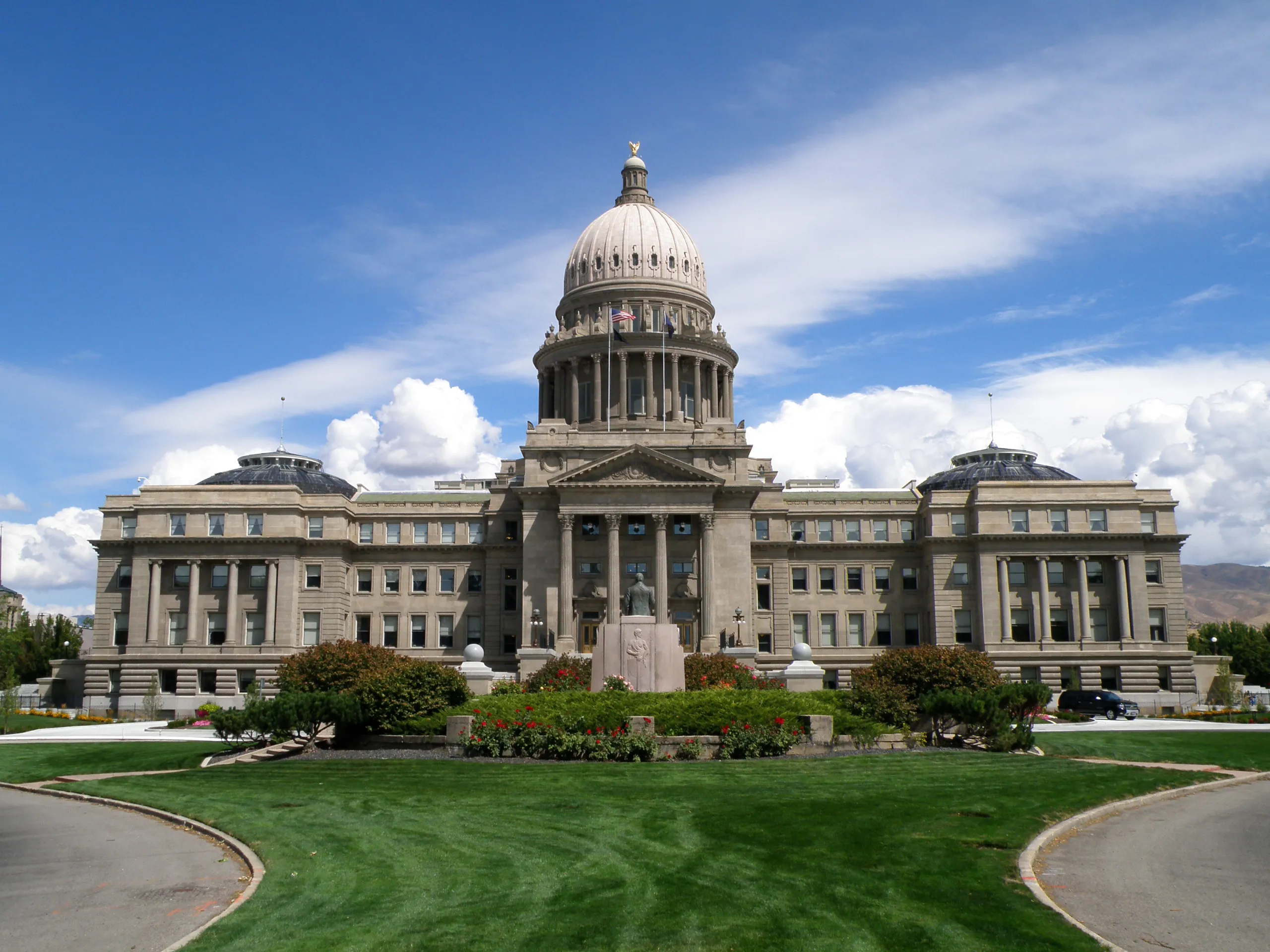
Mountains that dwarf most ranges in the lower 48. The longest free-flowing river contained within a single state in the lower 48. The largest wilderness in the contiguous United States. The potato capital of America and one of its fastest-growing tech cities. Idaho is vast, wild, and quietly consequential, a state that shapes American food, technology, and land conservation in ways far larger than its population would suggest.
Idaho state finances at a glance
State Debt - FY2024
$730 million
Total state government debt outstanding at the close of fiscal 2024, including long-term bonds and short-term borrowing across state agencies and public universities.
Tax Revenue - FY2024
$8.6 billion
Total Idaho state tax collections in fiscal 2024, led by the general sales tax ($3.1B) and the individual income tax ($2.9B).
Borrowing
Idaho's constitution bars the state from carrying general obligation debt without a public vote, and voters have rarely approved any, so Idaho has almost no tax-supported debt. Short-term tax anticipation notes and a handful of lease and revenue bonds issued by state building authorities are sold to investors in the municipal market. The state reported about $173 million in interest on its debt in fiscal 2024.
Source: U.S. Census Bureau, 2024 Annual Survey of State Government Finances.
43rd
State admitted to the Union
2.0M
Population, fastest-growing
83K
Square miles, 14th largest
#1
Potato-producing state
…
Last updated:
Idaho's 2026 Midterm Election: Who and What Is on Your Ballot
Howdy, Idaho. On Tuesday, November 3, 2026, you're choosing a governor, one of your U.S. senators, your member of the U.S. House, the other statewide offices, two constitutional amendments, an abortion-rights initiative (Proposition 1), and, yes, a non-binding vote on an official state gun.
This is a midterm election, halfway through the president's term, and nationally it decides who controls Congress for the next two years. Gov. Brad Little is running for a third term, and Sen. Jim Risch for a fourth.
One unusual race to note: there's no Democrat in the U.S. Senate race. The Democratic nominee withdrew, and Risch's main challenger is independent Todd Achilles.
The key dates and how voting works are right below. Use the buttons above to open each part of the ballot. Facts first; the decision is yours.
Checked against official sources on October 4, 2026
Key Dates
Key Dates
Early voting begins (schedules vary by county)
Tuesday, October 13
Pre-registration deadline and absentee ballot request deadline (5 p.m.)
Friday, October 23
Early voting ends
Friday, October 30
Election Day: polls open 8 a.m. to 8 p.m.
Tuesday, November 3
How Voting Works in Idaho
Register by 5 p.m. on Friday, October 23, online at VoteIdaho.gov or with your county clerk. Missed it? You can still register at your polling place on Election Day with a photo ID and proof of where you live.
Early voting runs October 13 through 30, with schedules set by each county. On Election Day, polls are open 8 a.m. to 8 p.m.
Need an absentee ballot? Request it at VoteIdaho.gov by 5 p.m. on October 23, and return it so it arrives by the time polls close on Election Day.
You'll be asked for photo ID at the polls: an Idaho driver's license or ID card, a U.S. passport, an Idaho tribal ID, or an Idaho concealed weapons permit.
Governor Race
The governor runs Idaho's executive branch, proposes the budget, signs or vetoes bills, and sits on the Land Board that manages state endowment lands. Governors serve four-year terms with no term limit.
The lieutenant governor is elected separately in Idaho, on their own line of the ballot.
Candidates are from Ballotpedia's lists of candidates on the November ballot; your sample ballot at VoteIdaho.gov is the final word. Idaho's pamphlet doesn't include candidate statements.
Positions are summarized from the candidates' own campaign websites (and, for independent Todd Achilles, his Ballotpedia survey answers), in neutral words and without attacks on opponents.
Governor of Idaho
Statewide, four-year term
Republican Gov. Brad Little faces Democrat Terri Pickens, an attorney; Pro-Life of the Constitution Party; Libertarian Paul Sand; and unaffiliated John Stegner, a former Idaho Supreme Court justice. Jacob Burnett is a certified write-in candidate.
Brad Little
Incumbent
Republican
Occupation:
Governor; rancher
Government experience:
Governor (2019 to present); Lieutenant Governor (2009 to 2019); Idaho Senate
What they say they stand for
Points to cutting or simplifying 95 percent of state regulations.
Points to teacher pay raises, more literacy funding, new school choice options, and the Idaho LAUNCH job training program.
Points to tax cuts, a balanced budget, and Idaho's AAA credit rating.
Points to working with President Trump on border security and Operation No Return to remove criminals here illegally.
Supports pay raises for police and bigger investments in veterans homes and the Guard.
Four things to decide this year. Two constitutional amendments from the Legislature (HJR 4 and HJR 6), one citizen initiative (Proposition 1, on abortion and reproductive rights), and one non-binding advisory question about an official state gun.
Money check: none of them raises a tax. The state estimates Proposition 1 would add a few thousand dollars a year in Medicaid costs.
Everything here comes from the Secretary of State's official Voter Pamphlet, mailed to every household: the ballot language, the Legislative Council's explanations, and the official arguments for and against, summarized.
Today, Idahoans can change the state's drug laws two ways: through the Legislature, or by gathering signatures for a citizen initiative and voting on it. Several marijuana initiatives have tried to qualify for the ballot in recent years.
HJR 4 would add to the Idaho Constitution that only the Legislature has the power to legalize growing, producing, selling, prescribing, possessing, or using marijuana, narcotics, or other psychoactive substances. It would take effect as soon as voters approve it.
A YES vote means
The Legislature would have exclusive authority to legalize marijuana, narcotics, or other psychoactive substances in Idaho.
A NO vote means
No change; Idahoans could still change controlled substance laws through the initiative process.
Reasons people vote yes
Drugs destroy lives and families, and legalizing them is too important to decide lightly.
The legislative process means public hearings where law enforcement and people harmed by drugs can testify, and legislators are publicly accountable for their votes.
Reasons people vote no
The Constitution says political power belongs to the people, and this takes away their ability to pass drug laws by initiative.
It's unnecessary: if voters ever passed a poorly considered drug law, the Legislature could already amend or repeal it.
💵 Taxes and money: No tax change
It changes who can legalize drugs; no cost or tax is attached.
Idaho has no official language in its constitution, though state law already designates English as the official language.
HJR 6 would put it in the constitution: official speeches, meetings, and proceedings of state and local governments, such as city council meetings and jury trials, would be in English; public school instruction would be in English; and government documents would be published in English. Other languages could be used when federal law requires it.
A YES vote means
The constitution would designate English as Idaho's official language.
A NO vote means
No change to the constitution, which doesn't name an official language today.
Reasons people vote yes
It could encourage non-English speakers to learn English and take part in public life, promoting unity and a shared identity; federal law still guarantees language help for critical services.
It could make government more cost-efficient by limiting spending on communication in other languages.
Reasons people vote no
It's unnecessary because state law already makes English official, and that law is more detailed, for example allowing public schools to teach foreign languages, which this amendment might not.
It could create division by signaling to non-English speakers that they're unwelcome.
💵 Taxes and money: No tax change
No cost estimate was published. Supporters say it could reduce spending on translation.
Idaho law currently bans abortion except to prevent the death of the pregnant woman and, in the first trimester, in cases of rape or incest reported to law enforcement.
Proposition 1 would create a right to reproductive freedom and privacy, including abortion up to fetal viability, which it defines as when a fetus has a "significant likelihood of sustained survival" outside the uterus "without extraordinary medical measures," judged case by case by a physician. After viability the state could still regulate abortion, except in medical emergencies that threaten the patient's life or health.
It also protects the right to make decisions about contraception, fertility treatment like IVF, childbirth, miscarriage, and prenatal and postpartum care; bars the state from restricting those rights unless narrowly tailored to the patient's health; and shields health care providers from discipline or prosecution for care consistent with the act. It doesn't require public funding. It would take effect January 1, 2027.
A YES vote means
Idaho law would create a right to abortion before fetal viability, and after it in medical emergencies, protect providers from discipline and liability, and establish a right to reproductive freedom and privacy.
A NO vote means
No change to current law, which bans abortion except to prevent the pregnant woman's death and, in the first trimester, in reported cases of rape or incest.
Reasons people vote yes
Idaho's ban has no health exception, so doctors must wait until a crisis is critical; women have been flown to Utah for care, and Idaho is losing OB-GYNs and emergency doctors. (Idahoans United for Women & Families)
It restores the health and life standard Idaho used for nearly 50 years, protects birth control and IVF, creates no public funding for abortion, and doesn't change parental consent laws, supporters say.
Reasons people vote no
It redefines viability and would allow abortion until seven or eight months of pregnancy, beyond what Roe v. Wade allowed. (Idaho Family Policy Center, Right to Life Idaho, Catholic Diocese of Boise, and others)
Opponents say it lets non-doctors perform abortions and overrides parental consent for minors, and that birth control and IVF are already legal in Idaho.
💵 Taxes and money: No tax change; a small estimated Medicaid cost
The Division of Financial Management estimates state spending would rise by $3,100 to $7,800 a year, for treating complications of medication abortions among Medicaid patients. That's less than 0.001 percent of the state's share of Medicaid. Supporters say the act creates no new financial obligation and affects no taxes.
This is a poll, not a law. You choose one: the Winchester Model 1894 (.30-30); the Winchester Model 1873, "the Gun that Won the West" (.44-40); the 1873 Colt Single Action Army "Peacemaker" revolver (.45 Colt); the M1 Garand rifle (.30-06) of World War II and Korea; the Colt M1911 .45 pistol; or the Remington Model 700 bolt-action rifle (.30-06).
The Legislature would still have to pass a law in a future session to make any of them the official state gun.
A YES vote means
Pick one of the six guns; the most popular choice is sent to the Legislature as voters' preference.
A NO vote means
You can skip the question. Nothing becomes official without a future law either way.
Reasons people vote yes
The voter pamphlet includes no arguments for or against; it's a non-binding question.
Reasons people vote no
The voter pamphlet includes no arguments for or against; it's a non-binding question.
💵 Taxes and money: No tax change
A non-binding poll; it doesn't change any law or spending.
Your county, city, or school district may have local questions too, like bond or levy votes. Check your sample ballot at VoteIdaho.gov.
Senate Races
Every state gets two U.S. senators. The Senate votes on every federal law, confirms Supreme Court justices and cabinet members, and approves treaties. Senators serve six-year terms.
Jim Risch's seat is up this year. Idaho's other senator, Mike Crapo, isn't up until 2028.
Candidates are from Ballotpedia's lists of candidates on the November ballot; your sample ballot at VoteIdaho.gov is the final word. Idaho's pamphlet doesn't include candidate statements.
Positions are summarized from the candidates' own campaign websites (and, for independent Todd Achilles, his Ballotpedia survey answers), in neutral words and without attacks on opponents.
U.S. Senator
Statewide, six-year term
Republican Jim Risch, in the Senate since 2009, faces independent Todd Achilles, a former state representative; Libertarian Matt Loesby; and independent Natalie Fleming. Democrat David Roth won the May primary but withdrew, so there's no Democrat on the ballot.
Jim Risch
Incumbent
Republican
Occupation:
U.S. Senator; attorney; rancher
Government experience:
U.S. Senator (2009 to present); Governor of Idaho (2006 to 2007); Lieutenant Governor; Idaho Senate
What they say they stand for
Says he led the fight to stop a proposal to sell some of Idaho's public lands.
Wants to lower costs through tax cuts and stronger domestic supply chains.
Supports farmers and ranchers, small businesses, and fewer regulations.
Supports border security, the Second Amendment, and returning power to the states.
Idaho has two seats, both held by Republicans: District 1 covers the west and north (including part of Boise and the Panhandle), and District 2 covers the east and the rest of Boise.
Idaho's Two Districts and Who Holds Them Today
Republican
Each district is colored by the party of the member of Congress who holds it right now, not by who will win in November. Select a district to jump to its race. District lines: U.S. Census Bureau, 120th Congress.
Candidates are from Ballotpedia's lists of candidates on the November ballot; your sample ballot at VoteIdaho.gov is the final word. Idaho's pamphlet doesn't include candidate statements.
Positions are summarized from the candidates' own campaign websites (and, for independent Todd Achilles, his Ballotpedia survey answers), in neutral words and without attacks on opponents.
District 1
Western Idaho and the Panhandle
Republican Russ Fulcher, in office since 2019, faces Democrat Kaylee Peterson, Brendan Gomez of the Constitution Party, and independent Sarah Zabel.
Russ Fulcher
Incumbent
Republican
Occupation:
U.S. Representative
Government experience:
U.S. Representative (2019 to present); Idaho Senate
What they say they stand for
Supports a border wall, merit-based immigration, and ending the visa lottery.
Strongly opposes breaching the lower Snake River dams.
Opposes abortion and has backed bills to bar taxpayer funding for it.
Wants fiscal discipline and supports the Second Amendment.
We summarize positions in depth for the Democratic and Republican nominees and incumbents. This candidate didn't answer the questionnaires we use.
Sarah Zabel
Independent
Occupation:
Not available
Government experience:
None in elected office
What they say they stand for
We summarize positions in depth for the Democratic and Republican nominees and incumbents. This candidate didn't answer the questionnaires we use.
District 2
Eastern Idaho and part of Boise
Republican Mike Simpson, in office since 1999, faces Democrat Elinor Gilbreath, a lawyer and mediator; Libertarian Will Johanson; and independents Emre Houser and Tripp Hutchinson.
Mike Simpson
Incumbent
Republican
Occupation:
U.S. Representative; dentist
Government experience:
U.S. Representative (1999 to present); Speaker of the Idaho House
What they say they stand for
Calls stopping illegal immigration the most important issue and wants to build the wall.
Promotes Idaho agriculture, including potatoes, sugar, and dairy.
Supports photo ID for every voter, in person or absentee.
Supports the Second Amendment and opposes the Green New Deal.