Because democracy only works when we understand it
Searches are processed by Cloudflare Workers AI and are not stored.
Searches are processed by Cloudflare Workers AI and are not stored.
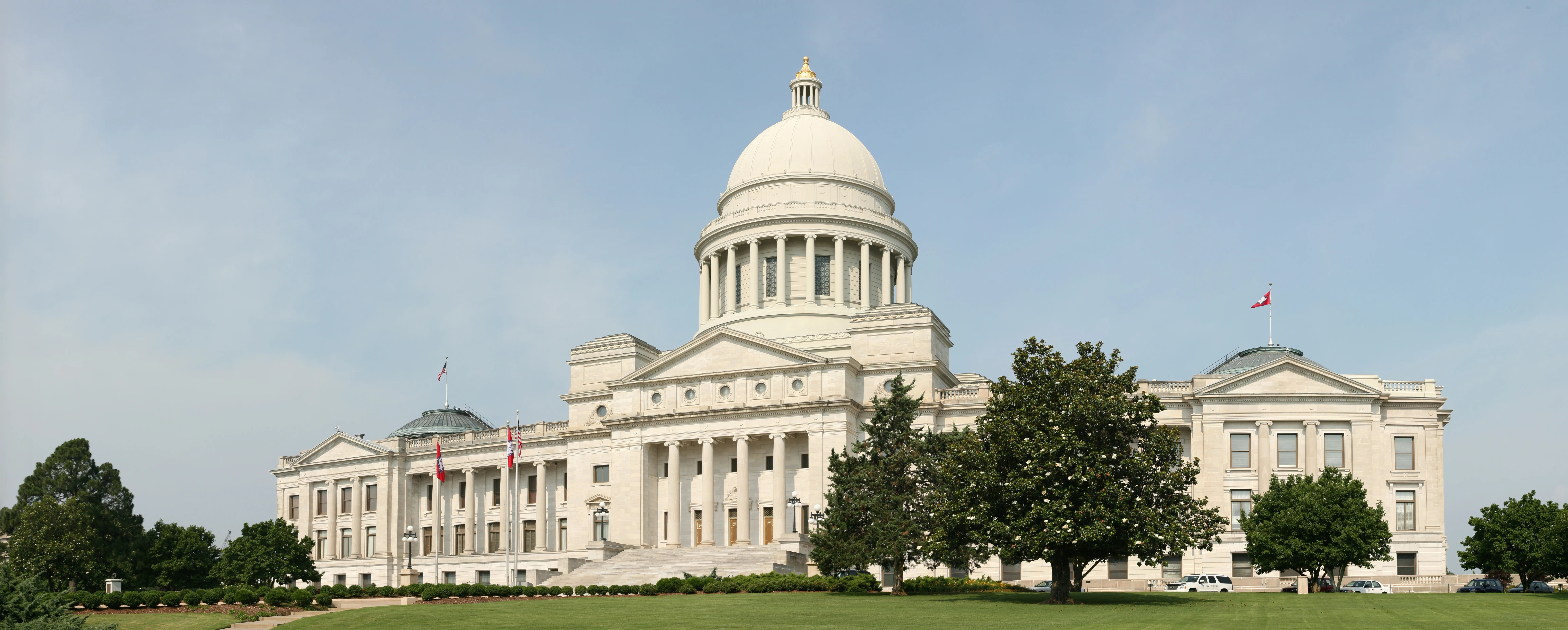
Arkansas
State Guide25th StateEst. 1836
Arkansas AR
"The Natural State"
From the Ozark Mountains to the Mississippi Delta, Arkansas is a land of natural beauty, agricultural heritage, and growing economic opportunity.
Arkansas state finances at a glance
State Debt - FY2024
$8.1 billion
Total state government debt outstanding at the close of fiscal 2024, including long-term bonds and short-term borrowing across state agencies and public universities.
Tax Revenue - FY2024
$12.7 billion
Total Arkansas state tax collections in fiscal 2024, led by the general sales tax ($5.1B) and the individual income tax ($2.8B).
Borrowing
Arkansas issues general obligation bonds only after statewide voter approval, backed by the state's full faith and credit, along with revenue bonds tied to specific programs. All are sold to investors in the tax-exempt municipal bond market. The state reported about $246 million in interest on its debt in fiscal 2024.
Source: U.S. Census Bureau, 2024 Annual Survey of State Government Finances.
25th
State admitted to the Union
53K
Square miles
3.07M
Population
Natural State
Nickname
…
Last updated:
Arkansas's 2026 Midterm Election: Who and What Is on Your Ballot
Okay, Arkansas, let's get you ready. On Tuesday, November 3, 2026, you're choosing a governor, one of your two U.S. senators, your member of the U.S. House, and four statewide ballot issues.
This is a midterm election, halfway through the president's term, and nationally it decides who controls Congress for the next two years. In Arkansas, Governor Sarah Huckabee Sanders and Senator Tom Cotton are both running for second terms.
The four ballot issues all came from the Legislature; there are no citizen initiatives this year. Three would amend the state constitution (voting, gun rights, and economic development districts) and one asks to borrow up to $500 million for water projects.
The key dates and how voting works are right below. Use the buttons above to open each type of race. Every candidate on the ballot is listed, and every issue comes with what a FOR or AGAINST vote means. Facts first; the decision is yours.
Checked against official sources on October 4, 2026
Key Dates
Key Dates
Last day to register to vote
Monday, October 5
Early voting begins
Monday, October 19
Last day for your county clerk to receive a mailed absentee application
Tuesday, October 27
Last day to apply for or hand-deliver an absentee ballot in person
Friday, October 30
Early voting ends at 5 p.m.
Monday, November 2
Election Day: polls open 7:30 a.m. to 7:30 p.m.; mailed absentee ballots due by 7:30 p.m.
Tuesday, November 3
How Voting Works in Arkansas
Register by October 5. You can check your registration, see a sample ballot, and find your polling place at VoterView (voterview.ar-nova.org).
Early voting runs October 19 through November 2 at locations your county sets: 8 a.m. to 6 p.m. weekdays and 10 a.m. to 4 p.m. Saturdays, ending at 5 p.m. on Monday, November 2. On Election Day, polls are open 7:30 a.m. to 7:30 p.m.
Bring a photo ID; Arkansas has required one since voters approved Amendment 99 in 2018. A driver's license, passport, or military ID works, and your county clerk issues a free voter ID card if you don't have one. No ID with you? You can cast a provisional ballot and then show ID to the county clerk or election commission by the deadline poll workers give you, so it counts.
Absentee voting is for people who'll be away on Election Day, are ill or disabled, are in the military or overseas. Apply through your county clerk; mailed applications must arrive by October 27. Include a copy of your photo ID with your ballot, and get it back by mail so it arrives by 7:30 p.m. on Election Day, or deliver it in person by the end of the day October 30. Questions? Call the Secretary of State at 1-800-482-1127.
Governor Race
The governor runs Arkansas's executive branch: the state agencies, the budget proposal, and signing or vetoing bills. Arkansas's veto is weak; the Legislature can override it with a simple majority of each chamber. Governors serve four-year terms and are limited to two.
Sarah Huckabee Sanders won in 2022, becoming the state's first woman governor, and is running for a second term. The lieutenant governor and other statewide officers are elected separately, on their own lines of the ballot.
Arkansas's last Democratic governor was Mike Beebe, who served from 2007 to 2015.
Candidates are those on Arkansas's general election ballot, as listed by the Arkansas Advocate's 2026 voter guide and Ballotpedia. Arkansas has no statewide candidate pamphlet.
Positions are summarized from the candidates' own campaign websites and, for James Russell and Terri Yarbrough Green, their Ballotpedia Candidate Connection answers, in neutral words and without attacks on opponents. Use each candidate's website for the full pitch.
Governor of Arkansas
Statewide, four-year term
Three candidates are on the ballot: Republican Governor Sarah Huckabee Sanders, Democratic State Senator Fred Love, and Libertarian Colt Shelby. Both challengers oppose the planned 3,000-bed state prison in Franklin County.
Sarah Huckabee Sanders
Incumbent
Republican
Occupation:
Governor of Arkansas
Government experience:
Governor (2023 to present); White House Press Secretary (2017 to 2019)
What they say they stand for
Points to Arkansas LEARNS, her education overhaul that raised teacher pay and created universal school choice.
Points to state income tax cuts that return more money to taxpayers.
Points to public safety changes that add prison space and keep repeat offenders off the streets.
Points to the Natural State Initiative to grow the outdoor economy, and to changes that streamline state government.
We summarize positions in depth for the Democratic and Republican nominees and incumbents. This candidate didn't answer the questionnaires we use, so see their website for where they stand.
Four statewide issues this year, all sent to you by the Legislature. Issues 1, 2, and 3 amend the Arkansas Constitution; Issue 4 asks permission to borrow. Each needs a simple majority. On the ballot you'll mark FOR or AGAINST.
Money check: Issues 1 and 2 cost nothing. Issue 3 doesn't raise a statewide tax but would let new districts tax property inside them. Issue 4 borrows up to $500 million, repaid from existing state revenue.
The explanations and the reasons for and against come from the 2026 voter guide published by the University of Arkansas Division of Agriculture's Public Policy Center, which is reviewed by legal experts and by each issue's supporters and opponents. The university doesn't endorse either side.
Today, Article 3 of the Arkansas Constitution says "any person may vote" who is a U.S. citizen, an Arkansas resident, at least 18, and registered. Citizenship has been required to vote in Arkansas since Amendment 8 in 1920.
Issue 1 swaps that wording for "only a citizen of the United States" meeting those qualifications, and adds a line saying anyone who doesn't meet them may not vote in any state or local election. The four qualifications themselves don't change.
Why bother if citizenship is already required? Supporters want a ceiling, not a floor, so no Arkansas city could ever let noncitizens vote in local elections, as a few cities in Maryland, Vermont, and California and Washington, D.C. have done. No Arkansas local government has proposed it. If it passes, it takes effect January 1, 2027.
A FOR vote means
The Constitution says specifically that only U.S. citizens who meet the existing qualifications may vote, and that no one else may vote in a state or local election.
An AGAINST vote means
Article 3 keeps its current wording, which already requires U.S. citizenship to vote.
Reasons people vote for
"Only citizens" sets an exclusive, unambiguous limit on who can vote, where the current "any person who is a citizen" wording leaves room for others to be added, as has happened in other places.
It's easier to settle the question before any Arkansas city considers noncitizen voting, and American elections should be decided by Americans.
Reasons people vote against
The Constitution already limits voting to U.S. citizens, so the amendment changes a few words without changing anything of substance, and a months-long review by election officials found noncitizens weren't voting.
Opponents worry lawmakers could use it as a reason to pass strict proof-of-citizenship rules in 2027 that some qualified voters couldn't meet.
💵 Taxes and money: No tax change
It changes wording in the Constitution only. It doesn't create a program, a tax, or any spending.
Since 1874, Article 2, Section 5 has said: "The citizens of this State shall have the right to keep and bear arms, for their common defense." That's the whole thing.
Issue 2 adds that the right also covers lawful hunting and recreational use and any other lawful purpose; that it includes, "without limitation," the possession and use of ammunition, firearm accessories, and firearm components; and that it's a "natural, fundamental, and individual right that shall not be infringed."
Arkansas voters last voted on something close to this in 2010, when they added a right to hunt and fish. Alabama, Iowa, Louisiana, and Missouri adopted similar gun-rights amendments between 2012 and 2022. If it passes, it takes effect January 1, 2027.
A FOR vote means
The Constitution spells out that the right to keep and bear arms covers hunting, recreation, and other lawful purposes, and includes ammunition, accessories, and components.
An AGAINST vote means
Article 2, Section 5 keeps its current wording.
Reasons people vote for
It makes clear that "arms" includes ammunition, components, and accessories and that it's an individual right, so the language can't be read narrowly.
Clearer wording means fewer arguments in court about what the right covers, and it protects law-abiding gun owners from future calls for disarmament.
Reasons people vote against
The current Constitution already protects an individual's right to bear arms, and "without limitation" could make reasonable safety rules harder to defend in court.
Opponents warn it could be used to challenge limits on gun possession by people convicted of serious crimes or under domestic violence orders, and rules on items like bump stocks, making law enforcement's job harder.
💵 Taxes and money: No tax change
It changes wording in the Constitution only. It doesn't create a tax or any spending.
Issue 3 does two things. First, it lets the Legislature create programs, loans, and grants of public money to grow and diversify the economy, fight unemployment, expand transportation and commerce, or improve property for economic development.
Second, it lets lawmakers authorize cities, counties, or cooperative areas to create economic development districts. Property inside a district would be exempt from the regular property taxes charged by schools, counties, and cities, and the district itself could levy taxes, assessments, or other charges there (not limited to property taxes). Districts could issue bonds that don't count against city or county debt limits. Churches, schools, and other already-exempt property stay exempt.
Bonds paid off with property taxes would need local voter approval. The amendment doesn't create any district or project by itself: the Legislature would write the rules in a later session (a 2025 bill to do that died). It overrides any conflicting part of the Constitution or court ruling; the guide notes that could reach the 25-mill school property tax, the same money a 2007 Arkansas Supreme Court decision kept tax increment financing (TIF) districts from using. It would take effect January 1, 2027.
A FOR vote means
The Constitution allows economic development programs, loans, and grants of public money, and economic development districts that can levy taxes and fees and issue bonds.
An AGAINST vote means
The Constitution stays as it is; existing tools like TIF districts and economic development bonds remain.
Reasons people vote for
Arkansas is the only state in its region without this kind of district, which puts its towns, urban and rural, at a disadvantage competing for retail, housing, tourism, and mixed-use projects.
Communities could fix up abandoned buildings and shopping centers, pay for roads and water lines, and help businesses already in the district, without raising statewide taxes, and act fast enough to match offers from neighboring states.
Reasons people vote against
Property in a district comes off the tax rolls for schools, the county, and the city, so the cost of those services shifts to everyone outside the district, and it creates an unelected layer of government.
Voters are being asked to put this in the Constitution before the rules are written, and government would pick which businesses get help, often newcomers, while taxpayers carry the risk if a project fails.
💵 Taxes and money: No new statewide tax, but it shifts who taxes property inside a district
The guide lists no statewide cost estimate, because nothing happens until the Legislature passes rules and local governments create districts.
Inside a district, property would stop paying the usual school, county, and city property taxes and would instead pay whatever taxes, assessments, or fees the district sets. Outside a district, nothing changes directly, though opponents argue the lost revenue would have to be made up by other taxpayers. Bonds paid with property taxes would need a local vote.
Issue 4 lets the Arkansas Natural Resources Commission issue up to $500 million in general obligation bonds, repaid over as long as 35 years, for water, waste disposal, water pollution control, drainage, irrigation, flood control, and wetlands projects. No more than $165 million could go to irrigation, and no more than $60 million could be issued in any two-year period without the Legislature's approval.
The money is loaned or granted to cities, counties, water associations, conservation and irrigation districts, and other local entities, and it helps cover the state match for the federal Clean Water and Drinking Water revolving loan funds. Past bond money has gone to projects like the Grand Prairie and Bayou Meto irrigation projects, which move river water to farmland so less is pumped from shrinking aquifers.
Voters approved the last bond like this, $300 million, in 2008, and the last of that money was offered for sale in July. The EPA has identified more than $13 billion in drinking water, sewer, and stormwater needs in Arkansas. If approved, it takes effect July 1, 2027.
A FOR vote means
The state may issue up to $500 million in bonds for water, waste disposal, and pollution abatement projects, no more than $60 million every two years without legislative approval.
An AGAINST vote means
The state can't sell new bonds for these projects, and lawmakers would need to find other money to keep the loans and grants going and match federal funds.
Reasons people vote for
The last two bond issues helped every county, and without new money, up to $500 million in local water and sewer projects can't be funded.
The state can borrow at a better interest rate than small towns can and pass those savings on to the communities that borrow from it.
Reasons people vote against
Borrowing means paying interest, at rates well above a few years ago, when the state has billions of dollars in reserves.
The broad wording raises questions about who could benefit from taxpayer-backed bonds, and some counties already struggle to repay loans.
💵 Taxes and money: No new tax; the state repays the borrowing from its general revenue
Bond payments come first out of the state's general revenue fund, before agencies get their money, and are also paid from the loan repayments local borrowers make. Issue 4 doesn't raise any tax rate.
The total borrowed can't exceed $500 million, paid back over up to 35 years. The guide doesn't give an interest estimate, so total interest isn't known yet.
What it could cost you
What it could cost you
$500 million principal per Arkansas tax return
About $360, once
Spread over a 35-year payback
About $10 a year, before interest
Our arithmetic, not an official estimate: $500 million divided by about 1.4 million individual federal income tax returns filed from Arkansas (IRS Statistics of Income). The money comes from existing state revenue, not a new tax on you, and interest would add to it.
Your ballot may also include local questions, like city or county sales taxes, school millages, or wet-dry votes. They vary by county; see your sample ballot on VoterView or ask your county clerk.
Senate Races
Every state gets two U.S. senators. The Senate votes on every federal law, confirms Supreme Court justices and cabinet members, and approves treaties. Senators serve six-year terms.
Tom Cotton's seat is up this year. Arkansas's other senator, John Boozman, isn't up until 2028.
Three candidates are on the ballot.
Candidates are those on Arkansas's general election ballot, as listed by the Arkansas Advocate's 2026 voter guide and Ballotpedia. Arkansas has no statewide candidate pamphlet.
Positions are summarized from the candidates' own campaign websites and, for James Russell and Terri Yarbrough Green, their Ballotpedia Candidate Connection answers, in neutral words and without attacks on opponents. Use each candidate's website for the full pitch.
U.S. Senator
Statewide, six-year term
Republican Tom Cotton, first elected in 2014, faces Democrat Hallie Shoffner, a farmer, and Libertarian Jeff Wadlin, an engineer. In 2020 Cotton had no Democratic opponent.
Tom Cotton
Incumbent
Republican
Occupation:
U.S. Senator
Government experience:
U.S. Senator (2015 to present); U.S. Representative (2013 to 2015); U.S. Army officer
What they say they stand for
Wants to secure the border and end illegal immigration; authored the RAISE Act to change the legal immigration system and voted for the Laken Riley Act.
Points to his votes for the 2025 tax law, including no tax on tips and a tax break on Social Security, and opposes IRS expansion.
Points to billions in defense investment in Arkansas and his focus on countering China, as chairman of the Senate Intelligence Committee.
Supports Second Amendment rights and tougher penalties for violent criminals and drug traffickers.
Has sponsored legislation to protect Arkansans from costs tied to data centers.
We summarize positions in depth for the Democratic and Republican nominees and incumbents. This candidate didn't answer the questionnaires we use, so see their website for where they stand.
The U.S. House of Representatives has 435 members, and every seat is up every two years, which is why midterms can flip control of Congress in one night.
Arkansas has four seats, and Republicans hold all four. All four incumbents are running again, and three of them chair a House committee.
You vote only in the district where you live; VoterView will tell you which one. Curious how the lines get drawn? Here's how redistricting works.
Arkansas's Four Districts and Who Holds Them Today
Republican
Each district is colored by the party of the member of Congress who holds it right now, not by who will win in November. Select a district to jump to its race. District lines: U.S. Census Bureau, 120th Congress.
Candidates are those on Arkansas's general election ballot, as listed by the Arkansas Advocate's 2026 voter guide and Ballotpedia. Arkansas has no statewide candidate pamphlet.
Positions are summarized from the candidates' own campaign websites and, for James Russell and Terri Yarbrough Green, their Ballotpedia Candidate Connection answers, in neutral words and without attacks on opponents. Use each candidate's website for the full pitch.
District 1
Northeast and eastern Arkansas, including Jonesboro and the Delta
Republican Rick Crawford, in office since 2011 and chairman of the House Intelligence Committee, faces Democrat Terri Yarbrough Green, a physician, and Libertarian Steve Parsons.
Rick Crawford
Incumbent
Republican
Occupation:
U.S. Representative
Government experience:
U.S. Representative (2011 to present); U.S. Army (1985 to 1989)
What they say they stand for
Calls the national debt his top priority and wants permanent federal spending controls.
Wants lower taxes and a growing economy.
Wants to keep the federal government out of people's lives and businesses.
We summarize positions in depth for the Democratic and Republican nominees and incumbents. This candidate didn't answer the questionnaires we use, so see their website for where they stand.
Central Arkansas, including Little Rock and Conway
Republican French Hill, in office since 2015 and chairman of the House Financial Services Committee, faces Democrat Chris Jones, a physicist and minister who was the party's nominee for governor in 2022.
French Hill
Incumbent
Republican
Occupation:
U.S. Representative; founder of Delta Trust & Bank
Government experience:
U.S. Representative (2015 to present); Deputy Assistant Secretary of the Treasury (1989 to 1991)
What they say they stand for
Points to the 2025 tax law, including no tax on tips and overtime and a new deduction for seniors, and wants to cap the long-term capital gains tax at 15 percent.
Introduced bills to build more housing by cutting federal red tape, and to steer federal policy toward lowering inflation.
Helped write the first federal rules for stablecoins and backs easier access to capital for small businesses.
Supports border security bills and the fentanyl sanctions laws he sponsored.
Points to his office's work for veterans and the Fisher House at the Little Rock VA hospital.
Northwest Arkansas, including Fayetteville, Springdale, Rogers, Bentonville, and Fort Smith
Republican Steve Womack, in office since 2011 and a senior member of the Appropriations Committee, faces Democrat Robb Ryerse, a pastor, and Libertarian Bobby Wilson.
Steve Womack
Incumbent
Republican
Occupation:
U.S. Representative
Government experience:
U.S. Representative (2011 to present); Mayor of Rogers (1999 to 2010); Arkansas Army National Guard, retired colonel
What they say they stand for
His campaign website lists his background and committee roles (he chairs the Appropriations subcommittee on Transportation, Housing and Urban Development and formerly chaired the House Budget Committee) but no issue positions, and he hasn't answered the questionnaires we use.
We summarize positions in depth for the Democratic and Republican nominees and incumbents. This candidate didn't answer the questionnaires we use, so see their website for where they stand.
South and west Arkansas, including Hot Springs, Pine Bluff, Texarkana, and El Dorado
Republican Bruce Westerman, in office since 2015 and chairman of the House Natural Resources Committee, faces Democrat James Russell, who ran for governor in 2022.
Bruce Westerman
Incumbent
Republican
Occupation:
U.S. Representative; engineer and forester
Government experience:
U.S. Representative (2015 to present); Arkansas House of Representatives
What they say they stand for
Wants lower taxes and fewer federal regulations.
As the only forester in the House, pushes science-based forest management; wrote the Resilient Federal Forests Act.
Introduced the Fair Care Act to lower health care costs while covering pre-existing conditions.