
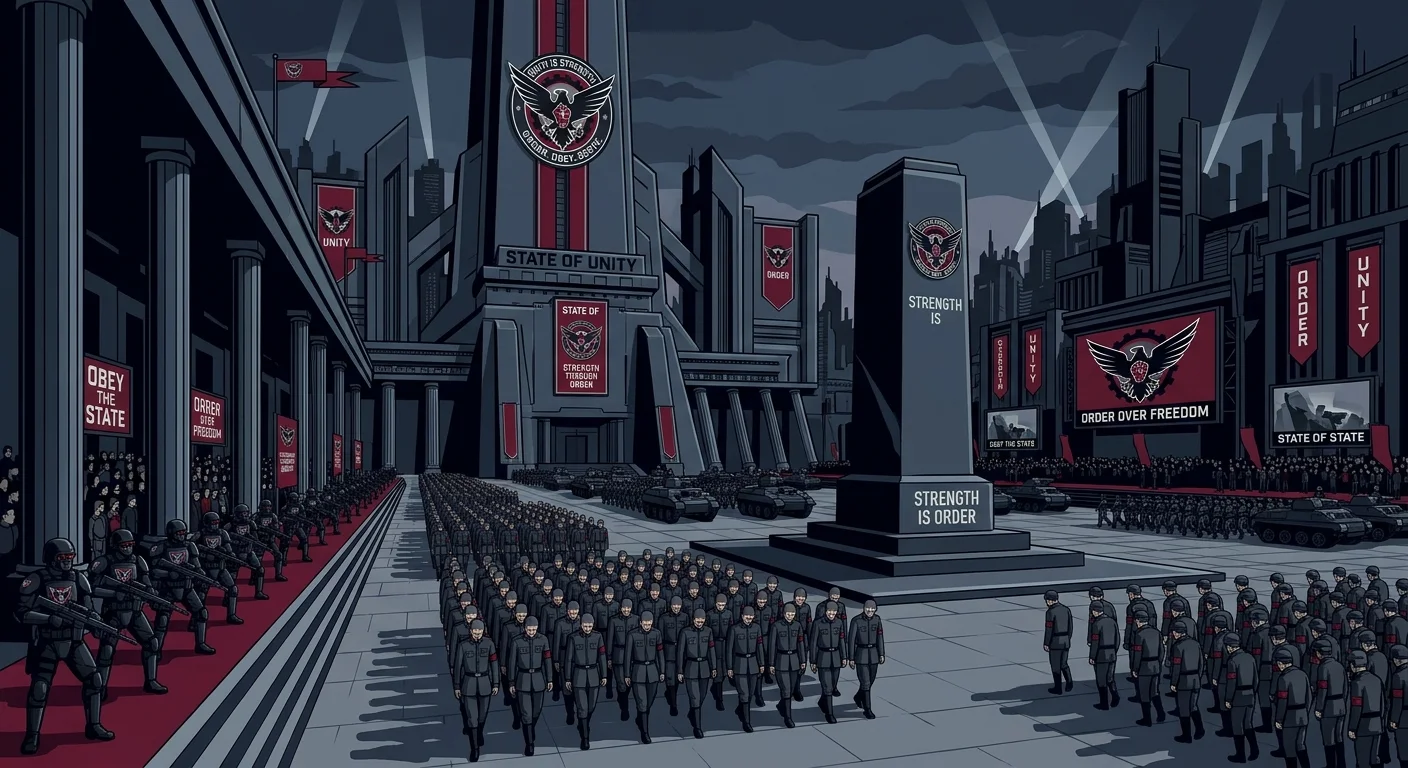
The Windows, the Neighbors, and the Town Made of Glass
Imagine a town called Linden, where every house has thick walls, curtains on the windows, and a front door that locks from the inside.
Linden is a republic. Its people elect a council, and the mayor can serve only two terms. The town's constitution, kept in a glass case at the town hall, says that a family's home is its own, that people may meet, worship, and speak as they please, and that no one may be punished for what they believe.
Outside the houses, Linden is full of things nobody planned. There's a chess club in the back of the bakery, a choir at the stone chapel, a carpenters' union, a Saturday football league, and two newspapers that disagree about almost everything.
Nobody is in charge of all of it.
Children used to learn the constitution in the seventh grade: why the walls are thick, and why the clubs belong to their members. Then the lesson was cut to make room for test drills. Nobody complained. The walls had always been there. Why study them?
Then come hard years. The mill closes. A fire at the grain store is blamed on saboteurs. People are frightened, and they stop asking, "Does the constitution allow it?" They ask only, "Will it keep us safe?"
How the Unity Party won every office in Linden is a story of its own. This one starts the morning after, when a party that holds the town hall decides that isn't enough.
The first order is small. Every house must cut one window into the wall facing the street, so the night watch can see that all is well.
"A family that loves Linden," says the Party, "is glad to be seen loving it."
Ah, it's only one window. (Privacy.)
And it works. Burglaries drop. Mothers let their children walk home after dark. A widow on Mill Lane says she has never slept so well.
But the night watch is only forty men, and Linden has three thousand windows. So the watch asks for help. A neighbor who notes who visits whom gets an extra coal ration. A coworker who repeats a joke heard at lunch gets a promotion. Nobody announces who has said yes. Everyone knows that some of their neighbors are writing reports, and no one knows which ones (informers).
Next come the glass front doors. Groups that meet behind closed doors are suspicious, the Party says, so the chess club, the choir, the carpenters' union, and the football league are closed. The Party opens its own: the Unity Chess Circle, the Unity Choir, the Unity Workers' Front. The members are mostly the same people. The songs are not (independent associations).
The two newspapers become one, the Linden Unity Herald, and it agrees with itself about everything (a free press). The chapel stays open, but a Party officer sits in the back row and takes notes during the sermon (freedom of worship).
The children join the Lantern Youth. It's free, there are summer camps and brass bands, and most of the children love it. At their first meeting they learn about Little Tomas, a brave boy who told the watch that his own father was hiding grain, and who was killed for it by his angry relatives. There is a statue of Tomas in the square now. The teachers ask, kindly, what parents talk about at dinner.
Marta, a seamstress on Bell Street, notices that her son Pim has stopped asking questions at the table. So has she.
Then the cards appear. Every door gets a small painted card: gold, gray, or black. Gold families get the apartments near the square, the jobs at the town hall, and university places for their children. Gray families wait. Black families, whose grandfather once wrote for the wrong newspaper, are moved to the cold houses by the quarry, and their children stop school after the eighth grade. The color passes from parents to children like a family name (equal treatment under the law).
The town chronicle is rewritten. The years before the Party become "the Years of Disorder." Old newspapers vanish from the library, and a former councilman who fell out of favor disappears from the photograph of the new bridge's opening. The word "free" is painted on banners everywhere, but now it means free of disorder (an honest record of the past).
The constitution is still in its glass case, every word unchanged. Nobody reads it.
One evening a polite man from the watch visits Marta. Pim's school is choosing who goes on to the academy, he says. It would help if Marta wrote a little each month about her neighbor Helga, who used to sing in the old choir. Nothing much. Who visits. What she says.
Marta thinks of Pim. She says yes. She tells herself she will write only harmless things, and mostly she does. Pim goes to the academy.
By now, the walls of every house might as well be glass. People keep their curtains open, because closed curtains get noticed. They cheer at the parades and grumble nowhere. They learn to wear two faces: one for the street, and one they keep so far inside that sometimes they forget it's there (freedom of conscience).
There is no wall left to stand behind.
So when the Party does something that many people hate, nobody can meet to talk about it, because every club is the Party's. Nobody can write about it, because every newspaper is the Party's. Nobody can say it at work, or at the chapel, or even at the dinner table in front of a child. Each person is alone with the thought, and one person alone with a thought can't do much.
And still, many people in Linden say life is good. Everyone has a job. Rents are low. The streets are clean and the parades are splendid. Gold-card families do very well, and plenty of gray-card families truly believe in the Party.
Many years later, the glass finally cracks. Crowds fill the square, too many for the watch to stop, and they walk into the watch house itself. They find rooms full of folders, one for nearly every family in Linden.
The new council passes a law: anyone may read their own folder, and learn the real name of anyone who wrote about them.
Helga reads hers. She finds Marta's careful handwriting, month after month. Marta wrote mostly about the weather, the price of thread, and how often Helga watered her roses.
The town historian opens one more folder, the one about Little Tomas. Almost none of the story was true.
Helga sits with her folder for a long time. Then she walks to Bell Street and knocks on Marta's door, which is made of wood again.
The Party never needed to watch everyone. It only needed everyone to believe they were being watched, and to take away every place where people could stand together and say no.
A town made of glass doesn't have to break a single door. It only has to make sure nobody closes one.