
The U.S. Government

Because democracy only works when we understand it

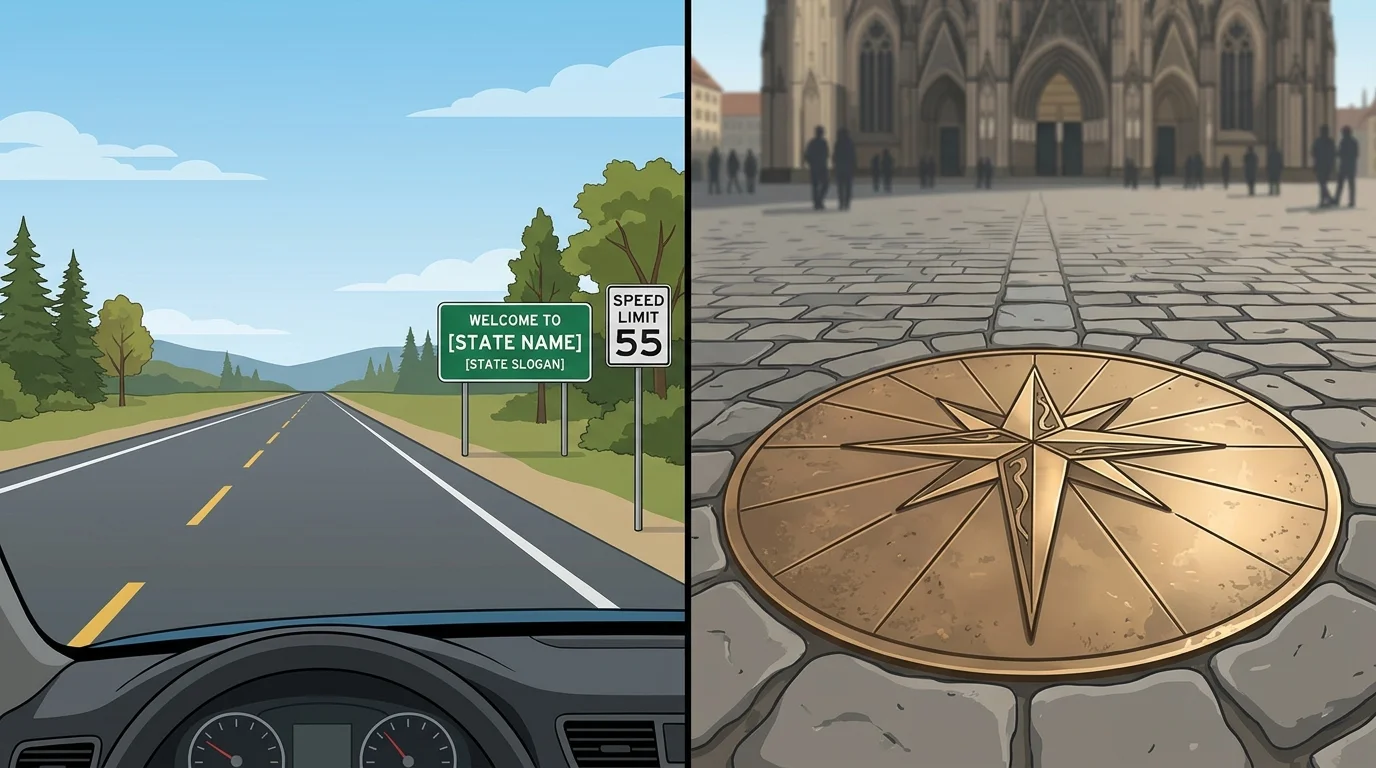
A split illustration: on the left, a highway seen from a driver's seat passing a Welcome to State Name sign and a 55 mile per hour speed limit; on the right, a bronze compass rose set into the cobblestones of a cathedral square, the single point from which a whole country is measured
Government through Stories: Federal vs. Unitary Systems

The Villages, the Great Hall, and Who Holds the Keys

Two valleys, both republics. One splits its keys among its villages, and one keeps every key in a single hall. Each choice protects something, and each has a price.

Political system7 minute read

The Villages, the Great Hall, and Who Holds the Keys

Imagine two valleys side by side, with a high ridge between them. Both are republics. Each has a written constitution, leaders elected for a set number of years, judges who can strike down a law that breaks the constitution, and a list of rights every person keeps: to speak, to worship, to gather, and to be treated equally under the law. Every official swears an oath to that constitution before taking office.

The two valleys agree on almost everything. They disagree on one question: where to keep the keys.

In the eastern valley, Willowmere, the keys are split. Each of its twelve villages elects its own council, which runs the village school, mends the village roads, digs the wells, and hires the village constable. A valley council, elected by everyone, handles the few things no village can do alone: defending the valley, keeping trade fair between the villages, and minting the valley's coins.

Willowmere's constitution lists the valley council's jobs one by one. Everything not on that list belongs to the villages, or to the people themselves (the Tenth Amendment).

In the western valley, Stonereach, every key hangs on one ring in the Great Hall. The people of the whole valley elect the Hall, and the Hall decides the school lessons, the road rules, and the well rules for every village at once. Each village has a clerk who carries out the Hall's decisions, and the Hall can give a village more say or less.

Willowmere didn't start out split this way. Its first constitution made the valley council so weak it couldn't collect a single coin without begging the villages for it. Villages charged tolls on each other's carts at every bridge. Changing anything required all twelve villages to agree, and they never did (the Articles of Confederation).

After a few hard years of that, Willowmere wrote a new constitution. The valley council got real power, but only over its short list. The villages kept the rest. Each level had its own job, and each could keep an eye on the other (a compound republic).

Life in Willowmere is messy.

A cart driver crossing the valley meets twelve sets of road rules. Children in Fernhollow learn different lessons from children in Millbrook. The village councils argue with the valley council, and with each other, about who is supposed to fix what.

But the villages try things. One year, Millbrook lets its women vote in village elections. The other villages laugh. Then a few of them copy it. Years later, the whole valley writes it into the constitution.

Another village tries a well tax so high that families haul water from the river instead. It's a bad idea, but it stays a bad idea in one village. The neighbors watch, learn, and never try it (laboratories of democracy).

Life in Stonereach is tidy.

Every road is built to the same width. Every school uses the same books, so a child in the farthest village learns what a child next door to the Great Hall learns. A traveler knows the rules in every village, because they are the same rules. When the Hall builds a bridge, it builds it once, and it builds it well, and no village pays for a bridge its neighbor already built.

Everyone also knows who is responsible. When something goes wrong, there is one place to complain and one set of leaders to vote out.

But the Great Hall is a long walk from the upper villages. When a well cracks in the high pastures, the farmers wait a whole season for the Hall's answer. And one spring, the Hall orders every village to plant a new kind of grain. It grows beautifully near the river and dies in the cold hill fields. Because the order reached every village at once, the hill villages lose their harvest together.

So the hill villages ask for councils of their own. The Hall agrees and lets them run their own schools and wells (devolution). Stonereach even adds a line to its constitution saying that the valley is one, but its work is shared out (a decentralized republic). Still, the Hall keeps the final word. What the Hall gave, the Hall could take back.

Ah, but neither valley is safe just because of where it hangs its keys.

In Willowmere, the village of Redbank makes a rule that the ferry families, who live along the river and have always been fewer and poorer, must send their children to a separate schoolhouse, one with a leaky roof and half as many books.

When the valley council objects, Redbank's headman says, "Our village, our school, our rules."

But the valley constitution promises equal treatment to every person in every village (the Fourteenth Amendment). A ferry family takes its case to the valley court, and every judge agrees: a separate schoolhouse can never be an equal one (Brown v. Board of Education).

Redbank's headman sends his constables to stand at the schoolhouse door and turn the ferry children away.

So the valley council sends its own guard. They walk nine children up the schoolhouse steps, past a shouting crowd, and through the door (Little Rock, 1957).

A village's keys open its own doors. They were never meant to lock a neighbor out of rights the whole valley promised.

Far beyond the mountains, travelers tell of a third valley, Greyhaven. Greyhaven once split its keys the way Willowmere does. Then, in a hard year, a man who promised order took the central hall. He put his own men in charge of every village, and then passed one law that closed every village council for good (Germany, 1934).

There was no one left at the village level to say no. Every key hung on one ring, and one man held it.

When Greyhaven was free again, it rebuilt its village councils before almost anything else, and it wrote into its new constitution that they could never be abolished (West Germany's Basic Law, 1949).

Stonereach hears that story and pays attention. Its guards don't live in village councils. They live in its constitution, its courts, its free newspapers, and its elections. As long as those hold, the Great Hall stays a hall and never becomes a throne. So far, they have held.

Willowmere hears the story too, and remembers Redbank. Its villages are only as free as the valley constitution that protects every person in every one of them.

On the ridge between the two valleys, an old farmer from each side meets every summer. One envies the other's tidy roads and fair schools. The other envies the village that dared to try something new.

Every year, they ask each other which valley got it right. And every year, they walk home still thinking about it.

The Real Lesson

This story isn't claiming that a federal republic is better than a unitary one, or the other way around. France, Japan, New Zealand, and the United Kingdom keep most of their keys in one central government and are free, stable democracies. The United States, Germany, Switzerland, and Canada split theirs and are free too.

Nor is it claiming that local power is always kind, or that central power is always dangerous. Willowmere's worst moment came from one of its own villages, and the valley stepped in. Greyhaven's came from the center, and nothing below it was left to resist.

Dividing power between levels of government is one more set of guards. Two levels can check each other, keep a bad idea from spreading, and give people more than one door to knock on. A single level can be fairer, simpler, and easier to hold accountable.

But neither design protects anyone by itself. Redbank broke the valley's promise of equal treatment just as surely as Greyhaven's central hall broke its villages. What saved Willowmere was a constitution that reached every village, and what keeps Stonereach free is a Hall that still answers to courts, a free press, and the voters.

The real lesson is this: whether a republic splits its keys or keeps them on one ring, it needs a constitution that protects every person's rights in every village, and it works only when power at every level stays limited and answers to the people.

Where the Keys Were Tested

On May 17, 1954, a unanimous Supreme Court ruled in Brown v. Board of Education that "separate educational facilities are inherently unequal." In September 1957, Arkansas Governor Orval Faubus used the state's National Guard to turn away nine Black students from Little Rock's Central High School. President Dwight Eisenhower signed Executive Order 10730, which placed the Arkansas Guard under federal control and sent about 1,000 paratroopers of the 101st Airborne Division, and the students entered under their escort, a turning point in the civil rights movement.

On January 30, 1934, Germany's Law on the Reconstruction of the Reich declared, "The parliaments of the States are abolished," and moved the states' powers to the national government. After the war, West Germany's Basic Law, signed on May 23, 1949, made the country "a democratic and social federal state," and its Article 79 forbids any amendment that would abolish the division into states.

The United Kingdom, a unitary state, created the Scottish Parliament, the National Assembly for Wales, and the Northern Ireland Assembly in 1998 and 1999 after referendums in which 74.3 percent of Scottish voters backed a parliament of their own. The Scotland Act 1998 still says it "does not affect the power of the Parliament of the United Kingdom to make laws for Scotland."

France, also unitary, amended its constitution on March 28, 2003, so that Article 1 now says the Republic "shall be organised on a decentralised basis." Its local councils govern themselves, within limits set by national law.

What Each Version Trades

Both valleys are constitutional republics. These are the safeguards each design leans on, how each held in the story and in real history, and what each one trades to get it.

  • Safeguard: Voters who ask, "Which level should decide this?"

    How it held, and the trade: Willowmere asks whether a matter belongs to the village or the valley, the question the Tenth Amendment puts to Americans. Stonereach asks whether the Hall should keep a power or share it. Both ask before they act.

  • Safeguard: A short list of central powers (federal)

    How it held, and the trade: Willowmere's valley council can act only on its listed jobs; James Madison called the federal powers "few and defined" (Federalist No. 45). The trade: some problems wait while two levels argue over whose they are.

  • Safeguard: Two levels that check each other (federal)

    How it held, and the trade: Madison called the division between national and state governments a "double security" for the people's rights (Federalist No. 51). The trade: twelve sets of road rules, and arguments over who fixes what.

  • Safeguard: Room to experiment (federal)

    How it held, and the trade: Millbrook let women vote before the valley did, as Wyoming Territory did in 1869, 51 years before the Nineteenth Amendment. The trade: a bad idea can also last for years in one place before anyone stops it.

  • Safeguard: A center strong enough to work (federal)

    How it held, and the trade: Willowmere's first valley council couldn't collect a coin, as Congress under the Articles of Confederation could not tax. The new constitution fixed it. The trade: a stronger center needs limits of its own.

  • Safeguard: Rights enforced in every village (federal)

    How it held, and the trade: The valley court and the valley guard opened Redbank's schoolhouse, as Brown v. Board of Education (1954) and the troops at Little Rock (1957) did. The trade: a federation must be willing to overrule its own villages.

  • Safeguard: One standard for everyone (unitary)

    How it held, and the trade: Stonereach gives every child the same books and every traveler the same rules. The trade: one decision, good or bad, reaches every village at once, like the grain that died in the hill fields.

  • Safeguard: Clear accountability (unitary)

    How it held, and the trade: Stonereach's voters know exactly whom to praise or blame. The trade: the Hall is far from the upper villages, and its answers come slowly.

  • Safeguard: Local councils the center chooses to create (unitary)

    How it held, and the trade: Stonereach gave its hill villages councils, as the United Kingdom created devolved governments for Scotland, Wales, and Northern Ireland in 1998-99. The trade: the center keeps the final word, and what it gave, it can take back.

  • Safeguard: Guards that don't depend on the map

    How it held, and the trade: Greyhaven lost its village councils to one law, as Germany's states did in 1934. Stonereach's safety rests on its courts, a free press, and elections instead. The trade: in a unitary system, if those fail, nothing local is left to hold the line.

What the Story Shows

  • In the story: Every official swears an oath to that constitution

    In real life: Article VI of the U.S. Constitution binds members of Congress, state legislators, and all executive and judicial officers "both of the United States and of the several States" by oath to support it, so both levels answer to the same document.

  • In the story: Everything not on that list belongs to the villages, or to the people themselves

    In real life: The Tenth Amendment, ratified in 1791 with the Bill of Rights: "The powers not delegated to the United States by the Constitution, nor prohibited by it to the States, are reserved to the States respectively, or to the people."

  • In the story: The valley council couldn't collect a single coin without begging the villages for it

    In real life: The Articles of Confederation, adopted by Congress on November 15, 1777, and in force from March 1, 1781, gave Congress no power to tax and too little power to regulate trade. Major decisions needed nine of the 13 states, and any change to the Articles needed every state.

  • In the story: Each level had its own job, and each could keep an eye on the other

    In real life: In Federalist No. 51 (1788), James Madison wrote that in "the compound republic of America," power is first divided between two distinct governments, national and state, and then within each. "Hence a double security arises to the rights of the people."

  • In the story: Willowmere's constitution lists the valley council's jobs one by one

    In real life: In Federalist No. 45 (1788), Madison wrote: "The powers delegated by the proposed Constitution to the federal government are few and defined. Those which are to remain in the State governments are numerous and indefinite."

  • In the story: Millbrook lets its women vote in village elections

    In real life: On December 10, 1869, Wyoming Territory passed the first U.S. law granting women the right to vote (Library of Congress). Wyoming joined the Union in 1890 with women's suffrage intact, and the Nineteenth Amendment made it national in 1920.

  • In the story: It stays a bad idea in one village

    In real life: Dissenting in New State Ice Co. v. Liebmann (March 21, 1932), Justice Louis Brandeis wrote: "It is one of the happy incidents of the federal system that a single courageous state may, if its citizens choose, serve as a laboratory; and try novel social and economic experiments without risk to the rest of the country."

  • In the story: Every key hangs on one ring in the Great Hall

    In real life: France, Japan, New Zealand, and the United Kingdom are unitary states: the national government holds sovereign power and decides what local governments may do.

  • In the story: The Hall lets the hill villages run their own schools and wells

    In real life: After referendums in Scotland and Wales in September 1997 and in Northern Ireland in May 1998, the Scotland Act, the Government of Wales Act, and the Northern Ireland Act (all 1998) created devolved governments, which began work in 1999. The UK Parliament can still make laws for every part of the country.

  • In the story: The valley is one, but its work is shared out

    In real life: France's constitutional revision of March 28, 2003, added to Article 1 that the Republic "shall be organised on a decentralised basis," while keeping it "indivisible." Article 72 lets its local communities govern themselves through elected councils, within limits set by national law.

  • In the story: A ferry family takes its case to the valley court, and every judge agrees

    In real life: Brown v. Board of Education, decided unanimously on May 17, 1954, held under the Fourteenth Amendment's equal protection clause (1868) that "separate educational facilities are inherently unequal."

  • In the story: The valley council sends its own guard

    In real life: On September 4, 1957, the Arkansas National Guard, called out by Governor Orval Faubus, turned away nine Black students from Little Rock's Central High. Executive Order 10730, signed by President Dwight Eisenhower, federalized the Guard and sent about 1,000 paratroopers of the 101st Airborne Division to see the court order carried out (National Archives).

  • In the story: One law that closed every village council for good

    In real life: Germany's Law on the Reconstruction of the Reich, January 30, 1934, Article 1: "The parliaments of the States are abolished." Article 2 moved the states' powers to the Reich and placed the state governments under the national government, a key step in the Nazi dictatorship's centralization of power.

  • In the story: It wrote into its new constitution that they could never be abolished

    In real life: West Germany's Basic Law, signed on May 23, 1949, declares the country "a democratic and social federal state" (Article 20). Article 79(3) forbids any amendment affecting "the division of the Federation into LΓ€nder," a deliberate answer to 1934. Germany has 16 states today.

In real history

The United States, Germany, Switzerland, and Canada are federal democracies, with power divided between a national government and states, cantons, or provinces. France, Japan, New Zealand, and the United Kingdom are unitary democracies, and the United Kingdom has shared some of its powers with Scotland, Wales, and Northern Ireland since 1999.

You Decide

What draws people to it

  • Federal: room to experiment. Wyoming Territory let women vote in 1869, and the idea spread state by state until the Nineteenth Amendment made it national in 1920.
  • Federal: a double check. Two levels of government, each with powers of its own, make it harder for one person or party to capture everything, which is why West Germany restored its states in 1949 and made them permanent.
  • Unitary: one standard for everyone. The same laws, rights, and services reach every town; France's constitution calls the Republic "indivisible" and promises every citizen equality before the law.
  • Unitary: simplicity and accountability. One government answers for the whole country, so voters know whom to hold responsible; in Britain, Parliament can make law for every part of the country, as the Scotland Act 1998 itself confirms.

What it costs

  • Federal: local majorities can trample local minorities. States used their powers to keep schools segregated, and in 1957 it took federal troops to bring nine students into Little Rock's Central High.
  • Federal: a patchwork, and sometimes a center too weak to act. Under the Articles of Confederation, Congress could not even collect taxes, and any change needed every state to agree.
  • Unitary: distance. Decisions are made far from the people they affect; in 1997, 74.3 percent of Scottish voters chose a parliament of their own, and the United Kingdom still keeps the final word over it.
  • Unitary: one ring of keys. In 1934, a single German law abolished every state parliament and moved their powers to Berlin, removing a check the dictatorship did not want.

Willowmere's villages can try new things, but one of them can also fail its own people until the valley steps in. Stonereach treats every village the same, but one mistake reaches them all, and its safety rests on the guards at the center. Both kinds of republic have stayed free for generations. Which matters more to you, uniform fairness or local choice? And whichever valley you would choose, what has to stay in place so no one can ever hold all the keys?

See how federal and unitary systems compare with other forms of government on Modern Systems of Government, read the Fourteenth Amendment and its promise of equal protection in every state, and see how the Constitution divides power to keep it limited on Safeguards Against Tyranny.

Why a republic is easy to lose and hard to win back

See all the stories in Government through Stories

Last updated: