
The U.S. Government

Because democracy only works when we understand it

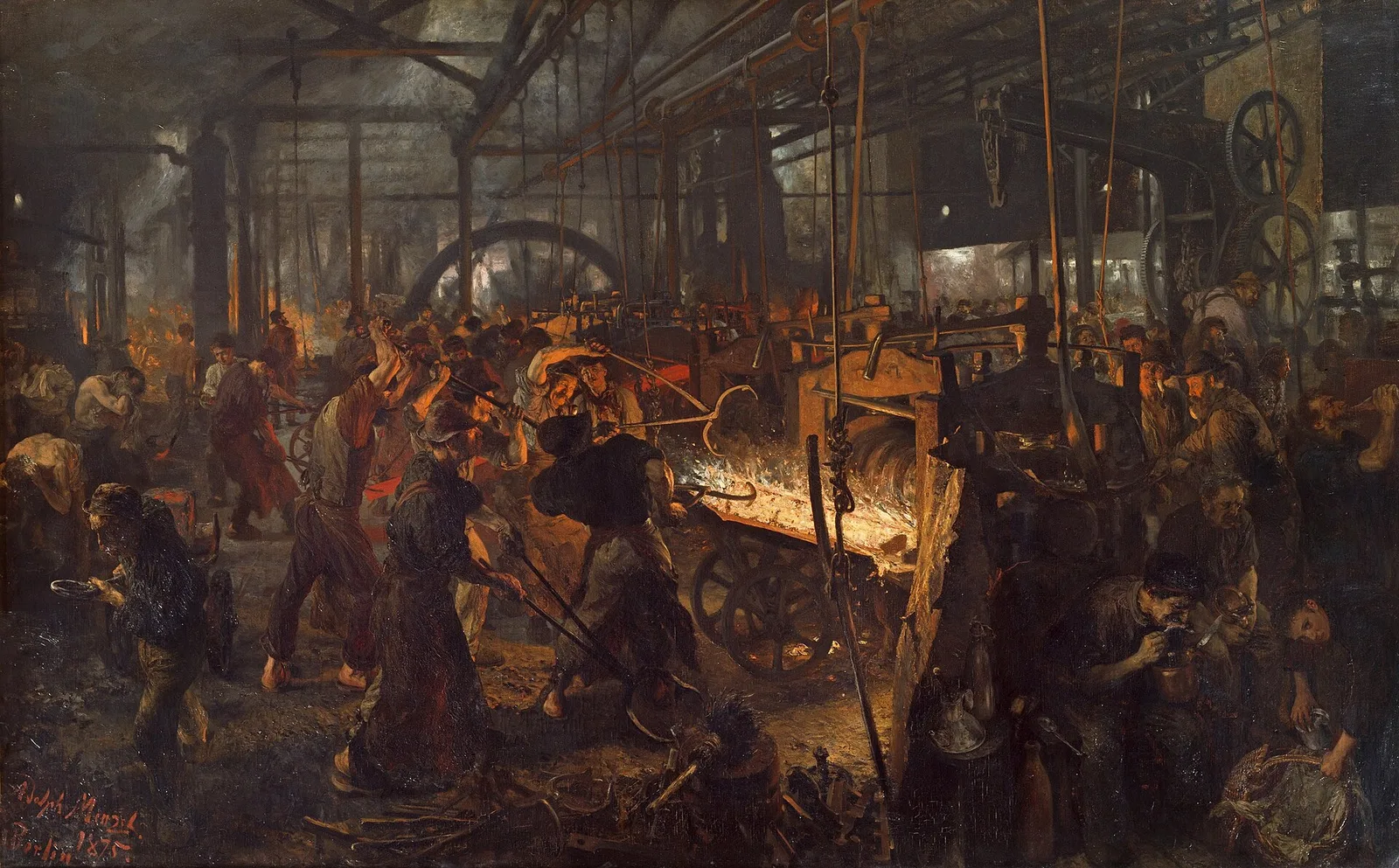
Adolph Menzel's 1875 painting The Iron Rolling Mill: crowds of workers in a dark, smoky factory hall haul a glowing red-hot iron bar into the rollers of a huge machine, sparks flying, while belts and wheels turn overhead
Government through Stories: Fascism

The Machine, the Guards, and the Blade That Cuts Everyone

A republic is like a chopping machine with safety guards on its blades. In hard times, with a strong man promising order, the guards start coming off, one emergency at a time.

Political system7 minute read

The Machine, the Guards, and the Blade That Cuts Everyone

Imagine a busy workshop built around a giant chopping machine.

The machine is powerful. It cuts lumber, shapes steel, and keeps the whole town working. But its blades are dangerous, so the machine was built with safety guards over every one of them.

The shop runs like a republic. The workers don’t vote on every decision themselves. They elect representatives to a shop council, the way Americans elect a Congress. Before taking their seats, the council members swear an oath to obey the rules of the floor: the shop’s constitution. And the rules say the guards stay on.

Each guard protects the workers in a different way. One is a free press: anyone can pin a notice to the shop’s bulletin board, even a notice criticizing the council. Another is the right to gather: workers can meet, organize, and protest. Another is the judges: a small panel that can rule that a council vote broke the rules. And the most important guard of all is free elections: every few years, the workers can replace the whole council if they don’t like what it’s doing.

The guards are annoying. They slow the machine down. Workers miss deadlines. Nobody can remember the last time anyone lost a hand, so the guards start to look like they’re only in the way.

Part of the reason is the shop’s training school. It used to teach every new worker what each guard was for and what happened in the shops that took theirs off. Then the class was cut to make more time for production drills. A whole generation learned how to run the machine without ever learning why the guards were there.

Then hard times hit.

Orders dry up. The shop loses a big contract to a rival across town, and the workers feel humiliated. Wages are cut. Families struggle to pay their bills. The council argues for months and gets almost nothing done.

Into that anger walks a man with a loud voice and a simple message. He doesn’t promise free things. He promises strength.

“This shop used to be the finest in town,” he says. “We were stabbed in the back by weak leaders, and by the troublemakers in the back corner of the floor. Give me the power, and I’ll restore order, and this shop will be the envy of every shop in town.”

The troublemakers he means are the workers in the back corner, a small group who look different and worship differently, and the union organizers who keep asking for better pay. Blaming them is easier than fixing anything.

His followers start wearing matching work shirts. They march across the floor. They break up union meetings and shove the back-corner workers around. The shop’s security guards, who are supposed to stop fights, often look the other way. A few of them quietly agree with the marchers.

The wealthy men who own the building don’t like him much. He’s crude and unpredictable. But they’re more afraid of the union organizers than they are of him, so they give his movement money. “We can control him,” they tell each other. “Once he’s on the council, he’ll need us.”

At the next election, his party doesn’t win a majority. But it wins more seats than any other party. A few of the old council leaders make a deal: they’ll make him head of the council and surround him with sensible people who can keep him in check.

A few weeks later, a fire breaks out in the supply room. Nobody is sure who started it. The new head of the council calls it an attack by his enemies and declares an emergency.

“Just for now,” he says. “Just until the shop is safe.”

So the council votes to remove one guard. Just one. Ah, it won’t hurt to have just one missing. (A free press.) The bulletin board is cleared, and from now on only the council’s notices go up.

The machine doesn’t complain. It just keeps running, and nothing bad happens. So the council votes off the next guard (the right to gather). Union meetings are banned, and the men in matching shirts make sure of it.

Then comes the biggest vote of all. The head of the council asks for the power to make the shop’s rules himself, without any council vote, for the next four years. When the vote is taken, men in matching shirts line the walls of the meeting room. Some of the members who would have voted no have already been arrested. The rest vote yes, more than the two-thirds the rules require. Only one group stands up and votes no.

Nobody tears up the shop’s constitution. It still hangs on the wall, every word unchanged. It just doesn’t matter anymore, because the judges can no longer say no to anything he decides (judges who can say no).

Within months, his party is the only one allowed on the floor (free elections).

And for a while, the machine really does run faster. Orders come in. Men go back to work. Some of the workers who voted for him point to the full shifts and say he was right all along.

But the blades were always closer to someone else’s hands, until they weren’t.

The back-corner workers lose their jobs, then their rights, then much more. The union men disappear. Then the owners who paid for his rise learn that he doesn’t need them anymore. Even some of his own oldest allies are dragged away in a single night.

Each guard was a protection written into the constitution: a limit that kept any one person, or any one part of the shop, from gaining too much power.

And the blade? The blade is power itself (a would-be strongman and the loyalists around him, whatever his title and whatever his party). It belongs to whoever is ready to seize it, from any side, and it’s always spinning, waiting for the slightest opening.

But a blade doesn’t care which side of the floor you stand on.

Once the guards are gone, it cuts everyone: the workers who voted for it, the workers who voted against it, the representatives who passed it, and the owners who thought they were in charge.

It starts innocently enough, with one emergency, one deadline, one good reason. It ends with a monster no one would wish on anyone.

The guards feel useless right up until the day you realize they were the only thing between your hand and the blade. By then it’s too late.

The Real Lesson

The lesson isn’t that every strong leader is a fascist, or that people who want order, pride, or a working economy are dangerous. Hard times are real, and wanting a government that gets things done is reasonable.

The lesson is that fascism rarely arrives by force at first. It arrives by invitation: frightened voters, a crisis, a leader who promises strength, and powerful people who believe they can use him. Every step is taken by people who think the next guard will be the last one.

It also shows that the guards protect everyone, including the people who want them removed. A free press, the right to gather, independent courts, and free elections don’t belong to one side of the floor. Remove them to stop your opponents, and you have removed them for yourself.

Watch for the warning signs: a leader who blames a group of neighbors for the nation’s troubles; private squads that use violence while the police look away; an emergency used to suspend rights “just for now”; and a legislature that votes away its own power.

The real lesson is this: A republic doesn’t need its guards on the good days. It needs them on the worst day, when people are angry and afraid and a strong man is offering to take care of everything. The guards only protect you if you keep them on when it’s hard, because once they come off, no vote can put them back.

Oaths and Checks That Held

Checks have held in real life, against presidents of both parties. In 1937, President Franklin Roosevelt asked Congress for a bill, S. 1392, that would have let him add up to six justices to the Supreme Court. The Senate Judiciary Committee, run by his own Democratic Party, sent it to the floor with an adverse report recommending that it be rejected (Senate Report No. 711, June 14, 1937). On July 22, 1937, the full Senate voted 70 to 20 to send the bill back to committee, which ended the plan (Senate roll call vote 42, Congressional Record, volume 81, page 7381).

In 1973, Republican President Richard Nixon ordered Attorney General Elliot Richardson to fire Watergate special prosecutor Archibald Cox. Richardson resigned instead. In his resignation letter of October 20, 1973, he told the President he "could not" carry out that direction, because he had publicly promised the special prosecutor his independence. Deputy Attorney General William Ruckelshaus left rather than do it too. Solicitor General Robert Bork, next in line, carried out the firing, but the public outcry forced the White House to accept a new special prosecutor, Leon Jaworski.

Jaworski subpoenaed the White House tapes. In United States v. Nixon, decided July 24, 1974, the Supreme Court ruled 8 to 0 that a president's general claim of confidentiality "must yield to the demonstrated, specific need for evidence in a pending criminal trial." Three of the justices who joined that ruling had been appointed by Nixon himself.

The House Judiciary Committee voted to recommend impeachment on three articles: obstruction of justice on July 27, 1974 (27 to 11), abuse of power on July 29 (28 to 10), and contempt of Congress on July 30 (21 to 17), with Republican members joining Democrats on the first two. Nixon resigned on August 9, 1974, in a one-sentence letter to Secretary of State Henry Kissinger, now in the National Archives (identifier 302035). One official's refusal doesn't always stop the act, but it can make it impossible to hide. Every federal official takes an oath of office to the Constitution, not to a person.

What Was Lost

The story starts in a constitutional republic. These are the safeguards it had, and how each one was lost.

  • Safeguard: Voters who asked, "Does the Constitution allow it?"

    How it was lost: At election time, workers asked only which representatives would help their side meet its deadlines. Once that became the only question, every guard was on the ballot.

  • Safeguard: Knowing what each guard is for

    How it was lost: The training school cut the class on what each guard was for, and a guard that has never been needed looks like it is only in the way.

  • Safeguard: Representatives sworn to the Constitution

    How it was lost: The council members swore an oath to obey the rules of the floor, then made a strong man head of the council, declared an emergency, and voted away their own power.

  • Safeguard: Rights a majority cannot vote away

    How it was lost: The first guard came off "over the objections of the others." The Bill of Rights exists so that some protections are not up for a majority vote, even a fairly elected one, and once one was, the rest followed.

  • Safeguard: Police who protect everyone equally

    How it was lost: The shop's security guards looked the other way while men in matching shirts broke up meetings and shoved the back-corner workers around.

  • Safeguard: A free press

    How it was lost: It was the first guard to go, because it seemed to cost the least. Without it, no one could see clearly which guard was coming off next, or who was reaching for the blade.

  • Safeguard: The right to gather and protest

    How it was lost: Once workers could no longer gather, the ones who objected could not organize to win the next election.

  • Safeguard: Judges who can say no

    How it was lost: With no one left to rule that a council vote broke the Constitution, any law could be carried out, whether the Constitution allowed it or not.

  • Safeguard: Free elections

    How it was lost: This was the guard that let workers vote in representatives who would put the others back. Once it was gone, there was no peaceful way to undo the earlier votes.

  • Safeguard: Limits that keep power divided

    How it was lost: Every guard kept any one person, or any one part of the shop, from gaining too much power. With all of them gone, the blade belonged to the strongman and his loyalists.

  • Safeguard: A written Constitution

    How it was lost: It was never torn up. The guards were simply voted off one at a time, what James Madison called a "parchment barrier" in Federalist No. 48: words that protect only as long as people follow them.

What the Story Shows

  • In the story: A giant chopping machine with safety guards over every blade

    In real life: A constitutional republic limits power because no one can be trusted with all of it. As James Madison wrote in Federalist No. 51, "If men were angels, no government would be necessary."

  • In the story: They elect representatives to a shop council, and its members swear an oath

    In real life: In a representative republic, voters elect lawmakers rather than voting on every law. Article VI of the U.S. Constitution requires every senator and representative to be bound by oath to support the Constitution.

  • In the story: The class was cut to make more time for production drills

    In real life: In 2022, U.S. eighth graders' civics scores on the National Assessment of Educational Progress fell for the first time since the test began in 1998, and more students scored below the basic level. After taking power, both Fascist Italy and Nazi Germany rewrote what schools taught, to train loyalty to the leader and the party.

  • In the story: The guards slow the machine down, and the council argues for months

    In real life: Checks and balances are slow on purpose, and in a crisis that slowness can feel unbearable. Germany's Weimar Republic was deadlocked during the Great Depression, governing by emergency decree while millions were out of work.

  • In the story: The shop loses a big contract, and the workers feel humiliated

    In real life: Both countries came out of World War I bitter. Germany signed the Treaty of Versailles on June 28, 1919, accepting responsibility for the war and owing reparations; many Italians called their own victory "mutilated" because Italy did not get all the land it was promised.

  • In the story: "We were stabbed in the back"

    In real life: After 1918, the "stab-in-the-back" myth claimed Germany had not lost the war on the battlefield but had been betrayed at home, and it blamed socialists and Jews. Hitler made it a central theme.

  • In the story: Matching shirts, and security guards who look the other way

    In real life: Mussolini's Blackshirts attacked socialist and union offices across Italy from 1920 to 1922, and Hitler's SA, the Brownshirts, fought political opponents in German streets. Police in both countries often failed to stop them.

  • In the story: The owners give his movement money: "We can control him"

    In real life: Some industrialists, such as Fritz Thyssen, funded the Nazis, though historians still debate how much business support mattered. When Hitler became chancellor, President Hindenburg and his advisers, chiefly Franz von Papen, were confident they could control him.

  • In the story: His party wins more seats than any other, but not a majority

    In real life: The Nazis came to power through elections. They won 37 percent of the vote in July 1932 and became the largest party in Germany's parliament. No party ever won a majority on its own, but with conservative partners, Hitler's government passed 50 percent in March 1933.

  • In the story: The old council leaders make a deal

    In real life: Hitler was appointed chancellor through the constitution's own process in January 1933, and Mussolini was named prime minister of Italy by its king in 1922. Each step after that was taken by people who thought it served them.

  • In the story: A fire breaks out, and he declares an emergency: "Just for now"

    In real life: On February 27, 1933, a fire gutted the Reichstag, Germany's parliament building. Hitler blamed the Communists. Freedoms are often suspended as temporary measures. After the Reichstag fire, a February 28, 1933, emergency decree suspended freedom of the press, freedom of speech, and the right to assembly in Germany, and the Nazis went on to bring newspapers and radio under party control.

  • In the story: The right to gather comes off

    In real life: The same 1933 decree suspended the right to assembly, and Fascist Italy and Nazi Germany both banned independent labor unions, the groups best able to organize opposition.

  • In the story: The power to make the rules himself, for four years, with men in matching shirts lining the walls

    In real life: Germany's republic was voted away by its own parliament, not conquered. On March 23, 1933, the Enabling Act passed by more than the two-thirds vote it needed, with SA and SS men in the chamber and Communist deputies kept out. Only the Social Democrats voted no. The Enabling Act was set to last four years.

  • In the story: The constitution still hangs on the wall, every word unchanged

    In real life: The Enabling Act let Hitler's cabinet make laws without parliament, and its Article 2 said those laws could "deviate from the Constitution." No court or legislature was left to stop them.

  • In the story: His party is the only one allowed

    In real life: In July 1933, the Nazi Party became the only legal political party in Germany, six months after Hitler took office.

  • In the story: The machine really does run faster

    In real life: Some things really did speed up. Unemployment in Nazi Germany fell sharply in the 1930s, driven largely by public works and rearmament.

  • In the story: The back-corner workers lose their jobs, then their rights

    In real life: Each group expected the new power to be used against someone else. In Germany it fell first on Communist and Social Democratic leaders, who were arrested, and on Jews, who were stripped of their rights step by step.

  • In the story: Even his oldest allies are dragged away in a single night

    In real life: In the Night of the Long Knives, June 30 to July 2, 1934, Hitler had about 100 people killed, among them the leaders of his own SA and a former chancellor.

  • In the story: The blade: power itself, from any side

    In real life: Power without limits has been seized from both the right and the left, under many titles. Mussolini called himself Il Duce and Hitler the Führer, both meaning "leader"; Lenin's Bolsheviks seized power in Russia in 1917 and built a one-party state of their own.

  • In the story: "It ends with a monster no one would wish on anyone"

    In real life: The regime Germans voted into power led them into World War II, which killed an estimated 6.6 to 8.8 million Germans alongside tens of millions of others, including six million Jews murdered in the Holocaust.

  • In the story: "By then it's too late"

    In real life: Once the guards were gone, no vote could put them back. Nazi Germany lasted twelve years and ended only in total defeat in 1945.

In real history

Benito Mussolini built the first fascist state in Italy, ruling from 1922 to 1943; the word comes from the Italian fascio, a bundle of rods. Adolf Hitler's Nazi Germany (1933 to 1945) was the most destructive fascist state in history, and its persecution of Jews and other groups led to the Holocaust.

You Decide

What draws people to it

  • Speed. A leader with no parliament, courts, or press to answer to can act at once, and in a crisis, when elected leaders seem weak and divided, that can look like the only way out. Germany's Weimar Republic was deadlocked during the Great Depression, governing by emergency decree while millions were out of work.
  • Results people could see. Unemployment in Nazi Germany fell sharply in the 1930s, driven largely by public works and rearmament, and business owners who feared unions and revolution saw a partner.
  • Pride and belonging after humiliation: a promise to restore what a defeated or hard-hit people felt they had lost. Many Germans resented the Treaty of Versailles that ended World War I.
  • Each guard really was removed for a reason that sounded good at the time: order after a crisis, an end to gridlock, protection from a feared enemy.

What it costs

  • Once elections, courts, and a free press were gone, people had no peaceful way to change course.
  • The groups blamed lost their rights, their property, and in Nazi Germany, their lives in the Holocaust.
  • The blade turned on its own backers. In 1934, Hitler had the leaders of the SA, the men who had fought in the streets for him, killed along with other rivals, and the elites who thought they could control him lost that control within months.
  • Economies built around rearmament led Italy and Germany into World War II, which killed millions of their own people and left both countries in ruins.

Many republics live through hard times, slow governments, and angry elections, and keep every guard on. Every guard in the U.S. Constitution slows someone down, and every one was put there for a reason. Which guard would you be most tempted to vote off, would you vote for a representative who promised to remove it, and would you want that representative to keep the promise or the oath?

See how fascism compares with other systems on Modern Systems of Government, and how the U.S. Constitution tries to keep any one person from taking total control on Safeguards Against Tyranny.

Why a republic is easy to lose and hard to win back

See all the stories in Government through Stories

Sources & Further Reading

The story and its characters are invented. The historical facts in the boxes below the story are drawn from the sources above.

Last updated: