The U.S. Government

Because democracy only works when we understand it

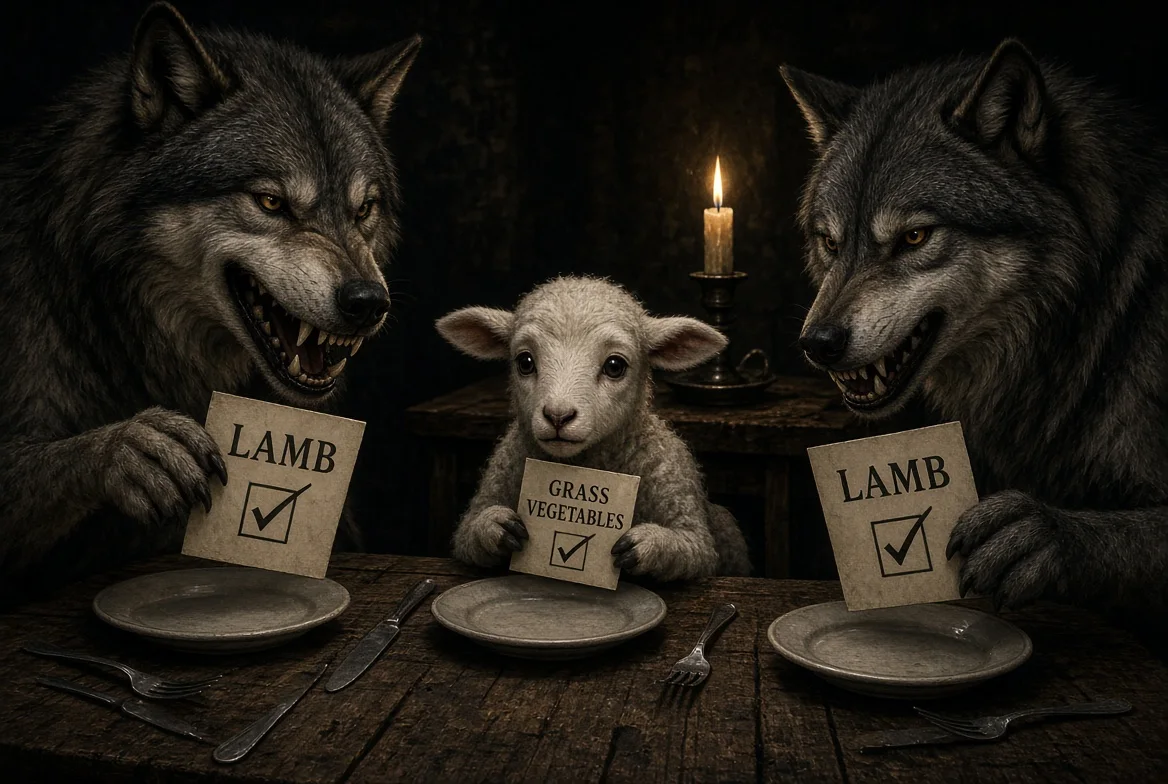
Two grinning wolves and a small lamb sit at a candlelit wooden table with empty plates. Each wolf holds up a ballot checked LAMB, and the lamb holds a ballot checked GRASS VEGETABLES
Government through Stories: Direct Democracy

The Wolves, the Sheep, and the Vote for Dinner

Direct democracy is two wolves and a sheep voting on what to have for dinner. Every vote is fair, every ballot is counted, and that’s the problem.

Political system5 minute read

The Wolves, the Sheep, and the Vote for Dinner

Direct democracy is two wolves and a sheep voting on what to have for dinner.

Imagine a wide green meadow where all kinds of animals live together: rabbits, deer, foxes, sheep, and a small pack of wolves.

The meadow is a republic. The animals don’t vote on every decision themselves. They elect a few neighbors to a meadow council to make the rules, the way Americans elect a Congress. Before taking their seats, the council members swear an oath to the meadow’s constitution.

And the constitution keeps a short list of things no vote can ever touch: no animal can be eaten, silenced, or driven off the meadow, no matter how many others want it. That’s the meadow’s bill of rights. If the council ever tries to break the list, an old owl, the meadow’s judge, can say no.

There’s one more rule. If enough animals sign a petition, they can put a question straight to the whole meadow: where to dig the new pond, how long the grazing season runs, whether to build a fence. But the list stays off the ballot.

For years, it works. The council is slow. It argues, compromises, and sends half its ideas off to committee. But the ponds get dug, the fences get built, and every animal sleeps safely.

The wolves don’t like it.

They don’t attack the system head-on. They talk about fairness. “Why should a handful of animals speak for all of us?” they ask. “Why should one old owl overrule the whole meadow? Let the meadow decide everything itself. That’s real democracy.”

It sounds good. It even sounds right. Who could be against letting everyone vote?

So a petition goes around: let the meadow vote on everything directly, with no council in the middle. The animals like the idea of having more say. The petition passes, fair and square, and the council is sent home.

Next comes a petition about the owl. Why should one judge overrule the will of the meadow? From now on, any ruling she makes can be overturned by a simple majority. That passes too.

Then the wolves aim at the last obstacle. That list of things no vote can touch? Just an old rule written by an old council. Why should the meadow’s past tie the hands of the meadow’s present? Let the majority change anything, at any time, with one vote more than half.

Ah, nobody’s planning to eat anyone. It’s just about principle.

That passes too.

None of it is a trick. Every vote is fair, open, and counted correctly. The rabbits vote. The deer vote. The sheep vote too.

Then comes dinner.

The wolves put it on the ballot.

The sheep makes a good speech. She talks about all the years she has grazed beside her neighbors, about the list that used to protect everyone, about what the meadow is supposed to stand for. Everyone listens politely.

Two to one.

Nothing is broken. The election is clean. The majority wins, just like it always does.

And that’s the problem.

The only things that could have saved the sheep were the list no vote could touch, a council sworn to protect it, and a judge who could say no. The meadow voted away all three, one fair vote at a time.

The sheep wasn’t outvoted because the system broke. She was outvoted because the system worked exactly the way the wolves had redesigned it.

Next week, the wolves will be hungry again. And the meadow has a lot of other animals.

The Real Lesson

The lesson isn’t that voting is bad, or that the people can’t be trusted to decide anything themselves. Americans vote directly in New England town meetings and on ballot measures in about half the states, and it works.

The lesson is that majority rule and individual rights are not the same thing. A majority can be fair, honest, and correctly counted, and still be wrong. Rights that depend on winning the next vote aren’t really rights. They’re permissions that last only until the majority changes its mind.

That’s why the United States is a republic. Elected representatives slow decisions down and force compromise. Independent courts can strike down laws that break the Constitution, even popular ones. And the Bill of Rights and later amendments put certain freedoms beyond the reach of any majority: speech, worship, a fair trial, and equal protection under the law.

Watch for the arguments that sound most democratic: that a vote of the people should override a court, that old protections shouldn’t bind today’s majority, that anyone who disagrees with the majority is standing in the way of the people. Each one sounds like more democracy. Each one removes a protection for whoever is outnumbered.

The real lesson is this: Democracy decides who governs. A constitution decides what no government, and no majority, may do. Without both, the only protection anyone has is being on the winning side, and sooner or later, everyone ends up on the losing side of something.

Checks That Held Against the Majority

In 1943, in the middle of World War II, the Supreme Court ruled 6 to 3 in West Virginia State Board of Education v. Barnette that public schools could not force students to salute the flag. Justice Robert Jackson wrote that "the very purpose of a Bill of Rights was to withdraw certain subjects from the vicissitudes of political controversy, to place them beyond the reach of majorities and officials," and that fundamental rights "may not be submitted to vote; they depend on the outcome of no elections."

Courts have also struck down laws the voters passed themselves. In 1964, the Supreme Court rejected a plan for drawing Colorado's legislative districts that Colorado voters had approved two years earlier: "A citizen's constitutional rights can hardly be infringed simply because a majority of the people choose that it be" (Lucas v. Forty-Fourth General Assembly of Colorado).

In 1967, the Court ruled 5 to 4 in Reitman v. Mulkey against California's Proposition 14, which about 65 percent of voters had approved in 1964 to let property owners refuse to sell or rent housing on the basis of race. In 1996, it ruled 6 to 3 in Romer v. Evans against Colorado's Amendment 2, approved by about 53 percent of voters in 1992, which barred state and local laws protecting gay, lesbian, and bisexual people from discrimination. The Bill of Rights applies to a majority of voters just as it applies to a legislature.

What Was Lost

The story starts in a constitutional republic. These are the safeguards it had, and how each one was lost.

  • Safeguard: Voters who asked, "Does the constitution allow it?"

    How it was lost: They began asking only whether a majority wanted it. Once that was the only question, everything could go on the ballot.

  • Safeguard: Representatives sworn to the constitution

    How it was lost: The council was sent home. No one who had sworn an oath stood between a vote and the law.

  • Safeguard: Time to think it over

    How it was lost: The council's committees, debates, and compromises felt slow, so they were replaced by a straight vote. A passing mood could become the law the same day.

  • Safeguard: A judge who can strike down unconstitutional laws

    How it was lost: Any ruling could now be overturned by a simple majority, so the owl's "no" meant nothing.

  • Safeguard: A constitution that is hard to change

    How it was lost: It could be changed at any time with one vote more than half. Changing the U.S. Constitution takes two-thirds of Congress, or a convention requested by two-thirds of the states, plus ratification by three-fourths of the states.

  • Safeguard: A short list no vote can touch (a bill of rights)

    How it was lost: It was voted away by a fair majority, and with it the only protection the outnumbered had.

  • Safeguard: A voice for the outnumbered

    How it was lost: The sheep still spoke, and everyone listened politely. Being heard is not the same as being protected.

  • Safeguard: A written constitution

    How it was lost: Nobody tore it up. Every change was made by an honest vote, counted correctly. It simply stopped protecting anyone a majority wanted to outvote.

What the Story Shows

  • In the story: Two wolves and a sheep voting on what to have for dinner

    In real life: A popular saying about democracy. It is often credited to Benjamin Franklin, but there is no record he said or wrote it; the earliest known printed version is anonymous, from 1987 (Fred Shapiro, editor of the Yale Book of Quotations, and researcher Barry Popik). Writer James Bovard used the wolves-and-sheep version in 1994.

  • In the story: Everyone gets one vote, and the majority wins on everything

    In real life: Ancient Athens, beginning with Cleisthenes' reforms around 508 BC, was the first famous direct democracy. Citizens voted on laws themselves in the Assembly on the Pnyx hill, but only adult male citizens could vote; women, enslaved people, and foreign residents could not.

  • In the story: "Let the meadow vote on everything itself"

    In real life: In Federalist No. 10, James Madison warned that pure democracies "have ever been spectacles of turbulence and contention" and "incompatible with personal security or the rights of property," which is why the Constitution created a republic of elected representatives.

  • In the story: The council: a few neighbors elected to make the rules

    In real life: Article IV of the U.S. Constitution requires the United States to guarantee every state "a Republican Form of Government," and there is no national ballot measure: every federal law is passed by elected representatives.

  • In the story: A short list of things no vote could ever touch

    In real life: The Bill of Rights. In 1943, Justice Robert Jackson wrote that its purpose was "to place them beyond the reach of majorities and officials."

  • In the story: Any ruling she makes can be overturned by a simple majority

    In real life: In 406 BC, after the naval battle of Arginusae, the Athenian Assembly condemned eight generals together in a single vote, which broke Athens' own law; the six who had come home were executed. Socrates, on the council's presiding committee that day, refused to put the illegal motion to a vote.

  • In the story: Every vote is fair, open, and counted correctly

    In real life: In 399 BC, a jury of about 500 Athenian citizens convicted Socrates by majority vote and, in a second vote, sentenced him to death.

  • In the story: The sheep makes a good speech, and everyone listens politely

    In real life: Athenian citizens could also vote to exile any leading citizen for ten years, a practice called ostracism, without accusing that person of any crime.

  • In the story: The sheep vote too

    In real life: Majorities have voted against minorities in the United States as well: California's Proposition 14 (about 65 percent, 1964) and Colorado's Amendment 2 (about 53 percent, 1992), both later struck down by the Supreme Court.

  • In the story: With enough names on a petition, any animal can put a question to the whole meadow

    In real life: Americans use direct democracy inside the Constitution's limits. Of the 50 states, 26 allow citizen-initiated measures, popular referendums, or both, and 24 let citizens propose laws or amendments themselves. Many towns in Vermont and other New England states still govern through town meetings; Vermont's is the first Tuesday in March.

  • In the story: In a republic, the majority still chooses who leads and what most of the laws say

    In real life: Switzerland, the best-known modern example of direct democracy at the national level, combines it with an elected parliament: 50,000 signatures gathered within 100 days force a national vote on a new law, and 100,000 within 18 months put a constitutional amendment on the ballot. The Swiss vote about four times a year.

In real history

Athens practiced direct democracy for most of the fifth and fourth centuries BC, with citizens voting on laws, war, and peace in the Assembly. Today no large country is governed entirely by direct democracy. Switzerland uses it most at the national level, and in the United States it lives on in New England town meetings and in the ballot measures of about half the states, always within the limits of the U.S. Constitution.

You Decide

What draws people to it

  • The people's own voice, with no middlemen. Swiss voters decide about fifteen national questions a year directly.
  • Laws the voters want, even when officials don't. In 1893, Colorado became the first state to adopt women's suffrage by a popular vote, after voters had turned it down in 1877.
  • Local control. In a New England town meeting, the neighbors who pay for the road vote on the road themselves.
  • A check on lawmakers. In 24 states, citizens can put a law or an amendment on the ballot themselves when the legislature won't act.

What it costs

  • A majority can vote away a minority's rights, as California and Colorado voters did with measures the Supreme Court later struck down.
  • Decisions made in the heat of the moment. The Athenian Assembly condemned eight of its own generals in one illegal vote after a disaster at sea.
  • Hard questions, hard wording. Ballotpedia found that 2023 ballot measure titles averaged a reading level of about grade 19, like a graduate school text, and harder-to-read measures are skipped by more voters.
  • No room to compromise. A ballot question can only be answered yes or no, while a legislature can amend a bill until more people can live with it.

The United States lets voters decide some questions directly and keeps others off the ballot entirely. Which questions should the people decide themselves, which should go to the representatives they elect, and which should no vote be able to touch? Would your answer change if you were the sheep?

See how direct and representative democracy compare with other systems on Modern Systems of Government, read the Bill of Rights the story's short list stands for, and see how the Constitution keeps any one part of government from taking total control on Safeguards Against Tyranny.

Why a republic is easy to lose and hard to win back

See all the stories in Government through Stories

Last updated: