The U.S. Government

Because democracy only works when we understand it

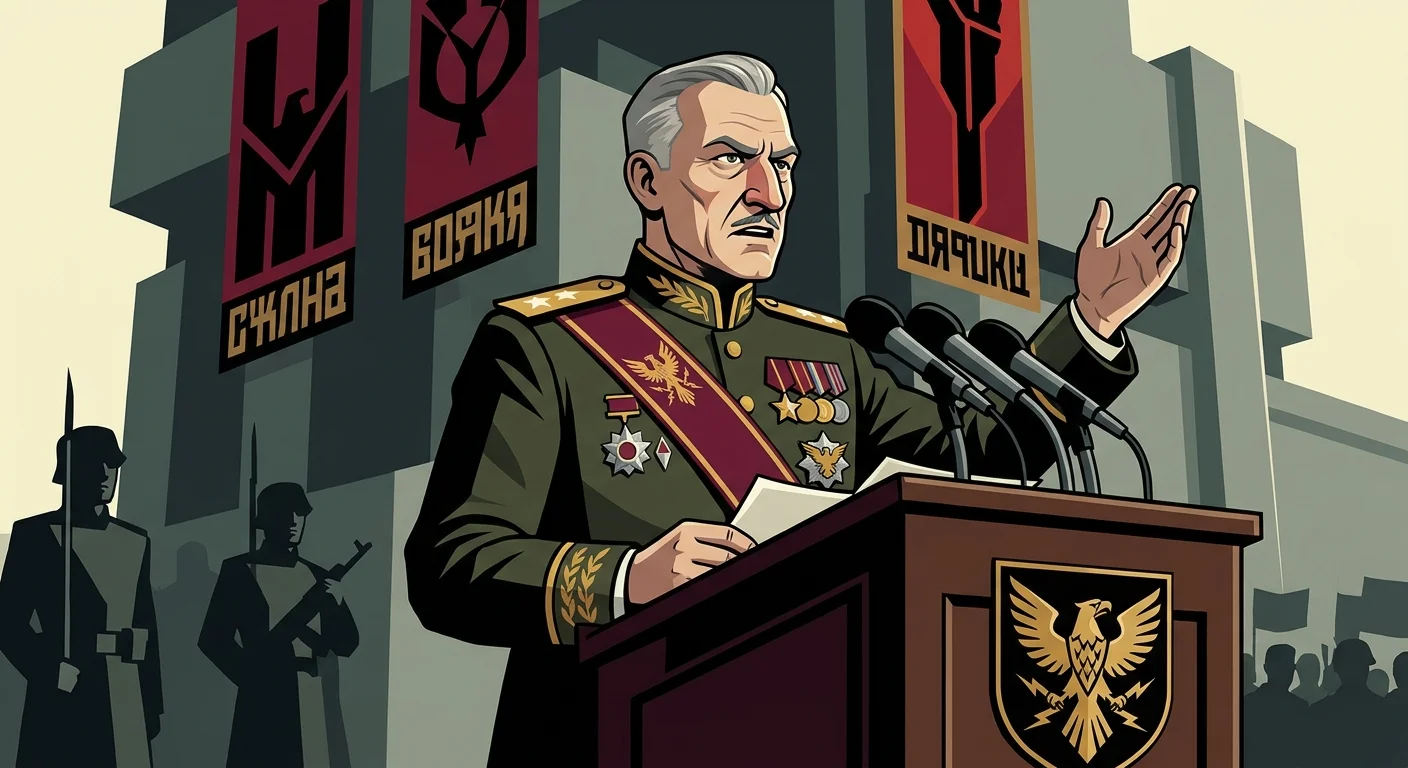
An illustration of a gray-haired general in a medal-covered uniform and red sash speaking at a podium bearing an eagle crest, with soldiers silhouetted behind him and large propaganda banners on a gray concrete building
Government through Stories: Dictatorship

The Watchman, the Keys, and the Night That Never Ended

In a hard year, a town's night watch takes the keys to save the republic and promises to give them back soon. Getting them back takes sixteen years.

Political system8 minute read

The Watchman, the Keys, and the Night That Never Ended

Imagine a harbor town called Larkhaven. It is a republic. Its people elect a mayor and a town council, its judges can strike down a law that breaks the constitution, and every newspaper in town can print whatever it likes about all of them.

Larkhaven also has a night watch: armed men and women who guard the walls, keep the peace after dark, and answer fires and floods. Every one of them swears an oath, not to the mayor and not to their captain, but to the town's constitution.

The constitution has one strange old rule. In a true emergency, the council may hand the Captain of the Watch the great ring of keys: the keys to the town hall, the granary, the gates, and the jail. For a time, the captain can do whatever it takes. But only for six months, and then the keys go back on their hook (a lawful emergency office with a time limit).

Every child in Larkhaven used to learn why. Long ago, when raiders burned the outer farms, the council gave the keys to a farmer named Hollis. He drove the raiders off, hung the keys back on the hook after sixteen days, and went home to his plow. There is a statue of him by the gate, with empty hands.

The children learned the other half of the story too. Many years later, a captain named Sorrel took the keys with no end date and gave them back only when he chose. A later captain had himself named Keeper of the Keys for Life. Within weeks, men who had once been his friends killed him, and the republic he had sworn to protect never truly came back.

Then the school dropped the lesson to make room for others. The statue became a place to lean a bicycle. A whole generation grew up knowing how the keys worked, but not why they always had to go back.

Then Larkhaven split in two.

The Harbor side wanted the town to take over the cannery, the big farms, and the copper pit, and run them for the workers. The Hill side wanted them left in private hands. In a three-way race, the Harbor candidate won the mayor's office with barely more than a third of the votes, and the council confirmed him, just as the constitution required when no one won a majority.

He kept his promises. Wages went up. The pit and the cannery became the town's. For a year, many families had more money than they had ever had.

Then prices began to climb, and then to run. Bread that cost one coin in the spring cost five by the next winter. Shelves emptied. Farmers hid their grain and sold it out the back door. The wagon drivers went on strike, and shopkeepers locked their doors to join them. Gangs from both sides fought in the streets at night, and someone kept cutting the power lines.

Voters stopped asking, "Does the constitution allow it?" They asked only one question: "Who will make it stop?"

The council, now run by the Hill side, passed a resolution saying the mayor was breaking the constitution. It had no power to remove him. But everyone knew who the resolution was really written for.

The watch had a new captain, chosen only weeks before: a quiet man named Brannock Vale, who had always said the watch stays out of politics.

Before dawn one morning, the watch closed the gates, surrounded the town hall, and took the keys themselves (a military coup). The council never voted to hand them over. By evening, the mayor was dead inside the town hall, and the captain was in charge.

"We swore to protect the constitution," Captain Vale told the crowd in the square. "The constitution was dying. We are saving it. As soon as order returns, the keys go back on the hook."

Many people cheered. Up on the Hill, families rang bells. Shopkeepers opened their doors. Ah, it would only be for a few months, people told each other, and anything was better than the year they had just lived through.

That night, the curfew bell rang for the first time (a curfew). Anyone on the street after dark could be arrested.

The next week, the council hall was locked (a closed legislature). The Harbor parties were banned. The Hill parties, which had cheered, were told to "rest" for a while, and a few years later they were banned too (banned parties). The newspapers printed what the watch approved. The voter rolls were thrown out.

And people began to disappear.

A teacher was taken from her classroom. A union man was taken from his bed. Families lined up outside the watch house to ask where they were, and the watchmen said they had no record of them. Some came home months later and would not talk about where they had been. Some never came home at all (the disappeared).

The emergency ended. The keys did not come back.

It would be simpler if the story stopped there, but it doesn't. Captain Vale brought in a group of young economists. They tore up the price rules, sold off most of what the town owned, opened the harbor to trade, and replaced the old pension fund with savings accounts that each worker owned (a free-market overhaul). Slowly, prices stopped running. The shelves filled again.

Then the town's banks collapsed, and one worker in five lost their job. People lined up again, this time for work. The captain fired some of his economists and kept the rest, and over the next years the harbor grew busier than anyone could remember.

In the school, the lesson was rewritten. The morning the watch took the keys became the morning Larkhaven was saved. Nobody mentioned the statue with empty hands.

After seven years, Captain Vale wrote a new constitution. It made him keeper for eight more years, and the vote to approve it was held with no voter rolls at all. But it held one promise he would come to regret: at the end of those eight years, the people would vote yes or no on whether he could keep the keys for eight more (a plebiscite).

He expected to win. He had the newspapers, the money, and the watch.

But the people of Larkhaven did something they had not done in fifteen years. They signed up to vote, in record numbers. Volunteers from more than a dozen parties, old enemies from the Hill and the Harbor, sat side by side at every ballot table to watch the count.

On the night of the vote, the early count was clear. Captain Vale called his commanders together and asked them for a new emergency. The commander of the watch's riders refused. "The vote is the vote," he said. The others would not back the captain either.

"No" won, with about 56 of every 100 votes.

A year later, the town elected a new mayor, and Captain Vale hung the keys back on the hook. He stayed captain of the watch for eight more years, and nobody pretended he had given up all his power. But the council hall opened again, the parties came back, and the newspapers printed what they liked.

It took one morning to take the keys. It took sixteen years, and a whole town standing in line, to get them back.

Someone has started cleaning the statue by the gate again.

Some evenings, people stand beside it and argue about whether Captain Vale saved Larkhaven or stole it. A few of them still have an empty chair at their kitchen table. The harbor is still busy. Larkhaven has to live with all of it.

The Real Lesson

This story isn't saying that every soldier is a threat to a republic, or that the people who cheered the watch were foolish. Larkhaven's crisis was real: prices were running away, the shelves were empty, and the streets were dangerous. People were genuinely afraid, and some of what the captain did, like taming prices, worked.

Nor is it saying that coups come from only one side. Officers have seized power promising to save their countries from the left and from the right, and their governments have both wrecked economies and rebuilt them.

The real issue is who decides when the emergency is over. Under Larkhaven's old rule, the council handed over the keys, for a fixed time, and the keys came back on schedule. Once the watch took the keys itself, nobody was left with the power to say the time was up.

An emergency is exactly when frightened people will hand over the most power, and exactly when it is hardest to take it back. The weapons and the keys end up in the same hands, and the council, the courts, and the newspapers that might object are the first things closed.

The real lesson is this: An emergency is the most dangerous time to hand anyone unlimited power. The people who carry a republic's weapons must answer to its constitution, not decide when to suspend it. Larkhaven got its keys back because its people turned out to vote and a few officers refused to overturn the count. A republic shouldn't have to count on that.

When the Keys Went Back

The Roman Republic had a lawful emergency office called dictator, limited to six months. According to the historian Livy, Lucius Quinctius Cincinnatus, named dictator in 458 BC, "resigned on the sixteenth day the dictatorship which had been conferred upon him for six months." Later, Lucius Cornelius Sulla, who had already marched an army on Rome, made himself dictator in 82 BC with no time limit, and Julius Caesar was named dictator in perpetuity in early 44 BC. Caesar was assassinated on March 15, 44 BC, and the republic gave way to rule by emperors.

In Chile, the military's own 1980 constitution set a yes-or-no vote on whether General Augusto Pinochet would rule eight more years. On October 5, 1988, after a record 92 percent of voting-age Chileans registered, the No won about 56 percent of the valid votes. That night, Air Force commander Fernando Matthei refused Pinochet's request for emergency powers, and the other commanders turned it down too (National Security Archive). An elected civilian president took office in March 1990, and Pinochet stayed commander of the army until March 1998.

In the United States, members of the armed forces swear to support and defend the Constitution, not a person or a party. Read more about the oath of office and why it is sworn to the Constitution.

What Was Lost

The story starts in a constitutional republic. These are the safeguards it had, and how each one was lost.

  • Safeguard: Voters who asked, "Does the constitution allow it?"

    How it was lost: In the year of shortages and street fights, they asked only, "Who will make it stop?" Many Chileans welcomed the 1973 coup, among them former president Eduardo Frei, who soon turned against the regime and opposed it until his death in 1982.

  • Safeguard: Knowing why the keys go back

    How it was lost: The school dropped the lesson of Hollis and his empty hands, and after the takeover it taught that the watch had saved the town. Rome kept the story of Cincinnatus for centuries, yet still gave Caesar the office for life.

  • Safeguard: Emergency power with a time limit

    How it was lost: The old rule gave the keys for six months, by a council vote. The watch took them with no vote and no end date, as Rome's six-month limit gave way to Sulla's open-ended dictatorship and Caesar's dictatorship for life.

  • Safeguard: Armed forces sworn to the constitution

    How it was lost: The watch broke its oath in the name of saving the constitution. Chile's armed forces overthrew the elected president on September 11, 1973, after the new army commander purged officers loyal to the constitution.

  • Safeguard: An elected council

    How it was lost: The council hall was locked the next week. Chile's junta dissolved the National Congress by Decree-Law 27 on September 21, 1973.

  • Safeguard: Parties free to compete

    How it was lost: The Harbor parties were banned at once, and the Hill parties were "rested" and later banned. Decree-Law 77 dissolved the parties of the left in October 1973, and the junta put the rest "in recess" and then outlawed them too.

  • Safeguard: A free press

    How it was lost: The newspapers printed only what the watch approved. Chile's military government censored the media from its first days.

  • Safeguard: No one held without charge

    How it was lost: People were taken at night and the watch house said it had no record of them. Chile's own commissions counted 3,216 people killed or disappeared and 38,254 survivors of political imprisonment and torture.

  • Safeguard: Free and fair elections

    How it was lost: The voter rolls were thrown out, and the captain's new constitution was approved in a vote held without them. Chile's 1980 constitution was ratified in a plebiscite without registration lists that the Library of Congress country study calls highly irregular.

What the Story Shows

  • In the story: For a time, the captain can do whatever it takes. But only for six months

    In real life: The Roman Republic's dictator was a lawful emergency leader, named in a crisis and given full command for at most six months.

  • In the story: He hung the keys back on the hook after sixteen days, and went home to his plow

    In real life: According to Livy, Cincinnatus was named dictator in 458 BC to rescue a trapped Roman army and resigned "on the sixteenth day" of a six-month term. The story is ancient tradition, and it became the model of a leader who gives power back.

  • In the story: A later captain had himself named Keeper of the Keys for Life

    In real life: Sulla was named dictator in 82 BC with no time limit. Julius Caesar was named dictator for ten years in 46 BC and dictator in perpetuity in early 44 BC, weeks before he was assassinated on March 15, 44 BC.

  • In the story: The Harbor candidate won the mayor's office with barely more than a third of the votes

    In real life: Salvador Allende won Chile's September 1970 presidential election with about 36 percent of the vote. With no candidate holding a majority, Chile's Congress chose between the top two and confirmed him.

  • In the story: The pit and the cannery became the town's

    In real life: In 1971, Chile's Congress voted unanimously to nationalize the large copper mines. Allende's government also used a 1932 emergency law to take over other industries without congressional approval (Library of Congress).

  • In the story: Bread that cost one coin in the spring cost five by the next winter

    In real life: By mid-1973, Chile's inflation had reached an annual rate of more than 500 percent (Library of Congress). Shortages, a thriving black market, a trucking strike, and business lockouts followed.

  • In the story: The council passed a resolution saying the mayor was breaking the constitution

    In real life: The opposition won 55 percent of the vote in Chile's March 1973 congressional elections, short of the two-thirds needed to remove Allende. In August 1973, the Chamber of Deputies accused him of systematically violating the constitution.

  • In the story: The watch had a new captain, chosen only weeks before

    In real life: Shortly before the coup, Augusto Pinochet, newly appointed commander of Chile's army, purged officers sympathetic to Allende or the constitution. The coup came on September 11, 1973, and Allende died by suicide in the presidential palace.

  • In the story: "We are saving it. As soon as order returns, the keys go back on the hook"

    In real life: Coups have come from the right and the left. Chile's junta, and Argentina's, which seized power in 1976, said they were saving their countries from the left. Peru's General Juan Velasco Alvarado took power on October 3, 1968, nationalized oil and land, and seized the newspapers; Peru's military handed power to an elected president only in 1980.

  • In the story: The council hall was locked. The Harbor parties were banned

    In real life: Chile's junta dissolved Congress on September 21, 1973 (Decree-Law 27), banned the parties of the left in October 1973 (Decree-Law 77), put the other parties "in recess" and later outlawed them, and censored the media from the start.

  • In the story: Some never came home at all

    In real life: Chile's Rettig Commission (1991) counted 2,279 victims of political violence, most killed or disappeared by state agents. Later commissions, including the Valech Commissions (2004 and 2011), raised the official totals to 3,216 killed or disappeared and 38,254 survivors of political imprisonment and torture. Pinochet's secret police also killed former ambassador Orlando Letelier in Washington, D.C., in 1976.

  • In the story: Captain Vale brought in a group of young economists

    In real life: Chile's military government carried out sweeping free-market reforms from 1973 to 1982 that greatly reduced inflation and virtually eliminated the government deficit. In the 1982 debt crisis the economy collapsed and unemployment passed 20 percent; a recovery followed, and the reforms were kept (Library of Congress).

  • In the story: At the end of those eight years, the people would vote yes or no

    In real life: Chile's 1980 constitution scheduled a plebiscite on whether Pinochet would serve eight more years. A record 92 percent of voting-age Chileans registered, and fourteen parties joined the No campaign.

  • In the story: The commander of the watch's riders refused

    In real life: On October 5, 1988, the No won about 56 percent of valid votes. That night, Air Force commander Fernando Matthei refused Pinochet's request for emergency powers, and the other junta members turned it down too (National Security Archive).

In real history

Many modern dictatorships began as military governments that promised to step aside: Peru (1968 to 1980), Chile (1973 to 1990), and Argentina (1976 to 1983), whose own truth commission documented 8,961 people who disappeared, with human rights groups estimating up to 30,000. Some ended at the ballot box, as Chile's did in 1988, and some only after a military defeat or economic collapse.

You Decide

What draws people to it

  • Order in a breakdown. Chile in 1973 had inflation of several hundred percent a year, empty shelves, strikes, and street violence, and many Chileans, including at first a former president, welcomed the military.
  • Fast decisions with no gridlock. Chile's military government pushed through free-market reforms that greatly reduced inflation and virtually eliminated the deficit, changes its supporters credit for the growth that followed.
  • Reform the old order would not allow. Peru's left-leaning military government broke up the large estates in its June 1969 land reform and handed them to cooperatives and small farmers.
  • Some do hand power back. Peru's generals held elections and stepped aside in 1980, and Chile's regime accepted its 1988 defeat at the polls.

What it costs

  • Lives. Chile's official count is 3,216 killed or disappeared and 38,254 survivors of political imprisonment and torture. Argentina's truth commission documented 8,961 disappeared, and human rights groups estimate up to 30,000.
  • No one to say the time is up. Chile's junta, which many expected to step aside quickly, ruled for sixteen and a half years; Peru's ruled for twelve.
  • Mistakes nobody can stop. With no congress or free press to object, Chile's economy crashed in 1982, and unemployment passed 20 percent.
  • Power that lingers. Pinochet stayed army commander until 1998, eight years after leaving the presidency, and the way back depended on generals who chose to accept a vote.

Chile's crisis in 1973 was real, and so were the lists its own commissions made of the dead. Many republics have lived through runaway prices, strikes, and street fighting and kept their constitutions. When a republic is in real danger, who should decide that it is an emergency, how much power should anyone get, and who decides when it is over?

See how the Constitution spreads power so no one holds the keys alone on Safeguards Against Tyranny, compare dictatorship with other forms of government on Modern Systems of Government, and read how Separation of Powers keeps one branch from deciding everything.

Why a republic is easy to lose and hard to win back

See all the stories in Government through Stories

Last updated: