The U.S. Government

Because democracy only works when we understand it

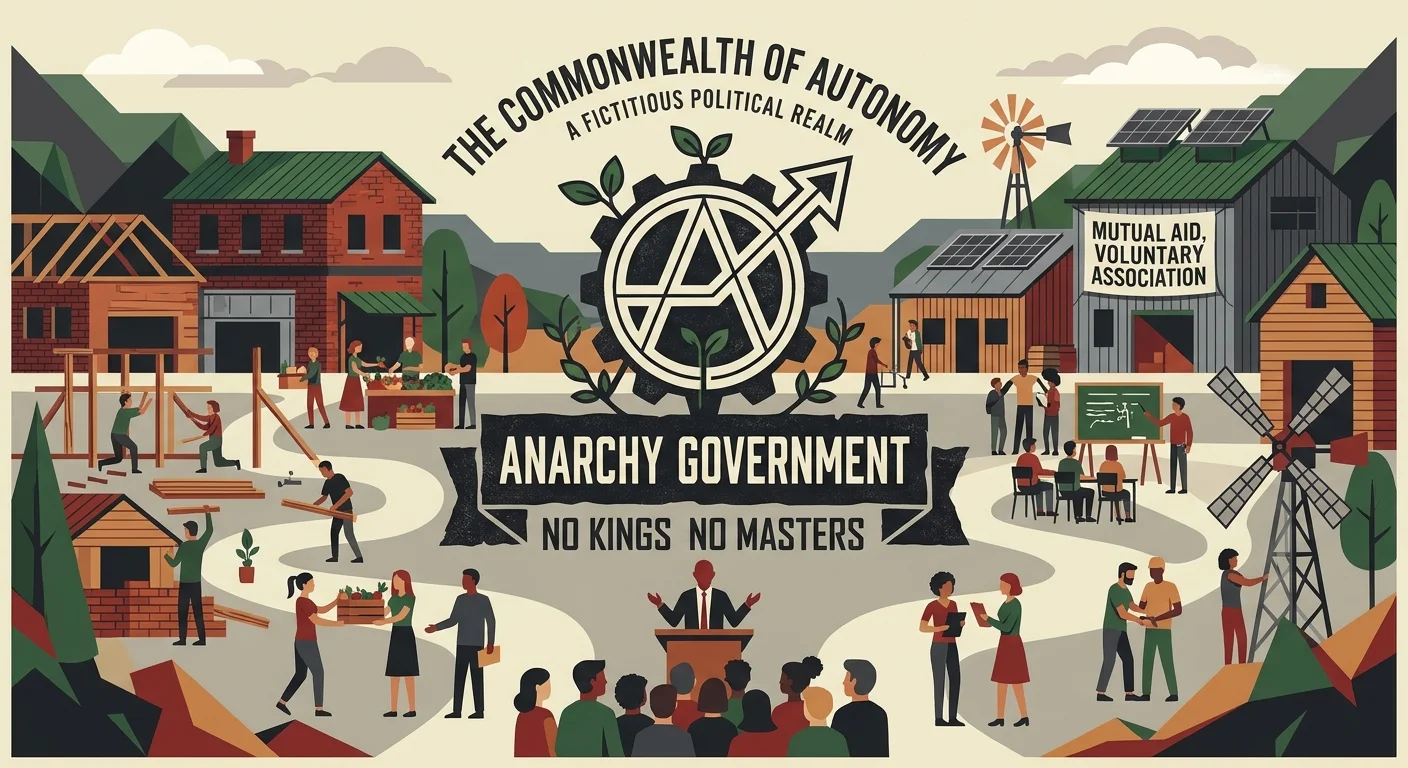
An illustration of a fictional village called The Commonwealth of Autonomy, where neighbors build houses, trade vegetables, hold an outdoor class, and work beside windmills and solar panels, around a large anarchy symbol and a banner reading No Kings, No Masters
Government through Stories: Anarchy

The Lamps, the Watch, and the Strongest Man on the Street

A town stops paying for its streetlamps, its night watch, and its judge, and for a while its neighbors do fine on their own. Then someone breaks open the watchhouse.

Political system5 minute read

The Lamps, the Watch, and the Strongest Man on the Street

Imagine a town called Larkfield, built along one long street. Every evening at dusk, a lamplighter walks the street and lights the lamps. Every night, two members of the night watch walk it too, ringing a bell on the hour. A small tax pays for both.

Larkfield is a republic. Its constitution, kept under glass in the town hall, says who makes the laws (an elected council), who settles quarrels (a judge), and who keeps the peace (the night watch). The watch answers to the council, the council answers to the voters, and every one of them swears an oath to the constitution.

For a long time, nobody thinks about any of it. That's the thing about streetlamps. You only notice them when they go out.

Then, little by little, people stop trusting the town hall. One council member is caught taking a bribe. Another promises a new bridge and never builds it. Each election, the speeches get louder and the work gets slower. The school, short on money, drops its civics lessons, and a generation grows up never having read the constitution. To them, the town hall is just a building where people argue.

"Why are we paying for this?" people start asking. Not "How do we fix it?" Just "Why pay at all?"

Fewer people vote. Fewer people serve on juries. Then fewer people pay the lamp tax.

The council tries to collect, but the voters have lost the habit of trusting it, and the council has lost the habit of being obeyed. Half its members stop coming to meetings. Without enough of them in the room, it can't pass anything at all.

The judge, unpaid for a year, closes her courtroom. The night watch, unpaid for longer, hangs up its bells. One evening the lamplighter doesn't come.

The lamps go dark, and nobody lights them again.

And here's the surprising part: for a while, Larkfield does fine. Better than fine, some say.

Neighbors who never spoke start helping each other. The families on the north end set up a schedule for the well, and everyone keeps to it. The baker and the miller trade bread for flour on a handshake. When two farmers argue over a fence, the oldest people on the lane sit them down and settle it by the old custom: whoever did the harm pays for it, in sheep (customary law).

A young woman named Tessa starts a messenger service, running letters up and down the valley. With no town fees and no town rules, she charges less than the old town post ever did, and soon three other runners are racing her for customers.

A printer named Abel Rook writes a pamphlet. "We never needed the town hall," he says. "People can live by free agreement, helping each other because they choose to, not because they're told to (anarchism)." Many people read it and nod. Look around, they say. He's right.

Ah, but the lamps are still dark.

The trouble starts at the old watchhouse. When the watch went home, its muskets stayed on the rack, and the lock is easy to break. The Garrow brothers, five of them, big and quick-tempered, get there first.

Nobody elected the Garrows. Nobody can vote them out. They just have the guns.

At first they offer to guard the market at night, for a small fee. Merchants pay it (protection money). A merchant who won't pay finds his stall knocked flat in the morning. Before long, another family breaks into the old armory up the hill, and now there are two armed bands, each claiming its own end of the street (warlords).

The bands fight over the market square. Families stay indoors after dark, afraid of their own street (the state of nature). The old custom of paying for harm still works between neighbors, but it doesn't work on men with muskets. The elders can tell the Garrows they owe a debt. They can't make them pay it.

Then a dry summer comes, and the harvest fails.

In the old days, the council would have opened the town granary and rationed the grain. Now there is no council, and the granary belongs to whichever band reaches it first. Grain wagons are stopped at the bridge and emptied. The poorest families, the old, and the very young go hungry first, and many of them don't live to see spring (famine).

The next valley sends wagons of grain. To get them through, its drivers have to pay the armed bands, and some of what they pay ends up buying more muskets. At last the next valley sends soldiers with the wagons. The food gets through, and fewer people die. But the soldiers can't stay forever, and when they leave, the bands are still there (foreign intervention).

Abel Rook stops writing pamphlets. Free agreement worked between people who wanted to agree. It had no answer for people who didn't.

Years pass. Then one spring a stern man named Captain Holt rides in from the hills with a disciplined band of followers.

He doesn't promise freedom. He promises order.

And people cheer.

Holt's men take the muskets from the Garrows and the others. They drive the worst of the bandits out of the valley. The bridge opens. The market reopens. Holt's men even light the streetlamps again. A widow can walk home after dark.

But Holt doesn't reopen the town hall. He doesn't call an election. He closes the print shop, decides what the school may teach, and makes his own rules, which change whenever he likes (a strongman).

When someone asks about the constitution, Holt's men laugh. The town tried living without rules, they say. Now it has rules. His.

One evening, Tessa stops beneath a lit lamp on her way home and looks up at the town hall. The constitution is still under glass in there, every word unchanged. She remembers the years with no taxes and no forms, the well schedule, the handshake trades, the runners racing each other up the valley. She remembers the winter the wagons were emptied at the bridge.

She wonders which part of those years she would want back, and what it would cost to light the lamps again, this time with someone watching the watchmen.

The town stopped paying for its lamps and its watch.

It got them back from a man nobody had elected, and nobody could vote out.

The Real Lesson

This story isn't claiming that people can't cooperate without a government. They can, and they do. Neighbors share wells, trade on trust, and settle quarrels by custom. Nor is it claiming that the thinkers who argued for a world without rulers wanted warlords. They didn't. Most of them hoped for the opposite.

The real issue is what happens to the weak when nobody is responsible for protecting them.

Free agreement works between people who choose to agree. It has no answer for someone who would rather take than trade, and who has the guns to do it. When a government collapses, power doesn't disappear. It moves to whoever is best armed and best organized, and those people answer to no one.

That is why people who have lived through the dark years so often welcome a strongman. Order, even harsh order, can feel like rescue. But order with no limits is just another kind of danger.

A republic tries to solve both problems at once. It gives the government enough power to protect people's rights, and it limits that power so the government can't abuse it, through elections, courts, a free press, and a constitution that binds the people in charge. Federalist No. 51 put it this way: "you must first enable the government to control the governed; and in the next place oblige it to control itself."

The real lesson is this: When the rules and the people accountable for enforcing them disappear, the gap isn't filled by freedom. It's filled by whoever has the most guns. A republic needs enough government to protect the weak from the strong, and enough limits to protect everyone from the government.

Where That Road Led

Somalia became independent in 1960 under a parliamentary constitution. On October 21, 1969, the army seized power, and General Siad Barre's Supreme Revolutionary Council banned political parties, abolished the National Assembly, and suspended the constitution. When rebels drove Barre from Mogadishu in January 1991, the state he had built fell with him, and no national government replaced it. Rival militias fought for the capital: from November 1991 to the end of February 1992, about 14,000 people were killed and 27,000 wounded there (Africa Watch and Physicians for Human Rights).

Drought and war together brought famine. The United Nations estimated that perhaps 300,000 people died after November 1991, that almost 4.5 million faced severe malnutrition, and that almost one million fled abroad, while armed groups looted relief supplies and extorted large sums from aid groups. On December 3, 1992, the Security Council unanimously authorized "all necessary means" to protect relief (Resolution 794), and U.S.-led forces of Operation Restore Hope arrived that month. After 18 U.S. soldiers were killed in Mogadishu on October 3, 1993, U.S. troops left by March 1994 and the UN by March 1995.

Somalia went years without an effective national government. A Transitional Federal Government was formed in 2004, and on August 20, 2012, a new Federal Parliament was inaugurated under a provisional constitution adopted that month.

In Afghanistan, rival armed factions fought over the country from 1992 to 1996. The Taliban entered Kandahar in November 1994 and, the Council on Foreign Relations notes, "attracted popular support" by "promising to impose stability and rule of law." They seized Kabul in September 1996 and ruled without elections. In the United States, every federal official takes an oath of office to support the Constitution, which both empowers the government and limits it.

What Was Lost

The story starts in a constitutional republic. These are the safeguards it had, and how each one was lost.

  • Safeguard: Voters who asked, "How do we fix it?"

    How it was lost: After the scandals piled up, they asked only "Why pay at all?" A town that stops expecting its government to work soon stops keeping it working.

  • Safeguard: A school that taught the constitution

    How it was lost: The school dropped civics, and a generation never learned what the town hall was for. In 2022, only 22 percent of U.S. eighth graders scored at or above Proficient in civics on the NAEP, and the average civics score fell for the first time.

  • Safeguard: Shared taxes for shared protection

    How it was lost: People stopped paying the lamp tax, so there was no money for the lamps, the watch, or the judge. When Somalia's government collapsed in 1991, nothing was left to tax, regulate, or pay for public services.

  • Safeguard: An elected council that can act

    How it was lost: Half the council stopped coming, and it could pass nothing at all. Somalia went without an effective national government from 1991 until a transitional government formed in 2004.

  • Safeguard: Judges who settle quarrels by law

    How it was lost: The unpaid judge closed her courtroom, and elders settled what they could by custom. In Somalia, elders applying customary law (xeer) kept resolving disputes through the 1990s, yet militias and bandits still looted with little regard for human life (Human Rights Watch).

  • Safeguard: A night watch that answers to the voters

    How it was lost: The watch went home, and the Garrows took its muskets. After Barre fell, Somalia's armed movements split into rival clan militias, and in Mogadishu the forces of Ali Mahdi and Mohamed Farah Aidid fought each other for the capital.

  • Safeguard: A granary for hard times

    How it was lost: With no council, the granary belonged to whoever reached it first. In Somalia's 1991-92 famine, the UN estimated that perhaps 300,000 people died while armed groups looted aid.

  • Safeguard: Elections and a constitution that bind the rulers

    How it was lost: Captain Holt brought order but called no election and made his own rules. In Afghanistan, the Taliban won early support by promising stability after four years of factional war, then ruled without elections.

What the Story Shows

  • In the story: The lamps go dark, and nobody lights them again

    In real life: Rebels drove Somalia's President Siad Barre from Mogadishu in January 1991. His government fell, and no national government took its place; that May, the Somali National Movement declared the northwest independent as Somaliland.

  • In the story: The families on the north end set up a schedule for the well

    In real life: Elinor Ostrom won the 2009 Nobel Prize in economics "for her analysis of economic governance, especially the commons." Studying fisheries, pastures, woods, lakes, and groundwater basins, she found that users often build their own rules that work better than standard theories predict.

  • In the story: Whoever did the harm pays for it, in sheep

    In real life: Somali customary law, xeer, is an unwritten code passed down orally and applied by clan elders. Its central remedy, diya, is compensation, usually livestock, paid for an injury or a death. It also historically left women and minority clans out of its decisions (ACCORD, 2017).

  • In the story: Tessa's messenger service, and three runners racing her for customers

    In real life: With no government regulator after 1991, private Somali companies built mobile phone networks. The International Telecommunication Union reported in 2018 that Somalia's tariffs were among the lowest in Africa, though the lack of rules also caused problems with spectrum and connecting networks.

  • In the story: "People can live by free agreement"

    In real life: Pierre-Joseph Proudhon wrote in What Is Property? (1840), "I am an anarchist," and argued that "the government of man by man (under whatever name it be disguised) is oppression." Peter Kropotkin's Mutual Aid (1902) argued that cooperation, not only competition, helps species and communities survive.

  • In the story: Nobody elected the Garrows. They just have the guns

    In real life: In Mogadishu, the forces of Ali Mahdi and Mohamed Farah Aidid, both from the United Somali Congress, fought for the city. From November 1991 to the end of February 1992, about 14,000 people were killed and 27,000 wounded there (Human Rights Watch).

  • In the story: Merchants pay it (protection money)

    In real life: The UN reported that during the collapse "large sums of cash and relief aid were being extorted from donor agencies and organizations," and to guard food, relief agencies had to hire gunmen, who were often accused of stealing it themselves (Christian Science Monitor, 1992).

  • In the story: Families stay indoors after dark, afraid of their own street

    In real life: Thomas Hobbes wrote in Leviathan (1651) that without a common power, people live in "continuall feare, and danger of violent death; And the life of man, solitary, poore, nasty, brutish, and short."

  • In the story: Grain wagons are stopped at the bridge and emptied

    In real life: Drought and fighting brought famine. The UN estimated that perhaps 300,000 Somalis died after November 1991, almost 4.5 million faced severe malnutrition, and almost one million fled the country; Human Rights Watch reported that food aid was a prime target for looters.

  • In the story: At last the next valley sends soldiers with the wagons

    In real life: On December 3, 1992, the UN Security Council authorized "all necessary means" to secure relief (Resolution 794), and the U.S.-led Operation Restore Hope began that month. After 18 U.S. soldiers died in Mogadishu on October 3, 1993, U.S. troops left by March 1994 and UN forces by March 1995.

  • In the story: He doesn't promise freedom. He promises order

    In real life: After four years of fighting among rival factions, the Taliban entered Kandahar in November 1994 "to pacify the crime-ridden southern city" and seized Kabul in September 1996 (Council on Foreign Relations).

  • In the story: The constitution is still under glass, every word unchanged

    In real life: Somalia's Transitional Federal Charter was adopted in August 2004, and its Federal Parliament was inaugurated on August 20, 2012, under a new provisional constitution, more than 21 years after the government collapsed.

In real history

Somalia had no effective national government from 1991 until a transitional government formed in 2004, and Afghanistan's years of factional war from 1992 to 1996 ended in Taliban rule. Anarchism as a philosophy, from Proudhon and Kropotkin onward, has argued for voluntary cooperation without a state, and Elinor Ostrom's research showed that communities often manage shared resources well without orders from above.

You Decide

What draws people to it

  • People can govern themselves. Elinor Ostrom won the 2009 Nobel Prize in economics for showing that communities managing fisheries, pastures, forests, and groundwater often build their own rules, with results better than standard theories predicted.
  • No ruler means no one to rule you. Proudhon argued in 1840 that "the government of man by man (under whatever name it be disguised) is oppression," and anarchists have pointed out that governments, too, can turn their power on their own people.
  • Cooperation is natural. Kropotkin's Mutual Aid (1902) gathered examples, from animals to medieval towns, of cooperation helping communities survive.
  • Some things grew in the gap. With no regulator after 1991, Somalia's private phone companies built networks with tariffs the ITU called among the lowest in Africa, and clan elders kept settling disputes by customary law (xeer).

What it costs

  • The strong rule the weak. Hobbes warned in 1651 that without a common power, life is "solitary, poore, nasty, brutish, and short." The fight for Mogadishu killed about 14,000 people in four months of 1991 and 1992.
  • No one protects the hungry. Somalia's famine killed an estimated 300,000 people, and armed groups looted the food sent to save them.
  • Custom can't stop a gun. Elders could judge a dispute, but militias and bandits looted with little regard for human life (Human Rights Watch), and customary law historically left women and minority clans out of its decisions.
  • Chaos invites a strongman. Afghans worn down by years of factional war gave early support to the Taliban, who promised "stability and rule of law" and then ruled without elections.

Larkfield's neighbors really did share their well, trade on trust, and settle quarrels without a judge, and for a while that was enough. Communities around the world manage shared things well without orders from above, and Somalia's phone companies thrived with no regulator. Yet Somalia's collapse also brought warlords and famine. Which jobs can neighbors handle by free agreement, and which need a government? How much power should that government have, and who watches it?

Compare anarchy with every other form of government on Modern Systems of Government, see how the founders tried to build a government strong enough to protect rights but limited enough to respect them on The Founders' Choice, and read how the Constitution keeps power in check on Safeguards Against Tyranny.

Why a republic is easy to lose and hard to win back

See all the stories in Government through Stories

Last updated: